





1. Introduction
Environmental concepts are often communicated through spatial and metaphorical language. In public environmental discourse, environmental action and sustainability are frequently discussed through expressions of movement, direction, progress, delay, and regression. English environmental discourse frequently represents positive environmental action as forward movement toward a desirable goal, for example, by describing green initiatives as advancing toward sustainability. Conversely, environmental degradation or inadequate environmental action may be conceptualized as backward movement, such as regression or failure to progress in environmental protection. Comparable Chinese expressions include “迈向绿色未来” (moving toward a green future), “推进可持续发展” (advancing sustainable development), and “环保行动滞后” (environmental action is lagging behind). These expressions illustrate how environmental meanings may be linguistically linked to forward/backward spatial representations. However, discourse examples alone cannot determine whether such spatial-environmental associations are activated during word processing. The present study therefore examines whether environmental protection and pollution words are associated with forward and backward joystick movements in Chinese-English bilinguals.
This question is theoretically important because environmental protection and pollution words are not purely abstract, ideologically neutral, or context-free concepts; they are also evaluative and socially embedded. These words do not refer to simple perceptual objects or concrete actions; rather, they are shaped by bodily interaction with the environment, public discourse, and culturally shared knowledge. This is consistent with recent work suggesting that abstract concept processing cannot be explained by concreteness alone; word specificity may function as a distinct semantic dimension that independently shapes lexical access and conceptual organization (Bolognesi, Reference Bolognesi2025). From an embodied and grounded cognition perspective, conceptual processing is shaped by sensorimotor experience and situated interaction with the world (Barsalou, Reference Barsalou1999, Reference Barsalou2008; Gibbs, Reference Gibbs2012). Conceptual metaphor theory provides one possible account of how such abstract meanings are structured: abstract concepts may be partly understood through more concrete source domains, including space and motion (Lakoff & Johnson, Reference Lakoff and Johnson1980). Barsalou (Reference Barsalou2020) presents grounding as a broad process in which cognition emerges from interactions among cognitive processes, perceptual modalities, the body, and the physical and social environment. From this perspective, environmental protection and pollution words provide a useful domain for examining how embodied and affective grounding, together with lexical and discourse-based sources of meaning, may jointly contribute to the processing of abstract concepts.
Environmental protection and sustainability concepts should not be treated as entirely ideologically neutral or self-evident. Environmental concepts related to climate change and sustainability are embedded in science-policy and media discourse, where their framing may vary according to economic assumptions and national geopolitical positions (Pan et al., Reference Pan, Opgenhaffen and Van Gorp2019; Shaw & Nerlich, Reference Shaw and Nerlich2015). More broadly, attitudes toward particular climate interventions may also be shaped by actors’ beliefs about the impacts of climate change (Dannenberg & Zitzelsberger, Reference Dannenberg and Zitzelsberger2019). For this reason, metaphor and framing are relevant to the interpretation of spatial language in environmental discourse, because metaphorical and multimodal frames can foreground some aspects of environmental issues, such as time, causes, and consequences, while backgrounding others (Dancygier, Reference Dancygier2023; Nerlich & Koteyko, Reference Nerlich and Koteyko2009; Semino, Reference Semino2008). Forward expressions may be associated with meanings of progress, transition, and movement toward desirable goals, whereas backward expressions may be associated with delay, regression, or insufficient progress. Although metaphorical framing can influence environmental reasoning and evaluation, as shown by the effects of war and race metaphors in climate-change communication (Flusberg et al., Reference Flusberg, Matlock and Thibodeau2017), such metaphorical framing effects should not be assumed to be automatic or universal, since they may depend on individual, political and linguistic factors (Stanojević et al., Reference Stanojević, Tonković and Peti-Stantić2023). Therefore, spatial-environmental associations should be interpreted cautiously, as they may reflect conceptual metaphor, affective evaluation, discourse framing, repeated linguistic experience, or their interaction.
1.1. Previous studies on spatial associations and the action compatibility effect
Spatial associations have been widely examined in abstract concept processing. Previous research has reported associations between space and abstract domains such as time, number, and emotional valence (Casasanto & Henetz, Reference Casasanto and Henetz2012; de Hevia et al., Reference de Hevia, Veggiotti, Streri and Bonn2017; Fischer & Shaki, Reference Fischer and Shaki2014; Starr & Srinivasan, Reference Starr and Srinivasan2021). For example, expressions such as His spirits were soaring and She is feeling low illustrate a common association between verticality and emotional valence. Nevertheless, spatial associations should not be treated as automatic, universal, or inherently evaluative. Hampe’s (Reference Hampe2005) usage-based analysis of the plus-minus parameter shows that up is not always associated with positive evaluation, nor is down necessarily negative. This caution is especially important for environmental protection and pollution words, because they are not only spatially describable but also affectively evaluated and socially framed.
One behavioral paradigm for testing spatial associations is the action compatibility effect. In the original action compatibility paradigm, participants judged whether sentences were sensible by making motor responses directed either toward or away from the body (Glenberg & Kaschak, Reference Glenberg and Kaschak2002). The paradigm tests whether the action direction implied by a sentence is compatible with the direction of the required motor response, with incompatibility between the two directions producing interference. For example, participants experienced interference when a sentence implied movement away from the body, as in “Close the drawer,” but required a response toward the body (Glenberg & Kaschak, Reference Glenberg and Kaschak2002). At the same time, the interpretation of the action compatibility effect requires caution. The action compatibility effect emerges only when participants can prepare their motor responses during sentence processing (Borreggine & Kaschak, Reference Borreggine and Kaschak2006), and Morey et al. (Reference Morey, Kaschak, Díez-Álamo, Glenberg, Zwaan, Lakens, Ibáñez, García, Gianelli, Jones, Madden, Alifano, Bergen, Bloxsom, Bub, Cai, Chartier, Chatterjee, Conwell and Ziv-Crispel2022) reported that none of the 18 participating laboratories obtained reliable evidence for the action compatibility effect. Therefore, the action compatibility paradigm can provide a useful behavioral index of language-action associations, but it should not be treated as a direct or exclusive measure of conceptual metaphor activation.
Previous studies have extended action compatibility paradigms to several abstract domains. Success-related words have been categorized faster with forward movements and failure-related words with backward movements (Robinson & Fetterman, Reference Robinson and Fetterman2015), consistent with the Source-Path-Goal schema, in which goal-directed behavior is structured as movement along a path toward a desired endpoint (Forceville & Jeulink, Reference Forceville and Jeulink2011; Johnson, Reference Johnson1987). Yang et al. (Reference Yang, Reid, Katz and Li2021) similarly found faster categorization when powerful words were mapped onto forward responses and powerless words onto backward responses than when these mappings were reversed. More recently, Yang and Yang (Reference Yang and Yang2025) found that immoral words were categorized faster with backward than with forward movements, whereas moral words showed no corresponding forward-movement advantage. These prior findings motivate the possibility that environmental protection and pollution words may also show an action compatibility effect, although such an effect would need to be interpreted in relation to multiple possible sources, including metaphor, valence, and discourse experience.
1.2. Spatial–environmental associations: Metaphor, valence, and distributional experience
Environmental and climate-change discourse is saturated with spatial metaphors that map abstract environmental processes onto experiences of motion, direction, and progress. According to conceptual metaphor theory, such mappings may help structure abstract concepts through more basic concrete domains (Lakoff & Johnson, Reference Lakoff and Johnson1980). For instance, expressions such as moving forward with environmental protection and falling behind on pollution control frame environmental action or inaction in terms of forward and backward movement. However, metaphors are not a single homogeneous phenomenon. Grady’s (Reference Grady, Gibbs and Steen1999) distinction between correlation- and resemblance-based metaphors suggests that metaphorical mappings can emerge from different sources, such as recurrent experiential correlations (correlation-based) or perceived resemblance or shared salient features (resemblance-based). Moreover, metaphor can function as a discourse-framing device, highlighting some aspects of a situation while backgrounding others (Flusberg et al., Reference Flusberg, Matlock and Thibodeau2017; Nerlich & Koteyko, Reference Nerlich and Koteyko2009; Semino, Reference Semino2008). For example, forward metaphors may foreground progress, agency, and desirable collective action, whereas backward metaphors may foreground delay, regression, or insufficient environmental responsibility. Thus, spatial expressions in environmental discourse may not simply reveal pre-existing conceptual mappings; they may also help frame how environmental problems and actions are understood.
Other work further supports the role of metaphorical framing in environmental communication. Shaw and Nerlich (Reference Shaw and Nerlich2015) analyzed international science-policy reports and argued that these discourses draw on metaphors and narrative structures prevalent in the wider culture to construct particular representations of climate change. Flusberg et al. (Reference Flusberg, Matlock and Thibodeau2017) showed that metaphorical framing can influence climate-change reasoning: compared with a race frame, a war frame increased perceived urgency, perceived risk, and willingness to engage in conservation behavior. Dancygier (Reference Dancygier2023) similarly shows that multimodal climate-change discourse relies on frames such as Save the Planet and Hourglass, which organize meanings related to agency, time, causes, and consequences. These findings provide a discourse-based rationale for examining environmental protection and pollution words experimentally, but they do not by themselves prove a universal forward/backward conceptual metaphor.
Spatial-environmental associations may also be influenced by affective valence and distributional experience. This issue is particularly important because environmental protection words are typically evaluated more positively than pollution words. Therefore, any action compatibility effect may partly reflect valence or approach-avoidance tendencies rather than spatial metaphor alone. For instance, social representations of climate change often objectify the issue through familiar negative environmental consequences, such as floods and droughts (Wibeck, Reference Wibeck2014). Such evaluative differences may relate to broader approach-avoidance tendencies (Iachini et al., Reference Iachini, Pagliaro and Ruggiero2015; Wu et al., Reference Wu, Wang, He, Tian, Zhao and Chen2019) and to negativity bias, whereby negative events gain dominance partly because negative entities are more contagious than positive entities (Rozin & Royzman, Reference Rozin and Royzman2001). Metaphors can function as evaluative resources in discourse (e.g., Stanojević & Šarić, Reference Stanojević and Šarić2025), and prior work suggests that affective valence is associated with the choice between ego-moving and time-moving metaphors when anticipated events are conceptualized, particularly with a preference for ego-moving expressions for positively evaluated events (Piata & Soriano, Reference Piata and Soriano2022). In addition, repeated usage events can strengthen overlapping aspects of linguistic experience, contributing to speakers’ implicit knowledge of words and constructions (Goldberg, Reference Goldberg2019), so environmental protection and pollution words may differ in their lexical associations with forward- and backward-related vocabularies. Therefore, any action compatibility effect should be interpreted as potentially reflecting not only spatial metaphor but also affective salience and learned lexical-distributional associations.
Finally, spatial-environmental associations should not be assumed to be universal. Environmental and climate-change discourse varies across cultures and political contexts. Media coverage of climate negotiations differs across British, American, and Chinese news media, reflecting different geopolitical contexts, policy priorities, and values associated with established and emerging powers (Pan et al., Reference Pan, Opgenhaffen and Van Gorp2019). Stanojević et al. (Reference Stanojević, Tonković and Peti-Stantić2023) suggest that metaphorical framing effects in climate-change reasoning may be conditional rather than uniform, with individual differences such as political orientation playing an important role. Therefore, if similar spatial-environmental associations are observed in Chinese and English among Chinese-English bilinguals, this similarity should not be interpreted as direct evidence for a universal conceptual metaphor. It may instead reflect shared sociocultural experience, L1-based framing, bilingual lexical mediation, or comparable exposure to environmental discourse across the two languages.
1.3. Bilingual lexical processing of abstract words
Because the present task involves word classification rather than sentence-level metaphor comprehension, the central issue is whether environmental protection and pollution words in L1 and L2 activate spatial-environmental associations with different degrees of processing efficiency. The Graded Salience Hypothesis provides a useful account of this process: salient meanings that are more conventional, frequent, familiar, or prototypical in the mental lexicon are accessed earlier than less salient meanings (Giora, Reference Giora1997, Reference Giora1999, Reference Giora2003). This account is especially relevant to bilingual lexical processing, because salience may differ substantially between L1 and L2. According to the revised hierarchical model (RHM), bilinguals have separate lexicons for their two languages, with stronger connections from L1 words to the conceptual system than from L2 words (Kroll & Stewart, Reference Kroll and Stewart1994). These weaker L2-concept links may lead to slower lexical access relative to L1. Thus, spatial-environmental associations linked to environmental protection and pollution words may be accessed more rapidly or efficiently in L1 than in L2.
Empirical findings from bilingual metaphor research are broadly consistent with this possibility, although they should be applied cautiously because the present study uses isolated words rather than metaphorical sentences. Prior ERP research points to differences between L1 and L2 metaphor processing. In Jankowiak et al. (Reference Jankowiak, Rataj and Naskręcki2017), conventional metaphors elicited reduced LPC amplitudes in L2 but not in L1, suggesting lower sensitivity to metaphor conventionality in the second language. Moreover, Jankowiak et al. (Reference Jankowiak, Naranowicz and Rataj2021) found that, in L2, anomalous sentences, novel nominal metaphors, and novel similes produced comparable N400 amplitudes, whereas L1 showed a graded response pattern, with anomalous sentences eliciting the strongest N400 activity. At the same time, Chinese-English bilinguals have been shown to activate conceptual metaphor mappings in both Chinese and English in a false-memory paradigm, suggesting that conceptual mappings can be available across languages (Yang et al., Reference Yang, Reid and Mei2023). For the present study, this means that Chinese-English bilinguals may show a similar direction of forward/backward action compatibility effect in both languages, while the magnitude of the effect may vary across languages due to differences in lexical experience, proficiency, and discourse exposure.
1.4. The current study
The present study investigated whether environmental protection and pollution words are associated with forward/backward joystick movements in Chinese-English bilinguals’ first and second languages. Previous research has demonstrated action compatibility effects in abstract domains such as success, morality, and power (Robinson & Fetterman, Reference Robinson and Fetterman2015; Yang et al., Reference Yang, Reid, Katz and Li2021; Yang & Yang, Reference Yang and Yang2025). However, no experimental study has directly examined whether environmental protection and pollution words show comparable forward/backward action compatibility effects. The present research therefore examined whether environmental protection and pollution words are processed more efficiently when paired with congruent forward/backward joystick movements. Bilingual speakers participating in the study categorized words in their native language (L1) and second language (L2) according to whether they referred to environmental protection or pollution. During the compatible block, participants performed forward joystick movements for environmental protection words and backward joystick movements for pollution words. During the incompatible block, the required directional responses were reversed.
Two hypotheses and one additional research question were proposed. First, consistent with the RHM (Kroll & Stewart, Reference Kroll and Stewart1994), we predicted faster overall responses in L1 than in L2. Second, based on previous action compatibility effects involving success-related and power-related words (Robinson & Fetterman, Reference Robinson and Fetterman2015; Yang et al., Reference Yang, Reid, Katz and Li2021), we predicted faster responses in the compatible block than in the incompatible block. Third, because previous studies have not shown a consistent direction of cross-language differences in compatibility effects (Yang et al., Reference Yang, Reid, Katz and Li2021; Yang & Yang, Reference Yang and Yang2025), we examined whether the magnitude of the action compatibility effect differed between L1 and L2. This question concerns the relative magnitude of the effect across languages rather than its presence or absence in either language. Bilinguals may nevertheless access corresponding conceptual metaphor mappings in both L1 and L2 (Yang et al., Reference Yang, Reid and Mei2023), and broadly similar compatibility patterns may therefore emerge in Chinese and English. Any cross-language similarity should, however, be interpreted cautiously, as it may also reflect shared sociocultural framing, L1-mediated processing, or bilingual exposure to environmental discourse.
2. Method
2.1. Participants
A priori power analysis conducted with G*Power 3.1 (Faul et al., Reference Faul, Erdfelder, Buchner and Lang2009) indicated that a minimum sample size of 48 participants would provide 0.80 statistical power to detect a medium effect size of f = 0.25. Thus, a total of 58 unbalanced Chinese-English bilinguals were initially recruited from Zhejiang Gongshang University. Six participants were excluded from the analyses because their error rates exceeded 20%, leaving 52 participants in the final sample. All retained participants were able to read both Simplified Chinese and uppercase English words. The participants were born in China and had Chinese as their first language. Their mean age was 21 years. All participants were right-handed and had normal or corrected-to-normal vision, with no reported reading disorders.
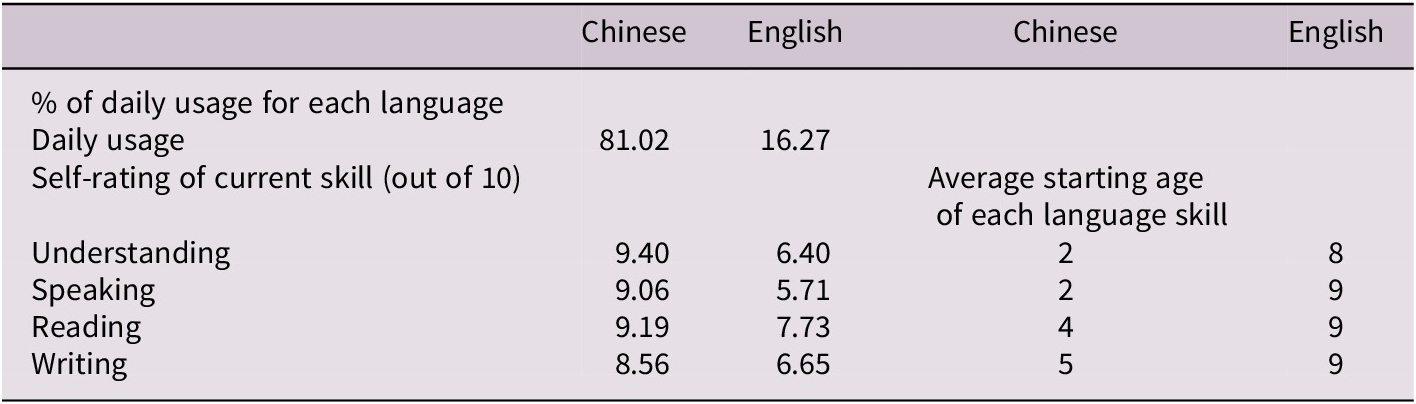
Eligibility criteria regarding English proficiency required participants either to have obtained an English score above 110 in the National College Entrance Examination or to have passed the College English Test Band 4 (CET-4). Thirty-four participants had passed CET-4, with a mean score of 579, whereas the remaining participants had obtained an average English score of 125 in the National College Entrance Examination. Data regarding participants’ self-ratings of daily language usage percentage and language proficiency skills (from 1 = none to 10 = very fluent) are presented in Table 1.
Language experience for Chinese–English bilingual participants

Table 1. Long description
The table summarizes background characteristics of the 52 Chinese-English bilingual participants included in the final analysis. It presents information about language experience, daily language use, and self-rated Chinese and English proficiency. Participants were Chinese-dominant bilinguals, with greater experience and proficiency in Chinese than English. These characteristics provide important context for interpreting cross-language differences in environmental word processing.
2.2. Materials
For the experimental stimuli, this study selected 70 Chinese and 70 English words, with half classified as “environmental protection words” and half as “environmental pollution words.” Thus, the final stimulus set included 35 environmental protection words and 35 environmental pollution words in each language. The preliminary norming experiment included an initial pool of 100 environmental protection words and 100 environmental pollution words in each language.
Thirteen unbalanced Chinese–English bilingual undergraduates from the foreign languages department who had passed CET-4 participated in the norming experiment. In the norming experiment, participants rated each word on two 7-point scales measuring environmental friendliness and familiarity. Environmental protection words were defined as terms describing actions, products, or practices that contribute to environmental protection, resource conservation, and ecological sustainability in everyday life. Environmental pollution words were defined as terms describing actions, products, or practices that cause environmental harm, resource depletion, or ecological damage in everyday life.
The final stimuli were selected to maximize the difference in perceived environmental friendliness between environmental protection and pollution words while keeping familiarity comparable across categories. In the norming study, Chinese environmental-protection words received significantly higher environmental-friendliness ratings (M = 6.14) than Chinese pollution words (M = 2.03), t(68) = 36.88, p < 0.001. However, no significant difference was found in familiarity ratings between the two categories of words (5.56 versus 5.51), t(68) = 0.193, p = 0.847, indicating that both categories of words were very familiar. In a comparable pattern, for the English environmental words, the environmental protection words demonstrated higher environmental-friendliness scores (M = 6.12) compared to environmental pollution words (M = 1.89), t(68) = 47.44, p < 0.001, but the familiarity ratings showed no significant difference (5.64 versus 5.48), t(68) = 0.623, p = 0.536, with both categories of words being very familiar. These findings demonstrate a difference in environmental friendliness between the two selected word categories, but no difference in familiarity. Importantly, the word selection methodology followed procedures used in previous research (Sherman & Clore, Reference Sherman and Clore2009; Yang et al., Reference Yang, Reid, Katz and Li2021; Yang & Yang, Reference Yang and Yang2025). The research protocol included administering a language experience questionnaire adapted from prior research (Pan & Jared, Reference Pan and Jared2021; Yang et al., Reference Yang, Reid and Mei2023). Detailed findings from the language history questionnaire are presented in Section 2.1. The complete list of Chinese and English environmental protection and pollution stimuli is provided in Appendix A.
To address the affective properties of the stimuli, an additional norming study was conducted with 18 Chinese university students who did not participate in the main experiment. They rated each target word on two 7-point scales measuring emotional valence and arousal. For emotional valence, higher scores indicated more positive affective evaluations (1 = very negative, 7 = very positive). For emotional arousal, higher scores indicated stronger affective activation (1 = very calm, 7 = very intense). Mean valence and arousal ratings were calculated for each item and were later entered into additional mixed-effects models as standardized continuous covariates. This additional norming procedure was included because environmental protection and pollution words may differ not only in environmental friendliness but also in affective valence and arousal.
2.3. Procedure
The experimental paradigm employed a 2 (Language: Chinese versus English) × 2 (Compatibility: compatible versus incompatible) × 2 (Environmental Type: environmental protection versus environmental pollution) mixed design, with Language and Environmental Type as within-subject variables, and Compatibility as a between-subject variable. Prior to experimental participation, participants received an information letter explaining the study and provided verbal informed consent. Participants performed a word-categorization task in which they classified onscreen words as either “environmental protection” or “environmental pollution” as quickly and accurately as possible. The definitions of environmental protection and environmental pollution were identical to those used in the norming procedure. Response latency and accuracy were recorded by E-Prime and served as the dependent measures.
At the start of each experimental trial, the word “Ready” appeared in the center of the screen. Participants pressed the top button on the joystick with their right hand to initiate the trial. Then a fixation cross “+” was displayed for 1,600-1,800 ms before the environmental word was presented. This random fixation duration was used to reduce anticipation of the environmental word. When the word appeared, participants responded by pushing the joystick forward or backward. In the compatible condition, environmental protection word presentation required participants to push the joystick forward, whereas environmental pollution word presentation required participants to push the joystick backward. The response pattern was reversed in the incompatible condition. The environmental word presentation sequence within blocks was randomized. The joystick movement directions are illustrated in Figure 1, showing the setup for forward/backward joystick movements in this experiment.
Illustration of the experimental setup: joystick orientation for horizontal movements.

Figure 1. Long description
The figure illustrates the experimental response setup used in the action compatibility task. Participants categorized environmental words by moving a joystick forward or backward with their right hand. A forward movement refers to pushing the joystick away from the body, whereas a backward movement refers to pulling the joystick toward the body. In the compatible condition, environmental protection words were paired with forward movements and environmental pollution words were paired with backward movements. In the incompatible condition, these mappings were reversed. The figure visually demonstrates how spatial movement direction was linked to environmental concept processing.
Participants were evenly divided into two groups, with half assigned to the compatible condition and half to the incompatible condition. Since Chinese was the participants’ dominant language, all experimental sessions began with Chinese blocks followed by English blocks. Each participant completed two experimental blocks sequentially: first the Chinese block (either compatible or incompatible) and then the English block (maintaining the same compatibility condition). This design reduced frequent language switching and helped maintain a stable task context within each language, which may have minimized switching-related cognitive demands. However, because language order was not counterbalanced, the overall main effect of Language should be interpreted cautiously, as it may reflect both language dominance and potential order-related effects. The experimental phase lasted approximately 10-20 min in total. Upon completion, participants responded to a language experience questionnaire evaluating Chinese and English proficiency, which took approximately 5-10 min. The complete experimental session spanned approximately 15-30 min.
2.4. Corpus-based co-occurrence analysis
To examine whether the behavioral action compatibility effect could be partly explained by local lexical co-occurrence, we conducted an exploratory corpus-based KWIC analysis using the 2020 300 K-sentence Chinese and English news corpora from the Leipzig Corpora Collection (Goldhahn et al., Reference Goldhahn, Eckart and Quasthoff2012). This analysis was exploratory and was intended to examine whether local lexical-distributional experience could provide an alternative or complementary explanation for any observed action compatibility effect. These corpora were selected for three reasons. First, the Leipzig Corpora Collection provides corpora across languages with relatively comparable formats and corpus sizes, facilitating bilingual Chinese-English comparisons. Second, the 300 K-sentence news corpora offer a sufficiently large amount of naturally occurring public discourse for examining environmental and climate-related expressions while remaining feasible for manual inspection and reproducible analysis. Third, news discourse represents an important domain for examining environmental and pollution-related expressions because environmental issues are frequently represented and discussed in public communication.
For the corpus analysis, we used the same 70 Chinese and 70 English environmental words selected for the formal experiment, with each language containing 35 environmental protection words and 35 environmental pollution words. The Chinese corpus was first segmented using Jieba in Python with a custom user dictionary based on the 70 Chinese target words, ensuring that multi-character terms such as “碳中和” and “生态破坏” were treated as single lexical units. English tokenization was conducted using a custom Python script that preserved multi-word and hyphenated expressions, such as environmental protection and non-renewable. All subsequent KWIC extraction and co-occurrence counting were conducted using Python.
For each occurrence of a target environmental word or phrase, we extracted up to 10 tokens to the left and right, without crossing punctuation boundaries. The forward-related word lists included directional and progress-related terms such as “推进,” “迈向,” forward, and progress, whereas the backward-related lists included terms such as “滞后,” “退化,” backward, and fall behind. The analysis was conducted separately for environmental protection and pollution words in Chinese and English. Fisher’s exact tests were then used to compare the proportion of forward- and backward-related KWIC lines between environmental protection and environmental pollution words within each language.
2.5. Statistical analysis
Before model fitting, categorical predictors were coded using sum-to-zero contrasts (−1, 1) rather than R’s default treatment contrasts (Levy, Reference Levy2014; Singmann & Kellen, Reference Singmann, Kellen, Spieler and Schumacher2019). All analyses were conducted in R version 4.3.3. Trial-level response latencies and accuracy were analyzed using mixed-effects models that accounted for variability associated with both participants and items (Bates et al., Reference Bates, Mächler, Bolker and Walker2015; Lo & Andrews, Reference Lo and Andrews2015). Response latencies were log-transformed to reduce right skew and were analyzed using linear mixed-effects models fitted with the lmer function in the lme4 package (Baayen & Milin, Reference Baayen and Milin2010; Bates et al., Reference Bates, Mächler, Bolker and Walker2015). Fixed-effect significance tests were obtained using the Satterthwaite approximation implemented in the lmerTest package (Kuznetsova et al., Reference Kuznetsova, Brockhoff and Christensen2017). Accuracy data were analyzed using generalized linear mixed-effects models fitted with the glmer function in lme4, with a binomial distribution and a logit link function (Bates et al., Reference Bates, Mächler, Bolker and Walker2015). In additional sensitivity analyses, item-level emotional valence and arousal ratings were standardized and entered as continuous covariates to examine whether the principal response-time and accuracy effects remained after accounting for the affective properties of the stimuli. The R code for all models is provided in Appendix B.
3. Results
3.1. Corpus-based co-occurrence results
The corpus-based analysis showed that forward/backward co-occurrences were generally rare, as shown in Table 2. In the Chinese corpus, environmental protection words occurred in 961 KWIC lines. Among these, 20 lines contained a forward-related word and two contained a backward-related word. Environmental pollution words occurred in 1,706 KWIC lines, with 11 forward-related co-occurrences and two backward-related co-occurrences. A similar numerical pattern was observed in English. Environmental protection words occurred in 377 KWIC lines, of which eight contained a forward-related word and one contained a backward-related word. Environmental pollution words occurred in 433 KWIC lines, of which four contained a forward-related word and none contained a backward-related word. Overall, environmental protection words showed a slightly higher rate of forward-related co-occurrence than environmental pollution words in both Chinese and English. However, backward-related co-occurrences were extremely rare in both languages. This pattern suggests that lexical-distributional experience may contribute to spatial-environmental associations, especially for environmental protection words, but the corpus data do not provide strong evidence that pollution words are consistently associated with backward-related vocabulary.
Corpus-based KWIC co-occurrence analysis of forward- and backward-related words

Table 2. Long description
The table presents corpus-based co-occurrence patterns between environmental concepts and directional vocabulary in Chinese and English news corpora. It summarizes keyword-in-context (KWIC) frequencies and forward- and backward-related co-occurrences for environmental protection and pollution words. Overall, forward-related associations were more frequent than backward-related associations, particularly for environmental protection words in Chinese, whereas backward-related co-occurrences were rare across languages and categories.
Fisher’s exact tests were conducted separately for forward- and backward-related co-occurrences in each language. In Chinese, environmental protection words were significantly more likely than environmental pollution words to co-occur with forward-related vocabulary, OR = 3.27, 95% CI [1.49, 7.60], p = 0.002. The corresponding backward-related comparison was not significant, OR = 1.78, 95% CI [0.13, 24.55], p = 0.623. In English, the forward-related comparison showed the same numerical direction but did not reach significance, OR = 2.32, 95% CI [0.62, 10.63], p = 0.243. The backward-related comparison was also not significant, p = 0.465. Because one cell contained zero observations and the total number of backward-related co-occurrences was extremely small, this estimate should not be interpreted substantively.
3.2. Experimental results
For the latency analysis, response times less than 300 ms or greater than 5,000 ms, response times that were more than three standard deviations from the participant’s mean latency, and incorrect responses (totaling 12.2% of the data) were excluded from the latency analyses. The implementation of a high upper latency threshold was necessitated by the extended duration characteristic of joystick movements. Table 3 presents the mean word-categorization response times and error rates with standard deviations.
Mean lexical decision latencies (ms) and error rates (%) by language version, environmental type, and compatibility condition
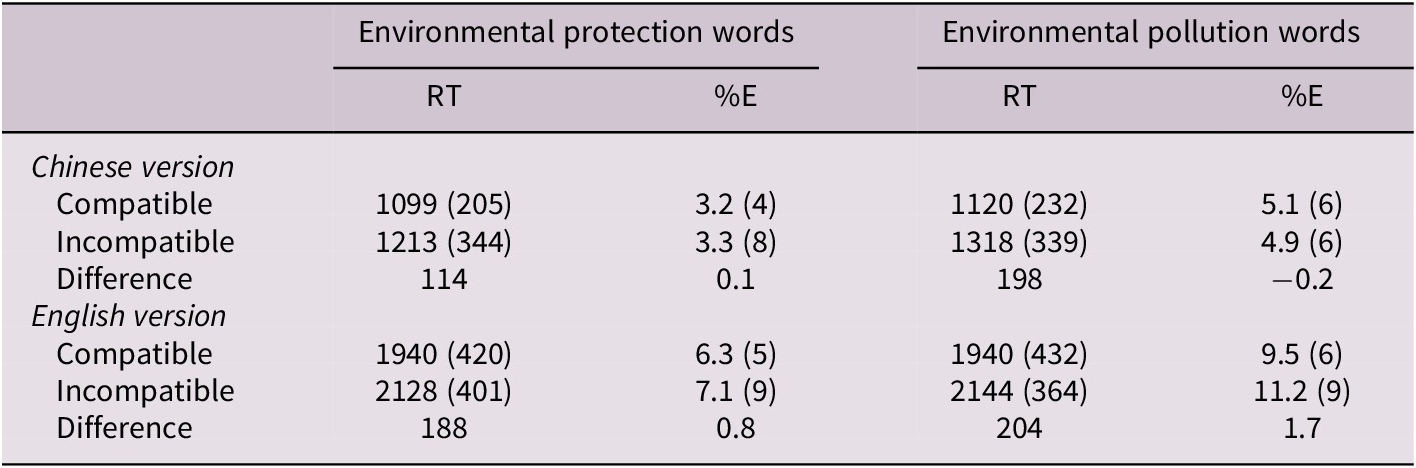
Table 3. Long description
The table presents descriptive behavioral results from the word categorization task. It includes mean response times, standard deviations, and error rates across language, environmental category, and compatibility conditions. The table shows the behavioral pattern underlying the statistical analyses, including faster responses for Chinese words than English words and faster responses in compatible than incompatible response mappings.
3.2.1. Latency analysis
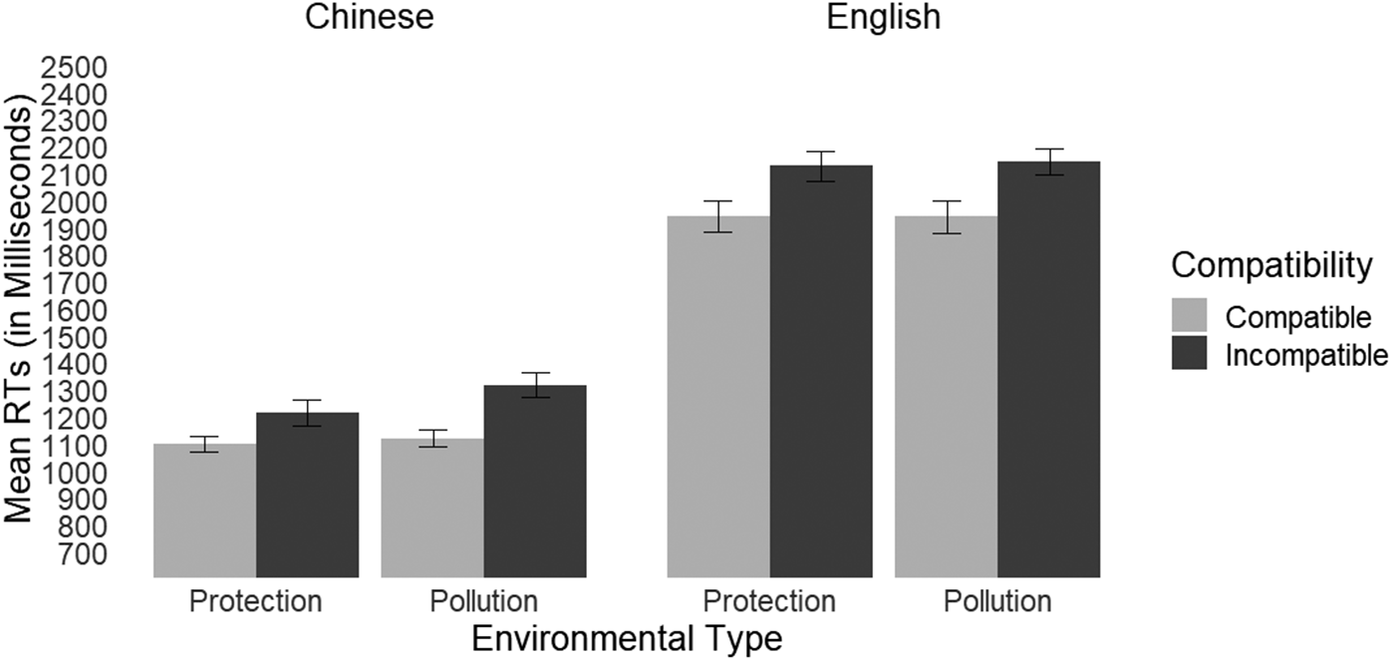
The logRT analysis revealed a significant main effect of Language, β = −0.290, SE = 0.017, t = −17.190, p < 0.001, indicating that Chinese words were overall categorized faster by Chinese-English bilinguals than English words. The main effect of Compatibility was also significant, β = −0.049, SE = 0.023, t = −2.126, p = 0.039, indicating that responses were faster in the compatible condition than in the incompatible condition. However, the main effect of Environmental Type was not significant, β = 0.019, SE = 0.017, t = 1.130, p = 0.261.
For the interaction effects, the Environmental Type by Compatibility interaction showed a marginal trend but did not reach conventional significance, β = −0.008, SE = 0.004, t = −1.841, p = 0.066. The Environmental Type by Language interaction was not significant, β = 0.010, SE = 0.017, t = 0.568, p = 0.571. The Compatibility by Language interaction was also not significant, β = 0.002, SE = 0.004, t = 0.534, p = 0.593. The three-way interaction among Environmental Type, Compatibility, and Language was not significant, β = −0.006, SE = 0.004, t = −1.285, p = 0.199, indicating that the Environmental Type by Compatibility interaction did not reliably differ across languages. The mean response latencies under different experimental conditions are presented in Figure 2.
Mean response times (ms) across experimental conditions. Note: Error bars represent standard error of the mean.
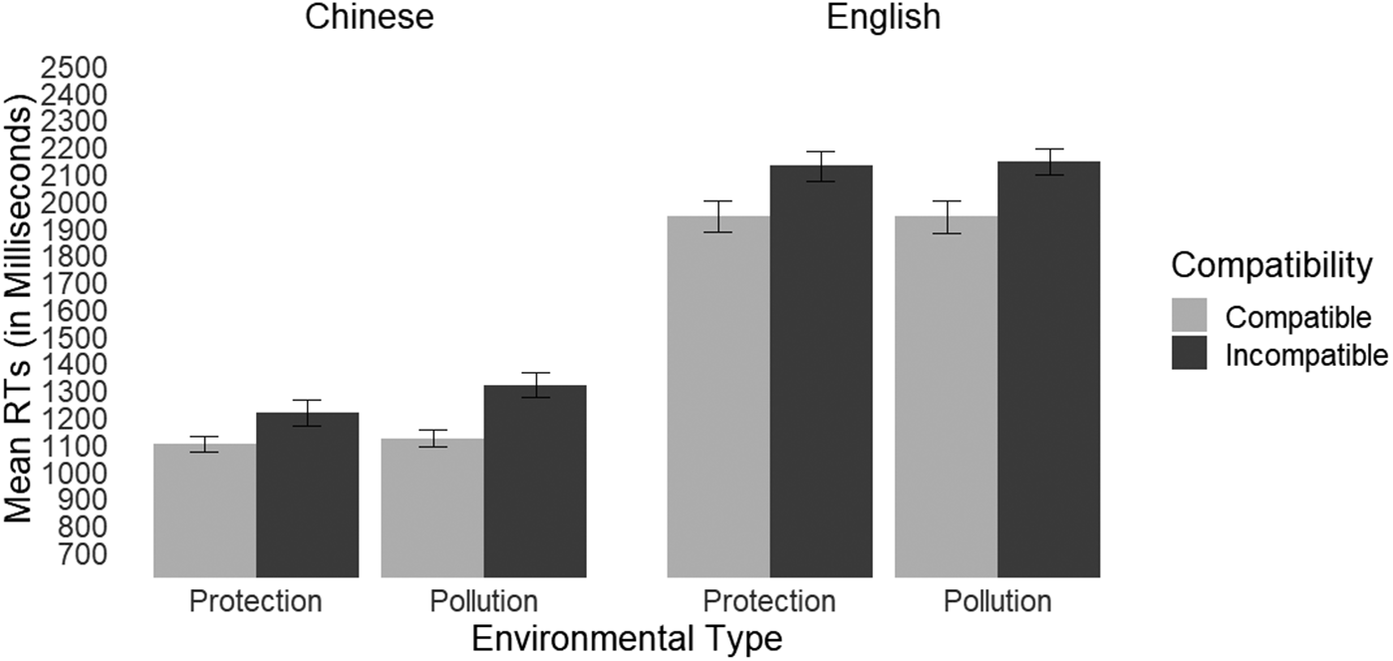
Figure 2. Long description
The figure presents mean response latencies for environmental word categorization across Chinese and English languages, environmental protection and pollution categories, and compatible versus incompatible response conditions. The horizontal axis represents the experimental conditions, and the vertical axis represents mean response latency in milliseconds, with lower values indicating faster responses. Chinese words are processed faster than English words overall. Compatible mappings show shorter response times than incompatible mappings. The overall pattern indicates an action compatibility advantage in environmental concept processing.
3.2.2. Accuracy analysis
Accuracy was analyzed using a generalized linear mixed-effects model. There were significant main effects of Language (z = 3.239, p = 0.001) and Environmental Type (z = −2.504, p = 0.012), indicating that accuracy was lower for English words than for Chinese words and lower for environmental pollution words than for environmental protection words. However, the main effect of Compatibility was not significant, β = 0.037, SE = 0.121, z = 0.307, p = 0.758.
Importantly, none of the interaction effects reached significance. The interaction between Environmental Type and Compatibility was not significant, β≈ 0.000, SE = 0.053, z = −0.004, p = 0.997. In addition, the interaction between Environmental Type and Language was not significant, β = 0.043, SE = 0.112, z = 0.389, p = 0.698. The interaction between Compatibility and Language was also not significant, β = −0.049, SE = 0.053, z = −0.937, p = 0.349. The three-way interaction among Environmental Type, Compatibility and Language was not significant, β = −0.015, SE = 0.053, z = −0.285, p = 0.775.
3.2.3. Additional analyses controlling for emotional valence and arousal
To examine whether the compatibility effect could be attributed to affective properties of the stimuli, we conducted additional control analyses including emotional valence and arousal as covariates. Mean valence and arousal scores were calculated for each target word, merged with the trial-level behavioral data, standardized, and entered into the mixed-effects models as continuous covariates. These analyses allowed us to assess whether the response-compatibility pattern persisted after accounting for emotional valence and arousal.
After controlling for emotional valence and arousal, the logRT analysis revealed a significant main effect of Language, β = −0.290, SE = 0.017, t = −17.506, p < 0.001, indicating that Chinese words were overall categorized faster than English words. The main effect of Compatibility was also significant, β = −0.049, SE = 0.023, t = −2.125, p = 0.039. However, the main effect of Environmental Type was not significant, β = −0.043, SE = 0.063, t = −0.686, p = 0.494. The two affective covariates were both significant. Valence significantly predicted logRT, β = −0.134, SE = 0.064, t = −2.113, p = 0.036, and arousal also significantly predicted logRT, β = −0.076, SE = 0.036, t = −2.114, p = 0.036. These results suggest that words with more positive valence and higher arousal were associated with shorter response latencies.
For the interaction effects, the Environmental Type by Compatibility interaction showed a marginal trend but did not reach conventional significance, β = −0.008, SE = 0.004, t = −1.841, p = 0.066. The Environmental Type by Language interaction was not significant, β = 0.007, SE = 0.017, t = 0.402, p = 0.688. The Compatibility by Language interaction was also not significant, β = 0.002, SE = 0.004, t = 0.532, p = 0.595. The three-way interaction among Environmental Type, Compatibility, and Language was not significant, β = −0.006, SE = 0.004, t = −1.283, p = 0.200. Overall, the pattern of the Compatibility effect remained after controlling for emotional valence and arousal.
After controlling for emotional valence and arousal, the accuracy analysis showed a significant main effect of Language (β = 0.373, SE = 0.109, z = 3.409, p = 0.001) and a significant effect of arousal (β = 0.593, SE = 0.235, z = 2.525, p = 0.012). The main effects of Environmental Type (β = −0.407, SE = 0.395, z = −1.031, p = 0.303), Compatibility (β = 0.037, SE = 0.121, z = 0.307, p = 0.759), and valence (β = 0.408, SE = 0.420, z = 0.971, p = 0.331) were not significant.
None of the interaction effects reached significance. The Environmental Type by Compatibility interaction was not significant, β ≈ 0.000, SE = 0.053, z = −0.003, p = 0.998. The Environmental Type by Language interaction was not significant, β = 0.067, SE = 0.110, z = 0.607, p = 0.544. The Compatibility by Language interaction was also not significant, β = −0.049, SE = 0.053, z = −0.933, p = 0.351. The three-way interaction among Environmental Type, Compatibility, and Language was not significant, β = −0.015, SE = 0.053, z = −0.287, p = 0.774. Taken together, the additional analyses showed that valence and arousal significantly predicted response speed, and arousal additionally predicted accuracy. Controlling for these affective variables did not substantially change the overall response-time pattern.
4. Discussion
The present study investigated whether Chinese-English bilinguals show forward/backward action compatibility effects when processing environmental protection and pollution words in L1 (Chinese) and L2 (English). The results revealed several key findings: first, participants responded faster in the compatible mapping condition than in the incompatible mapping condition. This significant main effect of Compatibility indicates an overall compatibility advantage: mappings between environmental protection words and forward movements, and between environmental pollution words and backward movements, were processed more efficiently overall than the reversed mappings. Second, Chinese environmental words were categorized faster and more accurately than English environmental words, indicating a clear L1 processing advantage. Third, despite the L1 processing advantage, the compatibility pattern appeared broadly similar across Chinese and English in this bilingual group. Importantly, the action compatibility effect remained significant after controlling for emotional valence and arousal, suggesting that it could not be fully explained by the measured affective properties of the stimuli. Overall, these findings suggest that environmental word processing may involve contributions from spatial-environmental associations, affective evaluation, and bilingual lexical processing, rather than reflecting a purely metaphorical mapping alone.
The compatibility effect is broadly consistent with embodied accounts of conceptual processing, according to which abstract concepts can be partially structured through concrete spatial and bodily experience (Barsalou, Reference Barsalou1999, Reference Barsalou2008, Reference Barsalou2020; Gibbs, Reference Gibbs2012; Lakoff & Johnson, Reference Lakoff and Johnson1980). In the present study, participants showed faster categorization of environmental pollution words when responses involved backward joystick movements compared to forward joystick movements. This finding is compatible with a spatial association between environmental pollution concepts and backward movement, which may be related to metaphorical framing of environmental degradation as regression or retreat. However, this pattern should not be taken as evidence that the effect is exclusively metaphorical in origin. Prior research has demonstrated similar action compatibility effects for failure words (Robinson & Fetterman, Reference Robinson and Fetterman2015), powerless words (Yang et al., Reference Yang, Reid, Katz and Li2021), and immoral words (Yang & Yang, Reference Yang and Yang2025), where backward-compatible responses were associated with faster processing of negative abstract concepts. Pollution, as a threat to human health and ecological well-being, may activate avoidance-related tendencies that are compatible with backward responses. This pattern is also consistent with negativity bias, according to which animals and humans give greater weight to negative entities than to equivalent positive ones, manifested in negative potency, steeper negative gradients, negativity dominance, and negative differentiation (Rozin & Royzman, Reference Rozin and Royzman2001).
Second, participants demonstrated slightly faster categorization of environmental protection words when responses involved forward joystick movements compared to backward joystick movements, and this finding nevertheless aligns with the conceptual metaphor of Environmental Protection Is Moving Forward. This aspect of the compatibility effect is consistent with the possibility that environmental protection concepts are associated with forward movement, progress, and goal-directed action. This mapping makes intuitive sense, as environmental protection represents positive progress toward sustainability goals. Theoretically, this finding is consistent with the Source-Path-Goal schema (Forceville & Jeulink, Reference Forceville and Jeulink2011; Johnson, Reference Johnson1987), in which goal-directed behavior is structured as forward movement along a path. Environmental protection requires ongoing, directed effort that maps well onto a forward trajectory. To further support this interpretation, there are several English expressions of environmental protection described using forward language, such as “advancing green initiatives” and “moving towards a sustainable future.” These examples provide ecological validity to the experimental finding linking environmental protection concepts to forward movements. However, they should be interpreted as discourse-based motivation rather than direct evidence for an automatic or universal conceptual metaphor, because environmental concepts are strongly evaluative and discourse-dependent.
The additional analyses controlling for emotional valence and arousal were included because these two dimensions of affective meaning have distinct and interactive influences on word processing, with evidence that emotionally valenced words generally show processing advantages over neutral words (Kousta et al., Reference Kousta, Vinson and Vigliocco2009). In the present study, the main effect of Compatibility remained significant after valence and arousal were entered as covariates, suggesting that the overall compatibility advantage was not fully accounted for by these affective variables. At the same time, both valence and arousal significantly predicted response latencies, indicating that affective properties contributed to the processing of environmental words. Therefore, the present findings do not support a purely metaphorical interpretation independent of affect. Rather, they suggest that action compatibility effects in environmental word processing may reflect not only metaphorical mappings but also affective evaluation. This possibility is broadly consistent with previous work linking affective valence to approach-avoidance tendencies and spatial-distance representations (e.g., Iachini et al., Reference Iachini, Pagliaro and Ruggiero2015; Wu et al., Reference Wu, Wang, He, Tian, Zhao and Chen2019). Thus, valence and arousal should be treated not merely as control variables but as theoretically meaningful components of environmental word processing.
To examine whether the behavioral compatibility effect might reflect distributional regularities in language use, we conducted a corpus-based co-occurrence analysis. According to Goldberg (Reference Goldberg2019), lexical and constructional knowledge emerges from accumulated experience with repeated usage events. In the 2020 Chinese and English news corpora from the Leipzig Corpora Collection (Goldhahn et al., Reference Goldhahn, Eckart and Quasthoff2012), forward- and backward-related co-occurrences were generally rare. Chinese environmental protection words were significantly more likely than pollution words to co-occur with forward-related vocabulary, whereas the same numerical tendency in English did not reach significance. By contrast, backward-related co-occurrences were extremely rare in both languages. Overall, the corpus analysis suggests that language experience may contribute to the observed action compatibility effect, especially for the protection-forward association in Chinese. However, the available co-occurrence evidence is not sufficient to explain the full behavioral pattern by local lexical association alone, particularly because backward-related co-occurrences were rare even though pollution words showed a numerical backward-compatible tendency.
Environmental protection and pollution should also be understood as discourse-framed concepts rather than purely neutral abstract concepts. Metaphor in discourse not only provides a source-domain structure for abstract thought but also frames social issues by highlighting some aspects of reality while backgrounding others (Flusberg et al., Reference Flusberg, Matlock and Thibodeau2017; Nerlich & Koteyko, Reference Nerlich and Koteyko2009; Semino, Reference Semino2008). Previous research has shown that climate-change and environmental issues are often structured through metaphorical, visual, and evaluative frames, including war, race, risk, and hourglass frames (Dancygier, Reference Dancygier2023; DiFrancesco & Young, Reference DiFrancesco and Young2011; Flusberg et al., Reference Flusberg, Matlock and Thibodeau2017; Pan et al., Reference Pan, Opgenhaffen and Van Gorp2019; Shaw & Nerlich, Reference Shaw and Nerlich2015). Accordingly, the present findings should not be interpreted as demonstrating a universal or context-independent mapping between environmental concepts and forward/backward space. Instead, they indicate that, in the present Chinese-English bilingual sample, environmental words were processed in a way that was compatible with spatial, evaluative, and discourse-based associations available in contemporary environmental communication. This cautious interpretation is warranted by evidence that action compatibility effects are sensitive to task conditions and experimental settings. Specifically, the effect emerges only when participants can prepare their motor responses during sentence processing (Borreggine & Kaschak, Reference Borreggine and Kaschak2006), whereas Morey et al. (Reference Morey, Kaschak, Díez-Álamo, Glenberg, Zwaan, Lakens, Ibáñez, García, Gianelli, Jones, Madden, Alifano, Bergen, Bloxsom, Bub, Cai, Chartier, Chatterjee, Conwell and Ziv-Crispel2022) failed to obtain reliable evidence for the effect across 18 participating laboratories.
Turning to the cross-linguistic results, Chinese environmental words were processed faster than English environmental words. The processing advantage for L1 Chinese words compared to L2 English words is unsurprising, given the unbalanced nature of the Chinese-English bilinguals’ language proficiency. Previous research with Chinese-English bilinguals has found slower overall categorization of L2 English words than of L1 Chinese words (Yang & Yang, Reference Yang and Yang2025). Moreover, the L1 processing advantage is consistent with bilingual lexical-processing models such as the RHM (Kroll & Stewart, Reference Kroll and Stewart1994) and the BIA+ model (Dijkstra & Van Heuven, Reference Dijkstra and Van Heuven2002). The RHM (Kroll & Stewart, Reference Kroll and Stewart1994) suggests that bilinguals possess separate lexicons for their two languages, characterized by stronger connections between L1 words and the conceptual system in comparison to L2 words. These weaker links may contribute to less efficient lexical access in L2 relative to L1. According to the BIA+ model, bilingual word recognition involves language non-selective access, with lexical candidates from both languages activated in parallel according to their similarity to the input and their resting-level activation (Dijkstra & Van Heuven, Reference Dijkstra and Van Heuven2002). Because L2 words generally receive less frequent exposure and lower activation levels than L1 words, they may be accessed less efficiently (Dijkstra & Van Heuven, Reference Dijkstra and Van Heuven2002). Taken together, the RHM and BIA+ models provide a theoretical framework for understanding the faster processing of L1 environmental words observed here.
More importantly, the action compatibility effect pattern was broadly similar across Chinese and English in the present bilingual group. This finding is consistent with previous evidence that Chinese-English bilinguals may activate conceptual metaphor mappings in both L1 and L2 (Yang et al., Reference Yang, Reid and Mei2023). Nevertheless, because all participants were Chinese-dominant bilinguals, the cross-linguistic similarity should not be taken as evidence for a universal mapping. It may partly reflect influences from L1 conceptual knowledge and exposure to Chinese environmental discourse frames, shared sociocultural experience, or comparable exposure to environmental discourse across the two languages.
Several limitations should be noted. First, the present study focused on Chinese-English bilinguals from one university. This relatively homogeneous sample allowed us to control participants’ language background, but future studies could test more diverse bilingual groups to examine whether the present pattern generalizes across different L1 backgrounds and environmental discourse contexts. Second, although we controlled for valence and arousal and added a corpus-based co-occurrence analysis, the present study cannot fully separate the contributions of spatial metaphor, affective evaluation, and distributional language experience. Future studies using larger corpora or distributional semantic methods could further clarify how environmental-spatial associations are represented in language use. Third, the present study examined forward/backward movements at the behavioral level. Future research could extend this design to time-sensitive measures such as ERPs to further investigate the temporal dynamics of environmental-spatial associations. Fourth, the language order was fixed, with Chinese blocks always preceding English blocks. Although this design reduced language switching, future studies should counterbalance language order to distinguish language dominance effects from possible order-related effects.
5. Conclusion
The present study investigated forward/backward action compatibility effects in Chinese-English bilinguals’ processing of environmental concepts. The results showed a significant overall compatibility advantage and an overall L1 processing advantage. However, the compatibility pattern did not significantly differ between Chinese and English, suggesting broadly similar forward/backward spatial associations across the two languages in this bilingual group. Importantly, the overall compatibility advantage remained after controlling for emotional valence and arousal, but affective variables and corpus-based co-occurrence patterns also contributed to the interpretation. Therefore, the findings should not be attributed to conceptual metaphor alone. Instead, environmental word processing appears to reflect the combined influence of spatial associations, affective evaluation, and distributional language experience, within broader environmental discourse contexts.
Data availability statement
The complete list of experimental stimuli and the R analysis code are provided in Appendices A and B, respectively. The anonymized data and statistical outputs are publicly available on Zenodo at https://doi.org/10.5281/zenodo.21387500. Further information may be obtained from the corresponding author upon reasonable request.
Competing interests
The authors declare no relevant financial or non-financial interests to disclose.
Ethics statement
This study was reviewed and approved by the School of Foreign Languages at Zhejiang Gongshang University. The study was conducted in accordance with the ethical principles of the American Psychological Association (APA, 2017). All participants provided informed consent before participation.
Appendix A
Experimental stimuli for environmental protection and pollution words

Table A1. Long description
The table is organized into four columns. The first two columns are under the header English, and the next two are under the header Chinese.
Column 1: English Protection words. Terms include Recycling, Environmental protection, Low-carbon lifestyles, Garbage classification, Sustainable energy, Sustainable consumption, Renewable energy, Ecological conservation, Conserve water, Ecological balance, Wind power, Degradable material, Low energy consumption, Clean energy, Public transport, Energy saving, Green energy, Energy conservation, Solar power, Electric vehicles, Zero emission, Emissions reduction, Greenery, Decarbonization, Wetlands restoration, Afforestation, Farmland management, New energy, Solar farm, Water resource management, Carbon capture technology, Ecological agricultural practices, Carbon neutrality, Energy-efficient light, and Bio-energy.
Column 2: English Pollution words. Terms include Species extinction, Air pollution, Drinking water contamination, Overfishing, Nuclear waste, Nuclear pollution, Water pollution, Resource depletion, Deforestation, Marine pollution, Plastic pollution, Over-exploitation, Habitat destruction, Energy crisis, Biodiversity loss, Deterioration of ground waters, Industrial waste, Disposable, Land pollution, Ecological destruction, Greenhouse gas emissions, Ozone layer depletion, Waste production, Non-renewable, Soil degradation, Overgraze, Ocean acidification, Deterioration of coastal, Light pollution, Acid rain, Fossil fuel production, Soil erosion, Climate change, Extravagance, and Over-consumption.
Column 3: Chinese Protection words. Terms include 节约能源, 植树造林, 循环利用, 生物多样性, 环保, 节能, 可再生, 可持续, 低碳, 节电, 可降解, 绿色能源, 新能源, 减排, 可回收, 节约用水, 清洁能源, 环卫, 垃圾分类, 恢复湿地, 太阳能, 绿色交通, 清洁技术, 零排放, 电动汽车, 光伏电站, 碳中和, 生态农业, 水能发电, 天然气, 风力发电, 生物能源, 脱碳, 除尘, and 碳抵消.
Column 4: Chinese Pollution words. Terms include 海洋污染, 物种灭绝, 资源枯竭, 水污染, 空气污染, 生态破坏, 森林砍伐, 核污染, 过度开发, 污染, 污水, 过度捕捞, 土壤退化, 过度放牧, 高耗能, 土地污染, 不可再生, 一次性, 能源危机, 海岸退化, 浪费, 塑料, 土壤侵蚀, 光污染, 化石燃料, 露天采矿, 废料, 全球变暖, 废气, 酸雨, 浑浊, 过度消费, 污泥, 烟尘, and 气候变化.
Appendix B
R analysis code for behavioral data
#Analysis code for RT test.
library(lme4).
library(lmtest).
getOption(“contrasts”).
options(contrasts = c(“contr.sum,”“contr.poly”)).
RTmodel = lmer (logRT ~ Environmental Type * Compatibility * Language + (1 |Subject) + (1 |Item), data = Cleaned data).
# Analysis code for additional RT analyses controlling for emotional valence and arousal.
RTmodel = lmer (logRT ~ Environmental Type * Compatibility * Language + valence_z + arousal_z + (1 |Subject) + (1 |Item), data = Cleaned data).
# Analysis code for accuracy rate test.
Accuracy = glmer (accuracy ~ Environmental Type * Compatibility * Language + (1 |Subject) + (1 |Item), data = rawdata, family = “binomial,” control = glmerControl(optimizer = “bobyqa,” optCtrl = list(maxfun = 1e6))).
# Analysis code for additional accuracy rate analyses controlling for emotional valence and arousal.
Accuracy = glmer (accuracy ~ Environmental Type * Compatibility * Language + valence_z + arousal_z + (1 |Subject) + (1 |Item), data = rawdata, family = “binomial,” control = glmerControl(optimizer = “bobyqa,” optCtrl = list(maxfun = 1e6))).




 Open access

