

1. JOYCE'S ARGUMENT FOR PROBABILISM
Let  ${\cal F} $ be the set of propositions about which an agent has an opinion. Throughout this paper, I will assume that
 ${\cal F} $ is a finite, full algebra. Represent our agent's credal state at a given time by her credence function: this is a function from
 ${\cal F} $ to [0, 1] that takes a proposition and returns a measure of her credence in that proposition at that time. In the presence of that representation, Probabilism is the following normative claim:
(Prob) At any time, an agent ought to have a credence function that is a probability function.
Joyce's argument for (Prob) contends that, for any possible world, we may assign an epistemic utility to an agent's credence function relative to that world. This epistemic utility is a measure of the purely epistemic goodness of being in such a credal state at that world. Having done this, we may derive norms that govern credal states by appealing to this epistemic utility function together with standard norms of utility theory. Joyce derives (Prob). Here is the argument in detail:
(1) The Brier score measures epistemic utility
The epistemic utility of a credence function at a possible world is a measure of how ‘close’ that credence function is to the ‘ideal’ (or ‘perfect’ or ‘vindicated’) credence function at that world.
(a) The ideal credence atw isv w
Given a possible world w, the ‘ideal’ credence function at that world is the one that assigns maximal credence (i.e. 1) to propositions that are true at w and minimal credence (i.e. 0) to propositions that are false at w. Call this credence function v w. So
 $$v_w \lpar A\rpar :=\left\{{\matrix{ 0 & {\; {\rm if}\; A\; {\rm is}\; {\rm false}\; {\rm at}\; w} \cr 1 & {\; {\rm if}\; A\; {\rm is}\; {\rm true}\; {\rm at}\; w} \cr } } \right.$$
(b) ‘Distance’ is the sum of squared differences
The ‘distance’ between two credence functions b and b′ is given by the sum over the propositions on which they are defined of the squares of the differences between the credence assigned by b to that proposition and the credence assigned by b′. That is:
$$D\lpar b\comma \; b^{\prime}\rpar =\sum\limits_{A \in {\cal F}} \, \lpar b\lpar A\rpar - b^{\prime}\lpar A\rpar \rpar ^2$$
Putting (a) and (b) together, the epistemic utility of credence function b at world w is
$$B\lpar b\comma \; w\rpar :=1 - D\lpar b\comma \; v_w \rpar =1 - \sum\limits_{A \in {\cal F}} \, \lpar b\lpar A\rpar - v_w \lpar A\rpar \rpar ^2$$This function is called the Brier score.
(In fact, Joyce allows that other epistemic utility functions may be acceptable. But all purport to measure ‘closeness’ to v w. In the interests of clarity, in the main body of this paper, we restrict attention to Brier score B. However, in Section 6, we explain how the results we obtain in fact hold for a large range of alternative measures of ‘closeness’ to v w.)
(2) Dominance
This is a norm of standard utility theory.
Suppose
${\cal A} $ is the set of possible actions between which an agent must choose.Definition 1 (Dominance)If a, a′ in
${\cal A} $then we say that a is dominated by a′ if a′ has greater utility than a at every possible world.Now suppose a, a′ in
${\cal A} $ and(i) a is dominated a′; and
(ii) a′ is not dominated by any a′′ in
${\cal A} $.
Then the agent ought not to choose a.
(3) Theorem 1 (de Finetti, Joyce Footnote 1)
(I) If b is a credence function that violates (Prob), there is a credence function c that satisfies (Prob) such that B(b, w) < B(c, w) for all worlds w.
(II) If c is a credence function that satisfies (Prob), there is no credence function b such that B(c, w) < B(b, w) for all worlds w.
Putting these together, we have (Prob).





Thus, for Joyce, an agent ought to satisfy (Prob) because: if she doesn't, there is a probabilistic credence function that is closer to matching the truth than hers no matter which possible world she inhabits; whereas, if she does, there is no credence function that is closer to matching the truth than hers no matter which possible world she inhabits.
2. LEWIS'S PRINCIPAL PRINCIPLE
In the light of Joyce's argument, the question naturally arises: Which other norms that govern credence functions might we justify by appealing to considerations of epistemic utility? In an earlier paper (Pettigrew Reference Pettigrew2012), I argued that such considerations tell in favour of some suitable version of David Lewis′s Principal Principle, which says how an agent's credences in propositions concerning the objective chances ought to relate to her credences in other propositions (Lewis Reference Lewis and Jeffrey1980). To state this norm, we need a little notation:
• Given a possible world w, the ur-chance function at w (written ch w) is the probability function on which one conditionalizes with the history of w up to time t in order to obtain the chance function of w at t. That is, if the history of w up to t is H tw, then ch w (· | H tw) is the chance function of w at time t.Footnote 2
• Let
${\cal W} $ be the set of possible worlds and let ${\cal C} $ be the set of possible ur-chance functions. Thus, ${\cal C}=\lcub ch_w\, \colon\, w \in {\cal W}\rcub $. For the sake of simplicity, we assume that ${\cal W} $, and thus ${\cal C} $, is finite.• Given a probability function
$ch\,\colon\, {\cal F} \to \lsqb 0\comma \; 1\rsqb $, let C ch be the proposition The ur-chances are given by ch. Thus, C ch is true at w iff ch w = ch. We assume C ch is in ${\cal F} $, for all ch.







With this in hand, we can state Lewis′s Principal Principle:
(PP) An agent with evidence E ought to have a credence function b such that
 $$b\lpar A\vert C_{ch} \rpar =ch\lpar A\vert E\rpar$$
for all propositions A in  ${\cal F} $ and all possible ur-chance functions ch in
 ${\cal C} $ such that b(C ch) > 0.Footnote 3
In fact, this is stronger than the version that Lewis stated (Lewis Reference Lewis and Jeffrey1980: 266). For Lewis, the Principal Principle applies only to an agent at the beginning of her epistemic life; that is, it applies only if she has yet to collect any evidence. Let b 0 be the credence function of an agent at such a time. Then Lewis demands that b 0(A|C ch) = ch(A). However, it is straightforward to derive the stronger and more general version of the principle just stated if we combine Lewis's version with the updating rule of Conditionalization, which says that an agent with evidence E ought to have a credence function b such that b(A) = b 0 (A|E) for all propositions A in  ${\cal F} $. Thus, we will work with the stronger version (PP) throughout this paper.
However, (PP) is problematic when coupled with certain accounts of chances. Suppose ch is a possible ur-chance function. Then we say that ch is self-undermining in the presence of evidence E if ch(C ch|E) < 1. Now, Lewis noticed that the Humean account of chance that he favoured had the following feature (Lewis Reference Lewis1994: section 5):
(a) Given evidence E, there are many possible worlds that are compatible with E whose Humean ur-chance function is self-undermining in the presence of E.
He also noticed that (PP) has the following consequence when combined with (Prob):
(b) If an agent has evidence E and satisfies (PP) + (Prob), then she must assign no credence to any ur-chance function that is self-undermining in the presence of E.
After all, if ch is self-undermining in the presence of E and b(C ch) > 0, then (PP) demands that b(C ch|C ch) = ch(C ch|E) < 1, while (Prob) demands that b(C ch|C ch) = 1.
Thus, putting (a) and (b) together, in the presence of Humeanism, (PP) demands that an agent assign no credence at all to certain possible worlds that are nonetheless compatible with her evidence. Lewis concluded that either Humeanism or (PP) must go. Since Lewis's paper, alternatives to (PP) have been proposed that do not have the same consequence, viz., Hall Reference Hall1994; Ismael Reference Ismael2008). In my earlier paper, I enumerated these alternatives and showed how my argument might be used to establish any one of them by tweaking its assumptions slightly [Pettigrew 2012: section 5]. To keep things simple, in the main body of this paper, I will assume throughout that there are no self-undermining chance functions in the presence of any evidence. In the presence of this assumption, (PP) permits an agent to assign positive credence to any possible world that is compatible with her evidence. It is (PP) that we will seek to establish in this paper. However, it is easy to see how to adapt the argument I give below to give arguments for the alternative versions of (PP) that I considered in the earlier paper. I will sketch the details in Section 6.
3. AN EPISTEMIC UTILITY ARGUMENT FOR THE PRINCIPAL PRINCIPLE
My earlier argument for (Prob) + (PP) differed from Joyce's argument for (Prob) only in the definition of the epistemic utility function (Pettigrew Reference Pettigrew2012: section 5.1). I agreed with Joyce that the epistemic utility of credence function at a world is a measure of how ‘close’ that credence function is to the ideal credence function at that world; and I agreed that the ‘distance’ between two credence functions is measured by the sum of squared differences—that is, by the function D defined above.Footnote 4 But we disagreed on the identity of the ‘ideal’ credence function at a world w: for Joyce, it is v w; for me, it was ch w (·|E) (where E is the agent's evidence at the time). Thus, the epistemic utility of a credence function b at w and in the presence of evidence E is given by:
 $$\eqalign{C\lpar b\comma \; w\rpar \colon & =1 - D\lpar b\comma \; ch_w \lpar \!\cdot\! \vert E\rpar \rpar =1 - \sum\limits_{A \in {\cal F}} \, \lpar b\lpar A\rpar - ch_w \lpar A\vert E\rpar \rpar ^2}$$
Let's call this the chance-based Brier score. We then have the following analogue of Theorem 1:
Theorem 2
(I) If b is a credence function that violates (Prob) + (PP), there is a credence function b′ that satisfies (Prob) + (PP) such that C(b,w) < C(b′,w) for all worlds w.
(II) If b′ is a (Prob) + (PP) credence function, there is no credence function b such that C(b′,w) < C(b,w) for all worlds w.
Thus, my original epistemic utility argument for (PP) ran as follows:
(1′) The chance-based Brier score measures epistemic utility.
(a) The ideal credence function atw in the presence ofE isch w(·|E)
(b) ‘Distance’ is sum of squared differences
(2′) Dominance
(3′) Theorem 2
Putting these together, we have (Prob) + (PP).
Thus, according to this argument, an agent ought to satisfy (Prob) + (PP) because: if she doesn't, there is a credence function that is closer to matching the chances than hers no matter which possible world she inhabits; whereas, if she does, there is no credence function that is closer to matching the chances than hers no matter which possible world she inhabits.
The argument differs from Joyce's only in that (1a′) ≠ (1a) and (3′)≠ (3) (note that (2) = (2′) and (1b) = (1b′)). (3′) is a mathematical theorem and cannot be faulted. Thus, we turn our attention to (1a′), which I now see is wrong.
The problem with (1a′) is that it is incompatible with reasonably uncontroversial claims about the aim of full beliefs and the relationship between full beliefs and credences. Full beliefs aim at the truth. One consequence of this is:
Epistemic Utility of Full Beliefs Given a possible world w and an agent with opinions about propositions in the set  ${\cal F} $, that agent will have maximal epistemic utility only if she has full beliefs in all propositions in
 ${\cal F} $ that are true at w and full disbeliefs in all propositions in
 ${\cal F} $ that are false at w.
That is one widely accepted claim about full beliefs. Another is this:
Partial Lockean Thesis If an agent has a full belief in a proposition, then she must have a credence of greater than 0.5 in that proposition.
Depending on how one conceives the relationship between full beliefs and credences, one might take this to be an analytic truth or a substantial normative claim. Either way, one will surely take it to be true.Footnote 5 However, together, Epistemic Utility of Full Beliefs and the Partial Lockean Thesis entail that (1a′) is false. Consider a world at which (i) proposition A will turn out to be true; but (ii) the ur-chance of A conditional on our agent's current evidence is 0.4. By (1a′), the agent will have maximal epistemic utility if she has credence 0.4 in A. But, by the Epistemic Utility of Full Beliefs, the agent will have maximal epistemic utility only if she fully believes A. And by the Partial Lockean Thesis, she will do this only if she has credence greater than 0.5 in A. Thus, the three principles are incompatible (assuming it is possible for the agent to have credence 0.4 in A). I submit that we should abandon (1a′).
4. NEW ARGUMENT FOR PROBABILISM AND THE PRINCIPAL PRINCIPLE
Henceforth, we assume that the ideal credence function at a world is the one that assigns maximal credence to those propositions that are true at the world and minimal credence to those that are false; it is not the one that agrees with the world's ur-chance function conditional on the agent's evidence. That is, we assume (1a) rather than (1a′). Can we then adapt Joyce's argument in a different way, preserving (1a), to give an argument for (Prob) + (PP)? I now think we can. The key is to change (2), not (1a). Here is the alternative to (2) on which our new argument will depend:
(2′′) Chance Dominance
Suppose is  ${\cal A} $ is the set of possible actions between which an agent must choose.
Definition 2 (Chance dominance).If a, a′ in  ${\cal A} $then we say that a is chance dominated by a′ relative to evidence E if the expected utility of a′ is greater than the expected utility of a relative to every possible ur-chance function conditional on E. That is, for all ch in
 ${\cal C} $,
 $$\sum\limits_{w \in {\cal W}} \, ch\lpar \overline w \vert E\rpar {\cal U}\lpar a\comma \; w\rpar \lt \sum\limits_{w \in {\cal W}} \, ch\lpar \overline w \vert E\rpar {\cal U}\lpar a^{\prime}\comma \; w\rpar$$
where  ${\cal U} $is the utility function and
 $\overline w $is the proposition that is true only at world w.Footnote 6
Thus, a is chance dominated by a′ relative to E if every ur-chance conditional on E expects a′ to have greater utility than it expects a to have.
Now, suppose a,a′ ∈  ${\cal A} $ and suppose our agent has evidence E. Suppose further that
(i) a is chance dominated by a′ relative to E; and
(ii) a′ is not chance dominated by any a′′ ∈
${\cal A} $ relative to E.

Then the agent ought not to choose a.
Let's see, then, how we might exploit this norm to give an argument for (Prob) + (PP):
(1′′) The Brier score measures epistemic utility.
(a) The ideal credence function atw isv w.
(b) ‘Distance’ is the sum of squared differences.
(2′′) Chance Dominance
(3′′) Theorem 3Suppose E is the agent's evidence.
(i) If b is a credence function that violates (Prob) + (PP), there is a credence function c that satisfies (Prob) + (PP) such that, for each ur-chance function ch in
${\cal C} $,
$$\sum\limits_{w \in {\cal W}} \, ch\lpar \overline w \vert E\rpar B\lpar b\comma \; w\rpar \lt \sum\limits_{w \in {\cal W}} \, ch\lpar \overline w \vert E\rpar B\lpar c\comma \; w\rpar$$(ii) If c is a credence function that satisfies (Prob) + (PP), there is no credence function b such that, for each ur-chance function ch in
${\cal C} $,
$$\sum\limits_{w \in {\cal W}} \, ch\lpar \overline w \vert E\rpar B\lpar c\comma \; w\rpar \lt \sum\limits_{w \in {\cal W}} \, ch\lpar \overline w \vert E\rpar B\lpar b\comma \; w\rpar$$
Putting these together, we have (Prob) + (PP).Footnote 7




Thus, an agent ought to satisfy (Prob) + (PP) because: if she doesn't, there is a credence function that does that is expected to be closer to matching the truth than hers by all possible ur-chance functions conditional on her evidence; whereas, if she does, there is no credence function that is expected to be closer to matching the truth than hers by all possible ur-chance functions conditional on her evidence. This is our new epistemic utility argument for Probabilism and the Principal Principle.
5. AN OBJECTION
In Section 6, we will see how we might generalize this argument in various ways. But, first, I wish to consider the following objection that might be raised against it: The argument just presented fails to establish (PP) because it appeals to a principle—namely, Chance Dominance—that is itself justified by appealing to (PP); in short, the argument is circular. More precisely, the objection is that Chance Dominance requires justification, and the only justification that is possible is the following, and that appeals to (PP):
An agent's credence function b ought to satisfy (Prob) and (PP) and she ought to choose between the actions in a set  ${\cal A} $ in accordance with Maximize Subjective Expected Utility (MSEU), which says that she ought to choose an action from
 ${\cal A} $ that has maximal subjective expected utility relative to b (whenever such actions exist).
Suppose that she satisfies these norms. Then, we will show, she must also satisfy Chance Dominance. Suppose there are a, a′ in  ${\cal A} $ such that a is chance dominated by a′ relative to the agent's evidence E. Then, since she satisfies (PP), we can show that the expected utility of a′ is greater than the expected utility of a relative to b.Footnote 8 Suppose further that there is a* in
 ${\cal A} $ that has maximal expected utility relative to b. Then the expected utility of a* is at least as great as the expected utility of a′, which is greater than the expected utility of a relative to b. Thus, a does not have maximal subjective expected utility relative to b. Thus, by MSEU, our agent will not choose action a, which is precisely as Chance Dominance requires.
In fact, this justification only establishes Chance Dominance on the assumption that there is an action a* in  ${\cal A} $ that has maximal expected utility relative to the agent's probabilistic credence function. But let's put that aside.
A deeper problem with this objection is revealed when we consider an analogous objection to Joyce's argument for Probabilism, which is based on Dominance. After all, there is an analogous justification for Dominance that is based on (Prob) and (MSEU): a dominated action can never have maximal subjective expected utility, so (Prob) and (MSEU) establish Dominance, at least in those situations in which there is an action that has maximal expected utility. But this does not show that Joyce's argument is circular. The reason is that Dominance is not a norm that stands in need of justification. Thus, even if the justification that appeals to (Prob) and (MSEU) is the only justification we can give, it does not follow that it is circular to appeal to Dominance in the justification of (Prob).
Similar considerations apply to Chance Dominance. It is not a norm that stands in need of justification. It occupies normative bedrock. Thus, even if it is true that the only justification we can give appeals to (Prob) and (PP) (together with (MSEU)), it does not follow that it is circular to appeal to Chance Dominance in the justification of (Prob) + (PP).
Another problem with the objection: If the foregoing argument were the only way to justify Chance Dominance, then Chance Dominance would not be justified in its most general form. After all, the foregoing argument will only go through if our agent has credences in particular chance hypotheses—note how the proof in footnote 8 requires this. But suppose she does not. Perhaps her evidence about the chances is just too inconclusive for her to have formed credences about them. Perhaps she has no determinate cognitive attitude to those hypotheses whatsoever. Or perhaps she knows that there are many chance hypotheses that are compatible with her evidence, but she has not taken the time to formulate particular chance hypotheses precisely enough to have genuine cognitive attitudes towards them. Nonetheless, if she knows that, whatever the chances are, they will expect a′ to have greater utility than they will expect a to have, then she should not choose a, just as Chance Dominance says. That is, in order to reject a, she need only have a cognitive attitude to the universal proposition that says that any chance function will expect a′ to be better than it expects a to be. She need not have any cognitive attitude towards the particular instances that it entails. The point is that Chance Dominance applies to agents with much more impoverished and less determinate cognitive attitudes than those required by the foregoing argument based on (Prob), (PP), and (MSEU). Thus, if Chance Dominance stands in need of justification, and if this is the only available justification, then the norm is simply not justified in its full generality. But that is clearly not the case. I conclude that it is legitimate to appeal to Chance Dominance in a justification of (Prob) + (PP).
6. EXTENSIONS
In the preceding presentation, we made a number of assumptions. Here, we ask which can be relaxed while retaining the conclusion of the argument. Most importantly, we assumed that: (i) distance from vindication is given by the sum of squared differences, thus giving the Brier score as the distance from the truth-values and the chance-based Brier score as the distance from the chances conditional on evidence; (ii) ur-chance functions are not self-undermining in the presence of any evidence.
6.1 Other epistemic utility functions
The first major assumption of the preceding sections has been that the Brier score is the correct measure of epistemic utility. Now, while arguments have been given for such a claim, I would prefer not to rely upon them here.Footnote 9 Fortunately, we do not need to. Indeed, Theorem 3 holds for a large range of different putative epistemic utility functions, and certainly all those that have been seriously entertained. To describe this range, we need some terminology.
Consider the Brier score B. Above, I introduced B(b, w) as a measure of the ‘closeness’ of our agent's credence function b to the credence function v w that is vindicated at world w. This measures the ‘distance’ from b to v w by the sum ofthe squared differences. Thus, the ‘distance’ from b to v w is given by summing the ‘distances’ between the individual credences that b and v w assign to each of the propositions in  ${\cal F} $, where the distance from credence b(A) to v w (A) is given by (b(A) – v w (A))2. This means that the Brier score is a particular sort of epistemic utility function that is generated by a so-called scoring rule.
Definition 3 (Scoring rule) A scoring rule is a function  $s\,\colon\, \lcub 0\comma \; 1\rcub \times \lsqb 0\comma \; 1\rsqb \to \lsqb 0\comma \; \infty \rsqb $.
The idea is this:
• s(1, x) gives the ‘distance’ of the credence x from the vindicated credence when the vindicated credence is 1.
Put another way: s(1, x) measures the epistemic badness of having credence x in a true proposition.
• s(0, x) gives the ‘distance’ of the credence x from the vindicated credence when the vindicated credence in 0.
Put another way: s(0, x) measures the epistemic badness of having credence x in a false proposition.
Notice that a scoring rule can take value ∞.
Definition 4 (Propriety)
Given a scoring rule s, we say that s is strictly proper if, for any p ∈ [0, 1],
 $$\,ps\lpar 1\comma \; x\rpar +\lpar 1 - p\rpar s\lpar 0\comma \; x\rpar$$
is uniquely minimized at x = p.
A scoring rule is proper, then, if a probabilistic agent with credence p in a proposition expects that credence and only that credence to be epistemically best. This entails that s(0, 0), s(1, 1) < ∞.
Definition 5 (Epistemic utility function)
Given a scoring rule s, define the epistemic utility function generated by s as follows:
 $$E{\cal U}_s \lpar b\comma \; w\rpar =1 - \sum\limits_{A \in {\cal F}} \, s\lpar v_w \lpar A\rpar \comma \; b\lpar A\rpar \rpar$$
Thus, if s(v w(A), b(A)) measures the ‘distance’ of an individual credence b(A) in A from vindication at w, then  $\sum\nolimits_{A \in {\cal F}} \, s\lpar v_w \lpar A\rpar \comma \; b\lpar A\rpar \rpar $ measures the ‘distance’ of the whole credence function b from vindication at w, and so E
 ${\cal U} $s(b,w) measures the ‘closeness’ of b to vindication at w. Clearly, one obtains the Brier score from the following scoring rule:
 $$q\lpar v\comma \; x\rpar =\left\{{\matrix{ {\lpar 1 - x\rpar ^2 } & {\; {\rm if}\; v=1} \cr \hskip-18pt{x^2 } & {\; {\rm if}\; v=0} \cr } } \right.$$
This is known as the quadratic scoring rule. And EU q = B. A little calculus shows that q is proper. But there are many other proper scoring rules that give rise to different epistemic utility functions. For instance, suppose we define the following scoring rule:
 $$l\lpar v\comma \; x\rpar =\left\{{\matrix{ { - ln\lpar x\rpar } \hfill & {\; {\rm if}\; v=1} \cr { - ln\lpar 1 - x\rpar } & {\; {\rm if}\; v=0} \cr } } \right.$$
This is the logarithmic scoring rule and EUl the epistemic utility function it generates. Note that l(1,0) = ∞ = l(0,1). Again, a little calculus shows that l is a proper scoring rule.
The quadratic and logarithmic scoring rules share a further feature in common: both are continuous.
Definition 6 (Continuity)
Given a scoring rule s, we say that s is continuous if s(0,·) and s(1, ·) are continuous on [0, 1].
As we prove in the Appendix, if we replace the Brier score by any epistemic utility function generated by a continuous, proper scoring rule in Theorem 3, the result still holds. That is, we have:
Theorem 4
Suppose s is a continuous proper scoring rule and EUs is the epistemic utility function it generates. Suppose E is the agent's evidence. Then:
(I) If b is a credence function that violates (Prob) + (PP), there is a credence function c that satisfies (Prob) + (PP) such that, for each ur-chance function ch ∈
${\cal C} $,
$$\sum\limits_{w \in {\cal W}} \, ch\lpar \overline w \vert E\rpar E{\cal U}_s \lpar b\comma \; w\rpar \lt \sum\limits_{w \in {\cal W}} \, ch\lpar \overline w \vert E\rpar E{\cal U}_s \lpar c\comma \; w\rpar$$(II) If c is a credence function that satisfies (Prob) + (PP), there is no credence function b such that, for each ur-chance function ch ∈
${\cal C} $,
$$\sum\limits_{w \in {\cal W}} \, ch\lpar \overline w \vert E\rpar E{\cal U}_s \lpar c\comma \; w\rpar \lt \sum\limits_{w \in {\cal W}} \, ch\lpar \overline w \vert E\rpar E{\cal U}_s \lpar b\comma \; w\rpar$$


Nearly all epistemic utility functions that have been proposed have been generated by continuous and proper scoring rules. Thus, Theorem 4 guarantees that the argument of the present paper should have very wide appeal. We prove it in the Appendix.Footnote 10
6.2 Self-undermining ur-chance functions
Suppose we relax the assumption that no ur-chance function ch in  ${\cal C} $ is self-undermining in the presence of the agent's evidence. Then, as noted above, (PP) makes unreasonable demands on an agent's credence function. In response, Ned Hall has proposed his New Principle (NP) (Hall 1994), while Jenann Ismael has proposed her alternative (GPP) (Ismael Reference Ismael2008).Footnote 11 In my earlier paper, I tweaked the epistemic utility function to give justifications for these as well as for (PP). Can we also tweak the justification for (PP) given in this paper to give justifications for these alternative norms? The answer is that we can, and I think more naturally than in the previous paper.
Suppose we allow that there might be ur-chance functions that are self-undermining in the presence of evidence E. And suppose we measure epistemic utility either by the Brier score or some other continuous proper scoring rule. What, then, will follow from Chance Dominance? In short: Ismael's principle (GPP). But to obtain this result, we must make a similar assumption about the ur-chances to the assumption made in the previous paper (Pettigrew 2012: 264). By allowing that some ur-chance functions might be self-undermining in the presence of E, we relax the assumption that a given ur-chance function conditional on E is certain that it gives the ur-chances. But, to obtain (GPP) in this way, we must nonetheless require that, relative to a given ur-chance function conditional on E, the expectation of the ur-chances is equal to the ur-chances that function assigns conditional on E. The point is this: Theorem 4 establishes that Chance Dominance and an epistemic utility function generated by a continuous proper scoring rule entails that an agent ought to have a credence function that lies in ( ${\cal C} $E)+, the convex hull of the set
 ${\cal C} $E of ur-chance functions conditional on her evidence E: that is,
 ${\cal C} $E := {ch(·|E) : ch ∈
 ${\cal C} $}. If no ur-chance function in
 ${\cal C} $E is self-undermining in the presence of E, (
 ${\cal C} $E)+ is the set of credence functions b that satisfy (Prob) + (PP). But if there are ur-chance functions that are self-undermining in the presence of that evidence, then (
 ${\cal C} $E)+ is the set of credence functions b that satisfy (Prob) + (GPP), providing the requirement on expectations is met.
To obtain (NP), on the other hand, we need make no assumptions about the expectations of ur-chances relative to particular ur-chance functions. But we are forced to tweak the Chance Dominance norm a little. Suppose our agent's evidence is E. Given an ur-chance function ch in  ${\cal C} $, define another probability function as follows: ch*(·) := ch(·|C ch). ch* is the ur-chance function ch after it has been appraised that it is the ur-chance function. Let
 ${\cal C} $* := {ch* : ch ∈
 ${\cal C} $}. Then, if a, a′ in
 ${\cal A} $, we say that a is chance* dominated by a′ relative to E if, for all ch* ∈
 ${\cal C} $*
 $$\sum\limits_{w \in {\cal W}} \, ch^ {\ast} \lpar \overline w \vert E\rpar \;{\cal U}\lpar a\comma \; w\rpar \lt \sum\limits_{w \in {\cal W}} \, ch^{\ast} \lpar \overline w \vert E\rpar{\cal U}\lpar a^{\prime}\comma \; w\rpar$$
Now adapt the norm Chance Dominance to give the norm Chance* Dominance in the obvious way: an action a is not permissible if a is chance* dominated relative to the agent's evidence by an action that is not itself chance* dominated by anything else relative to that evidence. Then the Brier score together with Chance* Dominance entails (NP). Thus, if we choose to make the probability functions ch* in  ${\cal C} $* guides to our actions, as opposed to the ur-chance functions ch in
 ${\cal C} $, then we ought to obey (NP).
7. CONCLUSION
In sum: Joyce's argument establishes (Prob) by appealing to an epistemic utility function and a norm of orthodox utility theory. My earlier epistemic utility argument established (Prob) + (PP) by appealing to a different epistemic utility function and the same norm of orthodox utility theory. But we saw that this epistemic utility function is problematic, since it is based on (1a′), which is incompatible with certain fundamental facts about full beliefs. The new argument presented here establishes (Prob) + (PP) by appealing to Joyce's epistemic utility function but a different norm of orthodox utility theory.
APPENDIX: PROOF OF THEOREM 4
We will prove the result for the case in which E =⊤. That is, the case in which the agent has no evidence. It is straightforward to adapt the proof to the case in which E is non-trivial.
Thoughout, we will represent a credence function by a vector. Thus, if  ${\cal F} $ = {A 1,…, A n} and
 $b\,\colon\, {\cal F} \to \lsqb 0\comma \; 1\rsqb $, then we represent b by the vector
 $$b=\left({b_1\comma \; \ldots\comma \; b_n } \right)$$
in [0, 1]n where b i = b(A i ). And, if  ${\cal W} $ = {w 1,…,w m} is the set of possible worlds, we assume without loss of generality that
 $A_i=\overline {w_i }$. That is, the i th proposition in the sequence A 1, …, A n is the proposition that is true at only the i th possible world. Thus, for 1 ≤ j ≤ m and an ur-chance function ch,
 $ch_j=ch\lpar \overline {w_j } \rpar $.
• Thus,
${\cal B} $ = [0, 1]n is the set of all possible credence functions.• Let
${\cal V} \subseteq \lsqb 0\comma \; 1\rsqb ^n $ be the set of classically consistent truth-value assignments.Thus, if v ∈
${\cal V} $, then v(A) = 0 or v(A) = 1. And $v\lpar A \vee B\rpar =max\lcub v\lpar A\rpar \comma \; v\lpar B\rpar \rcub $ and $v\lpar \neg A\rpar =1 - v\lpar A\rpar $.And, if w ∈
${\cal W} $ is a possible world, then v w ∈ ${\cal V} $ is the truth-value assignment at w.• Let
${\cal P} \subseteq \lsqb 0\comma \; 1\rsqb ^n $ be the set of probabilistic credence functions.By a theorem of de Finetti, we have
${\cal P} $ = ${\cal V} $+, where ${\cal V} $+ is the convex hull of ${\cal V} $.• Let
${\cal C} \subseteq \lsqb 0\comma \; 1\rsqb ^n $ be the set of possible ur-chance functions.By a theorem analogous to de Finetti's, we have that
${\cal C}^+ $ is the set of credence functions that satisfies (Prob) + (PP) in the presence of no evidence, where ${\cal C}^+ $ is the convex hull of ${\cal C} $ (cf. Pettigrew Reference Pettigrew2012: theorem 5.3).






Suppose s is a continuous proper scoring rule. We begin by representing the epistemic utility function E  ${\cal U} $s generated by s using a sort of function called a Bregman divergence. First, define
 $\varphi \; \;\; \lsqb 0\comma \; 1\rsqb \to {\open R }$ as follows:
 $$\varphi :=- xs\lpar 1\comma \; x\rpar - \lpar 1 - x\rpar s\lpar 0\comma \; x\rpar$$
As Savage (Reference Savage1971) showed, since s is proper, φ is bounded, continuous, strictly convex, and differentiable at all x ∈ (0, 1). Now define  $\Phi\, \colon\, \lsqb 0\comma \; 1\rsqb ^n \to \lsqb 0\comma \; \infty \rsqb $ as follows:
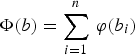 $$\Phi \lpar b\rpar =\sum\limits_{i=1}^n \, \varphi \lpar b_i \rpar$$
Finally, define the Bregman divergence  $d_\Phi \lpar c\comma \; b\rpar \,\colon\, \lsqb 0\comma \; 1\rsqb ^n \times \lsqb 0\comma \; 1\rsqb ^n \to \lsqb 0\comma \; \infty \rsqb $ generated by Φ as follows:
 $$d_\Phi \lpar c\comma \; b\rpar =\Phi \lpar c\rpar - \Phi \lpar b\rpar - \left\langle {c - b\comma \; \nabla \Phi \lpar b\rpar } \right\rangle$$
where 〈·,·〉 is the dot product.
Then, by [Predd et al., Reference Predd, Seiringer, Lieb, Osherson, Poor and Kulkarni2009, 4790], since s is proper, we have:
 $$E{\cal U}_s \lpar b\comma \; w\rpar =1 - d_\Phi \lpar v_w\comma \; b\rpar - s_w$$
where, for any world w, let
 $$s_w :=\sum\limits_{A \in {\cal F}} \, s\lpar v_w \lpar A\rpar \comma \; v_w \lpar A\rpar \rpar$$
Note that, since s is proper, s w < ∞ for all possible worlds w.
Now we turn to proving clause (I) of Theorem 4. Suppose  $b \notin {\cal C}^+$. Then, by Proposition 3 of Predd et al. (Reference Predd, Seiringer, Lieb, Osherson, Poor and Kulkarni2009: 4788) there is
 $c\in {\cal C}^+$ such that, for all ch ∈
 ${\cal C} $
 $$d_\Phi \lpar ch\comma \; c\rpar \lt d_\Phi \lpar ch\comma \; b\rpar$$
We now wish to show that, for any ch ∈  ${\cal C} $,
 $$\sum\limits_w \, ch\lpar \overline w \rpar E{\cal U}_s \lpar b\comma \; w\rpar \lt \sum\limits_w \, ch\lpar \overline w \rpar EU_s \lpar c\comma \; w\rpar$$
Thus, pick an arbitrary ch ∈  ${\cal C} $. We keep this fixed throughout the proof. Recalling that
 $A_j=\overline {w_j } $, and that we write
 $ch_j $ for ch(A j), we rewrite this as follows:
 $$\sum\limits_{\,j=1}^m \, ch_j E{\cal U}_s \lpar b\comma \; w_j \rpar \lt \sum\limits_{\,j=1}^m \, ch_j EU_s \lpar c\comma \; w_j \rpar$$
Since s w < ∞ for all w, it suffices to show that
 $$\sum\limits_{\,j=1}^m \, ch_j d_\Phi \lpar v_{w_j }\comma \; c\rpar \lt \sum\limits_{\,j=1}^m \, ch_j d_\Phi \lpar v_{w_j }\comma \; b\rpar$$
We exploit the ideas in the proof of Proposition 1 in Banerjee et al. (Reference Banerjee, Meruga, Dhillon and Ghosh2005: 1710), taking care at each stage to ensure that the proof goes through even when  $d_\Phi \lpar v_{w_j }\comma \; b\rpar =\infty $. Let μ be the following vector in [0, 1]n:
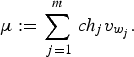 $$\mu :=\sum\limits_{\,j=1}^m \, ch_j v_{w_j } .$$
Since ch is a probability function, we have ch = μ. Now:
 $$\eqalign{& \sum\limits_{\,j=1}^m \, ch_j d_\Phi \lpar v_{w_j }\comma \; b\rpar - \sum\limits_{\,j=1}^m \, ch_j d_\Phi \lpar v_{w_j }\comma \; \mu \rpar \cr &\quad = \sum\limits_{\,j=1}^m \, ch_j \left[{\Phi \lpar v_{w_j } \rpar - \Phi \lpar b\rpar -\langle v_{w_j } - b\comma \; \nabla \Phi \lpar b\rpar \rangle } \right] - \sum\limits_{\,j=1}^m \, ch_j \left[{\Phi \lpar v_{w_j } \rpar - \Phi \lpar \mu \rpar - \left\langle {v_{w_j } - \mu\comma \; \nabla \Phi \lpar \mu \rpar } \right\rangle } \right]\cr & \quad= \Phi \lpar \mu \rpar - \Phi \lpar b\rpar - \sum\limits_{\,j=1}^m \, ch_j\langle v_{w_j } - b\comma \; \nabla \Phi \lpar b\rangle\rpar +\sum\limits_{\,j=1}^m \, ch_j\langle v_{w_j } - \mu\comma \; \nabla \Phi \lpar \mu \rpar \rangle \cr &\quad= \Phi \lpar \mu \rpar - \Phi \lpar b\rpar - {{\langle}} {\sum\limits_{\,j=1}^m \, ch_j v_{w_j } - b\comma \; \nabla \Phi \lpar b\rpar } {{\rangle}} +{{\langle}} {\sum\limits_{\,j=1}^m \, ch_j v_{w_j } - \mu\comma \; \nabla \Phi \lpar \mu \rpar } {{\rangle}} \cr &\quad = \Phi \lpar \mu \rpar - \Phi \lpar b\rpar - \left\langle {\mu - b\comma \; \nabla \Phi \lpar b\rpar } \right\rangle+\left\langle {\mu - \mu\comma \; \nabla \Phi \lpar \mu \rpar } \right\rangle \cr &\quad = \Phi \lpar \mu \rpar - \Phi \lpar b\rpar - \left\langle {\mu - b\comma \; \nabla \Phi \lpar b\rpar } \right\rangle \cr &\quad = d_\Phi \lpar \mu\comma \; b\rpar \cr & \quad =d_\Phi \lpar ch\comma \; b\rpar }$$
Thus, since s is proper, and thus  $\sum\nolimits_{\,j=1}^m \, ch_j d_\Phi \lpar v_{w_j }\comma \; ch\rpar \lt \infty $, we have
 $$\sum\limits_{\,j=1}^m \, ch_j d_\Phi \lpar v_{w_j }\comma \; c\rpar \lt \sum\limits_{\,j=1}^m \, ch_j d_\Phi \lpar v_{w_j }\comma \; b\rpar$$
iff
 $$\eqalign{& \sum\limits_{\,j=1}^m \, ch_j d_\Phi \lpar v_{w_j }\comma \; c\rpar - \sum\limits_{\,j=1}^m \, ch_j d_\Phi \lpar v_{w_j }\comma \; ch\rpar \lt \sum\limits_{\,j=1}^m \, ch_j d_\Phi \lpar v_{w_j }\comma \; b\rpar - \sum\limits_{\,j=1}^m \, ch_j d_\Phi \lpar v_{w_j }\comma \; ch\rpar }$$
iff
 $$d_\Phi \lpar ch\comma \; c\rpar \lt d_\Phi \lpar ch\comma \; b\rpar$$
But, we have already shown that  $d_\Phi \lpar ch\comma \; c\rpar \lt d_\Phi \lpar ch\comma \; b\rpar $. This completes our proof of Theorem 4(I).
Next, we prove clause (II) of Theorem 4. Suppose c ∈  ${\cal C} $+. Then c is a probability function. Now, suppose there is b ∈
 ${\cal B} $ such that
 $$\sum\limits_{\,j=1}^m \, ch_j E{\cal U}_s \lpar c\comma \; w_j \rpar \lt \sum\limits_{\,j=1}^m \, ch_j EU_s \lpar b\comma \; w_j \rpar$$
for all ch ∈  ${\cal C} $. Then that is the case iff
 $$\sum\limits_{\,j=1}^m \, ch_j d_\Phi \lpar v_{w_j }\comma \; b\rpar \lt \sum\limits_{\,j=1}^m \, ch_j d_\Phi \lpar v_{w_j }\comma \; c\rpar$$
iff
 $$\eqalign{&\sum\limits_{\,j=1}^m \, ch_j d_\Phi \lpar v_{w_j }\comma \; b\rpar - \sum\limits_{\,j=1}^m \, ch_j d_\Phi \lpar v_{w_j }\comma \; ch\rpar \lt \sum\limits_{\,j=1}^m \, ch_j d_\Phi \lpar v_{w_j }\comma \; c\rpar - \sum\limits_{\,j=1}^m \, ch_j d_\Phi \lpar v_{w_j }\comma \; ch\rpar }$$
iff
 $$d_\Phi \lpar ch\comma \; b\rpar \lt d_\Phi \lpar ch\comma \; c\rpar$$
for all  $ch \in {\cal C}$. But it follows from this latter inequality that
 $$d_\Phi \lpar y\comma \; b\rpar \lt d_\Phi \lpar y\comma \; c\rpar$$
for any  $y \in {\cal C}^+$. The reason is that, if
 $y \in {\cal C}^+$, then
 $y=\sum\nolimits_{w \in {\cal W}} \, \lambda _w ch_{w} $ for some
 $\lambda _w \geq 0$ and
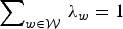 $\sum\nolimits_{w \in {\cal W}} \, \lambda _w=1$; and thus,
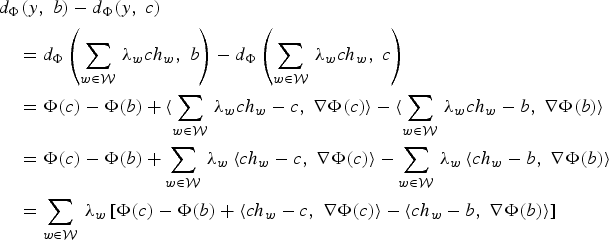 $$\eqalign{ &d_\Phi \lpar y\comma \; b\rpar - d_\Phi \lpar y\comma \; c\rpar \cr & \quad= d_\Phi \left({\sum\limits_{w \in {\cal W}} \, \lambda _w ch_w\comma \; b} \right)- d_\Phi \left({\sum\limits_{w \in {\cal W}} \, \lambda _w ch_w\comma \; c}\right)\cr &\quad= \Phi \lpar c\rpar - \Phi \lpar b\rpar +{{\langle}} {\sum\limits_{w \in {\cal W}} \, \lambda _w ch_w - c\comma \; \nabla \Phi \lpar c\rpar } {{\rangle}} - {{\langle}} {\sum\limits_{w \in {\cal W}} \, \lambda _w ch_w - b\comma \; \nabla \Phi \lpar b\rpar } {{\rangle}} \cr &\quad= \Phi \lpar c\rpar - \Phi \lpar b\rpar +\sum\limits_{w \in {\cal W}} \, \lambda _w \left\langle {ch_w - c\comma \; \nabla \Phi \lpar c\rpar } \right\rangle - \sum\limits_{w \in {\cal W}} \, \lambda _w \left\langle {ch_w - b\comma \; \nabla \Phi \lpar b\rpar } \right\rangle \cr&\quad= \sum\limits_{w \in {\cal W}} \, \lambda _w \left[\Phi \lpar c\rpar - \Phi \lpar b\rpar +\left\langle ch_w - c\comma \; \nabla \Phi \lpar c\rpar \right\rangle - \left\langle {ch_w - b\comma \; \nabla \Phi \lpar b\rpar } \right\rangle \right]}$$
 $$\eqalign{\cr &= \sum\limits_{w \in {\cal W}} \, \lambda _w \left[\Phi \lpar c\rpar - \Phi \lpar b\rpar +\left\langle ch_w - c\comma \; \nabla \Phi \lpar c\rpar \right\rangle - \left\langle ch_w - b\comma \; \nabla \Phi \lpar b\rpar \right\rangle \right]\cr &= \sum\limits_{w \in {\cal W}} \, \lambda _w \left[\Phi \lpar ch_w \rpar - \Phi \lpar b\rpar - \left\langle {ch_w - b\comma \; \nabla \Phi \lpar b\rpar } \right\rangle \right] - \sum\limits_{w \in {\cal W}} \, \lambda _w \left[\Phi \lpar ch_w \rpar - \Phi \lpar c\rpar - \left\langle {ch_w - c\comma \; \nabla \Phi \lpar c\rpar } \right\rangle \right]\cr &= \sum\limits_{w \in {\cal W}} \, \lambda _w \lpar d_\Phi \lpar ch_w\comma \; b\rpar - d_\Phi \lpar ch_w\comma \; c\rpar \rpar \lt 0}$$
since d Φ (ch w, b) < d Φ (ch w, c) for all ch w. But, since c ∈  $ch \in {\cal C}$+, it follows from this that
 $$d_\Phi \lpar c\comma \; b\rpar \lt d_\Phi \lpar c\comma \; c\rpar =0$$
and this gives a contradiction, since d Φ takes only non-negative values. This completes the proof of Theorem 4(II).□











