Despite the common acknowledgement of ancient pastoral nomadism in much of the African continent, particularly in the Sahelian corridor and the Horn of Africa, the existence of politically centralized nomadic regimes and confederacies in ancient Africa is only rarely acknowledged in the scholarship. It is only in episodes of pronounced contact with nearby urban regimes and associated episodes of migration or invasion that relevant sources acknowledge the presence of political and intertribal organisation and cooperation amongst pastoral nomadic groups. The emergence and existence of a Libyan ‘confederate polity’ of Late Bronze Age-Early Iron Age Cyrenaica and Marmarica is confirmed by Egyptian records of the Ramesside period (ca. 1300–1100 BCE). Looking east, in the Red Sea Hills, a series of ethnically related tribal lineages, which are generally given to be ancestrally related (at least linguistically) to the contemporary Beja, roamed the deserts between the Nile and the Red Sea.Footnote 1 The antiquity of the Beja language in the desert is confirmed in lexical material of Medjay personages from ca. 2000 BCE. Beja-speakers can be traced in the desert in all ensuing periods until modernity, and thus far no linguist has identified or confirmed any other indigenous languages in the region from the plentiful onomastic data in Egyptian records.
In the Eastern Desert, there is documentation as early as 1900 BCE of nomadic rulers who were known in Egyptian records as Medjay. The record of the local nomadic elite, however, is very fragmentary until late antiquity and the early medieval period (ca. 200–1000 CE), when there is a relative boon of evidence relating to the historical Blemmyes and Beja. Despite some scope for confusion in the ethnic terminology, it is clear that these two ethnic monikers referred to the same group, ‘Blemmyes’ being the regular term in Greek and Coptic with ‘Beja’ and ‘Bega’ in Arabic and Geʿez respectively.Footnote 2 It is in this period that the Eastern Desert experienced its political apogee, known in the scholarship as the ‘rise of the Blemmyes’, a period typified by successive nomadic raids on the Nile and control of the Nile River in Lower Nubia. Following a series of wide-ranging wars, the severance of trade, and the appearance of an emerging elite class in the third and fourth centuries CE, it will be argued that the Blemmyes formed a united political confederacy, one of Africa's earliest traceable nomadic kingdoms. This paper will trace the Blemmyean elite from their Medjay ancestors in the second and first millenniums BCE, when nomadic elites wielded local power in their desert homeland but did not form any united political bloc or participate in expansionist activities.
Despite the common recognition that there was an ancient pastoralist nomadic occupation in the Sudanese deserts and the extensive study of documents pertaining to the Blemmyes, particularly in late antiquity, few scholars have ventured to position these people in any political structure or even acknowledge the existence of an ancient Beja polity.Footnote 3 An analysis of their political structures reveals the emergence of a unified pastoral kingdom in the Eastern Desert in the first millennium CE (ca. 400–900 CE) — an intertribal confederation which has otherwise escaped the attention of scholarship or alternatively been typologically glossed according to a nebulous ‘barbarian’ or ‘chiefdom’ model which dismisses any unique features of their political organisation.Footnote 4 The Blemmyean tribes were unified for approximately half a millennium under a line of preeminent kings. Under these nomad kings’ guidance, the Blemmyean state raided the Nile, captured agricultural regions, made treaties with Rome and other kingdoms, and controlled trade and mineral wealth in the desert. Yet despite the political and economic achievements of these camel and goat herders in late antiquity, current scholarship attributes little political structure or ‘complexity’ to these nomads’ political configuration.
ANCIENT SAHELIAN KINGDOMS
Stepping back from the situation of the Beja, the historical traditions of ancient Africa only rarely allow for detailed discussions and examinations of tribal and political organisation. Muslim geographers and chroniclers provided the most insightful and plentiful evidence of matters in Sahelian and sub-Saharan Africa, but this tradition only begins after the conquests of the Rashidun Caliphate and the advent of Arabic geographic traditions following al-Yaqubi and Ibn Hawqal in the ninth and tenth centuries CE. Hereafter, there is a veritable trove of information for such ethnopolitical blocs that appeared in the Sahel and the Horn of Africa as Ghana, Mali, the Zaghawa (Darfur), Kanem (Lake Chad), Habashat (Ethiopia), Beja (Eastern Sudan), and the Zanj (Swahili coast). Before this period, Ancient Egyptian and later Graeco-Roman sources give us a limited picture of the Sudanese Middle Nile (Nubia) and adjacent Saharan peoples like the Garamantes of the Fezzan, while in the Horn of Africa the advent of literate epigraphic cultures in the early first millennium BCE and more proliferate Aksumite inscriptions beginning in the fourth century CE provide a glimpse into the geopolitical makeup of neighbouring regions. While the classical states of the medieval Sahel, especially in West Africa, are well-known from both archaeological excavation and Arab geographies, it is difficult to define the nomadic political groupings that inhabited the deserts and savannah around the Niger River, Lake Chad, or the Nile.Footnote 5
Archaeological research, especially cemetery archaeology, can independently fill gaps in our knowledge of polities unmentioned in the historical record and identify the presence of nomadic elites and political clusters in pastoralist settings.Footnote 6 Archaeologists have even demonstrated the existence of nomadic elites in the Libyan Sahara since the terminal Neolithic.Footnote 7 Nomadism or pastoralism was no barrier to social differentiation and economic integration in long-distance trade networks. The presumption must be that Saharan desert polities headed by nomadic or semi-nomadic elites were relatively common throughout North Africa and the Sahel even if they are not attested explicitly in historical records or easy to define or map archaeologically. In a related development, the easternmost extension of the Sahel, the desert locked between the Nile and the Red Sea, has been largely excluded from the historiography of ‘Sahelian kingdoms’ and discussions of political transformations across medieval Africa.Footnote 8 Partly on account of the Beja's nomadic existence and their living in the shadow of the large urban states of Kush, Egypt, and Aksum, few scholars have entertained the rise of nomadic states or considered strong political formations as an enduring feature of the para-Nilotic world. In this historiographical schema, the Beja offer a unique insight into the formation of nomadic political organization as their affairs are documented in both pre-Islamic (Egyptian, Greek, Coptic, Aksumite) and Islamic sources. As pastoralist or semi-sedentary polities in Northeast Africa are concerned, only the Garamantes of the Fezzan or Berber groups of the Mediterranean littoral and hinterland provide similar case studies of cultures well-known in both pre-Islamic and Islamic sources.Footnote 9
The nomads of the deserts between the Nile and the Red Sea were bestowed with a myriad of ethnica in ancient documents and are seldom treated as a single cultural bloc in scholarship. Situated between Pharaonic, Hellenistic, and Roman Egypt, Kushite and Meroitic Nubia, and Aksumite Ethiopia, they have long remained in the footnotes of history. Scholarship on the ‘peripheral’ Blemmyes has largely been orientated to these superordinate disciplines (Egyptology, classical studies, Arabic studies) from which originate many of the written sources on the Blemmyes. But the cultures of the Sudanese Nile present a unique challenge to the historian — something between mixed agropastoralist confederations and agricultural states with a confusing array of external relations and multiethnic complexity. Moving outside the Sudanese Nile into the adjacent deserts, the common scholarly narrative frequently espouses a formless mass of nomadic elites ruling over vast and ill-defined swathes of desert valleys, temporarily raiding Nile settlements, and at least preventing easy exploitation of desert resources by Nile regimes. In terms of historical developments, kinship structures, and political ecology, the nomadic cultures of this desert seemingly have little in common with Aksumite Ethiopia, Pharaonic Egypt, or Kushite Nubia. For relevant comparisons and political phenomena, we must rather turn to polities dominated by arid pastoralist ecologies such as the nearby Somali and Tigre or even Mongol and Turkic groups of Central Asia.
The Blemmyes and their earlier Pharaonic period ancestors, the Medjay, are often missing from reconstructions of ‘kingship’ and ‘political complexity’ in North Africa. Unlike their Kushite and Egyptian neighbours, the Blemmyean peoples did not rule over dense agricultural populations capable of producing agricultural surpluses that fuelled large bureaucracies, but roamed over the vast deserts, rocky hills, arid steppelands, and ravines between the Nile and Red Sea. In such pastoral nomadic societies, distinct familial-territorial lineages or ‘tribes’ were the main political units where cultural meaning and power was invested. In the Beja landscape, the social unit of the tribe was primarily based on the admixture of kinship and territorial rights. The ‘tribe’ here is simply meant as a social unit which places emphasis on common kinship and distinct lineages for its social and hierarchical organisation as well as identity.Footnote 10 While the word ‘tribe’ is hardly ideal with its vague and pejorative uses in the African context, especially when applied to perceptions of social organisation, in the context of the Beja, like the Arabs across the Red Sea, it is a suitable phrase without a clear alternative. Here it simply refers to distinct and well-established branches or segments of the larger ethnic group based on perceived or real bonds of genealogy. Like Arabs, Beja tribes drew their origins from legendary ancestors of the remote past, for example Barakwin for the Hadendowa and Kuka for the Bishareen. The present-day Beja society, as in the past, is dominated by ‘tribes’ (gabila, adat) which form a basic unit of identity, with each tribe being segmented into smaller family lineages (diwab).Footnote 11 This article asks what kind of hierarchies and rulership structures existed in the ancient societies of the Eastern Desert — and, importantly, what kind of power nomadic kings exercised over their subjects, territories, and economies. This analysis of ancient Beja politics and social order demonstrates the formation of strong political confederations in the Beja deserts in which rulers took advantage of steppe environments and ruminants, particularly the dromedary, in order to form a wholly different entity to that of urban states in the Ethiopian Highlands and the Nile Basin.
FROM THE DESERT TO THE RIVER: NOMADIC LEADERS OVER THE MILLENNIA
Written records concerning desert leaders largely gloss and summarize finite episodes of contact between small traveling groups of nomads and Egyptians in the Nile Valley. The earliest mention of nomadic rulers concerns the Medjay, where a rock inscription near Philae mentions a heqa (ruler) of Medjay alongside other Nubian polities as early as 2280 BCE. In the later Middle Kingdom (ca. 1800–1650 BCE), Egyptian scribes recorded two Medjay polities in the desert, Webat-Sepet and Ausheq. Each of these polities was ruled by a set of interrelated families tied back to a dynastic ancestor called Wenkat.Footnote 12 In this same period Pan-Grave people, the possible archaeological corollary of desert Medjay on the Nile, were immigrating to Egypt and forming distinct diaspora communities around Egyptian cities.Footnote 13 A written testament of this activity is found in the expenditures of the 13th Dynasty Theban palace where successive records list the provisions granted to arriving families of Medjay along with their rulers. One exceptional record even includes a named Medjay ruler, the ‘chief of Ausheq’ named Kewy, whose delegation received one hundred loaves of bread and five jars of beer.Footnote 14
Despite some shared subsistence patterns, languages, and possibly familial bonds, there are no signs that these most ancient desert polities and rulers enjoyed friendly relations with each other. In the wars of the Egyptian Second Intermediate Period (ca. 1674–1535 BCE) some Medjay tribes joined Egypt's rival Kush in raids directed against Upper Egyptian cities, while others instead joined Egyptian forces in their reconquest of Hyksos-controlled Lower Egypt.Footnote 15 Moving forward into the first millennium BCE, papyri make frequent mention of the presence of a continued diaspora of the ‘Blemmyes’ and ‘Trogodytes’ in Upper Egyptian towns — but there are still no specific signs of a centralized desert polity. Kushite records include the names of some rulers, for instance the ruler Kheru of the Rehrehs who raided Nubia under Harsiyotef (404–369 BCE).Footnote 16 The name of the Meday chief Kheru is significant. As demonstrated by Karola Zibelius-Chen, this is likely connected to the Beja word had'a (lord), later transcribed in Coptic script as khara, in the only connected text in the Beja language.Footnote 17 After this period in Nubia, the use of the largely untranslatable Meroitic language in local inscriptions (ca. 200 BCE–400 CE) makes it impossible to reconstruct conflict between the Kushite state and the nomads.
With the ascendency of the Blemmyes in the Nile Valley in the late Roman Empire from the third century CE onwards, we enter a new phase of Blemmyean history and hegemony. Our view of these nomadic desert rulers and their local political hierarchies now becomes much clearer. A new range of Roman histories, papyri, and even texts written by the Blemmyes themselves provide intimate insights into their internal social organisation not witnessed in previous periods. This epoch of power and expansion, sometimes termed ‘the rise of the Blemmyes’, is first marked by a number of aggressive raids in Upper Egypt and Coptos in the third century CE. In the fourth and fifth centuries this pattern continued, with the nomads annexing parts of Lower Nubia after the Roman withdrawal from the region under Diocletian (298 CE) and the crumbling of Meroe's power in Nubia. In Lower Nubia, Blemmyean rulers captured the Dodekaschoinos, the northern half of Nubia between the first and second cataracts, and the major temple of Kalabsha (Talmis) as well as Tafa. With this territorial growth, they also came into conflict with the Nobades, themselves a new rising force in the power vacuum of northern Sudan.
In the Greek and Coptic documents, Blemmyean hierarchical positions were ascribed with their nearest Greek equivalents. The Greek word phylarchos (tribal-chief) predominates in the relevant texts, but there is also the lower hypotyrannos (sub-despot) and the higher basiliskos or basileus (king). The earliest instance of this hierarchy in respect to the Blemmyes comes from the desert route leading between the Nile Valley at Coptos and the Red Sea harbour at Berenike. In local ostraca (inscribed potsherds) found in the fortress way stations of Didymoi, Iovis, and Xeron (175–250 CE), mention is made of a certain Baratit, a hypotyrannos.Footnote 18 While Baratit appears to give orders to his fellow tribesmen in the ostraca, the title ‘sub-despot’ presumes to an extent that there existed a ruler above himself. It is in this period that we can first detect the growing formation of a tribal elite and intertribal cooperation that would lead to confederation.
Some evidence from the earlier sources indicates the existence of these tribal structures without naming specific rulers. Agatharchides's first-century CE geography describes the tribes of the nomadic Trogodytes as each led by a ‘ruler’ (tyrannos).Footnote 19 The word ‘Trogodytes’ is the more frequently encountered word for Eastern Desert nomads than the term ‘Blemmyes’ in the Ptolemaic period, and thus the Trogodytes are probably in the same ethnolinguistic constellation of Eastern Desert tribes as the Blemmyes, both living in the deserts east of Upper Egypt. Indeed, some archives and histories seem to use these words interchangeably for the same group.Footnote 20 Trogodytic tribal names are known, including the Abylloi and Bolgioi (Diodorus Siculus) and the half-Arab, half-Trogodytic Asarri (Pliny).Footnote 21 The first-century trade guidebook the Periplus of the Erythraean Sea mentions the land around Berenike as dominated by the barbaroi (‘barbarians’) and other vague stereotyped Greek constructions like Ichthyophagoi (Fish-Eaters), Agriophagoi (Wild-Animal Eaters), and Moschophagoi (Shoot-Eaters), also defining the political structure of these groups as one of tyrannis (monarchies).Footnote 22 But with the exception of Asarri, Bolgioi, and Abylloi, no names of individual subtribes of Blemmyean groups are known until the Islamic period. The only other exception could be the ethnic Megabaroi, possibly a subtribe of the Blemmyes or a wholly different ethnic group living on the Eritrean borderlands such as the Nara (earlier known as Barya). In a papyrus from the Upper Egyptian city of Edfu, a family identifies both as Blemmyean and as Megabaroi, perhaps suggesting that one of these names is a tribal designator.Footnote 23
The lack of tribal names in our sources might be a result of the worldview and conceptions of Graeco-Roman authors who did not overtly invest political importance in subtribes or who had little intimate ‘insider’ information. It could also be that the Blemmyes themselves glossed this situation for outsiders.Footnote 24 The Arabs, who evidently had greater familiarity with the heartland of the Beja polity and had intermarried with Blemmyes in the Allaqi region, were much more familiar with the interior desert. Furthermore, Arab heritage and worldview invested great social importance in the traditions of tribal filiation and correspondingly show a much more intimate and detailed picture of Blemmyean tribes. Despite arguments in the literature, there is no linguistic evidence to suggest that there were other indigenous ethnolinguistic groups in the Atbai from the Coptos deserts to the Gash-Kassala region — the desert ‘tribes’ were likely all part of the same Beja- or Cushitic-speaking milieu. The variances in nomad ethnonyms are not problematic when contextualized in their chronological and linguistic setting: ‘Trogodytes’ (Ptolemaic and early Roman Greek), ‘Blemmyes’ (late antique Coptic and Greek), ‘Beja’ and ‘Bega’ (Arab and Aksumite). A cultural unity in the desert is also borne out by the archaeology, which shows a consistent funerary culture and ceramic corpus, Eastern Desert Ware, across the whole Atbai.Footnote 25 It is only in the southern Atbai and Ethiopian borderlands, on the banks of the Gash and Baraka, that this cultural unity gave way to a great melting pot of different ethnic groups like Tigre, Kunama, and Nara. This southerly region was also agropastoralist unlike the largely desert and steppelands further north.Footnote 26
The biography of the famous Coptic saint and monk Shenoute of Atripe mentions an unnamed Blemmyean king at some point in the middle of the fifth century. The story of Shenoute's encounter, blending fantastic miracles with a real historical backdrop, records a Blemmyean raid on the Nile Valley north of the major metropolis of Ptolemais (modern El-Manshah) that took plunder and captives from the Egyptian community back into the desert.Footnote 27 The heroic monk Shenoute disarms the Blemmyes he encounters by performing a miracle — making their arms stiff — and later following the Blemmyes back to the ‘place of their king’. The Blemmyean king beckons Shenoute to heal the disabled arms of his compatriots, a request which Shenoute complies with in return for the captured Egyptians. The king then offers Shenoute back the plunder taken from the raid, signalling that the Blemmyean king apparently had the authority to distribute raid plunder. The account is mainly concerned with the miracles of Shenoute, but the backdrop of a Blemmyean raid is firmly grounded in the historical setting. Blemmyes are recorded raiding Ptolemais and Coptos in the late third century, and raids in the sixth century possibly reached as far north as Cusae.Footnote 28 Despite the obvious hagiographic purpose of such texts, there is no reason to suggest that such information is entirely fictive, but could rather rest upon local Upper Egyptian understandings of Blemmyean tribal organisation. Besa, the abbot who authored the text of the Life of Shenoute, was himself in charge of the white monastery at nearby Ptolemais and it is hardly likely that he was unfamiliar with Blemmyes. The ‘place of the king’ may well be one of the many archaeologically attested Blemmyean desert camps dotted throughout the nearby Upper Egyptian deserts in this period.Footnote 29
An exceptional source naming early Blemmyean rulers of Late Antiquity, still debated and discussed by philologists due to the difficulties of Meroitic grammar and lexicography, is the Meroitic inscription of Kharamadoye (REM 0094).Footnote 30 The text was inscribed at Kalabsha Temple, dating to roughly the late fourth or early fifth centuries. The inscription gives the Meroitic word qore (king) for the text's protagonist Kharamadoye. It has been argued that this refers to a Blemmyean king rather than an expected Meroitic ruler as would be standard in a Meroitic text. This is based on the name Kharamadoye itself, which begins with the segment khar-, common in Beja personal names and especially those of chiefs and rulers. The other ruler in the text, Yisemeniye, is a ‘great king’ (qore lh) and is identical to the Blemmyean king Isemne mentioned in a Greek inscription at Kalabsha and a recently discovered inscription at Berenike.Footnote 31 The relations between Yisemeniye and Kharamadoye are as yet unclear. Following the interpretation of Rilly, it is likely that Yisemeniye, the ‘great king’, was Kharamadoye's superior or possibly predecessor, as the latter was merely labelled a ‘king’ without any superlative qualification.Footnote 32 This would make the Meroitic title ‘great king’ in this text a rather unique epithet for a preeminent king in the tribal confederate milieu, possibly leaving the unqualified ‘king’ Kharamadoye as the ruler in charge of a specific subregion or tribe of the Blemmyes. The short Berenike inscription, dedicated by a Blemmyean ‘interpreter’ named Mochosak, mentions the tenth regnal year of Isemne.Footnote 33 This demonstrates that the Blemmyes, like many ancient monarchical polities, had an established practice of keeping count of the reigning years of the ruler and used this as a system of counting years. In identifying a regnal date for one king, it also furthers the argument that there was a single king of the Blemmyean nation (ethnos) presiding above all other local rulers.
Not long after this text, the poet-historian Olympiodorus visited the Blemmyes at Kalabsha Temple (ca. 423 CE). He recorded that the Blemmyes possessed a number of ‘tribal-chiefs’ (phylarchous) as well as ‘priests’ (prophetes).Footnote 34 Luckily, some of these ‘tribal-chiefs’, such as Phonoin, are known by name from local inscriptions at the temple. Blemmyean ‘kings’ Tamala, Isemne, and Degou also visited and patronized the temple and an unnamed Blemmyean king appointed the leaders of the local religious cult.Footnote 35 Olympiodorus's account implies that these kings possessed power over the movement of people throughout their lands. He explained that he was urged by Blemmyean priests to visit the famous emerald mines in the desert at Sikait but exclaims that it was not possible to do this without a ‘royal order’. The implication from Olympiodorus's account is that such an ‘order’ could not originate from a lowly ‘tribal-chief’, but had to be issued directly by the Blemmyean king himself who was in this case absent from Kalabsha. This specific royal prerogative is confirmed by a similar episode more than 150 years later (580 CE) in the story of the Christian conversion of the Nubian kingdom of Alwa recorded by the Syriac chronicles. The Miaphysite bishop Longinus, in attempting to avoid the theologically hostile and Chalcedonian Nubian kingdom of Makuria, was escorted to the southernmost Nubian kingdoms through the desert by the king of the Blemmyes himself.Footnote 36 Foreigners could not pass through the desert without his permission.
The ‘tribal-chief’ (phylarchos) Phonoin mentioned in the inscription at Kalabsha Temple is no doubt the same as the ‘king’ (basileus) Phonen mentioned in a diplomatic letter found at Qasr Ibrim, the so-called Letter of Phonen. There can be little doubt that in the intervening period between his Kalabsha inscription and the diplomatic letter that Phonen had ascended rank from phylarchos to ‘king of the Blemmyes’. This letter, uncovered in excavations at the fortress of Qasr Ibrim, is one of the most remarkable documents in late antique Northeast Africa. It is the only preserved Blemmyean diplomatic letter and is also one of the few sources for the very poorly understood war between the Blemmyes and the Nobades of the fifth century CE. It is also a remarkable testament to the new geopolitics of a Nile world no longer dominated by Egypt or Meroe, with the letter containing the diplomatic correspondence between two pastoralist warlords writing to each other in the lingua franca of Greek.Footnote 37 The document communicates not only the quarrels between these two nations locked in a duel over the control of Lower Nubia, but also the preoccupations of a Blemmyean king whose legitimacy rested upon his family, tribe, and herding nation. The opening formula and paraphernalia of greetings in the letter outline King Phonen's concerns for his people. Phonen, while king of the Blemmyes, was also a tribal leader, and he was concerned with the welfare of his sons, the pasturing rights of his people, and the crimes committed against his people by the Nobades. He stated his paramount authority: ‘No one can fight without my command.’ As the war with the Nobades encompassed much of Lower Nubia, Phonen was the commander-in-chief of a complicated conflict that probably affected multiple Blemmyean tribes and their pasturing privileges on the Nubian Nile. It was likely that under Phonen's rule the Blemmyes lost their Nile province as well as the trade and agricultural taxation opportunities that came with riverine power.Footnote 38 By the middle of the fifth century CE, the Blemmyes retreated into the desert, losing their prestigious riverine province. The lack of distinctive Blemmyean settlements and material culture in the archaeological record of Lower Nubia after this period is a testament to their exodus from the Nile.
Despite being unburdened of their only riverine territorial possession, the Blemmyes did not rest in the desert long. They quickly acquired new agricultural lands on the Nile around the Egyptian town of Gebelein, just south of Thebes and ostensibly within the territory of Roman Egypt. A corpus of 13 documents written on animal skins from this domain demonstrates the inner workings of the local Blemmyean administration. The documents were written on behalf of the Blemmyes by three non-Blemmyean scribes, one of whom, Dioskoros, is known elsewhere as the ‘scribe of the Blemmyean nation’.Footnote 39 All the texts are administrative or legal in nature with most signed and witnessed by Blemmyean kings, elites, and more lowly members of the community. In the Gebelein region, the Blemmyes were in charge of the administration and taxation of an unspecified region of agricultural land around the islands of Temsir and Tanare. They controlled this region from settlements situated in the nearby desert, while they buried their dead in a large cemetery at Moalla.Footnote 40 It is unclear when precisely they took up the administration of this small agricultural fiefdom or the level of cooperation with Roman authorities, but the Blemmyes evidently used it at least partly for taxation of agricultural land.Footnote 41 Captives and slaves, frequently women, were common in the community and were traded and sometimes set free. No one had power over freemen except the Blemmyean king. Blemmyean women could own and free slaves, but there is no certain evidence of their holding political offices.Footnote 42 The Gebelein documents manifest all three tiers of Blemmyean rulers — basiliskos, phylarchos, and hypotyrannos — in this single corpus and sometimes in the same letter. Three kings are mentioned in separate documents, Pokatimne, Kharakhen, and Barakhia, none of whom seem to have lived in Gebelein. This arrangement of visiting their Nile territories but not residing there is identical to the one the Blemmyes employed in Kalabsha. Royal succession is also explicitly recorded in the corpus; one document records that King Barakhia ‘ascended the throne’ after Kharakhen.Footnote 43
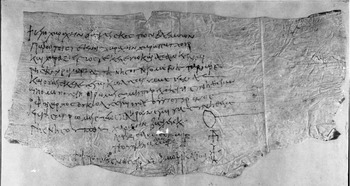
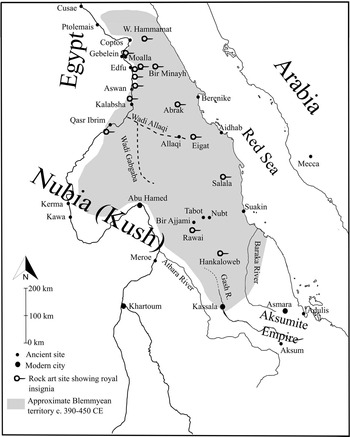
A key piece of evidence for this kind of tribal rulership and administration is the signature that the king Kharakhen left on one of these documents, a ‘royal disposition’ with an extant pictorial monogram comprising a royal signature next to his name (Fig. 1).Footnote 44 The king's signature appears alongside that of the ‘secretaries’ (domesticus) Laize and Tiutikna. It was Hans Winkler who first noticed that the signatures on this document bear a strong resemblance to geometric symbols common in local rock art, sometimes called wasm (‘marks’ in Arabic) and given to be similar in practice to the markings that Arab tribes use to brand camels and inscribe tribal territory in Arabia and Palestine.Footnote 45 The Blemmyes possibly even learned these symbols and practices from Arabs who had frequented their deserts since the Ptolemaic period.Footnote 46 Kharakhen's specific ‘tribal symbol’, a circle with a line emanating from the circumference, is also found at a number of diverse rock art sites throughout the Nile Valley and Eastern Desert.Footnote 47 At most of these sites, Kharakhen's tribal mark is associated with camel depictions and other distinct wasm. Most of these locations are either in Blemmyean desert lands or near known Blemmyean haunts near the Nile Valley. These marks are found in so many diverse locales that they are unlikely to have belonged to Kharakhen himself; rather the monogram may likely be the symbol for the royal or lead tribe. This royal tribe had marked sites over a wide territory, almost the totality of the Blemmyean desert (Fig. 2).
SB III, 6257: An animal skin with the royal decree in Greek of King Kharakhen, with monogram signatures next to his name and those of the ‘secretaries’ (domesticus) Laize and Tiutikna. Photograph courtesy of The Photographic Archive of Papyri in the Cairo Museum and CSAD.

Rock art sites where the Blemmyean monogram signature is found, marked with  . The symbol at Gebelein marks the likely location of the papyrus with Kharakhen's royal symbol.

Following this model, Blemmyean kings must have originated from a lead or royal tribe to which other tribes recognised some form of patrimony or fealty. East African and Sahelian pastoral societies frequently contained such ruling castes and aristocratic orders. Amongst the Beja tribes, early medieval Arab authors mention the Zanafij Beja as being subservient to the Hadarib tribe. In another reference to classes among the Beja, Ibn Hawqal remarks: ‘The richest among them make it their own duty to abstain from wild game and from conversance with those who eat wild game.’Footnote 48 While pastoralist nomads sometimes appear economically or socially egalitarian compared to sedentary and urban societies, embedded hierarchies and pronounced social stratification are comparatively commonplace and exist amongst nomadic groups as diverse as the Somali, Tuareg, Turks, and Comanche.
The status of Blemmyean kings as rulers of more than just small regions or individual tribes is a recurrent issue in the scholarship. The Blemmyean lands and their polity were massive by any reckoning. At its height, their territory covered the Lower Nubian Nile and the deserts east of the Nile between Coptos and Meroe, probably approaching the Gash-Baraka region in the south — an area roughly the size of modern Sweden or Iraq. Despite this great territory, the indications are that individual Blemmyean rulers were recognized overlords of the entire desert. If the Blemmyes had meant to refer to an individual tribal ruler who ruled a small section of their people, they quite easily could have used the term phylarchos rather than ‘king’. King Barakhia is mentioned not only as a king but as a king of ‘the nation of the Blemmyes’, as is Isemne.Footnote 49 In keeping with consensus tribal politics, Barakhia's royal decree was witnessed by lower-ranked tribal elites: a certain phylarchos Tata, the phylarchos Noupika, and the hypotyrannos Eisoeit.Footnote 50 The king could not rule without the support of tribal headmen.
Outsiders, namely Greek and Coptic scribes, inevitably glossed tribal kinship and hierarchical terms with the closest term in their own language and communicated their relative position. The Blemmyes were not unaware of the cultural cachet of these terms, and the same three terms — basileus/basiliskos, phylarchos, and hypotyrannos — appear in many documents. What is important is not so much the meaning of the words themselves, which would in any case be difficult to equate with Blemmyean organisation, but rather the existence of a threefold rank implying an established hierarchy amongst the Blemmyean elite. An exception to this standard system are the texts recounting Ezana's fourth-century Aksumite campaign that relocated six Bega or Bougaeitoi (the Aksumite words for Blemmyes) rulers and their tribes into Aksumite lands.Footnote 51 The use of an apparent diminutive basiliskos (kinglet) in this text has been explained as avoiding the term basileus which was reserved for the Aksumite King in the phrase ‘king of kings’ (basileus basileo¯n), which was the Greek translation of the Ethiopic phrase ‘king of kings’ (nəguśa nägäśt).Footnote 52
This variant use of basileus (king) and basiliskos (kinglet) has created some problems in understanding Blemmyean rulers. In Phonen's letter, the word basileus is used for both himself and the Nobadian leader Aburni, while in the Gebelein documentation Coptic rro (king) and Greek basiliskos are used. Elsewhere in this period, basiliskos is used in reference to the Nobadian King Silko in his Kalabsha inscription, who is indisputably the ruler of the Nobadian populace.Footnote 53 This lexicographic issue has been dealt with in the scholarship extensively and is entangled with the notion of whether Blemmyes and Nobades had a client relationship with the Roman Empire and therefore were precluded from using the term basileus.Footnote 54 Pragmatically, the use of the terms basileus or basiliskos matters little in the assessment of the de facto sovereignty of these rulers. Blemmyean rulers, like the Nobades, were largely independent of Rome even if there is evidence for short term treaties and peace accords.Footnote 55 Labelling kings as basiliskos in certain texts could simply be a tool for avoiding basileus where that word may be reserved for the Roman or Aksumite emperors. The six Beja ‘kinglets’ (basiliskos) from Ezana's Aksumite-Greek document were the equivalent of phylarchs in the Graeco-Coptic documentation.
Likewise, the existence of the phylarchos in the Blemmyean hierarchy is usually discussed in the scholarship with respect to the possible client relationship of the Blemmyes as a foederatus (allied, client) insofar as they were possibly bound by treaty to Rome. Following this scholarly approach, this title is not used to delineate any indigenous political institution per se but is part of a formal Roman administrative language. Comparisons are usually made in the use of this title amongst Rome's Arabian clients or the closer Nobades.Footnote 56 Leaving aside the unlikely Roman suzerainty over the Blemmyes, the problem with viewing these hierarchical terms from this ‘client’ Roman perspective is that it relegates all Blemmyean political positions to a set of administrative and diplomatic terminology but does little to practically shape our view of indigenous hierarchies. When using Greek or Coptic as the language of their documents, the Blemmyes would have been forced to employ such mutually intelligible titles. All indications are that the Blemmyes and Greeks used phylarchos to refer to any ‘tribal-chief’ in their lands, not one specifically tied by treaty to Rome.Footnote 57
THE DESERT IN THE TIME OF THE CALIPHATE
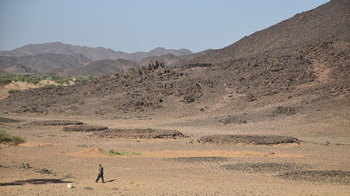
As the inheritors of Egypt and suffering from the same recurrent pattern of nomad raiding as their Roman predecessors, the Arabs quickly made reprisal incursions into the desert and established treaties with the nomads.Footnote 58 The first reliable information of desert rulers in this period comes from an incredibly insightful (and unpublished) Coptic document from Qasr Ibrim that mentions a single Blemmyean king (Coptic rro) living in a place called ‘Noubt’.Footnote 59 The document, dated to 760 CE, is a missive from the Nubian agent in Aswan addressed to his superior in the powerful kingdom of Makuria. In the letter, the agent exclaims the ability of the Abbasid emir of Aswan in vanquishing the common Beja enemy of the Nubians and Arabs. The emir also threatens to attack a place called ‘Noubt’ where the Beja king and his people reside. This place is no doubt the same as modern Khor Nubt, a major cemetery in the heart of the desert. The circular platform tombs (for examples, see Figs. 3 and 4) here are some of the largest in the desert and are likely the royal cemetery of the nomads in this period.Footnote 60 This is the only reliable record of a Blemmyean/Beja king between the period of the Gebelein rulers of the sixth century CE and the early Arab histories of the ninth century. The Arabic war story of the Muslim conquests of Middle Egypt in the 640s CE, the Futūḥ al-Bahnasā, also makes mention of a Beja king in a possibly but not certainly fictive context.Footnote 61 This king, Makšūḥ, joined a pan-Sudanese alliance and came north to Egypt's defence against the Arabs with 1,000 elephants and 20,000 men. But this narrative is so resplendent with anachronistic and fantastic elements that it is impossible to discern fact from fiction or whether Makšūḥ was a real Beja ruler.

Large platform tumuli (akerataheil) near Bir Ajjami. Photographs by author.

The Arab conquest and its ensuing intellectual spring bring a new trove of geographic and societal information on the Beja. These scholars frequently mention a single king of the Beja in various histories and geographies. Al-Yaqubi mentions a ‘kingdom of the Beja’ divided into seven smaller kingdoms across Sudan and the Horn, only some of which are obviously Beja in ethnic origin. Al-Yaqubi and Ibn Hawqal mention the division of the Beja into a number of tribes (buṭūn or qabila), some of whose names still appear in a similar linguistic form to the present day.Footnote 62 Tribes and tribal confederacies were not always of equal status, as Maqrizi (ca. 1364–1442 CE, paraphrasing the tenth-century history of al-Aswani) remarked in respect to the Hadarib, the ruling tribe or caste, and the Zanafij commoners:
There is another tribe among them called Zanāfij, who are more numerous than the Ḥadārib, but they are subject to them as serfs, escorts and guards and the Ḥadārib entrust their cattle to them. Every chieftain of the Ḥadārib owns a number of the Zanāfij as patrimony: they are like slaves and many be bequeathed from one to another. In the past the Zanāfij were masters [of the Ḥadārib].Footnote 63
The word ‘caste’ is not commonly used to describe ancient Beja society, but this term is appropriate as it refers to a hierarchical relationship of separate tribes of the same ethnicity. Castes are also relatively common in Sahelian Africa and the Horn. Other Cushitic-speaking groups like the Somali and Oromo exhibit endogamous hierarchical orders and specialist occupations. Closer to the Beja deserts, the Habab Tigre and Beni-ʿAmer of the Eritrea-Sudan borderlands exhibit patron-vassal endogamous groups, with the nabtab nobility ruling over the təgre serfs.Footnote 64 Judging from the ancient accounts, a similar system of established endogamous patron-vassal groups or tribes also characterised ancient and medieval Beja society.Footnote 65
Whatever the manifestation of privileged groups, the Arab geographers described complicated and dynamic political arrangements in the desert. Ibn Hawqal (tenth century CE) specified a special dual-ruling chieftainship (raʾīsān) arrangement amongst the Hadarib Beja tribe under the rulers ʿAbdak and Kuk. One king ruled the greater confederacy of Beja tribes while another ruled the Hadarib tribe proper. Ibn Sulaym al-Aswani refers to this time of a preeminent Beja king: ‘In the past they had a chief whom all the [other] chiefs obeyed, and who used to reside in a village called Hajar in the remotest part of the island of the Beja.’Footnote 66 Al-Istakhri and Ibn Hawqal mention that the Beja had and sold slaves (raqīq) while al-Masʿudi describes their slave raids directed against the Nuba.Footnote 67 Historical episodes also bear out these arrangements. In 831 CE an Arab army under the freed slave ʿAbdallah ibn al-Jahm was sent against the Beja chief Kanun ʿAbd al-ʿAziz to quell their raiding and form a peace settlement which recognized Kanun as ruler of the Beja nation.Footnote 68 Kanun resided in the unlocated capital of Hajar, somewhere deep in Eastern Sudan. Several Muslim chroniclers describe the campaign of the convict turned general al-Qummi against the Beja in 855 CE. Al-Qummi marched into the Beja desert heartland and encountered the castle (qalʿah) of the Beja king (malik al-Bujah).Footnote 69 Al-Qummi's campaign was directed against a Beja ruler called ʿAli Baba aimed at curbing continued Beja raids against Upper Egypt. After the Arabs’ victory in pitched battle they took ʿAli Baba to the capital of the caliphate in Iraq at Samarra for a year in order to assure peace with the Beja.
THE KING AND THE FORMATION OF A BLEMMYEAN-BEJA STATE
Taking into consideration all these historical allusions to Blemmyean and Beja kings, there was likely a continuous institution of preeminent kingship from approximately the fourth century CE until the early Arab period — a span of roughly 500 years. By al-Aswani's time (975 CE), it would seem this ‘royal’ institution had been exhausted; his history remarks that it was in the past that they had loyalty to a single ruler. Accordingly, the Beja tribes had once again ceased to operate as a united political bloc. This period would witness the emergence of the Hadarib ruling aristocratic tribe who intermarried with the Arab Rabiʿa tribe and converted to Islam. They became a Beja-Arab aristocracy and benefitted from this association and integration with the wider Islamic world.Footnote 70 The Hadarib would come to dominate much of the Beja lands in Allaqi, Aidhab, and Suakin, and by the thirteenth century one author even mentioned that the Hadarib chief Sarim ad-din was ‘recognised as the caliph of Sudan’.Footnote 71 Strong confederate arrangements amongst the Beja tribes did not disappear altogether, but transformed into a looser association still led by a ruling tribe.
Blemmyean chiefs and rulers also controlled key export commodities in international trade and other modes of wealth extraction. In addition to selling slaves and camels, sources mention that the Blemmyes controlled the export of emeralds from their desert mines at Sikait, with these gemstones ending up as far away as Aksum and then traded on to India.Footnote 72 The mainstays of their subsistence economy would have been herds of camel, sheep, goats, and cattle and small-scale rainfed agriculture in better-watered valleys. The cultural facet of raiding, so ubiquitous in late antique documents relating to the Blemmyes, also emerged as a major wealth-accruing apparatus. Recurring raids had begun in earnest by the third century CE, but much earlier phases of Medjay raids on Lower Nubia reveal that this had been a practice of Eastern Desert nomads since the second millennium BCE.Footnote 73 Raids were sometimes aimed at thieving grain and livestock but were also directed at cities and other economic and religious institutions like monasteries and churches.Footnote 74 Such foreign expeditionary ventures also spurred the administration and taxation of foreign settlements in the Nile Valley. These economic strategies should be considered the direct initiatives of nomadic kings and tribal rulers, who had considerable authority to conduct such affairs. The accumulation of wealth by nomadic rulers enabled them to amass a significant prestige in their society and tribe and probably accelerated growing inequality between tribes that could directly benefit from this wealth and those who could not.
Both external and internal factors probably played a part in the development and formation of the Blemmyean preeminent kingship institution and increasing political unity. The Blemmyean world of the third and early fourth century CE was in flux. Desert and maritime routes to the Red Sea, long established since the Ptolemaic Period (ca. 305 to 30 BCE), were now waning. The third century crisis of the Roman Empire was in full swing and international trade at Berenike was in decline.Footnote 75 The kingdom of Meroe was about to fall, and the Noba and Aksumites now interfered in the territorial integrity of this long-dominant empire.Footnote 76 From the third century CE, various documents mention Blemmyean wars and raids directed at Roman Egypt, Meroitic Nubia, and Aksumite Ethiopia.Footnote 77 The Aksumites had even launched deep raids into Blemmyean territory, temporarily creating a direct overland desert route to Egypt.Footnote 78 The Blemmyes had been fully integrated into the Nile and Red Sea trade circuits and would subsequently turn to raiding as a profitable means of diversifying their economy during an era of withering trade and economic crisis. Procuring trade as well as directing group security may have been a real and pressing need for this nascent Blemmyean polity in this period. It is common in anthropological and archaeological parlance to define such episodes of political amalgamation as examples of ‘secondary state formation’, a polity formed under external pressures and emulations from neighbouring preexisting states, usually well-defined agricultural states.Footnote 79 While this has some explanatory power, as a theorem it inadvertently relegates or dissolves the role of indigenous modes of political organization and long-term internal structural processes within the domestic space. One has to look also within the polity to explain how state formation arose.
One of these structural and transformative changes was the adoption of the dromedary in Northeast African societies. By the third century CE at the latest, the Blemmyes employed this animal for new subsistence pathways and transportation, greatly increasing this desert's economic prosperity. The camel transformed the power of the Blemmyes, increasing their subsistence flexibility, transport opportunities, and eventually paved the way for camel cavalry. The exact date of camel domestication in the Eastern Desert and Northeast Africa in general is an incredibly complex issue. North Arabian traders and caravans were bringing camels and breeding them in the Eastern Desert by the third century BCE, and it cannot have taken long after this for an indigenous camel culture to slowly develop and emerge among neighbouring Blemmyes.Footnote 80 The slowly expanding control and manipulation of Graeco-Roman roads and watering stations in the Eastern Desert by local Blemmyes, as well as the interaction of desert and maritime foreign trade routes at Berenike, probably also spurred the accumulation of wealth and its corresponding politicization by tribal elites and their lineages. The dedicatory inscription of the Blemmyean king Isemne at the port of Berenike all but cements the view that the Blemmyes exercised some control or partnership over this entrepôt's lucrative trade.Footnote 81
Such international developments and pressures may have called for greater cooperative measures and centralization in the decision making of Blemmyean tribes. There are a number of archaeological indicators for this transformation in the interior desert including signs of growing uniformity in material culture and increased economic wealth. Small stone-walled ‘Blemmyean settlements’ such as Tabot and Bir Minayh sprung up throughout the desert from the third to eighth centuries CE, perhaps shifting the Blemmyes to a marginally less nomadic existence. A particular type of decorated ceramic vessel, which archaeologists have called Eastern Desert Ware, proliferated across Blemmyean sites on the Lower Nubian Nile and in the desert from Coptos to Kassala in the same period.Footnote 82 Distinctive circular platform tumuli, locally called akerataheil, litter the desert from the Nile periphery at Moalla as far south as Kassala and were filled with precious grave goods of gold and emeralds. These tombs bear some marks of social stratification. While many are only two to five metres in diameter, others at sites like Khor Nubt or Bir Ajjami (Figs. 3 and 4) dwarf these at 15–20 metres across, presumably containing the burials of the nomadic elite.Footnote 83 Overall one gets the impression, without the grandiose overtones, of a Blemmyean political space much like that of pre-Chinggisid Mongolia or pre-Islamic North Arabia, a bloc of interrelated tribes each with their own elites that became unified by a new institution of a ruling khagan or caliph and their associated royal lineages.
The Blemmyean tribal administration had multiple political nodes. The northernmost was Allaqi, a large settlement known from the early Arab sources to be centrally situated in the goldfields east of Lower Nubia.Footnote 84 The reference to a Beja king at ‘Nubt’ in 760 CE also suggests that the Blemmyean kings had other important nodes of power in the desert. These nodes possibly served different functions for the nomadic state, with Nubt acting as a ceremonial centre with a ‘royal’ cemetery and Allaqi as an important trade town near the goldfields. Arab authors also mention the Beja capital of Hajar, the seat of the Hadarib confederacy where their King Kanun was encamped. Hajar is said to be on the ‘far side’ of the Beja nation, so it has usually been placed in the region of the Gash or Baraka rivers.Footnote 85 This multiple-capital arrangement might also reflect the movement of herds to catch the summer rains, or perhaps these sites were of political importance for individual tribes. These multiple nodes of power would mirror situations of moving court in other nomadic polities (Mongols, Seljuqs) where seasonal weather patterns, pasturage, and political expedience forced tribes to move locations.
The geographic nature of our sources for Blemmyean rulers must also be stressed — they are chiefly known from documents originating in Kalabsha and Gebelein as well as papyri from Qasr Ibrim, on the periphery of the Blemmyean domain where the Blemmyes controlled ‘foreign’ regions of the Nile Valley.Footnote 86 In Lower Nubia, only a few sites contain distinctly Blemmyean populations: Kalabsha South, Wadi Qitna, Sayala, Beit el-Wali, Wadi el-Arab and possibly Qurta. Elsewhere the majority population was presumably ancestrally Meroitic or nascent Nobadians. But the largest part of the Blemmyean territories and population resided in the Eastern Desert, and here we have very little idea how the Blemmyean kings projected their rulership. The picture of the Blemmyes in Lower Nubia and Upper Egypt is only one small and very exceptional frontier of the Blemmyean story, not its political centre. The story of the Blemmyean desert homeland's interactions with Upper Nubia (Meroe and the post-Meroitic kingdoms) and Aksum is only haphazardly understood. So too, the interactions between the Blemmyes and groups on their southern periphery in the Gash, Baraka, and Anseba regions, such as the Barya or Bazin, remain largely elusive.
The precise nature of this Blemmyean polity and its kings is not well defined. Some have postulated the existence of a ‘Blemmyean state’ given the administrative apparatus obvious in the Blemmyean documents from Kalabsha or Gebelein, but only for the periods where they controlled the river in Lower Nubia or Gebelein.Footnote 87 If by a ‘state’ we adhere to some minimal definitions of centralized governance, territorial jurisdiction, and compulsory membership, it would appear that this polity satisfies the basic criteria for an ancient state. Their polity had an established monarchy as well as a bureaucratic apparatus controlled by tribal leaders, secretaries, and priests, and it existed both during and after they controlled Nile lands. Definitions aside, it would not be fruitful comparing this polity to its riverine neighbours in Egypt and Kushite Nubia. It was tribal and pastoralist in foundation and nature. The Blemmyean political system might be best thought of as a confederacy, an association of independent political units (tribes). Its functioning was thus somewhat oligarchic or heterarchical in nature. This confederacy would have taken on many of the typical trappings of statehood but manifested itself in a particularly nomadic and flexible character. Political offices and positions were not embedded in bureaucratic institutions but situated according to kinship and tribal relations. Phonen's sons acted as his chief officers. Blemmyean tribal relations and family-based hierarchies stood in lieu of administrative institutions.
SACRAL RULERSHIP AND LEGITIMACY
Coercion- and consensus-driven politics may have been effective tools for Blemmyean leaders to enforce their decisions. Phonen's letter makes it clear that he alone controlled military force (kratos) and decision making. But there is yet another aspect of kingship among the Beja which must have provided a degree of legitimacy for Beja kings. The aspect of ‘sacral kingship’, a common feature of legitimacy amongst diverse cultures, must have provided some basis on which the Beja tribal elite could presume the status as leaders of the wider polity. From what deity or mythic cycle they sought legitimacy can only be guessed at. Phonen, in his Greek letter to the Nobadian king Aburni, appeals to a grammatically singular ‘god’ (theos) to protect Aburni's Nobadian populace, but later in the text uses the plural ‘gods’ (theous) when demanding that the cult statues must be returned to their sanctuaries at Kalabsha after being stolen by the Nobades. Even in the instance where a single god is mentioned, given the place of the inscription in Kalabsha Temple and the endurance of Blemmyean ‘pagan’ cults, it is more likely that Phonen is evoking the god of the temple, namely Mandulis, rather than the Christian god.Footnote 88 Indeed, Mandulis was likely Blemmyean in origin. There are no traces of his cult outside Lower Nubia, so he cannot have been Meroitic or Egyptian, and his name is etymologically non-Egyptian.
The historian Procopius mentions that the Blemmyes worshipped Graeco-Egyptian cults (Osiris, Isis, Priapus) in addition to practicing sacrifice to a sun-god, which might conceivably reference Mandulis since his cult theology does have some solar aspects.Footnote 89 The Blemmyean dedicatory inscriptions at Kalabsha evoke the primacy of the Mandulis cult while also honouring enigmatic indigenous deities like Khopan and Abene in addition to Amati at Tafa Temple.Footnote 90 The Blemmyes also patronised the Isis cult of Philae throughout late antiquity.Footnote 91 From the Arab histories, there is a reference to the Beja king ʿAli Baba prostrating before a ‘stone idol’ while al-Yaqubi names an indigenous Beja deity called Ḥājājwā.Footnote 92 Arab geographers describe Beja magician priests performing oracles:
Each clan has its own magician (kāhin), who erects a leather dome (qubba) where they worship. If they ever want to consult him about their needs, he takes off his garments and enters the qubba walking backwards towards it, then he comes out to them looking somewhat like a madman [or epileptic], shouting: ‘The Devil greets you and advises you to withdraw from such and such a place, lest a people should attack you. You have asked about such and such a raid; well, go, because victory will be yours and you will take such and such spoils.’Footnote 93
Some tribes had converted to Christianity, and by the ninth century Islam had also penetrated the interior desert, as evidenced by the Arab-Islamic inscriptions at Khor Nubt.Footnote 94 Before Arab hegemony, a number of documents point to Christian adherents amongst the Blemmyes. This religion was practiced by all of the neighbours of the Blemmyes since the fourth and fifth centuries CE in Egypt, Aksum, and Nubia, so the Blemmyes can hardly have been immune to the proselytizing activities of these regimes.Footnote 95 This multitude of religious identities across the Beja landscape, including indigenous and Egyptian deities, Christianity, Islam, and magician-priests, might not necessarily have been mutually exclusive, and each deity might have been considered a manifestation of another or the prerogative of particular tribes (henotheism).
At the temples of Kalabsha and Tafa, local cult practices and rituals seem to have been upheld by a professional priestly class under the patronage of the Blemmyean king who, like their Meroitic and Egyptian counterparts, oversaw the construction and maintenance of a temple cult. In addition to the Kalabsha priests, there was a local cult society with an appointed president at Tafa. The administrator of the island near Gebelein was a pagan priest (hiereus).Footnote 96 There is no evidence that the new religions of Christianity and Islam impacted the ideology of kingship. So little is known about their indigenous religion that it would premature to suggest exactly how Blemmyean kings might have used sacral kingship, but the pervasive presence of priests and cults in available Blemmyean documents suggests that kings can hardly have ruled without legitimacy from these ideologies.
CONCLUSION: PASTORAL STATES IN ANCIENT SUDANESE DESERTS
The desert witnessed its own tribal politics wholly unique and separate from the world of the river — but could benefit from its proximity. By late antiquity, probably in the third century CE, a united tribal confederacy under a single preeminent king emerged, engendering a new confederate nomadic state. This Blemmyean political organisation had unquestionably indigenous features and was not modelled on external cultures. In ancient Sudan, various scholars have proposed a typically ‘Sudanic’ model of political organisation which emphasizes the elite's power base in patronizing raiding, monopolizing long-distance exchange and its associated prestige, as well as establishing kinship alliances enabling social control over wide areas.Footnote 97 In the anthropological literature, this has much in common with the ‘segmentary state’, where vast territorial spheres were controlled through prestige, ritual legitimacy, and indirect power rather than a direct mode of ‘bureaucratic’ territorial control.Footnote 98 Pastoralism is a salient element in the Sudanic state model, where the much lower population densities paradigmatic of livestock mobility make it difficult to effect the same kind of control as ancient urban agricultural states. Cohesion and control over people and their herds could be maintained through the establishment of kinship alliances. The most obvious tool of social control was the legitimization of a monarch's ruling status by tapping into or creating an established mythic ideology, but the threat of force and control of prestige trade goods might have played equally important roles.
This Sudanic model has many commonalities with Blemmyean political structures, particularly the emphasis on social relations and raiding as well as lack of direct institutional control. But with only seasonal rivers, the Blemmyean polity did not have the same agricultural quotient as a classical ‘Sudanic’ state. Assuring pasturage and grazing rights would have been the primary and eminent concern of a Blemmyean ruler and his people. In lieu of a Blemmyean Magna Carta or Res Gestae, the Letter of Phonen is our model for the responsibilities of a Blemmyean king: protecting the herd and the contentment of his gods, tribe, and family.Footnote 99 Wealth-accruing ventures such as raiding, foreign taxation, trading, and mining required a careful balance of cooperation or conflict with the foreign powers of Kush and Egypt. Maintaining the support of tribal leaders and managing intertribal relations must have certainly been a constant concern of the king. The Gebelein documents which exhibit the co-signing of royal orders by tribal chiefs and even non-elite Blemmyes are a literal witness to the power of Blemmyean kings being checked by tribal consensus and heterarchical elements.
For a Blemmyean monarch, as with his tribe, life was one of movement and pasturing. Such nomadic ‘kinetic’ political power, as termed by Hämäläinen, allowed for such nomadic cultures to assert their power hierarchies across wide domains and assisted in rulers’ co-option of different economic activities such as trading and raiding, thus expanding the domain of the Blemmyes outside a set territorial sphere with established borders.Footnote 100 The high level of mobility exhibited in desert nomadism came with opportunities for the Blemmyean elites to take advantage of the Nile Valley and its urban riches, the Red Sea international maritime trade, and the mineral wealth of the interior desert all the while maintaining a subsistence herd. And beyond the apparent vertical hierarchy between a king and their subjects, there was also probably an elusive horizontal stratification in Blemmyean society where groups such as priests, warbands, traders, miners, and even individual tribes exerted their own interests on the confederacy.
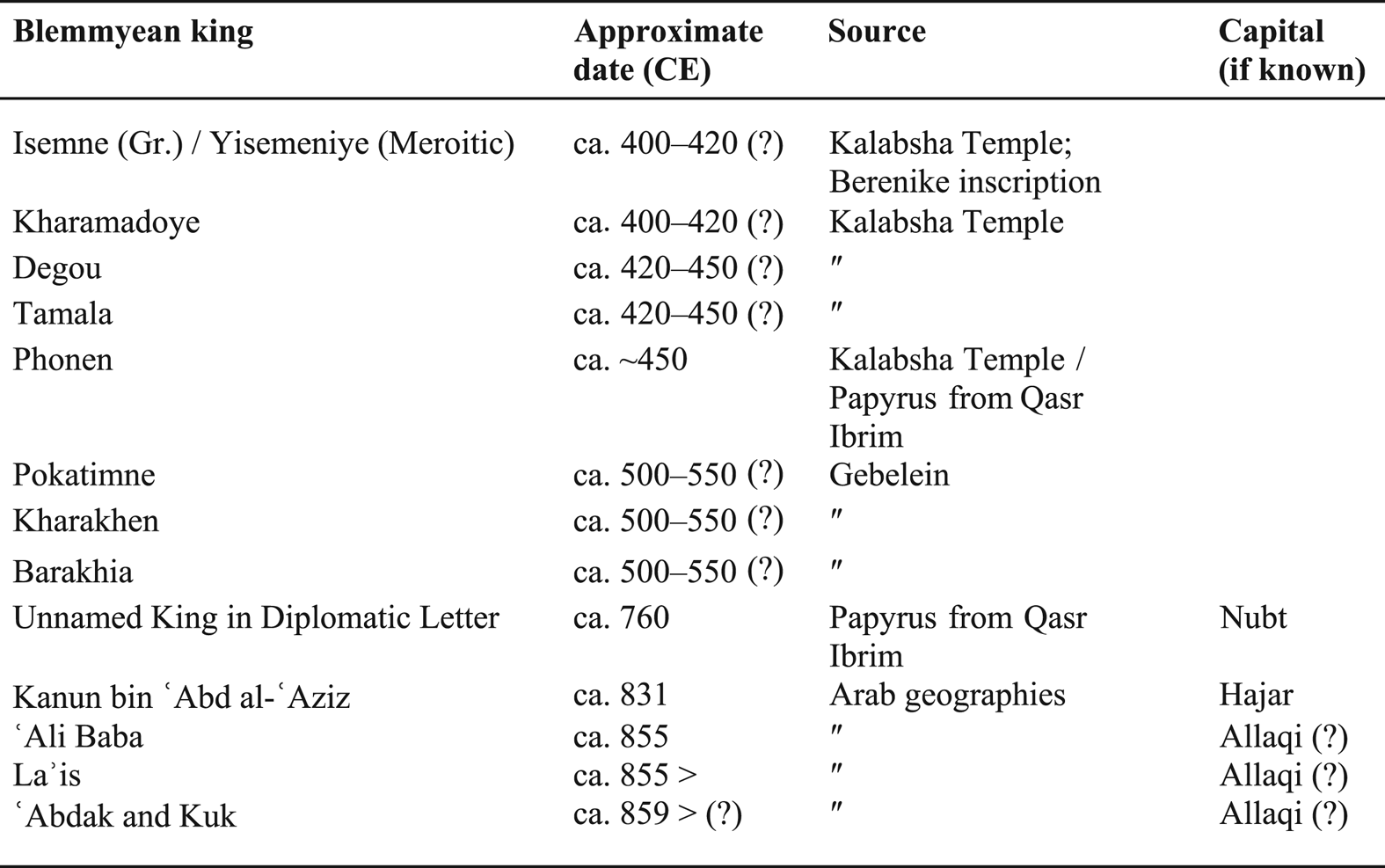
The Blemmyes had more in common in their kinship structures with pastoral nomadic societies elsewhere in East Africa and the Horn such as the Somali than neighbouring riverine Nile kingdoms. Even when they conquered part of the Nubian Nile, the Blemmyes never seemed to have lost any of their nomadic heritage nor the primacy of tribal and herding institutions. The Blemmyean state was not an urbanizing nomadic state that invaded and replaced local dynasties on the model of the Mongol-born Yuan Dynasty or Il-Khans of Persia. But it was still a nomadic state — a politically unified entity firmly bound to its pastoralist heritage and homeland.Footnote 101 For 500 years, the Atbai desert space was defined by a nomadic elite, complex hierarchies, and pronounced episodes of political opportunity and unity (see Fig. 5). The Blemmyean polity was therefore one of the most enduring confederated tribal polities traceable in the ancient history of Africa.
List of known Blemmyean-Beja kings and provisional dates. For dates of Blemmyean rulers in Greek and Coptic documents, see FHN III, nos. 300, 310, 311, 313, 319, and 331–43.