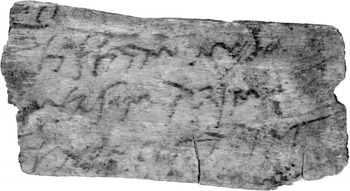
I. INTRODUCTION
This article is the second of two in which we publish the ink writing-tablets from Vindolanda discovered in the excavation seasons 2001, 2002 and 2003 which contain significant amounts of text, albeit in many cases very meagre and fragmentary.Footnote 1 To these editions we add a few brief descriptions of fragments with negligible amounts of writing (Descripta). Since we consider the texts in the present article to be, in effect, their editio princeps, we have described the article as Tab. Vindol. IV.2, and have numbered the texts continuously from those in Tab. Vindol. IV.1, beginning at 870. We have added a concordance and indexes to all the texts published in IV.1 and 2.
Most of the texts in the present article, like those in the previous instalment, have already been noted by A.R. Birley, who offered transcriptions for some.Footnote 2 The caveats about accepting some of these readings which were expressed in the previous article also apply here. We had intended that this article should contain only the remaining letters but, after the publication of the previous instalment, we noticed that there was one document (870), probably a military report, associated with a letter (871), both of which need to be published under separate numbers.Footnote 3
For details of the image-capture technology and the archaeological context, see Tab. Vindol. IV.1, pp. 189–91.
II. THE TEXTS
NB For editorial conventions used in the editions below, see Tab. Vindol. III, p. 19. All the texts in this article are written along the grain of the wood.Footnote 4 In the headings we record the dimensions in the form ‘(width) × (height)’.
MILITARY DOCUMENT (NO. 870)
870
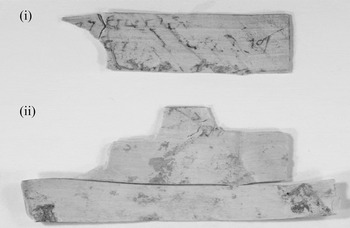
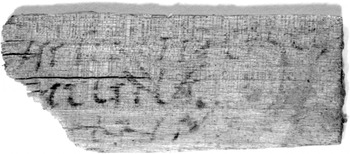
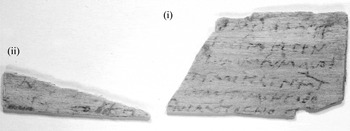
Inv.no. T02.13, Side A. BM Registration no. 2004,0501.55. Dimensions: (i) 56 × 15 mm; (ii) 77 × 28 mm. Period: II/III. Location: V02-19, below Rooms 1 and 2 of a Period IV structure. A.R. Birley Reference Birley and Birley2003, 104; 2009, no. 3.
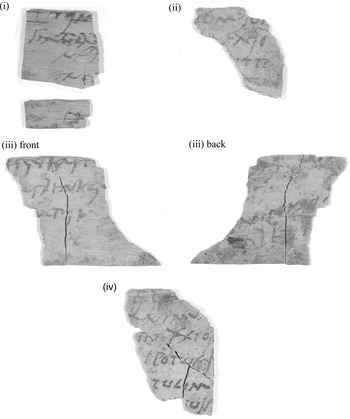
870. (i) 56 × 15 mm; (ii) 77 × 28 mm. Fragments of a military document.

Under this inventory number there are three fragments which contain on one side lacunose remains of what appears to be a military report, and on the other side the beginning of a letter (871). Two of the pieces join; the third does not although it is evidently written by the same hand, which leads us to believe that these pieces all belong to one tablet. We are uncertain about the order of priority of the texts, but think that the fact that the military report is cancelled by being struck through with diagonal lines suggests that this was the first text to be written and that the other side of the tablet was used for a draft of the letter. We, therefore, denote the military report as ‘Side A’ and the letter as ‘Side B’, noting also that the letter is written upside-down in relation to the report. Fragment (i) is probably complete at the right only; fragment (ii) only at the foot.
(i)
. . . . . . . . .
].. (centuriae) eiusdem vacat
].c.[ ]u…arios
] tops of letters
. . . . . . . . .
‘… of the same century …’
(ii)
. . . .
] ad [
].os …[
vacat
i.1. The traces immediately following the break could be read as ti, ligatured, whether it is nominative masculine plural (a collective noun) or genitive masculine singular (a soldier's name). The latter is more likely, since line 2 ends in accusative masculine plural, which would hardly have followed a ‘heading’ in the nominative. The centurial sign following that is clear, and the word eiusdem implies that the century has already been mentioned in the document and that there was some text preceding this line.
2. The traces at the right consist of a bold curve for u, a few indeterminate letters, then the diagonal of a probable a, a generous r, and the termination -ios. It might be possible to imagine ].  ṭṛạ[ns]uẹṛṣạṛios (cf. 862.8).
ii.1. The reading seems clear and, if correct, is another indication that this is a report of a military detail of the kind found in 858.6, 8 and elsewhere.
LETTERS (NOS 871–881)
871
Inv.no. T02.13, Side B. BM Registration no. 2004,0501.55. Dimensions: (i) 77 × 28 mm; (ii) 56 × 15 mm. Period: II/III. Location: V02-19, below Rooms 1 and 2 of a Period IV structure. A.R. Birley Reference Birley and Birley2003, 104; 2009, no. 3.
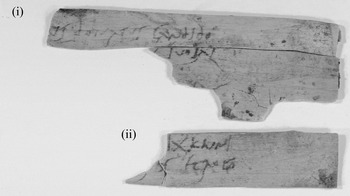
871. (i) 77 × 28 mm; (ii) 56 × 15 mm. Fragments of a letter.

A letter written on the other side of the tablet containing a military report (870; see the introduction for further detail). There are two joining fragments (i) which come from the start of a letter and a further non-joining fragment (ii) which can be aligned with the others. All are in the same hand: note the v-shaped u and the elongated left-hand diagonal of a, especially in sal (i.2). Fragment (i) has the start of a letter and is complete at the top. Side A (870) suggests it was complete at the right, where there is a large blank; so there was no second column, which suggests either a short letter in one column or, more likely, that the draft letter was discarded. To judge from Side A, fragment (ii) is complete at the right, but not at any of the other three edges.
(i)
]us Donatus Candido
] suo sal(utem)
one line blank
].ạṣ
].
. . . . . . . . .
‘[ ]us Donatus to his Candidus, greetings …’
(ii)
. . . . . . . . .
]ix k(alendas) Iuni
]as et rogo
. . . . . . . . .
‘… 24 May … and I ask …’
i.1. As Birley notes, the name Donatus is well-known but new to the Vindolanda tablets, and Candidus is frequent in the tablets.
2. The trace before suo, for which Birley suggests collega]e, is surely just the end of a long diagonal from a in Candido, and should therefore be discounted. Birley notes that it is unusual to find suo and salutem in the second line of an address, but there are eight examples in Tab. Vindol. II alone. He also reads salutem in full, commenting that the last four letters are very faint. We think that nothing was written here: the slight traces on the scan do not look like ink. However, the abbreviation of salutem is extremely unusual in the tablets, though common enough in MSS. The only other possible example in the tablets seems to be 298.a.2.
ii.1. It is surely pure coincidence that the extant part of the next line begins as. Either iuni was completed at the start of line 2 or the month-name was abbreviated. Kalendas is here abbreviated (as usual) and several month-names are abbreviated in the tablets, but we would expect the form of the abbreviation to be Iun rather than Iuni.
872
Inv.no. T01.34. BM Registration no. 2004,0501.33. Dimensions: 81 × 37 mm. Period: IV. Location: V01-42A, mixed debris and timbers from demolition of Period III and IV buildings, directly below the Period V cobbler's workshop. A.R. Birley Reference Birley and Birley2003, 94.
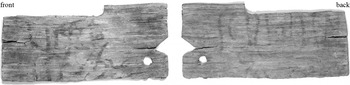
872. 81 × 37 mm. Fragment of a letter, front and back.

Two joining fragments, probably the top-right corner of the right-hand leaf of a diptych, since the top edge is apparently complete but the foot is broken, and the right edge with tie-hole and notch is complete; there is also part of an address on the back. Front and back are by different hands.
Front:
] u…io
] Seụero
] traces
. . . .
1. Birley reads a Vettio (cf. 305.ii.back 1, Vettio | Seuero), by interpreting a discoloration to the left mid-way between lines 1 and 2 as a, which he then links to 1 by seeing the line as slanting diagonally upwards, with the implication that it carries the sender's name on the back of a letter (for this format see Tab. Vindol. II, pp. 42–3). However, he recognises that the address (see below) is actually written on the other side. Moreover, the line does not in fact slant upwards.
We have no better reading to offer. The line ends like 2 with a diminutive o, preceded by i and possibly li, and is thus probably another personal name in the dative or ablative. It begins with u, formed like u on the back, but the second letter cannot be read as e. It resembles c, p or t, written over s; and it seems to have been followed by another correction involving t or tt and a second s.
Back:
Iụlio Vịn[di
ci vacat
traces
‘To Julius Vindex …’
1–2. The cognomen is not uncommon, but the addressee might be the Vindex who is associated with the prefect Cerialis in 260.7 and 631.b.2; see also 659.5 and 802.
873
Inv.no. T01.42(i) and (ii). BM Registration no. 2004,0501.37. Dimensions: (i) 108 × 13 mm; (ii) 30 × 6 mm. Location: V01-45A, the outermost Period 1 ditch. A.R. Birley Reference Birley and Birley2003, 99.
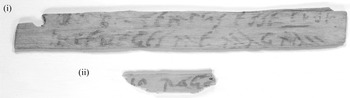
873. (i) 108 × 13 mm; (ii) 30 × 6 mm. Fragments of a letter.

Two small fragments, found together but not joining. They have only one letter in common, g, but since this is much the same in both, it is possible without being certain that they belong together. The larger fragment (i) is incomplete at the top and foot, but complete at both sides. The incomplete tie-hole on the left indicates that it is part of the left-hand leaf of a diptych. The back is blank, as might be expected, since the sender of the letter would have written the address and his name on the back of the other leaf. The smaller fragment (ii) is incomplete on all sides. The back is also blank. They were found with a third fragment (874) which is not by the same hand.
(i)
. . . . . . . .
trace
ṭạmẹṇ tempus esse ẹṭsị
intelleges me magnam
. . . . . . . .
(ii)
. . . . . .
].o rogo[
. . . . . .
(i) ‘… yet [?I say or I think] that it is time, even if you will understand that I [?have or fear] a great …’
(ii) ‘… I ask …’
i.2. tamen and etsi are mutually supporting in syntax, but neither reading is certain. The first two letters of the line are obscured by a curving descender from above, but the traces are compatible with ta. Then m is faint but visible, e has lost its top in the break, and n having lost its third stroke resembles a. So …mea is a possible reading. At the end of the line, etsi has lost the tops of its letters in the break, but the only difficulty is the short horizontal streak at the end, which suggests e but is rather low for it; also there is no curve in the downstroke, which is thus unlike e elsewhere. But ipse (emphasising the person of intelleges) is a possible reading.
On the reading adopted, tamen tempus esse would have been preceded by a verb of saying or believing in the first-person present indicative: dico, puto, etc. magnam would then qualify an abstract noun (cunctationem, moram, etc.) followed by a present infinitive (habere, timere, etc.) in oratio obliqua which expresses the writer's reluctance to act, even though he realises it is full time that he did so.
ii.1. The first letter might be u, perhaps for [den]uo (‘again’), but the tip of a letter followed by i is also possible.
874
Inv.no. T01.42(iii). BM Registration no. 2004,0501.37. Dimensions: 41 × 16 mm. Location: V01-45A, the outermost Period I ditch. A.R. Birley Reference Birley and Birley2003, 99.
874. 41 × 16 mm. Fragment of a letter.

Small fragment found with 873, but not in the same hand. Part of the right-hand leaf of a diptych, since the address was written on the back. The right edge is original, but not the top edge (since it cuts the address on the back) nor the foot (since it cuts line 3).
The hand is competent but undistinguished. In 1, note the upward-sloping crossbar of t, and the curve at the top of d.
Front:
. . . . . . .
] est si qụid c.rịs
]ṇt uale vacat
]ṃbrẹṣ vacat
. . . . . . .
1. It is tempting to read the place-name Coris at the end of the line, but the slight remains of the second letter suit a better than o. Perhaps therefore caris|[sim- ].
2. ]nt would suggest a verbal ending in the third-person plural. After it the sequence uale is unmistakable, and like Birley we take it to be the letter-ending, in view of the space at the end of lines 2 and 3. The horizontal stroke of e apparently extends downwards as if to form a cramped and diminutive s, but we take this to be dirt or perhaps a slip of the pen.
3. Possibly the end of a date below the closing greeting, as apparently in Tab. Vindol. III App. 242.ii.4; the month named would be September, November or December.
Back:
The first five letters of a name in address script, of which only the bottom half survives. Perhaps Iulio […], but the putative u looks more like s.
875
Inv.no. T01.47. BM Registration no. 2004,0501.40. Dimensions: 176 × 82 mm. Location: V01-45A, the outermost Period I ditch. A.R. Birley Reference Birley and Birley2003, 99.
875. 88 × 82 mm. Letter with list of names, left leaf.

875. 88 × 82 mm. Letter with list of names, right leaf.

875. 88 × 82 mm. Right leaf, back: part of the sender's name.

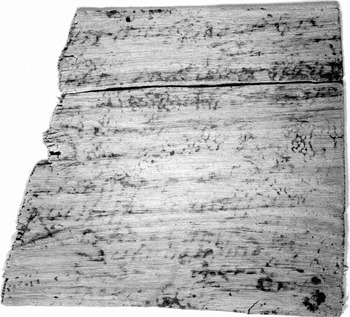
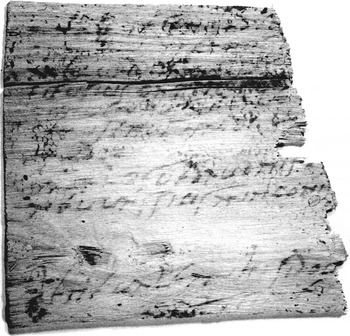
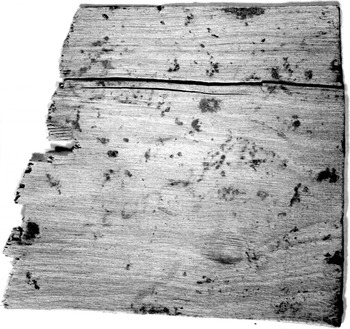
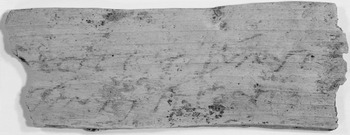
Two facing leaves of a diptych, complete at top and bottom and in the fold, but incomplete symmetrically at outer left and right. As Birley notes (2003, 87), it is unusually thick, at just over 2 mm. Since the beginning of i.8 is preserved, it can be estimated that the width at the foot is more or less original. The hand is strongly right-sloping. There are many dark marks which are not ink, and traces of an address on the back of the right-hand leaf.
In format this is a letter, but unusually it is a list of personal names. The reason was apparently given in the preamble (lines 3–8) which is now largely lost, but cf. Tab. Luguval. 16, a letter from a decurion to his prefect listing troopers who have lost weapons. However, this is not a close parallel, since neither writer nor recipient of 875 is identified by rank, and apart from the bureaucratic turn of phrase in 8, there is no sign that the letter was ‘official’.
Birley sees traces of five lines in 3–6, not four, so his line-numbering after 6 is one more than ours. In his transcript thereafter ‘it is difficult to see any real sense in much of what can be read at present, apart from the closing greeting’ (2003, 101), so we have seen little point in contesting it letter by letter. Our own differs almost entirely except in 9, 10, 21 and 22.
Front:
i
Dec]ụminus Ṣidoṇị  [r]atri ṣụ[o
salutem
traces
traces
5 traces
traces
ṇẹ essaria traces
qui infra ṣṛị ti sụṇṭ
vacat Candịḍị Ḥa….
10 vacat Adventi ..ṛindenṣ
vacat Mada traces
vacat Troụ.. Cessaụcius
ii
traces
 ạ traces
15 Me traces
Fifusius Carạṇṭ … .
traces
traces nus traces
traces
20 … .us Vedauonis
Neuuassius Minconis
vacat (2–3 lines)
m 2 bene uale mihi Sido ṛ[ater
vacat ḳarissime
Back:
] a Decuminọ
‘Decuminus to his brother Sido, greetings. […] necessary [?names of those] who are written below. Of Candidus … of Adventus … Cessaucius … Fifusius (son) of Carant[…] … […]us (son) of Vedauo, Neuuassius (son) of Minco. Fare well for my sake, Sido, dearest brother. [Back] … from Decuminus.’
1. The first letter is incomplete and visually might also be i, but the beginning of the writer's name is quite well preserved on the back; by collating the two, we are confident of Decuminus.
The name of the recipient, Sido, is repeated in the closing greeting (22) and presents a similar but less straightforward problem of collation. In 22 the sequence sido is clear, and since it is followed by sufficient remains of the expected fr[ater] (see below), we read the name there in the vocative (and thus the nominative) case as Sido. This Germanic name is well attested by Tacitus (Ann. 12.29, 30; Hist. 3.5 and 21) as that of a client-king of the Suebi who fought on the Flavian side in the Battle of Cremona (a.d. 69). Here in line 1, sido can still just be read although badly abraded, and it is followed by trace of one or two letters before f[r]atri. They suggest u or ci, but can also be seen as a cramped ni for the expected dative *Sidoni.
After f[r]atri, in which r has been lost but the last four letters are certain, there is apparently the tail of s and the first diagonal stroke of u. fratri suo is regular in letter-headings.
3–8. Decuminus must have explained why he was sending this list of names, presumably nomina qualified as ‘necessary’ (necessaria, 7). The phrase in 8, qui infra scripti sunt, is the only hint of military bureaucracy, but is not peculiar to it.
9–12 are indented, so as to mark the beginning of a list which continued until the end of the letter. So far as it can be reconstructed, it consisted of two names per line, one of which was in the nominative case, the other in the genitive. This combination is best seen in 20 and 21, but the remains elsewhere are consistent with it, given that in Col. i the sequence was reversed, with the first name in 9 and 10 being genitive, the second name in 10 and 12 being nominative. The persons named were evidently men identified in peregrine fashion by their father's name.
9. There is not enough space for the nominative Candidus, and the traces preclude it. The name is frequent at Vindolanda, and no identification is possible.
10. Again, the genitive Adventi must be read, not the nominative Adventus. In the next name there is quite good evidence of rindens (already read by Birley), but this sequence is not found in any known name. Before it, the first letter is indeterminate, but the second looks like h, which would suggest an aspirated Germanic name.
12. After trou there is trace of two letters and space for a third; the first has a descender and can hardly be c, which would exclude Troucisso (App. 182, noting the masculine name Troucissa in CIL III, 4146), which is also too long. Another possibility is a variant of the Germanic name Trupo (RIB I, 2063, whence (centuria) Thruponiana, RIB I, 1556), but the nominative *Troupo would be precluded by the next name being in the nominative case, while there is not enough room for the genitive *Trouponis.
The next name, Cessaucius, has already occurred at Vindolanda (312.back 2), but is otherwise unique. It is likely to be the same man.
16. The name Fifusius is unattested, but the reading is good. It is followed by the well-attested Celtic name Carantus, in the genitive case presumably, which has already been found at Vindolanda (Britannia 39 (2008), 384, No. 19).
20. The name Vedauo is unattested, but was presumably formed from the name-element found in Veda (RIB I, 191), Ved[…] (RIB I, 639), and Vedian[us] (CIL XIII, 8266), with the suffix avo-s.
21. The name Neuuassius (already read by Birley) is also unattested, but must belong to the large group of names containing the element uasso-s. Its first element is perhaps found in the feminine name Neuica (CIL V, 453); cf. also Neuissati[us] (CIL V, 1316).
Birley reads the second name as minconi, but the downstroke of the final s is quite clear. The name Minco (whence the genitive Minconis) is found as Minc[…] in a contemporary graffito from Vindolanda (Britannia 36 (2005), 494, No. 62), and is likely to be a variant of the name from which the gentilicium Minuconius (CIL V, 6953, Turin) was derived; cf. also the Cisalpine river-name Mincius, found as a cognomen in CIL V, 4908.
22. This is the first instance from Vindolanda of mihi being added to uale in the closing greeting, but uale mi is frequent, and in our note to 635.3–4 we follow Adams (Reference Adams2003, 547) in regarding mi here as the contracted form of mihi, a dative of advantage. This identification is now confirmed.
After Sido (see above, note to line 1), there is a letter which looks just like f in Fifusius (16) without its tail, which can easily be read as f followed by r. This must be fr[ater] of which there is no sign in 23, since in the closing greeting at Vindolanda karissime is always preceded by frater (or soror or domine where appropriate); in 242.ii.2–3, the only apparent exception, it was lost when the edge broke away.
Back:
Written on the slant, and thus the name of the sender. Initial d shows better in Birley's photo than in our scans, but he reads decurione. However, m looks better than rio, and a rank without a name is most unlikely; moreover, there is a good overlap with the name as transmitted in line 1.
876
Inv.no. T01.55. BM Registration no. 2004,0501.46. Dimensions: (i) 50 × 28 mm; (ii) 42 × 12 mm. Location: V01-45A, the outermost Period I ditch. A.R. Birley Reference Birley and Birley2003, 102–3.
876. (i) 50 × 28 mm; (ii) 42 × 12 mm. Fragments of a letter.

Two fragments which appear to be in the same hand and to belong together, but which do not join. Since both have writing on the back, they should both be from the right-hand column of a letter. (i) is complete at the right and (ii) at the left. (i) may also be complete at the top (see below on the back). Part of a tie-hole and a v-shaped cut are preserved at the foot of (i), which suggests that it is the top half of the tablet. The hand is competent but unremarkable, except for the prolonged upper diagonal of a (i.4).
Front:
(i)
]d mihi .. ṣe
].ṛem et pen-
].ịum meum quod
].as mihị ịn ma-
5 ] cum homine ido-
] enim hoc nos.[
. . . . . . . . . . . . . . . . . .
1. h in mihi is made differently from the way it is made in 4 and 6 (which are again different from one another), but it is made in a standard way of writing it in Old Roman Cursive, and mihi looks certain. Before it most probably sed or quid. There are four or five letters after this, the last of which is e with a probable xs to precede it; the letters between this and mihi are difficult. We tentatively suggest the future perfect or perfect subjunctive of dico; the spelling is not a problem, but it is far from easy to read di.
2. ].ṛ em: after the break perhaps e, suggesting m]ẹṛ em, which might suit the context.
3. The trace of the letter before ium might fit d, which suggests stipen]ḍium. In which case we could well have some form of pendo/penso/pensito before it, e.g. et pen|[de stipen]dium meum, but we do not know how much is lost at the left.
4. ].as: the reading would appear to be ]cas, but we would not wish to rule out ]ṭas. If so, we suggest quod [rogo (ut) mit]tas mihi, which makes good sense. mitto is also one of the commonest verbs in the tablets. remittas is another possibility. mihị: there is something odd about the last letter which has more at the foot than would be expected in i. ịn ma-: this is the obvious reading and looks as though it would construe without difficulty (see below), but we cannot suggest a convincing supplement. Perhaps simply in ma|[nibus (‘in hand’).
5–6. Clearly we must restore ido[neo.
If the above suggestions are accepted we might venture the following translation for 2–6: ‘… and pay my wages, which please send to me in … along with a suitable person’.
6. nos.[: nostr- is not probable and the switch from singular to plural is unexpected. Possibly we have some form of nosco, perhaps with tu before enim to precede it.
(ii) A triangular fragment with one line and the start of a preceding line at the left.
. . . . . . . .
ṇ traces [
ṣ.. e o .e..[
. . . . . . . .
1. If n is right, there may well be the tail of a descender from a line above at the left.
2. The line seems to be indented in comparison with the one above. Birley reads cuị ego de, which is possible.
Back:
(i) seems to be complete at the top (and left). It has traces of two lines of writing, the second but not the first in address script. We should therefore expect the first line to give the place to which the letter is being sent and the second line the name of the addressee (so Birley).
We might, with some imagination, read the top line as Ṿị[n]ḍ[o]ḷand[ae, with a pronounced curve to the top of d (despite Birley).
For the addressee Birley suggests Cạmmị[o and we agree that it begins Cam. After that we suggest alị[. The names Camalus and Camalius are well attested in Spain.
(ii) presumably comes from the back of the same column and so must belong below (i), though without joining. We agree with Birley that the last two letters might be ef; but this is very uncertain and we would not wish to hazard pra for the traces preceding. Another possibility would be to read the last two strokes as ii, i.e. as a numeral, with c]ọḥ at the start of the line.
877
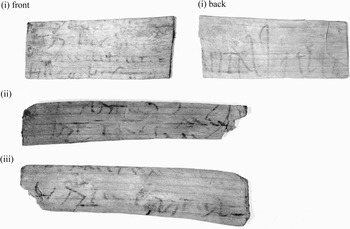
Inv.nos T02.33 = (i); T02.44 = (ii) and (iii). BM Registration nos 2004,0501.67 and 74. Dimensions: (i) 63 × 26 mm; (ii) 80 × 18 mm; (iii) 81 × 14 mm. Location: V02-19A, floor debris of a Period II/III building, probably a barrack room, below the Period IV praetorium. A.R. Birley Reference Birley and Birley2003, 108, 113.
877. (i) 63 × 26 mm; (ii) 80 × 18 mm; (iii) 81 × 14 mm. Fragments of a letter.

Fragments (i) and (ii) + (iii) have separate inventory numbers, but we are certain that both are written in the same hand and think it most probable that they come from the same letter, even though they do not join. (i) is a small fragment from the right-hand leaf of a letter, since part of the address survives on the back. Probably all four edges are incomplete; there is a straight edge at the left, but the writing is very close to the edge and we think it quite likely that we do not have the start of the lines preserved. (ii) and (iii) are two non-joining fragments, written in the same hand and no doubt from the same tablet as one another and probably the same tablet as (i). Each has a line or two of a letter. (ii) is complete at the left and (iii) at the right; both are incomplete on the other three sides. (iii) is no doubt from a right-hand column for it contains a closing greeting; it may well belong below (i), but we cannot see any trace of the address on the back. It is very likely from the way the fragments are broken that (ii) is from the corresponding left-hand column.
The hand of the fronts of all the fragments is rather crude (old-fashioned?). It uses the stilus-tablet form of e with two backward-slanting strokes (\\); a has a third, downward stroke, sometimes exaggerated (see Tab. Vindol. I, p. 58, no. 2); b and r can be ‘stunted’.
(i)
Front:
. . . . . . . . . . . .
traces
]ịtạ h.c traces [
].arebiṭ ut .[
].uo.is..[
. . . . . . . . . . . .
3. The initial sequence is quite well preserved, and precludes reading u before the verbal ending -bit. The verb might then be [ap]  arebit or arebit.
4. The first surviving letter looks most like h, in which case we should have to read huc or ad]huc. In neither case can we then suggest anything plausible for what follows. We have therefore considered the possibility that the line is incomplete at the left (see the introduction) and that the supposed h is to be taken as it. This points to a personal name, presumably [T]ituconis, the genitive of the Celtic name Tituco attested in Noricum (CIL III, 11646 = ILLPRON 75, Deuignata Tituconis filia; cf. 105, Titu[…] and 348, Tituca), whence the gentilicium Tituconius (CIL XIII, 11826, Mainz).
Back (in address script):
. . . . . . . . . . . . . .
] Vitali sepla[siario
. . . . . . . . . . . . . .
‘To Vitalis, pharmacist …’
If the tablet is complete at the right (see the introduction), seplasiario will have been completed on the line below. The addressee can be identified with Vitali seplasiario in 586 i.7, where the meaning of this term is discussed. cf. Britannia 22 (1991), 299, no. 24 (Carlisle), a stilus writing-tablet addressed Albano seplasiario.
(ii)
. . . . . . . . . . . .
traces
rater me[
.at..e ịạm [
traces [
. . . . . . . . . . . .
The writing slopes downwards.
1. Tails of three long descenders at the right.
2. No doubt me[us.
3. The first letter seems to be i, but it would be very surprising to have a word break such that the line began with iat. iam: although the bottoms of the letters are lost, iam is certain (not etiam for the stroke between e and i is the tail of r from the line above). Perhaps no more than te iam.
4. A couple of ascenders are visible.
(iii)
. . . . . . . . . . . .
]…ṃet.m vacat?
] uale frater
. . . . . . . . . . . .
2. The hand does not appear to change for the closing greeting.
878
Inv.no. T03.3. BM Registration no. 2004,0501.93. Dimensions: 57 × 20 mm. Period: III/IV. Location: 12A, laminated material in the north-west corner of a structure immediately to the south of the Severan praetorium. A.R. Birley Reference Birley, Birley and Blake2005, 83; 2009, no. 8.
878. 57 × 20 mm. Fragment of a letter.

A fragment containing two lines of a letter and a trace of a third. It is almost certainly complete at the top but broken on all the other sides (although this is less certain for the right-hand edge). The apparent remains of a tie-hole at the left are probably misleading: this must be just the way the wood has broken. The fragments must be from a right-hand column (not the left, as in Birley Reference Birley2009) because of the traces of writing, which we take to be the remains of an address, on the back. Birley's readings are mostly incorrect, as is his understanding of the placing of the fragment as the opening of a letter.
] ạcciịeṣ sumsi[
]ṣsimiṣ ẹṭ orn..[
] traces [
. . . . . . . . . . . .
1. We are reasonably confident of accipies, although the second i is more curved than one might expect.
The line might continue sum si (divided), but the syntax would then be still more difficult. sumsi for sumpsi is not problematic: the assimilation of ps to s is a common Vulgarism; ILS offers many instances of p lost after m, including sumsit (5040) and other parts of sumere and absumere. It is not necessarily the whole of the word; if it is right, we suppose that it began a new clause or sentence.
2. The readings are far from certain. If they are on the right lines we imagine, e.g., a reference to amicis karissimis et Cornelio …, which would be appropriate at the end of a letter. Instead of et c, Birley's fac is possible, but it is not followed by iat.
Back:
Traces of one or two lines of writing, the second very exiguous (including a tall ascender). We should expect this to be the name or title of the addressee, although it does not seem to be in address script. The traces at the left in the upper line seem to include a and perhaps s or f, and might be compatible with praef, which is often not written in address script; but although the first of the following traces looks like c, it seems impossible to fit them to all or any part of cohortis.
879
Inv.no. T03.14(1). BM Registration no. 2004,0501.101. Period: IV. Location: V03-38A. A.R. Birley Reference Birley2005, 84.
879. Fragments of two leaves of a letter.

Part of two fragmented leaves of a diptych. The left-hand leaf (Col. i) is represented by three joining fragments; the left edge and probably the foot are original, but the other two edges are incomplete. The right-hand leaf (Col. ii) is represented by two joining fragments; the right edge and probably the foot are original. It is identified by the remains of the closing greeting and the uninscribed space below, and a series of vertical lines scored on the back may be the illegible remains of the address.
Like most of the other fragments (see below), this diptych is inscribed in a good hand with cursive features: note the ligatures in uikario (i.4) and ualeret (7), and the cursive form of r in uikario; in confestim (6), s is made with a downstroke which continued upwards in a loop, and the cross-stroke of t does not project beyond the vertical. The hand is similar to and may be the same as the hand responsible for 888.
There are also eight unplaced fragments, (a) to (h), some of which may not belong to this letter. A small fragment (a), which may belong to the first line of a letter (see below), is probably in the same hand. Two larger fragments, (b) and (c), are certainly in the same hand, but cannot be placed with any confidence; all four edges of (b) are broken, but the right edge of (c) seems to be original. Three small fragments, (d), (e) and (f), are too slight to be identified by their hand. (d) is apparently the top right-hand corner of a leaf, and both lines end with an interpunct, of which there is no sure instance in Cols i and ii, which suggests that it belongs to another text. (e) and (f) do not conjoin, but look as if they belong to the top of a leaf. A larger fragment (g) has traces of address script on one side, but is blank on the other, so it can hardly belong to this letter. Finally a small fragment (h) is not inscribed at all.
(i)
. . . . . . . . . . . .
.[
excita [
eṭ ..hi dẹt[
4a vacat aend[
uikario ut poss[
5 mandaui ẹffị[cere
confestim e[t
bene ualeret[
m 2 in the left margin, traces of four line-endings
(ii)
. . . . . . . . . . . .
o]pto . bene ro
] habeam vacat
vacat
(a)
]s fla[
. . . .
(b)
. . . . . .
]ạṛạṭum hab[
. . . . . .
(c)
. . . . .
]ṭẹm
] mei
]ẹa quae
. . . . .
(d)
]as .
]ạs .
. . . . .
(e)
]e.[
. . . . .
(f)
]. [
. . . . .
i.1. The tail of a sweeping descender runs from the top edge to the left edge of 2, and probably belongs to the first letter of the sender's name in ekthesis as often.
2. excita is apparently complete; a space follows, and the fine upward line from the end of a is probably owing to the lifting of the pen. Thus the imperative, ‘rouse up’.
3. hi is very clear, i being made with a long downward sweep to mark the end of a word. Birley reads et mịhi, which is what we would like to do, but the putative m is quite unlike m elsewhere and resembles a ligatured to t (or p). There is not really space for i after it. The letter between d and t is almost certainly e, whether for the preposition de or part of the next word; it is not a as read by Birley.
4a. Between lines 3 and 4, agend[ was inserted, its position suggesting that it was to be understood after uikario (4). It is unclear whether it was the accusative agend[um] or agend[a], presumably the object of effi[cere] (6), or the genitive agend[i] or agend[orum] defining uikario (‘to the deputy responsible for the business to be done’).
4. The first letter looks superficially like n, but the apparent incomplete descender belongs to the writing in the margin (see below). uikario is a variant spelling of uicario with medial k for c, well attested in the epigraphy of imperial slaves described as uicarius. This word is occasionally found as a cognomen, but here the sense of ‘deputy’ or ‘agent’ (in the dative) is guaranteed by mandaui (5, ‘I delegated’). It is often used in this general sense, but also in particular of one slave bought by another to be his ‘replacement’. In the imperial household this sense was extended into a grade or title often applied to imperial slaves who exercised a delegated financial authority especially in the provinces (Weaver Reference Weaver1972, 200–11). Such a uicarius called Vegetus is attested by a writing-tablet from London (Tomlin Reference Tomlin2003), and we have suggested that after manumission he became the Cocceius Vegetus who receives 352 (see Tab. Vindol. III App. 352). Note also Cocceius Maritimus, the recipient of 645, a letter which refers to ‘business’ with the Caesariani (imperial slaves and freedmen).
uikario is followed by a final clause, ut poss[em] or ut poss[et], ‘that I [or he] might be able to …’. It is not clear from the immediate context whether this subjunctive was present or imperfect, but the imperfect is required by ualeret in 6 (see below). The verb infinitive governed by poss[em] or poss[et] is evidently effi[cere] (‘achieve’), with its adverb confestim (‘immediately’) postponed for greater emphasis. The object of effi[cere] has been lost, and it is tempting to supply ea quae from line 3 of the detached fragment (c), and to read ut poss[..] ea quae | mandaui effi[cere] | confestim (‘to achieve immediately what I delegated’). But syntactically it would then be difficult to fit lines 1 and 2 of (c) to Col. i.2–3, and another possibility is agend[um] or agend[a] (see note above to 3a).
7. The letter before the break is t, but Birley reads it tentatively as d so as to detach the sequence bene ualere as part of a closing greeting; this also requires him to read te tentatively at the beginning of the line, but only because he has consistently been unable to locate the left-hand margin of Col. i. However, this is clear in the scans we have used, and there is no doubt that 6 begins with bene. Since also there is good evidence of the closing greeting on the other leaf (see below), the subjunctive ualeret can be taken as dependent on ut in 3: e[t ?res | bene ualeret (‘… and that the business might fare well’).
In the left margin, from midway between lines 2 and 3 to midway between 4 and 5, there are the ends of four lines of writing cut by the left edge. The first ends in ]at, a verbal ending; the others consist of 2–3 letters of uncertain reading. Since these letters are somewhat smaller and written by another hand, and the lines are more closely spaced vertically, they cannot belong to the main text. We conjecture that they belong to another diptych from which this leaf was salvaged.
ii.1. The letter b is now incomplete, but the upper portion of its loop and the sinuous second stroke survive, so Birley's f for fenero is not possible. As he points out, however, the space after and below habeam shows that the letter ended here. [o]pto, like bene, is appropriate to a closing greeting, which we would restore here as [o]pto bene ro|[bustum te] habeam (‘I hope that I find you well and hearty’). For this formulation cf. Cicero, In Q. Caecilium 48, ‘uideo eum esse bene robustum’.
a. There is a space between ]s and Fla[, which suggests the end of a personal name in the nominative and the beginning of another, conceivably in a letter-heading. Fla[ naturally suggests the frequent gentilicium Flauius, but when one Roman citizen wrote to another, he conventionally suppressed the recipient's gentilicium in the letter-heading (thus, for example, 261.1, Hostilius Flauianus Ceriali); so Fla[ is probably a cognomen here, whether that of the writer himself or the recipient. Cerialis’ correspondent Hostilius Flavianus (ibid., and cf. 714.b.1n), perhaps to be identified with the prefect(?) Flavianus (172), comes to mind.
b. In this hand it can be difficult to distinguish between a, p and r, but Birley's reading pratum (‘meadow’) is not possible, since another letter to the left is ligatured to his putative p. The object of the verb habere is unclear; it might be the past-participle passive paratum (‘prepared’) or [com]paratum (‘bought’), making the verb an auxiliary, or simply [ap]paratum (‘equipment’).
c. Since line 1 may well be a word-ending, and 2 and 3 end in complete words, with quae significantly cramped into 3, the right-hand edge seems to be original. In 1, the reading ]tem is not certain, but one of many possibilities would be [salu]tem, formulaic at the end of the second line of a letter. This is another reason for hesitating to place this fragment somewhere to the right of i.1–3 (see above).
880
Inv.no. T03.15(2). BM Registration no. 2004,0501.102. Dimensions: 55 × 36 mm. Period: IV. Location: V03-38A, in a drain at the southern end of Building 2, Room 4, probably the centurion's quarters in a barrack-block. A.R. Birley Reference Birley2005, 90; Reference Birley2009, no. 9.
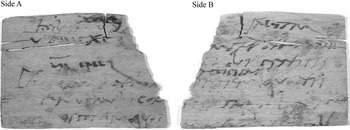
880. 55 × 36 mm. Fragment with two drafts of a letter, front and back.

This fragment has text on both sides and is complete at the left margin of Side A (the back of the right margin of Side B). The relationship between the texts on the two sides is difficult to elucidate, as are the texts themselves. Our readings differ significantly from those of Birley, and we do not see this as ‘a fragmentary letter referring to calli’ (2009, 284).
We think that both sides contain drafts of a letter which have some words in common and are the work of the same hand. The first hand is noticeably cursive; e.g. on Side B in salutem the u is a tiny hook and e is missing its top; in do]mine there is a marked serif on i, also nobis (3) and in (5). The side which we have designated A, however, also has the remains of an account written by a different hand. The draft letter on Side B appears to be an improved, though not perfect version of the text on Side A, although it is awkward to accommodate the fact that the latter has part of a phrase which does not occur on Side B. Our working hypothesis is that the account was written first on Side A and that a second writer used that for a first draft of his letter, without erasing the account, and then turned over and wrote a second draft on Side B, perhaps omitting some words which had originally been included on Side A. If this letter is a draft of a request for ‘lodgings’, the only parallel at Vindolanda is 632 (to Cerialis), where again a special sort of lodging is requested.
This fragment was found with three small fragments (889), which are not by the same hand.
Side A:
. . . . . . . . . . . .
traces
m 1 vacat x..vi [
m 2 hạbeam uḅ.(.)[
m 1 vḍ… cxc ṣ(.)[
5 vi. .r.(.). vacat [
m 2 peto domine de bọn[itate
tuá ut mihi con[
họspitiụm quod [
. . . . . . . . . . . .
Side B:
. . . . . . . . . . . . . . . .
m 2 ] vacat salutem
do]mine de bọṇịṭạṭẹ
] nobis praestes
4a ] accipi…
ho]spitium quod est
5 ]st.. inqụ.l..um
].n.ṣẹṣ. c.8 ḅe
. . . . . . . . . . . . . . . .
Side A:
1. One or two descenders only.
2. The numeral may have been deleted. Our preference is to read x  vi, but it is not easy to do so; however, there is too much ink for xxvi.
3. habeam: m is certain and the reading is secure although the first a is made by extending the horizontal of h downward to form the diagonal downstroke and then writing the second vertical of h afterwards at the left. This does seem to be the work of the same hand as lines 6ff. and certainly not the hand of the account. But it is unclear how habeam fits and what follows it. After u, which is certain, we can only have b or d; if it is d, udones would be attractive (cf. 346.i.2), but the trace of the third letter does not seem compatible with o; therefore perhaps ubi. The draft of the letter on Side B corresponds to what begins at line 6 on Side A, so habeam looks as though it must belong to a draft of a different letter, or to a variant and earlier draft of the same letter. We prefer the latter.
4. There is a horizontal bar over v which should mean it is the day of the month, but it is hard to interpret the account as a sequence of dates since the numeral in line 5 (also barred) is vi.. At the right we think the numeral must be cxc and the first c is lighter because after writing it he dipped his pen in the ink again. We are not convinced by Birley's reading of calli (‘hides’) after the barred numeral v. It looks most like d at the start, and then the \\ form of e is a possibility; but we cannot suggest anything convincing. The scan shows a possible faint trace of s after the numeral. If the numeral is vi, the l-shaped letter is this man's way of writing terminal i; which suggests that the next word in line 5 also ends in i. Even if Birley's calli were possible, the numeral would surely have followed.
5. Again a horizontal bar over the numeral vi. (see note to line 4). As for what follows, we can see how Birley arrived at calli, but think r much more likely than a for the second letter and, as he points out, if it were right here and in line 4, it is made quite differently in the two places. pre. with the \\ form of e is possible, but we cannot see how this could yield sense with the final letter as a terminal i comparable to the final digit of the numeral; otherwise possibly prel( ), a wine- or oil-press (prelum).
6. See Side B.2 and note. The large p clearly belongs with this line (so Birley). For comparable and contemporary usage of bonitas, see Pliny, Ep.10.4, 94.2. The fragmentary 719 contains the words bonitas and indulgentia.
7. There is an apex over a (see Tab. Vindol. II, pp. 56–61; Adams Reference Adams1995, 97–8). The differences from what is written on Side B are mihi for nobis and con[ for praestes. The latter suggests a reference to procuring accommodation and there are several possibilities for restoration, including conpares and constitues.
8. o in hospitium is a correction or remade.
Side B:
1. There is presumably a line lost above this. Birley says there is a trace of a letter above this line, perhaps o, but we think this is probably dirt or surface damage.
2. Before domine the draft on Side A suggests peto, with the subjunctive praestes in the next line. Although we have dotted most of the letters we are confident that de bonitate is right and makes sense, with tua restored at the start of the next line.
3. There is an apparent mark over o but it should probably be ignored. Despite Birley, the readings are certain. At the start after tua supply ut (see Side A).
4a is clearly inserted between the lines, just possibly by a different hand although we have not designated it as such; there ought to be 4–5 letters lost before it. We do not see how we can read Birley's accipiunt and we think that the best possibilities are accipient, accipiant, and accipi{s}as. Against the first two is the fact that the third letter from the end looks very much like s, is very hard to read as a, and is quite unlike the other example of that letter in this word (and it certainly cannot be u); also the abrupt plural of accipiant is difficult to explain. If we accept accipi{s}as we would have to suppose that he wrote accipis, then realised he needed the subjunctive, and corrected to accipias (cf. praestes) without deleting the redundant s. accipias (like con[ in A.7) is apparently an alternative for praestes: ‘if you accept a lodging on our behalf’, as being more polite than ‘if you provide us with a lodging’.
4. There seems no reasonable alternative to hospitium, but unfortunately it is a couple of letters short if the other restorations are right; perhaps therefore preceded by id or hoc.
5. We think we can plausibly read stṛạ here and so presumably have to choose between castra and nostra. We suggest that castra makes good sense, though if this is a draft letter to be sent elsewhere, the fort is not necessarily Vindolanda. (For Vindolanda as ‘castra’, see 156.5; 300.4–5, ad castra; 668.2.) It presumably locates the hospitium close to the castra, judging by the likely space. The next word is difficult, but we think inquilinum compatible with the traces, given that the sequence undoubtedly begins with inqu, has a clear l, and ends in um. The sense requires a qualification of [ho]spitium in relation to [ca]stra, meaning ‘near’ or ‘convenient for’: e.g. uicinum, contiguum, proximum, propinquum. For the sense cf. Seneca, Ep. 56.4, a catalogue of the noises which beset his lodgings over a bath-house: ‘pono et fabrum inquilinum et serrarium uicinum’, where inquilinum is clearly a synonym of uicinum, ‘including the local faber and the neighbourhood serrarius’.
6. We cannot read Birley's uale though the final traces are compatible with be or le.
Proposed reconstruction of lines B.1–5
[A to B] | salutem. | [peto, do]mine, de bonitate | [tua ut] nobis praestes ‘accipi{s}as’| [id ho]spitium quod est | [ad ca]stra inquilinum | …
‘[A to B], greetings. I ask of your goodness, my lord, that you provide [accept] for us that lodging which is local to the fort …’
881
Inv.no. T03.16(1). BM Registration no. 2004,0501.103. Dimensions: 45 × 23 mm. Period: IV. Context: V03-38A. A.R. Birley Reference Birley2005, 91; 2009, no. 10.
881. 45 × 23 mm. Fragment of a letter.

The front has the remains of five lines of a letter, complete at right with part of a semi-circular nick. We do not know how much is missing at the left. The hand has cursive features with some ligatures. As there is an address on the back this will be from a right-hand column. It is probably near the top, since the back is part of the name of the addressee.
Front:
. . . . . . . . . . . . . .
] traces
].(.)eṭ feram mọdo
].mensum agimụṣ
].ṭe non ceṣ.a.ent
5 ] traces
. . . . . . . . . . . . . .
1. Traces of some six letters at the left. Birley reads ]. i[, which is possible but not probable. There is a horizontal line between this line and 2, extending as far as the end of feram; we can offer no explanation for it.
2. Birley reads si before feram, but e is certain. If the letter following is t, it has a tiny cross-stroke; this seems more likely than ei. modo: there appears to be a diagonal through the first o which is perhaps a descender from the line above. As a translation perhaps ‘I shall soon bring’.
3–4. Birley's readings are not correct and there is no reference to caduca (‘void’, of a legacy).
3. mensum: this could be the genitive plural of mensis, but the verb which follows immediately, if the reading is right, makes an accusative singular more likely. There are numerous possibilities; we might, for example, have an expression such as immensum agimus negotium (‘we are engaged in an immense business’). We are confident of agim. In which case the only possibility would seem to be agimus, although us is not obvious.
4. If the reading suggested is correct we presumably have to read non cesṣaṛent, but r is far from easy.
5 seems to end in s, perhaps es.
Back:
One line and faint traces of a second.
In the top line there is a clear o, which is preceded by the descenders of some seven letters in address script. This must be either the end of the addressee's whole name or of his gentilicium. There are too many strokes for it to be Birley's flauio; after it his p is possible, but f looks better.
The traces of the second line, where Birley reads praef, are too scanty for us to venture a reading.
DESCRIPTA (NOS 882–889)
882
Inv.no. T01.51. BM Registration no. 2004,0501.43. Dimensions: 52 × 28 mm.
Small fragment with all sides incomplete. There are traces of three lines of text, but they are too badly preserved and too ambiguous to be transcribed. There may also be traces on the back.
883
Inv.no. T02.1B. BM Registration no. 2004,0501.87.
Eleven small fragments with traces of writing by at least two hands. There is nothing on the backs.
(i) Only two fragments join: .abes cuṃ[ / guṃ.[
There is rather a wide margin to the left, but not an original edge. Only one letter has apparently been lost in line 1, but the slight remains do not support h (for habes). A third fragment (ii), apparently by the same hand, carries part of three letters, perhaps ]cc.[
(iii) Fragment of the right leaf of a diptych, judging by what seems to be the lower edge of a binding-notch in the right edge. Inscribed in another hand: traces / ]rṃịre vacat
(iv) Very small fragment: ]ạcoiu[
Perhaps the end of a place-name, -aco, followed by a tense of the verb iubeo.
(v) Nothing can be made of the other seven fragments. One preserves the tops or bottoms of 3–4 letters. Two carry illegible traces of 1–2 letters. One carries a fleck of ink. The other three are blank.
884
Inv.no. T02.20. BM Registration no. 2004,0501.60. Dimensions of largest fragment: 36 × 16 mm. Period: II/III. Location: V02-24A (the same as V02-19A), floor debris of a Period II/III building, probably a barrack room, below the Period IV praetorium. A.R. Birley Reference Birley and Birley2003, 106.
Front:
One large fragment with 3 lines of writing, complete at right. Two smaller fragments, one placed immediately to the left of the large fragment where it seems to join. One loose fragment with a trace of ink only. Noticeable word division. The ink has faded badly: ].ẹṛ ad uọṣ / ]uṃ ḅene .ạ. / ]..et tuạṣ
2. bene is very probable and may be followed by  a .
3. tuas is uncertain and does not fit well with uos in line 1; we have also considered tuṇ .
Back:
There seem to be some traces on the main fragment, suggesting part of the address of a letter, but nothing legible.
885
Inv.no. T02.34. BM Registration no. 2004,0501.68. Period: II/III. Location: V02-19A, floor debris of a Period II/III building, probably a barrack room, below the Period IV praetorium. A.R. Birley Reference Birley and Birley2003, 109.
Six fragments, of which (i) and (ii) certainly join, and (v) and (vi) may. They may all belong to the same document, which is no doubt a letter.
Front:
(i) + (ii) Complete at the left where there is part of a v-shaped notch: traces / ……fli…..[ / .[
(iii) Probably blank on both sides.
(iv) Complete at the left with a margin. Three lines of writing with a descender from line 1: traces / au.no..[ …eṭ..[ / nunc [
2. aut non may be possible.
(v) + (vi) Part of three lines, again with a possible descender of line 1: perhaps complete at the right: ] 2ụọ / .eṣ..ạuer[ / su.ṃ.f traces /5..ọ.[
3. Possibly ita uer[
Back:
There is some writing on the back of (i) + (ii) and (v) + (vi), but nothing legible.
886
Inv.no. T02.48. BM Registration no. 2004,0501.78. Dimensions of largest fragment: 43 × 13 mm. Period: II/III. Location: V02-31A, planked floor of a Period II structure below a Period III boarded wall. A.R. Birley Reference Birley and Birley2003, 114.
Four fragments. (i) does not join the others and has writing on the back. (ii), (iii) and (iv) are joined on the scan, but (iv) does not fit where placed. (ii) and (iii), which do join, seem to be blank on the back.
Front:
(i) The right edge is preserved with a margin. Two lines, with possibly a couple of descenders from a line above: ]….ueṣ vacat / 2] traces of 5–6 letters.
(ii) + (iii) Broken on all four sides: ]..ọs ad me ẹṛṭ…ṭ[ / 2]….deṭis aliquiḍ [
1. ad me is plain, suggesting the tablet is from a letter; perhaps preceded by q]ụos and perhaps followed by pertulit.
(iv) has just a trace of ink.
Back:
There is writing on the back of (i) and (iv), but no more than the odd letter is legible.
887
Inv.no. T02.52. BM Registration no. 2004,0501.82. Dimensions: 35 × 30 mm.
Small fragment with traces of letters slanting diagonally, perhaps therefore the name of the sender at the foot of an address; but only u is legible. The other side is blank.
888
Inv.no. T03.14(2). BM Registration no. 2004, 0501.101. Period: IV. Context: 38A. A.R. Birley Reference Birley2005, 87–90.
888. Fragments of a letter.

Birley correctly describes this tablet as ‘multiple fragments of a letter, written on both sides’. We have found it impossible to fit the fragments together and so impossible to offer any connected sense. Most, probably all, of the fragments which are not blank are written in the same cursive hand on the front; this is similar to and may be the same as the hand responsible for 879. In the case of some fragments, where the script appears to be the same on both sides, it is not possible to be sure which is the front and which the back. Of the 16 fragments, 11 are either blank or have only slight traces. We offer transcripts of the remaining five, two of which join.
(i) Front:
Four lines, all broken at the right but complete at the left; lines 3–4 are inset with respect to lines 1–2. Lines 2–4 = Birley's b 4–6; his lines 1–3 are on a small piece placed below our fragment which he fits to his b and which we have not attempted to transcribe: ..ṭ.m[ / 2 saṇt..rr[ / ne.[ / ịn .[
1. At the start possibly an enlarged u or la; the letter after t appears to be q but is not followed by u.
2. t is raised above the line.
4. If i is correct it has a noticeable serif.
The other side has part of two lines, not in address script. Birley thinks it likely to be in a different hand from the front, but too little remains for any certainty. The second line may read eḍạs.
(ii) Birley's d. Front:
Five lines broken on three sides but likely to be partly complete at the right: traces /2 ] ụm …[ / ] facio [ / ]ịtte / 5 ] traces
2. Birley's elam is not possible; cum is a good reading. It may be followed by ṛẹṣ[, e.g. cum rescribas.
4. No doubt m]itte, or a compound, unless we divide -it te; there seems to be an interpunct after e.
The other side has remains of two lines, the first of which reads mihi; below the second line the tablet appears to be blank.
(iii) Birley's c. Front:
Three lines with a large blank below line 3. This suggests we have the foot of the tablet, especially as the bottom edge is straight; the fragment is incomplete on the other three sides: ].rateṛ .[ / 2 ].uṣ bene ụa[ / 3 ].tụṛe vacat
1. rater is possible; if er is correct there has been some correction. After this fe[ is possible, but not Birley's fusc[.
2. u after bene (which is certain) is a mere hook, as often when followed by a. This looks like part of a closing greeting and we are tempted to suggest opto … frater felicissimus bene ualeas, which is what we have in 260.4–6.
3. Birley's m]ature is possible, but his supposed apex over e is the tail of a from the line above. If [m]ature is correct, we would interpret it as the vocative of the personal name Maturus, part of a greeting.
Back:
Traces of one, or possibly two, lines (not transcribed); and then, after a space, two lines on the slant. These are presumably the name and description of the sender, written diagonally as usual. They seem to be in a different hand from the one responsible for the front.
1. Tentatively we suggest a]ḅ Anṭọnịọ .[
2. ]ạleạ.[ Birley reads ale for alae, suggesting that dec(urione) has been lost from 1, but something (not dec(urione)) has almost certainly been written before the first a in 2; whether just one letter or more it is hard to say. If just one letter, we tentatively suggest  ạleạ[rio]. Vegetius equates galiarii [sic] with lixae (I.10) and calones (III.6), with the implication that it was the usual colloquial term for soldiers’ servants; in general, see Speidel Reference Speidel1989. But if Antonio is read in 1, it is difficult to imagine a soldier's servant bearing a gentilicium, unless it was only used as a cognomen, i.e. his servile name, followed by his master's name in the genitive.
(iv) Birley's f + h (the join is correct). Front:
Remains of six lines broken on all sides: ].ị …[ / 2 ] animuṃ [ / ].ịt exto.[ / ]. potueri.[ / 5 ]tulim [ / ]..[.]ṭuiṣ [
1. If i is correct, it appears to be followed by an interpunct (so Birley). After it his pạr is possible.
3. After exto Birley's l is possible, as is his suggestion that in that case we may have a form of extollo.
4. potueri is plain: u extends over two fragments which are not quite correctly aligned on the plate and this has led to Birley's erroneous reading. p has a noticeable loop. The trace at the right, if it is a trace, could suit t, i.e. potuerit.
5. tulim is a good reading, but cannot be perfect subjunctive as Birley suggests. Either we have tulim[us (perfect of fero or a compound) or we must divide tuli m[.
The back has traces in address script.
889
Inv.no. T03.15(1). BM Registration no. 2004,0501.102. Dimensions: 35 × 15 mm. Period: IV. Location: see 880.
Three small fragments, two joining. Found with 880, but not in the same hand. Traces of two lines, followed by line 3 ]…eas; not likely to be ualeas, but more probably ḥạḅeas. Tops of letters in address script on the back.
III. CONCORDANCE
This concordance includes all the tablets published in this article and in Tab. Vindol. IV.1 (Britannia 41, 2010). The attribution of individual tablets to particular periods or structures is complex (see Britannia 41 (2010), 189–91). We have cited only the information given in the Vindolanda archaeological reports.

IV. INDEXES
These indexes include all the texts (except literary and sub-literary fragments) published in this article and in Tab. Vindol. IV.1. A line number in square brackets indicates that the word is wholly supplied. Entries of the type ‘857.6n’ mean that the word in question is suggested in the relevant note.
Index I: Calendar
Ianuarius 857.1
Maius
xii Kalendas 862.1
Iunius
ix Kalendas 871.ii.1
]mbres 874.3
Index II: Personal Names
Aceptus 864.i.2
Aduent(i)us 875.i.10
Alb[ 861.ii.21
Andauer, faber 862.10
Antonius? 888.iii.back.1
Ca[ 875.ii.14
Camal(i)us 876.i.back.2n
Candidus 871.i.1, 875.i.9
Carant[ 875.ii.16
Cessaucius 875.i.12
Corn[ 878.2?
Crescens, scutarius 861.i.2
Decuminus 875.i.1, back
Donatus 871.i.1
Fifusius 875.ii.16
Firmus, centurion 862.3
Fla[ 879.(a)
Geu…us 861.i.12
Goua..us 861.ii.18
Ha[ 875.i.9
Huennius, faber 862.7
Ianuarius, centurion 861.i.1
Iulius? 874.back
Iulius Verecundus 857.3
Iulius Vindex 872.back
Iustus 855.b.2, 868.back
Liber 861.ii.23
Mada[ 875.i.11
Manduorix 863.B
Mansuetus 864.ii.7
Maturus? 888.iii.3
Me[ 875.ii.15
Medragus 864.i.1
Minco 875.ii.21
Musurunus, centurion 862.5
Neuuassius 875.ii.21
Neso 861.iii.33
Proculus 864.i.3
Sanctus 868.2
Secundus 864.ii.6, 869.ii.4
Seuerus 872.2
Sido 875.i.1, ii.22
Tagomas, faber 862.11–12
Tagomas, uexillarius 861.ii.25
Tagomas 864.ii.5
Tituco 877.i.4n
Trou[ 875.i.12
Tullio 861.iii.35
Vastinus 863.B
Vedauo 875.ii.20
Verecundus 867.1; see also Iulius
Verrinus 861.ii.29
Victor, uenator 861.ii.27
Vindex: see Iulius
Vitalis 877.back
]rindens 875.i.10
Index III: Geography
Belgia? 858.1n
Briga 858.7
Calcaria? 858.9n
Coria? 874.1n
Londinium 858.2
Tungri: see Index IV s.v. cohors
Vindolanda? 876.i.back.1n
Viriconium? 858.5n
Index IV: Military and official terms
castra 880.B.5n
centuria 861.i.1, 862.3, 870.i.1
centurio 857.4,6,7,12, 862.5
cohors 869.back.3, 876.ii.back.n
cohors i Tungrorum 857.2
cohors iii [Batauorum] 860.B.2?
faber 862.1n, 7, 10, 12
galearius 888.iii.back.2n
lancea 861.ii.17, 20, 22, 26, 28, 30, 34
legatus 857.6n
praefectus 857.3, 869.back.3
prouincia 859.1n
singularis 857.[6n]
uexillarius 861.ii.25
uicarius 879.i.4
Index V: Abbreviations and symbols
coh: cohors 857.[2], 860.B.2, 869.back.3, 876. ii.back.n
d: debet 861 passim
k: Kalendas 862.1, 871.ii.1
leg: legatus 857.6n
mo: modius 866.3
n: numerus 857.1, 862.6,8
p: purus 857.1
praef: praefectus 857.3, 869.back.3
s: semis 861.i.3, 7, 13, iii.37
sal: salutem 871.i.2
scuta: scutarius 861.i.2
sum: summa 861.iii.37
(as) 861.i.11, ii.17
(centuria) 861.i.1, 862.3, 870.i.1
(centurio) 857.4,6,7,12, 862.5
(denarius) 861 passim, 864.ii.8, 865.7–14
Index VI: General index of Latin words
a,ab 875.back, 888.iii.back.1n
absum
absentes 857.5
accipio 878.1, 880.B.4a
ad 858.6,8, 862.4, 870.ii.1, 884.1, 886.ii/iii.1
ago
agend[ 879.i.4a
agimus 881.3
aliquid 886.ii/iii.2
animus 888.iv.2
appareo 877.i.2n
as: see Index V
aut 885.iv.2n
bene 869.ii.2 875.ii.22 879.i.7, ii.1, 884.2, 888. iii.2
bonitas 880.A.6, B.2
calcar[ 858.9; see also Index III
careo 877.i.2n
carus
caris[sim- 874.1n
karissime 869.ii.3, 875.ii.23
karissimis 878.2n
castra: see Index IV
centuria, centurio: see Indexes IV and V
cesso
cessarent 881.4n
*circola 862.6
cohors: see Indexes IV and V
con[ 880.A.7
confestim 879.i.6
cum 876.i.5, 883.i.1, 888.ii.2
de 880.A.6, B.2
debeo: see Index V
denarius: see Index V
denuo 873.ii.1n
dico 876.i.1n
dolabra 861.i.15n
dominus 880.A.6, B.2
efficio 879.i.5
ego 876.ii.2
me 873.i.2, 886.ii./iii.1
mihi 875.ii.22, 876.i.1,4, 879.i.3n, 880. A.7, 888.ii.back
nobis 880.B.3
enim 876.i.6
et 871.ii.2, 876.i.2, 878.2, 879.i.3, 6?
etsi 873.i.1
ex 857.[5]
excito 879.i.2
exigo 869.ii.2
extollo 888.iv.3n
faber: see Index IV
fabrica 862.2
facio 888.ii.3
fac[ 884.2n
facta 862.8
factam 862.4
factas 862.6
felix
felicissimus 888.iii.2n
fero
feram 881.2
]tulim[ 888.iv.5
ferrum 862.9
frater 868.1, 869.ii.3, 875.i.1, ii.22, 877.ii.2, iii.2, 888.iii.1n
galearius: see Index IV
habeo
hab[ 879.(b)
habeam 879.ii.2, 880.A.3
habeas 889.3?
hic
hoc 876.i.6
huc 877.i.4n
homo 876.i.5
hospitium 880.A.8, B.4
iam 877.ii.3
idem
eiusdem 870.i.1
idoneus 876.i.5
in 857.4,6, 876.i.4
infra 875.i.8
inquilinus 871.B.5
intellego 873.i.2
ipse 873.i.1n
is
ea 879.c.3
(e)is 857.4, [5], 6
ita 877.i.2, 885.v/vi.3n
item 862.9
iussus 858.8n, 862.5
lancea: see Index IV
legatus: see Indexes IV and V
magnus 873.i.2
mando 879.i.5
manus 876.i.4n
mensa 861.ii.19n
merx 876.i.2n
meus 876.i.3, 877.ii.2n, 879.c.2
mitto
missi 868.1
mit]tas 876.i.4n
m]itte 888.ii.4?
modius: see Index V
modo 881.2
necessarius 875.i.7
non 881.4, 885.iv.2n
nosco 876.i.6n
numerus 857.1, 862.6,8; see also Index V
nunc 885.iv.3
nux 865.8n
opto 879.ii.1
opus 862.2
paropsis 865.13n?
pen[ 876.i.2
perfero 886.ii/iii.1n
peto 880.A.6
possum
poss[ 879.i.4
potueri[ 888.iv.4
praefectus: see Indexes IV and V
praesto 880.B.3
praesum
prae(e)est 857.2
produco
productum 862.9
prouincia: see Index IV
purus 857.1
qui
cui 857.2 876.ii.2n
quae 879.c.3
qui 875.i.8
quo 869.ii.2
quod 876.i.3 880.A.8, B.4
quos 886.ii/iii.1n
quis
quid 874.1
res 869.ii.2, 879.i.[7]n
robustus 879.ii.1n
rogo 871.ii.2, 873.ii.1, 876.i.[4]n
sagellum 861.iii.32
sagum 861.ii.24
salus
salutem 867.2, 869.i.1, 871.i.2, 875.i.2, 880.B.1
scribo 875.i.8
scutarius 861.i.2
semis: see Index V
seplasiarius 877.back
si 874.1
singularis: see Index IV
stipendium 876.i.3n
subscribo 869.ii.1
sudarium 861.i.3n,iii.36
sum
esse 873.i.1
est 874.1, 880.B.4
sunt, 875.i.8
summa 861.iii.37; see also Index V
sumo
sum(p)si 878.1
suus 867.[1], 871.i.2, 875.i.1
tamen 873.i.1
tempus 873.i.1
tra(ns)uersarius 862.8, 870.i.2n
tu
te 888.ii.[2n]
tibi 868.1
uos 888.1
tunc 884.3n
tuus 869.ii.3, 880.A.7, 884.3, 888.iv.6?
ualeo
uale 869.ii.3, 874.2, 875.ii.22, 877.iii.2
ualeas 888.iii.2n
ualeret 879.i.7
ubi 880.A.3n
ue(c)tura 862.4
uenator 861.ii.27
uexillarius: see Index IV
uicarius: see Index IV
*uocris 862.4n
usque 869.ii.1
ut 877.i.3, 879.i.4 880.A.7, B.[3]
]abes 883.i.1
]gum 883.i.2
]mand[ 863.A.7
]massum[ 866.7
]mensum 881.3
]paratum 879.(b)