On February 6, 2023, a 7.7-magnitude earthquake occurred in the Pazarcık district of the Kahramanmaraş province at 4:17 a.m. local time, followed by another 7.6-magnitude earthquake at 1:24 p.m. in Elbistan, Türkiye. These 2 earthquakes severely affected the provinces of Adıyaman, Hatay, Kahramanmaraş, Kilis, Osmaniye, Gaziantep, Malatya, Şanlıurfa, Diyarbakır, Elazığ, and Adana in Southeastern Anatolia, where approximately 14-15 million people live. According to the latest estimate, 53,537 people lost their lives and approximately 107,213 were injured as a result of the earthquake.1 On February 13, 2023, at least 15 hospitals in the affected areas were declared partially or severely damaged. Those at risk of collapse were evacuated, and patients were diverted to field hospitals or other facilities located across the country. Basic health services were severely disrupted, with unprecedented health consequences. Coordination of the deployment of emergency medical teams and the provision of emergency medicines and supplies to responders in the affected areas were among WHO’s response priorities.2 The Ministry of Health deployed health workers to the disaster area, where professionals worked continuously to ensure the care of patients affected by the disaster.
In its history, Türkiye has frequently encountered natural disasters that have led to injury, deaths, and property loss,3 but little is known about the current assessment of disaster preparedness among nurses in developing countries.Reference Songwathana and Timalsina4 Türkiye’s health system faces many challenges, especially after natural disasters such as major earthquakes, with nurses playing a critical role in disaster response.Reference Altuntaş, Korkmaz and Efe5, Reference Harmanci Seren and Dikeç6 The 2023 Kahramanmaraş earthquake was recorded as one of the most devastating disasters in Türkiye’s history. The great destruction it caused, along with the crisis in health services, revealed the importance of nurse preparation and intervention processes in disasters.
In this context, an in-depth examination of the experiences of nurses who participated in the Kahramanmaraş earthquake disaster relief will provide a better understanding of all aspects of disaster response. The psychological and organizational challenges that nurses face in disaster conditions highlight the need for improving nursing practice and providing more effective post-disaster health care services. Qualitative studies can provide valuable insights into the process of preparing for future disasters by addressing such experiences in detail. In addition, such studies may contribute to defining nurses’ educational needs, psychological support requirements, and post-disaster strategies designed to maintain their functionality. This study aimed to reveal the experiences of nurses working in disaster relief areas after the 2023 earthquakes in Türkiye.
Methods
Aim
The aim of this study was to reveal the experiences of nurses assigned to the disaster area during relief efforts after the February 6, 2023 earthquakes in Türkiye.
Design
This qualitative and descriptive study used an individual, in-depth interview method, one of the qualitative research methods.
Participants
This study used the maximum variation sampling method, one of the purposive sampling methods,Reference Polit and Beck7 and was completed with a total of 20 nurses: 15 female nurses and 5 male nurses assigned by the Ministry of Health to participate in disaster relief efforts in the earthquake zone. Inclusion criteria required that nurses had participated in relief efforts and were willing to participate in the study. All participants were nurses from western Türkiye who were willing to share their experiences with the researchers and voluntarily participated in the study. To ensure maximum diversity, nurses with different levels of education, marital status, age, work experience, a province assigned for earthquake relief efforts (Hatay, Gaziantep, Adıyaman, and Kahramanmaraş), current work units, and departments were selected to participate in the study. During disaster relief operations, participants had provided services such as mobile hospital services, pediatric emergency and inpatient ward/service duties, intensive care, dialysis, and emergency services. Data collection continued until data saturation was reached. The characteristics of the participants are shown in Table 1.
Descriptive characteristics of participants

Data Collection Tools
Data were collected using 2 forms, the first being a participant information form consisting of 8 questions concerning introductory information about participants’ individual and socio-demographic characteristics, and the second being a semi-structured questionnaire consisting of 7 questions prepared by the researchers. The latter form was finalized after conducting a pilot interview with a participant. Pilot interview data were not included in the study’s findings.
Data collection
Using a semi-structured interview form to conduct individual, in-depth interviews, data were collected between November 14-29, 2023. After obtaining the necessary permissions, nurses who volunteered to participate in the study and whose individual consent was obtained were contacted, and face-to-face interviews were scheduled at the most convenient time for participants. All interviews were conducted by the first researcher, who had qualitative research training. The researchers first informed potential participants about the study, explained the study’s aim, and invited candidates to participate. The researcher ensured that participants had access to a suitable and private environment during interviews. All participants were informed that the interviews would be recorded, and the interviewer recorded brief notes during the interviews. Interviews lasted an average of 30 minutes (14-44 minutes), and the data collection process continued until data saturation was reached. Audio recordings of the interviews were transcribed and reported.
Data analysis
Data were analyzed using inductive content analysis.Reference Vaismoradi, Turunen and Bondas8 Transcribed interviews were read separately and repeatedly by 2 female researchers who encoded the data line-by-line. Both researchers held a PhD in nursing management and had previous training in qualitative research. The researchers finalized the emerging themes and sub-themes together, after reaching consensus.Reference Polit and Beck7 The Consolidated Criteria for Reporting Qualitative Research (COREQ) Checklist steps were used to analyze the data.Reference Tong, Sainsbury and Craig9
Rigor and trustworthiness
To achieve rigor, this study used 4 criteria: credibility, dependability, confirmability, and transferability. All participants gave consent to participate in the study. To achieve consistency, interviews were conducted by only 1 of the researchers, who summarized each interview session for participants before asking for additional feedback and response. To ensure consistency and validity of the data, the main themes and sub-themes were identified separately by each of the 2 researchers, after which consensus was reached through discussion. The COREQ was used to report this study,Reference Tong, Sainsbury and Craig9 and direct quotations from the interviewees were recorded.
Ethical considerations
Ethics committee approval (2023/391) was obtained from the relevant university for the study. The purpose of the study was explained to all participants before obtaining written and verbal consent.
Limitations of the study
This study has some limitations. The findings are based on the experiences of 20 nurses who voluntarily participated in the 2023 Türkiye earthquake disaster relief efforts. Therefore, the results cannot be generalized to the experiences of all nurses involved in disaster response. Because the data are based on participants’ personal narratives, they are open to individual perceptions and possible recall bias. The emotional intensity and traumatic nature of disaster settings, in particular, are factors that may increase such biases. Although face-to-face interviews provided more in-depth information, some participants may have had difficulty in fully expressing their experiences due to the emotional impact they experienced, which may have limited the depth of the data. In addition, the cultural context of the study should also be taken into consideration. The study was conducted in a context specific to the Turkish cultural structure; therefore, the results obtained should not be directly transferred to different cultural contexts.
Results
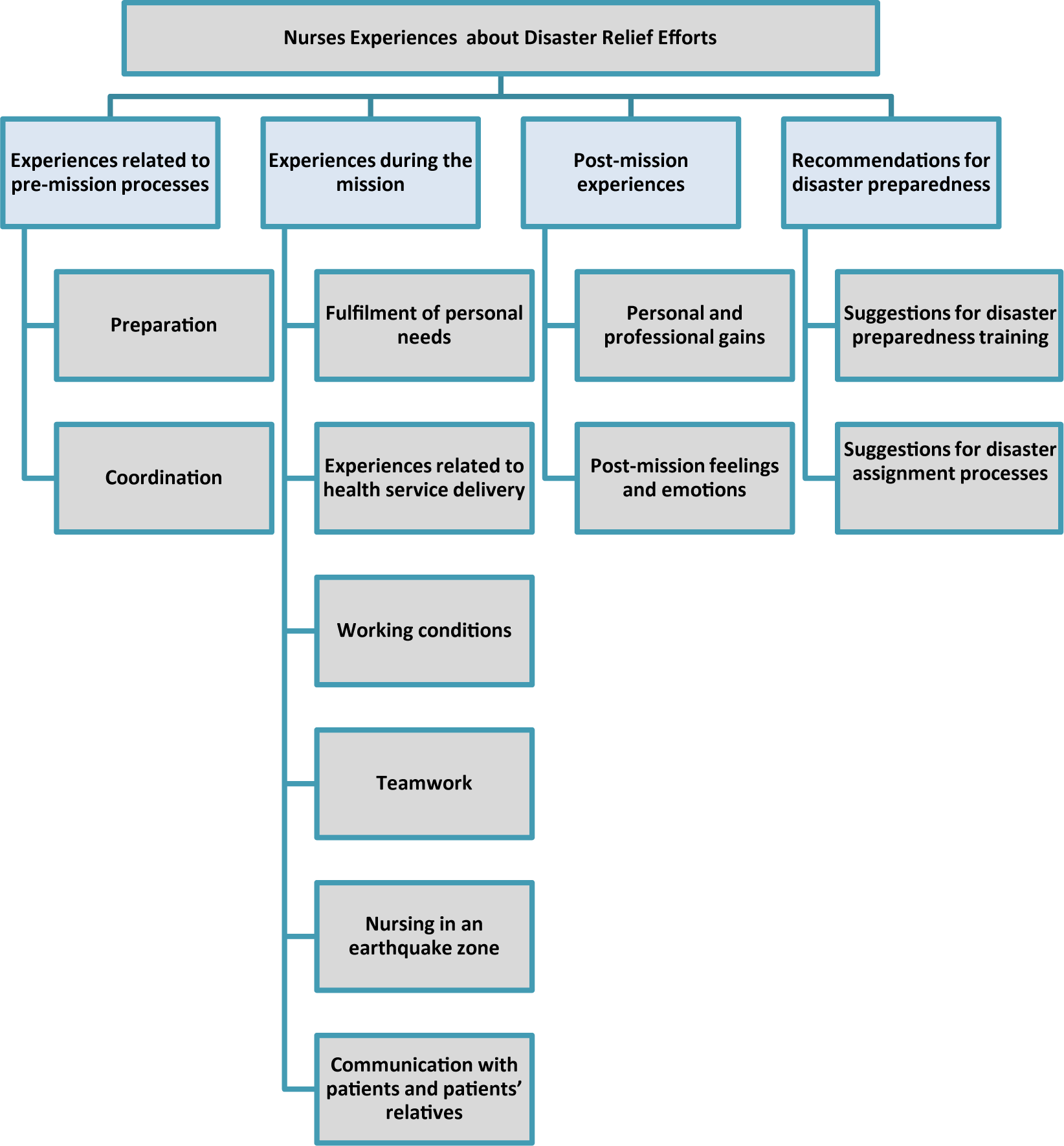
Participating nurses were interviewed after having worked in the disaster area, resulting in 4 main themes and 12 sub-themes (Figure 1).
Themes, sub-themes.

Theme 1. Experiences Related to Pre-mission Processes
Preparation
Regarding the sub-theme of preparation, participants shared their experiences of the personal and professional measures they took before traveling to the earthquake zone. While some participants expressed indecision about pre-journey preparations, others mentioned personal items they planned to bring. Some participants claimed that they experienced stress at this stage, with others saying that they experienced fear, anxiety, or excitement. Although some nurses questioned their professional competence, all nurses stated that despite the circumstances, they were motivated to do their best and hopeful that they could overcome challenges. Participants said:
“I didn’t even know what I was going to take with me when I left for the disaster. I had some things in mind—should I take this or that?” (Participant No. 5)
“We didn’t know anyone, didn’t know the city, didn’t know where we were going…I didn’t know what I would encounter because I didn’t know what I would experience. That uncertainty was already a source of stress.” (Participant No. 19)
“I left with the fear that I would have to intervene in patient care on my own and wondered whether I would be competent." (Participant No. 16)
Coordination
Almost all participants stated that institutional planning for transport to the region was very good. They noted facilitating practices such as pre-check-in procedures and VIP entrances at the airport. While some participants stated that they arrived late at night and others were not informed of their arrival, others claimed that the coordination process worked well and that they reached the mission site without any problems.
“Organization was really very good. They came to the front door of our houses, picked us up from home and then took us to Ankara. From Ankara, we left for the airport, and as far as the flight, there was a very nice planning process.” (Participant No. 3)
“I had to sleep on a bench outside by the fire on the first night because we had no shelter.” (Participant No. 14)
Theme 2. Experiences During the Mission
Fulfilment of personal needs
Participants stated that they were housed in different places such as tents, containers, hospital buildings, and dormitory buildings, and that they experienced problems related to accommodation due to factors such as the continuation of aftershocks and adverse weather conditions. Others, on the other hand, claimed that their accommodations were safe and trouble-free. Participants also mentioned administrators’ efforts to provide the best possible conditions for health workers in terms of accommodation. While some nurses stated that their quality of sleep was affected by earthquake aftershocks and poor accommodation conditions, others noted the challenges of maintaining personal hygiene outside of their normal routine. All participants stated that there were no problems with the meals provided to them during the mission. Regarding this issue, participants’ statements were as follows:
“I changed accommodation seven times. I stayed in a tent, I stayed in a building, I stayed in a hospital. Our tent flooded, and I moved to a container. I moved 7 times in 16 days, but it was nothing. I mean, that motivation kept us alive.” (Participant No. 14)
“Our meals were prepared, and our breakfasts were very regular. There was a washing machine and dryer on every floor; our sheets were changed every day if you wanted. It was nice; we didn’t have any problems.” (Participant No. 15)
“I woke up 3 to 4 times at night because you sleep in a bed directly on the floor; you could feel even the slightest shaking.” (Participant No. 5)
“My tent was blown away…. Stones and debris had fallen on the tents…… If we went inside, there was risk of earthquakes. If we went outside, something could fall on our heads. If there was a storm, we had nowhere to stay. We were in a dilemma, always wondering what to do at every moment.” (Participant No. 12)
Experiences related to health service delivery
During the mission, nurses were assigned to various areas such as emergency, intensive care, clinic, and dialysis. While some of the participants provided health services related to their previous experiences, others were assigned new or unfamiliar tasks. The nurses provided care to earthquake victims in the region or to the patient group within the scope of routine health care. Almost all participants stated that they mostly provided psychological care in addition to basic nursing interventions. Regarding these issues, nurses shared the following:
“As an adult intensive care unit, we thought that we would have a lot of trouble in pediatric emergency at first. We didn’t know about intravenous access, and we didn’t know about treatment. Making adjustments according to weight was a problem. We were always on our toes in that sense because there was the risk of making mistakes.” (Participant No. 12)
”Talking to them (patients) relaxed me. That is, there was a sense of satisfaction. Talking to them satisfied me more than anything." (Participant No. 10)
“I tried to talk to every patient I saw, every patient that entered the room.” (Participant No. 10)
Working conditions
Participants also shared their experiences related to the disaster area’s working conditions. While some participants continued to provide services in hospital buildings suitable for use, others were working in tents. Participants mentioned the challenges of working in damaged hospital buildings. Participants stated that they were worried about their personal safety due to constant earthquakes and storms. While they did not claim to have experienced problems regarding the amount of supplies and equipment provided, they did claim to have experienced problems with the coordination of such materials due to the confined spaces caused by the aftermath of the earthquake. Participants had different experiences in terms of working arrangements. They mentioned that such arrangements were planned according to the location, required personnel, or service requirement. They noted that one of the major challenges was the chaotic nature of the post-disaster working environment. On this subject, participants stated:
“We experienced earthquakes from time to time. We were shaken and shaken, but we still continued to work. At first, we were a little panicked, but then we continued to work after a few minutes. We worked like that.” (Participant No. 1)
“All the materials were in a corner…in a tiny tent. Vaccinations, dressings, plasters, and injections…. The tent was very small after all, and then there are patients and 4 nurses or so. We worked there alternately, you know, the physical conditions were a bit difficult.” (Participant No. 13)
“Earthquakes were happening one after the other, and we were afraid for our lives…. When I was there, we experienced some big earthquakes.” (Participant No. 10)
“The supplies were abundant. We didn’t have any problems. It was like that on the field…supplies were abundant, but there was a lack of coordination.” (Participant No. 1)
“Everything was more comfortable there than in my current hospital, to be honest. I mean, technologically, computers, barcode printers, or other extra products were new. They were the latest models. In terms of treatment, I didn’t have any problems such as shortages of medication or gloves. Even things that were not available in our hospital were there.” (Participant No. 10)
“There was no such thing as the concept of working hours…. Everyone was willing to work anyway; no one asked questions like ‘when will we rest?’” (Participant No. 5)
Teamwork
Most of the participants stated that although they had not previously known other team members in the earthquake zone, nurses exhibited harmony, positive communication, a patient approach, tolerant behavior, trust, awareness of unity of purpose, teamwork, support, and work satisfaction. Participants expressed the following views on the subject:
“Everyone came from all over the country—both health professionals and other health workers. Everyone was from somewhere else, but no one felt out of place.” (Participant No. 7)
“We formed a bond, and when we saw each other, we felt the need to help each other.” (Participant No. 16)
“As a team, it was very good that everyone was there in the same dormitory living in the same conditions, like a big family.” (Participant No. 11)
Nursing in an earthquake zone
Regarding the duties of being a nurse in an earthquake zone, participants stated that they felt intense emotions and that the experience changed them as people. Some participants said that they felt sad, empathetic, exhausted, and confused, with others comparing the situation to a “horror film.” “You can’t think about it,” said one participant, “it happens in films, but unfortunately we were living it.” “It was like a haunted town,” said another. Nevertheless, nurses stated that the experience increased their professional awareness and gave them a sense of personal fulfilment. Some participants stated that the experience taught them what “real” nursing means. Participants stated:
“I tried to remain very stoic.” (Participant No. 7)
“This is where the professionalism comes into play…. I felt bad, but it had to pass, I had to put it to the side.” (Participant No. 14)
“I think it was very bitter. There was still the smell of blood in the building, which made me very sad.” (Participant No. 8)
Communication with patients and patients’ relatives
Participants spoke of their interactions with patients and patients’ relatives, stating that the public’s positive approach increased their motivation and sense of worth. Participants also stated that they had positive experiences communicating with patients and patients’ relatives as they strove to understand their needs and provide support while establishing a relationship based on trust. Regarding this subject, participants stated the following:
“They were grateful, you know, they were aware of the situation. The feeling of gratitude was very strong.” (Participant No. 5)
“The people of the region were already very respectful, and I have never seen employees valued so much in my sixteen years in the profession.” (Participant No. 3)
“People would come and tell their stories because they thought only we could understand. They were always coming to me and talking to me because the person next to them had lost their loved one and their home….and they were very grateful.” (Participant No. 13)
Theme 3. Post-mission Experiences
Personal and professional gains
Regarding the sub-theme of personal and professional gains, the nurses mentioned that every aspect of their experience in the emergency zone, including those that were painful, enriched their personal development. Among other personal achievements, they claimed to have gained increased empathy and awareness of human emotions, a new outlook on life, and awareness of individual disaster preparedness. Most participants stated that their work in the region grew their professional development and increased their knowledge of disaster nursing. One participant, for example, stated that she learned valuable lessons for future disaster relief assignments, with others claiming that their experience increased their knowledge of treating disaster victims, applying crisis management skills, and assuming decision-making responsibilities. Participants said:
“My life has changed for the better, and my expectations have decreased a lot.” (Participant No. 8)
“We were seeing the glass half empty. Now I can see the glass half full; I realized this when I returned.” (Participant No. 13)
“As a professional, I realized that we need to be prepared for anything at any moment.” (Participant No. 5)
“Professionally, I felt safer because I also worked in those conditions. I also served the patients there. I managed this process and this profession under those conditions.” (Participant No. 16)
“I saw that I could be a decision maker.” (Participant No. 4)
“It raised my diminishing professional motivation again.” (Participant No. 5)
“I enrolled in UMKE. I definitely believed that I would be more useful if I was more conscious and regularly trained.” (Participant No. 4)
Post-mission feelings and emotions
After returning from the mission, nurses claimed to have experienced a variety of intense and mixed emotions. Some participants stated that they had difficulty adapting to their normal lives and that they were still affected by the tremors, while others claimed to have gained a renewed sense of self-fulfillment. One participant reported that the experience led him to seek psychotherapy, with another reporting concern about residual trauma. Participants stated the following:
“For a while after I got back, I felt like an earthquake was still happening…. When I was eating or something, I felt like I was shaking.” (Participant No. 7)
“I felt a little bit of a burden there. I started therapy; it was very emotionally exhausting.” (Participant No. 14)
“Still, after I returned, there were images that I will never be able to erase from my mind.” (Participant No. 16)
Theme 4. Recommendations for Disaster Preparedness
Suggestions for disaster preparedness training
Concerning recommendations for disaster preparedness, nurses reported the need for realistic disaster drills, as well as regular training based on both practice and theory, beginning at the undergraduate level. Based on their experiences, participants emphasized the need for training on topics such as care and treatment of patients trapped under debris, treatment of wounds and bleeding, earthquake evacuation, communication skills, emergency protocols, trauma response, triage, psychological care, practical applications such as blood sampling/venipuncture, first aid, first intervention, resilience, and hospital disaster plans. They also emphasized that to be prepared for every situation, nurses should gain experience in each unit by rotation, especially in special units such as emergency and intensive care. Participants highlighted the following:
“Just like finishing a practical internship at university, this evacuation process can also be taught, or they can do this as orientation training when beginning the profession. It should not only be verbal.” (Participant No. 10)
“I don’t know about disaster plans. I think we should all be trained.” (Participant No. 8)
“When there is an earthquake, maybe it would be good if there is training in how we can help the people under the rubble.” (Participant No. 12)
Suggestions for disaster assignment processes
Concerning suggestions for disaster assignment processes, participants recommended the formation of professional teams consisting of volunteer nurses. They suggested that the selection of nurses working in the post-earthquake zone should be based on criteria such as professional competence, years of professional experience, age, hospital experience, and decision-making/problem-solving skills. Participants also stated that assignment periods should be longer. They stated:
“A team of professionals with problem-solving capacities should be formed, and they should stay in that position for 5-10 years. The same people should go everywhere.” (Participant No. 5)
“Field of work can be a criterion. Has she been in a disaster before? How long has she worked? Where has she worked? What has she done? You know, because experience is important.” (Participant No. 2)
“Professional competence should be looked at, yes, but self-confidence should also be there. They should look at whether people are team players because you are a team with people you do not know. Communication skills should be strong.” (Participant No. 14)
Discussion
This study revealed the experiences of nurses assigned to the earthquake disaster area, including their experiences of pre-mission personal and professional readiness. Though nurses reported to have experienced feelings such as fear, anxiety, and concerns about professional and personal competence, they also expressed that they were willing and motivated to provide service in the disaster area. Similarly, Sani Mert and Köksal (2024) reported that the pre-assignment period was full of uncertainties, and that the lack of clarity about the time, duration, and location of the assignment, in particular, created difficulties for nurses. The current study highlighted that nurses acted with the desire to help, despite uncertainties and feelings of inadequacy.Reference Sani Mert and Koksal10 According to the literature, health workers frequently experience anxiety when assigned new tasks related to disaster relief efforts,Reference Yamamoto, Yamada and Onoda11 with Scrymgeour (2020) reporting that health workers express commitment to participate in disaster relief, despite its emotional effects.Reference Scrymgeour, Smith and Maxwell12 According to another study, disaster relief participants often experience anxiety before travelling to unknown disaster zones, feelings of inadequate mental and physical preparation, and concerns about lack of knowledge and experience.Reference Yang, Xiao and Cheng13 In line with these findings, personal and professional preparation is crucial to disaster assignment processes, as nurses may experience a variety of pre-mission mixed emotions.
Participants in this study stated that coordination of transport to the disaster area was very good. While there is no study to date on transportation to disaster areas and coordination of pre-duty disaster relief processes, Bahadori et al. (2015) stated that effective, fast, and coordinated provision of disaster services before, during, and after a disaster requires a well-organized system.Reference Bahadori, Khankeh and Zaboli14 Institutional and governmental support is reported to be an important external influencing factor in the provision of effective disaster relief health services.Reference Kimin, Nurachmah and Lestari15 The current study reveals the importance of effective organization and coordination in the disaster assignment processes of health service providers by all relevant institutions and organizations.
This study determined that although participants experienced different challenges regarding personal needs during the disaster relief mission, they were able to overcome such difficulties and continued to be devoted to their work. Related studies report similar challenges faced by disaster relief health workers.Reference Altuntaş, Korkmaz and Efe5, Reference Yanik and Ediz16, Reference Unsal, Ozbudak Arıca and Hobek Akarsu17, Reference Sermet Kaya and Gulnur Erdoğan18 According to the literature, participants have exhibited the ability to adapt, cope, and respond to challenging situations while maintaining a strong sense of professional duty, personal obligation, and responsibility, despite facing various personal, structural, and organizational barriers.Reference Scrymgeour, Smith and Maxwell12, Reference Yanik and Ediz16, Reference Doğan, Tosunöz and Kaya19, Reference Açık and Yeşilyurt Sevim20 The current study’s finding that nurses were able to overcome the challenges of working in the disaster zone may be due to their ability to prioritize their professional responsibility over their individual needs.
This study highlighted differences between nurses’ roles in the disaster area and their roles in the hospital in which they normally worked. While some were assigned tasks appropriate to their experience, others assumed new roles and responsibilities. Previous studies have reported similar findings.Reference Sermet Kaya and Gulnur Erdoğan18, Reference Doğan, Tosunöz and Kaya19 One study showed that due to the uncertainty of aid teams’ capabilities, attention should be paid to the organization and employment of aid teams in order to increase performance.Reference Abdi, Vaisi-Raygani and Najafi21 The results of this study show that in addition to the importance of manpower planning in the provision of health services during disaster periods, nurses should also be provided with the basic equipment they need to assume various tasks in case of disaster.
This study also revealed nurses’ opinions regarding working conditions in the disaster area. Participants reported difficulties related to destruction in health service delivery areas, safety concerns, and a chaotic working environment. One of the more striking findings was that despite such difficult conditions, nurses were able to maintain their professional responsibility. Ensuring that health care facilities remain safe and are able to withstand the effects of disasters is one of the priorities identified in the Sendai Framework for Risk Reduction,22 but various studies have reported deterioration of and damage to infrastructures after disasters.Reference Abdi, Vaisi-Raygani and Najafi21, Reference Yıldırım and Sarı23, Reference Kapisiz, Kaya and Eryılmaz24 Nurses are assigned to work in chaotic environments caused by disaster zones,Reference Pourvakhshoori, Norouzi and Ahmadi25 and, therefore, frequently experience safety concerns, a factor that may reduce the effectiveness of health service provision in disaster response.Reference Kimin, Nurachmah and Lestari15 While nurses participating in the current study stated that materials and equipment were sufficient, previous studies have reported equipment deficiencies during disaster relief efforts.Reference Yanik and Ediz16, Reference Doğan, Tosunöz and Kaya19, Reference Açık and Yeşilyurt Sevim20 The current study’s results show that despite the disaster zone’s difficult and challenging working conditions, the safest possible working environments were created for health workers and service recipients, necessary arrangements were made to ensure the continuity of health services, and nurses played a crucial role in the effective continuation of health services.
This study also found that the nurses’ positive outlook on and commitment to teamwork in the region were noteworthy. Similarly, previous studies have pointed to the importance of team cooperation and cohesion for health care professionals serving in disaster areas.Reference Sani Mert and Koksal10, Reference Açık and Yeşilyurt Sevim20, Reference Düzgün, Polat and Yönt26 Yang et al. (2010) found that the instinct to help and care for one another contributed to effective teamwork.Reference Yang, Xiao and Cheng13 However, another study reported that communication between health care professionals during disaster relief efforts was a major problem.Reference Maznieda, Dalila and Rosnah27 In line with these results, a tolerant and understanding approach of disaster relief teams has a significant positive impact on the provision of health services after a disaster.
The participants of this study spoke of their feelings about the effects of witnessing traumatic situations while performing nursing duties in the earthquake zone. This finding is consistent with findings in the literature concerning the psychological difficulties and emotional burnout nurses face while working in affected areas.Reference Altuntaş, Korkmaz and Efe5, Reference Yanik and Ediz16, Reference Açık and Yeşilyurt Sevim20 It has been shown that feelings of empathy and sensitivity towards earthquake victims or those experiencing physical or psychological distress may have an indirect effect on nurses’ emotional experiences.Reference Sert, Gulbahar Eren and Koc28 One study reported that nurses often experience mixed emotions during disaster relief efforts and that they may have feelings of helplessness, despite their passion to offer care and assistance.Reference Pourvakhshoori, Norouzi and Ahmadi25 The results of this study provide data on how nurses manage and adapt their emotions/behaviors during disaster relief efforts, as well as on nurses’ assessment of their ability to overcome traumatic events and build resilience.
This study found that patients and their caregivers exhibited positive and motivating attitudes towards nurses assigned to relief efforts in the disaster area. Nurses continue to play an important role in protecting the public during and after disasters and public health emergencies.Reference Flaubert, Le Menestrel and Williams29 One study, however, reported that disaster relief nurses expressed experiences of being hurt by the words of local people residing in a disaster zone.Reference Yamamoto, Yamada and Onoda11 These findings reveal that a relationship of trust and positive communication with patients and their relatives during disaster relief efforts have a facilitating effect on the ability to cope with crisis in the aftermath of a disaster.
This study determined that participants experienced personal and professional gains from the disaster relief mission, despite its many difficulties. Similarly, Yamamota et al. (2022) reported that despite the negative impact of witnessing trauma, participants’ experiences during disaster relief raised their awareness of disaster relief activities, helped their personal development, and had a significant impact on current nursing services.Reference Yamamoto, Yamada and Onoda11 Similarly, Altuntaş et al. (2023) found that nurses developed a deeper awareness of the “meaning of life” after their services in the earthquake zone,Reference Altuntaş, Korkmaz and Efe5 and Yanık and Ediz (2024) reported that they experienced an increased sense of love, respect, and commitment towards the profession.Reference Yanik and Ediz16 Similarly, Açık and Yeşilyurt Sevim (2025) reported a significant increase in the professional satisfaction levels of nurses who participated in disaster relief.Reference Açık and Yeşilyurt Sevim20 According to Kimin et al. (2022), previous experience with disaster relief may increase nurses’ ability to adapt to disaster conditions.Reference Kimin, Nurachmah and Lestari15 Considering these findings, the personal and professional gains obtained from post-duty disaster relief experience may be useful in subsequent disasters and may increase nurses’ awareness of and motivation to participate in disaster preparedness and intervention.
This study determined that the emotional intensity and effects of the disaster mission continued after participants’ return. Similar findings were also reported by Açık and Yeşilyurt Sevim in a study conducted in 2025 in response to the same earthquake. The study found that nurses experienced intense psychosocial difficulties in the post-disaster period and faced various challenges in the recovery process.Reference Açık and Yeşilyurt Sevim20 Many studies have reported a high prevalence of potential post-traumatic stress disorder among health care workers involved in disaster rescue operations,Reference Tahernejad, Ghaffari and Ariza-Montes30, Reference Bou Sanayeh, El Chamieh and Saade31 pointing to the necessity of post-mission follow-up and the provision of psychosocial therapeutic support.
The participants of this study emphasized the necessity of nurse preparedness training for all types of disaster relief nursing activities, implicating the importance of disaster education improvement. Acquiring the professional competence required to provide care in a critical situation is crucial.Reference Rezaei, Abdi and Akbari32 The literature includes similar recommendations regarding health workers’ professional development through awareness and education.Reference Sani Mert and Koksal10, Reference Doğan, Tosunöz and Kaya19, Reference Mohtady Ali, Ranse and Roiko33
The findings of this study include nurses’ suggestions regarding the selection of disaster relief team members, pointing to specific qualifications and characteristics inducive to disaster relief work. It is reported that the scope of disaster relief practice is different from hospital nursing and that first response nurses following a disaster should have at least 3 years of clinical experience (especially in the emergency department) and training in emergency rescue skills.Reference Yin and Arbon34 One study reported that disaster emergencies may induce panic in inexperienced health care professionals,Reference Maznieda, Dalila and Rosnah27 and Zhang et al. (2020) have emphasized the need for more skilled nurses in disaster areas.Reference Zhang, Zhang and Gong35 This study’s findings draw attention to the importance of selection standards for nurses acting as first responders in disaster areas.
Conclusion
This study highlights the importance of nurses’ personal and professional preparation for disaster relief nursing, as well as the coordination of the deployment of aid teams to disaster areas. Although nurses encountered challenging working conditions in the region, they exhibited professionalism and strong adaptation/coping skills. The study also emphasizes the importance of manpower planning in the provision of health services during disaster periods, the provision of basic equipment needed for various tasks in case of disaster, and the development of nurse resilience. In addition, the study showed that team cohesion and a relationship of trust with the people of the region had a facilitating effect on coping with the crisis of the disaster. It also revealed the necessity of psychosocial follow-up and support for nurses returning from disaster relief work. This study’s results include suggestions concerning the development of disaster training and selection standards for nurses assigned to disaster areas. The experiences of this study’s participants can contribute to the creation of plans, interventions, and training programs for disaster preparation at international, national, and regional levels and may support the improvement of nursing disaster relief skills.
Acknowledgements
We would like to express our sincere thanks to all nurses who voluntarily participated.
Author contribution
Study design: SG, NG; Data collection: SG; Data analysis: SG, NG; Manuscript writing: SG, NG.
Funding statement
No external or internal funds were received for this study.
Competing interests
The authors declare that there are no conflicts of interest and that the content has not been published or submitted for publication elsewhere.
Ethical standard
Bolu Abant İzzet Baysal University Ethics Committee for Human Research in Social Sciences (Decision no: 2023/391).