Introduction
Antarctica is no longer a pristine environment due to atmospheric pollution, fuel spills, inadequate waste management and wastewater discharges from anthropogenic activities (Harris Reference Harris1998, Stark et al. Reference Stark, Smith, King, Lindsay, Stark, Palmer and Riddle2015). Approximately 37% of the permanent stations and 69% of the summer stations lack any form of sewage treatment (Gröndahl et al. Reference Gröndahl, Sidenmark and Thomsen2009). The characteristics of wastewater from stations are also of concern because they are a complex mix of contaminants containing human waste, cosmetics, viruses, dyes, detergents, medications, chemicals from laboratories and even microplastics (Bhardwaj et al. Reference Bhardwaj, Chauhan, Ranjan and Jindal2018). In Antarctica, treatment plants discharge treated water into the sea and then sludge is packed and sealed into drums for later shipment to Chile. Nevertheless, sewage sludge (c. 59–88% organic matter) could become a biosolid instead of being a waste if correctly stabilized. The Ecuadorian Antarctic station ‘Pedro Vicente Maldonado’ produced c. 200 kg of sewage sludge during expeditions in 2017 and 2018. Thus, the aim of the present study was to biostabilize sewage sludge using two methods (one thermal and one biological) at the Ecuadorian Antarctic station. As a result, the stabilization of sewage sludge produced a biosolid that was easier and more cost effective to transport, avoiding odour problems.
Material and methods
Sewage sludge samples were collected from the wastewater treatment plant at ‘Pedro Vicente Maldonado’ station (Greenwich, South Shetland Islands, 62°26'57''S, 59°44'29''W). Two stabilization treatments were separately applied: a thermal treatment in which the sludge was dried up to 128°C for 14 hours in a 50 l heating drum; and a biological treatment in which four algae residues from the coastline beach of Greenwich Island were mixed with the sludge. The sludge was mixed in a 1:1 weight ratio with algae residues from (A1) Pachymenia dichotoma, (A2) Himantothallus grandifolius (A3) Ascoseira mirabilis, (A4) Delisea pulchra and the mixture (A5) of the four algae residues plus the moss Risodontium aciphyllum. The final volume of every biostabilization treatment was 500 ml and all treatments were maintained at an average temperature of 14.8°C in a plastic container. In addition, four bacterial strains (in the process of being identified) were isolated from sludge samples in nutrient agar (Difco, USA) at 10°C and then added to the biological treatments. Temperature and pH were measured daily over two weeks using a multiparameter (HANNA HI 99121, USA). Total solid (TS) and volatile solid (VS) contents were determined at 105°C and 550°C, respectively, using standard methods (ASTM 2015).
Results
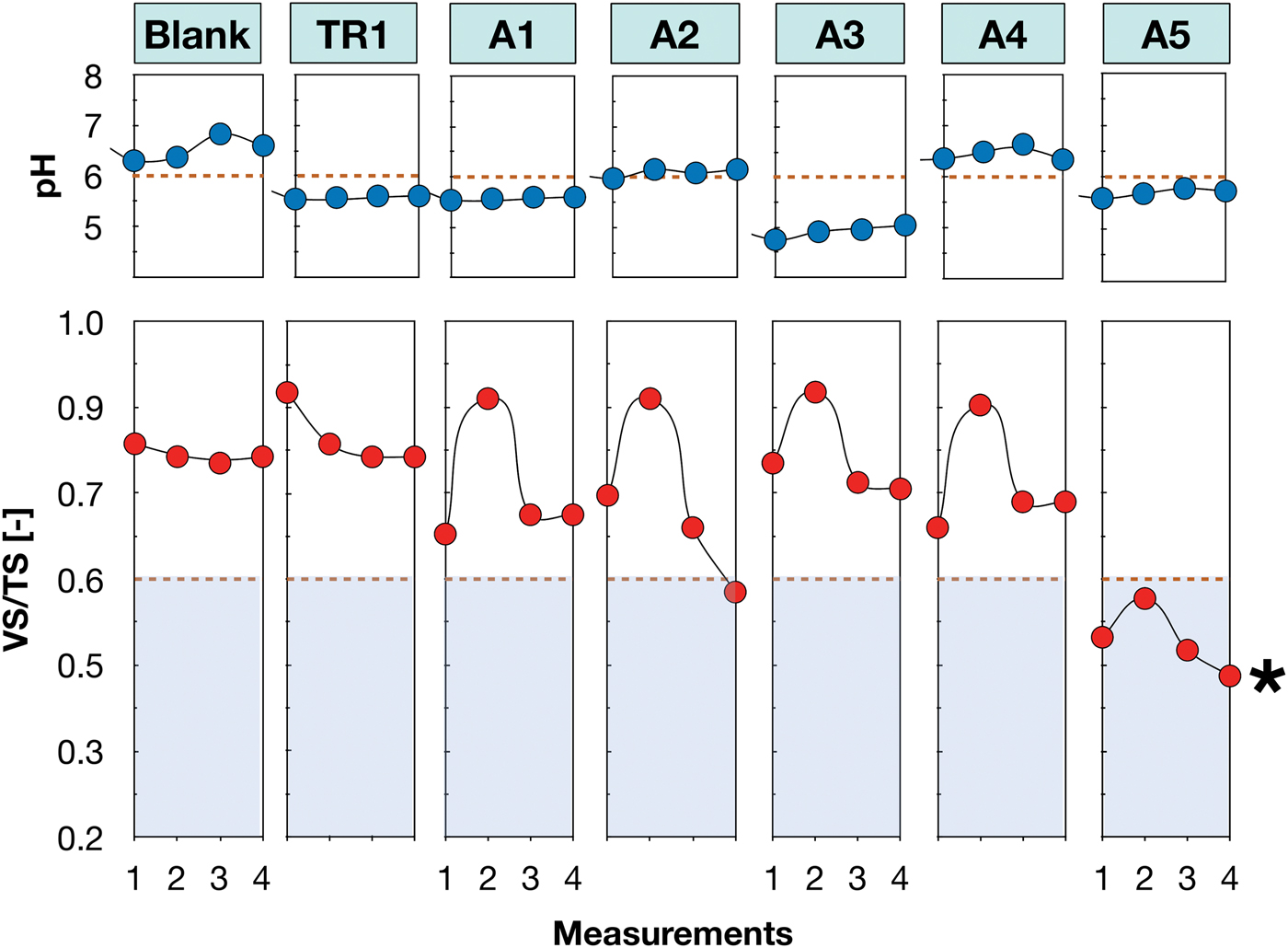
Figure 1 presents the pH values and the VS/TS ratios over the two weeks of the biological treatment and over the 14 hours of the thermal treatment. After 14 hours, the vaporized water was at 63.5 kg per 100 kg of sludge.
Changes in pH and VS/TS ratio over the two weeks of the biostabilization process. ‘Blank’ is the sludge without treatment; ‘TR1’ is the thermal treatment; ‘A1’ is Pachymenia dichotoma, ‘A2’ is Himantothallus grandifolius, ‘A3’ is Ascoseira mirabilis, ‘A4’ is Delisea pulchra and the ‘A5’ is the mixture of the four algae plus the moss Risodontium aciphyllum.

Discussion
The thermal treatment reduced the weight of sludge by up to 63.5%; thus, the cost of sewage sludge shipping to Chile was reduced in 2018. After the thermal treatment, microorganisms were counted using the most probable number (MPN) method, and a microbial count above 2 × 10⁶ MPN g−1 was found in the dried sludge. Although a thermal treatment is beneficial due to the killing of bacteria and genomic material, in the present case it was insufficient to reach the standards for biosolids according to the US Environmental Protection Agency (EPA). According to environmental regulations for biosolids, a VS/TS ratio under 0.60 is an indicator of a sludge being biostabilized (EPA 1994, Solé-Bundó et al. Reference Solé-Bundó, Cucina, Folch, Tàpias, Gigliotti, Garfí and Ferrer2017). In the thermal treatment, the VS/TS ratio did not vary significantly, and neither did the pH; therefore, this thermal treatment did not reach the biosolid standard. On the other side, over 15 days of anaerobic digestion during the 2018 Antarctic summer, the best treatment was a mixture of algae and moss (A5 in Fig. 1), with which a VS/TS ratio of 0.45 was reached, along with a final pH of 5.7. The content of organic matter that is represented by VS was significantly reduced by 70.8% due to microbial mineralization.
The environmental impact of domestic sewage sludge is of great interest to the Ecuadorian ‘Pedro Vicente Maldonado’ station due to the significant economic and logistic investment that is needed for the transfer of faeces to Chile after each short expedition to Antarctica. The present results will allow larger-scale tests of the biostabilization of sewage sludge with due sanitary control in order to avoid environmental impacts on the Antarctic continent.
Acknowledgements
We appreciate the technical assistance of Cromber Torres-Tagles and acknowledge the Instituto Antártico Ecuatoriano (INAE) for its valuable logistic support.
Author contributions
All authors conceived and planned the experiments. CB, PP and MG carried out the experiments at the Antarctic Ecuadorian station. PP, TB and MG contributed to the interpretation of the results. CB took the lead in writing the manuscript and all authors provided critical feedback.
Details of data deposit
The gravimetric data were submitted to Figshare under https://doi.org/10.6084/m9.figshare.7571102.v1.