

Introduction
Large-scale farming of cattle is a hot topic in public discussions related to animal welfare and emissions. Livestock producers are aware of the importance of a good ventilation system for removing excess moisture, heat and pollutants. However, for naturally ventilated buildings the prediction of the air exchange and the resulting microclimate is sophisticated as the indoor environmental parameters depend on the outside temperature and the constantly changing wind conditions (Saha et al., Reference Saha, Fiedler, Ammon, Berg, Loebsin, Amon and Amon2014). Moreover, suitable measures to define ‘optimal microclimate’ are missing (Shoshani and Hetzroni, Reference Shoshani and Hetzroni2013). In the ERANET+project OptiBarn partners from Germany, Denmark, Israel and Spain are developing an integrated modelling approach to solve this problem in order to support sustainable, regional and animal-specific adaptation of naturally ventilated dairy barns to climate change (Hempel et al., Reference Hempel, Amon, Ammon, Hoffmann, Berg, Menz, Zhang, Halachmi, Prado, Estelles, Brunsch and Amon2015).
Material and methods
We link numeric models with different temporal and spatial scales.
Module ‘ambient climate’: regional climate models are adapted to provide high-resolution simulations of ambient climate conditions associated with heat stress. A selection of simulations is taken from CORDEX-EUR11Footnote 1 to estimate the model uncertainty for the ambient climate. The CCLMFootnote 2 regional climate model is used to downscale specific events (Rockel et al., Reference Rockel, Will and Hense2008). These time series are used as an input for the barn scale model.
Module ‘barn climate’: a computational fluid dynamics model for air flow and indoor climate is developed using Open FOAM and ANSYS software tools. It considers effects of barn geometry, ventilation concepts, inflow conditions and temperature gradients resulting from the nonstationary climate input. We focus on unsteady large eddy simulation methods to model the turbulence (Fiedler et al., Reference Fiedler, Fischer, Hempel, Saha, Loebsin, Berg, Amon, Brunsch and Amon2014). Air flow measurements in four selected pilot barns in Germany, Spain and Israel, and experiments in a boundary layer wind tunnel (20×3×2.3 m) provide the database for a comprehensive model validation. Sustainable engineering solutions for optimal climate in the animal-occupied zone and for low emissions are tested in lab experiments and numeric simulations (Rong et al., Reference Rong, Liu, Pedersen and Zhang2015).
Module ‘animal response’: a mixed-effect model is developed to predict the stress level of cows with fixed physiological parameters (e.g. state of lactation) given particular barn climate conditions. Animal-based parameters like respiratory frequency, activity, body temperature (rectal, vaginal and ruminal), heart rate and heart rate variability are monitored in various experiments together with microclimatic parameters under summer and winter conditions. Individual experiments are conducted in Germany, Israel and Spain. Selected experiments take place in all three countries to include the regional component.
Module ‘farm response’: the SimsDairy farm-scale model is adapted to assess the economic and environmental impact of climate change with and without smart ventilation (Prado et al., Reference Prado, Misselbrook, Chadwick, Hopkins, Dewhurst, Davison, Butler, Schröder and Scholefield2011). Aggregated values of the ambient climate and the barn climate are used as input variables. Evaluation of economic impacts and risk management options includes the review of heat stress impacts, risk factor assessment and cost-benefit analysis scenarios.
Results
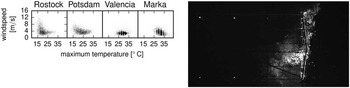
Analysis of weather station data revealed that temperature increase often comes with a decrease in incident wind speed (cf. Figure 1, left).
Left: analysis of climate observations (1981–2010) for four official meteorological stations near the pilot farms. Right: high-speed photo of the air flow through a scale model of one pilot barn in the boundary layer wind tunnel (incident wind direction 30°) – top view.

Thus, the probability of cows suffering from heat stress increases in general. Long-term measurements and modelling showed that the flow through the barn is heterogeneous even for symmetric buildings and constant ambient climate (cf. Figure 1, right). In consequence, the distributions of temperature and humidity vary in time and space, which complicates a definition of reference points to evaluate heat stress based on meteorological parameters.
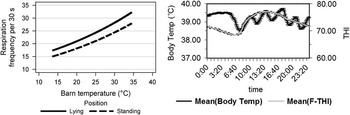
Moreover, thresholds of physiologic heat stress indicators varied for individual cows and depended on the animal activity. Respiratory rate, for example, significantly increased with temperature, but was lower for standing cows than during lying phases (cf. Figure 2, left). Cow individual differences have been observed in time series of respiration, heart rate variability and body temperature. The classical temperature humidity index cannot capture fast variations in the physiologic stress response (cf. Figure 2, right).
Left: respiratory rate of standing (solid line) and lying (dashed line) cows for different barn temperatures. Right: time series of vaginal body temperature (black line) and temperature humidity index (THI) (grey line). Oscillation in the second half of the day corresponds to sprinkling events.

Conclusion
Numeric models must consider the nonstationary input of the ambient climate and use turbulence parameterisations that capture time-dependent flow structures in order to predict comfort zones in naturally ventilated barns. The microclimate must be evaluated based on the climate-related physiological stress response. More animal–individual traits have to be included in the modelling. Model development, validation and linkage at different temporal and spatial scales are needed to improve the assessment of climate change impacts.
Acknowledgements
This work was financially supported by the German Federal Ministry of Food and Agriculture (BMEL) through the Federal Office for Agriculture and Food (BLE), grant number 2814ERA02C.