Introduction
Intimacy and sexuality are lifelong elements of being human (World Health Organization, 2006). When satisfactory, they influence health and quality of life positively (Weeks, Reference Weeks2002; Bouman et al., Reference Bouman, Arcelus and Benbow2007). Despite the negative myths, prejudices, and stereotypical thinking surrounding late-life intimacy and sexuality, a growing number of studies contradict the assumption that needs for intimacy and sexuality are just for the young (Hajjar and Kamel, Reference Hajjar and Kamel2004; Reingold and Burros, Reference Reingold and Burros2004; Rheaume and Mitty, Reference Rheaume and Mitty2008; Dourado et al., Reference Dourado, Finamore, Barosso, Santos and Laks2010). Although increasing age is associated with a decline in sexual activity, a substantial proportion, 26%, of community-dwelling elderly people (between 75 and 85 years of age) reported still being sexually active (Lindau et al., Reference Lindau, Schumm, Laumann, Levinson, O’Muircheartaihg and Waite2007). In a lifecycle model of intimacy, sexuality is considered as just one component, alongside physical contact and intimacy (Delfos, Reference Delfos1994). There is a wide spectrum of intimacy and sexuality described, ranging from emotional intimacy, such as friendships, to sexual arousal and sexual activity. The spectrum consists of both psychological and physical aspects (Basson, Reference Basson2001). In old age, an even broader definition of intimacy and sexuality seems appropriate (Hajjar and Kamel, Reference Hajjar and Kamel2004). As physical sexual activity becomes increasingly difficult due to physical, cognitive, or environmental limitations, intimacy becomes a more important means of maintaining a sense of self-identity and self-worth (Tsatali et al., Reference Tsatali, Tsolaki, Christodoulou and Papaliagkas2010).
It is not clear whether the proportion of sexuality in sexually active elderly people is as high in elderly people with dementia. The prevalence of dementia increases with age, one in eight people over the age of 65 years has dementia; in over 85-year-old elderly people this percentage has increased to 45% (Alzheimer's Association, 2012). Patients with dementia will experience several cognitive impairments such as memory loss, apraxia, and disturbance of executive functions (American Psychiatric Association, 2000), which can influence ability to receive, experience, and express intimacy and sexuality. Moreover, geriatric physiological changes in function, anatomy, neurochemistry, and pathophysiology, such as diabetes, hypertension, and heart disease, also influence sexual desire and sexual function (Tsatali et al., Reference Tsatali, Tsolaki, Christodoulou and Papaliagkas2010). Finally, availability of a willing partner to experience intimacy or sexuality with may be lower in old age. Loss of a partner or a change in roles within the relationship, due to increasing caring responsibilities, have been shown to influence intimacy and sexuality in people with dementia (Harris, Reference Harris2009).
As dementia progresses and impairments become more severe, it may become necessary for the individual to move to a more protective environment, such as a nursing home. In the United States, 3.2 million people live in a protective living environment. More than 60% of them suffer from moderate to severe cognitive impairments such as dementia (Alzheimer's Association, 2012). When people with dementia reside in a nursing home, it can be difficult to satisfy the needs for intimacy and sexuality (Hajjar and Kamel, Reference Hajjar and Kamel2004). People with dementia are often less able to verbalize needs and preferences, and observable behavior may be the only way in which their needs are expressed. This means that identification of needs and preferences in this sensitive domain is highly dependent on care staff and Healthcare Professionals (HCPs), such as geriatric physicians and social workers (Archibald, Reference Archibald2002; Bouman et al., Reference Bouman, Arcelus and Benbow2007). Observed behavior is frequently misinterpreted as a sexual “problem” behavior or sexual disinhibition by care staff. In research, this more pathological perspective on intimate and sexual behavior was found to be overrepresented (Rheaume and Mitty, Reference Rheaume and Mitty2008). There is a need for a clear definition of the distinction between normal sexual behavior and abnormal or “problem” sexual behavior in nursing home residents (Hooren, Reference Hooren2011). A review of studies on healthy, normal intimacy, and sexuality seems to be an appropriate and evidence-based foundation for future research, and the results could be used to inform care practice.
This systematic review focuses on research on aspects of healthy, normal intimacy, and sexuality in patients with dementia who are resident in nursing homes. The aim was to produce a structured overview of all elements of intimacy across the full spectrum of intimacy and sexuality in people with dementia, living in a specialist residential care.
Methods
Search strategy
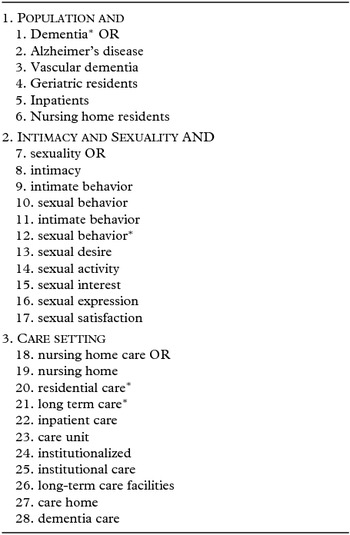
A systematic search of papers published between 1990 and 2013 was carried out. Papers of interest were expected to be published in biomedical, psychological, and healthcare management journals, so the following databases were searched: PsychInfo, PubMed, and Medline. CINAHL database was not searched due to inaccessibility and the reported large overlap with the searched databases (Edhlund, Reference Edhlund2006; Byrne and Neville, Reference Byrne, Neville, Byrne and Neville2010). Synonyms and some additional words were used as (free text) keywords to retrieve relevant articles (Table 1). The search was performed on 8 October 2013. The search terms (mesh terms and free text words) were selected from three categories: (1) population (dementia); (2) intimacy and sexuality, and (3) care setting (Table. 1).
(Mesh) Search terms used in search strategy

Note: *Mesh terms used to search PubMed database.
Inclusion and exclusion criteria
Three authors (Tineke Roelofs, Katrien Luijkx, and Petri Embregts) agreed inclusion and exclusion criteria consistent with the aim of the study.
Inclusion criteria
-
1. Studies focusing on intimacy and sexuality of people with dementia living in residential and nursing homes, and if applicable, their partners.
-
2. Studies focusing on attitudes of care staff, HCPs, and management of residential and nursing homes on intimacy and sexuality in patients with dementia.
-
3. Empirical research: Qualitative, quantitative, and mixed methods studies.
-
4. Original, peer-reviewed studies written in English.
Exclusion criteria
-
1. Other systematic reviews and statements.
-
2. Studies focusing solely on legal, theoretical, and ethical aspects.
-
3. Studies focusing on hyper-sexuality problem or inappropriate sexual behavior and sexual or intimate disinhibitions.
-
4. Studies focusing on abuse, sexual abuse, mistreatment, or maltreatment.
-
5. Studies focusing on Parkinson's disease, Huntington's disease, AIDS, dementia, and Creutzfeldt–Jakob syndrome.
Study selection and data extraction
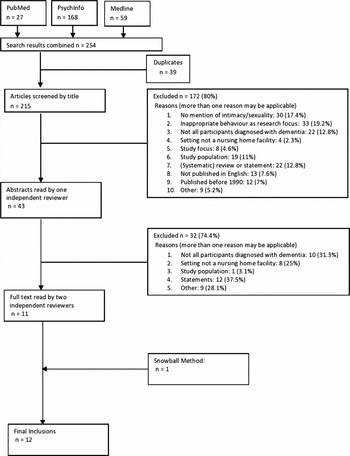
Figure 1 shows the selection process in a flowchart. In the first selection phase, duplicates were removed and all titles and abstracts were screened by one reviewer (Tineke Roelofs). Publications which met the inclusion criteria and those which were uncertainty about went forward to the second selection phase. In the second phase two reviewers (Tineke Roelofs and Katrien Luijkx) assessed abstracts and full text versions of publications independently. Disagreements about inclusion were resolved by discussion between the two reviewers. All references from articles in the second phase (N = 43) were assessed (Snowball method) by one reviewer (Tineke Roelofs) to find more relevant studies. These publications were screened by title, abstract, and full text version by the two reviewers in an identical process.
Flow chart of publication selection process.

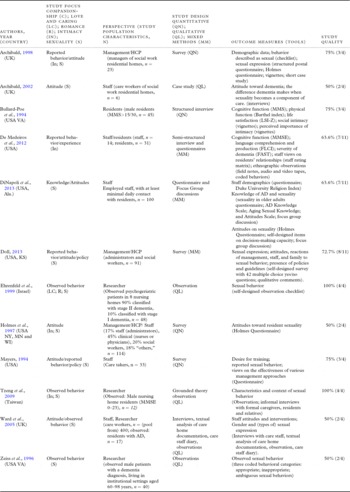
A predefined table of descriptive information and characteristics was used to provide an overview of the diversity of design characteristics and research focus in the included publications (Table 2). Next, two reviewers (Tineke Roelofs and Katrien Luijkx) assessed the results in the included publications independently. The structure of the review was determined by the analysis of the results and the themes that emerged.
Descriptive information and characteristics

Notes: HCP = Health Care Professional; reported behavior = retrospective report; MMS(E) = (Folstein) Mini-Mental State (Exam); LSI-Z = Life Satisfaction Index-Z; FLCI = Functional Linguistic Communication Inventory; FAST = Functional Assessment Staging.
Assessment of methodological quality
In health sciences, a substantial proportion of published studies use a mixed methods design (Pace et al., Reference Pace2012). This was true of the papers included in this review. We therefore chose to assess the methodological quality of research using the Mixed Methods Appraisal Tool checklist (MMAT; Pace et al., Reference Pace2012). This checklist consists of 21 criteria divided into six categories: (1) Screening questions (for all types); (2) Qualitative; (3) Quantitative randomized controlled trials; (4) Quantitative non-randomized; (5) Quantitative descriptive; (6) Mixed methods. Mixed method studies and purely qualitative and quantitative studies can all be assessed using this instrument. There are three levels for all MMAT criteria: fulfilled, unfulfilled, and unmentioned. All included publications were assessed independently by two reviewers (Tineke Roelofs and Katrien Luijkx) and disagreements were resolved by discussion. Relative outcome scores and the percentages of these scores are reported in Table 2. In calculating scores, we considered unmentioned criteria to be unfulfilled. The conversion of relative scores into percentages was recommended by the authors of the MMAT (Pace et al., Reference Pace2012).
Results
General findings and quality assessment
The search strategy initially retrieved 215 unique research publications from the databases. Following the selection process, 12 unique papers were included (Figure 1). Seven studies were conducted in the United States, three in the United Kingdom, one in Israel, and one in Northern and Eastern Taiwan.
Four publications were based on quantitative studies, five on qualitative, and three on mixed methods (Table 2). Percentages of MMAT outcomes were calculated to compare the methodological quality of the included publications, these ranged from 50 to 100% (Table 2). Publications with an MMAT score of 50%, i.e. those of the lowest methodological quality, are marked (*) in Tables 3 and 4. The MMAT criteria which were least frequently fulfilled by the included qualitative studies and research parts of mixed methods studies were those relating to “relevance of analyzing processes” and “influencing (bias) by researchers.” There was no detectable pattern to the MMAT criteria most or least likely to have been fulfilled by the included quantitative studies and research parts of mixed methods studies. The criteria least frequently fulfilled by the included mixed methods studies were those relating to “divergence of qualitative and quantitative data in data triangulation” (Pace et al., Reference Pace2012).
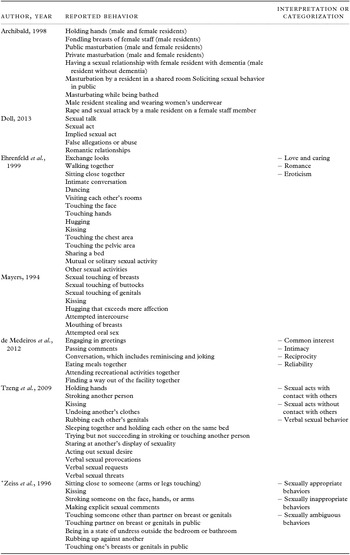
Reported intimate and sexual behavior and authors’ interpretation or categorization

Note: *Studies assessed with a score of 50% on the MMAT.
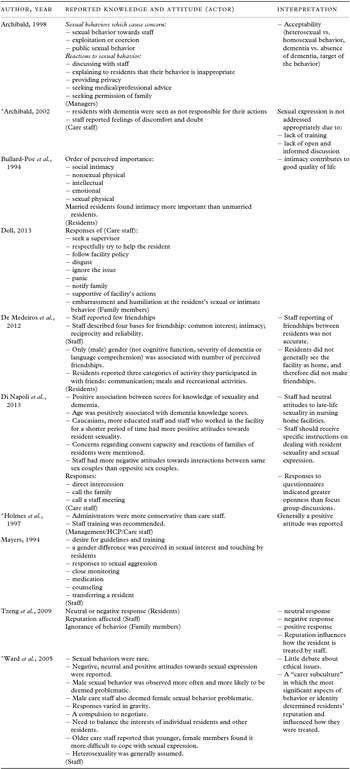
Knowledge and attitudes

Note: *Studies with a score of 50% on the MMAT.
The included publications varied greatly (Table 2). First, health care systems for the elderly people and educational systems for staff varied across countries, which meant that there was variation in the definitions and designations of care facilities, care staff, HCPs, and care facility administrators. Second, actual study populations varied greatly among included studies. The participants were mostly proxies, such as care staff (e.g. care workers and registered nurses), HCPs, and management or administration staff of nursing homes. In some studies, partners, families, and legal representatives of the residents also participated. Residents were mostly included as subjects of observation; there were several observational studies. Observations were carried out by researchers, care staff, and management. One study reported on the resident perspective on intimacy. Finally, outcome measures varied greatly, depending on the study population and research objectives. In half of the studies, the instruments used to index outcomes were neither validated nor reliable.
Themes
Various themes emerged from the included publications. First, a clear distinction could be made between descriptions of reported or observed behavior displayed by residents with dementia and reports of the knowledge and attitudes of different stakeholders in the care process. Second, additional themes emerged: capacity to consent; care staff culture; staff training and practice, and policy guidelines. Ethical considerations and dilemmas are dealt with under the capacity to consent theme. The culture of care was often mentioned as an explanation or interpretation of staff attitudes and was therefore a more implicit theme. The themes which emerged have been used to structure the Results: “Reported Intimate and Sexual Behavior,” “Knowledge and Attitudes,” “Capacity to Consent,” and “Care Culture, Staff Training, and Guidelines.”
Reported intimate and sexual behavior
Seven of the 12 included publications reported on the intimate and sexual behaviors of people with dementia living in residential nursing homes. Reports of the prevalence of intimate and sexual behaviors in residents were inconsistent. Some researchers reported “high” prevalence (Mayers, Reference Mayers1994; Holmes, et al., Reference Holmes, Reingold and Teresi1997) whereas others reported low prevalence (Zeiss et al., Reference Zeiss, Davies and Tinklenber1996; Ward et al., Reference Ward, Vass, Aggarwal, Garfield and Cybyk2005). A wide range of behaviors was reported, ranging from “greetings” to “sexual acts.” As discussed in the Introduction, a wide spectrum of behaviors should be considered under the domain of intimacy and sexuality, especially in the context of elderly people with dementia. One study covered a relatively wide range of the spectrum of intimate friendships, intimacy, and sexuality (Ehrenfeld et al., Reference Ehrenfeld, Bronner, Tabak, Alpert and Bergman1999). Following advice from a specialist, they assigned behaviors to three categories: love and caring; romance; and eroticism (Ehrenfeld et al., Reference Ehrenfeld, Bronner, Tabak, Alpert and Bergman1999). In this study, behaviors were interpreted from a third party (proxy) perspective, rather than the resident perspective. The resident perspective was however considered in a study by de Medeiros et al. (Reference De Medeiros, Saunders, Doyle, Mosby and Van Haitsma2012). Three studies only reported observed behavior (Archibald, Reference Archibald1998; Mayers and McBride, Reference Mayers and McBride1998; Doll, Reference Doll2013). A variety of categorization schemes were used in the studies, and there was heterogeneity in the approach to the interpretation of data (Table 3) (Zeiss et al., Reference Zeiss, Davies and Tinklenber1996; Ehrenfeld et al., Reference Ehrenfeld, Bronner, Tabak, Alpert and Bergman1999; Tzeng et al., Reference Tzeng, Lin, Shyr and Wen2009; de Medeiros et al., Reference De Medeiros, Saunders, Doyle, Mosby and Van Haitsma2012).
De Medeiros and colleagues (Reference De Medeiros, Saunders, Doyle, Mosby and Van Haitsma2012) reported qualities associated with friendship in the interactions and relationships between residents based on interviews with staff and residents. Themes such as “intimacy” and “reciprocity” emerged from the interviews with both residents and care staff, including references to “the closeness” of the relationships (de Medeiros et al., Reference De Medeiros, Saunders, Doyle, Mosby and Van Haitsma2012). Behaviors such as “holding hands,” “sitting close to someone (arms or legs touching),” and “stroking someone on the face, hands, or arms” were also considered in terms of love, caring, or intimacy (Zeiss et al., Reference Zeiss, Davies and Tinklenber1996; Archibald, Reference Archibald1998; Tzeng et al., Reference Tzeng, Lin, Shyr and Wen2009).
Romance or romantic relationships were also observed and reported in residents (Mayers, Reference Mayers1994; Ehrenfeld et al., Reference Ehrenfeld, Bronner, Tabak, Alpert and Bergman1999; de Medeiros et al., Reference De Medeiros, Saunders, Doyle, Mosby and Van Haitsma2012; Doll, Reference Doll2013). These romances were described in terms ranging from “close friendship” to “incidents of consensual sexual activity” (Mayers, Reference Mayers1994; de Medeiros et al., Reference De Medeiros, Saunders, Doyle, Mosby and Van Haitsma2012), and all were heterosexual encounters. In the reports on male residents, intimacy was strongly associated with life satisfaction and contributed to the quality of life (Bullard-Poe et al., Reference Bullard-Poe, Powell and Mulligan1994). All forms of intimacy were reported to be important and the major value was attributed to social, nonsexual physical intimacy (Bullard-Poe et al., Reference Bullard-Poe, Powell and Mulligan1994).
Eroticism was observed by several researchers. The behaviors in this category most often reported by administrators and social workers were “sexual talk” and “sexual acts” (Doll, Reference Doll2013). Sexual acts were also reported and observed by care staff and researchers, and included “having an erection while bathing (men),” “touching breasts,” “touching buttocks,” and “kissing or petting” (Mayers, Reference Mayers1994; Ehrenfeld et al., Reference Ehrenfeld, Bronner, Tabak, Alpert and Bergman1999). According to the management staff and HCPs of residential nursing homes, the four types of sexual behavior that occurred most frequently were “holding hands,” “fondling breasts of female staff,” “public masturbation,” and “private masturbation” (Archibald, Reference Archibald1998). It is notable that “holding hands” was considered as “sexual behavior” by these managers and HCPs, while residents and care staff reported the same behaviors as an expression of friendship (Archibald, Reference Archibald1998; de Medeiros et al., Reference De Medeiros, Saunders, Doyle, Mosby and Van Haitsma2012). The erotic behaviors least frequently reported were “inappropriate behaviors,” “false allegations,” and “abuse” (Doll, Reference Doll2013). This confirms the findings of Zeiss et al. (Reference Zeiss, Davies and Tinklenber1996), who concluded that inappropriate sexual behavior is uncommon in dementia patients in residential care, generally. Differences were found in the inappropriate or ambiguous sexual behaviors of residents with Alzheimer's disease and those with dementia caused by other conditions, such as vascular dementia. Qualitative differences, such as a higher frequency of provocative behavior and more intentional sexual behavior in people with vascular dementia, were found (Zeiss et al., Reference Zeiss, Davies and Tinklenber1996).
Various researchers described causes or “predisposing factors” for intimate and sexual behavior. Tzeng and colleagues (Reference Tzeng, Lin, Shyr and Wen2009) described factors such as “opportunity,” “cooperative target,” and “personal space without privacy” that may have led to intimate or sexual behavior. According to care staff and researchers, “perceived friendship,” “conversation between residents,” and “close seating positions in the public area” also preceded intimate and sexual behavior (Ward et al., Reference Ward, Vass, Aggarwal, Garfield and Cybyk2005; de Medeiros et al., Reference De Medeiros, Saunders, Doyle, Mosby and Van Haitsma2012). Although the term “cooperative target” may imply nonconsensual intimate or sexual behavior, “mutual affection” was also considered under this category (Tzeng et al., Reference Tzeng, Lin, Shyr and Wen2009).
Intimate or sexual behavior was initiated most frequently by male residents (Mayers, Reference Mayers1994; Ehrenfeld et al., Reference Ehrenfeld, Bronner, Tabak, Alpert and Bergman1999; Ward et al., Reference Ward, Vass, Aggarwal, Garfield and Cybyk2005; Tzeng et al., Reference Tzeng, Lin, Shyr and Wen2009; de Medeiros et al., Reference De Medeiros, Saunders, Doyle, Mosby and Van Haitsma2012) and the vast majority of observed behavior was heterosexual (Ehrenfeld et al., Reference Ehrenfeld, Bronner, Tabak, Alpert and Bergman1999). In general, men displayed sexual behavior more frequently than women according to managers and HCPs (Archibald, Reference Archibald1998), although interest in intimate and sexual behavior was reported in both male and female residents (Mayers, Reference Mayers1994; Ward et al., Reference Ward, Vass, Aggarwal, Garfield and Cybyk2005).
Knowledge and attitudes
Professionals in various roles in residential and nursing homes were the subject of study in ten of the 12 studies on knowledge of and attitudes to intimacy and sexuality in nursing home residents with dementia (Table 2). Although individuals in a variety of roles were included, most of the participants were females (Archibald, Reference Archibald1998; Ward et al., Reference Ward, Vass, Aggarwal, Garfield and Cybyk2005; Di Napoli et al., Reference Di Napoli, Breland and Allen2013). Only two studies included male staff members (Holmes et al., Reference Holmes, Reingold and Teresi1997; Ward et al., Reference Ward, Vass, Aggarwal, Garfield and Cybyk2005). Care staff was described as being low-paid and low or intermediately educated (Archibald, Reference Archibald1998; 2002). There was an age gap between staff and residents, in some cases of more than half a century, which implies that an “intergenerational effect” influenced the knowledge and attitudes of care staff (Ward et al., Reference Ward, Vass, Aggarwal, Garfield and Cybyk2005).
General findings
Care staff reported neutral or accepting attitudes towards intimacy and sexuality in nursing home residents with dementia (Zeiss et al., Reference Zeiss, Davies and Tinklenber1996; Holmes et al., Reference Holmes, Reingold and Teresi1997; Ehrenfeld et al., Reference Ehrenfeld, Bronner, Tabak, Alpert and Bergman1999; Tzeng et al., Reference Tzeng, Lin, Shyr and Wen2009; Di Napoli et al., Reference Di Napoli, Breland and Allen2013; Doll, Reference Doll2013). Managers, HCPs, and researchers reported a range of responses by care staff to observed intimate or sexual behavior, including “checking with another care worker or supervisor,” “trying to improve resident privacy,” “following the policy of the nursing home,” and “ignoring the behavior” (Zeiss et al., Reference Zeiss, Davies and Tinklenber1996; Tzeng et al., Reference Tzeng, Lin, Shyr and Wen2009; Doll, Reference Doll2013). The self-reported responses of the care staff included “direct intercession,” “calling the family,” or “calling a staff meeting” (Holmes et al., Reference Holmes, Reingold and Teresi1997; de Medeiros et al., Reference De Medeiros, Saunders, Doyle, Mosby and Van Haitsma2012). In some studies, feelings of discomfort, disgust, panic, or practical difficulties were observed and reported by HCPs, care staff, or researchers (Mayers, Reference Mayers1994; Holmes et al., Reference Holmes, Reingold and Teresi1997; Ehrenfeld et al., Reference Ehrenfeld, Bronner, Tabak, Alpert and Bergman1999; Archibald, Reference Archibald2002; Doll, Reference Doll2013). Feelings of discomfort or practical difficulties were generally related to diffusion of responsibility, the gender (usually male) of the resident, fear of legal action against care staff or the residential (nursing) home, concern for the potential “target” of the behavior, and the conservative or traditional background of the residents (Mayers, Reference Mayers1994; Holmes et al., Reference Holmes, Reingold and Teresi1997; Ehrenfeld et al., Reference Ehrenfeld, Bronner, Tabak, Alpert and Bergman1999; Archibald, Reference Archibald2002; Ward et al., Reference Ward, Vass, Aggarwal, Garfield and Cybyk2005; Tzeng et al., Reference Tzeng, Lin, Shyr and Wen2009; Di Napoli et al., Reference Di Napoli, Breland and Allen2013; Doll, Reference Doll2013). Care staff displayed a more negative attitude, sometimes including attempts to conceal or deny the behavior, to certain behaviors, including interactions of homosexual couples (Ward et al., Reference Ward, Vass, Aggarwal, Garfield and Cybyk2005; Di Napoli et al., Reference Di Napoli, Breland and Allen2013), erotic behavior (Ehrenfeld et al., Reference Ehrenfeld, Bronner, Tabak, Alpert and Bergman1999), possession of pornographic material (Holmes et al., Reference Holmes, Reingold and Teresi1997), or sexual behavior toward care staff (Mayers, Reference Mayers1994; Ehrenfeld et al., Reference Ehrenfeld, Bronner, Tabak, Alpert and Bergman1999).
Selection of research participants was not limited to care staff and HCPs; Archibald (Reference Archibald1998) surveyed 23 managers of residential homes in Scotland, most of whom were women. The participants reported a generally liberal view of sexual expression in non-demented residents, but a diagnosis of dementia was thought to add “another dimension,” and a less liberal view of intimacy and sexuality in residents with dementia was reported (Archibald, Reference Archibald1998). In total 19 of the 23 managers reported concerns about sexual expression in their residential home. In situations where sexual behavior was directed at staff members, or exploitation was suspected, the managers found it more difficult to manage the situation and ensure that care staff felt comfortable again (Archibald, Reference Archibald1998). Holmes and colleagues (Reference Holmes, Reingold and Teresi1997) found that managers showed a more conservative attitude toward sexual expression than frontline service delivery staff (care staff).
Research has revealed differences in the openness or seriousness with which care staff discusses intimate and sexual behavior in people with dementia, depending on the context of the discussion, the educational level of the staff member, and the method used to assess attitudes (Ward et al., Reference Ward, Vass, Aggarwal, Garfield and Cybyk2005; Di Napoli et al., Reference Di Napoli, Breland and Allen2013). Di Napoli and colleagues (Reference Di Napoli, Breland and Allen2013) found that when responding to questionnaires, care staff reported that sexual feelings should be encouraged, whereas when they were asked in a focus group, they advised that such behavior should be ignored. Most of the care staff did not raise the issue of sexual interests, history, or sexual orientation in an admission interview, nor were positive intimate or sexual behaviors generally mentioned in care plans and reports (Mayers, Reference Mayers1994; Ward et al., Reference Ward, Vass, Aggarwal, Garfield and Cybyk2005; Di Napoli et al., Reference Di Napoli, Breland and Allen2013; Doll, Reference Doll2013). More highly educated care staff was more likely to report more general sexual expression than participants with fewer years of education (Di Napoli et al., Reference Di Napoli, Breland and Allen2013). In addition, a lack of debate about the issue of intimacy and sexuality in dementia was mentioned as a cause of denial of sexual and thereby human rights of nursing home residents (Holmes et al., Reference Holmes, Reingold and Teresi1997; Ward et al., Reference Ward, Vass, Aggarwal, Garfield and Cybyk2005).
The ability of care staff to observe and report intimate and sexual behavior accurately was questioned (Ward et al., Reference Ward, Vass, Aggarwal, Garfield and Cybyk2005; Di Napoli et al., Reference Di Napoli, Breland and Allen2013). First, the accuracy with which care staff identified self-reported friendships among residents was low, even though both residents and nursing staff shared the same definition of friendship (de Medeiros et al., Reference De Medeiros, Saunders, Doyle, Mosby and Van Haitsma2012). Second, contradictory statements about recognition of sexual interest and expression of sexuality were made (Mayers, Reference Mayers1994; Holmes et al., Reference Holmes, Reingold and Teresi1997; Ward et al., Reference Ward, Vass, Aggarwal, Garfield and Cybyk2005). Finally, there was considerable divergence between the experiences reported by residents and the observations of sexual and intimate behavior reported by care staff, HCPs, and managers (Bullard-Poe et al., Reference Bullard-Poe, Powell and Mulligan1994). Observation skills and attitudes are influenced by several factors. Di Napoli and colleagues (Reference Di Napoli, Breland and Allen2013) found a positive relationship between age and years of education, and knowledge of dementia and sexuality in aging, and an association between knowledge of dementia and knowledge of sexuality. Factors such as ethnicity (Caucasian vs. African American), years of education, years of working experience, and knowledge of sexuality also influenced attitudes to sexuality in people with dementia in this research population (Di Napoli et al., Reference Di Napoli, Breland and Allen2013). Notably, knowledge of dementia of care staff was found not related to attitude to expression of sexuality in residents (Di Napoli et al., Reference Di Napoli, Breland and Allen2013).
Role of religious beliefs in attitude toward sexuality in elderly people was investigated. An association between “intrinsic,” “non-organizational” religiosity, and knowledge of sexuality was found, indicating that care staff who engaged in prayer less frequently or reported that religion was less important to them tended to have more knowledge of sexuality in general (Di Napoli et al., Reference Di Napoli, Breland and Allen2013) and this reflects in reporting of expression of sexuality by residents; care staff for whom religion was less important or who engaged in less religious activity reported more sexual behavior in residents. Care staff working in residential institutions with a religious affiliation was more conservative in their attitude toward sexuality than staff in non-religious residential institutions (Tzeng et al., Reference Tzeng, Lin, Shyr and Wen2009).
There was also considerably heterogeneity in the attitudes of family members and legal representatives to expression of intimacy and sexuality. A majority of family members reacted in a generally supportive way and were supportive of any actions taken by the nursing home. Family members also reported embarrassment and uncomfortable feelings (Doll, Reference Doll2013). In cases where a women was sexually active, family members tended to feel protective and reacted with concern for their loved one (Ehrenfeld et al., Reference Ehrenfeld, Bronner, Tabak, Alpert and Bergman1999). In cases where a family member in residential care started a new romantic relationship within the facility, family members reported positive feelings about the new relationship (Ehrenfeld et al., Reference Ehrenfeld, Bronner, Tabak, Alpert and Bergman1999).
Gender
As mentioned above, intimate and sexual behavior was most frequently observed in and reported to be initiated by male residents (Mayers, Reference Mayers1994; Ehrenfeld et al., Reference Ehrenfeld, Bronner, Tabak, Alpert and Bergman1999; Ward et al., Reference Ward, Vass, Aggarwal, Garfield and Cybyk2005; Tzeng et al., Reference Tzeng, Lin, Shyr and Wen2009; de Medeiros et al., Reference De Medeiros, Saunders, Doyle, Mosby and Van Haitsma2012). There was a notable gender difference in reporting of intimate and sexual behavior by care staff; female care staff were more inclined to report intimate or sexual behavior performed by male residents and often considered this behavior problematic (Holmes et al., Reference Holmes, Reingold and Teresi1997; Ward et al., Reference Ward, Vass, Aggarwal, Garfield and Cybyk2005), whereas Ward et al. (Reference Ward, Vass, Aggarwal, Garfield and Cybyk2005) found that some male care staff reported more sexual behavior by female residents, which they found in some sense problematic.
A similar effect was found with respect to the perceived sexual orientation of residents. Same sex encounters were observed by care staff and researchers at the friendship and intimacy end of the spectrum, for example, two female residents holding hands (Ehrenfeld et al., Reference Ehrenfeld, Bronner, Tabak, Alpert and Bergman1999; de Medeiros et al., Reference De Medeiros, Saunders, Doyle, Mosby and Van Haitsma2012), whereas 70% of observed eroticism and more overtly sexual behavior reported by care staff took place in the context of heterosexual encounters (Ehrenfeld et al., Reference Ehrenfeld, Bronner, Tabak, Alpert and Bergman1999).
Archibald (Reference Archibald1998) stated that sexuality in residential care, as in the wider western society, was viewed from a traditional perspective in which “male dominated heterosexual activity” predominates and female sexuality is often overlooked. Doll (Reference Doll2013) described a variety of attitudes to non-heterosexuality in residential nursing home care. Ward and colleagues (Reference Ward, Vass, Aggarwal, Garfield and Cybyk2005) found no reports of sexual orientation in a study of care files. In another survey study, 22% of the care staff reported being aware of a lesbian, gay, bisexual, or transgendered (LGBT) resident, but only a very small proportion of care staff members had collected this information during the admission process (Doll, Reference Doll2013). Another study reported more conservative attitudes toward homosexual intimate or sexual behavior (Di Napoli et al., Reference Di Napoli, Breland and Allen2013). In one study, none of the managers and HCPs reported to respond explicitly, but implicit policy ranged from a “don't ask, don't tell” approach to viewing the admission of LGBT residents as a potential source of problem sexual behavior (Doll, Reference Doll2013). In only one of the included studies was a more liberal view mentioned (Ehrenfeld et al., Reference Ehrenfeld, Bronner, Tabak, Alpert and Bergman1999).
Capacity to consent
In the extant literature, the capacity of people with dementia to consent to intimate or sexual acts is often questioned. Golander and Raz (Reference Golander, Raz, Gubrium and Holstein2000) described this questioning as part of a wider “halo effect of dementia,” in which individuals with dementia are regarded as lacking capacity for any responsibility by virtue of the diagnosis, irrespective of their current actual capacity. This effect can subsequently prevent people from making any decision. Archibald (Reference Archibald2002) described a more ambiguous image and referred to the construct of dementia as a “contested site.” Dementia is also viewed as posing diffuse and difficult ethical dilemmas, which have to be managed on an individual basis (Holmes et al., Reference Holmes, Reingold and Teresi1997; Archibald, Reference Archibald2002).
Care staff was generally accepting of intimate or sexual behavior in people with dementia, but care staff, HCPs and managers also reported ethical concerns and dilemmas, including legal concerns, safety concerns, gender issues, the issue of whether or not to involve the family, mismatch in cognitive functioning in the residents involved, and differing levels of perceived confusion and awareness (Mayers, Reference Mayers1994; Holmes et al., Reference Holmes, Reingold and Teresi1997; Archibald, Reference Archibald1998; Archibald, Reference Archibald2002; Ward et al., Reference Ward, Vass, Aggarwal, Garfield and Cybyk2005; Di Napoli et al., Reference Di Napoli, Breland and Allen2013; Doll, Reference Doll2013).
A variety of views on capacity to consent in people with dementia were reported. First, managers and HCPs reported total abstention from intimate and sexual behavior for people with dementia is the only safe approach (Doll, Reference Doll2013). Second, neuropsychological evaluation of current cognitive function was suggested as a way of formally assessing capacity to consent (Doll, Reference Doll2013). Third, handing over responsibility for decisions about capacity consent to family members was sometimes suggested by managers, HCPs and care staff (Doll, Reference Doll2013; Di Napoli et al., Reference Di Napoli, Breland and Allen2013). Finally, care staff considered that a conscious, consistent, and explicit statement of consent by the residents involved was very important (Di Napoli et al., Reference Di Napoli, Breland and Allen2013); given the symptoms of dementia, this is likely to pose a dilemma. Concerns about possible negative comments from spouses and other relatives were also mentioned by the care staff (Ward et al., Reference Ward, Vass, Aggarwal, Garfield and Cybyk2005). In spite of these various concerns, expressing and experiencing intimacy and sexuality was also perceived as a “basic human right” (Mayers, Reference Mayers1994; Holmes et al., Reference Holmes, Reingold and Teresi1997).
Care culture, staff training, and guidelines
In the publications included in this review, care was carried out by care staff working in teams, in residential nursing homes. Obviously, discussion about behavior of residents takes place in these teams. The reactions of care staff to expressions of sexuality may be influenced by their views on such activity, such as whether it is acceptable, deviant, or a consequence of dementia-related brain damage (Archibald, Reference Archibald1998; Reference Archibald2002). Involvement in intimate or sexual behavior can affect a resident's reputation within a team of care staff and registered nurses. This reputation of a resident within a “carer subculture,” based on his or her observable sexual behavior, may influence how that resident is treated in general (Ward et al., Reference Ward, Vass, Aggarwal, Garfield and Cybyk2005). Tzeng et al. (Reference Tzeng, Lin, Shyr and Wen2009) reported that some care staff nicknamed residents in a non-respectful way on the basis of their intimate or sexual behavior.
Most included publications made reference to the need for staff training and guidelines on managing the expression of intimacy and sexuality (Mayers, Reference Mayers1994; Zeiss et al., Reference Zeiss, Davies and Tinklenber1996; Holmes et al., Reference Holmes, Reingold and Teresi1997; Archibald, Reference Archibald2002; Ward et al., Reference Ward, Vass, Aggarwal, Garfield and Cybyk2005; Di Napoli et al., Reference Di Napoli, Breland and Allen2013; Doll, Reference Doll2013). Meaningful is the notion care staff members endorse this statement themselves in most studies (Holmes et al., Reference Holmes, Reingold and Teresi1997; Di Napoli et al., Reference Di Napoli, Breland and Allen2013). Di Napoli and colleagues (Reference Di Napoli, Breland and Allen2013) emphasized that training should provide an understanding of sexuality and dementia in order to reduce the stigma associated with the combination of these themes, and improve the attitudes of care staff toward expressions of sexuality in people with dementia (Di Napoli et al., Reference Di Napoli, Breland and Allen2013). Care staff, HCPs and managers also suggested that training should improve skills relating to the open discussion of sexuality, and that special attention should be given to the same sex relationships in residential (nursing) home care (Mayers, Reference Mayers1994; Di Napoli et al., Reference Di Napoli, Breland and Allen2013; Doll, Reference Doll2013).
Several facilities had formal guidelines concerning intimacy and sexuality (Doll, Reference Doll2013), which were viewed as being a “better than nothing option.” These guidelines or policies usually covered privacy, consent, human rights, responsibility, and religious values (Doll, Reference Doll2013). Lack of guidelines or formal policy was considered a shortcoming, and under these circumstances care staff was more likely to view expressions of sexuality as “problem” behaviors (Holmes et al., Reference Holmes, Reingold and Teresi1997; Archibald, Reference Archibald1998).
Discussion
We carried out a systematic review of research on intimacy and sexuality in nursing home residents with dementia to provide an overview of the spectrum of healthy, and normal aspects of intimacy and sexuality in this population. We found reports on a wide spectrum of aspects associated with intimacy and sexuality, and several themes emerged.
Reported intimate and sexual behavior
Data on different aspects of intimate and sexual behavior were found. Most studies covered only a small part of the broad spectrum of expressions of intimacy and sexuality, and care staff, HCPs, management or researchers were the source of information. Only one study focused explicitly on the needs of residents with dementia (Bullard-Poe et al., Reference Bullard-Poe, Powell and Mulligan1994) and included the resident perspective; however, this study sample was exclusively male, which is not representative of the population in which women are the majority. Literature addressing intimate and sexual behavior generally adopted a rather normative approach and interpretations of observed or reported behavior appeared to be fairly simplistic; known symptoms of dementia were rarely integrated into these interpretations. Behaviors such as “masturbation,” “sexual talk,” and “kissing” self-evidently imply intimacy or sexuality, but other behaviors such as “touching hands” (Ehrenfeld et al., Reference Ehrenfeld, Bronner, Tabak, Alpert and Bergman1999) or “being in a state of undress outside the bedroom or bathroom” (Zeiss et al., Reference Zeiss, Davies and Tinklenber1996) may also be interpreted as an accidental encounter or loss of decorum as a result of dementia. Discussion of predisposing factors or causes of intimate and sexual behavior did not even mention the normal and healthy need for intimacy and sexuality.
Knowledge and attitudes
We found research on the knowledge and attitudes of workers in various roles in residential care, such as care staff, HCPs, managers, and administration. Contrary to the expectations of most researchers, care workers reported a generally positive attitude to intimacy and sexuality in nursing home residents. Nevertheless, the literature presents a complex pattern of influences on attitudes. Several characteristics of individual care staff members were found to influence attitude to the expression of sexuality by residents. The attitude of care staff was also influenced by various characteristics of the resident involved, such as gender, severity of dementia, and conservative background. Several behavioral factors influenced the attitude of all residential care professionals. Cases in which sexual behavior was directed toward care staff or other residents were mentioned, but the diffusion of responsibility was also an important concern (Mayers, Reference Mayers1994; Holmes et al., Reference Holmes, Reingold and Teresi1997; Ehrenfeld et al., Reference Ehrenfeld, Bronner, Tabak, Alpert and Bergman1999; Archibald, Reference Archibald2002; Doll, Reference Doll2013). This diffusion of responsibility was described as a complex implicit dilemma, where care roles are confused with overtaking complete responsibility of the resident with dementia. Homosexual behavior and more explicitly sexual behavior attracted the most conservative reactions. References to the need for staff training and guidelines were ubiquitous; it was suggested that training should improve knowledge about intimacy and sexuality in nursing home residents with dementia, and thereby encourage a less conservative approach.
Gender
Gender was a major issue in the expression of intimacy and sexuality in nursing home residents. This can be concluded based on mere implicit statements and comments found in literature, as it was never reported as a main result of a study. This raises questions of gender positions in residential nursing home care. In the observational studies, we reviewed that intimate and sexual behavior was usually initiated by men and was more frequent in men. Consequently, a result found by Ward and colleagues (Reference Ward, Vass, Aggarwal, Garfield and Cybyk2005) is noteworthy. This study found that female care staff reported male residents performing more sexual behavior and the female care staff was more inclined to perceive male residents’ sexual behavior as problematic, while for two male care staff members, the opposite pattern was found (more sexual behavior in female residents, female residents’ sexual behavior more likely to be perceived as problematic). Further study of this gendered pattern of observation and labeling of behavior would be of interest from both research and practitioner perspectives.
Capacity to consent
The capacity of people with dementia to consent to any type of intimate or sexual behavior was also considered to be important. This ethical challenge was described in several ways. Capacity to consent was of particular concern for care staff, HCPs, and care management when there was uncertainty about the level of cognitive functioning. Several approaches to a formal or “objective” evaluation of competence were suggested. We conclude that ethical issues should be addressed on a case-by-case basis, taking account of the basic human right of intimacy and sexuality of people with dementia who are residents in a nursing home.
Limitations
Search strategy and inclusion
Only 12 of the 215 publications retrieved in the first phase of the search met all the inclusion criteria. The majority of the research publications were retrieved from PsychInfo. Fewer publications were retrieved from Medline and PubMed. Also, CINAHL database was not searched due to inaccessibility and the reported large overlap with the searched databases (Edhlund, Reference Edhlund2006; Byrne and Neville, Reference Byrne, Neville, Byrne and Neville2010). The small number of relevant publications and the limited sources (mainly PsychInfo) suggest that this is a neglected research area, particularly in medical science.
A substantial proportion of the retrieved publications were excluded owing to ambiguity about the nature of the residential care facility. The heterogeneity of elderly healthcare systems worldwide is one explanation for this. With the exception of the study by Tzeng and colleagues (Reference Tzeng, Lin, Shyr and Wen2009), all the studies included were conducted in wealthy, Western countries; this means that a large part of the world is not represented in this literature. We also failed to find any reports of studies conducted in the Netherlands during the search process.
Study quality
Study quality was assessed using the MMAT. Four of the included papers achieved an MMAT score of 50%; the remaining eight had higher scores. The MMAT was developed recently (2012) and is not yet in widespread use among researchers. The MMAT can be used to assess the quality of qualitative, quantitative, and mixed method studies and thus may enhance the consistency of quality assessment in reviews that include papers using different designs.
Half of the studies included used neither validated nor reliable measurement tools. Most researchers used survey or observation tools of their own development. This is an indication that more research is needed in this area. Qualitative, individual-based research seems the most appropriate approach to investigating the resident perspective, which is currently the least represented in the literature.
Implications for future research and clinical practice
This overview has provided a description of intimacy and sexuality in people with dementia in nursing home care, addressing the issues of the spectrum of behavior, knowledge, and attitudes, gender differences, and capacity to consent, which should inform future research and practice.
The need for staff training and guidelines was mentioned repeatedly in the literature. Current levels of knowledge of intimacy and sexuality and the observation skills of care staff were questioned (Ward et al., Reference Ward, Vass, Aggarwal, Garfield and Cybyk2005; Di Napoli et al., Reference Di Napoli, Breland and Allen2013). Knowledge was found to influence attitude toward expression of sexuality (Di Napoli et al., Reference Di Napoli, Breland and Allen2013), which suggests that increasing knowledge might lead to a beneficial change in attitudes. As well as improvements in individual knowledge and skills, a need for training at the level of the care team is implied by reference to a “carer subculture” (Ward et al., Reference Ward, Vass, Aggarwal, Garfield and Cybyk2005), in which residents’ reputations may be based on their expressions of intimacy and sexuality. Openness to discussion and a more liberal view among stakeholders in general are probably the prerequisites for altering the subculture of care staff teams. This would allow the misconceptions about intimacy and sexuality in the elderly people with dementia to be addressed more easily; this would hopefully lead to improvements in the quality of life of nursing home residents.
Finally, we conclude that the resident perspective is neglected in the extant literature. In the light of the WHO definition recognizing sexuality as an important, lifelong aspect of human life, the lack of firsthand evidence from people with dementia living in a residential nursing home on this deeply personal and private aspect of life is an important gap in current understanding of intimacy and sexuality.
Conclusions
The perspective of the residents themselves was rarely mentioned in the context of any of the themes that emerged from this review. Given that intimacy and sexuality is a deeply personal and private matter, this is rather striking. Intimacy and sexuality are considered to be lifelong elements of being human and their influence on the quality of life is recognized (Weeks, Reference Weeks2002; World Health Organization, 2006), which makes this lacuna as more remarkable.
The guiding principle of care in dealing with intimacy and sexuality in residents with dementia, based on the studies included in this review, is best described as “protective.” Care staff, management, and family members try to prevent physical or mental abuse. Some researchers described this protective approach as treating residents like children (Archibald, Reference Archibald2002; Doll, Reference Doll2013). The dependency relationships between residents and care staff seems to contribute to this protective approach, the “intergenerational effect” (Ward et al., Reference Ward, Vass, Aggarwal, Garfield and Cybyk2005), which would appear to imply a rather different relationship, notwithstanding. In other publications the “halo effect of dementia” (Golander and Raz, Reference Golander, Raz, Gubrium and Holstein2000) was suggested as a potential cause of this protective approach (Archibald, Reference Archibald2002).
Conflict of interest
None
Description of authors’roles
Tineke Roelofs performed the searches and selection, assessed the research quality, extraced data, and constructed the tables. Katrien Luijkx selected the papers, assessed the research quality, and extracted data. All the authors interpreted the findings and were involved in the production and revisions of the manuscript.