Following earlier research supporting links between attachment patterns and normal and abnormal development in children, applications of attachment theory to the study of adolescent and adult functioning have recently proliferated. Despite the rapid growth of the adult attachment literature, relatively few studies have investigated adult attachment processes and the development of psychopathology. Childhood maltreatment has for some time been considered to have detrimental effects on the attachment system, and appears to be a primary pathway to insecurity and psychological maladjustment in later life (Adam, 1994; Cicchetti & Toth, 1995). Currently, however, studies examining links between childhood trauma and adult attachment are limited by their use of community or college samples (e.g., Anderson & Alexander, 1996; Muller, Lemieux, & Sicoli, 2001; Roche, Runtz, & Hunter, 1999). In an effort to extend the application of adult attachment constructs and assessments to a clinical population, the present study investigated the links between adult psychiatric patients' attachment representations, personality, and psychopathological symptoms. A further goal was to evaluate the relative utility of different conceptualizations and methods of assessing adult attachment in an inpatient population characterized by a history of severe trauma.
Adult Attachment Research
Conceptual and methodological issues
A major debate developed in the late 1980s and 1990s between two lines of attachment research, distinguished by conceptual and methodological differences. Both research traditions conceptualize the adult attachment system according to Bowlby's (1969, 1973, 1980) early formulations as a set of mental representations of self and other formed in early parent–child relationships, and carried forward to influence subsequent personality development, interpersonal relationships, and mental health in adulthood. Each research group also identifies adult attachment classifications that parallel the infant attachment patterns initially recognized by Ainsworth and colleagues (Ainsworth, Blehar, Waters, & Wall, 1978), and later expanded by Crittenden (1985) and Main and colleagues (Main & Hesse, 1990; Main & Solomon, 1986). However, the two branches of research diverge in their focus of study and their approach to measuring adult attachment constructs.
The first line of adult attachment research emerged from the discipline of developmental psychology and generally focuses on early childhood experiences with parents. Typically, developmental researchers have employed the interview method to assess adults' current mental representations with respect to early parent–child attachments. Of particular interest to these researchers was how parents' internal working models of early attachment experiences in the family of origin might predict their caregiving behaviors and their infants' attachment behavior. Based on Bowlby's (1980, 1988) original conception of internal working models as largely acting outside of awareness, the Adult Attachment Interview (AAI; George, Kaplan, & Main, 1985) was designed to assess present state of mind with respect to early attachment-related experiences by means of discourse analysis. Using a technique described as “surprising the unconscious” (George et al., 1985), the AAI probes for detailed information regarding childhood relationships with parents, the influence of these experiences on personality, and experiences of loss or trauma. Under the Main and Goldwyn (1985/1998) scoring system, attachment status is determined by the extent to which participants can discuss their experiences openly in a collaborative, balanced, and highly coherent fashion, rather than by the reported quality of those experiences per se. Thus, individuals with a history of adverse experiences might nevertheless be classified as secure, provided their narratives are coherent and do not violate the principles of collaborative speech. The AAI identifies four classifications analogous to the four infant strange situation classifications: (a) secure/autonomous, (b) dismissing, (c) preoccupied, and (d) unresolved/disorganized.
Secure parents whose AAI narratives are coherent, consistent, and collaborative tend to demonstrate sensitive and responsive caregiving and have secure infants, whereas three distinct patterns of discourse violation predict three different caregiving styles and three types of insecure attachment in infants (Lyons-Ruth, Bronfman, & Parsons, 1999; Main & Hesse, 1990; Main, Kaplan, & Cassidy 1985; van IJzendoorn, 1995). Secure individuals value attachment relationships and recognize the importance of attachment-related experiences, while remaining relatively autonomous and objective with regard to particular experiences or relationships. In contrast, insecure individuals share an inability to fully integrate early memories in a coherent and believable manner. Dismissing adults attempt to limit or minimize the influence of attachment relationships by dismissing, devaluing, or conversely idealizing attachment relationships and experiences. Preoccupied individuals are characterized by excessive current involvement in early attachment relationships, manifested in a generalized state of confusion, passivity, or preoccupying anger. Finally, the unresolved classification, like the disorganized infant classification, is assigned in conjunction with one of the three previous categories when lapses in the monitoring of reasoning and/or discourse are noted during discussions of loss or traumatic abuse in childhood.
The second line of adult attachment research emerged from social and personality psychology and focuses on current relationships with romantic partners, which are assumed to be outgrowths of early attachment bonds. Although theoretically related, adult romantic attachment style is conceptually distinct from the construct measured by the AAI. Romantic attachments presumably are rooted in the same innate system, and are related to early attachments, but they differ from parent–child bonds in several important ways, including reciprocity of attachment and caregiving, and sexual mating (Hazan & Zeifman, 1999). In addition, rather than measuring unconscious mental representations regarding past relationships with parents like the AAI, with few exceptions, these researchers measure adult romantic attachment using self-report instruments assumed to assess consciously held attitudes regarding close relationships without specifying a particular partner (Bartholomew, 1997; Jacobvitz, Curran, & Moller, 2002; Simpson & Rholes, 2002). The constructs measured by self-reports are viewed as “convenient surface indicators of differences in attachment-related cognitions, emotions, and behavioral tendencies which are partly unconscious” (Shaver & Mikulincer, 2002, p. 137).
Following seminal work by Hazan and Shaver (1987), Bartholomew (1990; Bartholomew & Horowitz, 1991) proposed a model of adult attachment that describes attachment patterns in terms of a self-other polarity. Models of self and other can be dichotomized as either positive or negative and various combinations of these two dimensions represent four prototypes of adult attachment: (a) secure adults have positive models of self and positive models of others; (b) dismissive–avoidant adults have a positive model of self, but a negative model of others; (c) conversely, preoccupied adults have a negative model of self and a positive model of others; and (d) fearful–avoidant adults have a negative model of both self and other. A negative model of self appears more closely associated with anxiety about loss and abandonment, and a negative model of other appears more closely associated with avoidant behavior (Blatt & Levy, 2003).
The bulk of the literature on adult attachment consists of studies using self-reports because they require less effort, less time, and less expense. However, the validity of self-reports has been questioned by developmental researchers. Skepticism regarding the ability of individuals to reliably report on their own attachment styles may be particularly justified in the case of dismissing/avoidant adults, who defensively exclude attachment-related information from awareness (Crowell & Treboux, 1995), idealize their parents (Main & Goldwyn, 1998), and possess defensive response styles making them less likely to disclose personal information (Dozier, 1990; Dozier, Stevenson, Lee, & Velligan, 1991; Kobak & Sceery, 1988; Pianta, Egeland, & Adam, 1996; Rothbard & Shaver, 1994). In addition, although retrospective reports of parental behavior are suggestive (e.g., Carranza & Kilmann, 2000; Hazan & Shaver, 1987; Shaver & Clark, 1994), there is no direct evidence that romantic attachment styles stem from differential parent–child relationship histories (Belsky, 2002). As a result, Bernier and Dozier (2002) suggested that the concepts measured by self-reports may be developmental outcomes of attachment experiences, rather than secure or insecure attachment per se.
Despite these criticisms, there is an impressive body of research demonstrating theoretically expected associations between self-reported adult attachment style and experiences or beliefs about love, romantic relationship satisfaction and commitment, sexual attitudes and behaviors, and partner abuse (e.g., Bartholomew, 1997; Collins & Read, 1990; Dutton, Saunders, Starzomski, & Bartholomew, 1994; Henderson, Bartholomew, & Dutton, 1997; Simpson, 1990; see Feeney, 1999, for comprehensive review). In contrast, although the AAI demonstrates strong associations with variables related to caregiving and infant behaviors, it does not appear to be as effective in tapping feelings or thoughts about romantic relationships (e.g., Holtzworth-Munroe, Stuart, & Hutchinson, 1997; Paley, Cox, Burchinal, & Payne, 1999). Despite these differences and evidence indicating that statistical associations between attachment interviews and self-reports are generally quite weak or nonexistent (Bartholomew & Shaver, 1998; Holtzworth-Munroe et al., 1997), there are clearly conceptual parallels, particularly with regard to theoretically expected behaviors and attitudes of individuals classified as secure, dismissing, or preoccupied. Moreover, a review of both literatures suggests that there are some overlapping areas associated with both interview and self-reported adult attachment, including self-esteem (Collins & Read, 1990; Treboux, Crowell, & Colon-Downs, 1992), self-disclosure (Collins & Read, 1990; Dozier, 1990; Mikulincer & Nachshon, 1991), support/therapy seeking (Lopez, Melendez, Sauer, Berger, & Wyssmann, 1998; Riggs, Jacobvitz, & Hazen, 2002), and couple behavioral interactions (Campbell, Simpson, Kashy, & Rholes, 2001; Paley et al., 1999; Simpson, Rholes, Orina, & Grich, 2002). More important to the current study are findings demonstrating associations of both interview-based and self-reported adult attachment with various forms of psychopathology.
Attachment and psychopathology
Attachment theory conceptualizes psychopathology as deviation from the normal developmental pathway in an attempt toward adaptation (Carlson & Sroufe, 1995). In optimal circumstances, attachment security develops from early experiences with parents who sensitively respond to their children and support autonomous behavior (DeWolff & van IJzendoorn, 1997). Secure children and adults are expected to demonstrate a balance between a healthy connection to others and self-reliance, and are thought to have a positive self-image and to have experienced trust and open communication in past relationships (Bartholomew & Horowitz, 1991). Consequently, they are likely to remain open and flexible in their interpretation of and response to information, particularly in their approach to interpersonal relationships. It is not surprising that attachment security is associated with adaptive functioning throughout the life span. Research utilizing both self-reports and the AAI has demonstrated that secure individuals are less likely to show symptoms of emotional disturbance (e.g., Brennan & Shaver, 1998; Kobak & Sceery, 1988; Riggs & Jacobvitz, 2002) and are more likely to demonstrate effective coping strategies, such as a healthy degree of self-disclosure and help seeking (Lopez et al., 1998; Mikulincer & Nachshon, 1991; Riggs et al., 2002).
In contrast, insecure attachment is characterized by an imbalance between attachment to others and exploration/autonomy. Although insecure attachment strategies do not inevitably lead to psychopathology, they may create a vulnerability to psychopathology because of inflexible maladaptive strategies for interpreting and interacting with the world (Carlson & Sroufe, 1995). For example, having experienced ambivalent attachment with parents who provided inconsistent caregiving and/or engaged in role reversal in childhood, children and adults classified as preoccupied/ambivalent develop negative beliefs about the self engendering anxiety regarding abandonment, but generally positive views of others (Bartholomew, 1990). Preoccupied adults appear to employ a hyperactivating strategy whereby they exaggerate emotions and become overinvolved in the availability of others (Dozier, Stovall, & Albus, 1999), which may manifest itself in passive dependence, confusion, or extreme involving anger (Main & Goldwyn, 1998). Empirical studies have linked AAI preoccupied attachment to increased psychological distress, a high incidence of mood disturbance and anxiety symptoms, and borderline personality disorder (Cole-Detke & Kobak, 1996; Fonagy et al., 1996; Kobak & Sceery, 1988; Patrick, Hobson, Castle, Howard, & Maughan, 1994; Pianta et al., 1996; Rosenstein & Horowitz, 1996). Self-reported preoccupied attachment has been associated with negative self-view; high neuroticism; low self-control and tolerance; interpersonal dependence/reliance; and histrionic, dependent, and borderline personality traits (Allen, Coyne, & Huntoon, 1998; Bartholomew & Horowitz, 1991; Brennan & Shaver, 1998; Collins & Read, 1990; Diehl, Elnick, Bourbeau, & Labouvie-Vief, 1998; Onishi, Gjerde, & Block, 2001; Shaver & Brennan, 1992).
Individuals with dismissing attachment strategies are likely to have childhood histories of avoidant attachment marked by parental rejection. As a result, they develop an intra- and interpersonal strategy intended to deactivate or inhibit natural attachment responses with the goals of avoiding negative emotional states and achieving distance, control, and independence (Shaver & Mikulincer, 2002). To maintain internal working models of the self as invulnerable and others as untrustworthy or weak, the psychological defenses of dismissing individuals may involve avoidance, externalization, detachment/withdrawal, perfectionism, anger, denial, narcissism, and possibly paranoia (Bowlby, 1979; Carlson & Sroufe, 1995; Crittenden, 1995; Dozier et al., 1999; Rosenstein & Horowitz, 1996). Negative models of others and the propensity to avoid emotional experience may also create a vulnerability to dissociation, whereby an individual mentally detaches to defend against painful internal conflict. Recent studies have linked the AAI dismissing classification to bipolar disorder, eating disorder, and externalizing disorders, such as conduct disorder, antisocial personality/criminality, and substance abuse in psychiatric populations (e.g., Allen, Hauser, & Borman-Spurrell, 1996; Cole-Detke & Kobak, 1996; Fonagy et al., 1996; Rosenstein & Horowitz, 1996; Tyrell & Dozier, 1997). In nonclinical samples, self-reported dismissing attachment has also been associated with substance abuse, as well as somaticization and repressive tendencies (Mickelson, Kessler, & Shaver, 1997; Mikulincer, Florian, & Weller, 1993; Onishi et al., 2001). Other suggested psychopathological consequences of a dismissing attachment strategy include narcissistic, schizoid, antisocial, paranoid, and obsessive–compulsive personality traits (Blatt & Levy, 2003; Bowlby, 1973, 1979, 1980; Cole-Detke & Kobak, 1996; Crittenden, 1995; Dolan, Arnkoff, & Glass, 1993; Fonagy et al., 1995; Main, 1995).
Although the secure, preoccupied and dismissing categories represented in both self-reports and the AAI appear conceptually similar, the fourth categories identified by the two lines of research differ considerably from one another in meaning and description. According to Bartholomew (1990), the fourth self-report category, fearful–avoidant, is a free-standing alternative type of avoidant attachment characterized by both negative self and other models. Unlike dismissing–avoidant attachment, fearful–avoidant adults may desire close relationships but lack self-worth and confidence in others, causing them to avoid intimacy for fear of being hurt. Simpson and Rholes (2002) theorized that fearful adults are unable to determine the viability of proximity seeking, and consequently experience strong internal conflicts that lead to behavioral and emotional disruption. They suggested two ways to conceptualize the fearful–avoidant style: (a) a form of dismissive–avoidant attachment, in which the ability to maintain the usual deactivating defenses has collapsed, or (b) a form of disorganized attachment stemming from experiences of unresolved fear and characterized by incoherent coping strategies and approach/avoidance behaviors. Although not specifically designed to capture trauma-related attachment style, there is some evidence that fearful attachment is associated with a history of physical and sexual abuse (Alexander, 1993; Shaver & Clark, 1994).
From either the collapsed-defenses or disorganized perspective, psychiatric disturbance is a likely correlate of self-reported fearful attachment style and recent research does indeed suggest that it is associated with the poorest adjustment of Bartholomew's four prototypes. Studies with nonclinical samples have documented significant statistical relationships between the fearful style and neurotic defenses, depression, anxiety expressed in body symptoms, substance abuse, dissociation, and paranoid, schizoid, schizotypal, avoidant, self-defeating, borderline, narcissistic, and obsessive compulsive personality traits (Anderson & Alexander, 1996; Brennan & Shaver, 1995, 1998; Brennan, Shaver, & Tobey, 1991; Carnelley, Peitromonaco, & Jaffe, 1994; Diehl et al., 1998; Onishi et al., 2001). In the only study we found utilizing an inpatient psychiatric sample, Allen et al. (1998) reported that a pattern of behavior thought to reflect fearful attachment (i.e., inability to depend and high anxiety), was related to paranoid, schizotypal and borderline personality dimensions.
In contrast to the self-reported fearful–avoidant attachment style, AAI unresolved/disorganized attachment is not a distinct, enduring strategy but rather a brief collapse of mental organization resulting from a lack of resolution to trauma or loss, which underlies the predominant secure, dismissing, or preoccupied organization. Characterized by lapses of reasoning and discourse thought to be due to unintegrated beliefs and accompanying anxiety surrounding trauma or loss, unresolved attachment in parents is conceptually and empirically related to disorganized attachment in their infants (Main & Hesse, 1990; van IJzendoorn, 1995). Recent studies have provided support for Main and Hesse's suggestion that frightened/frightening caregiving behavior resulting from parents' unresolved trauma or loss may contribute to disorganization in children's attachment behavior (Jacobvitz, Hazen, & Riggs, 1997; Lyons-Ruth et al., 1999; Schuengel, van IJzendoorn, & Bakermans-Kranenburg, 1999), which in turn, is associated with dissociative symptoms in adolescence (Carlson, 1998; Ogawa, Sroufe, Weinfield, Carlson, & Egeland, 1997). Research has demonstrated that the AAI unresolved classification is highly related to various forms of psychological dysfunction, including general emotional distress and psychiatric hospitalization, substance abuse, borderline personality disorder and suicidal ideation, and it has been suggested as a risk factor for the development of anxiety and phobias, posttraumatic stress disorder (PTSD), and antisocial personality (Adam, Sheldon-Keller, & West, 1996; Alexander, 1992; Allen et al., 1996; Dozier et al., 1999; Fonagy et al., 1995, 1996; Main, 1995; Patrick et al., 1994; Riggs & Jacobvitz, 2002). In addition, two studies have reported links between AAI unresolved status and dissociative features (e.g., psychological absorption, “stares blankly”) in nonclinical college and clinical adolescent samples (Hesse & van IJzendoorn, 1999; West, Adam, Spreng, & Rose, 2001), but neither study utilized an instrument specifically designed to assess pathological dissociation or dissociative identity disorder (DID).
The AAI unresolved classification is based on two scales representing lack of resolution to either loss or trauma (i.e., abuse). Although bereavement and child abuse may exert disorganizing influences along common developmental pathways (Adam, 1994), research evidence suggests that long-term outcomes of these experiences differ. Whereas early loss is most consistently associated with adult depression (e.g., Brown & Harris, 1978; Clayton, 1990; Makikyro et al., 1998), childhood physical or sexual abuse has been linked with depression as well as more severe forms of psychopathology, such as PTSD, dissociation, and personality disorders in adulthood (e.g., Allen, 2001; Allen et al., 1998; Allen, Huntoon, & Evans, 1999; Carlson, Armstrong, Loewenstein, & Roth, 1998; Chu, Frey, Ganzel, & Matthews, 1999; Johnson, Cohen, Brown, Smailes, & Bernstein, 1999; Modestin, Oberson, & Erni, 1998; Ross, 2000). In addition, interrelationships among different types of adversity likely exist so that a history of multiple traumatic events increases the risk for psychopathology (Draijer & Langeland, 1999; Folette, Polusny, Bechtle, & Naugle, 1996; Krupnick et al., 2004). Despite the increased risk generally associated with early trauma, it is important to note that many adults reporting a history of loss or abuse do not experience emotional difficulties or demonstrate unresolved attachment. Although many factors likely contribute to different long-term consequences, research suggests that some of the variability in outcomes may be related to whether trauma has been resolved; that is, a lack of resolution to the trauma, rather than the traumatic event per se, may engender psychological disturbance (Riggs & Jacobvitz, 2002). Two studies have separately examined the two types of AAI lack of resolution, reporting that unresolved trauma but not unresolved loss was associated with suicidal ideation and substance abuse (Adam et al., 1996; Riggs & Jacobvitz, 2002). Despite this suggestive evidence, it is unclear at this time whether psychopathological symptoms are differentially related to unresolved loss versus unresolved trauma, or whether when both types of lack of resolution are present, they interact to intensify psychological fragmentation and generate more severe forms of personality psychopathology.
A fifth AAI category called cannot classify (CC) is sometimes identified in high-risk samples such as this one. Hesse (1996) described the CC category, with its unusual mixture of secure, preoccupied and dismissing features, as a “global breakdown in the organization and maintenance of a singular [attachment] strategy” (p. 4) throughout the entire interview rather than only during discussions of trauma like the unresolved category. Reported associations with history of psychiatric disorder, marital violence, and sexual abuse (Allen et al., 1996; Holtzworth-Munroe et al., 1997; Stalker & Davies, 1995) imply that the CC category may represent an unrecognized adult attachment category or perhaps multiple distinct categories entailing different relational strategies that may have some systematic relationship to adverse experience or psychopathology (Hesse, 1996).
The Current Study
Recently, there has been a rapprochement between the two lines of adult attachment research (Bernier & Dozier, 2002; Carnelley & Brennan, 2002; Jacobvitz et al., 2002; Shaver & Mikulincer, 2002). At this time, although most researchers agree that the AAI and self-reports likely “tap related but distinct manifestations of the attachment system” (Bernier & Dozier, 2002, p. 173), it is unclear how the constructs measured by the two methods are related and how they diverge. Leaders in the field have strongly recommended further integration of the developmental and social psychological lines of inquiry by utilizing both measurement methods (Main, 1999; Shaver & Mikulincer, 2002). In particular, research with clinical samples is limited and badly needed because convergence between self-reported romantic attachment style and AAI states of mind with respect to early attachment may vary across different types of clinical and nonclinical populations (Bartholomew & Moretti, 2002). In addition, studies examining adult attachment in relation to long-term outcomes among abuse survivors have used college or community samples (e.g., Anderson & Alexander, 1996; Muller et al., 2001; Roche et al., 1999), which generally produce small effect sizes and are characterized by shorter, less violent, and less invasive abuse experiences than clinical samples (Jumper, 1995). The current study extends the literature by examining both interview-based and self-reported adult attachment classification in a geographically diverse sample of inpatients admitted to a specialized trauma treatment program. Further, because the sample was characterized by a wide range of Axis I and Axis II diagnoses derived utilizing multiple sources of information, including clinician diagnosis and several self-report measures, it was possible to explore the associations of adult attachment to specific types of personality dysfunction and clinical disorders, most notably DID.
Preliminary analyses were conducted to provide descriptive statistics and check associations with demographic variables. We anticipated low proportions of secure classifications and high proportions of Experiences in Close Relationships (ECR) Scale fearful–avoidant and AAI unresolved classifications in this trauma sample. When the best-fitting alternative classification was used for unresolved participants, we also anticipated higher than normal proportions of preoccupied and CC participants. Subsequent data analysis proceeded in three phases. In the first phase, self-report and interview classifications were compared to identify potential correspondence. We predicted that the self-report and AAI attachment classifications would not be statistically related, a finding previously reported for nonclinical samples but not yet examined in a psychiatric sample. The second phase tested hypotheses using the self-report measure, ECR (Brennan, Clark, & Shaver, 1998), to determine attachment classification, whereas the third phase utilized AAI classification to test hypotheses. Compared to other attachment categories, we expected the ECR fearful and AAI unresolved categories would be related to the most maladaptive personality patterns and psychopathology. In the third phase, beyond the standard classification schemes, for the ECR, we were also interested in exploring the relation of self-models and other models to psychopathology; for the AAI, we were interested in exploring possible differential expression of psychopathology between adults classified as unresolved for loss and those classified as unresolved for trauma. Statistical procedures were virtually the same in Phases 2 and 3, with analyses conducted for three ECR classification schemes (coefficient-based attachment category, self-model, other-model) and three AAI classification schemes (three-way primary classification, unresolved loss, unresolved trauma). Specific predictions regarding the ECR and AAI classification schemes are described below.
Self-reported attachment style and psychopathology
Based on Millon's (Millon & Davis, 1996; Millon, Davis, & Millon, 1997; Millon, Davis, Millon, Escovar, & Meagher, 2000) conceptualization of differing self-other polarities among the various personality styles, as well as previous research findings, we made specific predictions regarding the associations of clinical diagnoses, symptom dimensions, and personality scales with self-reported fearful attachment. Because of negative expectations of self and other, the ECR fearful category was expected to be associated with avoidant, depressive, and self-defeating personality dimensions. Because negative models of both self and other may limit coping resources and engender “contradictory, abortive approach/avoidance behaviors or perhaps paralyzed inaction or withdrawal” (Simpson & Rholes, 2002, p. 225), we also predicted that fearful adults would show increased levels of pathological dissociation and DID diagnosis, as well as elevations on the Millon Clinical Multiaxial Inventory (MCMI-III) severe personality disorder scales (i.e., borderline, schizotypal, and paranoid), which Millon described as having conflicting or ambivalent self-images and/or object representations. Conversely, we expected the fearful group to show the lowest levels of histrionic, narcissistic, and antisocial personality dimensions, which appear to have at least one excessively positive internal working model. Finally, based on previous research findings with nonclinical or community samples, we predicted that fearful attachment style would be associated with the highest levels of depression/dysthymia, anxiety, somatoform disorder, substance abuse, and PTSD.
Because the attachment system represents an integration of self-definition and relatedness, the processes of attachment to others and separation of self may provide a solid basis for establishing links between attachment patterns, personality development and adult psychopathology (Blatt & Levy, 2003). Although Bartholomew's four-group model assumes that models of self and other interact to produce one of the four prototypes (Griffin & Bartholomew, 1994), it is theoretically conceivable that these two polarities are independently associated with different forms of psychopathology. Few studies have specifically examined the underlying dimensions of attachment-related self-model and other-model. Preliminary evidence suggests that negative model of self is associated with depression, anxiety, and PTSD (Carnelley et al., 1994; Muller et al., 2001) and negative models of both self and other have been associated with childhood sexual abuse (Roche et al., 1999). In the current study, we attempted to replicate the above findings of associations between negative self-model and depression/dysthymia, anxiety, and PTSD. In addition, we tested hypotheses that negative self-model would be significantly related to dependent, depressive, self-defeating, and borderline personality dimensions; as well as low levels of histrionic, narcissistic, and antisocial personality traits. We predicted similar associations of negative other-model with depression/dysthymia and PTSD, but distinct associations of negative other-model with dissociation/DID, substance abuse, and schizoid and avoidant personality dimensions based on the idea that each of the latter are symptomatic expressions of avoidant coping/personality styles. Because of conflicting or ambivalent self-images and/or object representations (Millon et al., 2000), we also thought that a self-/other-model interaction might emerge for borderline, schizotypal, and paranoid dimensions.
AAI unresolved attachment and psychopathology
Early trauma is thought to be of etiological significance in wide range of psychological outcomes (Ross, 2000), so we expected the AAI unresolved classification to be related to a variety of clinical symptoms and Axis I disorders. Specifically, we attempted to replicate findings that the AAI unresolved classification is associated with substance abuse, depression/dysthymia, and borderline personality disorder, as well as provide new empirical support for hypothesized associations with PTSD and pathological dissociation in an adult psychiatric sample. Whereas the three primary attachment strategies are likely to contribute to enduring personality styles, because unresolved status may be a transient state of mind, no predictions were made regarding MCMI personality dimensions.
Unresolved loss and trauma have rarely been examined separately. One study reported that AAI unresolved trauma is associated with substance abuse (Riggs & Jacobvitz, 2002), but it is unclear how the two unresolved scales may be related to personality dimensions, pathological dissociation, and PTSD. Hypotheses derived from the differential outcomes for loss and trauma reviewed earlier predicted that both AAI unresolved loss and unresolved trauma would be related to depression/dysthymia, whereas unresolved trauma would be uniquely related to substance abuse, dissociation/DID, and PTSD. In addition, given research indicating that the risk and severity of psychopathology mounts with increasing numbers of traumatic events (Draijer & Langeland, 1999; Folette et al., 1996; Krupnick et al., 2004), it is possible that the two unresolved classifications might interact with respect to severe personality disorders characterized by extreme fragmentation of the self and fears of loss (e.g., borderline personality disorder). Because of a lack of clarity, specific hypotheses were not advanced for the CC category; however, exploratory analyses were planned to examine CC in relation to psychopathology.
Method
Sample
Participants were 80 inpatients (74 females, 6 males) with a mean age of 36.56 (range = 18–66) recruited over a 7-month period from a specialized hospital treatment program for trauma-related disorders. Patients were excluded from the study if they were psychotic, did not speak fluent English, or did not receive approval for participation from the attending physician because of severely unstable condition. Over 90% of the sample reported child sexual abuse, with 75% reporting a childhood history of both sexual and physical abuse, and 7.5% reporting neither type of abuse. Of those reporting childhood sexual abuse, close to 66% (n = 48) indicated that the perpetrator was a member of their immediate family (i.e., parent, stepparent, or sibling).
The sample ethnicity was predominantly White (81.3%; n = 65), but also included three Hispanics, three Native Americans, one African American, one Asian American, and five multiracial backgrounds, with another two participants reporting “other” ethnicity. In terms of educational attainment, 43.8% of participants reported a bachelors or graduate degree, 47.5% some college or technical school, and 8.8% a high school degree or less. Marital status was fairly evenly distributed between single (38.8%), married (33.8%), and divorced (27.5%) individuals. Similarly, participants reported varied levels of annual family income, with 22.5% reporting below $15,000, 21.3% reporting $15,000–$30,000, 16.3% reporting $30,000–$45,000, 16.3% reporting $45,0000–$75,000, and 22.5% reporting over $75,000. A heterosexual orientation was endorsed by 66.3% of the participants, whereas 20% endorsed a bisexual orientation, and 7.5% endorsed a gay/lesbian sexual orientation.
Procedure
All procedures were reviewed and approved by the hospital staff and medical director as well as the Institutional Review Board of the Principal Investigator's educational institution. During intake interviews, patients were assessed by their attending physician to determine DSM-IV-TR (American Psychiatric Association [APA], 2000) diagnosis and the appropriateness of their participation in the study based on clinical status. Eligible patients interested in participating scheduled an appointment with a research assistant. After the study was explained in depth, the patient signed a consent form and a release of information form for diagnostic records. Doctoral-level counseling psychology research assistants (RA), who received extensive interview training, administered the AAIs, which were audiotaped for later transcription. After an hour break, RAs provided specific verbal and written instructions as they individually administered self-report instruments. Questionnaire packets were completed that day if possible, or returned within 48 hr, at which time participants could ask questions or discuss any concerns about the study.
Instruments
AAI
The AAI (George et al., 1985; Main & Goldwyn, 1998) is a semistructured clinical interview, generally lasting 60 to 90 min, designed to assess adults' representations of their relationships with their parents during childhood. The interview focuses on early attachment experiences and participants' current states of mind regarding the influences of these experiences on their lives. In the course of the interview, participants are asked to describe their childhood relationships with both parents and/or other significant attachment figures (e.g., stepparents), as well as trauma and loss experiences. Interviews were administered in a private room, audiotaped, and later transcribed verbatim by a professional transcriber, retaining all dysfluencies, grammatical errors, stuttering, mispronunciations, and marking any interruptions and pauses. Five interviews could not be transcribed because of inaudible tape and/or equipment failure, yielding a maximum sample size of 75 participants for AAI analyses.
Interviews are evaluated in terms of probable childhood history with each parent, present state of mind, coherence, and lack of resolution. Each scale ranges from 1 to 9, with 1 representing an absence of the particular variable and 9 representing very high levels of the variable. There are five childhood experience scales: Loving, Rejecting, Role Reversing, Pressuring to Achieve, and Neglecting. Scales assessing present state of mind with respect to attachment-related experiences include Idealization, Involved/Involving Anger, Dismissing Derogation, Lack of Memory, Metacognitive Monitoring, Passivity of Thought, and Fear of Loss. Two overall coherence scales, Coherence of Transcript and Coherence of Mind, rate the subject's ability to present an integrated, realistic and believable narrative. Finally, disorganization and/or disorientation in thinking or discourse when discussing experiences of bereavement or abuse are rated on the Unresolved Loss and/or Unresolved Trauma Scales. Assignment of major classification is always based on the scores for the present state of mind scales and not on scores for the childhood experience scales, which only provide a guide to common experiences associated with a particular state of mind. The current AAI classification scheme delineates four major attachment classifications: secure, dismissing, preoccupied, and unresolved.
The unresolved classification is assigned in conjunction with the best-fitting primary classification (secure, dismissing, preoccupied). Adults can be considered “unresolved” if they receive a 5 or higher rating on one of two scales representing lapses in the monitoring of reasoning or discourse in discussions of trauma or loss. The fifth category, CC, is represented by low coherence scores and an unusual mixture of secure, preoccupied, and/or dismissing indices that indicate a collapse of organized strategy throughout the entire interview rather than only during discussions of trauma. Whereas adults in the CC group can receive an additional unresolved designation, by definition they cannot be put into a best-fitting alternative category and therefore were omitted from analyses using the three primary AAI classifications.
Coding of the AAIs in this sample was conducted by two coders trained for reliability in the use of Main and Goldwyn's (1985/1998) adult attachment scoring and classification system. One of the coders received specialized training in coding of the CC category from Mary Main and Eric Hesse. Approximately one-third of the AAI transcripts were double coded (n = 22/75). Disagreements between two coders on transcripts in the present study were resolved by conferencing. Interrater agreement on overall four-way attachment classification was 91% (κ = .71) and 81% when the unresolved classification was removed leaving the three primary classifications and the CC category (κ = .74).
The AAI has demonstrated adequate test–retest reliability over 2 months (Bakermans-Kranenburg & van IJzendoorn, 1993) through 1.5 years (Fonagy, Steele, & Steele, 1991). Research has established the independence of AAI classifications from social desirability bias (Bakermans-Kranenburg & van IJzendoorn, 1993), memory (Sagi, van IJzendoorn, Scharf, & Koren-Karie, 1994), and intellectual ability (Steele & Steele, 1994). The distribution of AAI classifications in nonclinical samples averages 16% dismissing, 55% secure, 9% preoccupied, and 19% unresolved, but the unresolved and preoccupied categories are typically overrepresented in clinical populations (van IJzendoorn & Bakermans-Kranenburg, 1996; see Hesse, 1999 for a comprehensive review of the psychometric properties of the AAI).
ECR
The ECR (Brennan et al., 1998) is the latest benchmark self-report measuring adult romantic attachment style. Using a large number of items chosen from existing self-report measures of adult attachment, the authors conducted a principal components analysis with a large undergraduate population, which produced two major factors. Based on the highest absolute-value correlations with one of the two major factors, a 36-item instrument with two 18-item scales was created. Each item is rated on a 7-point Likert scale ranging from not at all like me to very much like me. These two higher order scales are almost uncorrelated with one another (r = .11) and demonstrated coefficient α values above .90. Item-total correlations ranged from .50 to .73. Based on cluster analysis, the authors developed a categorization procedure using standardized coefficients that identifies four distinct attachment groups: secure, preoccupied, dismissing–avoidant, fearful–avoidant. Crowell, Fraley, and Shaver (1999) report that the two scales demonstrate internal consistency and test–retest reliability, and have high construct, predictive, and discriminant validity.
Recently, researchers have been interested in the differences among individuals who hold positive and negative models of self and other. To explore these constructs, in addition to the coefficient-based categories, this sample was grouped according to positive or negative model of self and positive or negative model of other. Following Muller et al. (2001) and Roche et al. (1999), secure and dismissing participants were categorized in the positive self-model group, whereas preoccupied and fearful were categorized in the negative self-model group. For model of other, secure and preoccupied participants were categorized in the positive other-model group, whereas dismissing and fearful were categorized in the negative other-model group.
MCMI-III
The MCMI-III (Millon, 1994) is the latest revision of the MCMI, a widely used 175-item, true/false instrument designed to assess both personality disorders and symptom syndromes in clinical populations. The 22 scales are based on Millon's (1990; Millon & Davis, 1996; Millon et al., 2000) evolutionary theory of personality and psychopathology, as well as DSM-IV diagnostic criteria. There are 11 personality disorder scales, 9 of which were used in the present study to represent the DSM personality disorders (schizoid, avoidant, dependent, histrionic, narcissistic, antisocial, compulsive) and 2 proposed personality disorders thought to reflect personality tendencies of abuse survivors (depressive, masochistic/self-defeating); 3 severe personality disorder scales (schizotypal, borderline, paranoid); 7 clinical syndrome scales (anxiety, somatoform, bipolar/manic, dysthymia, alcohol dependence, drug dependence, posttraumatic stress); 3 severe syndrome scales, of which only major depression was used in the present study; and 3 validity scales (disclosure, desirability, debasement). Raw scores are transformed into base rate (BR) scores to allow a comparison to a normative group of patients and to reflect the nonnormal distribution and actual prevalence of the disorder among patient populations. A BR score of 75 indicates the presence of clinically significant features, whereas a BR score of 85 or above indicates the prominence or likely presence of a particular disorder (Millon et al., 1997).
There is extensive research providing support for the validity and reliability of earlier versions of the MCMI (Choca & Van Denburg, 1997; Craig, 1993). For the MCMI-III, Millon et al. (1997) reported external validity equal to or slightly better than the MCMI-II. Internal consistency for the clinical scales ranged from .66 for the Compulsive Scale to .90 for the Major Depression Scale, and Cronbach α values for the Desirability and Debasement Validity Scales were .86 and .95, respectively. Millon also reported test–retest reliabilities for the scales ranging from .82 to .96. Answer forms were mailed to NCS Assessments for computer scoring, which generated a profile report for each participant. Missing data for eight participants were replaced by the method of mean substitution to maximize power for MCMI analyses.
Dissociative Experiences Scale (DES)
The DES (Bernstein & Putnam, 1986) is a 28-item self-report designed as a screening instrument to measure the frequency of dissociative experiences in clinical adult populations. Respondents are asked to indicate to what degree a particular experience applies to them by circling a percentage of time ranging in 10% increments from 0%, indicating never, to 100%, indicating always. Total scores are determined by calculating the average score for all items (i.e., summing item scores and dividing by 28). The DES has demonstrated good validity and reliability, and good overall psychometric properties (Bernstein & Putnam, 1986; Carlson & Putnam, 1993; Carlson et al. 1993; Ross, Norton, & Anderson, 1988; van IJzendoorn & Schuengel, 1996), especially in its ability to discriminate DID from other diagnostic groups. Carlson et al. (1993) reported that a cutoff score of 30 optimally maximized the accuracy of predicting a DID diagnosis.
Dissociative Disorders Interview Schedule—Self-Report Version (DDIS)
The DDIS (Ross et al., 1989) is a 131-item measure designed to assess the presence of DSM-IV disorders, including somatization disorder, major depressive disorder, borderline personality disorder, and five dissociative disorders (dissociative amnesia, dissociative fugue, depersonalization, DID, and dissociative disorder not otherwise specified [NOS]). The instrument also includes questions pertaining to demographic information, detailed history of childhood physical and sexual abuse (e.g., type, severity, onset and duration, frequency, perpetrators), substance abuse, schizophrenia, extrasensory/paranormal experiences, and general psychiatric history. Ross et al. (1989) reported interrater reliability of .68, with a sensitivity of 95% and specificity of 100% for the diagnosis of DID. The DDIS showed excellent diagnostic concordance for DID and dissociative disorder NOS with the DES-T (κ = .81), Structured Clinical Interview for DSM-III-R (κ = .74), and clinician diagnosis based on clinical interview (κ = .71; Ross, Duffy, & Ellason, 2002). For the purposes of the present study, a self-report version was developed and administered. The interview and self-report versions differ only in who (interviewer or participant) determines whether responses are necessary (e.g., “If yes to the previous item, please continue to answer items # …” Or “If no, please skip items # … and begin again at item # …”).
Background Information Questionnaire
This questionnaire was developed by the researchers to collect demographic data (i.e., age, ethnicity, income, marital status, education level, employment status, sexual orientation). Participants were also asked about their experiences of adoption, parental divorce/separation, bereavement, support of other important figures, as well as the history of mental health in members of their families of origin (alcoholism, drug abuse, suicide attempt, psychiatric hospitalization, diagnosed mental disorder). Information about past experiences was categorized as present or absent.
Results
Preliminary analyses
Consistent with previous research using clinical samples (Allen et al., 1998; van IJzendoorn & Bakermans-Kranenburg, 1996), attachment classifications in this inpatient trauma sample were predominantly insecure, with self-reported fearful and AAI unresolved classifications disproportionately represented. The distribution of ECR attachment classifications consisted of 5% secure (n = 4), 17.5% dismissing (n = 14), 20% preoccupied (n = 16), and 57.5% fearful (n = 46). Although retained for self-model and other-model analyses, inadequate numbers necessitated the exclusion of the secure category from subsequent analyses using the ECR coefficient-based categorization scheme (N = 76). With respect to the AAI, a full 80% of the 75 participants for whom the AAI was available were classified as unresolved. The remaining sample was distributed among secure (7.5%), dismissing (5%), preoccupied (5%), and CC (1.3%) categories. Of the 60 unresolved participants, 51 were unresolved for trauma (n = 30 trauma only), 30 were unresolved for loss (n = 9 loss only), and 21 participants were unresolved for both trauma and loss. When unresolved adults were placed in the best-fitting primary classification, the three-way distribution yielded 21.3% secure (n = 17), 15% dismissing (n = 12), and 30% preoccupied (n = 24), with another 27.5% (n = 22) falling in the CC group.
With only one exception, all analyses comparing secure and insecure ECR and AAI (with unresolved in best-fitting primary category) classifications in relation to demographic variables (i.e., gender, ethnicity, age, employment status, family income, marital status, sexual orientation) were nonsignificant. However, AAI classification was significantly associated with education level, χ2 (1, 75) = 4.49, p = .03. Seven adults with a high school degree or less were significantly more likely to be classified as insecure, whereas those with a higher education degree (i.e., technical/2-year degree, bachelor's or graduate degree) were significantly more likely to be classified as secure. In addition, although females generally are more likely than males to report sexual abuse and some psychopathological symptoms, no gender differences were found with respect to these variables. For example, five of six males in this sample reported sexual abuse and approximately 50% of both males and females received a diagnosis of an anxiety disorder. Based on these findings and a preliminary examination of the data showing no consistent pattern of outliers on any of the scales used in the study, it was determined that statistical analyses could proceed as planned without controlling for demographic variables.
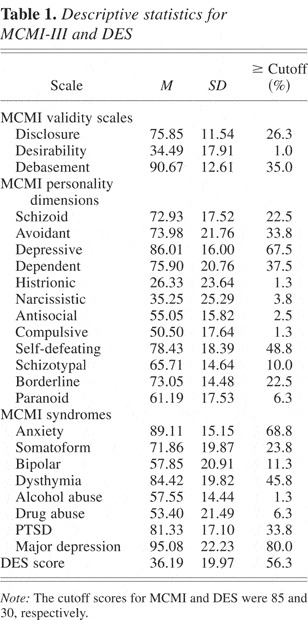
Descriptive statistics for MCMI-III scales and the DES are presented in Table 1. MCMI descriptive data are comparable to similar samples reported in the literature (Allen et al., 1998; Ellason, Ross, & Fuchs, 1995). Although MCMI debasement and disclosure scale elevations may be indicative of “faking bad,” these scale elevations in an inpatient psychiatric sample are more likely to indicate severe emotional distress and psychopathology (Allen et al., 1998; Wetzler & Marlowe, 1990). The DES mean score of 36 is higher than the cutoff score of 30 for identifying severely dissociative features and comparable to previously reported DES means for PTSD and DID/DDNOS populations (Bernstein & Putnam, 1986; Carlson et al., 1993; Coons, Bowman, Pellow, & Schneider, 1989; Frischholz et al., 1990; Ross et al., 1988).
Descriptive statistics for MCMI-III and DES

To increase diagnostic certainty, the assignment of clinical diagnoses considered several sources of information, including clinician diagnosis, MCMI-III scale scores 85 or greater, DDIS indices, and a DES cutoff score of 30 or greater. To receive a particular diagnosis, two or more data sources were required to indicate the presence of each disorder. For example, if the clinician diagnosis was major depressive disorder and the MCMI major depression scale was 85 or higher, the participant was given a diagnosis of major depression. Likewise, the participant was assigned a DID diagnosis if the clinician's diagnosis was DID and either the DDIS or DES score (>30) supported this diagnosis. Diagnostic categories using this multisource method included major depression, bipolar disorder, anxiety (any anxiety related disorder other than PTSD), somatoform disorder, PTSD, substance abuse (alcohol and/or drug abuse), DID, and personality disorder. Because only one personality disorder (borderline) could be assessed using the criteria of two or more instruments, the diagnosis of personality disorder included any of the DSM-IV-TR personality disorders. Using this criteria, 87.5% of the sample was diagnosed with major depression, 17.5% bipolar, 48.8% anxiety, 8.8% somatoform, 13.8% PTSD, 16.3% substance abuse, 55% DID, and 65% personality disorder (21.3% borderline). The mean number of comorbid diagnoses was 3.09 (SD = 1.43).
Phase 1: Comparison of self-report and interview classifications
Because of low cell counts, it was statistically impossible to directly compare three- and four-way self-report and interview categories; however, with AAI unresolved participants placed in their best-fitting primary classification to determine secure versus insecure status, a Fisher's exact test (1, 75; p = .57), was nonsignificant for two-way secure and insecure status on the two measures. Informal examination of cross-tabulation clearly indicated a lack of concordance between the attachment classifications of the two measures. In both four-way and three-way distributions, all participants classified as secure on the AAI reported insecure romantic attachment styles; likewise, the four participants reporting a secure romantic attachment style were classified as insecure on the AAI. A similar lack of concordance was observed for preoccupied and dismissing classifications in four-way distributions, although agreement improved slightly when unresolved status was not considered. A higher concordance rate was observed for unresolved AAI classification and fearful self-report category, with 55% of unresolved participants reporting a fearful attachment style; correspondingly, 80.5% of fearful participants were classified as unresolved. Nevertheless, a two-way chi-square analysis of unresolved/not unresolved and fearful/not fearful was nonsignificant, χ2 (1, 75) = .122, p = .73.
To provide stronger statistically based comparisons, we utilized continuous scores from each measure to compare to the attachment categories of the other measure. Specifically, we conducted multivariate analysis of variances (MANOVAs) to examine the association between AAI attachment category (three-way, four-way, and another four-way using secure, preoccupied, dismissing, and CC categories) and the ECR Secure, Fearful, Preoccupied, and Dismissing Scale scores that determine the ECR coefficient-based attachment categories. We also performed an analysis of variance (ANOVA) using the three insecure ECR coefficient-based attachment categories and the AAI Coherence of Mind Scale, which is thought to be the best reflection of secure/insecure state of mind. None of the results were significant.
Phase 2: Self-reported attachment and psychopathology
Statistical analyses were conducted using the insecure ECR coefficient-based attachment categories (fearful, preoccupied, dismissing), as well as the ECR self-model and other-model categories. For analyses of patient diagnosis, the Bonferonni correction to control for familywise error indicated that a p value of .006 was necessary to establish significance. Small cell size prevented statistical comparison of the ECR insecure categories and most diagnoses, except anxiety, DID, and personality disorder. Only one marginal association emerged, showing that fearful and dismissing adults were more likely than preoccupied adults to receive a diagnosis of DID, χ2 (2, 76) = 6.21, p = .04. Negative other-model was significantly related to a diagnosis of DID, χ2 (1, 80) = 9.69, p = .002, whereas negative self-model was marginally associated with diagnoses of bipolar disorder, Fisher's exact test (1, 80; p = .03), substance abuse, Fisher's exact test (1, 80; p = .03), and personality disorder, χ2 (1, 80) = 4.31, p = .04.
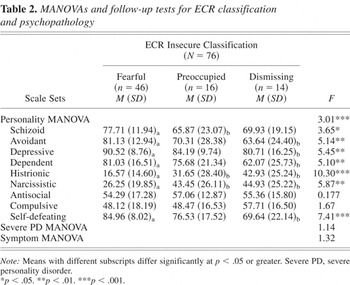
Three MANOVAs were conducted to determine if coefficient-based attachment style was significantly related to personality dimensions, severe personality disorder, and symptom scales. Because MANOVAs control for the possibility of inflated overall type I error rate and also incorporate correlations among variables into the test statistic (Stevens, 1996), it was determined that an α value of .05 was sufficient to determine significance. For the first MANOVA, nine MCMI personality scales were used, including the MCMI Schizoid, Avoidant, Dependent, Histrionic, Narcissistic, Antisocial, Compulsive, Depressive, and Masochistic/Self-Defeating Scales. The second MANOVA used the three MCMI severe personality disorder scales, including Schizotypal, Borderline, and Paranoid Scales. The third MANOVA examined clinical symptoms and included the MCMI Anxiety, Somatoform, Bipolar/Manic, Dysthymia, Alcohol Dependence, Drug Dependence, Posttraumatic Stress, and Major Depression Scales, as well as the DES score as a measure of dissociation. Wilk's lambda multivariate tests showed that coefficient-based attachment category was significantly related to personality dimensions, but not related to severe personality disorder, nor symptom scales (see Table 2). Results of follow-up ANOVAs for seven of the personality scales were significant, with the exception of the Antisocial and Compulsive Scales. Post hoc Tukey's honestly significant difference tests showed that fearful adults scored higher than preoccupied adults on the Schizoid Scale and higher than dismissing adults on the Avoidant, Dependent, Depressive, and Self-Defeating Scales. Conversely, fearful adults scored lower than both preoccupied and dismissing adults on the Histrionic and Narcissistic Scales.
MANOVAs and follow-up tests for ECR classification and psychopathology

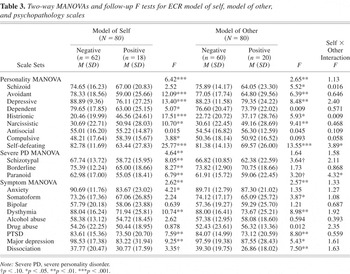
Similarly, three two-way factorial MANOVAs were conducted to examine the relation of self-model and other-model to the same personality, severe personality disorder, and symptom scales (see Table 3). The first factorial MANOVA examining self- and other- models in relation to personality dimensions showed a significant main effect for the self-model and for the other-model, but the interaction was nonsignificant. Follow-up ANOVAs showed significant associations of the self-model with seven personality dimensions (avoidant, depressive, dependent, histrionic, narcissistic, compulsive, self-defeating) and significant associations of other-model with six personality dimensions (schizoid, avoidant, depressive, histrionic, narcissistic, self-defeating). The second MANOVA examining severe personality disorder scales yielded a significant main effect for self-model, but was nonsignificant for other-model, and the interaction. Follow-up F tests indicated that the negative self-model was significantly associated with all three severe personality disorder scales. The third MANOVA examining the symptom scales showed a main effect for the self-model, and for the other-model, but the interaction was nonsignificant. Significant associations were noted for the negative self-model with anxiety, dysthymia, PTSD, and major depression, whereas the negative other model was significantly associated with dissociation, somatoform, dysthymia, PTSD, and major depression.
Two-way MANOVAs and follow-up F tests for ECR model of self, model of other, and psychopathology scales

Phase 3: AAI-based attachment and psychopathology
The same statistical tests were conducted using several AAI attachment classification schemes. Although four-way analyses (secure, preoccupied, dismissing, unresolved) were not possible because of low numbers of secure-not unresolved participants, when unresolved patients were assigned to the best-fitting primary classification and CC patients were removed from the analyses, three-way analyses could be conducted for anxiety, DID, and personality disorder with a total of 53 secure, preoccupied, and dismissing patients. In addition, to more closely examine variations within the unresolved category, personality and clinical symptoms were examined in relation to two additional classification schemes utilizing the AAI sample of 75 patients: (a) unresolved trauma (n = 51) versus not unresolved trauma (n = 24), and (b) unresolved loss (n = 30) versus not unresolved loss (n = 45). With respect to patient diagnoses and AAI classification, when the Bonferonni correction was again used to establish a .006 significance level, three-way chi-square analyses were nonsignificant for DID and personality disorder, but were marginally significant for anxiety, χ2 (2, 53) = 5.86, p = .05, with dismissing patients less likely and secure patients more likely to have an anxiety diagnosis than other attachment groups. When lack of resolution was examined separately according to loss or trauma categories, chi-square tests showed that unresolved loss was marginally associated with bipolar disorder, χ2 (1, 75) = 5.59, p = .02, and unresolved trauma was marginally associated with DID, χ2 (1, 75) = 6.48, p = .01, and personality disorder χ2 (1, 75) = 5.92, p = .01.
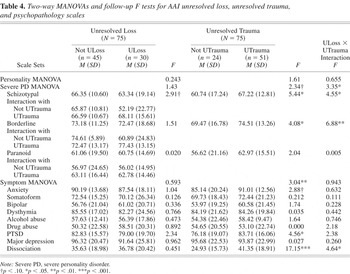
Three MANOVAs testing the association of the three-way AAI classification to the personality dimensions, severe personality disorders, and clinical symptom scales were nonsignificant based on an α level of .05. In the next series of tests examining unresolved loss and unresolved trauma, two-way factorial MANOVAs were conducted with personality and symptoms scales to capture both main effects and potential interactions occurring when both types of lack of resolution were present compared to unresolved loss only and unresolved trauma only. Because the number of participants in the unresolved loss only group was low (n = 9), current analyses remained exploratory for this category. A two-way factorial MANOVA showed no systematic relations for the personality dimensions, but a second factorial MANOVA demonstrated an interaction effect for the two unresolved categories in relation to the severe personality disorder scales. As shown in Table 4, unresolved loss in the absence of unresolved trauma appeared to suppress score elevations on the schizotypal and borderline personality scales, but have the opposite effect in the context of unresolved trauma. The third factorial MANOVA showed no main effect for unresolved loss and no interaction, but there was significant main effect for unresolved trauma in relation to the symptom scales, specifically for dissociation and PTSD.
Two-way MANOVAs and follow-up F tests for AAI unresolved loss, unresolved trauma, and psychopathology scales

Post hoc exploratory analyses were conducted to determine if the inclusion of the CC category (i.e., a four-way classification of secure, dismissing, preoccupied, CC) contributed to the predictive power of the AAI. Results were similar to the previously reported three-way findings, and did not add any new information. It is interesting to note, however, that despite nonsignificant overall MANOVAs, the CC group had the highest mean scores on schizoid, depressive, histrionic, compulsive, schizotypal, paranoid, bipolar, anxiety, and dissociation scales, and a follow-up ANOVA indicated that CC participants scored significantly higher than dismissing participants on the PTSD Scale, F (3, 71) = 2.91, p = .04.
Discussion
Results of the current study partially supported theoretical predictions regarding conceptually and methodologically distinct measures of adult attachment in a psychiatric sample of trauma patients. Consistent with the first hypothesis based on previous research with clinical or at-risk populations (Adam et al., 1996; Alexander, 1993; Allen et al., 1998; Fonagy et al. 1996; Muller et al., 2001; van IJzendoorn & Bakermans-Kranenburg, 1996), this inpatient sample contained low proportions of secure and high proportions of insecure classifications, especially the ECR fearful style, and AAI preoccupied and unresolved classifications. Results also supported the second prediction that self-reported ECR romantic attachment style would not be associated with AAI attachment classification. However, specific predictions regarding associations of ECR and AAI attachment groupings with personality dimensions and clinical symptoms or diagnoses received mixed support. The following discussion will first address ECR findings, then AAI findings, then explore possible explanations for the different findings for the two measures with a view toward the developmental and clinical implications.
ECR findings
Although the proportion of ECR fearful adults (57.5%) exceeds expectations for normative samples, the current study's distribution is similar to reported proportions of self-reported fearful attachment among trauma survivors (58%, Alexander, 1993; 66.7%, Allen et al., 1998). Results supported the prediction that fearful participants would show the most maladaptive personality profiles of the four self-reported adult attachment styles. Fearful adults scored extremely low and significantly lower than preoccupied and dismissing adults on the histrionic and narcissistic dimensions. According to Millon et al. (1997), extreme low/high levels on these scales are suggestive of problems in sociability and self-esteem, whereas modest levels represent more healthy adaptation in these areas. Preoccupied and dismissing attachment styles have at least one positive self or other model, which may allow compensatory coping strategies to be implemented. For example, a preoccupied/ambivalent individual with a positive other-model may seek help when anxious or threatened, whereas a dismissing/avoidant individual with a positive self-model may have the self-confidence to cope adequately with many external threats.
In contrast, fearful adults possess both negative self-models (high anxiety) and negative other-models (high avoidance); as expected, they showed the highest elevations on personality scales marked by behavioral and cognitive patterns of low self-esteem and/or interpersonal distrust (i.e., schizoid, avoidant, dependent, depressive, and self-defeating personality styles). The negatively skewed self-other perspective is consistent with descriptions of trauma survivors, who tend to view the world as more malevolent and the self as less worthy (Janoff-Bulman, 1992). Expectations formed in childhood for others to be hurtful and the self to be inadequate may engender internal conflicts when facing stressful life circumstances. Although overwhelmed and desirous of help, fearful individuals may also want to avoid seeking assistance for fear of rejection and/or abandonment. Consequently, they may exhibit contradictory hyperactivating and deactivating coping strategies (Simpson & Rholes, 2002) and/or resort to more primitive coping mechanisms such as dissociation, resulting in patterns of cognitive and behavioral disorganization that characterize personality disturbance.
Although ECR coefficient-based attachment classification was unrelated to the severe personality disorders and symptom scales, when the two underlying dimensions of self-model and other-model were considered separately, statistically significant associations emerged. Although some findings overlapped, the lack of statistically significant interactions suggests that the dimensions of self-model and other-model may independently contribute to the development of specific types of disturbance. This might explain the failure to find significant associations of clinical symptoms and severe personality disorders with coefficient-based attachment classification, which combines self and other models. Negative self-model was uniquely associated with MCMI-III anxiety and personality dimensions characterized by high anxiety levels and/or deficient self-worth (i.e., dependent, compulsive, schizotypal, borderline, paranoid). It is noteworthy that the three severe personality disorders were associated with the negative self-model, but not the negative other-model. Although social relations are always important to address, effective treatment of these personality disorders initially may require focused, intensive reconstruction of a fragmented, traumatized self to provide a more stable foundation for extending treatment to the improvement of interpersonal interactions.
Given the high degree of distrust, it is somewhat puzzling that paranoid personality disorder was not also associated with a negative other-model. However, a negative other-model was uniquely associated with higher schizoid, somatoform, and dissociation scores, as well as a diagnosis of DID. The latter finding is consistent with and strengthens the marginal finding linking DID to fearful and dismissing attachment, both of which have negative other models. All of these disorders are characterized by avoidance behaviors or compartmentalization, which reflect views of others as unreliable and possibly harmful. The clinical literature has emphasized the association of somatic complaints with the reluctance to experience or express emotion (Brewin, Dalghleish, & Joseph, 1996; Zerbe, 1999) and childhood trauma (Heim, Ehlert, Hanker, & Hellhammer, 1998; Thakkar & McCanne, 2000). For abused children, somatic expressions of distress may function adaptively, in that physical illness and avoidance of emotion may increase nurturance and decrease abusive behaviors in caregivers and perpetrators. Similarly, dissociation is thought to be temporarily adaptive, developing under extremely stressful conditions where active fight or flight/avoidance defenses are limited and more passive avoidance behaviors such as dissociation are the only viable defenses (Allen, 2001; Nijenhuis, Vanderlinden, & Spinhoven, 1998). Because of their expectations that others will be hurtful or incompetent, patients with negative other-models may be particularly difficult to treat. Consequently, it would be particularly important for therapists working with these patients to establish trust and security in the therapeutic relationship before initiating intensive treatment approaches.
AAI findings
Like previous AAI research with clinical samples (see van IJzendoorn & Bakermans-Kranenburg, 1996), secure attachment was underrepresented whereas preoccupied and unresolved attachment were overrepresented in this study. Although higher than meta-analytic findings of 40% in six clinical samples (van IJzendoorn & Bakermans-Kranenburg, 1996), the number of unresolved patients in this sample (80%) is in line with the closest comparable psychiatric sample (76%; Fonagy et al., 1996). However, the proportion of preoccupied adults (30%) in the current sample was substantially lower than the meta-analysis (46%) and the other comparable sample (59%; Fonagy et al., 1996). The discrepancy may be due to this study's inclusion of CC, which was not considered in previous research and reduced the number of preoccupied classifications. Although the CC classification is rare in low-risk populations, the substantial number of CC adults in this inpatient sample validates recent observations that this classification is increasingly seen among clinical populations (Hesse, 1999; Lyons-Ruth & Jacobvitz, 1999).
Although consistent with van IJzendoorn and Bakermans-Kranenburg's (1996) meta-analytic findings, there are several possible explanations for the failure to replicate other previous research reporting significant associations for AAI preoccupied and dismissing classifications with specific forms of psychopathology. Three-way chi-square analyses could not be conducted with some diagnostic categories that lacked sufficient cell size (i.e., major depression, bipolar, somatoform, PTSD, substance abuse, borderline personality disorder). In addition, none of the former studies identified the CC category, which necessarily reduced the number of participants receiving one of the three primary classifications and consequently led to different results. Differences in the sample characteristics of previous studies (e.g., nonclinical college students, high-risk poverty mothers, clinical adolescents) may also have contributed to the discrepant results. Of the two studies using the AAI with adult psychiatric patients, neither was composed primarily of sexual abuse survivors (90% in the current sample vs. 50 and 65%) and one consisted of only 12 borderline and 12 dysthymic patients, which is not representative of the broader psychiatric population (Patrick et al., 1994). The second study utilized a larger (N = 82), more representative psychiatric sample with substantial comorbidity and, like the current study, reported no significant associations for AAI three-way classification and Axis I disorders (Fonagy et al., 1996). Both studies were also limited by small cell size for some analyses and both used a less conservative α level of .05 to determine significance for diagnostic category.
Furthermore, the proportion of unresolved adults within some diagnostic categories in the current study appeared similar to the two adult psychiatric samples mentioned above. For example, 93% of the borderline personality diagnoses in this sample were classified as unresolved, compared to 75% in the Patrick et al. (1994) study and 89% in the Fonagy et al. (1996) study. Similarly, whereas 81% of anxiety patients in the current sample were unresolved, 86% of Fonagy et al.'s (1996) anxiety patients were unresolved. Yet, only analyses separately examining the AAI unresolved loss and unresolved trauma categories proved significant in this study. Contrary to predictions, neither unresolved category was associated with depression/dysthymia, possibly because of the prevalence of depression in the sample as a whole. However, support for the differential expression of symptoms was found for unresolved trauma, which was highly and uniquely associated with the pathological dissociation and PTSD scales, considered to be the two primary trauma-related syndromes (Allen, 2001). In addition, a significant interaction suggested a moderating effect for severe personality disorder, such that the combination of unresolved loss and unresolved trauma increased scores, but unresolved loss without unresolved trauma decreased MCMI-III scores on schizotypal and borderline personality scales. It is important to note, however, that this analysis was conducted on an exploratory basis because only nine participants were unresolved for loss only, and consequently, the findings must be viewed with increased caution. With this in mind, the following tentative interpretation is suggested. Based on findings that childhood experiences of loss and abuse have opposite effects on a newly identified hostile–helpless state of mind on the AAI, Lyons-Ruth, Yellin, Melnick, and Atwood (2003) speculated that loss may inhibit the perception of parents as malevolent, even in the context of abuse. Although this same effect may have contributed to lower scores in the absence of unresolved trauma, the combination of unresolved loss and unresolved trauma interacted to increase these scores, suggesting an additive effect when both types of lack of resolution are present. Once again, it must be emphasized that cautious interpretation and further replication of these findings is warranted.
Similarities and differences among ECR versus AAI findings
Consistent with previous research and theoretical distinctions between the two types of measurement, analyses comparing self-reported adult romantic attachment style and AAI attachment classification were nonsignificant. Although unexpected, the relative lack of significant results with the AAI compared to multiple findings of significance using the ECR may be due to the prominence of the unresolved AAI classification in this sample (60/75), which left only 15 participants distributed among the other groups in four-way analyses. Even in three-way analyses, the presence of so many participants with underlying lack of resolution in each of the primary categories may have compromised results by decreasing the variability between groups. Another explanation for the discrepancy between results of ECR and AAI analyses derives from a fundamental limitation inherent to studies relying on self-report measures. Specifically, it is possible that findings for ECR and MCMI/DES analyses were inflated because of common method variance in using self-reports of both attachment style and personality/psychopathology; conversely, the lack of significant associations between the AAI and the MCMI/DES may be related to the use of an interview to assess attachment representations and self-report questionnaires to measure personality and psychopathological symptoms. In addition, the general nature of the ECR and most self-report adult attachment measures, which assess attachment models across relationships rather than within specific relationships like the AAI, may enhance the ability to detect associations with the broad construct of personality. Given findings that adults rated themselves differently on attachment scales depending on the particular relationship they referred to (Ross & Spinner, 2001), current findings may have differed if participants were asked to rate their attachment-related attitudes in a specific relationship.
Alternatively, it is possible that adult romantic attachment style, in particular the self-other polarity captured by the ECR, is more closely associated with current personality functioning than adult states of mind regarding early parent–child attachments measured by the AAI. Although mental representations of past attachment relationships may be important to current functioning, “adaptation is always the joint product of developmental history and current circumstances, never either alone … early experience frames, but also is transformed by, later experience” (Sroufe, Carlson, Levy, & Egeland, 1999, p. 1). This does not diminish the ongoing significance of the parent–child relationship, but rather highlights the importance of considering current approaches to adult attachment relationships. From developmental and clinical standpoints, the central role of adult romantic attachment offers hope for change despite difficult early experiences that may continue to adversely influence current working models of parent–child attachment in adulthood. Establishing a sense of security in current attachment relationships with romantic partners or other attachment figures may offset the impact of earlier adverse attachment experiences, leading to improved personality functioning and well-being.
In this trauma sample, it is also important to consider the proclivity for revictimization among individuals with a history of childhood abuse (e.g., Acierno, Resnick, Kilpatrick, Saunders, & Best, 1999; Cloitre, Scarvalone, & Difede, 1997). The theoretical concepts of relational reenactment and traumatic bonding suggest that experiences in current romantic relationships among trauma survivors may parallel and potentially magnify negative internal models formed in aversive parent–child relationships (Allen, 2001; Herman, 1992; Walker, 1979). Thus, if present-day attachment security is influenced by early attachment experiences, but primarily derives from appraisals of attachment figure availability in current relationships (Kobak, 1999), it is conceivable that romantic attachment style in this sample reflects the composite result of multiple attachment traumas, both past and present, and as such, shows greater correspondence with current personality functioning. Clinically, this suggests that a therapeutic focus on the reenactment of early attachment trauma in current romantic relationships may be useful in addressing personality disorders among trauma survivors.
Whereas self-reported adult attachment style may play an important role in general personality functioning, results suggest it may not affect specific symptomatic expressions or the more severe personality disorders. The AAI primary categories were also not significantly related to any measures of psychopathology in this study. In contrast, although analyses with the overall unresolved classification were nonsignificant, findings suggested that unresolved loss and unresolved trauma are differentially related to severe personality disorder and symptom dimensions. Specifically, AAI unresolved trauma was related to pathological dissociation, PTSD, and schizotypal and borderline personality. This discrepant pattern of findings between the ECR and AAI classifications is intriguing. Some might argue that the traumatic experience itself, rather than unresolved status, contributed to these results. However, this entire inpatient sample was characterized by severe childhood trauma, and participants reported a wide range of symptoms and personality dysfunction, so why was unresolved trauma associated with only these four variables? Based on research demonstrating that PTSD and schizotypal and borderline personality disorders are associated with dissociation (Allen, 2001; APA, 2000; Bremner et al., 1993; Modestin, Ebner, Junghan, & Erni, 1996), it seems reasonable to surmise that the coding of lapses of reasoning and discourse, which are the hallmark of the AAI unresolved classification, may tap into dissociative mechanisms that give rise to these disorders. This interpretation is consistent with theoretical formulations regarding the role of early attachment processes in the ongoing development of dissociation (Liotti, 1992), and empirical reports that dissociative symptoms in adolescence are linked longitudinally to infant attachment disorganization and concurrently to AAI unresolved classification (Carlson, 1998; Hesse & van IJzendoorn, 1999; West et al., 2001).
Despite mixed findings across studies that have led to suggestions to modify or supplement current AAI coding criteria for use in nonnormative samples with severe psychopathology (Lyons-Ruth, Yellin, Melnick, & Atwood, 2005; Turton, McGauley, Marin-Avellan, & Hughes, 2001), arguably the most consistent finding regardless of sample makeup is the greater likelihood of unresolved classification among those experiencing psychological distress. In particular, one implication of current findings is that separate examination of the AAI unresolved loss and unresolved trauma categories in future studies might provide a better understanding of attachment processes related to loss versus abuse experiences, particularly in at-risk or clinical samples. Another area that clearly warrants further investigation is the question regarding the exact nature of the CC category, which currently lacks specificity and tends to accommodate any significant deviation from the standard coding criteria. In this study, exploratory analyses including the CC category did not increase the predictive power of AAI classification. Although it is difficult to interpret this finding because of unclear definition, Hesse's (1996) suggestion that the CC category may represent multiple distinct relational strategies might account for the nonsignificant results. The substantial number of CC participants in this and other clinical samples suggests that further clarification and refinement of this category may be useful, particularly with clinical or at-risk samples where higher numbers of CC are more likely to be identified.
Conclusions
This study provided intriguing new information concerning the role of adult romantic attachment and AAI states of mind regarding early attachment in the development of personality and psychopathology. Current results should be interpreted in light of the study's strengths and limitations. Multiple diagnostic measures raise confidence in the accuracy of participant diagnosis, although comorbidity and the prevalence of major depression must be taken into account as representative of an inpatient trauma sample. Similarly, assessment of adult attachment with both self-report and interview methodology is a significant contribution to the current literature on adult attachment. The use of a psychiatric trauma sample extends previous research with community or college samples (e.g., Anderson & Alexander, 1996; Roche et al., 1999) and offered a unique opportunity to explore attachment processes in relation to specific forms of psychopathology, most notably dissociative symptoms and DID. By the same token, however, the sample composition and size limited a full analysis because of the paucity of secure participants and high proportions of AAI unresolved or ECR fearful participants. Future studies using larger samples with psychiatric and control groups are needed to more fully explicate links between adult attachment and psychopathology.
Retrospective reports of childhood trauma and parent–child relationships in the context of depressive symptoms may have introduced subjective biases reflected in distorted memories or lack of self-disclosure. In particular, we had no corroborating evidence of childhood sexual or physical abuse. Although some clinicians and researchers have suggested that the validity of retrospective reports from psychiatric patients is questionable (e.g., Burbach & Borduin, 1986; Widom, 1989), Brewin, Andrews, and Gotlib (1993) reviewed the evidence, concluding that psychiatric status is not related to decreased reliability or validity of early recollections. Finally, the concurrent nature of data collection precludes an examination of the temporal and causal relationships between adult attachment and personality or psychopathology. Longitudinal research following at-risk children into adulthood would better address these questions.
Clearly, more research is needed using both self-report and interview measures of adult attachment in clinical and nonclinical populations to clarify how these constructs relate to one another and differentially relate to personality and psychopathology. Results of this study suggest that self-reported ECR romantic attachment style, especially its self–other dimensions, is meaningfully related to personality and psychopathology and can be usefully applied to psychiatric populations. Relative to the ECR, the AAI was less successful in uncovering associations, with the notable exception that pathological dissociation and clinical disorders featuring dissociation are related to unresolved trauma. ECR negative other-model was also related to dissociation, DID, and PTSD. Although this evidence represents only a few links in the developmental chain, in concert with prior research the findings lend some weight to theoretical conjectures (Lyons-Ruth & Jacobvitz, 1999; Main & Hesse, 1990; van IJzendoorn et al., 1999) regarding the intergenerational transmission of attachment disorganization. Specifically, the circular pathway of transmission may take the following form: dissociative or frightened/frightening parental behaviors stemming from unresolved loss and/or trauma contribute to infant attachment disorganization, which evolves into controlling behaviors in childhood and dissociative symptoms in adolescence or adulthood, which when combined with negative models of romantic partners and parenthood, in turn, may begin another cycle of disturbed parenting. Although the chain of evidence is still incomplete and requires longitudinal research to definitively confirm, this theoretical model provides clinicians with a broad view of the intergenerational sequence to inform comprehensive treatment planning for at-risk children and their parents or families, which targets multiple systemic levels and components that maintain and perpetuate the cycle of attachment disorganization and psychopathology.