Introduction
The avian egg has several functions: it protects the developing embryo and supplies all components necessary for the development of the enclosed embryo and ensures a proper preparation for the post hatch period. At the time of laying a bird egg must contain all the water and macronutrients needed for embryo development and maintenance. The importance of nutrition to early development is uniquely illustrated by the variation in egg composition among different species of birds. The relative proportions of yolk and albumen contrast widely among birds and are related to the degree of chick independence at hatching (Ar and Yom-Tov, Reference AR and YOM-TOV1978; Carey et al., Reference CAREY, RAHN and PARISI1980; Sotherland and Rahn, Reference SOTHERLAND and RAHN1987).
Within a species, egg weight (Christians, Reference CHRISTIANS2002) and the amount of albumen present is influenced by a number of factors which may have an impact on the success and survival of the hatchling. These factors include season (Marion et al., Reference MARION, NORDSKOG, TOLMAN and FORSYTHE1964), age (Fletcher et al., Reference FLETCHER, BRITTON, RAHN and SAVAGE1981) and breed of the hens (Marion et al., Reference MARION, NORDSKOG, TOLMAN and FORSYTHE1964) as well as the amount of stress present in the parent flock, housing conditions (Varquez-Montero et al., Reference VARQUEZ-MONTERO, SARMIENTO-FRANCO, SANTOS-RICALDE and SEGURA-CORREA2012), quantity and quality of feed given to the parent flock (Fisher, Reference FISHER1969; Keshavarz and Nakajima, Reference KESHAVARZ and NAKAJIMA1995). Depending on these factors, more or less nutrients can be allocated to the egg, giving the developing embryo a more or less favourable ‘nutritional’ environment to start post hatch development. The yolk is the main source of lipids and is implicated more in body mass gain than in body size development, whereas albumen represents the main source of water and proteins (Romanoff and Romanoff, Reference ROMANOFF and ROMANOFF1949; Carey et al., Reference CAREY, RAHN and PARISI1980; Sotherland and Rahn, Reference SOTHERLAND and RAHN1987). Albumen seems to be a functionally overlooked component of the egg.
This review deals with composition of the albumen and provides a brief discussion of the factors influencing this component. In addition, the role of albumen during embryonic development and the effect of partial removal of the albumen are discussed.
Composition of albumen
In precocial birds (mobile and endothermic at hatching), albumen contributes 33-76% of the initial egg content (excluding egg shell weight), whereas in altricial birds (sessile and ectothermic at hatching) albumen represents 65-86% (Carey et al., Reference CAREY, RAHN and PARISI1980). Yolk content varies from 14 to 67% and in general, the greater the proportional content of yolk, the more precocial the resulting chick will be (Ar and Yom-Tov, Reference AR and YOM-TOV1978; Carey et al., Reference CAREY, RAHN and PARISI1980; Sotherland and Rahn, Reference SOTHERLAND and RAHN1987). This difference in egg composition might be necessary to ensure that eggs are provisioned with adequate levels of nutrients for the prolonged incubation and development of the embryos of precocial species (Sotherland and Rahn, Reference SOTHERLAND and RAHN1987). The relationship between initial egg mass and shell, albumen and yolk mass in a wide variety of birds has recently been reviewed by Deeming (Reference DEEMING2007). Because of the difference in egg albumen content between different species, the egg water content will vary as well.
In the domestic fowl, the albumen contains about 10.5% protein and 88.5% of water and may be regarded as the main water source for the developing embryo. In contrast, the yolk only contains 50% of water. Over 90% of the solids in the albumen of the domestic fowl are proteins, there being little carbohydrates (6%), lipids (less than 1%), and inorganic ions (4%) such as sulphur, potassium, sodium and chloride and to a lesser extent phosphorus, calcium, magnesium and trace amounts of iron (Romanoff and Romanoff, Reference ROMANOFF and ROMANOFF1949). The most abundant protein is ovalbumin (75%), followed by 13% ovomucoid, 7% ovomucin, 3% ovotransferrin and 2% ovoglobulin. These are all simple proteins, except ovomucoid and ovomucin, which are glycoproteins and thus contain a carbohydrate group (Romanoff and Romanoff, Reference ROMANOFF and ROMANOFF1949). Proteomic analysis to identify minor components present in hen egg white has recently been performed (Guérin-Dubiard et al., Reference GUERIN-DUBIARD, PASCO, MOLLE, DESERT, CROGUENNEC and NAU2006; Mann, Reference MANN2007). As much as 69 (Guérin-Dubiard et al., 2006) or 78 (Mann, Reference MANN2007) chicken egg white proteins have been identified, including many components described for the first time.
The albumen of chicken eggs is composed of two types - thick and thin albumen. The total protein content of both layers is similar, but the thick albumen contains four times more ovomucin (Freeman and Vince, Reference FREEMAN and VINCE1974). The yolk contains about 50% water, 32% lipid, 16% protein, 1% of carbohydrates and about 1% of inorganic ions (Romanoff and Romanoff, Reference ROMANOFF and ROMANOFF1949). The eggs of other birds have a similar proportional composition (Freeman and Vince, Reference FREEMAN and VINCE1974). Egg albumen presumably contains only one pigment, water-soluble ovoflavin (Romanoff and Romanoff, Reference ROMANOFF and ROMANOFF1949). In the albumen several vitamins such as ascorbic acid, vitamin A and choline have been observed.
Avian albumen has a density of about 1.035 g cm-3 (Romanoff and Romanoff, Reference ROMANOFF and ROMANOFF1949). In a freshly-laid egg, the pH of the albumen is about 7.6. However, within a few days, the albumen becomes very alkaline, with a pH of about 9.5 (Freeman and Vince, Reference FREEMAN and VINCE1974).
Role of albumen during embryonic development
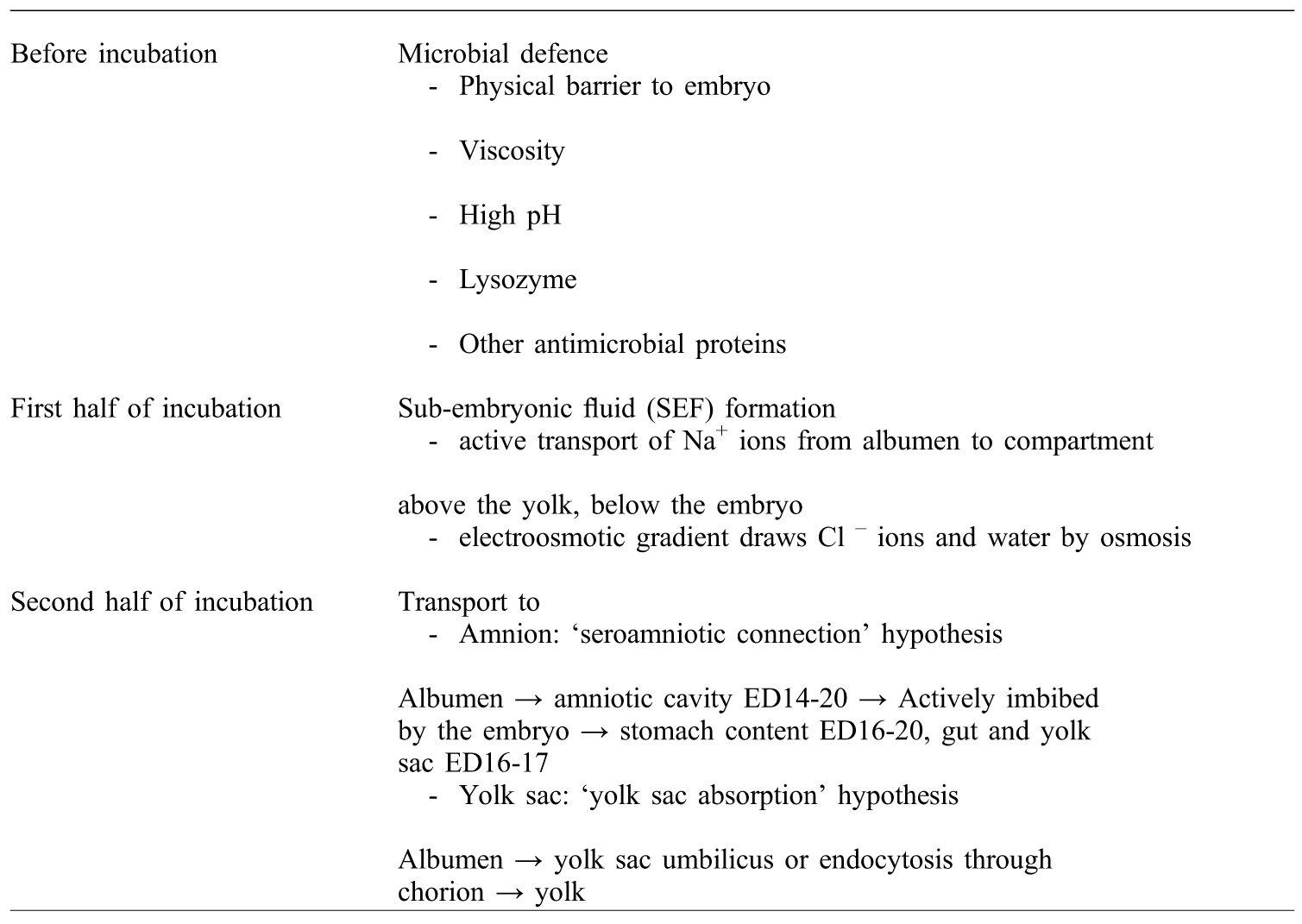
Albumen has several functions within the egg (Table 1). Besides to being a reservoir of water and proteins, starting from oviposition it provides a microbial defence for the developing embryo by directly killing bacteria or by creating an environment unfavourable for their growth. The chalazae, in combination with the high viscosity of the albumen, hold the yolk in a central position away from the egg shell, forming a barrier to any bacteria that might penetrate the eggshell (Board and Fuller, Reference BOARD and FULLER1974). Additionally, the high pH combined with the presence of lysozyme, which hydrolyses β(1-4) glycosidic bonds, a component of the cell wall of certain bacteria, disrupts the cell wall integrity of these bacteria. Some proteins such as ovotransferrin, can bind to minerals and vitamins, making them unavailable for microbial use and ovomucoid inhibits trypsin (Board, Reference BOARD1966). For a full review of the antimicrobial proteins present in the albumen and their function, the reader is referred to Palmer and Guilette (Reference PALMER and GUILLETTE1991).
The albumen appears to be important in maintaining the environment of the blastoderm at the optimum pH for development (Spratt, Reference SPRATT1947). The experiments of Schmidt (Reference SCHMIDT1937) provide evidence that the osmotic pressure of the egg white is of great physiological importance in the regulation of water exchange between the yolk and the embryo. The ability of the egg albumen to act as a nutrient source during the early developmental period is shown by the fact that the addition of albumen extract alone to the non-nutrient medium permits normal differentiation of the embryo. However, embryonic growth is somewhat less than optimal (Spratt, Reference SPRATT1947). Schmidt (Reference SCHMIDT1937) noted that the organic components of albumen are indispensable for the start of development.
Ovomucoid is a prominent albumen protein that appears in blood and remains to be detectable after hatching. This protein is one of several proteins in albumen that has extensive amounts of carbohydrate. Gluconeogenesis from albumen proteins focuses on using the inherent carbohydrates to form glycogen while conserving amino acids per se for protein synthesis (Scott et al., Reference SCOTT, JOHNSON, SATTERLEE and GILDERSLEEVE1981; Muramatsu et al., Reference MURAMATSU, HIRAMOTO, KOSHI, OKUMURA, MIYOSHI and MITSUMOTO1990). As a result, blood glucose levels progressively increase to support increasing liver and muscle glycogen deposition (Moran, Reference MORAN2007). The mass of the albumen in the egg is reduced during incubation in two phases, as discussed below.
Role of albumen during embryonic development.

first half of incubation
During the first few days of incubation, albumen is rapidly dehydrated by the movement of water into the yolk to form sub-embryonic fluid (SEF; Stern, Reference STERN1991). The formation of SEF involves the active transport of Na+ ions by the yolk sac membrane across the vitelline membrane from the albumen into the yolk, below the embryo. This creates an electro-osmotic gradient which draws chloride ions and water from the albumen across the membrane to a new compartment under the developing embryo to form the SEF (Deeming, Reference DEEMING2002). This process is a simple passive movement of water by osmosis (Romanoff, Reference ROMANOFF1967). The SEF can be considered a temporary store that holds water and electrolytes and from which the water can be easily channelled through the blood vessels to other compartments. At the same time, the stored fluid disperses the condensed yolk nutrients and increases their availability to the yolk sac membrane (Schlesinger, Reference SCHLESINGER1958). The formation starts after embryonic day (ED) two and reaches its maximum (of 14 ml) on the ED seven in chicken eggs. Thereafter, the volume reduces, and by ED 14-15, the compartment has disappeared (Ar, Reference AR1991).
The continuous removal of water results in a reduction in the volume of albumen, and as development proceeds the albumen becomes concentrated towards the narrow pole of the egg and is gradually surrounded by the chorio-allantois which finally forms a discrete albumen sac (Freeman and Vince, Reference FREEMAN and VINCE1974). Some limited movement of material does occur before ED 13 since egg white proteins have been found in the yolk, blood and amniotic fluid as early as ED five (Marshall and Deutsch, Reference MARSHALL and DEUTSCH1950; Reference MARSHALL and DEUTSCH1951; Wise et al., Reference WISE, KETTERER and HANSE1964).
second half of incubation
The majority of movement of albumen begins at about ED 13. The ‘seroamniotic connection’ hypothesis (Deeming, Reference DEEMING1991) proposes that a hole opens in the wall of the amnion adjacent to the neck of the albumen sac where the albumen comes into direct contact with the amnion (instead of being enveloped by the chorionic ectoderm). This area of amnion ruptures between ED 11 and 14 in the chicken, allowing albumen to comingle with amniotic fluid (Romanoff, Reference ROMANOFF1960; Reference ROMANOFF1967). Transfer of the albumen is rapid - within one day amniotic fluid proteins account for 70% of absorbed albumen proteins (Carinci and Manzoli-Guidotti, Reference CARINCI and MANZOLI-GUIDOTTI1968). However, it is not complete and a little thick albumen may be left (Wise et al., Reference WISE, KETTERER and HANSE1964). Once open the connection allows albumen proteins to flow into the amniotic cavity, where they are actively imbibed by the embryo, appearing subsequently in the gut and yolk sac (Baintner and Fehér, Reference BAINTNER and FEHÉR1974; Sugimoto et al., Reference SUGIMOTO, SAITO, KUSAKABE, HORI and KOGA1989; reviewed by Moran, Reference MORAN2007). Ingestion by the embryo begins at about ED 12 but becomes particularly active after ED 14 (Romanoff, Reference ROMANOFF1960; Kramer and Cho, Reference KRAMER and CHO1970). The proteins are then absorbed by the embryo - either via the intestinal epithelium, the yolk sac, or both. This mechanism is likely to be dependent on egg turning, which mechanically stresses the amnion and is thought to facilitate opening of the seroamniotic connection (Tullett and Deeming; Reference TULLETT and DEEMING1987; Deeming, Reference DEEMING1989a; Reference DEEMING1989b; Reference DEEMING1991).
At the same time as part of the albumen flows into the amniotic cavity, there is a simultaneous movement of albumen into the yolk sac (McIndoe, Reference McINDOE1960; Saito et al., Reference SAITO, MARTIN and COOK1965), probably through the yolk sac umbilicus and as a result there is a net increase in the amount of proteins in the yolk. More recently, Yoshizaki et al. (Reference YOSHIZAKI, ITO, HORI, SAITO and IWASAWA2002) proposed the ‘yolk sac absorption’ hypothesis, which states that albumen water and solids are transported via endocytosis through the chorion (surrounding the albumen and forming the albumen sac), the yolk sac, and amniotic membranes and into the yolk sac and amnion. The proteins are then absorbed by the yolk sac or ingested by the embryo, respectively. Some albumen proteins may also be digested in situ by a ‘hatching enzyme’ produced in the extra-embryonic membranes (Yasumasu et al., Reference YASUMASU, MAO, SULTANA, SAKAGUCHI and YOSHIZAKI2005).
The presence of albumen proteins in different compartments during embryonic development has been studied by Nelson et al. (Reference NELSON, GROTH and SOTHERLAND2010). In chicken embryos, protein banding patterns similar to those of fresh albumen appeared first in the amniotic fluid starting from ED 14 to 20, then in the stomach contents on ED 16 to 20, and finally in the yolk sac at ED 16-17 before hatching. The timing of these events supports the seroamniotic connection hypothesis for movement of albumen in avian eggs (Nelson et al., Reference NELSON, GROTH and SOTHERLAND2010).
Natural variation in amount and composition of albumen
In addition to variations between species (Carey et al., Reference CAREY, RAHN and PARISI1980; Sotherland and Rahn Reference SOTHERLAND and RAHN1987), the components of the egg may vary within one species. The proportional content of yolk and albumen can differ depending on the size of the egg, hen age (Fletcher et al., Reference FLETCHER, BRITTON, RAHN and SAVAGE1981), breed (Marion et al., Reference MARION, NORDSKOG, TOLMAN and FORSYTHE1964) and health status, quantity and quality of feed (Fisher, Reference FISHER1969; Keshavarz and Nakajima, Reference KESHAVARZ and NAKAJIMA1995; Li et al., Reference LI, XU, SHAN, HU, ZHANG and LI2011). In addition, variation is seen due to the female that produced the egg, the flock currently studied and the egg's position in the laying sequence, and in general the environment, including season (Marion et al., Reference MARION, NORDSKOG, TOLMAN and FORSYTHE1964) and housing conditions (Varquez-Montero et al., Reference VARQUEZ-MONTERO, SARMIENTO-FRANCO, SANTOS-RICALDE and SEGURA-CORREA2012). Apart from differences in egg size and composition, the content of solids of the egg may vary. Depending on the age and breed (Fletcher et al., Reference FLETCHER, BRITTON, RAHN and SAVAGE1981; Reference FLETCHER, BRITTON, PESTI, RAHN and SAVAGE1983; Ahn et al., Reference AHN, KIMAND and SHU1997), health status (Pan et al., Reference PAN, ZHAO, LIAO, CHEN, QIN, WU, ZHOU and HUANG2011) and the diet (Walker et al., Reference WALKER, WANG, XIN and DOLDE2012) of the breeder flock, more or less nutrients will be allocated to the egg, giving the developing embryo a more or less favourable ‘nutritional’ environment to start post hatch development.
egg weight
Intraspecies variation in egg mass is primarily attributable to variation in albumen mass (Sotherland et al., Reference SOTHERLAND, WILSON and CARNEY1990; Hill, Reference HILL1995; Nelson et al., Reference NELSON, GROTH and SOTHERLAND2010). As the egg mass increases, the mass of the albumen increases proportionately more whereas the proportion of yolk decreases (Romanoff and Romanoff, Reference ROMANOFF and ROMANOFF1949; Ricklefs, Reference RICKLEFS1984; Nelson et al., Reference NELSON, GROTH and SOTHERLAND2010). The growth rate of the embryo during incubation will also vary in direct proportion to egg mass (Byerly, Reference BYERLY1932). It has previously been shown that with increasing egg mass, there will be an increase of the hatchling mass and a corresponding increase in survivability (Nisbet, Reference NISBET1978; Stokland and Amundsen, Reference STOKLAND and AMUNDSEN1988; Amundsen and Stokland, Reference AMUNDSEN and STOKLAND1990), at least during the first few days post hatching (Williams et al., Reference WILLIAMS, LANK, COOKE and ROCKWELL1993; Williams, Reference WILLIAMS1994). Hence, is the increase in albumen mass responsible for increased survivability?
Nisbet (Reference NISBET1978) suggested that it is the dry portion of the albumen which may be the crucial factor, as the yolk's participation in tissue formation is less relevant. As previously stated, a large fraction of this dry portion consists of protein and this is about 67% of the total protein content of the egg (Romanoff and Romanoff, Reference ROMANOFF and ROMANOFF1949). With increasing egg weight, the albumen mass will increase more prominently and hence, more protein will be available for assimilation into tissue during embryonic development. Another factor that might be involved is the increase in water content accompanying an increase in albumen mass. Several studies suggest that manipulation of the water content of eggs per se may influence hatching size and quality of chicks (Simkiss, Reference SIMKISS1980; Tullett and Burton, Reference TULLETT and BURTON1982; Davis and Ackerman, Reference DAVIS and ACKERMAN1987). Sotherland et al. (Reference SOTHERLAND, WILSON and CARNEY1990) noted that intraspecific increases in hatchling mass occur at a rate similar to the increase in albumen in the egg, which consists of 90% water (Sotherland and Rahn, Reference SOTHERLAND and RAHN1987). From several studies it is also clear that hatching mass can be decreased by the partial removal of albumen (see below).
hen age
The average egg weight of a flock increases with hen age in chickens (e.g. Weatherup and Foster, Reference WEATHERUP and FOSTER1980), which is curvilinear tending to plateau towards the end of the laying cycle (French and Tullet, Reference FRENCH and TULLET1991). Hen age has also been shown to influence the proportion of yolk, albumen and shell present in eggs of chicken (Marion et al., Reference MARION, NORDSKOG, TOLMAN and FORSYTHE1964; Fletcher et al., Reference FLETCHER, BRITTON, RAHN and SAVAGE1981). As the hen ages, the eggs contain proportionally more wet and dry yolk, and proportionally less wet and dry albumen and hence the total percent water content of the egg decreases.
genetics
Different genetic lines can show marked variations in their average egg weights (Romanoff and Romanoff, Reference ROMANOFF and ROMANOFF1949) as a consequence of the type and extent of the applied selection pressure (French and Tullet, Reference FRENCH and TULLET1991). Recently, heritability for egg weight was estimated at 0.60, whereas for albumen weight and albumen dry matter concentration it was 0.57 and 0.38, respectively (Hartmann et al., Reference HARTMANN, JOHANSSON, STRANDBERG and RYDHMER2003). Altering egg weight either by direct selection or through a correlated response to selection for egg production was achieved primarily by changes in total albumen content (Rodda et al., Reference RODDA, FRIARS, GAVORA and MERRIT1977; Akbar et al., Reference AKBAR, GAVORA, FRIARS and GOWE1983).
nutrition
The effects of maternal diet on egg composition have been reviewed by Naber (Reference NABER1979) and Stadelman and Pratt (Reference STADELMAN and PRATT1989). The effect of nutrition can be dependent on the genotype. Indeed, low daily feed intake (75% of normal) decreased the egg production, increased the egg weight and decreased percentage yolk and yolk/albumen ratio and increased percentage albumen in lean broiler line breeder hens. In contrast, in fat broiler line breeder hens, the opposite was true. Indeed, a reduction in feed intake (75% of normal) led to increase in egg production, decrease in egg weight, increased percentage yolk and yolk/albumen ratio and decreased percentage albumen (Li et al., Reference LI, XU, SHAN, HU, ZHANG and LI2011). However, no significant differences could be found on either yolk or albumen solids content. No effects on albumen heights could be measured (Li et al., Reference LI, XU, SHAN, HU, ZHANG and LI2011). Thus, the effects of the nutritional stress are very different depending on the genotype of the hens.
Wu et al. (Reference WU, BRYANT, GUNAWARDANA and ROLAND2007) examined the effects of nutrient density in combination with different breeds of laying hens. As nutrient density increased (both in energy and other nutrients such as amino acids, Ca and available P), a quadratic response of the percentage of albumen solids was established, whereas Haugh units linearly decreased possibly because of the higher egg weight of hens fed the high nutrient density (Wu et al., Reference WU, BRYANT, GUNAWARDANA and ROLAND2007). Novak et al. (Reference NOVAK, YAKOUT and SCHEIDELER2004) reported that increasing lysine intake increased the percentage of albumen solids. Similarly, dietary methionine supplementation increased component mass, solids content and crude protein content in both albumen and yolk (Shafer et al., Reference SHAFER, CAREY and PROCHASKA1996). During early egg production, increasing the nutrient density caused an increased yolk and albumen weight, resulting in increased egg weight (Wu et al., Reference WU, BRYANT, GUNAWARDANA and ROLAND2007). Decreasing amino acid (Lys or Met) intake significantly decreases albumen weight and percentage of albumen to egg weight (Prochaska et al., Reference PROCHASKA, CAREY and SHAFER1996; Shafer et al., Reference SHAFER, CAREY, PROCHASKA and SAMS1998; Novak et al., Reference NOVAK, YAKOUT and SCHEIDELER2004). Increasing the protein content in the diet increased the egg weight by increasing the albumen weight (Keshavarz and Nakajima, Reference KESHAVARZ and NAKAJIMA1995). It is important to consider what sort of effect feed restriction in broiler breeder hens has on albumen composition of eggs and what sort of effects this will have on the developing broiler embryos.
environmental factors
Several sources of stress can have an impact on eggs. Heat stress is known to reduce egg weight (e.g. Star et al., Reference STAR, DECUYPERE, PARMENTIER and KEMP2008). Exposure of laying hens to high environmental temperatures (29.4-33.3°C) decreased both albumen and shell weight. Yolk weight was only depressed at 33.3°C (Tadtiyanant et al., Reference TADTIYANANT, LYONS and VANDEPOPULIERE1991). When switching from a normal 14L:10D light cycle to an ahemeral light cycle of 14L:14D, both egg and albumen weight increased (Lakshmanan et al., Reference LAKSHMANAN, HAWES and KLING1992). Japanese quail hens exposed to brief and mild stressors several times a day during laying, produced heavier eggs containing more albumen, although laying rates were not affected (Guibert et al., Reference GUIBERT, RICHARD-YRIS, LUMINEAU, KOTRSCHAL, BERTIN, PETTON, MÖSTL and HOUDELIER2011).
position in laying sequence
Intra-clutch variation in egg composition appears to be small although within a clutch the first egg that is laid tends to have a higher proportion of albumen (Romanoff and Romanoff, Reference ROMANOFF and ROMANOFF1949). For an individual female, the egg composition in a clutch will exhibit relatively more variation in albumen mass than in yolk mass (Rohwer, Reference ROHWER1986; Hepp et al., Reference HEPP, STANGOHR, BAKER and KENNAMER1987). For more information on this topic, see a review by Williams (Reference WILLIAMS1994).
Egg size variation in relation to laying order has been extensively investigated in birds and differs between species. Egg size can decrease or increase with laying order (Viñuela, Reference VIÑUELA1997; Hillstrom, Reference HILLSTROM1999). Kilpi et al. (Reference KILPI, HILLSTROM and LINDSTROM1996) found a reduction in egg weight within the laying sequence in herring gulls but no effect on dry albumen mass. Parsons (Reference PARSONS1976), however, found lower albumen content in the last laid egg in herring gulls and suggested that the difference in albumen size was an adaptation to reduce the length of incubation of the third egg. St. Clair (Reference ST. CLAIR1996) found an increase in egg mass with laying sequence in rock hopper penguins, accompanied by a proportional increase in albumen content. Ferrari et al. (Reference FERRARI, MARTINELLI and SAINO2006) found that both egg mass and absolute and proportional albumen mass increased with laying order in the barn swallow, whereas yolk mass did not vary.
changes occurring in the albumen during storage
Storing eggs prior to incubation has been shown to have small, but important, effects on egg composition (Oosterwoud, Reference OOSTERWOUD1987). In the first few days of storage, carbon dioxide dissolved in the albumen as a result of the shell formation process is lost to the outside atmosphere through the porous shell. This leads to a rise in albumen pH (from 7.6 at oviposition to 9-9.5). As the shell is porous, eggs lose water by evaporation during storage. Under normal storage conditions, approximately 1% of the egg's weight is lost as water vapour each week. The third change that occurs during egg storage is movement of water from the albumen to the yolk by osmosis (French and Tullet, Reference FRENCH and TULLET1991). In addition to lower albumen weight and higher albumen pH, longer periods of storage resulted in lower albumen heights (Scott and Silversides, Reference SCOTT and SILVERSIDES2000).
Experimentally manipulating the albumen content of the egg
Several studies have been conducted to examine the impact of partial albumen removal on the developing embryo and its post hatch performance. As albumen is consumed rapidly during embryonic development to supply amino acids for body protein synthesis, embryonic growth during incubation could be manipulated by albumen removal. These studies are important to examine whether within-species differences in the yolk/albumen ratio may affect chick development and whether this can lead to long-term consequences. Hill (Reference HILL1993) proposed that albumen removal can be used as a unique avian model to investigate the direct effect of reduced protein availability during embryogenesis on growth and behavioural development. Indeed, in contrast with mammalian models, manipulating the maternal diets include indirect confounding factors, such as maternal endocrine effects.
body weight
Hill (Reference HILL1993) removed a portion of 1, 2, 4, 8, 12 or 16% of the albumen present prior to incubation to examine the effects on embryonic growth. In contrast to Muramatsu et al. (Reference MURAMATSU, HIRAMOTO, KOSHI, OKUMURA, MIYOSHI and MITSUMOTO1990) who removed 1 or 2 ml of the albumen present prior to incubation but found no differences in embryo size on ED 12, Hill (Reference HILL1993) showed that decreasing levels of albumen led to decreased chick weight at hatch. Removal of 5 ml of albumen on day three of incubation gave similar embryo weights at ED 12, but led to a reduction in wet and dry embryo mass on ED 19 (Deeming, Reference DEEMING1989b). Evidence of reduced body weight towards the end of incubation was also provided by other authors such as Finkler et al. (Reference FINKLER, VAN ORMAN and SOTHERLAND1998), Ruijtenbeek et al. (Reference RUIJTENBEEK, KESSELS, DE MEY and BLANCO2003) and Everaert et al. (Reference EVERAERT, MÉTAYER-COUSTARD, WILLEMSEN, HAN, SONG, ANSARI, DECUYPERE, BUYSE and TESSERAUD2013) who reported reduced body weight in near-term embryos. Willems et al. (Reference WILLEMS, WANG, WILLEMSEN, LESUISSE, FRANSSENS, GUO, KOPPENOL, BUYSE, DECUYPERE and EVERAERT2013), however, did not observe reduced chick weight at hatch. One could speculate that the effects of albumen deficiency on growth may only begin early in the second half of the incubation period in poultry, as this stage, corresponds to the onset of the rapid increase in embryonic growth in chickens (Starck, Reference STARCK1998).
water content of the chick
As albumen consists of about 88.5% of water and 10.5% of protein (Deeming, Reference DEEMING2002), it is important to take the water content of embryos, chicks and the yolk sac into account. Finkler et al. (Reference FINKLER, VAN ORMAN and SOTHERLAND1998) removed 20% of the albumen present before incubation which resulted in a decrease in the wet yolk-free body but not the dry yolk-free body weight, corresponding with decreases in water content in the body (cells and extracellular fluid, including blood) in near-term embryos. This observation was further supported by Everaert et al. (Reference EVERAERT, MÉTAYER-COUSTARD, WILLEMSEN, HAN, SONG, ANSARI, DECUYPERE, BUYSE and TESSERAUD2013) at hatch but not at ED18, when no difference in dry body weight was observed. In a study by Willems et al. (Reference WILLEMS, WANG, WILLEMSEN, LESUISSE, FRANSSENS, GUO, KOPPENOL, BUYSE, DECUYPERE and EVERAERT2013), 3 ml of albumen was removed after ED one and replaced with about the same amount of saline. Chick weight at hatch, although lower, was not significantly reduced. The water content of the chick, however, was not measured.
residual yolk at hatch
As part of the albumen water and proteins are transferred to the yolk during embryonic development, it is important to examine the impact of albumen removal on the wet and dry weight of the yolk. Although Everaert et al. (Reference EVERAERT, MÉTAYER-COUSTARD, WILLEMSEN, HAN, SONG, ANSARI, DECUYPERE, BUYSE and TESSERAUD2013) did not find an altered absolute or relative yolk weight, other authors found a reduced wet yolk sac mass, but not dry yolk sac mass (Deeming, Reference DEEMING1989b; Finkler et al., Reference FINKLER, VAN ORMAN and SOTHERLAND1998), corresponding with decreases in water content of the yolk sac. Everaert et al. (Reference EVERAERT, MÉTAYER-COUSTARD, WILLEMSEN, HAN, SONG, ANSARI, DECUYPERE, BUYSE and TESSERAUD2013) did not measure the water content of the residual yolk. This suggests that differences in residual yolk weight are attributable to differences in water content. However, the results of Willems et al. (Reference WILLEMS, WANG, WILLEMSEN, LESUISSE, FRANSSENS, GUO, KOPPENOL, BUYSE, DECUYPERE and EVERAERT2013) indicated increased uptake and utilisation of yolk as the residual yolk weight was lower for the albumen-deprived group, without concurrent differences in yolk water content. This implies a higher consumption of the available yolk to support an equal embryonic growth and equal hatching weight. Most likely, this higher yolk utilisation acted as a compensation for the removed albumen proteins. On the other hand, as part of the proteins move from the albumen to the yolk starting from ED 13 (Freeman and Vince, Reference FREEMAN and VINCE1974), the reduced albumen availability in the albumen-deprived group could result in the lower residual yolk weight at hatch (Willems et al., Reference WILLEMS, WANG, WILLEMSEN, LESUISSE, FRANSSENS, GUO, KOPPENOL, BUYSE, DECUYPERE and EVERAERT2013).
morphometry and protein synthesis
Miller et al. (Reference MILLER, GREEN, PEEBLES, HANSON and BLANCO2002) removed 10% of the albumen content before incubation and observed a reduced body weight and length at ED 15, with no change in brain and heart weight. At hatch, however, decreased body weight was combined with increased proportional brain, heart, lungs and kidney weights, whereas the proportional liver weight was not significantly different. The rest of the body (comprising carcass, gut and yolk sac) proportionally weighed significantly less. These observations indicate an asymmetric growth restriction with relative ‘sparing’ of the brain and heart, diverting nutrients away from non-vital organs, such as muscle and skin, and towards essential organs, although it is not clear whether the increases in organ weight are due to increase in normal tissue growth or tissue oedema (Miller et al., Reference MILLER, GREEN, PEEBLES, HANSON and BLANCO2002). Removal of 7.5% of the albumen showed relative brain sparing but this was not apparent in the 5% removal group (Rodricks et al., Reference RODRICKS, ROSE, CAMM, JENKIN, MILLER and GIBBS2004). Ruijtenbeek et al. (Reference RUIJTENBEEK, KESSELS, DE MEY and BLANCO2003) removed 10% of the albumen before incubation and reported reduced embryo weight at ED 19 and increased proportional brain weight, resulting in disproportionate growth retardation.
Deeming (Reference DEEMING1989b) found reductions both in amount of allantoic fluid at ED 10 to 18 and amniotic fluid between ED 14 and 16 (Deeming, Reference DEEMING1989b), suggesting a reduced amount of the albumen available to move into the amnion and allantoic fluid.
Removal of 1 or 2 ml of the albumen present in chicken eggs prior to incubation significantly reduced whole-body protein synthesis when assessed after ED 12, but did not affect the weight of the embryo. Embryos from eggs naturally containing a large amount of albumen had higher whole-body protein synthesis rates than those from eggs containing naturally less albumen. It was concluded that albumen content was of crucial importance in regulating whole-body protein synthesis in chicken embryos during incubation (Muramatsu et al., Reference MURAMATSU, HIRAMOTO, KOSHI, OKUMURA, MIYOSHI and MITSUMOTO1990). Muscle proteolysis is transiently increased by the removal of albumen before the start of incubation. No evidence was found for altered protein synthesis capacity and translational efficiency in albumen-deprived chicks (Everaert et al., Reference EVERAERT, MÉTAYER-COUSTARD, WILLEMSEN, HAN, SONG, ANSARI, DECUYPERE, BUYSE and TESSERAUD2013).
time of hatch
Finkler et al. (Reference FINKLER, VAN ORMAN and SOTHERLAND1998) found no effect of albumen deficiency on hatching time. Willems et al. (Reference WILLEMS, WANG, WILLEMSEN, LESUISSE, FRANSSENS, GUO, KOPPENOL, BUYSE, DECUYPERE and EVERAERT2013) examined the effects of albumen removal on the time of internal pipping (IP), external pipping (EP) and hatch. Only the length of the EP-hatch interval was significantly shortened in the albumen-deprived group, which could be influenced by the availability of energy, such as yolk lipids or liver glycogen (Christensen et al., Reference CHRISTENSEN, GRIMES, DONALDSON and LERNER2000; Everaert et al., Reference EVERAERT, WILLEMSEN, DE SMIT, WITTERS, DE BAERDEMAEKER, DECUYPERE and BRUGGEMAN2008), corresponding with the decreased wet and dry residual yolk weight in this group. In altricial birds such as the barn swallow and semiprecocial birds, such as the yellow-legged gull, albumen removal significantly delayed hatching (Ferrari et al., Reference FERRARI, MARTINELLI and SAINO2006; Bonisoli-Alquati et al., Reference BONISOLI-ALQUATI, MARTINELLI, RUBOLINI, ROMANO, BONCORAGLIO, FASOLA and SAINO2007). This suggests that birds can adjust the hatching times of the eggs by modification of the proportion of albumen in their eggs (Bonisoli-Alquati et al., Reference BONISOLI-ALQUATI, MARTINELLI, RUBOLINI, ROMANO, BONCORAGLIO, FASOLA and SAINO2007).
behavioural changes
Hill (Reference HILL1993) examined the impact of albumen removal on behaviour by examining righting responses. These responses were retarded in the 2% and 4% albumen-removal group at hatch, but not later in life, so no long-term deficit in motoric development could be detected. No differences in body temperatures at hatch could be measured. No significant effect of 5, 7.5 or 10% albumen removal prior to incubation on memory consolidation could be detected (Rodricks et al., Reference RODRICKS, ROSE, CAMM, JENKIN, MILLER and GIBBS2004). In yellow-legged gull hatchlings, begging rate increased with laying order among albumen-deprived chicks, whereas the opposite was true for the control, as begging rate decreased with laying order. Concomitantly, begging rate decreased with egg mass among controls, but did not vary between albumen-deprived hatchlings (Bonisoli-Alquati et al., Reference BONISOLI-ALQUATI, MARTINELLI, RUBOLINI, ROMANO, BONCORAGLIO, FASOLA and SAINO2007). This indicates that a reduction of the relative egg albumen content can have complex effects on offspring behaviour.
long-term effects on growth
Everaert et al. (Reference EVERAERT, MÉTAYER-COUSTARD, WILLEMSEN, HAN, SONG, ANSARI, DECUYPERE, BUYSE and TESSERAUD2013) demonstrated that removal of 10% of the albumen from broiler eggs before incubation resulted in a decreased embryonic and posthatch body weight at least up to day seven, both in males and females. At both seven and 12 days post hatch, body mass of barn swallow chicks was decreased by albumen removal (Bonisoli-Alquati et al., Reference BONISOLI-ALQUATI, MARTINELLI, RUBOLINI and SAINO2008). After 20 days, female layer-type chicks were smaller, but in males no differences could be detected, so albumen removal seemed to have a larger impact on females than on males and resulted in long-term effects on growth rate (Hill, Reference HILL1993). In agreement to these findings, research from Willems et al. (Reference WILLEMS, WANG, WILLEMSEN, LESUISSE, FRANSSENS, GUO, KOPPENOL, BUYSE, DECUYPERE and EVERAERT2013) showed long-term effects of albumen removal (7.45%) on the body weight of layer-type hens. During the rearing period, the body weight of the albumen-deprived pullets was lower, whereas, during the laying period, the effect on body weight was dependent on the housing conditions. Housing albumen-deprived hens in battery cages (with limited possibility for exercise) during the laying period resulted in a higher body weight (Willems et al., Reference WILLEMS, WANG, WILLEMSEN, LESUISSE, FRANSSENS, GUO, KOPPENOL, BUYSE, DECUYPERE and EVERAERT2013), whereas housing in floor pens (together with roosters) resulted in continuous lower body weights compared to the control group (Willems et al., unpublished results).
survival in animal models of albumen removal
All studies examining the effect of partial albumen removal, however, suffer from a similar problem: seriously reduced hatchability. Hill (Reference HILL1993) found that removal of 8% of the albumen yielded a hatchability of 15.2% (compared to 46.7% in the sham-treated eggs). Removal of 10% of the albumen resulted in 10% hatchability in comparison with 82% in the controls (Everaert et al., Reference EVERAERT, MÉTAYER-COUSTARD, WILLEMSEN, HAN, SONG, ANSARI, DECUYPERE, BUYSE and TESSERAUD2013), 7.45% albumen removal in 38% hatchability compared to 87% for control eggs (Willems et al., Reference WILLEMS, WANG, WILLEMSEN, LESUISSE, FRANSSENS, GUO, KOPPENOL, BUYSE, DECUYPERE and EVERAERT2013) and removal of 20% of albumen resulted in 36.7% of hatchability (93.3% for control eggs) (Finkler et al., Reference FINKLER, VAN ORMAN and SOTHERLAND1998). Miller et al. (Reference MILLER, GREEN, PEEBLES, HANSON and BLANCO2002) obtained a hatchability of 45% with 10% albumen removal. Finkler et al. (Reference FINKLER, VAN ORMAN and SOTHERLAND1998) suggested that high mortality was directly due to the removal of the egg content and not to an unrelated pathology. Data from the classifications of the unhatched fertile eggs suggested that the actual manipulation was the main cause for the high mortality rate and low hatching success. This is supported by the observation that sham treated eggs, where no albumen was removed, also exhibited an elevated mortality (54% survival; Willems et al., Reference WILLEMS, WANG, WILLEMSEN, LESUISSE, FRANSSENS, GUO, KOPPENOL, BUYSE, DECUYPERE and EVERAERT2013) further supported by Everaert et al. (Reference EVERAERT, MÉTAYER-COUSTARD, WILLEMSEN, HAN, SONG, ANSARI, DECUYPERE, BUYSE and TESSERAUD2013). In addition, the high early (defined as before ED 10) embryonic mortality (52% in the albumen-deprived vs. 5% in the control group) illustrates the detrimental effect of the manipulation on the embryonic development. Furthermore, if the embryo survived the early stages of the embryonic development, the chance of a successful hatch was the same in the three treatments (control, sham and albumen-deprived), as no differences in mid and late death were detected (Willems et al., Reference WILLEMS, WANG, WILLEMSEN, LESUISSE, FRANSSENS, GUO, KOPPENOL, BUYSE, DECUYPERE and EVERAERT2013).
Interestingly, studies of albumen removal in altricial birds such as the barn swallow (Ferrari et al., Reference FERRARI, MARTINELLI and SAINO2006; Bonisoli-Alquati et al., Reference BONISOLI-ALQUATI, MARTINELLI, RUBOLINI and SAINO2008) revealed no differences in hatching success after albumen removal. In semiprecocial birds, such as the yellow-legged gull (Bonisoli-Alquati et al., Reference BONISOLI-ALQUATI, MARTINELLI, RUBOLINI and SAINO2008), hatching success was reduced by 35% and 39% for the first and second laid egg, respectively, but a similar hatchability as the control eggs was obtained for the third laid egg. Albumen removal in these studies was always aimed at keeping the eggs within the natural range of variation for proportional albumen content.
Conclusions
Although albumen is one of the major functional components in eggs, it is often overlooked. The albumen content of an egg is influenced by many different factors, which needs to be taken into account when managing laying hens or broiler breeders. In addition to being an important source of water for the developing embryo, the protein content is used as building blocks for the synthesis of embryonic tissue. Differences in the amount of albumen will lead to changes both during embryonic and postnatal development.