Introduction
Older adults tend to be more dedicated volunteers of time and money than younger ones. Between September 2008 and September 2009, the median annual number of hours of formal volunteering among the 55–64 age group in the United States of America (USA) was 60 and that among the age 65+ volunteers was 90 (US Bureau of Labor Statistics 2010). Previous research has also found that a higher proportion of older adults (age 55+) than younger ones make charitable donations and tend to be repeat donors (Center on Philanthropy 2007; Rooney, Brown and Wu Reference Rooney, Brown and Wu2008).
Time volunteering in late life has been found to have positive physical, functional, and mental health outcomes for older volunteers (Harlow and Cantor Reference Harlow and Cantor1996; Herzog et al. Reference Herzog, Franks, Markus and Holmberg1998; Lum and Lightfoot Reference Lum and Lightfoot2005; Musick, Herzog and House Reference Musick, Herzog and House1999; Oman, Thoreson and McMahon Reference Oman, Thoresen and McMahon1999; Thoits and Hewitt Reference Thoits and Hewitt2001; Van Willigen Reference Van Willigen2000; Wheeler, Gorey and Greenblatt Reference Wheeler, Gorey and Greenblatt1998). Mental health effect of time volunteering in most previous studies has been measured in terms of depressive symptoms. Using the three waves of panel data from the Americans' Changing Lives Survey (ACL), Musick and Wilson (Reference Musick and Wilson2003) found that volunteering, especially volunteering for religious causes, lowered depression levels for those age 65 or older, while it did not affect depression levels for those younger than age 65. Li and Ferraro (Reference Li and Ferraro2005), also using the three waves of ACL, found that volunteering is a long-term, albeit modest, antidote to depressive episodes among those age 60 or older.
The findings of the previous studies also suggest that only an optimum level of volunteering may have salutary effects. For example, two ACL-based studies found that volunteering at a level higher than 100 hours a year was not associated with increasing gains for mental or physical health among those age 60 or older (Morrow-Howell et al. Reference Morrow-Howell, Hinterlong, Rosario and Tang2003; Van Willigen Reference Van Willigen2000). Another study using the four waves of the Health and Retirement Study of the United States and focusing on individuals aged 55–66 at baseline also found that volunteering <100 hours a year only, coupled with paid work, was associated with lower depressive symptoms (Hao Reference Hao2008). Among Australian adults aged 64–68, volunteering 100–799 hours per year, relative to non-volunteering, was associated with higher life satisfaction and positive affect, whereas higher-level volunteering was associated with lower life satisfaction and no increase in positive affect (Windsor, Anstey and Rodgers Reference Windsor, Anstey and Rodgers2008).
Unlike the case of time volunteering, little research has been done on the effect of making charitable donations on older adults' wellbeing. Previous studies have found that some individuals engage in joint decisions to make gifts of time and money, and that people who volunteer time are also more likely to give money and vice versa (Apinunmahakul and Devlin Reference Apinunmahakul and Devlin2008; Bryant et al. Reference Bryant, Jeon-Slaughter, Kang and Tax2003; Duncan Reference Duncan1999; Freeman Reference Freeman1997). These and other studies that simultaneously examined the factors associated with time volunteering and money volunteering also found that sympathy, altruism, a desire to do a good deed, and a sense of social responsibility were motivational factors for charitable giving as well as for time volunteering (Apinunmahakul and Devlin Reference Apinunmahakul and Devlin2008; Bryant et al. Reference Bryant, Jeon-Slaughter, Kang and Tax2003; Duncan Reference Duncan1999; Hur Reference Hur2006; Lee and Chang Reference Lee and Chang2007; Rossi Reference Rossi2001, Reference Rossi, Brim, Ryff and Kessler2004; Sargeant and Woodliffe Reference Sargeant and Woodliffe2007; Small, Lowenstein and Slovic Reference Small, Lowenstein and Slovic2007). Given the similar motives for both time and money volunteering, the beneficial effects of charitable contributions on the wellbeing of older adults may be similar to those of time volunteering. However, the question of whether volunteering of one's money, like volunteering of one's time, will have long-term positive effect on psychological wellbeing needs to be empirically examined.
Despite the large quantity of previous studies of time and money volunteering activities in late life, the following gaps remain with regard to their mental health effects. First, previous studies have tended to focus on depressive symptoms, whereas a conception of mental health that is broader than depressive symptoms alone may be more likely to capture the overall mental health status of individuals. Second, past studies have also found that older adults with depressive symptoms chose volunteering out of self-protective motivations and as part of their efforts to maintain or improve their own physical and emotional health (Bowen, Andersen and Urban Reference Bowen, Andersen and Urban2000; Li and Ferraro Reference Li and Ferraro2005; Morrow-Howell and Mui Reference Morrow-Howell and Mui1989; Okun, Barr and Herzog Reference Okun, Barr and Herzog1998). Thus, the compensatory effect of volunteering may have been at work when depression was the study outcome. Third and most important, despite the high prevalence of charitable-giving behaviour among older adults, we know little about the relationship between charitable-giving behaviour and the mental health outcomes of older adults. As stated, older adults tend to be generous and repeat donors. Some older adults may also continue money volunteering, while they cut down or stop time volunteering due to declining health. Comparison between the mental health effects of time volunteering and those of charitable giving among older adults will provide further insight into psychological wellbeing in late life.
The purpose of the present study was to examine the relationship between time volunteering and charitable donations among older adults, on the one hand, and individual psychological wellbeing, on the other hand. We focused on psychological wellbeing as a broader measure of overall mental health status than depressive symptoms. According to Ryff, psychological wellbeing
encompass a breadth of wellness that includes positive evaluations of one's self and one's life, a sense of continued growth and development as a person, the belief that life is purposeful and meaningful, the possession of good relationships with other people, the capacity to manage one's life and the surrounding world effectively, and a sense of self-determination. (1995: 99)
Specifically, we examined the direct effect of the baseline (time 1 or T1) time volunteering and charitable donations on psychological wellbeing at follow-up nine years later (time 2 or T2). By examining the influence of time volunteering and charitable-giving behaviour on older adults' psychological wellbeing, we attempted to compare the mental health effects of charitable contributions to those of time volunteering. We focused on formal time volunteering and charitable donations for various organisations and causes. We excluded informal helping activities, in which individuals provide caregiving, financial support, and other services for family members, friends, and neighbours, as some of these informal helping activities may not be truly voluntary but obligatory (seeCnaan, Handy and Wadsworth Reference Cnaan, Handy and Wadsworth1996 for definitions of volunteer).
Theoretical and conceptual framework and hypotheses
This study was guided by activity theory and the theory of volunteering. Activity theory (Lemon, Bengtson and Peterson Reference Lemon, Bengtson and Peterson1972; Longino & Karl Reference Longino and Karl1982) emphasises the link between engagement in social and productive activities in later life, on the one hand, and life satisfaction and other domains of psychological wellbeing, on the other hand. Engagement in activities gives older adults opportunities to continue existing roles or assume new roles that sustain their self-identity and reinforce life-long patterns of attachment to sources of identity and reciprocal social support, hence the beneficial psychological effects (Glass et al. Reference Glass, Mendes de Leon, Bassuk and Berkman2006; Hao Reference Hao2008).
Activity theory and time volunteering
Volunteering helps older people to remain involved and connected by providing them with roles in later life when other roles as a paid worker, a family breadwinner, a spouse, and/or caretaker of children have ceased or been reduced. Volunteer work is one of the few viable alternatives to complete social disengagement in lieu of major role losses in later life such as widowhood and retirement (Krause, Herzog and Baker Reference Krause, Herzog and Baker1992). For older adults who experience a decrease in meaningful social roles, volunteering activities can also afford a sense of meaning, purpose, and control in life gained from perceiving and experiencing the effect of their volunteering activities in terms of contribution to others and the community (Chappell and Prince Reference Chappell and Prince1997; Krause, Herzog and Baker Reference Krause, Herzog and Baker1992; Morrow-Howell, Hong and Tang Reference Morrow-Howell, Hong and Tang2009; Narushima Reference Narushima2005; Thoits and Hewitt Reference Thoits and Hewitt2001). This sense of fulfilment and self-efficacy and the resulting self-esteem may help reduce depression in older adults and enhance their psychological wellbeing (Musick and Wilson Reference Musick and Wilson2003).
Volunteering activities can bolster psychological wellbeing in volunteers also because of direct human interaction with and social support from other volunteers and/or the recipients of the goods and services that they deliver (Krause, Herzog and Baker Reference Krause, Herzog and Baker1992; Musick and Wilson Reference Musick and Wilson2003; Wilson and Musick Reference Wilson and Musick1997). Since most volunteer work involves collective action, done with other people and for other people, volunteering can help strengthen or expand one's informal and formal support networks. In times of stressful life events, volunteering done with and for others may have protective effects on the mental health of volunteers because of social interaction and reciprocal support that result from the volunteering (Greenfield and Marks Reference Greenfield and Marks2004; Li Reference Li2007; Li and Ferraro Reference Li and Ferraro2005).
Activity theory and charitable contributions
The tenets of activity theory also apply to examining the psychological benefits of giving behaviour for the following reasons. First, like time volunteering, charitable donations of money are acts of volunteering and social engagement that represent active involvement by donors in the causes and groups that they identify with and support. This form of volunteering and social engagement is also likely to afford the donors a sense of meaning, fulfilment, and control in life and help them maintain their self-identity.
Second, previous studies have found that social bonds and close human interactions are also the basis of charitable-giving behaviour (Adloff Reference Adloff2009; Sokolowski Reference Sokolowski1996; see alsoHurd Reference Hurd2009). That is, donors tend to base their donation decisions on their involvement in the networks of face-to-face relationships, and giving tends to reinforce the social bond. Moreover, a substantial proportion (e.g. 45% in 2007 and 46.5% in 2008; GivingUSA 2009) of all individual donations in the USA go to religious groups/causes, and a greater share of middle-aged and older adults' donations is made in conjunction with their religious affiliation and service attendance. Level of religious service attendance, which is higher among older than younger adults, is a significant factor for religious giving (Wilhelm, Rooney and Tempel Reference Wilhelm, Rooney and Tempel2007). Religious donors are likely to belong to a congregation, interact with its members, and engage in reciprocal support. A modest amount of secular giving may not involve direct human contact, as donors mail in cheques or make online contributions; however, a substantial amount of charitable donations, both secular and religious, is likely to involve some positive human interactions throughout the process of being asked to donate, making donations, and being recognised for the donations.
Third, charitable donations also offer tangible benefits/rewards to the donors in the form of reduced tax payments and/or increased tax refunds and social status, which may contribute to their psychological wellbeing. Previous studies have found tax deductibility associated with high income to be an important determinant of money volunteering (Brooks Reference Brooks2007; Pitts and Skelly Reference Pitts and Skelly1984). Previous studies also found that donors use large sums of donations as a vehicle for joining ‘high society’ and/or for their self-definition and expression of identity (Adloff Reference Adloff2006; Ostrower Reference Ostrower1995).
Theory of volunteering of time and/or money
Predictors of time volunteering and charitable-giving behaviour have often been examined in accordance with the theory of volunteering that suggests human, cultural, and social capital to be the necessary ingredients for engagement in such behaviour (Wilson and Musick Reference Wilson and Musick1997). Studies have found that people who have more human (e.g. education, income, health status), cultural (e.g. sense of moral obligation, generative qualities, religiosity), and social (e.g. social network size, number of meetings attended, trust in others and in their community) capital attributes are more likely to engage in time volunteering and/or charitable giving (Brown and Ferris Reference Brown and Ferris2007; Hughes and Luksetich Reference Hughes and Luksetich2008; James and Sharpe Reference James and Sharpe2007; Li and Ferraro Reference Li and Ferraro2005; Lunn, Klay and Douglas Reference Lunn, Klay and Douglas2001; Regnerus, Smith and Sikkink Reference Regnerus, Smith and Sikkink1998; Smith and McSweeney, Reference Smith and McSweeney2007; Wilhelm et al. Reference Wilhelm, Rooney and Tempel2007; Wilson Reference Wilson2000).
In essence, the theory of volunteering, supported by the findings of these previous studies, posits that volunteers/donors tend to have more favourable human, cultural, and social capital resources – indicators of higher wellbeing – than non-volunteers. The psychological wellbeing of volunteers and donors is likely to be greater than that of their peers who are not volunteering and making donations regardless of their engagement in volunteering or making charitable donations. That is a likely explanation for the significant but modest effect of volunteering on depression found in previous studies (Li and Ferraro Reference Li and Ferraro2005; Musick and Wilson Reference Musick and Wilson2003). In the present study, we controlled for individual human, cultural, and social capital resources in order to examine the independent effect of volunteering and charitable donations on psychological wellbeing among older adults.
Conceptual framework and hypotheses
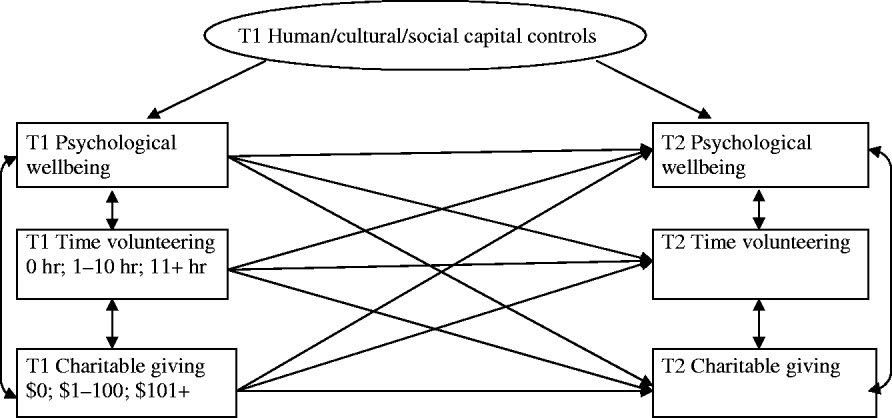
The conceptual framework of the present study, guided by activity theory and the theory of volunteering, is shown in Figure 1.
Conceptual framework of the study.
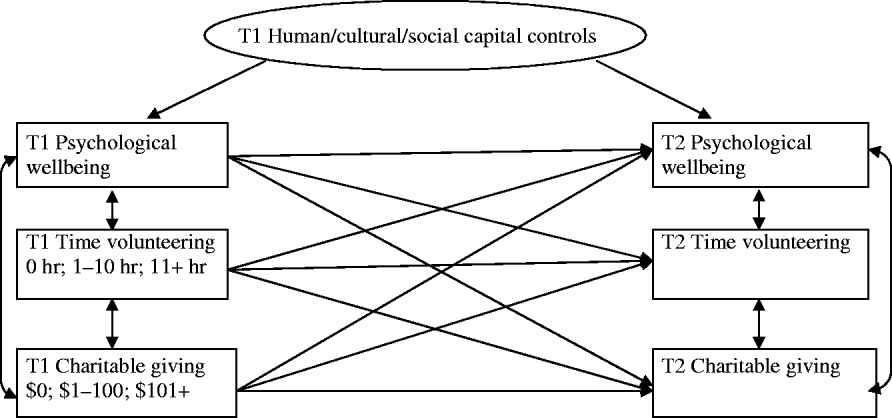
Our specific hypotheses were as follows:
H1: Moderate and/or high levels of T1 time volunteering, as opposed to no T1 volunteering, have a significant positive effect on T2 psychological wellbeing.
H2: Moderate and/or high levels of T1 charitable donations, as opposed to no T1 charitable donations, have a significant positive effect on T2 psychological wellbeing.
The control variables included T1 human, cultural, and social capital, T1 psychological wellbeing, and demographic characteristics (age at T2, gender, and race/ethnicity). Given the previously found threshold or curvilinear effect of volunteering hours on psychological wellbeing (Morrow-Howell et al. Reference Morrow-Howell, Hinterlong, Rosario and Tang2003; Van Willigen Reference Van Willigen2000), we specifically tested the effect of moderate versus higher levels of time volunteering. We also tested possible threshold or curvilinear effect of donation amount on psychological wellbeing.
Methods
Data, sample and measures
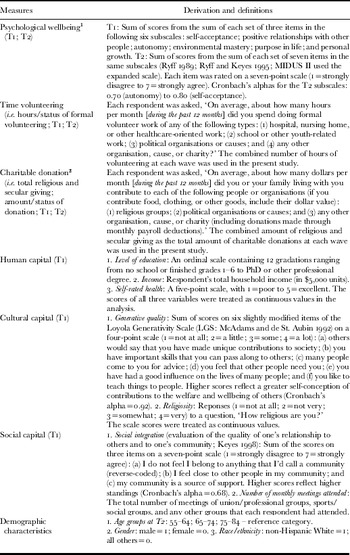
The data for this study came from the first and second waves of the Midlife Development in the United States – MIDUS, 1995–1996, and MIDUS II, 2004–2006 – that measured a number of social and psychological constructs for a national probability sample of non-institutionalised, English-speaking adults who were aged 20–74 at T1 (MIDUS, 1995–1996). In addition to the general population sample, siblings of the main sample respondents, a sample of twins, and over-samples in select metropolitan areas were included in the total sample. The sampling design and methods and the interview formats (a computer-assisted telephone interview followed by a mailed, self-administered survey) are described in detail by the MIDUS investigators (Brim, Ryff and Kessler Reference Brim, Ryff, Kessler, Brim, Ryff and Kessler2004; Inter-University Consortium for Political and Social Research (ICPSR) 2006a). At T1, 3,032 respondents of the general population sample completed both a telephone interview and a self-administered survey. At T2 (MIDUS II), 1,805 of the general population sample completed both a telephone interview and a self-administered survey. The sample for this study consisted of 917 respondents of the general population sample, who were aged 55–84 at T2 and who completed both a telephone interview and a self-administered survey at both T1 and T2. The attrition rate at T2 among T1 respondents who would have been in the 55–84 age group at T2 was high, at about 45 per cent. (We estimated the number of T1 respondents who would have been in the 55–84 age group at T2 to be 1,672.) We conducted a series of bivariate analyses comparing T2 respondents and non-respondents with respect to their T1 psychological wellbeing; number of volunteering hours; donation amounts; human capital, cultural capital, and social capital; and demographic characteristics. We found no significant difference in any of the variables. The study variables are described and defined in Table 1.
The measures of psychological wellbeing, time volunteering, charitable donation and controls

Notes: T1: at time 1. T2: at time 2. 1. We examined the three-item subscales for T2 psychological wellbeing to be consistent with the measures of T1 psychological wellbeing; however, the Cronbach's alpha for each three-item subscale at T2 was unacceptably low. Thus, we chose to use the combined scores from the seven-item subscales. The combined scores from the six subscales of Ryff's psychological wellbeing scale have been used in previous studies as a measure of overall mental health or psychological wellbeing (seeAn and Cooney Reference An and Cooney2006). 2. Because the donor unit could be an individual respondent or his or her family, we compared the amount of giving by living arrangement (i.e. living alone or with spouse, living with adult children, living with parents). We found no significant difference in the amount of giving by the living arrangement. Given the age group of the sample (55+), it is most likely that the respondents themselves or their spouses, not other family members, were the donors.
Analysis methods
Using Mplus Version 5 (Muthén and Muthén Reference Muthén and Muthén2007), a path analysis was conducted to test the proposed conceptual model (Figure 1) and the hypothesised effects of T1 time and charitable donations on T2 psychological wellbeing. The path analysis provided a method to test the interrelated multiple hypotheses posited in this study without conducting multiple estimations (Kaplan Reference Kaplan2000). Path analysis also allowed us to assess the overall fit of a conceptual model with multiple exogenous and endogenous variables to the observed data. We tested the effect of the different levels of time volunteering and charitable donations in the same path model to examine the effect of each type of volunteering, controlling for that of the other type.
Because our analysis model included categorical and continuous outcomes, we used a robust weighted least squares estimator using a diagonal weight matrix (WLSMV) in Mplus analysis (Muthén, du Toit and Spisic Reference Muthén, du Toit and Spisic1997; Muthén and Muthén Reference Muthén and Muthén2007). Missing data were handled using the full information maximum likelihood (FIML) algorithm (Little and Rubin Reference Little and Rubin2002) in Mplus. Also, we rescaled household income and psychological wellbeing by dividing them by 5,000 and 100, respectively, as these variables' variances were substantially larger than those of other variables in the model, which caused a convergence problem in the model estimation. To examine the threshold or curvilinear effect of T1 time volunteering hours on T2 psychological wellbeing, we used T1 volunteering hours as a categorical variable: 1–10 hours monthly (moderate level of volunteering); 11+ hours monthly (high level of volunteering); and no volunteering as the reference category. Ten hours per month is a rough equivalent of the 100 hours per year that previous studies found to be the upper limit of time volunteering that had a positive mental health effect. The T1 donation amount was also recoded as a categorical variable in order to examine possible threshold or curvilinear effects: US $1–100 monthly (moderate level of giving); $101+ monthly (high level of giving); and no charitable donations as the reference category. In the absence of any benchmark for charitable donations in previous studies, we used the median donation amount ($100) at T1 for the study sample as the threshold. The T2 volunteering hours and T2 donation amount, with the same categories, were treated as ordinal variables for the ordinal logistic regression analysis in the path model.
We evaluated the overall model fit to the data using the likelihood ratio test, the Comparative Fit Index (CFI), the Tucker-Lewis Index (TLI), the root mean square error of approximation (RMSEA), and the weighted root mean squared residual (WRMR). We followed the suggestion of Hu and Bentler (Reference Hu and Bentler1999) in using benchmark values for good models: CFI >0.95, TLI >0.95, and RMSEA <0.06. The WRMR is considered to be better suited to a path model with categorical data; WRMR values smaller than 1.0 would indicate a good fit with continuous and categorical data (Yu and Muthén Reference Yu and Muthén2002). The MIDUS II post-stratification weight, correcting for region, age, and education strata, for the MIDUS general population sample (ICPSR 2006b) was used in all univariate and bivariate analyses.
Results
Sample characteristics
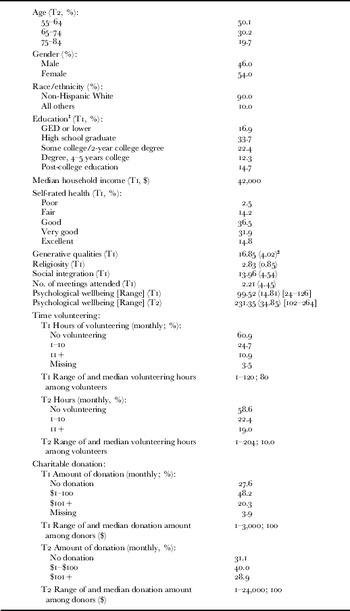
As shown in Table 2, the sample consisted of relatively highly educated (i.e. 83% with a high school diploma or higher education), healthy, and mostly non-Hispanic White individuals who had a high degree of social support, self-esteem, and psychological wellbeing.
Sample characteristics

Notes: 1. The 12 original categories for education (no education to PhD) were reduced to five in this table. 2. Standard deviation of the mean in parentheses. N=917. GED: General Educational Diploma.
About 36 per cent at T1 and 41 per cent at T2 volunteered their time, and about 69 per cent each at T1 and T2 made charitable donations. Further analysis (not reported in the table) showed that 28 per cent volunteered at both T1 and T2, and 60 per cent made charitable donations at both times. In other words, 73.8 per cent of T1 time volunteers volunteered again at T2, and 82.9 per cent of T1 charitable donors contributed again at T2, and that 78.3 per cent of non-volunteers and 61.7 per cent of non-donors at T1 were non-volunteers and non-donors, respectively, at T2, showing a relatively stable pattern of time volunteering and charitable-giving behaviour among the respondents. Further analysis also showed that, of all T1 donors, about 74 per cent gave to religious groups (median: $100); about 23 per cent gave to political organisations/causes (median: $10); and about 71 per cent gave to any other organisations/causes/charities (median: $40). Of all T2 donors, about 72 per cent gave to religious groups (median: $200); about 20 per cent gave to political organisations/causes (median: $20); and 71 per cent gave to any other organisations/causes/charities (median: $50).
The effect of time volunteering and charitable donations on psychological wellbeing
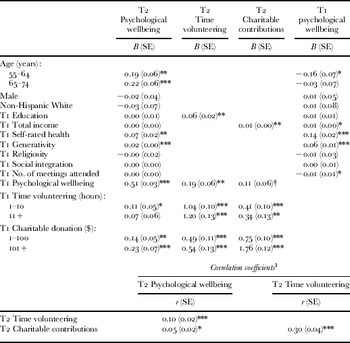
The path analysis results in the first column of Table 3 show that 1–10 hours monthly of T1 time volunteering, as compared to no time volunteering, had a significant positive direct effect on T2 psychological wellbeing, while 11+ hours of volunteering had no direct effect (i.e. not statistically different from no time volunteering).
Path analysis results in tabular format

Notes: Path model fit indices: CFI=0.99; TLI=0.97; RMSEA=0.03; WRMR=0.70.
1. Only the r values that were part of the model are presented. N=878. SE: standard error.
Significance levels: † p<0.06, *p<0.05, **p<0.01, ***p<0.001.
With respect to the effect of T1 charitable donations, the amounts in either the $1–100 or the $101+ range monthly, as compared to no donations, had a significant positive effect on T2 psychological wellbeing, but the effect of donations in the $101+ range was greater than that in the $1–100 range. This finding suggests a direct linear effect of the amount of charitable donations on psychological wellbeing. The findings also show a greater effect on psychological wellbeing of any amount of charitable donations than of any amount of time volunteering. These results support H1 and H2 with respect to the direct positive effect of time volunteering and charitable donations on psychological wellbeing. In a separate path model, we also tested the amount of donation to religious groups only, and found that both amounts – $1–100 and $101+ – of religious donations were also significant factors, although the effects were smaller – path coefficients 0.08 for $1–100 and 0.14 for $101+ – than those of the total amount of charitable donations. The other path coefficients with the religious donation amount were virtually identical to those with the total amount of charitable donations.Footnote 1
As far as the results relating to human and cultural capital are concerned, T1 self-rated health and generative quality were significant predictors of T2 psychological wellbeing, but neither indicator of social capital was significant. The only significant demographic predictor of T2 psychological wellbeing was the age group, with the two younger groups having a higher psychological wellbeing than the 75–84 age group. As expected, the relationship between T1 psychological wellbeing and T1 human and cultural capital (income, self-rated health, and generative quality) were also significant. It appears that income has a significant contemporaneous, but not lagged, relationship with psychological wellbeing, as T1 income was not significantly correlated with T2 psychological wellbeing. The data also show significant correlations not only between T1 hours of time volunteering and T2 hours of time volunteering and between T1 amount of charitable donations and T2 amount of charitable donations, but also significant contemporaneous and lagged correlation between the number of hours of time volunteering and the amount of charitable donations at both time periods. Bivariate correlation coefficients (lower part of Table 3) also show the significant association between T2 time volunteering and T2 charitable contribution as well as between both types of volunteering at T2 and psychological wellbeing at T2.
Discussion
The findings of the present study show that a moderate level of time volunteering (up to ten hours monthly or up to 120 hours annually) and any amount of charitable donations nine years earlier had a positive direct effect on psychological wellbeing among individuals age 55 or above. Like the findings of previous studies that focused on depressive symptoms as the outcome (Morrow-Howell et al. Reference Morrow-Howell, Hinterlong, Rosario and Tang2003; Van Willigen Reference Van Willigen2000), this study found that volunteering more than ten hours monthly did not have any long-term positive effect on psychological wellbeing. Heavy-duty volunteering may have created stress to the volunteers because of the significant time commitment and accompanying responsibilities. Heavy-duty volunteering may also be different from a light/moderate level of volunteering with respect to the type of social interaction and the degree of experienced reciprocity between efforts spent in activities and rewards received. Some previous studies have found that the quality or the context of social relationships and the experienced reciprocity in social and productive activities, not the frequency and level of the activities per se, were associated with positive wellbeing (Litwin and Shiovitz-Ezra Reference Litwin and Shiovitz-Ezra2006; Maier and Klumb Reference Maier and Klumb2005; McMunn et al. Reference McMunn, Nazroo, Wahrendorf, Breese and Zaninotto2009; Menec Reference Menec2003; Wahrendorf, von dem Knesebeck and Siegrist Reference Wahrendorf, von dem Knesebeck and Siegrist2006). Further research is needed to examine the reasons for differential effects of different levels of time volunteering.
With respect to charitable donations, we found significant positive effects of both levels (i.e. US $1–100 and $101+) of charitable donations on psychological wellbeing. Donations of more than $100 monthly (more than $1,200 annually) had a greater effect on psychological wellbeing nine years later than donations up to $100 monthly. Moreover, the positive psychological effect of even the lower donation amounts was greater than the effect of time volunteering. In the absence of any previous study findings regarding the long-term psychological effect of making charitable donations, we report this finding with caution and call for further studies that would take into account the different types of donations (e.g. religious, political, other secular) and the social and economic context and reasons for giving. As stated, we found that the amount of T1 religious donations alone was also a significant predictor of T2 psychological wellbeing. However, we could not undertake a separate analysis of political donations due to the small number of political donors in our sample and the small amount of their donations. Donors to political organisations/causes might have been quite different from donors to religious organisations. In future studies, donations to different organisation/causes need to be separated because people give money to different groups for different reasons (Bennett Reference Bennett2000). Future research may also need to examine the question of whether the methods of donating – mailing a cheque, contributing online, and/or donating in person – would have any differential effect on the psychological wellbeing of donors. Further research is also needed to examine different types of psychological resources (e.g. life satisfaction, sense of control, self-efficacy) that may mediate the relationship between volunteering and psychological wellbeing and the exact mechanism of mediation.
The results of the path analysis also showed positive effects of T1 human (self-rated health) and cultural (generative quality) capitals on T1 and T2 psychological wellbeing. Self-ratings of health were consistently found to be significant predictors of mortality, course of disability, and individual health practice or perceived control and control-enhancing strategies (Benyamini and Idler Reference Benyamini and Idler1999; Menec, Chipperfield and Perry Reference Menec, Chipperfield and Perry1999; Mor et al. Reference Mor, Wilcox, Rakowski and Hiris1994). Generative qualities were also found to be positively associated with several indicators of subjective psychological and social wellbeing and of life satisfaction (Ackerman, Zuroff and Moskowitz Reference Ackerman, Zuroff and Moskowitz2000; de St. Aubin and McAdams Reference de St. Aubin and McAdams1995; Grossbaum and Bates Reference Grossbaum and Bates2002; Keyes and Ryff Reference Keyes, Ryff, McAdams and de St. Aubin1998). The present study shows that these T1 individual resources affected T2 psychological wellbeing both directly and indirectly through their effect on T1 psychological wellbeing.
The study has a few limitations. First, as mentioned, the majority of the study sample were relatively highly educated non-Hispanic Whites, and they were not representative of the age group of the population. Racial/ethnic minorities were underrepresented in the MIDUS data. Because of the small sample of each racial/ethnic minority group, all minorities were grouped together in the analyses. Future research with a better representation of minority groups is needed. Second, although the data set allowed the separation of religious giving from secular giving, it did not allow separation of time volunteering for religious groups from time volunteering for secular groups/causes. It would have been more informative if these two types of volunteering were analysed separately to compare their psychological effect (see Musick and Wilson Reference Musick and Wilson2003). Third, as noted, the donor units could have been either individual respondents or their families. Because the age group selected for this study was 55 or older, the individual respondents were likely to have been the primary donors or major decision makers in the donation decision. Nevertheless, detailed data on primary versus secondary donors may have been more accurate. Fourth and as mentioned, the nine-year interval may have been too long to examine any carry-over effect of time volunteering and charitable donations in late life, as a variety of changes with regard to health conditions and other important correlates of psychological wellbeing may have happened during the time interval. Further research with a more representative sample and more detailed time and charitable donations data is needed.
Despite these limitations, the study findings show the positive psychological effect of involvement through volunteering one's time or making charitable donations in later life. To our knowledge this is the first study to examine the effect of charitable donations on psychological wellbeing. The positive psychological effect of even a modest amount of donations may be attributable to the donor's sense of self-efficacy or satisfaction with his or her actions based on his or her sense of sympathy, altruism, and a desire to do a good deed. Especially for older adults with a functional impairment that may prevent them from volunteering their time, making charitable donations may be a way for them to continue to act upon their sense of social responsibility.
Acknowledgements
This research was partially supported by a special research grant from Seoul Women's University to Jinseok Kim in 2010.