INTRODUCTION
Infections with Sarcocystis spp. are observed worldwide in a wide range of definitive and intermediate hosts. Approximately 200 species of these apicomplexan parasites have been described so far (Matuschka, Reference Matuschka1987; Dubey et al. Reference Dubey, Speer and Fayer1989; Odening, Reference Odening1998). Most of them have a heteroxenous life cycle, which is linked to a predator–prey relationship, i.e. the definitive hosts (DH; carnivorous or omnivorous animals) ingest tissue cysts (sarcocysts) predominantly present in muscle tissue of infected intermediate hosts (IH). One to two weeks post-ingestion, the DH excrete with their feces mature sporocysts or oocysts (each of which contain two sporocysts). The IH contract the infection by accidental ingestion of sporocysts via contaminated food or water (Dubey et al. Reference Dubey, Speer and Fayer1989). The prevalence of Sarcocystis spp. infections can exceed 80% in populations bred under extensive conditions (for example cattle raised on grazing systems) or even in wild animals (Dubey et al. Reference Dubey, Speer and Fayer1989; McAllister et al. Reference McAllister, Upton, Trauth and Dixon1995; Moré et al. Reference Moré, Abrahamovich, Jurado, Bacigalupe, Marin, Rambeaud, Venturini and Venturini2011). Although a large number of species has been identified, many of them have not been well described (Odening, Reference Odening1998). Information on the life cycles, morphology and molecular genetics of these parasites is scarce. It has been shown, however, that the phylogeny of Sarcocystis spp. can help to identify species in this genus and their affiliation with different host species (Tenter et al. Reference Tenter, Baverstock and Johnson1992; Slapeta et al. Reference Slapeta, Modry, Votypka, Jirku, Lukes and Koudela2003; Dahlgren et al. Reference Dahlgren, Gouveia-Oliveira and Gjerde2008; Tian et al. Reference Tian, Chen, Wu, Rosenthal, Liu, He, Dunams, Cui and Yang2012). One of the DNA sequences most often used for phylogenetic and diagnostic analyses is the 18S rRNA gene, which shows considerable variability among Sarcocystis spp. (Tenter et al. Reference Tenter, Baverstock and Johnson1992; Yang et al. Reference Yang, Zuo, Yao, Chen, Yang and Zhang2001; Dahlgren et al. Reference Dahlgren, Gouveia-Oliveira and Gjerde2008). Host specificities have been recorded, at least at the family level of the DH, for most Sarcocystis spp. with known life cycles, and co-evolution with the DH has been proposed (Barta, Reference Barta1989; Odening, Reference Odening1998; Dolezel et al. Reference Dolezel, Koudela, Jirku, Hypsa, Obornik, Votypka, Modry, Slapeta and Lukes1999). Reptiles within the suborder Serpentes seem to serve as definitive hosts for approximately 17 Sarcocystis spp., although molecular information has only been recorded for a few of these parasites (Matuschka, Reference Matuschka1987; Odening, Reference Odening1998; Slapeta et al. Reference Slapeta, Modry and Koudela1999; Duszynski and Upton, Reference Duszynski and Upton2009; Tian et al. Reference Tian, Chen, Wu, Rosenthal, Liu, He, Dunams, Cui and Yang2012). Sarcocystis singaporensis, for which 18S rRNA sequences are available, is one of the most studied species. It uses python snakes (Python reticulatus, Python sebae, Python timorensis and Aspidites melanocephalus) as DH and rodents (Rattus spp. and Bandicota spp.) as IH (Odening, Reference Odening1998; Slapeta et al. Reference Slapeta, Kyselova, Richardson, Modry and Lukes2002; Duszynski and Upton, Reference Duszynski and Upton2009). Other Sarcocystis spp. use snakes of the family of Pythonidae as DH, such as Sarcocystis villivillosi (DH: A. melanocephalus, P. reticulatus, P. sebae, P. timorensis), Sarcocystis zamani (DH: P. reticulatus), Sarcocystis rzepcyzkii (DH: Morelia spilota) and one unclassified Sarcocystis sp. All these Sarcocystis spp. use rodents of the genera Rattus and Bandicota as IH (Matuschka, Reference Matuschka1987; Duszynski and Upton, Reference Duszynski and Upton2009). However, lack of reported 18S rRNA gene sequences and of cross-infection studies renders the identification and validation of these species uncertain.
Large numbers of reptiles have, in recent years, been traded and imported into Europe as pets (Nijman and Sheperd, Reference Nijman and Sheperd2009). Among those declared as captive-bred, Morelia viridis seems currently to be exported in the largest numbers from Indonesia. There is growing concern, however, that many breeding farms are used to ‘launder’ illegally caught wildlife (Lyons and Natusch, Reference Lyons and Natusch2011). Consequently, veterinary authorities are confronted with the need to differentiate between import animals with a legal (breeding) or illegal origin (caught from the wild). Morphological and molecular identification of the parasites that the reptiles are infected with may help to determine the origin of the snakes (Öfner et al. unpublished results; Pasmans et al. Reference Pasmans, Blahak, Martel and Pantchev2008).
The aim of the present study was the molecular characterization of Sarcocystis spp. isolated from four green pythons (M. viridis), which were recently confiscated at customs when imported from Indonesia into Germany, in order to help to determine whether or not they had been bred in captivity, as had been claimed.
MATERIALS AND METHODS
In 2011, a group of 69 green pythons (M. viridis) was confiscated and housed at the Rescue Reptile Centre Munich to examine the health status of the snakes and to assist with the decision on the origin of the animals (farm bred or wild-caught). As declared, the snakes have been farm bred in special cages, in a closed room with thermoregulation, therefore completely isolated from natural habitats. They were fed twice a week only with rats and mice bred and raised in captivity (separate rooms).
A pooled fecal sample from four M. viridis was submitted to IDEXX Vet Med Lab (Ludwigsburg, Germany), where it was analysed by flotation technique (zinc chloride/sodium chloride solution with specific gravity of 1·3) and by a direct saline smear with a small volume of feces and staining the fresh sample with iodine solution (Pasmans et al. Reference Pasmans, Blahak, Martel and Pantchev2008).
A sample of the pooled feces was submitted to the Friedrich-Loeffler-Institut, Wusterhausen, Germany, for molecular identification of the Sarcocystis spp. Sporocysts of Sarcocystis spp. were concentrated as described previously for oocysts of other apicomplexan parasites (Schares et al. Reference Schares, Pantchev, Barutzki, Heydorn, Bauer and Conraths2005), and DNA was extracted using the ZR fecal DNA kit (Zymo, USA) according to the manufacturer's instructions. Initially, the ITS region was amplified by PCR using the COC-1/COC-2 primer pair (Ho et al. Reference Ho, Barr, Marsh, Anderson, Rowe, Tarantal, Hendrickx, Sverlow, Dubey and Conrad1996). In addition, a fragment of around 850–900 bp of the 18S rRNA gene was amplified by PCR using the primer pair SarcoFext and SarcoRext (Moré et al. Reference Moré, Schares, Maksimov, Conraths, Venturini and Schares2013). Five microlitres of each amplicon were examined in 1·5% agarose gels stained with ethidium bromide. DNA sequences of amplicons from both PCR reactions were obtained on a LI-COR DNA Sequencer 4200 (MWG Biotech, Germany) using the 5′ labelled primers COC-1 and COC-2 or SarcoFint and SarcoRint, respectively, as previously described (Schares et al. Reference Schares, Heydorn, Cuppers, Mehlhorn, Geue, Peters and Conraths2002; Moré et al. Reference Moré, Schares, Maksimov, Conraths, Venturini and Schares2013). Sequences were analysed with the GENEIOUS program (version 5.5.6, http://www.geneious.com) (Drummond et al. Reference Drummond, Ashton, Buxton, Cheung, Cooper, Heled, Kearse, Moir, Stones-Havas, Sturrock, Thierer and Wilson2011).
As sequences obtained with these primers showed several double peaks in the chromatograms, the original DNA sample was amplified with the primers ERIB1 and PrimerB (Barta, Reference Barta1989; Fenger et al. Reference Fenger, Granstrom, Langemeier, Stamper, Donahue, Patterson, Gajadhar, Marteniuk, Xiaomin and Dubey1995) to gain full length 18S rDNA sequences, which were subsequently cloned into plasmids. Amplification and DNA purification were carried out as described previously (Moré et al. Reference Moré, Schares, Maksimov, Conraths, Venturini and Schares2013). Purified products were cloned using the TA Cloning® kit and One Shot® TOP10 chemically competent Escherichia coli (Invitrogen, Life Technologies GmbH, Darmstadt, Germany) according to the manufacturer's instructions with 3 μL of purified product as ligation template.
Bacterial colonies (white) that had grown overnight at 37 °C on selective agar plates with ampicillin were propagated in 4 mL LB overnight at 37 °C and DNA extracted from 2 mL LB culture medium using the Invisorb® Spin Plasmid Mini Two kit (Stratec Molecular GmbH, Germany) according to the manufacturer's instructions. Each plasmid DNA was PCR-amplified using the universal primers M13-F and T7Prom-R to check the size of the cloned fragments.
Five microlitres of DNA and 5 μL (5 pmol μL−1) of each of the primers M13-F, T7Prom-R, S3, S5, H3 and H4 were mixed in 1·5 mL tubes as previously described (Moré et al. Reference Moré, Schares, Maksimov, Conraths, Venturini and Schares2013) and submitted to the Lightrun service of GATC Biotech (www.gatc-biotech.com/lightrun) for DNA sequencing. Sequences were aligned and assembled using the pair-wise global alignment with free end gaps and a similarity cost matrix of 65% from GENEIOUS.
Obtained consensus sequences were compared with other sequences deposited in GenBank by megablast alignment of the Basic Local Alignment Search Tool (BLAST) of the National Center for Biotechnology Information (http://blast.ncbi.nlm.nih.gov/). Phylogenetic analysis was conducted based on a performed global multi-alignment with a similarity cost matrix of 70% (GENEIOUS) using 18S rRNA gene sequences longer than 1250 bp from several Sarcocystis spp. with the 18S rRNA gene sequence of Toxoplasma gondii (GenBank M97703) as an out-group (tree function of the GENEIOUS program). A neighbour-joining method was applied with a Tamura–Nei model genetic distance calculation and with 1000 bootstrap replicates using 50% of support threshold. Additionally, the alignment was analysed by the program MrBayes (Plugin from GENEIOUS) for Bayesian inference of phylogeny and by Maximum Likelihood tree building (PhyML, GENEIOUS).
RESULTS
Large numbers of Sarcocystis spp. sporocysts were detected in the fecal samples by flotation and light microscopy. Moreover, a few eggs of spirurids, trematodes, Strongyloides spp. and large numbers of strongyle-type eggs were also found (Figs 1 and 2; Strongyloides egg not shown). In addition, some parasites of rodents (probably passing through the intestine of the snakes only) were observed (Hymenolepis nana-like tapeworm eggs, Myocoptes/Myobia-like mites of rodents; not shown). The Sarcocystis spp. sporocysts measured approximately 10·4 μm length×7·2 μm width (Figs 1 and 2).
Photomicrograph of material obtained by NaCl/ZnCl2 flotation from a pooled fecal sample of four Morelia viridis showing numerous Sarcocystis sp. sporocysts, a spirurid egg (Physaloptera-like; top left) and strongyle-type egg (Kalicephalus/Herpetostrongylus-like; bottom right).

Photomicrograph of a direct saline smear from a pooled fecal sample of four Morelia viridis showing numerous Sarcocystis sp. sporocysts and a digenean trematode egg.

PCR analysis with sporocyst DNA as the template yielded amplicons of the expected size for the ITS region using the COC-1/COC-2 primer pair (Ho et al. Reference Ho, Barr, Marsh, Anderson, Rowe, Tarantal, Hendrickx, Sverlow, Dubey and Conrad1996) and for a fragment of the 18S rRNA gene obtained with primer pair SarcoFext and SarcoRext (Moré et al. Reference Moré, Schares, Maksimov, Conraths, Venturini and Schares2013).
Sequences obtained with these primers showed several double peaks in the chromatograms and therefore deemed inconclusive as no consensus sequence could be derived. This finding indicated that the original DNA sample might have contained a mixture of different DNA target sequences. Therefore, the full length 18S rDNA sequences were amplified from the original DNA sample and subsequently cloned into plasmids and sequenced as described previously (Moré et al. Reference Moré, Schares, Maksimov, Conraths, Venturini and Schares2013). In the six sequenced plasmids, two different Sarcocystis spp. sequences were identified, and the resulting 18S rRNA full length gene sequences deposited in GenBank (accession numbers KC201639 and KC201640), referring the origin as Sarcocystis sp. from M. viridis. Both sequences have a 93·8% of pair-wise sequence identity.
The sequence with the accession number KC201639 (found in four plasmids), showed 95% identity with other S. singaporensis sequences (GenBank AF434054 and AF434051), as well as with Sarcocystis sp. MA#347 (GenBank AB251613) identified in a blood sample from a raccoon (Procyon lotor) (Jinnai et al. Reference Jinnai, Kawabuchi-Kurata, Tsuji, Nakajima, Fujisawa, Nagata, Koide, Matoba, Asakawa, Takahashi and Ishihara2009). The sequence with the accession number KC201640 (identified in two plasmids), showed 97% identity with S. singaporensis sequences (GenBank AF434054, AF434051 and AF434057).
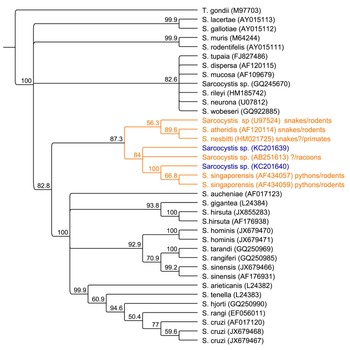
A phylogenetic tree was constructed and both sequences (KC201639 and KC201640) were closely related to those of other Sarcocystis spp., which use snakes as DH, and also to other sarcocysts which use raccoons and primates as IH but for which the DH is not yet known (Fig. 3). Results from Bayesian and Maximum Likelihood analysis positioned the sequences on the same branch shown on Fig. 3 with a branch support of 97% of probability and 68% of bootstrap proportion, respectively.
Neighbour-joining consensus tree from a multiple Sarcocystis spp. 18S rRNA gene sequence alignment. A Toxoplasma gondii sequence (GenBank M97703) was used as an out-group. The coloured branch indicates the positions of newly obtained sequences of Sarcocystis spp. from Morelia viridis (in blue). Branch support is represented as percentage from 1000 bootstraps. For sequences positioned in the coloured branch, hosts are mentioned (definitive host/intermediate host). (?): host unknown; (snakes?): snakes suggested as definitive host.

DISCUSSION
A pooled fecal sample from four confiscated green pythons (M. viridis) was collected and analysed for intestinal parasites. Using a conventional flotation and other fecal examination techniques, several Sarcocystis spp. sporocysts were observed. To identify the Sarcocystis spp. we used a DNA extraction kit that had proven reliable for extracting DNA from T. gondii and Hammondia hammondi oocysts (Herrmann et al. Reference Herrmann, Maksimov, Pantchev, Vrhovec, Conraths and Schares2011).
Initially performed PCRs were targeting regions of the 18S rRNA gene that are conserved among several apicomplexan species (Ho et al. Reference Ho, Barr, Marsh, Anderson, Rowe, Tarantal, Hendrickx, Sverlow, Dubey and Conrad1996; Moré et al. Reference Moré, Schares, Maksimov, Conraths, Venturini and Schares2013). They yielded substantial amounts of amplicons (data not shown) confirming the reliability of the DNA extraction method and successful PCR using primer pairs with a broad specificity among coccidian or apicomplexan parasites. DNA sequencing of these amplicons resulted in sequences with several double peaks, suggesting a mixture of different DNA molecules. To isolate different DNA species, the full-length sequence of the 18S rRNA gene was amplified from the original sample and its DNA cloned in a plasmid vector as previously described for bovine Sarcocystis spp. (Moré et al. Reference Moré, Schares, Maksimov, Conraths, Venturini and Schares2013). DNA sequencing of the inserts of six individual clones yielded two different Sarcocystis spp. sequences, confirming that a mixture of DNAs had been present in the initial sample. Unfortunately, it was not possible to establish whether these results correspond to a mixed infection of a single snake or single or mixed infections of several animals, as the analysed fecal sample was obtained as a sample passed by four green pythons kept in a single cage.
Both sequences were reported to GenBank and compared with other available sequences. None of them matched completely with known sequences, but both showed a 95–97% sequence identity with the 18S rRNA gene of S. singaporensis. The identity was too low to assume that the Sarcocystis spp. we found in this study were identical with those for which 18S rRNA gene sequences had previously been reported (Dahlgren and Gjerde, Reference Dahlgren and Gjerde2007). These findings suggest that we found Sarcocystis spp. of at least two other taxa, but we do not have sufficient data to describe or to name these taxa (Odening, Reference Odening1998). Both sequences (KC201639 and KC201640) might either belong to a Sarcocystis sp. already described but for which no 18S rRNA sequence is available, or to new taxa. More sequence data and experimental infection studies are needed to improve the taxonomy of the genus Sarcocystis (Odening, Reference Odening1998).
To study the relationship of the Sarcocystis spp. detected with known species, 18S rRNA sequences were phylogenetically analysed. The quality and interpretation of phylogenetic trees depends on the number and length of the 18S rRNA sequences used and on the presence of variable regions (Jeffries et al. Reference Jeffries, Schnitzler, Heydorn, Johnson and Tenter1997; Dolezel et al. Reference Dolezel, Koudela, Jirku, Hypsa, Obornik, Votypka, Modry, Slapeta and Lukes1999; Mugridge et al. Reference Mugridge, Morrison, Jakel, Heckeroth, Tenter and Johnson2000; Slapeta et al. Reference Slapeta, Modry, Votypka, Jirku, Koudela and Lukes2001). We therefore conducted the analysis with full length 18S rRNA gene sequences or sequences longer than 1250 bp, which included variable regions (Dahlgren and Gjerde, Reference Dahlgren and Gjerde2007).
As previously shown by others and corroborated by this study, the Sarcocystis spp. that use snakes as the DH share the same branch of a phylogenetic tree constructed with their 18S rRNA sequences (Dolezel et al. Reference Dolezel, Koudela, Jirku, Hypsa, Obornik, Votypka, Modry, Slapeta and Lukes1999; Slapeta et al. Reference Slapeta, Modry, Votypka, Jirku, Lukes and Koudela2003; Tian et al. Reference Tian, Chen, Wu, Rosenthal, Liu, He, Dunams, Cui and Yang2012). The sequences we obtained (KC201639 and KC201640) grouped closely with S. singaporensis sequences (GenBank AF434057 and AF434059) with a branch consensus support of 84%. This phylogenetic relationship may suggest that the sequences correspond to a Sarcocystis sp. that uses pythons as the DH and, most likely, rodents as its IH. On the other hand, both sequences were positioned in the same node with the sequence of a Sarcocystis sp. accidentally identified in raccoon blood (Jinnai et al. Reference Jinnai, Kawabuchi-Kurata, Tsuji, Nakajima, Fujisawa, Nagata, Koide, Matoba, Asakawa, Takahashi and Ishihara2009; GenBank AB251613), suggesting that this Sarcocystis sp. could correspond to a completely different species that uses snakes as DH, but more solid evidence is needed. On the other node from the same branch, which contains our sequences, Sarcocystis nesbitti (GenBank HM021725), S. atheridis (AF120114) and another Sarcocystis sp. (GenBank U97524) were positioned, which uses viperid snakes (Sistrurus catenatus) as the DH and rodents (Microtus sp.) as IH (Carreno et al. Reference Carreno, Schnitzler, Jeffries, Tenter, Johnson and Barta1998). Based on phylogenetic information, it has recently been proposed that S. nesbitti is a parasite that uses snakes as its DH (Tian et al. Reference Tian, Chen, Wu, Rosenthal, Liu, He, Dunams, Cui and Yang2012), which is in accordance with our analysis.
The two 18S rRNA gene sequences of sporocysts isolated from the feces of green pythons seem to belong to Sarcocystis spp. that use python snakes as DH and probably rodents as IH. It is therefore highly likely that the animals were in contact with their natural environment and had ingested tissue of potential IHs of Sarcocystis spp. that got infected via food or water contaminated with sporocysts from the feces of python snakes. A predator–prey relationship is much more likely for free-living animals or farm-bred animals reared under extensive conditions (Dubey et al. Reference Dubey, Speer and Fayer1989; McAllister et al. Reference McAllister, Upton, Trauth and Dixon1995; Moré et al. Reference Moré, Abrahamovich, Jurado, Bacigalupe, Marin, Rambeaud, Venturini and Venturini2011). As the ‘farmers’ officially declared, to regulatory authorities, that they breed all rodents used as food for the snakes themselves, and based on the facility conditions, where a direct contact of the snakes with wild rodents can be excluded, it seems unlikely that the infected snakes had been legally bred. It is improbable that rodents fed to the snakes were captured from the wild, as this would be extremely laborious and inefficient. On the other hand, it also appears unlikely that the captive-raised rodents, which were bred separately, would contain Sarcocystis spp. cysts, as an infectious source for sporocysts would be absent. We therefore believe that our results, supported by further evidence obtained by physical and other laboratory examinations, firmly suggest that the snakes were wild-caught.
In conclusion, two new 18S rRNA gene sequences belonging to Sarcocystis spp. that use green pythons (M. viridis) as DH were identified and reported to GenBank. These data, together with the results of clinical examinations and available information on farm facilities suggest that the confiscated snakes were wild-caught.
ACKNOWLEDGEMENTS
We would like to thank Aline Maksimov and Diana Herold for their excellent technical assistance, Markus Baur, Tobias Friz, Thomas Türbl and Rudolf Hoffmann (Reptile Rescue Centre Munich, Germany) and Silvia Blahak (CVUA-OWL, Detmold, Germany) for their support.
FINANCIAL SUPPORT
Dr Gaston Moré was supported by the Alexander-von-Humboldt Foundation through a George Forster Research Fellowship (ARG 1141453 STP).
COMPETING INTERESTS
The authors declare that they have no competing financial or non-financial interests.