1. Introduction
This paper relates firm size and opportunism. We show that, given certain evolved behavioral dispositions of humans, the size of a profit-maximizing firm can be determined by cognitive aspects underlying firm-internal learning processes. When taking into account social learning, the opportunism problem appears in a different light. Such processes of intra-firm cultural evolution, including socialization are usually not a subject matter in the theory of the firm. We find that high opportunism-related costs are a reason for keeping firms’ size small. The fruitfulness of the general idea of applying evolutionary approaches – or ‘Darwinian thinking’ – to business, management, and organizational behavior has been the subject matter of recent debates on theories of organizations (e.g., Nicholson and White, Reference Nicholson and White2006; Dosi and Marengo, Reference Dosi and Marengo2007). As will be shown, this idea is suited to provide an evolutionary explanation for the origins of behaviors of interest to organizational scholars – including an inclination toward cooperation and cognitive dispositions taking effect in social learning.
Transaction cost oriented concepts dominate the research agenda in the theory of the firm. These approaches postulate that a profit-maximizing firm will internalize a sequence of activities if the costs of doing so are lower than transacting the same activities through arm-length market transactions. The aim is to minimize transaction costs, hold-up, and post-contractual hazard as well as to internalize scale economies (see, as a point of origin, Coase, Reference Coase1937, Reference Coase1992; Williamson, Reference Williamson1975, Reference Williamson2002). Central to transaction cost economics’ explanations of the ‘nature of the firm’ is the question of how opportunism is kept under control to facilitate gains on transaction costs – a main reason for choosing the organizational form of the firm as a particular way of coordinating individual economic activities (Arrow, Reference Arrow1974; Williamson, Reference Williamson1985; Holmstrom and Tirole, Reference Holmstrom, Tirole, Schmalensee and Willig1989; Hill, Reference Hill1990; Kreps, Reference Kreps, Alt and Shepsle1990; Conner and Prahalad, Reference Conner and Prahalad1996; Foss, Reference Foss1996; Schilling and Steensma, Reference Schilling and Steensma2002).Footnote 1 The answers provided to this question emphasize measures of monitoring, governance, and the general design of incentive structures (e.g., Alchian and Demsetz, Reference Alchian and Demsetz1972; Williamson, Reference Williamson1979; Holmstrom and Milgrom, Reference Holmstrom and Milgrom1994). This paper offers a new perspective on the role opportunistic behavior plays in determining the size of a firm. Emphasis is shifted from transaction cost arguments to processes of transmission of competing cultural variants – including opportunistic behavior – in groups of varying size by social learning, i.e. cultural evolution.
The two basic behavioral assumptions on which transaction cost analysis relies are bounded rationality and opportunism. Organizational choices and complex contracts – including employment contracts – arise in a bounded (or limited) rationality context (Williamson, Reference Williamson1981, Reference Williamson1999; Nelson and Winter, Reference Nelson and Winter1982; Cyert and March, Reference Cyert and March1992; Madhok, Reference Madhok1996; Foss, Reference Foss and Foss2000). Incomplete contracting results from bounded rationality and implies the impossibility to deal with complexity in all contractually relevant respects (Williamson, Reference Williamson1981). As regards the recognition of the boundedness of rationality, this is a starting point common to both avenues, transaction cost economics and the theory of cultural evolution. Humans’ constrained psychological resources are also a fundamental part of cultural transmission processes. Imitating or learning from others is one of the most important means by which humans finesse the bounds of rationality (Boyd and Richerson, Reference Boyd, Richerson, Day and Chen1993). Limits to human rationality in the face of a complex world induce individuals to adopt culturally transmitted behaviors, frequently without independent evaluation of their outcomes (Richerson and Boyd, Reference Richerson, Boyd and Nesse2001). Hence, human choice between different kinds of behavior is boundedly rational: repertoires of behavior are mostly formed by imitating others.Footnote 2 This can lead to adaptive but also myopic choice among the cultural variants observed.Footnote 3
With respect to the second behavioral assumption, we consider, besides an inclination toward opportunistic behavior, a human disposition for cooperation. By doing so, we extend the behavioral assumptions of the transaction cost approach and provide an evolutionary explanation for behaviors of interest to organizational scholars (Nicholson, Reference Nicholson1997; Langlois, Reference Langlois2003; Hodgson and Knudsen, Reference Hodgson and Knudsen2007; Field, Reference Field2007). In organizations, cooperation readily emerges spontaneously in small- and medium-sized groups. Cooperation seems to be a kind of first choice for human actors (see the abundant evidence from game theory and experimental economics, e.g., Bolton and Ockenfels, Reference Bolton and Ockenfels2000; Güth and van Damme, Reference Güth and van Damme1998; Fehr and Gächter, Reference Fehr and Gächter2000; Rubin, Reference Rubin1982). This disposition is rare in nature if not uniquely human and calls for a sound explanation. For that purpose, we rely on insights from evolutionary theory on aspects of the human psychology, learning, and preferences, especially on the theory of gene-culture coevolution. Humans are unique in the degree to which they depend upon socially transmitted information (culture) to create complex adaptations (Tomasello, Reference Tomasello, Heyes and Galef1996). And these evolved cultural learning capacities prepared the stage for the evolution of pro-sociality, including cooperation: Boyd and Richerson (Reference Boyd and Richerson1982, Reference Boyd and Richerson2002) and Richerson and Boyd (Reference Richerson and Boyd2005) propose that the disposition for cooperation has evolved by a process of cultural group selection that is rooted in the interaction between cultural and genetic transmission. By producing multiple behavioral equilibria between groups that comprise group-beneficial equilibria, cultural evolution endogenously generated a mechanism of equilibrium selection that can favor pro-sociality (Henrich, Reference Henrich2004).Footnote 4 Given multiple equilibria, cultural group selection represents a process that selects among alternative stable equilibria in favor of the ones most successful in competing with other groups. Groups with pro-social norms for cooperation had a considerable advantage over other, competing groups.
When cultural group selection became an appreciable evolutionary force, it set in motion a process of gene-culture coevolution.Footnote 5 The prevalent level of cooperation based upon the prevailing social, culturally transmitted, institutions in a group would exert selection on innate human social dispositions. Thus, these cognitive dispositions were the coevolved products of genes responding to the novel social environments created by cultural group selection. Repeated gene-culture coevolutionary cycles established social institutions in populations and caused a coevolutionary response. Over many generations, this coevolutionary dynamic generated a social psychology that facilitated cooperation. This dynamic made genes as susceptible to cultural influences as vice versa. Moreover, the selective mechanisms involved in this process can favor quite different behaviors from those favored by selection on genes alone. As a result, any gene that contributed to pro-social behavior or anti-social conduct would have undergone selection by coevolution (Richerson and Boyd, Reference Richerson and Boyd2005: 214; Henrich, Reference Henrich2004).
Another link between evolved cognitive capacities – giving rise to bounded rationality – and the theory of the firm is provided by the concept of ‘cognitive leadership’ (Witt, Reference Witt1998, Reference Witt2007). This theory shows how a business conception motivates and coordinates firm members and how an entrepreneur can foster cooperation while holding down opportunism. Thereby, it emphasizes the crucial cognitive input of entrepreneurs and other business leaders as social role models in organizing production and trade. Central to this approach is the implementation of a business conception as a socially shaped cognitive frame within the firm that directs the scarce resource of ‘human attention’. If employees adopt the entrepreneurial business conception as their own cognitive frame for their firm-related activities, a firm's organization can attain a higher degree of cognitive coherence among its members, which affects the interpretation of information and the motivation to cooperatively contribute to a common goal instead of to opportunistic private interests. This concept bears some resemblance to the notion of a ‘shared identity’ within organizations (Tajfel, Reference Tajfel1982; Kogut and Zander, Reference Kogut and Zander1996).Footnote 6 As the size of the firm increases, the entrepreneur's or business leader's capacity to exert cognitive leadership via intense communication processes decreases. We draw on this concept to account for the outstanding role of the entrepreneur or business leader in the socialization process of employees.
In the formation of shared cognitive frames, cultural transmission based on social learning plays a crucial role. Gene-culture coevolution theory explains how the choice of a cultural trait can be based on the observable attributes of a social role model – for example, an entrepreneur or business leader who exhibits the trait (Richerson and Boyd, Reference Richerson and Boyd2005: 69; Harrington Jr., Reference Harrington1999). In humans’ evolutionary past, selection favored social learners who have been able to evaluate potential models and copy the most successful among them, thereby saving the costs of individual learning (see also Rogers, Reference Rogers1983; Henrich and Gil-White, Reference Henrich and Gil-White2001; Labov, Reference Labov2001). Hence, a model-based bias in cultural evolution includes a predisposition to imitate successful or prestigious individuals. In general, such an indirect bias results if social learners use the value of a second character that characterizes a model (e.g., prestige) to determine the attractiveness of that individual as a model for the primary character (e.g., a business conception and cooperative behavior). This method of evaluating different cultural variants is likely to be much less costly than directly evaluating these variants (Boyd and Richerson, Reference Boyd and Richerson1985: 135). An entrepreneur or business leader may take advantage of this human characteristic by providing a prestigious role model for social learning processes that is embedded in the business conception, for example by demonstrating cooperative attitudes as a worthwhile (e.g., Penrose, Reference Penrose1959; Langlois, Reference Langlois1998; Berson et al., Reference Berson, Oreg and Dvir2008).
The paper proceeds as follows. Section 2 introduces the analytical apparatus for understanding intra-firm cultural transmission via recursion equations that account for processes of social learning that increase the frequency of some cultural variants while decreasing the frequency of others. In addition, we derive the profit-maximizing firm size. Potential implications of these insights for the relation between opportunism and firm size are the subject matter of Section 3. Section 4 concludes the paper.
2. A model of cultural transmission processes within the firm
To understand how corporate cultures evolve, we need to account for the processes that increase the frequency of some cultural variants and reduce that of others.Footnote 7 A complex concatenation of such processes will constantly play upon any organization's culture. In this context, the agents’ behavioral repertoire is crucially influenced by the process of socialization. This section illustrates how such considerations are translated into formal mathematical models. We model three basic processes, the impact of entrepreneur/leaders upon firm culture, the impact of individual learning by ordinary employees, and a firm's profit-maximizing decisions.
Within the scope of this model, we will focus on three cultural evolutionary forces that bias transmission and that are the result of the gene-culture coevolutionary dynamics described above: the model-based bias and two direct biases, the evolved inclination toward group-beneficial cultural contents favoring cooperation and a bias toward opportunistic behavior (of course, humans also have selfish interests; this trait we share with every organism). In general, cultural transmission biases are forces that arise because people's psychology makes them more likely to adopt some cultural contents rather than others, thereby changing the frequency of the different types of cultural variants in the population.Footnote 8 In this context, biases can consist of an innate component and/or a cultural component acquired in an earlier episode of social learning (Richerson and Boyd, Reference Richerson and Boyd2005: 66).Footnote 9
To model the transmission of a dichotomous cultural trait, we begin by labeling the variants, say c and o, where c represents the variant ‘cooperative behavior’ and o the variant ‘opportunistic behavior’. The state of the group is determined by the frequency of employees with the variant c, labeled p. Now, the task is to find a recursion equation in discrete time that allows us to predict the frequency of p in the next stage of the transmission process, given its frequency in the present stage. The general model is of the form

Transmission, including socialization, takes place from the entrepreneur or business leader to the employees and from employees to agents entering the firm in the course of firm growth. In organizations, the entrepreneur or business leader is just one source of information. Other members also influence the agenda of communication and introduce rival cognitive frames and social models (see Salancik and Pfeffer, Reference Salancik and Pfeffer1978; Witt, Reference Witt2007). We assume that an agent entering the firm is influenced by the entrepreneur and n peers she is interacting with. To depict the importances of the models in different social roles in the cultural transmission process, we assign different weights, AE and AP, to the models. A large value of AE means that the employee is disproportionately likely to acquire the cultural variant of the entrepreneur. nAP reflects the weight of an employee's fellow employees, whereby AE + nAP = 1. The entrepreneur's influence as a role model in implementing shared cognitive frames is decreasing with a growing group size due to a decreasing number of face-to-face contacts. Therefore, her weight AE is assumed to be dependent on the group size n. The total, i.e. firm size adjusted actual weight of the entrepreneur or leader is given by
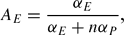
where αE is the basic weight (raw prestige or charisma) of the entrepreneur (see Langlois, Reference Langlois1998) and αP the basic weight of any given peer employee.Footnote 10 Given this expression, the entrepreneur's influence is diluted as group size n increases. Moreover, given the entrepreneur or business leader's influence, the weight of a member of the peer group is given by
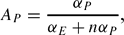
where αP is the basic weight of the ith worker and αP = α1 = α2 = . . . = αn. The n peers’ cumulative influence on the social learning process is growing with an increasing group size and a dwindling role of the entrepreneur. Moreover, the weights of the entrepreneur and the peers are normalized by the denominator so that Ai gives the weight of the ith model relative to the other models encountered by the individual in question.
To characterize the evolution of the group, we specify the probability that a particular set of role models makes an individual acquire the cultural variant c. Firm employees (n in total) may be cooperative (c) or opportunistic (o). We assume that the entrepreneur is always cooperative. To account for the effects of new personnel joining the firm from outside, we suppose that in each time step a cohort of n employees retires and is replaced by n new employees who are socialized by all n old employees, plus the entrepreneur. We may also interpret this process as a necessary ‘renewal’ of the socialization of existing employees. These would then be considered as if they were personnel just joining the firm.
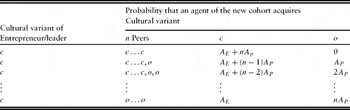
In addition, we assume that the n new employees are initially naïve.Footnote 11 New employees encounter members of their peer group at random. With these assumptions, the cultural transmission table showing the probability of agents acquiring trait c or o, given a particular set of models (entrepreneur/leader, n peers) that have different total weights (AE, AP) and group size n – also determining the changing values of AE and AP – yields:
The probability of agents acquiring trait c or o, given a particular set of models (Entrepreneur/Leader, Peers) that have different total weights (AE, AP).

The variable p measures the frequency of the c type in an infinite meta population of firms of size n; i.e., for illustrative simplicity we are here modeling only the deterministic effect of evolutionary processes. In any given firm, stochastic effects will be important. However, in an infinite population of firms with particular characteristics, p will perfectly describe the average frequency of the cooperative variant and (1 − p) the opportunistic variant. Therefore, the average pairing probability of role models in the transmission table will have AE + pnAP probability of transmitting c to each new member of a cohort and probability (1 − p)nAp of transmitting the cultural variant o. So, in an infinite population of firms of size n, the partial recursion for the socialization phase with the frequency of c after transmission, p′, given that it was p before transmission is expressed by

In cultural evolution, individuals are more likely to adopt some cultural variants based on their content (Boyd and Richerson, Reference Boyd and Richerson1985: 135; Richerson and Boyd, Reference Richerson and Boyd2005: 69). Such a content-based or direct bias can result from the calculation of costs and benefits associated with alternative variants or from cognitive structures that cause people to preferentially adopt some cultural variants rather than others. In general, a cultural transmission rule is characterized by direct bias if one cultural variant is more attractive than others.Footnote 12 A directly biased transmission creates a force that increases the frequency of the culturally transmitted variant that is favored by the bias. We assume two direct learning biases here that reflect the existence of conflicting human goals: first, an employee may recognize the discrepancy between her personal effort for the firm's interests and her direct benefits accruing from it. Hence, she may lower her efforts, i.e. increasing the relative importance of her individual interests. We call this the opportunistic bias μco favoring the cultural variant o (Boyd and Richerson, Reference Boyd and Richerson1980). Second, as has been argued above, humans have an inclination toward cooperation. We label this propensity the cooperation bias μoc favoring cultural variant c. We suppose that each c employee has a μco chance of learning to be opportunistic and each o employee a μoc chance of learning to become c. Hence, the partial recursion for the individual learning phase is

where p″ indicates the frequency of c after one complete ‘generation’. We assume that μco > μoc. The evolutionarily and organization theoretically interesting case is when the opportunistic cultural variant is preferred to the cooperative one. If the opposite inequality holds, then the cooperative tendencies of individuals would be sufficient to maintain group cooperation without any form of cognitive leadership. Since even the simplest human societies seem to require some form of prestige-based leadership, and multi-person firms virtually always have leadership roles, this assumption makes empirical sense.
The complete recursion for p, obtained by substituting (3) into (4), is expressed as

and models the change of p in the group over one socialization and learning step. By setting the parameters of the system, we can analyze its long-run behavior by conceptually iterating equation (5) recursively for many generations. For the purpose of simplification, we assume a positive value for μco while setting μoc = 0 in the following. Therefore, we obtain

We now calculate the equilibrium frequency of the cultural variant c in the population. At equilibrium, the population does not change, so p″ − p = 0. We subtract p from both sides of (5a). We can determine the equilibrium of the set of coupled recursions implied by (5a) by solving for  denoting the equilibrium frequency of the cooperative cultural variant c
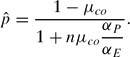
The derivative of with respect to n,  , is negative for all n; i.e., given a certain charismatic potential of the entrepreneur, the level of cooperation within a firm is decreasing with firm size. Consistent with this, the derivative of with respect to αE,
 , is positive for all n; i.e., the larger an entrepreneur's charismatic potential, the higher the level of cooperation in the group for fixed n and the lower the level of opportunistic behavior.
Next, we calculate the optimal firm size for a profit-maximizing firm. In this context, maximization is an analytical convenience to account for the fact that boundedly rational human agents are intendedly rational (Williamson, Reference Williamson1981). The problem of organization is the joining of rational purposes with the cognitive limits of human actors. Therefore, optimizing behavior may be substituted by other heuristics (see Simon, Reference Simon1955).
We assume that each employee contributes to the firm's profit, rc, or loss, ro (rc, ro > 0). Thus, pnrc represents the number of cooperative employees times the profit they make. Similarly, n(1 − p)(−ro) is the aggregate loss of a firm's income due to opportunistic employees. We represent the profit function by R and, given our assumptions about the generation of profits and losses, the firm's objective becomes to find the value of n, i.e. the level of employment, so as to maximize profits (n > 0)

Substituting the equilibrium frequency of the cooperative cultural variant c – denoted by equation (6) – into (7) and differentiating it with respect to n gives
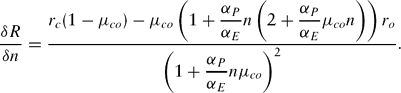
By setting (8) equal to zero and solving for n, we obtain the profit-maximizing firm size n max
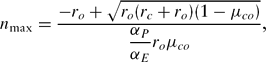
where

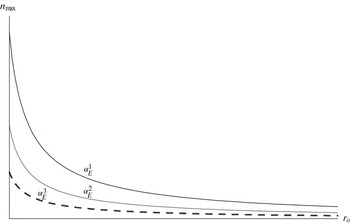
Treating ro as the only variable term and all other terms in this expression as parameters, the profit-maximizing firm size is always decreasing with an increasing ro. Varying αE, while keeping constant all other variables in this equation, shows that the profit-maximizing firm size is growing with an increasing charismatic potential of the business leader or entrepreneur. Figure 1 shows the relationship between profit-maximizing firm size n max and costs of opportunism ro for different values of αE (α1E > α2E > α3E). A profit-maximizing firm's size decreases with increasing costs of opportunism.
The relationship between n max and ro for different α E

An extension of the model: the case of variable costs of opportunism
The costs of opportunism may vary with firm size. Opportunistic behavior in small groups where employees enjoy a high degree of autonomy and discretion would be especially harmful. It is in this context that cognitive leadership by the entrepreneur or business leader is of outstanding importance. As, however, the firm grows, economies of scale can compensate for some of the losses caused by opportunistic agents in smaller firms. Moreover, the task structure of larger firms in more mature markets that engage in mass production of standardized goods is characterized by a relatively higher share of routinized exercises. The effort and results of performance of these tasks are relatively easy to monitor preventing great losses from shirking behavior. A more formal monitoring regime is then sufficient to keep opportunism in check.
To capture these effects and to endogenize the costs of opportunism, we modify equation (7) as followsFootnote 14

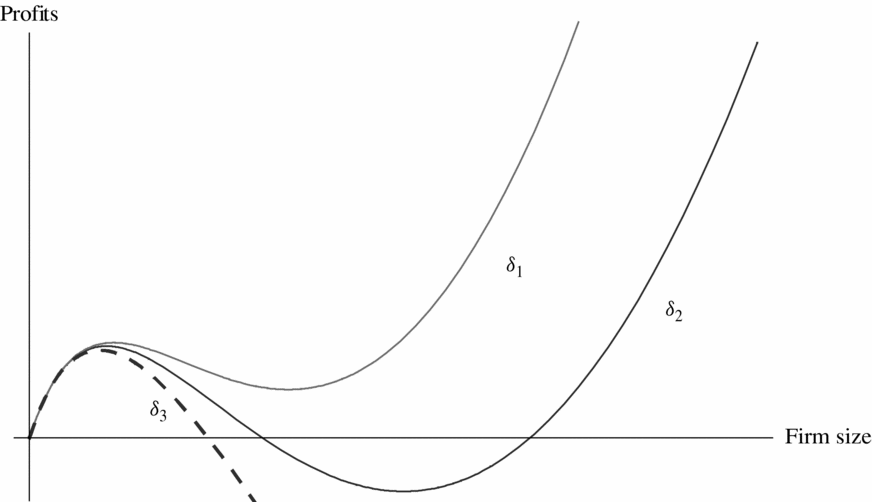
To keep the analysis as simple as possible, we assume a simple linear relationship between ro and n: ro(n) = −rc + δn, whereby δ determines the strength of the firm size effect on the costs of opportunism and the critical firm size beyond which opportunistic agents start to contribute a profit to firm development. Furthermore, again for simplicity, we assume a close to symmetrical profit/loss case for very small firm sizes where rc ≈ ro. Figure 2 plots the different shapes of the profit function R, given increasing firm size n and different values for δ (δ1 > δ2 > δ3).
The relationship between R and n for different δ
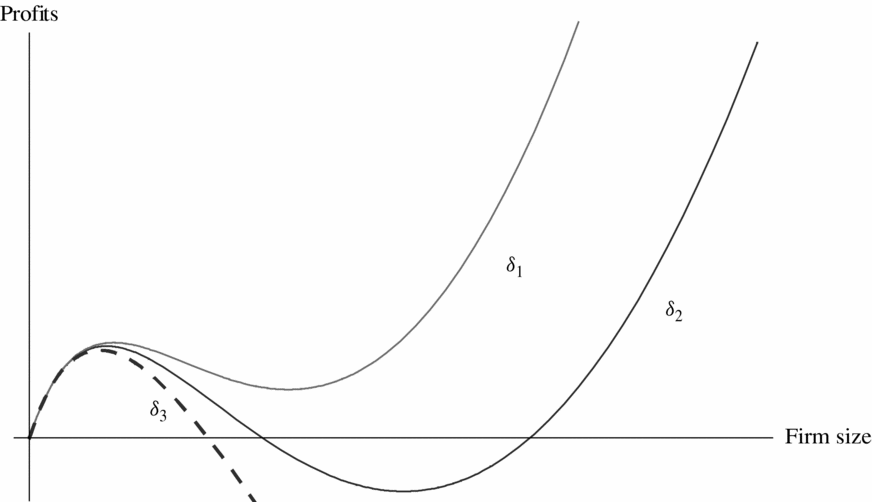
As can be seen for δ2, a firm's profits first increase with growing size and a high level of intra-firm cooperation, then reach a maximum, before a rising share of opportunistic agents causes profits to shrink again. If a firm survives the following period of losses that can be interpreted as a growth crisis in firm development,Footnote 15 it will be able to reap the advantages of a larger size based on more formal managerial control keeping in check opportunism and economies of scale and become profitable again. If the critical firm size is smaller (δ1), which may be due to technological reasons that allow for a smaller firm size to realize economies of scale, the firm's growth crisis is less pronounced and the growth path is reached at a smaller size. Finally, if the firm's initial growth potential is insufficient to reach the critical threshold in due time, the resulting losses would force the corporation to exit the market (δ3).
3. Opportunism and firm size
Opportunism is a central concept in the study of transaction costs. Transaction costs are significant, according to Williamson (Reference Williamson1971, Reference Williamson1979), when there exist bounded rationality and opportunism. Moreover, the design of governance structures is a function of the perceived probability of opportunism. Therefore, minimizing transaction costs amounts to economizing on bounded rationality while simultaneously safeguarding the transactions against opportunistic behavior. A heightened probability of opportunistic behavior entails great coordination efforts, compliance costs, as well as high costs for drafting, negotiating, monitoring, safeguarding, and enforcing contingent contracts, i.e. potential opportunism causes high transaction costs (see Parkhe, Reference Parkhe1993). The organizational setting – or governance structure – of the firm is expected to economize on the writing of complex (employment) contracts and the monitoring costs that are necessary to attenuate opportunism (Alchian and Demsetz, Reference Alchian and Demsetz1972). The advantages of managing opportunism internally outweigh the advantages of managing them through markets. Monitoring controls for potential costs resulting from opportunistic behavior within the firm, including moral hazard, shirking, filtering, undisclosed subgoal pursuit, distortions, and other strategic deceits (Williamson, Reference Williamson1999).Footnote 16
The core hypothesis of transaction cost economics is that transactions are assigned to and organized within governance structures in a transaction-cost economizing manner. Coase (Reference Coase1937) and later Williamson (Reference Williamson1975) argued that the size of a firm will be determined by answering the question whether it will pay to bring an extra exchange transaction under the organizing authority: ‘[T]the limit to the size of the firm is set where its costs of organizing a transaction become equal to the cost of carrying it out through the market’ (Coase, Reference Coase1988: 7).Footnote 17 Firm-internal organization restrains the opportunism that would otherwise infect market exchange, and informational asymmetries are mitigated due to the fact that internal organization can be more effectively monitored (see Schilling and Steensma, Reference Schilling and Steensma2002 for a concrete example concerning licensing versus acquiring of technological know-how, given the threat of opportunism; also Reinstaller, Reference Reinstaller2007). Therefore, according to transaction cost economics, great costs potentially accruing from opportunistic behavior are positively correlated with firm size.Footnote 18
This paper's approach, by contrast, shows that high opportunism-related costs can be an incentive for keeping firms’ size small. If our model is correct, the dilution of entrepreneurs’ and leaders’ influence as organizations grow acts as a diseconomy of scale, the magnitude of which is dependent upon the leaders’ talents and the rate of individual learning of opportunistic strategies. We suggest the following propositions and theorems:
Proposition 1 As is shown by equation (9), for increasing potential costs of opportunistic behavior, denoted by ro, the profit-maximizing firm size n max is decreasing.
Theorem 1 Ceteris paribus, if the potential costs of opportunistic behavior are high, firm size stays small, thereby facilitating a higher level of cooperation and less opportunistic behavior within the group through intense processes of socialization.
Proposition 2 Given equation (9), the profit-maximizing firm size n max is growing in αE.
Theorem 2 Ceteris paribus, the higher the entrepreneur's or business leader's charismatic potential, the greater her weight in the socialization process of employees and the greater the group size in which a cooperative regime can be maintained.
In the proposed model, an optimizing firm chooses a level of employment that enables the establishment of a cooperative regime via processes of cultural transmission and socialization to keep opportunism low. The higher the costs of opportunistic behavior, the smaller is the profit-maximizing size of the firm. The entrepreneur's or business leader's weight in the socialization process crucially influences the spreading of opportunistic behavior in a growing firm. Therefore, a monitoring regime is not the only way to counteract opportunistic behavior within the firm. In this framework, opportunism is subject to an entrepreneur's or business leader's cognitive influence via the transmission of competing cultural variants. It is not considered to be a mere behavioral constant. Moreover, the argument does not rely on a comparison of market versus firm internal interactions, but focuses on intra-firm processes of cultural evolution.
Collectively shaped cognitive frames enable a high degree of cooperativeness within small, intensely communicating groups (see Witt, Reference Witt1998, Reference Witt2000). The entrepreneur or leader can easily maintain a high level of cooperation in these smaller organizations by exerting cognitive leadership. Especially in firms consisting of highly independent, specialized employees with a great level of self-motivated responsibility-taking, opportunistic behavior would be harmful. This argument may provide an explanation for why expert firms are often small or why, for example, consultant firms have a structure that is explicitly based on small groups. Many other organizational stratagems are used to try to finesse the limitations on firm size due to the dilution effect. Franchising creates many small businesses under one umbrella. The hierarchical form of large organizations creates roles for sub-leaders in an effort to spread the burden of leadership and extend face-to-face leadership to the bottom of the organization. Therefore, a divisionalization combined with ‘divided entrepreneurship’ (Witt, Reference Witt2007) is a strategy to create subgroups within which a more cooperative attitude can be maintained. Given such an internal organization, even bigger firms can reach a high level of overall intra-organizational cooperation.Footnote 19 As a result, there would be more than one optimal – legal – firm size observed empirically.
Moreover, organizations may invest in devices to increase the charisma of the leader as in the case of American ‘celebrity CEOs’ (the utilization of modern communication media would be one means to achieve this goal). Not least, many businesses and other organizations simply remain small. Businesses that grow too large often divest themselves of units in order to shrink. Due to the dilution effect with respect to the entrepreneur's or business leader's influence on socialization in the course of a firm's growth process, a firm – when it is trying to exceed the profit-maximizing firm size n max, given a certain αE – may be forced to implement a monitoring regime or an intra-organizational subdivision of entrepreneurship to overcome this constraint.
Also Williamson (Reference Williamson1981) addressed the economic purposes of the widespread adoption of divisionalization. This paper's finding that a cooperative cognitive regime is easier to employ and maintain in small groups provides a potential answer to this question that is not exclusively based on transaction cost arguments but also involves cognitive learning aspects. Moreover, across most industries and regardless of existing scale economies, firm-size distribution is skewed with only a few large enterprises and numerous small ones (Audretsch, Reference Audretsch1997). Firms in the same industry serving the same market might be expected to cluster tightly around one optimal size on the basis of most transaction cost considerations. Our model provides a ready account for the distribution of firm sizes in the same market and same industry. If the distribution of entrepreneurial and leadership talent has considerable variance, so will the equilibrium distribution of firms. This will be especially the case if even the largest firm reaches its profit-maximizing size short of serving the whole market and if economies of scale are a weak determinant of profit.
The persistence of this asymmetric firm-size distribution biased toward small-scale enterprises may reflect some of the intra-organizational processes described above. Especially highly innovative firms rely on well-educated and specialized employees’ initiative and cooperation – reasons to keep firms’ size small to facilitate cooperation and avoid harm from opportunistic behavior. This may also prevent the founding of spin-offs by these personnel. Williamson (Reference Williamson1975: 205f) has argued that an efficient procedure to introduce new products to a new market is performed by independent small firms in an industry. This may be due to the high degree of flexibility of small firms that is based upon initiative, cooperative, and creative employees. Zenger and Hesterly (Reference Zenger and Hesterly1997), for instance, claimed that the observed pervasive trend toward disaggregation of US corporations into small, autonomous units is motivated by the powerful performance incentives that accompany small size. By analyzing the prerequisites for a cooperative regime within a firm, we derive another rationale for the existence of these small firms or organizations and why their organizational forms are preferred to market transactions and great hierarchical structures.
The prevailing view of why firms exist has been that they serve to keep in check the transaction costs arising from the opportunistic motivations of individuals (Williamson, Reference Williamson2002). However, instead of reducing the latter kind of behavior, monitoring and control designed to motivate supposedly selfish actors often threatens peoples’ personal sense of autonomy, decreases their intrinsic motivation, and crowds out voluntary cooperation (Ghoshal and Moran, Reference Ghoshal and Moran1996; Frey and Jegen, Reference Frey and Jegen2001). Enzle and Anderson (Reference Enzle and Anderson1993) have shown that intrinsic motivation is higher under noncontrolling and no-surveillance conditions. Cooperative employees resent tight monitoring as an implication that they are opportunistic agents (even in a cooperative regime, however, a minimum of monitoring and sanctioning is necessary due to a significant minority of people that play selfish strategy). Hence, room for self-determined action is necessary to elicit a high level of initiative, cooperation, creativity, and problem-solving engagement as well as intrinsic work motivation in general (also Baron and Hannan, Reference Baron and Hannan2002). Innate dispositions toward cooperation and group loyalty increase the individual effort devoted to information updating and creativity beyond that favored by individual advantage alone. Rational, selfish thinking will tend to produce less individual learning than would be optimal from the point of view of the firm or organization due to the altruistic effects of social learning and public good problems (see Kogut and Zander, Reference Kogut and Zander1992; Conner and Prahalad, Reference Conner and Prahalad1996).
We argue here that what firms do better than markets – besides economizing on transaction costs – is to establish a cooperative regime among its employees that ‘crowds in’ desirable behavior, or, ‘positive organizational behavior’ (Hodgson and Knudsen, Reference Hodgson and Knudsen2007; Bakker and Schaufeli, Reference Bakker and Schaufeli2008), based on humans’ unique evolved group-regarding social predispositions.Footnote 20 This ‘crowds out’ opportunistic pursuits. At the same time, this process is a determinant of firm size; cooperation is easier to maintain in small, intensely communicating groups. Transactions that would be integrated into the governance structure of the firm according to the predictions of transaction cost economics are left to the market in the case of a cooperative regime in order to keep group size small and maintain a high level of intra-firm cooperation. This amounts to a better fit between some of humans’ evolved cognitive dispositions and an organizational setting (Nicholson, Reference Nicholson1997).
In the preceding section, we extended our model to account for endogenously changing costs of opportunistic behavior that may vary with firm size and the managerial control system. This modification changes the assumptions included in the ceteris paribus clauses above. Therefore, our extended analysis leads us to suggest an additional proposition and theorem:
Proposition 3 As is shown by equation (10), for costs of opportunistic behavior endogenously changing with firm size, ro(n), different developmental paths of a firm's profits, as measured by R, are possible including an organization's passing through a growth crisis with (temporarily) decreasing profits.
Theorem 3 Ceteris paribus, if larger firms are capable of realizing economies of scale, these can compensate for the losses caused by opportunistic agents in smaller firms. In this case, after a growth crisis due to a decreasing level of intra-firm cooperation, a more formal managerial control system keeps in check opportunistic behavior in larger organizations, enables these to reap economies of scale, and makes them profitable again.
This assumed – presumably more stable and mature – business environment that allows larger firms to realize economies of scale altering the employees’ contributions to firm growth opens up new developmental paths for organizations: (1) the now endogenously changing contributions of opportunistic agents, ro(n), do not strictly constrain the profit-maximizing firm size anymore. This is due to the fact that, after a local profit maximum based on intra-firm cooperation and a growth crisis with decreasing profits (a kind of ‘crisis of control’), the firm may reach a size range where economies of scale, more routine tasks in production, and a new corporate culture based on monitoring allows for continuous growth in the number of employees and concomitantly profits. (2) The charismatic potential of the entrepreneur or business leader and the corresponding level of cooperation within the firm now crucially influences the severeness of a firm's growth crisis and whether the organization reaches a critical size in due time beyond which it can reap economies of scale at all. Hence, corporations may fail due to an entrepreneur's charismatic potential being insufficient to reach a size during the cooperative regime beyond which a new managerial control system would allow the firm to survive and prosper.
4. Conclusions
According to Williamson (Reference Williamson1971), the most distinctive advantage of the organizational form or governance structure of the firm is the wider variety and greater sensitivity of control instruments to attenuate opportunism and related transaction costs. In this paper, we argued that – besides transaction costs – cognitive aspects of human agents are important in the organization of economic activity and the choice of the mode of organization.Footnote 21 As a result of processes of gene-culture coevolution, human agents have an inclination toward cooperation, i.e. cultural learning exhibits a bias toward cooperative cultural variants. In addition, a role-model-based bias takes effect in cultural transmission; both dispositions can be utilized by entrepreneurs or business leaders to influence the evolution of corporate cultures. By referring to these processes of cultural transmission and calculating the optimal size of a profit-maximizing firm, we identified another governance structure within the organizational setting of the firm: the cooperative regime. Thus, opportunism is not the only stable behavioral equilibrium within the context of the firm (see also Hodgson, Reference Hodgson2004; Field, Reference Field2007).
According to transaction cost economics, great costs potentially accruing from opportunistic behavior are positively correlated with firm size. This paper's approach, by contrast, shows that high opportunism-related costs are a reason for a profit-maximizing firm to keep its size small. In our model, potential opportunism is a decision variable open to influence, rather than a fundamental behavioral constant.
 , is always negative. Thus, n max is a maximum.