INTRODUCTION
The early American state is often overlooked in discussions of state building, relegated to the background as a period of “courts and parties,” in the famous words of Stephen Skowronek.Footnote 1 Examining the army, however, shows us instead an energetic state deeply involved in helping to guide the pattern and direction of economic development. Despite its small size, the army played a crucial role in promoting the economic might that led to the United States becoming a world power. In the nation's early years the army fostered engineering expertise the nation lacked; surveyed the geography, geology, and mineralogy of newly acquired territory; helped to build a nationwide infrastructure of roads, canals, and railroads; and led innovations in technology and administration that subsequently spread to the private sector.Footnote 2
These important measures were not, however, inevitable – rather, they were the result of contingent developments, based partly on the individual decisions of political entrepreneurs. As presidents generally lacked the institutional resources to closely monitor routine army operations, and Congress demonstrated only episodic involvement, responsibility for determining the exact course of many socioeconomic projects fell largely to the uniformed chiefs of War Department bureaus. Although not entirely independent of traditional constitutional actors, these men were often able to exercise their authority as political entrepreneurs to either enhance or constrain the army's capacity to influence economic development. Bureau chiefs served for long stretches of time (often decades) and gained a form of autonomy much earlier than suggested by previous studies of bureaucratic autonomy. The bureaus were thus able to nurture specific types of knowledge that the state called upon as needed, with their uniformed heads making key decisions about the exact ways in which that expertise was subsequently used.
Especially important in this regard was the relationship between the bureaus and the secretary of war. The secretary of war was picked by the president, clearly marking him as a partisan official. At the same time, secretaries were able to carve out a niche for themselves in policymaking that was not strictly defined by presidential commands. In the antebellum era, cabinet officials were more independent of presidential control, generally having been chosen to satisfy some constituency within the president's party or meet a geographic distribution requirement. This allowed them to maintain their own political agenda and independent base of support.Footnote 3 Crucially, however, the secretaries of war were also often influenced by the pre-existing institutional interests of the officers and bureaucrats serving under them. As a result, secretaries frequently endorsed policies that had also been embraced by their predecessors, regardless of shifts in partisan control of the executive branch. In particular, John J. Abert, head of the Army Corps of Topographical Engineers, was a pivotal player in many of the central economic development debates of the antebellum period. As head of the bureau for thirty-two years, Abert was uniquely able to build his organization and leverage favorable circumstances into a form of conditional bureaucratic autonomy. However, the corps' autonomy was threatened when Abert came into conflict with the highly knowledgeable and skilled Secretary of War Jefferson Davis.
This article focuses on the Corps of Topographical Engineers, examining its rise to prominence, its gaining and maintenance of bureaucratic autonomy, and its eventual demise. The corps' autonomy differed from the more robust form of bureaucratic autonomy described by Daniel Carpenter insofar as the corps generally lacked significant linkages to outside groups or a network of committed supporters in the private sector.Footnote 4 The corps was nevertheless able to develop a relatively long-lasting form of autonomy that positioned it so that it could often successfully push for its preferred policy goals. When faced with challenges, the corps proved to be a flexible organization that adapted and shifted its methods to accomplish the same ultimate goals with different instruments. In the end, however, the corps lost its autonomy when it became entangled in the sectional politics surrounding the potential building of a transcontinental railroad line. Once the corps lost several of the conditions supporting its autonomy, its downfall was swift.
To demonstrate the early development of bureaucratic autonomy in the War Department, I examine a series of key policy decisions made in the antebellum period involving the Corps of Topographical Engineers. Sustaining a claim of autonomy will require showing where bureaucrats' preferred policy goals originated and the efforts made to convince secretaries of war, presidents, and Congress to pass them. Through careful use of primary sources, including records of congressional debates, messages from the president to Congress, official documents of the War Department, and contemporaneous accounts in newspapers and periodicals, I will show how the corps developed, maintained, and then ultimately lost its autonomy when the forces supporting it were undermined. This article thus joins a recent wave of scholarship by William Novak, Brian Balogh, Stephen Rockwell, and others highlighting strengths within the early American state.Footnote 5 Furthermore, this study demonstrates the centrality of the military to early American state-building, especially in the nation's periphery.
BUREAUCRACY AND AMERICAN POLITICAL DEVELOPMENT
Scholars of contemporary bureaucratic politics focus on how Congress and the president manage the bureaucracy and the resources they have to oversee its workings. A large literature has developed exploring these institutional relationships, focusing primarily on congressional control of the bureaucracy. McCubbins, Noll, and Weingast, for example, explain how Congress can use administrative procedures to control regulatory agencies, while Terry Moe critiques theories that presume congressional dominance of the bureaucracy.Footnote 6 These pioneering works have been followed by a long series of studies investigating every aspect of the relationship between Congress and the bureaucracy, usually presented as some variation on classic principal-agent models.Footnote 7 A subset of this literature has directly examined the question of bureaucratic autonomy.Footnote 8
A different perspective is offered by historical-institutionalist scholars, who examine historical cases to understand the changing nature of bureaucratic control over time. These studies, in contrast to other work in the field of bureaucracy, interrogate the bureaucracy from a multi-institutional perspective, especially by including the executive branch as a strong, independent force in directing institutional development.Footnote 9 Amy Zegart's study of twentieth-century national security bureaucracies is also highly relevant, as she discusses how agencies that deal with foreign policy issues differ from purely domestic agencies.Footnote 10
I adopt a historical-institutionalist perspective to analyze the antebellum army's bureaucratic structure. Influenced by the work of scholars such as Paul Pierson, Karen Orren, and Stephen Skowronek, I argue that the relationships among Congress, the president, and the bureaucracy should properly be characterized as ones in which no one institution necessarily predominates.Footnote 11 Over time, as coalitions shift, and the makeup of the actors within the institutions changes, the balance of power between those institutions shifts as well. Much of the public policy literature assumes that bureaucracies have a limited role in policymaking.Footnote 12 Studies in the field of American political development, by contrast, help provide a new perspective on the bureaucracy by analyzing it over a longer period of time. Such an approach opens space for a richer and more dynamic view of institutional change that more fully takes into account the contingent nature of bureaucratic control. As a result, we will see that bureaucrats can sometimes dominate a particular policy arena by becoming more autonomous, if they have been able to build up the necessary resources in relation to elected national officials.Footnote 13 Like Zegart, I find that the executive branch often predominates in the politics of a bureaucracy related to national security.Footnote 14
STATE DEVELOPMENT AND BUREAUCRATIC CAPACITY IN EARLY AMERICA
The literature on the development of the early American state focuses primarily on that state's apparent weaknesses. Scholars have, for the most part, seen the early American state as lacking the fundamental characteristics of a strong state, such as a centralized bureaucracy, a strong executive branch, high spending capacity, strong military power, or the ability to fundamentally shape various segments of American society. More recently, a new wave of scholarship has started to challenge this depiction of central state capacities in early America by pointing to a variety of strengths in the national state.
American political development, as a subfield, has largely accepted the weak state hypothesis. Skowronek, in Building, argues that the state could do a few things well, but he then proceeds to downplay national capacities in early American history relative to the changes wrought by the era of industrial transformation at the end of the nineteenth century. In his words, “the state that evolved in nineteenth-century America scored relatively low on all the basic measures of state organization,” particularly national defense, which was “radically decentralized” and primarily “relied upon a militia system of citizen-soldiers organized and controlled by the several states.”Footnote 15 Richard Bensel similarly argues that, prior to the Civil War, “the national government had no identity apart from that imparted by the sectional forces that occupied the seat of power” in Washington, and that it “contained no statist-bureaucratic element that could prepare for the secession crisis.” He admits that the army was the “best approximation” to a centralized bureaucracy, but sees even that institution as far too weak to contain the sectional crisis from devolving into civil war.Footnote 16
Daniel Carpenter's work on bureaucratic autonomy is particularly relevant to this conversation. While acknowledging recent work that demonstrates strengths of the early national state, he argues that these are merely details that flesh out an existing story of weak institutions lacking independence. He characterizes the pre–Civil War government as a “clerical state” where bureaucrats simply carried out the wishes of elected officials within the government and rarely had the ability to push their own ideas into policy. Due to the twin Jacksonian-era policies of patronage and rotation in office, mezzo-level bureaucrats lacked the ability to develop the network of ties to outside interests and influential members of Congress that would have been necessary to procure their own autonomy. Carpenter thus concludes that “the end result left federal agencies talent-starved.”Footnote 17 Some recent work has challenged Carpenter's position; Mark Wilson, for instance, sees the origins of bureaucratic autonomy in the Quartermaster General's office during the Civil War.Footnote 18 Wilson even hints at the earlier appearance of autonomy in the War Department when he notes in passing that bureau heads evinced features of autonomy prior to the Civil War.Footnote 19 Similarly, Stephen Rockwell has argued that the Indian Office had significant autonomy in the antebellum period.Footnote 20
I argue that a close examination of the early War Department and its bureaus demonstrates that there was ample capacity for carrying out various policies, and furthermore that the bureaus could develop a form of autonomy from elected officials. Neither the captive of sectional forces nor of any one group within society, bureaus such as the Corps of Topographical Engineers developed the ability to help shepherd their preferred policies into law or to create new policies on their own initiative when Congress declined to accede to their wishes. The War Department became not merely a close approximation of a centralized bureaucracy, but, especially in the nation's periphery, the most significant institutional actor with the greatest amount of power. The autonomy that these bureau chiefs gained came about partially as a result of their long tenures in office, almost entirely unaffected by the norms of patronage and rotation in office prevalent across other areas of the national bureaucracy at the time. Thomas Jesup headed the Quartermaster General's office from 1818 until 1860, and John J. Abert was the Chief Topographical Engineer from 1829 until 1861, almost the entire life of the topographical corps. Men such as Jesup and Abert developed for their bureaus standing as neutral, professional experts who were providing the best technical advice available to policymakers.Footnote 21 Regardless of shifts in partisan control of the presidency, these men stayed in power and regularly influenced successive generations of presidents, Secretaries of War, and members of Congress to help implement their desired policies.
The different manner by which autonomy developed in the early American state, and the circumstances supporting conditional autonomy, distinguish it from Carpenter's descriptions of robust autonomy. Conditional autonomy is more easily reversible if the circumstances surrounding it change, while robust autonomy is difficult – thought not impossible – to eliminate. Like the bureaucrats studied by Carpenter, officers such as Jesup, George Bomford, and Abert served at the mezzo level of administration, as “durable actors with official authority . . . who maintained stable relations with the oversight and appropriations committees of Congress.”Footnote 22 However, building their reputations along with a solid network linking themselves to organized interests and experts in the field, as in the case of the Department of Agriculture and Post Office in Carpenter's account, was not the primary method through which their autonomy was attained. There were certainly tentative links to emerging professional organizations and outside interests, but these were preliminary and not sufficient to support the bureaus' autonomy when other conditions underlying that autonomy faltered. The army was professionalizing at this time, contrary to the assertions of Samuel Huntington's famous survey in The Soldier and the State, but this process was just starting and had not yet led to the rise of strong linkages with private interests.Footnote 23
Bureau chiefs in the early army developed their autonomy due to a combination of several factors: their long tenures in office; perceived organizational and personal expertise; lax congressional oversight; cabinet secretaries who relied heavily on their underlings for knowledge of even basic policy issues; the secretary of war's independence from the president; and little presidential involvement in the details of engineering policy. The mixture of these unique conditions led to an environment in which a short-lived but highly significant form of autonomy could come about. These bureaus became central players in some of the period's most important nation-building projects and thereby shaped the path of economic development. Particularly in early America, which had few countervailing institutions in place, a small degree of autonomy could have an outsized effect. On the nation's periphery, where virtually no other public institutions functioned, this power became especially potent. Paradoxically, however, autonomy exercised in the geographic periphery was simultaneously more tenuous, as the periphery gradually became absorbed into the nation's core and the policies being implemented there became more prominent in the eyes of elected officials.
In principal-agent terms, we might conceive of conditional autonomy as existing when the principal is either ignorant of or chooses not to become involved in agent actions. If the principal relies too heavily on ideas, information, and proposals generated by the agent, then principal control is effectively superseded. To the extent that bureau chiefs shaped the opinions of their supposed principals, then, they exercised a meaningful form of autonomy. The case of the Topographical Corps thus invites us to rethink how bureaucratic autonomy develops and the circumstances under which civilian authorities control their bureaucratic agents.
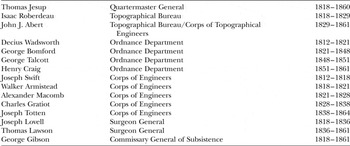
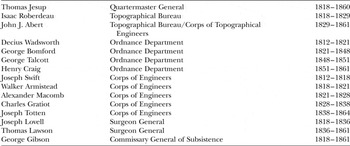
It was not unusual in this period for army bureau chiefs to stay in their positions for decades at a time, as demonstrated in Table 1. Longevity made them essentially permanent actors in national politics who continued across shifts in partisan control of the presidency and Congress. Using the informal contacts with members of Congress that were prevalent at this time, near-permanent bureau chiefs were often able to press their policies forward and convince Congress, secretaries of war, and presidents to follow their lead.Footnote 24
Length of Service of War Department Bureau Chiefs
Sources: Merritt Roe Smith, Harper's Ferry Armory and the New Technology: The Challenge of Change (Ithaca, NY: Cornell University Press, 1977); http://history.amedd.army.mil/surgeons.html; Erna Risch, Quartermaster Support of the Army, 1775–1939 (Washington, DC: Center of Military History, 1989); Frank N. Schubert, The Nation Builders: A Sesquicentennial History of the Corps of Topographical Engineers, 1838–1863 (Fort Belvoir, VA: Office of History, U.S. Army Corps of Engineers, 1988); Todd Shallat, Structures in the Stream: Water, Science, and the Rise of the U.S. Army Corps of Engineers (Austin: University of Texas Press, 1994); Theophilus F. Rodenbough and William L. Haskin, The Army of the United States: Historical Sketches of Staff and Line with Portraits of Generals-in-Chief (New York: Maynard, Merrill, & Co., 1896).
Although the president in this period always retained his formal authority as commander in chief of the military and chief executive of the government, in practice the absence of presidential staff or other oversight resources prevented most presidents from involving themselves in routine military administration and socioeconomic military activities, particularly regarding faraway projects located on the periphery.Footnote 25 Only infrequently did a president even focus on the salient topic of internal improvements in his annual message to Congress, an important method of presidential communication in the premodern era.Footnote 26 President Jackson mentioned his vetoes of large improvement bills, for example, but otherwise largely ignored the bulk of the army's efforts.Footnote 27
Congress could supervise more day-to-day economic development activities by the military than could the president, but here, too, short congressional sessions and limited sources of information hampered congressional control.Footnote 28 As Todd Shallat notes with regard to river and harbor improvements, “[P]ublic-works committees in Congress knew very little about rivers and harbors . . . the bureaucracy guided internal improvement through power of implementation,” despite the fact that Shallat also notes how Congress chose many of the projects to be funded through appropriations.Footnote 29 Budgeting was not, however, a particularly efficient method for Congress to use in overseeing the army. Unlike other parts of the government, military outlays were often appropriated in broad categories, not in line items, leaving discretion on many of the details of spending to the executive branch.Footnote 30 Indeed, it seems that Congress chose not to involve itself on many occasions, instead deferring action and allowing actors within the executive branch to make important decisions, especially in the periphery.Footnote 31 The terms of the General Survey Act of 1824, for instance, handed discretion over to the War Department to pick whichever projects it believed to be of greatest importance. Partisan politicians also had a limited stake in much of what the army did. Since many of the army's activities took place in the periphery and offered no distributive rewards to the states represented in Congress, members had little reason to take an interest in them.Footnote 32 Therefore, unlike the argument presented by Stephen Minicucci, who prioritizes legislative affairs in his discussion of internal improvements, I see the executive branch as primary in most of these policies.Footnote 33
Additionally, the structure of government in the early United States made it difficult for presidents to maintain close oversight of the military bureaucracy. Cabinet members such as the secretary of war were chosen based on political considerations, had an independent political base, and were therefore not completely beholden to the president they served.Footnote 34 Officers heading War Department bureaus served for long stretches of time across multiple presidential terms, and as a result were relatively isolated from direct presidential control. Similarly, engineers or ordnance officers working on projects remote from the capital, especially those in the periphery, were essentially subject to no direct line of presidential control. To that extent, models of civil-military relations that presume a relatively high degree of civilian control over the military do not seem applicable to the Army's socioeconomic role in this era.Footnote 35
Indeed, the president in this era often seemed to follow bureaucratic priorities, rather than setting a unified agenda for the entire executive branch. In this respect, my argument is quite similar to that put forward by Carpenter and Gisela Sin. They show that the FDA played a critical role leading up to the passage of the 1938 Food, Drug and Cosmetic Act, expanding the agency's regulatory profile by preparing years in advance and taking advantage of an opportunity to press their agenda on the secretary of agriculture and the Roosevelt administration.Footnote 36 As they contend, “agencies often possess immense informational advantages, particularly when the facts in question are intimately known only by those who administer the specifics of policy.”Footnote 37 Here as well, War Department bureaus were experts in their arenas and were able to use that expertise to their advantage in advancing their predetermined agendas on the secretary of war, the president, and Congress. Bureaucratic priorities thus seem to have often had a high level of influence over the secretary of war and the president, more transitory figures compared to long-serving bureau chiefs.
The secretary of war was also in a position to be a policy entrepreneur, made possible by the political autonomy that cabinet members possessed in this era.Footnote 38 Many secretaries of war, even Democrats who supposedly opposed government intervention in the economy, chose to use their position to promote state-led development policies. Henry Knox, the nation's first secretary of war, began planning for the national armory system in 1793, despite his department's tiny size (Knox and four clerks ran the entire department) and general disorganization.Footnote 39 Besides helping to create West Point, the national leader in engineering, Henry Dearborn, secretary of war under Jefferson, was deeply involved in encouraging commercial development. For instance, he closely supervised the production of new artillery at the armories, giving finely detailed instructions on the processes for inspecting, repairing, and supplying new weapons.Footnote 40 Dearborn ordered Decius Wadsworth, the first head of the Ordnance Department, to meet with inventor Eli Whitney to discuss his muskets, as Dearborn tracked the progress of this contract quite closely.Footnote 41 Following the War of 1812, James Monroe, serving briefly as secretary of war in addition to secretary of state, recommended an expansion of internal improvements, at least in part as a plan for national defense.Footnote 42
Perhaps the most entrepreneurial secretary was John C. Calhoun, who served in the cabinet under President Monroe. Planning a run for president in 1824, Calhoun, who had previously opposed national internal improvements, tried to boost his prospects by supporting a strongly nationalistic improvements program. He approved War Department assistance for canal projects in Illinois, Ohio, and Virginia; and road building in Iowa, Louisiana, Mississippi, Tennessee, Georgia, New York, and Maine.Footnote 43 His 1819 report on the benefits of improvements for military defense was one of the impetuses that eventually led to the passage of the General Survey Act.Footnote 44
The desire to promote economic development, particularly an advanced transportation infrastructure to capitalize on the emerging railroad technology, led secretaries of war to encourage close cooperation between technical specialists in the military and the private sector. For example, James Barbour, secretary of war under President John Quincy Adams, lent crucial support to one of the first railroad requests for army assistance. In 1827, the Baltimore and Ohio Railroad (B&O) asked the Department of War for the help of topographical engineers in surveying and selecting routes. Barbour, who had previously been an opponent of such assistance, reversed himself and approved the B&O's petition.Footnote 45 In terms of political control over the army's noncoercive activities, the policy shifts demonstrate clearly the central role played by the leading political appointee in the War Department, and the centrality of the relationship between the secretary of war and bureau chiefs for the development and maintenance of bureaucratic autonomy.
BUILDING THE NATION, BUILDING THe ECONOMY
In this section, I briefly outline the activities of army engineers and their importance to the young nation's economy. The military academy at West Point became the nation's first and largest school for training engineers. Presidents Washington and Adams had both pushed for the creation of such an academy, but neither had succeeded in resisting the consistent cultural currents that opposed any kind of expanded military presence in society. In 1794, a Corps of Artillerists and Engineers was created and stationed at West Point, but it was a far cry from a true academy designed to educate future officers. As the military was expanded during the crisis of the Quasi-War in the late 1790s, Alexander Hamilton and Secretary of War James McHenry urged the creation of a series of academies similar to France, but their proposals foundered in Congress.Footnote 46 It was Thomas Jefferson, who had previously led the opposition, who finally created the academy. His unilateral decision creating West Point was later ratified by Congress in 1802.Footnote 47 Jefferson intended to create a school that would focus on practical issues relating to civil engineering that could be put to good use, not just specialize in military-related engineering problems.Footnote 48
Over the following decades, army engineers trained at West Point were in the vanguard of scientific progress in the United States. They borrowed heavily from European traditions, especially from France, in large part through foreign travel conducted by officers. Over 100 trips were made by army officers to Europe between 1815 to 1861.Footnote 49 French ideas about using central state power for grand economic projects were imported into the United States through the Corps of Engineers, as France was seen as the leading scientific nation in the world.Footnote 50 The corps thus became a hotbed of prostatist thought, distinctive in its opposition to the prevailing antigovernment feelings of the time.Footnote 51 A small seed of advocacy of state power was thereby planted in the United States through these engagements. International cooperation and knowledge sharing by the corps represents an important moment at which American political and economic development was decisively shaped by nondomestic causes. Contrary to suggestions that the United States was isolated following the War of 1812 and allowed to develop free from international pressures, this indicates that there was never a time at which international influences ceased to be a factor.Footnote 52
Engineers provided assistance in improvement projects through two agencies within the War Department: the Corps of Engineers and the Topographical Bureau, which later became an independent corps. Geographers were employed briefly as part of the Revolutionary War, but official status as topographical engineers within the army was only conferred during the War of 1812. The topogs, as they were known, were subordinated to regular engineers even after the creation of a separate Topographical Bureau in 1818. The corps looked down on them and they were “patronized and isolated,” according to historian Frank Schubert.Footnote 53 Employing a state-centered, educational approach, the topogs were out of step with prevailing notions of engineering based on practical skills and on-the-job training.Footnote 54
The topographers' eventual success was not merely due to a surfeit of opposing interests or a lack of partisanship in the antebellum period. Roberdeau and Abert faced opposition to their bureau's mere existence from the very beginning. The Corps of Engineers waged a constant battle to convince Congress and the secretary of war to retain control over the topographers, and every step toward the topographical engineers' gaining autonomy met with resistance. After the passage of the General Survey Act of 1824, the War Department established a Board of Engineers for Internal Improvements to determine which projects would receive national assistance. Historian Todd Shallat notes that the Board was “dominated” by the regular corps, and engineers Simon Bernard and Joseph Totten worked to keep the topographers in a weak position. When Bernard resigned in 1831, the department shifted surveys to Abert's Topographical Bureau. This bureau was an arm of the regular corps until Abert convinced Congress to give it independence in 1838 as the Corps of Topographical Engineers.Footnote 55 Furthermore, there was significant partisan disagreement in this era over improvements policies, and many did not wish to see Abert's bureau succeed.Footnote 56 A more likely explanation for the success of the Topographical Corps is Abert's long tenure in office and the informal network he built among important members of Congress, including men who later became secretaries of war.
The two engineering agencies shared responsibility over river and harbor projects for most of this period, spending a total of $43 million.Footnote 57 The topographical engineers' most important job, however, was surveying. Accurate maps of the Atlantic Coast, the coast of the Great Lakes, and most of the nation's rivers simply were not available prior to the topogs' efforts in the mid-nineteenth century to create them. More precise mapping led to smoother trade.Footnote 58 States were unable to conduct surveys on their own, since they lacked the requisite engineering knowledge contained within the Topographical Corps, and they were forced to rely on national assistance. Although it is true that states spent more on internal improvements during this era than did the national government, a closer look at improvement policy shows state reliance on federal largesse.Footnote 59 In May 1816, for example, Secretary of War William Crawford ordered Major James Kearney to help the state of Virginia survey land intended to be used for a new canal.Footnote 60 The passage of the General Survey Act of 1824 accelerated this process, as the law specifically provided that states and private companies could request engineering support from the army for surveying and construction. The topogs responded with an increase in surveying, getting involved in projects ranging from the Chesapeake and Ohio Canal to a road leading from New Orleans to Washington, D.C.Footnote 61 In fact, the demand for engineering services was so high that the army never had enough engineers to fulfill every request it received from the states and private companies.Footnote 62 Significantly, many of the projects engineers were involved in had a clear bias toward the periphery, with river projects, road building, and survey missions all favoring Western interests.Footnote 63
Surveys focused on railroads proved to be one of the topogs' most enduring legacies. Though surveys for this purpose were not expressly authorized by the General Survey Act, the War Department began lending engineers out for railroad surveys as early as 1827, when Secretary of War James Barbour approved the Baltimore and Ohio Railroad's request for engineering assistance. The army paid for the engineers this time, but in the future the War Department required the company asking for help to pick up the tab. Dozens of railroads received help from the army in this manner.Footnote 64 This era of army engineers working on private projects did not last very long, however. Opposition from civil engineers intensified as they complained that the army was stealing away their business, while critics within the army worried about eroding military professionalism. In 1831, the War Department started reducing the number of engineers allowed to go on leave to work on private projects, and in 1838 the Army Reorganization Act forbade the lending of engineers to the railroad companies at all. In reaction, hundreds of West Point-trained engineers resigned their commissions and went to work for the railroads.Footnote 65
The most significant, and most politically charged, surveys were the Pacific Railroad surveys conducted in the 1850s. The idea of a transcontinental railroad was first proposed in 1844 by businessman Asa Whitney, and quickly caught on in the popular imagination as part of Manifest Destiny.Footnote 66 Once the new territories acquired during the war with Mexico made the concept feasible, competition over potential routes became the order of the day. Early surveys that had this purpose in mind were conducted in the new territories as early as 1849 by topographers.Footnote 67 With many options on the table, Congress in 1853 authorized surveys of four routes, each traversing a different section of the country, leaving it to the Topographical Corps to make a judgment about which one would best serve the nation's needs.Footnote 68 All of this was done prior to the existence of any railroad corporation that wanted to build the line, an innovation in railroad surveying.Footnote 69 The surveys, which cost $500,000, produced a massive amount of useful scientific knowledge about the West, including a new map of the Trans-Mississippi West, and information on the geology and mineralogy of the new lands. This new knowledge would be exploited by miners, settlers, and railroad companies in the years to come.Footnote 70 In the end, although the topogs recommended a southern route, sectional bickering made it impossible for Congress to approve the idea, and a railroad linking the periphery directly to the settled state would not be built until the 1860s.Footnote 71 However, the feat never could have been accomplished without the army's presence.
THE CORPS OF TOPOGRAPHICAL ENGINEERS: A CASE OF CONDITIONAL BUREAUCRATIC AUTONOMY
The Corps of Topographical Engineers provides a useful case study of bureaucratic autonomy and its limits in the antebellum state. The topogs gradually built up support for themselves as independent experts and won important bureaucratic turf wars against the Corps of Engineers. For many years the topogs were able to create the conditions for a form of bureaucratic autonomy by balancing their independence from civilian officials against the need to convince those same officials to follow their lead on important policy questions. In part they maintained their autonomy through avoiding close oversight: “on a day-to-day basis . . . the Corps tended to elude rigorous scrutiny.”Footnote 72 Powerful actors, including presidents, secretaries of war, and committee chairs also ended up supporting their efforts. The backing of influential members of Congress was especially important.Footnote 73 As a result, when in the 1850s the topogs became embroiled in sectional politics on a high-profile issue of national significance, Congress and the secretary of war became deeply involved in the details of how the proposed transcontinental railroad would be implemented. When several of the conditions supporting their autonomy crumbled, their edifice of support came tumbling down, demonstrating the fragility and conditionality of their hard-won autonomy.
Congress authorized a small group of topographers in 1813 during the war against Great Britain, but they were subsumed within the larger and more well-established Corps of Engineers.Footnote 74 At the end of the War of 1812, all but two, John Anderson and Isaac Roberdeau, were relieved of duty. In 1816, ten were brought back into service, again under the control of the corps. In 1818 they were given their own bureau, though the Corps of Engineers still maintained control over it. The bureau was headed in its early years by Roberdeau, a talented engineer who was nevertheless passed over for promotion on several occasions, as regular engineers looked down on topographers.Footnote 75 Roberdeau asked for an independent corps as early as 1816, but was refused.Footnote 76
Despite significant opposition, the topogs continued to press for greater autonomy. Roberdeau continually pressed for the expansion of his bureau and for greater autonomy, but he was swimming against the political tide. Initially he did not even handle field reports directly, as they had to go through the Corps of Engineers first.Footnote 77 Additionally, the mood within Congress was one of frugality, with Democrats looking to cut federal expenditures wherever possible. In 1821, a bill considered in the House to reduce the size of the army included a section proposing “[t]hat [sic] the topographical engineers, and their assistants, shall be discharged from the service of the United States.”Footnote 78 Not only was this proposition put forward, at one point it commanded a majority of the House, as an amendment to eliminate this section of the bill was voted down.Footnote 79 While some supported the topographers, their work was generally viewed with a high degree of skepticism.
Members of Congress used this proposal as an opportunity to debate the broader role of the topogs. Congressman Timothy Fuller of Massachusetts put forward a pro-topog (and generally pro-army) position.Footnote 80 In response, Gideon Tomlinson of Connecticut made a long and impassioned speech opposing the topogs' existence. He argued that the topographers were redundant, since their duties “seem not to differ even in name from those required to be performed by the corps of engineers.”Footnote 81 Furthermore, he replied directly to those who felt that deference to Secretary of War John C. Calhoun required them to support the topographers:
It has, too, been often repeated . . . that the bill before the House is in hostility to the recommendation of the Secretary of the Department of War, and that its adoption may be considered disrespectful to that valuable officer. Sir, I repel the charge, and I improve this occasion to say, that I entertain the highest respect for the distinguished gentleman who presides over the War Department . . . But great as my respect is for that gentleman, I will not consent to make even his opinions the rule of my own conduct. I act here upon my own responsibility, and shall be directed by the dictates of my own judgment.Footnote 82
Although they deferred to Calhoun in certain areas, including the overall organization of the post–War of 1812 army, and later in the passage of the 1824 General Survey Act, some members seemed to have drawn the line here. For reasons unknown, however, when the bill passed the House the next day, the section eliminating the topogs had disappeared, replaced by wording that “the corps of engineers, as at presently established, be retained in service,” and indeed the final version as enacted kept the engineers and topographers “as at presently organized.”Footnote 83 Perhaps some behind-the-scenes lobbying from Calhoun or other officials influenced this change. Nevertheless, this episode does demonstrate the topogs' early difficulties.
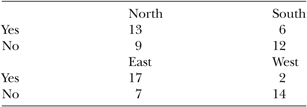
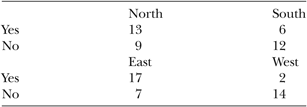
Later years would see the topographers increasing their base of support. During the administration of John Quincy Adams, a strong supporter of internal improvements, Congress agreed to increase the number of engineers and topographers by supplementing their ranks with the top graduates of West Point.Footnote 84 Funding for topographical surveys authorized by the General Survey Act came under attack in 1825, as part of the emerging divide between Adams'ssupporters and Jacksonians. A rancorous debate in the Senate over the issue repeated some of the concerns voiced in the House in 1821, but this time without anyone explicitly opposing the topogs' existence. Senator Nathaniel Macon of North Carolina, a committed supporter of Andrew Jackson, contended that “these Engineers [sic] were designed for army purposes. They had no right to divert them from their legitimate duties, by making them Civil Engineers [sic].”Footnote 85 Even those resisting the surveys no longer questioned the need for topographical engineers. There was significant disagreement, however, over the amount of discretion that the executive should have over how the surveys would be conducted. Josiah Johnston of Louisiana argued that the War Department would be able “to regulate the expenditures . . . [and] seek out the best talents in the country,” while Macon and John Holmes of Maine disliked Congress ceding so much authority to the executive branch.Footnote 86 Unsurprisingly, there was also continued debate about the constitutionality of conducting the surveys at all. In the end, the Senate voted 21–19 not to defund the surveys. Though it was a close vote, it shows some increase in support for the topographers' new mission.Footnote 87Table 2 demonstrates the geographic breakdown of the vote. Northern senators were somewhat more likely to oppose surveys than southerners. When we compare East and West, however, the results are more dramatic: only two western senators supported ending the topographic surveys, while over 70 percent of eastern senators wanted to defund them. Peripheral support for the topographers' mission was quite strong. The opposition to the surveys may have also been based, in part, on the fact that some still opposed improvements as a matter of course, even though Jackson himself would later prove to be a strong supporter of many improvement projects.Footnote 88
Senate Vote to Defund Topographical Surveys, 1825
Source: Register of Debates, Senate, 18th Congress, 2nd Session, February 11, 1825. Geographic information on senators for this and subsequent tables is drawn from the Biographical Dictionary of the United States Congress, 1774–Present, accessed at http://bioguide.congress.gov/biosearch/biosearch.asp. For this and subsequent tables, states were divided in the following manner: North: CT, DE, IA, IL, IN, MA, ME, MI, NH, NJ, NY, OH, PA, RI, VT, WI; South: AL, AR, FL, GA, KY, LA, MD, MO, MS, NC, SC, TN, VA; East: CT, DE, FL, GA, MA, MD, ME, NC, NH, NJ, NY, PA, RI, SC, VA, VT; West: AL, AR, IA, IL, IN, KY, LA, MI, MO, MS, OH, TN, WI.
In 1825 and 1826, Secretary of War James Barbour, in his annual report, requested increases in the size of the Corps of Engineers, specifically including the topographers.Footnote 89 As mentioned previously, Congress in 1825 agreed to supplement the ranks of engineers with new graduates of West Point, although it did not approve an increase as large as Barbour had wanted. Chief Engineer Alexander Macomb echoed this request and called particularly for the passage of a congressional bill designed to augment his ranks.Footnote 90 Some members of Congress eagerly followed Barbour and Macomb's lead. James Hamilton Jr., chairman of the House Committee on Military Affairs, reported a bill in early 1826 that followed Barbour's request almost to the letter. Hamilton simply asserted the members of the committee “deem it unnecessary to indulge at present in any argument to show the necessity of the passage of the accompanying bill, as the whole view of this subject is so fully and ably presented in the annexed letter of the Secretary of War, to which they earnestly and confidently refer.”Footnote 91 The letter he refers to was sent by Barbour to Hamilton six days earlier, which presented a comprehensive argument favoring an expanded Corps of Engineers.Footnote 92 Hamilton followed the lead of the nationalistic Adams administration in this matter, despite being well-known as a committed Jackson supporter and later forcefully advocating nullification during the crisis of 1832.Footnote 93
Intriguingly, the bill itself includes one provision that neither Barbour nor Macomb specifically asked for, namely a proposal to separate the topographical engineers into an independent entity, “as soon as the President of the United States shall deem it expedient.”Footnote 94 It is unclear where this idea originated. Historians who have studied the Corps of Topographical Engineers seem to have missed this episode in its development.Footnote 95 Circumstantial evidence, however, suggests that the topogs themselves may have been undertaking a cunning campaign to win their independence. After the measure failed in 1826, Major John J. Abert, who would later head the topographers for many years, wrote a letter to the House asking not only for more topographers, but also for independent bureaucratic standing within the War Department distinct from the Corps of Engineers. Abert said he thought a separate topographical office was a good idea, but
… not that we have any feeling adverse to the increase of the engineers of fortifications. We know it to be a corps of scientific men, and believe it to deserve the patronage of government. But we are of the opinion that there does not exist a strong disposition for the increase of both corps, and that by the uniting of them in one bill would certainly occasion a failure in the increase of either.Footnote 96
Abert continues his sales pitch by noting that it was no slight to the Corps of Engineers if the topogs were given an increase this year, rather it would simply indicate Congress's desire not to increase both services at the same time. He also insists that the proposed law wouldn't change the topogs' status, since “it contains no innovations upon our own established customs.”Footnote 97
An attached document written from the topographers to Secretary of War Barbour argued more directly for an independent Corps of Topographical Engineers. This unsigned letter concludes by thanking Barbour, the former chair of the Senate Committee on Military Affairs, for his support of their organization:
The topographical engineers have been in the habit of considering you as the patron of their establishment, and that to your efforts when in the Senate of the United States they are principally indebted for their present existence.Footnote 98
Clearly, the topogs were working every angle available as part of their campaign for greater independence. They must have made an impact, as three days later a bill was introduced to create an independent topographical corps, no longer at the president's discretion as in the previous year's bill.Footnote 99 Apparently some sort of symbiotic relationship was developing between the relevant congressional committees, the Corps of Topographical Engineers, and the secretary of war, all of whom were working toward a common goal.
The topogs also received support outside Washington in the form of favorable news coverage. Niles' Weekly Register, a nationally circulated periodical, repeatedly provided positive reports about the topographers' activities. One story intentionally highlighted the need to familiarize the public with these important works, “so as to give the country the greatest possible advantage which can be derived from its skill and activity” despite the “limited strength of this branch of our military system.”Footnote 100 Another heralded the topogs' shift to civil engineering projects as a “delightful linking of the various parts of our extensive country together, to consolidate the good wishes and feelings of the whole people, and yet not interfering with the ‘rights of the states.’”Footnote 101The Literary Casket and the North American, both apparently short-lived journals, published stories about improvements made to the locomotive engine by Major Stephen H. Long of the topographical engineers and the survey of a planned route for the Baltimore & Ohio Railroad.Footnote 102
Roberdeau died in 1829 and control of the bureau shifted to Abert.Footnote 103 Abert proved to be quite proficient at maneuvering the thicket of Washington politics and turning his priorities into the goals of those above him, even during the new anti-improvement Jackson administration. Abert stated that he did not want to be “a mere keeper of pictures, without any knowledge of my own corps . . . of no more account than an automaton,”Footnote 104 and he immediately went to work on expanding the topogs' numbers and autonomy. Proposals to make the topogs into a corps continued to fail in 1830 and 1831, despite the support of Secretary of War John Eaton.Footnote 105 However, although he faced strong opposition from Chief Engineer Charles Gratiot and lacked an external support network, Abert convinced acting Secretary of War Philip G. Randolph to give the Topographical Bureau independent standing within the War Department in 1831, though it was not yet a corps.Footnote 106 At the same time the topographers were given complete control over surveying, taking away a valuable piece of bureaucratic turf from the Corps of Engineers.Footnote 107 Their fight for independence had made great strides.
Abert immediately began a campaign to further expand his bureau and its mission, but the topogs still faced some resistance in Congress from those unhappy with its expanded portfolio. In 1832, for example, when the Senate was debating a bill to create a Corps of Topographical Engineers, Senator Robert Hayne of South Carolina questioned the need for such a proposal, since “there was an engineer corps in the service of the Government [sic].”Footnote 108 Senator Thomas Hart Benton of Missouri, chair of the Committee on Military Affairs, defended the bill, but it was nevertheless set aside.Footnote 109 Abert did successfully lobby for an expansion in the number of topographers from six to ten in 1834, despite the putative resistance of Jacksonians who supposedly opposed internal improvements.Footnote 110 Congressman Richard M. Johnson of Kentucky, chairman of the House Military Affairs Committee, closely tracked Abert's arguments when he introduced a bill to provide for the corps' independence. He stated that “there is no part of the army as defective in its organization as [the corps of topographical engineers], and subject, in consequence, to as great inconveniences in the execution of its duties.”Footnote 111 Benton and Johnson were both strong supporters of the topogs, and it is worth noting that both represented states on the nation's periphery. Despite this backing from key members of both houses, however, a broader plan to create an independent corps failed to pass.Footnote 112
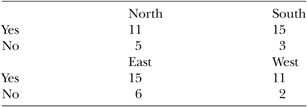
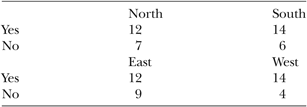
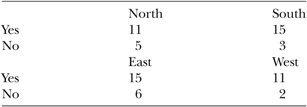
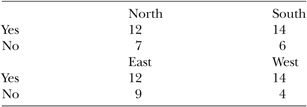
Still not satisfied, Abert continued pressing for more topographers and a reorganization that would make the bureau into a corps on an equal footing with the regular engineers. Though Abert's objectives were seemingly in tune with Whig politician Henry Clay's controversial American system, he was able to win support from both parties for his plans.Footnote 113 The Senate did approve a bill for an independent corps in 1836 and 1837, but it failed in the House.Footnote 114Tables 3 and 4 provide geographic breakdowns for Senate votes on the bill. Though this is not a perfect indicator of support for the topographers, passage of the final bill would have marked a significant triumph for the topogs and for supporters of the army more broadly. Western support both times remained quite strong, with only a few senators from that region opposing the bill. This is not surprising, as spending on improvements for the West surged during the 1830s.Footnote 115 Southern senators were more likely to oppose the 1837 version of the bill, for reasons that are unclear. In the 1837 debate, John C. Calhoun stated that “there never was a time when so little necessity existed for an increase of the army,” whereas in 1836 he “thought that there ought to be an increase of the army . . . only in reference to our Indian relations.”Footnote 116 The strongest measure of opposition to the legislation seems to have been partisan affiliation, as almost every vote opposing the bill in both instances came from Whigs or other anti-Jacksonians. Calhoun's opposition to internal improvements, along with that of certain other southerners, may have solidified after the election of Van Buren to the presidency.
Senate Vote on Passage of Army Reorganization Act, 1836
Source: Register of Debates, Senate, 24th Congress, 1st Session, June 20, 1836.
Senate Vote on Passage of Army Reorganization Act, 1837
Source: Congressional Globe, Senate, 24th Congress, 2nd Session, February 16, 1837.
Abert's congressional supporters tried to grease the wheels of the legislative process by adding a new provision to the bill in 1836 that would repeal the section of the General Survey Act allowing the employment of civil engineers, a program many Democrats had long opposed.Footnote 117 Again, however, it seems that Abert was working closely with the congressional committees on this matter, and may have even given them this idea. On the day the House version of the bill was introduced, Abert wrote a letter to Congressman Richard M. Johnson of Kentucky, chairman of the Committee on Military Affairs, arguing that civil engineers were not as capable as topographers.Footnote 118 This position reversed long-standing policies within the War Department that had encouraged the use of civil engineers. Abert had already won the support of Secretary of War Lewis Cass for this shift.Footnote 119 It appears that Abert initiated this proposal in order to win support for the topogs' independence, a clear instance of the agent influencing the actions principals were taking.
Democrats opposed to internal improvements were apparently somewhat placated by this new proviso. With the civil engineering prohibition attached, Congress finally granted Abert's wish as part of the Army Reorganization Act of 1838. The bill passed in the House by a vote of 112–80, though there seems to be no record of how each member voted.Footnote 120 The law enlarged Abert's staff and increased the number of topographers to thirty-six.Footnote 121 It directly followed language proposed by Abert in his annual report to Secretary of War Joel Poinsett, yet another indication of how the topogs were leading from behind and convincing others to enact their preferred goals.Footnote 122 The topographers were now on equal bureaucratic footing to the Corps of Engineers, and in fact became more important as they took charge of all civil engineering projects, while the regular engineers focused all their attention on military fortifications.Footnote 123
Outside of the nation's capital, at least one newspaper did seem to take a special interest in the ongoing debate over increasing the size of the army, and specifically in the role of the topographical engineers. The Baltimore Sun published several stories relating to the impending bill to increase the size of both engineering corps and how important the paper believed this to be for national well-being. On December 20, 1837, the Sun reported that the bill
must be a source of gratification to every man of judgment and reflection, to know that a measure so well calculated to advance the prosperity of the country . . . is about to be carried into effect. If any measure can properly advance the real importance of our being possessed of an immense and valuable territory, it must be the correctly and topographically knowing the various advantages of which that territory is susceptible.Footnote 124
In July of 1838, after the bill had become law, the paper recorded some of the details of how many new engineers had been appointed, the overall increase in the size of the army, and some new regulations. The article concluded by stating that “these additions and improvements will make this arm of the national defence [sic] much more respectable.”Footnote 125 One of the War Department-supported service journals, the Army and Navy Chronicle, celebrated the success of Secretary of War Poinsett in convincing Congress to pass this bill, noting how his report “became the foundation of the legislation” and that “to MR. POINSETT is then justly due the reputation of having brought this corps to increased usefulness.”Footnote 126
The 1840s were lean years for proponents of nationally funded improvements, with vetoes of many appropriations bills by Presidents Tyler and Polk. Even popular river and harbor improvements received less funding.Footnote 127 In response, the Corps of Topographical Engineers subtly shifted its aims and thereby promoted and maintained its autonomy. Surveys of little-explored western territories now became its bailiwick, without any specific authorization to this effect from Congress, the Secretary of War, or the president. Topographers such as John C. Frémont conducted important explorations in this decade that propelled the nationalistic concept of Manifest Destiny by encouraging citizens to settle in the far West. Frémont gained influence partly due to his powerful father-in-law, Senator Thomas Hart Benton. Benton pressed Abert to give important missions to Frémont, a request Abert fulfilled, though he also attached his own conditions of employment. Interestingly, Abert funded Frémont's first western survey to Oregon with $30,000 of previously appropriated funds, despite the opposition of President Tyler and Secretary of War John Spencer to encouraging immigration there. This shifting of funds represents a clear use of Abert's autonomy. Although Frémont occasionally took actions that went beyond some of his orders, Abert could not have been particularly unhappy with the results: Frémont became a national celebrity, with copies of his surveying reports selling thousands of copies across the country. Surveying became associated in the popular mind with Manifest Destiny, making it and the topographers politically powerful.Footnote 128
The 1840s also saw a triumph for the Corps of Topographical Engineers in taking away a valuable piece of bureaucratic turf from another agency. For decades, the Coast Survey, run out of the Treasury Department, had been in charge of all surveying of the Atlantic Coast, along with most lighthouse construction and maintenance. Going back to 1807, when Congress passed the initial funding, the Coast Survey and the topographers competed fiercely with each other over this issue. Since the topographers were relatively weak, however, they lost these early battles.Footnote 129 In 1834, Secretary of War Lewis Cass put the topographers in charge of construction for lighthouses but they were not given full responsibility for their design and implementation.Footnote 130 By the 1840s the issue still had not been resolved. The Coast Survey continually requested that topographers be detailed to its service to continue works on lighthouses. In 1847, however, Abert convinced Congress to give all further lighthouse construction to the Corps of Topographical Engineers.Footnote 131
In view of the topographical corps' new-found political importance and surveying expertise, it is no surprise that the Pacific Railroad Surveys were placed under its control. Congress in the early 1850s deadlocked on the question of where precisely to place a route for a proposed transcontinental railroad. The debate largely followed sectional lines, with congressmen from the North preferring a route that ran westward from St. Louis or Omaha, and southerners wanting the line to run along the 32nd parallel. In an effort to end the impasse, Congress in 1853 approved a compromise bill that ordered the Corps of Topographical Engineers to conduct four surveys traversing the nation's various sections, leaving it to the topographers to pick the best one.Footnote 132 In truth, the topographers had been preparing for this for several years. In 1850, Secretary of War Charles Conrad and Abert began planning for railroad surveys, after Asa Whitney's 1849 proposal for a transcontinental route had entered into the popular imagination.Footnote 133 In combination with their perceived expertise, these bureaucratic preparations made the Corps of Topographical Engineers the natural choice to conduct these important surveys. The topographers had the opportunity to provide scientific advice to Congress and the president on the future of the nation's railroads. Their findings would be widely publicized, not just for Congress and national officials, but also reaching professionals and the public interested in the subject of railroads. Results of the expeditions as well as surveys in progress were reported on both in newspapers, including the Baltimore Sun and the New York Daily Times, and professional publications, such as the American Railway Times.Footnote 134
Early on, Abert had argued in favor of a southern route, believing it to be the cheapest and most technically feasible.Footnote 135 His involvement soon impacted the process. The supposedly nonpartisan surveys quickly became politicized, as members of Congress from both sections pushed for their favored routes. Abert and Secretary of War Jefferson Davis of Mississippi then picked the southernmost route despite contrary evidence indicating that northern routes were also potentially viable.Footnote 136 By siding with Davis and the South, Abert lost one of the most important conditions underpinning the topographical corps' autonomy, its ability to influence its civilian principals. Key members of Congress from the North and West were outraged by Abert's choice, and their backing of the topogs ceased almost immediately. Since the topogs were no longer merely involved in an issue relegated to the nation's periphery, Congress had become deeply immersed in the process, and important members stepped up their criticism of the corps. The loss of the secretary of war's support was also crucial. With virtually no protest, Davis was able to simply move western surveys into a newly created Office of Western Exploration, while also recommending the reabsorption of the Corps of Topographical Engineers by the regular engineering corps.Footnote 137 Davis, who had long been an opponent of internal improvements and both of the engineering corps, had already decided that the topographical corps did not need to be independent from the regular engineers anymore, and he had merely been waiting for the right opportunity to present itself.Footnote 138 The autonomy that Abert had so painstakingly built up over decades vanished once the topographers became caught up in the sectional politics of the 1850s. In 1861 Abert retired, and in 1863 a northern-oriented Republican administration folded the Corps of Topographical Engineers back into the Corps of Engineers.Footnote 139
Comparing the topographers' experience to the Quartermaster General's office is instructive about the development and maintenance of bureaucratic autonomy. As Mark Wilson has demonstrated, Thomas Jesup and his bureau gradually gained a reputation for improved administration of supply in the antebellum years, which helped him to build his office into a behemoth during the Civil War.Footnote 140 Over $1 billion of spending came through the Quartermaster's Bureau during the war, with Jesup and his top five deputies making decisions about how and where to spend the money independent from partisan influences.Footnote 141 By avoiding entanglement in sectional and partisan politics prior to the war, Jesup preserved his bureau's autonomy. Along with the Ordnance Department, his bureau grew in prestige during the war and became more involved than ever in promoting economic development across the nation.Footnote 142
CONCLUSION
Scholars who have examined national improvements policy in the antebellum period have largely focused on sectionalism and slavery as driving factors in its eventual demise.Footnote 143 They have not, however, sufficiently emphasized the central role that officials in the army and War Department played in pushing for those policies and, eventually, destabilizing their support base. When those officials began allying themselves with particular sides in the sectional conflict, they undercut their independence. This is illustrated by the topographical engineers' selection of the southernmost route for the transcontinental railroad, which weakened the previously strong position of bureaucrats and helped to cost them the autonomy that they had so painstakingly built up over many years.
Focusing our attention on the War Department's bureaucratic structure, bureau chiefs, and the secretary of war reveals the limits of any attempt to neatly categorize the antebellum state using a grand historical explanation. The “state of courts and parties”Footnote 144 characterization cannot apply, as army officials, particularly mezzo-level bureaucrats such as John J. Abert, were deeply involved in pushing for an agenda that rose above partisanship and continued across administrations of differing partisan control. Congress was only occasionally involved in socioeconomic policymaking, and on many key questions deferred to the preferences of bureaucrats. Similarly, Richard Bensel's view that sectional politics dominated this period is only partially correct: until the early 1850s, most War Department officials kept their agendas separate from sectional-based politics.Footnote 145 Rather, we need to consider the state in all of its complexity and closely examine the actual policies pursued by the national government.
Particularly important in this regard is the distinction between different forms of bureaucratic autonomy that this article has proposed. Conditional autonomy, while quite tenuous in certain respects, is nevertheless a meaningful form of independence from elected officials and can have a significant effect on political development. Conceivably, the conditional autonomy that the Corps of Topographical Engineers enjoyed during the antebellum period could be replicated in other institutions at different moments in history. Despite being more fragile than robust autonomy, for whatever period this type of autonomy persists it can leave a substantive impact on the policies under question. In early America, it is clear that the topographical engineers shaped the path of statebuilding as well as the nation's future economic development.
In examining the topographers' actions, it becomes apparent that their greatest impact came on the periphery of the nation, in what may be considered “the State of the West.”Footnote 146 With few other public or private institutions in place, the West became the central locus of operations for the Corps of Topographical Engineers, and for the entire national military apparatus more generally. As Senator Thomas Hart Benton of Missouri said when he introduced the bill that became the Army Reorganization Act of 1838, “this was a measure of western origin . . . this augmentation was a WESTERN measure, called for by WESTERN voices, and due to the state and condition of that section of the Union.”Footnote 147 The triumphs of the topographers and the army were celebrated by the West because they most advanced the interests of those living in the nation's periphery. However, while the topographers enjoyed their greatest achievements in the State of the West, their position was gradually (if not inevitably) being whittled away as the periphery came to be absorbed into the nation's core. Territories that had been largely outside of the purview of elected officials became increasingly visible, and therefore the policies implemented there became more contentious too. Paradoxically, then, the topographical corps' success in accelerating economic development in the West, which led to further population growth and its ultimate absorption into the core, eventually helped instigate the loss of the corps' autonomy.
In joining in a wave of scholarship that takes more seriously the strengths of the early national state, this article points the way toward a more complete analysis of state power that does not assume away the characteristics of the state's contours. Instead we should examine the strength or weakness of each of the state's functions, as Peter Baldwin has suggested.Footnote 148 This approach, when applied in early America, suggests that ample authority was available for the central state, especially for the national military, which became a central player in early state-building efforts. Using the autonomy they gained, bureaucrats made crucial policy choices that set the stage for development policies that profoundly affected the future of the American economy and polity.