





Guided openings

Drawing on the genre of essays, emerging from a long tradition of practice, enables personal, reflexive thinking. Credited as deriving from the French verb essayer in the 1500s, essay means “to try/attempt.” This genre’s potential to trouble mainstream habits aligns with my attempts, in this think-along, performing-the-talk of doing scholarship otherwise offering, to contribute to alternative knowledge-regimes that I attempt to do in alternative ways.
The two provocations offered in this theoretical essay push for transcending what I call prefixed “cross/inter/multi/trans”-disciplinary epistemic work and the contemporary metalanguage in circulation that centers communities, individuals, languages, territories… By making the case for an undisciplinary stance, I argue instead for a metalanguage that disrupts hegemonic, naturalized thinking habits to enable a collective (re)imagining of (an)other word(s) and world(s).
Nested within a Second Wave of Southern Perspectives (SWaSP) framework, this essay’s argumentative arc transcends established labels, boundaries, and binaries (including “mono/mainstream”-disciplinary and prefixed “cross/inter/multi/trans”-disciplinary research). Binaries and boundaries flatten analyses and understandings. Aligned with ongoing efforts to question settled norms, the essay engages multiple theories from across northern-southern territories, enabling a global-centric perspective that transcends north-centrism and south-centrism. This includes discarding narrow, selective norms that transcend citational justice issues like foregrounding historically underrepresented scholars, sidestepping those whose moral sensibilities have been credibly marked… In harmony with an essayist genre, non-standard referencing also builds on contemporary access that the internet (including AI) enables. Using multiple referencing styles, I align with experimentations by those who position themselves as southern thinkers (see Reference note).
Invested in undisciplinary work from the margins with others and at the intersections of different domains, this essay offers theoretical reflections in three parts on what SWaSP enables in the educational and language sciences. Part 1 illustrates key naturalizations in epistemic labor (this includes research and educational work) and circulating discourses to trouble salient myths that continue to hold ground in mainstream norm-based thinking despite prior critique. It also positions my gaze in epistemic labor. Part 2 presents a SWaSP framework, an iteration of southern thinking that brings into its fold theories related to communication, culture, identity, and learning. Importantly, it helps debunk decoloniality as a monolith. The final Part 3 summarizes what a curiosity-driven, creative stance can mean for supporting epistemic work/ers, irrespective of its/their academic situatedness. The questions and concerns that arise through this doing of thinking otherwise essay require meta-reflective stances. While the illustrations offered point to complexities that are acknowledged in scholarly frontlines, their further theoretical and consequential engagements remain eclipsed. This is what I attempt to illuminate.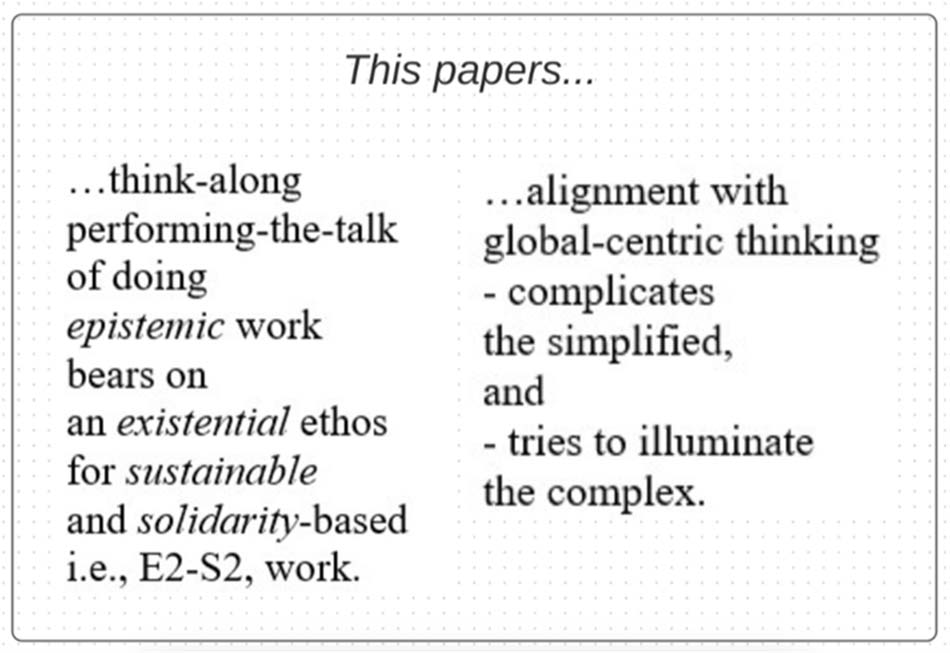
Part 1
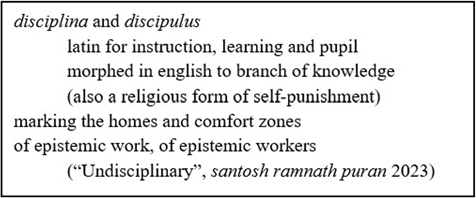
Cracks in the contemporary world make evident the myths of linear development and harmony. My collaborations with the performing arts sector and fine arts explorations in Sweden foreground possibilities of alternative worlds through the cultural sector's focus on “what if.” What if world leaders were brave and genuinely concerned about everyone, about our planet? Extending the Beatles’ lyrics, what if countries did not exist, what if land and water belonged to everyone? What if Swedish Sign Language and Sámi languages were available for and learned by everyone in the territories we call Sweden? What if… Alternative, southern epistemologies, in line with the cultural sector, enable (re)imagining (an)other wor(l)d(s). Imagining that other worlds are possible is important for instilling hope and fostering care. This essay’s key agenda invites you to imagine multiple other worlds through other words.
Portraying a close friend, her family members, some of their mobilities, and labels like Swedish, Sámi, Norwegian, European…, my first example illustrates the work that languaging does in positioning people. We recognize and acknowledge one another as something, most often implicitly. Languaging, i.e., the doing of language, and words that label humans, play a key role in creating positionalities. Beyond identities, languaging plays a central role in upholding our worlds.

Boxing in Gunlög’s father into the position of a Sámi priest, rather than a Swedish priest, has consequences for who he can be understood as and the territories he can be fixed onto. Boxing in her biological mother as a Swede, even though she grew up in Tehran, also has consequences for her positionality and personhood. Fixing Paul’s mother as Norwegian, even though she lived, gave birth to, and raised four children in western Sweden, has consequences for who she, and in turn Paul, can be understood as.
Contemporary logics of mainstream epistemic thinking are unable to position Gunlög or her family members as migrants, despite their regional and (trans)national mobilities. Nor does such logic support Norwegian or any Sámi language becoming mother tongues that any of them were or are required to learn in schools. Their whiteness and allegiance to another Nordic nation-state render the logic of minority mother tongues or of multilingualism irrelevant. Despite having long been troubled in the scholarship, the specter of nation-state thinking colludes to simplify this rationality. It can be argued that white phenotypes and belongings to contemporary Sweden are naturalized, as is the Swedish language attached to them. While such selective thinking needs (re)problematizing, it is the conundrums such imaginaries create in academic labor that are of concern here. While situating people into specific positionalities based on selected characteristics has been critiqued, not least through intersectionality-flagged research, epistemic labor itself continues to flourish in siloed identity domains. Intersectional complexities of the human condition need scrutiny across scales, particularly in how research and education are organized. Similar to what this opening example offers for (re)imagining epistemic labor, other identity labels can illustrate the logic of mainstream thinking that I am inviting y/our gaze toward.
The binary woman-man did not exist in pre-colonial times across our planet. Nor was humanity’s existence shaped through silos where humans were detached from what the mainstream now calls non-human/more-than-human. As Oyèrónké Oyewùmí foregrounds in The Invention of Women, “The emergence of women as an identifiable category, defined by their anatomy and subordinated to men in all situations, resulted, in part, from the imposition of a patriarchal colonial state” (1997, p. 124). Similarly, Maria Lugones highlights that the
“connection between gender, class, heterosexuality as racialized was not made explicit [in the development of 20th century mainstream feminism that]… centered its struggle and its ways of knowing and theorizing against a characterization of women as fragile, weak in both body and mind, secluded in the private, and sexually passive. [Mainstream feminism] did not bring to consciousness that those characteristics only constructed white bourgeois womanhood… white bourgeois feminists theorized white womanhood as if all women were white” (2014, p. 69, emphasis added).
Such an overarching reflective arc pushes mainstream epistemic work/ers to both (re)visit categories like woman, sexuality, class, functionality… and how they continue to hold ground in the organization of epistemic labor itself. In addition to acknowledging white womanhood as part of the multicolored scale of womanhood on the planet, two issues are key here: first, human identities need recognition as always being intersectionally complex, and second, this understanding calls for reimagining the organization of research and education.
Aligning with the work of women of color scholars and unconventionally inclined epistemic workers across domiciles, the point to note is that imaginaries are embedded in mundane languaging itself and are complicit in creating identities that loop back into epistemic labor. While others have raised such issues, I bring into focus both academically differentiated domains like deaf studies, gender studies, language studies, migration studies… where I am active, and contributions from alternative, southern epistemologies broadly. Thus, we find disabilities, genders, migrants…; we find people who have singular mother tongues or those who are multilingual, when we look for them through siloed lenses (compare with Gunlög’s case). The coloniality of terms like class, deaf, disability, ethnicity, migrant, queer, minority, wo/man… lies in their naturalization when epistemic labor lives within its own silos. Andrew Valls’ foreword in Michael Merry’s book A Defense of Separation echoes this: “Too often, a whole literature grows up around a particular group, paying too little heed to other literatures that treat other groups that confront similar circumstances” (2013, p. xii). Here, erased terms like color and race in Sweden (and beyond) also need illumination; irrespective of whether words are foregrounded or erased, intersectional complexities and human-non/more-than-human entanglements need consideration in the very organization of epistemic labor.
Colonial underpinnings dilute the complexities of Being Human Being, as Molefi Kete Asante and Nah Dove argue in their framing of the human condition. Inspired by ongoing experimental efforts from thinkers across southern-northern spaces, unpacking these opening examples invites y/our collective gaze on epistemic and existential issues that are highly relevant for sustainability and solidarity, i.e., E2-S2-based work from borderlands. The contraction E2-S2 is offered as a reminder of their primacy and intertwined nature. Auto-ethnographical accounts by Alan Carneiro (Following the Path of Otherwise), Sara Ahmed (Living a Feminist Life), Shahram Khosravi (“Illegal Traveller.” An auto-ethnography of borders), Stefan Svallfors (The Inner World of Research), and others push for an E2-S2 stance that (re)imagines the importance of being and engaging from intersecting margins. Despite their different positionalities, such thinkers argue about nurturing a borderland position since the light and comfort of being in academic centers is blinding and disciplining, and thus curtails academic labor itself. This aligns (as we see below) with bell hooks' point of Choosing the Margin as a Space of Radical Openness.
Mobilizing borderland thinking further, the next two interlinked examples in Part 1 illuminate my overarching argument regarding troubling naturalizations. Figure 1 depicts Earthrise, the iconic 1968 representation of our planet from outer space. This image metaphorically decenters mainstream taken-for-granted logic, opening y/our sensibilities to (re)imagine (an)other wor(l)d(s). It pushes all scholars to leave their naturalized secure zones in siloed and prefixed disciplines. Looking back at Earth from the disorienting openness of space, troubles naturalizations created from the comfort zones of mainstream epistemologies. Alternative Earthrise epistemic framings and words enable transcending contemporary naturalized dichotomized positions in research, represented by Sunrise-Moonrise – both observable from the security offered on the planet.
1968 Earthrise.

Consider the following taken-for-granted binaries that need troubling to shift to a Third Position that enables (re)imagining (an)other wor(l)d(s): monolingual-bi/multi/pluri/translingual, native-foreign languages, first-second/third languages, inclusion/integration-segregation… While these ideas are not new, my point is that mobile gazing from open spaces builds on an active acceptance of the shifting contours enabled through multiple Earthrisings and Earthsettings (as the 2026 Artemis mission enabled), including potential other celestial risings/settings. Similarly, borderlands constitute fertile innovative spaces for epistemic labor. Earthrise, i.e., Third Position, mobile gazing also challenges nation-state thinking anew. Unlike what human-made maps depict, country separation devices are invisible from outer space; only land-water demarcations are discernible (Figure 2). While nation-state boundaries are (re)drawn to obliterate or create bigger, smaller, or newer countries, their use remains surprisingly stable as units of analysis in the educational and language sciences (as my/our work indicates). Aligning with Catherine Walsh, this constitutes colonial veils of denial.
South-up, land-water continental (de)centering map.

Figure 2 offers a view of our planet that is disorienting, frequently leading to the verdict that the map is “upside down.” Some may have never questioned why places on our spherical, mobile planet are called North, South, West, East, why mainstream academic discourses label some territories the Middle-East (rather than West/Southwest Asia), why Linköping is south of Stockholm, or Sápmi is in the north, or how we locate one another (as Gunlög’s case illustrated). In addition to boundaries, human-made world maps have naturalized directionalities. While terms like the Global North/South have become popular in attempts to replace earlier terms like West/East, they continue to mark colonizers or the rich and the colonized or poor geographies. Calling attention to the need for transcending the binaries North/West-South/East, recent conceptualizations in iterations of southern thinking draw traction from anti/counter/post/de-colonial, indigenous, subaltern… epistemologies. As Ana Deumert, Gurminder Bhambra, Walter Mignolo, and others argue, such words point to ideas, not just to territories and people who have been marginalized, co-opted, or erased from the grand narratives of north-centric enlightenment and modernity. These words relate to territories that west/north Europe claimed to have discovered, appropriated, and colonized since at least the 15th century, and whose people’s west/north European logic continues to colonize culturally, economically, and intellectually.
As all these illustrations highlight, the salient point is that words used for people (Gunlög, you, me), or nation-states or transnational territories (Sápmi), or planetary directionalities or languages (mother tongue, first/second/third/foreign/home language), are value-laden. They are, as others have suggested, not neutral. However, given their entrenched existence in epistemic labor, it is relevant to ask why this continues to be the case, who decides what words are relevant to mark different areas of human existence, and what constitutes analytical relevance within research and education. The neutrality objective myth in mainstream epistemic labor needs renewed scrutiny, as Karin Murris and her collaborators push for in Navigating the Postqualitative, New Materialist and Critical Posthumanist Terrain Across Disciplines, or as Soumhya Venkatesan argues for in Decolonizing Anthropology. Neutrality myths continue to keep alive problematic assumptions related to the universal/universalizing dogma.
Some mainstream research now recognizes that over 500 years of colonialism not only murdered millions and stole land but also appropriated ideas of communities that west/north Europe colonized. Colonialism both colonized everyone’s thinking and erased knowledge regimes from across the planet. Furthermore, colonialism (re)wrote the narrative of nature whereby domination of, rather than co-existence with, everything on our planet became naturalized. Alternative thinking trajectories call for unlearning such myths, pushing us to (re)imagine y/our relationships with the non/more-than-human. They centrally call for acknowledging the erasures of multiple knowledges through the dominance of one hegemonic narrative, which is upheld in research and in education, imagined as a linear trajectory whose seat is in west/north Europe.
Southern thinking, in its different iterations, has emerged differently across territories and scholarly domiciles. My writings explore what alternative ways and waves can mean in territories (like Sweden) where such thinking has not found a foothold yet. How can epistemic (and professional) labor strategize to confront coloniality and repair centuries of imperialism? How can we understand the ongoing genocidal violence in different territories, including what the mainstream calls the Middle-East, the continued plundering of resources, labor, and energy from southern territories, including the south in the north? Coloniality is alive and well today.
Following Catherine Walsh’s reflections about not just colonial veils of denial but also their hiddenness while being in plain sight in Rising up, Living on… and Decolonial Cracks, my point is that while colonial naturalizations are in plain sight, they continue to be hidden in many scholarly areas. Importantly, their role in upholding binaries and borders in the educational and language sciences needs scrutiny. (Re)imagining (an)other wor(l)d(s) creates discomfort that enables (re)learning to see, a precondition for unlearning myths that facilitate re-turning to other words-worlds. Herein lies the relevance of an E2-S2-based stance.
This doing otherwise essay has, so far, illustrated and argued for troubling the logic of mainstream thinking. Drawing on undisciplinary stances through the open spaces of a Third Position, my argumentative arc acknowledges the thinking of others from multiple domains where I have conducted anthropologically framed research. While all scientists use language to make their case – whatever their areas of epistemic engagement – the only tool that I have at my disposal to illuminate identity and language is language itself. This, as others have highlighted, too, means that the words we use, or avoid using, and the words that circulate in academic labor need analytical attention.
My perpetual mobilities and languaging repertoires, including the mobilities and languaging repertoires of my students and colleagues, shape my/our epistemic labor. Transversing analog-digital spaces, where different named languages (Swedish, Swedish Sign Language, English, Italian, Finnish, Hindi, American Sign Language…), different scripts (Roman, Devanagari, different finger-spelling conventions…), and different modalities (written, oral, signed…) that I/we are familiar with, shape my/our experiences and understandings.Footnote 1 These constitute existential dimensions that align with Ron and Suzie Scollon’s Nexus Analysis framework. Thus, the languaging and intersectional repertoires that constitute my historical body have a bearing on the dynamic ways-of-being-with-words that humans (I/we study) deploy during their/our mundane sense-making. These have been framed as normal-diversities and normal-languaging, foregrounding the complexities that shape SWaSP themes elaborated in Part II of this essay.
However, this across-timespaces existence has also puzzled me, given that words used for identity and language, and the doing and writing of research, remain siloed. The multiple illustrations above foreground the importance of acknowledging this fragmentation in epistemic and professional labor. They highlight the boundary-markings that (re)create branches of the mainstream language sciences that are entangled with areas of the educational sciences. This has been circumvented through my/our analytical gaze on people’s composite and fluid intersectional existence, their mundane engagement with multiple semiotic resources as normal-diversity, normal-languaging, and their engagement with primary and secondary languages, rather than enclosed vocabularies that mark languagers and languages.
Following Satnam Sanghera (in Empireland) on critical work beginning with the self before it can extend outwards, my/our personal-professional experiences, which constitute my/our historical bodies, are relevant in two specific ways. First, being at the emic-etic borderlands of multiple epistemic areas has enabled a constant cross/inter/multi/trans-disciplinary engagement that has increasingly morphed into undisciplinary framings. Remaining alert to the dangers of fossilized centers of mono-disciplinary and prefixed-disciplinary areas, an undisciplinary ethos aligns with feminist scholar of color Mari Matsuda’s push to “ask the other question”: a focus on migrants’ languaging is illuminating through a gaze on signed languaging, or centering deaf people is enriched by reflecting on gender issues… Second, being at emic-etic margins constitutes an epistemological-methodological matrix where a multi-field, “loitering”–“wandering-wondering” mobile gaze supports engagement with the intricacies of normal-diversities and normal-languaging.
Irrespective of whether different (re)imagined words and worlds are populated by people with diverse migration trajectories, different hearing levels, or various languaging experiences, my arguments in Part 1 point to the necessity for all scholars to step out of their comfort zones to enable an Earthrise gaze for addressing issues of equity, marginality, and privilege in epistemic labor. I will, in the next two parts of this think-along, performing-the-talk of doing scholarship otherwise essay, point to what this means from SWaSP’s alternative framing. The primacy of epistemic, existential (E2) work in tandem with sustainability, solidarity-based (S2) work aligns with the acknowledgment that the human condition is pluralistic. Thus, terms like normal-diversity and normal-languaging, rather than the popular uptake accorded to north-centric neologisms like super/hyper-diversity and trans/pluri-languaging or metro-lingualism, have richer analytical potential.
By embracing undisciplinary thinking for doing E2-S2-based work, I align with calls for “epistemic disobedience” if we are to transcend “northern exceptionalism” and “innocence” for attending to complexities in the educational and language sciences. While Part 1 has been guided by the presuppositions of an iteration of southern thinking, i.e., a SWaSP framework, Part 2 presents and discusses its key tenets.
Part 2

One of many articulations of southern thinking, the multidimensional theoretical framework SWaSP, a Second Wave of Southern Perspectives, has relevance for revitalizing the mainstream educational and language sciences. SWaSP tenets point to the mismatch between progressive north-centric theorizing, in relation to language and marginalized identities, and the fossilized wor(l)ds that inadvertently place vulnerable people in unfavorable positions. By illustrating some key SWaSP presuppositions, I indicate how central concepts, i.e., the metalanguage in the educational and language sciences, are unwittingly outsourced to naturalized reductionisms. It is here that multiversal thinking and global-centric (rather than naturalized north-centric or south-centric) stances – illustrated in Part 1 and elaborated further here through SWaSP – become interesting. These constitute ideas to think about and with to revitalize epistemic labor.
Importantly, SWaSP foregrounds a focus on knowing and learning, including how a scholar’s knowing and (un-re)learning is integral to knowledge-production. Acknowledging epistemologies from across territories, SWaSP decenters naturalized, dichotomizing thinking in at least three ways.
First, it troubles the dichotomised ways in which research and education are organised and conceptualised: (mono/mainstream-disciplinary versus prefixed multi/cross/inter/trans-disciplinary, inclusion/integration versus segregation, special treatment versus general support, teaching versus learning, research versus practice…).
Second, it challenges the ways in which language is demarcated in epistemic labour (language A versus language B, modality 1 versus modality 2, monolingual versus bi/multi/translingual…).
Third, it troubles understandings related to the human condition (the meaning of being human versus non/more-than-human, man versus woman, disabled versus abled/normal, deaf versus hearing/normal…).
Thus, and as an indicative, rather than a comprehensive list, SWaSP centrally contributes to revitalizing epistemic labor by,
highlighting issues of epistemic justice,
valuing relationality as fundamental,
troubling entrenched binaries,
critiquing the primacy of traditional text,
challenging oral language biases,
illuminating embodiment as integral to meaning-making.
While an overlapping first wave highlights the continuing colonial-order-of-things in terms of a natural-order-of-things in the dominant, mainstream north-centric scholarship, a second wave, i.e., SWaSP, draws on two theoretical clusters constituted by thinking that has emerged from across planetary territories. Building on their confluence, SWaSP dynamically contributes to global-centric epistemologies and methodologies that transcend north/south-centrism.
Cluster one draws on the thinking offered through theories/perspectives related to power differentials; these include anti-, post-, counter-, de-colonial, indigenous perspectives, subaltern studies…
Cluster two brings together theories/perspectives relevant to the domains of learning, communication and identity; these include activity-based, sociocultural, dialogical, ubuntu, sadharanikaran,Footnote 2 integrationism, intercomprehension…
Importantly, SWaSP transcends the individual silos constituted by the theories/perspectives within these two clusters. Drawing from their multiple knowledge-production trajectories, five overlapping, non-hierarchical themes create SWaSP’s flexible framework: positionalities, timespaces, epistemological-methodological entanglements, ethics, and languaging. While some of these themes may be central in other framings, it is their composite, nonlinear, multiversal meshwork that is privileged in SWaSP. These themes are expounded below.
Positionalities and timespaces…
…are important concerns for doing research otherwise. Expanding colonial marginalizations to include people and places marked by the economically disadvantaged, functionally othered, minoritized, racialized… the SWaSP theme of positionalities argues for cultivating a problematizing creative gaze from undisciplinary borderlands. This disrupts the naturalization of both the mythical objective gaze from nowhere and a naturalized rooted gaze from a territory, including from mono/prefixed-disciplinary platforms. As argued in Part 1, this privileges a gaze from open spaces and borderlands, wherein contemporary human mobility, including digitalization, dissolves place hegemonies. Such a stance troubles the naturalization of locating scholars or those they focus upon in territories based only/primarily on place of birth, passports, or biological lineage.
Furthermore, engaging with marginalizers’ positionalities (in terms of the entanglements of their naturalized privileged historical bodies), an E2-S2-based stance transcends the overwhelming focus on marginalizations and vulnerabilities based on human characteristics. Naturalizations of privileges and vulnerabilities constitute colonial veils of denial of what is hidden while in plain sight. Given that scholars’ positionalities build on their life experiences, marginalities, privileges, (un-re)learning stances… through the gaze they bring to their epistemic labor, calls for analytical (not static) positionality statements. Since positionality relates to a scholar’s mobile gazing orientation, fixing scholars or those they study only/primarily to geographies needs rethinking.
The theme of timespaces draws attention to the coloniality that exists in the here, there, everywhere, in the past, present, and future. It acknowledges that colonial, hegemonic stances exist in places irrespective of their colonial heritage. Recognizing marginalizations and privileges across north-south territories, SWaSP’s global-centric framing critically transcends naturalized planetary stances in the scholarship. This addresses colonial legacies by foregrounding complex spatial diversities where analog-digital spaces are entangled and the co-presence of marginalizers and marginalized people everywhere. Consider the following illustration that centers the relationship between these two themes.
 Far from condoning the “buying” of Greenland by any contemporary nation-state or suggesting that what is transpiring in north Europe is worse off in comparison to other places, a mobile gaze across timespaces illuminates the political complexities in the here and now, everywhere. A mobile gaze enables recognizing contemporary coloniality, irrespective of whether it is North American or north European continuing domination over Greenland or their exceptionalism that hides what is in plain view.
While horrendous atrocities have transpired in all the continents that west/north European powers seized and handled brutally, horrific massacres continue today. SWaSP calls for recognizing such trajectories in alignment with multiple ways and waves of alternative thinking, established through different genealogies in some territories, absent in others. The themes of positionalities and timespaces suggest that frameworks like anti/post/de-colonial or SWaSP are not end stations; rather, they constitute stances and ways of being within epistemic labor where WH-questions raise concerns in terms of,
people (who is focused upon from whose gaze),
places (where issue),
ideas (whats, hows, whys regarding analytical assumptions in knowledge-production).
Epistemological-methodological entanglements and ethics…
…constitute two further SWaSP themes. Acknowledging the complexities of human existence challenges programmatic, straitjacketed methodologies that set out to “gather” data, analyze data, and write results as linear processes. As John Law illustrates forcefully in After Method. Mess in Social Science Research, simplifying and boxing complexities into streamlined procedures, makes a greater mess of illuminating the human condition. Approaching complexity head-on aligns with undisciplinary stances that support many-(possible)-ways-of-doing, writing, and producing research (as this essay attempts to do by foregrounding complexity and engaging with alternative stances). Making sense of data, analysis, results, writing, and publishing calls for privileging creative stances, including transcending contemporary theoretical-methodological hegemonies; this includes troubling the routine tendency of enclosing digital and offline spaces in the educational and language sciences. As Karin Murris, other postqualitative scholars, and those aligned with southern thinking highlight, meanings “do not preexist relations but come into being through relations” (2021, p. 13). This pushes scholars to acknowledge their complicities in data generation, since our craft does not lie in collecting/extracting passive, static materials from analog-digital worlds through observations, or from human heads through interviews. Aligning with epistemic diversity that resonates with broader democratic agendas, instead of falling back on the most advanced/familiar theoretical framework as a straitjacket, SWaSP pushes for transcending programmatic stances and engaging with practices and multilayered messy data. This makes both (so called) qualitative and quantitative materials relevant from a mobile gaze.
Highlighting the centrality and multiplicities of west/north European conceptual framings in the humanities and social sciences, Gurminder Bhambra, Roger Säljö, Ruth Finnegan, Tim Ingold, and others illuminate the need for (re)imagining and (re)articulating the situated, multiple ways of being human. Learning how to notice, feel, and research human existence across timespaces draws attention to the fallacy of continuing to equate west/north European epistemologies as global epistemologies. Neither mainstream hegemonic epistemologies and methodologies nor alternative ones are value-neutral; all are biased and partial. Bringing together two analytical clusters, SWaSP enables advancing broader global-centric apertures that have a robust chance of engaging with contemporary challenges across local, regional, planetary, analog-digital… scales.
Acknowledging scholars' situated and mobile positionalities as enabling only partial gazing possibilities frames SWaSP’s ethical theme. Critically, scholars’ mobile gazing trajectories shape what can be seen/noticed, and this can never be anything but partial. Ethics is a deeply entangled dimension of such thinking. Approaching the entanglements of epistemology, methodology, and analysis when the object of study is the unpredictable messiness of the human condition calls for meta-reflexive attention by scholars who can never dissociate themselves from their subjectivities. Here, centering alternative multiversal approaches enabled by foregrounding erased or marginalized southern epistemologies and methodologies disrupts naturalized habits in epistemic labor. SWaSP posits that alternatives are complementary, rather than replacements of mainstream imaginaries.
Rather than knowable, clear, or definite, it is the vagueness, non-coherence, multiplicities, complexities, and indeterminacies of the human condition, including a scholar’s situatedness in the matrix of the non/more-than-human, that are in continuous need of a deep personal inquiry in epistemic labor. Thus, engaging with unpredictability, perspectival, and multiversal views calls for going beyond entrenched ideas regarding objectivity, subjectivity, and token reflexivity during fieldwork, data-creation/generation, analysis, writing… Ethics here critically interrogates and transcends institutional mandates.
Consider these illustrations: a fundamental ethical conundrum arises when scholars engaged in multilingual/literate sites are themselves novices in the normal-languaging of those they study. Normal-languaging is often sidelined in deaf studies or migration and language studies work, given scholars' unfamiliarity with the complex, multilayered communication of their subjects. Thus, ethical engagement is compromised given the continuing legitimacy accorded to…
…researching visually-oriented settings without knowledge of the signed languaging in those settings,
…studying contexts where mobility-marked people are members without access to people’s primary meaning-making repertoires.
SWaSP posits that the multilayered, complex messiness of all human communication and people’s intersectional complexities constitute entangled epistemological-methodological and ethical issues for the analyst; these are rarely problems for people’s meaning-making processes in the flow of their everyday lives (that are relationally constituted).
Languaging…
…constitutes a key theme in a SWaSP framework. As has already been noted, it is central to the entangled matrix of SWaSP’s other four themes. A verb, languaging centers the doing of language. SWaSP pushes for troubling taken-for-granted words that mark boundaries; it privileges alternative vocabularies that illustrate the chained nature of all languaging, including the intersectional entangled complexities of human, non/more-than-human existence. This contrasts substantially with the overwhelming attention that language structures receive and the essentialized ways of handling the human condition (intersectionality scholarship notwithstanding). As the illustrations presented so far highlight, complexities become flattened when naturalized stances and vocabularies frame epistemic labor.
SWaSP presuppositions specifically challenge mainstream language-centrism, oral-language biases, monolingual predispositions, embodied-centric and other myths in epistemic labor. Thus, language-as-object ontology and the oral modality are privileged, at the cost of language-as-assemblage ontology in epistemic and professional labor; the latter privileges the dynamic, fluid, and relational dimensions of meaning-making, irrespective of how many named languages and modalities humans engage with.
Consider an illustration of the mundaneness of visually-oriented normal-languaging involving sighted humans.

Highlighting the ordinary as achievement in meaning-making acknowledges the key chaining implicated through the entangled pointing, shift in gaze directionality, oral and/or signed communication in the above composite ethnographic illustration. In Mikhail Bakhtin’s words, such resources inter-illuminate one another. They can only be parsed out heuristically for analytical attention. Importantly, languagers meaning-making takes place irrespective of the co-presence of what is designated as language in any of its modalities. Silence is communication. Thus, paying attention to composite gestures troubles the continuing reductionisms in epistemic labor in the educational and language sciences.
This illustration also foregrounds that people’s hearing status cannot be assumed in signed language contexts, since hearing people (like me, professionals, friends...) are signers. Furthermore, an element of cascading could be the result of a hearing person’s reaction to a loud sound, with deaf people following the startled person’s embodied reactions in this illustration. “Baby signing” courses, actively chosen by hearing parents (in some territories), provide signing for enhancing hearing babies' early communication. The irony of keeping signing away from deaf babies and pupils, particularly after they receive assistive technologies like cochlear implants, is therefore ideologically, not analytically, motivated.
My long-term research, including that of my collaborators, shows that decontextualized approaches to languaging become privileged in educational practices when pupils are positioned as vulnerable. In contrast to the visual-orientation and chaining of mundane normal-languaging (highlighted above), communication then tends to morph into structured regimes where (implicit, if not explicit) ideological stances steer educational work. Routine habits thus see children marked by labels related to migration, language disabilities, deafness… removed from their home-classrooms for “special” attention. Illustrative of naturalized circulating vocabularies, deaf children with assistive devices like cochlear implants in what is called mainstream/inclusive classrooms have access to reduced multimodal, contextual dimensions of normal-languaging (facial expressions, lip movements, embodied gestures…), when they are pulled out to practice decoding of oral language. Questioning the necessity of Learning by Hearing through Technological Framings for Participation, Ingela Holmström’s doctoral thesis richly illustrates the instrumentality of languaging in such settings.
Humans do not speak in demarcated first/second/third languages. As meaning-making creatures, humans language to communicate, irrespective of how many named languages they engage with. Language is a verb, and words used for languages and modalities are nouns that are constructed myths. As a verb, language plays out in people’s mundane meaning-making practices where other resources are chained in patterned ways; different communities of languagers share different patterned practices. Thus, epistemic reporting of only oral, signed, or written words is ideological. Acknowledging the vital role of normal-languaging in meaning-making is at a crossroads with the webs-of-understandings that are hegemonically sustained through contemporary words that label languages, modalities, and languagers. Going beyond the language-centrism, oral language biases, monolingual predispositions, embodied-centrism… thus requires troubling the existing dominant metalanguage in epistemic (and professional) labor. Figure 3 attempts to locate and mark the shifts in the metalanguage that I have argued for in this essay.
Webs-of-understandings – metalanguage.

In addition to existing naturalizations, nomenclature innovations in the 21st century try to re-orient understandings of language. While neologisms like metro-lingualism, trans-languaging… set out to trouble structural understandings (where prefixes like bi/multi/pluri are used), shifts in vocabularies without fundamental (re)imaginings of the nature of communication do not shift hegemonic stances, as the parallel usage of neologisms and older terms suggests. Transcending west/north Eurocentric gazing necessitates troubling such epistemic slippage. In line with Roy Harris’s The Language Myth, we can ask, with Ruth Finnegan, what, and Where is language?
The words discussed in this essay contribute to a rethinking stance. They are raised to revitalize the metalanguage in the educational and language sciences. Drawing inspiration from multiple language ontologies and southern multilingualisms through an E2-S2-based stance, the communicative and democratic agendas of an analytically revised metalanguage illuminate and dislocate archaic naming traditions that unwittingly reinforce ableist, colonial, gendered… demarcating agendas in epistemic labor.
Part 3

(Re)imagining the premises of epistemic labor – explicated as an E2-S2-based stance in this essay, through a SWaSP framework – holds promise. While increasing critique is meted out to mainstream universalizing knowledge-regimes, the polycrisis that marks the contemporary world, including multiple crises in academia, necessitates not just calling out problems with dichotomies, labels, and binaries, including (mono/mainstream-)disciplinary versus prefixed (multi/cross/inter/trans-)disciplinary thinking, but more importantly, transcending them in epistemic labor. The many ways and waves of thinking otherwise enabled through multiple southern framings, I have argued, offer analytical impetus. As an iteration of these, SWaSP opens for an undisciplinary Earthrise or Third Position stance that enables engaging with the complexities of human existence. In the concluding part of this essay, I raise four interrelated points that privilege an E2-S2 stance.
First, global-centric, multiversal considerations have a robust chance to engage with complexities through undisciplinarity. Conceptualizing relevant issues to address contemporary challenges necessitates shedding hegemonic universalizing myths and logic that naturalize biases. Importantly, this includes acknowledging epistemic contestations in mainstream science as taking place within west/north Eurocentric framings. Global-centric, multiversal framings acknowledge erasures and the co-opting of alternative knowledge genealogies, other ways of thinking that privilege multi-scalar relationality of relevance for humanity and the planet. Using a mobile gaze across multiversal epistemologies and methodologies centers what science is all about. SWaSP here offers ways to navigate binaries across scales: the terrain of disciplinary versus prefixed-disciplinary thinking, inclusion/integration versus segregation, universal design for all versus special support for some, oral versus manual/sign communication… Being at borderlands, rather than in disciplinary/prefixed-disciplinary fossilized centers through an undisciplinary stance, also encourages cross-sectoral collaborations that tap into multiple existing knowledges from outside academia of relevance to the educational and language sciences. This supports efforts that resist, (re)claim, (re)arrange, and transcend siloed engagements to revitalize research for multi-scalar equity.
Unconventional strategies in E2-S2-based work sidestep methodological straitjackets for resolving (new/old) challenges. They can reverse the counterproductive consequences of outsourcing reasoning to naturalized thinking through the existing metalanguage and its reductionist webs-of-understanding. Global-centric, multiversal, and undisciplinary epistemic work encourages posing uncomfortable WH-questions (what/why/how/who/when/where) that have the potential to creatively tackle issues of equity and learning in situ. Undisciplinarity thus offers revised ways to bring humanism back into research and education.
Second, words used for places, people, things, and ideas are value-laden, not neutral. Words are not just sites of representational struggle; they also centrally relate to ontological existence. Reiterating this is important since the contemporary circulating metalanguage in the educational and language sciences is universalizing, reinforces itself, and erases multiversal epistemologies. Rethinking naturalized naming habits through multiversal epistemological lenses in E2-S2-based work builds on meta-reflexivity that centers words. Drawing on other ontologies and epistemologies, other eyes, ears, taste buds, and multiple-colored skins enable alternative name-ability. Neologisms that promise equitable outcomes risk tokenism if their epistemological assumptions are not grounded dynamically in meta-reflections. The same holds for popular words like integration (aligned historically with migration), inclusion (aligned with disability positionalities), social/cultural justice, empowerment…
Troubling universalizing knowledge-regimes by drawing traction from calls to decolonize y/our minds, illuminates naturalizations regarding a linguistic-order-of-things in epistemic labor. Recognising the salience of the verb languaging from northern thinking (wittgensteinianism, integrationism, intercomprehension…) and southern framings (sadharanikaran, ubuntu…), presents alternatives to reductionist labels like bilingual/multilingual person, indigenous individual, disabled human, racialized citizen, planetary directionalities…; alternatives can feed into and rescue contemporary understandings of words related to culture, diversity, equity… from their colonial trappings.
Third, convergent framings regarding the nature of being human in both newer northern thinking and different southern epistemologies stress intersectional complexities and the relational interdependence of humans with non/more-than-humans. These are highly relevant for troubling and augmenting mainstream ways of circumventing, erasing, or instrumentalizing positionalities in epistemic labor. Challenging mainstream thinking habits that locate humans within territorial affiliations, seemingly forever, by acknowledging 21st-century mobilities in analog-digital timespaces is relevant analytically. Mobility shapes epistemic workers’ lives and academic trajectories, as it does the lives of those scholars study. This pushes for nurturing scholars’ multi-directional mobile gazing. Asking whose knowledge matters in the educational and language sciences needs augmentation by parsing out a scholar’s positionality through meta-reflective stances.
Fourth, epistemic ethics needs to transcend formalities and instrumentalization. Ethical thinking calls for meta-reflexivity regarding mundane epistemic processes across planning, designing, conducting, and producing trajectories. Engaging in epistemic labor that is significant for contemporary planetary challenges and engaging with multiple framings is doing ethics. Epistemic ethics also includes disrupting naturalized citational practices. Ongoing experimentation here includes expanding and revising referential repertoires, referencing only marginalized minoritized scholars, doing away with citations altogether… It also calls for inviting the gaze of marginally positioned scholars on issues of relevance for northern territories, rather than relegating them to passive, restrictive gazing on issues regarding “their” territories of birth or former citizenship or “their” functionality, social class, sexuality… Herein lies the significance of an undisciplinary, multiversal stance nurtured from borderland positionalities.
Post-script

From a second wave mobile gaze, southern/decolonial/indigenous/subaltern frameworks are neither discrete knowledge strands nor monoliths. They constitute the many ways and waves of thinking otherwise that continue to challenge the universal mainstream in the social sciences and humanities. Situated within such a theoretical landscape, SWaSP importantly brings into conversation two clusters, one of which emerges in the entanglements of multiple sidelined or erased epistemic strands. The second cluster brings together theoretical trajectories that engage with issues of learning, communication, and identity. This essay, and SWaSP in particular, offers (re)imagining possibilities to those who are familiar with one or the other of these two composite genealogies, including those who are curious about one or both.
A pre-requisite for revitalizing epistemic and professional labor is meeting complexity head-on. (Re)imagining (an)other wor(l)d(s) to meet contemporary challenges calls for creative, curiosity-driven research, rather than conformity-based epistemic labor. This think-along, performing-the-talk of doing scholarship otherwise essay has aimed to nudge and engage, perhaps even trouble you, the reader. Embracing this nudge to (re)imagine (an)other wor(l)d(s) can enable stepping out of de facto mono/mainstream-disciplinary, but also prefixed-disciplinary silos that have, across time, become fossilized. Transcending mythical imaginaries to cultivate a borderland stance can safeguard epistemic work/ers from the fixed, blinding centers of mainstream thinking. This is needed to democratize and contribute to epistemic, existential, sustainable, solidarity-based (E2-S2) work.



 Open access

