Introduction
The ginger genus Etlingera Giseke is distributed from Bhutan to Fiji, with most species in equatorial Malesia, where it has been revised in Peninsular Malaysia (12 species; Khaw, Reference Khaw2001), Borneo (40 species; Poulsen, Reference Poulsen2006), Java (9 species; Poulsen, Reference Poulsen2007) and Sulawesi (46 species; Poulsen, Reference Poulsen2012). Poulsen (Reference Poulsen2003) made four combinations (Etlingera dalican (Elmer) A.D.Poulsen, Etlingera pandanicarpa (Elmer) A.D.Poulsen, Etlingera purpurea (Elmer) A.D.Poulsen and Etlingera sorsogonensis (Elmer) A.D.Poulsen) in preparation for a Checklist of the Zingiberaceae of Malesia (Newman et al., Reference Newman, Lhuillier and Poulsen2004), which includes six species of Etlingera in the Philippines. In Reference Naive2017, Naive described Etlingera hamiguitanensis, and in 2018, Naive et al. increased the number to eight by publishing the presence of E. coccinea (Blume) S.Sakai & Nagam. in the Philippines.
In the process of examining all types of gingers in Malesia, in preparation for previous and ongoing revision, it became clear that more names than those published by Poulsen in 2003 are in need of a combination in Etlingera. We also report some discoveries as a result of recent fieldwork.
Materials and Methods
Detailed studies of the morphology were made by examining types of species of all basally flowering genera of Zingiberaceae at 38 herbaria, 28 of which were visited or sent material on loan (A, BM, BO, BORH, BRUN, C, CEB, E, FI, G, HBG, K, KEP, L, M, NY, P, PNH, PUH, S, SAN, SAR, SING, SNP, U, USTH, WAN and Z). The collections of the remaining herbaria were seen as digital images online (BISH, DS [= CAS], F, GH, MICH, MO, NY, PH, UC and US). Photographs on the Co's Digital Flora of the Philippines website (Pelser et al., Reference Pelser, Barcelona and Nickrent2011–) inspired new fieldwork conducted by Docot et al. Only accepted names and basionyms are given for taxa described outside the Philippines. For full synonymy, see Poulsen (Reference Poulsen2006, Reference Poulsen2012).
Results
Below we list all species of Etlingera presently known to occur in the Philippines. We place a number of names in synonymy and add species already known from the neighbouring island of Borneo, doubling the total number of known species to 16.
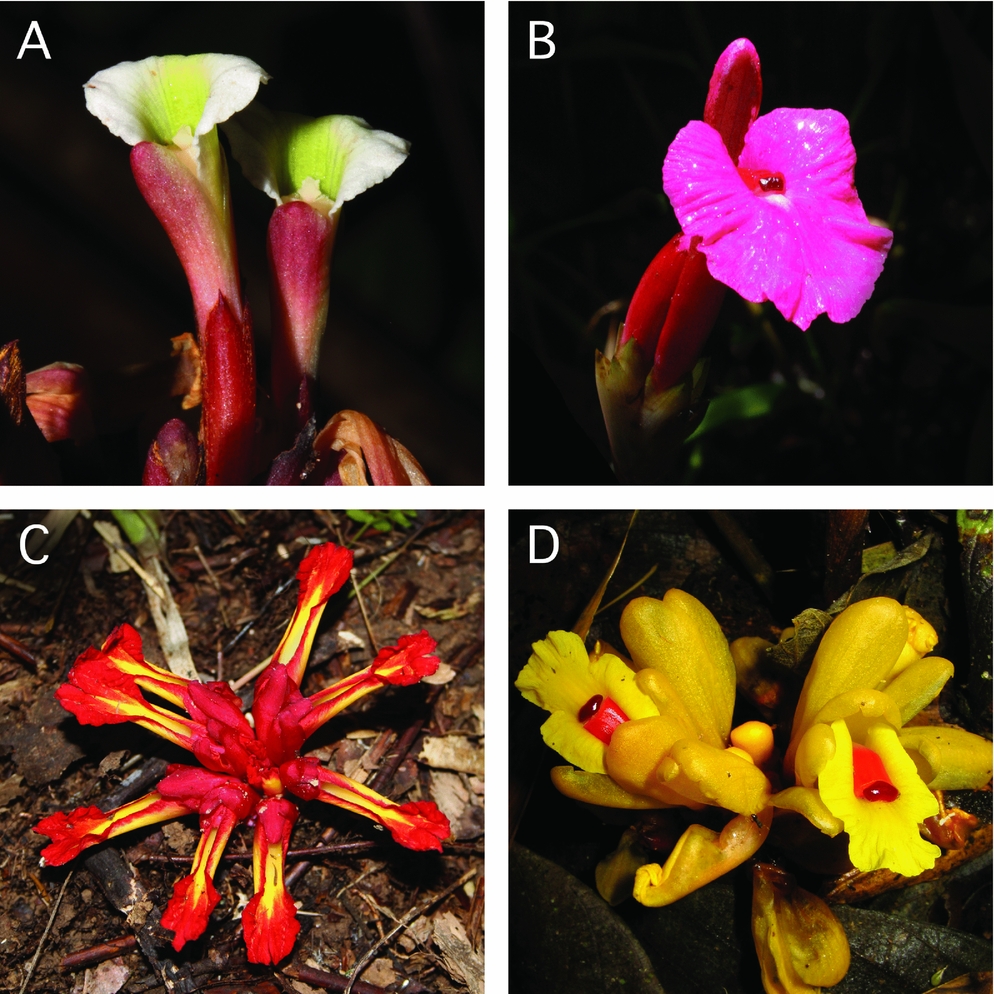
1. Etlingera alba (Blume) A.D.Poulsen, Etlingera Sulawesi: 58 (Reference Poulsen2012). – Elettaria alba Blume, Enum. Pl. Javae: 53 (1827). – Alpinia alba (Blume) D.Dietr., Syn. Pl. 1: 12 (1839). – Cardamomum album (Blume) Kuntze, Revis. Gen. Pl. 2: 686 (1891). – Amomum album (Blume) Koord., Meded. Lands Plantentuin 19: 318 (1898). – Types: Indonesia, Sulawesi, near Tondano [20–23 x 1821], C.G.C. Reinwardt s.n. (lecto L [L0193641], designated by Poulsen (Reference Poulsen2012); isolecto L [L0193642]); North Sulawesi Province, Gunung Masarang, Rampun plantation, 1°19′19′′N 124°51′41′′E, 960 m, fl. 20 ii 2008, A.D. Poulsen, Marlina Ardiyani & Erik Kaunang 2621 (epi BO, designated by Poulsen (Reference Poulsen2012); isoepi E [sheet barcodes: E00531924–6; spirit bottles: E00830553–4]). Fig. 1A.
Selected Philippine Etlingera. A, Etlingera alba (R.V.A. Docot 0156, Cuernos de Negros Mountains, Negros Oriental); B, E. brevilabrum (Samar Island); C, E. coccinea (Mount Labo, Camarines Sur); D, E. dalican (Davao del Sur). (Photographs: A, R.V.A. Docot; B, H. Funakoshi; C, J.F. Barcelona; D, U. Ferreras.)

Amomum lepicarpum Ridl., Leafl. Philipp. Bot. 2: 604 (1909). – Hornstedtia lepicarpa (Ridl.) Elmer, Leafl. Philipp. Bot. 8: 2979 (Reference Elmer1919). – Geanthus lepicarpus (Ridl.) Loes., Nat. Pflanzenfam. ed. 2, 15a: 593 (1930). – Type: Philippines, Visayas, Negros Island, Negros Oriental, Dumaguete, Cuernos de Negros Mts, vi 1908, A.D.E. Elmer 10044 (lecto K, first step designated by Turner (Reference Turner2000), second step [K000255025], designated here; isolecto BM, FI, G, GH, HBG, K [K000928038], L, US, Z), syn. nov.
Turner (Reference Turner2000) cited the “holotype” at K, but this herbarium harbours two sheets of A.D.E. Elmer 10044. One (barcoded K000928038) contains one leaf and loose fruits in a capsule, whereas the other (K000255025) has one leaf, a whole infructescence with peduncle, loose flowers and a handwritten note and is therefore superior.
A soaked and examined flower of the lectotype confirms it is an Etlingera, and new collections from Mount Makiling (R.V.A. Docot 0093, USTH) and the Cuernos de Negros Mountains (R.V.A. Docot 0154, 0156 and 0177; USTH) have measurements within the range of E. alba. In the original description, Ridley (Reference Ridley1909a) gave measurements of the corolla lobes and labellum, which are much smaller than those of Etlingera alba, and he also described the ovary as “sparingly pubescent”. The dissection of the recent collections, however, revealed that measurements were within the range of variation of Etlingera alba in Sulawesi (Poulsen, Reference Poulsen2012).
2. Etlingera brevilabrum (Valeton) R.M.Sm., Notes Roy. Bot. Gard. Edinburgh 43: 243 (1986). – Achasma brevilabrum Valeton, Icon. Bogor. 3: t. 202 (1906). – Type: plant collected in Borneo, cultivated in Hortus Bogoriensis, Bogor, Java, as no. HB XI B (V) 144 (lecto L [L0193777], designated by Sakai & Nagamasu (Reference Sakai and Nagamasu2003); isolecto BO). Fig. 1B.
Even though a proper collection documenting this species in the Philippines has not yet been made, an excellent photograph (Fig. 1B) by H. Funakoshi in Samar Island clearly proves its presence in the Philippines. Therefore, Etlingera brevilabrum is no longer endemic in Borneo.
3. Etlingera bulusanensis (Elmer) A.D.Poulsen. – Amomum bulusanense Elmer, Leafl. Philipp. Bot. 8: 2973 (Reference Elmer1919). – Type: Philippines, Luzon, Sorsogon, Irosin, Mt Bulusan, iv 1916, 2000 ft, A.D.E. Elmer 16395 (lecto BM [BM000798557], designated here; isolecto BISH, BM, BO, C, F, G, GH, HBG, L, MICH, MO, NY, PH, S, U, US, Z), comb. nov.
Elmer (Reference Elmer1919) emphasised that this species was related to Amomum pubimarginatum Elmer (see below; clearly a species of Etlingera) from which, he pointed out, it differs in the smaller leaves with a less ciliate margin, longer flowers, a glabrous ovary and distinctly costate fruits lacking apiculations at the apex. The puberulous axis of the floral shoot is indeed also similar on the types of both species. It is, however, a concern that parts of the description of the flower by Elmer (Reference Elmer1919) relate more to an Amomum Roxb. sensu lato. New material from the type locality is needed to clarify all details of the morphology of the flower.
4. Etlingera coccinea (Blume) S.Sakai & Nagam., Edinburgh J. Bot. 60: 190 (Reference Sakai and Nagamasu2003). – Elettaria coccinea Blume, Enum. Pl. Javae 53 (1827). – Type: Indonesia, Java, G. Papangdayan, probably 1818 or 1819, C.G.C. Reinwardt s.n. (lecto L [accession no. 905339126, barcode L0193260], designated by Sakai & Nagamasu (Reference Sakai and Nagamasu2003), including only fertile material to the right of the leaf). Fig. 1C.
This species has a wide distribution in Sundaland and has been known for some time (e.g. Pelser et al., Reference Pelser, Barcelona and Nickrent2011–; Naive et al., Reference Naive, Pabillaran and Esrupulo2018) to occur also in the Philippines. Sakai & Nagamasu (Reference Sakai and Nagamasu2003) mistakenly believed that the collectors of the type material were H. Kuhl & J. C. van Hasselt, who collected in West Java in 1820–1821. This mistake was repeated by Naive et al. (Reference Naive, Pabillaran and Esrupulo2018). As explained by Poulsen (Reference Poulsen2006), the collector is, however, most likely Reinwardt. In addition, a label on the type sheet, presumed to be written by the collector, includes the words: “kapol”, “Amomum sp nov”, and “Papangdayan”. The former is a Sundanese generic name for Amomum sensu lato and must refer to the elements to the left of the sheet, excluded from the type by Sakai & Nagamasu (Reference Sakai and Nagamasu2003). Papangdayan (alternatively Gunung Papandajan or Pepandajan) is a volcano in West Java that Reinwardt ascended in 1818 (van Steenis, Reference van Steenis1950) or 1819 (von Humboldt, Reference von Humboldt1859).
5. Etlingera dalican (Elmer) A.D.Poulsen, Blumea 48: 524 (Reference Poulsen2003). – Hornstedtia dalican Elmer, Leafl. Philipp. Bot. 8: 2906 (Reference Elmer1915). – Amomum dalican (Elmer) Merr., Enum. Philipp. Fl. Pl. 1: 238 (1923). – Type: Philippines, Mindanao, Davao del Sur, Todaya, Mt Apo, ix 1909, A.D.E. Elmer 11626 (lecto UC, designated by Poulsen (Reference Poulsen2003); isolecto BM, BO, F, FI, G, GH, HBG, K, L, MO, NY, P, PH, U, US, Z). Fig. 1D.
Since Newman et al. (Reference Newman, Lhuillier and Poulsen2004), eight additional isolectotypes have been discovered. Elmer (Reference Elmer1915) commented that the syntype from the same locality (A.D.E. Elmer 11759) did not agree in every detail with his description.
6. Etlingera elatior (Jack) R.M.Sm., Notes Roy. Bot. Gard. Edinburgh 43: 244 (1986). – Alpinia elatior Jack, Malayan Misc. Descriptions of Malayan Plants 2 (7): 2 (1822). – Type: Indonesia, Nias Island or Ayer Bangy, W coast of Sumatra. W. Jack s.n. 1818 (specimen lost).
Some of the first Philippine collections of this species were made in Mindanao at Santa Cruz on 2 June 1905 (R.S. Williams 2943, K) and in May 1909 at Mount Apo (A.D.E. Elmer 10652; BM, BO, C, FI, G, HBG, L, P, U, Z). Elmer (Reference Elmer1915) discussed these two collections (erroneously citing his collection as number 10552), commenting that Phaeomeria imperialis Lindl. (invalid name) did not appear to be introduced in the Philippines. Merrill (Reference Merrill1923) referred to the same two collections as Phaeomeria speciosa (Blume) Koord., which is also a synonym of Etlingera elatior. As discussed under this species in Sulawesi by Poulsen (Reference Poulsen2012: 136), it is questionable whether Etlingera elatior is native in the Philippines, as it has been used for centuries and is likely to have naturalised in several forests in Malesia.
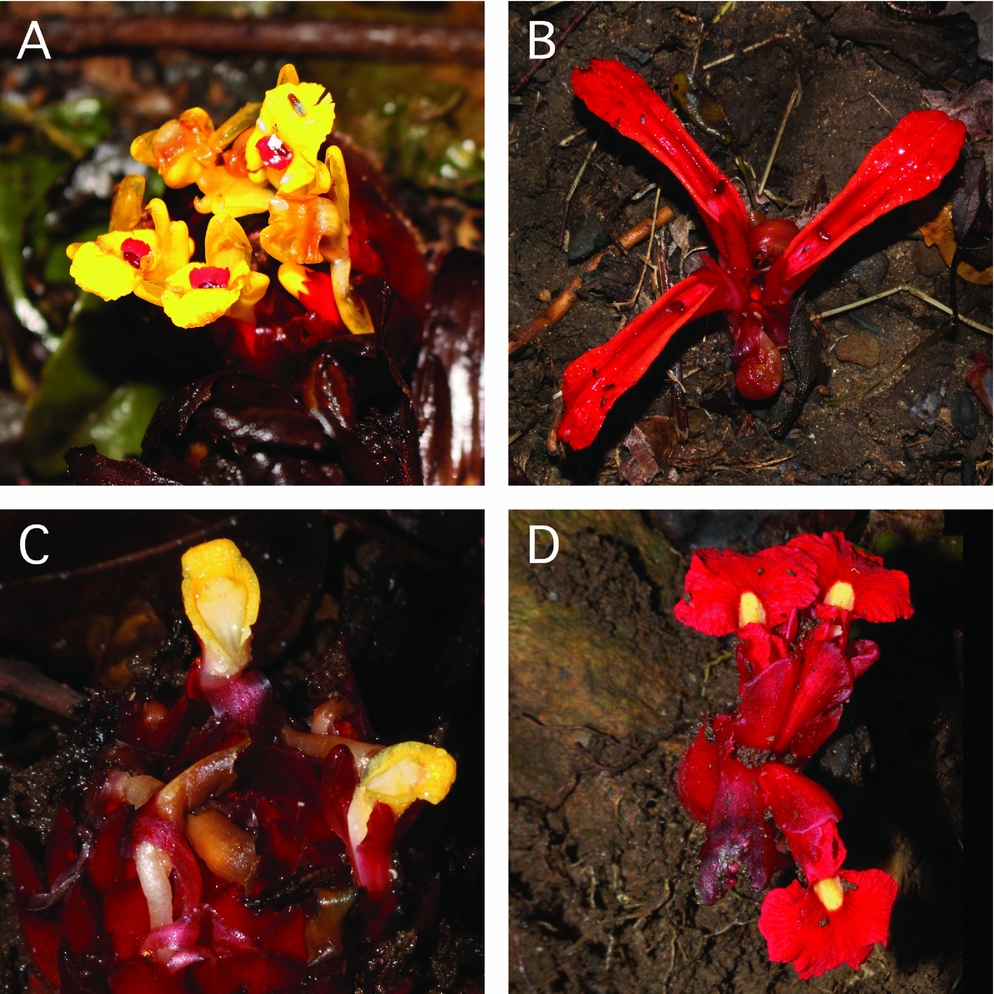
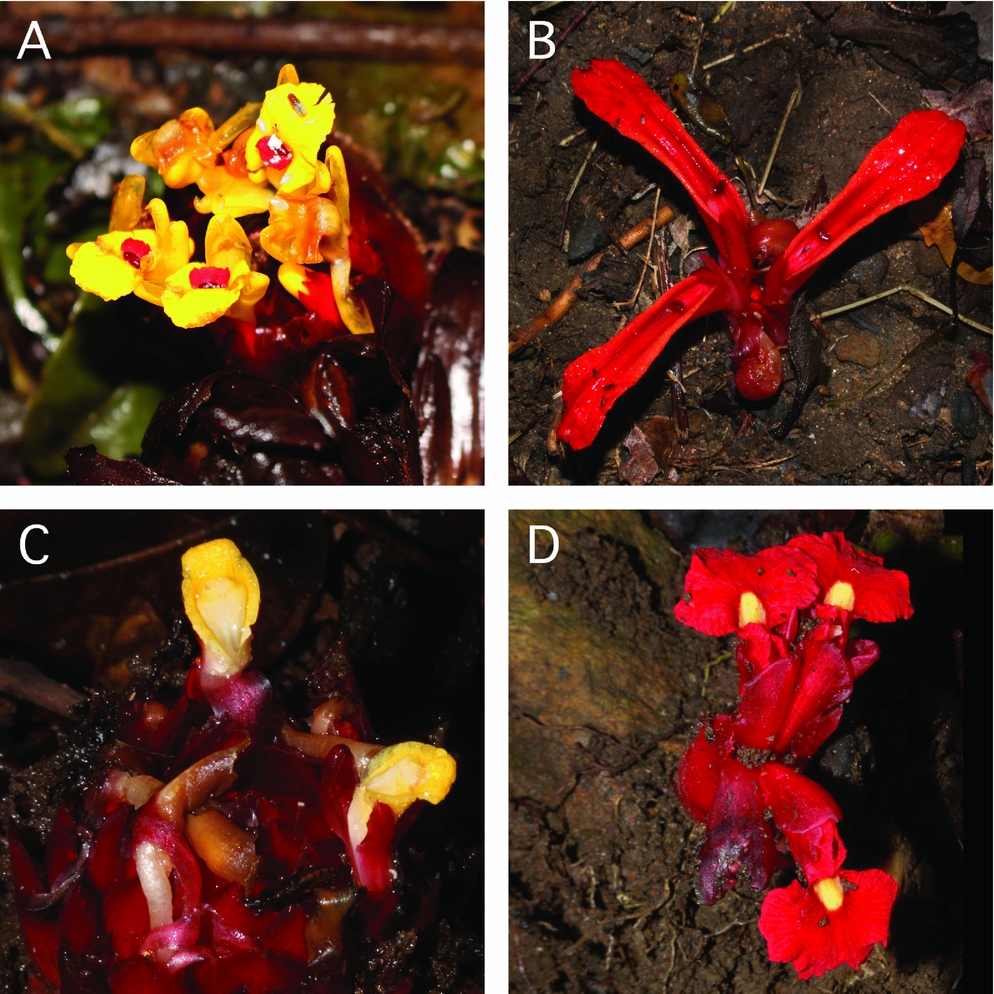
7. Etlingera fimbriobracteata (K.Schum.) R.M.Sm., Notes Roy. Bot. Gard. Edinburgh 43: 245 (1986). – Amomum fimbriobracteatum K. Schum., Bot. Jahrb. Syst. 27: 317 (1899). – Type: Malaysia, Sarawak, Bintulu, Sg. Tubao, viii 1867, O. Beccari 3735 (holo FI). Fig. 2A.
Selected Philippine Etlingera. A, Etlingera fimbriobracteata (Central Cebu Protected Landscape, Cebu); B, E. philippinensis (S.G.S. Zamudio & R.V.A. Docot SZ18-723, El Nido, Palawan); C, E. pilosa (R.V.A. Docot 0158, Cuernos de Negros Mountains, Negros Oriental); D, E. sessilanthera (R.V.A. Docot 0113, Puerto Princesa, Palawan). (Photographs: A, J.F. Barcelona; B–D, R.V.A. Docot.)
Etlingera pandanicarpa (Elmer) A.D. Poulsen, Blumea 48: 525 (Reference Poulsen2003). – Amomum pandanicarpum Elmer, Leafl. Philipp. Bot. 8: 2899 (Reference Elmer1915). – Hornstedtia pandanicarpa (Elmer) Elmer, Leafl. Philipp. Bot. 8: 2979 (Reference Elmer1919). – Type: Philippines, Mindanao, Davao del Sur, Todaya, Mt Apo, ix 1909, A.D.E. Elmer 10508 (lecto DS [0213627], designated here; isolecto BISH, BM, BO, F, FI, G, GH, K, L, MO, NY, P, U, US, Z), syn. nov.
The possibility that Etlingera pandanicarpa was a synonym of E. fimbriobracteata was raised by Poulsen (Reference Poulsen2006), revising the genus in Borneo, and is confirmed here after examination of the flowers of a recent collection (C.I. Banag CB16-267, Angat Watershed Forest Reserve, Bulacan, 12 vii 2016; USTH).
Elmer (Reference Elmer1915), quoting his field notes, described the “staminodes bent over the outer petal, yellowish white except the dark crimson apex”. Had he not lost all the flowers he collected, he might have altered his description to say that the stamen, bent over the labellum, was yellowish white with a dark crimson apex.
Even though Elmer (Reference Elmer1915: 2900) wrote that his 10508 was collected in May and September, all labels examined have the month of May printed on them, and we therefore treated all duplicates as a single gathering of which the one at DS is the best.
8. Etlingera hamiguitanensis Naive, Taiwania 62: 341 (2018). – Type: Philippines, Mindanao, Davao Oriental, San Isidro, Barangay La Union, Mount Hamiguitan Range Wildlife Sanctuary, 568 m, 21 x 2016, Naive 0132016 (holo CMUH n.v., iso PNH n.v.).
This recently described species is closely related to Etlingera philippinensis, the variation of which is poorly understood. A close examination may well reveal one or both to be synonyms of species already known elsewhere.
9. Etlingera linearifolia (Elmer) A.D.Poulsen. – Amomum linearifolium Elmer, Leafl. Philipp. Bot. 8: 2975 (Reference Elmer1919). – Type: Philippines, Luzon, Sorsogon, Irosin, Mt Bulusan, 1000 ft, x 1916, A.D.E. Elmer 16926 (BM [BM001217421], designated here; isolecto BISH, BM, BO, C, F, FI, G, GH, HBG, K, L, NY, P, S, U, US, Z), comb. nov.
The densely sericeous axis of the inflorescence, and the rigid, striate bracts on peduncle and spike, make this convincingly an Etlingera. The narrow leaves recall the description of Etlingera stenophylla (K.Schum.) A.D.Poulsen from the Matinang Mountains, Sulawesi. The type of this species seems unfortunately to have been lost (Poulsen, Reference Poulsen2012). New collections of both species from their type localities would be very useful.
At BM, two sheets of A.D.E. Elmer 16926 are present, and we designate sheet [BM001217421], where three fertile shoots are still physically connected to the rhizome and base of the leafy shoot.
10. Etlingera philippinensis (Ridl.) R.M.Sm., Notes Roy. Bot. Gard. Edinburgh 43: 248 (1986). – Hornstedtia philippinensis Ridl., Publ. Bur. Sci. Gov. Lab. 35: 86 (Reference Ridley1905). – Amomum philippinense (Ridl.) Merr., Enum. Philipp. Fl. Pl. 1: 240 (1923). – Achasma philippinensis (Ridl.) B.L.Burtt & R.M.Sm., Notes Roy. Bot. Gard. Edinburgh 31: 307 (Reference Burtt and Smith1972). – Type: Philippines, Mindanao, Davao, iii 1904, E.B. Copeland 416 (lecto, first step designated by Burtt & Smith (Reference Burtt and Smith1972) but herbarium not specified, second step SING [barcode 0044057], designated here; isolecto G, K, P; all fruits to be excluded). Fig. 2B.
Ridley (Reference Ridley1905) first described the fruits as stout, elliptic, one inch long and covered with short processes, and noted that they resembled more those of an Amomum. Four years later, Ridley (Reference Ridley1909b) realised that the type material included fruits of Amomum propinquum (synonym of Meistera propinqua (Ridl.) Škorničk. & M.F.Newman) and that the fruits of Hornstedtia philippinensis had not yet been collected. In Reference Elmer1915, Elmer commented that the fruits remained unknown, but in 1919 he had been able to find them up to six inches below ground and described them as obovoidly globose, one inch across and smooth apart from a few “blunt excrescences” similar to Etlingera megalocheilos (Griff.) A.D.Poulsen, exactly as Ridley (Reference Ridley1909b) had predicted they would look.
We studied both syntypes and agree with Ridley (Reference Ridley1909b) that the fruits of E.B. Copeland 416 (G, K, P, SING) appear to be of Meistera propinqua. The 3–5 inflorescences in each of these sets are typical of an Etlingera with an Achasma-type labellum. The fruits of the other syntype, W.W. Clark 1704 (SING), Masbate, v–vi 1904, however, contains an ellipsoid infructescence with long-pedicellate and loosely spiny fruits, which is clearly of an Etlingera related to E. alba. On the same sheet is part of a leafy shoot that is not attached to the infructescence and is unlikely to represent the leaves of the Etlingera in Copeland 416, which unfortunately only includes fertile shoots and no leaves.
As noted by Turner (Reference Turner2000), Burtt & Smith (Reference Burtt and Smith1972) referred to Copeland 416 as the lectotype of this species but they had not seen it, nor did they indicate in which herbarium this was to be found, whereas we have examined material at four herbaria and find the sheet at SING marginally superior to the others.
11. Etlingera pilosa A.D.Poulsen & Docot. – Amomum lepicarpum var. pubescens Ridl., Leafl. Philipp. Bot. 2: 605 (1909). – Hornstedtia pubescens (Ridl.) Elmer, Leafl. Philipp. Bot. 8: 2979 (Reference Elmer1919). – Amomum pubescens (Ridl.) Merr., Enum. Philipp. Fl. Pl. 1: 240 (1923). – Type: Philippines, Visayas, Negros Island, Negros Oriental, Dumaguete, Cuernos de Negros Mts, 3500 ft, vi 1908, A.D.E. Elmer 10384 (lecto K, first step effectively designated by Turner (Reference Turner2000), second step [barcode K00255023], designated here; isolecto BISH, BM, BO, E, G, HBG, K, L, NY, US, Z), nom. nov. Fig. 2C.
A combination of this name in Etlingera cannot be made, because Etlingera pubescens (B.L.Burtt & R.M.Sm.) R.M.Sm. already exists for a different species in Borneo.
Ridley (Reference Ridley1909a) speculated that A.D.E. Elmer 10384 may represent a distinct species, and Elmer (Reference Elmer1919) agreed and recognised it at species rank due to its much larger size and numerous other characters that he did not mention. Unfortunately, the flowers were in a bad state, and new material is needed from the type locality. The fruits, however, are still convincingly those of Etlingera, and the fruiting head is much more compact and certainly represents a different species than E. alba in accordance with Elmer's judgement (Reference Elmer1919). Recent collections from the type locality (R.V.A. Docot 0158 and 0171) match the type and reveal that the flowers are yellow (Fig. 2C). A full description is beyond the scope of the present study and will be published in a forthcoming revision when more is known of the variation and distribution of this and the other Philippine species.
There are three sheets at Kew: K00255022 has a folded leaf only; K00255023 includes the upper part of infructescence, loose flowers, and the handwritten label; and K000308961 is similar to the former. We designate the sheet with the fertile material as lectotype here.
12. Etlingera pubimarginata (Elmer) A.D.Poulsen. – Amomum pubimarginatum Elmer, Leafl. Philipp. Bot. 8: 2900 (Reference Elmer1915). – Geanthus pubimarginatus (Elmer) Loes., Nat. Pflanzenfam. ed. 2, 15a: 593 (1930). – Type: Philippines, Mindanao, Davao del Sur, Todaya, Mt Apo, south of Sibulan River, 4250 ft, v 1909, A.D.E. Elmer 10546 (lecto BM [BM000630037], designated here; isolecto BISH, BM, BO, F, G, K, L, MO, NY, US), comb. nov.
The striate, rigid and somewhat spreading bracts as well as the densely pubescent fruits with a few wart-like spines at the apex clearly resemble some species of Etlingera in Sulawesi (Poulsen, Reference Poulsen2012). The epithet refers to the densely ciliate leaf margin, which is also a character commonly found in species of the genus.
13. Etlingera purpurea (Elmer) A.D.Poulsen, Blumea 48: 525 (Reference Poulsen2003). – Hornstedtia purpurea Elmer, Leafl. Philipp. Bot. 8: 2984 (Reference Elmer1919). – Amomum purpureum (Elmer) Merr., Enum. Philipp. Fl. Pl. 1: 240 (1923). – Type: Philippines, Luzon, Sorsogon, Irosin, (Mt Bulusan, 1500 ft, viii 1916, A.D.E. Elmer 16819 (lecto L [L0193648], designated by Poulsen (Reference Poulsen2003), isolecto BISH, BM, BO, C, F, FI, G, GH, HBG, K, MO, NY, P, S, U, UC, US, Z).
Poulsen (Reference Poulsen2003) placed this in Etlingera due to the fruit typical morphology of the genus. It is unique compared to all other species of the genus presently known from the Philippines in its 2 cm long membranous ligule and the leaves being purple beneath, no matter what their age.
14. Etlingera sessilanthera R.M.Sm., Notes Roy. Bot. Gard. Edinburgh 43: 240 (1986). – Type: Malaysia, Sarawak, G. Mulu NP, Camp 5, Melinau Gorge, S of Sg. Melinau, 4°5′N 114°54′E, 200 m, 29 i 1978, C. Hansen 201 (holo C, including spirit collection no. 15166). Fig. 2D.
Photographs on Co's Digital Flora of the Philippines (Pelser et al., Reference Pelser, Barcelona and Nickrent2011–) taken by Jonah van Beijnen in 2015 indicate the presence of this species in Palawan, Philippines, and a recent collection (R.V.A. Docot 0113, 3 x 2017; NY, PNH, USTH) confirms it. The material is a perfect match with the collections, including the type, from northern Borneo (Poulsen, Reference Poulsen2006).
15. Etlingera sorsogonensis (Elmer) A.D.Poulsen, Blumea 48: 526 (Reference Poulsen2003). – Hornstedtia sorsogonensis Elmer, Leafl. Philipp. Bot. 8: 2985 (Reference Elmer1919). – Type: Philippines, Luzon, Sorsogon, Irosin, Mt Bulusan, 1000 ft, viii 1916, A.D.E. Elmer 16925 (lecto G [G00008004], designated here; isolecto BM, BO, C, F, FI, G, GH, HBG, K, MO, NY, P, U, UC, US, Z).
Poulsen (Reference Poulsen2003) placed this in Etlingera because the fruits, as already noted by Elmer (Reference Elmer1919), are similar to those of E. purpurea and E. pandanicarpa. Most collections consist of one leaf and a few fruits derived from the collector tearing one infructescence into bits, which is so typical of Elmer's multiple sheets. The leaf of the collection at G is best, because it is nicely pressed, with an intact apex.
16. Etlingera subviridis (Elmer) A.D.Poulsen. – Hornstedtia subviridis Elmer, Leafl. Philipp. Bot. 8: 2987 (Reference Elmer1919). – Type: Philippines, Luzon, Sorsogon, Irosin, Mt Bulusan, 1000 ft, vi 1916, A.D.E. Elmer 16437 (lecto NY [00320260], designated here; isolecto BISH, C, DS, F, FI, G, GH, HBG, K, L, MICH, MO, P, PH, S, U, Z), comb. nov.
This species shares many characters with Etlingera alba (synonym Amomum lepicarpum), but as Elmer (Reference Elmer1919) noted, it grows in denser clumps, and the leafy shoots are shorter (1.75–2.75 versus 3–5 m), with smaller (40–50 × 6 cm versus 60 × 10 cm), greenish (subviridis) leaves. Elmer also found that the fruits exhibited minor differences. Unfortunately, the flowers were in too bad condition to allow detailed measurements. Further collections at Mount Bulusan are urgently needed to fully understand if this is simply based on a small individual of the same species perhaps growing in an atypical habitat. One should bear in mind that in Sulawesi, Poulsen (Reference Poulsen2012) did recognise two species, which shared many similarities with Etlingera alba (including long-pedicellate, spiny fruits) but were generally smaller in several vegetative characters; however, floral characters justified recognition of these separate species.
Discussion
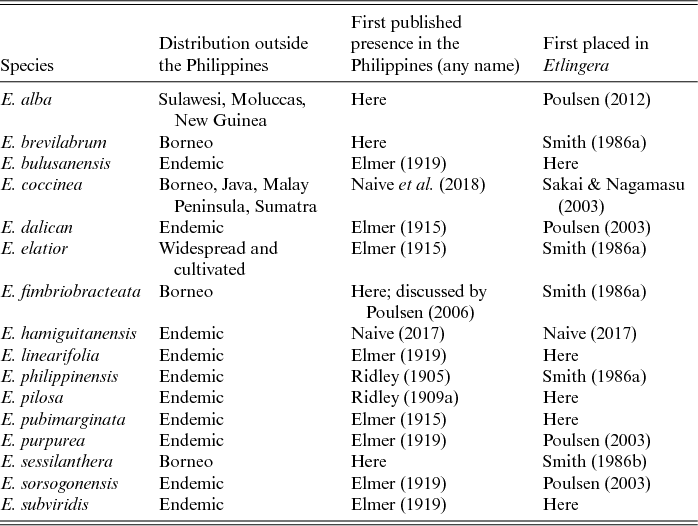
The increased fieldwork activities in the Philippines focused on gingers in recent years will no doubt result in an increase in the number of species of Etlingera known in the country. It is likely that more species already known from Sulawesi and especially Borneo will be discovered in the Philippines. Presently, the proportion of endemism is around 63% (Table 1). It is important to consider if names already published from Malaysia and Sulawesi may apply before rushing to publish new species, especially if the description is based on only one collection. In addition, a big task lies ahead to fully understand the variation and distribution of those taxa already known to occur in the Philippines, and the priority for future fieldwork should be to collect better material at the type localities, especially Mount Bulusan.
The 16 species of Etlingera currently known in the Philippines, and their distribution and history of presence

Khaw (Reference Khaw2001) and Poulsen (Reference Poulsen2006, Reference Poulsen2012) emphasised the importance of fruit morphology in distinguishing species of Etlingera. When collecting gingers, securing the flowers and preserving them in alcohol is essential, but during future exploration of gingers in the Philippines, it is also extremely useful to pickle infructescences and fruits to enable comprehensive and accurate descriptions, especially for any potential new taxa described.
Acknowledgements
Carlsbergfondet and the Sibbald Trust funded Axel Dalberg Poulsen as a Davis Research Fellow at the Royal Botanic Garden Edinburgh, which is supported by the Scottish Government's Rural and Environmental Science and Analytical Services Division. Nagao Environment Foundation, and Department of Science and Technology Accelerated Science and Technology Human Resource Development Program–National Science Consortium supported the fieldwork of Rudolph V. A. Docot. Collection permits in the Philippines were issued by the following institutions: the Palawan Council for Sustainable Development, facilitated by Sarah G. S. Zamudio; the Department of Environment and Natural Resources Region VII with PENRO Negros Oriental; and the Makiling Center for Mountain Ecosystems, through the help of Emer C. Gestiada and Manuel L. Castillo. We are also grateful to the keepers of several herbaria for giving access to collections and sending loans. We thank Julie F. Barcelona, Ulysses Ferreras and Hidenobu Funakoshi for allowing us to use their photographs; John McNeill for nomenclatural advice; and Mark F. Newman for updating the Padme Database and advising on lectotypification.