Introduction
Most interactions researchers will have with teachers fall under the umbrella of teacher professional development (PD). There are many models for teacher PD, some more successful than others. Improved student learning is the ultimate goal for PD activities. Student learning outcomes, however, should be more broadly defined than grades on standardized tests, and researchers are encouraged to consider equally important factors, such as students’ attitudes toward science, enrollment statistics in optional science classes, and statistics regarding the selection of an undergraduate field of study, when evaluating a program’s impact. (For more information on assessment, see the Reed-Rhoads article in this issue.)
Research on the characteristics of teacher PD programs and conclusions regarding their effectiveness “rarely include rigorous investigations of the relationship between the noted characteristics and improvements in instructional practice or student learning outcomes,”Reference Guskey1 as evaluations are largely comprised of opinion surveys of the researchers and educators. Despite the sometimes contradictory and inconsistent findings of studies on a cross section of teacher PD activities, general guidelines for developing an activity can be defined. With the ultimate goal of student learning in mind, factors to consider when designing a K–12 teacher outreach program include:Reference Garet, Porter, Desimone, Birman and Kwang2
• Focus on improving and deepening teachers’ content knowledge and their understanding of how children learn this material (pedagogical content knowledge).
• Create opportunities for teachers to engage in active learning.
• Design a program that is consistent with the teachers’ goals by aligning it to local standards and assessments.
• Build a network for teachers.
To define your program, consider (1) what types of activities you will offer teachers, (2) what the duration of your program will be, and (3) who will be your audience—individual teachers, a department at the school, or entire school districts. A comparison of lists of “effective professional development” characteristics recommends the inclusion of evaluation procedures, analyses of student learning data, and basing a program on the best available research evidence.Reference Guskey1 A comprehensive, up-do-date resource on PD programs is “Designing Professional Development for Teachers of Science and Mathematics,” by Susan Loucks-Horsley.Reference Loucks-Horsley, Stiles, Mundry, Love and Hewson3 In this article, we will review various types of programs for K–12 teachers as well as exemplary existing programs.
Improve teachers’ content knowledge and pedagogical content knowledge
Teacher PD programs are commonly offered as workshops, graduate courses, and teacher institutes. Programs may focus on a variety of issues, including improving a teacher’s technical knowledge, enhancing their understanding of how students learn science, presenting state-of-the-art research, and providing demonstrations and lab activities that teachers can use in their classrooms. The duration of workshops for teachers can range from a few hours to several weeks. While 90% of U.S. teachers participate in primarily short-term conferences or workshops, research indicates that such programs do not change teacher practices, and 50 or more contact hours are needed to affect a teacher’s classroom practices.Reference Wei, Darling-Hammond, Andree, Richardson and Orphanos4 If providing a long-term program is not a viable option, maintaining contact with teachers and offering a series of workshops is another way to build in continuity and increase the probability of effecting classroom change.
It is exciting to have graduate students, postdocs, faculty, and informal science education institutions work together with teachers and teacher PD organizations to develop PD programs. Researchers provide teachers an introduction to up-to-date scientific research and a strong scientific background. Informing teachers about the current state-of-the-art and showing them research facilities serve two very valuable purposes: (1) It energizes teachers about science, and this enthusiasm carries over into their classroom; and (2) it provides a real-world context for science that teachers bring to their students. This is critical, since studies show that kids are more interested in science when they see how it relates to their everyday lives.Reference Bybee5 The most effective programs and activities result from establishing long-term relationships among the scientific community, museums, and teacher PD organizations. This is an ideal approach for researchers to learn how to best address the needs of their audience. Not only do the teachers learn about science, the researchers learn how to work with teachers and engage students. The following examples of informal and formal education institutions’ PD offerings provide a glimpse of the diversity of activities undertaken to enhance K–12 education.
The Exploratorium in San Francisco, a renowned museum of science, art, and human perception, has a very active Teacher Institute. The staff presents 100 hour-long summer workshops for middle school science teachers that begin by exposing them to various phenomena under study. This is the technique recommended by the National Academy of Sciences for science education.6 From this initial concrete experience, the workshop proceeds toward abstraction, introducing the language scientists use to describe the phenomena, and then the mathematical representation of the phenomena. The Exploratorium also uses this model when a scientist gives a presentation to teachers. First, the participating teachers have about two hours to interact with some basic phenomena related to the work that the lecturer will present. After this introduction, the visiting researcher presents an overview of their field and their work. In these cases, the initial excitement of interacting with real materials provides the teachers with an additional impetus to gain a deeper understanding of the phenomena. This models a technique teachers can implement to more effectively work with their students. This successful program structure could easily be adopted by universities or research centers looking to expand their educational outreach activities.
Convincing inner city students to study science or engineering can be an uphill battle. Most students have never met a scientist or know what they do. For students who are the first in their family to attend college, higher education can be viewed as an expensive option. Researchers can make an impact by forging long-term partnerships with teachers at inner city schools and help science come alive by bringing current research problems (and current scientists) into the classroom. One example of such a program is the Harlem Children’s Zone (HCZ), which was created by Geoffrey Canada, President and Chief Executive Officer, to meet the needs of underserved students and their families in central Harlem. Professor Itai Cohen, from the Cornell University Physics Department, and his graduate students led PD workshops for HCZ’s 15 elementary and middle school teachers. The elementary school teachers learned how to utilize everyday materials to explain states of matter. For example, the teachers experimented with the superabsorbent polymer material found in diapers. The students observed how the polymer material expands as they gradually added water to it. Elementary students also discovered how a single material can act like both a solid and a liquid under different conditions. As the students tried to lift a mixture of cornstarch and water with their fingers, it slid off their fingers like a liquid. When they tried to quickly push their fingers through the mixture, they discovered with fascination that this non-Newtonian fluid behaved more like a solid. At the middle school, the team created Cartesian divers from plastic pipettes to illustrate how changing either the mass or the volume changes the diver’s buoyancy. Students made their own diver by cutting the tip off of a pipette bulb, adding a brass nut to the end of the bulb, and partially filling the bulb with water. Some of the divers are sealed with hot glue, while others are left open. By placing the divers in a sealed soda bottle full of water and squeezing the bottle, the students can make the divers sink or float. Another experiment showed teachers how to demonstrate the concepts of momentum using a series of weights, foam, and a clear plastic drop tube. These activities can be accessed at http://www.ccmr.cornell.edu/education/lendinglibrary/.
Teacher PD opportunities can have an engineering perspective, as well as a science perspective. Since its inception in 2002 at the request of a local school science department, the Science Teacher Enrichment Program (STEP) at the Massachusetts Institute of Technology’s (MIT) Materials Research Science and Engineering Center (MRSEC) has inspired middle and high school science teachers to use hands-on projects to teach the engineering design process in their classrooms. During this one-week PD workshop on the MIT campus, the teachers learn first-hand by designing and building their own motors. After attending the program in 2008, one teacher developed a classroom project titled “Electromagnets and Electric Motors in the Context of Geology.” With two colleagues, he implemented the unit with all 260 sixth graders in the Gloucester, MA school system. He is now finalizing a kit of motor parts to enable the students to build a variety of motor designs and test several variables in phase two of the project. Details regarding the MIT outreach program can be found at http://web.mit.edu/cmse/educational/teachers.html.
Opportunities for teachers to engage in active learning through real-world research
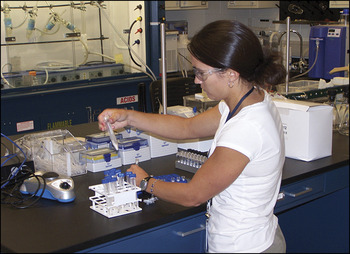
Scientists can have a major impact on science and mathematics education by offering research opportunities for teachers. As a specific example, the Department of Energy’s Academies Creating Teacher Scientists (DOE-ACTS) program (http://www.scied.science.doe.gov/scied/ACTS/about.htm) provides a comprehensive research experience for teachers. The DOE-ACTS program immerses practicing educators of grades 5–12 into the science research environment at state-of-the-art DOE national laboratories (see Figure 1). This is an intensive, three-year commitment on the part of the DOE and the teacher. ACTS is a key part of DOE’s Workforce Development for Teachers and Scientists (WDTS) pipeline strategy to increase the capabilities of educators teaching science, technology, engineering, and mathematics (STEM) subjects, and thereby improve student interest and achievement in these fields. The program integrates the principles of teaching STEM disciplines with the authentic practice of science. Teachers’ experiences in scientific research will be reflected in and transferable to classroom practice and will contribute to the reform of STEM education.
Lisa Boes is measuring biomass feedstock composition by thermogravimetric analysis in the National Bioenergy Center at the National Renewable Energy Laboratory as part of the Department of Energy’s Academies Creating Teacher Scientists program. This program provides a comprehensive research experience for teachers and helps them progress as leaders of science, technology, engineering, and mathematics education.

Many research programs for teachers require a teacher to commit a significant part of only one year. The National Science Foundation (NSF) has a long history of providing Research Experiences for Teachers (RET) programs for K–12 teachers and community college faculty. The goals of RET programs are (1) to give teachers valuable, hands-on research experience within the disciplines that they teach, (2) to build long-term collaborative partnerships among K–12 STEM teachers, community college faculty, national laboratories, and the university research community, (3) to provide teachers access to the science relevant to today’s students, and (4) to help teachers translate their research experiences into classroom activities. The NSF RET in Engineering program solicitation (http://www.nsf.gov/funding/pgm_summ.jsp?pims_id=5736) states that “An RET site project may be conducted during the summer, academic year, or both, and must have a well-defined focus, with clearly articulated projects and activities for teachers or community college faculty. An RET site proposal must be submitted by a college, school, or department of engineering and must involve teachers and/or community college faculty in an engineering research project for a duration of at least six weeks.”
The MRSEC RET program at Pennsylvania State University developed an effective model for hosting RET participants. Implementing teams of two to three teachers reduces the time and effort required of the researcher, since the team approach enhances self-sufficiency and peer mentoring. This approach also improves teachers’ confidence. In addition to working together in their research, teachers also team up for the development of lesson plans, oral and poster presentations, and papers for publication.
Researchers also can make their science accessible to classrooms by providing real-time data and equipment to teachers and their students. A best practice example of providing state-of-the art science to teachers and students in real time is the QuarkNet program. QuarkNet (http://quarknet.fnal.gov) is an ongoing collaboration between DOE and NSF that operates at 48 centers, including laboratories and universities conducting particle physics research throughout the country. Physicists from these facilities mentor and collaborate with high school educators in a multi-year program to provide in-depth knowledge about particle physics. The QuarkNet centers have developed valuable resources for teachers in the instruction of particle physics because they allow high school students to learn fundamental physics as they analyze live, online data and participate in inquiry-oriented investigations. Students use their web browser to access the data portal (http://www18.i2u2.org/elab/). This portal—or e-Lab—provides analysis tools and an online logbook that students can use to record their work. Teachers can read the logbook records made by their students and comment on them. The e-Lab currently provides data from the Compact Muon Solenoid (CMS) experiment at CERN, the Laser Interferometer Gravitational-Wave Observatory (LIGO) experiment in Hanford, Washington, and a network of hundreds of classroom cosmic ray muon detectors.
The GLOBE (Global Learning and Observations to Benefit the Environment) program is another example of successful collaboration among students, teachers, and scientists. GLOBE is a worldwide hands-on, primary and secondary school-based science and education program. GLOBE supports students, teachers, and scientists to collaborate on inquiry-based investigations of the environment and research about the dynamics of Earth’s environment working in close partnership with NASA and NSF Earth System Science Projects. Students and teachers provide data to ongoing research problems. More information regarding this program can be found at http://globe.gov. These types of programs provide real-world research experiences for students and teachers through participation in a research team.
Align your program to curriculum standards
Many U.S. public school teachers are required to teach science topics specified by science standards, which vary with location. Science standards within the United States often specify much more material than a teacher can cover in one year and are often criticized for being a “mile wide and an inch deep.” Considering this, it is highly unlikely that a teacher will incorporate content not tied to their standards. Two examples of overlap between materials science content and the New York State (NYS) Physical Setting: Chemistry Core Curriculum (http://www.p12.nysed.gov/ciai/cores.html#MST) include: “Elements can be differentiated by their physical properties. Physical properties of substances, such as density, conductivity, malleability, solubility, and hardness, differ among elements,” and “physical properties of substances can be explained in terms of chemical bonds and intermolecular forces. These properties include conductivity, malleability, solubility, hardness, melting point, and boiling point.” The NYS Physical Setting: Physics Core Curriculum (http://www.p12.nysed.gov/ciai/cores.html#MST) includes statements such as, “Behaviors and characteristics of matter, from the microscopic to the cosmic levels, are manifestations of its atomic structure. The macroscopic characteristics of matter, such as electrical and optical properties, are the result of microscopic interactions…. The factors affecting resistance in a conductor are length, cross-sectional area, temperature, and resistivity.” Teachers will embrace a PD program that delves deeper into such topics and gives them better insight into this material. Adding the materials science aspect to such topics allows teachers to put together these chemistry and physics concepts across disciplines to provide a “big picture” of physical phenomena and how it relates to real-life materials.
The National Research Council took aim at the big picture in its July 2010 release of the K–12 science education’s Framework for Science Education: Preliminary Public Draft. This conceptual framework guides the development of next-generation standards for science education in the United States. The draft framework contains four core disciplinary ideas for the physical sciences. One of the four has a strong materials science focus that, if adopted, will open doors to incorporating materials science curriculum into K–12 education. The National Research Council describes the following:
• PS (physical science) 1: Macroscopic states and characteristic properties of matter depend on the type, arrangement, and motion of particles at the molecular and atomic scales. What are substances made from and how does their structure affect their properties? (Structure and Properties of Matter)
• PS 1.A. What makes up everything around us? (Atomic Structure of Matter)
• PS 1.B. How can you distinguish one substance from another? (Properties of Matter).
Local or national standards ultimately guide the language and content of assessments. It is likely that this framework released by the National Research Council will become the basis for future science education standards in the United States. The main point, independent of the state or country, is that teacher PD activities that focus on the language, recommendations, and content of current and future standards will give teachers the knowledge and tools they need to implement an effective curriculum. It will also result in PD programs that teachers will actively seek out, as the benefit to them will be clear. Another effective method of inspiring the use of PD activities in the classroom is directly linking these activities to known areas of student difficulty, as is illustrated through the sidebar, “The movie ‘Speed’ inspires a high-quality, hands-on physics lab activity.”
The movie “Speed” inspires a high-quality, hands-on physics lab activity
If you can tie the content you create to known areas of student difficulty on exams and other assessment measures, then you further improve the likelihood that teachers will use your resources and take advantage of the professional development opportunities you offer. The most effective way to learn the details of core content, student difficulties, and the needs of teachers is to establish a genuine collaboration with them. An example of the result of such collaboration is the Stunt Car Lab, which specifically addresses difficulties New York State (NYS) students have on the 2D projectile motion problems often found in the NYS Physics Regent’s Exam, a statewide exam. Inspired by the movie “Speed,” this lab has students calculate the maximum height and distance of flight for a Darda car launched at three different angles. In the figure shown, one student prepares to launch his car to measure its initial velocity using a photogate. Another student will catch the car in a net so as to not reveal its trajectory. The students will use this initial velocity to predict and then test the car’s trajectory. Cheers are usually heard when students succeed in sending their car through a “ring of fire” set at the location of the car’s maximum height. This type of excitement and engagement in science is contagious. Dwight “Buzz” Putnam, a veteran NYS high school physics teacher, created this projectile motion activity as a part of the lab development program of the Center for Nanoscale Systems Institute for Physics Teachers (CIPT) in collaboration with Arbor Scientific, a commercial producer of science hardware for schools. The CIPT is the education and outreach program of CNS, an NSF-funded Nanoscale Science and Engineering Center at Cornell University.
Physics students at Cortland High School in Cortland, New York actively engaged in the Stunt Car Lab activity.

Commercially available Stunt Car Lab activity developed by the Center for Nanoscale Systems Institute for Physics Teachers at Cornell University, a high school physics teacher, and Arbor Scientific, a commercial supplier of laboratory hardware for schools.

Provide teachers lab activities/research equipment for their students
A recent British study of physics students’ attitudes toward different learning activities revealed that class time is often filled with the least preferred student activities. Although students much prefer engaging in constructive activities, such as doing experiments and making things, they spend most of their class time listening to explanations, taking notes, and doing other passive or written activities.Reference Owen, Dickson, Stanisstreet and Boyes7 This classroom environment prevails in many countries around the world.
A National Research Council committee found that laboratories have the potential to help students master science subject matter, develop scientific reasoning skills, increase interest in science, and achieve other important science learning goals.Reference Singer, Hilton and Schweingruber8 Well-designed laboratory activities can serve as effective learning instruments for both teachers and students, and the manner in which they are presented to teachers can model appropriate uses in the classroom. Unfortunately, the report Reaching the Critical Mass: The Twenty Year Surge in High School Physics Reference Neuschatz, McFarling and White9 reveals that the “Funding available per class for equipment and supplies has fallen from about $300 in 1987 to about $250 in 2005 in the United States. After adjusting for inflation, physics teachers have less than half of the funds available to support the purchase of equipment and supplies than they did 20 years ago.” This reflects a true concern in many nations; the state of the economy strongly influences what has and can be done in the classroom.
The Center for Nanoscale Systems (CNS), an NSF-funded Nanoscale Science and Engineering Center at Cornell University, sponsors the CNS Institute for Physics Teachers (CIPT). The CIPT responded to a lack of resources by creating a lending library containing approximately 40 high school physics laboratory activities, which were developed by teams of graduate students and physics teachers. The CIPT lending library fills a critical need for teachers since it provides them with high-quality, often sophisticated laboratory activities, which they could otherwise not afford. Teachers gain access to this library by attending workshops at state science conferences, Cornell University workshops, and two summer courses that award graduate credit from the Cornell Physics Department. In the 2009/2010 school year, this hardware was used more than 10,000 times across the United States. A web-based interface is available for teachers to sign up for CIPT labs they wish to borrow (http://www.cns.cornell.edu/cipt/labs/lab-index.html).
Some experiments require expensive equipment such as solar cells and oscilloscopes. Others are much simpler and use inexpensive materials. An inexpensive activity has the advantage that teachers can more easily recreate it for themselves. For examples of good, low-cost activities, see the Exploratorium’s Science Snacks at http://www.exploratorium.edu/snacks/snacksbysubject.html. Creating a set of materials science “snacks” or resources would be an excellent and effective way to promote the integration of materials science content into K–12 curriculum. A sound strategy would be to provide workshops where teachers learn the associated materials science content and then participate in a “Make and Take” activity, where the activity is demonstrated, and teachers receive a laboratory kit.
The research community can also make science real for teachers and students by donating excess research equipment to middle schools, high schools, universities/colleges, and other nonprofit educational institutions of higher learning. The Department of Energy has a Used Energy-Related Laboratory Equipment Grant program where educational institutions can apply to receive excess laboratory equipment from national laboratories and facilities (http://www.osti.gov/erle). This equipment can open doors for science inquiry and discovery for teachers and students.
Summary
There are many avenues for researchers to participate in or create K–12 teacher professional development (PD) programs at research institutions, universities, schools, or museums. Some researchers recognize the needs of science teachers and are self-motivated to make a difference in an arena where there is much to be done. Funding agency requirements such as the Broader Impacts section of an NSF proposal may motivate others. Still other researchers may choose to engage in activities in response to frustration with the science education of their own children. The approaches to teacher-based outreach programs can be as varied as the reasons why researchers become involved—ranging from teacher training and PD workshops and courses, research experiences in active laboratories, development and improved accessibility to active learning experiments and tools, or donation and training in the use of laboratory equipment. Regardless of the motivation or type of involvement in teacher outreach efforts, it is hoped that by collaborating with science teachers, researchers will gain an appreciation for teachers’ dedication to enlightening and engaging the world’s youth. Most researchers who reflect on their own K–12 education will quickly name that science or mathematics teacher who inspired them to study science. Giving back to the system that helped prepare us is certainly a good thing.