Ethical questions regarding the behaviour of mining firms in developing countries have been making headlines since the late 1990s and Canadian firms have attracted particular attention from the media, activist NGOs, and academics. But are Canadian firms behaving differently or worse than other mining firms? Although this is the empirical crux of the matter, there is a surprising lack of rigorous and generalizable evidence, notwithstanding the significant number of problem cases to which critics can point.
In this paper, we conduct a large-n analysis of the association between the corporate nationality of mining firms and social conflict, using an original database of 634 properties developed by the authors in five countries of Latin America (Argentina, Brazil, Chile, Mexico and Peru). We focus on the specific question of whether country of origin, in this case, the “Canadian-ness” of mining firms, is correlated with social conflict in communities proximate to mines and mining projects abroad.
First, we examine whether there is a difference in the performance of local and foreign firms with regards to social conflict proximate to mining properties. This analysis establishes the base specification, and demonstrates the importance of ownership to social conflict. Second, we assess whether there is a broad institutional country-of-origin effect associated with being headquartered in Canada, by testing “Canadian-ness” in comparison to being foreign or local, as well as against alternative determinants of conflict, such as host-country social and environmental characteristics and firm/property characteristics. Finally, a marginal effects analysis quantifies the difference in the likelihood of being associated with a social conflict for Canadian, foreign non-Canadian, and local firms.
A Short History of Canadian Mining Abroad
Social conflicts are the corollaries of an extractive economy, especially in the developing world. In forestry and farming, for instance, geographic and environmental disturbances have triggered social conflicts between local farmers and the extractive sector (de Jong et al., Reference de Jong, Ruiz and Becker2006; Turner, Reference Turner2004), as have concerns over the use of water resources as an industrial input in rural areas (McDonell, Reference McDonell2015; Sneddon, Reference Sneddon2002). Furthermore, organized, interstate and violent forms of conflict have historically been associated with high-value resources such as oil, diamonds, gems, and timber (Humphreys, Reference Humphreys2005; Le Billon, Reference Le Billon2001). Resource endowments can also be politicized as a result of resource nationalism (Haslam, Reference Haslam2016; Haslam and Heidrich, Reference Haslam, Heidrich, Alexander Haslam and Heidrich2016). In this regard, social conflicts in the mining sector are not an exception to the general trends related to conflict in the extractive sector.
In Canada, an important home country for global mining investment, activists, academics and the media have drawn attention to alleged malfeasance by Canadian companies abroad. Allegations include human rights abuses committed by security personnel employed by the company or by agents of the host state (DPLF, 2014: 16–17), violation of “free, prior and informed consent” (FPIC) especially among indigenous communities (Weitzner, Reference Weitzner2010: 93–95), fears of environmental contamination affecting human health (Urkidi and Walter, Reference Urkidi and Walter2011), dirty dealing with host country governments, gendered impacts (Deonandan and Tatham, Reference Deonandan, Tatham, Deonandan and Dougherty2016), and complicity of the Canadian government in all of the above (Clark and North, Reference Clark, North, North, Clark and Patroni2006: 7; DPLF, 2014: 25–29; Garrod and Macdonald, Reference Garrod, Macdonald, Deonandan and Dougherty2016; Keenan, Reference Keenan2013: 116; Veltmeyer, Reference Veltmeyer2013: 85–86). The recently released “Canada Brand” report on the alleged human rights abuses associated with Canadian mining firms in Latin America, produced by a team co-ordinated by Shin Imai, identified incidents involving 28 companies (44 deaths and 709 cases of criminalization) (Imai, Reference Imai2017: 4, 37–41).
The apparent connection between Canadian mining firms and social conflict, has created the impression that Canadian firms are particularly associated with social conflict, even among non-Canadian observers (Bebbington et al., Reference Bebbington, Bury, Gallagher, Bebbington and Bury2013: 271–72). A CCSRC (Canadian Centre for the Study of Resource Conflict) report, concluded that “Canada has been the most involved in these [conflict] incidents, tripling its closest peer, Australia” (2009: 16). The evidence marshalled by the CCSRC report was much weaker than has generally been acknowledged as the report asserted that 75 per cent of mining companies were headquartered in Canada, while only 34 per cent of conflicts were associated with Canadian firms, suggesting that on a proportional basis Canadian firms were less likely to be associated with social conflict than firms of other nationalities (2009: 7). Nonetheless, both the CCSRC and “Canada Brand” reports have been widely and approvingly cited by researchers and activists seeking to shine a light on the allegedly bad behaviour of Canadian firms, and promote home-county extraterritorial regulation of the sector (for example, Mining Watch 2010; North and Young, Reference North and Young2013: 97; Veltmeyer, Reference Veltmeyer2013: 90). Similarly, media coverage of Canadian mining firms has tended to identify them as “among the worst” (Karunananthan, Reference Karunananthan2013), or “far and away the worst human rights and environmental offenders” (Whittington, Reference Whittington2010).
But observers have generally failed to distinguish between several plausible hypotheses: that factors unrelated to “being Canadian” are associated with social conflict (and therefore the supposed relationship is false); that there could be a lot of reported conflict with Canadian firms simply because mining is a conflictual industry in which Canadian firms are numerically dominant (that sectoral characteristics are more important than national origin); or that Canadian firms are for some reason more likely to be involved in social conflict (country-of–origin matters). To resolve this question, it is necessary to examine the purported reasons for poor performance by Canadian mining firms and empirically compare that performance with non-Canadian mining firms.
Country-of-origin effects on firm behaviour
As internationalization became globalization, many assumed that multinational firms would homogenize in corporate strategy, management techniques and performance, or, in the language of international relations, tend to unit isomorphism, as global competition bred similarity (Pauly and Reich, Reference Pauly and Reich1997). But these assertions ran counter to more recent research that has linked corporate ownership advantages with constellations of home-country attributes, including regulation, national innovation systems and social pacts underlying the welfare state (Ferner, Reference Ferner1997: 19; Matten and Moon, Reference Matten and Moon2008; Porter, Reference Porter1990). By the end of the 2000s, it was clear that corporate nationality, based on a firm's country of origin, remained salient to a whole range of business practices, including the creation of ownership advantages, internationalization strategy and stakeholder engagement (Knudsen et al., Reference Knudsen, Moon and Slager2015; Maignon and Ferrell, Reference Maignan and Ferrell2000; Matten and Moon, Reference Matten and Moon2008).
Although the mechanisms through which country of origin affects the behaviour of firms are poorly understood, the literature has tended to gravitate towards two principal explanations: institution-centric explanations in which home-country institutional arrangements influence corporate ownership advantages and agent-centred and constructivist explanations focused on how managers internalize home-country norms and cultures. These mechanisms are not posed as alternatives; rather the agent-centred explanations are a narrower specification of the broader institutional variants.
In Canada, activists and academics have tended to view the home-country regulatory regime for mining as weak and permissive, with few effective mechanisms for corporate accountability. Although this relationship is not always made explicit, it is often assumed that poor corporate social and environmental performance abroad is the consequence of this liberal home-country regime. Insofar as this regime is often portrayed as more liberal than other home countries, a logical link is created between weaker Canadian regulation and worse performance by Canadian mining firms, comparatively speaking. The argument is perhaps best articulated by Deneault and Sacher, who link “ultra-permissive” domestic legislation on the extractive sector with international “consequences” (Reference Deneault and Sacher2012:12, 24, 179).Footnote 1
Analysts have pinpointed several key sources of regulatory “weakness.” Canadian stock markets are the source of financing for a significant proportion of global mining firms, especially small exploration or junior companies (Heidrich and Ortiz Loaiza, Reference Heidrich, Ortiz Loaiza, Deonandan and Dougherty2016). It is widely thought the Canadian exchanges have less demanding disclosure requirements and weaker enforcement of the rules that exist, particularly in comparison to the United States under the Dodd-Frank Act (Deneault and Sacher, Reference Deneault and Sacher2012: 32; Imai, Reference Imai2017: 40).Footnote 2 In particular, Canadian exchanges have not required disclosure of social, environmental or human rights issues associated with an investment.
Similarly, activists and academics have also pointed to the lack of legal accountability for actions taken abroad through the Canadian court system, especially in comparison to the United States, where such litigation is made possible by the Alien Tort Claims Act (CNCA, 2007: 5.1; Deneault and Sacher, Reference Deneault and Sacher2012: 51–52). For the most part, Canadian courts have been unwilling to hear cases (except those involving bribery and corruption abroad, which are covered by Canadian law) for a number of reasons: the legal principle that cases are better heard in the original jurisdiction; the arms’ length relationship between head office and foreign subsidiary which makes it difficult to find the Canadian-based office responsible for management decisions of the subsidiary; and for substantive reasons related to the allegations against the company and its responsibilities under the law (Above Ground, 2017; North and Young, Reference North and Young2013: 98–99). Nonetheless recent rulings from British Columbia (Nevsun Resources Ltd., Tahoe Resources), and Ontario (Hudbay) have allowed some cases to proceed, and there is the potential for case law to rapidly develop (Above Ground, 2017, 4–6; Quan, Reference Quan2017).
According to critics, Canada's regulatory framework is also weak in terms of export financing, where it fails to require human rights assessments, unlike the UK Export Credit Guarantee Department and in screening pension investments for poor corporate practice, unlike France and Norway (CNCA, 2007: 1.2). The logical corollary of these arguments is that the home-country regulatory and institutional environment should be strengthened to reduce the alleged problems associated with Canadian firms (Coumans, Reference Coumans2010: 36; Keenan, Reference Keenan2013: 115). Indeed, regulatory strengthening as a policy response doesn't make much sense unless weak institutions are one of the causes of poor corporate performance abroad. Similarly, the reference in the literature to “stronger” oversight existing in other countries, also logically requires that those countries have better performing firms than Canada (otherwise there is no value to that oversight). In this regard, the literature on Canadian mining firms, even when not explicit on the matter, mostly assumes that both the home-country regulatory environment and the performance of Canadian firms on social, environmental and human rights criteria are weaker than other countries.
While the literature describing the home-country regulatory environment as weak and permissive has tended to dominate, it is worth noting that some argue that Canada's regime is broadly in line with other mining powers, such as Australia, the UK, the US and Switzerland. This argument provides us with an alternative hypothesis around the same institutional mechanism: that the Canadian regulatory environment and therefore the performance of Canadian firms is unlikely to be much different from other prominent home countries. For example, we note that Canada's regulatory environment is broadly in line with the Anglo-American tradition, shared by the UK, US and Australia (other important mining home-countries), characterized by a focus on responsibilities to shareholders rather than stakeholders (Ferner, Reference Ferner1997: 27). On the specific issue of regulating mining abroad, Canada's practice of promoting self-regulatory rather than regulatory solutions to accusations of corporate malfeasance abroad, is also compatible with this tradition (Coumans, Reference Coumans2010: 36; Keenan, Reference Keenan2013: 115; Seck, Reference Seck2008: 192).Footnote 3 Furthermore, some see Canadian stock market requirements regarding corporate transparency as relatively demanding, especially for mining firms (Woodside, Reference Woodside2009: 7).Footnote 4
In terms of agent-centred and constructivist explanations of country-of-origin effects, the application of corporate social responsibility (CSR), is the element of management practice that is most important for any analysis of social conflict. It is well known that the nationality of multinationals is associated with different management cultures and attitudes to stakeholder groups (Gjolberg, Reference Gjǿlberg2009: 19; Maignon and Ferrell, Reference Maignan and Ferrell2000). The most important source countries for mining investment in Latin America (notwithstanding the recent arrivals of Chinese firms, which are not captured in our dataset) are, broadly speaking, found within a similar Anglo-American tradition of “explicit” stakeholder relations, namely Australia, UK and USA (Matten and Moon, Reference Matten and Moon2008).
From this perspective, the literature on Canadian firms would tend to predict similar if not better, but certainly not worse performance on CSR, in comparison to other foreign firms. Of course, there is no shortage of criticism denigrating CSR practices as little more than cynical public relations ploys (see Clark and North, Reference Clark, North, North, Clark and Patroni2006). A careful reading of the historical record, however, shows that the pattern of CSR adoption in Canada has largely mirrored that of other mining powers. Furthermore, as Dashwood has argued, a small number of Canadian companies were important first movers who contributed to the creation of global CSR norms and helped build institutions like the ICMM (International Council on Mining and Metals) and diffuse “sustainable development” as a guiding normative principle for the industry (Dashwood, Reference Dashwood2007). The largest mining firms represented in the Mining Association of Canada (MAC) are required to subscribe to the association's CSR standard, “Towards Sustainable Mining.” Canada's approach to promoting CSR among mining firms has been voluntary rather than punitive, similar to other major home countries for mining enterprise (see Grayson, Reference Grayson2006: 479; Keenan, Reference Keenan2013: 114; NRCAN, 2013; Webb, Reference Webb2012: 11).
The literature provides clear hypotheses that are suitable for testing. If, indeed, Canada has a more permissive regulatory environment for mining than other mining countries, and that such permissiveness is associated with poor social, environmental and human rights performance by corporations abroad, then we would expect Canadian firms to be more associated with social conflict than companies with a different country of origin. In contrast, the agent-centred and constructivist literature on corporate social responsibility would tend to predict that Canadian firms should perform at least as well, if not better than firms originating from other mining countries.
Other explanations of social conflict
However, the debate about the role of country of origin in social conflict at mining properties needs to be put in perspective. Among Canadian activists and scholars, the focus is, naturally, on Canadian firms and the alleged effects of a liberal home-country regulatory regime. But it must be remembered that the full range of factors hypothesized to affect the likelihood of social conflict is much broader (Conde and LeBillon, Reference Conde and Le Billon2017; Haslam and Ary Tanimoune, Reference Haslam and Tanimoune2016). Although it is beyond the scope of this paper to address these factors in detail, some important variables enter our model as controls that permit us to tease out the country-of-origin effect independent of all other determinants of known conflict. Nonetheless, we can identify two main sets of factors that offer alternative explanations for social conflict at mining properties: host-country characteristics (the broader social and institutional environment) and firm-level, structural features (unrelated to management practices, or country of origin).
Host-country determinants of social conflict have figured prominently in the case study literature on mining. In general, observers have considered governments in developing countries to have weak regulatory capacity vis-à-vis transnational mining firms, as well as a weak capacity to mediate or resolve conflicts that may emerge. However, we can also examine host-country determinants of social conflict at the property level, which is a better fit for our firm-level analysis. The literature suggests that local dynamics of social conflict are usually related to (1) livelihood concerns—how mines impact existing agricultural livelihoods—and (2) distributional concerns—how mining rents are distributed to the local population (Arellano-Yanguas, Reference Arellano-Yanguas2011; Bebbington et al., Reference Bebbington, Humphreys Bebbington, Bury, Lingan, Pablo Muñoz and Scurrah2008). Evidence shows that increasingly acute competition between agricultural and alternative livelihoods and mining, revealed in the use of marginal lands, scarcity of water and proximity to national parkland, are likely to foment livelihood-based social conflict (Urkidi and Walter, Reference Urkidi and Walter2011). In terms of distributional drivers, an increased sensitivity of the local population to who gets what from the mining firm, due to poverty, low educational attainment and lack of provision of state services in that locality, is also important (Amengual, Reference Amengual2018; Canel et al., Reference Canel, Idemudia and North2010: 21; Conde and Le Billon, Reference Conde and Le Billon2017).
There are also alternative firm and property-level factors, unrelated to country of origin or the host environment that could also affect the likelihood of a mining firm being involved in a social conflict (see Haslam and Ary Tanimoune, Reference Haslam and Tanimoune2016). The case study literature points to several potential determinants: exploitation method, particularly open-pit mining, which is considered to have larger and more visible impacts on the surrounding environment (Bebbington et al., Reference Bebbington, Humphreys Bebbington, Bury, Lingan, Pablo Muñoz and Scurrah2008); higher altitudes at which mines compete with other livelihood options that are already under pressure (Arellano-Yanguas, Reference Arellano-Yanguas2011; Canel et al., Reference Canel, Idemudia and North2010: 22); market capitalization, as it is widely believed that small “juniors” are less professional in their relations with communities (Dougherty, Reference Dougherty2011); and type of mineral, whereas certain minerals such as gold are associated with chemical processes that are thought to cause more concern for communities (Urkidi and Walter, Reference Urkidi and Walter2011: 683). These structural features can be considered independent of firm nationality and, in this respect, offer compelling alternative hypotheses to the country-of-origin effect we are investigating. Our statistical analysis makes a concerted effort to control for these factors.
Methodology
Hypotheses and estimation method
Our principal hypothesis is that the location of a mining property's head office will affect the likelihood of a conflict at that property. In particular, the qualitative case study literature leads us to hypothesize that Canadian firms, as compared to non-Canadian foreign-owned firms, are more likely to be associated with known social conflict in communities near mining properties, due to the institutional and regulatory permissiveness of the home country. We also consider the null hypotheses discussed above: that country-of-origin is not significantly associated with social conflict in the mining sector and that host-country and firm-level variables (that encourage livelihood-based and distributional conflicts) are associated with conflict independent of firm nationality. The estimation method is a logit technique with factors and interactive variables (Greene, Reference Greene2011). Logit regression is well adapted for highlighting the statistical correlations between a categorical dependent variable (such as our binary “known conflict” versus “no known conflict”) and one or more independent variables.
Sample and database
Our analysis is based on an original dataset of 634 mining properties in five Latin American countries (Argentina, Brazil, Chile, Mexico and Peru). The data were assembled by the authors in order to facilitate the quantitative analysis of the relationship between mining firms and social conflict (see Haslam and Ary Tanimoune, Reference Haslam and Tanimoune2016). The initial list of properties in Latin America, with their geo-spatial co-ordinates, was drawn from the industry site Infomine in June 2011 and included all properties at the advanced exploration, pre-feasibility, feasibility, development and producer phases (but excluded properties classified as raw prospects or in early exploration, as these rarely result in mines). Infomine takes its information from regulatory and stock market filings and, as a result, should approximate the universe of mining properties.
The aforementioned countries were selected because they are the most important mining countries in the region by number of properties and constitute 634 of 783 properties in 23 countries of Latin America at the advanced exploration phase, or 81 per cent of the possible universe. Of the 783 properties, 713 were obtained from Infomine, but an additional 70 (49 of 634 used in the current analysis) were added, that were known to be involved in social conflicts. In this regard the proportion of known conflict cases to the total number of properties slightly overrepresents the likelihood of social conflict, but the advantage of this method of constructing the sample is that we approximate the known universe of social conflicts at the end of 2012. In this regard, the unit of analysis, the property, was (principally) not selected on the dependent variable, known social conflict, but instead on the whole universe available from Infomine. Furthermore, the overall analysis remains robust in the unbalanced sample (see online appendix, Tables 2A, 3C, 5C).
Additionally, we limited the sample to five countries because the analysis required census data that were not available from some smaller countries. From a statistical point of view, it is preferable to use longer series of data from a single source. Colombia was excluded because of its particular characteristics, namely, a prolonged civil war with a potentially different dynamic than the livelihoods versus distributive contests seen elsewhere in the region. The percentage of the total available properties captured in our sample means that it approximates the universe. Nonetheless, we note certain limitations to the sample, namely, that it excludes countries with extremely low-quality governance, such as El Salvador, Guatemala and Honduras, which may limit the applicability of our findings to these kinds of contexts.
Geo-spatial co-ordinates of properties in the sample served as a starting point for further data extraction. By applying GIS techniques, data were obtained for each individual property within a 25 km radius around each mine site, notably, altitude data, population count and density, and land cover characteristics and use (Bright et al., Reference Bright, Coleman, King and Rose2007; ESA and POSTEL, 2008; Hijmans et al., Reference Hijmans, Cameron, Parra, Jones and Jarvis2000). The data acquired at the property level were further coded and transformed for inclusion in the database for regression analysis. Based on latitudinal and longitudinal data, we identified the administrative divisions within which each mining property is located at the third administrative level (one level below the province/state/region) (GADM, 2012). The latest census data for that level were accessed through the national statistical agencies of each country, and socioeconomic indicators (such as measures of poverty, education and indigenous population) were found, coded and added to the database for each property. As a result, the database includes highly localized information for each mining property covering the firm and property data, socioenvironmental features of the proximate area and socioeconomic characteristics of the nearby population.
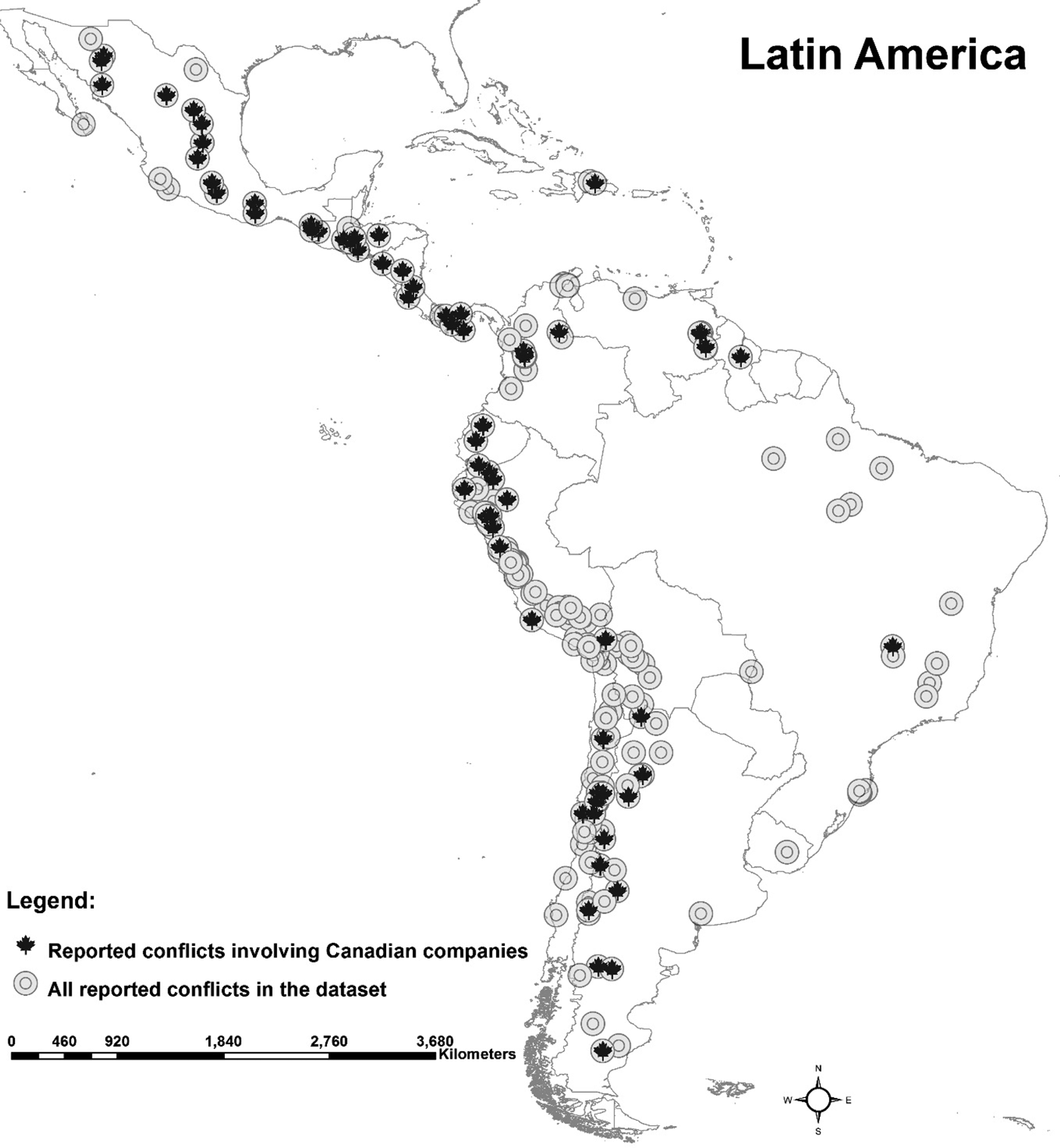
An overview of the number of Canadian firms involved in known social conflicts in the twenty-three countries of the database is found in Figure 1: Canadian Mining Firms and Social Conflicts in Latin America, 2012.
Canadian Mining Firms and Social Conflicts in Latin America, 2012

Dependent variables
The dependent variable we use in the analysis is the presence of a known social conflict in the communities proximate to the property, which we code as either “1” (known conflict), or “0” (no known conflict). Known social conflicts were identified using a methodology common to political event analysis (PEA) and widely used in the literature on contentious politics to study the emergence of social movements (Tilly, Reference Tilley2008: 32–35). In this methodology, researchers identify media reports of contention, and code the events in various ways. Despite the limits of this methodology, namely the impossibility of including all contentious events, it is justified in the literature by the lack of any other superior source of data on social movement organization and action (Earl et al., Reference Earl, Martin, McCarthy and Soule2004: 72). In this regard, we follow the contentious politics literature, which focuses on the eruption of sustained, organized and public collective action that express claims on authorities (Tarrow, Reference Tarrow2008: 2–4; Tilly, Reference Tilley2008: 5; also Kriesi et al., Reference Kriesi, Koopmans, Duyvendak and Giugni1995: 263).
Our indicator for “known social conflict” is drawn from our own coding of activist websites that aggregate information about mine-community conflict from media reports and activist organizations, namely OCMAL (Observatorio de Conflictos Mineros de America Latina) and MAC (Mines and Communities), and—in the case of Peru—monthly reports on social conflict filed by the Ombudsman's Office (2006–2011). Like PEA, our focus is on the emergence of observable and public collective action, not the severity of protest. Since there are obvious risks that we have not identified all cases, we refer to “known” social conflicts. However, as organizations like OCMAL exist to promote public knowledge of conflicts, we think that our dataset is more likely to over- rather than underrepresent the number of known social conflicts. Furthermore, robustness tests show that the exclusion of source data uniquely obtained from MAC, or from international rather than national sources, does not affect the analysis (see online appendix, Tables 3A, 3B, 5A, 5B).
We underline that the identification of conflicts was based on data provided by activist sources, namely the same principal source (OCMAL), as Imai's “Canada Brand” report (Reference Imai2017: 46). “Known conflict” is recorded as having or not having occurred during the time period under study, and like the other variables in our analysis, is suitable only for cross-sectional analysis. Finally, we have taken great care to ensure that the dependent variable (“known social conflict”) does not auto-correlate with our principle independent variable (“Canadian headquarters”) by avoiding the use of information on conflicts from Canadian sources.
Independent variables
We organize the independent variables into two categories: the variables of interest, and the control variables. We use two variables of interest (in separate regressions):
Headquarter1 is a constructed variable that distinguishes local from foreign firms.
Headquarter2 is a constructed variable that distinguishes between three ownership categories: local; foreign-Canadian; and foreign other than Canadian.
The variables of interest are considered in two ways in our regressions: as categorical variables and as factor variables. Categorical variables allow us to identify the effect of a global characteristic (such as “local” or “foreign”) without considering the impact of its component parts. Factor variables allow the examination of each of the components in comparison to each other.
As a categorical variable, Headquarter1 takes the value “1” when the head office for that mining property is located in the same country as the mine it is exploiting, indicating local ownership and is equal to “0” when the head office is located in another country, indicating foreign ownership.Footnote 5 In the same way, the categorical variable Headquarter2 takes the value “0” when the head office of a mining property is located in the same country as the property; “1” when the headquarters are located in Canada; and “2” when located abroad, other than in Canada. When treated as factor variables, Headquarter1 is split in two virtual variables: Headquarter_local and Headquarter_foreign, the latter being the baseline factor variable. This method allows us to highlight the effect of being Headquarter_local in comparison to Headquarter_foreign. In a similar fashion, Headquarter2 is split into three virtual variables: Headquarter_local, Foreign_Canadian and Foreign_Other, the first being the baseline factor variable. This method allows us to highlight the effect of being Foreign_Canadian and Foreign_Other in comparison to Headquarter_local.
We also briefly examine the “management” aspects of the country-of-origin thesis using the variable CSR_commitments, which is a researcher-coded scale from 0 to 5, based on analysis of the latest CSR documents available from the company's website. The scale is based on a empirically proven framework developed by Ans Kolk and colleagues, which shows that the specificity of commitments (high levels of detail) as well as an obligation to measure them are good predictors of “compliance likelihood,” which is “a broad term for implementation, monitoring, reporting, auditing verification and enforceability” (Reference Kolk, van Tulder and Welters1999: 167). On this scale, “0” indicates no published commitment to CSR whatsoever, while “5” indicates wide-ranging specific and measurable commitments with independent external verification. Obviously, this variable is a necessary proxy that does not measure actual CSR behaviour in each of the 634 properties included in the study.
The control variables allow us to further explore and provide robustness checks of the hypothesized effects of the country-of-origin thesis. For the purposes of this discussion, we classify the control variables into two categories, corresponding to localized social and environmental characteristics and property/ firm-level characteristics. Since the level of analysis is the property, and all countries are characterized by properties with and without known social conflicts, we prefer localized controls to national-level variables (which cannot explain both conflict and its absence). Nonetheless, robustness tests using the World Governance Indicators as country-level controls (institutional quality, rule of law, and so forth) showed no effect on our principal results (see online appendix, Table 6A).
Empirical Results and Discussion
Descriptive statistics
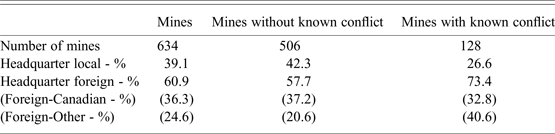
As previously indicated the original database we built for the analysis includes 634 mining properties in five countries of Latin America (Argentina, Brazil, Chile, Mexico and Peru). The lack of information on the universe of mining firms operating in Latin America means the descriptive analysis is of some value alone. Of the 634 mining properties identified, 39.1 per cent are headquartered locally, while 36.3 per cent have their head office in Canada, and 24.6 per cent in foreign countries other than Canada. In this respect, there are more locally owned mines than Canadian-owned, although there are more foreign-owned than locally owned mines in the sample as a whole.
The vast majority of mining properties in our sample, were, as of the end of 2012, not associated with a known social conflict (506 of 634). However, among the 128 mines with a known social conflict, 73.4 per cent have foreign headquarters, suggesting that foreign ownership is significantly more likely to be associated with social conflict than local ownership. Furthermore, we find that among mining properties with known social conflicts, 26.6 per cent have local headquarters, while 32.8 per cent are Canadian. In terms of mines without known social conflicts, 42.3 per cent are locally owned, while 37.2 per cent are Canadian-owned.
Regression analysis
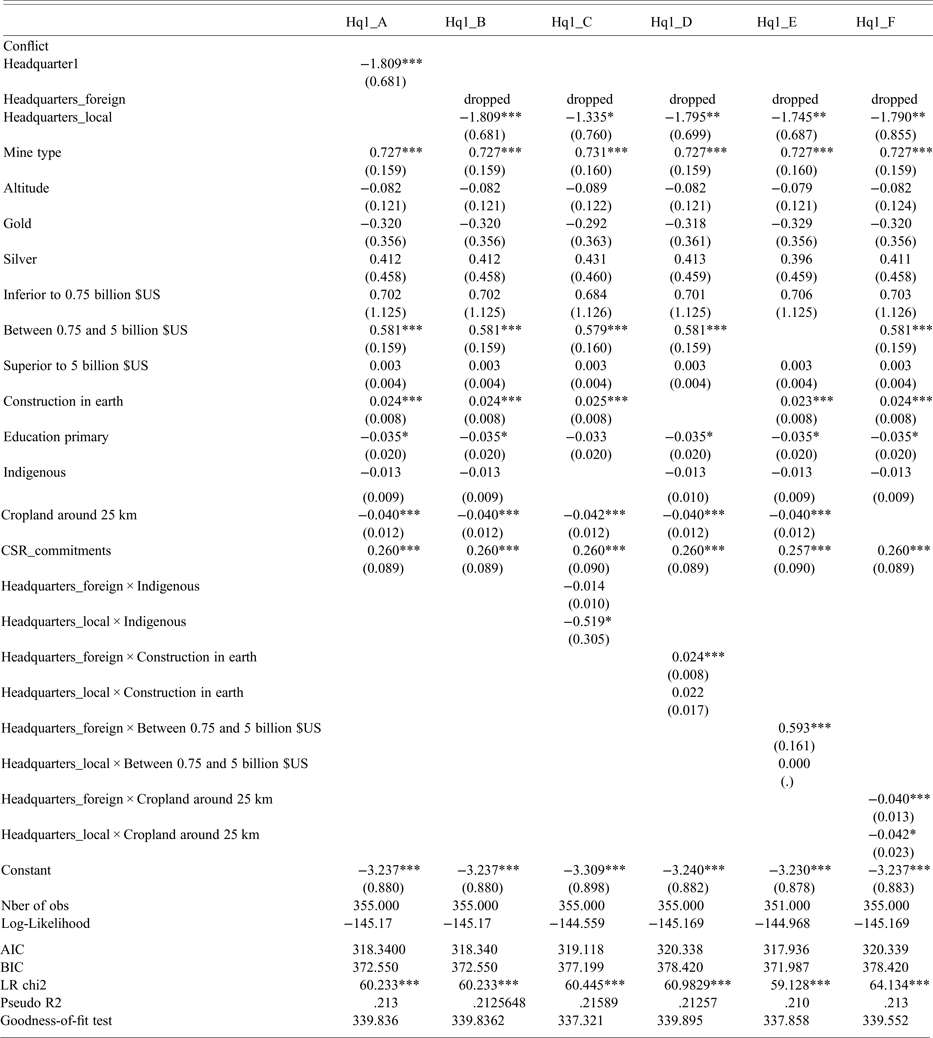
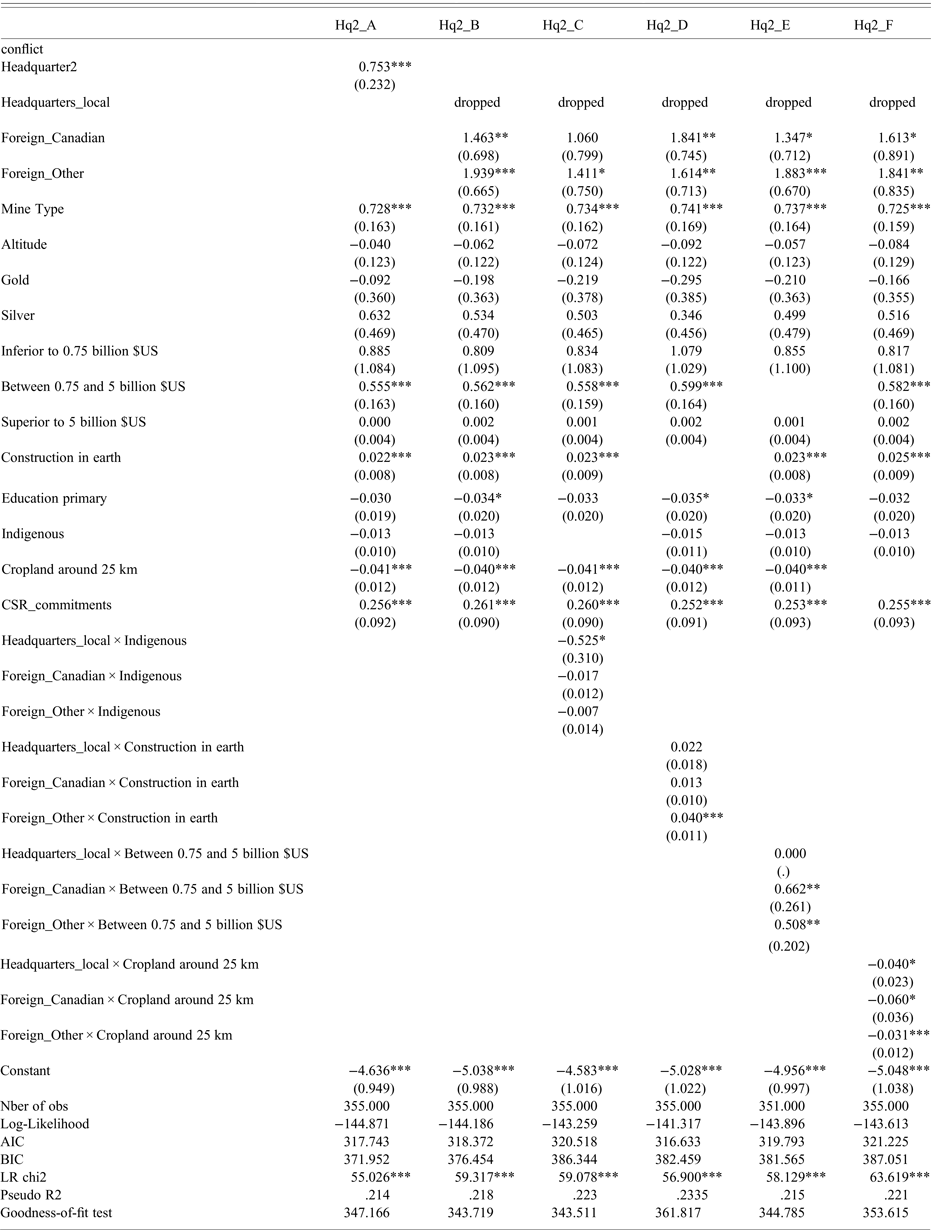
We run two groups of regressions based on each of two main explanatory variables (“Headquarters1,” which distinguishes local and foreign ownership; and “Headquarters2,” which distinguishes between local, foreign-Canadian, and foreign non-Canadian ownership). The first set of regressions in Table 2 establish that there is a difference between local and foreign mining firms, in terms of their association with social conflict. Once this basic fact is established, Table 3 considers the difference between foreign firms that are Canadian-based, and those which are not.Footnote 6
Mining properties, according to location of headquarters (c.2012)

Source: Authors’ calculations.
Estimation results based on Headquarter1 (local versus foreign).

* p < 0.10, ** p < 0.05, *** p < 0.01; in brackets: standard errors.
Estimation results based on Headquarter2 (local versus foreign Canadian versus foreign non-Canadian)

* p < 0.10, ** p < 0.05, *** p < 0.01; in brackets: standard errors.
In the regressions reported in Table 2, we find strong evidence for country-of-origin effects on known conflict, as the relationship between local ownership and known social conflict is consistently negative and significant as compared to foreign ownership. This finding is extremely robust across all specifications we tried. We hypothesize that local firms must benefit from some kind of legitimacy premium vis-à-vis foreign firms, a contention that has long-standing support, as illustrated in such classic analyses as Eduardo Galeano's treatise on “anti-imperialist” sentiment in Latin America (Reference Galeano1997). This result also underlines the appropriateness of treating foreign companies differently from local companies in the analysis. The bottom line is that “being foreign” is a liability for mining companies in Latin America.
Our null hypotheses receive support as well. When the control variables enter the regression without interacting with Headquarters1 (presented in the upper portion of Table 2 and 3) a number of host-country environments and firm/property level characteristics have a significant effect on conflict. In terms of the host-country variables, we find that as poverty increases (Construction in earth) it is positively related to increased social conflict, which is consistent with the literature that asserts the importance of distributive concerns in mine-community conflicts. Likewise, as good land becomes more abundant (a larger surface area is covered by land that is 70% cultivated), conflict is also reduced. This also corresponds with the predictions of the case study literature, which emphasizes the threat of mining to alternative livelihoods, as a cause of social struggle, especially when already under pressure. Taken together, these findings underline that environments characterized by poverty and low educational attainment, in which traditional agricultural activities are disrupted but with a low capacity to adapt to or benefit from mining, are most likely to protest mine development. In this regard, the findings accord with the case study literature previously discussed.
Likewise, some structural characteristics of the property or firm also have a significant effect on conflict. We find that as mineral exploitation methods have a greater impact on the environment (tend to open-pit), known social conflict increases, which is also consistent with the case study literature. This variable has the greatest magnitude of all the control variables in the regression, and is robust across all specifications. The regressions also point to a pattern that is not recognized in the case-study literature: known social conflict is most associated with mid-sized firms with a market capitalization between 0.75 and 5 billion $US, not the juniors cited by the case-study literature. Furthermore, it is worth noting that concerns of the literature over the commodity extracted (particularly gold) are not supported by the regressions. Not only are the coefficients for both minerals not significant, but the extraction of gold is in fact negatively associated with known social conflict (reduces conflict), while the extraction of silver seems to increase it.
In the lower part of Table 2, we interact each of the variables considered significant with local and foreign ownership. Overall, this suggests that local firms have better (less openly conflictual) relationships with poor and disadvantaged communities in comparison to foreign firms, which are particularly vulnerable under these conditions. The regressions do not allow us to determine the cause of this difference, but it may be speculated that the lack of local legitimacy associated with “foreignness” may encourage distributional politics aimed at extracting more resources from the firm. The evidence seems to suggest that local firms handle this situation better, either because of the legitimacy premium previously discussed, or perhaps because of recourse to traditional mechanisms of social control, such as clientelism. But the regression analysis also shows us the limits of the local advantage: when mining overlaps with agricultural livelihood strategies, the scarcity of alternatives for peasants is likely to drive social conflict for both foreign and local firms.
In Table 3, we split the category “foreign” used in Table 2, into Canadian and foreign non-Canadian firms. The basic analysis shows that both Canadian-owned and foreign non-Canadian companies are significantly correlated with an increased likelihood of known social conflict, as compared to local firms. It is also worth noting that the coefficient for foreign non-Canadian firms is generally larger suggesting that Canadian firms perform better (are associated with less conflict) than foreign non-Canadian firms, although both perform worse than local firms. This finding is robust across most of the specifications.
Whereas Table 2 allowed us to examine how the control variables interacted differently with local and foreign firms, the regression in Table 3 allows us to do the same, distinguishing between foreign-Canadian, and foreign non-Canadian firms (Foreign_Other). With regards to the host-country environmental characteristics, it is apparent that the pressure created by mining on agricultural livelihoods remains salient (Cropland is negative and significant) for all three types of firms. Likewise, the advantage that local firms have over foreign firms (from Table 2), in terms of relations with indigenous communities, remains when foreign firms are disaggregated. One notable difference between Canadian and foreign non-Canadian firms is found in their relationship with poor communities. Higher levels of poverty (Construction in earth) are positively and significantly related to known social conflict for foreign non-Canadian firms but not for Canadian firms or local firms. Although the sign of the coefficient is the same, its magnitude is three times smaller and not significant, for Canadian firms. This suggests that Canadian firms may be better than other foreign firms in managing community relations, or distributional claims, in poorer areas, although our analysis does not permit insight into why that would be the case. In terms of the effect of the structural characteristics of properties/firms on conflict, there is little difference between Canadian and other foreign firms.
In both Tables 2 and 3, we attempt to specify country of origin more narrowly by looking at community relations practices (a possible conduit for national corporate cultures), using an indicator for the “CSR commitment” of the firm. We find that higher levels of CSR commitment (in the entire sample) are positively correlated with known social conflicts. This finding is counterintuitive, since we would expect to find that a public and verifiable commitment to CSR correlates with reduced levels of social conflict. We think that this correlation is explained by the one-shot regressions, which cannot assess how social conflict and CSR commitment are related to each other over time. Since there are few obvious causal pathways between CSR and more conflict, it is more likely that firms having experienced social conflict would improve their CSR policies and commitments (as suggested by Dashwood, Reference Dashwood2007). Without conducting a time-series analysis (which our data do not allow), it is not possible to distinguish between these two possibilities. Obviously, further research remains to be done to clarify the nature of the relationship between CSR and social conflict, which other authors have noted is indeterminate (Conde and Le Billon, Reference Conde and Le Billon2017).
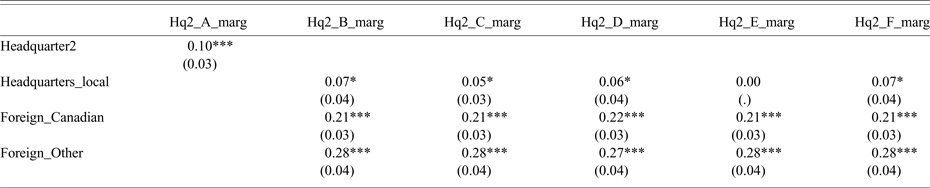
Tables 4 and 5 assess the marginal effects on known conflict of being local, foreign, Canadian and foreign non-Canadian. We report these figures to underline the differences between these ownership categories. While we are confident in the statistical relationships identified (direction and significance), we caution reading too much into the findings on the marginal effects and remind the reader that because the dependent variable is binary and none of the data is expressed in a time-series, it remains a blunt instrument to assess marginal effects precisely. Table 4 examines local and foreign headquarters in our sample, finding that on average the former is associated with a 7 per cent probability of being associated with a known conflict, and the latter, a 24 per cent probability. Table 5, which distinguishes between local, Canadian and foreign non-Canadian ownership, finds that Canadian-headquartered firms in our sample have a 21 per cent probability of being associated with a known conflict, while foreign non-Canadian firms are associated with known conflict 28 per cent of the time.Footnote 7 That being said, the reader should recall that we added cases to the original sample from Infomine of properties at the advanced exploration stage and above, to obtain universal coverage of known conflicts. If these firms are removed from the sample, the revised results are consistent, but at slightly lower levels of probability (see Online Appendix Tables 5A, 5B).
Marginal effects associated with the estimations based on Headquarter1 (local versus foreign)

* p < 0.10, ** p < 0.05, *** p < 0.01; in brackets: standard errors.
Marginal effects associated with the estimations based on Headquarter2 (local versus foreign-Canadian versus foreign-Other)

* p < 0.10, ** p < 0.05, *** p < 0.01; in brackets: standard errors.
Conclusions
There is no doubt that social conflict sometimes associated with mining should be avoided or reduced in a way that takes account of the legitimate concerns of affected communities. This is an ethical position that should be non-negotiable. And to the extent that any firm is directly implicated in such conflicts, we agree that it is deserving of attention or sanction by host country legislators, activist watchdogs, home country governments, and the international community. Nothing in this article should be interpreted as an attempt to minimize the problem of social conflict between firms and communities when it occurs, make light of the responsibility of firms and governments involved, or judge the rights claims of stakeholders.
We are interested in a clear and narrow question: is country of origin, and particularly “being Canadian” a cause of firm-community conflict in the mining sector? Our analysis shows a clear country-of-origin effect when local firms are compared to foreign firms in our sample. In comparison to foreign firms, local firms seem to benefit from a legitimacy premium or local knowledge that makes their mining properties less susceptible to social conflict. We find this result is particularly salient in poorer communities, which are normally more likely to be associated with social conflict. Indeed, since social conflict associated with livelihood concerns remained salient for all three types of firms (local, Canadian, and foreign non-Canadian), the ability to manage distributional claims seems to be the key differentiating factor. When foreign firms were divided into Canadian and foreign non-Canadian firms, the analysis suggested that Canadian firms were better than foreign non-Canadian firms at avoiding known social conflict, and particularly that Canadian firms seem to perform better in poorer communities.
Insofar as the literature on Canadian mining firms has linked a regulatory home-country environment that is portrayed as weaker than other source countries, with worse comparative performance of Canadian firms, our findings that Canadian mining companies perform better than non-Canadian foreign firms falsify that line of argumentation. In other words, the analysis presented here casts doubt on the commonly hypothesized relationship between weaker sectoral regulation at home and worse corporate behaviour abroad. This finding has policy implications, as it suggests that that raising home-country regulatory standards to meet some of the foreign “best practices” cited in the literature is unlikely to be the magic bullet that solves social conflicts. Of course, the evidence presented here does not discount the possibility that a significant departure over and above past regulatory practices, would not have a knock-on effect further improving the performance of Canadian firms.
Our attempt to specify the country-of-origin effect by looking at firm commitment to CSR yielded mixed results. On the one hand, the figures revealed important differences between foreign and local firms, with the former exhibiting a correlation between high levels of CSR commitment and known social conflict. We think this result is backwards, and that CSR commitments are probably increased by companies in response to the experience of social conflict, but this can only be verified through a time-series analysis. More fundamentally, the findings in this paper seem to correspond better with the predictions of the agent-centred or constructivist literature on CSR adoption by firms. In other words, the better performance of Canadian mining firms, as compared to foreign non-Canadian firms, corresponds to Canadian country-of-origin CSR commitments originating in public debate, government policy and sectoral association efforts that are also probably superior to other mining source countries. The possibility that Canadian practices on CSR matter to better outcomes in social conflict is also supported by the findings that Canadian firms seem to perform better in poorer communities, where distributive concerns are likely to be more important.
Finally, our null hypotheses—that host-country environment; and firm/property-level structural characteristics contribute to social conflict— retain significant explanatory value, and undermine explanations of social conflict focused purely on nationality. Overall, our findings should cause us also to ask what Canadian regulators and mining companies have done to perform better than foreign non-Canadian firms, a question with important implications for the policy debate about how best to regulate the activities of the sector abroad. However, we are emphatic that nothing in this article justifies complacency regarding the relationship between mining companies and nearby communities and the social conflict and human rights issues sometimes associated with it; instead, more research into the nuances of these relationships needs to guide policy.
Supplementary materials
To view supplementary material for this article, please visit https://doi.org/10.1017/S0008423918000185.