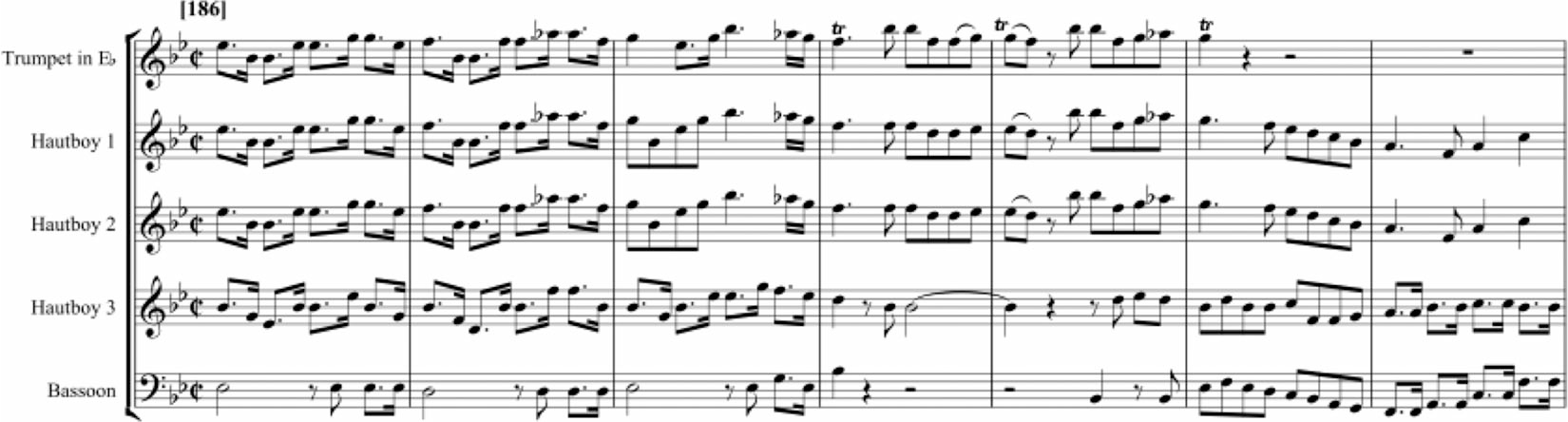


Part 1. Introduction, terminology
To date, writers of standard music-history texts and musicologists generally have tended to assume that the violin family of instruments is the staple of Western instrumental art music.Footnote 1 But in adopting this viewpoint, some of the most important musicians of the seventeenth and eighteenth centuries, the Hautboisten (pronounced obo'ist∂n), have been neglected in musicological research. In The Eloquent Oboe, the most comprehensive monograph dealing with historical oboes published to date, Bruce Haynes has signalled the importance of Hautboisten by stating that they ‘provided much of the musical background that is today the job of the radio and Muzak’.Footnote 2 Yet despite this he devotes only ten pages to the ensemble he introduces as the ‘hautboy band’,Footnote 3 further strengthening the commonly received opinion that Hautboisten were a marginal phenomenon rather than a standard in the musical life of the Baroque era.
Haynes refers to more than 500 pieces for ‘hautboy band’ dating from the latter decades of the seventeenth century up until around the mid-eighteenth century that remain extant in libraries. Not surprisingly then, Haynes’ bibliography, Music for Oboe, 1650–1800, provides details of numerous compositions for Hautboisten, among them what he calls the Sonsfeldsche Musikalien Sammlung (the Sonsfeld Music Collection).Footnote 4 This Sonsfeld Collection, collated in the early eighteenth century by the Prussian General Friedrich Otto Freiherr (commonly translated as Baron) von Wittenhorst-Sonsfeld (1678–1755), contains those parts that still remain of his music library. Six extensive partbooks within this collection were almost certainly gathered together for the use of Hautboisten, and form the chief focus of this article. These partbooks represent the principal manuscript evidence of music performed by Hautboisten at the beginning of the eighteenth century and are now held in the Bibliotheca Fürstenbergiana, in the manor of the Freiherr von Fürstenberg in Herdringen, in the German region of Westphalia. This library belonged to Clemens Lothar von Fürstenberg (1725–1791) and has since been in the possession of the Fürstenberg family in Arnsberg/Herdringen.
Other sources of Hautboisten music are scant and often consist solely of one manuscript of a single composition in a library, and are usually not collated into a collection such as the six partbooks in focus here. The entry in Haynes’ bibliography of hautboy music contributes to the confusion of terminology regarding these sources by suggesting that the six partbooks were actually called the Sonsfeldsche Musikalien Sammlung. Therefore, the information given in Haynes’ bibliographic entry for this important source, which reads ‘52 multi-movement pieces of instrumental music for 2-3 Obs, Taille, 2 Bsns (usually 6 separate parts) and occasional Trp’,Footnote 5 will be questioned, since it appears that the Sonsfeld Collection comprises far more compositions in its entirety. Furthermore, as we shall see, David Whitwell's book chapter dealing with those compositions in the six partbooks that feature pure wind instrumentation will also be challenged.Footnote 6 As recently as 2003, he has assumed the partbooks were connected to ‘a Christian Friedrich Theodor von Fürstenberg’,Footnote 7 one of Clemens Lothar's earlier ancestors, who was in Paris in 1711 and 1712.
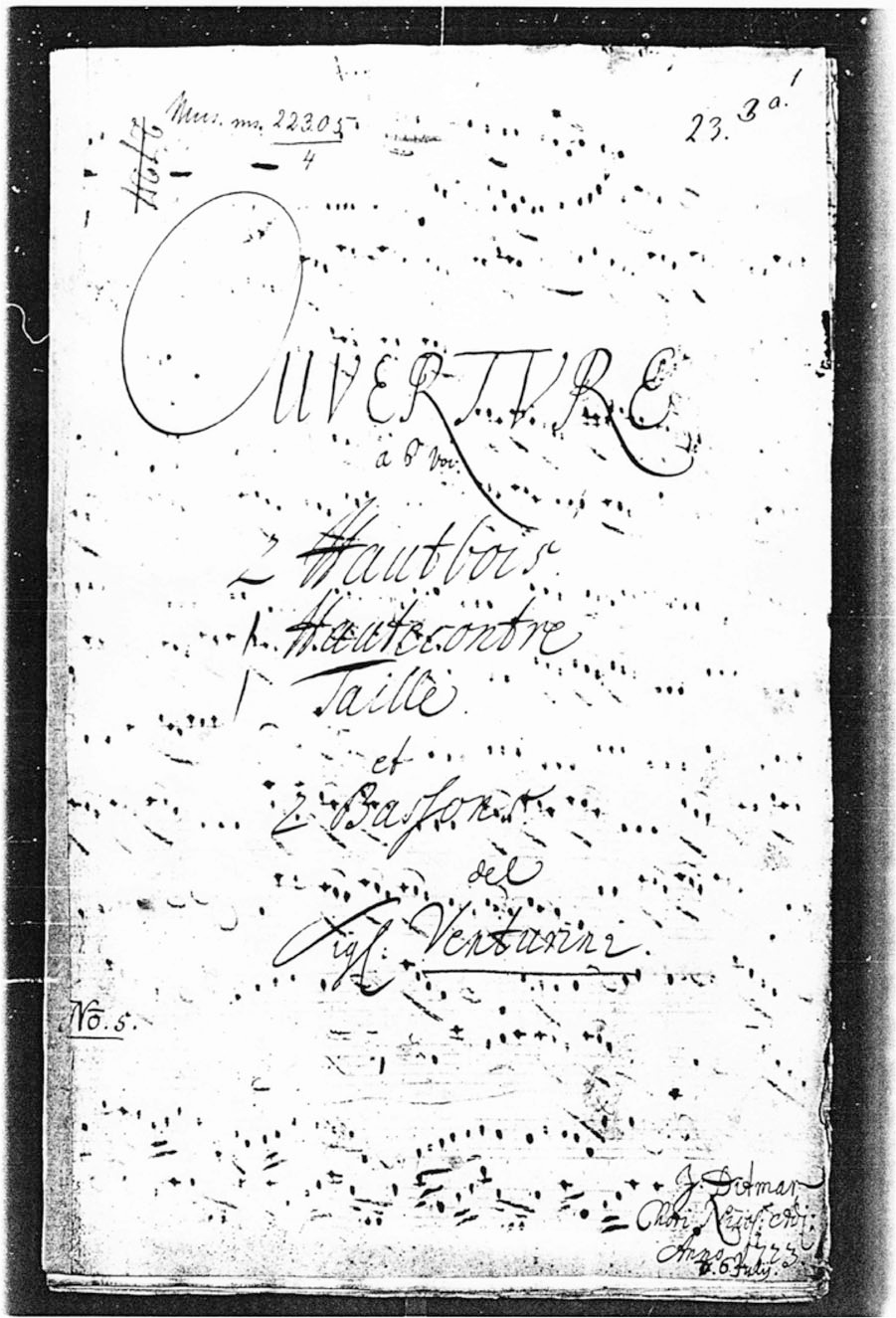
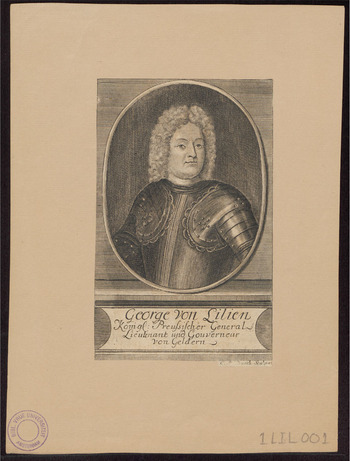
In order to make a clear distinction between Clemens Lothar's Bibliotheca Fürstenbergiana, Friedrich Otto's entire collection – the Sonsfeld Collection – and the six partbooks, the latter will be referred to as the Lilien Partbooks, since it appears that the three golden letters ‘G. v. L.’ embossed on the leather covers of the six partbooks refer most likely to Georg von Lilien (1652–1726), who appears to have been their original possessor, prior to them becoming part of the Sonsfeld Collection. For the catalogue numbering of the works in the Lilien Partbooks, which will be adopted from the partbooks, the abbreviation LPb has been devised for the incipit catalogue to clarify that these are the works in the Sonsfeld Collection that are found specifically in the Lilien Partbooks. Microfilms of the contents of the Bibliotheca Fürstenbergiana, including the six partbooks, are available at the Deutsches Musikgeschichtliches Archiv in Kassel.Footnote 8
Terminology – the profession of Hautboist
The word Hautboisten (also Hoboisten) is the plural form of the name for a musical profession once common in German-speaking countries. Their appearance in official eighteenth-century salary lists is relatively rare, and often the only surviving evidence of their existence comes in the form of documentation concerning conflicts with other groups of musicians such as Stadtpfeifer (town pipers), making research a challenging task.Footnote 9 Individual members of this profession were referred to by the title Hautboist (singular), which derives from the French hautbois (oboe). The term Hautboisten, however, cannot be simply translated as oboe-players, given that in addition to performing on double-reed instruments, such as oboes and bassoons, they were also able (and indeed expected) to play numerous other instruments. For this reason, even using the phrase ‘hautboy band’, as introduced by Haynes, seems to ignore the true versatility of these musicians.
The title Hautboisten was in use from the latter decades of the seventeenth century up until the end of World War I, by which time it had become a term used solely to describe military musicians. Not surprisingly then, many modern scholars were led to the conclusion that the term Hautboisten had at all times referred primarily to military musicians.
A further term in need of clarification here is ‘orchestra’. John Spitzer and Neal Zaslaw define the orchestra as an ensemble ‘based on string instruments of the violin family plus double basses’.Footnote 10 Among the additional key elements that constitute orchestras, they also require numerous violins, whose parts are doubled more than the other strings in the ensemble, as well as the presence of wind instruments, the latter usually not playing in unison and with the number employed depending on the era and location.
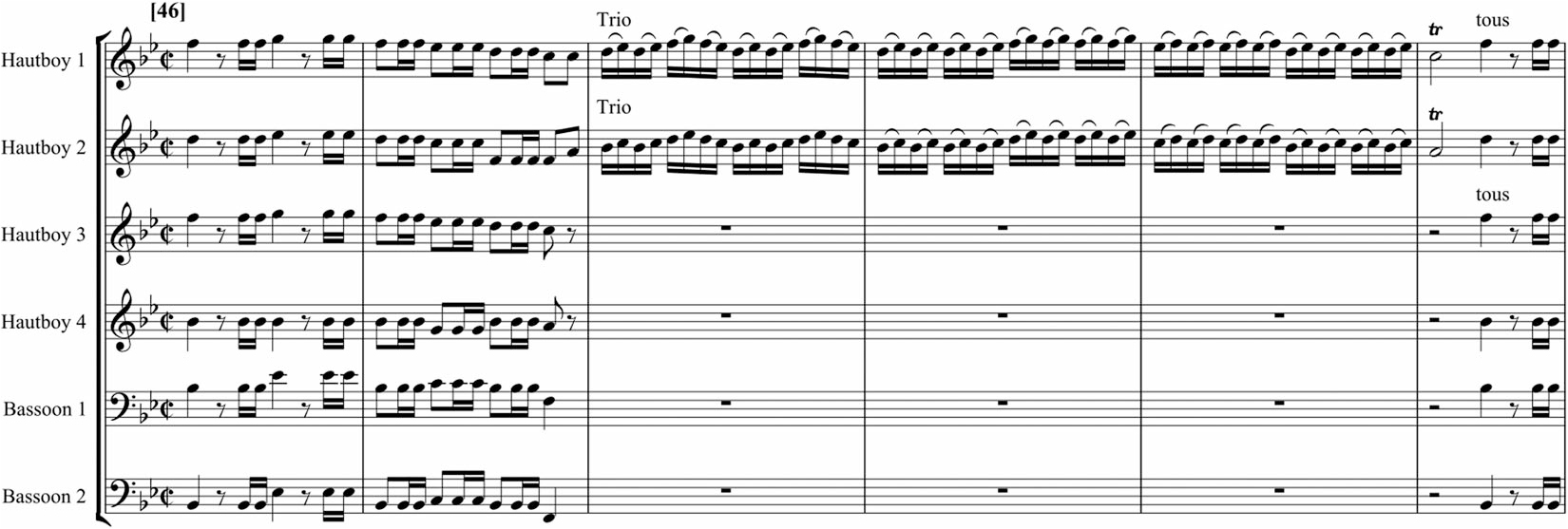
According to Michael Robertson the German Lullists, such as Johann Sigismund Kusser (1660–1727), followed the French tradition of doubling the outer parts in their orchestral works, scoring the bassoon along with the basses and both hautboys along with the first violin.Footnote 11 This seems to be true in many cases. In Kusser's opera Adonis, however, the composer employs five double-reed players among four of the five parts of the score. These are two hautboys, one Haut-contre d'hautbois (most likely another hautboy in C), one Taille d'hautbois and one bassoon. Regularly, the first hautboy plays in unison with the first violin, whilst the second and third hautboys join the second violin. The Taille doubles the part of the first viola and the bassoon plays the same part as the other basses.Footnote 12 In light of Kusser's instrumentation in Adonis it may be questionable, and warrants future investigation, whether Spitzer's and Zaslaw's definition was already the norm rather than one of many possibilities during the period they describe as the time of ‘the birth of the orchestra’, that is, 1680–1740.Footnote 13
From the mid-seventeenth century onwards the term Kapelle (chapel), which had previously been used largely to denote ensembles of vocalists, also came to refer to instrumentalists performing alongside the singers, and even to pure instrumental ensembles, which resembled an orchestra in today's commonly accepted sense, adding further to the confusion in terminology.Footnote 14
Although many courts, such as, for example, those based in Celle, Hanover, Dresden, Darmstadt, Stuttgart and Berlin, had orchestras established during the first half of the eighteenth century,Footnote 15 and the term ‘orchestra’ began to be established by that time, the vast majority of courts in the German-speaking territories comprised small earldoms and duchies, which did not have the financial means to support such large musical bodies. When Johann Mattheson (1681–1764) complained about every small court's desire for its own ‘orchestra’ in the 1725 issue of his periodical Critica Musica (published between 1722 and 1725), it may be understood that many such small groups of musicians did indeed exist.Footnote 16 Accordingly, it might be assumed that one-to-a-part instrumentation was still the norm rather than the exception at that time. Therefore, the term ‘orchestra’ will appear regularly with inverted commas throughout this article in order to remind the reader that different concepts of instrumentation existed in earlier periods.
Stadtpfeifer – Hautboisten
Prior to about 1680 when the hautboy came into fashion in German-speaking lands, there were already established ensembles specializing in wind instruments, comprising capable musicians who were required to perform on and teach string instruments as well. The tradition of these Stadtpfeifer groups can be traced back to the fourteenth century. They provided much of the music required in towns, including ceremonial music as well as music for pure entertainment. From the mid-seventeenth century they were organized into regional guilds, which provided them with the rights to perform music in their town of employment.Footnote 17 In addition to the income they received for their official work as civil servants, their guild affiliation entitled the Stadtpfeifer to earn a living by performing for any private occasion such as weddings and birthday celebrations.Footnote 18
When the newly developed hautboys arrived in German-speaking lands in the latter decades of the seventeenth century, naturally the Stadtpfeifer learned how to play these instruments and were required to show some proficiency on them;Footnote 19 however, there is also some evidence to suggest that on occasion Hautboisten groups were accorded a privileged status, and therefore provided competition to the Stadtpfeifer. For example, Renate Hildebrand has shown that in 1700 the so-called Hyntzsche Hautboistencompagnie was given the right to be the only ensemble to perform publicly on hautboys in the town of Halle.Footnote 20 On the other hand, in Leipzig, at the time when Johann Sebastian Bach was employed as the cantor of the St. Thomas’ Church (1723–50), it was the Stadtpfeifer Caspar Gleditsch who performed the parts for the first hautboy in Bach's works during the services.Footnote 21
The inclusion of the hautboy as part of already established groups, such as the Stadtpfeifer, as well as in the comparatively newly formed ensemble-type, the Hautboisten – both groups likely performed the same kind of music – makes a definitive investigation of their respective repertoire difficult. Yet although the professional titles of these groups differed, the similarity of the music they performed therefore serves as an indicator for the concept and understanding of Hautboisten ensembles in the seventeenth and eighteenth centuries.
Scope of this study
Where did these musicians usually find employment during the eighteenth century? What kind of music did they perform, and was this music really the same as that performed by the Stadtpfeifer, as implied above, or did their repertoire differ from that of the Stadtpfeifer? What were the typical instrumentations of the music they performed? What was the usual size of a group of Hautboisten? How can we identify whether music might have been intended specifically for Hautboisten? And, finally, can the analysis of the repertoire found in the Lilien Partbooks assist in establishing a fuller picture of the use of music in the daily life of Baroque society and the perception of the concept of Hautboisten by their contemporaries?
The analysis of a representative group of pieces contained within the Lilien Partbooks allows for significant light to be shed on Hautboisten and the role they played in the daily musical life of German towns, courts and the military. In addition to answering some of the questions outlined above, our understanding of the music profession in general during the eighteenth century may have to be revised in order to take into account this distinct, but often overlooked, group of musicians.
Achim Hofer investigated the extent and the significance of music composed specifically for regimental Hautboisten in his studies on the history of the military march.Footnote 22 The works collated in the Lilien Partbooks, however, are generally in a musical form that today would be categorized as ‘art music’. It is for this reason that the large number of marches still extant in libraries was ignored for the purposes of this article.
Furthermore, it is necessary to inform the reader that the number of secondary sources used for this article, not only in the parts concerning the general history of Hautboisten but also in the presentation of the provenance of the Lilien Partbooks, is due to the state of the manuscript data collated in the archives. Jacques Rensch from the Regionaal Historisch Centrum Limburg in Maastricht (Netherlands) stated in a personal conversation that the vast number of files concerning the history of the Sonsfeld family were yet to be catalogued and therefore could not be accessed by scholars.Footnote 23
Because not only the primary sources but also the recent output of research publications on Hautboisten are widely spread and require modern-day investigators to search in many different places, the following comprehensive summary of our current state of knowledge is warranted as an aid for future research.
Recalling the current state of knowledge of Hautboisten, their history, and the concept of homogeneous instrumental consorts (as evident in the scores of the time) will create a platform for an understanding of the music performed by these groups. The study of music that is known to have been composed for such groups aims to complement our historical knowledge. A comparison of these works, specifically composed for Hautboisten, with those contained within the Lilien Partbooks, will draw a picture of the types of music commonly heard as part of everyday life at the beginning of the eighteenth century.
Following this introduction, part 2 of this article details the French origins of these groups and further provides an overview of the current state of knowledge regarding the spread of Hautboisten from France to the German-speaking lands of the Holy Roman Empire. The prime source of information in this field remains a seminal book chapter published by Werner Braun in 1971,Footnote 24 and subsequently revised and translated into English in 1983: ‘The “Hautboist”: An Outline of Evolving Careers and Functions’.Footnote 25 Braun's chapter is therefore considered in some depth, together with a selection of more recent research.
Part 3 examines published music known to have been composed for use by Hautboisten during the first half of the eighteenth century, much of which was marketed directly to Hautboisten as potential buyers. Additionally, a selection of manuscript music for wind ensembles that features instrumentation typical for Hautboisten will be investigated.
Subsequently, the provenance and contents of the Lilien Partbooks within the Sonsfeldsche Musikalien Sammlung will be analysed in part 4. The distinct labelling of the six partbooks as the ‘Lilien Partbooks’ identifies them as a group and sets them apart from the rest of the entire collection currently owned by Wennemar Freiherr von Fürstenberg.
Part 2. The provenance of Hautboisten
France – the development of the Hautbois
Present-day scholars agree that the hautboy's origin can be found in France.Footnote 26 When King Louis XIV (1638–1715) reigned (from 1661), his passion for the arts provided musicians and instrument makers (often combined in one person) with employment and, more importantly, with the possibility, perhaps even the commission, to experiment and invent. The instruments in use at the beginning of the Sun King's sovereignty were still basically the same as they had been during the fifteenth and sixteenth centuries. In the 1660s, the woodwind instruments from these earlier periods, which at this stage had been in use for a long time, went through a number of experimental stages involving a series of modifications that led to the creation of the Baroque versions of the hautboy, the bassoon, the recorder and the transverse flute, among others. An exact date for the introduction of the newly invented hautboy into existing ensembles at the French court cannot be identified because the instruments now known as the shawm, Baroque oboe and modern oboe were at all times, in French, labelled hautbois. We are therefore reliant upon other sources, such as iconography, literature and music (which occasionally offers clues regarding scoring) to provide us with evidence of the change in the hautbois's use and appearance, in order to gauge the approximate date of structural changes made to the instrument.
About 30 years before the period of transformation of this double-reed instrument, Marin Mersenne, in his Harmonie universelle (Paris, 1636), described two versions of the hautbois in use in France. The illustration of the first, the hautbois (or as he also calls it, the ‘grands Haut-bois’), shows members of the instrument family today known as shawms.Footnote 27 In German sources of the same period this descant of the double-reed consort was referred to as the Schalmey and any lower versions, from the treble onwards, were called Pommer.Footnote 28 These were instruments with a double reed directly controlled by the lips with some support of a pirouette.Footnote 29 The distinct terminology in German-speaking lands, calling the earlier versions Schalmey and Pommer, whilst adopting the term Hautbois for the hautboy, makes it much easier to find particular dates as to when the newer version was first introduced into German music-making.
The second pertinent double-reed instrument discussed and illustrated in Mersenne's book is the Hautbois de Poictou (or Poitou), which appears to be an instrument with a wind cap covering the reed – similar to a crumhorn.Footnote 30 According to modern definitions this would perhaps no longer be classified as a member of the oboe family; however, surviving evidence seems to suggest that musicians may have experimented by playing without the cap for more direct control of the reed which is suggested by Bruce Haynes and Marc Ecochard, respectively, in their contribution to an anthology on evolving instruments and music from the Renaissance to the Baroque periods.Footnote 31
Ecochard discusses a letter by Michel de La Barre (ca. 1675–1745) that is an eighteenth-century report of the development of wind instruments at the French court between the 1660s to the 1680s.Footnote 32 Although La Barre omits to provide specific dates for the first use of the new hautboy (his testimony was written more than 80 years after the development of the new hautboy in ca. 1740), it provides us with a historical view of what might have happened.
La Barre claims that the newer version of the transverse flute was introduced much later than the hautboy, and that the constructional changes finally made the doublereed instruments ‘useful’ within an ensemble of other instruments such as violins, recorders, viola da gambas and plucked string instruments. He further names two players, Philibert Rebillé (1639–1717) and René Pignon dit Descoteaux (ca. 1645–1728), who were given new positions in 1667 to perform on the new transverse flutes.Footnote 33 Since these musicians are mentioned for the first time in official paylists in 1667,Footnote 34 La Barre's letter appears to prove that the hautboy was first introduced to the court music before that year.Footnote 35
Both types of hautbois presented by Mersenne are described as consort instruments of different sizes, thus confirming the fact that by the time Harmonie universelle was published in the early seventeenth century, the tradition of homogenous groups of instrument families was still in place. Combining these groups, in order to amalgamate the timbral characteristics of individual consorts, seems to have been the exception rather than the norm, and the idea of a large string ‘orchestra’ with an additional small number of wind instruments appears to be an innovation introduced by Jean-Baptiste Lully.Footnote 36
In trying to establish an accurate date before 1667 for the inclusion of the hautboy into existing ensembles at the French court it becomes clear that the process of development of the hautboy was one of transition over many years rather than a particular moment at which all the old instruments were exchanged with new ones. It is highly likely that for a long period the different versions of the hautbois coexisted.
According to Haynes, it is currently undoubtedly believed that a ‘useful’ hautbois (e.g. for joining a consort of various types of instruments) premiered in a performance with the Petite Bande in 1657 in Lully's work L'Amour malade.Footnote 37 His investigation of iconographic evidence within Mersenne's treatise and also on gobelins created in Charles Le Brun's (1619–1690) workshop led him to conclude that hautbois instruments between the mid-1650s and the early 1670s were ‘transitional’ versions which he calls ‘protomorphic hautboys’.Footnote 38 He further explains that Lully, apparently, did not score for hautbois in his stage works between 1664 and 1670, the latter being the year of the premiere of Le bourgeois gentilhomme.Footnote 39 Haynes concludes in his article that from towards the change of the decade up until 1664 protomorphic hautboys joined the strings of the Petite Bande, and that by 1670 the development of the new hautboy in its Baroque version was finalized.
France – provenance of double-reed ensembles
Initially, players of any type of wind instrument were generally employed by the Musique de l’Écurie; however, in the last decade of the seventeenth century, string consorts of the Musique de la Chambre and the Chapelle Royale began to engage double-reed players in permanent positions.Footnote 40 Whenever wind instruments were required within these groups prior to that time, they would have been specially invited for that particular occasion.
The Écurie was divided into five separate groups, of which the first four utilized double-reed instruments, while the fifth group, Les Trompettes, was an independent formation consisting of trumpets, timpani and drums:
Violon, Hautbois, Saqueboutes et Cornets
later known as the Douze Grands Hautbois du Roi
Hautbois et Musettes de Poitou
Fifres et Tambours
Cromornes et Trompettes Marines
Les Trompettes
By the sixteenth century it was not necessarily the case that the instruments mentioned in the title of a particular group were actually played by its members.Footnote 41 These titles were retained long after the musical style as well as the instruments themselves had changed. A further complicating factor is the fact that the majority of instrumentalists routinely performed on more than one instrument in this era, which makes it difficult to know exactly how the consorts were arranged. It seems likely, however, that the hautbois-instrumentsFootnote 42 were used initially in consort groupings as wind band instruments.
During the second half of the seventeenth century, double reeds were introduced, as a novelty, to the Petite Bande – the smaller of the two string consorts of the Musique de la Chambre. Although this may indicate the beginnings of the ‘orchestra’, with an instrumentation ratio of 4:1 for strings and woodwinds, it also suggests that the different consorts at court were still organized in the Renaissance tradition of smaller ensembles of like instruments, which retained their own qualities when performing together for special and rare occasions. Having one group taking the leading role, whilst others only provided additional tone colour, was the necessary innovation leading to the institutionalization of the ‘orchestra’.
The instruments used by the ensembles of the Écurie
The group at court that specialized above all in double-reed instruments was the Violons, Hautbois, Saqueboutes et Cornets, also known as the Douze Grands Hautbois du Roi, a formation that comprised ten hautbois and two bassons. A list of court employees dating from 1664 consulted by Marcelle Benoit makes it clear that each member of the Violon, Hautbois, Saqueboutes et Cornets was capable of performing on one string and one wind instrument.Footnote 43 It seems most likely that within this ensemble, wind instruments and string instruments did not perform together, but rather followed the long-standing tradition of employing ‘loud’ winds (hautbois) and strings in separate ensembles. This practice might also be evident in pitch differences between these instrumental families.Footnote 44
According to Anthony, the Douze Grands Hautbois performed in only three festivities throughout the year, and for the remaining time appeared with the string groups of the Chambre.Footnote 45 This reinforces the argument that this group usually performed as an independent consort on double-reed instruments at outdoor festivities. Furthermore, the versatility of this band also represents a prototype for those ensembles that were later to emerge as the popular groups of Hautboisten in German-speaking lands, with the flexibility in terms of instrumentation also in accordance with the music found in the Lilien Partbooks as well as other compositions extant in the Sonsfeld Collection.
The other groups of the Écurie that utilized the hautbois specialized in different instrumentations and appear to have had other duties within the musical life of the court. During the eighteenth century the Hautbois et Musettes de Poitou, for example, concentrated on flutes, recorders and musettes and was regularly associated with the Musique de la Chambre.Footnote 46 By the end of the seventeenth century the members of the Fifres et Tambours also seem to have exchanged their fifes for hautboys. They were involved with the Chambre as well, and may possibly have been the most commonly heard band of hautboy players at the court, performing in a variety of occasions.Footnote 47 Evidence of their work as outdoor musicians can be seen in the music of the so-called Philidor Collection (Partition de plusieurs marches, F-Pn Rés. F. 671) explored by Susan Sandman.Footnote 48 Ninety-one marches and airs for wind band and percussion within the collection were collated in 1705 by the musician André Danican Philidor (1647–1730), who was, along with Françcois Fossard (1642–1702), in charge of the music library at the French court during Louis XIV's reign.Footnote 49 These pieces, dating from the second half of the seventeenth century, are of great significance for research into the history of wind band music. Sandman states that this repertoire was possibly intended for an ensemble comprising some type of transitional hautbois,Footnote 50 rather than for the new hautboy and bassoon, which became the norm by the end of the seventeenth century.Footnote 51
The remaining group using the hautbois among the Écurie was the Cromornes Footnote 52et Trompettes Marines, members of which, according to Haynes, appear to have been paid less and were apparently of minor importance for music at the court.Footnote 53
One further ensemble that is crucial to this investigation was the Mousquetaires (sometimes also known as Plaisir du roi), up until 1683 the French military's double-reed band. Subsequently this group was no longer associated with the military, due to the king's decision not to engage double reeds in the battlefield anymore, but became one of the most utilized hautboy groups at court.Footnote 54 As with the other consorts of the Écurie, the Mousquetaires were known to be skilled players of string instruments in addition to their skill on the hautbois. They are yet another example of a prototype ensemble that was to become a common instrumental formation – the Hautboisten – in eighteenth-century German-speaking lands.
French musicians and their instruments in German-speaking lands
Towards the end of the seventeenth century, the number of players of the newly invented version of the hautbois had exceeded the availability of work at the French court. As the number of wind players at the Écurie had remained steady at 35 for more than a century,Footnote 55 and these positions were already occupied, it seems likely that many musicians had to apply for positions at smaller courts and towns or even outside of France.
Around this time, French music had become increasingly popular with members of the European nobility, many of whom also looked to France as a successful model of an absolute monarchy. French instrumentalists were made welcome in a number of countries, and many of them found employment in foreign lands including England, Spain and, of course, in German principalities. Since they brought the newly developed hautboy with them, and as this instrument was as yet unknown outside of France, there was an increasing interest in the employment of hautboy players who could teach the local double-reed musicians to play the new instrument. Among the German locations where French hautboy players were first engaged were the courts of Celle (1680), Stuttgart (1680), Hanover (1681) and Berlin (1681).Footnote 56
The context of the creation of the hautboy and the ensembles in which it was played, both before and after the constructional modifications undertaken at the French court, provides the background for a consideration of Hautboisten, in particular in the Holy Roman Empire, and is therefore crucial. As pointed out in this section, music at the French court in the seventeenth century was performed by groups of musicians rather than by virtuoso soloists. Those players who left France to work in the German-speaking lands were either employed as an existing group,Footnote 57 or, when seeking work as individuals, as teachers to create a group of players made up of local forces. At the Berlin court after 1690, for example, the Frenchman Pierre de La Buissière was employed to teach local players. In Dresden, two hautboy players with French names were employed in 1696, and in 1699 the famous François La Riche was part of the Dresden orchestra and most certainly educated a number of players.Footnote 58
Whilst the first part of this section has provided the reader with knowledge of the origins of the hautboy and its players, the following part will engage in a detailed discussion of previous research on Hautboisten to form the stage for understanding the situation in German-speaking lands, and, subsequently in Prussia.
Hautboist – a German profession
Werner Braun – ‘Typologie der Hautboisten’
Practically the only study to discuss the role of German Hautboisten in any detail is Werner Braun's chapter ‘Entwurf für eine Typologie der “Hautboisten”’, first published in 1971.Footnote 59 Its ongoing significance can be measured, in part, by the fact that the majority of subsequent publications focusing on Hautboisten have drawn heavily on Braun's work. To name two examples, Renate Hildebrand, in her Diplomarbeit (completed four years after the ‘Typologie’ was first published), gave a similar overview of the different employment possibilities for Hautboisten to that provided by Braun.Footnote 60 A more recent voice, Achim Hofer, indicated in a 2004 conference paper on the performance practices of Harmoniemusik that while Braun's chapter is somewhat obsolete, still no monograph has been dedicated to their existence, despite Braun's statement that there is plenty of evidence regarding Hautboisten.Footnote 61
Braun's information appears to have been gathered mostly from secondary sources. In particular, he uses Heinrich Christoph Koch's Musikalisches Lexicon (Frankfurt/Main, 1802) and Gustav Schilling's Enzyclopädie der gesamten musikalischen Wissenschaften (Stuttgart, 1835) to establish a detailed picture of Hautboisten and their role in German musical life. Yet, given that these two works were published almost a century later than Braun's era of interest – that is, the beginning of the eighteenth century – and provide the major body of evidence for his analysis, the relevance of this information needs to be challenged.
Recognizing that the majority of Braun's sources are secondary rather than primary ones, and bearing in mind his point that it is extremely difficult to investigate the many pieces of evidence in primary sources, most of which are not clearly organized, the present discussion is above all an analysis of the ‘Typologie’ as the first existing study into the role of Hautboisten.
If, as asserted by Haynes, these ensembles were indeed such a ubiquitous group,Footnote 62 we must ask ourselves why there is not more distinct evidence of their existence remaining in archives, libraries and private collections. With a sizeable number of bands of Hautboisten known to have been employed in Prussia alone,Footnote 63 and with the high numbers of Hautboisten active professionally at countless other smaller German courts as well as in towns and free cities, what has become of their music? Considering the enormous amount of music that has survived from the Baroque period, the 500-odd extant works for Hautboisten cited in Haynes’ bibliography appear to be relatively insignificant in terms of quantity. For this reason, the circumstance of the survival of the Lilien Partbooks fully justifies detailed research into their contents and provenance, and forms one important piece in the jigsaw that makes up the history of the Hautboisten.
It remains to be seen, however, whether these partbooks themselves are indeed so distinct, or if in fact they simply represent one facet of ordinary musical life at the beginning of the eighteenth century. Will an increased understanding of Hautboisten and the analysis of the music in the Lilien Partbooks perhaps call for us to redefine the term ‘orchestra’? Was Hautboisten music substantially different from, or merely identical to, the repertoire that any other instrumental ensemble would have performed for daily musical entertainment during this period? Does the music of the Lilien Partbooks represent music played by an Hautboisten Compagnie at the beginning of the eighteenth century? Furthermore, does any other music for Hautboisten remain extant that might illuminate further aspects of their professional activity?
Hautboist, Hautboistenbande, Hautboistencompagnie
Braun defines that ‘[a]n Hautboist or Hoboist, in the first half of the eighteenth century, […]’ must be ‘accomplished on the oboe, but […] also able to perform on other instruments’.Footnote 64 Skill on several instruments, which may have included the hautboy, bassoon, recorder and horn, as well as several string instruments such as the violin, violoncello and viola da gamba, was a general requirement for professional musicians in the first half of the eighteenth century.Footnote 65 Indeed, this had been the rule rather than the exception for all musicians prior to the specialization that led into the era of virtuosos at the beginning of the nineteenth century. Many recognized musicians and composers such as Johann Sebastian Bach, George Friderick Handel and Georg Philipp Telemann are all known to have been extremely proficient on a number of different instruments. One example can be seen in Johann Joachim Quantz's autobiography, in his description of his own music education:
| Das erste Instrument, welches ich erlernen mußte, war die Violine; zu welcher ich auch die größte Lust und Geschicklichkeit zu haben schien. Hierauf folgte der Hoboe, und die Trompete. Mit diesen drey Instrumenten habe ich mich in meinen Lehrjahren am meisten beschäftiget. Mit den übrigen Instrumenten, als Zincke, Posaunen, Waldhorn, Flöte a bec, Fagott, deutsche Baßgeige, Violoncell, Viola da gamba, und wer weis wie vielerley noch mehr, auf welchen allein ein rechter Kunstpfeifer muß spielen können, blieb ich auch nicht verschonet.Footnote 66 | The first instrument that I had to learn was the violin, at which I seemed to have the greatest pleasure and skill. This was followed by the oboe and trumpet. I occupied myself mostly with these three instruments during my apprenticeship. I was also not spared other instruments, such as cornets, sackbuts, horn, recorder, bassoon, German string bass, violoncello, viola da gamba, and who knows how many more, all of which a real Kunstpfeifer must be able to play. |
In addition to the skills on numerous instruments, many Hautboisten (usually the band leaders) were expected to be proficient composers. Hans Friedrich von Fleming (1670–1733), a contemporary writer on the organization of the military, noted in his book, Der vollkommene Teutsche Soldat (The Perfect German Soldier, 1726), that it was a requirement that every Premier (Hautboisten bandleader) should be able to compose and arrange for the needs of his ensemble: ‘The Premier among them has to be able to compose, in order for the music to be better adjusted [with regard to the arranging of existing works for the available instruments].Footnote 67
In 1724, Friedrich Wilhelm I, King in Prussia, founded an orphanage for the children of deceased soldiers in Potsdam, as a direct response to the increase in the number of such orphans in the aftermath of war.Footnote 68 Hans-Joachim Bandt cites the now lost General-Reglement, the foundational regulations for this institution (signed in Berlin on 1 November 1724), which establishes that the children were to receive a general education alongside instruction in a craft in preparation for a future profession:
| Nachdem Sr. Königlichen Majestät in Preußen usw. Unserm allergnädigsten Herrn allergnädigst gefallen, allhier in Potsdam ein Waysenhaus für Dero Grenadier- und Soldatenkinder von Dero Armee als höchster Stifter zu bauen und zu fundieren, so daß selbige darinnen nicht allein wohl versorget, und in ihrem Christentum, Schreiben und Rechnen gehörig informieret, sondern hiernächst auch zu einer annehmlichen Profession gebracht werden sollen, damit sie nicht allein einmahl zu Gottes Ehren leben, sondern sich auch ihr Brodt, wie es christlichen und rechtschaffnen Unter-thanen eignet und gebühret, mit ihrer Hände Arbeit hiernächst schaffen können.Footnote 69 | Since it has pleased our gracious Lord his Royal Majesty in Prussia etc. graciously to build and found an orphanage here in Potsdam for the children of the infantry's grenadiers and soldiers as its highest donor so they are not only cared for, properly educated in Christianity, writing and arithmetic, but also brought to an acceptable profession, so that they do not solely live to the glory of God, but can earn their bread with their own hand's work as it is proper and due to Christian and righteous subjects. |
In that same year, soon after its establishment, an Hoboistenschule was integrated into the school, in order to train talented students in music under the direction of Heinrich Gottfried Pepusch (after 1667–1750), the younger brother of Johann Christoph Pepusch (1666/67–1752). Not only did the school provide the orphans with the possibility of future employment, but it also supplied a pool of young Hautboisten to fill the many vacancies in the numerous Prussian regiments at the time. According to the school's regulations, students were obliged to work as military Hautboisten for eight, and later for 12, years after their education finished,Footnote 70 and as stated by Braun, the Hautboisten educated at the Hoboistenschule were generally taught composition by Johann Theile (1646–1724) for two years during their apprenticeship.Footnote 71
Origins and provenance of German Hautboisten
Regarding the origins of the Hautboisten, Braun points to the earliest double-reed ensembles, evidence of which he claims first appeared in archival records at the court in Burgundy at the end of the fifteenth century.Footnote 72 In the Middle Ages these ensembles were made up of treble and alto shawms. Later, lower instruments were added, including the larger shawm instruments (tenor and bass). The bass shawm was replaced by the dulcian, the Renaissance forerunner of the bassoon, towards the end of the sixteenth century. Bernhard Höfele states that Friedrich Wilhelm of Brandenburg (known as the ‘Great Elector’, 1620–88) added a group of four shawms to the standard band of four drummers for each of his dragoon regiments. This group would have comprised two trebles, one alto and one bass instrument, and thus marks the beginning of the double-reed ensemble, which by the end of the seventeenth century had been established as the hautboy quartet. Höfele further claims that the earliest known source mentioning trumpets in use together with fifes and shawms in Brandenburg military music dates from 1620.Footnote 73 He also draws attention, however, to the fact that these double-reed bands were employed above all to perform for entertainment purposes and to represent the glory of their employer, whereas trumpeters, pipers and percussion players were primarily engaged in signalling duties for the military and at court.Footnote 74 Remnants of medieval double-reed ensembles can still be found in the vast variety of shawm-like instruments played by French and Spanish folk musicians.Footnote 75
The most successful versions of either family of Renaissance instruments – shawms for the top and inner parts and dulcians for the bass – were subsequently chosen for future development by instrument makers, and by following this traditional instrumentation of Renaissance double-reed consorts, at the end of the seventeenth century hautboys were chosen for the higher and middle parts, whilst bassoons provided the bass in a Baroque double-reed ensemble.Footnote 76 Thus one standard configuration for an hautboy band around 1700 appears to have been a quartet featuring two treble instruments, one alto (or tenor)Footnote 77 and one bass instrument. This allowed these ensembles to perform any music written in four parts, including works for two violins, one viola and bass, which in modern concert practice would normally be performed by a string orchestra and harpsichord continuo; however, many different instrumental combinations were possible for Hautboisten, as will be explored below.
Braun states that musical ensembles known as Hautboisten, Hautboistenbanden or Hautboistencompagnien were well established by the first half of the eighteenth century. He notes that in 1798, more than a century after the first hautboy bands were employed in German-speaking lands, these groups were still known by these names. Braun also explains, however, that by then they had evolved to become mainly large brass ensembles and normally the players were unable to perform on any type of oboe.Footnote 78
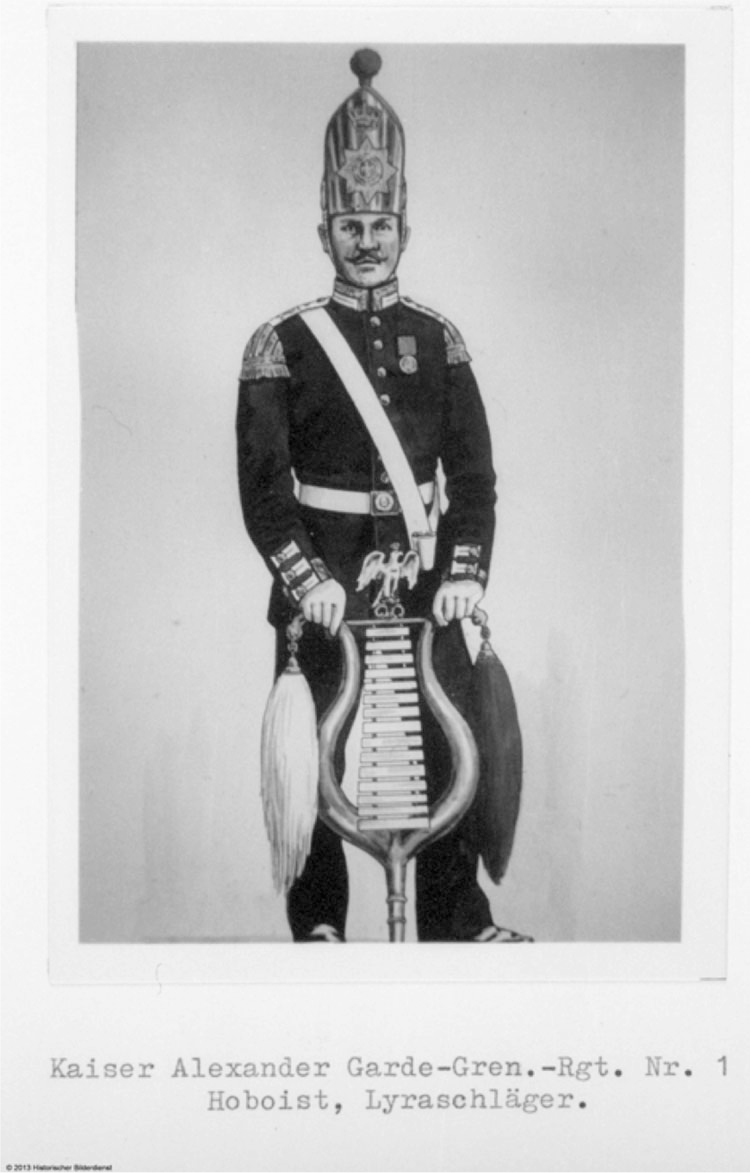
Indeed, the term Hautboisten remained in use until the beginning of the twentieth century, especially for German military bands: the Historischer Bilderdienst (an online archive of illustrations documenting military history, in particular uniforms),Footnote 79 provides reproductions of pictures of Hautboisten dating from the beginning of the twentieth century. In some of the images, percussion players are referred to as Hautboisten, which provides clear evidence that this had become the generic term for any military musician (see Figure 1). Thus, it appears to have been relatively easy for scholars, including Braun, to conclude that in the seventeenth and eighteenth centuries Hautboisten had also generally been part of the military.
Anonymous, Musician (‘Hoboist, Lyraschläger’) of the Prussian Kaiser Alexander Garde-Grenadier-Regiment No. 1 (ca. 1910). Reproduced in Reinhard Quenstedt, ‘Alte Armee: Kesselpauker, Trompeter, Hautboisten’, Historischer Bilderdienst Website.

Braun believes it ‘is particularly difficult to describe the German hautboist because the documents referring to his existence – employment records like those often found for town pipers, cantors, organists, court musicians, trumpeters and drummers – are not usually available’,Footnote 80 a situation that would soon lead to frustration on the part of any scholar. He goes on to state that ‘a monograph devoted to them has not yet been written.’Footnote 81Hautboisten rarely appear on payrolls or similar lists, and most written evidence regarding non-regimental Hautboisten concerns disagreements between them and both the Stadtpfeifer and court musicians. Adequate research would therefore require considerable time spent in archives collecting data and, as the records on Hautboisten are scarce, Braun states that further collation of facts by any scholar would be a major achievement. Thus, the investigation of the Lilien Partbooks represented in this article is just one step towards a monograph on the subject of Hautboisten.
Despite the rather unaccommodating state of the primary-source material, Braun nevertheless attempts to categorize the different types of Hautboisten and the nature of their employment and duties. His chapter provides a detailed discussion of three main divisions: military; court; and town. Yet while this undoubtedly offers a basis for research in this field, each particular group still requires detailed research to be undertaken. Even establishing a clear differentiation between the Stadtpfeifer (town pipers), Hofmusici (court musicians) and Hautboisten seems to be a problematic task. The same group of players might have appeared in different situations under a different professional title, either as Hofmusici or as Hautboisten; indeed, some of them appeared with both titles in lists of courtly Kapellen.Footnote 82 Samantha Owens, for example, notes in her dissertation the existence of Hautboisten at the Württemberg court and provides information on their direct involvement with the courtly Kapelle.Footnote 83
Hautboisten in the military
Despite the fact that Hautboisten were often employed within military regiments, music that is nowadays considered ‘military music’ would rarely have been part of the Hautboisten repertoire. Even though each Hautboisten ensemble had its own march, similar in function to a national anthem, which was always dedicated to the highest ranked military leader of that particular regiment, the prevailing repertoire was for performance in the church, for concert entertainment (including Tafelmusik), and for music to portray the splendour of the general.Footnote 84
When Braun cites Johann Mattheson's complaint that every small principality employed poorly trained musicians who could also serve as lackeys,Footnote 85 he implies that such performers, likely Hautboisten, were held in low repute by the end of the seventeenth century, and had descended even further by the beginning of the eighteenth century. Clearly Braun's conception of Hautboisten was, first and foremost, as band musicians of minor talent. This did not indicate that they were players of signals, however, but rather that they were musicians charged with the responsibility of entertaining the general and his officers, brightening the soldiers’ moods and required to perform whenever music was needed. By the turn of the eighteenth century, signals relaying information to the soldiers during a battle were generally played by fifes and brass drums (tambours).Footnote 86 Beside his own categorization of Hautboisten as primarily military musicians, Braun suggests that their only connection to the military was the obligation to follow regimental orders and to be dressed in uniform.Footnote 87 As seen earlier, the musicians employed as part of the Écurie at the French court were administered by the military, a situation that was obviously not unusual in this period.
Braun concludes that Hautboisten were more interested in employment at courts than with the military,Footnote 88 largely due to the fact that a regimental Hautboist always risked losing his life on the battlefield.Footnote 89 Consequently, civic or court engagements seem to have been more desirable. One can assume that only the more advanced players gained a court appointment, with its attendant privileges, which in turn gives the impression that careers in military bands were inferior to those with the nobility and burghers.
One particularly important aspect of the category of regimental Hautboisten is the identification of the significance of French influence on military matters. This not only related to musical issues, but also impacted upon the terminology used at German courts more generally. Many aspects of general courtly ‘business’ appeared to have been organized in a military manner, even when not connected in any way to the army. For example, the Hofmarschall (court chamberlain) was the title allocated to the head administrator of the courtly household. The term Marschall might indicate membership of a military organization, and someone with a high rank in the army generally occupied this position, but a Hofmarschall’s job description in modern terms would equate more to a senior executive in the business world.
Compositions from the Lilien Partbooks can be taken as examples of music played by a band of regimental Hautboisten.Footnote 90 It seems plausible to assume that the Hautboisten employed by Friedrich von Wittenhorst-Sonsfelds's regiment, which also carried his name – ‘Regiment Sonsfeld’ – used this collection. Furthermore, it is likely that the players employed by this particular regiment would also have performed at the small Sonsfeld court, either just occasionally or perhaps as the sole provider of music at the court. If this is the case, these musicians were no different from the court musicians playing in ‘orchestras’ of the higher nobility. The discussion below, dedicated to the Lilien Partbooks in Sonsfeld's music collection, will attempt to clarify some of these assumptions.
Court and town Hautboisten
As noted earlier, Zaslaw and Spitzer demonstrate that members of the various ensembles at the French court also played different instruments, including players within the Grands Hautbois, for example, who were able to play string instruments and could be employed in several different configurations according to the type of music required on specific occasions.Footnote 91 With this in mind, Braun's explanation of the situation in German-speaking lands, after French musicians emigrated with their instruments to play and teach outside of their homeland towards the end of the seventeenth century, is unsurprising.
According to Braun, Hautboisten with French names appeared in Berlin from 1681 and were certainly teaching German musicians how to play this ‘modern’ instrument around this time.Footnote 92 Similarly, he refers to French Hautboisten in Celle (1681),Footnote 93 Bonn (1697) and Dresden (1699), dates that have been amended by Haynes’ research.Footnote 94 It seems plausible to assume that every major court in Germany employed a band of Hautboisten in the first half of the eighteenth century. Significantly, the French players employed at the court in Berlin in 1681 received the same salary as the ordinary court musicians and were obviously ranked at a similar level.Footnote 95 It is impossible to know, however, whether these players of the recently developed French hautboy were considered Hautboisten in the later German sense of the word – that is performers on multiple instruments – rather than as musicians who primarily taught and performed on double-reed instruments.
Employment in towns as Stadt-Hautboisten, as well as at court as Hof-Hautboisten, promised to be safer in nature than positions offered by the army. Since all towns regularly required music for a variety of occasions, this was certainly a secure place to work as a musician. Not only were the Hautboisten required by the town council for performance at official ceremonies, but they also provided music for church services, funerals, weddings and private festivities. Although Haynes claims that Stadtpfeifer and Stadt-Hautboisten were not the same and were, in fact, employed in different functions in towns,Footnote 96 this demonstrates once again that a problematic distinction existed between the types of work both groups engaged in.
The social status of Hautboisten
Later known as the ‘Soldier King’, the Prussian King Friedrich Wilhelm I, who commenced his reign in 1713, dismissed the entire court orchestra to save money immediately after he inherited the throne. At the beginning of the eighteenth century, Hautboisten were already so well established as part of the court music, as well as providers for military music, that his decision that all necessary court music was to be performed by the Hautboisten appears simply in accordance with common practice at those smaller courts in the Empire that did not have the financial means to support an orchestra.Footnote 97 The only novelty was his decision to order one trumpeter to join Prussian regimental Hautboisten bands. This order, nevertheless, was not to the liking of the trumpet players, who saw this move as a step downwards for them in the social order, as they had long been established members of the Imperial Guild of Trumpeters with their knowledge secretly guarded. The Prussian Hautboisten, on the other hand, rose in rank by playing with the king's trumpeters.
Although Braun states in his ‘Typologie’ that Hautboisten belonged on the lower steps of the social ladder, he also notes later that extant contemporary documentation fails to provide a single, clear categorization of their social status. He cites Johann Mattheson's reference on the one hand to an ‘exquisite hautboy band’ that he had witnessed in Hanover,Footnote 98 and on the other, Mattheson's complaints that every minor court expected to employ an orchestra for little money, with music of poor quality being the end result. Accordingly, the situation at the many other German courts will need to be investigated in future research, since Braun also states as an example that the Hautboisten at the court of Saxony-Weissenfels around 1700 were ranked immediately below the trumpeters, which makes them a rather privileged group of musicians at that particular court, similar to their ranking in Prussia;Footnote 99 yet, having established this picture of Hautboisten as highly regarded musicians, he also refers to ‘the same court (Saxony-Weissenfels) as well as to the court in Zeitz, where the instrumentalists indeed also served as lackeys’.Footnote 100
In a source dating from 1696, Braun indicates that sometimes wind players were not allowed to play string instruments in public, a prohibition that he takes as evidence that they were regarded as lower in rank than string players.Footnote 101 It seems more likely, however, that this source deals with disputes originating from different musicians enviously guarding their employment territory. Braun clearly believed that a Baroque musician's ultimate ambition was to gain a position as a court musician; an Hautboist perhaps started as a military player, later working as a town Hautboist, subsequently being employed as a court Hautboist and finally being appointed a Hofmusicus. His assumption that ‘a large number’ of Hautboisten were ‘disappointed human beings who were more or less deceived in their life expectations’ seems more than a little overstated.Footnote 102
Clearly thinking along similar lines, Braun concludes that the duties of the Hautboisten, apart from those that comprised music making, demonstrate that they had a lackey's status rather than that of an artist. He outlines the duties of Hautboisten employed at the court of Saxony-Zeitz around the end of the seventeenth century, as follows:
… they accompanied their sovereign on journeys, led the processions of the court on either oboes or violins, played violins for an hour before the evening meal outside the rooms of the Duchess (Jan. 17, 1692), carried sauerkraut and bratwurst to the hunt (Oct. 14, 1698), played to the good health of a court official at his wedding, played minuets along with other pieces at a dance (Feb. 21, 1693), and played a courante for the performance of a tightrope walker and his wife (Aug. 15, 1696). From a socio-historical point of view, the hautboist can be placed somewhere between the peasant musician and the real court musician.Footnote 103
The concept of early-modern musicians being free from any obligations other than performing music seems to be, in any case, a romanticized idea that bears more in common with nineteenth-century notions of the profession, and the fact that Hautboisten were multi-instrumentalists does not render the classification of these ensembles as anything unusual.
The fact that Braun regards the Hautboisten to be of low status at court seems to be at odds with his earlier statement that they were second only in rank to the trumpeters at the court in Saxony-Weissenfels. Nevertheless, assuming that appointments at major courts were better paid than those with the military, it is understandable that musicians were naturally interested in applying for court positions. As mentioned before, a courtly life would have involved a considerably more comfortable lifestyle than life on the battlefield; however, an examination of the wages of different military musicians reveals that Hautboisten were consistently regarded as more highly ranked within the military than any other group of musicians the military employed – for example, the players employed solely to provide signals.Footnote 104
Given that Haynes refers to a total number of 1,266 military musicians in the Prussian Army in 1713,Footnote 105 and taking into account the large number of minor courts in the German-speaking lands around this time, one can estimate that there were vast numbers of Hautboisten employed in various positions during the late seventeenth and eighteenth centuries. Daily musical life at courts and in towns, as well as in the army, would simply not have been possible without their skills. The many different options for their employment as outlined above also indicate that their social ranking must have been as wide-ranging as their working environments.
Hautboisten music
Citing Johannes ReschkeFootnote 106 and Peter Panoff,Footnote 107 Braun believes that music for Hautboisten was, initially, composed in three parts. Unfortunately, it is not clear whether he is referring to repertoire composed during times prior to the Baroque era, and therefore still for instruments of the shawm family, or works composed during the period after the structural changes of the instrument. Certainly, the alta capella, the early shawm band of the Middle Ages, and hence the forerunner of the Hautboisten band, had generally played music in three parts.Footnote 108 As Braun does not provide any musical examples for the period he investigates, and given that his information is drawn from secondary sources dating from the early twentieth century, the contents of the Lilien Partbooks assume even greater importance. Contrary to Braun's assertions regarding music for Hautboisten, the music in the Lilien Partbooks is in fact generally in six parts, with numerous exceptions of works in even more parts as well as some with fewer parts.Footnote 109
Braun describes the trios (scored for two hautboys and one bassoon) in Jean-Baptiste Lully's operas as a three-part double-reed ensemble, and goes on to conclude that these represent the origin of the wind section in the modern symphony orchestra. Whilst in some senses this may seem to be a valid conclusion, it has been suggested that these parts may have been played by a consort consisting of more than three players, rather than a trio of soloists joining an existing string ensemble. Haynes, for example, states there were 21 woodwind players and 47 string players involved in Lully's first production of Le triomphe de l'Amour in 1681.Footnote 110 He also explains that ten of these woodwind players performed on double-reed instruments. Assuming that these ten musicians would have been divided into the four parts stipulated in the score, a possible instrumentation may have been: three first hautboys; two second hautboys; two taille de hautbois; and three bassoons. Consequently, it seems plausible to assume that there may have been (as one of several possible instrumentations) more than one player per part for Lully's double-reed trios.Footnote 111 Additionally, Spitzer and Zaslaw's description of large festivities with combined wind and string ensembles seems to lead only to their conclusion that Lully's trios may have been performed by ‘two oboes and bassoon, perhaps doubled, perhaps not’.Footnote 112
Braun's conclusion that these ensembles had always been regarded as independent ‘choirs’ is, nevertheless, of major value. It opens up a field of research focusing on the music that Hautboisten ensembles played by themselves, as well as on a reconsideration of much music that at present is generally classified as ‘orchestral’ music. Future investigation is needed regarding the possibility that a number of ‘orchestral’ pieces were, in fact, written for several distinct ensembles of instruments. Compositions such as Bach's Brandenburg Concerto No. 1 and Telemann's overture suites for three hautboys, one bassoon and strings come to mind.
Braun believes the taille de hautbois to have been in a, while the oboe da caccia in f (which he also mentioned) – a curved instrument with a brass bell – was in fact only a solo instrument and, furthermore, is almost exclusively found in cantatas by J. S. Bach. Yet the results of research undertaken by Eric Halfpenny, together with analysis of extant music, demonstrate that it is more likely that a normal Hautboisten quartet would have comprised two hautboys in C, one taille de hautbois in f and one bassoon.Footnote 113
The taille – the direct forerunner of the cor anglais – was an ensemble instrument and provided the middle part, akin to a viola in a string quartet. Knowledge of the range of the instruments in such an ensemble is clearly of utmost importance when attempting to identify whether a composition was possibly intended for winds rather than strings, as the wider range of both the violin and viola allows performance with hautboys and bassoons to be ruled out when the music cannot be realized on these instruments. Fleming claims in his 1726 publication that both middle parts of a four-part composition were generally performed on the taille de hautbois in double-reed bands;Footnote 114 however, iconographic evidence provided by Halfpenny, as well as information on instrumentation found in manuscript music and printed editions from the seventeenth century, appear to support the opinion that only the lower middle part was performed on a taille de hautbois.
In his paragraphs dealing with specialized music for Hautboisten, Braun identifies several connections such repertoire has with other music genres of the time.Footnote 115 Although one might most readily consider wind bands to have been providers of outdoor entertainment music, he also points out their importance in church music, such as cantatas and motets. Amongst others, J. S. Bach, for example, clearly wrote for Hautboisten, as can be seen in the instrumentation of his motets.Footnote 116
Another genre of music that Braun believes was of importance for Hautboisten is the Tafelmusik (dining music) customarily performed at courts. It is worth noting that surviving collections of Tafelmusik from this era feature diverse instrumentation and the music is often of very high quality and difficulty – as, for example, Georg Philipp Telemann's Musique de table (Hamburg, 1733). If the performance of such music was indeed a typical part of the daily work of Hautboisten, then it is a very strong indicator of an advanced standard of playing, even though Braun describes this repertoire as Gebrauchsmusik (utility music) – that is, music for entertainment purposes, rather than as ‘high art’.
Given that by the end of the eighteenth century and during the nineteenth century wind band music was generally regarded as light and ‘easy to play’ entertainment, we must question how much of Braun's bias, as a scholar writing in the twentieth century, influenced his thoughts regarding groups of musicians whose traditions were derived more directly from the wind-instrument playing of the Middle Ages, and whose origins and professional development have been highlighted earlier. The questions asked at the beginning of this section recur throughout this entire article, albeit from different perspectives. For example, were the Hautboisten really an insignificant group of musicians (as some authors have suggested), whose existence was a mere adjunct to the ‘real’ music performed by court Kapellen? Or is the development of the orchestra the exception here, but one that in the following centuries happened to become the norm and subsequently the major musical institution? Is there really so little ‘art music’ for Hautboisten remaining?Footnote 117 And can the Lilien Partbooks in particular help our understanding of these groups and their music?
In order to be able to answer some of these questions, the following sections of the article will shed light on a small variety of relevant compositions. An analysis of printed music intended for performance by Hautboisten alone, alongside a discussion of the information found in original dedications and prefaces, will provide the body of knowledge necessary for the subsequent analysis of manuscript music. Details on the history of music for Hautboisten in Prussian lands during the seventeenth and eighteenth centuries will be the focus of the beginning of part 4, thus providing important background knowledge for the subsequent examination of the Lilien Partbooks.
Part 3. Music for Hautboisten
Hautboisten were employed as military, court, municipal and freelance musicians. In any of these positions, their duties might include involvement in sacred music, both performing in elaborate cantatas with independent instrumental parts and playing in unison with the singers when performing motets,Footnote 118 providing music for ceremonies such as weddings and consecrations, and marching with muted hautboys in front of mourners in funeral processions.Footnote 119 Among other duties, their secular performances consisted of providing music for the visits of important guests to courts or towns, playing Tafelmusik and entertaining whenever music was needed. As a result of these numerous options for employment, and also because of their extensive education on multiple instruments (see earlier), the repertoire performed by Hautboisten included a vast variety of different types of Gebrauchsmusik (utility music, or music composed for a specific purpose, such as dancing). This diversity, however, makes it a challenging task to identify which music is specifically written for Hautboisten.
While there still seems to be a gap regarding our knowledge of the typical repertoire played by these groups when supplying music for entertainment, significant research on the musical activities of regimental musicians, including military Hautboisten in Prussia during the eighteenth century, has been undertaken by Achim Hofer,Footnote 120 Peter C. MartenFootnote 121 and Sascha Möbius.Footnote 122
As part of his findings, Marten published marches for the different regiments of the Alt-Preussische Armee (that is, the Prussian Army prior to its defeat by French-backed forces in 1806–7). Most facsimiles of manuscript copies of marches and musical signals provided in Marten's volume date from the seventeenth and eighteenth centuries and feature only a single melody line, although occasionally there is also a part for a second treble instrument and even for drums. Fife players (Spielleute) are the focus of this first volume of his research (a planned second volume has yet to be published); nevertheless, Marten's introductory chapter contains information on Hautboisten. Recalling previously mentioned information that the leader of every band of Hautboisten was required to be able to compose as well as to arrange music, it can be assumed that they would have added other parts such as a second hautboy, a bassoon and perhaps brass to these pieces, as can be seen in existing marches composed by Johann Georg Christian Störl (1675–1719),Footnote 123 the Prussian Princess Amalie (1723–87)Footnote 124 and numerous others, which have parts for 2nd hautboy, bassoon and brass.Footnote 125
Whereas Marten investigates music for fifes, Möbius's article provides information regarding hymns played by Prussian Hautboisten whilst marching into battle.Footnote 126 These were presumably performed with the specific aim of raising the soldiers’ morale, although the atmosphere created by such sacred tunes might also have been intended to give the enemy a shiver of fear and demoralize them, in the same way Scottish bagpipes were used in battle. Military Hautboisten are also known to have performed first aid and certainly had a dangerous life in times of war, as can be seen, for example, by the large number of deserting players in the year 1714.Footnote 127
Whilst music performed by military Hautboisten was clearly important for providing both strategic and morale-boosting messages, it was also required off the battlefield for entertainment for the officers. Likewise, Hautboisten employed by town councils or at courts played signals such as music for curfew calls; however, these duties were only a minor part of their work and by the beginning of the eighteenth century many were freed of these obligations, as they had become increasingly occupied with other responsibilities.Footnote 128
It is important to mention that Achim Hofer challenges Möbius’ statements in a publication on Prussian military music.Footnote 129 Hofer claims that there is a lack of evidence of Hautboisten ‘marching’ into the battlefields and continues to argue that written records are unclear and contradictory. His doubts will need to be considered in future investigations, and will possibly necessitate updates to the summarized current knowledge presented here.
Whereas research on regimental Hautboisten may provide important information regarding the lives of musicians in the military, as well as supplying possible insights into the types of music performed by these groups in a wider context, investigation beyond the regimental realm offers further material on other aspects of the daily musical life of Hautboisten in the eighteenth century. The fact that they routinely provided entertainment such as Tafelmusik, for example, requires investigation into an extensive repertoire, which at first glance does not seem connected to Hautboisten. The following investigation of contemporary music dedicated to Hautboisten will provide us with a platform for the subsequent discussion of the Lilien Partbooks.
Early publications
Questions arise as to the typical instrumentation of a band of Hautboisten in the early eighteenth century, the occasions upon which they performed, and, last but not least, how to determine whether a composer had Hautboisten in mind when writing a particular piece of music. Two extant early publications will be investigated in the following paragraphs. This discussion will contribute substantially to the background required when determining what was considered ‘typical music’ for Hautboisten, and will therefore be crucial to answering some of the questions posed in this article.
Johann Philipp Krieger – Lustige Feld-Musik
A collection of the utmost importance for this research is the Lustige Feld-Musik of Johann Philipp Krieger (1649–1725), a collection that comprised six overture suites and was published in his birthplace, Nuremberg, in 1704. Krieger travelled extensively throughout Europe for his education, including study in Italy, Copenhagen, Holland and also Stuttgart. He worked for the courts in Bayreuth and Halle, and, for 45 years, from 1680 until his death in 1725, was Kapellmeister at the Saxon court in Weissenfels.Footnote 130
In Harold E. Samuel's entry on Krieger in Die Musik in Geschichte und Gegenwart, the Lustige Feld-Musik is listed among the composer's extensive output under the heading ‘orchestral works’. Samuel discusses this collection alongside the publications of Johann Sigismund Kusser (Composition de musique, 1682; Apollon enjoüé, 1700) and Georg Muffat (Florilegium primum, 1695; Florilegium secundum, 1698) as examples of orchestral overture suites. Derived from collections of dance movements of French operas from the second half of the seventeenth century, the orchestral suite soon became an archetype of German composition of the beginning eighteenth century. Steven Zohn suggested that Georg Philipp Telemann took this form to its climax.Footnote 131
Muffat's works are clearly composed for a five-part string formation with hautboys and a bassoon added ad libitum instead of the concertino string group of two violins and a string bass. In the prefaces to Muffat's two collections (both printed in Passau), he explains the manner in which this French-style music should be performed, providing, in the process, important information on Jean-Baptiste Lully's performance practices. Muffat's compositions feature a typical instrumentation of two violins, two violas and bass; however, he also notes that in performances these suites can be adapted to the needs of the available musicians. The minimum-sized group would be a trio of two violins and a bass, whereas the most common ensemble would be one-per-part and basso continuo.Footnote 132 Any larger number is also possible according to Muffat, and he further states that: ‘If some of your musicians can play the French oboe or the shawm well, you can form the concertino or trio with two of the best of these instead of the two violins, and with a good bassoonist instead of the small bass…’.Footnote 133 Muffat's suggestion of the use of a concertino of clearly three players seems at odds with Haynes’ proposed possibility of doubling the parts in Lully's trios which was mentioned above. Future investigation needs to clarify whether these are possibilities or rules, whether one automatically excludes the other, and whether there may have been differences in performance practice in France and in German-speaking lands.
Whilst the typical French scoring in five parts was introduced into the German-speaking countries by Kusser and Muffat, and thereafter also copied by composers such as Philipp Heinrich Erlebach (1657–1714),Footnote 134 who never went to France, Lully's music would usually have been scored for one violin, three violas and bass (labelled dessus de violon, hautecontre, taille, quinte and basse de violon) rather than two violins, two violas and bass, as found with the German masters. Krieger's Lustige Feld-Musik is distinctly different. In common with all typical French-style ‘orchestral’ suites by German composers, the six works in his collection start with an overture followed by a number of dances; however, the instrumentation is in four parts rather than in five. For the double-reed band at the French court, the Douze Grands Hautbois, Lully scored in four parts when they performed together with the strings, omitting the lower viola part.Footnote 135 Since German composers continued to copy the typical French instrumentation for strings in five parts more than a decade after Lully died, this might suggest that the four-part set-up for Hautboisten was also in imitation of the common practice of omitting the second viola part when performing on double-reeds, as was shown, for example, in Kusser's instrumentation of his Adonis, and, furthermore, underlines the fact that Krieger had a wind band primarily in mind for his Lustige Feld-Musik rather than a string orchestra.
Unfortunately, no original print of Krieger's collection has survived. Therefore, our current knowledge must rely on editions of three of the six overture suites in secondary sources. To name the most important source, Robert Eitner's 1897/98 article in the Beilage zu den Monatsheften für Musikgeschichte not only offers the music of two of the six suites, but also includes a transcription of the invaluable preface of the original publication, in which information on potential customers and the collection's instrumentation can be found.Footnote 136 The overture suites in this collection are similar to other pieces of the same genre played by any Hofkapelle (court orchestra) during that period, and therefore provide essential information about the musical repertoire of Hautboisten.
Dedicated to the Nuremberg collegium musicum, the title page of Krieger's collection reads as follows:
| Johann Philipp Kriegers | Johann Philipp Krieger's |
| Lustige Feld-Musik, | Auf vier blasende oder andere Instrumenta gerichtet | welche zu starkerer Besetzung mehrfach, | Nemlich Premier Dessus dreyfach, | Second Dessus zweyfach, | Taille einfach | Basson dreyfach | gedruckt sind. | Zur Belustigung der Music Liebhaber und dann auch zum Dienst derer an | Höfen und im Feld sich aufhaltenden Hautboisten | herausgegeben Nürnberg | In Verlegung Wolfgang Moritz Endters. | Gedruckt bey Johann Ernst Adelbulner. | (1704). | Merry Field Music, set for four wind or other instruments, [and] which for a larger ensemble multiple parts are printed, namely three for the first treble, two for the second treble, one for the taille Footnote 137 and three for the bassoon. For the entertainment of music lovers [amateurs], and also to serve those Hautboisten employed at courts and on the [battle] field. Edited and published in Nuremberg by Wolfgang Moritz Endters. Printed by Johann Ernst Adelbulner. (1704). |
In his preface, Krieger explains the finer points of the work's instrumentation and intended purpose:
| Der Bass zum Cembalo ist darum beygefüget worden, damit diese Partien auch von wenigen Liebhabern mit Geigen können musiciert werden. | The bass for the harpsichord has been added so that small ensembles of amateurs also can perform these suites with violins. |
| Weiln der Setzer theils Zahlen verschoben und theils unrechte Zahlen gesetzet, so hat sich der Cembalist nicht an solche zu binden, sondern das Accompagnement nach dem Gehör zu richten. | Because the typesetter has both shifted figures and set incorrect figures, the harpsichordist should not depend on them, but create his accompaniment by ear. |
| Premier Dessus und Basson sind dreyfach, und Second Dessus zweyfach gedruckt worden, damit man bey Feld Musicken und Banden solche Stimmen desto starcker besetzen kan. | The First Treble and Bassoon have been printed three times, and the Second Treble twice, so that when performing as Feldmusik [i.e. as military Hautboisten] and in bands these parts can be stronger [i.e. by adding more players to a part]. |
| Die Hautboisten, welche im Marschiren vor denen Compagnien blasen und sonsten denen Officieren aufwarten, können sich dieser Partien sehr wohl bedienen, angemerckt die Entrées fast alle für Marches zugebrauchen sind. | Those Hautboisten who perform [literally blow] while marching at the front of [military] companies, or else play for the entertainment of the officers, can make very good use of these suites, since it should be noted that almost all the entrées can be used for marches. |
| Man hat mit Willen in den Hautbois oder Violinen, den ordinary Claven G. auf die andere Linie von unten auf gesetzt, weiln die Liebhaber dessen besser gewohnt sind, als des Französischen: Wann er also auf der untersten Linie stehen, so ist es für einen Druck-Fehler zu rechnen. | The ordinary G clef [i.e. G2 clef] has been set on the second line from the bottom intentionally, as music lovers [amateurs] are more used to this than to the French violin clef [i.e. G1 clef]. Thus when it appears on the bottom line, it must be understood to be a printing error. |
Krieger's preface indicates very clearly the intended purpose of his Feld-Musik. It was first and foremost composed for Hautboisten on the [battle] field, at court and wherever they were employed to entertain; however, it seems likely he addressed the musical amateur prior to the professional Hautboisten to ensure its attractiveness to all potential customers and purchasers.Footnote 138 The translation of the German phrase Music Liebhaber as ‘amateurs’ is problematic in any case, given that both members of the nobility and up-and-coming burghers are known to have had music and dancing lessons and were at times very competent musicians.Footnote 139
The range of the parts in Krieger's collection never exceeds the possibilities of the instruments for which the music is composed: for example, the second part has no lower note than c’ and the taille has nothing lower than an f. If this music were clearly meant to be for strings, both first parts could have gone as low as g and the taille, being played by a viola, could have gone down to c. Such considerations can also act as a useful indicator for music which does not provide information on the intended instrumentation: that is, if the range does not exceed that of the instruments of the hautboy family, it seems reasonable to assume that the composer might have thus provided the option for his music to be played by Hautboisten.
The same applies to another of the six suites, this time in F major, which exists in an edition by Max Seiffert.Footnote 140 Both Eitner's and Seiffert's editions, however, fail to provide information on whether the original clefs used for the second and third parts were the same as in their modern editions, presenting them in G2 clef for the second oboe and viola clef for the taille without further comment. The use of clefs for the middle parts, and even for the top part, was not yet standardized at the beginning of the eighteenth century.
Jean-Michel Muller – XII Sonates
Günter Thomas’ entry on Johann Michael Müller (1683–1743) in The New Grove Dictionary tells us that he found employment as organist and musical director for Count Philipp Reinhard of Hanau (1664–1712) at the age of 23. Seven years later Müller took on a position at the local Gymnasium, where he subsequently (in 1737) became deputy headmaster.Footnote 141 Müller is well known for his contributions to German Protestant church music through his published hymnbooks; however, he was also much influenced by French fashions. The latter is evident in the Frenchification of his name as Jean-Michel Muller and in the French-language dedication to his XII Sonates, a collection of high-quality virtuosic music published in Amsterdam by Estienne Roger. Although Thomas states that these sonatas are now lost, Haynes’ bibliography of oboe music refers to copies in three libraries.Footnote 142 One of these is now available in a facsimile reprint.Footnote 143Die Musik in Geschichte und Gegenwart fails to include an entry on Müller; however, when considered from the viewpoint of researching published music for Hautboisten at the beginning of the eighteenth century, discussion of his work is crucial.
The dating of this collection is somewhat problematic. According to Gerber, the printed edition of the XII Sonates dates from before 1730.Footnote 144 In the facsimile edition published recently by Fuzeau, Jean Saint-Arroman gives ca. 1712 as an approximate date of publication, whereas Haynes’ bibliography indicates ca. 1709.
The title page of Müller's collection reads as follows:
| XII Sonates | à un Hautbois de Concert, qu'on doit jouer sur cet Instrument sur tout [sic] | quand il y a écrit Solo, deux Hautbois |ou Violons, une Taille, un| Fagot & Basse Continue pour le |clavecin, ou Basse de Violon. | Dediées | A Son Excellence Serenissime | Monsieur Philippe Reinhard, Comte de Hanau, Rhineck & Deux | Ponts; Seigneur de Munzzenberg, Lichtenberg, & | Ochsenstein; Marêchal Hereditaire & Grand | Baillif de Strasbourg &c. &c. &c. | par Jean Michael Muller | Directeur & Oarganiste à Hanau | Premier Ouvrage. | A Amsterdam | Chez Estienne Roger Marchand Libraire. No. 86 | XII Sonatas for one Hautbois de Concert, which one should play on that instrument, especially when Solo is written, two Hautboys or Violins, one Taille, one Fagot [Bassoon?] & Basso continuo for the harpsichord, or Basse de Violon. Dedicated to His Most Serene Excellency Mr. Philip Reinhard, Count of Hanau, Rheineck & Zweibrücken; Lord of Munzzenberg, Lichtenberg, & Ochsenstein; Hereditary Marshal and Grand Bailiff of Strasbourg &c. &c. &c. by Jean Michel Muller, Director and Organist in Hanau Opus One. Amsterdam by Estienne Roger, Bookseller. No. 86 |
Confusingly, the title page and the parts give slightly contradictory information on the instrumentation of the collection. The parts are labelled Hautbois di Concerto, Hautbois o Violino Primo, Hautbois o Violino Secundo, Alto and Organo e Violoncello. In the modern orchestral tradition, where the wind instruments are considered to add special colour to the core string group, one would most likely perform these pieces with one solo hautboy, a string group (possibly with two extra hautboys in unison with first and second violin) and of course a keyboard instrument added – in this case, an organ. As we have already seen, however, on the title page, the instrumentation for these pieces is listed as solo hautboy, two hautboys (or violins), taille, Fagot (presumably a bassoon) and basso continuo (harpsichord or basse de violon), differing for the lower middle and for the bass part.
As we can see, the title page labels the middle part taille rather than Alto, as appears on the part. But whereas Alto may indicate a string instrument (as in Alto Viola), the term taille can refer to any instrument playing a middle part, such as a taille de violon (which is often the term used for the second viola part in French string music), but also a taille de hautbois, a tenor hautboy in f. As this part never extends below an f in Müller's collection of sonatas, it is therefore well suited to the latter instrument. It remains unclear why Müller used the term Fagot in his dedication rather than the term basson. Regarding Müller's reference to the harpsichord rather than the organ, given that a wider range of possibilities in terms of instrumentation meant an increased market for selling this collection, it is perhaps not surprising that such terminological discrepancies occur. Both Krieger and Müller followed the usual practice of leaving the instrumentation of any music they published variable, almost certainly for marketing reasons.
Considering what is now known about Hautboisten, it seems most likely that these sonatas were published, on the one hand, for use at a court by an ordinary Kapelle, where they could have been performed with a solo hautboy and string group together with a keyboard continuo (perhaps also with a bassoon). On the other hand, it seems that this publication was just as likely to have been aimed at Hautboisten ensembles, given that the sonatas can be performed with double-reed instruments alone, employing a solo hautboy and a band comprising two hautboys, one taille de hautbois and one bassoon. This woodwind combination would most likely mean that neither keyboard nor string instruments would have been involved.
Manuscript sources of music for Hautboisten
In attempting to determine the nature of music for Hautboisten through the analysis of early publications it becomes apparent that there are a number of instrumentation possibilities to be taken into account when investigating sources of manuscript music that, according to Haynes, were intended for ‘oboe band’. Whilst only a selection of the latter compositions can be investigated given the limitations of the present article, the following discussion facilitates a preliminary definition of music for Hautboisten.
Music for pure double-reed ensembles will be analysed first by examining eighteenth-century arrangements of orchestral music by Francesco Venturini (1675–1745), which demonstrate how Hautboisten were able to adapt any suitable music to their needs. These works feature four hautboys and two bassoons, an instrumentation that also occurs regularly in the Lilien Partbooks. In addition, Telemann's works for wind bands featuring a core group of double-reed players with added horns will be discussed, thus demonstrating the evolution of Hautboisten bands into Harmoniemusik ensembles.
Francesco Venturini – arrangements for Hautboisten
Special attention needs to be drawn to a composer who is today almost forgotten, but who was undoubtedly of major importance in the German-speaking lands at the beginning of the eighteenth century. Probably born in Brussels in 1675, Francesco Venturini died on 18 April 1745 in Hanover, where he appears to have spent the majority of his life. In the court files of the House of Welf, the Duchy of Braunschweig-Lüneburg (later Hanover), he is listed as ‘François Venturini’Footnote 145 and it is unclear whether he Italianized his name for reasons of fashion. Several musicians with the name Venturini can be found in Hanoverian files during this period; all were very likely part of his family.Footnote 146
Initially employed as a chamber violinist, Venturini advanced to the rank of Konzertmeister and finally to that of Hofkapellmeister, a position he held until his death. He appears to have been well regarded by other composers of the time. As pointed out by David Plantier, Händel's fugue theme in his Concerto Op. 3, No. 3 is extremely similar to the main theme in the overture movement of Venturini's Sonata XI from his Concerti da camera, Op. 1,Footnote 147 whilst Telemann stated in his autobiography, published in Mattheson's Grundlage einer Ehren-Pforte in 1740, that he learnt the distinction between the French and the Italian style when he was in Hanover, possibly as a result of contact with Venturini.Footnote 148
Venturini's compositional art is evident in his collection of 12 Concerti da camera, Op. 1, published by Estienne Roger in Amsterdam sometime before 1714.Footnote 149 The suites with odd numbers are in the French style with several dances following an overture, whereas those with even numbers are more Italianate, opening with a movement labelled ‘Concerto’. The basis of the instrumentation is a French-style string group of two violins, two violas and bass, joined by two hautboys and one bassoon. Occasionally ripieno violins, an extra violoncello and bassoon, and sometimes recorders are added. The music is of very high quality and can easily stand next to similar works by Händel, Telemann and J. S. Bach.
Venturini's contemporaries must have shared this high opinion, as there are a number of manuscript arrangements of this music still extant. One of them – of the most relevance to the present discussion – is a manuscript set of three of the 12 works from Op. 1 arranged for Hautboisten, now held at the Staatsbibliothek zu Berlin (D-B, Mus. Ms. 22305 2, 4 and 6). Unfortunately, it is no longer possible to identify the arranger, but the title page of each of the three pieces carries a note on the bottom right-hand corner identifying the owner of these parts (see Figure 2).Footnote 150 Haynes identifies this as the court of ‘Witmar’; however, it is clear in the second piece that the ‘J’ and the ‘D’ of ‘J. Ditmar’ are, in fact, separate letters, indicating that J. Ditmar was their possessor.Footnote 151
Title page of Venturini's Overture in A minor (Staatsbibliothek zu Berlin Musikabteilung mit Mendelssohn-Archiv, D-B, Mus. Ms. 22305/4).
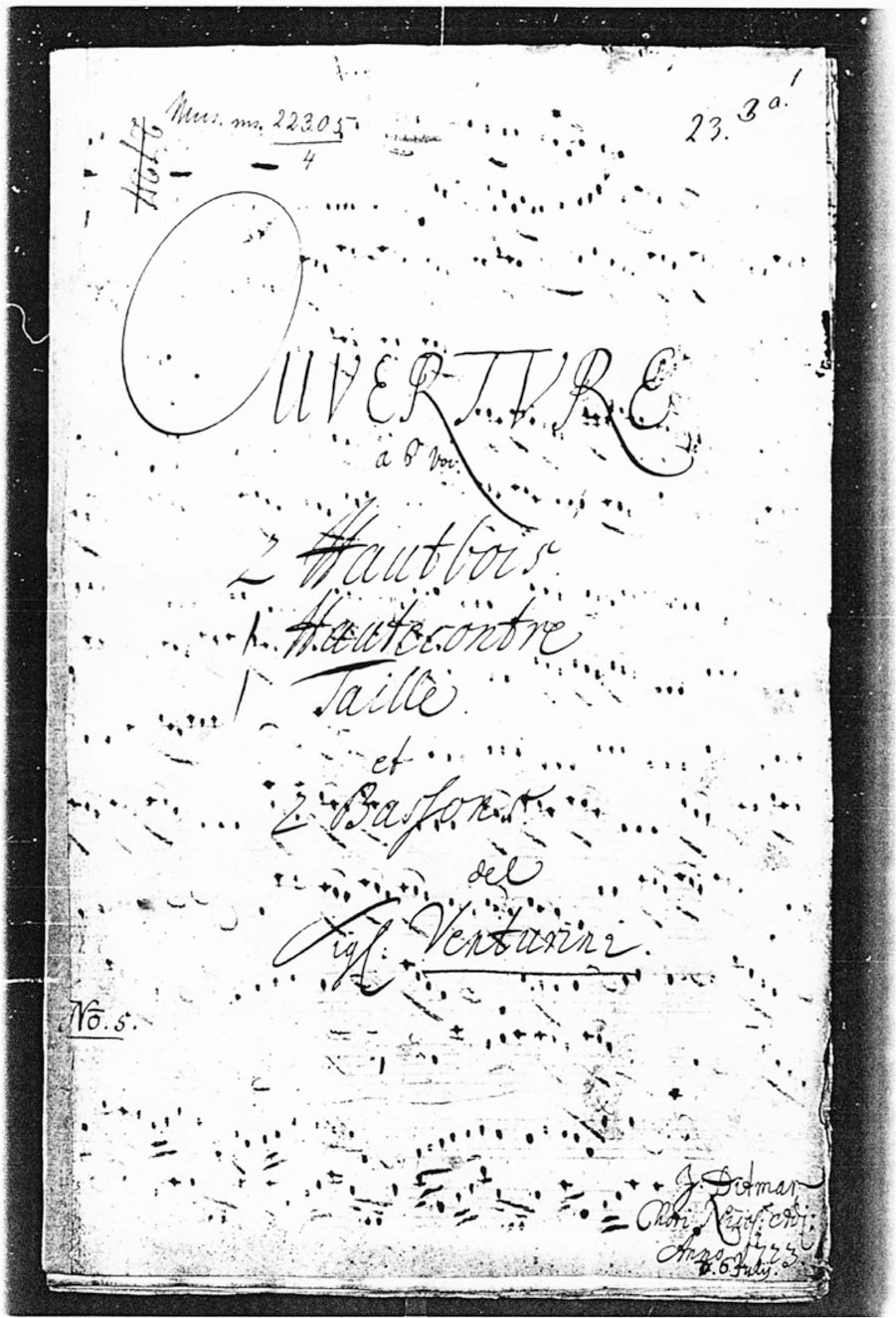
These works represent how Hautboisten adapted music for their own needs. They are also similar to those works set for four hautboys and two bassoons within the Lilien Partbooks.
Music for double reeds and brass
As mentioned earlier, music for Hautboisten could also involve brass instruments playing together with a purely double-reed ensemble. One example can be found in Prussia, when, soon after coming to the throne in 1713, King Friedrich Wilhelm I decreed that all music at court would be performed by regimental Hautboisten and ordered one trumpeter to join each band.Footnote 152 By the beginning of the eighteenth century, horns also became common in wind bands. Many marches dating from the first half of this century featured an instrumentation of a double-reed band joined by brass instruments;Footnote 153 furthermore, an incalculable number of pieces in a much wider variety of genres can still be found in libraries, stemming from the pens of anonymous composers as well as renowned masters such as Telemann, Mattheson and Johann Friedrich Fasch, testifying to what must have been a widespread practice.
Georg Philipp Telemann
The most striking example of Georg Philipp Telemann's output for Hautboisten is his Marsch (TWV 50:43),Footnote 154 most likely composed for the Frankfurt artillery for performance at a procession on 10 August 1716. This procession formed part of a shooting carnival held over two weeks for the burghers in Frankfurt. The event was described in a number of contemporary texts and depicted in etchings, with both types of evidence illustrating six municipal Hautboisten including two bassoonists.Footnote 155 The other four players featured in the iconographic evidence can unfortunately only be discerned not to be playing bassoons, since the etching does not provide enough detail to recognize their instruments. Telemann chose to score the work for hautboys (three in this case, each with their own part), two horns and bassoon. As pointed out by Achim Hofer, however, it is debatable whether this march was composed for the shooting carnival in 1716, since both the written and iconographic evidence relating to that occasion depicts a band of Hautboisten including two bassoonists, a fact which argues against the use of three hautboy players, given that the group was known to have been made up of six musicians. This would logically allow only for four double-reed players, as two of the six were needed to perform on horns. Hofer claims that the first line of the part of the third hautboys in the score features a bass clef that has been corrected to a treble clef. He therefore concludes that the piece was possibly first intended for two hautboys, two horns and two bassoons and was heard that way in the procession.Footnote 156
In his Telemann Werke Verzeichnis (TWV),Footnote 157 Martin Ruhnke provides 13 entries for works scored for wind ensemble.Footnote 158 All of these appear to have been intended initially for an instrumentation including hautboys, horns and bassoon. Wolf Hobohm argues that these compositions were for Hautboisten, even though they are categorized in the TWV either as orchestral suites or as chamber-music quintets.Footnote 159 Usually the five parts comprise two hautboys, two horns and one bassoon. In two cases the hautboys are exchanged for two hautboys d'amore (TWV 55:F18 and TWV 44:2), and in one case Telemann scored for four horns rather than only two (TWV 55:F11). As mentioned earlier, the Frankfurter Marsch (TWV 50:43) leaves some unanswered questions regarding its instrumentation, and one suite (TWV 55:F4) listed for two violins, two horns and bass most likely first existed as a work scored for hautboys, horns and bassoon.Footnote 160
Despite providing convincing arguments that these 13 works by Telemann were composed for Hautboisten, Hobohm's understanding of this music appears to have been coloured by a modern bias concerning the composition of the orchestra, since he indicates that for Telemann ‘composing for an instrumentation of two hautboys, two horns and bassoon naturally meant that the richness of the string group was sacrificed’.Footnote 161 The vast number of compositions for such wind groups in the eighteenth century, however, seems to imply that this music might not have been regarded as limited by the absence of a large string orchestra. Rather, it appears that this was one of a multitude of possibilities available for musical entertainment at the time.
Part 4. The Lilien Partbooks – Hautboisten in Prussia
To clarify the provenance, and to position the Lilien Partbooks and the Sonsfeld Collection firmly within the Prussian context, rather than at the French court as has been suggested by David Whitwell,Footnote 162 it is necessary to supplement the general knowledge regarding Hautboisten by focusing on the relevant historical background in Prussia.
Prussia in the early eighteenth century and the Wittenhorst-Sonsfelds
Prussia played a unique role in the ongoing history of Hautboisten in the German-speaking lands. Given this role and the surviving evidence pointing to clear connections between the Sonsfeld Collection and the Prussian military, it is necessary at this point to take a closer look at the situation in Prussia in the early eighteenth century.
Prussia became a kingdom on 18 January 1701, when Elector Friedrich III (1657–1713), a son of Friedrich Wilhelm, the so-called ‘Great Elector’ (1620–1688), crowned himself King Friedrich I in Königsberg (now Kaliningrad in Russia). In order to earn the support of the Habsburg Emperor Leopold I (1640–1705) for the elevation of Prussia's status to a kingdom, it was necessary for Friedrich to collaborate with the Holy Roman Empire against France in the War of the Spanish Succession. Leopold I, however, only agreed that those lands not already within the realm of the Empire could become part of the Prussian kingdom, and therefore granted Friedrich I the title King in Prussia. Friedrich II ‘the Great’ (1712–86), great-grandson of the ‘Great Elector’, was the first to become King of Prussia in 1772, after the Prussian annexation of territories in Poland.
The grandson of the ‘Great Elector’, son of Friedrich I (the first King in Prussia) and father of Friedrich II ‘the Great’ (the first King of Prussia) was the so-called Soldatenkönig (Soldier-King), Friedrich Wilhelm I. He commenced his reign in 1713 and promptly dismissed the court orchestra, as his own father's extravagance had left him with meagre resources. The sole musical entertainment Friedrich Wilhelm I retained at the court was that provided by the Hautboisten of the Königsregiment (the king's regiment). In 1713 this ensemble comprised 15 players, and from 1723 onwards engaged 21 Hautboisten, divided into three groups of seven.Footnote 163 To each of these he ordered the addition of a single trumpeter. Prior to this development, trumpeters – who were members of the Imperial Guild of Trumpeters – would not have performed with a band of Hautboisten. And since the Prussian ‘Soldier-King’ was the first to order the combination of trumpeters and Hautboisten within the same ensemble, this provides a strong clue to the dating of the music in the Lilien Partbooks as well as to their connection to the Prussian kingdom, eliminating the possibility of any year earlier than 1713 for the works including trumpets that are found in the Lilien Partbooks.
As established in part 2, it was the ‘Soldier-King’ who was responsible for founding the Hoboistenschule in Postdam in 1724,Footnote 164 an institution that was led by Heinrich Gottfried Pepusch (after 1667–1750) with the assistance of ‘Cammer Musicant’ (chamber musician) Sydow (d. 1754). The latter directed the establishment himself from 1738. According to Mary Oleskiewicz, Samuel Peter Sydow (d. 1701) was employed as Kapellmeister at the Prussian court from 1679 until 1701, and was most likely father of ‘Cammer Musicant’ Sydow, who is regularly confused with his father in secondary literature.Footnote 165 Oleskiewicz also notes that neither Sydow junior's given names nor his exact dates can be established with certainty.Footnote 166 Bandt, therefore, is referring to Sydow junior rather than Samuel Peter when stating that ‘Sydow’ held the positions of both Kapellmeister and Komponist (composer) at the Prussian court.Footnote 167 It appears that some of the compositions in the Lilien Partbooks can be attributed to Sydow, either father or son, as will be discussed in the following analysis of the music within these sources.
In addition to the Hautboisten of the Königsregiment, the apprentices of the Hoboistenschule regularly supplied entertainment at Friedrich I's court. Although he unfortunately fails to provide a reference, Bandt quotes a source that describes the courtly activities of the students of the Hoboistenschule as follows:
| Was die übrigen Lust-barkeiten des Hofes (im Potsd. Stadtschloß) betrifft, so waren an zwei Abenden in der Woche Assembleen, wobei jeder Offizier Zutritt hatte und alles ziemlich ähnlich zuging wie im Tabaks-Kollegium, nur erfreute, eine aus den Zöglingen des Waisen-hauses gebildete Kapelle, welcher der König zuweilen den italienischen Noten-schrank seiner Mutter (der geistvollen Sophie-Charlotte) auftat, mit trefflicher Musik.Footnote 168 | As for the other pleasures of the court (at the Potsdam Stadtschloss), on two evenings a week assemblies were held, which were quite similar to the Tabaks-Kollegium, except that a Kapelle formed by the students of the orphanage sometimes entertained with excellent music out of the Italian sheet music cabinet of the King's mother (the brilliant Sophie-Charlotte), which he opened on occasion. |
Further research is needed to investigate whether any of the works in Sophie-Charlotte's collection were composed for wind band. Bandt's quotation seems to imply that the Hautboisten apprentices acted as a Kapelle – or an ‘orchestra’ – performing the music in scorings that would most likely have included string instruments and harpsichord as well as wind instruments.
Prussian enclaves in the lower Rhine region
Although Prussia had gained leadership over the duchy of Kleve, as well as the Grafschaften (counties) of Mark and of Ravensberg, following an inheritance dispute in 1614, these areas, which were near to the Dutch border and thus separated from the contiguous territory of Prussia, were repeatedly occupied by other nations. Initially, the Catholic Spanish ruled these Prussian enclaves in the Lower Rhine region, and then, from 1629 to 1672, governance was taken over by representatives of the Calvinist Netherlands, who had managed to oust the Spanish intruders. By agreement, however, the inhabitants of these duchies and counties were guaranteed religious freedom.
Friedrich Wilhelm, the ‘Great Elector’, was the first to strengthen Prussia's contacts with the Netherlands, when he was sent there to live with his mother's uncle Friedrich Heinrich of Orange (1584–1647) from 1634 until 1638, during which time he studied at the University of Leiden. In 1646, Friedrich Wilhelm married Princess Luise Henriette (1627–67) from the House of Orange-Nassau in The Hague.Footnote 169 In the early 1700s the Rhine area around Kleve was once more the subject of military conflicts as a result of fierce disputes over inheritance. In 1703 the Prussian military conquered the stronghold of Geldern, which had previously been thought to be impenetrable. At the Peace in Utrecht in 1713, those parts of the duchy of Geldern formerly ruled by the Spanish were given to Prussia in compensation for the principality of Orange, which was lost to France.Footnote 170 And although France subsequently conquered Kleve in the turmoil of the French Revolution later in the eighteenth century, these eastern areas of the former duchy of Geldern were returned to Prussia after the Congress of Vienna in 1815 and are now part of Germany.Footnote 171 The western area called Gelderland remained in the Netherlands (as it does to this day).
The Prussian lands in Geldern were labelled the Herzogtum Geldern preußischen Antheils (Prussian division of the duchy of Geldern), and were administered from 1713 to 1726 by Georg von Lilien (1652–1726), who held the post of Governor of Geldern (see Figure 3). His father, Georg Lilien (1597–1666), had been the Domprobst (provost) at the St. Nicolai-Kirche (St Nicholas’ Church) in Berlin. In 1704, Georg von Lilien and his wife were ennobled; he subsequently held the ranks of Prussian General Major (from 1709) and General Lieutenant (from 1720).Footnote 172
Georg von Lilien, engraving by Georg Paul Busch, ca. 1725. Available from VU Amsterdam University Library [http://imagebase.ubvu.vu.nl/cdm/singleitem/collection/prt/id/1639/rec/1/lang/en_US].
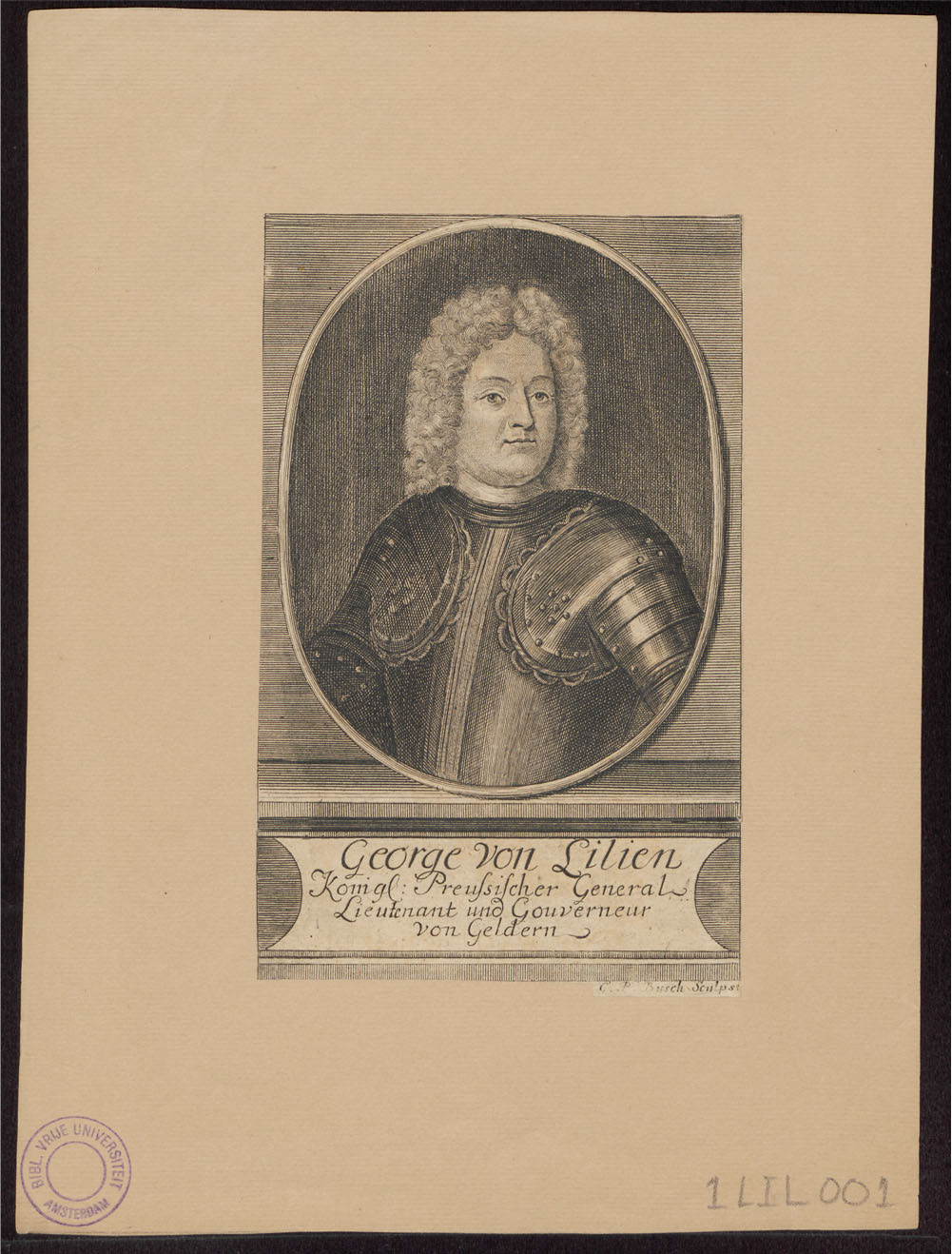
In 1725, von Lilien appears to have been dismissed for discharging a farm labourer who had been drafted into military duties against his will. He subsequently retired and moved to a residence in the vicinity of Wittstock (some 95 kilometres northwest of Berlin), where he died in 1726 with no heirs.Footnote 173
Von Lilien's successor in the post of governor of Geldern was Friedrich Otto Freiherr von Wittenhorst-Sonsfeld (1678–1755), who became the head of the new Dragonerregiment No. 2 (Second Dragoon Regiment) – which also carried his name – in 1725, and governor of Geldern in 1726. On 25 July 1739 Friedrich Otto was promoted to the rank of General Lieutenant of the Prussian cavalry.Footnote 174 His sister, Dorothea Louise (1681–1746), is known to have served as Hofdame (lady-in-waiting) at the Prussian court in Berlin, as well as having been employed as nanny to Wilhelmine of Prussia (the favourite sister of Friedrich ‘the Great’). In 1731, when Wilhelmine married the Hereditary Margrave (and later Margrave) of Brandenburg-Bayreuth, she took her confidante ‘Sonsine’ (Dorothea Louise von Wittenhorst-Sonsfeld) with her to her new residence in Bayreuth. Dorothea Louise was later to be appointed Oberhofmeisterin at the court.Footnote 175
According to Erich Thurmann, in an unpublished article focusing on the Sonsfeldsche Musikalien Sammlung, little is known about Friedrich Otto von Wittenhorst-Sonsfeld's personal life; nevertheless, secondary sources repeatedly state that he was presumably a ‘musikalischer preußischer General’ (a musical Prussian general),Footnote 176 who, as stated by Hanne Buschmann, apparently composed and also played the hautboy.Footnote 177 However, no primary-source evidence is provided to back up either claim; furthermore, it seems somewhat doubtful that a person of noble status would have played the hautboy – an instrument usually considered to be played solely by professionals. Indeed, Thurmann cites an inventory of the musical instruments owned by Friedrich Otto's mother that include listings for keyboards (positive organ, clavichord, harpsichord) and strings (viols, chitara) – instruments generally preferred by such noble amateurs.Footnote 178
Countess Maria Adriana Alexandrina Theresia von Arberg und Frézin, who was Friedrich Otto's aunt, lived in Horst (now in the Netherlands and on the western side of the Rhine), and belonged to the Catholic branch of the family – the Wittenhorst-Horsts. Friedrich Otto fought a long court case against this aunt for the feudal rights of the lands in Horst. When the countess died in 1738, Friedrich Otto moved temporarily to Horst, taking over the property illegitimately in disregard of his aunt's will of 17 September 1736, which stated that her goddaughter Maria Alexandrina von Fürstenberg was her sole heir. This was the same year that his regiment, which until then had been in Treptow/Hinterpommern (now in Poland), was stationed in his home area. For the rest of his life Friedrich Otto mostly lived in the Prussian enclaves in the Lower Rhine region.
Baron Clemens Lothar von Fürstenberg (1725–91), brother and guardian of the countess’ goddaughter, engaged in a long-lasting legal dispute over the inheritance with Friedrich Otto on behalf of his sister, who died a minor, never becoming the legal owner of her inheritance. Officially Clemens Lothar, who won these legal fights, was given the feudal rights for Horst in 1754; however, Friedrich Otto did not hand anything over before he died in 1755. Accordingly it appears that Friedrich Otto was possessor of those lands from 1738 until 1755.Footnote 179
The Lilien Partbooks and their owners
In his study of the musical history of the courts of Westphalian nobility, Joachim Domp focuses on music that forms part of the Bibliotheca Fürstenbergiana, the library of the Fürstenberg family, which is held in the castle of Herdringen. Domp suggests that this music collection comprises repertoire that was performed by an ensemble at the local court.Footnote 180 Within this library works can be found that formerly belonged to Friedrich Otto von Wittenhorst-Sonsfeld. According to Thurmann, Domp's study provides the first scholarly attention given to the Sonsfeld Collection in modern times.Footnote 181 Thurmann also notes, however, that while Domp's work lays the foundation for research on Westphalian music history, ‘his information needs supplementing and correcting, in order to be able to characterize fully the peculiarity of this music collection’.Footnote 182 According to Thurmann, the surviving archival material does not indicate that a Kapelle was ever employed by the Fürstenbergs and, therefore, that any performance at the Herdringen court of the music in their collection cannot be safely assumed.
Also kept in the Fürstenberg library is a manuscript entitled Des Herren General Major Frey Herrn von Sonsfeldt Musicalisches Cathallogium (D-HRD, Fü 3720a), published as a facsimile reprint within a modern catalogue, edited by Jürgen Kindermann in 1987/88.Footnote 183 Strikingly, according to Barry S. Brook, this appears to be the earliest known thematic music incipit catalogue.Footnote 184 It was initiated by Friedrich Otto and lists the contents of his music collection, which was extended once it came into the possession of Freiherr Clemens Lothar von Fürstenberg (1725–91) in 1755. Only parts of the works listed in the catalogue are still extant, but among them are the compositions contained within the six partbooks whose leather bindings are imprinted with the golden letters ‘G. v. L.’ – the so-called Lilien Partbooks – which form the focus of this article.
A number of secondary sources suggest that Governor Georg von Lilien was most likely the person to have been the original owner of the six partbooks.Footnote 185 Although it is possible that Johann Christoph Graf (Count) von Wylich and Lottum (1681–1727), brother-in-law of Friedrich Otto von Wittenhorst-Sonsfeld, was the first owner of the partbooks – given that his name also provides the initials ‘G. v. L.’ (Graf von Lottum) found on the covers of the partbooks – little evidence remains to confirm this supposition and Thurmann believes it to be less likely.Footnote 186
Exactly how and when the Lilien Partbooks changed ownership for the first time will perhaps never be uncovered; however, it is known that the second person to call these six books his own was Friedrich Otto von Wittenhorst-Sonsfeld. He integrated them into his own music collection – now referred to as the Sonsfeld Collection. Some of the works from these partbooks are listed in the incipit catalogue that he initiated – the Sonsfeld Catalogue.
Thurmann assumes that once von Lilien had been dismissed from the military he no longer had access to his regimental Hautboisten. He further states that von Wittenhorst-Sonsfeld did, however, and accordingly made better use of the six partbooks.Footnote 187 It may have been this fact that led Haynes to the conclusion that the music in the partbooks was collated in the period ‘ca. 1713–1725’,Footnote 188 the first date marking the appearance of trumpets within an ensemble of Hautboisten and the second an estimation of the time when the partbooks came into Sonsfeld's possession. According to Curt Jany, the Sonsfeld Regiment employed one timpanist and four Hautboisten. It may be assumed that the music in the six partbooks was played by this ensemble, even though the music collated in the Lilien Partbooks does not have a single piece requiring timpani, and usually six or more players are engaged, suggesting that additional players were involved if performing the music from the six partbooks.Footnote 189
A number of errors regarding the history of the Sonsfeld family and the provenance of the Lilien Partbooks have recently been published that stand in need of correction. The fact that Friedrich Otto von Wittenhorst-Sonsfeld was born on Dutch territory in Huissen, and also that the official language remained Dutch in this area, appears to have led to David Whitwell's incorrect conclusion that the Sonsfeld family were Dutch nobility.Footnote 190 Whitwell further claims that the music in the Lilien Partbooks must have been composed at the French court, given the presence of ‘one Christian Friedrich Theodor von Furstenberg’Footnote 191 in Paris in 1711 and 1712, alongside the fact that some of the pieces in the Partbooks bear French titles. He therefore assumes that this music provides an example repertoire for French Hautboisten dating from the beginning of the eighteenth century.
Yet while Dutch family connections are evident in primary sources relating to the Sonsfelds, the family's loyalty to the Prussian (or at that time still Brandenburg) court is evident from at least the early seventeenth century, as demonstrated by Johann III von Wittenhorst (1568–1617), who held the position of councillor to the Prince-Elector of Brandenburg (‘kurfürstlich-brandenburgischer Rat’).Footnote 192 Furthermore, as we have seen, Georg von Lilien was also a Prussian General.
Whereas the connections of the Sonsfeld family to Georg von Lilien remain rather uncertain, it is clear that after 1755 the inheritance of Countess Maria Adriana Alexandrina Theresia von Arberg und Frézin, including the music collection, made its way into the ownership of the Fürstenberg family.Footnote 193 After Friedrich Otto's death in 1755, and therefore after his music library (including the incipit catalogue) became part of Clemens Lothar von Fürstenberg's Bibliotheca Fürstenbergiana, Clemens Lothar added items to the Sonsfeld Catalogue. It seems unlikely, however, that any changes or additions were made to the contents of the Lilien Partbooks after that time. Along with the Sonsfeld Catalogue and the Sonsfeld Collection, the Partbooks have since been kept in the Fürstenberg family's residence in Herdringen, with the exception of the period from 1919 to 1969, when the collection was lent to the Erzbischöfliche Akademische Bibliothek in Paderborn.Footnote 194 The current owner is Wennemar Freiherr von Fürstenberg.
The music in the Lilien Partbooks – categories of instrumentation
In the following, the focus will be upon the music of the Lilien Partbooks in order to provide more detailed evidence of the context of Hautboisten music in eighteenth-century Prussia. A musical analysis of the entire contents of these partbooks, however, would go far beyond the scope of this article. Therefore a selection of examples, portraying the various categories of instrumentation found in this collection, will serve as representative for a comparison with Hautboisten music discussed previously.
Each of the six Lilien Partbooks is covered in leather and embossed with the golden letters ‘G. v. L.’. The instrument corresponding to each partbook is stated on its cover, that is:
HAUTBOIS. I. ET.
HAUTBOIS. II. ET.
HAUTBOIS. III. ET.
TAILLE. ET.
BASSON. I. ET.
BASSON. II. ET.
These match with an instrumentation commonly used by Hautboisten ensembles of the early eighteenth century, as seen earlier with the arrangements of music by Venturini; however, the additional ‘ET.’ (that is, et cetera) on each partbook indicates that a variety of instrumentations are found inside these partbooks. Generally the partbook titled Hautbois. I. et. requires the player (most likely the bandleader) to perform on an hautboy, but occasionally the same player must exchange the hautboy for a recorder, transverse flute or even violin. Similarly, the other partbooks also usually ask for the instrument specified on the cover, but fairly frequently the players either have to read from another partbook (for example, the bassoonists regularly share – having one part on the right page of the open book and the other part on the left page), or play different instruments, such as string instruments.
Each of the movements bears a number, making it easier to find the corresponding piece in any of the other partbooks. This numbering system continues throughout each entire partbook independently of the works themselves and was most likely inserted during the eighteenth century, possibly even at the time when each movement was added to the partbooks, given that the numbers are written in the same hand as the music. It nevertheless appears that these numbers do not continue to the end of each partbook. In Partbook 1 the last numbered movement is 329, in Partbooks 2 it is 321, in Partbook 3 it finishes with 319, in Partbook 4 with 314, in Partbooks 5 with 325, and finally in Partbook 6 it is movement 332 that is given the last number. Subsequent numbers are partly given in pencil, likely by a twentieth-century scholar. In the appended catalogue, those movements for which no numbering is provided in the partbooks will be tacitly supplied with the appropriate number.
The partbooks contain several instances in which numbers are missing, or a movement is numbered and has clefs and a key signature provided, but has no music in the staves that follow. After movement 12, for example, there are a number of empty pages in each of the partbooks, followed by the next piece, which is numbered 16. There are also other cases in which movements either seem to be missing, or the writer intended to add another movement at a later point in time, the reasons for which can only be a matter for speculation. Accordingly, the number of movements in the partbooks totals 331, even though the continued numbering in the attached catalogue finishes at 340.
A second numbering system in pencil, marking the beginning of each composition (that is, for example, a concerto or overture with its following movements) rather than each movement, is also provided. These numbers are in square brackets, written with pencil and probably date from the twentieth century. This numbering starts at [1] and finishes at [52]; however, one composition is numbered [32] and one [32a]. This makes for a total of 53 works, contrary to statements in the secondary literature, such as Haynes’ bibliography, that the partbooks contain ‘52 multi-movement pieces of instrumental music for 2-3 Obs, Taille, 2 Bsns (usually 6 separate parts) and occasional Trp’.Footnote 195 In the attached catalogue of the Lilien Partbooks (see below), a numbering is adopted following the original system, together with the prefix ‘LPb’. The instrumentation suggested by Haynes (mentioned earlier) will be considered in the context of the following investigation of selected works, since it appears that many more instruments than just the ‘occasional trumpet’ can be found. The sequence of the works in the Lilien Partbooks does not follow any thematic order of instrumentation but seems to suggest that works have been added apparently at random. For the purposes of this discussion, the following categorization will be used:
Hautboisten – Pure Double-Reed Ensembles (12 works)
Hautboisten and Trumpets
(a) Double-Reed Ensemble and Trumpet (11 works)
(b) Double-Reed Ensemble, Strings and Trumpet(s) (4 works)
Hautboisten and Horns
(a) Double-Reed Ensemble and Horns (3 works)
(b) Double-Reed Ensemble, Strings and Horns (2 works)
Hautboisten and Strings (10 works)
Solo Instrument and ‘Orchestra’ (8 works)
Miscellaneous (3 works)
These categories indicate the general instrumentation of the music, although in some cases compositions are included within one of these subheadings even though they also ask for other instruments. These specific examples, however, will be mentioned in the attached catalogue, and are usually those in which players must exchange an instrument for another (generally taking up a recorder) in only one movement (or even only a few bars).Footnote 196
Pure double-reed ensembles
Of the 53 works collated in the partbooks, only 12 are scored for a double-reed ensemble that could be described as an ‘hautboy band’. One of these compositions is set for two hautboys and two bassoons, whilst the remaining 11 are for four hautboys and two bassoons, with two of those works featuring a taille de hautbois rather than a fourth hautboy. Furthermore, one of the 12 works requires two players to exchange their hautboys for recorders for a period. In all of the works, a textural differentiation is made between tutti and a smaller group of players. The first hautboy and the first bassoon usually have the most elaborate parts, with the concertino groups (called ‘Duetto’ or ‘Trio’) often consisting of either two hautboys, two bassoons, one hautboy and one bassoon, or sometimes two hautboys and one bassoon. In some cases the two hautboys are accompanied by the remaining hautboys, which provide a quasi bass in place of the bassoons.
The Concerto in B-flat major (LPb 6), in three movements, represents the most common type of double-reed instrumentation in the Lilien Partbooks. Furthermore, this scoring is the same as that seen in the arrangements of the overture suites by Francesco Venturini (discussed in part 3), strengthening the argument that during the first half of the eighteenth century a standard double-reed ensemble of six players usually performed with four hautboys and two bassoons.
The third and fourth bar of the first movement of this work (see Example 1) indicates that the term ‘Trio’ refers solely to a distinct differentiation from the ‘Tutti’ section (here with the French term tous) – in this case the first and second hautboys are featured, a pattern that is also regularly found in the remaining works with the same instrumentation.
Anonymous, Concerto in B-flat major (LPb 6), 1st movement, bars 1–6.

In Example 2, it can be seen that the two bassoons also regularly play unaccompanied. This instrumentation pattern for the concertino parts can be found throughout most of the works in the Lilien Partbooks.
Anonymous, Concerto in B-flat major (LPb 6), 1st movement, bars 32–35.

In Example 3 the preference for the first and second hautboys and also for both bassoons as solo instruments is particularly clear, since the third and fourth hautboy remain silent through the entire movement.
Anonymous, Concerto in Bb major (LPb 6), 2nd movement bars 1–5.

The Concerto in C major (LPb 8) can be attributed to a ‘Sign. Sydow’ according to its entry in the Sonsfeld Catalogue, which led Kindermann to suggest that Samuel Peter Sydow was the composer of this work. No composer is given in the Lilien Partbooks, and since no first names are mentioned in the Sonsfeld Catalogue it appears to be more likely to be Sydow junior, whose first name as yet remains unknown. In this work the pair of bassoons often forms the concertino group, but with the first hautboy also regularly featured as a solo instrument accompanied by the first bassoon (see Examples 4 and 5).
Sydow, Concerto in C major (LPb 8), 1st movement, bars 45–49.

Sydow, Concerto in C major (LPb 8), 1st movement, bars 59–62.
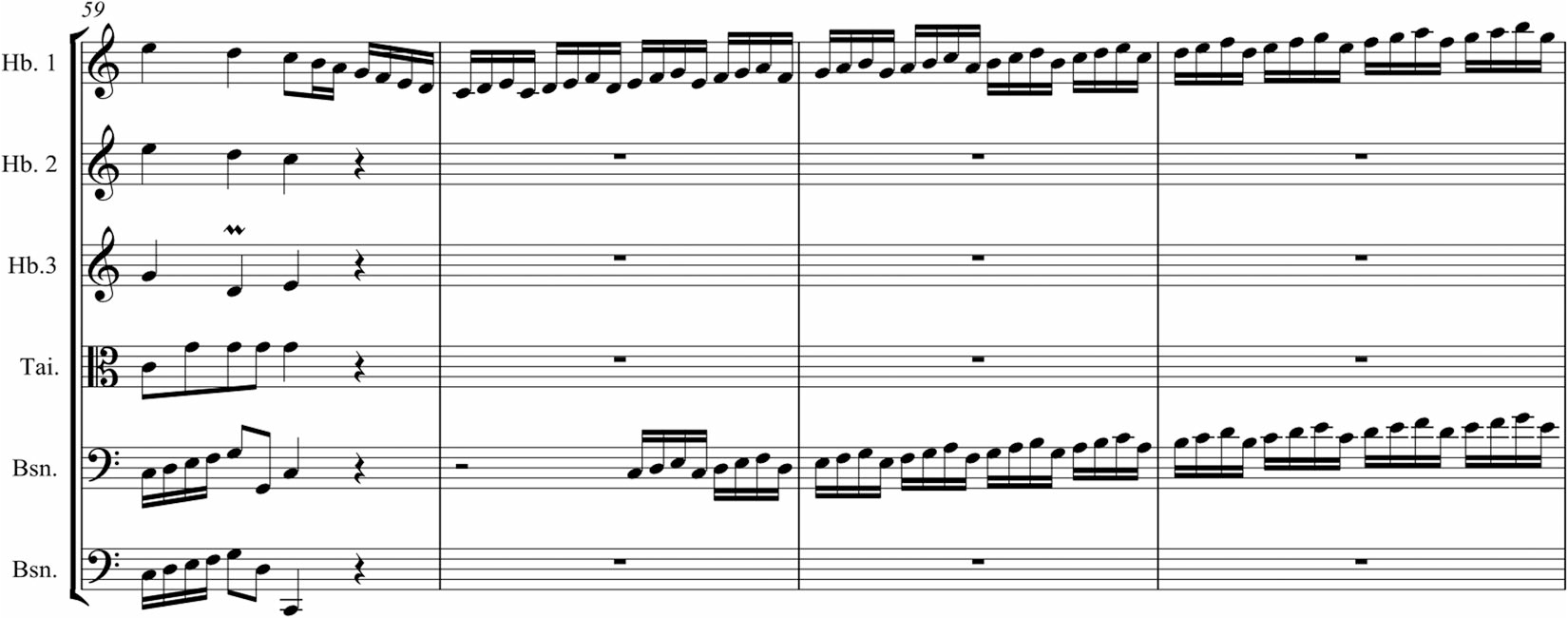
In most of the works scored for pure double-reed consort in the Lilien Partbooks the ‘Tutti’ passages require four voices. The instrumentation for these passages varies, with either two doubling hautboy parts and two separate bassoon parts, or one doubling hautboy part, two separate hautboy parts and one doubling bassoon part.
Two exceptions can be found amongst the works that require six players: the first is LPb 37, which appears to feature the first hautboy as a solo instrument accompanied by the rest of the band, and the second is LPb 49, a selection of opera arias arranged for Hautboisten, with the first hautboy part notated in C1 clef, commonly used for a soprano at this time.
Only two of the works scored for ‘hautboy band’ are not for six players. LPb 47, a Concerto in B-flat major, requires only four hautboys and one bassoon, while LPb 50, a Concerto (labelled Sinfonia) in F major, is set for two hautboys and two bassoons. In the case of LPb 47 there is a pencil marking in the partbook indicating that this work is by Telemann – an assumption that may be debatable. In LPb 50 both hautboys and both bassoons have independent parts, a situation that is particularly clear in the second part of the first movement, which comprises a fugue in four parts. Interestingly, in the third part of the first movement of this work the second part has to play two notes simultaneously during three bars, suggesting double-stopping on a violin. Since only the part for the first bassoon is labelled for a specific instrument – Basson Primo – the other bass part may also be intended for a bassoon. It is possible that the upper parts might have been intended for violins; however, the range of those parts does not exceed that of an hautboy. Taking ‘Tutti’ and ‘Trio’ markings into account, it might be plausible to assume that the upper parts were doubled.
Hautboisten and trumpets
Two of the works from the Lilien Partbooks were investigated by Albert Lee Moore in 1981:Footnote 197 the Concerto in D major (LPb 3) and another Concerto in D major (LPb 32a, labelled Sÿmphonia – referred to as 32b in Moore's dissertation). Moore states that LPb 32a (one of the two works for two trumpets in the collection) is not an arrangement of pieces taken from Handel's opera Amadigi (1715). At the end of this work in Partbook 3 (Hautbois III) the title for Handel's opera is given; however, this refers to the music on the following pages (LPb 33), which is an arrangement of the complete opera, excluding the recitatives.Footnote 198 Perhaps Moore did not have access to the entire manuscripts, which could have led to the misunderstanding that the title for Amadigi referred to the music on the same page and on the previous pages rather than to the next page (of which he most likely did not possess a copy).
The Lilien Partbooks contain 11 compositions that fall into the category of double-reed ensemble including one trumpet. A further four works also employ trumpets, in one case two trumpets, plus additional string instruments. The instrumentation for LPb 11, a Concerto in D major, is one trumpet, four hautboys and two bassoons. The entry in the Sonsfeld Catalogue states that the composer of this Concerto is again a ‘Sign. Sydow’.Footnote 199 Following the argument made earlier regarding the dating of compositions including trumpets (that is, after 1713) it appears likely that Sydow junior was the composer of this work, rather than his father, Samuel Peter Sydow.
Another work for double-reed ensemble and one trumpet collated in the six partbooks also exists in a further copy that is held at the Universitätsbibliothek in Rostock.Footnote 200 The opening of this work, a Concerto in E-flat major for trumpet, three hautboys and one bassoon (LPb 31), is provided as Example 6.
Anonymous, Concerto in E-flat major (LPb 31), 1st movement, bars 1–7.
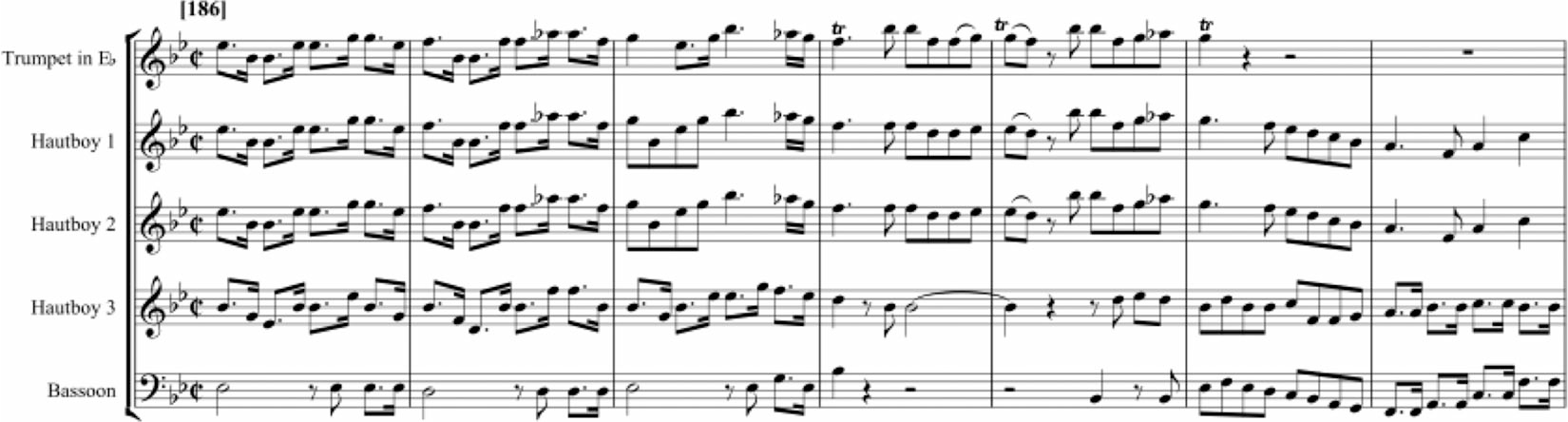
In this concerto both the first hautboy and the trumpet are treated as solo instruments, often competing with each other. In ‘tutti’ passages, however, the first hautboy usually plays in unison with the second hautboy. The trio formed by the double-reed ensemble requires two hautboys and one bassoon. Movements 190 and 191 of this work seem to be missing from the trumpet part of the Lilien Partbooks; however, they exist in the Rostock copy. Movement 192 is a second Menuet, labelled ‘Trio’, scored for two hautboys and one bassoon.
As mentioned earlier, the categorization of the music in the Lilien Partbooks leaves many questions unanswered. Several compositions contain occasional references to strings in the middle of a movement. It remains unclear whether this indicates that the wind players exchanged their instruments for string instruments for a short period of time, or if perhaps in an ‘orchestral’ performance in which strings doubled the hautboy parts, the winds were asked to remain tacet for those sections. Another solution may be that terms such as ‘Basson 1mo’ referred solely to the player in question rather than to the instrument he was playing. Nevertheless, it also seems clear that some instrumentations were chosen simply to have an instrument with the necessary range for the part (in this case a viola rather than a taille de hautbois), as can be seen in LPb 5, a concerto (labelled ‘Sinphonia’) in E-flat major for trumpet and Hautboisten ensemble.
In LPb 5 the Hautboisten are required to perform on three hautboys, two bassoons and one viola. Yet whereas elsewhere in the Lilien Partbooks the middle part in alto clef is either labelled simply ‘Taille’ or has no instrument specification at all, in LPb 5 this part is marked ‘Viola Alto’. Analysing this specific part proves the necessity of this choice, since on a number of occasions an e-flat is required, a note below the range of the taille de hautbois (see Example 7). In the following bar (bar 27), the third hautboy has a b-flat, a note below the range of this instrument; however, since this is in unison with the viola and bassoons, it seems plausible that the player would have performed the same notes as the second hautboy by repeating b-flat’. In this work the bassoons play mostly in unison, but in one movement the other instruments are tacet, leaving the bassoons to perform a duet, and in another movement they form a trio with the first oboe – each instrument playing its own distinct part.
Anonymous, Concerto in E-flat major (LPb 5), 1st movement, bars 26–27.
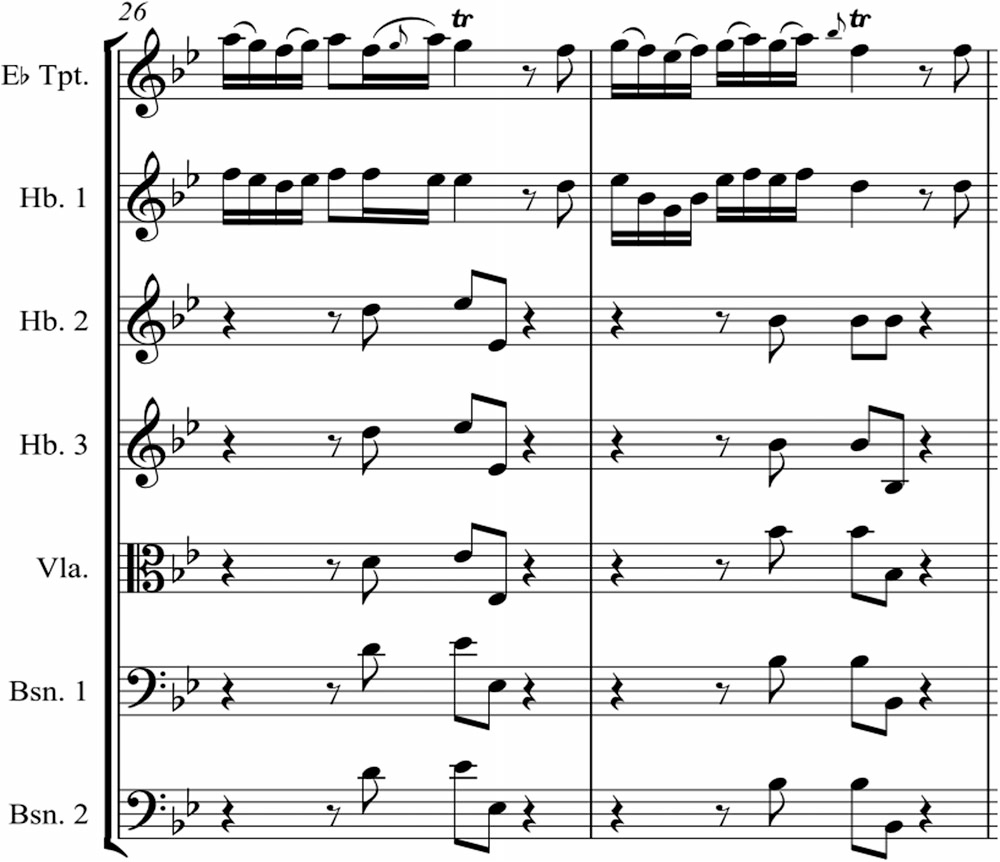
The first hautboy and trumpet often appear as the two ‘concertino’ instruments in this work. Interestingly, in movements 41 and 42 (that is the third and fourth movements in this concerto) the first hautboy part is notated in C1 clef rather than in G2 clef as is more generally the case in this partbook. All movements following the first in this concerto-style work are dances more commonly found in an overture suite.
Another composition in which the scoring includes strings is LPb 32a, a Concerto in D major in three movements titled Symphonia, and which is one of the two works investigated by Moore. Scored for two trumpets, two hautboys, two violins, one viola and one bassoon, generally the pairs of instruments form an entity competing with the other pairs and also joining in the tutti passages. The middle movement features both violins in unison as a basset, whilst the first hautboy plays a solo. Only in the final one-and-a-half bars do all parts (with the exception of the trumpets) join in a cadence on the dominant chord, which leads into the final movement featuring highly ornamented hautboy parts (see Example 8), in a piece in which hautboys, trumpets and violins are generally thematically doubling. In a usual ‘orchestral’ set-up nowadays, this composition would be performed with a string orchestra, a harpsichord, an additional bassoon, two hautboys and two solo trumpets. Nothing in the work would change, but the concept seen in the Lilien Partbooks – that is, a concerto performed by a group such as Hautboisten – implies that the winds were leading rather than merely adding timbral colour to a string orchestra.
Anonymous, Symphonia in D major (LPb 32a), 3rd movement, bars 1–11.

Hautboisten and horns
Six works in the Lilien Partbooks include horns, which can be divided into those compositions with cors de chasse (natural horn) and those with cors de post (signal horn for post coaches). In those works with two cors de post, the scoring was most likely for one instrument in F and one in B-flat. Both Overture Suites in F major (LPb 23 and LPb 24) are scored for double-reed ensemble and two cors de chasse. Two Concertos in B-flat major (LPb 26 and LPb 36) feature also two violins and require two post horns rather than hunting horns (one in F and one in B-flat), and finally the Intrada in B-flat major (LPb 25) is for double-reed ensemble with two horns in F and one post horn in B-flat. The Concerto in F major (LPb 7), which includes horns, strings and recorders, will be discussed in the group of miscellaneous compositions.
LPb 23 and LPb 24 feature the instrumentation considered by Hofer to represent the ‘birth of the Harmoniemusik’: hautboys, two horns and bassoons.Footnote 201 A variety of versions of this instrumentation exist from the first half of the eighteenth century, including either two or three hautboys and either one or two bassoons. LPb 23 requires three hautboys, two horns and one bassoon, whilst LPb 24 is set for a second bassoon.
The Overture in F major (LPb 23) is a work in ten movements, beginning with tri-partite overture. The second movement, entitled Combattans, is an example of a ‘battle’ composition for wind instruments with repeated semiquavers. A string of eight varied movements follow, some of which require the second and third hautboy players to exchange their instruments for recorders.
LPb 24, an overture suite in F major, represents exactly the instrumentation regarded by Hofer as the beginnings of the Harmoniemusik as it was discussed in part 3 with regard to Telemann's compositions for double-reed ensemble including horns, and which can also be seen in Haydn's Divertimenti for two hautboys, two horns and two bassoons (Hob. II, No. 7, No. 15 and No. 23).
On the other hand, the other works that include post horns are unique in their instrumentation. It appears that they only produced two notes in each of the compositions in the Lilien Partbooks: the fundamental and the octave. Exactly what type of horns these were remains to be investigated in future research. The works including two post horns are scored for one instrument in B-flat (the first horn) and one in F (the second horn).
Hautboisten and strings
Approximately half of the compositions included in the Lilien Partbooks require string instruments, despite the collection clearly being intended for use by Hautboisten. As already explored earlier (see Examples 7 and 8), in some instances these merely employ a tenor part that exceeds the range of a taille de hautbois, whilst in other cases the middle parts are specified for string instruments, assigning the solo parts and the bass to double reeds. In further instances they are scored in a way that would nowadays be considered ‘orchestral’.
Example 9, an extract from an anonymous Symphonia in G minor (LPb 2), shows the opening of an overture-type first movement, which is then followed by a number of dances. It appears that this work is scored for two hautboys, two violins, one ‘La Taille’ and two bassoons. The ‘La Taille’ part was most likely intended to be executed on a viola, since in several places it exceeds the range of the taille de hautbois. When the concertino instruments (here labelled trio) separate from the tutti in bar 6, the first violin and the viola provide a four-foot bass in unison, which is marked in the parts with the term basset. This instrumentation was common practice with seventeenth-century German Lullists’ such as Philipp Heinrich Erlebach (1657–1714).Footnote 202
Anonymous, Symphonia in G minor (LPb 2), 1st movement, bars 1–6.

In this first movement, in bar 48 (see Example 10), the second bassoon part contains the marking ‘violoncello’. Interestingly, the spelling for instrumental specifications on the bass parts is given as Passon Primo and Passon Secundo. In bar 48 to 50 the concertino is scored for two violins, one viola and one bass instrument. It seems reasonable to assume that the bass instrument for this group may also have been a string instrument rather than a bassoon. It remains questionable as to whether the second Passon part was intended to be performed entirely on a violoncello in this work, or if the performer may have exchanged instruments in the middle of that movement. Considering the size of a violoncello and of a bassoon, the latter seems rather implausible; however, it may be that the performer exchanged instruments between the movements. Assuming that one bass part was played on a bassoon and the other on a violoncello, scoring of this work was presumably two hautboys, one bassoon, two violins, one viola and one violoncello. If one were to add a harpsichord, this would be the same instrumentation as any other typical ‘orchestral’ overture suite of the first half of the eighteenth century.
Anonymous, Symphonia in G minor (LPb 2), 1st movement, bars 48–52.

The third movement in this composition also deserves attention: an Andante, numbered 18 (see Example 11). In the partbook labelled Hautbois II, parts for Flauto Primo and Flauto Secondo are provided for this movement on the left-hand and right-hand pages, respectively. This requires the player of the second hautboy to exchange his hautboy for a recorder; however, it also implies that a further, eighth, player is needed for this movement.
Anonymous, Symphonia in G minor (LPb 2), 3rd movement, bars 1–10.
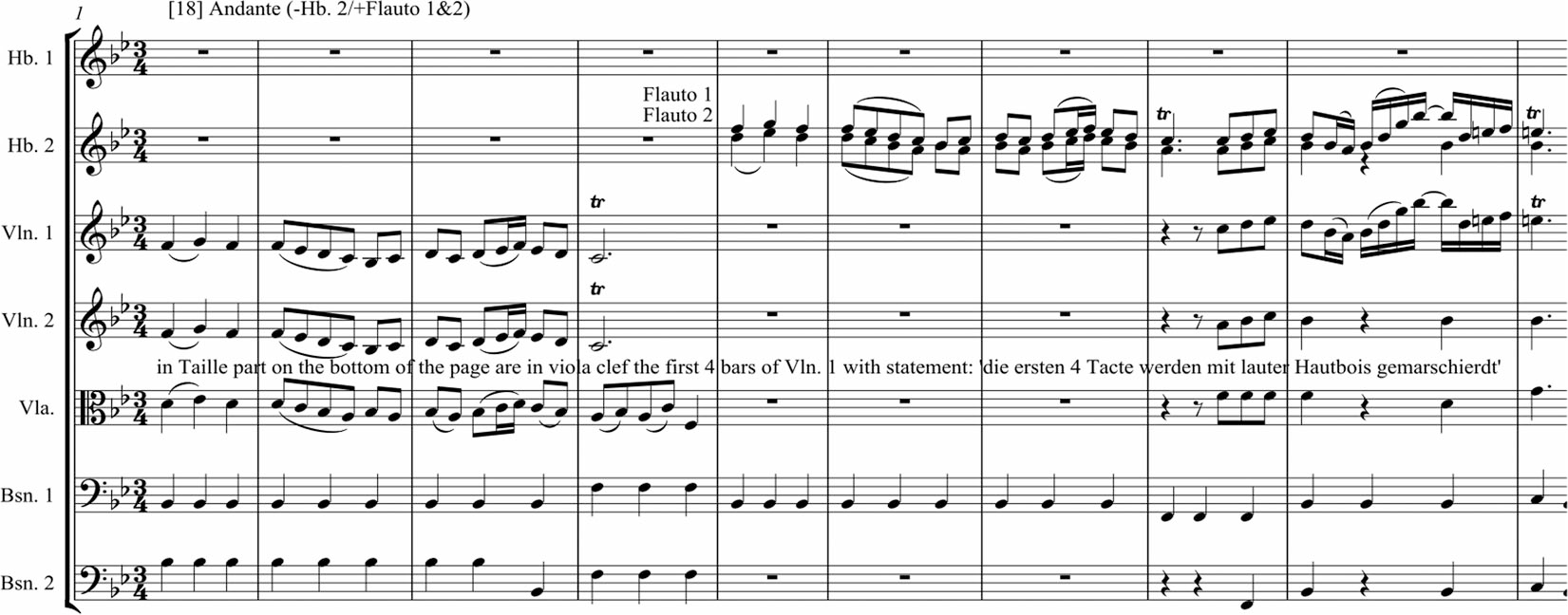
This might open the path to speculation concerning the possibility that the second bassoon part was intended to be doubled by a violoncellist, who may perhaps have performed the second recorder part in the Andante. Confusingly, however, in the part for ‘La Taille’, there is a textual note added below the actual piece, showing the first four bars of the 1st violin line in viola clef (a passage which is in thirds with the viola) and stating that ‘die ersten 4 Tacte werden mit lauter Hautbois gemarschierdt’ (the first four bars will be marched with loud hautboy). Unfortunately this remains a conundrum, since both violin parts as well as the viola part extend below the range of an hautboy. Furthermore, with the added recorders, it appears that the first hautboy remains the solo instrument in this movement, given that it engages in elaborate ornamentation.
In the other compositions that include strings in the Lilien Partbooks, the general scoring appears to be similar. Usually these works are for two hautboys, two violins, one viola and two bassoons. It seems far more likely in these cases that the ‘La Taille’ parts were meant for a viola rather than a taille de hautbois.
The work with the most movements in the Lilien Partbooks – namely 30 in total – is an arrangement of the entire opera Amadigi (1715) by George Friderick Handel (except for the recitatives) – LPb 33. Winton Dean examined this arrangement of the work in a 1991 article.Footnote 203 Interestingly, in the fourth partbook some movements call for a viola and some for a ‘Taille’, while other parts also regularly call for change of instruments. In three movements a trumpet is added to the score.
Arrangements of several other works by Handel can be found in the partbooks. LPb 45 is the overture to the opera Il Pastor Fido (1712), and LPb 51 can be recognized as Handel's Concerto grosso, op. 3 no. 4. Several other arrangements of opera arias could recently be identified. These are LPb 34, LPb 37, LPb 40, LPb 47 and LPb 49 in the attached catalogue, and include, beside Handel, composers such as Francesco Mancini (1672–1737), Alessandro Scarlatti (1660–1725), Johann David Heinichen (1683–1729), Reinhard Keiser (1674–1739) and Antonio Lotti (1667–1740).Footnote 204 The instrumentation varies between four hautboys and two bassoons, or strings and trumpet added to the double-reed ensemble. Future research will analyse the details of these arrangements; however, these works appear to allow the hypothesis that Hautboisten adapted any music to their needs.
Solo instrument and Hautboisten (or ‘Orchestra’?)
The category of ‘solo works’ is represented by eight compositions in the Lilien Partbooks. Five of these feature an hautboy as the solo instrument, two feature a ‘Flauto Traverso’ (LPb 19, LPb 41) and one a solo bassoon (LPb 17). In several of the works in this category the first violin is also presented as a solo instrument in some passages.
Example 12 shows the ‘orchestral’ opening of the first movement of the Concerto in C minor for hautboy (LPb 15). Similar to concertos by Antonio Vivaldi (1678–1741) or Tomaso Giovanni Albinoni (1671–1751), this work features the hautboy in the solo sections and has it remain tacet during the ritornelli. The latter are generally scored for first and second violin, together with both bassoons in unison. Only in the second movement do the violins have separate lines.
Anonymous, Concerto in C minor (LPb 15), 1st movement, bars 1–3.
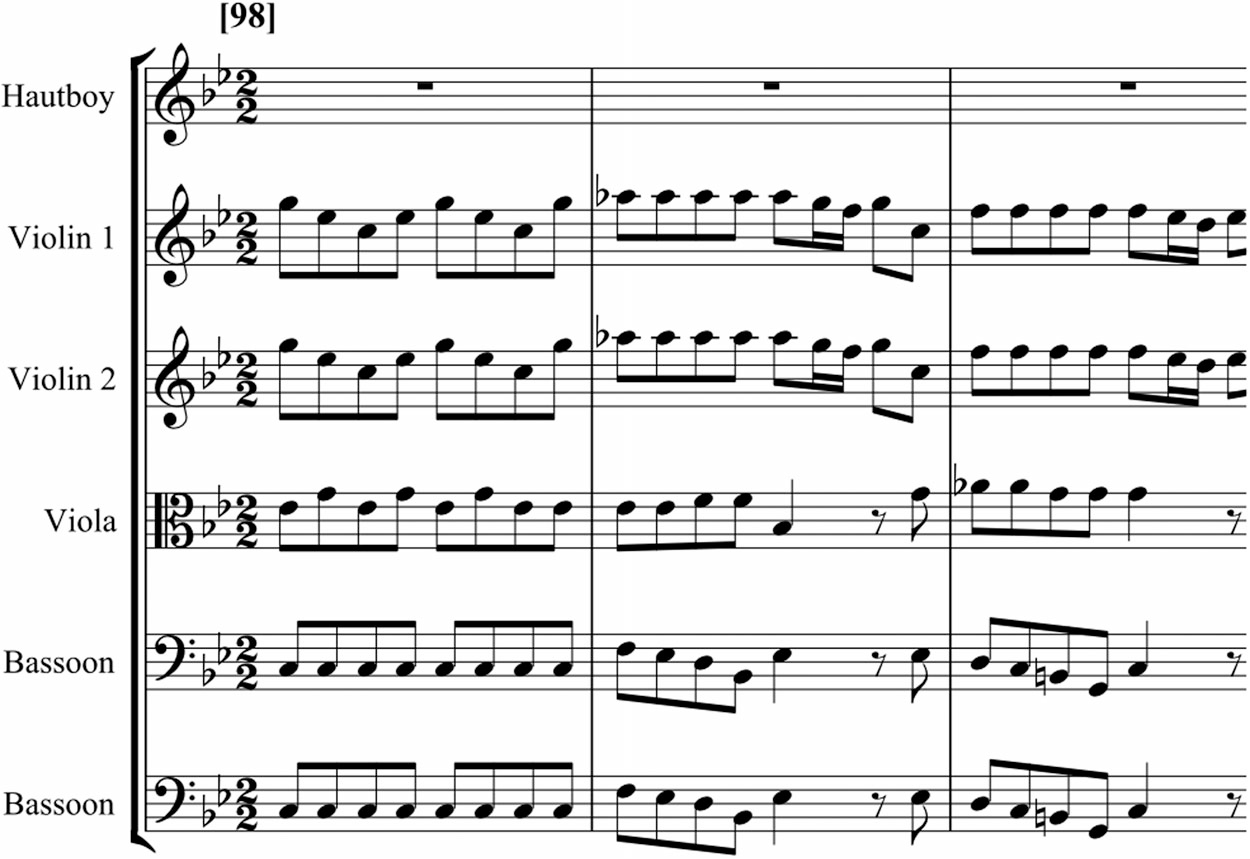
The solo sections for the hautboy are generally accompanied by the first bassoon, but also occasionally by the strings (see Example 13).
Anonymous, Concerto C minor (LPb 15), 1st movement, bars 13–15.

The Overture Suite in G minor (LPb 42) differs only in that it is not a concerto but a series of dances including its opening movement, yet featuring one hautboy as a solo instrument. The Concerto in B-flat major (LPb 17) presents a virtuosic solo part for the first bassoon and uses the hautboy merely as a ripieno instrument to double the first violin in the tutti passages. The Concerto in F major (LPb 16) is, according to a pencil note, by Handel. This pencil mark, however, was most likely added by the same scholar who provided the work numbers in the twentieth century.
The composition with the work number LPb 41 deserves attention, since it appears to be a well-known work by Georg Philipp Telemann. This Concerto in D major for ‘Flauto Traverso’ is a transcription of his Concerto for recorder and orchestra in F major (TWV 51:F1). The part for the second bass is clearly marked for a violoncello, which remains tacet in the solo sections, during which the first bassoon accompanies the flute.
All the concertos for one solo instrument and ‘orchestra’ in the Lilien Partbooks appear to correspond to the general style of solo concertos of the time. The only difference appears to be the regular instrumentation incorporating two bassoons for the bass part; however, in those works that specify a violoncello, the forces are the same as those generally required for standard early eighteenth-century concertos. The use of a keyboard instrument as part of the basso continuo group is not evident in the partbooks either through instrumentation markings or through figures in the bass line; nevertheless, it may well be possible that in some circumstances this instrument might have been added. If these works were performed in a [battle] field situation, however, it seems most unlikely that a keyboard would have been involved, as has been argued above.
Miscellaneous
The final category of compositions from the Lilien Partbooks to be discussed here are those works that cannot be placed in any of the other groups. Two are scored for two recorders as distinct instruments in addition to the two hautboys through the entire work (as opposed to being exchanged for hautboys for a number of bars or one entire movement); and one is a trio sonata for hautboy, violin and bass, probably by Handel.
Example 14 shows an excerpt of a Concerto in F major for two recorders, two hautboys, two horns and two bassoons (LPb 7). A number of instrumental changes are marked, though it appears uncertain as to what they mean. In bar 18 of the first movement, for example, the first hautboy part is marked as ‘violin basset’, while the horns and the bassoons remain tacet for the following 34 bars. Both hautboy parts are in unison in these bars, and their line extends down to g, a note that, indeed, cannot be performed on the hautboy. Whether this indicates that both parts were intended to be doubled by violins, leaving the hautboys to remain tacet in this part, or that the term ‘Hautbois’ at the beginning of the subsequent tutti section was used for the player rather than for his instrument, cannot be answered with certainty.
Anonymous, Concerto in F major (LPb 7), 1st movement, bars 15–22.

In the second movement of this Concerto, an Adagio, the second recorder part is marked ‘Hautbois solo’ (see Example 15). The music for both recorders is not particularly soloistic, but instead functions as an accompaniment to the elaborate first hautboy part (which may perhaps have been intended for violin – see comments on ‘violin basset’ earlier). Accordingly, it seems likely that this marking only served to inform the recorder players that this is the movement with the hautboy solo.
Anonymous, Concerto in F major (LPb 7), 2nd movement, bars 1–8.
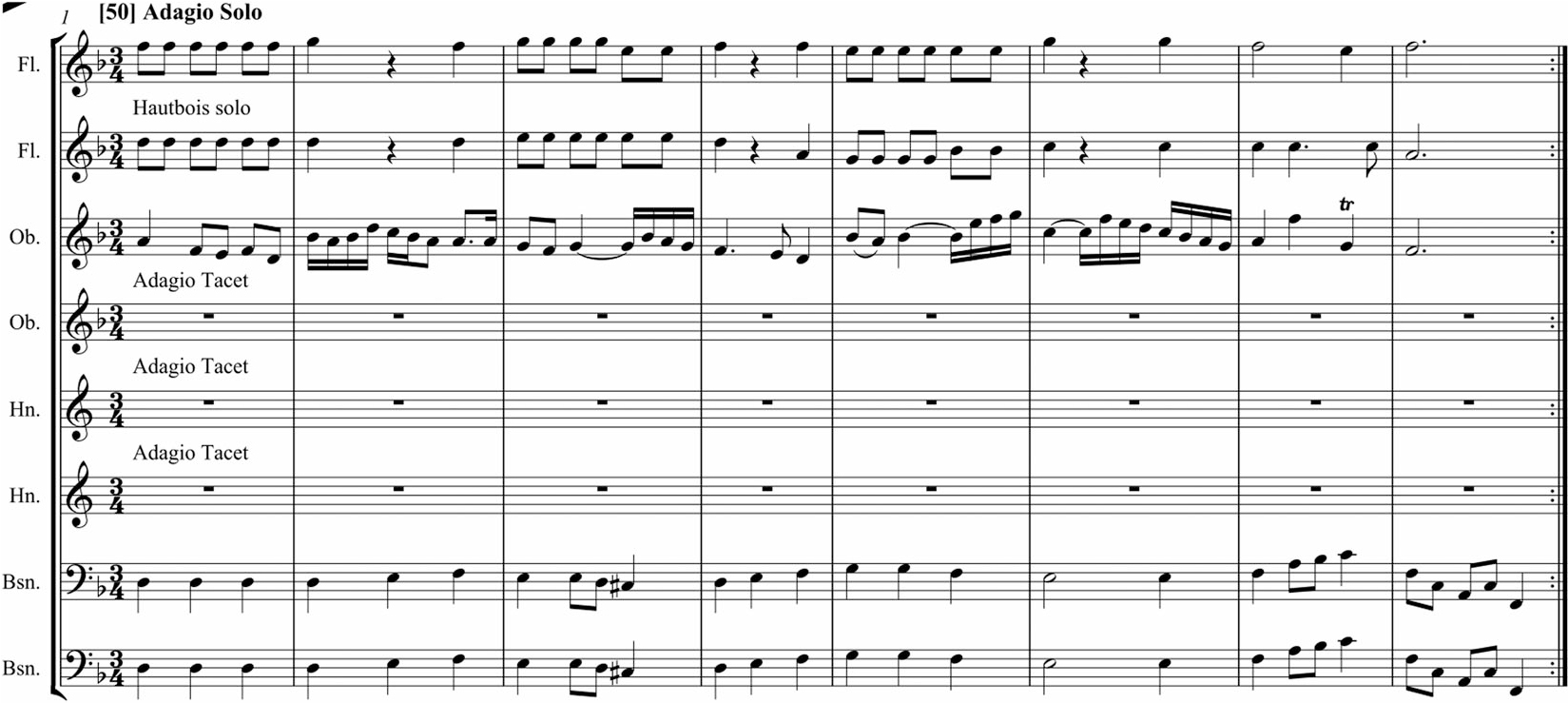
The first of the two Gigues in this Concerto (movement No. 53) requires both recorder players to exchange their instruments for hautboys, playing in unison with the first and the second hautboys, as marked in their parts. This is also evident in the range of the parts that exceeds that of a treble recorder. The second Gigue, however, clearly requires recorders (being marked ‘Flauto’) again, whilst the second hautboy and the second bassoon are tacet.
Alongside the works scored for larger ensembles (which are by far the majority of the repertoire in the Lilien Partbooks) is a single trio sonata in B-flat major (LPb 52). This work was published in 1935 in an edition by W. Hinnenthal.Footnote 205 A second manuscript copy of this work is also kept in the Bibliotheca Fürstenbergiana and listed in the Sonsfeld Catalogue, which identifies Handel as its composer. The bass part in Lilien Partbooks is simply labelled ‘Basso’, and although there are no figures (either in this copy or in the second one held in Herdringen), Hinnenthal's edition offers a realized part for harpsichord. While it cannot be answered with certainty that a keyboard instrument was used alongside with a bassoon or a violoncello in performance by the Hautboisten for whom these partbooks were compiled (either under the auspices of von Lilien or von Wittenhorst-Sonsfeld), again it seems reasonable to assume that no keyboard instrument would have been transported to a [battle] field. It is, however, necessary to keep in mind that Hautboisten were, of course, able to play the harpsichord, as indicated in a document dating from 1737, which contains an order from King Friedrich Wilhelm I to both Sydow junior and to the ensemble of the Prussian Königsregiment:
| König Friedrich Wilhelm I. in Preußen, an Oberstleutnant Christoph Johann von dem Knesebeck vom Königsregiment; Potsdam, 6. August 1731: ‘Ihr sollet dem (adjungierten Kapellmeister beim Militär-waisenhaus zu Potsdam) Sydow sowohl als denen Hobois meines Regiments anbefehlen, und zwar denen Hobois bei Spießruthen-strafe, auf kein ander Instrument als auf der Flöthe, den Hobois und dem Clavier zu spiehlen, aber auf keine Violinen und Baßgeigen, und sollet Ihr die Violinen und Baßgeigen, so sie itzo haben, ihnen wegnehmen lassen, und solche oben auf dem Schloß alhier legen lassen.’Footnote 206 | King Friedrich Wilhelm I in Prussia to Oberstleutnant Christoph Johann von dem Knesebeck of the Königsregiment, Potsdam, 6 August 1731: ‘You should order (the adjunct Kapellmeister of the orphanage in Potsdam) Sydow and also the Hautboisten of my regiment, in fact the Hautboisten on pain of running the gauntlet, not to play any other instrument than the recorder, the hautboys and the harpsichord, but no violins and bass violins; and you should take away from them those violins and bass violins which they have now, and store them up here in the castle. |
The examples from the Lilien Partbooks discussed above seem to represent music collated for performance by Prussian Hautboisten. It also emerges that the musical genres included in these partbooks vary greatly. Some of the works are clearly for hautboy band (that is, for pure double-reed ensembles), whilst others include brass instruments, and still others even strings. Recorders are occasionally employed in order to provide a different sound colour for a few bars or for a single movement; sometimes they even have their own part throughout an entire composition. Those works with strings frequently require an instrumentation that is now commonly recognized as the ‘orchestra’, accompanying solo instruments such as a transverse flute or an hautboy and, on one occasion, a bassoon. In other cases, however, strings merely provide the middle parts in a work, while hautboys present the elaborate melody lines and bassoons provide the bass lines.
In light of the description of the musical activities of the students of the Hoboistenschule provided earlier, the variety of works in the Lilien Partbooks demonstrate clearly that the concept of independent groups did not function in a manner different from any other ‘orchestral’ group of performers.
Conclusion
A preliminary definition of music for Hautboisten?
This article has explored a wide-ranging selection of extant music for Hautboisten and has engaged in the hypothesis that compositions might offer clues as to the instrumentation, the number of players and also a general understanding of the common consorts in use in the German-speaking lands in the early decades of the eighteenth century. This Conclusion further draws on this evidence of ‘music for the masses’, which Haynes referred to as the ‘Muzak’ or the ‘radio’ of the time.Footnote 207
The primary goal of the previous section of this article was to establish the grounds for a hypothetical definition of the music typically played by Hautboisten. From this examination, it appears that the current convention of equating Hautboisten with ‘oboists’ and, accordingly, the phrase Hautboisten Bande with ‘oboe band’ (or ‘hautboy band’) cannot withstand scrutiny. Even though the surviving eighteenth-century publications of music for Hautboisten appear to indicate a pure double-reed band – an ‘oboe band’ – as a common formation, the analysis of manuscript music presumably intended for performance by Hautboisten illustrates the diversity of these players’ roles in reality, and sheds light on the variety of possible instrumentations for these ensembles.
It seems safe to assume that composers like Krieger definitely had bands of Hautboisten in mind among the potential purchasers of their published music. Furthermore, we can be certain that the manuscript arrangements of music by Venturini were meant for one of these groups. Nevertheless, only a minority of surviving compositions for Hautboisten are for double-reed instruments alone. Recalling that Krieger indicates that ‘small ensembles of amateurs also can perform these suites with violins’, and since the original edition of the Feld-Musik provided ensembles with three parts for the first treble and the bassoon, respectively, and two parts for the second treble, ‘so that when performing as Feldmusik and in bands these parts can be stronger’,Footnote 208 this collection was primarily intended for a pure double-reed band. Although Krieger only suggests strings and a harpsichord as an alternative instrumentation, the possibility, and indeed the likeliness, cannot be ruled out that these suites were also performed by a combination of strings and winds, perhaps joined by a keyboard instrument for the basso continuo. This possibility may represent an amalgamation of consorts of double-reeds and strings of equal strength, sometimes featuring the hautboys as a timbral colour within a string ensemble, but in other instances perhaps using strings to fill the middle parts in a wind band as we have seen in some of the works within the Lilien Partbooks.
Accordingly, when Robertson asks whether ‘perhaps string ensemble and double-reed ensemble were interchangeable’,Footnote 209 he allows the hypotheses, on one hand, that the concept of an orchestra with a substantial number of string players with solo wind players may not yet have been established as the single norm in German-speaking lands at the beginning of the eighteenth century, and, on the other hand, that any music, whether intended for string bands or any other instrumentation, may have been used by Hautboisten.
It seems, therefore, that a limited knowledge of double-reed ensembles performing as an entity has misled scholars and musicians nowadays to equate Hautboisten with ‘oboe bands’. For Prussian Regiments-Hautboisten the trumpet was an early and essential addition to the score. Music including other wind instruments, such as horns, clarinets and flutes, nevertheless, seems to provide the largest quantity of surviving scores intended for Hautboisten. This music is evidently the predecessor of the wind octet, the Harmoniemusik ensemble, which is often considered a less important sideline in the canon of Western art music. Accordingly, and not unsurprisingly, scholars have also regarded Hautboisten as musicians of minor significance; however, as existing pieces by Telemann, Mattheson and others prove, instrumentation alone does not inform us about the quality of a composition and its players. It might suggest, nevertheless, that elaborate music for wind ensembles composed by these masters was possibly intended for court Hautboisten rather than those employed by the military.
Drawing upon our knowledge of the French provenance of Hautboisten and the information provided by Braun on their role in the German-speaking lands, there can be no doubt that these multi-instrumentalists performed on wind as well as on string instruments. Braun demonstrates that Hautboisten were known to have been involved in performing Tafelmusik and also shows the variety of instrumentation these groups were able to provide. Assuming that Tafelmusik was played by Hautboisten (or at least by a combination of them and players of the courtly Kapelle), an instrumentation of ‘oboe band’ with added strings becomes one of many standard combinations for these ensembles, rather than an exception. Moreover, the examples from the Lilien Partbooks discussed earlier prove that there is evidence for the use of strings for the middle parts in a wind band.
The practice of arranging music, such as the works by Venturini, shows that any music may have been performed by Hautboisten, since these players made use of any Gebrauchsmusik whenever music was needed. This became even more evident in the foregoing analysis of the music of the Lilien Partbooks, which, along with many works by anonymous composers, contain several arrangements of music by well-known masters, such as George Friderick Handel and Georg Philipp Telemann.
This article has demonstrated that the instrumentation possibilities for Hautboisten are to be found in much of the musical repertoire of the eighteenth century. There can be no doubt that Bach and his contemporaries were familiar with Hautboisten and Stadtpfeifer.Footnote 210 It seems most likely, even if only for financial reasons, that performances with one-per-part were still the norm in German-speaking lands and doubling strings was the exception.
The existence of Hautboisten ensembles and their utilization by composers prove that they were common in the German-speaking music world. Accordingly, the analysis of a selection of compositions considered in combination with knowledge of the history of Hautboisten in German-speaking lands, and in particular in Prussia, provides some answers to a number of the questions asked at the beginning of this article. Nevertheless, the research focus on wind ensembles and their role in the art music of the sixteenth and seventeenth centuries, as well as the unanswered queries that appeared throughout this investigation, allows us to utilize the presented current state of knowledge and the attached catalogue as a stepping stone for future research.
Note on contributor
Georg Corall is an Honorary Research Fellow with the ARC Centre of Excellence for the History of Emotions, and with the UWA School of Music, where he was awarded the degree of Doctor of Musical Arts. Subsequently, he commenced his studies for a PhD in historical musicology (Monash University, Melbourne). Before entering academia, he trained as a teacher and performer of historical oboes, recorder and harpsichord. With his ensemble les hautboïstes de prusse, he strives to find practical answers to his scholarly interest in the music of Hautboisten, and in the rediscovery of the sound of double-reeds made according to historical information.
ORCID
Georg Corall http://orcid.org/0000-0003-4237-1478
The Lilien Partbook Catalogue (LPb) – Manuscript: D-HRD Fü 3741a
Categories of Instrumentation (with corresponding LPb-Numbers)
1. Double-Reed Ensemble – Hautboy Band (12 works)
LPb-Numbers: 6, 8, 20, 27, 28, 29, 37, 44, 46, 47, 49, 50
2. Trumpet
a. Double-Reed Ensemble and Trumpet (10 works)
b. LPb-Numbers: 1, 3, 9, 11, 22, 30, 31, 35, 38, 43
c. Double-Reed Ensemble, Strings and Trumpet(s) (5 works)
d. LPb-Numbers: 5, 21, 32a, 33, 40
3. Horns
a. Double-Reed Ensemble and Horns (3 works)
b. LPb-Numbers: 23, 24, 25
c. Double-Reed Ensemble, Strings and Horns (2 works)
d. LPb-Numbers: 26, 36
4. Double-Reed Ensemble and Strings (10 works)
LPb-Numbers: 2, 4, 10, 12, 13, 18, 32, 34, 45, 51
5. Solo Concertos (8 works)
LPb-Numbers: 14, 15, 16, 17, 19, 39, 41, 42
6. Miscellaneous (3 works)
LPb-Numbers: 7, 48, 52
LPb 0 (Lilien Partbook Catalogue Work Number)
0-0 (Movement Numbers as in Partbooks) Title – key signature (Minimum number of Players required)
Instrumentation: (spelling generally as in the partbooks)
Partbook I – HAUTBOIS. I. ET.
Partbook II – HAUTBOIS. II. ET.
Partbook III – HAUTBOIS. III. ET.
Partbook IV – TAILLE. ET.
Partbook V – BASSON. I. ET.
Partbook VI – BASSON. II. ET.
Additional information for each partbook: instrument names given as in the original manuscript, / = different players, & = same player changing instruments, — = no music in that part, […] = suggestions by the author, (-) = no title for this movement.
Composer:… (Incipits generally from Partbook I but occasionally from other parts.
Clefs according to the original manuscript).
Movements:
Number of movement as in the partbooks
Name of movement usually as it appears in Partbook 1; occasionally changed to modern spelling or as it appears in a different Partbook. Added information by the author in parentheses [].
Comments:
Additional information.
Reference:
in: Deutsches Musikgeschichtliches Archiv Kassel (DMgA), Katalog der Filmsammlung, Die Musikalien der Bibliotheca Fürstenbergiana zu Herdringen, ed. Jürgen Kindermann (Kassel, 1987/88), 4/204–486.
LPb 1
1–12 Ouverture – C minor (6 Players)
Instrumentation:
i. Hautbois Pr.
ii. Hautbois Secundo
iii. [Hautbois 3]
iv. La Taille
v. Passon
vi. Tromba [in E-flat]
Composer: Anonymous
Movements:
1. Ouverture

2. Gigue

3. Aria vivace

4. Gavotte alternativement

5. L'autre

6. Aria molto adagio

7. Rigaudon

8. Trio

9. Menuet alternativement

10. Trio

11. Gigue alternativement

12. Gigue

Comments:
Overture suite in C minor. Hautboy 1 in unison with trumpet in alteration with hautboy 2. Hautboy 2 in unison with hautboy 1 in alteration with hautboy 3. Ornaments in hautboy 2 but not in hautboy 1 when in unison. Trios: either trumpet, hautboy 1 and bassoon or hautboy 1, hautboy 2 and bassoon.
Reference:
DMgArchiv, Katalog, 124.
Nos. 13–15 do not exist in the partbooks
LPb 2
16–22 Symphonia – G minor (8 Players)
Instrumentation:
i. [Hautbois 1]
ii. [Hautbois 2]/Flauto Pr & Flauto 2do
iii. Violino Primo
iv. La Taille
v. Passon Primo/Basson Secundo – Violoncello
vi. Violino 2do
Composer: Anonymous
Movements:
16. Symphonia

17. Bourée

18. Andante

19. Vivace

20. Allemande

21. Sarabande

22. Tempo di Menuet

Comments:
Overture suite in G minor. Partbook ‘Hautbois II’; 18. Andante – instrument change to two recorders. In that movement in ‘La Taille’ partbook a note: ‘the first 4 bars should be marched with loud Hautboy’. Range of ‘La Taille’ part down to c, therefore it requires to be performed on viola rather than Taille de hautbois. Hautboy 1 in several movements solo with violins/viola ‘basset’, indicating that the bassoons rest and 4' string bass accompanies the solo hautboy. Bassoons form regularly a duet; then the other instruments rest. In the middle of 16. Symphonia in bassoon 2 part a note: ‘Violoncello’.
Reference:
DMgArchiv, Katalog, 128.
LPb 3
23–28 Concerto – D major (6 Players)
Instrumentation:
i. [Hautbois 1]
ii. [Hautbois 2]
iii. Hautbois 3me
iv. [-]
v. Basson Primo/Basson Secundo
vi. Trompett [in D]
Composer: Anonymous
Movements:
23. Concerto

24. Aria

25. Menuet alternativement

26. L'autre Menuet

27. Allegro

28. L'autre Allegro

Comments:
Italian-style concerto-type first movement followed by dances. See Albert Lee Moore, ‘Two Anonymous Eighteenth-Century Manuscripts for Trumpet with Oboe Ensemble from the Lilien Part-Books' (DMA Dissertation, North Texas State University, 1981).
Reference:
DMgArchiv, Katalog, 118–19.
LPb 4
29–38 Sinfonia – B-flat major (8 Players)
Instrumentation:
i. [Hautbois 1]/Flauto
ii. Hautbois tous & Flauto solo
iii. Violin 1/Violin 2
iv. [Viola 1/Viola 2]
v. Basson Primo/Basson Secundo
vi. Basson Secundo/Basson 3
Composer: Anonymous
Movements:
29. Sinfonia

30. Allemande

31. Aria Allegro

32. Passepied alternativement

33. Trio

34. Adagio

35. Aria Menuet

36. Aria Menuet Primo Hautbois seul

37. Grave e staccato

38. Allegro

Comments:
Overture suite in B-flat major. Partbook ‘Hautbois II’ – in several short passages change of instrument to recorder. Viola part does not specify two players, but has two voices in several movements. Those movements without the second voice for viola have a third bassoon part, which implies one player changing between these two instruments for some movements.
Reference:
DMgArchiv, Katalog, 128–9.
LPb 5
39–45 Sinphonia – E-flat major (7 Players)
Instrumentation:
i. [Hautbois1]
ii. [Hautbois 2]
iii. Hautb. 3tro
iv. Viola Alto
v. Basson Primo/Basson Secundo
vi. Tromba [in E-flat]
Composer: Anonymous
Movements:
39. Sinphonia

40. Grave

41. Aria

42. Aria

43. Gigue alternativement

44. Duetto [for two bassoons]

45. Aria

Comments:
Italian-style concerto first movement followed by dances. Although manuscripts specifically marked ‘viola alto’, this part never exceeds below f and is accordingly possible to be realised on a Taille de hautbois. Tutti at beginning of first movement without trumpet, but in the da Capo the trumpet joins. Movement 40 (Grave) shows two notes in the last bar of the 1st hautboy part.
Reference:
DMgArchiv, Katalog, 127–8.
LPb 6
46–48 Concerto – B-flat major (6 Players)
Instrumentation:
i. [Hautbois 1]
ii. [Hautbois 2]
iii. Hautbois 3.
iv. Hautbois 4do
v. [Basson 1]
vi. Basson 2do
Composer: Anonymous
Movements:
46. Concerto

47. Duetto

48. Allegro

Comments:
Concerto in three movements for ‘hautboy band’ in B-flat major. Second bassoon down to BB-flat. First hautboy often solo. Concertino passages usually with either two hautboys or two bassoons.
Reference:
DMgArchiv, Katalog, 123.
LPb 7
49–54 Concerto – F major (10 Players)
Instrumentation:
i. Hautbois 1 & Violin basset
ii. Flauto Primo/Flauto Secundo/Hautbois solo or primo/Hautbois 2do
iii. Hautbois Secundo
iv. Cors de chasse Premier/Secundo Cors de chasse
v. Basson Primo
vi. Basson Secundo
Composer: Anonymous
Movements:
49. Concerto

50. Adagio

51. Tempo di Bourée

52. L'autre [for two cors de chasse and two bassoons]

53. Gigue alternativement

54. L'autre

Comments:
Italian-style concerto first movement followed by dances. In first movement both hautboy parts marked ‘Violin Basset’ and exceed down to g. Most likely for ten rather than eight players with hautboy parts doubled by violins. Recorders in this concerto not in exchange, but with distinct parts throughout the concerto.
Reference:
DMgArchiv, Katalog, 121.
LPb 8
55–58 Concerto – C major (6 Players)
Instrumentation:
i. [Hautbois 1]
ii. [Hautbois 2]
iii. Hautbois 3.
iv. [Taille de hautbois]
v. Basson Primo
vi. Basson Secundo
Composer: Sydow
Movements:
55. Concerto

56. Andante

57. Ritornelle

58. Allegro

Comments:
Concerto in four movements for ‘hautboy band’ in C major. First hautboy often solo. ‘Trio’ (Concertino) passages usually with two bassoons; sometimes also one solo hautboy and two bassoons. According to the entry in the Sonsfeld Catalogue composed by Sigr. Sydow.
Reference:
DMgArchiv, Katalog, 111.
LPb 9
59–65 Concerto – C minor (7 Players)
Instrumentation:
i. [Hautbois 1]
ii. [Hautbois 2]
iii. Hautb. Tertio
iv. [Taille de hautbois]
v. Basson Primo/Basson Secundo
vi. Tromba [in E-flat]
Composer: Anonymous
Movements:
59. Concerto

60. March

61. (-)

62. Aria

63. Menuet alternativement

64. Duetto [for two bassoons]

65. Gigue

Comments:
Concerto-type first movement followed by dances in C minor. Concertino mostly trumpet, hautboy 1 and bassoon 1. Trumpet and hautboy 1 also regularly as Concertino. Occasionally the bassoons form a duet, in which the other instruments rest.
Reference:
DMgArchiv, Katalog, 117.
LPb 10
66–73 Sinphonia – G minor (7 Players)
Instrumentation:
i. [Hautbois 1]
ii. Violino 1mo
iii. Hautbois 2do/Violino 2do
iv. La Taille
v. Basson Primo
vi. Basson Secundo
Composer: Anonymous
Movements:
66. Sinphonia

67. Rondeau

68. Aria andante

69. Arietta

70. La Speranza

71. Menuet alternativement

72. Duetto [for two bassoons]

73. (-)

Comments:
Overture suite in G minor. ‘La Taille’ never below f and can therefore be realized on a Taille de hautbois. Occasionally the bassoons form a duet, in which the other instruments rest. ‘Orchestral’ instrumentation with strings doubling the hautboys, but also hautboy 1 and violin 1 as Concertino.
Reference:
DMgArchiv, Katalog, 128.
LPb 11
74–80 Concerto – D major (7 Players)
Instrumentation:
i. [Hautbois 1]
ii. [Hautbois 2]
iii. Hautbois 3
iv. Hautbois 4do
v. Basson Primo/Basson Secundo
vi. Tromba [in D]
Composer: Sydow
Movements:
74. Concerto

75. Aria

76. Rondeau

77. Aria

78. Gigue

79. Aria

80. Allegro

Comments:
Concerto-type first movement followed by dances in D major. Concertino mostly trumpet, hautboy 1 and bassoon 1. Occasionally the bassoons form a duet, in which the other instruments rest. According to the entry in the Sonsfeld Catalogue composed by Sigr. Sydow.
Reference:
DMgArchiv, Katalog, 111.
LPb 12
81–90 Ouverture – G minor (6 Players)
Instrumentation:
i. [Hautbois 1]
ii. Hautb: 2do
iii. Violino Primo
iv. Viola
v. Basso continuo
vi. Violino 2do
Composer: Anonymous
Movements:
81. Ouverture

82. Gavotte

83. Bourée alternativement

84. Bourree 2

85. Sarabande

86. Rigaudon alternativement

87. Trio

88. Passacaille

89. Passepied alternativement

90. Trio

Comments:
Overture suite in G minor. Concertino usually consists of the hautboys with the violins (occasionally also viola) forming a 4' bass. Basso continuo without figures. Passacaille marks in violin 1 part ‘Flauto et Violin’. Flauto (recorder) could be played by violin 2, viola or Basso continuo player, since those instruments rest in these bars.
Reference:
DMgArchiv, Katalog, 126.
LPb 13
91–94 Concerto – C major (6 Players)
Instrumentation:
i. [Hautbois 1]
ii. Hautbois Secundo
iii. Violino Primo
iv. Viola
v. Basson [!] continuo
vi. Violino Secundo
Composer: Anonymous
Movements:
91. Vivace

92. Adagio

93. Menuet alternativement

94. Trio

Comments:
Italian-style double-concerto for two hautboys and ‘orchestra’ in C major. Bass line for Basson continuo instead of Basso continuo, which might indicate one bassoon rather than a group comprising a keyboard instrument and bass string instruments. The marking ‘Basset’ in the violin and viola parts indicating that the bass instrument rests.
Reference:
DMgArchiv, Katalog, 115.
LPb 14
95–97 Concerto – E-flat major (6 Players)
Instrumentation:
i. Hautbois
ii. Violino 1mo
iii. Violino Secundo
iv. Viola
v. Basson [!] continuo
vi. Violoncello
Composer: Anonymous
Movements:
95. Concerto

96. Siciliana

97. Allegro

Comments:
Italian-style solo-concerto for hautboy and ‘orchestra’ in E-flat major. Bass 1 for Basson continuo instead of ‘Basso continuo’, which might indicate a bassoon rather than a group comprising a keyboard instrument and bass string instruments. Bassoon and violoncello part throughout in unison.
Reference:
DMgArchiv, Katalog, 122.
LPb 15
98–100 Concerto – C minor (6 Players)
Instrumentation:
i. [Hautbois]
ii. Violino Primo
iii. Violino 2do
iv. Viola
v. Basso [!]
vi. Basson Secundo
Composer: G. Ph. Telemann (?)
Movements:
98. Concerto

99. Adagio

100. Allegro

Comments:
Italian-style solo-concerto for hautboy and ‘orchestra’ in C minor. Solo passages of the hautboy usually accompanied by first bassoon. According to RISM Georg Philipp Telemann, TWV 44:31. See: opac.rism.info.
Reference:
DMgArchiv, Katalog, 116–17.
LPb 16
101–104 Concerto – F major (6/8 Players)
Instrumentation:
i. Hautbois
ii. [Violino]
iii. Violin Secunde unisoni
iv. Viola
v. [Basson 1]
vi. [Basson 2]
Composer: George Friderick Handel (?)
Movements:
101. Concerto

102. (-)

103. Aria

104. (-)

Comments:
Italian-style concerto for hautboy, strings and two bassoons in F major. In second movement violin 1 has very prominent solo. According to pencil mark in partbooks by G. F. Handel. In Partbook II movement 102 at beginning ‘unisoni’ and later ‘Violino Solo’, which perhaps indicates to double first and second violins.
Reference:
DMgArchiv, Katalog, 120.
LPb 17
105–107 Concerto – B-flat major (6 Players)
Instrumentation:
i. [Hautbois 1]
ii. Violino Primo
iii. Violino Secundo
iv. Viola
v. Basson Concerto
vi. Basson
Composer: Anonymous
Movements:
105. Allegro

106. Adagio

107. Allegro

Comments:
Solo concerto for bassoon and ‘orchestra’ in B-flat major. Very virtuosic bassoon part. Hautboy 1 features as ripieno instrument.
Reference:
DMgArchiv, Katalog, 122–3.
LPb 18
108–113 Ouverture – G major (6 Players)
Instrumentation:
i. [Hautbois 1]
ii. Hautbois 2do/Violino 1mo
iii. Hautb: 3to
iv. [Viola]
v. [Basson]
vi. Violino 2do
Composer: Anonymous
Movements:
108. Ouverture

109. Tremolo adagio

110. Allegro

111. Largo

112. Menuet alternativement

113. Trio

Comments:
‘Orchestral’ overture suite in G minor.
Reference:
DMgArchiv, Katalog, 126.
LPb 19
114–121 Concerto – D major (7 Players)
Instrumentation:
i. Flaute traverse
ii. Violino concerto
iii. Violino 1. Ripieni/Violino 2do Ripieno
iv. Viola
v. [Bass 1]
vi. [Bass 2]
Composer: Anonymous
Movements:
114. Concerto

115. Largo

116. Allegro

117. Rigaudon alternativement

118. Rigaudon solo

119. Menuet alternativement

120. Trio

121. Gigue

Comments:
Concerto for ‘Flauto traverso'solo and ‘orchestra’ in D major.
Reference:
DMgArchiv, Katalog, 119.
LPb 20
122–126 Concerto – C major (6 Players)
Instrumentation:
i. Hautb: 1mo
ii. Hautb: 2do
iii. Hautbois
iv. Taille
v. [Basson 1]
vi. [Basson 2]
Composer: Anonymous
Movements:
122. Concerto

123. Duetto adagio

124. Allegro

125. Stringilo

126. Quinto peno

Comments:
Concerto in five movements for ‘hautboy band’.
Reference:
DMgArchiv, Katalog, 115.
LPb 21
127–132 Concerto – C major (9 Players)
Instrumentation:
i. (Hautbois 1)
ii. (Hautbois 2)
iii. Hautb: 3to & Violino 1.
iv. Taille/Violini 2.
v. [Basson]
vi. Violino Primo & Tromba Primo/Tromba Secundo
Composer: Anonymous
Movements:
127. Concerto

128. Adadio

129. (-)

130. Menuet

131. (-)

132. (-)

Comments:
Concerto for two trumpets and ‘orchestra’ in C major.
Reference:
DMgArchiv, Katalog, 116.
No. 133 does not exist in the partbooks
LPb 22
134–139 Concerto – B minor (6 Players)
Instrumentation:
i. [Hautbois 1]
ii. Hautboi 2do
iii. Hautbois 3me
iv. —
v. Basson Primo/Basson Secundo
vi. Tromba [in D]
Composer: Anonymous
Movements:
134. Concerto

135. Andante Vivace

136. (-)

137. (-)

139. Guige [sic]

Comments: Instrumentation:
One of very few concertos for trumpet and double-reed ensemble in a minor key. Movement 138 does not exist in the partbooks.
Reference:
DMgArchiv, Katalog, 129.
LPb 23
140–149 Ouverture – F major (6 Players)
Instrumentation:
i. [Hautbois 1] & Flauto 1mo
ii. [Hautbois 2] & Flauto 1mo
iii. [Hautbois 3] & Flauto 2do/Flauto Primo
iv. Corno chasse Primo
v. [Basson]
vi. Corn chasse Segonto
Composer: Anonymous
Movements:
140. Ouverture

141. Combattans

142. Aria

143. Fantassia [sic]

144. Trio

145. Aria

146. March

147. Menuet alternativement

148. Trio

149. March

Comments: Instrumentation:
Overture suite in F major. Instrumentation predecessor of ‘Harmoniemusik’. Hautboy 2 and 3 exchange their instruments for recorders in two movements.
Reference:
DMgArchiv, Katalog, 125.
Nos. 150-151 do not exist in the partbooks
LPb 24
152–156 Ouverture – F major (7 Players)
Instrumentation:
i. [Hautboy 1]
ii. [Hautboy 2]
iii. [Hautboy 3]
iv. Cornu de chass Primo/Cornu de Chass Secunde
v. [Bassoon 1]
vi. [Bassoon 2]
Composer: Anonymous
Movements:
152. Ouverture

153. Paysane

154. Aria

155. Passepied alternativement

156. Trio

Comments:
Overture suite in F major. Instrumentation predecessor of ‘Harmoniemusik’. Movement 157 does not exist in the partbooks.
Reference:
DMgArchiv, Katalog, 125.
No. 157 does not exist in the partbooks
LPb 25
158–163 Intrade – B-flat major (8 Players)
Instrumentation:
i. [Hautbois 1]
ii. [Hautbois 2]
iii. [Hautbois 3]
iv. Pr: Cornu la Chasse & Hautb.
v. [Basson]
vi. Cornu la Chasse/Corno de Poste & Hautb. 4to
Composer: Anonymous
Movements:
158. Intrade

159. Gavotte

160. March

161. Air

162. Menuet alternativement

163. l'autre

Comments:
Post horn requires only two notes – the fundamental B-flat and the octave.
Reference:
DMgArchiv, Katalog, 127.
LPb 26
164–166 Concerto – B-flat major (8 Players)
Instrumentation:
i. [Hautbois 1]
ii. Violino Primo
iii. Hautbois Secundo
iv. Pr. Cors de Post/ 2me Cors de Post
v. Basson Primo/Basson Secundo
vi. Violino Secundo
Composer: Anonymous
Movements:
164. (-)

165. Adagio

166. Allegro

Comments:
Post horns require only two notes – the fundamental B-flat or F and the octave, respectively.
Reference:
DMgArchiv, Katalog, 124.
LPb 27
167–171 Concerto – F major (6 Players)
Instrumentation:
i. [Hautbois 1]
ii. [Hautbois 2] & Flauto Primo
iii. Hautb 4 & Flautino
iv. Hautbois 3.
v. [Basson 1]
vi. [Basson 2]
Composer: Anonymous
Movements:
167. (-)

168. Aria Adagio alternativement

169. March

170. Menuet Alternativement

171. Trio

Comments:
Concerto in five movements for ‘hautboy band’. Hautboy 2 and 4 exchange their instruments for recorders.
Reference:
DMgArchiv, Katalog, 120–1.
LPb 28
172–174 Concerto – A minor (6 Players)
Instrumentation:
i. [Hautbois 1]
ii. [Hautbois 2]
iii. Hautboe 3tio
iv. Hautbois 4.
v. [Bassoon 1]
vi. [Bassoon 2]
Composer: Anonymous
Movements:
172. (-)

173. Adagio

174. Allegro

Comments:
Concerto in three movements for ‘hautboy band’.
Reference:
DMgArchiv, Katalog, 123.
LPb 29
175–177 Concerto – C major (6 Players)
Instrumentation:
i. [Hautbois 1]
ii. Hautbois 4
iii. Hautbois Tertio
iv. Hautbois Secundo
v. Basson Primo
vi. Basson 2do
Composer: Anonymous
Movements:
175. (-)

176. Adagio

177. Allegro

Comments:
Concerto in three movements for ‘hautboy band’.
Reference:
DMgArchiv, Katalog, 116.
LPb 30
178–185 Ouverture – C major (6 Players)
Instrumentation:
i. [Hautbois 1]
ii. Tromba [in C]
iii. Hautbois Tertzio
iv. [Hautbois 2]
v. Basson Primo
vi. Basson 2do
Composer: Anonymous
Movements:
178. (-)

179. Allemande

180. March

181. Aria

182. Tempo di Gavotte

183. Duetto [for two bassoons]

184. Aria en Menuet

185. Trio

Comments:
Overture Suite in C major for trumpet and ‘hautboy band’.
Reference:
DMgArchiv, Katalog, 124.
LPb 31
186–192 Ouverture – E-flat major (5 Players)
Instrumentation:
i. Hautbois Primo
ii. Hautbois Secundo
iii. Hautbois Tertzio
iv. —
v. Basson
vi. Tromba [in E-flat]
Composer: Anonymous
Movements:
186. (-)

187. Bourree

188. L'autre

189. Aria Siciliana

190. Aria

191. Menuet Alternativement

192. Trio

Comments:
Overture suite in E-flat major. For a different copy of this work see also D–Rou, Mus. Saec. XVII.18.–51.53.
Reference:
DMgArchiv, Katalog, 125.
LPb 32
193–196 Concerto – G major (7 Players)
Instrumentation:
i. Hautb: Solo
ii. Violino Primo
iii. Violini/Travers/tous
iv. Viola
v. Basson Primo/Basson Secundo
vi. Hautbois Secundo [for 193. tacet]
Composer: Anonymous
Movements:
193. (-)

194. Allegro mano Presto

195. Duetto

196. Grave

Comments:
First part called ‘Hautb. Solo’ because there is only one hautboy in the first movement. Hautboy 2 tacet in this movement.
Reference:
DMgArchiv, Katalog, 122.
LPb 32a
197–199 Sÿmphonia – D major (8 Players)
Instrumentation:
i. Hautbois Primo/Hautbois Secundo
ii. Violino Primo
iii. [Violino 2]
iv. [Viola]
v. [Basson]
vi. Trompett Primo/Tromba Secundo
Composer: Anonymous
Movements:
197. Sÿmphonia

198. Adagio

199. Allegro

Comments:
Concerto for two trumpets and ‘orchestra’ in D major. See Albert Lee Moore, ‘Two Anonymous Eighteenth-Century Manuscripts for Trumpet with Oboe Ensemble from the Lilien Part-Books' (DMA Dissertation, North Texas State University, 1981).
Reference:
DMgArchiv, Katalog, 127. Here as No. 32.
LPb 33
200–229 L'opera d'Amadigi del Seign: Hendel [sic] (7 Players)
Instrumentation:
i. Hautbois Primo
ii. Hautbois Primo/Hautbois Secundo
iii. Violino Secundo/Tromba (Tromba only in movements 223, 224, 226)
iv. Basson Secundo/Taille & Viola & Hautbois Primo
v. Basson Primo
vi. Violino Primo
Composer: George Friderick Handel
Movements:
200. Ouverture

201. Gavotte

202. Aria Largo [Gioje, venite in sen]

203. Aria unison [Ti pentirai, crudel!]

204. Aria Allegro

205. Aria [Dolce vita del mio petto]

206. Aria allegro [Ch'io lasci mai d'amare]

207. Aria Largo [Ah! Spietato]

208. Aria

209. Symphonia

210. Aria adagio-allegro [T'amai, quant'il mio cor]

211. Aria Largo [S'estino è l'idol mio]

212. Aria Unisoni [Io godo, scherzo e rido]

213. Aria Largo [Cangia al fine]

214. Aria Unisoni [Vanne lungi dal mio petto]

215. Aria Largo/Staccato [Oh caro mio tesor]

216. Aria Unisoni [Non sà temere]

217. Largo Staccato [O rendetemi il mio bene]

218. Aria [Crudel, tu non farai]

219. Solo Aria [Vado, corro, al mio tesoro]

220. Aria

221. Aria Adagio [Notte amica]

222. Aria Allegro

223. Sÿmphonia

224. Allegro [Desterò dall'empia Dite]

225. Aria Allegro [È si dolce il mio content]

226. Aria Allegro [Sento la gioja]

227. Aria allegro [Se tub rami di gedere]

228. Ballo

229. Trio

Comments:
Arrangement of the entire opera except for the recitatives. See Winton Dean, ‘A New Source for Handel's “Amadigi”’, in Music & Letters, 72 (1991), 27–37.
Reference:
DMgArchiv, Katalog, 100–1.
LPb 34
230–236 [Arias from Giove in Argo (Dresden 1717)] (7 Players)
Instrumentation:
i. Hautbois 1 or Flauto o Traversiere solo
ii. Violino 1
iii. Violino 2
iv. Viola
v. Basson
vi. Flauto 1 & Hautbois 1/Flauto 2 & Hautbois 2
Composer: Antonio Lotti (1667–1740)
Movements:
230. Vieni ò de viventi dolce orror

231. Vuo seguir [d'eroe l'impegno]

232. La Tortorella (Ritornello)

233. Aria à Voce sola [La Tortorella – vocal part to 232. La Tortorella]

234. Bramo aver

235. Aria Sospirando [lagrimando]

236. Da quei begl occhi

Comments:
Arrangement of several arias in varying instrumentation. I am grateful to Steffen Voss (RISM, Munich) for pointing out the provenance of the original versions for these arrangements. Previously the composer of these arias was anonymous.
Reference:
DMgArchiv, Katalog, 131.
LPb 35
237–246 Ouverture – D major (6 Players)
Instrumentation:
i. Hautbois Primo
ii. Hautbois Secundo & Flauto 1
iii. Hautbois 3me & Flauti
iv. Tromba
v. Basson Primo
vi. Basson Secundo
Composer: Anonymous
Movements:
237. Ouverture

238. Angloise Alternativement

239. Trio

240. Largo Staccato

241. Menuet

242. Arietta Alternativement

243. Adagio

244. Duetto [for two bassoons]

245. Gavotte

246. Rondeaux

Comments:
Concerto for trumpet and ‘hautboy band’ in D major. Hautboy 2 and 3 exchange their instruments for recorders only for several bars.
Reference:
DMgArchiv, Katalog, 124–5.
LPb 36
247–254 Concerto – B-flat major (6 Players)
Instrumentation:
i. Hautbois Primo
ii. Violino Primo
iii. Violino 2do.
iv. Corne de Post 1mo
v. Basson
vi. Corne de Poste 2do
Composer: Anonymous
Movements:
247. Concerto

248. Aria Andante

249. Bourree

250. Menuet Alternativement

251. Trio

252. Gavotte

253. Gigue

254. Passepied

Comments:
Post horns require only two notes – the fundamental B-flat or F and the octave, respectively.
Reference:
DMgArchiv, Katalog, 123.
LPb 37
255–260 (—) – C major (6 Players)
Instrumentation:
i. Hautbois Primo
ii. Hautbois Secundo
iii. Haut 3.
iv. Hautb. 4
v. Basson Primo
vi. Basson Secundo
Composer: Francesco Mancini / Alessandro Scarlatti / George Friderick Handel
Movements:
255. (-) [Mancini: Farò che si penta from L'Idaspe fedele]

256. Aria Largo [Mancini: A mischiar faro le lagrime from L'Idaspe fedele]

257. Aria [Mancini: Mostro crudel che fai from L'Idaspe fedele]

258. Aria Adagio

259. Aria [G. F. Handel: Ho un non so che nel cor from Agrippina. Also in in Pirro e Demetrio]

260. Aria [Scarlatti: If of my sorrow (S'ha pietà del mio dolore) from Pirro e Demetrio]

Comments:
Six aria arrangements from operas for ‘hautboy band’. I am grateful to Steffen Voss (RISM, Munich) for pointing out the provenance of the original versions for these arrangements. Previously the composers of these arias were anonymous.
Reference:
DMgArchiv, Katalog, 130.
LPb 38
261–266 Concerto – C minor (8 Players)
Instrumentation:
i. Hautbois Primo
ii. Hautbois Secundo/Hautboy Ribieno
iii. Hautbois 3./Tromb.
iv. Tallie & (Basson 3)
v. Basson Primo
vi. Basson Secundo
Composer: Anonymous
Movements:
261. Concerto

262. Menuet Alternativement

263. Trio

264. [staves but no music in either part]
265. Gigue Alternativement

266. Duetto

Comments:
Concerto for trumpet and ‘hautboy band’ in C minor. Movement 264 does not exist.
Reference:
DMgArchiv, Katalog, 117.
LPb 39
267–269 Concerto – E minor (6 Players)
Instrumentation:
i. Hautbois Primo
ii. Violino Primo
iii. (Violino 2)
iv. Talli
v. Basson (Primo)
vi. Basson Scundo
Composer: Anonymous
Movements:
267. Concerto

268. Adagio

269. Allegro

Comments:
Italian style solo-concerto for hautboy and ‘orchestra’ in E minor.
Reference:
DMgArchiv, Katalog, 119–20.
LPb 40
270–277 Concerto – D major (5 Players)
Instrumentation:
i. Hautbois Primo
ii. Violino Primo
iii. Violino Secundo
iv. Tromba
v. (—)
vi. Basson
Composer: Alessandro Scarlatti [and others?]
Movements:
270. Concerto

271. Aria Largo [Scarlatti: Per le campagne pascendo from Pirro e Demetrio]

272. (-)

273. Aria [Scarlatti: Love would invade me from Thomyris. Originally Se geloso è il mio core aus from Serenata: Endimione e Cinzia.]

274. Grave

275. (-)

276. Adagio

277. (-)

Comments:
Pencil mark by twentieth-century librarian: ‘Telemann’ (?), but possibly all movements composed by Scarlatti. I am grateful to Steffen Voss for pointing out the provenance of the original versions for these arrangements. Previously the composers of these arias were anonymous.
Reference:
DMgArchiv, Katalog, 117–18.
LPb 41
278–282 Concerto Flauto Traverso – D major (6 Players)
Instrumentation:
i. Flauto Traverso
ii. Violino Primo
iii. Violino 2d
iv. Viola
v. Basson Primo
vi. Violon
Composer: Georg Philipp Telemann
Movements:
278. Affettuoso

279. Allegro

280. Adagio

281. Menuet

282. Presto

Comments:
Concerto in D major for ‘Flauto Traverso’. This Concerto is also known for recorder and orchestra in F major (TWV 51:F1).
Reference:
DMgArchiv, Katalog, 112.
LPb 42
283–291 Ouverture – G minor (6 Players)
Instrumentation:
i. Hautbois Primo
ii. Violino Primo
iii. Violino 2.
iv. Taille & Basson 2
v. Basson Primo
vi. Basson Secundo
Composer: Anonymous
Movements:
283. Ouverture

284. Rigaudon Alternativement

285. Trio

286. Sarabande

287. Aria Angloise

288. Aria Adagio

289. Menuet

290. Aria Adagio

291. Gigue

Comments:
Overture suite in G minor for ‘orchestra’.
Reference:
DMgArchiv, Katalog, 126–7.
LPb 43
292–306 Concerto – D major (6 Players)
Instrumentation:
i. Hautbois Primo
ii. Hautbois Secundo
iii. (—)
iv. (Taille)
v. Basson Primo/Basson Secundo
vi. Tromba
Composer: Anonymous
Movements:
292. Concerto

293. Rigaudon Alternativement

294. Aria

295. Gigue

296. Duetto

297. Angloise

298. L'autre Angloise

299. Sarabande

300. Hornpipe

301. L'autre

302. [staves but no music]
303. Menuet

304. Menuet

305. Menuet

306. Lira
[staves but no music]
Comments:
Concerto-type first movement followed by dances. Renate Hildebrand names G. F. Handel (?) as the composer in one of her concert programmes.
Reference:
DMgArchiv, Katalog, 118.
LPb 44
307–309 Concerto – F major (6 Players)
Instrumentation:
i. Hautbois Primo
ii. Hautbois Secundo
iii. Hautbois 3tio
iv. Hautbois 4.
v. Basson Primo
vi. Basson Secundo
Composer: Anonymous
Movements:
307. Concerto

308. Adagio

309. Allegro

Comments:
Concerto in three movements for ‘hautboy band’.
Reference:
DMgArchiv, Katalog, 121.
LPb 45
310–314 Sÿmphonia – D minor (7 Players)
Instrumentation:
i. Hautbois Primo
ii. Hautbois Secundo
iii. Violin 2
iv. Violletta
v. Basson Primo/Basson Secundo
vi. Violino Primo/Basson Secundo
Composer: George Friderick Handel – Il Pastor Fido
Movements:
310. Sÿmphonia

311. (-)

312. (-)

313. Menuet

314. (-)

Comments:
Arrangement of the entire overture movements from Il Pastor Fido by G. F. Handel.
Reference:
DMgArchiv, Katalog, 102.
LPb 46
315–318 Concerto – C major (6 Players)
Instrumentation:
i. Hautbois Primo
ii. Hautbois Secundo
iii. Hautbois 3
iv. Hautbois 4.
v. Basson Primo
vi. Basson 2do
Composer: Anonymous
Movements:
315. Concerto

316. Adagio

317. Allegro

318. Allegro

Comments:
Concerto in four movements for ‘hautboy band’.
Reference:
DMgArchiv, Katalog, 116.
LPb 47
319–322 Concerto – B-flat major (5 Players)
Instrumentation:
i. (Hautbois Concerto)
ii. (Hautbois 1)
iii. Seconde
iv. (Hautbois 3)
v. —
vi. (Basson)
Composer: Francesco Mancini
Arias from Idaspe Fedele (London version of Gli amanti generosi)
Movements:
319. Aria Vivace [Cara si che ognor sarà]

320. Aria [Vive sperando nel petto il core]

321. Aria Adagio [È vano ogni pensiero]

322. Aria Allegro [Con volto sereno]

Comments:
According to pencil mark in partbooks this work was previously assumed to be by Telemann. I am grateful to Steffen Voss for pointing out the provenance of the original versions for these arrangements. Previously the composer of these arias was anonymous.
Reference:
DMgArchiv, Katalog, 130–1.
LPb 48
323–325 Concerto – F major (5 Players)
Instrumentation:
i. Hautbois Primo
ii. Oboe [!]
iii. Flauto Secondo
iv. (—)
v. Flauto Primo
vi. (Basson)
Composer: Anonymous (G. Ph. Telemann)
Movements:
323. Allegro

324. Largo

325. Vivace

Comments:
Original ink marking for second part: Oboe. According to RISM Georg Philipp Telemann, TWV 44:15. See: opac.rism.info.
Reference:
DMgArchiv, Katalog, 120.
LPb 49
326–329 (—) (6 Players)
Instrumentation:
i. Hautbois Primo
ii. (Hautbois Secundo)
iii. Hautbois 3
iv. Hautb. 4.
v. (Basson Primo)
vi. (Basson Secundo)
Composer: Johann David Heinichen / Reinhard Keiser
Movements:
326. Aria [Rido e peno e il mio dolor from Le Passioni per troppo amore]

327. Aria [E pur gradita al cor from Mario / Calfurnia]

328. Duetto [For two hautboys and two bassoons. Reinhard Keiser: Dagli amori flagellato from Caro autor di mia doglia. Previously assumed to be by Händel; HWV 183.]

329. Aria [Fuggi nasconditi nelle caverne from Le Passioni per troppo amore]

Comments:
Aria arrangements. First hautboy in C1 clef, third hautboy in C2 clef. I am grateful to Steffen Voss for pointing out the provenance of the original versions for these arrangements. Previously the composers of these arias were anonymous.
Reference:
DMgArchiv, Katalog, 131.
LPb 50
330–332 Sinfonia – F major (4 Players)
Instrumentation:
i. (Hautbois 1)
ii. (Hautbois 2)
iii. (—)
iv. (—)
v. Basson Primo
vi. (Basson 2)
Composer: Anonymous
Movements:
330. Sinfonia

331. Cantabile

332. Aria Allegro

Comments:
331 follows 332 in the parts. Second part has two notes simultaneously in three bars (double stop on violin?).
Reference:
DMgArchiv, Katalog, 128.
LPb 51
333–336 Ouverture – F major (6/8 Players)
Instrumentation:
i. Hautbois Primo et Viol
ii. Violino Primo et Hobo 2nd
iii. (—)
iv. (—)
v. Basso 1mo/Basso 2do
vi. Violino 2do et Hautbois 3.
Composer: George Friderick Handel
Movements:
333. Ouverture

334. Andante

335. Allegro

336. Menuet Alternativement

336a. L'autre

Comments:
Arrangement of Concerto grosso op. 3 No. 4 by G. F. Handel.
Reference:
DMgArchiv, Katalog, 99–100.
LPb 52
337–340 Sonata – B-flat major (3/4 Players)
Instrumentation:
i. Hautbois
ii. Violin
iii. (—)
iv. (—)
v. Basso
vi. (—)
Composer: G. F. Handel
Movements:
337. Adagio

338. Allegro

339. Largo

340. Allegro

Comments:
Published as Georg Friedrich Händel, Sonate für Oboe und Geige mit Generalbass, ed. W. Hinnenthal (Kassel: Bärenreiter-Verlag, 1935).
Reference:
DMgArchiv, Katalog, 102.