Introduction
Siphula Nyl. is a genus of foliose to fruticose lichens that had long bewildered taxonomists owing to its lack of ascomata and highly variable morphology and chemistry. Advances in the knowledge of the group over the last 50 years have seen the clarification and description of new species, mainly from New Zealand and Tasmania (Galloway Reference Galloway1983; Kantvilas Reference Kantvilas1987, Reference Kantvilas1994, Reference Kantvilas1996, Reference Kantvilas1998), mainland Australia (Kantvilas Reference Kantvilas2004), South-East Asia (Obermayer & Kantvilas Reference Obermayer and Kantvilas2003; Kantvilas et al. Reference Kantvilas, Kashiwadani and Moon2005), southern Africa (Mathey Reference Mathey1971; Kantvilas et al. Reference Kantvilas, Zedda and Elix2003) and South America (Kantvilas & Elix Reference Kantvilas and Elix2002; Marcano Reference Marcano2021a, Reference Marcanob). The first investigations of the phylogenetic position of Siphula (Platt & Spatafora Reference Platt and Spatafora2000; Stenroos et al. Reference Stenroos, Myllys, Thell and Hyvönen2002) placed it in the Icmadophilaceae. A subsequent molecular investigation by Grube & Kantvilas (Reference Grube and Kantvilas2006), focusing on infrageneric groupings within Siphula inferred from morphology, secondary chemistry, ecology and distribution (Kantvilas Reference Kantvilas2002), found that the genus as traditionally understood could be divided into two, unrelated but highly morphologically convergent genera, and described the genus Parasiphula Kantvilas & Grube (Coccotremataceae). Earlier, another unusual lichen with a Siphula-like morphology, chemistry and ecology was described as the monotypic genus Siphulella Kantvilas et al. following the discovery of ascomata (Kantvilas et al. Reference Kantvilas, Elix and James1992). A further molecular study by Ludwig et al. (Reference Ludwig, Kantvilas, Nilsen, Orlovich, Ohmura, Summerfield, Wilk and Lord2020) again confirmed the phylogenetic position of Siphula and described two additional, morphologically similar, monotypic genera, Siphulopsis Kantvilas & A. R. Nilsen and Knightiellastrum L. Ludw. & Kantvilas. Distinct though these genera are, especially to the field lichenologist, all share a superficially similar growth form, anatomy and ecology, as well as (apart from Siphulella) an absence of fruiting bodies. Here the term ‘siphuloid’ is coined for them, in much the same way as other morphological groups of often-unrelated lichens have been referred to as ‘cladoniiform’ (Stenroos & DePriest Reference Stenroos and DePriest1998), ‘baeomycetoid’ (Platt & Spatafora Reference Platt and Spatafora1999) or ‘lecideoid’ (Hertel Reference Hertel1984). Whereas Siphula itself is ±cosmopolitan, the other siphuloid genera display a distinctly austral cool temperate distribution, apart from Siphulopsis which is found in warm temperate Queensland, Australia.
The present paper continues the author's long interest in siphuloid lichens, which has been fuelled by the predominance of these taxa in the wild, natural areas of Tasmania. In the course of delimiting the Tasmanian taxa, collections from many other parts of the world have been studied, revealing additional overlooked species. Here, a new Tasmanian species of Parasiphula is described, as well as two species of Siphula from the tropics and southern Africa. In addition, a first key to the species of Parasiphula is presented.
Materials and Methods
The study is based on specimens deposited in a range of herbaria as cited in the text, but principally from the Finnish Museum of Natural History (H), Michigan State University, Lansing (MSC), the Natural History Museum, London (BM), and the Tasmanian Herbarium (HO). Morphological examinations were undertaken at low power magnification; anatomy was studied at high power using thin, hand-cut sections of the thallus mounted in water, 10% KOH (K) and lactophenol cotton blue. The author has studied the new species in the field in Tasmania and on Puerto Rico during the excursions of the IMC in 2018. Chemical analyses are mandatory in identifying and delimiting siphuloid lichens and were undertaken routinely by thin-layer chromatography following standard methods (Orange et al. Reference Orange, James and White2010); solvent A was the preferred medium. Standard spot tests, especially with K, are also useful but subtle differences in colour intensity must be treated with caution because the concentration of substances can vary, even across a single thallus.
Taxonomy
Parasiphula Kantvilas & Grube (Coccotremataceae)
The genus Parasiphula was introduced by Grube & Kantvilas (Reference Grube and Kantvilas2006) to accommodate what Kantvilas (Reference Kantvilas2002) had termed the Siphula fragilis and S. complanata groups on the basis of correlations in morphology and chemistry. The genus was strongly supported by DNA-sequence data (ITS and LSU), with its closest relationships being in the mainly crustose lichen family Coccotremataceae. It is characterized by a foliose to fruticose, or rarely ±squamulose thallus, anchored to the substratum by basal tufts of terete, highly branched, root-like, pale brown rhizines, a green, unicellular photobiont with globose cells 5–12 μm diam., and terete or flattened, isobilateral, corticate lobes that are usually a shade of pale yellowish grey, yellowish brown, dull grey or red-brown. Ascomata and conidiomata are unknown. Chemical composition consists of dibenzofuranes or depsidones, with several species lacking lichen substances.
Parasiphula consists of eight species restricted to cool to cold temperate regions of the Southern Hemisphere, with Tasmania being an undisputed centre of diversity as currently understood. It grows on peaty soil, mostly in treeless, windswept, wet environments, often submerged in shallow pools or at the fringes of small lakes. Parasiphula displays remarkable morphological similarities with Siphula, with the two genera having a similar habitat ecology, similar root-like rhizines, and lacking fruiting bodies, but, as shown by Grube & Kantvilas (Reference Grube and Kantvilas2006), they are only distantly related, with Siphula classified in the Icmadophilaceae together with, for example, Dibaeis Clem., Knightiella Müll. Arg., Siphulella Kantvilas et al. and Thamnolia Ach. ex Schaer. These differences are further illustrated by the two genera supporting entirely different complements of parasitic fungi (Motiejūnaitė et al. Reference Motiejūnaitė, Zhurbenko, Suija and Kantvilas2019). Those on Parasiphula include the monotypic genus Amylogalla Suija et al.
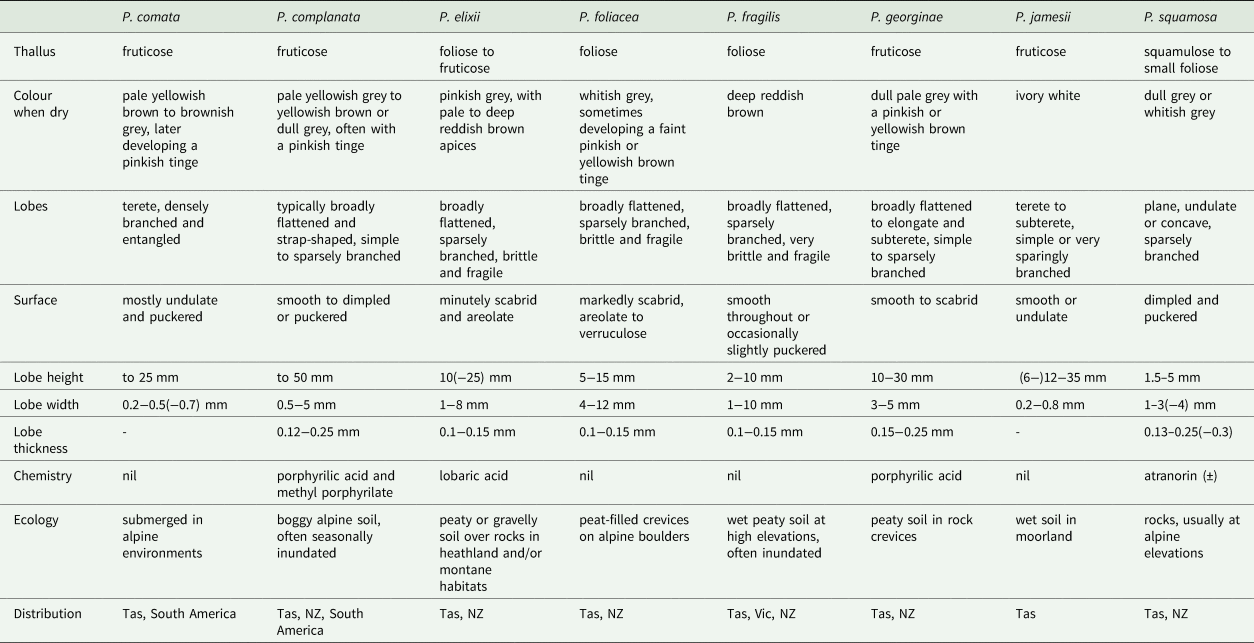
With experience, the species of Parasiphula can be identified in the field, especially when growing in their typical habitat. However, when growing in non-optimum habitats, they can display very variable and convergent morphologies, making chemical analyses using TLC mandatory. Thallus colour can be a helpful character but this changes over time, and most species and specimens acquire a distinct pinkish tinge with storage. Table 1 summarizes many of their salient features and supplements the identification key (see below).
Salient features of the species of Parasiphula. Distribution: Tas = Tasmania, Vic = Victoria (Australia); NZ = New Zealand.

Parasiphula squamosa Kantvilas sp. nov.
MycoBank No.: MB 846941
Characterized by the unique combination of a whitish grey, squamulose or minutely foliose thallus and a chemical composition that sometimes includes traces of atranorin and chloroatranorin.
Type: Australia, Tasmania, Ben Lomond, Stonjeks Lookout, summit of Hamilton Crags, 41°32ʹS, 147°40ʹE, 1535 m elev., on skeletal soil over alpine dolerite boulders, 20 November 2021, G. Kantvilas 552/21 (HO—holotype).
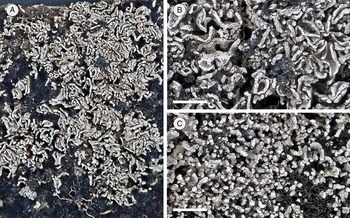
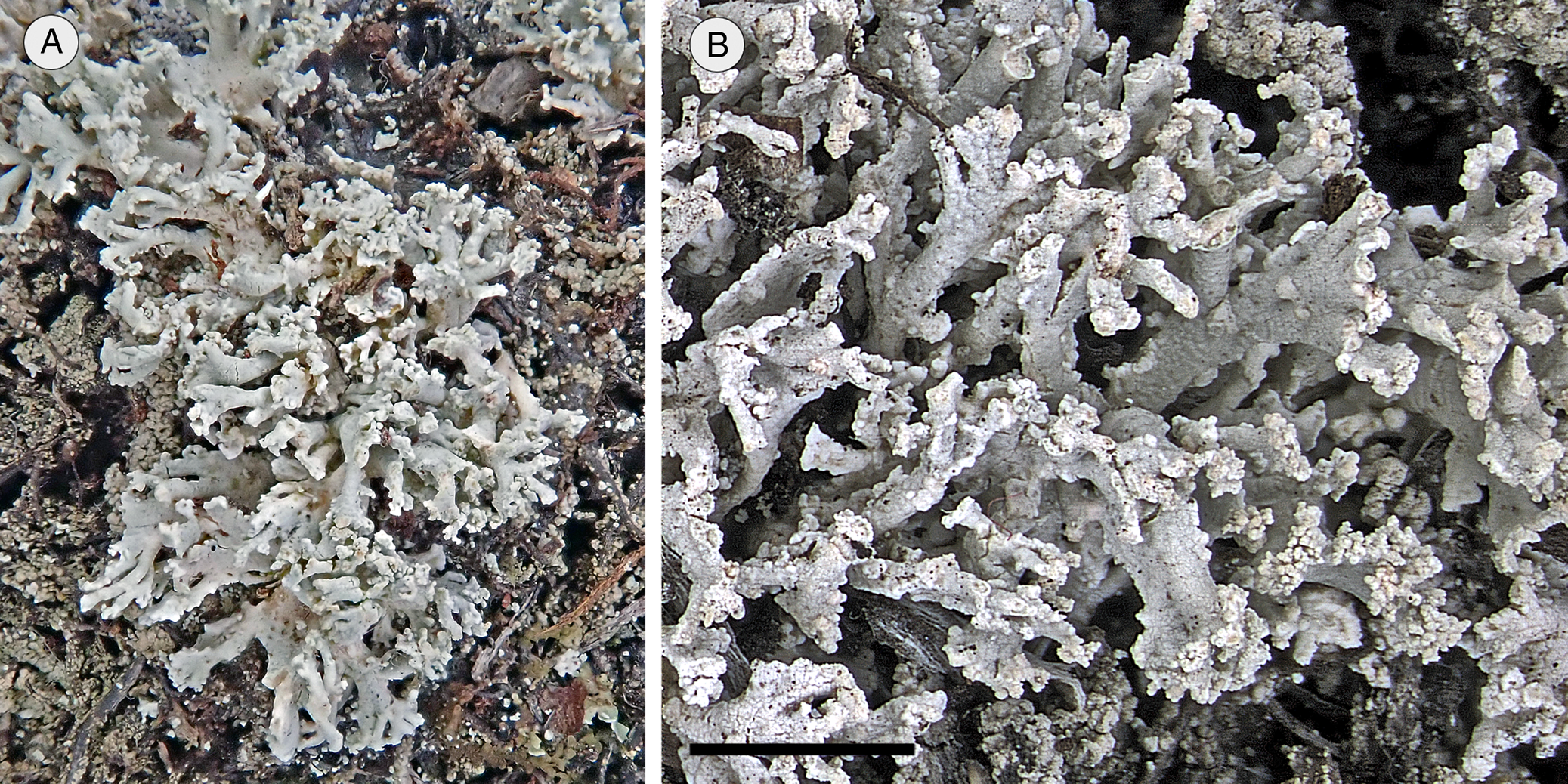
(Fig. 1)
Parasiphula squamosa habit. A, typical form with flattened, squamulose lobes (Kantvilas 12/97A). B, squamulose thallus detail (Kantvilas 12/97A). C, form with the ultimate segments of the squamules becoming terete (Kantvilas135/18). Scales = 2 mm. Images: Jean Jarman. In colour online.
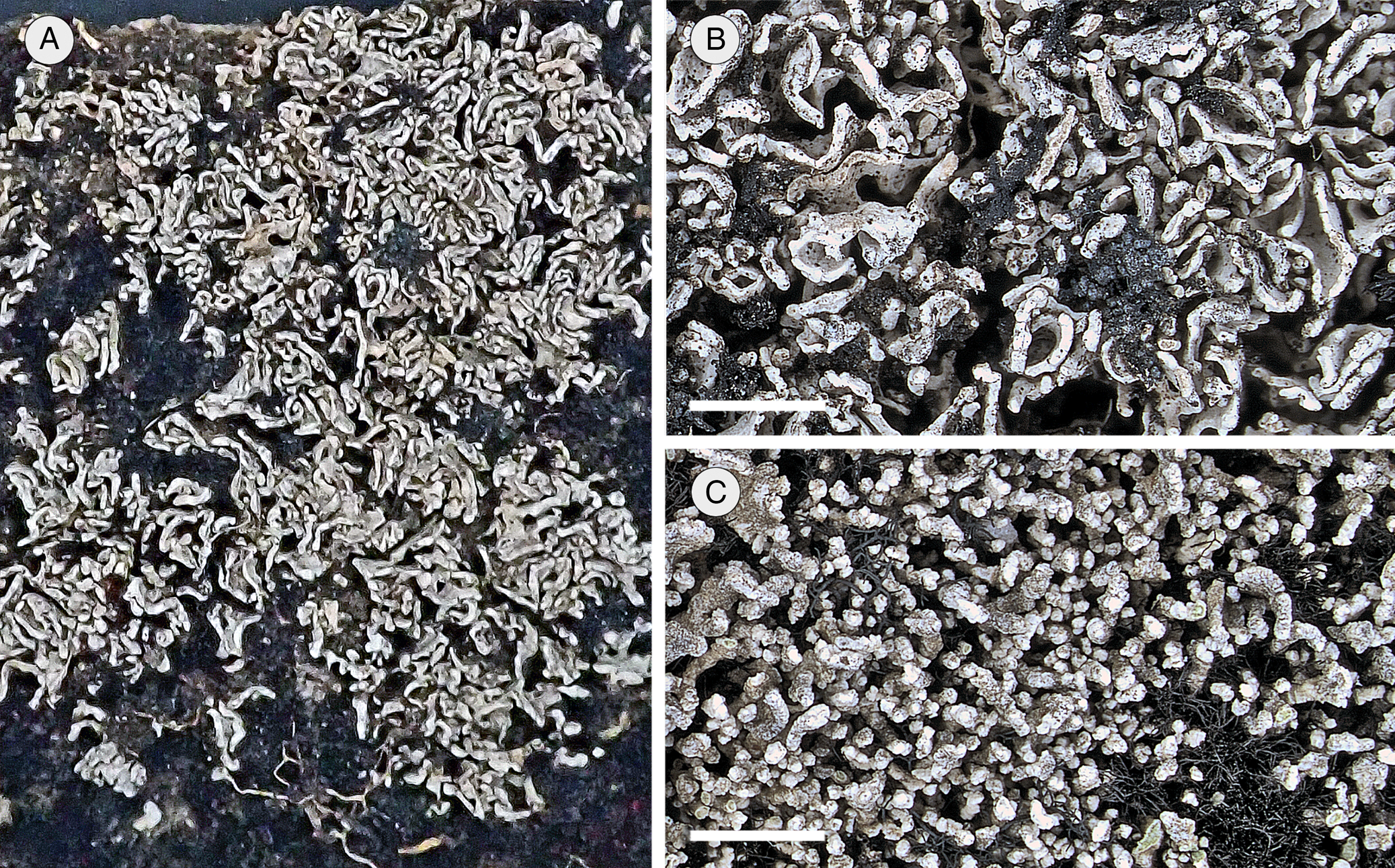
Thallus squamulose to small foliose, forming sparse to dense cushions to 6 mm thick, in section delimited by a cortex 10–20 μm thick composed of isodiametric cells 5−13 μm wide. Photobiont a unicellular green alga with globose cells 5–9 μm diam., loosely to densely packed throughout the entire medulla. Squamules very brittle and fragile, plane, undulate or concave, broadening from a narrow base and sparingly branched in several planes, densely congested, erect, ascending or decumbent, 1.5–5 mm tall, 1–3(−4) mm wide at the widest point, 0.13–0.25(−0.3) mm thick; surface dull grey or whitish grey, sometimes discoloured darkish grey due to an overlying weft of unidentified fungal hyphae, dimpled and puckered but not scabrid; apices rounded, unthickened, sometimes ±crenulate, commonly cracked off, sometimes nodulose or with the ultimate segments ±terete, erect or ascending, up to c. 0.25 mm wide, occasionally with terete lobes dominating the thallus and obscuring the flattened basal parts. Rhizines firmly buried within the substratum, pale greyish brown to grey, terete, branched, c. 0.15–0.5 mm thick at point of attachment to the lobes.
Ascomata and conidiomata unknown.
Chemistry
Nil or with traces of atranorin and chloroatranorin; cortex and medulla K± very pale yellowish, KC−, C−, P−, UV−.
Etymology
The specific epithet alludes to the growth form of the new species.
Distribution and ecology
The new species is known from Tasmania and New Zealand, but has only been studied in situ in the former region. Although widely distributed across Tasmania, and found on several different rock types including Precambrian quartzite, Ordovician conglomerate and Jurassic dolerite, most collections are from the north-eastern highlands. There it grows on exposed alpine dolerite boulders and rock plates in a low heathland-herbfield mosaic, or in the extensive lithoseres that predominate at high elevations. Unlike the other species of the genus, which mostly grow on a relatively well-developed soil, the new species occurs almost directly upon rock, with just the thinnest layer of soil accumulated around its rhizines. It is frequently intermixed with or overgrows the alpine moss Andreaea. The rock habitat is richly colonized by a wide variety of lichens, with the larger, more common species being Cladia aggregata (Sw.) Nyl., Micarea oreina Kantvilas & Coppins, Parasiphula fragilis (Hook. f. & Taylor) Kantvilas & Grube, Stereocaulon caespitosum Redinger, Usnea torulosa (Müll. Arg.) Zahlbr. and species of Umbilicaria Hoffm.
Remarks
Parasiphula squamosa is an enigmatic species that has taken many years of observation and study to resolve. In its typical provenance in the north-eastern Tasmanian highlands, it is relatively easily recognized by its characteristic whitish grey, squamulose or minutely foliose thallus, in combination with a chemical composition that sometimes includes traces of atranorin and chloroatranorin. However, these compounds usually occur at such low concentrations that they are easily missed by TLC and their presence was confirmed by HPLC (by Prof. J. Elix, Canberra). Away from its typical habitat, and in the wetter, western parts of Tasmania or at lower elevations, P. squamosa becomes more variable and easily confused with other species of the genus. The most similar is P. georginae (Kantvilas) Kantvilas & Grube, which differs unequivocally by containing porphyrilic acid. In general, this species has a larger, more robust, fruticose thallus of flattened, ±erect lobes that form a dense mat in peat-filled rock crevices. However, in more exposed situations on thinner soil, its thallus can become highly reduced, with many subterete or nodulose lobes or lobe apices. Since P. squamosa and P. georginae can occur at the same sites and in the same habitats (although they have never been observed growing together), chemical analysis by TLC is mandatory to confirm their identification. The C+ slow greenish reaction of P. georginae cannot be relied upon. Superficially, the new species may also resemble the widespread Siphula decumbens Nyl., which can occur in similar habitats on alpine rocks, but that species is readily distinguished by its chalky white, scabrid thallus containing thamnolic acid (K+ yellow). Two species of Parasiphula that lack lichen substances are P. jamesii (Kantvilas) Kantvilas & Grube and P. comata (Nyl.) Kantvilas & Grube, but both have a thallus composed almost entirely of terete lobes. While terete lobes may be seen in P. squamosa, they tend to be the ultimate segments of branched, flattened lobes. Furthermore, the habitat of these species is completely different, with P. comata being subaquatic and P. jamesii occurring exclusively on wet, peaty or gravelly soil and never on exposed rocks. A further greyish white species of Parasiphula that lacks lichen compounds is P. foliacea (D. J. Galloway) Kantvilas & Grube, but its lobes are broad and clearly foliose (up to 15 mm tall and to 12 mm wide), markedly scabrid, areolate to verruculose, and densely crowded together in mats; it is unlikely to be confused with P. squamosa.
Selected additional specimens examined
Australia: Tasmania: Mt Victoria, 41°19ʹS, 147°50ʹE, 1160 m, 1971, G. C. Bratt 71/58 et al. (HO); Mt Sprent summit, 42°48ʹS, 145°58ʹE, 1050 m, 1987, G. Kantvilas 44/87 (HO); summit of Mt Victoria, 41°20ʹS, 147°50ʹE, 1200 m, 1997, G. Kantvilas 12/97A (HO); St Patricks Head, 41°34ʹS, 148°14ʹE, 640 m, 1997, G. Kantvilas 122/97 (HO); summit of Schnells Ridge, 43°01ʹS, 146°26ʹE, 1085 m, 1998, G. Kantvilas 39/98 (HO); western flanks of Legges Tor, 43°32ʹS, 147°39ʹE, 1530 m, 1998, G. Kantvilas 112/98 (HO); Meadstone Falls, 41°45ʹS, 148°05ʹE, 400 m, 1999, G. Kantvilas 323/99 (HO); Maria Island, track to Mt Maria, 42°37ʹS, 148°06ʹE, 650 m, 2000, G. Kantvilas 204/00 (HO); Mt Sprent track, 42°47ʹS, 145°58ʹE, 900 m, 2003, G. Kantvilas 58/03 (GZU, HO); Clear Hill, 42°41ʹS, 146°16ʹE, 1030 m, 2021, G. Kantvilas 58/21 (HO); Ben Lomond, Plains of Heaven, 41°32ʹS, 147°39ʹE, 1500 m, 2021, G. Kantvilas 488/21 (HO); Legges Tor, 41°32ʹS, 147°39ʹE, 1560 m, 2022, G. Kantvilas 99/22 (HO); Ben Lomond, c. 750 m SE of Giblin Peak, 1530 m, 2022, G. Kantvilas 271/22 (HO); Ossians Throne, 41°33ʹS, 147°42ʹE, 1400 m, 2022, G. Kantvilas 345/22 (HO).—New Zealand: South Island: Denniston Plateau, c. 200 m from Whareatea escarpment mine, 1985, J. Johnston 1923 (HO).
Key to the species of Parasiphula
1 Lobes predominantly terete, at most flattened slightly only at the base; lichen substances always absent…………… 2
Lobes flattened, at most with some terminal segments terete to subterete; lichen substances sometimes present…………… 3
2(1) Lobes simple, mostly erect, forming dispersed swards on moist soil…………… P. jamesii
Lobes densely branched and entangled, forming decumbent cushions or tufts, usually fully submerged in water…………… P. comata
3(1) Thallus squamulose, lacking lichen substances or at most with traces of atranorin; growing on very thin soil, ±directly on rock…………… P. squamosa
Thallus foliose or fruticose, lacking lichen substances or containing porphyrilic or lobaric acids; thallus typically growing on peaty or gravelly soil…………… 4
4(3) Thallus fruticose, containing porphyrilic acid (C+ slowly greenish); lobes relatively robust (up to 0.25 mm thick) and elongate …………… 5
Thallus foliose to fruticose, containing lobaric acid or lacking lichen substances (C−); lobes very thin, brittle and fragile (up to 0.15 mm thick), generally broadly rounded…………… 6
5(4) Thallus containing porphyrilic acid and methyl porphyrilate; commonly forming extensive swards in very moist or inundated habitats…………… P. complanata
Thallus containing porphyrilic acid only; mostly forming tufts in peat-filled rock crevices at high elevations…………… P. georginae
6(4) Lobes whitish grey, markedly scabrid, areolate to verruculose; lichen substances absent…………… P. foliacea
Lobes ±entirely red-brown or at least distinctly red-brown to reddish pink at the apices, smooth or minutely scabrid; lobaric acid present or lichen substances absent…………… 7
7(6) Lobes typically entirely red-brown; lichen substances absent…………… P. fragilis
Lobes grey to pinkish grey with red-brown tints towards the lobe apices; containing lobaric acid…………… …………… P. elixii
New species of Siphula
Salient features of the genus Siphula s. str. have been outlined previously (Kantvilas Reference Kantvilas1998, Reference Kantvilas2002; Marcano Reference Marcano2021a, Reference Marcanob). Like Parasiphula, it is characterized by an ecorticate, foliose, fruticose or, rarely, squamulose thallus, anchored to the substratum by basal tufts of highly-branched, root-like rhizines, and a green photobiont with globose cells 5–10 μm diam. Critically, Siphula contains depsides and/or chromones. This chemical difference offers the most practical means of separating Siphula from the morphologically similar Parasiphula, although with experience, individual specimens are unlikely to be ascribed to the wrong genus. Furthermore, in regions where both genera occur, such as cool temperate Australasia and southern South America, the species of Siphula invariably have a chalky white, scabrid thallus containing depsides (usually thamnolic, baeomycesic, squamatic or hypothamnolic acids).
Despite advances in the knowledge of the group, infrageneric problems within the core of Siphula remain. Ludwig et al. (Reference Ludwig, Knight and Kantvilas2016, Reference Ludwig, Kantvilas, Nilsen, Orlovich, Ohmura, Summerfield, Wilk and Lord2020) argued that Siphula could be further subdivided, with the depside-containing taxa placed in a distinct genus, leaving mainly the chromone-containing, Northern Hemisphere species, S. ceratites (Wahlenb.) Fr., in Siphula. Whilst there is some molecular support for this (e.g. see Grube & Kantvilas Reference Grube and Kantvilas2006; Ludwig et al. Reference Ludwig, Knight and Kantvilas2016, Reference Ludwig, Kantvilas, Nilsen, Orlovich, Ohmura, Summerfield, Wilk and Lord2020), the status of several neotropical taxa, notably S. pteruloides Nyl. and S. carassana Müll. Arg., where depsides and chromones co-occur, requires investigation. There is also the distinct likelihood that sequences of two depside-containing taxa, S. polyschides Kremp. and S. pickeringii Tuck. (considered synonyms by Kantvilas (Reference Kantvilas2002)) that cluster with S. ceratites, generated by Platt & Spatafora (Reference Platt and Spatafora2000) and reused by subsequent workers, are based on misidentifications, possibly of the chromone-containing neotropical species S. pteruloides.
Ascomata in Siphula decumbens and S. fastigiata (Nyl.) Nyl. were thought to have been detected by Ludwig et al. (Reference Ludwig, Knight and Kantvilas2016), but subsequent examination of this material (this study) indicates that it represents the ascomata of the lichenicolous fungus Aabaarnia siphulicola Diederich. Siphula in general supports a rich suite of parasitic fungi across its geographical range, including the monotypic genera Aabaarnia Diederich and Saania Zhurb. (Motiejūnatitė et al. Reference Motiejūnaitė, Zhurbenko, Suija and Kantvilas2019).
New species of Siphula continue to be discovered, as demonstrated most recently by Marcano (Reference Marcano2021a, Reference Marcanob) who described four new species from the Venezuelan high páramo and the highlands of Guyana. Several further unidentified taxa remain in herbarium collections, chiefly from tropical South America and the Caribbean, suggesting that the study of Siphula will remain rewarding into the future. Two new species are described here.
Siphula capensis Kantvilas sp. nov.
MycoBank No.: MB 846942
Containing baeomycesic and squamatic acids, and distinguished from S. fastigiata and other chemically identical species by its robust, broadly flattened, smooth lobes, up to 8 mm wide and to 15 mm tall, with rounded, revolute or somewhat thickened apices.
Type: South Africa, Apollo Peak, Kromrivier, Cedarberg, S slope of ridge, E of peak, on shallow soil over bedrock, c. 1600 m elevation, 15 September 1984, H. C. Taylor 11054 (BM—holotype).
Siphula involuta R. Sant. nom. nud.
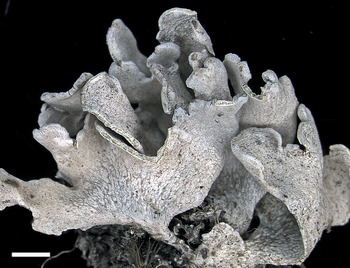
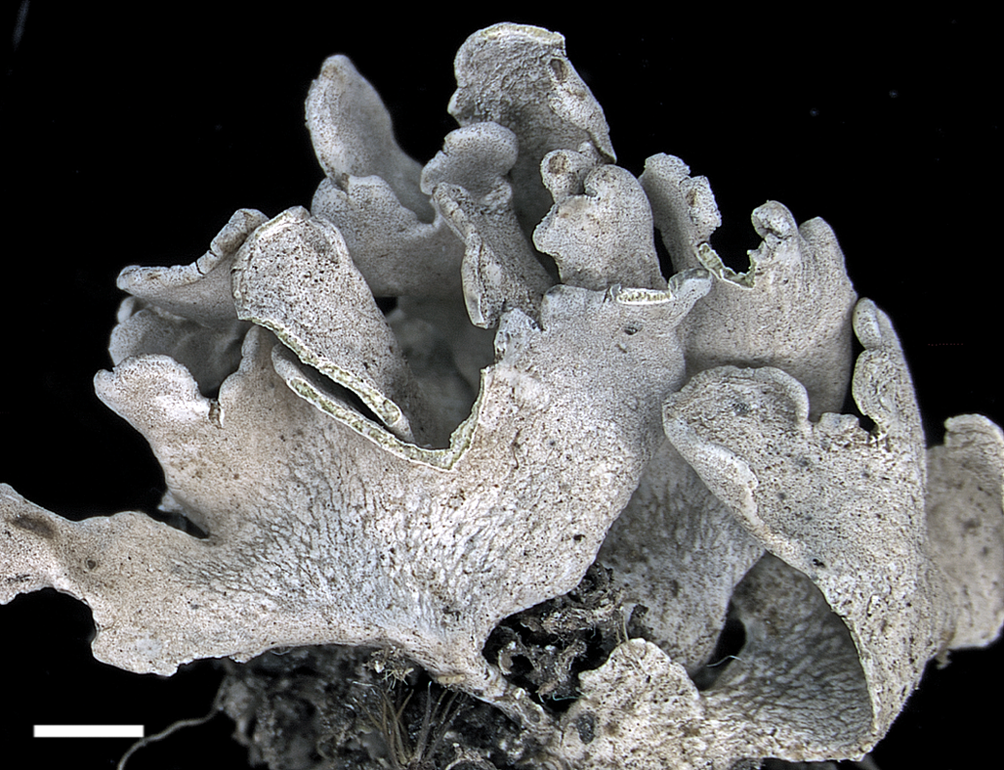
Siphula capensis habit. Note the thickened apices (holotype). Scale = 2 mm. Image: J. Jarman. In colour online.
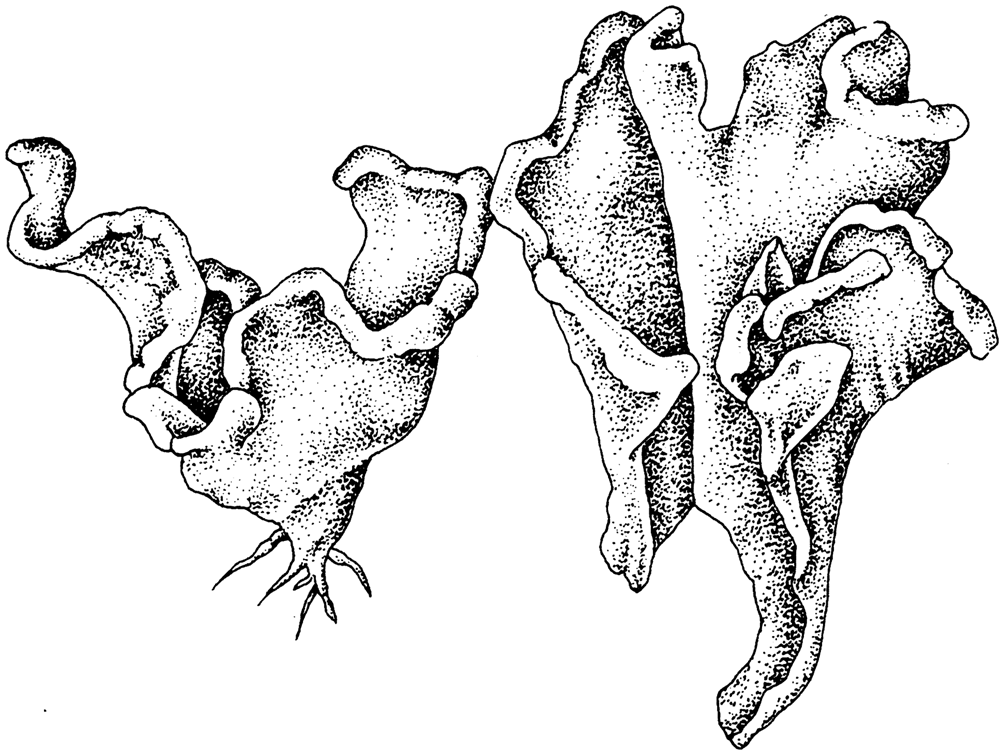
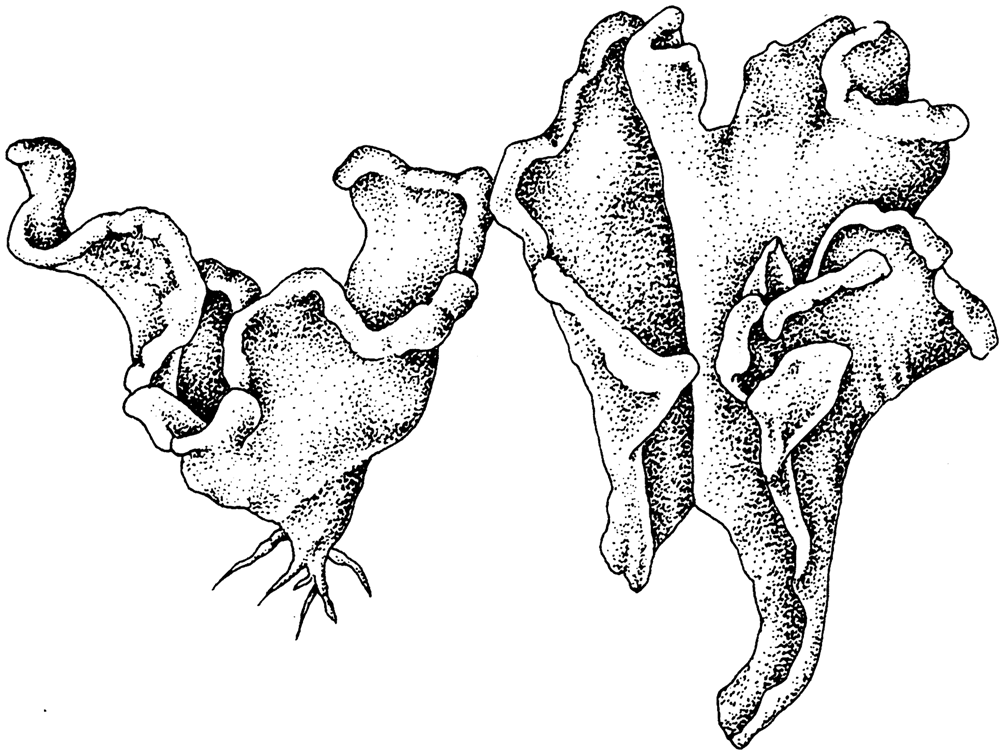
Siphula capensis habit (holotype). Drawing: Lauren Black.
Thallus foliose when well developed, more rarely sqamulose, forming a tight cushion or mat to c. 80 mm wide and up to 20 mm thick, in section delimited by a cortex 25–50 μm thick composed of densely packed, short hyphae 1.5–2.5 μm thick. Photobiont a unicellular green alga with globose cells 5–10 μm diam., occurring as an interrupted layer 50–65 μm thick or, more commonly, dispersed throughout the entire medulla. Lobes rather robust, plane, convoluted, sparingly branched, densely congested, erect or ascending, 2.5–8 mm wide, up to c. 5–15 mm tall, 0.3–0.5 mm thick; surface pale greyish or whitish, sometimes with a faint pale bluish hue, smooth or somewhat dimpled and puckered, sometimes a little scabrid; apices entire, typically a little revolute and therefore appearing rounded and somewhat thickened. Rhizines firmly buried within the substratum, pale beige to grey, terete, branched, c. 0.5–1 mm thick at point of attachment to the lobes.
Ascomata and conidiomata unknown.
Chemistry
Baeomycesic and squamatic acids; cortex and medulla K± pale yellowish, KC−, C−, P+ pale orange-yellow, UV+ yellow.
Etymology
The specific epithet refers to the provenance of the new taxon at the Cape of Good Hope, South Africa.
Distribution and ecology
I have not observed this taxon in the field and label data offers scant ecological information other than that the species occurs on soil. All collections are from the Cape.
Remarks
The baeomycesic and squamatic acid chemosyndrome is common and geographically very widely distributed in the genus Siphula. The new species is distinguished from these chiefly by its robust, relatively broad (as distinct from elongate) lobes with very distinctively thickened, seemingly rolled apices (Figs 2 & 3). This feature earned the new taxon the herbarium name of ‘S. involuta’, which has been pencilled onto several herbarium specimens (e.g. in H and BM) by the late Rolf Santesson, a specialist of the group. Whilst I would have preferred to validate Santesson's name here, I have opted not to because this invalid, unpublished name has found its way into de facto use through herbarium databases (e.g. MycoBank, Consortium of North American lichens), and to validate it now with a different authority could well cause confusion.
Mathey (Reference Mathey1971) clearly encountered S. capensis in her study of African species, even illustrating it (op. cit.: figs 26–28), but she included it within her very broad (and untenable) concept of S. decumbens. That species contains thamnolic acid and, although highly variable, its variation never encompasses the distinctive morphology of S. capensis.
The thickened lobe margins of S. capensis are also seen in the Australian S. coriacea Nyl., but that species contains barbatic acid and has more elongate lobes with a pale bluish grey hue. In the African region, the new species has no confusing species. Siphula dissoluta Nyl. (hypothamnolic acid), S. decumbens (thamnolic acid) and S. fastigiata (baeomycesic/squamatic acids) all differ clearly in having a very brittle, chalky white thallus with a markedly scabrid or mealy surface. The Cape endemic, S. torulosa (Thunb. ex Ach.) Nyl., is chemically identical but differs by its narrow, brittle lobes and entangled, decumbent habit. Some specimens of S. capensis are infected by the lichenicolous parasite Saania mobergii Zhurb.
Specimens examined
South Africa: Western Cape: Cap Bona Spei (H-NYL 40186, 40189); summit of Mt Tabularis (H-NYL 40189); Fl. Cap. 502 (BM); Worcester Distr., Deception Peak, Waachoek plateau, 5000 ft [1500 m], 1942, T. F. Stokes s. n. (UPS); Clanwilliam Distr., Scorpionsberg, N Cedarberg, 5300 ft [1590 m], 1945, E. Esterhuysen 12279 (UPS); Cedarberg, c. 100 miles [160 km] N of Cape Town, c. 4500 ft [1350 m], 1985, E. Abdy 1 (BM); Piketberg, Grootberg Mtn, 32°47ʹS, 18°39ʹE, 800 m, 1996, R. Moberg 11758 (distributed as Lich. Sel. Exsicc. Upsaliensis 290 (CANB, H, UPS)).
Siphula crittendenii Kantvilas sp. nov.
MycoBank No.: MB 846943
Characterized by a chalky white thallus containing thamnolic acid, with brittle, flattened lobes mostly up to 10 mm long and 1–5 mm wide, with the apices gnarled and granular, ragged and lacerate, or much-divided into narrowly flattened or subterete branchlets.
Type: Puerto Rico, Carite State Forest, c. 14.5 km E of Cayey, 18°05ʹN, 66°02ʹW, on canopy branches of a fallen tree in forest, 18 July 2018, G. Kantvilas & P. Crittenden (HO—holotype; F—isotype).
(Fig. 4)
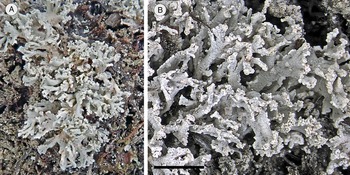
Siphula crittendenii (holotype). A, general habit. B, detail showing the lacerate lobes with gnarled, granular apices. Scales = 2 mm. Images: Jean Jarman. In colour online.
Thallus small fruticose, typically forming discrete or contiguous tufts 5−10(−30) mm across and up to 10(–25) mm tall, more rarely comprising scattered, single, flabellate lobes; in section ecorticate or with a poorly differentiated layer of densely packed hyphae c. 20 μm thick. Photobiont a unicellular green alga with globose cells 4–8 μm diam., mostly concentrated in a band c. 20 μm wide towards the dorsal surface. Lobes brittle and fragile, plane, undulate or concave, sometimes twisted and involute, erect, ascending or decumbent, discrete or loosely entangled, occasionally with a somewhat thickened midrib, broadening from a narrow base and dividing unevenly in several planes, 4–10(–20) mm long, 1–5 mm wide at the widest point, 0.25−0.5 mm thick, towards the apices becoming much divided into narrowly flattened to subterete branchlets 0.2–0.5 mm wide, gnarled, granular and 0.15–0.2 mm wide at the tips, or occasionally with the apices ragged and lacerate; surface chalky white, dimpled and puckered, occasionally fenestrate, smooth or, more typically, scabrid, particularly on one side; margins entire or ragged, not thickened. Rhizines pale greyish brown to grey, terete, branched, c. 0.15–0.25 mm thick at point of attachment to the lobes.
Ascomata and conidiomata unknown.
Chemistry
Thamnolic acid; cortex and medulla K+ bright yellow, KC−, C−, P+ yellow-orange, UV−.
Etymology
Named in honour of Prof. Peter D. Crittenden (Nottingham, United Kingdom), co-collector of the type specimen, a good friend and frequent companion on excursions to remarkable places.
Distribution and ecology
On the basis of herbarium collections, S. crittendenii is found mainly in the Caribbean Islands, where it occurs as an epiphyte on mossy trunks in low, scrubby forest. Henry Imshaug, collector of most material studied, frequently described the vegetation as ‘elfin forest’, ‘montane thicket’ and ‘mossy forest’ on his labels. The author's observations on Puerto Rico suggest it grows in relatively well-lit situations on large canopy branches or trunks in forest gaps, forming tufts that protrude from epiphytic bryophytes. The single Australian specimen is ascribed to S. crittendenii with some caution, given the geographical disjunction between it and the Caribbean material. Clearly more Australian collections and observations are required but it is noteworthy that the habitat ecology of this collection, from the trunk of Leptospermum wooroonooran in low, scrubby, mixed microphyll-notophyll forest on a rocky knoll, is very similar to that of the Caribbean material.
Remarks
This taxon was first studied in the course of a revision of Tasmanian Siphula species (Kantvilas Reference Kantvilas1998), where it was included tentatively under S. decumbens, noting that further specimens may well reveal it to be distinct. The opportunity to observe this species in the field on Puerto Rico (during the IMC field trips in 2018) and to study the extensive collections of the late Henry Imshaug (held in MSC with some duplicates distributed elsewhere) have confirmed that it is indeed distinct from S. decumbens, albeit sharing the same chemistry.
Imshaug's collections offer an excellent insight into the morphological variability of S. crittendenii. The typical form comprises a flattened, flabellate thallus that becomes much divided towards the apices into narrowly flattened to subterete, mostly ±erect branchlets. Critically, the lobe apices frequently become gnarled or granular. Such forms predominate in Imshaug's collections, all collected from scrubby vegetation at higher elevations on Caribbean Islands. When well developed, the thallus consists of much-branched tufts protruding from a mat of epiphytic bryophytes. The tufts are mostly up to 10 mm tall, but in one specimen (from Jamaica) they are as tall as 30 mm. When poorly developed, or perhaps, more accurately, immature, the thallus consists of single, scattered, flabellate lobes with ragged or torn apices but no branchlets. The range of specimens available allows these superficially different-looking forms to be interpreted as a continuum of development.
In contrast, Siphula decumbens is an extremely variable species when viewed across its broad range that includes Tasmania and New Zealand, the western Pacific and New Guinea, eastern Asia from Sri Lanka to Japan, southern Africa, the East African highlands and Mascarene Islands, and tropical America (but not the Caribbean). It is characterized by chalky white, usually broadly flattened scabrid lobes that form dense, decumbent mats or erect swards binding soil, or epiphytic tufts. Unlike S. crittendenii, its lobe apices are generally rounded and entire, sometimes thickened or crenulate, lobulate and nodulose but never subterete, gnarled or granular. To include under S. decumbens what is described here as S. crittendenii would mean broadening its morphological range to an untenable degree. An extreme epiphytic form with tufted, lacerate, fenestrate lobes seen in Tasmanian and New Zealand rainforests is rather similar to S. crittendenii, but these austral forms are seen as an in situ ecologically-driven continuum. In contrast, the morphology of S. crittendenii is essentially uniform.
The genus Siphula is well represented in the Neotropics, with several taxa containing thamnolic acid, including S. carassana (with additional siphulin), S. chimantensis V. Marcano (with additional hypothamnolic acid), the widespread S. decumbens and S. pteruloides (sometimes with additional siphulin). However, only S. crittendenii is known from the Caribbean Islands. An additional, as yet undetermined species is represented by three specimens from Dominica. These feature a rather reduced thallus of short, congested, gnarled lobes, growing on soil and are all from the same locality. Despite being morphologically very similar, one contains thamnolic acid only, another squamatic acid only and the third contains both squamatic and thamnolic acids (an unusual combination). Many more additional collections would be required to interpret these satisfactorily. I am loath to include them under S. crittendenii even provisionally, although typical S. crittendenii is also present on Dominica.
Selected specimens examined
St Lucia: Quarter of Soufrière: road south of Piton Canarie, 1963, 1800−2000 ft [540−600 m], H. A. Imshaug 29932, 29756 & F. H. Imshaug (CANB, MSC).—Jamaica: summit of Sugarloaf, 7100 ft [2130 m], 1953, H. A. Imshaug 15425, 15455 (MSC).—Puerto Rico: Humacao District: Luqillo Mountains, El Yunque, 700 m, 1967, I. Landrón 153, 255 (MSC); Luqillo Mountains, Palm Brake, La Mina, 550 m, 1967, I. Landrón 988 (MSC).—Grenada: summit of Mt Quaqua, 2250 ft [675 m], 1953, H. A. Imshaug 16111(MSC); valley between Grand Etang and ridge from Mt Sinai to Mt Lebanon, 1400 ft [420 m], 1953, H. A. Imshaug 16120 (MSC); southern slope of Fedon's Camp, 2000–2100 ft [600–630 m], 1953, H. A. Imshaug 16215 (MSC).—Guadeloupe: Basse-Terre Island: summit plateau of La Soufrière, 1400–1484 m, 1963, H. A Imshaug 33583, 33578 & F. H. Imshaug (MSC); Savana à Mulets, 1000−1100 m, 1963, H. A Imshaug 33599 & F. H. Imshaug (MSC).—Dominica: main ridge above Trois Pitons River (South Branch), 2900–3150 ft [870–940 m], 1963, H. A. Imshaug 33081 & F. H. Imshaug (H, MSC). Parish of St George: Laudat, Sandringham Estate, 1800–2200 ft [540–660 m], 1963, H. A Imshaug 33080 & F. H. Imshaug (MSC).—Dominican Republic: Cordillera Central, ridge between Pico del Yaque and L. Chinguela, 6800 ft [2040 m], 1958, H. A. Imshaug & C. M. Wetmore 3752, 3744 (CANB, MSC).—Trinidad and Tobago: Trinidad: summit area of El Tucuche, 3000−3072 ft [900 m], 1963, H. A Imshaug 31935, 31910 & F. H. Imshaug (MSC).—Australia: Queensland: Mt Lewis-Carbine Tableland, near Mt Lewis Hut, 16°30ʹ47ʺS, 145°16ʹ06ʺE, 1220 m, 2018, G. Kantvilas 435/18 (CNS, HO).
Specimens of unidentified species examined
Dominica: Valley of Desolation and Boiling Lake, 2500 ft [750 m], 1963, H. A. Imshaug 33103 (thamnolic and squamatic acids) (MSC); ibid., H. A. Imshaug 33102 (thamnolic acid) (MSC); ibid., H. A. Imshaug 33104 (squamatic acid) (MSC).
Acknowledgements
For the impetus to write this paper, I am grateful to Penny Clive (Detached, Hobart) and Julia Farrell (Federal Group, Australia) who, through their generous support of the 2022 Tasmanian Museum and Art Gallery ‘Expedition of Discovery’, enabled the Tasmanian species to be studied closely in the field. For the loan of specimens, and/or their hospitality during my visits to their institutions, I thank Teuvo Ahti and Saara Velmala (Helsinki), Alan Fryday (Lansing) and the curators of London's Natural History Museum. Siphula-like lichens can be challenging to describe; for her expert photographs, I thank Jean Jarman. The line drawing was undertaken by Lauren Black.
Author ORCID
Gintaras Kantvilas, 0000-0002-3788-4562.