Introduction
MCI refers to impairments in cognitive functioning that falls in between those observed in normal aging and dementias. It is characterized by the presence of objective impairments in at least one cognitive domain. Unlike dementia, a person with MCI suffers from relatively minimal levels of functional impairment (Petersen, Reference Petersen2004). MCI is of major clinical and research significance as it is associated with high rates of progression to dementia (Roberts et al., Reference Roberts2014). Taking a bird's eye view globally, the prevalence of MCI has been found to range from 16% to 20% in many different populations of older adults around the world (Roberts and Knopman, Reference Roberts and Knopman2013). An early study reported a staggeringly high prevalence of 46% in a sample of older adults (i.e. aged ≥ 60 years) population (N = 306) in Hong Kong (Lam et al., Reference Lam, Lui, Tam and Chiu2005). It is possible that this figure may have included false positives that arise from diagnoses being made solely based on subjective measures (i.e. Clinical Dementia Rating). This prevalence of MCI has yet to be verified.
MCI is associated with a number of psychosocial factors, such as depression and loneliness. In relation to the former, early longitudinal evidence has suggested depression to be a major risk-factor implicated in the development of MCI (Lopez et al., Reference Lopez2003). However, more recent findings suggest depression merely accompanies MCI and is unlikely to precede MCI (Richard et al., Reference Richard2013). Regardless, depression symptoms are common among those with MCI; as many as 63% of those with MCI present with depression symptoms (Panza et al., Reference Panza2010).
Unlike depression, loneliness is less studied in MCI populations. Nevertheless, according to a recent meta-analytic review (Boss et al., Reference Boss, Kang and Branson2015), perceived loneliness is found to be negatively correlated with cognitive functioning among older adults. Furthermore, cross-sectional and longitudinal studies have reported that cognitively impaired clinical populations (such that those with Alzheimer Disease (Wilson et al., Reference Wilson2007) and Dementia (Holmén et al., Reference Holmén, Ericsson and Winblad2000; Holwerda et al., Reference Holwerda2014)) were significantly lonelier relative to healthy controls. However, it remains to be found if individuals with less severe impairments in cognition, such as those with MCI, are also lonelier as compared to cognitively healthy controls.
In the study of loneliness and cognition among older people, it is important to take depression into account, especially since loneliness is linked to depression (Golden et al., Reference Golden2009). It is possible that the cognitive impairments associated with loneliness may manifest as a consequence or precursor of depression, instead of loneliness itself per se. Indeed, there were some studies that did not find significant associations between loneliness and cognitive impairments after controlling for depression, even if it is merely in some specific neurocognitive domain (O'Luanaigh et al., Reference O'Luanaigh2011; Gow et al., Reference Gow, Corley, Starr and Deary2013). However, there were also some studies that reported significant relationships between loneliness and cognitive functioning, even after depression levels were controlled for (Schnittger et al., Reference Schnittger, Wherton, Prendergast and Lawlor2012; Holwerda et al., Reference Holwerda2014). These inconsistencies may stem from the different neurocognitive domains examined and/or variations in methodology (Boss et al., Reference Boss, Kang and Branson2015). Findings in this area remain inconclusive.
In view of the above gaps in the MCI literature, the current report aims to (1) establish the prevalence of MCI in a selected community sample in Hong Kong, (2) determine whether individuals with MCI tend to feel lonelier compared to cognitively healthy controls, and (3) find out whether such differences in loneliness can be attributed to variations in depression levels. These findings would clarify the relationship between loneliness and cognitive impairments, and identify potential targets for intervention in MCI populations to better cognitive outcomes. In relation to the latter two aims, it was hypothesized that participants diagnosed with MCI are significantly lonelier than matched controls, even after controlling for depression levels.
Methods
Measures
A validated Chinese translation (Chan, Reference Chan1996) of the 15-item Geriatric Depression Scale (GDS; Sheikh and Yesavage, Reference Sheikh and Yesavage1986) was used to assess the level of depression. The GDS consisted of 15 yes/no questions and was designed in particular for older participants. It has demonstrated good psychometric properties in both the original and Chinese translated version (Sheikh and Yesavage, Reference Sheikh and Yesavage1986; Chan, Reference Chan1996). To assess for loneliness, a Chinese translation (Chou et al., Reference Chou, Jun and Chi2005) of the UCLA-Loneliness Scale (LS; Russell, Reference Russell1996) was used. The LS was designed to measure feelings of loneliness and social isolation, and had been used in cohorts of older persons (Chou et al., Reference Chou, Jun and Chi2005; Tse, Reference Tse2010) similar to the present. The LS consists of 20 items, each is rated on a scale of 1 (never) to 4 (often) on the frequency of having various feelings related to loneliness, giving a maximum possible total score of 80. For both of these measures, higher scores correspond to worse outcomes.
Participants and procedures
This study was approved by the Institutional Review Board of The University of Hong Kong/Hospital Authority Hong Kong West Cluster and carried out in accordance with the ethical standards laid down in the 1964 Declaration of Helsinki and its later amendments.
The present cohort of participants was part of a cognitive training intervention study conducted in Hong Kong. The participants of the study were recruited from the community via local monthly newsletters, word of mouth, and with the help of local day care centers for older adults. The inclusion criteria were: (1) Aged 60 and above and (2) no present or, history of neurological or psychiatric illness. Written informed consent was obtained from the participants prior to the intervention.
The intervention-study cohort consists of 480 participants. Among them, those aged 77 years and above (N = 104) were excluded from the current study due to the lack of appropriate normative data for this age group (Lee and Wang, Reference Lee and Wang2010). In addition, two participants whose cognitive impairments were sufficiently severe to qualify as dementia were also excluded. These exclusions resulted in a valid sample of 374, of which a total of 66 were diagnosed with MCI by a clinical psychologist, according to the Petersen's (Reference Petersen2004) criteria. These diagnosed cases have also fulfilled the DSM-5 criteria of Mild Neurocognitive Disorder. As part of the diagnosis, cognitive impairment was assessed via subjective reports and locally normed (age and education adjusted) neuropsychological measures, such as the Immediate Memory and General Memory indices from the Wechsler Memory Scale III, the Processing Speed Index from the Wechsler Adult Intelligence Scale III, Digit Span Backward, Semantic Fluency and Color Trails Test 2. These assessments, together with the above questionnaires, were administered by trained research assistants to the participants during the baseline-period of the intervention.
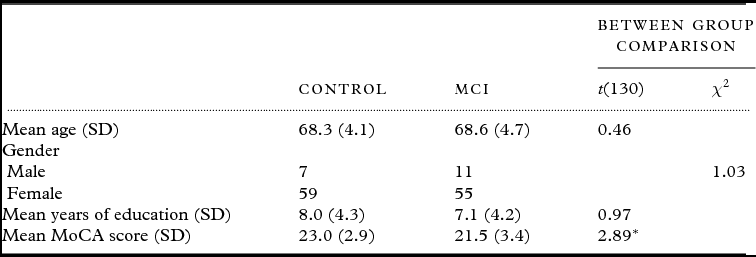
The MCI group consisted of six participants with multiple domain amnestic MCI, 16 with multiple domain non-amnestic MCI and 44 with single domain non-amnestic MCI. Having used a propensity score matching with a match tolerance of 0.9, 66 control participants were identified based on the relevant matching criteria in terms of age, sex, and years of education from the remaining 308 participants. As seen from Table 1, both groups of participants were not significantly different in terms of age, years of education, and gender ratios. On the other hand, participants identified with MCI have poorer general cognitive status, as compared to the matched controls, which is indicated by the significant differences in Montreal Cognitive Assessment scores.
Participants’ characteristics

MCI = Mild Cognitive Impairment; SD = Standard Deviation; MoCA = Montreal Cognitive Assessment.
*p > 0.1.
Statistical analyses
As a result of skewed distributions in the data, bootstrapping techniques were used. Bootstrapping is method of re-sampling that does not make any assumption on the sample's distribution (Chen and Peng, Reference Chen and Peng2015) and is robust to violations of normality and sphericity (Berkovits et al., Reference Berkovits, Hancock and Nevitt2000). Bootstrapping was carried out using the Bias-Corrected and Accelerated approach with 5000 bootstrap samples. Group differences among the demographic variables were tested via independent samples t-tests and χ2 tests for Independence in the overall sample. Following that, the differences in GDS and LS scores between the two matched groups were analyzed using an analysis of variance (ANOVA) and subsequently, an analysis of covariance (ANCOVA) with GDS scores as covariates. Statistical significance was set at p < 0.05. All analyses were carried out using Statistical Package for the Social Sciences (SPSS version 22) software.
Results
Among participants aged 60 to 76 years (N = 376), the prevalence of MCI is at 17.6%. t-tests and χ2 test of independence did not reveal any significant differences with regards to the age and gender ratios of participants between those with (N = 66) and without MCI (N = 308) in the overall sample. However, relative to the non-MCI cases in the overall sample, participants with MCI had significantly fewer years of education; t (372) = 3.3, p = 0.001, d = 0.34. Participants with MCI, relative to matched controls (N = 66) had significantly higher scores on the GDS and LS. These group differences were associated with moderate effect-sizes and group differences in LS scores remained significant even after including GDS scores as covariates in the ANCOVA model (see Table 2).
Descriptive statistics and group differences in the outcome variables

MCI = Mild Cognitive Impairment; SD = Standard Deviation.
a Geriatric Depression Scale scores are included as covariates.
*p < 0.05.
**p < 0.01.
Discussion
In the current report, a 17.6% prevalence of MCI has been obtained in the sample studied. This figure is similar to that observed in other geographical regions (Roberts and Knopman, Reference Roberts and Knopman2013). The significant difference between the current prevalence obtained and that reported by Lam et al.’s (Reference Lam, Lui, Tam and Chiu2005) can likely be explained by differences in methodology, such as the inclusion of objective measures of neurocognition to confirm the diagnoses of MCI. Additionally, it was found that this prevalence is associated with lower education levels, notwithstanding the education-adjusted norms used in the MCI diagnoses. This is not surprising given that education is a major component of the cognitive reserve that helps buffer one from cognitive decline (Sattler et al., Reference Sattler, Toro, Schönknecht and Schröder2012).
In line with our expectations, participants with MCI are significantly lonelier and more depressed than their cognitively healthy counterparts. This is consistent with previous studies wherein cognitive impairments had been found to be associated with both depression (Panza et al., Reference Panza2010) and loneliness (Boss et al., Reference Boss, Kang and Branson2015). More importantly, we have also shown that the MCI group was significantly lonelier compared to the matched controls, even after controlling for depression levels. This suggests that the relationship between loneliness and cognitive impairments in MCI is at least partially independent of depression. The current report is the first study to report such findings in participants with MCI.
This relationship between loneliness and MCI suggests that there is something in addition to the negative emotions associated with loneliness that may be related to cognitive impairments. Though causal inferences cannot be made from a cross-sectional study, such as the current report, it is speculated that an individual with a larger social network (hence less likely to feel lonely) may have had more opportunities for social interactions, and hence had more cognitive stimulation on a regular basis. This would help to build up one's cognitive reserve to buffer against cognitive decline (Fratiglioni et al., Reference Fratiglioni, Wang, Ericsson, Maytan and Winblad2000). Alternatively, this could also be explained by the social-brain hypothesis, which posits that one's social group size is limited by his/her ability to manage interpersonal relationships on the cognitive level (Barrett et al., Reference Barrett, Henzi and Dunbar2003). Hence, among individuals with MCI, it is plausible that it is difficult for them to engage in large social networks on a long term basis as a result of being limited by their cognitive functioning. Future research may consider using longitudinal paradigms and objective measures such as social network size, in addition to self-reports of loneliness to clarify on these explanations.
As previously alluded to, this study is limited by the lack of objective measurements (such as social network size) to corroborate the subjective findings on loneliness and the use of a cross-sectional design that does not allow causal inferences to be made. Nevertheless, this study has merits in terms of the satisfactory control of demographic variables, such as age, sex, and education levels and a good sample size.
The current report presents a number of implications within the public health context locally. When taken together with previous longitudinal findings, the present study identifies loneliness as a major risk-factor for cognitive decline. According to Chinese tradition, older people seek social company from their families and relatives; it is common for the elders in the family to live together with their children and grandchildren within the same household and be actively involved in the family. However, in light of the rapidly aging population in Hong Kong, families have become smaller. Consequentially, the older adults will find it increasingly difficult to seek out such social company, and possibly become lonelier (Chen et al., Reference Chen, Conwell and Chiu2014). This problem is likely to be exacerbated even further as the proportion of older adults doubles within the next two decades (Census and Statistics Department (HK SAR), 2011). Hence, at least within the local Hong Kong context, it is even more crucial to mitigate the problem of loneliness in order to prevent or slow down cognitive decline among the older adults. This can be resolved via community-based efforts and intervention programs to increase one's exposure to social contact and interactions with other individuals within the community (Chen et al., Reference Chen, Conwell and Chiu2014), and encourage greater involvement within families to keep their older members socially engaged (Wang, Reference Wang2008; Chen et al., Reference Chen, Hicks and While2014)
Conflict of interests
None.
Description of the authors’ roles
JY conceptualized the study, analyzed the data and wrote the manuscript. CL and TL contributed to the writing and review of the manuscript.
Acknowledgments
This work is supported by funding from The University of Hong Kong May Endowed Professorship and the KKHo International Charitable Foundation.