INTRODUCTION
Schistosomiasis remains a major public health concern affecting over 200 million people worldwide. As such, considerable financial, medical and scientific effort has been devoted to understanding the epidemiological factors influencing the transmission and spread of the parasite. Population-genetics theories and methodologies have enhanced our knowledge of Schistosoma mansoni population dynamics in light of the sociological, ecological and evolutionary forces that impact disease epidemiology. As studies investigating Schistosoma population genetics increase, our ability to discern the relative strength of these forces over space and time improves. However, accurate interpretation of natural genetic patterns of schistosomes requires both direct collection of genotypic data and assurance that the portion of sampled parasites constitutes an unbiased estimate of genetic diversity.
Schistosoma mansoni genetic studies involving both sylvatic and human transmission cycles have been performed to discern the forces shaping parasite transmission and maintenance in endemic areas (Minchella et al. 1995; Barral et al. 1996; Sire et al. 1999; Curtis et al. 2001, 2002; Sire et al. 2001a,b; Eppert et al. 2002; Prugnolle et al. 2002, 2004, 2005; Theron et al. 2004). While the intramolluscan parasite stages can be studied equitably in either cycle, differences exist in how parasite tissue is recovered from the vertebrate host. In sylvatic cycles of S. mansoni, adult worms are harvested directly from sacrificed murine hosts (Barral et al. 1993, 1996; Sire et al. 2001a,b; Prugnolle et al. 2002, 2004, 2005; Theron et al. 2004). Alternatively, among human hosts, S. mansoni eggs are collected from patient feces and subsequently passaged through laboratory populations of snails and rodents to obtain adult worms for genetic analysis (Minchella et al. 1994; Curtis et al. 2001, 2002; Rodrigues et al. 2002; Stohler et al. 2004). An important problem associated with this methodology is the potential for artificially selecting genotypes of the parasite that are better adapted for laboratory hosts, while filtering out genotypes adapted to natural host populations (LoVerde et al. 1985). The ability to genotype multiple loci from individual miracidia collected from eggs in human stool samples would circumvent the need for laboratory passage of the schistosomes, allowing a more direct assessment of genotypes associated with human schistosomiasis.
Determining the appropriate number of worms to sample from infected hosts is also an important problem facing researchers investigating S. mansoni population genetics. Currently, there are 2 commonly employed methodologies for collecting genotypic information from vertebrate hosts: genotyping all worms within a single host (Sire et al. 2001a; Theron et al. 2004) or genotyping an arbitrarily-sized sub-sample of worms (Curtis et al. 2001, 2002; Sire et al. 2001a; Rodrigues et al. 2002). Both of these methods have shortcomings. Genotyping all worms can lead to sampling redundancy (and wasted effort), as hosts often carry redundant clonal genotypes due to transmission from snail hosts. However, choosing an arbitrary number of worms from each host presents the risk of under-sampling the available parasite genotypes. A more efficient method would involve genotyping all worms from a subset of hosts and determining the relationship between the number of unique alleles and the number of genotyped worms. This relationship could help to determine the proportion of an infrapopulation that should be genotyped in the remainder of the hosts.
This paper presents our approaches to optimize S. mansoni sampling efforts in endemic regions. Herein, we describe a protocol for extracting DNA from single S. mansoni eggs (from human feces) that allows subsequent multilocus, microsatellite genotyping. We also assess the importance of genetic filtering during laboratory passage of S. mansoni, by genotyping parasites prior to laboratory infections (from eggs) and after passage through both snails and rodent hosts (from adult worms). Lastly, we present a methodology to empirically optimize the trade-off between capturing sufficient parasite genetic variability in adult worms and reducing the sampling effort necessary to gather that information.
MATERIALS AND METHODS
Collection of allelic information
Schistosoma mansoni eggs (in feces) were collected from 5 residents (hereafter, individually referred to as PID142, PID259, PID404, PID447, and PID008) of the Virgem das Graças (VdG) study area in the Jequitinhonha Valley of northern Minas Gerais, Brazil. These residents were expected to comprise a good sample of S. mansoni genetic variability within the larger VdG study population based on their high parasite intensities and the dispersed nature of their residences across the study area. The larger study population consisted of 47 individuals residing in a 60 km2 area surrounding Corrego do Cardoso and Corrego do Suçuarana. The village of VdG is near the centre of this study area. Participants of this study were divided into 5 geographical groups based on their proximity to the village. The 5 residents considered in this paper represent all 5 of the geographical groups. Evaluation of which residents to select as representatives of a geographical group was based on the number of S. mansoni adults that were collected following laboratory passage of miracidia through Biomphalaria glabrata snails and BALB/c mice. Within each geographical group, the resident providing the most worms from a mouse infection involving [ges ]5 cercariae-releasing snails was chosen for this study. This selection criteria offered the best a priori opportunity of detecting maximal levels of genetic variability within each of the study areas, while minimizing the number of parasite infrapopulations assessed since the greatest loss of schistosome genetic diversity is assumed to occur when the snails and the mice are exposed to their respective infective stages (mean number of snails per infected mouse for all 47 VdG residents ±1 standard deviation=3·54±1·75 based on 130 mice infected in the larger study).
Eggs were removed from feces using 2 washes and sedimentation in a 1·85% NaCl solution. These eggs were either (1) transferred individually to 0·5 ml microfuge tubes containing 50 μl of a 1·85% NaCl solution for storage at −20 °C (14–17 eggs per resident) or (2) transferred to dechlorinated tap water under a 100 W light source to induce miracidial hatching. Five groups of 15 laboratory-reared Biomphalaria glabrata snails were individually exposed to 10 miracidia per snail to represent the S. mansoni infections of the 5 VdG residents. Unfortunately, logistical constraints limited our ability to freeze enough eggs to provide a more equitable number of eggs and miracidia. Cercariae from each group of snails were used to infect 2–5 BALB/c mice (100–120 cercariae/mouse). Mouse infections and the subsequent collection of adult worms followed procedures described by Curtis et al. (2001). For each of the 5 VdG residents, the mouse that offered the greatest potential recovery of schistosome diversity, based on the number of snails providing cercariae and the number of worms recovered, was selected to represent that individual's schistosome infrapopulation. These experimentally infected mice yielded 414 adult schistosomes (Table 1). DNA from these worms was extracted using mechanical pulverization, chemical degradation, and ethanol precipitation (Sorensen et al. 1998).

In order to extract DNA from the 74 individual S. mansoni eggs, the eggs were first isolated from the saline storage buffer by centrifuging each tube at 13400 g for 5 min and eluting the supernatant. Tubes containing the single egg were then submerged in liquid nitrogen for 30 sec to rupture the surface of the eggshell and then 100 μl of InstaGene Matrix (Bio-Rad) was added to the disrupted egg, followed by a 3-min. incubation at 56 °C. This was followed by 30 sec of high-speed vortexing, a second incubation for 8 min at 100 °C, a final 10-sec high-speed vortexing, and 3 min of centrifugation. An aliquot of this supernatant was used as template DNA in 10 μl vol. PCRs.
Six schistosome microsatellite loci (ED28, ED57 (Durand et al. 2000), DA03, DO03, DO23, and G5 (Rodrigues et al. manuscript in preparation)) were amplified in 15 μl vol.multiplexed PCR reactions for the worms and in 10 μl vol.single-locus PCR reactions for the eggs; multiplexed reactions using egg template failed to produce detectable alleles. Whether for eggs or worms, each amplification reaction contained 10 mM Tris-HCl, pH 9·0, 50 mM KCl, 0·1% Triton®X-100, 200 μM dNTP, 2 mM MgCl2, 167 nM of each primer (3–4 primer pairs/reaction for multiplex reactions), 0·6 units of Taq DNA Polymerase (Promega), 0·8 mg BSA and 50 ng of worm DNA or a 4 μl aliquot of the InstaGene Matrix supernatant. Thermal cycling was performed under the following conditions: 4 min at 94 °C; 32 cycles of 30 s at 94 °C, 30 s at 55 °C, and 1 min at 65 °C; and a final 3 min extension at 65 °C, in either a MJ Research PTC-100 or an Eppendorf Mastercycler gradient thermocycler. The fluorescently labelled PCR products were electrophoresed on an ABI 377 sequencer using GENESCAN®-500[TAMRA] as an internal size standard for each lane. Allele sizes were determined using GENESCAN v3.1 and GENOTYPER v2.5 software (PE Applied Biosystems).
Assessing equality of egg and worm DNA sources
Allelic diversity (number of alleles and allele frequency), heterozygosity measures (observed and expected values), and Hardy-Weinberg equilibrium statistics of egg and worm DNA templates were determined using GenAlEx 6 (Peakall and Smouse, 2005). Since exhaustive collection of the parasites from experimentally infected mice yielded over 5 times more worms than the number of eggs that were initially reserved for genetic analyses, comparison of allelic diversity from the two sources was biased in favour of worms. This bias was addressed by calculating the allelic richness of each locus (El Mousadik and Petit, 1996; Petit et al. 1998) for the egg and worm templates using FSTAT v.2.9.3 (Goudet, 2001). All statistical tests were performed using SPSS 11 for Mac OS X. One-way ANOVA was used to compare the number of alleles detected per locus and overall allelic richness values between eggs and worms, while Mann-Whitney U or Kruskal-Wallis tests were used to make statistical comparisons when assumptions of normality or homoscedasticity were not met. Frequency differences were tested using chi-square analysis. An α of 0·05 was used to evaluate statistical significance in all cases.
Construction of an allelic diversity curve
Genotypic data from the most diverse microsatellite locus for each of the 5 VdG worm infrapopulations was used to determine how the cumulative number of unique alleles at these loci increased as a function of the number of worms assayed. By considering the most diverse locus in worms obtained from each of the VdG residents, we necessarily encompass the diversity of other less-diverse loci within their worm infrapopulations. Because the relationship between the number of unique alleles detected and the number of worms genotyped depends upon the order in which individual worms in a population are considered, an algorithm was written in Python 2.3.3 to randomly reorder and resample the original data from each of the 5 VdG worm infrapopulations. This program allowed us to consider the relationship between number of alleles detected and number of worms genotyped by iteratively shuffling the order in which individuals were genotyped (program available upon request from RES via email). Python's random.shuffle function was used to randomly change the order in which alleles from these worms were considered as unique or redundant.
Regression analysis was used to determine the most biologically relevant, mathematical relationship (based on R2 values) between the percentage of unique alleles detected and the percentage of the infrapopulation assayed using re-sampled data and SPSS 11 for Mac OS X. The optimal number of times to shuffle allelic data from each of the 5 VdG resident infrapopulations was determined iteratively using the single most diverse locus among the 5 worm infrapopulations. In this case, genotypic data from locus DA03 in PID447 was iteratively shuffled and reassembled 5, 10, 15, 20, 30, or 60 times. The best-fit curve was calculated for each of the resulting 6 datasets. The coefficients of determination (R2) from these curves were retained, and the process was repeated 4 additional times to determine the mean R2 and its standard deviation based on 5 trials for each of the 6 reassembly alternatives. This allowed to us to find the number of re-sampling iterations that minimized variation in the R2 value. Outputs generated using the optimal number of re-sampling iterations were combined into a single dataset to determine an overall best-fit regression curve.
RESULTS
Equality of egg and worm DNA sources
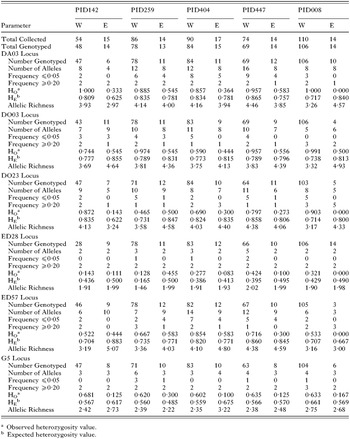
The 5 groups of experimentally infected BALB/c mice considered in this study yielded 414 adult schistosomes (Table 1) representing offspring of the infections in 5 Virgem das Graças residents. Of these, 385 (93·0%) produced allelic information for at least 1 of the 6 microsatellite loci under consideration (Table 1). PID142 yielded the fewest scored worms (88·9%), and PID008 offered the most (96·4%). Seventy (94·6%) of the collected eggs provided allelic information for at least 1 of the loci being studied, and the number of genotyped eggs appeared evenly distributed across the 5 residents (Table 1).
Our ability to detect microsatellite alleles differed somewhat among egg and worm DNA templates. This difference was observed in the mean number of loci scored per individual and in the proportion of genotypes detected per locus. Worms provided significantly more scored loci per individual than did eggs (mean=5·8 vs 4; Z=−9·985, U=6164, P<0·001). In the same manner, a significantly smaller proportion of eggs provided genotypic information at each locus than did worms, with 60·0–80·0% of the eggs and 93·8–99·7% of the worms offering genotypic information across the 6 loci (mean=67·2% vs 96·9%; χ2=445·42, D.F.=1, P<0·001). However, at a given locus, the number of alleles that were detected did not differ between the egg and worm populations assayed (F1,10=0·586, P=0·462).
Allelic variability was similar for both DNA sources in terms of the number of alleles per locus. Four of the loci, DA03, ED57, DO03, and DO23, all possessed >10 alleles, while G5 and ED28 presented <10 alleles regardless of the DNA source (Table 1). The frequency of more common alleles (frequency [ges ]0·20) was also similar in both the worm and egg portion of the population (Z=−0·589, U=14·500, P=0·589). However, rare alleles (frequency [les ]0·05) were detected more frequently in the worm population compared to the egg population (Z=−2·166, U=4·500, P=0·026). The occurrence of specific alleles differed between worms and eggs as well. Twenty alleles were found among the worms that were absent from the eggs, while 5 alleles were detected among the eggs that were lacking in the sampled worms (data not shown).
Allelic richness per locus did not differ between the 5 VdG residents when the egg samples and the worm samples were considered separately (worm: F4,25=0·434, P=0·783; egg: F4,25=0·056, P=0·994; Table 1). Furthermore, when the egg and worm samples were combined, allelic richness per locus did not differ between the residents or between the sources (egg or worm) of the DNA (resident: F4,55=0·260, P=0·903; source: F1,58=1·714, P=0·196). Although, allelic richness values were similar in eggs and worms, whether considered on a per locus or a per resident basis, the number of microsatellite alleles present differed among the loci, both when the egg and worm samples were considered separately and when they were grouped (egg: H=21·856, D.F.=5, P=0·001; worm: H=21·388, D.F.=5, P=0·001; grouped: H=40·295, D.F.=5, P<0·001).
Measures of observed and expected heterozygosity differed between the worm and egg portions of the S. mansoni population (Table 1). Observed levels of heterozygosity (Ho) were significantly larger among worms compared to eggs across all loci (U=4·000, Z=−2·246, P=0·026), while expected heterozygosity (He) values were comparable for the eggs and the worms (U=13·5, Z=−0·727, P=0·485). When eggs were used as the DNA source, Ho per locus and over all loci in each patient were lower than He. Nevertheless, some of the loci (PID142: loci DA03 and DO03; PID259: loci DO03, ED28, and G5; PID404: locus DO03; PID447: loci DA03 and DO03; PID008 loci DO03 ED57, and G5; P>0·05) did not deviate significantly from Hardy-Weinberg equilibrium (HWE), which may be due to the paucity of eggs genotyped for these loci among the individual residents. Unexpectedly, however, when adult worms were used as the DNA source, 16 loci showed Ho higher than the He, while 14 loci showed the opposite outcomes (Table 1). All but 1 (PID259: G5; P>0·05) loci in the worm populations deviated significantly from HWE (P<0·05).
Estimation of an allelic diversity curve
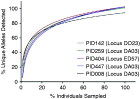
Using reshuffled data from the most diverse locus in each of the 5 VdG resident's worms, a logarithmic relationship, of the form y= m×ln(x)+b, best fit the association between the percentage of the unique alleles detected (x) and the percentage of the worm population sampled (y) better than alternative relationships (data not shown). The coefficient of determination's (R2) mean standard deviation decreased dramatically as the number of shuffling iterations increased from 5 to 15 and remained relatively constant as iterations increased beyond 15. As such, 30 re-sampling iterations of the most diverse microsatellite locus for each worm infrapopulation was used to determine the logarithmic relationship between the number of worms analysed and the number of unique alleles detected. The allelic diversity curves for each of the 5 VdG resident's worm populations were very similar (Fig. 1). Furthermore, for all resident-locus combinations, other than PID008, R2 for the regression exceeded 0·780 (range=0·544–0·916; mean=0·806) indicating a reasonable fit of the calculated relationship to the data. When the data used to produce these 5 curves were combined to determine an overall relationship, we found that the equation y=19·55×ln(x)+9·992 explained the association between worm number and unique allele number with an R2 of 0·775.

Fig. 1. Trendlines representing logarithmic relationships for the percentage of unique alleles detected for each of 5 microsatellite loci (DA03–G5) as a function of the percentage of worms in the infrapopulation (PID142–PID008) that were sampled. Each trendline is based on re-sampling allelic data from the single most diverse locus detected in a single patient infrapopulation of Schistosoma mansoni 30 times.
DISCUSSION
Our results show that sufficient high-quality DNA for microsatellite analyses can be obtained from individual Schistosoma mansoni eggs (collected from human feces) when an extraction protocol containing InstaGene Matrix is used. This technique greatly reduces the time and expense necessary to compile schistosome allelic data from human hosts by making laboratory passage of the parasites prior to genetic analysis unnecessary. PCR amplification of schistosome DNA has been utilized for microsatellite loci from pooled miracidia (Silva et al. 2006) and multi-copy or mitochondrial loci from eggs within fecal samples (Pontes et al. 2002; Gobert et al. 2005; Shrivastava et al. 2005), but to our knowledge this is the first demonstration of multilocus microsatellite genotyping of single copy loci from individual miracidia within schistosome eggs. Collection of multilocus genotypic information from individual eggs, as shown herein, enables the most comprehensive testing of hypotheses about the evolution of human schistosome populations. Although, allele frequency data can be obtained by genotyping a single locus from individual miracidia (Shrivastava et al. 2005), single locus genotypes are limited in their ability to identify alleles that are identical by descent compared to multilocus genotypes. Likewise, estimates of allele frequency that are calculated from pools of schistosome eggs (Silva et al. 2006) cannot provide measures of heterozygosity, limiting their usefulness in explaining modes of evolution within and among populations.
The use of individual S. mansoni eggs, rather than worms, as a DNA source may warrant reservations when successful detection of all microsatellite alleles under investigation is essential or when multiplexed PCR reactions are preferred. The success rate of microsatellite PCR reactions was greater using a worm DNA template in terms of the number of loci detected per individual and the proportion of genotypes detected per locus. Furthermore, the fact that worm DNA allowed multiplexed PCR reactions and egg DNA did not, may influence the economics of some studies. These negative aspects of using schistosome eggs may be countered by our finding that a comparable number of alleles was detected per locus whether egg or worm DNA was used and that the same common alleles were detected with both template sources. Similarly, further experimentation with single locus and multiplex PCR conditions should increase the efficiency of DNA amplification from egg templates. A somewhat similar DNA extraction protocol for nematode eggs that does not require freezing the eggs in liquid nitrogen has been described by Floyd et al. (2002), and may be worth considering in future studies.
In this study, we detected rare alleles more frequently among sampled worms than among genotyped eggs. However, this finding is confounded by the fact that 5 times more worms were genotyped than eggs in this study. It is worth reiterating that the lack of eggs was not related to the availability of eggs for collection, rather it was limited by our ability to store and freeze more eggs when the fecal samples were being processed. Because this method of collecting schistosome DNA from an individual egg was unproven at the time the eggs were harvested, greater emphasis was placed on the proven technique for collecting schistosome genetic information, which meant that infecting snails was the primary focus. Although more rare alleles were detected among the worms, 5 alleles were detected among the eggs that were not observed among the worms, which is noteworthy given that many times fewer eggs were analysed. This finding demonstrates that S. mansoni allelic diversity was lost from the original egg population as evidenced by their absence following passage through laboratory hosts. This supports previous evidence (Stohler et al. 2004) that genetic diversity is lost while maintaining laboratory populations of this parasite. However, this does not require that these alleles were lost due to selection pressures imposed by the laboratory hosts since rare alleles are strongly affected by chance events.
To more equitably compare the genetic diversity of our egg populations to the larger worm populations, we utilized allelic richness values to compare the number of alleles detected among the egg and worm samples. Allelic richness per resident did not differ among the 5 VdG residents suggesting that S. mansoni expresses similar intra-host genetic diversity in our study site. In other words, residents sample similar levels of the S. mansoni genetic diversity (richness) within the study area. Differences were detected in allelic richness between loci when eggs and worms were analysed individually. However, no such differences were found between the egg and worm subpopulations when data from both subpopulations were pooled. These results show that harvesting S. mansoni eggs from stool samples does not limit our ability to detect microsatellite alleles.
This study also considered the genetic consequences of laboratory passage of natural S. mansoni isolates since the worms we analysed were derived from the same stool samples as the genotyped eggs. We anticipated no difference in the expected and observed heterozygosity values for the two DNA sources because the genotyped eggs and the miracidia, which produced the worms, were obtained through replicate sampling of a common set of eggs. Our results do not support this hypothesis. When eggs were used as a DNA source, deficits in heterozygosity, relative to HWE, were detected in all loci across the 5 VdG residents. This finding does not seem to be related to technical limitations associated with our DNA extraction technique since heterozygotes were detected among 30·5% of the loci across all individual eggs. Furthermore, 74·7% of the sampled eggs were heterozygous at one or more loci and 63·1% of the eggs that yielded wholly homozygous multilocus genotypes came from PID008 (data not shown). Worms from PID008 also showed high levels of homozygosity. Therefore, the observed lack of heterozygous genotypes among eggs is likely due to natural causes including: inbreeding of the worms within a resident, population substructuring (Wahlund effect) due to residents sampling cercariae from several different S. mansoni subpopulations, or from positive selection pressures. Interestingly, when passaged adult worms were used as the DNA source, an excess of heterozygotes relative to HWE was observed in 3–4 of the loci among all the studied VdG residents. Selection pressures that favour heterozygous individuals would favour such an outcome. Comparison of Ho and He values in eggs and worms also suggests that heterozygote advantage may have affected the genetic diversity of the worm subsample since He values were equivalent for the two DNA sources but Ho for worms was significantly larger than that for eggs. Since the worms and eggs used in this study were derived from a common stool sample, this result suggests that passage through laboratory strains of snails and mice favoured heterozygous S. mansoni genotypes. This is an intriguing result as long-term passage of schistosomes through laboratory hosts results in reduced heterozygosity (Stohler et al. 2004), whereas heterozygote advantage should promote the maintenance of allelic diversity. In light of our current results, it appears that the reduction in diversity of laboratory populations, due to founder effects and potential bottlenecks, is sufficient to counter any initial heterozygote advantage that may result from passage through laboratory hosts.
To the extent that the 5 individuals from VdG used as the source of worms for this study represent all VdG residents, y=19·55×ln(x)+9·992, allows us to determine the proportion of worms required to obtain high allelic diversity among parasites from other VdG residents. Based on our overall equation, we can predict that when 60% of the S. mansoni tissue (laboratory passaged worms, most specifically) from other VdG resident infrapopulations is genotyped 90% of the distinct alleles present among that worm population should be detected. This is a powerful approach because it relies on allelic data from a subset of the original study population to define sampling effort for the remainder of the study population rather than arbitrarily choosing a number of individuals to genotype. It is likely that population genetic patterns discerned using this method are more indicative of the actual population structure than patterns suggested by less stringent sampling methods. Since this approach is based on previously obtained evidence of genotypic redundancy for a defined study area, its use can substantially reduce the overall cost of genetic analyses for parasite populations where clonality is an important determinant of population structure. Use of a cost-benefit curve can also limit over-sampling, which would be accompanied by exclusion of redundant genotypes.
Selecting appropriate hosts for generating parasite allelic diversity curves is critical for the applicability of this methodology. Variables that we consider most important for choosing host candidates include: the number of infection foci in the study area, the spatial distribution of these foci, aggregation of hosts relative to the foci, and the host's parasite intensity. As a general rule, the number of sampled hosts should be increased relative to the number of infection foci since a single host is unlikely to adequately represent the genetic diversity of multiple foci unless the foci are close together. As a result, aggregated host populations and/or foci may require fewer sampled hosts relative to populations and/or foci that are more diffuse. Lastly, hosts with similarly high parasite intensities (based upon initial intensity screening) should be given priority, as these individuals likely posses the richest parasite diversity. Each of these variables (and their interactions) should be considered within a particular study area to avoid biasing estimates of parasite genetic diversity.
In summary, the schistosome sampling approaches presented here provide worthwhile methods to increase the efficiency of our efforts to discern the sociological, ecological and evolutionary forces that impact genetic diversity and disease epidemiology. The use of template DNA from individual schistosome eggs can dramatically reduce the time and costs associated with obtaining multilocus genotypes by negating the need to artificially passage life-cycle stages in the laboratory. Likewise, sampling schemes that are defined by the underlying allelic diversity provide a realistic view of the genetic diversity in that population while limiting both the time and resources necessary to collect that view.
We are indebted to Laura Warlow, Kathy Mounts, Esther Dubrovsky, Marcilene Rezende Silva and Maíra Mazzoni Pucci for their technical support. We also wish to thank Liana Konovaloff Jannotti Passos for help with purifying the eggs and infecting snails as well as recognizing Andrea Gazzinelli and Rodrigo Correa-Oliveira for assistance with the field portion of this work. Manuscript comments, by Monika Zavodna, Greg Sandland and Jason Curtis were especially valuable. This work was funded by a National Institutes of Health (USA) Research Grant (R01-AI-42768) to D.J.M. and in part by a Fundação de Amparo å Pesquisa do Estado de Minas Gerais (FAPEMIG) Research Grant (407/02) and a World Health Organization/Tropical Disease Research (WHO/TDR) Grant (A20399) to G.O.