Introduction
2,4-Dichlorophenoxyacetic acid (2,4-D), a synthetic auxin herbicide discovered and commercially introduced in the 1940s, has been widely used for broadleaf weed control in crop and non-crop lands since becoming available on the herbicide market (Peterson Reference Peterson1967, Peterson et al. Reference Peterson, McMaster, Riechers, Skelton and Stahlman2016). Within the home and garden sector that encompasses residential landscapes, 2,4-D is the most commonly used pesticide active ingredient (Grube et al. Reference Grube, Donaldson, Kiely and Wu2011). Across all agricultural sectors, a total of 11,611,964 kg of 2,4-D was applied in 2011 and the rising adoption of 2,4-D-resistant genetically engineered crops is expected to significantly increase annual 2,4-D use (USDA 2014).
Turfgrass covers more than 16 million hectares in the United States across residential lawns, parks and school playgrounds, golf courses and sports fields, commercial and institutional landscapes, and cemeteries (Milesi et al. Reference Milesi, Running, Elvidge, Dietz, Tuttle and Nemani2005). In these turf areas, weedy plants such as buckhorn plantain, can emerge due to improper maintenance, environmental changes, and herbicide resistance (McCarty et al. Reference McCarty, Everst, Hall, Murphy and Yelverton2008). Practices such as proper mowing, fertilizing, irrigating, and hand pulling combined with prudent herbicide applications are important components of an integrated weed management strategy. If herbicide use is necessary, 2,4-D applied post-emergence is a commonly used and efficacious treatment for broadleaf weed control in grassy areas (Elmore Reference Elmore1996).
Plants can be tolerant or sensitive to 2,4-D, and such selectivity is influenced by translocation of 2,4-D in plants (Pillmoor and Gaunt Reference Pillmoor and Gaunt1981). In a general sense, broadleaf dicots are sensitive to 2,4-D, whereas monocots such as grasses, are tolerant (Peterson et al. Reference Peterson, McMaster, Riechers, Skelton and Stahlman2016). Sensitive species metabolize 2,4-D through direct conjugation resulting in phytotoxic metabolites. By contrast, tolerant species metabolize 2,4-D through ring hydroxylation resulting in nonphytotoxic metabolites (Peterson et al. Reference Peterson, McMaster, Riechers, Skelton and Stahlman2016). Additionally, more recent research suggests that synthetic auxin herbicides applied to sensitive plants triggers an up-regulation of an abscisic acid (ABA) biosynthesis gene in the plant that increases ABA synthesis and a down-regulation of photosynthetic machinery to incite plant death (McCauley et al. Reference McCauley, McAdam, Bhide, Thimmapuram, Banks and Young2020).
Weed species have developed resistance to synthetic auxin herbicides, but the risk of resistance development is low, with most instances occurring in situations of repeated use over long periods of time (>20 yr; Beckie and Tardif Reference Beckie and Tardif2012; Peterson et al. Reference Peterson, McMaster, Riechers, Skelton and Stahlman2016). Therefore, development of resistance to these herbicides could be troublesome and would limit the options of selective herbicides for weed control in managed turfgrass systems (Beckie and Tardif Reference Beckie and Tardif2012; Patton et al. Reference Patton, Weisenberger and Schortgen2018). The resistance mechanism in plants to synthetic auxin herbicides is not completely understood, but substantial progress has been made in unravelling the phenomenon. Interaction of specific auxin-binding proteins and auxin receptors have been found to be involved with auxin transport processes and these mechanisms are thought to play a role in synthetic auxin herbicide resistance development (Christoffoleti et al. Reference Christoffoleti, Alves de Figueiredo, Pereira Peres, Nissen and Gaines2015; Dharmasiri et al. Reference Dharmasiri, Dharmasiri and Estelle2005; Jugulam et al. Reference Jugulam, Hall, Johnson, Kelley and Riechers2011; Peterson et al. Reference Peterson, McMaster, Riechers, Skelton and Stahlman2016).
Forty weed species have been confirmed to have resistance to synthetic auxin herbicides, with 14 of those confirming resistance only to 2,4-D (Heap Reference Heap2020). Seven of the 40 species resistant to synthetic auxin herbicides are confirmed to have cross-resistance to multiple chemical families of herbicides in the synthetic auxin grouping (Heap Reference Heap2020). Most weed species resistant to synthetic auxin herbicides have an annual life cycle except for spotted knapweed (Centaurea stoebe L.), Canada thistle [Cirsium arvense (L.) Scop.], tall buttercup (Ranunculus acris L.), and buckhorn plantain. To our knowledge, there have been no previous reports of synthetic auxin resistance for any weed species in Pennsylvania.
Buckhorn plantain is a perennial broadleaf plant that is common in home lawns, landscapes, orchards, nursery crops and other perennial crops, and roadsides (Cavers et al. Reference Cavers, Bassett and Crompton1980; Uva et al. Reference Uva, Neal and DiTomaso1997). Buckhorn plantain tolerates close mowing and is commonly found on drier sites and in soils with a neutral or basic pH (Uva et al. Reference Uva, Neal and DiTomaso1997). The weed may crowd out desirable plant species and compete for soil nutrients, water, and light that could impact functionality and aesthetics of the landscape. Several previous studies have evaluated herbicide efficacy on controlling buckhorn plantain in grassy areas (Branham Reference Branham1990; McCullough et al. Reference McCullough, Johnston, Reed and Yu2015; Patton et al. Reference Patton, Weisenberger and Schortgen2018; Watschke Reference Watschke1983). Among the synthetic auxin herbicides, active ingredients from the phenoxycarboxylic acid chemical family including 2,4-D and others (dichlorprop, MCPA, and mecoprop) are generally effective in controlling buckhorn plantain, whereas the efficacy of pyridinecarboxylic acids (clopyralid, fluroxypyr, triclopyr) and benzoic acids (dicamba) are variable or do not effectively control the weed (Patton et al. Reference Patton, Elmore, Hoyle, Kao-Kniffin, Branham, Voigt, Christians, Thoms, Munshaw, Hathaway, Nikolai, Horgan, Miller, Xiong, Kreuser, Gaussoin, Gardner, Raudenbush, Li, Landschoot, Soldat and Koch2019).
The first confirmed population of buckhorn plantain with resistance to 2,4-D and other phenoxycarboxylic acid herbicides was found in Indiana on cemetery grounds following 30 yr of 2,4-D applications to control broadleaf weeds (Patton et al. Reference Patton, Weisenberger and Schortgen2018). In greenhouse dose-response experiments, the resistant buckhorn plantain biotype was more than 6-fold less sensitive to 2,4-D compared to a susceptible biotype (Patton et al. Reference Patton, Weisenberger and Schortgen2018). In comparison, responses to triclopyr, a pyridinecarboxylic acid, were similar in both biotypes, indicating a lack of cross-resistance to other chemical families in the synthetic auxins. Field experiments provided more evidence that resistance was confined to the phenoxycarboxylic acid chemical family because other herbicides from the pyridinecarboxylic acid (clopyralid, triclopyr) and arylpicolinate (halauxifen-methyl) chemical families were efficacious against the resistant biotypes (Patton et al. Reference Patton, Weisenberger and Schortgen2018). Halauxifen-methyl is a new synthetic auxin herbicide that has been demonstrated to be an efficacious alternative to 2,4-D and dicamba for controlling horseweed [Conyza canadensis (L.) Cronq.] and redroot pigweed (Amaranthus retroflexus L.) in cropping systems (Mccauley and Young Reference McCauley and Young2019; Zimmer et al. Reference Zimmer, Young and Johnson2018). This efficacy is due to differing binding affinity at the site of action for the herbicide (Bell et al. Reference Bell, Schmitzer and Robinson2014; Schmitzer et al. Reference Schmitzer, Balko, Daeuble, Epp, Satchivi, Siddall, Weimer and Yerkes2015). Further evaluation of halauxifen-methyl is needed in turfgrass systems to understand the role it may play in buckhorn plantain and other broadleaf weed control.
Two populations of buckhorn plantain in Pennsylvania, one at a college campus and the other on a golf course, were suspected as being resistant to 2,4-D-containing herbicide applications after long-term, repeated use. Thus, the objectives of this study were to 1) confirm 2,4-D resistance in greenhouse dose-response experiments, 2) confirm field resistance of buckhorn plantain to 2,4-D in Pennsylvania, and 3) evaluate alternative commercially available herbicides to control buckhorn plantain in turfgrass that has become resistant to 2,4-D.
Materials and Methods
Site History
Two sites of buckhorn plantain populations, one in Harrisburg, PA (40.20°N, 76.74°W) and one in Carlisle, PA (40.17°N, 77.28°W), were reported to not be controlled after repeated, long-term (>20 yr) 2,4-D applications. The soil type for the Harrisburg site was a Chavies fine sandy loam (coarse-loamy, mixed, active, mesic Ultic Hapludalfs) and the Carlsle site was a Duffield silt loam (fine-loamy, mixed, active, mesic Ultic Hapludalfs). Both locations were maintained as cool-season turfgrass landscapes mowed at 5.1 to 7.6 cm. At trial initiation, buckhorn plantain constituted less than 10% of green plant coverage at the Harrisburg site and 66% coverage at the Carlisle site. Greenhouse and field experiments were initiated to assess potential resistance to 2,4-D for each of these buckhorn plantain populations.
Greenhouse Dose-Response Experiments
Mature buckhorn plantain plants from the Harrisburg site were collected with a hand trowel to preserve root system and transplanted into 11.4-cm-diameter and 10.2-cm-tall, round, plastic pots with potting soil growing media (Sunshine Mix #4, Sun Gro Horticulture, Agawam, MA 01001) and allowed to establish at the Pennsylvania State University (University Park, PA) greenhouse complex. Additionally, a second buckhorn plantain collection was obtained from a susceptible population in University Park, PA (40.81°N, 77.86°W). Individual potted plants were irrigated and fertilized as needed to facilitate plant establishment. Fertilization included two applications of a water-soluble fertilizer (N-24 P-8 K-16; Miracle-Gro All Purpose Plant Food, Scotts Miracle-Gro, Marysville, OH 43040) to provide 24.4 kg N ha−1. Buckhorn plantain were established in the greenhouse for 8 wk before dose-response experiments were initiated. Greenhouse conditions maintained a 16/8 hr day/night cycle. Greenhouse air temperature was maintained above 18 C with cooling systems initiating when temperatures exceeded 25 C. Experiments were conducted in October 2018 and repeated in June 2019.
This experiment was arranged as a randomized complete block design in a 2 by 8 factorial treatment arrangement within each herbicide with four replications serving as blocks. Treatment factors included two buckhorn plantain biotypes (resistant or susceptible) and eight doses of each herbicide. Each biotype was treated with doses 0, 0.84, 1.68, 3.36, 6.72, 13.4, 26.9, and 53.8 kg ae ha−1 of 2,4-D dimethylamine (Gordon’s Amine® 400, PBI-Gordon Corp., Shawnee, KS 66226), with 1.68 kg ae ha−1 serving as the standard application rate. Similarly, each biotype was treated with technical grade halauxifen-methyl (GF-2685, Corteva Agriscience, Wilmington, DE 19805) at doses of 0, 0.003, 0.005, 0.01, 0.02, 0.04, 0.08, and 0.16 kg ae ha−1, with 0.01 kg ae ha−1 being the standard application rate. Treatments were applied using a CO2-pressurized backpack sprayer equipped with a single TeeJet AI9508 EVS nozzle (TeeJet Spraying Systems Co., Wheaton, IL 60139) calibrated to deliver 408 L ha−1.
Visual weed epinasty was evaluated 3 d after treatment (DAT) and visual necrosis was assessed 14 and 28 DAT. Epinasty was rated on a 0% to 100% scale, with 0% equivalent to no epinasty and 100% epinasty being complete twisting, bending, and curling of stems and leaf tissue. Necrosis was also rated on the same 0% to 100% scale, except a 100% evaluation was equivalent to completely dead plant tissue. Leaf chlorophyll content index (CCI) was evaluated 28 DAT with an MC-100 Chlorophyll Concentration Meter (Apogee Instruments, Logan, UT 84321) by taking two measurements of a single, representative leaf for each plant. Plants were harvested 2 cm above the soil surface 28 DAT to measure fresh and dry plant tissue weight. Harvested plant tissue was placed in a drying oven for 7 d at 60 C. Plants were allowed to regrow for an additional 2 wk and harvested again at 42 DAT for fresh and dry weight measurements.
Analysis of variance was conducted with the PROC MIXED procedure in SAS (version 9.3; SAS Institute, Cary, NC 27513). Experimental run was not a significant source of variation (P < 0.05), therefore data were pooled across experimental runs. The GR50 (the herbicide dose eliciting a 50% growth reduction by the plant) for each herbicide and biotype was estimated using a three-parameter log-logistic dose-response curve (Seefeldt et al. Reference Seefeldt, Jensen and Fuerst1995):
 $$y = C + {{D - C} \over {1 + {{\left( {{x \over {{\rm{G}}{{\rm{R}}_{50}}}}} \right)}^b}}}$$
where y is the response variable (epinasty, necrosis, etc.), GR50 is the herbicide dose eliciting a 50% reduction, b is the relative slope, D is the upper limit, C is the lower limit, and x is the rate of the herbicide being used. Log-logistic regression was analyzed using Prism 8 software (GraphPad Software, La Jolla, CA 92037). The GR50 of a biotype was deemed significantly different if the 95% confidence intervals of the GR50 estimates did not overlap. Resistance factors were calculated as the ratio of resistant biotype GR50 to susceptible biotype GR50 and were used to quantify level of resistance in each population with the scale employed by Becki and Tardif (Reference Beckie and Tardif2012).
Field Herbicide Efficacy Experiments
Field experiments were initiated at suspected 2,4-D-resistant sites in Harrisburg and Carlisle and also at a susceptible site in University Park (40.78°N, 77.87°W) to evaluate potential alternative herbicides to 2,4-D for controlling resistant populations. The University Park site averaged 30% buckhorn plantain coverage and the soil type was a Hagerstown silt loam (fine, mixed, semiactive, mesic Typic Hapludalf). For the Harrisburg and University Park sites, experiments were initiated in September 2018 and repeated in May 2019. For the Carlisle site, two experiments were initiated in May 2019 in different, but adjacent experimental areas.
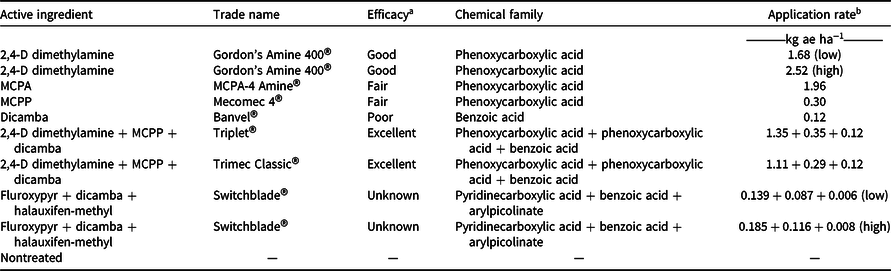
Field experiments were arranged in a randomized complete block design with four replications serving as blocks. Herbicide treatments included 2,4-D dimethylamine (Gordon’s Amine® 400) at a low (label) and high rate, MCPA (MCPA-4 Amine®, Nufarm Americas Inc, Alsip, IL 60803), MCPP (Mecomec 4®, PBI-Gordon Corp.), dicamba (Banvel®, Micro Flo Company, Memphis, TN 38117), 2,4-D + MCPP + dicamba (Triplet®, Nufarm Americas Inc.; Trimec Classic®, PBI-Gordon Corp.), fluroxypyr + dicamba + halauxifen-methyl (Switchblade®, PBI-Gordon Corp.) at a low and high rate, and a nontreated control (Table 1). All treatments are listed by their trade name in figures and tables.
Commercially available herbicides used in field efficacy experiments for control of buckhorn plantain in 2,4-D-resistant and susceptible populations.

a Efficacy based on key published by Patton et al. (Reference Patton, Elmore, Hoyle, Kao-Kniffin, Branham, Voigt, Christians, Thoms, Munshaw, Hathaway, Nikolai, Horgan, Miller, Xiong, Kreuser, Gaussoin, Gardner, Raudenbush, Li, Landschoot, Soldat and Koch2019) where excellent = ≥90% control, good = 75% to 90% control, fair = 50% to 75% control, poor = <50% control.
b Where indicated, low = labeled application rate, high = higher application rate than product label.
Buckhorn plantain coverage of herbicide treatments was evaluated 28 DAT. Buckhorn plantain coverage in plot areas was visually estimated on a 0% to 100% scale, with 0% equivalent to no buckhorn plantain and 100% representing an entire plot area consisting of buckhorn plantain. Data were transformed to percent buckhorn plantain reduction by dividing buckhorn plantain coverage at 28 DAT by initial coverage prior to treatment application.
ANOVA was conducted using the PROC MIXED procedure in SAS. Treatment means were separated using Fisher’s protected LSD test. A value of α = 0.05 was used to determine statistical significance.
Results and Discussion
Greenhouse Dose-Response Experiments
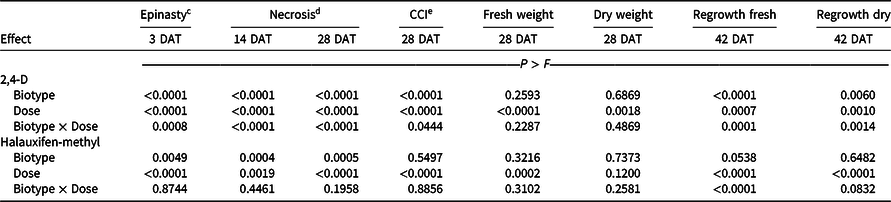
The effect of experimental run was not significant for any evaluation. Therefore, data from both experiments were pooled. ANOVA revealed a significant two-way interaction of biotype and 2,4-D dosage for all evaluations except fresh and dry weight measurements at 28 DAT, indicating differential responses of buckhorn plantain to doses of 2,4-D in susceptible (S) and resistant (R) populations (Table 2). In contrast, the two-way interaction of biotype and halauxifen-methyl dosage was only significant on one of 11 evaluations, suggesting similar responses to halauxifen-methyl across S and R populations.
Analysis of variance for epinasty, necrosis, chlorophyll content index, fresh and dry weight, and regrowth fresh and dry weight evaluations on buckhorn plantain treated with different rates of 2,4-D and halauxifen-methyl herbicides at various days after treatment in greenhouse dose response trials. a b

a Abbreviations: CCI, chlorophyll content index; DAT, days after treatment.
b Data presented are averaged across 2018 and 2019 trial years due to no significant trial year interaction (P > 0.05).
c Epinasty was visually assessed on a 0% to 100% scale with 0% being no epinasty and 100% epinasty being complete twisting, bending, and curling of stems and leaf tissue.
d Necrosis was visually assessed on a 0% to 100% scale, with 0% being no necrosis and 100% necrosis being completely dead plant tissue.
e CCI was measured with an Apogee MC-100 Chlorophyll Concentration Meter on a fully expanded, representative leaf of each plant.
Epinasty differed between R and S populations in response to 2,4-D and halauxifen-methyl at 3 DAT (Table 2). Across all dosages of 2,4-D, epinasty averaged 35% in the R biotypes and 53% in S biotypes (data not shown). For halauxifen-methyl, epinasty averaged 25% and 36% in R and S biotypes, respectively, across all dosages.
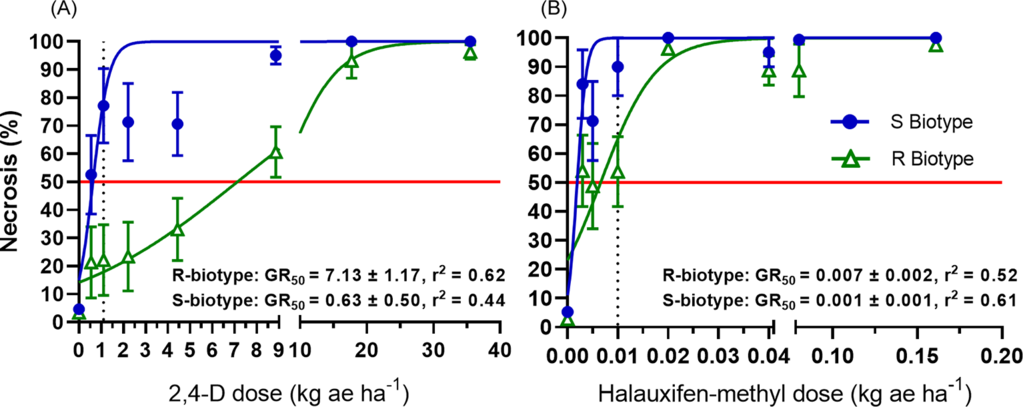
For necrosis evaluations at 14 and 28 DAT, a significant two-way interaction of biotype and 2,4-D dose was observed in buckhorn plantain populations (Table 2; Figure 1). The two-way interaction for 2,4-D-treated plants indicates that S and R populations had significant response differences at specified dosages. Conversely, only the main effects of biotype and dosage were significant in halauxifen-methyl-treated populations (Table 2). For 2,4-D, the estimated GR50 for necrosis in the R population 28 DAT was 7.13 kg ae ha−1, more than 4 times greater than the labeled application rate of 1.68 kg ae ha−1 (Figure 1). In comparison, the S population had a GR50 for necrosis of 0.63 kg ae ha−1, a dosage lower than half of the label rate. These results are similar to those reported by Patton et al. (Reference Patton, Weisenberger and Schortgen2018) in which a resistant buckhorn plantain biotype in Indiana required a 2,4-D dosage at least 6.2 times greater than the susceptible biotype.
Nonlinear regression of buckhorn plantain necrosis 28 d after treatment with 2,4-D (A) or halauxifen-methyl (B) in suspected-2,4-D-resistant (R) and suspected-2,4-D-susceptible (S) biotypes in greenhouse dose-response experiments. Error bars represent the standard error of the mean. Intersection of trendline with horizontal line at 50% necrosis is representative of the estimated GR50. ± indicates 95% confidence intervals of estimated GR50. Dashed vertical line indicates the labeled rate of each herbicide active ingredient.

For halauxifen-methyl treatments, necrosis at 14 and 28 DAT was significantly affected by dose and biotype main effects (Table 2). Except when compared to the nontreated control, necrosis at 14 DAT did not differ among doses of halauxifen-methyl across both populations, averaging 43% necrosis (data not shown). At 28 DAT, dosages of halauxifen-methyl at or below the standard application dose of 0.010 kg ae ha−1 resulted in necrosis greater than the nontreated control (67% compared to 4% necrosis, respectively), whereas dosages higher than the standard dose resulted in greater necrosis (96%; data not shown). Across all doses of halauxifen-methyl, 48% necrosis was observed in S populations 14 DAT, compared with 27% in R populations. At 28 DAT, necrosis was 80% and 66% in S and R populations, respectively, across all halauxifen-methyl doses. Despite the lack of a biotype-by-dose interaction for populations treated with halauxifen-methyl (Table 2), the GR50 for necrosis of S and R biotypes at 28 DAT were 0.001 and 0.007 kg ae ha−1 halauxifen-methyl, respectively, and were lower than the standard application rate of 0.010 kg ae ha−1 (Figure 1).
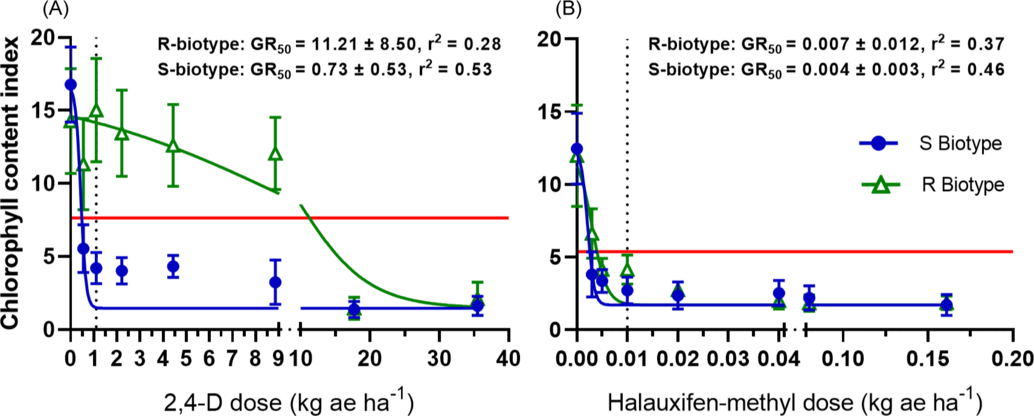
CCI measurements resulted in similar trends as necrosis evaluations. At 28 DAT, there was a significant two-way biotype-by-dose interaction for buckhorn plantain populations treated with 2,4-D (Table 2). Conversely, dose was the lone significant treatment factor for plants treated with halauxifen-methyl, suggesting that there were no differences among R and S biotypes in terms of CCI when treated with this active ingredient (Table 2). Although R 2 values were lower in regression analysis and more variability was present in CCI data than necrosis evaluations, the CCI GR50 for the R biotype in response to 2,4-D application was still greater (11.21 kg ae ha−1) than that of the S biotype (0.73 kg ae ha−1) and greater than the label application 2,4-D application rate of 1.68 kg ae ha−1 (Figure 2). The CCI GR50 values for R and S biotypes treated with halauxifen-methyl were not different from each other and were less than or equivalent to the standard halauxifen-methyl application rate.
Nonlinear regression of buckhorn plantain chlorophyll content index 28 d after treatment with 2,4-D (A) or halauxifen-methyl (B) in suspected-2,4-D-resistant (R) and suspected-2,4-D-susceptible (S) biotypes in greenhouse dose-response experiments. Error bars represent the standard error of the mean. Intersection of trendline with horizontal line at 50% chlorophyll content index is representative of the estimated GR50. Dashed vertical line indicates the labeled rate of each herbicide active ingredient.

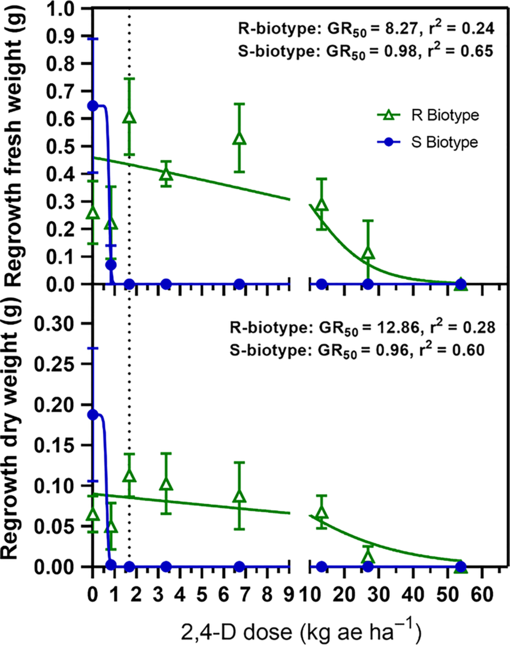
The main effect of dosage influenced fresh and dry weight 28 DAT in 2,4-D treatments, but it affected only fresh weight in halauxifen-methyl treatments (Table 2). The loss of plant moisture after drying could potentially explain why dosage did not affect dry weight in halauxifen-methyl treatments 28 DAT. However, a significant biotype-by-dose interaction was observed for 2,4-D treated plants regarding fresh and dry regrowth weight measurements taken 42 DAT after the initial harvest (Table 2). For both fresh and dry regrowth, the GR50 for the S biotype was less than the label rate of 2,4-D, indicating that 2,4-D treatments are effective at controlling this biotype (Figure 3). However, R biotypes needed 2,4-D dosages greater than four times the labeled rate to exhibit a 50% reduction in fresh or dry regrowth. In both S and R biotypes, all rates of halauxifen-methyl resulted in complete death of buckhorn plantain, whereas the nontreated plants grew new leaves following the initial harvest 28 DAT (data not shown). This finding suggests that there is no perceived resistance to this active ingredient in the 2,4-D-resistant biotype.
Nonlinear regression of buckhorn plantain fresh (A) and dry (B) regrowth weight from suspected 2,4-D-resistant (R) and suspected-2,4-D-susceptible (S) biotypes 42 d after 2,4-D treatment following initial plant tissue harvest 28 d after treatment in greenhouse dose-response experiments. Whole plant biomass was harvested and oven-dried at 60 C for 7 d. Error bars represent the standard error of the mean.

Resistance factors of 11.3 for necrosis and 15.4 for CCI evaluations after R and S biotypes were treated with 2,4-D indicate the differential responses in each population to the same herbicide. Resistance factors greater than 10 are often considered as being high for synthetic auxin herbicides (Beckie and Tardif Reference Beckie and Tardif2012) and quantify the level of 2,4-D resistance present in the resistant biotype. Although R and S biotypes had different resistance factors to halauxifen-methyl, the GR50 for each biotype was still below the standard application rate. These resistance factors are in the same range as those observed by Patton et al. (Reference Patton, Weisenberger and Schortgen2018) on 2,4-D-resistant buckhorn plantain in Indiana and are consistent with studies on several annual broadleaf weeds and their resistance to 2,4-D (Burke et al. Reference Burke, Yenish, Pittmann and Gallagher2009; Preston et al. Reference Preston, Dolman and Boutsalis2013; Rey-Caballero et al. Reference Rey-Caballero, Menéndez, Giné-Bordonaba, Salas, Alcántara and Torra2016).
Field Herbicide Efficacy Experiments
Commercially available synthetic auxin herbicides were evaluated to determine buckhorn plantain control efficacy in field experiments at one location with a S buckhorn plantain biotype in University Park and two locations with suspected-R biotypes in Carlisle and Harrisburg. There was a significant effect of experimental run (P = 0.0445) at the University Park site. Therefore, data are presented separately by experiment. At the Harrisburg and Carlisle sites, experimental run was not a significant effect (P = 0.5899 and 0.4300, respectively) and data were pooled across experiments for each location.
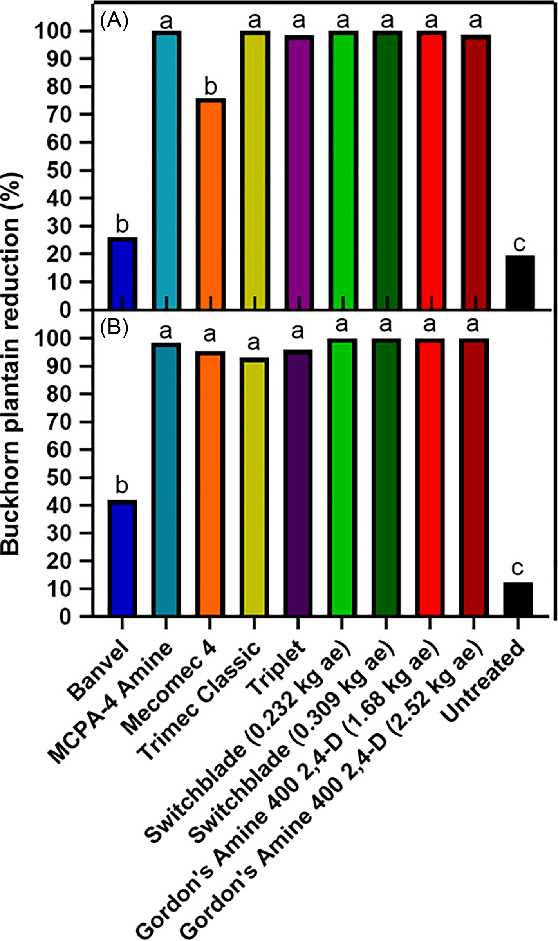
Initial buckhorn plantain coverage at the S biotype site averaged 16.1% and 45.7% of plot area in 2018 and 2019, respectively (data not shown). Except for Mecomec 4 in 2018 and Banvel, all other synthetic auxin treatments reduced buckhorn plantain ≥90% across all experiments conducted on S biotypes (Figure 4). Banvel provided poor reduction (<50%) in both years, as expected based on previous reports indicating poor efficacy on buckhorn plantain (Patton et al. Reference Patton, Elmore, Hoyle, Kao-Kniffin, Branham, Voigt, Christians, Thoms, Munshaw, Hathaway, Nikolai, Horgan, Miller, Xiong, Kreuser, Gaussoin, Gardner, Raudenbush, Li, Landschoot, Soldat and Koch2019). Both low and high rates of Gordon’s 400 2,4-D reduced buckhorn plantain by >90%.
Buckhorn plantain cover reduction in a 2,4-D-susceptible population at University Park, PA in 2018 (A) and 2019 (B) 28 d after synthetic auxin herbicide treatment in field efficacy experiments. Within each year, means followed by the same letter are not significantly different according to Fisher’s protected LSD test (α = 0.05).

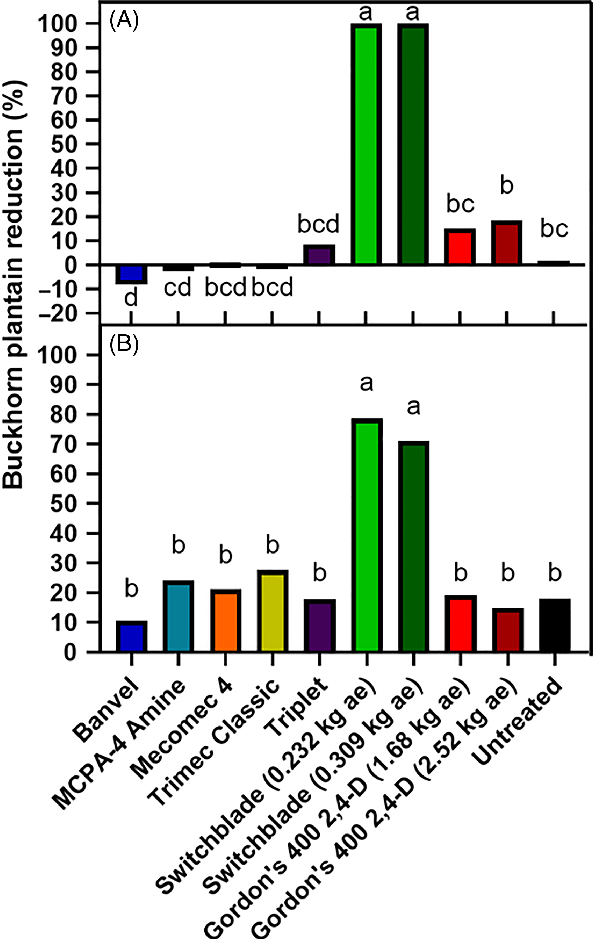
Across both runs of the experiment in R biotypes, initial buckhorn plantain coverage averaged 10.3% at the Harrisburg location and 66.2% at the Carlisle location (data not shown). Gordon’s 400 2,4-D applied at low and high rates were essentially equivalent to the nontreated at both resistant locations, reducing buckhorn plantain cover by less than 20% (Figure 5). Additionally, all other treatments from the phenoxycarboxylic acid and benzoic acid chemical families were not able to provide reduction greater than the nontreated, indicating resistance mechanisms to the phenoxycarboxylic acid chemical family as initially reported by Patton et al. (Reference Patton, Weisenberger and Schortgen2018). Alternatively, Switchblade treatments resulted in good (70% to 90% reduction) to excellent reduction (≥90%) at both locations (Figure 5). This treatment contained active ingredients from the pyridinecarboxylic acid (fluroxypyr) and arylpicolinate (halauxifen-methyl) chemical families in addition to a benzoic acid (dicamba) that do not have any reported cases of resistance in buckhorn plantain. Because dicamba is not considered an effective active ingredient in controlling buckhorn plantain (Patton et al. Reference Patton, Elmore, Hoyle, Kao-Kniffin, Branham, Voigt, Christians, Thoms, Munshaw, Hathaway, Nikolai, Horgan, Miller, Xiong, Kreuser, Gaussoin, Gardner, Raudenbush, Li, Landschoot, Soldat and Koch2019) and fluroxypyr has been reported to be ineffective on other 2,4-D-resistant buckhorn plantain populations (Patton et al. Reference Patton, Weisenberger and Schortgen2018), these results suggest that the effectiveness of the Switchblade treatments could be attributed to the halauxifen-methyl component. The differing binding affinity of halauxifen-methyl at the site of activity compared to that of 2,4-D and other synthetic auxins (Bell et al. Reference Bell, Schmitzer and Robinson2014; Schmitzer et al. Reference Schmitzer, Balko, Daeuble, Epp, Satchivi, Siddall, Weimer and Yerkes2015) could indicate why this treatment was successful in resistant populations, as has been suggested in other studies (McCauley et al. Reference McCauley, Johnson and Young2018). In addition to halauxifen-methyl, Patton et al. (Reference Patton, Weisenberger and Schortgen2018) also found that other pyridinecarboxylic acid herbicides such as clopyralid and triclopyr are effective in 2,4-D-resistant buckhorn plantain populations.
Buckhorn plantain cover reduction within 2,4-D-resistant populations in Carlisle, PA (A) and Harrisburg, PA (B) 28 d after treatment with synthetic auxin herbicides in field efficacy experiments. Treatment bars that do not share the same letter are significantly different according to Fisher’s protected LSD test (α = 0.05).

In the present study, resistance in buckhorn plantain was restricted to herbicides from the phenoxycarboxylic acid chemical family of synthetic auxin herbicides and is in agreement with previous research in Indiana (Patton et al. Reference Patton, Weisenberger and Schortgen2018). Field evaluations in suspected-R buckhorn plantain populations further indicated resistance to phenoxycarboxylic acids in the synthetic auxin herbicides. Greenhouse and field evaluations indicate that treatments including halauxifen-methyl could be used to effectively control these resistant populations. These results confirm resistance to 2,4-D in buckhorn plantain populations in turfgrass systems and further shed light on alternative control options in R populations. Although cross-resistance to multiple chemical families within the synthetic auxins has been reported in other weed species, a majority of reports cite single chemical family resistance in synthetic auxins (Heap Reference Heap2020). Specifically in turf systems, only lawn burweed has been reported to have synthetic auxin resistance to the pyridinecarboxylic acid herbicides (Harrington et al. Reference Harrington, Ward and Wells2001). Because it is not always practical or in the research objectives of a study to evaluate resistant weed species against all classes of an herbicide group, the disparity in cross-resistance and single chemical family resistance could be artificially inflated. There are several reports of weed species having multiple resistance to a synthetic auxin herbicide and other herbicide modes of action (Heap Reference Heap2020), but that was not evaluated in the present study. Regardless, this is the first report of synthetic auxin resistance of any weed species in Pennsylvania. Despite substantial research in unravelling the molecular mechanism for synthetic auxin resistance, additional research is needed to fully understand the factors conferring 2,4-D resistance in buckhorn plantain. Further research should also focus on cultural control options and additional commercially available herbicide formulations for buckhorn plantain, especially in resistant populations, as part of an integrated weed management strategy.
Acknowledgments
We thank PBI-Gordon Corp. for providing financial funding and the facilities that allowed us to conduct the research. This work was supported by the USDA–National Institute of Food and Agriculture, Hatch accession 1006804 and project PEN04592. No conflicts of interest have been declared.