INTRODUCTION
Mood disorders are a common problem among oncology patients, usually explained by the fear of death punctuating the care process. Within the digestive tract, pancreatic cancer remains one of the most malignant diagnoses. Despite the progress made over the past decades, by its rare accessibility to surgery and its frequent chemoresistance, it is the fourth deadliest cancer in the world. Its average five-year survival rate has dramatically remained between 1 and 5% over the previous 20 years (Jemal et al., Reference Jemal, Siegel and Xu2010). In parallel, it presents one of the highest rates of associated depression. Indeed, it is reported that patients in the advanced stage of pancreatic cancer have more symptoms of anxiety and depression compared to all other types of digestive cancer (Holland et al., Reference Holland, Korzun and Tross1986; Kelsen et al., Reference Kelsen, Portenoy and Thaler1995; Jia et al., Reference Jia, Jiang and Shang2010; Fras et al., Reference Fras, Litin and Pearson1967; Joffe et al., Reference Joffe, Rubinow and Denicoff1986). Massie (Reference Massie2004) assessed the prevalence of depression at between 30 and 50% of patients with a pancreatic tumor. This specificity is well recognized in our day and could be, as stated above, partially explained by the severity of the prognosis. However, this association is not found in other types of cancer of comparable malignancy.
Even if in most cases symptoms occur during the course of treatment, some research (Yaskin, Reference Yaskin1931; Fras et al., Reference Fras, Litin and Pearson1967; Passik & Roth, Reference Passik and Roth1999; Joffe et al., Reference Joffe, Rubinow and Denicoff1986; Green & Austin, Reference Green and Austin1993) has reported isolated depressive episodes occurring several months prior to diagnosis, suggesting the existence of a prodromal form of depression, appearing upstream of the neoplastic disease. Initial data are more than four decades old: Yaskin first described the now famous “depression, anxiety, and sense of impending doom” triad as possible precursors of pancreatic tumor. In a more recent study, Fras and colleagues (Reference Fras, Litin and Pearson1967) noted that psychiatric symptoms could appear up to 43 months prior to physical symptoms and could cover more than 50% of patients.
Numerous studies have subsequently proposed to verify and clarify the relationship between these two conditions (Passik & Roth, Reference Passik and Roth1999; Joffe et al., Reference Joffe, Rubinow and Denicoff1986; Green & Austin, Reference Green and Austin1993). The results, though consistent, remain subject to significant variations. For example, in another study, Boyd and colleagues (Reference Boyd, Brown and Henrickson2012a) found a 23% prevalence of depression in a cohort of 22 patients treated for pancreatic cancer. The available data have rarely been updated since. Nowadays, pancreatic cancer and depression are still the subject of many interrogations, and several reviews are available on the topic (Passik & Breitbart, Reference Passik and Breitbart1996; Mayr & Schmid, Reference Mayr and Schmid2010a ,Reference Mayr and Schmid b ; Makrilia et al., Reference Makrilia, Indeck and Syrigos2009). Despite the lack of recent studies, the idea is still present, both in the literature and at the clinical level, that pancreatic cancer and depression are two entities that share a high affinity.
In order to reinvestigate this phenomenon known as prodromal depression, we conducted a systematic retrospective screening, supported by psychometric tools, on patients newly diagnosed with pancreatic cancer. We present here a series of patients whose screening returned positive for depression-related diagnoses in the months prior to revelation of the cancer.
MATERIALS AND METHODS
We initiated a systematic screening for past mood events with any patients between 18 and 75 years of age diagnosed with pancreatic cancer less than a year before, and currently followed within the Léon Bérard Center (Lyon, 69008) between June and September of 2013.
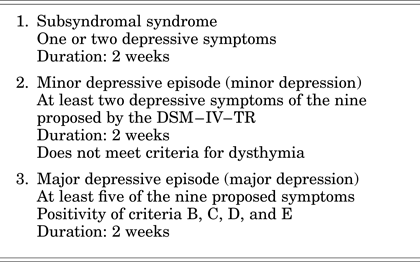
The retrospective evaluation consisted of a single psychiatric interview focusing on depressive symptoms during the year prior to diagnosis of cancer. For this purpose, we used the structured clinical interview for the DSM–IV (SCID–1) (First et al., Reference First, Spitzer and Gibbon1996), relying on the Diagnostic and Statistical Manual of Mental Disorders IV Text Revised (DSM–IV–TR) criteria. Consequently, all symptoms had to be present for at least two weeks to be considered, and the same for the existence of a depressed mood or loss of pleasure. The SCID–1 allows a standardized, dimensional, and easily reproducible evaluation of mood disorders. Based on the score grid, we built a retrospective diagnosis according to the positivity of the DSM–IV–TR items. Corresponding clinical entities were major depressive episode (MDE) and some unspecified depressive disorders, such as minor depressive episode (mDE) and subsyndromal depression (SSD) (Table 1).
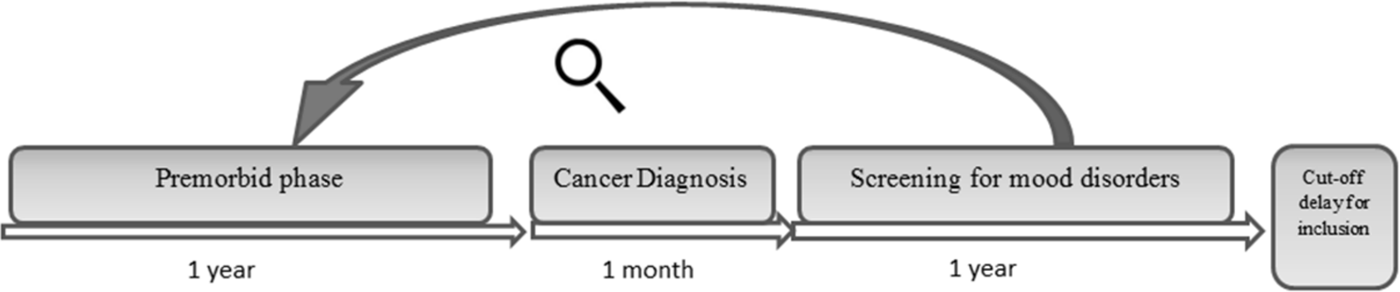
Overview of the study design.

DSM–IV–TR criteria for depressive episodes

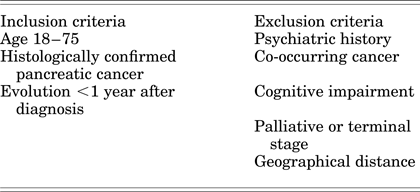
Additional data were collected, including demographic and medical factors (age, sex, lifestyle, BMI, medical history), as well as the existence of a traumatic or stressful event within the year. As a second intention, we assessed the current mood state using the Montgomery and Asberg Depression Rating Scale (MADRS) and a semistructured clinical interview, with particular attention to potential confounding bias (e.g., weight loss or anorexia). We focused on pancreatic cancer only, excluding any other neoplastic disease present at the same time. We also excluded geographically distant patients (i.e., outside the department) or those whose physical condition was too altered to allow adequate evaluation. The presence of cognitive impairment, psychiatric medications, or past psychiatric history, especially mood disorder, also constituted a reason for exclusion.
Patients meeting the inclusion criteria (see Table 2) were met during hospitalization, respecting a “washout” period of one month between the announcement consultation and screening. The entire protocol is schematized in Figure 1.
Inclusion and exclusion criteria

RESULTS
General Data
At the first stage, 15 patients were included, and retrospective screening returned positive for 10 of them. According to DSM–IV–TR criteria, we found two past major depressive episodes, four past minor depressive episodes, and four past subsyndromal depressions over the year prior to tumor diagnosis.
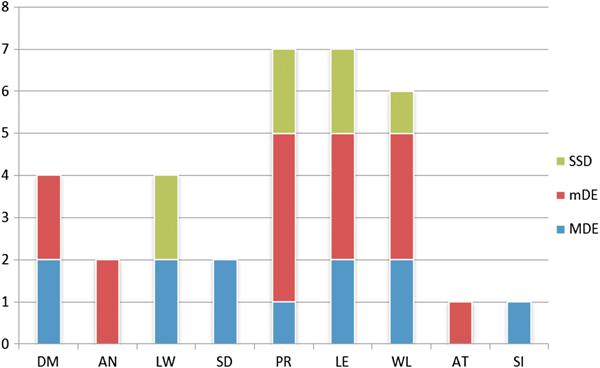
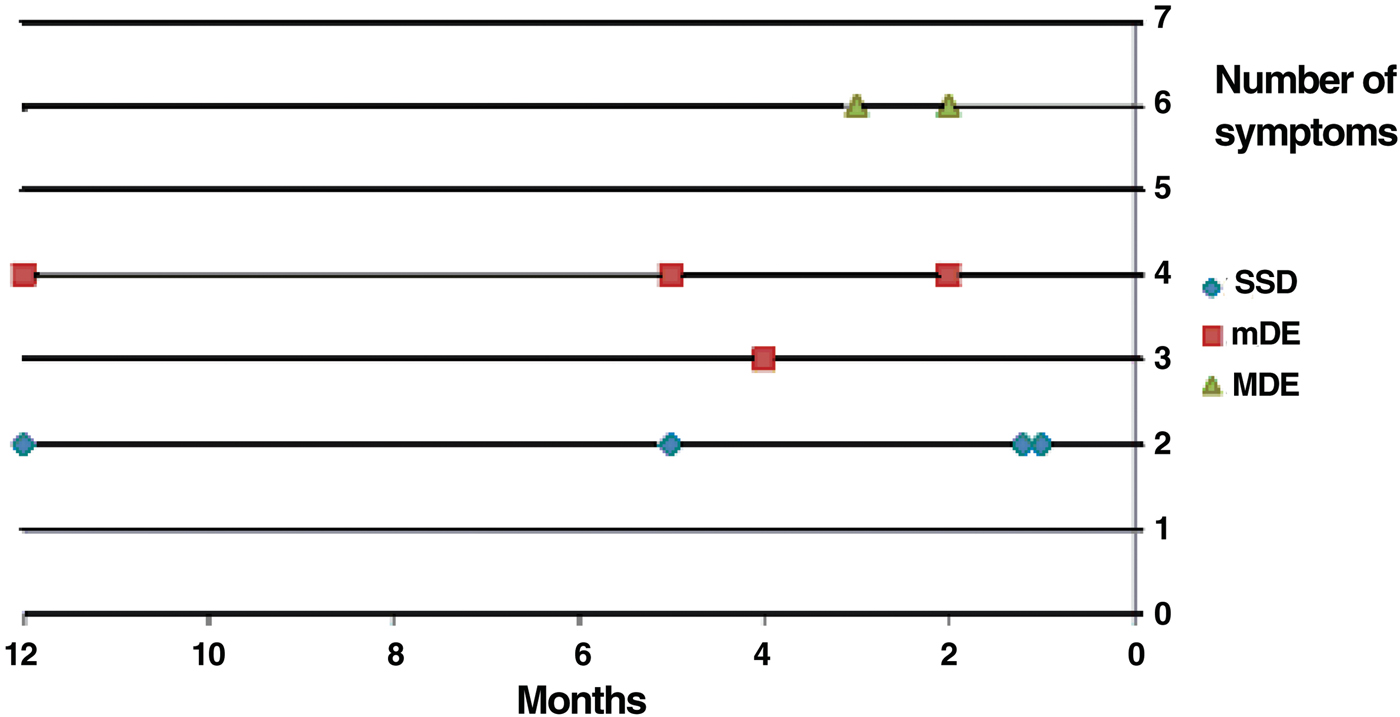
With regard to the retrospective screening, the most reported symptoms over the premorbid phase were psychomotor retardation (n = 7) and loss of energy (n = 7). Feelings of worthlessness took up third position (n = 6). One patient reported having suicidal thoughts. The overall results regarding symptom occurrence are detailed in Figure 2. The mean time at onset was 3.55 months (SD = 6.52) before cancer diagnosis. The vast majority (80%) of depression-related episodes took place between 6 and 3 months (see Figure 3) before tumor diagnosis. Five patients reported minor stressful factors during the year, but all depressive symptoms occurred prior to these events. Hereafter we will detail the cases that seem consistent with a prodromal depression.
Distribution of depression-related symptoms among the 10 patients, with final diagnosis (DM = depressed mood, AN = anhedonia, LW = loss of weight, SD = sleep disturbance, PR = psychomotor retardation, LE = low energy, WL = worthlessness, AT = attention impairment, SI = suicidal ideations).

Occurrence over time for depressive episodes over the 12 months prior to cancer diagnosis, by clinical severity.

Major Depressive Episode
As stated above, retrospective evaluation led to the discovery of two cases of MDE during premorbid phase. The first patient is a 60-year-old man who used to work as an office employee. No psychiatric history was found according to the patient himself, his entourage, and his general practitioner. Initial symptoms included a depressed mood with hyporexia and a moderate weight loss, a growing feeling of fatigue with hypersomnia, thoughts of guilt, and a significant slowdown. Nevertheless, this did not lead to a medical consultation, and so no treatment was prescribed.
The global onset of these symptoms was fairly rapid, over 10 days, and persisted for the next 10 days, with slight and incomplete regression. No social or psychological triggers were found to explain this episode. Two months after the onset of depressive symptoms, a radiological assessment for subacute digestive pain revealed an adenocarcinoma of the pancreatic tail with hepatic metastasis. Fatigue and psychomotor retardation were still present at the time of evaluation, with a slight tendency to irritability, but the depressed mood seems to have totally disappeared in a surprising manner. Consequently, the MADRS score at the time of assessment was 10.
The second case of premorbid MDE is a 67-year-old woman with no history of depression. This episode appeared three months before cancer diagnosis. In this specific case, no metastasis was found, and the tumor remained at a local stage. Once again, depressive symptoms had a rapid onset over 7 to 10 days, without an obvious triggering factor.
Initial symptoms were a progressive loss of appetite and energy with hypersomnia. A few days later, she began to develop thoughts of worthlessness associated with noticeable mood lability, crying many times a day without apparent reason, which progressed to fluctuating suicidal ideations. The patient described this as having lost all will to face up to the events of life, secluding herself in her apartment and refusing to answer phone calls. After two weeks of evolution, symptoms regressed spontaneously with persistence of some elements, as a transiently depressed mood or loss of motivation. This seems to have persisted several weeks, and then totally disappeared, as the current mood assessment highlighted no clinical signs of depression. We found no trace of prescribed psychotropic agents in this context that could explain such an atypical evolution.
These are the only reported cases in our study that could be compatible with a prodromal depression, but we should emphasize that there are no current consensual criteria for this diagnosis.
Minor Depressive Episode
Minor depression diagnoses belong to the mood disorders NOS (not otherwise specified) category. It has been discussed as a formal diagnosis similar to an MDE, in the idea of a continuum between physiological state and MDE. It remains comparable in its chronology and presentation to an MDE, involving a minimal duration of two weeks and a functioning impairment, but requires less intense and less numerous symptoms (two to four minor criteria compared to five). Its prevalence in the general population may vary from 2 to 23% (Kessler et al., Reference Kessler, Zhao and Blazer1997; Pincus et al., Reference Pincus, Davis and McQueen1999; Rapaport et al., Reference Rapaport, Judd and Schettler2002). Nevertheless, more consensual criteria for this diagnosis are still being researched.
In our study, this possible retrospective diagnosis covers four patients. Their respective ages were 43, 54, 65, and 68. Three patients reported similar episodes between months 6 and 3, with dominant symptoms of psychomotor retardation, loss of energy, and feelings of uselessness. In an inconstant way, patients had experienced a truly depressed mood and anhedonia. The mean symptom duration was 3.3 weeks (SD = 1.55) before spontaneous regression. None of them asked for medical or psychological help during this period. Interestingly, one reported resurgence of the same symptoms during the first month following cancer diagnosis, which were still active at the time of evaluation.
The fourth patient, a 65-year-old woman, reported an unusual episode of general depressed feelings at month 12 with significant social impairment that lasted for 6 weeks. She also experienced important sleep disturbance with hyposomnia and multiple wakeups during the night. The main symptom was a relentlessness questioning of her life choices and experiences, with a major anxiety component. A general practitioner consultation at week 3 resulted in a daily prescription of oxazepam 10 mg, which seemed to significantly improve her state, until she remitted totally at week 6. This episode seems typical of an acute response to a stress factor; however, once again, no triggering event was found. Connected to the cancer background, this situation refers once again to a possible prodromal psychiatric manifestation.
Subsyndromal Depression
Subsyndromal depression had been identified by Judd et al. (Reference Judd, Rapaport and Paulus1994) as a “subthresold depression” for patients not meeting DSM criteria for MDE, but presenting at least two depressive symptoms for at least two weeks. Nowadays, this entity is still discussed and could be assimilated with a prodromal or residual form of a more typical kind of depressive episode.
Reported symptoms among this subgroup were psychomotor retardation, fatigue, loss of weight, and feelings of worthlessness. Depressive mood or anhedonia were not present; otherwise, we would have reconsidered this diagnosis for mDE. Time-of-onset distribution was comparable to mDE, with 80% of the episodes occurring between months 6 and 2 before diagnosis.
As symptoms were too scattered and inconstant to present them as typical, we will not review the four affected patients in detail. Nevertheless, we will focus on one of them for the particular pattern of evolution of depression and pancreatic cancer.
He was a 59-year-old man, without psychiatric history, working as a hairdresser. His entourage described him as cheerful and optimistic. Interestingly, the patient reported an unusual episode of psychomotor retardation with feelings of worthlessness that lasted a few weeks, with no notion of a stressor, five months before the cancer diagnosis. These features were consistent with a subsyndromal depressive episode without alteration of personal functioning, which regressed in four weeks. No metastasis was detected at the time of diagnosis, making him eligible for first-line chemotherapy with possible second-time surgery.
One month after diagnosis of cancer, the same symptoms recurred and progressed, resulting in a major depressive episode that seemed typical. The MADRS score was 37/60. A first-line treatment with paroxetine was ineffective at two weeks follow-up. Delusions of failure and guilt, total anorexia, and a motor negativism appeared thereafter, with no arguments for a delirium. Our choice for second-line treatment focused on a frequently used combination scheme—clomipramine 100 mg/day with olanzapine 10 mg/day—allowing rapid regression of delusional elements and resumption of oral feeding. Unfortunately, due to severe nutritional complications, chemotherapy had to be delayed several weeks. Metastatic evolution was then found on control tomodensitometry, resulting in a significant loss of chance regarding prognosis, and death occurred at six weeks of evolution.
Regarding this case, it is clear that the somatic complications of melancholy favored metastatic evolution. However, aside from this, maybe we should also consider the intensity of depressive symptoms as a possible psychiatric expression of tumor progression. It is certain that the prodromal value of SSD can make sense in this background as a marker of vulnerability. This specific situation could illustrate once again the close relationship between pancreatic cancer and depression, which goes deeper than a single psychological reaction to illness. Moreover, it remains consistent with some data in the literature suggesting mood disorder as a particularly dramatic predictor in oncology (Steel et al., Reference Steel, Geller and Gamblin2007; Angelino & Treisman, Reference Angelino and Treisman2001, Boyd et al., Reference Boyd, Benarroch-Gampel and Sheffield2012b).
DISCUSSION
We found that 10 patients presented symptoms compatible with a depressive episode prior to diagnosis of a pancreatic tumor. Eight were related to mood disorders not otherwise specified, such as minor depression and subsyndromal depression. For the other two patients, reported symptoms were numerous and strong enough to be compatible with a past major depressive episode.
This series of cases is consistent with previous work on the subject that suggest an increased vulnerability to depressive events during the premorbid phase of pancreatic cancer. Disappointingly, the results of this short study do not reveal any clear continuum between depressive symptoms before and after diagnosis, with an exception made for the case of melancholia. However, the pathophysiological link operating between these two entities remains obscure.
Up to this day, many hypotheses have been advanced. The involvement of immuno-inflammatory factors such as interleukins 6 and 10 could play a major role in the onset of depressive symptoms. The depressogenic effects of these cytokines on the central nervous system have been described (Mesquita et al., Reference Mesquita, Correia-Neves and Roque2008; Raison et al., Reference Raison, Capuron and Miller2006). More specifically and more recently, Breitbart and colleagues (Reference Breitbart, Rosenfeld and Tobias2014) showed a strong association between onset of depressive symptoms and plasma levels of interleukin 6 in patients with pancreatic cancer.
Also, in agreement with the serotoninergic hypothesis (Maes et al., Reference Maes, Yirmyia and Noraberg2009) of depression, secretion by the tumor of blocking autoantibodies aimed at serotonin receptors in the central nervous system has also been discussed. Additional tracks have been advanced, including paraneoplastic encephalitis with pure psychiatric expression (Cornelius et al., Reference Cornelius, Soloff and Miewald1986).
Despite interesting data, we can point to some obvious limitations of our work. The first is methodological, related to the retrospective nature of the assessment, which exposes the results to recall bias among patients already confronted with very anxiety-provoking situations. The announcement of such a severe diagnosis could indeed influence the “emotional color” of past events, at the risk of wrongly attributing them to depression. The one-month period observed between announcement of consultation and screening aimed to limit this bias, though we cannot formally exclude it.
The existence of numerous confounding factors (e.g., smoking, alcoholism) between cancer and depression is also reported. Pain, which may greatly influence mood, is often problematic in pancreatic cancer, and also plays a major role in these factors. However, in our study, no patient reported experiencing painful symptoms before diagnosis or during the evaluation, or were adequately treated. The corollary of this issue is the adequacy of the tools employed for the diagnosis of depression in this oncological context, an issue widely discussed by psycho-oncological practitioners (Vodermaier & Millman, Reference Vodermaier and Millman2011). Among the many psychometric tools available (e.g., the Hamilton Depression Rating Scale, the Hospital Anxiety and Depression Scale, MADRS), none seems to be specifically adapted to the question of depression assessment in cancer because of many common elements (e.g., asthenia, weight loss, anorexia). Furthermore, available scales are mostly calibrated for severity assessment rather than diagnosis of depression. In our situation, it seemed appropriate to use the SCID–I, with its dimensional approach to diagnosis.
The existence of potential stressful factors during the prior year refers to their possible involvement in creating reactive symptoms. It should be noted that, in our study, these factors were not described as triggers but intervened after the onset of mood symptoms. If we cannot draw statistical conclusions here, these data refer to potentially increased anxious vulnerability, in the same train of symptoms as described by Yaskin.
If the possibility of depressive syndromes during the early stages of malignant disease is a common notion, it is still impossible to determine the natural history of these two disorders and thus any causal linkage. For illustration, a prospective study by Carney and coworkers (Reference Carney, Jones and Woolson2003) found a higher proportion of pancreatic cancer in a cohort of patients with psychiatric disorders than in the control cohort, although other factors, including toxic habits, could explain this association. The prospective nature of our study also allowed us to exclude recall bias.
The question of a causal linkage between pancreatic cancer and depression is, once again, very difficult to clarify. As a retrospective assessment presents obvious methodological issues, a prospective study should include a very large cohort of subjects to provide significance. The issue of depression occurring after diagnosis introduces confounding bias, and, taking into account the lack of clear criteria for cancer-related depression, it may wrongly include some anxiety-related symptoms. In this context, biological tests could be of interest to differentiate endogenous depression from more neurosis-related symptoms. The dexamethasone/corticotrophin-releasing hormone test has shown interesting results on this issue (Mokhtari et al., Reference Mokhtari, Arfken and Boutros2013), but it is still the subject of much ongoing research. It is not yet a validated method and, to our knowledge, has never been utilized in an oncological context.
We attempted to categorize a depression diagnosis in a manner that conformed as closely as possible to the actual criteria. This offered the opportunity to evaluate the pertinence of usual psychometric cancer diagnostic tools, and to shed light on the huge diversity of depressive experiences that may occur during the premorbid period.
It is evident that specific tools for psycho-oncology are lacking in order to make a standardized diagnosis of what can be called “prodromal depression.” A better understanding of this phenomenon could have beneficial effects in terms of diagnosis and comprehensive care for cancer patients. This suggests developing proper diagnostic criteria for prodromal depression and renewing large-scale prospective studies on the topic.