Introduction
An association between schizophrenia and violent behavior has significant clinical and social implications. The perception of people with mental illness, particularly schizophrenia, as more violent than the general population is supported by studies from around the world, finding a 2–10-fold increase in risk for violent crime among people with schizophrenia (Tiihonen et al. Reference Tiihonen, Isohanni, Räsänen, Koiranen and Moring1997; Arseneault et al. Reference Arseneault, Moffitt, Caspi, Taylor and Silva2000; Brennan et al. Reference Brennan, Mednick and Hodgins2000; Wallace et al. Reference Wallace, Mullen and Burgess2004; Coid et al. Reference Coid, Yang, Roberts, Ullrich, Moran, Bebbington, Brugha, Jenkins, Farrell, Lewis and Singleton2006; Fazel et al. Reference Fazel, Långström, Hjern, Grann and Lichtenstein2009c ). A meta-analysis of studies conducted between 1970 and 2009 revealed an average four-fold increase in violent crime in men and an eight-fold increase in women with schizophrenia (Fazel et al. Reference Fazel, Gulati, Linsell, Geddes and Grann2009b ). However, several studies did not find an increased risk for violent crime in schizophrenia patients after taking into consideration potential mediators, mainly substance misuse (Steadman et al. Reference Steadman, Mulvey, Monahan, Robbins, Appelbaum, Grisso, Roth and Silver1998; Fazel et al. Reference Fazel, Långström, Hjern, Grann and Lichtenstein2009c ).
Although the increased risk of violence observed in people with schizophrenia suggests that violence is part of the clinical picture of the disease, the association between schizophrenia and violence may increase stigmatization of people with mental illness (Phelan & Link, Reference Phelan and Link1998).
The studies examining the association between schizophrenia and violence vary in methods, assessment of psychosis and violence, size of population, length of follow-up and inclusion of potential confounders (for a review, see Fazel et al. Reference Fazel, Gulati, Linsell, Geddes and Grann2009b ). Using data from comprehensive national registries in Israel, the current study examined the association between lifetime violent crime and schizophrenia in a large population-based cohort.
Method
Israeli Psychiatric Hospitalization Case Registry
The Israeli Psychiatric Hospitalization Case Registry is a complete, nationwide, computerized list of all persons admitted to psychiatric hospitals, day hospitals or psychiatric units in general hospitals. It includes ICD-10 admission and discharge diagnosis for each hospitalization assigned by a board-certified psychiatrist at the facility. It also includes information about suicide attempts and substance (drug or alcohol) misuse during the 2 months preceding admission. The sensitivity of the registry diagnoses of psychotic disorders is 0.89 (Weiser et al. Reference Weiser, Kanyas, Malaspina, Harvey, Glick, Goetz, Karni, Yakir, Turetsky, Fennig, Nahon, Lerer and Davidson2005). Data used in this study refer to hospitalized patients, as there are no private psychiatric hospitals in Israel, and previous research shows that 93% of patients with schizophrenia in Israel are admitted to a psychiatric ward at least once during their lifetime (Weiser et al. Reference Weiser, Werbeloff, Dohrenwend, Levav, Yoffe and Davidson2012).
Israeli Population Registry
The Israeli Population Registry records all births, deaths, marriages and divorces in the country. At birth or upon immigration, all citizens receive a unique identity number, similar to the US social security number. For citizens born after 1970, the Population Registry is able to use the identity number to link citizens to their parents, siblings and offspring.
Procedure
After receiving approval from the local Institutional Review Board (IRB), the managers of the Psychiatric Hospitalization Case Registry compiled a list of probands, defined as all patients in the country born after 1970, who were consecutively admitted to any psychiatric ward. This file was linked to the Israeli Population Registry, where for each proband, their siblings and parents were identified. For each proband, sibling and parent, four random controls were selected from the population registry (Silva, Reference Silva1999). Controls were matched for age and gender. Controls were not related to the probands or to each other. The file with the probands, parents and siblings, and their matched controls, was then returned to the Psychiatric Hospitalization Case Registry, and data on all psychiatric hospitalizations, with admission and discharge diagnoses, were added. The complete list of probands, parents, siblings and controls was then linked to the Israeli court records where type of crime was recorded, along with convictions and cases that were dismissed due to mental illness. Registries were merged using the unique identity numbers of Israeli citizens.
In Israel, people accused of a crime and suspected of having mental illness are sent by the court for psychiatric evaluation to determine whether they are competent to stand trial and whether they were criminally responsible at the time of the offence. If either condition is met, the trial is dismissed and the person is referred for mandatory in-patient or out-patient psychiatric treatment. In line with previous studies, violent crimes were defined as murder, attempted murder, assault, rape, threats and robbery (Fazel & Grann, Reference Fazel and Grann2006). Sex-related crimes were defined as rape, attempted rape, statutory rape, sexual harassment, prostitution, compelling prostitution, patronizing a prostitute, soliciting a minor, and transmission of sexually transmitted diseases. To ensure confidentiality, identifiers were removed from the file before the data were analysed.
The original data file consisted of 3261 probands with schizophrenia. In some families, more than one family member had been hospitalized; hence some families appeared in the Israeli Psychiatric Hospitalization Case Registry more than once. In such cases, one family member was randomly selected as the proband, hence removing duplicate records, leaving 3187 probands. Parents, siblings and controls who had been hospitalized with any psychiatric disorder were excluded from all analyses. We also excluded half-siblings.
Statistical analyses
Differences in the prevalence of overall criminal activity and also violent crimes (convictions and acquittals for reasons of mental incompetency) were compared between patients with schizophrenia, their unaffected full siblings and their respective controls. Risk for violent crimes was assessed using logistic regression models. Associations were expressed as odds ratios (ORs) and 95% confidence intervals (CIs). We tested for possible confounders such as age, gender, marital status and having children, number of hospitalizations (as a measure of severity of illness), substance misuse and suicide attempts. A level of significance of 0.05 was used for all analyses. Statistical analyses were performed using SPSS version 19.0 (IBM Corp., USA).
Results
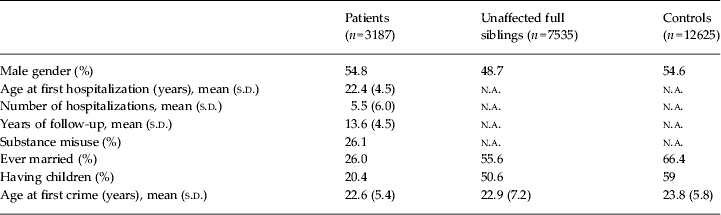
The demographic and clinical characteristics of the probands, unaffected full siblings and age- and gender-matched general population controls are presented in Table 1. The mean time of follow-up was 13.6 years (s.d. = 4.5, range 6–32).
Demographic characteristics

s.d., Standard deviation; n.a., not applicable.
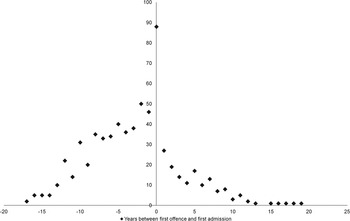
Sixty-five per cent of patients committed their first crime prior to their first admission. The prevalence of first crime was highest during the year of first admission (see Fig. 1).
Distribution of crimes by years from first admission.

Patients with schizophrenia versus controls and unaffected full siblings
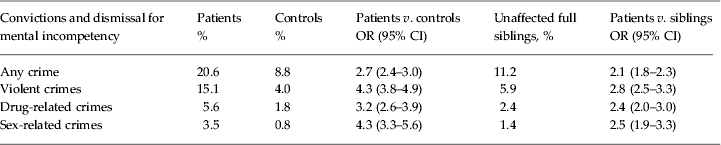
Overall, we found an increased risk of criminal activity in patients with schizophrenia. Whereas 656 patients (20.6%) were either convicted or deemed mentally incompetent to stand trial for at least one crime, only 1110 (8.8%) of the matched controls were convicted (OR 2.7, 95% CI 2.4–3.0) and 847 (11.2%) unaffected full siblings (OR of patients versus siblings 2.1, 95% CI 1.8–2.3). Rates of different types of crimes in patients, controls and siblings are presented in Table 2. Rates were higher among probands in all types of crimes examined: violent crimes, drug-related crimes and sex-related crimes.
Risk for criminal activity among patients with schizophrenia compared to sex- and aged-matched controls and unaffected full siblings

OR, Odds ratio; CI, confidence interval.
The increase in criminal activity was more pronounced for violent crimes: 480 (15.1%) patients were convicted or deemed mentally incompetent to stand trial for at least one violent crime whereas only 502 (4.0%) of the controls were convicted (OR 4.3, 95% CI 3.8–4.9). Patients were also at increased risk of conviction for violent crimes when compared with their unaffected full siblings (OR 2.8, 95% CI 2.5–3.3).
The most prevalent violent crime was assault, followed by threats. Eight probands (0.3%) were convicted or deemed mentally incompetent to stand trial for murder; three controls (0.02%) and one sibling (0.02%) were convicted of murder. Eleven probands (0.4%) were convicted or deemed mentally incompetent to stand trial for rape; six controls (0.05%) and two siblings (0.04%) were convicted of rape. As the purpose of this study was to assess the prevalence of violent crimes in schizophrenia, the remainder of the paper focuses on violent crimes as the outcome of interest.
As in the general population, among both patients and controls, men committed more violent crimes than women (males versus females: patients: 23.9% v. 4.3%; controls: 15.0% v. 1.3%). However, compared with their matched controls, the risk for violent crimes in patients was twice as high in female patients (OR 9.9, 95% CI 6.2–15.7) than in male patients with schizophrenia (OR 4.2, 95% CI 3.7–4.9). The risk was higher among women for all types of crimes. Of note, when patients were compared with their unaffected same-gender siblings, there was no gender effect (OR 2.7, 95% CI 2.3–3.1 for men versus OR 3.0, 95% CI 2.1–4.3 for women).
Risk factors among patients
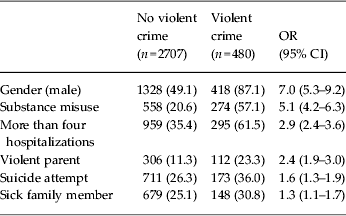
Univariate analysis of the associations between patient characteristics and crime is presented in Table 3. Gender, substance misuse, having more than four hospitalizations (the median in this study), having a parent convicted of a violent crime, having a first-degree family member with schizophrenia, and suicide attempts were significantly associated with violent crime.
Univariate analysis assessing risk factors for crime among patients

OR, Odds ratio; CI, confidence interval.
Values given are number of patients (%).
Multivariate analysis including only those variables that were found to be significant in the univariate analyses showed similar results: gender (OR 5.9, 95% CI 4.4–7.8), substance misuse (OR 3.4, 95% CI 2.7–4.2), having a parent convicted of a violent crime (OR 2.3, 95% CI 1.7–3.0), having more than four hospitalizations (OR 2.0, 95% CI 1.6–2.5) and having a first-degree family member with schizophrenia (OR 1.4, 95% CI 1.1–1.7) were all associated with violent crime, with no significant change in magnitude of the effect.
Substance misuse
Among patients, co-morbid substance misuse was found to be a significant risk factor for violent crimes. Whereas 274 (32.9%) patients with co-morbid substance misuse committed violent crimes, only 206 (8.7%) without such co-morbidity did so (OR 5.1, 95% CI 4.2–6.3). After removing patients with substance misuse, the rates of violent crime in schizophrenia patients compared to controls was lower, but still significant elevated (OR 2.3, 95% CI 2.0–2.7).
Discussion
This study examined the prevalence and risk of violent crime in a population-based cohort of 3187 patients with schizophrenia over 32 years. We found a 4.3-fold increase in the risk for violent crime in patients compared with controls and a 2.8-fold increase in risk compared with their unaffected full siblings. These results are in line with previous studies that found an increased risk of violence in patients with schizophrenia, with ORs ranging from 2 to 10 (Tiihonen et al. Reference Tiihonen, Isohanni, Räsänen, Koiranen and Moring1997; Arseneault et al. Reference Arseneault, Moffitt, Caspi, Taylor and Silva2000; Brennan et al. Reference Brennan, Mednick and Hodgins2000; Wallace et al. Reference Wallace, Mullen and Burgess2004; Coid et al. Reference Coid, Yang, Roberts, Ullrich, Moran, Bebbington, Brugha, Jenkins, Farrell, Lewis and Singleton2006; Fazel et al. Reference Fazel, Långström, Hjern, Grann and Lichtenstein2009c ). Of the previous studies on this topic, only seven were population based (Lindqvist & Allebeck, Reference Lindqvist and Allebeck1990; Arseneault et al. Reference Arseneault, Moffitt, Caspi, Taylor and Silva2000; Brennan et al. Reference Brennan, Mednick and Hodgins2000; Wallace et al. Reference Wallace, Mullen and Burgess2004; Fazel & Grann, Reference Fazel and Grann2006; Fazel et al. Reference Fazel, Långström, Hjern, Grann and Lichtenstein2009c ; Eriksson et al. Reference Eriksson, Romelsjö, Stenbacka and Tengström2011); of these, three from Nordic countries and one from Australia included a large number of patients with schizophrenia (>1000) (Brennan et al. Reference Brennan, Mednick and Hodgins2000; Wallace et al. Reference Wallace, Mullen and Burgess2004; Fazel & Grann, Reference Fazel and Grann2006; Fazel et al. Reference Fazel, Långström, Hjern, Grann and Lichtenstein2009c ).
We found an increased risk of sex-related crimes in patients with schizophrenia. Psychiatric diagnoses previously reported to be associated with sexual offences include substance use disorders, personality disorders, affective disorders and organic brain damage (Hanson & Bussiere, Reference Hanson and Bussiere1998; Gordon & Grubin, Reference Gordon and Grubin2004; Hanson & Morton-Bourgon, Reference Hanson and Morton-Bourgon2004). Most studies did not find an increase in sex-related crimes in patients with schizophrenia (Modestin & Ammann, Reference Modestin and Ammann1996; Mullen et al. Reference Mullen, Burgess, Wallace, Palmer and Ruschena2000; Soyka et al. Reference Soyka, Morhart-Klute and Schoech2004; Modestin & Wuermle, Reference Modestin and Wuermle2005). However, a case–control study in Sweden found that rates of schizophrenia were 4.8 times higher in sex offenders than in controls (Fazel et al. Reference Fazel, Sjöstedt, Långström and Grann2007). Our results suggest that clinicians should consider the risk of sexual offences and address it in their assessment.
Unlike other studies, we analyzed lifetime crime rates rather than crime after the diagnosis of schizophrenia. More than half of the probands committed violent crimes before their first admission, suggesting that factors affecting violent behavior are present prior to the onset of psychosis. Thus, these data add to a large body of knowledge on pre-morbid behavior abnormalities in patients with schizophrenia (Watt et al. Reference Watt, Stolorow, Lubensky and McClelland1970; Done et al. Reference Done, Crow, Johnstone and Sacker1994; Jones, Reference Jones1997; Bearden et al. Reference Bearden, Rosso, Hollister, Sanchez, Hadley and Cannon2000; Reichenberg et al. Reference Reichenberg, Weiser, Rabinowitz, Caspi, Schmeidler, Mark, Kaplan and Davidson2002).
Schizophrenia was a stronger risk factor for violent crimes for women than men (ORs of 9.9 and 4.2 respectively). This phenomenon has been described in other studies (Lindqvist & Allebeck, Reference Lindqvist and Allebeck1990; Brennan et al. Reference Brennan, Mednick and Hodgins2000; Fazel & Grann, Reference Fazel and Grann2006; Fazel et al. Reference Fazel, Gulati, Linsell, Geddes and Grann2009b ). Some suggest that this may be due to female patients having more positive symptoms, higher levels of impulsivity and more affective symptoms whereas men express more negative symptoms such as withdrawal and isolation (Leung & Chue, Reference Leung and Chue2000). Positive symptoms were previously found to be a risk factor for violent behavior whereas negative symptoms decreased the risk for violence (Swanson et al. Reference Swanson, Swartz, Van Dorn, Elbogen, Wagner, Rosenheck, Stroup, McEvoy and Lieberman2006). Men are more likely to be rehospitalized and stay in the hospital longer whereas women spend less time in hospitals and stay longer in the community (Goldstein, Reference Goldstein1988; Angermeyer et al. Reference Angermeyer, Goldstein and Kuehn1989). As violent behavior is less expected from women, women with mental illness may be disproportionately caught, charged and convicted. It should be noted that this gender effect was not observed when patients were compared with their unaffected full siblings.
As in other studies (e.g. Fazel et al. Reference Fazel, Gulati, Linsell, Geddes and Grann2009b ), substance misuse was found to be a major risk factor for violent crimes (OR 5.1, 95% CI 4.2–6.3); however, rates of violent crime remained elevated in patients without substance misuse co-morbidity. Reducing rates of substance misuse in patients with schizophrenia is likely to decrease, but not eliminate, violent behavior (Mullen, Reference Mullen2006). However, as we did not have information on substance misuse among controls, and the only data on substance misuse in patients were recorded at the time of hospitalization, this result must be interpreted with caution.
Having a parent convicted of a violent crime significantly increased the risk for violence. A parent with a history of criminal involvement was previously reported as a significant risk factor for violence (Mullen, Reference Mullen2006; Fazel et al. Reference Fazel, Grann, Carlström, Lichtenstein and Långström2009a ; Hodgins, Reference Hodgins2009; Witt et al. Reference Witt, van Dorn and Fazel2013). These results are in line with data indicating that criminal offending, in general, has been reported to run in families (Farrington et al. Reference Farrington, Jolliffe, Loeber, Stouthamer-Loeber and Kalb2001).
Patients who were hospitalized more than four times (the median number of hospitalizations in the current study) were more likely to be violent. These results could be interpreted in several ways: admission rate could be an indicator of the severity of illness or of low adherence to treatment, and severely ill or psychotic patients are more violent; or simply that patients are admitted because they are violent.
This study has several limitations. We excluded controls and family members with psychiatric admissions from the data analysis; thus, the analyses assess the risk for violent crime in patients compared with healthy population controls. For this reason, and because our study used a case–control methodology, rates of crime in the entire population could not be calculated from the sample, and the population-attributed risk for crime could not be calculated. Murder and rape seem more prevalent in probands than in controls. However, as these are cumulative results from up to 32 years of follow-up, with varying duration of follow-up for each proband, comparison to incidence rates of murder or rape in the general population could not be calculated. Nevertheless, relatively high rates of murder committed by patients with schizophrenia have been described by other authors (Eronen et al. Reference Eronen, Tiihonen and Hakola1996; Wallace et al. Reference Wallace, Mullen, Burgess, Palmer, Ruschena and Browne1998; Fazel et al. Reference Fazel, Gulati, Linsell, Geddes and Grann2009b ; Bennett et al. Reference Bennett, Ogloff, Mullen, Thomas, Wallace and Short2011).
Data on the socio-economic status of patients and controls were not available in this study. However, in a large national study conducted in Sweden, there was only a minor effect of socio-economic status on risk for violence among people with schizophrenia (Fazel et al. Reference Fazel, Grann, Carlström, Lichtenstein and Långström2009a ). Nonetheless, it is possible that the higher rate of violent crime in patients with schizophrenia is related, at least in part, to social factors such as stigma, discrimination and poverty.
In addition, data regarding substance misuse, as recorded by the psychiatric registry, were based on self-report. However, there are findings supporting the validity of self-reported substance misuse (Freedberg & Johnston, Reference Freedberg and Johnston1980; Maisto et al. Reference Maisto, Sobell and Sobell1982; Polich, Reference Polich1982; Verinis, Reference Verinis1983; Denis et al. Reference Denis, Fatséas, Beltran, Bonnet, Picard, Combourieu, Daulouède and Auriacombe2012).
In summary, this study replicated previous findings of an increase in risk of violent crime among people with schizophrenia, especially women and patients with co-morbid substance misuse.
The lower risk of violent crimes when compared to siblings rather than general population controls suggests a familial confounding of this association, perhaps through genetic susceptibility or shared environmental effects.
The clinical implications of these results is that an increased risk of violence is part of the clinical picture of schizophrenia and needs to be recognized as a legitimate and essential aspect of clinical management. Mental health service providers should address risk factors for violent behavior as an important part of clinical assessment in patients with schizophrenia; and risk assessment tools should be developed and validated to address the increased risk for violence.
Declaration of Interest
None.