Believed lost for decades, a handful of films produced between 1937 and 1945 by Korean filmmakers under Japanese rule has recently been rediscovered. This finding has opened the door to rethinking the relationship between the colonial past and the postcolonial present. Until their “return” to South Korea from archives in neighboring countries, beginning in the mid-2000s, these late colonial films had been excluded from both the Korean and Japanese cinematic canons. In mainstream Korean film histories, in particular, these films were referred to as “pro-Japanese” films with little consideration of the context of wartime mobilization and colonial politics. Following the rediscovery, repatriation, and subsequent commercial distribution of these films in South Korea over the past decade, scholars have not only investigated new evidence of colonial life represented via the films but also reconsidered the displacement of these films in earlier film historiography (Kim Soyoung Reference Kim Soyoung2010; Kim Yŏsil Reference Kim Yŏsil2006; Yi Yŏngjae Reference Yi Yŏngjae2008).
Particular attention has been paid to Yi Yŏngil's 1969 Han'guk yŏnghwa chŏnsa (Complete history of Korean cinema; hereafter Complete History). Korean film scholarship has largely relied on the longstanding assumption that Complete History is nothing but a “nationalistic” history, due to Yi's ethnocentric narrative and lack of nuanced interpretations of, most notably, the Japanese colonial era (1910–45). The book's angle has also permitted scholars to reduce Yi's work to a restorative enterprise that echoed the political motives of Park Chung Hee's regime (1961–79), which reinforced the idea of a homogeneous nation via mass media and education (Kim Won Reference Kim Won2012). The Korean Ministry of Culture and Information's endorsement of Complete History as the “official” history of Korean film, as shown in the foreword by the minister himself, indeed indicates that the book's agenda was not entirely free from political ideology. Criticizing Yi for this assumed alliance, leftist critics have discredited Complete History as a politically charged work that privileges what they call “right-wing nationalists” and excludes leftist film practice, which lasted briefly in the colonial era (Yi Hyoin Reference Yi Hyoin1992; Yi Sunjin Reference Sunjin2004).
As early historiography, Complete History might not provide us with a template for writing film histories that unsettle the myth of the homogeneous, unchanging nature of the nation, one that has been developed by newer scholarship. However, its updated edition (2004), coupled with other books, including Yi Yŏngil's last lecture and interviews with senior filmmakers, has exceeded the historiographical agenda that Yi set for himself in the late 1960s.Footnote 1 The new edition has helped to bring Yi to the attention of later generations of readers whose worlds have been formed by different predicaments than his, but who might, nevertheless, be inspired by his vision. In this process, the new generation of readers has focused on a wide range of issues, from Yi's influence on more recent publications in film historiography (Yi Hwajin Reference Yi Hwajin2011) to his selective narrativization of the colonial past based on the experiences of a group of filmmakers (Yi Sunjin Reference Sunjin and Sŏngsu2014).
It is also important to note that Complete History has been continuously in print since it came out, and that this new edition marks a significant revision of the original work. One of the critical breaks is in how Yi seeks to redefine the category of the national concerning colonial Korea. Included in the new edition are transnational co-productions from China, Korea, and Japan, as well as regional productions from outside Seoul during the colonial era (Yi Yŏngil Reference Yŏngil2004, 134–38, 148–49). Although he still has reservations about categorizing the collaborationist films of the late colonial era as undeniably “Korean” cinema, he yields that writing about the history of these films requires a “more complex reading” and a “multilayered approach” (208). The expansion beyond the previous realm of national history takes place in Yi's revision, and it cannot be denied that the series of recent studies on the transnationality of colonial cinema has been under the shadow of Yi's challenge of his own way of thinking about the history of Korean cinema.
This essay builds on the discussion that followed the publication of Yi's revision and pushes it further to rethink the historiography of Korean film in relation to Yi Yŏngil's subjectivity as a postcolonial writer. To understand the author's relationship to historiography, we first need to ask why film historiography is needed at a certain historical moment of the nation and, perhaps more importantly, what an author does to meet that need. These questions are important to answer, instead of simply assuming a close relationship between cinema and nation. One might claim that the pursuit of nation in film historiography is nothing unique in any given film history in any part of the world. However, in the postcolonial context historians have commonly found themselves in a dilemma, one that derives from two peculiar absences: film history without films and a national history without a nation. Although recent works (Hong Reference Hong2011; Kim Soyoung Reference Kim Soyoung2010; Lim Reference Lim2010) have offered some compelling ways to read these absences rather than lamenting them, there has been little discussion of how the dilemma operated in the work of earlier postcolonial writers whose colonial experience was not yet a distant memory. What does the writing of Korean film history mean when many early films, especially those made during Japanese rule, are unavailable? What methods can one imagine for expressing the past, and how can one organize a story about the past, if writing history is fundamentally storytelling? The first and second parts of this essay will demonstrate how Yi Yŏngil finds his answer to these questions by challenging the narrative and method of the predominant historiography that neglects the agency of the colonized under Japanese rule. He reveals, in his critique of colonialism and his rescue of colonized voices through the incorporation of oral testimony as historical sources, a new possibility for imagining the relationship between nation and cinema in the pre-1945 era.
More productive ways to reread Yi's original work a half-century after its publication can also emerge if we are willing to look at his position as a postcolonial writer and to consider the implications of his position for us, scholars in a neocolonial context, living with the possibilities and predicaments of decolonization.Footnote 2 A recent discussion of colonialism has posed a difficult question for those of us whose research revolves around colonial histories: how can we capture the ways these histories remain present? Our attempts to understand the relationship between these different temporalities have led to the emergence of two predominant analytic stances in the field. One position perceives colonial history with clear temporal and spatial ruptures; while it acknowledges colonial legacies, it emphasizes the differences between the political, economic, and social structures of the past and those of the present. Meanwhile, scholarship that pays more attention to continuity refuses a clear break, casting light on colonial discourses and practices that persist in our present time. Neither position, as Ann Stoler (Reference Stoler2016, 26) illuminates, invites us to ask more complicated questions about how colonial effects live within the contemporary conditions of our lives in active and disparate ways.
My discussion of Yi Yŏngil as a postcolonial writer is not simply intended to consider how he rendered a national history of cinema that connects the pre- and post-1945 eras. Rather, following Stoler's suggestion, it is to grapple with how he lived with the colonial effects operative in his time. In hindsight, we can say that Yi's Complete History is seamless in reconciling the relationship between the colonial past and the postcolonial present by completing a linear, written history. What is not entailed in his reconciliation is, however, the effects of colonialism that he and his interviewees had been living with during their time. In the last part of the essay, I will show how, even after the “end” of colonial rule, these effects were ingrained in their ways of narrating the past and in the developmental logic in historiography that displaced the colonized with the ideal of progress.
Against Colonialist Historiography
The publication of Complete History took place in the late 1960s when the South Korean state was continuing to firm up its ethnonationalism under the leadership of Park Chung Hee, more than a decade after the end of the Korean War. Nation-building in the postwar era demanded not only the imposition of an abstract sense of the nation on the population but also that the modern and rational subject be receptive to the nation's economic development in the liberal market. Faced with the challenge of reconstructing a nation below the 38th parallel, the political powers and Korean nationalists elaborated the territorial model of the nation-state, which imposed pedagogies and instruction upon the population through education and culture (Kim Won Reference Kim Won2012). Simultaneously, their affirmation of modernization set the stage for the regime's claim that authoritarian rule was necessary to allow South Korea to thrive in the US-led free world. Walt Rostow's The Stages of Economic Growth: A Non-Communist Manifesto ( Reference Rostow1960), a de facto bible of the US policy toward developing countries, provided a foundational idea of modernization to leaders, leading them to validate their development-first, democracy-later slogan (Park Taegyun Reference Park Taegyun2004). Combined with Park's anticommunist ethnonationalism, modernization discourse enforced capitalistic, state-led development as a norm.
These sociopolitical shifts shaped the broad cultural scene in which intellectuals, whether they developed a strong tie to the regime or not, evaluated Korea's modernization as a historical process. They particularly sought to challenge colonialist historiography that had long claimed the country's lack of agency in transforming itself into a modern nation, a frame developed from the early annexation period. According to this historiography, external forces had determined Korea's progress from the very beginning, and because Korean society before annexation had been stagnant, it was Japan that had led Korea into the modern world (Atkins Reference Atkins2010; Schmid Reference Schmid2002). Calling into question the assumption of Korea's “backwardness,” critics of both the colonial and postcolonial eras invested in the project of imagining and recovering an autonomous Korean subjectivity in various ways (Em Reference Em2013). What is notable in 1960s intellectual discourse is that critics envisioned Western-centric capitalist modernity and progress as South Korea's path (Heo Reference Heo Eun2007). One outcome appeared in 1967 when a group of historians reestablished a Korea-centered history that identified the “sprouts” of capitalist modernity in the eighteenth century, prior to colonial modernization (Pang and Shin Reference Pang Kie-Chung and Shin2007).Footnote 3 Literary critics also sought to revise the colonialist narrative and reveal the indigenous roots of modernity by extending the scope of modern Korean literature to include late eighteenth-century folk literature and theory (Yi Hyŏnsŏk Reference Yi Hyŏnsŏk2015, 494–513). These intellectuals tended to distance themselves from the regime's aggressive promotion of Korea's tradition, but they ultimately shared the urgency of establishing a modernization narrative that would recover the nation from its colonial experience (Kim Won Reference Kim Won2012; Yi Hyŏnsŏk Reference Yi Hyŏnsŏk2015).
Within this broader intellectual trend, film critics worked to counter the colonialist frame, which asserted that cinema in the colony was nothing but a derivative of that in the empire. According to this narrative, the colonial film business had barely survived until Japanese investment took place during the Pacific War era, due to a lack of capital, technology, and trained professionals. Against this frame, Korean critics considered the “belated” and “limited” growth of the film industry to be a result of Japanese rule. While the substantial loss of pre-1945 films daunted them, they drew heavily on firsthand experience of colonialism and established a narrative that rendered “dispossession” as the defining feature of Korean film history (An Reference An Chonghwa1962). This historiographical impetus, whether it resulted in fruitful outcomes, thrived in 1960s film discourse in accordance to a broad institutionalization of film culture through “kiŏp'hwa”: literally “enterprization,” but meaning the industrialization of the Korean film business, a long-cherished wish of Korean filmmakers who had worked with small and unstable production systems for decades.
Park Chung Hee's new film policy brought more systematic development through the cultivation of a body of commercial firms; in theory, the new film law aimed to transform Korea's film business from a group of small-scale production companies to a substantially capitalized field. Although it soon generated more problems than solutions, given the state's top-down implementation of the law, leaders of the film industry generally agreed on the need to modernize so that Korean cinema could attain a better reputation in the local market, which had been dominated by foreign, especially Hollywood, films (Chung Reference Chung2014). The industry's transformation also led to the establishment of film studies programs in a few colleges, which generated a demand for a textbook on the history of Korean cinema, though these programs focused primarily on directing and acting (Yi Sunjin Reference Sunjin and Sŏngsu2014).
This era's historiographical impetus resulted in the canonization of a set of colonial-era films and their respective makers. The elder generation of filmmakers whose careers had begun in the 1920s played a dominant role in this process, as they sought to validate their past as part of the nation's history. Motivated partly by the canonization of films in the name of art, which crystallized in the 1950s around European filmmakers and then moved quickly through global discourses, these elder statesmen of Korean film worked to enhance the reputation of Korean directors like Na Unkyu, a popular film star in the 1920s and 1930s. For instance, the 1965 biographical film Na Unkyu ilsaeng (Arirang: A life of Na Unkyu) depicts Na as an anticolonial activist who devoted himself to the fight against imperialism from his adolescence to his death through his participation in the students’ movement and filmmaking. This type of recollection pervaded the elder generation's self-narrative of filmmaking as a collective act of national resistance.
On the surface, Complete History seems to have much in common with this historical representation by the older generation. In fact, Complete History was largely initiated by this generation as a collective attempt to historicize Korean cinema. The fact that it was published under the name of the Association of Korean Film Personnel (Hang'uk yŏnghwain hyŏphoe), an umbrella organization of senior filmmakers, can discourage readers from viewing Yi Yŏngil as the sole author of this book.
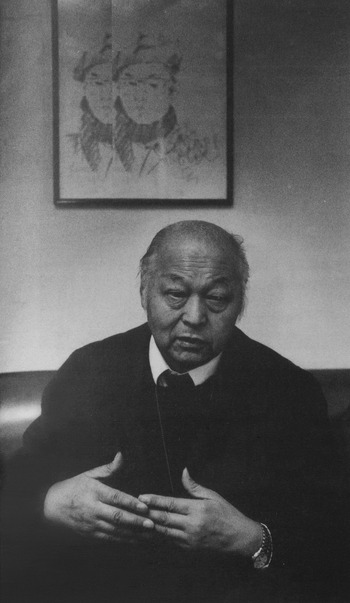
Before examining Complete History closely, I want to mention two factors in Yi's decision to produce this type of general history. First, his generational identity gives him a different vantage point from which he could create, in his words, an “objective” and “comprehensive” historical narrative (Yi Yŏngil 1969, 369). Born in 1931 in Kusŏng, in what is now North Korea, Yi belongs to a generation of critics who experienced Japanese imperialism as children and the Korean War as young adults (see figure 1). These are the writers who emerged in the postwar cultural scene, the first generation to have been educated in the Korean language in middle school. After going south following liberation in 1945, he majored in English in college, debuted on the literary scene with a poem in 1956, and soon became one of the most prolific film critics. As an editor of Film Arts, one of the influential journals of the era, he established a solid relationship with both the older and younger filmmakers in the 1960s and helped to act as a bridge between the two generations (Kim Chongwon Reference Kim Chongwon2001). While Yi is not interested in mirroring either generation's perspective, the fact that he spent his childhood and early adolescence under Japanese rule leads him to have an affinity with the elder. Still, that does not mean that he identifies fully with them, as he distances his purpose of writing from the elder's self-narrativization based on anecdotes.
Yi Yŏngil (1931–2001). Reprinted with permission of the School of Film, TV & Multimedia, Korea National University of Arts.

Second, it should be noted that Yi's writing took place in conversation with other national film histories that focused exclusively on the nation's film production at the time. In fact, Yi's book shares some traits with, for instance, Tanaka Junichiro's Nihon riga hattatsu-shi (A history of the development of Japanese film, 1957), a multivolume, major postwar film historiography.Footnote 4 Both works focus on cinema produced within the national boundary and present a distinctive way of organizing each chapter that includes a brief discussion of the development of “foreign” films—especially European and American cinema before or after that of national cinema (Cazdyn Reference Cazdyn2002, 70). Complete History, like any other national history of cinema, focuses on what and who constitutes the national history of cinema and, in doing so, entails a creation of a diachronic narrative that is built around film technology's development. What distinguishes Yi's work among the era's historiography lies in his search for a decolonizing approach to writing about the history of the pre-1945 era, as will be explored below.
Decolonizing Film Historiography
Complete History begins on the very terrain it is to contest: the colonial historiography of Korean film. Both Japanese and Korean critics had established a narrative based on Korea's lack of finances, technology, and most importantly, sovereignty. For all their merits, these critics could not fully explain the contributions made by Koreans to the making and development of cinema. Revising this predominant narrative requires what might be called a “decolonizing” of both conceptual and methodological ways of understanding colonial Korea. Decolonizing, according to Linda Tuhiwai Smith (Reference Smith1999), intervenes in how we, as scholars of colonialism, conduct our research; without understanding the complex ways in which the production of knowledge is deeply embedded in the layers of colonial practices, our pursuit will inevitably fail to understand the colonized. In this light, decolonizing involves a fundamental critique of the frames and tools we use to produce knowledge about the colonized.
Yi Yŏngil's endeavor to decolonize the historiography first becomes visible in his rethinking of the idea of cinema as a fundamental institution of Western modernity; that is, the notion that cinema as both a technology and a medium was first invented in the West and later received by the rest of the world. This idea too often governed the study of peripheral modernities in general, and the emergence of non-Western media culture in particular, normalizing the West as the standard with which to evaluate and classify the temporalities of other societies.Footnote 5 The colonizer's temporality defined the tone and rhetoric of the historiography that disavowed the local appropriation of cinema in pre-1945 Korea; according to colonialist historiography, it was the Japanese who brought economic, technical, and aesthetic development to Korea, though film technology came from the West.
In seeking to unsettle the colonialist historiography by reorienting his narrative to Korea's cinematic experience, Yi also experimented with a new methodology, that of analyzing oral testimony of senior filmmakers as historical sources. Yi conducted interviews with several senior filmmakers—Yi P'iru, Yi Kuyŏng, Yun Pongch'un, Yi Kyuhwan, Kim Sŏngchun, and others—and used their memories to address the information gap caused by the loss of early films and their relevant sources (Yi Yŏngil Reference Yŏngil2000, 162). To him, oral history offered a new possibility for film historiography in a society where “primary” sources—film prints, scripts, production notes, etc.—had long been lost.
At this point, I want to draw attention to the fact that interviewing as a historiographical method was quite unknown to Yi's fellow critics in South Korea, where it was largely unrecognized in academia until the late 1990s (Ham Reference Ham Hanhŭi2010, 9). Oral history was marginalized in many parts of the world at Yi's time. Although a few postwar American and British historians had used memory as a source for historical research, these scholars often became targets of positivist critics who considered the “unreliability” of memory to be the new method's serious pitfall (A. Thomson Reference Thomson2007). Intervening in such criticism, some historians of the 1970s affirmed oral testimony not as a storage of memory but as a powerful tool for exploring how people make sense of their past, how they connect individual experience and its social context, how the past becomes part of the present, and how people use it to interpret their lives and the world around them (Frisch Reference Frisch1979; Portelli Reference Portelli1991; P. Thomson Reference Thomson1978). Although there is little evidence that Yi had familiarized himself with the discourse of oral history research outside Korea—and he never elaborates on his method beyond writing Complete History—it is nonetheless remarkable that he was an early adopter of the historiographical technique.
Yi's methodological innovation appears, on the one hand, in his historical documentation—from initiating to recording and transcribing conversations—in which the documents of oral history are the result of a relationship. If written documents are fixed and exist whether historians are aware of them or not, oral testimony only becomes a potential resource once historians call it into existence. Yi selected the people who would be interviewed, who would contribute to the shaping of the testimony, and who would give the testimony its final shape. In an interview, Yi does not passively listen but acts as “a ‘partner’ in dialogue, often as a ‘stage director’ of the interview, or as an ‘organizer’ of the testimony” based on their rapport, which had already been established through multiple, previous meetings (Portelli Reference Portelli1991, 55). The final products of the interview, resulting in more than eighty recorded hours and 9,600 pages of transcription, are thus that of both the interviewee and the interviewer.
On the other hand, the oral discourse of the speaker takes on a new validity in relation to written sources in the incorporation of testimony as a crucial mode of historical representation. Yi's citation practice particularly demonstrates how the speaker is pulled into the narrative and becomes a part of the story. Yi often gives a certain power to both direct and indirect quotations, as seen here:
Na Unkyu agreed to star in Nongjungjo [a silent 1926 melodrama], though he was initially not interested in doing so, and according to Na's lifelong friend Yun Pongch'un, Na “already had plans in mind.” That is, even before starring in Nongjungjo, Na Unkyu stayed in his hometown for a while to complete his scenario that would be a great hit later (Oral Testimony for Film History: Yun Pongch'un). (Yi Yŏngil 1969, 77; emphasis added)
The phrase “(Oral Testimony for Film History: Yun Pongch'un)” is a direct citation of the transcription of the oral source, which at the time of his writing had never been published elsewhere. The inclusion of this citation indicates that Yi treats the oral testimony as a fully legitimate historical source like any other written sources cited in his book. He also invites the interviewee to the narrative as shown in his discussion of Arirang (1926), where he introduces the testimony of a theater manager, Yi Kuyŏng. Given that none of the filmmakers were alive at the time of publication, the speaker's testimony gives insight into a previously unknown aspect of Arirang’s success:
According to Yi Kuyŏng, who was overseeing the film promotion, the film's leaflet caused troubles … as it included the lyrics of the folk song, “Arirang,” from which the title of the film came. Japanese police confiscated all copies and investigated him.… Words on what happened spread rapidly, unexpectedly bolstering the film's popularity from the opening day. (Yi Yŏngil 1969, 87; emphasis added)
Here, Yi Kuyŏng is presented as a full-fledged actor in the story in which he participated. Similarly, in many parts of Complete History, the speaker telling the story is part of the story being told, which can implicitly indicate a much deeper involvement than that of an external narrator. Writing a history based on oral testimony then entails the historian's invitation of the participant, the participant's presence in the story, and the assumption of responsibility, all of which are inscribed in the account, revealing historiography as a dialogical act of narration.
Giving more authority and autonomy to the colonized through his methodology, Yi Yŏngil attempts to challenge the conceptual problem at the core of the colonialist historiography. One such instance unfolds when he discusses cinema's formative era in Korea, which, in fact, had been largely ignored as “pre-history” or only discussed relative to the exhibition of foreign films, given that motion pictures started to appear in public spaces in 1903 but were not produced by Koreans until 1919.Footnote 6 Pushing back against the idea of Korea's “belated” development, Yi seeks to dislocate the universal conception of progress that constituted the core of Eurocentric, imperial histories (Yi Yŏngil 1969, 40–55). He does so first by criticizing how the existing film histories have used two simplified categories to describe the early years of cinema in the world: the “countries of invention” and the “countries of adaptation.” To him, neither is adequate to comprehend the inception of cinema in Korea; since colonialism was exercised unevenly in the world, a binary notion of “invention” and “adaptation” created from the vantage point of a singular conception of progress would inevitably fail to place the Korean case. What follows is his perspective that considers the simultaneity of cinematic inception precipitated by global capitalism and its requirements within the region. Referencing the ways other Asian countries articulated motion pictures, Yi reveals that people in Japan, China, Hong Kong, and Korea all began to appreciate film technology between 1896 and 1905, and in the process, cinema evolved in close relation to their existing local cultures, rather than sweeping them out. Dismissing the binary between “modern” and “traditional,” Yi positions Korea's first public screening in 1903 within this regional phenomenon based on the memories of Yi P'iru and Yi Kuyŏng, who had watched (and had heard of urbanites watching) lantern shows and short films during the decade. To him, this cinematic experience occurred “synchronously with” and “in dialogue with” early cinema in other countries in Asia, and this regional context offers one way to valorize Korea's cinematic inception as part of the regional appropriation of new technology (48). Through his repositioning of the Korean case from a regional perspective, Yi presents Korea as essentially part of, rather than necessarily lagging behind, the regional transformation of capitalist modernity.
Although not suggesting an entirely new model to reconceptualize the Korean case, Yi considers both the heterogeneous effects and the ineluctability of capitalist modernity. Yi's perspective on modernity—in a significant resonance with what Harry Harootunian (Reference Harootunian2002) calls “co-eval modernity”—allows him to see “belatedness” as a material and discursive effect of uneven development. He refuses to order the differences in sociocultural formation according to an evolutionary temporal scheme in which such difference is translated into stages in the hierarchical ladder of historical progression, where Korea had been represented as “lacking” the property of modernity and consigned “to an imaginary waiting room of history” (Chakrabarty Reference Chakrabarty2000, 8). Yi's challenge of the universal scheme leads him to unsettle the perceived temporal lapse in subsequent chapters, for instance, when he claims that Korea's transition to talkie films paralleled that of other film industries that developed sound technology in the late 1920s and early 1930s. Yi builds upon the testimony of Yi P'iru, who claimed that, as early as 1931, he had experimented with sound recording and that he had helped the Japanese technicians with the invention of the Tsuchihashi sound system, which was used in one of the first complete sound films in Japan, Heinosuke Gosho's The Neighbor's Wife and Mine (1931) (Yi Yŏngil 1969, 142). By integrating Yi P'iru's memory into the heart of his narrative, Yi Yŏngil counters the colonial temporality that had denied Korean agency.
Both of Yi's methodological and conceptual challenges to colonialist historiography culminate in his validation of the authenticity of Korean cinema under colonial rule, particularly in his work on Na Unkyu and several male directors. Given the loss of films, Yi's writing depends on the memories of Na's colleagues, especially those of Yun Pongch'un, Na's lifelong friend. Yi's chapter on Na and other “pioneers” pivots on Yun's testimony, in which he highlights the filmmakers as a collective that shared the vision of filmmaking not for their sake but for the nation. Yi pays special attention to legitimatizing their “morality” and “intelligence,” drawing on Yun's recollection of Na Unkyu and other male directors whose backgrounds were relatively more established and even “elitist” (Yun Reference Yun P'ongchun and Yŏn'guso2004, 126). The story of “pioneers” continues to provide a basis for Yi Yŏngil to articulate Korean cinema's authenticity through his discussion of “realism” as a core dynamic of cinematic development. Instead of replicating the existing interpretation that values the “anti-Japanese sentiment” in Na Unkyu's film, Yi creates a genealogy of Korean realism through him:
Na Unkyu's Arirang represents “the aesthetic of blood,” which symbolizes the resistance of the colonized against the world of injustice and poverty under the severe exploitation in this era [the 1920s].… Na Unkyu's realism later [in the 1930s] shifted to “the aesthetic of soil” … where he now focused on the struggle of a young colonial intellectual to build a school in a small village.… Na recognized that the spirit of resistance through the “aesthetic of blood” could no longer dismantle the colonial power, turning to stress the importance of the enlightenment project, which would nurture and awaken Koreans. (Yi Yŏngil 1969, 86–89)
Through this codification of the “aesthetic” and “national” values of realism, Yi depicts it as the most important legacy of Korean cinema in the 1920s and 1930s, a legacy that never faded even during one of the country's most trying junctures—wartime mobilization during the Pacific War (1941–45). Often called “the dark age,” those years had been defined as condemning Japanese imperialism and Korean collaboration. Unlike earlier writers (An Reference An Chonghwa1962) who drew a clear break with colonialism, Yi imagines a linear trajectory of Korean cinema by emphasizing the shared “spirit” (ch’ŏngsin) of directors who claimed to have either secluded themselves or been forced into labor camps instead of making propaganda films, including Yi Kyuhwan, Yun Pongch'un, and Chŏn Changgŭn:
While Korean cinema on screen became dead, its spirit remained alive in the labor camps and secluded villages where these directors suffered. Only about 140 features were made during the colonial era, which reaches only half of the number of films made in the 1960s alone. Despite these limited film productions behind us, we find ourselves inheriting a rich vein of spirit in Korean cinema; it is the root that is irreplaceable by anything, that is, the tradition of Korean cinema. (Yi Yŏngil 1969, 172)
The creation of “realism” constitutes the core “spirit” of national culture for these filmmakers who resisted the colonial state's attempts to assimilate them. This emphasis on “spirit” continues in Yi's analysis of what he calls “liberation film,” which portrayed the lives of activists fighting for the nation's independence under Japanese rule. The stories of national activists such as Yu Kwansun and Yun P'ongkil were frequently retold in features (Yi Sunjin Reference Sunjin2005), and in such recreations of the past, the “successors of Na Unkyu” actively participated in filmmaking that ultimately “provided a basis to awaken people” in the immediate post-liberation era (Yi Yŏngil 1969, 172–77).
Yi Yŏngil was not the only critic interested in the Korean “spirit”; in fact, this idea was shared among postcolonial intellectuals in the pursuit of recovering the nation from the colonial experience. Prominent literary critic Kim Hyŏn, for instance, suggested that Korean intellectuals should disclose “the sacred” in Korean literature that “sustains” the nation's culture and “captivates” contemporaries (Kim Hyŏn and Kim Yunsik Reference Kim Hyŏn and Kim Yunsik1973, 30). For Kim ([1970] Reference Kim Hyŏn1991), the sacred in literature embodies the nation's unique historical experience and, once identified, enables scholars to imagine the specific dimensions of “Korean literature” rather than relying on European norms. What is symptomatic in their approach to the colonial era is a logic of dualism: a national body (the material) contrasted with a national soul (the spiritual). To them, as Partha Chatterjee (Reference Chatterjee1993) discusses in the context of Indian nationalistic intellectuals, colonialism dominated the outer material spheres of life but left the “inner domains of national culture” largely intact. Because of this belief in a relatively uncolonized domain of life, according to Kim and Yi, Koreans’ aesthetic and political purity can be protected from Western and Japanese influences.
In this sense, both Kim and Yi perceived that the task of postcolonial historiography could be first achieved through locating agency on the part of the colonial subjects and finding a way for those figures to make visible their subjectivity. However, their imagination of the postcolonial present is selective regarding the “purity” of subjectivity. For instance, in creating their genealogy, they exclude writers and filmmakers who went to North Korea from 1945 to 1948, seeking a more harmonious social and intellectual climate for their cultural production. The marginalization—or “eradication”—of these intellectuals is nothing new; it happened in virtually every field of historiography during that time, when the regime's anticommunist mandate not only outlawed any attempt to make North Korea visible, other than as the enemy, but also banned the work of those who had moved to the North (Hughes Reference Hughes2012, 61–89). Yi's film historiography offers a site in which these artists moving to the North are determined to be “impure,” and are thereby silenced. The filmmakers going to the North frequently appear in oral testimonies, but only in the context in which they were believed to be “abducted” or “forced” to go to the North by several communist filmmakers (Kim Sŏngchun Reference Kim Sŏngchun and Yŏn'guso2003, 55–60; Yi P'iru Reference Yi P'iru and Yŏn'guso2003, 300–310; Yu Reference Yu Changsan and Yŏn'guso2003, 27–30). By relying on the memories of those who lived through the division of the peninsula but remained below the 38th parallel, Yi erases some filmmakers who were actively involved in the reconstruction of the film industry in the liberation era. To Yi, these filmmakers, whether they voluntarily moved to the North or not, do not belong in the postcolonial history. In Yi's emphasis on oral testimony, despite its allowance of more agency to the colonized, the postcolonial memory of the filmmakers to the North appears to be unproblematic. While privileging oral discourses about the past, his method can end up overwriting alternative memory practices in the interest of producing a decolonized, but politically loaded, historical account that speaks to the “survivors” (Yi Sunjin Reference Sunjin and Sŏngsu2014) below the 38th parallel.
In the “Aftermath” of Colonialism
Throughout Complete History, Yi Yŏngil's interest remains more in prioritizing what is remembered and why, rather than how specifically the colonial forms their subjectivity after the “end” of colonialism. In interviews, most senior filmmakers similarly recall the “end”: all people, now liberated from the Japanese, shouted “hurray for freedom” everywhere. Yi Kyuhwan, who refused to collaborate during the late colonial era, expressed his exhilaration when reunited with other directors several days after August 15, 1945, “singing out (the) Korean national anthem together and planning on making a film for the whole nation” (Yi Kyuhwan Reference Yi Kyuhwan and Yŏn'guso2003, 197). On the surface, Yi Kyuhwan thought of himself as belonging to something that could represent itself as “after colonialism.” There seems to be no dialectic process in his discourse; becoming a “post”-colonial subject occurs as immediately as one disavows what was in place before.
Jamaican-born, British critic Stuart Hall, who himself experienced what has been called the “end” of colonialism, notes how complex his identification has been because he was admittedly “framed by and against ‘the colonial.’” He continues: “‘post-’ is not just a matter of the passage of time. It refers to the way one configuration of power, institutions and discourses, which once defined the social field, has been replaced by another.… In the case of the colonial and the postcolonial, what we are dealing with is not two successive regimes but the simultaneous presence of a regime and its after-effects” (Hall Reference Hall and Schwarz2017, 22–24; emphasis in original). Hall's observation provides us with a vantage point from which we can understand how the colonized/postcolonized subject is engaged. Even after the “end” of colonialism, the postcolonial subjects cannot help but live with the effects of colonialism. But simply acknowledging the continuity of the colonial effects does not enable us to see what Hall calls their “simultaneous presence” in the postcolonial present. It is, therefore, necessary to reveal how the effects of colonialism evolve in competition with the hegemonic practices of postcolonial power that contour popular memory of the colonial past. I am particularly interested in unpacking how postcolonial subjects—both Yi Yŏngil and his interviewees—reconcile with the effects of colonialism in their writing and speech.
One of the tenacious colonial effects can be seen in their conversations. In interviews, senior filmmakers often frame their filmmaking as an act of national resistance, and in so doing, the conversation itself seeks to resituate the popular experience of colonialism in accordance with the nationalist histories rather than with counter-nationalist narratives. It is indeed easy to detect an overt hatred against the Japanese in all interviews, as can be seen, for instance, in the regular usage of derogatory terms for Japanese, such as waenom (Japanese bastard). However, their criticism almost always targets “Japanese imperialism” and the “imperial government,” not the individuals who had collaborated with the colonial power. This might be explained by the fact that most filmmakers were not entirely free from allegations of supporting imperial propaganda by making films during the Pacific War. As a result, there were moments when filmmakers tried to refrain from speaking about any individual who had worked for the colonial power even before the war. For instance, here is Yi P'iru speaking about his early-1920s activities:
Yi P'iru: [After making Fool (1926)] eh, then I met Son Yongchin for the first time.
Yi Yŏngil: Yes, Son Yongchin.
Yi P'iru: Yes, he was, back then, [whispering] though this should not be told, this is just between you and me, working for the colonial government as an assistant. (Yi P'iru Reference Yi P'iru and Yŏn'guso2003, 199)
Yi P'iru is reluctant to speak about Son, a cinematographer who was still alive at the time of this interview. This reticence about collaboration is obviously the product of a political climate of anxiety in the mid-1960s, given that the interviews happened just after South Korea normalized its diplomatic relations with Japan despite the nationwide anti-normalization protests that took place most fiercely from 1964 to 1966 (Chŏng Reference Chŏng Haegu1995).
Beyond the reticence, however, what is also recurring throughout the conversation is an interesting language pattern: standard Korean is used overall, while Japanese crops up in technical terms (eiga [film], ooiri [incentive]), in digressions (an anecdote with a Japanese aniki [elder]), and in expressional phrases (daijobu [it is ok]) (Yi Kyuhwan Reference Yi Kyuhwan and Yŏn'guso2003, 190; Yi P'iru Reference Yi P'iru and Yŏn'guso2003, 205). The fact that the Japanese language is frequently used in Korean filmmakers’ speech is noticed anxiously by Yi P'iru alone:
Yu Ch'angsan: So, I suggested, since we had some technical restraint, let's drop Story of Simchong and kirikae [switch over to] The Story of Hong Gildong.
Yi P'iru: Hey, don't use Japanese repeatedly.
Yu Ch'angsan: So, we decided to work on The Story of Hong Gildong, and then started to figure out how to write the script. (Yi P'iru Reference Yi P'iru and Yŏn'guso2003, 276)
Yi P'iru abruptly jumps into the conversation, chastising his colleague who was liberally using Japanese during the interview. Both belong to the generation of Koreans who were familiar with the Japanese language due to their colonial experience and education. Trained under the strict, Japanese-style apprenticeship system and educated in both Japanese and Korean in their adolescence, this generation felt comfortable with the Japanese language. Although monolingualism came to dominate the postcolonial space through a series of measures to “cleanse” the remnants of the colonizer's language from education and daily life, this generation—the product of colonial bilingualism—could not eradicate the “embarrassing colonial legacy” in their habits (Suh Reference Suh2013, 151).
The colonial effect embedded in the linguistic register and cultural memory can reveal the speaker's emotions, their participation in the event, and the way the event affected them. This often involves attitudes that speakers may not be so willing to express otherwise, as in the case of Yi P'iru's reticence, or elements that are not fully within their control, as in the case of Yu's colloquial speech. These registers of the colonial, which remain quite naturally in the transcription, are concealed from Yi Yŏngil's representation. In Yi's articulation of “Korean” cinema, these colonial remnants should be invisible, given that most of colonial history was written from the vantage point of national resistance, and that within certain authorized versions of Korean history, daily life under the Japanese was marginalized or completely evaded.
Nonetheless, Yi's compromise with the colonial past ultimately is troubled by his temptation to view the world through the lens of “progress,” which was developed and utilized by colonial powers. While he challenges the colonialist frame that stages Korea as far behind the standard in his chapters on the colonial past, he returns, in the final chapter on the then-present time, to the temporal gap between “Korean cinema” and what he regards as model cinemas in the world. Here, Yi reviews the American, French, British, German, and Italian film industries and their outcomes at the time. Introducing their genres and filmmakers who were recognized throughout the world as being at the “pinnacle” of contemporary cinema, Yi positions these “leading” national cinemas and their industries as models for Korean cinema. In a nutshell, these “advanced” models have several ideal traits: film cultures that have developed into coherently organized systems, industries that all follow a scheme of aesthetic and technological developments that provide smooth transitions from the birth of a film to its distribution, and features in diverse genres and styles that earn global prestige. Yi ultimately concludes that “instead of remaining on the periphery,” Korean cinema should reach the “center” of the world, “walking shoulder to shoulder” with these “advanced” models: “unless Korean film companies build a path to survive in the world, Korean cinema will have to face stagnation.… If it fails to achieve status as great art and enterprise, and to be capable of competing in a global market, Korean cinema will never be in global film history in the future to come,” he warns (Yi Yŏngil 1969, 342).
What is palpable in Yi's assertion is that, unlike many film histories of the era, Complete History ends with anxiety rather than a celebration of a present moment. Yi's unease comes most specifically from South Korean film being on the “periphery” of the world, which is a consequence of the regime's “myopic” definition of cinema as an apparatus; Yi feels that this has suppressed the growth of “Korean cinema” both nationally and globally. The regime's approach materialized in its film policy that simultaneously promised the “cultivation and promotion” of the film industry and “stronger regulation” over it (Yi Yŏngil 1969, 252). This reform of the film industry caused severe problems, as the new code demanded that film studios produce overwhelming numbers of films per year or face dissolution. The state's censorship also “severely restrained any artistic expression” with its ban on all anti-governmental activity, including any criticism of the state and any representation of North Korea outside of the state's frame (264). To Yi, these problems derive from the state's contradiction between South Korea's structure as a constitutional republic and its repressive operation with regard to, for instance, “basic individual rights such as the freedom of speech, press, and artistic expression” (255–56). And what makes such oppression possible is precisely the statist cultivation of film as mere commercial entertainment, rather than as an art; due to the state's limited understanding of film, South Korean cinema could not advance as much as model cinemas.
It was not only Yi who perceived a dichotomy between entertainment and art; critics and cultured audiences had privileged artistic and foreign films over Korean films since the colonial era, and the elite status of Euro-American films did not end in the postwar period (Yi Sŏnju Reference Sŏnju2006). Advocating the notion of film as an art, they wanted to structurally shift the form and function of film away from what was understood as cheap entertainment for the masses and toward an artistic model that would eventually increase the global prestige of Korean film in the world.
Here, Yi Yŏngil replicates the postcolonial aspiration toward the “West” in his criticism of contemporary cinema and his desire to catch up with Euro-American models. It relates to what Dipesh Chakrabarty terms the “pedagogical mode,” a developmental form of decolonization endorsed by an anticolonial critic who has come to accept the West as a model for others to follow. This pedagogical mode reenacted “civilizational or cultural hierarchies between nations” when it operated in the Cold War system, where colonies turned into decolonizing nation-states under the hegemony of the United States and its creation of the so-called free world (Chakrabarty Reference Chakrabarty and Lee2010, 46). The primary purpose of decolonization was to reclaim territoriality and autonomy, yet global capitalism never left decolonizing nations to create their own models; rather, they were “conscripted” to the free world (Scott Reference Scott2005). Complete History, as a project of decolonizing colonialist historiography, reclaims Korean cinema's evolution and seeks to make a parallel between cinema and nation to authenticate the country's modernity. Yet, in Yi's declaration of Korean film's being peripheral within a global context, he takes a developmental lens, dividing film industries into stages according to their progress. Unwittingly, he uses “Western” cinema as a universal cultural norm—something he criticizes in his authentication of Korea's modernity in earlier chapters—for the evaluation of contemporary Korean cinema, and Korean cinema is mapped in terms of its distance from that norm. Yi's postcolonial attempt to present an alternative history of non-European culture still operates within cultural norms and values that affirm the West as the “sovereign subject” of all histories (Chakrabarty Reference Chakrabarty2000, 45–46).
At this point, one might conclude that Yi fails to find an approach to the relationship between coloniality and modernity that does not remain mired in totalization. But as Frantz Fanon emphasized, “liberation” in the Cold War era did not lead to a complete erosion of the Manichean structure that operated in the colonial world. For Fanon (Reference Fanon and Philcox2004), decolonization cannot be achieved by simply repossessing territory and sovereignty; rather, the future of the decolonized world can arrive only if postcolonial subjects resist the Manicheanism of the Cold War that the superpowers continue to impose on them. Instead of being frustrated with the double demand of decolonization and globalization, Fanon reminds us how difficult it is for postcolonial subjects to exorcise the logic of progress that constitutes, as Walter Mignolo (Reference Mignolo2007, 487) puts it, “the epistemic colonization of souls, of minds, of spirits, of beings.” Yi's acceptance of old norms tells us that postcolonial historiography is entrenched with the effects of colonialism, even for those who seek to find and restore the agency of the colonized. The contradiction in Complete History comes from that of the postcolonial subjectivity and its relation to the task, which is fraught with a demand for decolonization in the globalizing, “free” world.
Conclusion
Analyzing Complete History as a complex construct illuminates the process of writing a national history of cinema in Yi's then-present time with the recurring effects of colonialism. Even as we, as scholars of colonial culture and history, are able to take advantage of new opportunities to recover and understand the past, with discoveries of sources and restorative efforts, we are still grappling with many of the same questions that Yi faced. His methodological innovation continues to inspire scholars who, decades later, have approached oral testimony as a critical source of evidence for colonial histories rather than simply personal memory.Footnote 7 Complete History also encourages us to rethink how colonial effects carve through the postcolonial subjectivity when Yi takes on the task of decolonizing a colonialist narrative, one that centered on a developmental logic operating in the colonial era and continued to pose a challenge to him. The ensuing colonial effects can provide us with a compelling example to counter the idea that decolonization was an uninterrupted struggle to establish an autonomous nation-state. Navigating the complexity of decolonization—on both the physical and metaphysical levels—can lead to new possibilities for understanding the “post” in postcolonial as a temporal break, which ultimately invites a more critical engagement with the colonial effects that cling to our lives in the present.
Complete History’s dilemma as postcolonial historiography should be situated in Yi Yŏngil's hope and despair for decolonization in the Cold War, particularly since we no longer live in the dichotomous order of this era. Our methods for thinking about this history and for doing history itself have been shifting, especially in the study of the “non-West,” in order to find new paths forward where older frames of development, modernity, or progress have fallen short. This explains, at least in part, why, decades later, Yi Yŏngil attempts to challenge the paradoxical conditions that shaped his writing. Although evaluating all his thoughts would take us beyond the scope of the present discussion, it is crucial to note their polemic aspects. In his lectures given before his death, he advises a later generation of critics to discover the meanings of historical events that have been “repressed” by any hegemonic powers—not only by the state but also by the predominant way of seeing modernity and cinema in non-Western society, and even by earlier historiographies, including his own enterprise. The tasks left in our hands, thus, do not simply require a more attentive approach to the complexities of postcolonial historiography after the Cold War. Yi's unflagging effort to challenge his boundary of thought, never remaining in his comfort zone until his death, also asks us to broaden our horizons—fearlessly and persistently.