1. INTRODUCTION
The laser intensity at the focus has been raised to the relativistic limit and even by a few orders of magnitude beyond it through the recent advances in laser technology (Salamin et al., Reference Salamin, Hu, Hatsagortsyan and Keitel2006). This dramatically promotes the study of the nonlinear physics on laser-matter interactions and at the same time new fields are opened such as attosecond physics (Farkas & Tóth, Reference Farkas and Tóth1992; Corkum & Krausz, Reference Corkum and Krausz2007). The attosecond X-ray pulse can allow measurements with unprecedented temporal resolution (Hentschel et al., Reference Hentschel, Kienberger, Spielmann, Reider, Milosevic, Brabec, Corkum, Heinzmann, Drescher and Krausz2001; Kienberger et al., Reference Kienberger, Goulielmakis, Uiberacker, Baltuska, Yakovlev, Bammer, Scrinzi, Westerwalbesloh, Kleineberg, Heinzmann, Drescher and Krausz2004; Salamin et al., Reference Salamin, Hu, Hatsagortsyan and Keitel2006; Dromey et al., Reference Dromey, Zepf, Gopal, Lancaster, Wei, Krushelnick, Tatarakis, Vakakis, Moustaizis, Kodama, Tampo, Stoeckl, Clarke, Habara, Neely, Karsch and Norreys2006; Baeva et al., Reference Baeva, Gordienko and Pukhov2006). In order to obtain coherent X-ray sources, many methods have been proposed. One way that was first proposed by Farkas and Tóth (Reference Farkas and Tóth1992) is via Fourier synthesis of high-order harmonics generated by laser-atom interaction and has already been demonstrated experimentally (Paul et al., Reference Paul, Toma, Breger, Mullot, Augé, Balcou, Muller and Agostini2001; Hentschel et al., Reference Hentschel, Kienberger, Spielmann, Reider, Milosevic, Brabec, Corkum, Heinzmann, Drescher and Krausz2001). Paul et al. (Reference Paul, Toma, Breger, Mullot, Augé, Balcou, Muller and Agostini2001) experimentally realized a train of 250 as pulses. A 650 ± 150 as pulse was generated and the attosecond metrology was demonstrated for the first time by Hentschel et al. (Reference Hentschel, Kienberger, Spielmann, Reider, Milosevic, Brabec, Corkum, Heinzmann, Drescher and Krausz2001). Another way to obtain the attosecond X-ray pulses is also based on the high-order harmonics generation, while it is via the laser-plasma interaction instead of laser-atom interaction (Varró, Reference Varró2007; Baeva et al., Reference Baeva, Gordienko and Pukhov2007; Liu et al., Reference Liu, Xia, Liu, Wang, Cai, Wang, Li and Xu2008, Reference Liu, Xia, Liu, Li and Xu2009). More intense attosecond X-ray pulses can be generated because plasma media can withstand higher laser intensities (Tsakiris et al., Reference Tsakiris, Eidmann, Meyer-ter-Vehn and Krausz2006). Besides these methods, Thomson scattering of laser pulses by electrons is also a potential way to generate attosecond pulses (Lee et al., Reference Lee, Cha, Shin, Kim and Kim2003a; Lan et al., Reference Lan, Lu, Cao and Wang2005).
The characteristics of radiation emitted by the accelerated electron in an intense laser field based on the Thomson scattering have been investigated widely (Leubner, Reference Leubner1981a, Reference Leubner1981b; Puntajer & Leubner, Reference Puntajer and Leubner1989; Esarey et al., Reference Esarey, Ride and Sprangle1993; Tian et al., Reference Tian, Yu, He, Xu, Senecha, Deng, Wang, Li and Xu2006; Gao, Reference Gao2004; Lan et al., Reference Lan, Lu, Cao and Wang2005, Reference Lan, Lu, Cao and Wang2007; Lau et al., Reference Lau, He, Umstadter and Kowalczyk2003; Lee et al., Reference Lee, Cha, Shin, Kim and Kim2003a, Reference Lee, Cha, Shin, Kim and Kim2003b, Reference Lee, Chung, Lee and Kim2008; Tomassini et al., Reference Tomassini, Giulietti, Giulietti and Gizzi2005). The earliest thorough analytical and numerical investigations of nonlinear Thomson scattering of intense laser fields were presented by Leubner (Reference Leubner1981a, Reference Leubner1981b). Breakthrough work has experimentally confirmed the theoretical predictions of relativistic Thomson scattering by observing the distributions of harmonics (Chen et al., Reference Chen, Maksimchuk and Umstadter1998). The process of high-order harmonics generation has been utilized for attosecond X-ray sources. An attosecond pulse train that was generated based on nonlinear Thomson backscattering of an intense laser pulse by a single electron has been reported (Lee et al., Reference Lee, Cha, Shin, Kim and Kim2003a). Recently, numerical work has shown that when a tightly focused laser with circular polarization was scattered by a counter-propagating energetic electron, an isolated attosecond pulse that was highly desirable would be generated (Lan et al., Reference Lan, Lu, Cao and Wang2005).
In this paper, a new method by using two counter-propagating laser pulses to obtain a single attosecond pulse based on the relativistic headlight effect is proposed. The radiation characteristics of an electron driven by two counter-propagating incident laser pulses are investigated, respectively, for linear and circular polarizations. Supercontinuum spectrum that supports an isolated attosecond pulse without spectral filtering can be obtained for both polarizations. However, it is found that the generation of an attosecond pulse is highly sensitive to the carrier envelope phase (CEP) in the case of linear polarization. While, using circularly polarized pulses can not only obtain a single attosecond pulse, but also make its generation avoid the influence of CEP. In addition, it is found that the radiation power obtained by using two counter-propagating pulses can be significantly enhanced in comparison with that obtained by only using one of these two pulses.
2. FORMULATION
Let us consider that an electron is driven by two counter-propagating laser pulses with the same frequency, pulse duration, and CEP. The schematic geometry of the interaction is shown in Figure 1. It is assumed that the electron rests at the origin initially. One of the two incident pulses propagates along the +x axis, the other propagates along the −x axis. And the two pulses have Gaussian envelopes with the central wavelength at λ0 = 800 nm.
Schematic diagram showing that an electron is driven by two counter-propagating incident laser pulses.

The electric and magnetic fields of the two laser pulses can be expressed as

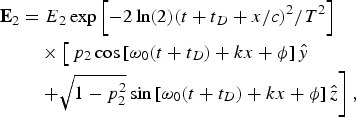
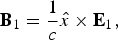
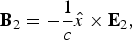

where E 1 and E 2 are the peak electric field amplitudes for laser pulses propagating along +x axis and −x axis, respectively; T is the pulse duration, i.e., full width at half maximum (FWHM); p 1 and p 2 are the polarization parameters such that p 1,2 = {± 1,0} for a linearly polarized laser and  for a circularly polarized laser; ω0 and k are the frequency and wave number of the laser, respectively; ϕ is the CEP; t D is the delay between the two pulses when they arrive at the origin;
 , ŷ, and ẑ are the unit vectors along the corresponding axes; and t evolves from −∞ to +∞.
Note that the fields above to describe the laser pulses are approximate. The ranges of transversal and longitudinal motions of the electron in the selected laser fields (the highest intensity is about 1019 W/cm2) are quite small compared to a typical focal spot size (order of several micrometers in radius in real experiments) and the corresponding Rayleigh length of a laser beam, respectively. In addition, when the laser beam has a typical focal spot size, the longitudinal component of the field which is much smaller than the transversal component can be neglected (He et al., Reference He, Yu, Lu, Xu, Qian, Shen, Yuan, Li and Xu2003). Hence, neglecting the effects of focusing, diffraction, and the longitudinal component of the laser field and adopting the plane wave approximation are valid to describe the short pulse laser with a Gaussian envelope in our calculations.
In addition, the peak electric field amplitude is given in dimensionless units a 1,2 = eE 1,2/m ecω0 in the following calculations, where e and m e are the charge and rest mass of an electron, respectively, c is the velocity of light in vacuum. The laser intensity I 1,2 is related to a 1,2 by

The motion of a single electron in a high intensity laser field is governed by the following equations:

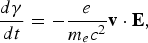
where β = v/c is the normalized electron velocity, 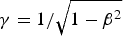 is the relativistic factor, E and B are the electric field and magnetic field, respectively. Once the orbit of the electron is calculated, the radiation power of the electron per unit solid angle detected far away from the electron in the direction
 can be calculated by (Jackson, Reference Jackson1975)
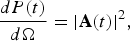

where the subscript ret means that the quantity in the square brackets should be evaluated at the retarded time t′, t′ is related to t by t = t′ + (R 0 − · r)/c, R 0 is the distance from the origin to the detector, r is the position of the electron relative to the origin. Further, the energy radiated per unit solid angle per unit frequency interval is given by
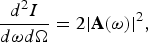

3. NUMERICAL RESULTS AND DISCUSSIONS
3.1. Counter-Propagating Incident Pulses with Linear Polarization
When the electron is driven by two counter-propagating laser pulses with linear polarization (p 1 = p 2 = 1), the radiation power in the direction = − can be described by

As presented in our previous work (Liu et al., Reference Liu, Xia, Liu, Li and Xu2009), two relativistic effects are contained in the radiation field. One included in the numerator is the frequency shift caused by the relativistic Doppler effect, the other is included in the denominator (1 + βx)3 (relativistic headlight effect), and plays a dominant role in the radiation when βx is close to −1. During the acceleration process of the electron, when βx is close to −1 at an instant time t i a strong radiation that is significantly higher than those generated at other times will be obtained owing to the relativistic headlight effect. This is very helpful to generate a single attosecond pulse.
An attosecond pulse train will be generated from nonlinear Thomson backscattering of an intense laser pulse scattered by an electron initially at rest (Lee et al., Reference Lee, Cha, Shin, Kim and Kim2003a; Gao, Reference Gao2004). In this process, the effect of (1 + βx)3 in enhancing the radiation is not obvious as the electron never moves backward (the incident laser pulse propagates along +x axis). Adding a colliding laser pulse propagating in the opposite direction will make the electron move backward at a velocity close to c at an instant time, thus the condition of single attosecond pulse generation will be satisfied owing to the effect of (1 + βx)3.
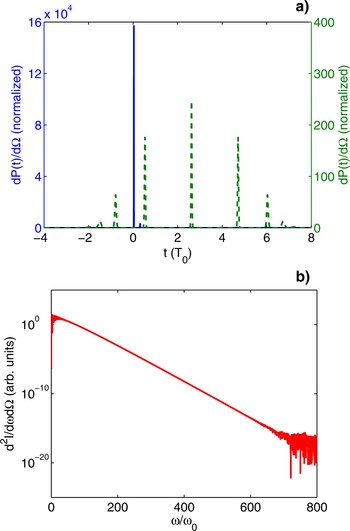
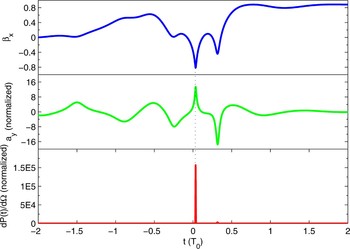
In Figure 2a, the olive dashed line represents an attosecond pulse train that is obtained in the direction = − by only using the laser pulse propagating along the +x axis, and the parameters of the laser pulse are: the intensity I 1 = 1.34 × 10¹⁹ W/cm2 (a 1 = 2.5), pulse duration T = 1.5T 0 (T 0 is the oscillation period of the laser field), p 1 = 1 (linear polarization), CEP ϕ = 0; the blue solid line (online only) represents a single attosecond pulse that is generated by adding a colliding laser pulse propagating in the opposite direction with I 2 = 2.36 × 10¹⁸ W/cm2 (a 2 = 1.05). The pulse duration, polarization parameter, and CEP of the colliding laser pulse are the same with the previous incident laser pulse. And it is assumed that laser envelope peaks of the two incident pulses arrive at the origin at the same time, i.e., T D = 0. Figure 2b is the corresponding spectrum of radiation generated by the two counter-propagating laser pulses in the direction = −. This supercontinuum spectrum confirms again that a single 12 as pulse can be supported without spectral filtering. A detailed analysis of the electron dynamics, such as the evolutions of the velocity and acceleration of the electron, will give us a clear picture about the generation of a single attosecond pulse. Calculated evolutions of the longitudinal velocity βx, transverse acceleration a y (normalized by c/T 0) and the time-varying radiation power per unit solid angle dP(t)/dΩ (normalized by e 2ω02/64π4ε0c) of the electron are shown in Figure 3, respectively. It can be seen from Figure 3 that when the electron moves toward the direction of observation at the maximum velocity, its transverse acceleration is also high. This will lead to that the radiation at this time is much higher than those at other times (see Fig. 3). Hence, a single attosecond pulse can be detected. Further, the electric field of this single attosecond pulse is linearly polarized along y axis. And the peak power of this single attosecond pulse is about 640 times of that of the attosecond pulse train generated by the single incident laser pulse.
(Color online) (a) Calculated evolutions of the radiation power per solid angle in the direction = − for two linearly polarized counter-propagating laser pulses with a 1 = 2.5, a 2 = 1.05, p 1 = p 2 = 1, T = 1.5T 0, ϕ = 0 and t D = 0 (blue solid line) and a single linearly polarized laser pulse (one of the two laser pulses with a 1 = 2.5) (olive dashed line), respectively. (b) The corresponding energy spectrum of the two counter-propagating pulses with linear polarization in the direction = −.

(Color online) Calculated evolutions of βx, a y (normalized by c/T 0) and dP(t)/dΩ (normalized by e 2ω02/64π4ε0c) in the direction = − respectively for two linearly polarized counter-propagating laser pulses. The parameters of the two laser pulses are the same as those in Figure 2.

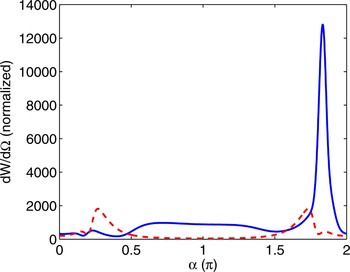
The angular distributions of the time-integrated radiation power (dW/dΩ), which is normalized by e 2ω0/32π3ε0c in the plane of electron motion, i.e., in the x-y plane, are calculated for the single incident pulse and the two counter-propagating incident pulses as shown in Figure 4, respectively. The direction of observation is defined as = cosα + sinαŷ, where α is the polar angle in this plane (see Fig. 1). For the single incident pulse, the electron will take relativistic motion in the laser field with the intensity of 1.34 × 10¹⁹ W/cm2. The angular distribution of the radiation obtained by such intense laser pulse will deviate from that of the dipole radiation. This can be confirmed by the result as shown in Figure 4 (red dashed line (online only)) that the time-integrated radiation along the +x direction (α = 0) or along the −x direction (α = π) is obviously weaker than the maximum radiation. In the case of the two counter-propagating pulses, the time-integrated radiation power is more intense than that in the case of the single pulse in the electron motion plane, and its maximum value is about seven times of that obtained by the single pulse. Calculated angular distributions of the peak radiation power dP/dΩ (normalized by e 2ω02/64π4ε0c) in the electron motion plane under the two conditions are shown in Figure 5, respectively. It can be seen from Figure 5 that the maximum peak radiation power obtained by using the two counter-propagating pulses is about 34 times of that obtained by using the single pulse.
(Color online) Angular distributions of the time-integrated radiation power in the plane of electron motion for two linearly polarized counter-propagating laser pulses (blue solid line) and a single linearly polarized laser pulse (red dashed line). The laser parameters in these two cases are the same as those in Figure 2.

(Color online) Angular distributions of the peak radiation power in the plane of electron motion for two linearly polarized counter-propagating laser pulses (blue solid line) and a single linearly polarized laser pulse (red dashed line). The laser parameters in these two cases are the same as those in Figure 2.

Figures 4 and 5 indicate that the distributions of dW/dΩ and dP/dΩ are symmetric about the x axis in the case of the single incident laser pulse, i.e., 
 . However, the symmetry of the angular distributions of dW/dΩ and dP/dΩ disappears in the case of the two counter-propagating incident laser pulses. The reason of this phenomenon is qualitatively analyzed as follows. For relativistic motion, the radiation in the direction not only depends on the acceleration but also on the velocity, especially when the velocity in this direction is close to c. In the case of the single incident laser pulse, the time-varying transverse velocity βy(t) performs sine oscillation around zero when neglecting the influence of the envelope function (Esarey et al., Reference Esarey, Ride and Sprangle1993; Lee et al., Reference Lee, Cha, Shin, Kim and Kim2003a). This is prerequisite to the appearance of the symmetry. When the laser pulse is shortened to few-cycle, the symmetry begins to depend on the CEP (ϕ). When ϕ = 0, the time-varying transverse velocity βy(t) is symmetric with respect to the midpoint in time of the process of acceleration. The symmetry of the angular distributions can be held in this situation. When the other incident laser pulse propagating in the opposite direction is added, the electron dynamics will be changed, and the symmetry of βy(t) will be broken as well. Correspondingly, the symmetry of angular distributions will not be held. Let us show it clearly through an example. If β(t) has a maximum velocity and it is close to 1 in the direction (α) (α ≠ 0,π, 2π) and the maximum velocity only appears once during the process of acceleration, then
 will be much stronger than
 , correspondingly
 will not equal
 .
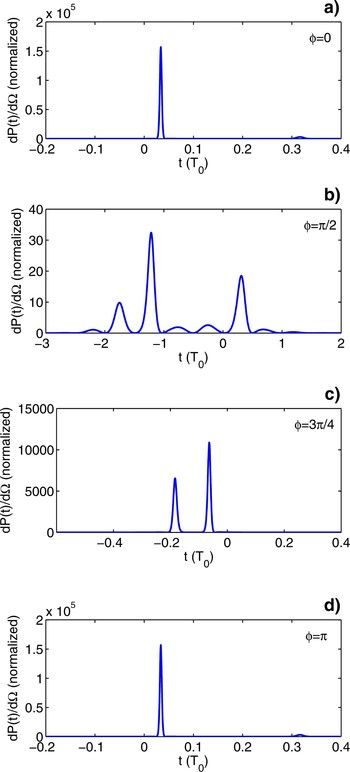
The time histories of radiation power detected in the direction = − for the two counter-propagating pulses with different CEPs are calculated, respectively, and shown in Figure 6. For the CEP ϕ = 0, a single attosecond pulse can be obtained. If ϕ changes, more than one pulses may be generated. The modulation cycle of CEP is π. It can be seen that the generation of an isolated attosecond pulse is highly influenced by the CEP in the case of linear polarization.
The time histories of the radiation power per solid angle in the direction = − obtained by two linearly polarized counter-propagating laser pulses with (a) ϕ = 0, (b) ϕ = π/2, (c) ϕ = 3π/4, and (d) ϕ = π. The other parameters of the two pulses are the same as those in Figure 2.

3.2. Counter-Propagating Incident Pulses with Circular Polarization
It is found that the radiation power of electron per unit solid angle detected in the direction = ± is not influenced by the CEP if the two counter-propagating laser pulses are circularly polarized with p 1 = p 2. This can be proved as follows. For two different CEP ϕ and ϕ′ = ϕ+ δ, the electric fields correspondingly are:


and


Here  are selected. Let us clockwise rotate the coordinate system around the x axis with the angle δ, then the laser fields with CEP ϕ can be transformed into:


where ″, ŷ″, and ẑ″ are the unit vectors in the rotated coordinate system, and they are related to , ŷ and ẑ by
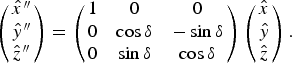
It can be seen that Eqs. (18) and (19) are exactly the same as Eqs. (16) and (17). In the similar way, the magnetic fields are the same too. In addition, the electron rests at the origin initially, hence the dynamic behaviors of the electron are the same in these two cases. So it can be seen clearly that the effect of a change of CEP δ on the electron dynamics is equivalent to that of rotating the coordinate system around the x axis with an angle δ. Hence, the longitude velocity of the electron βx and the radiation power of the electron per unit solid angle detected in the direction = ± are not changed with the change of ϕ. Especially, if an isolated attosecond pulse can be generated in the direction = ±, it will not be influenced by the CEP.
As presented in the above subsection, single attosecond pulses can be generated utilizing the relativistic headlight effect. The ideal condition to generate a single attosecond pulse with clean temporal profile in the direction = − is that βx(t) contains only one spike during the process of acceleration (only considering βx in the −x direction) and it is close to −1 at the instant time t i when the spike reaches to its peak. If this condition can be satisfied in the counter-propagating laser fields with circular polarization, the generation of a single attosecond pulse that is not influenced by the CEP can be realized.
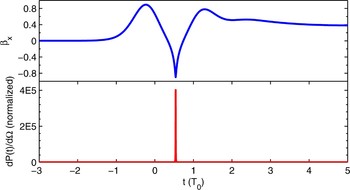
Calculated evolutions of βx and dP(t)/dΩ (normalized by e 2ω02/64π4ε0c) in the direction = − are shown in Figure 7, respectively, for two counter-propagating circularly polarized laser fields with I 1 = 8.55 × 10¹⁸ W/cm2 (a 1 = 2.0), I 2 = 6.93 × 10¹⁸ W/cm2 (a 2 = 1.8), T = 1.5T 0, T D = 0 and  . It can be seen that βx contains only one spike (only considering βx in the −x direction). When t is about 0.54T 0, βx reaches to its maximum in the −x direction and the radiation at this time is the strongest owing to the relativistic headlight effect. This will lead to the generation of a single attosecond pulse with clean temporal profile.
(Color online) Calculated evolutions of βx and dP(t)/dΩ (normalized by e 2ω02/64π4ε0c) in the direction = − respectively for two circularly polarized counter-propagating laser pulses with a 1 = 2.0, a 2 = 1.8,  , T = 1.5T 0, and t D = 0.

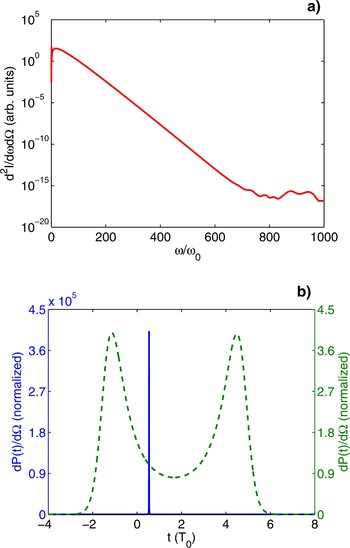
This can also be confirmed by the spectrum of radiation in this direction shown in Figure 8a. It can be seen that the generated spectrum is supercontinuum and can support a single 14 as pulse without spectral filtering (see Fig. 8b, blue solid line (online only)). Hence, the generation of a single attosecond pulse which is not influenced by the CEP can be realized by using two counter-propagating incident pulses with circular polarization. While, the backward radiation that has a twin-peak structure in time evolution will be generated by using one of the two incident laser pulses with a 1 = 2.0 (see Fig. 8b, olive dashed line (online only)). The peak power of this isolated attosecond pulse is about 105 times of that of the radiation generated in the same direction by using the single incident laser pulse (see Fig. 8b). And it is found that the electric field vector of this attosecond pulse is neither oriented in a single direction nor rotating at a certain angular frequency as the pulse travels.
(Color online) (a) Calculated energy spectrum of two circularly polarized counter-propagating laser pulses in the direction = −. The laser parameters of the two pulses are the same as those in Figure 7. (b) Calculated evolutions of the radiation power per solid angle in the direction = − for the two circularly polarized counter-propagating laser pulses (blue solid line) and a single circularly polarized laser pulse (one of the two laser pulses with a 1 = 2.0) (olive dashed line), respectively.

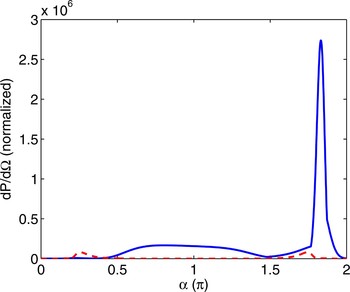
Figures 9a and 9b are the calculated angular distributions of time-integrated radiation power (normalized by e 2ω0/32π3ε0c) and the peak radiation power (normalized by e 2ω02/64π4ε0c) in the x-y plane for the single incident laser pulse and the two counter-propagating incident laser pulses respectively. Here ϕ = 0 for each incident laser pulse. It can be seen from Figure 9a that the time-integrated radiation power generated by the two counter-propagating incident pulses is greatly enhanced in comparison with that generated by the single incident pulse. And the maximum of its angular distribution is 8 times of that obtained by using the single incident pulse. Moreover, the peak radiation power is greatly enhanced as well. And the maximum of its angular distribution is about 50 times of that generated by using the single incident pulse.
(Color online) Angular distributions of (a) the time-integrated radiation power and (b) the peak radiation power in the x-y plane for two circularly polarized counter-propagating laser pulses (blue solid line) and a single circularly polarized laser pulse (red dashed line). The laser parameters in these two cases are the same as those in Figure 8, and ϕ = 0 is selected for each pulse.

4. SUMMARY
In conclusion, the radiation behaviors of an accelerated electron driven by two counter-propagating laser pulses with linear and circular polarizations are investigated, respectively. For the two kinds of polarizations, the intense isolated attosecond pulse can be obtained. In the case of linear polarization, the generation of single attosecond pulses is influenced by the CEP, while the influence can be avoided in the case of circular polarization. Therefore, the stable isolated attosecond X-ray pulses can be generated with circular polarization. The angular distributions of time-integrated radiation power and peak radiation power show that the radiation obtained by using the counter-propagating pulses can be largely enhanced in comparison with that obtained by only using the one of these two pulses for both linear and circular polarizations.
ACKNOWLEDGMENTS
This work was supported by the National Basic Research Program of China (Contract No. 2006CB806000), the NNSF (Contract Nos.10535070, 10674145), the state key laboratory program of Chinese Ministry of Science and Technology, and the Knowledge Innovation Engineering of Chinese Academy of Sciences.