1. Debating the Grounds for Political Legitimacy in the European Union
In May 2017, the German professor, political thinker, founder and Director of the European Democracy Lab (EDL), Ulrike Guérot, published a book with the striking title, A New Civil War: The Open Europe and its Enemies (Der neue Bürgerkrieg. Das offene Europa und seine Feinde).Reference Guérot 1 The book comes with a passionate appeal for a foundational restructuring of the European political system. With the motto ‘one market – one currency – one democracy’, Ulrike Guérot suggests the development of a post-national European democratic polity – a European Republic – founded on sovereign European citizens, the general principle of political equality, and the development of a European parliamentarism which corresponds to the division of power principle. One of Ulrike Guérot’s chief arguments is that the old European nationalisms, as well as the current supra-national institutional configuration of the EU founded on sovereign nation states rather than sovereign citizens, are the unavoidable breeding grounds for the now growing right-wing populism in Europe.
With her critical evaluations of the state of democracy in contemporary Europe, Ulrike Guérot turns to one of the two major camps – advocating the ‘democracy deficit argument’ – in a decades-long scholarly discursive debate evolving around contentious principled ideas on how to legitimize the institutionalization of European political organization and collaborative decision-making that goes beyond the institutions of the European nation states. Even though the democracy deficit argument comes with a variety of sub-specializations,Reference Habermas 2 – Reference Reif and Schmitt 11 its core content is that too many decisions are made by indirectly appointed politicians in the Council of the European Union, and/or by the non-elected ‘technocrats’ of the European Commission, that too few decisions are taken by the European Parliament whose authority rests on political mandates given directly through European citizens’ votes in the elections to the European Parliament, and that the EU is devoid of joint public space for political mobilization.
The contending camp – promoting the ‘intergovernmentalist argument’ – also comes with some sub-specializations,Reference Majone 12 – Reference Moravcsik 16 but its core argument is that pan-European political organization and joint decision-making should take the form of institutionalized collaboration between sovereign and democratically organized nation states. As long as the nation states are the constitutional building blocks of the EU, and hence there is no pan-European demos, there could not by definition be a democracy deficit. In addition, as long as the nation states have a capacity to bring about democratic legitimacy, and there are adequate mechanisms for accountability within the EU, there is no European democracy deficit since the EU-institutions as a collaborative whole are (indirectly) legitimized. From such a constitutional view the EU-institutions have a Weberian bureaucratic-legalistic legitimacy, which at worst actually could be undermined if ‘democratizing’ components were brought into the EU-institutions, since this could lead up to a politicized bureaucracy which in turn would undermine the legitimacy of the EU.
We will not directly engage in this heated discussion in the current article. Instead, we will assume that from principled normative reasons, and practical considerations, the democracy deficit argument and the inter-governmentalist argument represent an everlasting dividing-line. In principle, we find that both bureaucratic legality and democratic parliamentarism are valid and necessary as grounds for political legitimacy in the EU. Practically, we assume that the EU for the foreseeable future in its daily institutional and procedural practices will involve traits of parliamentarian democracy as well as bureaucratic legality. This is also to say that we strongly underline the importance of a continuous discussion on how the institutionalization of European political organization and collaborative decision-making can be improved and legitimized. We would also, however, which is part of our contribution, argue that there is another tricky governmental complexity of the EU which needs to be attended to, and for which we would like to suggest a way forward.
Regardless of whether EU political decisions in different policy fields are based on democratic parliamentarism or bureaucratic legalism, the decision preparations as well as the implementation assume the involvement of experts. Since the EU to an even higher degree than contemporary nation state organizations involves an inherent complexity, political decisions proper must to some extent be delegated to civil servants and to experts.Reference Rothstein 17 Scientific and technical decision-making in general has been the subject of a vast amount of research, especially in a US-American context. While that body of research houses great potential for comparative work, the current article focuses on the EU context specifically and therefore does not directly engage with the above-mentioned field.
Since political legitimacy is seriously at stake in contemporary Europe, our overall objective and contribution is to problematize, discuss, and come up with constructive ideas on the role of expert groups in the processes of legitimization of decision-making within the EU. We will dwell on the following questions. How could European citizens, as well as research scholars, understand under which institutional and ideational requirements expert groups can have a legitimate influence on policy decisions with the EU institutions? How could the diversity of expert group influence be made visible and how could the EU be organized differently, if the objective were to differentiate the scope for, and limits of, expert group influence? Seeing that the citizens of the member states are divided by values and interests, and that it would be practically impossible by parliamentarian or bureaucratic means to achieve fair representation of these divisions within the frame of EU decision-making, could expert groups’ involvement in EU decision preparation to some extent even compensate for such a deficient capability for legitimization through democratic representation?
2. Previous Research: The View of Expert Groups in the Epistemic Community Approach
The expanding scope and complexity of policy issues governed by international actors has led to an increase in the involvement of technical and scientific expert groups in democratic decision-making processes. This rising importance of expert groups has been the subject of a growing body of literature on the emergence, characteristics, and influence of such expert involvement in decision-making. This article proposes a new approach to the analysis and discussion of expert groups by introducing a two-dimensional model for expert group analysis and applying the model to so-called Epistemic Communities as a specific case of expert groups. An Epistemic Community is ‘a network of professionals with recognized expertise and competence in a particular domain and an authoritative claim to policy-relevant knowledge within that domain or issue-area’, as defined by Peter M. Haas, the main architect of the Epistemic Community framework.Reference Haas 18 Such an expert group is tied together not only by virtue of a shared professionalism, but also by a pursuit of specific policy aims based upon common strongly held salient beliefs. Haas outlines four conditions that indicate the existence of an Epistemic Community – first, shared normative or principled beliefs about a certain issue; second, shared causal beliefs that relate policy actions to desired outcomes; third, shared notions of validity, i.e. an agreement on scientific methods of validating knowledge; and fourth, a common policy enterprise that causes the community to act as more than the sum of its parts. Haas’s framework has been employed by many scholars analysing the occurrence, scope, and form of expert groups’ influence in policy making processes in various fields. The most notable theoretical expansion of the framework has been presented by Mai’a K. Davis Cross.Reference Cross 19 – Reference Cross 23
Applying the framework mostly to the field of security cooperation, Cross’s work shows how the cohesion and power of Epistemic Communities varies. Furthermore, Cross makes a methodological contribution by analysing non-cases, i.e. cases where individual experts are engaged in collective and collaborative expert groups’ undertakings but without coalescing into cohesive communities. This methodological strategy, yet often neglected by other scholars, is an effective way to specify the scope of a theoretical framework by probing its analytical boundaries and potency.
Building upon the strategy of analysing probable non-cases, and drawing mainly on the work by Cross and Haas, the current study introduces a theoretical specification of an institutional and an ideational dimension of expert groups’ involvement in policy-making within the EU. The institutional dimension concerns the expert group’s context, whereas the ideational dimension pertains to the specific policy issue that the group is engaged in, and the group members’ ideational beliefs regarding that issue.
The institutional dimension of Epistemic Communities has been analysed, for example, by Cross, who studies different agencies and networks within the EU, and by Verdun, who analyses the institutional boundaries of monetary experts in the creation of the European Monetary Union (EMU).Reference Verdun 24 The ideational dimension has been studied by others, e.g. Mitchell et al., who detected patterns of similar substantial beliefs on acid rain policy among a large number of scientific experts.Reference Mitchell, Herron, Jenkins-Smith and Whitten 25 The institutional dimension of the current study is exemplified by the Committee for Medicinal Products for Human Use (CHMP). That this committee is situated within the context of the European Union’s European Medicines Agency (EMA) implies a well-established formal institutionalized setting, and thus, considering previous research, favourable formal institutional conditions for the emergence of an influential expert group. The individual scientific experts that constitute the CHMP, one per EU Member State, are appointed by virtue of their professional merits and expertise. The appointment procedure is rather opaque and differs between Member States (MS), but it usually involves the Management of the national medicines agencies, and sometimes the Health Ministries. Furthermore, proposed candidates have to be accepted by the Management of the EMA. The task of the CHMP is to handle the authorization assessment of medicines that pharmaceutical companies wish to market within the EU. In practice, this means that when a company applies to the EMA for marketing authorization of a product for human use, the application is referred to the CHMP, where the supporting documentation is analysed and assessed, before a final opinion or recommendation is submitted to the European Commission. Beyond their monthly EU-obligations at the CHMP, the scientific experts work in their respective member states; mostly at national medicines agencies or ministries of health. The CHMP-members often have a team of assessors at their disposal at the national level, which support the CHMP’s assessment procedures. Thus, the CHMP scientific experts are appointed by virtue of professionalism and proportionality rather than on the ground of EU member state representation. Even though the assessments and opinions of the EMA, as prepared by the expert members of the CHMP, are not formally binding, the European Commission, which has the final say over marketing authorizations for medicinal products, grants the EMA, and hence the CHMP, authority and scope for action, and it has been characterized as a de facto regulatory agency.Reference Groenleer 26 , Reference Busuioc 27
The ideational dimension of Epistemic Communities is, in the current study, exemplified by one of the many cases of bids for marketing authorizations that the EMA and its expert members of the CHMP assess every year. The emergency contraceptive ellaOne has been available upon prescription in all EU member states in which emergency contraceptive pills are legalized since 2009, when the EMA granted its original marketing authorization. In 2013, HRA Pharma, the French manufacturer of ellaOne, submitted an application for a type II variation to the marketing authorization of ellaOne, which means that the status of the product would change from being available upon prescription only, to being available over the counter, without prescription, in pharmacies. This seemingly technical detail in the prescription status of ellaOne would in fact constitute a major change in the availability of emergency contraception across the EU, since it would be the first emergency contraceptive pill to become available over the counter in several EU Member States.
The CHMP, which usually acts largely in agreement, disagreed about this authorization – the type II variation was granted with 21 out of 29 votes, and there were two divergent opinions appended to the decision. The first divergent opinion was signed by CHMP members from Germany, Lithuania, Croatia, Italy, Poland and Hungary – predominantly countries where emergency contraception had not previously been available over the counter. The opinion contended the uncertainty of risks of using ellaOne during an already existing pregnancy, and the resulting risk to the health of the foetus. 28
The second divergent opinion opposing a switch to a non-prescription status of ellaOne, signed only by the CHMP member from Malta, contends that the use of emergency contraception equals the ‘destruction and death of human life’, and presents a risk to public health, and that such procedures are ‘in direct conflict with the responsibility of medicine to protect and promote life’. 28 Even though this second contending assessment could be regarded as scientific, it is loaded with normative ideational arguments about the value and views of life in itself. Since issues of emergency contraception inevitably invoke salient moral views embedded in deeply rooted religious and cultural beliefs that vary across the European nation states, it comes as no surprise that the ellaOne authorization assessment process came with such a fundamental contention. Located, thus, at the intersection between the firmly established institutional role of the EMA, and its experts’ committee CHMP, and a highly controversial ideational issue of emergency contraception, the CHMP’s handling of ellaOne presents a great opportunity to expand the knowledge on expert group influence analytically guided by the Epistemic Communities framework.
The following section presents a new theoretical modelling to the reading of a strategically chosen sample of previous literature on Epistemic Communities, with a special focus on the context of expert groups’ involvement in decision-preparation and legitimization processes in EU policy-making. Next, the methodological considerations and scope of the empirical material are presented, before discussing the results and concluding with a discussion on the findings and implications of this study as well as suggestions for further research.
3. Theorizing the Requirements for Expert Groups’ Influence in Policy-making
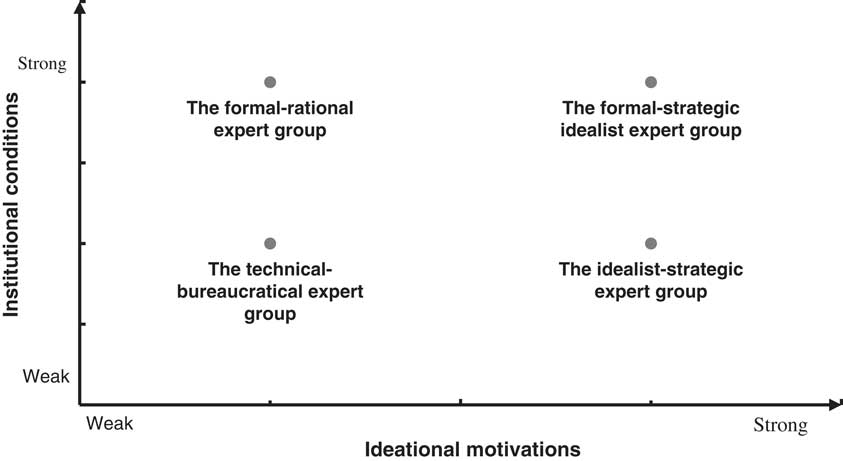
Figure 1 illustrates the main theoretical argument of this paper, namely how the institutional conditions and ideational motivations of expert groups can enable or disable the various ways in which experts can be involved in decision-preparation and legitimization processes within EU policy-making. The figure draws on four cases of ideal-typical expert groups, and their propensity for being more or less influential in legitimization and decision-making processes: (1) the technical-bureaucratically expert group; (2) the idealist-strategic expert group; (3) the formal-rational expert group; and (4) the formal-strategic idealist expert group. Starting from this, the following section provides a typology of these different ideal-typical expert groups, and reviews a limited selection of previous research on each type by deconstructing its empirical context institutionally as well as ideationally.
Requirements for expert groups’ contribution to legitimization of policy-making. Note: Combining previous theorizing and empirical analysis by HaasReference Haas 18 and CrossReference Cross 19 – Reference Cross 23 , the figure’s two dimensions as well as the four ideal-typical expert group categories are our own constructive theorization, aiming at facilitating the understanding of expert groups’ influence on legitimization and policy-making processes. The x-axis dimension, termed ‘Ideational motivations’, is intended to represent Haas’s four criteria for an epistemic communal expert group: shared principled beliefs, shared causal beliefs, shared notions of validity, and common policy enterprise. The y-axis dimension, termed ‘Institutional conditions’, is intended to represent Cross’s five procedural conditions that delineate the potentiality of epistemic communal expert groups: previous contact, selection and training, meeting frequency and quality, shared professional norms, and common culture.

3.1. The Technical-Bureaucratical Expert Group
This expert group acts in weak institutional settings with unfavourable institutional preconditions for the group to influence the policy-making process. Furthermore, the ideational questions that the experts deal with in their everyday work are not entrenched by strongly held salient beliefs. There is thus a lack of ideational motivation among the experts to push for specific policy aims and to try to extend their mandate based upon shared normative beliefs on these questions. Examples of such expert groups can be found in street-level bureaucracies, e.g. civil servants that have a formal-legalistic mandate to execute policies based on decisions taken by other actors. Their work requires specific skills and involves high levels of complexity, but these experts are not usually involved in the preparation and making of the policies that they execute. Cross’s study of EU security agencies showcases reasons for the weak power base for expert groups in such circumstances: a hierarchical setting where the individual experts have a limited mandate, in combination with a lack of deliberation and a high level of secrecy, which taken together undermines such an expert groups’ potential for influencing the policy-making.Reference Cross 23
3.2. The Idealist-Strategic Expert Group
The idealist-strategic expert group acts under weak institutional preconditions, and usually outside of the institutional framework of state agencies, and other formally institutionalized public bodies. Since such an expert group has no formal ties that prescribe regular meetings, or institutional measures that would make its opinions a given part of the policy-making process, the individual experts have to actively seek out both each other, and the policy-makers in order to make their voices heard. The ideational issues that the idealist-strategic expert group is involved in, however, make for strong ideational motivations in the form of general normative beliefs, or specific policy input, which could alter the state of policy-making in a certain direction. Idealist-strategic expert groups that develop into influential groups are likely to be rather powerful, not due to their institutional conditions, but due to the deep embeddedness and strength of the shared ideas that tie together the members of the group. In contemporary governance, the experts that occupy this kind of position are often found in civil society organizations, NGOs, think-tanks, and academia. In Mitchell et al.’s large-n study of scientific elites in the US and the EU, and their beliefs on nuclear policy preferences, it is shown that the scientists’ ideological and national concerns and values matter.Reference Mitchell, Herron, Jenkins-Smith and Whitten 25 The informants of Mitchell et al.’s study were recruited among subscribers of the journal Science. Many of the informants had a PhD and experience as researchers, but there were no other connections between them, and their beliefs rather than their institutional connections were at the centre of the study. Other studies focus on the diffusion and impact of ideas on the development of certain EU policies. Howorth traces the diffusion of ideas and discourses of what he calls ‘policy élites’, and their impact on the European Security and Defence Policy.Reference Howorth 29 The experts studied by Howorth are no scientific elite, contrary to the group analysed, for example, by Mitchell et al., but a policy elite, which includes political actors that are not embedded in bureaucratic settings or mandated by virtue of their scientific expertise. The comparative potential of Howorth’s study is thus limited due to the significantly different role that policy elites with a more or less explicit political agenda occupy in relation to experts with a restrictive mandate to execute certain technical tasks. Zito analyses a group of Scandinavian and US scientists that developed the ‘critical loads’ model as a tool for environmental policy-making and traces the method’s establishment in policy-making.Reference Zito 30
Dunlop combines the institutional and ideational dimension of expert groups by investigating the learning processes between epistemic communal expert groups, and US and EU decision-makers in the case of the milk yield enhancer somatotropin (rbST).Reference Dunlop 31 Dunlop studies an epistemic communal expert group consisting of agricultural economists, biotech scientists, veterinary experts, toxicologists, and lawyers associated with the pharma-chemical manufacturer Monsanto, and its university partners. Seeing that the policy preferences at play in this case do not stem from the personal, individual convictions of the expert group members, but rather from their employment at Monsanto or associated universities, this study raises the importance of incorporating possible corporate interests into the analysis of expert groups. In a more recent study by Faleg, the conceptual development of Security Sector Reform in the EU security architecture is analysed.Reference Faleg 32 This study by Faleg does not focus on the expert groups themselves or their members, but on the ideas and concepts that they succeed to diffuse and incorporate into EU policies.
In sum, previous research studying the influence potential of idealist-strategic expert groups has focused on the ideas and policy aims that are driving the emergence and activity of the expert groups, and how those ideas and policy aims find their way into policy-making, despite a lack of formal institutional involvement in the preparation and formulation of those policies.
3.3. The Formal-Rational Expert Group
The experts that are part of a formal-rational expert group occupy a position that could be characterized as the ‘intended’ expert role. Such expert groups have a high level of institutionally promoted cohesion, and favourable institutional preconditions, and they are the kind of more high-ranking experts that can be found in close proximity to ministries and government agencies, or, in the case of the EU, the European Commission. Formal-rational expert groups are entrusted with authority and scope for independence, due to their great influence on the policy-making process, and close contacts to political decision-makers. The issue areas that formal-rational expert groups are active within, do, however, not normally generate controversy or disputes of a normative nature. Instead, the issue areas are typically shielded from public deliberation and scrutiny, partly due to the technical complexity of the issues, but also since the ideational questions that are involved are not very politicized. Even though most scientific experts in EU policy-making work for multiple stakeholders, some policy areas are more politicized than others, and the expert groups do not only affect direct stakeholders, but all citizens. Experts who work, for example, at the European Centre for the Development of Vocational Training (Cedefop), or the Translation Centre for the Bodies of the European Union (CdT) are less likely to be subject to public deliberation and scrutiny than, say, the European Food Safety Authority (EFSA), or the European Environment Agency (EEA), who handle issues that are much more central to the public and present in the media.
The ‘purely scientific’ experts that are part of the formal-rational expert group are unlikely to have shared normative beliefs or policy aims regarding a certain question that they work on cooperatively. The ideational motivations that would make them develop into an influential expert group are thus absent. Cross’s analysis of several different expert groups in EU bodies in the realm of security integration focuses on the institutional aspects of their role and influence. Without a further expansion of the analysis of the motivations, beliefs and common aims of the group, they would thus classify as a formal-rational expert group with strong institutional preconditions.Reference Cross 19
3.4. The Formal-Strategic Idealist Expert Group
A strong position, both when it comes to institutional preconditions, and ideational motivations makes the formal-strategic idealist expert group the most important to study when probing the potential for particularly powerful expert groups, and when discussing expert influence from a democratic and legitimization perspective. The ideational and institutional preconditions are very favourable for this expert group – the group is formally established and meets on a regular basis, and the group is often part of the preparatory stage of the policy-making process. Much like the formal-rational expert group, the formal-strategic idealist group handles issues of high complexity, but the group is active in politicized issue areas that are more likely to invoke deeply embedded and salient views. In their work, formal-strategic expert groups deal with questions that either the group members themselves or other actors such as their principals (e.g. national governments, or the public) have strong ideational opinions about. Furthermore, these kinds of expert groups have strong incentives for pursuing their common policy aims since they are aware of their power and influence on the decision-making process. Thanks to favourable institutional premises for emergence, high incentives for engagement, and the availability of tangible institutional measures that can be used to influence policy-makers, the formal-strategic idealist expert group is most likely to develop into the most powerful type of expert groups. The formal-strategic idealist expert group acts under the conditions and constraints of a typical expert role in the public sector, but with the motivations of other actors with a strong, normative agenda. This type of expert group is most likely to generate an influential capacity that goes beyond the intended role of experts, and whose institutional embedding enables it to frame scientific complexities and uncertainties in certain ways to policy-makers, and thereby directly affect political decisions. The study of the formal-strategic idealist expert group includes both an analysis of the institutional preconditions and institutionalized measures, and the ideational motivations that make the individual experts merge into a strong expert group.
Dunlop’s studies of EU decision-making in controversial matters related to food policy provide great examples of how a critical case can be utilized to illuminate influential expert group activities.Reference Dunlop 31 , Reference Dunlop 33 While the first study (as mentioned above) regards an idealist-strategic expert group, the more recent piece analyses a formal-strategic idealist expert group. Using a principal-agent approach, Dunlop investigates the impact of expert groups’ autonomy from the European Commission in the case of hormone growth promoters in meat. In parallel with our distinction between expert groups with weak and strong Institutional Conditions, Dunlop’s study looks at ‘evolutionary’ and ‘governmental’ expert groups. Evolutionary expert groups, according to this definition, are autonomous from policy makers and have developed organically through their common policy enterprise. Governmental expert groups, on the other hand, are ‘engineered’ by political principals and ‘lack a purpose beyond the task set them by their principals’.Reference Dunlop 31 Dunlop’s approach sees experts as the agents, whose ‘socio-political beliefs are key’, and whose appointment into governmental expert groups can contribute to the delivery of policy advice in line with the principal’s policy preferences.
Cross analyses the EU Military Committee and its role in the development of the Common Security and Defence Policy.Reference Cross 21 The puzzle, according to Cross, is that security integration continues to deepen despite Member State resistance. Cross’s study analyses both the formal and institutional circumstances that the Committee acts within, and employs case studies of certain policy changes that were affected by members of the committee. Verdun traces the role of the ‘Delors Committee’ in the establishment of the European Monetary Union.Reference Verdun 24 Her historical study regards both the institutional setting and preparatory work in the committee, but also the normative beliefs and preferences among the individual central bankers who were members of the committee. Galbreath and McEvoy focus on epistemic communal expert groups’ influence on policy makers by analysing experts who work within the area of minority rights in EU institutions, the OSCE and the Council of the European Union.Reference Galbreath and McEvoy 34 Using interviews, the authors enquire about the expert group’s compliance with Haas’s four conditions of Epistemic Communities and find that the internal hierarchy of an expert group is important.
The above-mentioned studies showcase that the intersection between the institutional and the ideational dimension of expert group involvement presents a fruitful ground for research on epistemic communal expert groups in an EU setting. Similarly, the case at hand, the CHMP and ellaOne, regards a formal-strategic idealist expert group. The institutional preconditions in the ellaOne case were shared by all CHMP members. They all met on a regular basis and shared the same channels of communication and working norms. When it comes to ideational beliefs, however, the group was split between the majority in favour of making ellaOne available over the counter, and the minority objecting to such a status formally denoted as an OTC status.
Overall, previous research drawing on epistemic communal approaches to expert groups has been mostly focused on single-case studies of specific policy processes, and/or specific expert groups. To these strands of research, the typology introduced in Figure 1 contributes a new descriptive characterization of expert groups. More importantly, the theorized modelling of the emergence and power of expert groups implied by the typology suggests two new approaches to the empirical study of expert groups.
On the one hand, the modelling introduces an approach of comparative, and possibly also historical, institutionalism, which focuses on the institutional contexts as well as the ideas of epistemic communal expert groups’ emergence and influence. This provides the methodological potential to move beyond single-case studies, including comparisons over time and place, and across policy fields, studying material and formal institutions as well as ideas when defined as informal institutions.
On the other hand, the even more elaborate approach at the centre of this study introduces an operationalization of a quantitatively explanatory model of institutional conditions and ideational motivations. Such a model would be fit for large-n studies that would allow for more generalizable conclusions on expert groups’ influence in policy-making processes. The suggested approaches contribute powerful analytical tools in the critical empirical analysis of expert involvement in policy-making, and they are also conducive to normative discussions of the merits and drawbacks of different types of expert groups’ contributions in the processes of legitimization of decision-making within the EU.
4. Two-dimensional Analysis of Expert Groups’ Influence on Policy-making: Methodological Considerations
In order to be able to compile the findings of individual case studies, our approach takes previous conceptualizations of epistemic communal expert groups’ emergence and influence as a starting point. As stated in the introduction, Haas’s classical definition of an Epistemic Community prescribes four attributes that determine whether an expert group can be regarded as such a community; shared normative beliefs, shared causal beliefs, shared notions of validity, and a common policy enterprise.Reference Haas 18 In our two-dimensional model, the sum of these four indicators points towards a high degree of ideational motivations. These indicators are not detectable from the outside; they are internal to the group and its individual members. Furthermore, they always relate to a specific policy issue, regardless of whether it is an ideational transformation of an entire policy field, or a minor question or decision that unites the expert group in its activity.
In order to find out about the experts’ ideational motivations, it is thus crucial to study a specific case or policy issue that enables the detection and analysis of such ideational motivations. In addition to Haas’s four indicators, Cross’s work on Epistemic Communities provides a number of criteria that not only indicate the existence of an epistemic communal expert group, but also enable us to study the group’s internal cohesion, which reflects on its external power and influence. These indicators are positioned on the axis measuring institutional conditions, and they are easier to quantify than Haas’s indicators of ideational motivations.
First, if an expert group acts as more than the sum of its parts, i.e. that it is able to extend its formal mandate and power thanks to its organization as a group, epistemic communal expert group emergence is likely. Second, if the members of a group know each other and interact in different formal and informal settings, the emergence and power of an epistemic communal expert group is enabled. Third, if the expert group shares a set of professional norms and a common working culture, it is likely to be a cohesive and powerful group. This concerns factors such as the selection and training of group members, the frequency and quality of their meetings, their shared professional norms, and their common culture in a more normative sense, as indicated by a common identity, symbolism and sense of purpose. All these indicators are based upon a group’s institutional conditions and institutional embedding. They are thus not exclusive to one single policy question, but they are more permanent and generic to the group.
The combination of a case study of the institutional conditions that an expert group acts within, and the ideational motivations that unifies them as an epistemic communal expert group, as analysed utilizing a specific policy issue, provides a more powerful model of analysing such expert groups than one-dimensional approaches focusing on either institutional aspects or ideational motivations. It enables a thorough analysis of the conditions that expert groups develop and act within, and it could lend normative precision to general discussions about the merits and drawbacks of different forms of group influence in parallel to citizen’s participation in representative and deliberative democratic processes.
In order to demonstrate the applicability of this approach, the empirical findings of the current study have been generated by combining the institutional context of the European Medicines Agency with the specific policy issue of ellaOne. In other words, the institutional setting of the Committee for Medicinal Products for Human Use (CHMP) at the European Medicines Agency (EMA) determines the institutional conditions of the expert group to act as an epistemic communal expert group, whereas the specific case of ellaOne is used as a proxy exemplifying the ideational motivations of the group members in this controversial policy issue.
5. Applying the Two-dimensional Model of Expert Groups’ Influence to the Authorization Process of the Emergency Contraceptive ellaOne: Results
The empirical material of our study stems from semi-structured interviews with eight members of the CHMP, who were all members during the time in which the committee assessed the case of ellaOne. The interviews were conducted via telephone or video call in March and April 2016, and resulted in 5.6 hours of audio material, corresponding to 95 pages of transcribed text. The sample of informants covers a broad range of EU Member States in terms of geographical and cultural aspects, EU accession, and welfare state systems (including health and medicines regulation). All informants have a high level of education (PhD), and many years of experience of complex scientific work in national or European regulatory bodies, the pharmaceuticals industry and/or in the healthcare sector.
The issue itself concerned a possible change in regulatory status of ellaOne from freely available in pharmacies (‘over the counter/OTC access’) to a prescription-based availability. In practice, the question at stake was whether or not women should be able to buy this emergency contraceptive without a doctor’s prescription. Seeing that ellaOne would be the first emergency contraceptive with OTC access throughout the EU, this decision had the potential to substantially alter the availability of such medicines, and thus women’s reproductive freedom of choice. The political development of recent years in several EU Member States has seen women’s reproductive rights rise to a prominent position in the European public discourse. Most recently, the legal status and availability of abortion has been highly topical in Poland, where proposed restrictions of abortion laws by the socially-conservative government resulted in public outcry and mass protests. 35 Even in seemingly more secular and progressive countries, such as Germany and Sweden, issues concerning contraception and abortion have been high on the judicial agenda and in public discourse. 36 , 37 Used as a political football in a polarized political landscape, these issues provide an excellent opportunity to investigate the characteristics of expert group involvement in an EU context.
5.1. The Institutional Conditions of the Committee for Medicinal Products for Human Use for Developing into an Influential Expert Group
The indicators revealing the institutional conditions that an expert group acts within include previous contacts between group members, selection and training, meeting frequency and quality, shared professional norms, and common culture. While information on some of these indicators, such as selection and meeting frequency, can be retrieved from the website of the EMA, others, such as previous contacts between group members, training, meeting quality, and shared professional norms and common culture, depend on the personal background and perception of the individual experts.
If the members of an expert group have known each other for a long time and have met in different circumstances prior to their engagement in the current group, an epistemic communal expert group is likely to develop.Reference Cross 20 Asked about their relationships to other group members, several of the informants stated that they had known other current members of the group before they started working together at the EMA. Members who had had long scientific careers before steering their path towards regulation, and especially those who work in highly specialized areas, had previously met at conferences or associations dedicated to their specialties. Even previous work ‘on the other side of regulation’, i.e. in the pharmaceutical industry, could serve as a context for interaction. However, the majority of informants indicated that they had known some of their current colleagues in the CHMP before they themselves started working there, but that their acquaintance had been rather superficial. Meeting at conferences, reading each other’s names on assessment reports, or reading and discussing each other’s scientific articles does not necessarily foster the kind of personal relations that would form the basis for the development of an epistemic communal expert group.
Expert groups with comparable selection and training experiences, a consistently high level of expertise, and highly competitive selection processes are likely to have a high degree of internal cohesion, and thus have favourable preconditions for influencing policy-makers.Reference Cross 20 The analysis of this indicator is twofold – it comprises a comparison of the actual professional backgrounds of the informants, as available on the EMA website, as well as their perceptions, as narrated in the interviews. Although the trajectories and career paths of the informants are very individual, some common denominators can be discerned. All informants have a high level of education with at least a PhD degree, and comprehensive specialist training. All of them have some kind of practical clinical experience as a medical doctor, most of them at public hospitals, and all have worked or still work at their respective national agency for medicines regulation. The experts’ own perceptions of each other’s (and their own) backgrounds differ. Some informants (2, 6) said that the professional backgrounds of CHMP-members are very different due to age, specialties, etc, whereas others claimed that they are very similar (Informants 4 and 8). While this points towards a varying characterization of the CHMP from the inside, different backgrounds do not necessarily preclude an influential expert group. On the contrary, one could say that the different backgrounds of CHMP members, in sum, form an entity in which every member, due to her or his individual profile, constitutes a crucial part. Informant 2 said that:
Well, I mean, I think that’s an enrichment, because you have various people with various expertise, and you have clinicians, and you have more, you know, pharmacists, you have quality people, so that is a heterogeneous group, I think. Everybody has expertise so I think in total we cover, I would not say the full spectrum, but it gives a very good background, very good expertise. (Informant 2, p. 17)
This implies that the diversity of CHMP members could be an advantage, since it enables the community to gather a comprehensive medical expertise that cannot be achieved by a professionally homogeneous group of experts. Furthermore, informant 5 mentioned that recruitment for the co-opted positions in the CHMP differs from the regular appointment procedures. When expertise on a certain field is missing, experts can apply for a co-opted position and thereby become members of the committee. This further points towards the CHMP as a professionally diverse expert group that strives to cover as many medical fields as possible. This division of fields of expertise demands mutual trust and thereby strengthens the ties between the group members.
Since hardly any information on the appointment processes of the CHMP is available on the EMA website, the interviews served to collect the informants’ views about how the selection and nomination of scientific experts takes place in different countries. Comparing the informants’ accounts of their appointment, the procedures seem to differ greatly between countries, depending upon the national traditions as well as the institutional set-up of the respective national systems of medicines regulation. Furthermore, the informants do not have any insight into the procedures of other countries, which means that they do not know exactly how the appointment of their CHMP colleagues has occurred. Informant 6 raised the issue of political influence on the compilation of the CHMP, saying that ‘There are some countries where there is a political influence. In other words, if the government changes, then the CHMP delegate changes’ (p. 45). This hints at a politicization of scientific expertise even in the case of the seemingly politically independent EMA.
Several informants pointed out that the nomination to the CHMP is not very competitive, and that it is hard to find candidates due to relatively low wages (as compared with industry), a high workload, and the practical difficulties of travelling to London on a monthly basis (Informants 1, 4 and 6). Informant 6 went so far as to claim that the work at the CHMP ‘eats your private life’ (p. 63). The incentives for being a member of the CHMP thus seem to be outweighed by the difficulties, which makes it less attractive to possible candidates and thereby might discourage otherwise well-suited candidates from taking the position.
The training experience during the start of working as a member of the CHMP was described as very inconsistent. Several informants mentioned confusion and insecurity regarding the starting phase of CHMP membership, and the then perceived purpose of their attendance:
And I had no idea of what regulation was at the time when I started, and you can quote that, because I often mention that to new members when they join, during the six first months of my attendance in London, I was really asking myself what I was doing there. (Informant 1, p. 2)
In sum, the selection and training experiences of the CHMP do not point towards a procedure-wise highly cohesive expert group. Even though the level of expertise is consistently high, and there is a mutual solidarity, the very different professional trajectories, differing appointment processes, a lack of shared training routines, and a low degree of competitiveness indicate a weak cohesion, and hence a frail base for the exercise of power.
The frequency and quality of meetings with which an expert group gathers play a big role for its potential development into an influential expert group.Reference Cross 20 The members of the CHMP gather in a number of different contexts, most of which can be classified as either formal meetings, or informal meetings and social activities. The monthly plenary meetings in London usually take three working days and occur in a formal setting with a strict agenda and a large group of attendants. Furthermore, some CHMP members are also members of working groups at the EMA, other EMA committees, or temporary scientific advisory groups (SAGs). This provides the opportunity for CHMP members to meet in other professional circumstances, dependent upon the personal specialties and interests of the members. Several informants (1, 3, 6 and 8) explained that a two-day informal meeting is held for the CHMP twice a year, usually by the country that chairs the Council of the European Union. In these meetings, the discussions can revolve around bigger issues and provide the opportunity for an exchange of views beyond individual dossiers. These informal meetings are not organized by the EMA, but by the Member State that chairs the Council of the European Union, as a ‘tradition of [...] civility between the presidencies’ (Interview 1, p. 7). Furthermore, social events such as dinners and picnics are organized in connection with the plenary meetings, which points towards a community beyond formal expectations and rules in the framework of the EMA. Furthermore, all informants are content and appreciative of the open discussions and productivity that characterize CHMP meetings. The frequency and quality of meetings thus point towards highly favourable institutional conditions for the emergence of an internally cohesive expert group.
The shared professional norms of an epistemic communal expert group also concern different institutional aspects of its operation, such as consensus-building, standards with regard to protocol and speaking time, etc, and they can influence the character and cohesion of such a group.Reference Cross 20 A majority of informants explained that the CHMP reaches consensus most of the time, and that it is the official aim of its decision-finding. Furthermore, there are established norms on how to proceed in the absence of consensus, such as mediation by the chairman, and the possibility of issuing divergent opinions. There is an acceptance for differing views within the CHMP and, asked more specifically about the case of ellaOne, informant 3 stated that:
Of course I can understand the point of view of Malta, I can understand the point of view of Poland, for example, because they have very different views on this. And it’s not a fight, it’s a cooperation. And I think that everybody can understand. (Informant 1, p. 42)
This high level of tolerance for each other’s opinions creates the impression of a confident and permissive group spirit that values the individuality and autonomy of its members. At the same time, however, the question arises how shared principled and causal beliefs can operate efficiently in a group that tolerates and respects fundamentally divergent opinions.
The common culture of an epistemic communal expert group regards the purpose and identity of the group. More specifically, if the group members share a common sense of purpose, and they identify with each other, they are likely to constitute an internally cohesive expert group.Reference Cross 20
Several informants confirmed that the CHMP has a rather strong identity as a group. Informant 4 stated that:
It’s a camaraderie, which has grown up over the years. […] you know, you’re there, you’re travelling, you’re getting up, you’re leaving home on Sunday evening or getting up early on Monday morning, and then you work three very long days together, and you know, […] that generates community, a feeling of community. (Informant 4, p.48)
In order to gain insight into the sense of purpose of the informants, they were asked several questions enquiring about their commitment to, and opinions on, the European system of medicines regulation. The answers reveal an ambiguous relation to the EU and European integration.
On the one hand, all informants are supportive of the system in general and see the point of cooperating across borders. One informant stated that ‘I really think that it’s an example of how Europe can work together. And I really think it’s for mutual benefit’ (Informant 3, p. 21). On the other hand, several informants expressed doubts whether a group of countries as diverse as the EU can be jointly regulated:
What the Commission does is treating the European Union as a market. And you know, the issues such as geography and antibiotic resistance are irrelevant if you consider it as a market. But it is not a market. [‘What is it, then?’] [Chuckles] It’s a diverse collection of countries which has some political unifying factors. (Informant 4, p. 50).
This quotation exemplifies the criticism that is directed towards the EU institutions on the grounds that specialist knowledge is not sufficiently involved in the legislative process (see also Informant 5, p. 59).
Three final factors that are prevalent in the interviews, and that fall under the scope of ‘common culture’, are community, solidarity, and mutual trust. Both the informants’ answers during the interviews, and possible informants’ communication prior to the interviews, reveal that specific expertise is valued very highly. Many CHMP members referred us to the person who ‘knows best’, or who has a specific expertise or insight into the matter of enquiry. Thanks to the members’ knowledge of each other’s professional strengths and specialties, they know who is the right person in the group to answer a specific question. This way, the CHMP forms an entity, and every expert with his or her individual experience and expertise is a part. This collective approach demonstrates a loyalty to the basis of the very existence of the group – the gathering of a broad spectrum of specific scientific expertise. It further shows that the experts seem to be striving for the greater good rather than their personal merit. The strength of the CHMP thus lies in its members’ personal experiences and abilities, but also in their mutual trust, and knowledge of each other’s backgrounds. Despite some criticism towards the institutional set-up of European medicines regulation, a strong common sense of purpose and identity, mutual trust, solidarity, and community point towards a common culture within the CHMP. These elements thus point towards a shared working culture and professional norms as favourable preconditions for an influential expert group.
5.2. The Ideational Motivations of the Committee for Medicinal Products for Human Use for Developing into an Influential Expert Group
The ideational motivations of the CHMP can be analysed using the four characteristics of an Epistemic Community as defined by Haas: shared principled beliefs, shared causal beliefs, shared notions of validity, and a common policy enterprise.Reference Haas 18 While some of these aspects could be assessed in relation to the work of the CHMP in general, the use of the actual example, i.e. ellaOne, makes it possible to analyse expert groups regardless of their institutional embedding, and in close relation to the policy issue that they are engaged in. In the interviews, the CHMP members were thus asked questions both regarding the work of the CHMP in general, and their specific opinion and recollection of the ellaOne case.
Haas’s first indicator of the existence of an Epistemic Community is shared principled beliefs in the form of normative ideas or behavioural expectations that the members of such a community have in common.Reference Haas 18 Relating to the overall work of the CHMP, a recurring principled opinion brought up during the interviews concerns the appointment and mandate of the committee members and how they should act. All informants agree that in principle they should act as individual experts, nominated upon personal professional merits rather than in a representative capacity. This provides a ‘value-based rationale for the social action of community members’, as envisaged by Haas, by demanding the scientific experts act to the best of their professional knowledge, regardless of possible national concerns (Ref. 18, p. 4).
It [the CHMP] is a scientific body, and I might need to repeat to you, that the delegates are not delegates. They are nominees. […] So I personally am nominated as [name]. I am not a [country] delegate. I have not a [country] sign in front of my seat. As opposed to what you would see in Brussels at the Commission. It’s my name. And I’m there as a person, as an expert, and not as a [country] citizen […]. (Informant 1, p. 9)
At the same time, however, several of the interviewees acknowledged that one’s professional opinion can be influenced by the national setting that one comes from, and one informant pointed out that:
[…] there is always also sort of a value judgement, and it has to be acknowledged that it is about science, it’s mainly about science, but of course we come from different countries, from different cultures and we may differ a little bit in terms of values and how that gives weight to the uncertainties. (Informant 8, p. 95)
Talking more specifically about the case of ellaOne, informant 2 noted that ‘[…] it was clear that there was more involved than a simple drug’ (Informant 2, p. 24). Similarly, informant 3 mentioned that ‘When you asked about ellaOne, it was something that was of big interest for us, not only from the scientific point of view but also as a, I would say, socio-political issue’ (Informant 3, p. 26). These examples show that the informants see the CHMP as exercising agency beyond the purely scientific part of their evaluation, be it through establishing the risk-benefit ratio of products with certain societal implications, or through positioning itself in response to pressure from the public or from political actors (cf. Informant 3, p. 38). The informants were asked to put the ellaOne decision into the broader context of access to emergency contraception, and their own opinion on the matter, which not all of them chose to answer. Those who did agreed that emergency contraception should be available without prescription at pharmacies, which points towards a shared belief on the normative aspects of emergency contraception. In sum, these informants appear to share certain principled beliefs on the policy issue at stake. However, none of the CHMP-members who voted against the prescription-free access of ellaOne are included in the sample, and it is thus unclear if these principled beliefs are shared among all members of the CHMP. It is likely that the informants belong to a sub-group within the CHMP that shares these principled beliefs, and that there is at least one other sub-group that holds differing, or even opposed principled beliefs, and not only a smaller group within the committee, which all interviewees are part of.
The shared causal beliefs of an Epistemic Community are based upon a common professional judgement and ‘derived from their analysis of practices leading or contributing to a central set of problems in their domain’ (Ref. 18, p. 3). Shared causal beliefs shed light on the causal relation between policy action and outcomes. In relation to the work of the CHMP in general, the dominant causal belief mentioned in the interviews concerns impediments to a common European drug market and regulation. Due to differences when it comes to the pricing of medicines, the design of social security systems, and access to healthcare in different Member States, it can be difficult to reach agreement on certain topics within the European assessment procedure. Even geographical factors were considered as complicating the work of the CHMP:
The prevalence of microbial resistance to antibiotics in Scandinavia is low, in Southern Europe it’s high. So a toxic antibiotic which might be of interest in Southern Europe is not so in Northern Europe. Similarly, I can’t remember the example, but Greece is a mountainous country, hot and mountainous, and the Netherlands is cool and flat. So a product for cardiac impairment might be more successful in the Netherlands than it would be in Greece. (Informant 4, p. 49)
This statement demonstrates reasoning based on a causal link between the policy action that is taken on the EU level and which will affect the different regions and Member States (MS) of the EU in very different ways, and the specific policy outcome that may be inconsistent.
With reference to the ellaOne case, informants were asked how they would explain the divergent opinions to the CHMP decision granting non-prescription status. Informant 2 pointed out that ‘the whole registration process of ellaOne was more or less in line with politics which had already been followed in the past’ (Informant 2, p. 24). Several other informants expressed similar views, attributing the divergent opinions to path dependence, and to what the policies in these countries had previously been. This belief thus illuminates the causality between established policies in MS and the respective CHMP members’ action within the European assessment process.
Explicitly asked about the policy impact of the OTC-switch of ellaOne, all informants provided a very similar line of reasoning. Since all informants’ home countries had previously allowed OTC-access for emergency contraceptives based upon the substance levonorgestrel, they did not expect the ellaOne decision to have a big impact domestically. On a European level, however, most informants agreed that the access would be improved (see Informants 3, 4 and 6). Informant 8 even expanded this opinion to possible effects on the number of abortions, and the healthcare system in general:
[…] I hope that the easy availability to emergency contraception, not only ellaOne but also other products, serves a good purpose of reducing the number of abortions, with all the distress caused to a woman who is going to undergo an abortion, but also with regard to the healthcare costs. (Informant 8, p. 93)
In sum, the causal beliefs of the informants, both regarding the general functioning of the European regulative system, and the specific case of ellaOne, coincide to a large extent.
The shared notions of validity of a group concern its common appreciation of certain scientific methods of generating and evaluating knowledge.Reference Haas 18 In the context of the CHMP, some requirements regarding the scientific evidence that the committee assesses in the European assessment procedure are prescribed by law. Many other standards, however, are in the form of guidelines, which means that the expertise of the committee is crucial in the ‘matter of assessment’, which several interviewees pointed out.
Expanding this argument to the day-to-day work of the CHMP, i.e. the assessment of applications for marketing authorization, there is a high degree of consistency when it comes to the informants’ view of what determines the quality of studies submitted by pharmaceutical companies. All informants referred to the guidelines and recommendations that are applied within the EMA as well as general standards in medical science, such as Good Clinical Practice (GCP) and ICH (International Conference on Harmonization). Asked more specifically about what constitutes a sound methodology in studies, several informants mentioned that they usually prefer randomized, placebo-controlled studies (Informants 1, 2 and 6). This is, however, not based upon strict instructions or rules, but on the personal development and experience of the individual members. One informant explicitly stated that ‘[…] I’m a conservative person; I like a randomized trial with a good quality and size, and even better two of them’ (Informant 6, p. 65). This reference to the personal level and individual preferences further highlights the importance of personal expertise and the agency of the CHMP members as experts rather than delegates. This points towards a common understanding of methodological aspects among the members of the CHMP, which is further confirmed by the informants’ descriptions of methodological considerations with regard to ellaOne, and emergency contraceptives in general. Upon the question of whether they treat these kinds of applications the same way as other drugs when it comes to methodological requirements to the supporting documentation, most informants answered positively. This shows that there is a (possibly implicit) common understanding that the knowledge utilized to assess medicines with specific social implications should be weighed just as in other cases.
The common policy enterprise of an expert group concerns ‘common practices associated with a set of problems to which their professional competence is directed, presumably out of the conviction that human welfare will be enhanced as a consequence’ (Ref. 18, p. 3). It implies that the group acts as more than the sum of its parts, and strives towards a common goal, possibly by extending its formal mandate. The informants are in agreement about their ultimate goal, both in general, and when talking about the ellaOne case specifically – the safety of the European patient. This corresponds to Haas’s definition of a common policy enterprise as being directed towards the enhancement of human welfare. Furthermore, all informants agree on the added value in European cooperation in medicines regulation, and they have confidence in the system despite some minor suggestions for improvement.
The final interview questions regarding the ideational motivations revolved around the mandate of the CHMP and the EMA, and whether the committee members push for an extended mandate. Touching upon the formal and informal competences of the CHMP, one informant said that:
It’s very stimulating but also something that is associated with a high degree of responsibility because we are the committee that basically puts new medicines on the market in Europe, at least the ones that are centrally approved. Of course it’s not us who take the formal decision that is taken by the European Commission. But we advise the European Commission. So in that respect, it feels as if we are the committee that sort of approves new medicines in Europe. (Informant 8, p. 85)
The informants seem to be content with the formal status and mandate of the CHMP, since it provides them with a high degree of freedom in both decisions and accountability. It is thus understandable that the committee members do not push for an extended formal mandate, since greater formal competences would imply greater demands for accountability and more public scrutiny. The common policy enterprise of the CHMP thus appears to be limited to an agreement on the ultimate goal of its activity, the safety of the European patient.
In sum, the findings suggest that the preconditions and indicators are favourable for the development of an influential epistemic communal expert group. However, this community might not comprise the entire CHMP, but only some of its members and it seems to be an epistemic communal expert group within the CHMP. It is known that in the ellaOne case, there were at least two differing principled opinions at play. However, the sample of this study only included CHMP members with a positive principled and causal opinion regarding the marketing authorization switch of ellaOne, and it is thus impossible to generalize the findings regarding ideational motivations to the entire CHMP.
6. Concluding Discussion: The Utility and Delimitations of a Two-dimensional Analysis of Expert Groups
This article has introduced a new approach to the analysis of the development and influence of expert groups, stressing theoretically and probing normatively expert groups’ role in contributing to processes of legitimization of institutions and decision-making within the EU. Combining an analysis of institutional preconditions and institutional embedding with a case-study highlighting the ideational motivations and principled beliefs of the members of an expert group, it enables the identification of epistemic communal expert groups as well as an assessment of the cohesion and power of such expert groups. The indicators retrieved from previous research by Haas and Cross are applied to the framework to make the two different dimensions measurable. Furthermore, a significant case study has allowed us to probe the limits of our theoretical approach by studying expert groups in an exceptional setting.
As the analysis of the ellaOne case shows, this approach is well-suited to studying the institutional preconditions of an expert group. The specific setting in which an expert group acts is shared by all group members. Crucial factors, such as selection, training and meeting frequency, play important roles in laying the foundations for an influential expert group, and they can be studied not only using methodological techniques involving the group members, but also with the help of external sources (meeting protocols, information from outside informants, etc). Other factors, such as meeting quality, previous contact between group members, and common working culture are highly individual and dependent upon the perception of group members. It is thus necessary to consult members of the concerned group to gain insight into these relative and subjective questions.
The most important factor for a successful use of the two-dimensional approach is diligence with regard to sampling. In particular, the questions regarding the ideational motivations of group members cannot be answered by individual informants as representatives for the entire group. These motivations are highly individual, intrinsic to group members, and often implicit. In cases where there are several competing principled beliefs regarding a policy issue, it is thus crucial to cover the entire spectrum of beliefs by studying either each individual, or by identifying the different beliefs that exist and including representatives of all sides into the study.
Furthermore, when utilizing the two-dimensional approach in the context of quantitative studies, it would be necessary to leave room for contextual and nuanced interpretations. When studying epistemic communal expert groups, the question is not only ‘to be or not to be’, but also ‘how to be’. A quantitative study needs to provide room for conditionality of individual cases, such as expert groups restricted to some members of an analysed group, or to some instances of the group’s activity.
All in all, the two-dimensional approach to the analysis of expert group influence in EU policy processes demonstrated in this study presents a contribution not only to the knowledge of expert groups’ influence on policy-making, and the research fields that focus on Epistemic Communities, or scientific experts, but also to the study of political influence parallel to the procedures of representative democracy more generally. The theorization and typology of experts in Figure 1 could extend to the empirical study and normative evaluative discussions about the political influence of, for example, classical interest groups (such as labour unions or employers’ organizations), NGOs, and social movements, as well as street-level bureaucrats’ political influence, which is typically studied within the implementation research field. This is also to say that the two-dimensional model could contribute not only to the expert group influence or the Epistemic Community literature, but also to the research fields of corporatism and pluralism as well as to theories on how political opportunity structures influence social movement access to power. This subject is a highly promising avenue for future research, since it illuminates our understanding of political opportunity structures that different actors have at their disposal by focusing on both abstract and ideational, and concrete, pragmatic angles of their involvement in the policy process. The 2016 special issue of the Journal of European Public Policy dedicated to ‘Ideas, Political Power, and Public Policy’ acknowledges the importance of this topic by studying intersections between, and conceptions of ideas and power, setting the stage for further enquiry into different actors’ influence on policy-making processes. 38
The analytical model proposed in this article does not only offer the potential for the practical application to empirical case studies of expert groups, but it also allows for theoretical and political discussions of a more constructive and normative character. On what normative grounds would it be legitimate to grant certain groups and hence their ideas, but not others, access to the rooms of power in EU policy-making processes? Could it be that formal institutional settings in the EU member states and/or within the EU institutions (parliamentary systems, structure of public agencies, etc) happen to be (systematically) more conducive for some ideas-based groups than others, as regards the group’s potential to emerge into a powerful expert group? And if so, on what grounds and how could one bring about an institutional change (‘institutional engineering’), that would aim at levelling out the institutional conditions for group-based influence on policy-making within the EU?
Lena Caspers is an MA of Political Science and Research Administrator, Department of Political Science, University of Gothenburg. Her research interests lie in the realm of European Politics, Expertise and Decision-Making, and EU institutions.
Urban Strandberg is Associate Professor of Political Science and Director of European Studies, Centre for European Studies, Department of Political Science, University of Gothenburg. In his research he focuses on the prerequisites for political legitimacy in contemporary democratic government with a special emphasis on the intersections between technology and democracy, private and public, national and international, and politics and religiosity. Recent and coming publications include ‘Focus: Religiosity and public spaces. expressions, mediations, and exclusions in post-secular societies’, European Review, 20(1), 2012 (edited by U. Strandberg and K. Grinell); Contextualizing Nuclear Waste Management – Experiences from Canada, Germany, France, India, Sweden, UK, and the U.S. (London: Routledge, 2011, edited by U. Strandberg and M. Andrén);’Focus: Reconsidering humanity: Big data, the scientific method, and the images of humans’, European Review, 27(3), 2019 (forthcoming, edited by U. Strandberg and C. Munthe).