Introduction
The State industries are all displayed as in a shop front on the occasion of the exhibition that is held in Mysore City every Dasara.Footnote 1
To the holiday seekers [the Dasara Exhibition] is a sight, but to thousands of workers who gather from all parts of the state, from surrounding areas, it is a kind of university. It has come to be looked on by all India as its Wembley.Footnote 2
As a triumphant metaphor of industrial strength and imperial power, the British Empire Exhibition at Wembley in 1924 exerted extraordinary influence on the minds of the bureaucrats of Princely Mysore, who were obsessed with the idea of bringing a ‘national’ economy into being. The Mysore Dasara Exhibition, first held in 1888, then revived in the early twentieth century as an annual affair, with only a brief break, was envisaged, quite rightly, as a spectacle and an education, for what may have been amusement for the elite Indian or British visitor, but was indeed intended as an instruction for the masses. Organized in Mysore, a ‘capital’ city that had been turned into a museumized royal landscape, the two week annual exhibition showcased a shining economic future.Footnote 3 Appended to the annual Dasara festivities in Mysore city that ritually staged the splendours of a reconstituted ‘sovereign’, the exhibition held out the promise of another Mysore state that was being imagined in the administrative capital, Bangalore.Footnote 4
A large and critical body of work on the cultural history and anthropology of exhibitions, both in imperialist and in colonized countries, has drawn attention to styles and practices that were derived from imperial/metropolitan locations, though with distinctly different effects. The Dasara Industrial and Agricultural Exhibition which began in 1907 was organized as part of the annual Dasara celebrations at Mysore palace, to which hundreds of visitors flocked, from within and outside the state. It would be easy to read the form and content of these exhibitions as simply another creative adaptation of emerging collection and pedagogic practices. Instead, this paper takes as a starting point the persistence with which these exhibitions were organized despite indications that they were neither meeting their economic goals nor reaching their intended audiences. Rather than privileging the symbolic cultural gains of such exhibitionary practices, this paper asks: what social forms was the Mysore Government obliged to bring into being through its irrational insistence on holding the exhibitions on an annual basis?
The answer points to the experiments of Mysore bureaucrats within the broader economic domain. To what extent did Mysore's Exhibitions share, or depart from, those international and national fairs which were driven by the commercial ambitions of newly industrializing nations,Footnote 5 through which consumer cultures were being fostered and developed,Footnote 6 and in which competition was managed through fiercely innovative design styles?Footnote 7 The quantum leap elsewhere in the scale and frequency of such exhibitions has been understood as the epitome of bourgeois consumerism,Footnote 8 a show of mercantile power, or even an ‘imperial archive’.Footnote 9 Yet, in India generally, the prospects of large scale industrialization or economic transformation under colonialism were slight, until the slow growth of ‘development’ discourse in the interwar period, when nationalist pressure, the imperatives of wartime production, and the need for renewing the legitimacy of imperialism led to the thawing of rigidly imperial objectives.Footnote 10 In Mysore, particularly in the interwar period, exhibitions became a crucial site for imagining a new economy,Footnote 11 as reflected in both their timing and location. The Dasara pageants were designed to cohere the subjects to their ‘sovereign’ despite his truncated authority under colonial rule. During the early twentieth century, the palace and its environs became the spaces for forging a new relationship between the Mysore Royal family and the public, a relationship which thinned out the religious and sacred functions of the pageant in favour of a new civic and aesthetic culture.Footnote 12 The Dasara Exhibition was a far more unstable element in this pantheon of performances, at once supplementing the ‘secularized’ displays of monarchical power and simultaneously gesturing towards a possible Mysore, poised on the verge of ‘takeoff’. Whereas there was no singular purpose or even effect that was served by the exhibition in its long and chequered career, this paper will identify at least three important shifts.
Imperial and national exhibitionary practices
Firstly, what were the international and national legacies and practices against which Mysore's experiments might be analysed? The imperial and nation-building effects of exhibitionary practices in the countries of Europe in the late eighteenth century have been well documented. The Paris Exhibitions originated in 1798 out of the desire to entertain the working classes on the anniversary of the revolution, though its unwitting effect was, says Walter Benjamin, a general education in the dynamic powers of industrial capitalism and the opportunities for collective action.Footnote 13 Britain's early nineteenth century experiments with organizing exhibitions were many and varied, beginning with the twin goals of encouraging consumption and enhancing skills. If Peter Gurney suggests that British Exhibitions celebrated consumerism, combining commercial and political issues in the time of the Anti Corn Law Leagues,Footnote 14 Toshio Kusamitsu highlights the role of Mechanics’ Institutes in popularizing ‘the exhibition movement’ especially after 1837 in the industrial heartland of Manchester.Footnote 15 Begun in the 1820s to instruct, educate, amuse and encourage innovation amongst England's working class, the Mechanics’ Institutes, which totalled 200 by the 1840s, were largely considered a failure by industrial managers and businessmen, such as George Birkbeck, who were their staunchest advocates. In contrast, Mechanics’ Institutes on the other side of the Atlantic were more successful, having been founded by mechanics themselves.Footnote 16 These historical settings may perhaps account for the strikingly different styles that were adopted by America and Britain in the Great Exhibition of 1851 at Crystal Palace.Footnote 17
Britain occupied well over half the exhibitionary space in 1851, leaving the other half to the rest of the world.Footnote 18 Thereafter, there was no turning back, and other European nations, rapidly industrializing and simultaneously acquiring colonies of their own, staged their entry into these worlds of imperial power and enhanced consumption, often well into the twentieth century.Footnote 19 After the Great Exhibition, which showcased Britain as the workshop of the world, International Expos overshadowed national ones, and ran for a standard two-month period. Yet, in other countries of Europe such as France or Switzerland, exhibitions took on more stridently nationalist tones well into the twentieth century.Footnote 20
India was a major presence at such displays in Britain, as well as in France. How was the jewel in the imperial crown portrayed? According to Asa Briggs, the Indian section at Crystal Palace ‘derived its momentum. . .from a crumbling past’Footnote 21 since it focused on sumptuary articles rather than aestheticized tools or the poetry of mechanized motion,Footnote 22 unlike the Canadian and American pavilions which looked to the future. In her analysis of the Indian display at the Crystal Palace Exhibition of 1851, Carol Breckenridge traces a different set of terms for the display. First, the ocular triumph of this first world fair is related to older modes of collecting a ‘cabinet of curiosities’, now methodically organized, classified and grouped to enhance the enthronement of objects that served a variety of new purposes, inculcating awe, pride and even new tastes in products from across the British empire amongst the British public.Footnote 23 Second, though Britain's ‘global ecumene’ (also called the Victorian Ecumene) was ‘not yet politically in place. . .India's material culture, denuded of social context and natural environment, was choreographed and displayed to impress the world with the talent, skill, and ‘splendor’ of the subcontinent’.Footnote 24 However, the authors’ claim of British ‘parochialism’, redressed by the focus on novelties and rarities from the colonies, eclipses, as the Great Fair itself did, the undoubted familiarity with Indian textiles that had preceded the extraordinary technological revolution that had convulsed the world.
Deborah Hughes, in her study of the last great British Exhibition at Wembley in 1924, draws attention to how the exhibitions were themselves the sites for defying discriminatory imperial policies within the global ecumene. The rights of Indians who had settled in Kenya therefore became the cause for Srinivasa Sastri's campaign to withhold Indian participation at Wembley in 1924, and whilst it did not succeed, it did pose something of a threat to the possibility of holding such exhibitions.Footnote 25
In India, exhibitions were neither founded on the organic needs of workers themselves (as had occurred in America), nor on the perceived pedagogic values felt by employers (as was the case in Britain), nor indeed as the French ‘festivals of labour’. Beginning with agricultural fairs intended to promote British products, and continuing as spaces for the propagation of Swadeshi ideals and consumer-nationalism, there were no necessary parallels with the Anglo-American counterparts. Indeed, in India, the exhibitions were even more likely to fail as pedagogic exercises than in other locations, given the low educational levels of populations who shared neither the language nor habits of their masters, and given the marked disinterest of employers in educating their workers. Arindam Dutta suggests that whereas the nineteenth century elevation of Indian craftsmen's designs at international exhibitions invoked the memory of all that industrial societies had lost, early exhibitionary and museum practices within India tried to evoke an ‘extra-rational perception of wonder’.Footnote 26
Dutta also suggests that Indian Exhibitions until the mid 1870s were largely efforts to market British goods in the regional hinterlands; those Indian goods on display aimed ‘to foster a sense of native commercial prosperity under British governance’.Footnote 27 Exhibitions in India, rooted in displays of agricultural tools, had begun in the 1850s in most Indian towns. India's own ‘Great Exhibition’ in Calcutta (1883–1884) drew over a million visitors, and went well beyond the display of regional agriculture or art to become, in Peter Hoffenberg's words, ‘the largest, most comprehensive, and self consciously national, imperial and international’ exhibition, part museum, carnival, department store and bazaar.Footnote 28
A different set of frames, therefore, needs to be used in any analysis of the national exhibitions, which were no miniature replicas of the international exhibitions which ‘objectified’ the colonial Other.Footnote 29 Whilst national and international goals may have been simultaneously served in some cases, there were particular modes of communication and distinct effects—economic, political, pedagogic—that were achieved in the colonial setting. By the late nineteenth century, exhibitionary practices in India were also closely linked to the propagation of political goals, such as swadeshi. The Hindu Mela tradition of holding periodic exhibitions of swadeshi products (commodities produced within the country) was transformed by the Industrial Association in Bengal from 1893, its 1895 exhibition alone attracting 20,000 visitors. After 1901, such displays became a regular part of the Congress Annual sessions.Footnote 30 A strong emphasis was placed on remapping the Indian nation as a space of (politicized) production and consumption. In the 1920s, as Lisa Trivedi mentions, the All India Spinner's Association became actively engaged in the propagation of swadeshi and khadi, displaying ‘a new, modern political community that was overcoming the limitations of both traditional and colonial India’.Footnote 31 Khadi had a largely symbolic and defiant meaning in the lives of most, especially workers, rather than entering their homes as articles of daily wear.Footnote 32
By the early twentieth century, along with agricultural fairs and swadeshi exhibitions, displays in princely states and city-wide health and education exhibitions were frequently organized across the Indian subcontinent. The Mysore efforts, which began in 1888, mark both overlaps with, and significant shifts away from, patterns that have been discerned elsewhere, as we shall see. Although Mysore had been represented in overseas exhibitions since 1873, and also at the Calcutta Exhibition of 1883, the 1888 Exhibition was organized within the first decade of restoration of the newly fashioned Wodeyar dynasty in Mysore. Chamarajendra Wodeyar X was installed in 1881 after a 50-year hiatus of direct British rule. The exhibition produced a new semiotic cohesion to this political region that had stabilized under direct British rule. Held at the end of the newly revived annual Dasara celebrations, the Agricultural and Industrial Exhibition of 1888 ‘boasted’ more than 30,000 exhibits, and a large number of medals and prizes were distributed.Footnote 33 The medal minted for the event appeared to resemble coinage, proudly displaying the Mysore coat of arms on one side, encircled by the name of the monarch, whilst the obverse suggested flourishing agricultural activity.Footnote 34
At this exhibition, Mysore was successfully inserted on to the newly emerging map of Indian arts and British industries.
Only later did the necessity of defining Mysore as a distinctive economic region take greater hold. Mysore's chief identity in the late nineteenth century was as a site of manufacture of luxury artisanal products, rather than commodities for mass consumption. Yet, when the Dasara Exhibition had a firmer footing in 1933, the Chairman of the Dasara Committee harked back to its 1888 origins, to annex it to the long history of swadeshi: ‘Long before [the] Swadeshi movement took root in other parts, Mysore had the honour of organizing an exhibition as far back as 1888. . .’.Footnote 35 Such statements overlooked the long ‘industrial holiday’ of the nineteenth century, but Mysore's bureaucrats successfully pre-empted, and even usurped, the economic agenda of the Congress in the twentieth century. Driven by a concern about energizing a sluggish investment climate, the bureaucracy simultaneously created a new social memory for the region, equidistant from the palace culture and the political nationalism of the Congress. Close attention to the changing meaning of the Dasara Exhibition from its renewed inception in 1906 until the 1950s will illustrate the ways in which Mysore was imagined variously as a space of production, consumption and circulation, under the stifling constraints of colonial rule. Firmly yoked to the state's agenda of aid to industries, and its wider commitment to development through state intervention, the Mysore Dasara Exhibition became a space for imagining a new regional economy and society.
A regional economy
In 1930, a KGF miner told M. A. Sreenivasan, a bureaucrat then investigating the condition of labour in the gold mines, ‘Yenna saar, unga Mysore Government, thangathai poi vellakaranakke koduthe, irumbai nondran’! (what a pity sir, that your Mysore Government has given away the gold to the white man and is now searching [scratching] for iron!).Footnote 36 No scholarly analyses can match the shrewd brevity of this comment on the ironies of attempting economic development under conditions of colonial rule. Indirect rule in Mysore between 1881 (the year of Rendition) and 1947 is marked by two events that revealed one of the most stable and enduring features of colonial rule in India. The period had begun with the surrender in 1880 of one of the state's most valuable and finite assets, gold, to a British Managing Agent, John Taylor and Sons, leaving the state only with royalties from this lucrative mining venture.Footnote 37 In 1941, when the opportunities provided by the Second World War for brisker industrialization were evident, the Government of India's refusal to allow the manufacture of automobiles in Bangalore came as a harsh reminder of Mysore's subordinate status within the imperial order.Footnote 38
For the most part, the administrators of Mysore had to envisage changes to the Mysore economy within the constraints imposed by the paramount power. Alfred Chatterton, first Director of the Department of Industries and Commerce, brought his experience of years in Madras to emphasize the need to mobilize indigenous capital for small scale agrarian based efforts. Denying any role for exploitative foreign capitalists in establishing industries amongst a ‘primitive agricultural population’, Chatterton believed in encouraging the organic development of capitalist relations after which ‘large industrial concerns would come into existence by themselves’.Footnote 39 His small scale achievements (the sandalwood oil extraction plants or handloom weaving units) were in direct contrast to the views of the former Chief Engineer and Dewan of Mysore, Visvesvaraya (1912–1918),Footnote 40 who favoured rapid industrialization through large scale, state-owned industry, which would displace ‘1/4th to 1/5th of the population of the state from agriculture to industries’.Footnote 41
Visvesvaraya's and Chatterton's visions and policies were the twin legacies for administrators from the 1920s to the 1940s. In the early 1920s, for instance, Dewans Kantharaj Urs and Albion Kumar Banerjee, were content to strengthen small scale entrepreneurship.Footnote 42 The size and scale of Visvesvaraya's two schemes, the Mysore Iron Works and the Krishnarajasagar multi purpose dam project, both dogged by delays due to objections from the Government of India, were conspicuous reminders before 1941 that the Government of India discouraged the Mysore government efforts to develop independently of imperial interests. Nevertheless, Mirza Ismail's long tenure as Dewan (1926–1941) laid the ground for the development, if not complete success, of a state-aided industrial structure in Mysore.Footnote 43
Although Mysore did not have a State Aid to Industries act, as did British India, its practical strategies achieved much, especially when they coincided with opportunities offered by such structural breaks as the World Wars and the gradual imposition of protective tariffs.Footnote 44 The crippling size of the subsidy even after 1928, when it was reduced to Rs 24.5 lakhs,Footnote 45 and the consistent pressure of the Government of India to give preference to British firms, thwarted the more ambitious schemes of both Visvesvaraya and Mirza.Footnote 46 The Government of India for instance, nipped the prospect of Mysore's independent trade relations with America in the bud as early as 1915,Footnote 47 and even tried (though unsuccessfully) to prevent Mysore from appointing a Trade Commissioner in London.Footnote 48 Nevertheless, by the late 1920s, Mirza Ismail promoted joint stock companies as a middle path between large scale governmental efforts and small scale private endeavours. The phenomenal growth of joint stock companies, from a mere seven in the 1920s to 80 and 138 in the 1930s and 1940s respectively, boosted private production, particularly during the Second World War. It is the sign of the increased responsiveness of capital in Mysore that the state then laid down limits to the concessions and facilities it would provide for industries.Footnote 49
Mirza Ismail clearly privileged economic development over political democracy when he said:
I had set before myself the ideal of a truly socialist state in Mysore. . . .the commercial enterprises we had embarked upon had laid us open in some quarters, to the charge of going too far in the direction of ‘state socialism’. . . . In the great countries of the west, like England, the field of industry and commerce was pre-eminently one for the private entrepreneur, and any undue incursion into his preserves was looked upon as a violation of the doctrine of laissez-faire. On the other hand here in India, where private enterprise is proverbially unenterprising, and private capital notoriously shy, Governments have. . .to take a more active and practical interest in the problems of trade and industry than by merely passing a legislative measure regulating the hours of work here or amending laws there.Footnote 50
Amidst general optimism about the loosening grip of the imperial administration during the Second World War, plans were made by a leading industrialist Walchand Hirachand, in association with the Chrysler Corporation, to locate an automobile industry in Bangalore in 1941.Footnote 51 As early as 1934, Visvesvaraya had predicted considerable scope for car manufacture in India, which would set the pace for broader and more rapid economic growth,Footnote 52 since there were half a dozen car assembly plants but no car manufacturer in India. Walchand Hirachand's initial success in setting up the aircraft factory in Bangalore encouraged him to seek the help of ‘Go-Ahead Mysore’ for picking up what Bombay had lost.
The Government of India, however, did everything in its power to thwart the deal, dashing the hopes of both Walchand and the Mysore bureaucrats. The new Maharaja Jayachamarajendra Wodeyar's opposition to the car project strained the relationship between the Maharaja and his Dewan.Footnote 53 Mirza noted that Government did not relish American competition, and certainly did not cherish the idea of Income Tax and Sales Tax going to an Indian state. He issued a sharp rebuke to the Maharaja: ‘The people of Mysore’, he told the personal secretary, Charles Todhunter, ‘will not easily forget or forgive those responsible for deliberately missing such a splendid opportunity of establishing an industry of such far reaching importance in the state’.Footnote 54
When Bangalore did become the key location of several state-owned enterprises soon after independence, the ‘imagined economy’ of Visvesvaraya and Mirza Ismail was finally realized, affirming the crucial role played by the state apparatus in assisting a transitional economy. The career of the Dasara Exhibition therefore cannot be de-linked from the fitful development of a regionally distinct though dependent Mysore economy in this period.
Showcasing Mysore internationally
The system of serial exhibitions became the norm in England after 1871, says Paul Greenhalgh, marking a significant shift in European exhibitionary styles. ‘No longer was the audience passively amazed by whatever the organisers produced’,Footnote 55 with a gradual but perceptible shift to amusement and entertainment occurring after the 1880s.Footnote 56
The ‘showcasing’ of Mysore in the international industrial exhibition circuit served very different purposes from the Mysore Government's efforts to draw large and unwieldy Dasara crowds into disciplined ways of evaluating their own socio-cultural failures and achievements. Mysore's presence at the nineteenth and early twentieth centuries international expositions were a ‘barometer’ of its economic worth in the larger frame of empire, fitting into the important distinctions that developed between the time of the Crystal Palace Exhibition in 1851 and the British Empire Exhibition at Wembley in 1924. Yet, the tension between representing Mysore as a raw material producer and as a region of manufacturing was never successfully resolved even in 1924, though there were significant changes at Wembley where Mysore had a court of its own.
At the time of the Great Exhibition of 1851, Mysore was under direct Commissioner's rule, and the continuance of the Wodeyars was itself in doubt. By 1873, when the Universal Exhibition was held at Vienna, Mysore's existence as a princely state was more assured, following the adoption of Chamarajendra Wodeyar by Krishnaraja Wodeyar III. By this time, ‘exhibitions had become such a frequent occurrence’ that it prompted the Nagar District Superintendent to suggest that valuable sandalwood carvings be kept in readiness to transmit at short notice when such calls were made.Footnote 57 Superintendents of four districts confessed in 1872 that ‘no rare specimens of any sort worth contributing to the exhibition are manufactured’ whilst dutifully submitting samples of exotic sweet smelling rice, Mysore coffee and cardamom, dyes, gums, beeswax, resins, and even earth salt. Other officials believed that many articles of common use were too rough for the ‘home market’ [sic]. As many as 15 groups comprising 258 articles were submitted from Mysore to Vienna in 1873, ranging from charcoal iron and steel wootz to jewellery in gold and silver. Of these, 74 items of dyes, fibres and carpets were products of the Bangalore Central jail, the latter much admired for being reversible and taking dyes successfully.Footnote 58 Even more commercially successful were the jhools or horse blankets, supplied by the jail to the military and the envy of private manufacturers, but they were not sent to Vienna; instead, ‘every type of bodily adornment, whether clothing or jewellery’, and a few assorted musical instruments were contributed by Mysore.Footnote 59 Coarse cumblies or blankets sent from Chitradurga District on a previous occasion, despite being the commodity in which there was a huge internal trade, had been rejected on the grounds that they were not aesthetically refined; it was after all the robustness of Indian design, rather than utility, that was placed on conspicuous display at the International Exhibitions.Footnote 60 Still, hybridized British designs often used the name of Mysore, as Saloni Mathur says of ‘Liberty's Mysore Silks’, which were promoted as ‘exact reproductions of old Indian prints’ and noted for their precision and authenticity.
Mysore was also represented at the Paris International Exhibition of 1878, as if in defiance of the devastating famine of 1876–1877, from which the state was only slowly recovering. The state submitted ‘126 specimens of raw products’, ranging from spices, gums, resins, cereals, drugs, to hides and woods,Footnote 61 yet despite the heroic efforts of the Chief Conservator of Forests to collect samples after new crops had been harvested, the display fell short of being ‘truly representative’. Footnote 62 The state was once more on display at the Paris Exposition Universelle of 1889, where it chiefly showed artware, such as cabinets, temples, boxes, cases, and fans, which were richly carved in sandalwood and inlaid with ivory.Footnote 63
Many Indian princes, according to Peter Hoffenberg, attended the opening and closing ceremonies of the International Exhibition at Calcutta in 1883, and generally marked a very public presence at the exhibition.Footnote 64 The first exhibition in Mysore in 1888 was a likely ripple that was set off by the 1883 Calcutta Exhibition, since the Mysore Maharaja brought back many ideas from his visits to other parts of India. However, there was to be a long gap before the wares of Mysore were put on regular display for its own people.Footnote 65
In the twentieth century, after the Dasara Exhibition had become a hardy annual event, the representation of the princely states at International events changed subtly, as its status as raw material supplier became a source of embarrassment. One of the most important Empire Exhibitions in which Mysore took part was the British Empire Exhibition at Wembley in 1924, in the interregnum when the annual Dasara Exhibition had been suspended (1920–1927). Briefly threatened by V. Srinivasa Sastri's boycott call in 1923 against Britain's refusal to end the discriminatory policies which separated Indian from British settlers in Kenya, the Wembley Exhibition was finally able to display the British Empire.Footnote 66 Although the exhibition ended in the red, a triumphal gloss was put on the ‘visible and outward manifestation of the unity of the British Empire’. Wembley was indeed the pledge of unity that was redeemed by the British public, and the stock-taking of empire amongst its most unencashable achievements.Footnote 67
Although as many as 27 million people were said to have visited the exhibition, the Indian displays were not always a cause for pride. Mysore was among the less controversial and more enthusiastic participants, yet a pessimistic S. G. Sastri, who was in charge of the state's pavilion, began his report by saying ‘. . .This exhibition did not serve any valuable purpose’ since India could no longer be represented as a space for exploration and colonization:
The trade between Indian and the UK has been so thoroughly organized, the resources of India as a supplier of raw materials are so thoroughly well known in England, and also the needs of India for manufactured articles have been so accurately known by the manufacturers and merchants in England, that it was not at all a matter of surprise that this Exhibition did not serve to open out any new lines of development between India and the UK.Footnote 68
Such representations of India might even have had a negative impact on an already unfairly balanced trade between India and Britain, since the artefacts on display did not excite British retailers. Instead, he gloomily (and justifiably) predicted that handmade Indian silk goods and brass would hereafter be mechanically reproduced on a large scale.
No wonder then that the Mysore court in the Indian pavilion at Wembley was strongly focused on the aesthetics of display and on choice artistic products, rather than raw materials. Sastri reported with some satisfaction that many visitors remarked that ‘the Mysore section was the only place in the pavilion which did not remind them of the Indian bazaar’ which posed visual, auditory and olfactory challenges that both fascinated and repelled Europeans. The Mysore catalogue, intended for sale, was freely distributed, and although the postcard set sold briskly, their petty souvenir value did little to mask major disappointments on possible trade opportunities. Goods displayed at the Mysore Court boasted sandalwood articles, ivory inlaid work, rosewood furniture, carpets, lacquerware toys, brassware, of which most of the smaller items were sold for a paltry 2300 pounds, though critics pointed out the lack of finish and the tendency to cover blemishes and iron nails with paste. The carpets were rougher and harsher, and even the famed Mysore silk failed to make an impact since its knots and twists did not meet the uniform quality of Japanese or Chinese silks. Imitation fruits and vegetables ‘only served to show how backward we are in these things’; embossed silver images of Hindu gods and goddesses were pressed on some reluctant customers. A beautifully carved rosewood sideboard and cabinet were fated to remain admired, not sold. Though the market for some of Mysore's rich forest resources, teak and rosewood in particular, was noted, it only showed up Mysore's deficiencies in scientific forest management and emphasized the need for a mechanized saw mill. Sastri therefore soberly concluded that ‘Beyond giving a certain amount of advertisement to the state and its resources, the exhibition has not been of much benefit in other respects’.Footnote 69
The only triumphs that Sastri could report were ocular ones. The exotic and the rare, rather than the industrial and the mundane, fascinated the British audience. It was no surprise that the ‘most popular exhibit from Mysore’ particularly for the 2 million school children who visited Wembley, was the model of Khedda operations (the periodic trapping and taming of wild elephants) supplied by the Forest department, which was dispatched to the Natural History Museum. Other agricultural, sericultural, mineral and timber exhibits were handed over to the Imperial Institute in London. The European Royalty that visited Wembley reaped the benefits of the Mysore Court's poor sales: a sandalwood model of the Halebid temple, was gifted to the King Emperor by the Mysore government, and it only took lingering praise by the Spanish queen of the ‘intricate and beautiful carvings’ to procure her the gift of a sandalwood screen in the name of the government of Mysore.Footnote 70
The Mysore Government in short was turned into a petty retailer of its wares at the Wembley Exhibition, rather than communicating economic strengths, a paradox which Sastri noted. Yet so powerful a hold did the Wembley Exhibition exert on the imaginations of Mysore bureaucrats that the Dasara Exhibition, in its reformed phase after 1927 took on that name. By 1930, a Trade Commissioner in London, B. T. Kesavaiengar, was appointed to arrange the sale of its sandalwood oil and granite kerbstones.Footnote 71
Did the Dasara Exhibition conform to its description as Mysore's shop window throughout the long period of its existence? It is suggested that the intentions and achievements of the Dasara Exhibition may be understood only against the ambitious range of transformations that were attempted by the Mysore government during the first few decades of the twentieth century. We may then discern both the points at which it remained largely imitative of efforts undertaken elsewhere, or marked sharp departures from them. At least three broad phases may be distinguished—the first phase was from 1907 to 1920, when the exhibitions were largely subordinated to their pedagogic functions, their singular failure nevertheless producing a much needed semiotic coherence to the regional economy of Mysore. After 1920, the exhibition was suspended for several years and in its new incarnation, from 1927 until about 1948, it propagated forms of patriotic production and consumption, achieving a degree of financial autonomy. By 1956, when the region of Mysore ceased to exist following the reorganization of states, and the regional economy that had been nurtured by its economic policies yielded place to the national public sector, which also dominated the Dasara Exhibitions.
A cohesive regional economy
On 26 December 1903 the newly installed Maharaja of Mysore, Krishnaraja Wodeyar IV, opened the Madras Industrial Exhibition of the Indian National Congress by saying:
. . .doubts have, I believe, been expressed of the utility of exhibitions such as this. In early days, extravagant expectations were formed of their possibilities, and the Great London exhibition was, at the time, supposed to have inaugurated the millennium. The fifty years or so that have elapsed since then have not witnessed the realization of this pleasing vision, nor have the worlds’ fairs of Europe and the West always fulfilled [the] expectations of their promoters, in immediate and startling expansions of trade and industries. . .Our Exhibition, here however is on a more modest scale and our expectations of its results are modest in proportion. . . .Footnote 72
The Madras Exhibition was not repeated for another 12 years,Footnote 73 but just three years later, the Mysore Dewan, P. N. Krishnamurti, planned an Industrial and Agricultural Exhibition in Mysore for even slighter reasons, to commemorate the visit of the Prince and Princess of Wales to Mysore in January and February 1906.Footnote 74 It was intended to convey to the visiting British royals ‘an approximate idea of the industrial and agricultural resources of Mysore and the degree of civilization to which the people have attained’ whilst simultaneously offering the ‘people of the interior the rare opportunity of seeing Their Royal Highnesses’. This mutual exchange of glances would be educative, elevating Mysore in the eyes of the British, whilst granting the population of Mysore a glimpse of the colonial masters from whom their own king drew his power. Unlike its 1888 predecessor, the new exhibition privileged industry over agriculture, and a sum of Rs. 20,000 was set aside for the event. Deputy Commissioners were asked to arrange for the collection of exhibits, and to classify them. There was however the matter of urging a reluctant population to participate with enthusiasm, for which a system of prizes was sanctioned as an important incentive and Rs. 8,000 was set aside for this purpose.
Opposition to the idea came from an unexpected quarter, when Mysore Resident Williams expressed doubts over the Mysore government's ability to organize an ‘unusually perfect’ exhibition and chided Mysore for trying to imitate Hyderabad.Footnote 75 Krishnamurti reminded the Resident that Mysore had first organized an exhibition as early as 1888, and had even turned down an invitation to participate in the Congress Exhibition at Benares to prepare for its own show.Footnote 76
The Mysore Exhibition was modest in scope, with an ornamental gateway that led to 16 stalls of varying sizes spread over five acres. The exhibition, predictably, was considered neither ‘imposing enough’ nor representative enough to merit a visit from the British Prince. Krishnamurti's confession that the exhibition was small and unimpressive since ‘we have been very careful not to admit any article which is not purely of Mysore’ cut no ice.Footnote 77 Nevertheless, the display of a region could produce a new material unity out of its resources, and could rally its people around the theme of economic development.
The 1906 Exhibition was conceived as an appendage to the more enduring mark of progress, the opening of the technical school in Mysore by the British Prince. Yet there were distinct rewards to be reaped from repetition, and in pursuing pedagogic goals despite proven failures. Plans were made the very next year for an annual Dasara Exhibition to coincide with the festivities in Mysore, although it was frankly admitted that ‘very little solid benefit had accrued from Exhibitions of agricultural products, arts and manufactures held from time to time elsewhere in India in the past’.Footnote 78 What encouraged the Mysore bureaucrats was the enthusiasm generated by the Congress Exhibitions, with its combination of lectures and sales, aimed at the raiyats and artisans, and the general public. The focus once more remained on articles produced within the state.Footnote 79 In his Presidential address, A. Rangaswamy Iyengar noted ‘. . .the readiness with which landed proprietors with means are adopting machinery for irrigation, introducing new implements, and processes of cultivation. . .’Footnote 80 The exhibition brought together the resources from the districts, which in 1907 numbered 12,129, including several items of manufacture, such as Sorab's sandalwood carvings, Nagamangala's brass works, Bangalore's silk fabrics, as well as the cumbli from Chitaldurg (Chitradurga) and Mysore, along with products of the industrial schools of the state.
The deliberate focus on exclusively Mysore products had some political significance in countering the swadeshi wave that was sweeping across Bengal and some other parts of India: no wonder the Maharaja was lauded for ‘clever and pointed condemnation of those misguided Extremists who profess to regard the Government of India. . .as opponents of swadeshism’.Footnote 81 In 1907, the Madras Mail noted that the exhibition is ‘practically a Government institution, managed by the committee of officials of the state. . .’.Footnote 82 In 1908, a ‘powerful committee was set up to conceptualize the Industrial and Agricultural Exhibition’, consisting of the Chief Engineer of the state, the state geologist, and the Inspector General of Education, the primary aim being to bring together ‘the raiyat, the artisan and the manufacturer’ to introduce, amongst other things, ‘the value of agricultural implements, their cost, construction, use and repair’.Footnote 83 The number of exhibits increased to 13,911, representing 58 stations beyond Mysore; paying visitors were as many as 16,000 whilst another 5,000 were admitted free. The heavy expenditure in terms of labour, time and money was justified because ‘raiyats and artisans’ being of the backward classes ‘could not pick up new ideas without repeated demonstrations. . .’. Ploughing and weaving competitions enhanced the enthusiasm of visitors, and elements borrowed from cattle displays at the Hindu fairs were infused with on-site miracles: alongside the instructive horrors of insanitary conditions on human health were inoculations against rinderpest by the Cattle Diseases Inspector. Above all, the virtues of supplementing the larger spectacle of Dasara were stressed: ‘. . .an exhibition of this kind fits in well with our time-honoured and semi-religious Dasara festival’.
Despite the exultant language of these reports, the failures of such ambitious schemes in the Mysore setting made their unwitting appearance. Would the exhibitions only tend ‘to increase the competition of foreign countries possessing greater skill and resources’ thereby stifling ‘our primitive handicrafts’?Footnote 84 Certainly, imported articles of use to agriculturists, such as water supply pumps and engines, chaff-cutters, winnowers and grain-grinding mills, and sugar mills powered by steam, were amply visible.Footnote 85 As the Madras Mail put it, there was a ‘large and varied display of machinery by Messrs Samuel and Co. of Madras’ whilst oil engines made in England were also showcased. Importantly, ‘All [machines] worked to help spectators see how simple they were in practical working and how they were within the means of most raiyats’.Footnote 86 Even the Singer Company was praised for placing its sewing machines on display along with excellent specimens of machine work in braiding, quilting, ruffling, tucking, hemming and embroidery.Footnote 87 Walking lectures were arranged through the machinery section, and over the experimental crops: in short the exhibition grounds were thrumming with simulated industrial and agricultural activity.Footnote 88
Yet doubts and uncertainties persisted. The language of many of the 17 lectures meant for the improvement of the raiyats and artisans—on handloom weaving, water and waterborne diseases, milk and milk products—was English, though the promise of translating them into Kannada was made. By 1909, though the number of lecturers had increased, there was no audience, and a decision was made to publish them separately as a book.Footnote 89 Exhibits from regions beyond Mysore, such as Burma, Travancore, Cochin, and Pudukkottai, were mostly raw materials.Footnote 90 The splendid specimens of Amrit Mahal cattle, brought for display and sale, had to be dispersed when they developed symptoms of rinderpest. Attendance was markedly lower on the two gosha (or secluded, for women) days, despite the organizational commitment to reaching different sections of Mysore society.
Ironically, the Loan section, ‘articles brought from the palace’, such as silver caskets and Cashmere shawls, drew most visitors. Those objects which had been the focus of private worship or ownership now entered the public domain, to serve a new pedagogical purpose, since, as Tony Bennett says,
The formation of the exhibitionary complex involved a break with both [private ownership and restricted access] in effecting the transfer of significant quantities of cultural and scientific property from private into public ownership where they were housed within institutions administered by the state for the benefit of the extended general public’.Footnote 91
The Mysore people too were drawn to those things that had been ‘freed from the drudgery of being useful’.Footnote 92 The Dasara Exhibition thus formed part of a wider exhibitionary time-space in the Royal capital.
Reviews of the annual 10-day Dasara event were always marked by qualms about its intended effects: though the total number of exhibits proliferated, pouring in from places beyond Mysore, no checks were placed on their quality or their coherence within the classificatory schemes of the organizers.Footnote 93 Beehives and apicultural implements from Arni, incubators for poultry, rubber tapping instruments, chrome tanning devices and ivory carvings—all jostled not only for the eye of the raiyat in need of improvement. They vied, more importantly for the prizes that were awarded, to be used as advertisements elsewhere. Therefore, fierce contests broke out over the award of medals to undeserving companies and exhibitors, and pleas were made for the steady upgrading of medals to the successful competitors of the previous year.Footnote 94 Nariman Framjee of Anglo-Indian drug and Chemical Company wrote to the President of the Mysore Dasara Committee, G. H. Krumbiegal, in 1913 protesting careless awards which undermined ‘the value of the Mysore Exhibition in the estimation of all honest businessmen and merchants. . .’. He protested the award of a gold medal under Scents, General toilet articles and ‘Chemicals of Indian make’ to the Royal Perfumery Company of Bombay because his own Kaminia Oil had won the gold medal in 1910 leading to a steady growth in sales.Footnote 95 Others objected to the companies that sprang into being only for the exhibition.Footnote 96
It was clear that the Dasara Exhibition was adding value to certain professional exhibitionists, and not only the wisdom of the raiyats and artisans for whom they were intended. Mere ownership and use of new machinery was warmly commended with prizes: thus an electric motor driven sewing machine exhibited by a tailor, Yelloji Rao, was rewarded with the silver medal, whereas a gentleman who exhibited his collection of General Electric (GE) appliances earned a gold medal.Footnote 97
The hope of an award seemed to shape the exhibition in interesting ways: in 1913, G. H. Krumbiegal noted in his Presidential Address that there were less local and more outside exhibits:
Does this mean that the educative value of the local manufacturers is not what was hoped or do these concerns lack in the perseverance necessary to push a young trade? I fear that many rest on the laurels of one years’ award and trust its advertisement will last forever. Does the increased number of exhibits from outside indicate that after all the commercial result is good and that the Mysore Gold medal is a respected and useful help to the trade?Footnote 98
The unseemly scramble for medals may have led to the government proposal to discontinue gold and silver medals from 1912–1913.Footnote 99 It was also clear that the attendance at the exhibition was dropping, at first due to the plague of 1909, though without recovering despite the railway passes that were issued to deserving people from different rural and non-metropolitan areas. By 1911, sales of tickets had halved from their 1908–1909 levels. Meanwhile, in what was seen as a sign of good intentions going awry, the exhibition's growing popularity amongst women had led to a vast expansion of the embroidery section, (therefore not in craft but as a hobby) with 109 prizes awarded in gold, silver and silk embroidery.Footnote 100 Most distressing of all was the indifference of district collectors who, instead of sending the very best goods that each district could produce, appeared ‘to send the first things that one can lay hold on [sic]. . .’.Footnote 101
Whilst there was increasing disquiet about the continued viability of the exhibition in 1909, since not just numbers of visitors but also of exhibitors themselves were dropping, the exhibition organizers searched in vain for signs of ‘an enquiring spirit and intelligent study’, and concluded that it be made a ‘biennial’ event.Footnote 102 By 1913, attendance had doubled, though the sharp fall in the number of local exhibitors and the depressing fall of exhibits in the Machinery Section, was made good only by an increase in the ladies section.Footnote 103 The increasing per capita cost of the exhibition meant, as President Krumbiegal put it, that ‘we make a present of 4 annas to each visitor in order that he may learn something’.
The creation of the Department of Industries and Commerce in 1913 proved to be something of a boost to the Dasara Exhibition. Large extensions to the exhibition buildings were enabled since no engineering firm in Southern India could be expected to incur heavy freight annually. It was hoped that the display of machinery would ‘create a demand that had not as yet declared itself’.Footnote 104 The Government of Mysore therefore sanctioned a sum of Rs 30,000 for the purchase of machines.Footnote 105
The war did not at first diminish the prospects of dealers in European products and, in 1914, one shed full of machinery displayed a wide variety of pumps and internal combustion engines, textile machinery and sugar mills from Messrs Massey and Co., and a ‘self contained rice mill’ from Messrs Douglas and Grant, Edinburgh, who had been doing business in India for over six decades.Footnote 106 The exhibition won praise from the Indian Engineering magazine for displaying such exhibits quite prominently and promoting the interests of British Engineers and engineering firms in India.Footnote 107 This did not displace Chatterton's devices, such as the fly shuttle, from the exhibitionary space.Footnote 108 Situated between the two industrial machinery sheds in 1916 was Chatterton's own invention: a deep well pump for which he had a patent.
By 1915, war became the reason for a suspension of the Dasara Exhibition. Despite winning the praise of the English language press, the Dasara committee felt that the exhibition need not be an annual affair.Footnote 109 Visitors dropped in 1920 to 12,000 compared with 65,290 the previous year,Footnote 110 and Dewan Kantharaj Urs confessed that ‘more and more difficulty is experienced every year in making [the Dasara Exhibition] really useful and instructive’. Neither could the exhibition be restricted to local products nor could it be wholeheartedly extended to producers from all over India: the former would make it unduly dull and monotonous whilst the latter may not be economically viable. Finally, audience interest, rather than state agenda steered the exhibition away from pedagogy to amusement: Kantharaj Urs proposed an exhibition only once in three years, and the organization instead of an annual fair, ‘in order to provide some means of diversion to the large number of people who come to Mysore during the Dasara. . .’.Footnote 111 The Dasara Fair turned into fully-fledged entertainment, borrowing elephants, camels and nagaswaram (wind instruments) sets from the palace, staging baby shows, and finally dropping even the ‘fig leaf’ of educating the people of Mysore in industrial arts.Footnote 112
If anything, it is the failures of this phase of exhibitionary activity that help to clarify what was being attempted in Mysore. The increasing ‘feminization’ of the exhibition—the largest and most sophisticated exhibits which drew admiring crowds were from the embroidery and fancy crafts section—met with an ambiguous response from the organizers. Though they drew in crowds and competitors, the very success of the ladies section was seen as a failure of a convincing display of economic potentials and prospects. The Madras Mail's stocktaking of a decade of such exhibitions in 1917, whilst noting the attractiveness of the women's section, lamented the sharp decline in mechanical exhibits.Footnote 113
Yet how would these exhibitionary practices make a break with an older order by reassigning its powers, and develop a new language with which irreconcilably heterogeneous populations could envisage the future? Of what, in the absence of the literary cultures that were the commonsense of nationalisms elsewhere, would this new language consist, if not economic and social development? This goes beyond repeating the now well known argument about the restricted role played by civil social organizations in the colonial period, to look at the alternative ways in which a modernized, rational future could be produced. Both economic advance and social progress were limited by internal constraints. The Madras Mail, reporting in 1909 on the Health Exhibition, said:
It is a pity that in this country where the practice of hygiene is a religion, the people should have almost forgotten the significance of even their daily observances. Instruction in practical hygiene has therefore become a great necessity’.Footnote 114
Yet the technologies of good health came aground on the larger questions of caste discrimination and disparity. The fate of the Health Drama scripted by Dr Palpu, Sanitary Commissioner of the Government of Mysore, for the 1909 Exhibition is instructive. Called Arogya Dharmodaya, the drama in three parts used Hindu mythological figures such as Vishnu, Indra, Narada, and Bhumi Devi, to speak of the very contemporary concerns about the decline of Health and Dharma in the world. Such a play should have met with no opposition, had it not been for Dr Palpu's crusade (as a Malayali Ezhava who had found employment in Mysore) against the caste system, which the Dasara Committee member Narasimhacharya (a Brahmin) found objectionable, since ‘parts of it jarred on Hindu feelings, offended against good taste, and trenched on politics’, therefore Dr Palpu's ‘exaggerated picture of the evils of the caste system and a tirade against caste and sects’ was censored. Clearly, the exhibition had to confine itself to questions of the economy and to social improvement without addressing the more divisive issues of social justice. Could any language rise above these divisions and offer a vision of a possible Mysore?
Mysore's ‘Wembley’: the confident language of capitalism
It is the relatively greater success in developing a language of the economy severed from these social/cultural moorings that marks the second phase of the Mysore Dasara Exhibitions from the first. In 1927, just a year after Mirza Ismail took over as Dewan, the Dasara Exhibition was revived as an All-India affair, shaking free of the qualms that had dogged its previous incarnation. The exhibition, held at a permanent site with modest building after 1929 (and expanded to a three storied structure in 1936), soon became a must for all visitors to Mysore, along with the Palace, the Zoo, the Museum and, after 1934, the Krishnarajasagar Dam or Brindavan Gardens.Footnote 115
In its new incarnation, the exhibition signalled a significant shift. In the two previous years, Mysore had been included in the circuit of Swadeshi Exhibitions. In December 1926, the Bangalore District Board organized a large scale exhibition, attracting over a lakh of visitors. The All India Spinners’ Association carried out an extensive tour of the state in 1927–1928, distributing 1,000 new charkhas and 62 looms, which produced 9,200 yards of khadi. In 1927, the Bangalore Khadi Exhibition was inaugurated by M. K.Gandhi. By the 1930s, Khadi and Swadeshi Exhibitions were annual events organized around the time of the Deepavali festival in Bangalore.Footnote 116 The revived Dasara Exhibition attempted to absorb the economic dimensions of these displays shorn of their political baggage.
By this time, the refurbished Mysore palace was featured on the medals both as a reminder of the occasion on which the Dasara Exhibition was held, and to produce a new social memory linked to the realms of industrial and agricultural production.
A neat division of labour between industry and agriculture was portrayed through the ornate gateway which led to the exhibition on the cover of the Dasara Handbook 1929: vistas of quiet, confident agricultural productivity and rural industry led the eye of the visitor away from the power that enabled this spectacle, namely the Palace, the symbolic centre of Mysore. Weaving and agriculture remained the staple symbols of an industrious Mysore.
The exhibitions of the second phase in Mysore were marked by six different and important ways to their predecessors. First, there was virtue in repetition, and in predictable seriality. The annual event, now called an All India Exhibition, played its own role in pulling the Dasara crowds into a new tutelary experience.Footnote 117 A structured comparison at three levels came next between the districts of Mysore, between Mysore and British India, and between India and other industrializing countries. As early as 1853 William Whewall, the British contemporary historian of exhibitions, had said: ‘By annihilating the space which separates different nations, we produce a spectacle in which is also annihilated the time which separates one stage of a nation's progress from another’.Footnote 118 In Mysore, the simultaneity of stages of production was similarly emphasized to pedagogical effect. ‘The first thing’, said Mirza Ismail in 1926,
is to engender a spirit of emulation, and through it to teach the lesson of selection. For this purpose I would like to see shows in every village. . .in which the villagers could. . .see where their produce is inferior to that of others and be induced to try by use of better seed or better cultivation or better stud animals to improve it’.Footnote 119
The district stalls were arranged next to each other so that visitors could visually harvest the advantages of proximate display.Footnote 120 ‘The object was to afford a basis for comparative study’,Footnote 121 as when the Chitradurga cumblie adjoined the Tumkur comb, the sandalwood articles from Sagar and Sorab, and the silk from Mysore was set beside lacquerware from Channapatna, and they could even provide sobering lessons on the falling standards of brass and sandal woodwork.Footnote 122
The third achievement of the second phase of the exhibition was the novel extension of the principle of joint stock companies to make the exhibition self-supporting: private manufacturers and traders thus formed an Exhibitors’ Association in 1929, bringing in the shrewd calculation of profit over all other intangible gains. This made the exhibitions more competitive and a monetary success: ‘The exhibition is not only self supporting but actually results in a small profit to Government’, it was declared in 1929,Footnote 123 and the Association went from strength to strength, in demanding equal representation on the organizing committee, a railway to run into the exhibition grounds, and exercising the right to turn away exhibitors.Footnote 124 The chief target of the exhibition was thus no longer the raiyat/artisan alone, but the rural capitalist, the petty trader, and an indigenous bourgeoisie.
Fourthly, these exhibitions succeeded in promoting the concept of patriotic consumption of the products of the state-run or state-aided industries: The virtues of ‘swadeshi’ minus the politics were emphasized by the Maharaja in 1927 when he said that much more of Mysore's products should be put on display, so that outsiders ‘come here not to teach but to learn, not to sell but to buy, not to take away Mysore money but to leave their money in Mysore’.Footnote 125
Thus Mirza famously said in 1938,
We are very proud of the products of these factories and at the risk of being called provincial, try to set before all true Mysoreans the ideal that they should wash themselves with Mysore soap, dry themselves with Mysore towels, clothe themselves in Mysore silks, ride Mysore horses, eat the abundant Mysore food, drink Mysore coffee with Mysore sugar, furnish their houses with Mysore furniture, light them with Mysore lamps, and write their letters on Mysore paper.Footnote 126
Swadeshi itself was redefined when Mirza said ‘Let us start a “virtuous circle” of Mysore Swadeshi trade, and all lend hands in keep it circling [sic] for the general good and prosperity of our beloved state’. Stripped of its politics, swadeshi was redefined as ‘practical patriotism’. When the private companies complained about the preference given to the Government industries, and demanded more prominence and space, Mirza remained alert to the importance of privileging Government departments.Footnote 127 A display theme suggested by the Maharaja through his Private Secretary, Charles Todhunter in 1929, The Ideal Mysore Home, was emblematic of this interest.Footnote 128 ‘This is a model home furnished and equipped with Mysore products. . .in every room, such as Mysore crockery, Mysore lamps, Mysore timber, Mysore carpets, etc’.Footnote 129 Indeed a permanent Ideal Home Exhibition would ‘increase the standard of the average householder without involving him in unnecessary expense’.Footnote 130
Finally, an emerging goal of the exhibition was to persuade spectators about the virtues of standardization of products and processes, in delayed recognition of Chatterton's exhortations. In 1929, the Maharaja had urged ‘Also make up your minds to ‘standardise your production’ so that the name Mysore on any article in the world's markets, whether silk or soap or chairs is synonymous with good’. Campaigning against intractable disorderly habits, as if they were a cultural drag on capitalism's successes, was something to which Visvesvaraya and ChattertonFootnote 131 were wholly committed, and was taken up as a mission by Mirza. Here again, advanced capitalism was the model. In 1935, Mirza said,
In western countries even among the poorest classes, there is a more or less uniform method in the arrangement of the houses, the utensils used in cooking, the packages in which food is sold, and the articles of clothing that are worn, so that the makers of these things can turn them out by the thousand and secure great economies in the making of them as a result’.Footnote 132
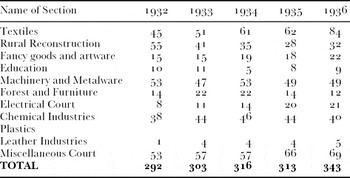
A look at the allotment of stalls in the mid 1930s indicates not only the growing focus on textiles, as more and more indigenous producers entered the space of the exhibitions, but also the dramatic increases in the displays at the Electric Court, and leather and fancy goods, whilst displays relating to Rural Reconstruction sharply declined, and the stalls of machinery and metalware fluctuated within a narrow band (Table 1).
Statement of Allotment of stalls at the Mysore Dasara Exibition during the five years 1932–1936

Source: Proceedings of the Stall Allotment Sub Committee, 23 July 1937, Dasara Exhibition, File no 1 of 1937, Dasara Files, Mysore Divisional Archives, Mysore.
The focus of the exhibition moved to industry in the larger sense of the term rather than retail, and it was a sign of confidence that it was neither confined to Mysore, nor even India or Britain alone, with Japanese exhibits making their way into the Mysore Exhibition.Footnote 133 Above all, Mirza recognized the importance of advertising Mysore's achievements and products, and sharply rebuked the producers of the Dasara Handbook in 1935 for foregrounding 53 private insurance companies at the expense of the robust government scheme. Indeed, the purpose of the Handbook was to showcase the state sector, in its articles and advertisements, whilst advertising itself had to avoid the unseemly juxtaposition of pictures of the palace with advertisements for Madras pencils.Footnote 134 Thereby, the sanctity of the Royal family was retained, instead of the Maharaja being turned into an ambassador of a ‘trading state’, as Sujit Parayil has suggested occurred in Travancore.Footnote 135
Both Mirza and the Maharaja recognized the importance of aggressively advertising the wares of the stateFootnote 136 and if Mysore was lauded as the ‘The Bee Hive of South India’ and its ‘Industrial Pre-eminence’ allowed for the full flowering of alliterative talents on the part of the journalist (‘Soap, Silk, Sandal and Sealing Wax’), it was in part a result of such aggressive promotion by the state itself. Praise for the state's industrial policies and progress hinged on ‘an ocular demonstration in the various factories, mills, and institutions’ through which journalists were guided.Footnote 137 The exhibitions offered people who could not visit individual industries an opportunity to witness Mysore's progress at a glance.Footnote 138
Finally, the exhibition also spectacularized the marriage of science and industry. In 1933, the Dasara Exhibition included, for the first time in its history, a stall of the Indian Institute of Science, Bangalore, which was divided ‘into three sections showing the investigations at the institute which are purely of scientific interest, investigations which have led to the development of particular industries and inquiries into the development of possible industries’.Footnote 139 Mysore was living up to its reputation of backing up its industrial dreams with actual research and investigation. For a long time the Chamarajendra Technical Institute's chief claims to fame were high quality rosewood and sandalwood carvings; in 1931, there were innovative adaptations of used gramophone needles for the central rotator of a cotton shredder.Footnote 140
The war-time boom in the demand for Mysore's goods put the state in an advantageous position vis-à-vis the Government of India and reversed old prejudices. The humble cumblie, earlier rejected for its poor claim to aesthetic qualities, now strode to the forefront of the War Supply Room, begun in 1939, as a symbol of pride, along with chemicals, barrels, aiming lamps, copper wires and bloodless castrators, produced by the Central Industrial Workshop, as well as other essentials supplied by nearly 30 state-run industries. Visitors were urged not to approach the stall ‘in a spirit of amusement but intent on business. . .and a burning desire to help and increase production. . .’.Footnote 141 An overt concern with preserving handicrafts and artisanal skills had yielded place to those industries which ‘augmented the defence resources of the empire’.Footnote 142 These economic achievements through the war years did not entirely eclipse the exhibitions’ goal of recasting the social: there were stalls on new forms of education, a sanitation court and local panchayat, a proud display of crossing superior bulls with inferior cows to produce the far more productive calf.
Meanwhile, the Fine Arts section of the Exhibition had grown to respectable proportions, bestowing medals on eager artists from all over the country. Unlike the Parisian artists of the nineteenth century, who, Walter Benjamin notes, refused to be displayed alongside the industrial arts,Footnote 143 Mysore's industries posed no threat to the aesthetic ideals, and the Fine Arts and Embroidery sections soon were the hardy annuals of the exhibition. The exhibition itself had become a thing of beauty throughout the 1930s, with grounds laid with lawns, and improved lighting with ornamental lamps.Footnote 144 Its proximity to the railway station made it perhaps the most visited sight of Mysore:Footnote 145 in 1935 there were 110,000 visitors, compared with far fewer at the Palace, Krishna Raja Sagar (dam) or the zoo.Footnote 146 As the Yuvaraja of Mysore remarked in his closing remarks at the Dasara Exhibition of 1935, needs had to be produced—through tiresome repetition, advertisement, and education—before being fulfilled:
You have now a great boom in building activity in the State and this is likely to increase if the scheme for promoting House-Building Co-operative Societies comes to pass. But which of you knows exactly what he wants in his home? The idea of the home is developing from year to year and in England, for instance, there has been an enormous advance in the standard of comfort by the application to common use of innumerable inventions as a result of Ideal Home Exhibitions and the giving of prizes for the houses that give the greatest amount of convenience for a limited sum.Footnote 147
It is a sign of the new confidence of the exhibition authorities that it was announced as an ‘All India Industrial and Agricultural Exhibition’ and within a year included ‘A Section for Demonstrations’ on a spacious adjoining ground, with a main building consisting of 300 stalls and temporary sheds. As in the past, each district of Mysore had a stall, offering the vast quantities of raw materials that could be commercially exploited.Footnote 148 Touted as a judicious blend of art, industry, and now science, the exhibitions placed on display scientific experiments and instruments, ranging from the ‘scattering of light by colloidal solutions and pure liquids’ to ‘a fine collection of iridescent shells and feathers, demonstrating the origin of colours’ all subjects that were dear to the research undertaken by Sir C. V. Raman in Bangalore.Footnote 149 The electrical illuminations of the grounds, the well displayed and stocked stalls, ensured that Mysore was depicted as a region that had come of age, and was making annual improvements to its repertoire of industrial activity.
Though some of the earlier themes were continued, the Mysore Exhibition was on a far firmer footing and no longer threatened by over-feminized displays, becoming more strongly focused by the 1930s on local innovations and products. Although in 1934 a ‘beauty competition’ was organized for girls aged between 12 and 15 who used ‘purely Indian ways of dressing’ and prizes awarded from the Government Silk Weaving factory.Footnote 150 Whilst the Fine Arts and domestic crafts sections of the exhibition continued to draw high praise, they were firmly subordinated to the more important sectors of state industrial efforts in soaps, power generation, porcelain conductors, paper or sericulture. As the Madras Mail reported in 1934, the production of porcelain insulators was first scorned by observers, though 15 years later, ‘it is clear that Mysore has succeeded in producing an article which she would otherwise inevitably have had to import from abroad in large quantities’.Footnote 151
Leaving the region behind for the nation
The war years provided an unexpected breakthrough for Mysore's industries, not only for supplying the war effort, but by the relatively relaxed strictures of the Government of India. The Mysore Exhibition saw an unprecedented number of visitors, and the war supply room was as much a matter of pride as of soliciting new markets. On one hand were the products of industrial Mysore such as the Iron and Steel Works, the Paper Mills, the Government Electrical Factory, Government Industrial and Testing Laboratory, Government Porcelain Factory, Mysore Soap factory, Mysore Chemical and Fertilizers, and the Chrome Tanning factory, and, on the other hand was the Mysore home, furnished with commodities made in Mysore.Footnote 152 In 1941, the ‘India and War Supplies stall’ was sanctioned by the Government of India, ‘to give the Mysore agriculturalist, artisan and businessman an opportunity to study the samples and increase his efforts in the production of war supplies. ‘Cumblies, hand tools and wooden barrels were on display to exhort visitors to be motivated by something more than profit.Footnote 153 The effort to fan the fire of enthusiasm, and produce ‘a burning desire to help increase production’ only thinly concealed the appeal to become ‘patriotic producers’ and thereby aid the war effort, and benefit from the breaks provided by the war.Footnote 154
The proportion of writings in the Dasara Handbooks on the Industries of Mysore increased in the run-up to Independence. In the last decade of Mysore state existence (1947–1956), the emphasis of the exhibition had shifted to the realm of national production via the Public Sector. The Hindusthan Aircraft Factory (HAF, later Hindusthan Aeronautics Limited, HAL), begun in 1940, Indian Telephone Industries (ITI), started in 1948, Radio and Electrical Manufacturing Company (REMCO) in 1946, Bharat Electronics Limited (BEL) in 1954 and Hindusthan Machine Tools (HMT) loomed large over the more modest-sized Mysore Government Factories.Footnote 155 Large public and private sector undertakings were repetitively highlighted in this period. Whereas Mysore's achievements were still very visible in the advertisements and in the listing of industries started in the 1930s, greater attention was given to national production. Moreover, Bangalore itself began hosting a series of exhibitions, such as the Textile Labour Arts Exhibition and the Congress Exhibitions.
Despite the predominance of the public sector in the Dasara handbooks, and the pride of place given to industry, the displays retained the importance of the agrarian sector, and rural artisanal industry though more in a symbolic sense. As the cover of the Dasara Handbook of 1953 indicated, agriculture had shrunk to a symbolic quarter of the new post independence economy, the financial bounty of the state being created by rural industry and urban large scale industry.
Conclusion
What are the virtues of repetition, comparison, standardization, advertisement and, most important, production and consumption, except as mastering the grammar of the universal language of capitalism? ‘The World Exhibitions were training schools in which the masses, barred from consuming, learned empathy with exchange value’.Footnote 156 Such training in understanding the ‘metaphysical subtleties and theological niceties’ of commodities was certainly begun through the extravagant exhibitions, advertisements and entertainments that were associated with Dasara. But full blown capitalism, rooted in mass consumption, was impossible under colonialism, and even the most strenuous kinds of state interventions of the Mysore kind, as we have seen, could not overcome those structural constraints. What then accounts for the insistence of the Mysore bureaucracy in organizing these supplementary spectacles? Were these exhibitionary practices performing another task, of ‘narrating a nation’ which could not be remembered, as Benedict Anderson suggests?Footnote 157
This commentary suggests that the Mysore state (not the nation) mimicked neither the western model nor the Indian nationalist examples in their entirety. The intentions of the Mysore officials were to strip ‘patriotism’ bare of political and cultural overtones linked to the nation, instead making ‘practical patriotism’ serve the purpose of supplementing the annual Dasara festivities centred on a display of royal power. In doing so, they produced the material for a new social memory of an economy striving to be, within the bounded socio-political space of Mysore. That the Maharaja himself participated so enthusiastically in its founding need not be dismissed as an irony so much as a need for that source of supplemental power, delinked from religion and the monarchy, within which the state would chart a new destiny for its people. Mysore city, and the annual Dasara festivities were an occasion for more than one kind of achievement to be placed on view: in addition to the annual meeting of the Representative Assembly, the Dasara festivities could happily coincide with meetings of the Vokkaligara conference, with the annual Mysore Co-operative Conference, or the Educational Exhibition. A visible association with the energies of the Mysore administration, located in Bangalore, was made via the Dasara Exhibition, which linked an imagined economy of Mysore to the more lovable figure of the Maharaja in its timing and location.Footnote 158
There were two levels at which the exhibition worked: as a space for the production of a new social memory, delinked from the empty grandeur of royalty, whose signs lay scattered all over the cityscape of Mysore; and as an ideological form, that of a ‘national economy’, which was put in place before the economy could take real shape. Thomas Richards begins his discussion of the Grand Exhibition of 1851 by noting that, ‘The cultural forms of consumerism then came into being well before the consumer economy did’.Footnote 159 In Mysore, likewise, the cultural forms of the capitalist economy came into being well before fully-fledged capitalism took root.
In fostering this imagined economy, the bureaucracy played a crucial role, as the repository of the bourgeoisie's intelligence in a state that so conspicuously lacked entrepreneurial talent and capital. It forged a sense of nation-ness primarily in the economic domain, by entering the realm of production ‘as a mobiliser and manager of investible resources’.Footnote 160 Mysore state also displayed an entrepreneurial flair in putting in place institutional forms that would compensate for a marked disinterest in associational practices. Indirect rule in Mysore thus departed significantly from the better known sites of both British and princely India in the colonial period,Footnote 161 with the Mysore bureaucracy playing a role far in excess of its British Indian counterparts, at once representing the autocratic power of the ‘colonizer’ and anticipating the moral-intellectual leadership of the nation. Whilst drawing important inspiration from the nationalist or Khadi Exhibitions, which similarly imagined and produced a new India, the Dasara Exhibition strove to produce a new enchantment with economic development that would deny cultural nationalism its formidable power, until the structural limits of this imagined economy were recognized by even those who had long incubated its fantasies.