Background
Mood disorders, dominated by major depression, constitute a substantial burden of disease. NICE guidelines recommend psychotherapy for mild depression, and cognitive-behavioural therapy for moderate depression, but these therapies typically require individual intervention and therefore, while cost-effective, are expensive. Novel approaches are needed to improve treatments for depression, and to prevent relapse.
Understanding emotional signals is critical to successful social functioning but is disrupted in many psychiatric disorders (Cotter et al., Reference Cotter, Granger, Backx, Hobbs, Looi and Barnett2018). Negative processing biases may play a role in the onset and maintenance of depression. Neurocognitive models suggest that antidepressant medications have early effects on emotional processing biases that result in therapeutic benefit only after sufficient time has elapsed to allow interaction with others, in which these effects lead to more positive social interactions (Warren, Pringle, & Harmer, Reference Warren, Pringle and Harmer2015). In support of these models, functional magnetic resonance imaging (fMRI) studies have demonstrated that SSRIs change responses to emotional expressions, and that such changes are associated with later improvement in mood (Warren et al., Reference Warren, Pringle and Harmer2015).
Given the proposed causal role played by emotion processing in depression, biases in this area may provide a potential target for behavioural, rather than pharmacological, intervention (Penton-Voak, Munafo, & Looi, Reference Penton-Voak, Munafo and Looi2017). We have developed a cognitive bias modification (CBM) technique which targets the recognition of facial expression of emotions by initially assessing the threshold for detecting one emotion over another in an ambiguous expression (e.g. a blend of happiness and sadness), and then providing feedback to shift this threshold (e.g. to favour identification of happiness over sadness). Preliminary results from adults recruited from the general population indicate robust and generalisable effects on emotion perception (Dalili, Penton-Voak, Harmer, & Munafo, Reference Dalili, Penton-Voak, Harmer and Munafo2015; Griffiths, Jarrold, Penton-Voak, & Munafo, Reference Griffiths, Jarrold, Penton-Voak and Munafo2015; Penton-Voak et al., Reference Penton-Voak, Thomas, Gage, Mcmurran, Mcdonald and Munafo2013). An early stage randomised controlled trial (RCT) with participants recruited from the general population on the basis of high levels of depressive symptoms on the Beck Depression Inventory ii (BDI-ii) also indicated that this intervention may have therapeutic benefit on positive affect which persists for at least 2 weeks (Penton-Voak, Bate, Lewis, & Munafo, Reference Penton-Voak, Bate, Lewis and Munafo2012). This is consistent with recent models of the action of antidepressant medication, which suggest that drug treatment has early effects on emotional processing bias including the ability to detect positive v. negative facial expressions (Harmer, Goodwin, & Cowen, Reference Harmer, Goodwin and Cowen2009; see also Holmes et al., Reference Holmes, Ghaderi, Harmer, Ramchandani, Cuijpers, Morrison and Craske2018). Here we investigated the neural correlates of our emotional recognition CBM intervention, and the therapeutic potential of this intervention.
Several studies show that SSRIs have robust effects on emotion processing in the amygdala (e.g. Godlewska, Norbury, Selvaraj, Cowen, & Harmer, Reference Godlewska, Norbury, Selvaraj, Cowen and Harmer2012; Harmer, Mackay, Reid, Cowen, & Goodwin, Reference Harmer, Mackay, Reid, Cowen and Goodwin2006, for review, see Warren et al., Reference Warren, Pringle and Harmer2015), which plays a key role in detecting the salience of emotional stimuli in the environment (Sander, Grafman, & Zalla, Reference Sander, Grafman and Zalla2003; Santos, Mier, Kirsch, & Meyer-Lindenberg, Reference Santos, Mier, Kirsch and Meyer-Lindenberg2011). The medial network has substantial amygdaloid and limbic connections (Price & Drevets, Reference Price and Drevets2010), and altered neural activation is seen in the medial prefrontal cortex (mPFC) in individuals suffering from mood disorders, although the pattern of this activation varies widely between studies (Grimm et al., Reference Grimm, Boesiger, Beck, Schuepbach, Bermpohl, Walter and Northoff2009; Lemogne et al., Reference Lemogne, Le Bastard, Mayberg, Volle, Bergouignan, Lehericy and Fossati2009; Renner et al., Reference Renner, Siep, Lobbestael, Arntz, Peeters and Huibers2015; Yoshimura et al., Reference Yoshimura, Okamoto, Onoda, Matsunaga, Ueda, Suzuki and Yamawaki2010). Similarly, mood related changes in activity are found in the dorsolateral prefrontal cortex (dlPFC), a cortical area associated with the control of attention that helps regulate the amygdala through an indirect inhibitory input (Davidson, Jackson, & Kalin, Reference Davidson, Jackson and Kalin2000; Drevets, Reference Drevets2001). A meta-analysis of studies measuring the neural response to affective stimuli showed a greater response in the amygdala, insula and dorsal anterior cingulate cortex, and a lower response in the dorsal striatum and dlPFC to negative stimuli in depressed individuals relative to healthy controls (Hamilton et al., Reference Hamilton, Etkin, Furman, Lemus, Johnson and Gotlib2012). Additionally, a review by Disner, Beevers, Haigh, and Beck (Reference Disner, Beevers, Haigh and Beck2011) found that biased processing of emotional stimuli in depression is associated with greater amygdala reactivity, as well as left dlPFC hypoactivity and right dlPFC hyperactivity.
Study 1 aimed to identify changes in the neural correlates of emotion recognition following this novel CBM in an analogue sample of participants with high levels of depressive symptoms. We administered 5 days of the emotion recognition training intervention (or a sham training procedure) and then scanned participants using fMRI while performing a face perception task that has been previously used to investigate the effects of SSRIs on the processing of emotion facial expressions (Godlewska et al., Reference Godlewska, Norbury, Selvaraj, Cowen and Harmer2012). We hypothesised that emotional recognition training would reduce amygdala responses to negative facial expressions. We also hypothesised that training would alter activity in the occipital cortex, as it is highly connected to the amygdala and is sensitive to the attentional change in response to emotional stimuli, and the prefrontal cortex, which exerts effects on circuitry implicated in pharmacological and psychological treatment for depression. Based on previous findings, we established the following areas as our regions of interest (ROIs) for comparing neural activation in individuals with low mood in our intervention and control conditions: the bilateral amygdala, the mPFC, bilateral dlPFC and the occipital cortex.
Study 2 was an early phase RCT, again using an analogue sample of participants recruited from the general population on the basis of high levels of depressive symptoms on the BDI-ii, in a direct replication of earlier work (Penton-Voak et al., Reference Penton-Voak, Bate, Lewis and Munafo2012), using a larger sample with long-term follow-up. The CBM procedure was identical to Study 1 – participants were randomised to receive either 5 days of the emotion recognition training intervention, or a sham training procedure. Participants completed a series of assessments of mood and anxiety at 2-week and 6-week follow-up after the end of treatment. We hypothesised that participants randomised to the emotion recognition training intervention would reduce lower symptoms of depression on the BDI-ii over the previous 2-weeks at 6-week follow-up (our primary outcome).
Methods: Study 1
Participants
We recruited adults from the staff and students at the University of Bristol and from the general population who reported depressive symptoms (defined as a score of 14 or more on the BDI-ii) (Beck, Steer, & Brown, Reference Beck, Steer and Brown1996). Participants were recruited via email lists and local advertisements.
Participants provided informed consent and inclusion/exclusion criteria were assessed. Screening consisted of structured clinical interview for DSM-IV: Clinical Interview Schedule; CIS-R (Lewis, Pelosi, Araya, & Dunn, Reference Lewis, Pelosi, Araya and Dunn1992), the Altman Self-Rating Mania Scale; ASRM (for bipolar disorder) (Altman, Hedeker, Peterson, & Davis, Reference Altman, Hedeker, Peterson and Davis1997) and medical history. After screening we also collected data on age, sex, ethnicity, alcohol, tobacco and caffeine use, previous history of depression (treated and non-treated), intelligence (National Adult Reading Test, NART) (Nelson, Reference Nelson1982), number of years of education, social network size (SNS) and current and past history of psychiatric treatment. Criteria for exclusion were a diagnosis of primary anxiety disorder, psychosis, bipolar disorder or substance dependence (other than nicotine and caffeine) as defined by DSM-IV; current use of an illicit drug (except cannabis); being at clinically significant risk for suicidal behaviour; use of psychotropic medication in the last 5 weeks prior to the study; major somatic or neurological disorders and concurrent medication that could alter emotional processing (including active treatment with counselling, cognitive behavioural therapy or other psychotherapies).
The study was approved by the Faculty of Science Research Ethics Committee at the University of Bristol. On completion of the final study session, participants were reimbursed £60 for their time and expenses.
Study design and intervention
An experimental collaborator at the Bristol Randomised Trials Collaboration used minimisation to allocate participants to either a training procedure designed to promote the perception of happiness over sadness in ambiguous emotional expressions, or a control procedure designed to elicit no change in perception of emotional expression, in order to ensure the groups were balanced for baseline BDI-ii symptoms (grouped according to a score of 14–19, or 20+). Testing was double-blind. The CBM intervention consists of three phases. First, in the baseline phase, images from a 15 face morph sequence that runs from happy to sad facial expressions are presented one at a time, with participants asked to judge whether the face is happy or sad. This allows the ‘balance point’ at which participants shift from a ‘happy’ judgement to a ‘sad’ judgement to be calculated in terms of the number of images in the 15-face sequence that a participant, on average, would classify as happy. We take this as a measure of cognitive bias. In the training phase, feedback (correct/incorrect) is used to shift the participant's balance point. In the training condition, the ‘correct’ classification is shifted towards ‘happy’; the two images nearest the balance point that the participant would have previously classified as ‘sad’ at baseline are considered ‘happy’ in terms of providing feedback. Feedback in the control condition is based directly on baseline performance, and has no effect on responses. Sessions last 20 min and are fully automated. Methods are described in detail elsewhere (Penton-Voak et al., Reference Penton-Voak, Bate, Lewis and Munafo2012, Reference Penton-Voak, Thomas, Gage, Mcmurran, Mcdonald and Munafo2013). Participants completed computerised training or control procedures once a day over 5 consecutive days (Monday to Friday). fMRI acquisition took place after the completion of training during the last session. The study protocol was registered prior to data collection (ISRCTN 50125738).
Mood assessment
Mood assessments via questionnaire measures were taken at baseline and at the end-of-treatment. End-of-treatment follow-up included a visual analogue scale rating of how friendly the participant thought the experimenter was, to ensure that there were no differences between treatment conditions that may have affected blinding. The questionnaire measures included the BDI-ii (Beck et al., Reference Beck, Steer and Brown1996), the Beck Anxiety Inventory (BAI) (Beck, Brown, Epstein, & Steer, Reference Beck, Brown, Epstein and Steer1988), the Hamilton Rating Scale for Depression (HAM-D) (Hamilton, Reference Hamilton1960) and the Positive and Negative Affect Schedule (PANAS) (Watson, Clark, & Tellegen, Reference Watson, Clark and Tellegen1988).
fMRI behavioural task
During fMRI scanning, participants completed a sex discrimination task involving the rapid presentation of sad, happy and fearful facial expressions. In this task, thirteen 30 s blocks of a baseline fixation cross were interleaved with twelve 30 s blocks of the emotional task – four blocks of sad, four blocks of happy and four blocks of fear. During each emotional block participants viewed 10 emotional faces (five female) from a standardised image set (Tottenham et al., Reference Tottenham, Tanaka, Leon, Mccarry, Nurse, Hare and Nelson2009). Each face was presented for 150 ms and participants were asked to report the sex of the face using a keypad. The experiment lasted 8.5 min.
Our main contrast of interest was happy > sad. We examined happy > fear and happy > sad + fear to explore whether effects generalised to other negative emotions. We also examined the three ‘emotion’ > rest contrasts to explore which emotions underpinned any observed effects. Where group differences for emotion contrasts were significant, mean percent signal change values were extracted for each participant and compared across conditions to characterise the specific effect. fMRI data acquisition, pre-processing and statistical analysis are described in the online Supplementary Material.
Results
Characteristics of participants
A total of 36 participants (24 female) aged 18–33 years (M = 22, s.d. = 4) were recruited. Due to a randomisation error, there were 19 participants in the intervention condition and 17 participants in the control condition. All participants were right-handed. The characteristics of participants by condition are shown in Table 1. A CONSORT diagram is shown in online Supplementary Material, Fig. C1.
Characteristics of participants (Studies 1 and 2)

Values represent mean (standard deviation) for continuous variables, and number (percentage) for categorical variables.
Behavioural results
Participants in the intervention condition showed a shift in balance point compared to participants in the control condition after five sessions, adjusting for their session 1 baseline balance point (adjusted mean difference 4.65, 95% CI 2.95–6.36, p < 0.001). Mean balance points at baseline and test for intervention and control conditions are presented in online Fig. S1 in Supplementary Material. A mixed model ANOVA of questionnaire score data with a between-subjects factor of training condition (intervention, control) and within-subjects factor of time (baseline, follow-up) indicated evidence of the main effect of time across measures [Fs (1, 33) = 6.66 to 9.59, ps ⩽ 0.014], reflecting an improvement of mood from baseline to follow-up, except for the PANAS positive and negative scores [Fs (1, 33) = 2.08 to 3.06, ps ⩾ 0.089], where the direction of effect was consistent with other measures but the statistical evidence weaker. We found no evidence of a main effect of training condition in any measures [Fs (1, 33) = 0.07 to 2.72, ps ⩾ 0.10], or any evidence of an interaction between time and training condition across measures [Fs (1, 33) = 0.24 to 2.68, ps ⩾ 0.11]. Due to a programming error, behavioural data from the sex discrimination task were not recorded.
fMRI results (regions of interest)
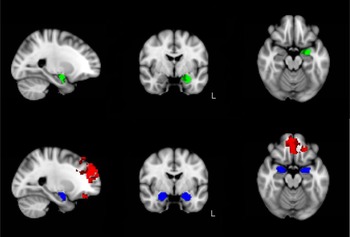
Due to a lost imaging data file, we analysed the fMRI data of 35 participants (19 intervention, 16 control). Our ROI analyses showed evidence of increased activation to the happy > sad contrast in the intervention condition relative to the control condition, but only in the left, and not the right, amygdala (FWE corrected p < 0.05, central coordinates 57, 61, 27; see Fig. 1, top panel). There were no group differences on the happy > sad contrast in the other ROIs (occipital cortex, dlPFC or mPFC).
(Top) Increased activity for the happy > sad contrast in the left amygdala for the intervention condition relative to the control condition (cluster corrected p < 0.05). (Bottom) Increased activity for the happy > rest contrast in the bilateral amygdala and mPFC for the intervention condition relative to the control condition (cluster corrected p < 0.05). L indicates left hemisphere.

Training also increased BOLD activation to happy > fear and happy > sad + fear contrasts in the left amygdala. These group differences were driven by increased BOLD activation to happy faces in the intervention condition compared to the control condition, with higher BOLD activation to the happy > rest contrast in both the left and right amygdala and also in the mPFC (see Fig. 1, bottom panel). The percent signal change in activation for happy faces relative to rest for both the intervention and control conditions in the bilateral amygdala and mPFC is shown in Fig. 2. There were no group differences for sad > rest, fear > rest or sad > fear, and no evidence for increased activation in any contrasts for the control condition relative to the intervention condition. There was no evidence for group differences on any contrasts in any other ROIs.
Percent signal change of activation for the happy > rest contrast in the left amygdala, right amygdala and mPFC for the intervention and control conditions. Error bars represent the standard error of the mean.

To further investigate the effect of training in the left and right amygdala between conditions for each of our three ‘emotion’ > rest contrasts, we conducted a post-hoc repeated measures mixed model ANOVA of the percent signal change with a between-subjects factor of training condition (intervention or control) and within-subjects factors of hemisphere (left or right) and emotion (happy, sad or fear). We observed evidence of a main effect of training condition [F (1, 33) = 6.53, p = 0.015], where participants in the intervention condition showed greater activation across contrasts relative to the control group. We also found a main effect of hemisphere [F (1, 33) = 12.10, p = 0.001], where participants showed greater activation in the right amygdala compared to the left amygdala. We did not find evidence for any interactions between factors (ps > 0.22). Activation for each condition by contrast and hemisphere is shown in online Supplementary Fig. S2. Independent samples t tests indicated greater activation for the intervention condition relative to the control condition for the happy > rest contrast in both the left (mean difference = 2.65, 95% CI 0.044–0.334, p = 0.012) and right (mean difference = 2.80, 95% CI 0.069–0.436, p = 0.008) amygdala. We also found evidence of greater activation for the intervention condition relative to the control condition for the fear > rest contrast in the right amygdala (mean difference = 2.18, 95% CI 0.010–0.286, p = 0.036).
Conclusions: Study 1
Our results suggest that emotion recognition training increases neural activation to happy faces compared to sad faces, driven by an increase in neural activity for happy faces. We see this increase in activation for this contrast at both the whole brain level (see online Supplementary Material) and among our a priori ROIs, specifically the mPFC and bilateral amygdala. Our ROI analyses also indicated increased activation for the intervention condition relative to the control condition in the left amygdala for the happy > sad, happy > fear and happy > sad + fear contrasts. We did not find differences in neural activation between conditions for our other contrasts in either our whole brain analyses or in our other ROIs, the bilateral dlPFC and the occipital cortex. Participants in the intervention condition did not show any clear improvements on measures of depressive symptoms or mood relative to controls at the end of treatment following emotion recognition training.
Our finding of clusters of activation for our happy > sad + fear contrast at the whole brain level in both the left amygdala and brainstem may be explained by the amygdaloid projections underpinning the limbic system. The increase in neural activation for happy expressions for the intervention compared to the control condition resembles changes seen following antidepressant administration. Although effects of SSRIs on amygdala activity in response to positive emotional faces have been reported and replicated, they are less robust than changes in response to negative facial expressions. This is important mechanistically, as anhedonia is characterised by depressed amygdala responses to happy faces (Keedwell, Andrew, Williams, Brammer, & Phillips, Reference Keedwell, Andrew, Williams, Brammer and Phillips2005).
Increased neural activation to happy faces has been observed following both acute and prolonged antidepressant administration, both in healthy and depressed individuals (Warren et al., Reference Warren, Pringle and Harmer2015). Increased activation to positive emotional information following antidepressant treatment has been observed across a large brain network, including the amygdala, mPFC, parahippocampal gyrus and extra-striate cortex. While these changes may occur in the absence of any effects on participants’ mood, it has been proposed that the early production of a positive bias in emotional processing may be predictive of ultimate symptom improvement in depressed patients (see Warren et al., Reference Warren, Pringle and Harmer2015 for a review). As we did not find any group differences in activation across our contrasts in the bilateral dlPFC and the occipital cortex, we find no evidence that our CBM intervention alters attention to emotional expressions, nor does it modify the way these faces are perceived by the visual system. Our analyses suggest that emotion recognition training may increase the salience of positive emotional expressions indexed by increased neural activation in the amygdala in our intervention v. control groups.
While our results indicate that completing a course of emotion recognition training alters neural activation associated with the perception of happy facial expressions, this fMRI study was not powered to detect mood outcomes when comparing participants in intervention and control conditions. Study 2 addresses this question.
Methods: Study 2
Participants
We recruited adults who reported depressive symptoms (defined as a score of 14 or more on the BDI-ii) from the same population as Study 1.
Upon arrival, participants provided informed consent and inclusion/exclusion criteria were assessed as in Study 1.
The study was approved by the Faculty of Science Research Ethics Committee at the University of Bristol. On completion of the final study session, participants were reimbursed £60 for their time and expenses.
Study design and intervention
As in Study 1, participants were allocated to condition using minimisation to balance baseline BDI-ii scores by an experimental collaborator, and testing was double-blind. The CBM intervention and control procedure were the same as in Study 1, and participants again completed computerised training or control procedures once a day over 5 consecutive days (Monday to Friday).
Mood assessment
Mood assessments via questionnaire measures were taken at baseline and at the end-of-treatment. Questionnaire measures included the BDI-ii, the BAI, HAM-D and the PANAS.
Other measures
The SNS was assessed at baseline by asking participants to rate the number of close friends (whom respondents report feeling close to and whom they believe they could confide in) they have on a 5-point scale ranging from 0 (none) to 4 (four or more). Participants repeated this process, rating the number of contacts and acquaintances. A contact or acquaintance was defined as a person known by sight or known to someone, but not intimately.
Behavioural assessments (Emotion Recognition Task, Scrambled Sentences Test and the Fishing Game) were taken at the end of treatment, and at 2-week and 6-week follow-up. Six-week follow-up also included a visual analogue scale rating of how helpful the participant thought the experimenter was, to ensure that there are no differences between treatment groups.
The emotion recognition task was a 45 trial task that was identical to the baseline block of the training procedure (i.e. no feedback was given). This was administered to determine whether any chance in bias induced by the task persisted to follow-up. The Fishing Game (Pictet, Coughtrey, Mathews, & Holmes, Reference Pictet, Coughtrey, Mathews and Holmes2011) and Scrambled Sentence Task (Rude, Wenzlaff, Gibbs, Vane, & Whitney, Reference Rude, Wenzlaff, Gibbs, Vane and Whitney2002) are described in online Supplementary Material.
Statistical analysis
We used linear regression to evaluate the effect of training on mood at 6-week follow-up. Analyses were conducted with adjustment for the minimisation factor only, and with additional adjustment for age, sex, ethnicity, previous history of treatment for depression and baseline mood (for analyses of mood variables only). The primary outcome was depressive symptoms over the last 2 weeks assessed using the BDI-ii at 6-week follow-up. Secondary outcomes included depressive symptoms measured using the HAM-D, and positive and negative affect assessed using the PANAS. Subgroup analyses were conducted stratified by whether participants meet criteria for clinical depression, number of episodes of depression, age at the first episode and whether participants had depression with or without anxiety. We also analysed the impact of the SNS on the treatment effect.
Our preliminary data indicated an effect size of d = 0.43 at 2-week follow-up, corresponding to a difference of 3 points on the PANAS. This suggested that a sample size of 172 would be required to achieve 80% power at an alpha level of 5%. This sample size gave us equivalent power to detect a difference of 5 points on the BDI-ii at 6-week follow-up (our primary outcome), which we considered would be clinically significant. We aimed to recruit 190 participants to accommodate potential attrition. The study protocol was registered prior to data collection (ISRCTN17767674) (Adams, Penton-Voak, Harmer, Holmes, & Munafo, Reference Adams, Penton-Voak, Harmer, Holmes and Munafo2013).
Results: Study 2
Characteristics of participants
A total of 190 participants (138 female) aged 18 to 39 years (M = 21, s.d. = 4) were recruited. Participant characteristics are shown in Table 1. A CONSORT flow diagram is in online Supplementary Material, Fig. C2.
Primary outcome
We found no evidence of a reduction in depressive symptoms on the BDI-ii at 6-week follow-up (our primary outcome) in the intervention condition compared with the control condition in either the unadjusted (mean difference 0.35, 95% CI −2.41 to 3.10, p = 0.80) or adjusted (mean difference 0.10, 95% CI −2.39 to 2.58, p = 0.94) models.
Secondary outcomes
There was no evidence of a difference between the two conditions on the BDI-ii at any other time points, or on any other mood measures. These results are shown in Table 2. We found no evidence of a difference in the Scrambled Sentences Test (unadjusted mean difference 0.48, 95% CI −0.94 to 1.90, p = 0.51; adjusted mean difference 0.30, 95% CI −1.12 to 1.72, p = 0.68), or the Fishing Game (unadjusted mean difference 0.23, 95% CI −2.24 to 2.70, p = 0.85; adjusted mean difference 0.28, 95% CI −2.24 to 2.79, p = 0.83) at 6-week follow-up. However, we did find clear evidence of a difference in the Emotion Recognition Task at 6-week follow-up (unadjusted mean difference −2.91, 95% CI −3.67 to −2.14, p < 0.001; adjusted mean difference −2.84; 95% CI −3.63 to −2.06, p < 0.001), indicating that the effect of the intervention on this particular cognitive bias persisted beyond the treatment phase.
Effects of emotion recognition training on mood symptoms in Study 2

BDI-ii, Beck Depression Inventory; HAM-D, Hamilton Rating Scale for Depression; PANAS, Positive and Negative Affect Schedule.
Adjusted analyses include age, sex, ethnicity, previous history of treatment for depression and baseline mood score as covariates.
Planned sub-group analyses
Subgroup analyses, both unadjusted and adjusted, did not indicate any evidence of improved mood in the intervention condition compared to the control condition among participants with a diagnosis of clinical depression, number of previous episodes of depression, age at first episode among those with a previous episode and among those with high levels of anxiety symptoms. Similarly, the SNS had no effects on our results.
Unplanned exploratory analyses
Given the lack of an effect of this CBM technique on mood at any time point, we explored whether emotion recognition bias may instead serve as a cognitive biomarker for depressed mood, by calculating the correlation between pre-training balance point at session 1 and self-reported measures of mood at the same time point. We found evidence of consistent, albeit relatively weak, correlations across most measures (BDI-ii: r = −0.18, p = 0.018; HAM-D: r = −0.17, p = 0.021; BAI: r = −0.11, p = 0.12; PANAS positive: r = +.23, p = 0.001; PANAS negative: r = −0.03, p = 0.67). At 6 week follow-up, these patterns of correlation were still largely present although attenuated (BDI-ii: r = −0.08, p = 0.286; HAM-D: r = −0.17, p = 0.035; BAI: r = −0.06, p = 0.44; PANAS positive: r = +0.16, p = 0.049; PANAS negative: r = +0.07, p = 0.37). These results should be treated with caution given the experimental manipulation of the balance point.
Conclusions
Our results suggest that a novel form of emotion recognition training induces a change in a cognitive bias (here, training people to classify faces as happy under ambiguity) that persists for 6 weeks after the end of treatment but does not reduce depressive symptoms on the BDI-ii, or on related measures of mood, motivation and persistence, or depressive interpretation bias between end of treatment and at 6 week follow up in an analogue sample of volunteers with low mood. We found no evidence of specific sub-groups that benefited from the intervention. However, we did find evidence that emotion recognition bias may serve as a cognitive biomarker for depressed mood (and in particular low positive affect), and hence may act as a marker of treatment success.
These two studies present evidence that a simple, automated CBM task leads to training effects that increase amygdala response to happy faces at the end of treatment (Study 1) and have a behavioural effect that persists for at least 6 weeks (Study 2). There is no evidence, however, that this form of CBM has any downstream effects on either questionnaire measures of mood, or behavioural measures of anhedonia. Given the robust nature of the training effects, these findings provide little support of a causal role for emotion processing biases, as operationalised here (a bias to recognise happy faces) in the onset or maintenance of depression. Other biases have not been assessed and it is unknown how cognitive biases may combine in this context (cf. Hirsch, Clark, & Mathews, Reference Hirsch, Clark and Mathews2006). A further and clear limitation of the current work is that it employs analogue and not clinical samples, which may not be appropriate to test mood outcomes. These results highlight the difficulty of translating interventions to mood outcomes, but provide a biomarker model which can be used in future investigations to optimise effects.
One possibility is that the emotional training task does not generalise to other situations in which any therapeutic effects of a modified bias in responding to happy faces may be realised (e.g. social interactions). Although the training effect transfers to other faces in an experimental context (e.g. the face task in Study 1, which employs different faces to the training task, see also Dalili, Schofield-Toloza, Munafo, & Penton-Voak, Reference Dalili, Schofield-Toloza, Munafo and Penton-Voak2017), there is currently little evidence that this bias generalises to real world encounters with others. A further RCT employing a modified version of the CBM technique reported here aiming to reduce social anxiety in adolescent participants also showed weak, but positive results. Although there was no decrease in social anxiety, participants in the intervention group showed lower depressive symptoms at 2-week follow up (Rawdon et al., Reference Rawdon, Murphy, Motyer, Munafo, Penton-Voak and Fitzgerald2018).
Recent meta-analyses of CBM studies (e.g. Cristea, Kok, & Cuijpers, Reference Cristea, Kok and Cuijpers2015) indicate inconsistent effects across a range of paradigms aiming to manipulate bias with the therapeutic effect. Grafton et al. (Reference Grafton, Macleod, Rudaizky, Holmes, Salemink, Fox and Notebaert2017) note that this meta-analysis does not discriminate between studies that attempt to change a cognitive bias but fail to do so, and those studies that successfully modify bias (which, as predicted, have stronger therapeutic effects). Our studies show excellent target engagement (responses to faces are changed robustly by this CBM procedure) but our mood measures show no change. Additionally, however, Grafton et al., suggest that mood measures per se may not be the best outcome measures for CBM studies, which may serve to reduce emotional vulnerability to further challenges. Our mood state outcomes do not investigate this possibility. However, while a recent study of our CBM technique (Peters et al., Reference Peters, Lumsden, Peh, Penton-Voak, Munafo and Robinson2017) with healthy participants showed little evidence of transfer of bias modification to a variety of cognitive tasks thought to be impacted by low mood, there was weak evidence of transfer to a measure of the impact of stressful events in daily life, particularly in those participants with higher baseline anxiety. This is consistent with Grafton et al.'s reasoning, and may warrant further research.
Alternatively, individual differences in emotion processing may play no causal role in the onset or maintenance of depression, and may be a cognitive biomarker of depression rather than a therapeutic target. However, this conclusion seems premature given the robust behavioural effects on emotion perception and mechanistically interesting neural responses we report here, and the large literature on the potential causal role that emotional perception plays in depression. Therefore, further work is justified to examine the potential of this and related CBM techniques, perhaps as adjunct therapies to pharmacological or other psychological treatments (Holmes et al., Reference Holmes, Ghaderi, Harmer, Ramchandani, Cuijpers, Morrison and Craske2018).
Acknowledgements
MRM and SA are members of the UK Centre for Tobacco and Alcohol Studies, a UKCRC Public Health Research: Centre of Excellence. Funding from British Heart Foundation, Cancer Research UK, Economic and Social Research Council, Medical Research Council and the National Institute for Health Research, under the auspices of the UK Clinical Research Collaboration, is gratefully acknowledged. This work was supported by the Medical Research Council (MR/J011819/1) and supported by researchers at the NIHR Oxford Health Biomedical Research Centre and by the NIHR Biomedical Research Centre at University Hospitals Bristol NHS Foundation Trust and the University of Bristol. The views expressed in this publication are those of the author(s) and not necessarily those of the NHS, the National Institute for Health Research or the Department of Health and Social Care. The views expressed in this publication are those of the author(s) and not necessarily those of the NHS, the National Institute for Health Research or the Department of Health and Social Care.
Financial support
This work was funded by MRC research grant MR/J011819/1.
Conflict of interest
IPV and MRM are co-directors of Jericoe Ltd. a company that designs and sells software for psychological assessment.
Ethical standards
The authors assert that all procedures contributing to this work comply with the ethical standards of the relevant national and institutional committees on human experimentation and with the Helsinki Declaration of 1975, as revised in 2008.
Supplementary material
The supplementary material for this article can be found at https://doi.org/10.1017/S0033291719004124