Introduction
Studying memory complaints in older adults
Complaints about memory or thinking abilities in older adults are common as age increases. Studies published in the 1990s found prevalence rates of memory complaints varied between 22% and 56% in a review of clinical- and population-based studies (Jonker et al., Reference Jonker, Geerlings and Schmand2000). More recently, 11% of adults 45 years and older sampled from 33 states and the District of Columbia perceive confusion and memory loss (Taylor et al., Reference Taylor, Bouldin and McGuire2018). In a study by Holmen et al. (Reference Holmen2013), the percentage of people indicating memory changes increased each 10-year generation to 89% of women and 92% of men in their 80’s. As many as 66% of women and 53% of men from a cohort of French national utility company employees with a mean age of 58 years reported experiencing memory problems (Singh-Manoux et al., Reference Singh-Manoux2014).
Although common, there is increased interest by researchers and clinicians in subjective cognitive decline (SCD; Jessen et al., Reference Jessen2020) and cognitive complaints because they may not be simply attributable to normal aging. Longitudinal evidence marks it as a risk factor for cognitive decline and dementia compared to uncomplaining peers (e.g. Jessen et al., Reference Jessen2010; Jonker et al., Reference Jonker, Geerlings and Schmand2000). There is also evidence linking endorsements of cognitive decline to Alzheimer’s disease (AD), biomarkers such as brain atrophy (Stewart et al., Reference Stewart2011), amyloid-beta (Aβ) deposition (Perrotin et al., Reference Perrotin2017), and differences in regional cerebral blood flow (Hohman et al., Reference Hohman, Beason-Held, Lamar and Resnick2011). Considering the current prevalence of AD, populations possibly experiencing the earliest signs of cognitive decline are critical to discovery, education, outreach, and prevention which prompted recent identification of best practices for health care (Mark and Sitskoorn, Reference Mark and Sitskoorn2013; Peterson et al., Reference Peterson2018), research (Jessen et al., Reference Jessen2014), and potential utilization in clinical trials (Buckley et al., Reference Buckley2016).
However, subjective cognitive complaints lack specificity and are associated with a variety of disorders (Stewart, Reference Stewart2012). Determining individual risk for future decline by the presence or absence of such a complaint is challenging for clinicians and researchers (Jessen et al., Reference Jessen2014; Jessen et al., Reference Jessen2020). Study setting is maintained as a factor to be considered (Jessen et al., Reference Jessen2010). A surprisingly large proportion of older adults do not seek help for perceived deficits (Hurt et al., Reference Hurt, Burns, Brown and Barrowclough2012) or talk about them spontaneously to health care professionals (Begum et al., Reference Begum, Morgan, Chiu, Tylee and Stewart2011), despite effects on quality of life (Mol et al., Reference Mol, Carpay, Ramakers, Rozendaal, Verhey and Jolles2006). Even people diagnosed with mild cognitive impairment (MCI) or dementia may not endorse complaints about their memory or thinking abilities when questioned (Mitchell, Reference Mitchell2008), likely reflecting impaired insight or self-awareness (Orfei et al., Reference Orfei2010). Help-seeking patients with complaints in a memory clinic setting are more likely to progress to MCI than randomly selected research volunteers with complaints elicited on questionnaires (Snitz et al., Reference Snitz2018).
The role of response bias in memory complaints
Both subjective assessment of memory (Hülür et al., Reference Hülür, Hertzog, Pearman and Gerstorf2015) and of overall health (Idler and Cartwright, Reference Idler and Cartwright2018; Idler, Reference Idler1993) have found to be disproportionately better relative to objective measures with increased age. Measurement of response bias, including the tendency to over-report or under-report symptoms, is commonly used when assessing the validity of self-report scales and symptoms in forensic settings (Wygant and Granacher, Reference Wygant and Granacher2015), but to our knowledge has not been applied to the evaluation of older adults presenting with cognitive complaints despite conventional wisdom that “worried well” may tend toward pessimism or hypochondriasis (Knopman, Reference Knopman2012). The Minnesota Multiphasic Personality Inventory-2 Restructured Form (MMPI-2 RF) technical manual suggests an association between response bias and subjective cognitive complaints, reporting moderate to strong intercorrelations between validity scales measuring over-reporting and measures of neurological and cognitive complaints in the normative sample (Tellegen and BenPorath, Reference Tellegen and Ben-Porath2008). The intercorrelations are stronger in community mental health center outpatients and psychiatric inpatients, underscoring the importance considering study setting when evaluating response bias. Scores on a measure of memory complaints, the Memory Complaints Inventory, were found to be related to Response Bias Scale (RBS) scores on the MMPI-2 in a population of disability referrals without head injuries (Gervais et al., Reference Gervais, Ben-Porath, Wygant and Green2008). This memory complaints scale was associated with symptom validity test (SVT) scores in a sample of disability referrals (Armistead-Jehle et al., Reference Armistead-Jehle, Gervais and Green2012a) and a clinical sample of retired military services members and adult family members as well (Armistead-Jehle et al., Reference Armistead-Jehle, Gervais and Green2012b). A prior study found a Memory Complaint Questionnaire correlated with the Hypochondriasis and Psychasthenia scales on the MMPI (Hänninen et al., Reference Hänninen1994) indicating a relationship between memory complaints and somatic complaints or anxiety. Whether someone has a general tendency to disproportionately report symptoms may help clarify some of the heterogeneity of subjective memory complaints and SCD.
The role of personality in memory complaints of older adults
Limited research to date examines the role of personality factors to understand how older adults may present with subjective assessment of their physical and cognitive health. Personality factors may normatively change as people age (Roberts and Walton, Reference Roberts and Walton2006) with differing change rates (Mroczek et al., Reference Mroczek, Spiro, Griffin, Birren and Schaie2006). Specific traits were found to be associated with long-term health (Kinnunen et al., Reference Kinnunen2012), longevity (Mroczek et al., Reference Mroczek, Spiro, Griffin, Birren and Schaie2006), and subjective assessment of health, memory, or cognition in cross-sectional (e.g. Pearman and Hertzog, Reference Pearman and Hertzog2014; Reid and Maclullich, Reference Reid and MacLullich2006; Hülür et al., Reference Hülür, Hertzog, Pearman and Gerstorf2015; Pearman and Storandt, Reference Pearman and Storandt2004) and longitudinal studies (Berg and Johansson, Reference Berg and Johansson2014). Research reveals mixed evidence for traits such as Neuroticism, Conscientiousness, and Openness-to-Experience correlating with future SCD, initial cognitive test performance, future objective decline, or AD biomarkers such as Aβ deposition (Wilson et al., Reference Wilson, Evands, Bienias, Mendes de Leon, Schneider and Bennett2003; Hülür et al., Reference Hülür, Hertzog, Pearman and Gerstorf2015; Pearman and Hertzog, Reference Pearman and Hertzog2014; Snitz et al., Reference Snitz2015a). One study found trait Neuroticism moderating the relationship between poor subjective memory and Aβ deposition (Snitz et al., Reference Snitz2015b). Personality traits and scales may informatively guide evaluation of cognition and memory in older adults.
To investigate whether tendencies toward over- or under-reporting symptoms play a role in how older adults report cognitive difficulties, this exploratory study examined relationships among measures of cognitive complaints, response bias, and five-factor personality traits in older adults with normal neuropsychological evaluations from two study settings: (A) a neuroimaging study with older adult volunteers from the community and (B) an academic memory clinic with older adults seeking an evaluation and recommendations for concerns about their memory and thinking. We investigated whether there were differences between study setting groups in (1) the tendency to over- or under-report; (2) the relationships between response bias and subjective memory complaints; and (3) the relationships between response bias and personality factors.
Methods
This study analyzed cross-sectional data from two studies approved by the University of Pittsburgh Institutional Review Board with participants’ written informed consent.
Participants
Participants were recruited from two studies: (A) an imaging study of older adult research volunteers recruited from community advertisements (Nebes et al., Reference Nebes2013) and (B) an observational study of participants seeking evaluation at the University of Pittsburgh Alzheimer Disease Research Center for concerns about their cognition (Snitz et al., Reference Snitz2015a). Exclusion criteria for Study A were the presence or history of major neurological/psychiatric diseases including dementia, MCI, psychoactive medication use, and Geriatric Depression Scale score greater than 15 (Nebes et al., Reference Nebes2013). Exclusion criteria for Study B were active major psychiatric disorder, neurologic conditions affecting central nervous system function (e.g. tumor, seizure disorder), and MRI/PET imaging contraindications (Snitz et al., Reference Snitz2015a). Inclusion criteria for both studies included normal cognitive status on neuropsychological evaluation determined by a neuropsychologist reviewing clinical picture and test performance using a cutoff of −1 SD below age-adjusted control means. Participants in Study B were confirmed by diagnostic consensus to have clinically significant memory or other cognitive concerns (i.e. subjective cognitive decline; SCD) despite normal neuropsychological test performance. The scales assessing cognitive complaints were not used to determine inclusion or SCD.
Materials and instruments
Demographic information, neuropsychological test scores, and questionnaires measuring depressive symptoms, subjective cognitive complaints, personality, and response bias were analyzed in the present study. Participants completed neuropsychological test batteries used to determine normal cognition by the neuroimaging study or memory clinic (Nebes et al., Reference Nebes2013; Snitz et al., Reference Snitz2015a). Neuropsychological tests shared by both protocols include: The Mini Mental Status Examination (Folstein et al., Reference Folstein, Foistein and McHugh1975), modified Rey Osterrieth [R-O] figure delayed recall (Becker et al., Reference Becker, Boller, Saxton and McGonigle-Gibson1987), Trail Making Test B (Reitan, Reference Reitan1958), WAIS-R Digit Symbol (Wechsler, Reference Wechsler1987), and animal and letter fluency (Spreen and Strauss, Reference Spreen and Strauss1998). Both settings measured depressive symptoms with the 30-item Geriatric Depression Scale (GDS) (Yesavage et al., Reference Yesavage1982).
Participants completed three scales measuring subjective cognition: The 64-item Memory Functioning Questionnaire [MFQ] (Zelinski et al., Reference Zelinski, Gilewski and Anthony-Bergstone1990), 25-item Cognitive Failures Questionnaire [CFQ] (Broadbent et al., Reference Broadbent, Cooper, FitzGerald and Parkes1982), and 24-item subjective cognitive complaints scale [SCC] (Snitz et al., Reference Snitz, Yu, Crane, Chang, Hughes and Ganguli2012).
Scales measuring response bias are constructed using true/false statements that are rarely endorsed or denied. Two validity scales from the MMPI-2-RF (Tellegen and Ben-Porath, Reference Tellegen and Ben-Porath2008) were combined and reproduced with permission from University of Minnesota Press to measure response bias: The Infrequent Somatic Responses [Fs] scale for over-reporting and the Uncommon Virtues [L-r] scale for under-reporting. The Fs scale consists of 16 conditions or symptoms reported by 25% or less of medical patients. The L-r scale consists of 14 statements that force the responder to endorse either perfection or undesirable qualities.
Personality factors were measured using the 60-item NEO Five-Factor Inventory (NEO FFI-3). Standardized sex-corrected T-scores were calculated using the NEO FFI-3 manual (McCrae and Costa, Reference McCrae and Costa2007).
Analysis
Analyses were carried out in IBM SPSS Software Statistics 25. All p-values reported are two-tailed. For normally distributed variables, group comparisons were evaluated with t-tests. A pooled variance was used for effect sizes when accounting for unequal sample sizes. Mann-Whitney U was used when evaluating non-normally distributed variables. Partial correlations were calculated using Spearman’s rho (rS) due to non-normal distributions to control for sex, age, and education. Suggested interpretive linear t-score conversion cutoffs for RBSs from the MMPI-2-RF Manual for Administration, Scoring, and Interpretation (T-score greater than 80 for Fs scale and 65 for the L-r scale) were used to explore the significance of high scorers in the two settings.
Due to significant demographic differences between the two study setting groups, two secondary sensitivity analyses were completed. The first compared groups using ANOVA for each variable with sex, education, and age as covariates (Table S1). The second used case–control matching to create a subsample of volunteers and repeated testing for group differences with related t-tests and Wilcoxon’s T estimating standard deviation of score difference in power calculations (Table S2). The minimum tolerance ranges to achieve a complete matched sample were exact match for sex, ±2 years of education, and ±8 years.
Results
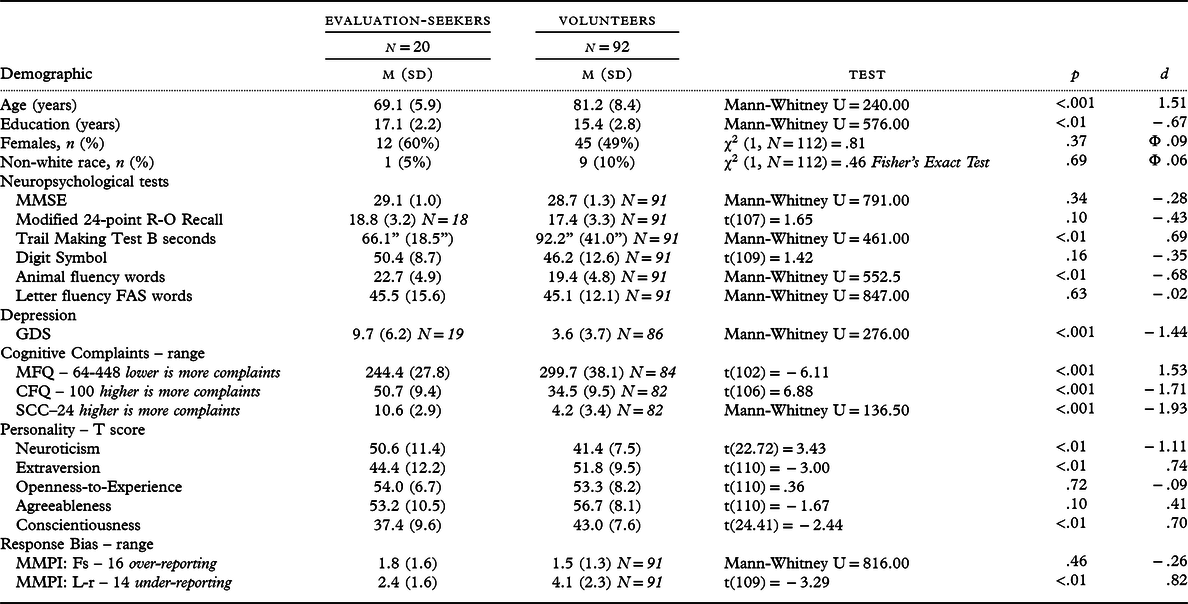
Demographic, cognitive, and psychological characteristics of the groups are reported in Table 1. The average age of evaluation-seekers was significantly younger than volunteers, and they had significantly higher education. They also performed better on some neuropsychological tests (Trails B and Animal Fluency). With sex, age, and education as covariates, only the modified Rey Osterrieth [R-O] figure delayed recall showed better performance by evaluation-seekers (Table S1). Despite demographically matching volunteers, the matched subsample was significantly older than evaluation-seekers; years of education and neuropsychological test performance did not differ (Table S2).
Demographic, cognitive, and self-reported psychological characteristics by study setting samples

Notes: MMSE, Mini Mental Status Examination; R-O, Rey Osterrieth; GDS, Geriatric Depression Scale; MFQ, Memory Functioning Questionnaire; CFQ, Cognitive Failures Questionnaire; SCC, subjective cognitive complaints scale; MMPI, Minnesota Multiphasic Personality Inventory; Fs, Infrequent Somatic Responses scale; L-r, Uncommon Virtues scale.
There were several group differences on psychological measures. Evaluation-seekers endorsed more depressive symptoms (GDS) and subjective cognitive complaints (MFQ, CFQ, SCC-24) compared to volunteers. Those significant differences held in both sensitivity analyses. The effect sizes (Cohen’s d) for group differences in mean subjective cognitive complaint scales ranged from 1.5 to 1.9 (Cohen’s d) using the whole volunteer sample; 1.4–1.8 (Cohen’s d) for the matched sample; and .2–.3 (partial η 2) with sex, education, and age as covariates, which is characterized as large.
Evaluation-seekers were also higher on Neuroticism, lower on Extraversion, and lower on Conscientiousness compared to volunteers. The effect sizes were medium for Conscientiousness (d = .6) and large for Neuroticism (d = 1.1) and Extraversion (d = .7). The same differences held in both sensitivity analyses, except for Extraversion when using the demographically matched volunteers.
Over-reporting
The difference between the mean Fs scores comparing over-reporting in the evaluation-seekers and volunteers was not significant. Three participants from both samples (3.4%), two seeking evaluation and one volunteer, had scores indicating a possibility of over-reporting of somatic complaints or credible symptoms of substantial medical conditions using the MMPI-2-RF clinical interpretive guidelines (Ben-Porath and Tellegen, Reference Ben-Porath and Tellegen2008).
Under-reporting
The mean L-r scores capturing under-reporting bias were higher in volunteers compared to evaluation-seekers (Table 1), an effect which was large (d = .8). This remained significant when controlling for sex, age, and education, but not when compared to the matched volunteers. No participants seeking evaluation had scores indicating under-reporting using the clinical guidance for the scale (Ben-Porath and Tellegen, Reference Ben-Porath and Tellegen2008). The volunteer sample had 26 participants (28.6%) who scored at that level. The matched volunteer subsample included 3 participants (15%).
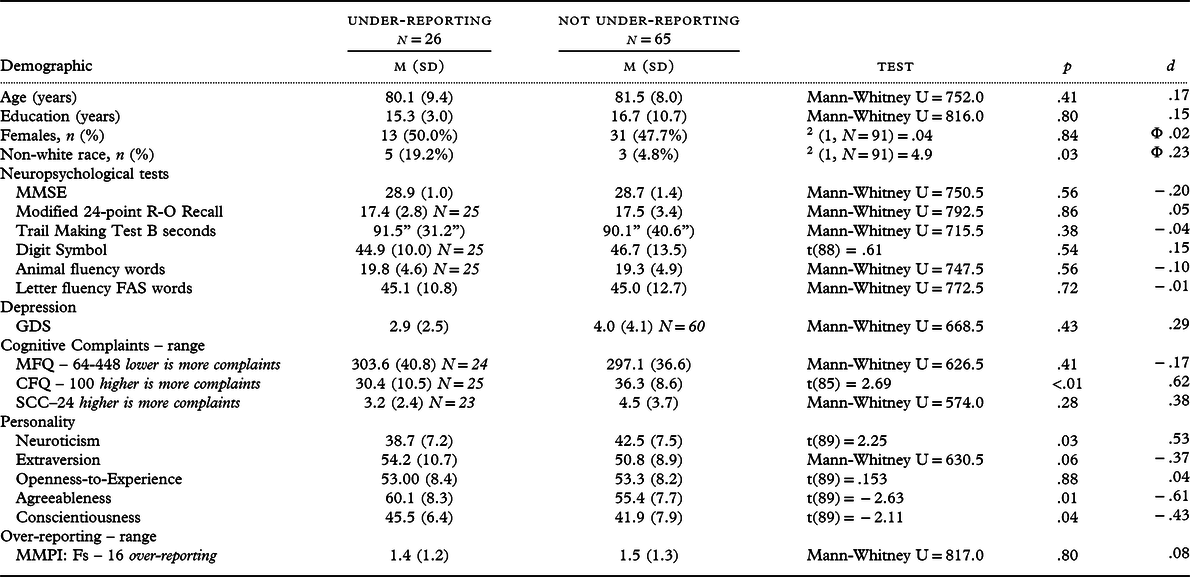
We further explored under-reporting response bias by examining the n = 26 volunteers above the clinical cutoff and the remaining volunteers below that cutoff score (Table 2). There were no significant differences in age, education, sex, depression scores, or neuropsychological test scores between those two groups. Five participants whose responses indicated possible under-reporting were non-white (19.2%) compared to three non-white participants whose responses did not indicate under-reporting (4.8%), p < .05. This effect size was small (phi = .2).
Volunteer sample characteristics subgrouped by under-reporting behavior

Notes: MMSE, Mini Mental Status Examination; R-O, Rey Osterrieth; GDS, Geriatric Depression Scale; MFQ, Memory Functioning Questionnaire; CFQ, Cognitive Failures Questionnaire; SCC, subjective cognitive complaints scale; MMPI, Minnesota Multiphasic Personality Inventory; Fs, Infrequent Somatic Responses scale.
One of the three self-report scales measuring cognitive complaints, the CFQ, was significantly lower in under-reporters compared to remaining volunteers. The difference between mean scores reflected a medium effect size (Cohen’s d = .6). Under-reporters had lower mean Neuroticism, higher Agreeableness, and higher Conscientiousness. The effects for these personality differences were medium in size (Cohen’s d ranging from .5 to .6). Besides differences shared by all volunteers, under-reporters also had higher Agreeableness t-scores compared to evaluation-seekers (t(44) = −2.6, p < .05). The difference in Agreeableness t-scores, −7.0, was large (Cohen’s d = .7)
Partial correlations between response bias and self-report scales
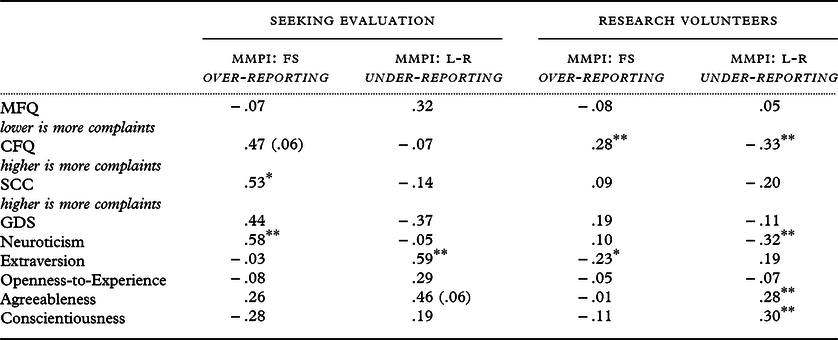
Significant relationships between response bias and self-report scales after controlling for sex, age, and education, as shown in Table 3, were observed in both study groups. Over-reporting had a positive relationship with cognitive complaints measured by the CFQ in volunteers, rS (82) = .28, p < .01 (possibly in evaluation-seekers too, rS (15) = .47, p = .06) and SCC in evaluation-seekers rS (15) = .53, p < .05. Under-reporting showed a negative correlation with cognitive complaints measured by the CFQ, rS (82) = −.33, p < .01. Cognitive complaints measured by the MFQ did not have a relationship with either measure of response bias.
Partial Spearman’s correlations between Response Bias Scales and other self-report controlling for sex, age, and education

Notes: *<.05; **<.01; MFQ, Memory Functioning Questionnaire; CFQ, Cognitive Failures Questionnaire; SCC, subjective cognitive complaints scale; MMPI, Minnesota Multiphasic Personality Inventory; Fs, Infrequent Somatic Responses scale; L-r, Uncommon Virtues scale.
When reviewing the correlations with personality, Neuroticism showed a positive correlation with over-reporting in evaluation-seekers, rS (15) = .58, p < .05, and a negative correlation with under-reporting in volunteers, rS (86) = −.32, p < .01. Conversely, Extraversion showed a positive relationship with under-reporting in evaluation-seekers, rS (15) = .59, p = .01, and a negative relationship with over-reporting in volunteers, rS (86) = −.23, p < .05.
In volunteers, under-reporting showed a positive relationship with Conscientiousness, rS (86) = .28, p < .01, and with Agreeableness, rS (86) = .28, p < .01. The correlation with Agreeableness approached, but did not meet significance in evaluation-seekers, rS (15) = .46, p = .06.
Discussion
The present study investigated response bias in cognitively normal older adults from two different settings, that is, seeking evaluation vs. volunteering for research. Specifically, we assessed the tendency to over- or under-report symptoms on questionnaires and their associations with subjective cognitive complaints and personality. We found that under-reporting bias differs by setting, further showing differences in relationships with subjective cognitive complaint scales and five-factor personality traits. Consideration of response bias contributes to the increasing empirical literature on SCD (Jessen et al., Reference Jessen2020) and, specifically, to better understand the complexity of psychological factors influencing self-reported cognitive functioning and its measurement (Hülür et al., Reference Hülür, Hertzog, Pearman and Gerstorf2015; Chin et al., Reference Chin, Oh, Sea and Na2014; Pearman and Hertzog, Reference Pearman and Hertzog2014; Hurt et al., Reference Hurt, Burns, Brown and Barrowclough2010; Buckley et al., Reference Buckley, Saling, Frommann, Wolfsgruber and Wagner2015).
Response bias by setting
Evaluation-seekers did not show significantly different over-reporting behavior compared to volunteers. However, the Fs scale was previously shown to be sensitive to over-reporting memory complaints (Gervais et al., Reference Gervais, Ben-Porath, Wygant and Sellbom2010), and there are indications of a possible relationship between cognitive complaints and reporting behavior of health complaints in general (Tellegen and BenPorath, Reference Tellegen and Ben-Porath2008; Gervais et al., Reference Gervais, Ben-Porath, Wygant and Green2008; Armistead-Jehle et al., Reference Armistead-Jehle, Gervais and Green2012a; Armistead-Jehle et al., Reference Armistead-Jehle, Gervais and Green2012b; Hänninen et al., Reference Hänninen1994). Noting that participants with severe emotional distress or psychopathology were excluded from the present study, this lack of evidence for otherwise healthy help-seeking older adults significantly over-reporting symptoms supports recommendations to not assume that memory concerns are invalid or unactionable (Mark and Sitskoorn, Reference Mark and Sitskoorn2013; Peterson et al., Reference Peterson2018).
Analysis indicated under-reporting was less likely in evaluation-seekers than volunteers to large effect. Previous studies of older adults showed evidence of disproportionate positive self-assessment compared to younger adults of health status relative to objective indicators (Hülür et al., Reference Hülür, Hertzog, Pearman and Gerstorf2015; Idler and Cartwright, Reference Idler and Cartwright2018; Idler, Reference Idler1993), emotional recovery (Pearman et al., Reference Pearman, Andreoletti and Isaacowitz2010), and depressive symptoms when presenting for inpatient psychiatric care (Lyness et al., Reference Lyness, Cox, Curry, Conwell, King and Caine1995). In the present study, none of the evaluation-seekers were possible “under-reporters” based on the MMPI-2-RF manual cutoff – a factor of the selection criteria for clinically significant cognitive concerns in an academic memory clinic. In contrast, a subset of 26 volunteers were under-reporters. Under-reporting bias is likely important to consider when recruiting for research from non-help-seeking populations to study preclinical stages of AD. This study did not find strong evidence for different neuropsychological test performance by volunteers with high under-reporting; however, assessing risk and possible masking of perceived or objective cognitive decline is an opportunity for further study. It may be worth investigating whether assessment of under-reporting bias in older adult research or community screening settings might be used to adjust symptom scores to increase validity and utility.
Response biases and subjective memory complaints
Assessment of cognitive complaints is ideally a multistep process (Jessen et al., Reference Jessen2014), and measurement scales used in research are widely variable (Mark and Sitskoorn, Reference Mark and Sitskoorn2013). The three self-report subjective cognition scales used in this study captured significantly higher cognitive complaints in evaluation-seekers to large effect across all analyses, supporting their validity. Yet, self-report scales of cognitive complaints can be susceptible to response bias to various degrees (Tellegen and BenPorath, Reference Tellegen and Ben-Porath2008; Gervais et al., Reference Gervais, Ben-Porath, Wygant and Green2008; Armistead-Jehle et al., Reference Armistead-Jehle, Gervais and Green2012a; Armistead-et al., Reference Armistead-Jehle, Gervais and Green2012b). In the present study, scales with higher face validity, with items reflecting symptoms or life dysfunction, appear more susceptible to response bias. Over-reporting partial associations with the CFQ and SCC were observed controlling for sex, age, and education. Both are scales with items worded toward memory and other cognitive failures (e.g. CFQ: ‘How often do you forget appointments?/where you put something?/people’s names?’). Further, the CFQ was associated with under-reporting in volunteers to the degree that under-reporting volunteers had significantly fewer complaints than the remaining volunteers. Generally, the MFQ was less sensitive to reporting bias and age differences (consistent with Hertzog et al., Reference Hertzog, Hultsch and Dixon1989). There was also an association between the MFQ and Aβ deposition in normal older adults previously reported (Snitz et al., Reference Snitz2015b). Both observations seem to support the value of this scale in studying preclinical AD and subjective cognitive complaints across different study settings. As noted above, future research can determine whether correcting for response bias might result in increased associations with, and prediction of, underlying disease such as preclinical AD.
Response biases and personality factors
Over-reporting was associated with higher Neuroticism in evaluation-seekers only. While in volunteers had significantly higher Extraversion to moderate effect and over-reporting was associated with higher Extraversion in that setting. MMPI-2-RF normative data do not reflect strong intercorrelations between over-reporting tendency and Neuroticism nor the interpersonal scales (Tellegen and BenPorath, Reference Tellegen and Ben-Porath2008). Rather than reflecting possible symptom invalidity, over-reporting bias in the current study may reflect a facet of Neuroticism and emotional dysregulation as in other settings (Tellegen and BenPorath, Reference Tellegen and Ben-Porath2008). The relationship between over-reporting and Extraversion is an opportunity for future study particularly in older adult settings.
In previous studies, we and others reported that increased Neuroticism is a correlate of subjective memory complaints (Snitz et al., Reference Snitz2015a; Snitz et al., Reference Snitz2015b; Steinberg et al., Reference Steinberg2013; Pearman and Storandt, Reference Pearman and Storandt2004), and here evaluation-seekers were significantly higher in Neuroticism than volunteers to large effect even when controlling for demographic differences. Neuroticism is thought as a predictor of cognitive decline and incident dementia (Mroczek et al., Reference Mroczek, Spiro, Griffin, Birren and Schaie2006; Wilson et al., Reference Wilson, Evands, Bienias, Mendes de Leon, Schneider and Bennett2003), but recently cognitive complaints were found to mediate objective cognition with emotional stability over time only in that direction (Aschwanden et al., Reference Aschwaden, Kliegel and Allemand2018). Neither Neuroticism’s nor Extraversion’s relationship with reporting behavior, evaluation setting, cognitive complaints, and cognitive prognosis is fully defined and should be evaluated longitudinally, not solely as a baseline measure.
Though the under-reporting scale has few intercorrelations across all MMPI-2-RF normative and clinical samples (Tellegen and BenPorath, Reference Tellegen and Ben-Porath2008), present findings show relationships between under-reporting bias and four of the “Big Five” personality traits excluding Openness-to-Experience. Among evaluation-seekers, under-reporting was positively correlated with higher Extraversion. Although this association was not observed in volunteers, they had significantly higher mean Extraversion and under-reporting scores compared to evaluation-seekers. Volunteers also expressed significantly lower mean Neuroticism and higher mean Conscientiousness compared to evaluation-seekers even when controlling for age, sex, and education with moderate to large effect sizes; both traits, as well as Agreeableness, correlated with under-reporting in the volunteer setting. A nuanced, multifaceted personality profile, rather than a single trait, likely influences behaviors such as under-reporting and help-seeking for cognitive complaints, over and above health status (Kinnunen et al., Reference Kinnunen2012).
Limitations and future considerations
The study design was largely exploratory and limited to cognition, response bias, and personality. Cross-sectional design precludes prediction of future decline, stability, or the direction of influence of these factors. Previously identified correlates of help-seeking, subjective cognition, and objective cognition were not measured, such as anxiety, self-efficacy (Pearman and Storandt, Reference Pearman and Storandt2004; Hänninen et al., Reference Hänninen1994; Hurt et al., Reference Hurt, Burns, Brown and Barrowclough2012), and effort (Armistead-Jehle et al., Reference Armistead-Jehle, Gervais and Green2012b). Small sample size of evaluation-seekers and under-reporters limits the power of study analyses. Large confidence intervals, particularly for smaller scaled measures, limit reproducibility and clinical utility. Effect sizes were small when comparing over-reporting response bias and neuropsychological test performance by setting across analyses. The case–control matching sensitivity analysis could not completely control for the significantly younger evaluation-seekers. The number of tests conducted increases the likelihood of statistically random occurrences being reported as significant. Finally, the under-reporting RBS used in the study has interpretive precautions for its association with traditional values (Ben-Porath and Tellegen, Reference Ben-Porath and Tellegen2008). It has been shown to be higher in some ethnic and minority groups with small effect (Marek et al., Reference Marek, Ben-Porath, Sellbom, McNulty and Heinberg2015), also suggested in present results. Future studies may investigate the interplay between under-reporting bias and cultural factors in illness perceptions to further the understanding of low rates of help-seeking and participation among under-represented minorities in clinical AD research (Barnes and Bennett, Reference Barnes and Bennett2014).
In sum, response bias and study setting both may contribute significantly to inconsistent and conflicting findings in the SCD literature (Rabin et al., Reference Rabin, Smart and Amariglio2017; Reid and MacLullich, Reference Reid and MacLullich2006) and studies of the relationship between personality and cognition in older adults. Consideration of study setting and related selection factors in future research, including response bias and personality, may increase both internal and external validity of assessing SCD across different settings. This approach may in turn advance the quest to better detect risk and investigate progression to AD at the preclinical stage.
Conflict of interest declaration
Dr. Oscar L. Lopez is a consultant for Grifols International, S.A. The other authors have no conflicts of interest to declare.
Description of authors’ roles
Sarah M. Goldberg formulated research questions, designed the study, conducted data analysis, and wrote the paper.
Oscar L. Lopez oversaw data collection and components of study design.
Ann D. Cohen oversaw data collection and components of study design.
William E. Klunk oversaw data collection and components of study design and assisted in writing the paper.
Howard A. Aizenstein oversaw data collection and components of study design.
Akiko Mizuno assisted in writing the paper.
Beth E. Snitz formulated research questions, designed the study, oversaw data collection, and assisted in writing the paper.
Acknowledgments
This work was supported by the NIH-NIA under grants AG038479, AG025516, P50 AG005133. We thank the study participants and staff of the University of Pittsburgh Alzheimer Disease Research Center and the PiB-PET Normal Aging Study, without whose time and effort this research would not be possible.
Supplementary material
To view supplementary material for this article, please visit https://doi.org/10.1017/S1041610220000319