Among various factors contributing to school success, research has pointed to the importance of classroom narrative discourse for children's engaged learning, literacy achievement, and cognitive and socioemotional development (Banks, Reference Banks2001; Cazden, Reference Cazden1988; Gay, Reference Gay2000; Heath, Reference Heath1983; Lue et al., Reference Lue, Green, Smalley, Obiakor and Ford2002; Wiley, Reference Wiley2005). Students with language disabilities or learning disabilities (LDs) have been shown to have less access to classroom discourse-based learning activities such as discursive teacher–student dialogues and peer cooperative learning (e.g., Donahue, Reference Donahue, Ripich and Creaghead1994, Reference Donahue, Butler and Silliman2002; Kraker, Reference Kraker2000). Their access to the benefits of classroom narrative discourse may be diminished due to the specific weaknesses in narrative performance that have been well documented in previous research (e.g., Celinska, Reference Celinska2004, Reference Celinska2010; Copmann & Griffith, Reference Copmann and Griffith1994; Crais & Chapman, Reference Crais and Chapman1987; Dolyniuk, Reference Dolyniuk1999; Roth & Spekman, Reference Roth and Spekman1986; Williams, Reference Williams1993, Reference Williams2000). Because the existing portrayal of narrators with LDs is a mosaic of narrative skills that emerged from the inquiries that predominantly utilized a single narrative approach, our understanding of narrative performance of these students may be incomplete. This study examines the congruence of the findings from two complementary narrative analysis perspectives, high point analysis (HPA) and episodic analysis (EA), in terms of the competencies of narrators with LDs to fulfill the referential and evaluative narrative functions. As a result, this study may provide additional insights into narrative strengths and weaknesses of these narrators, as well as contribute to the current practices in language assessment and intervention targeting their narrative performance.
The importance of narrative discourse for student classroom learning and participation is evidenced by the common use of narrative activities in a variety of instructional activities and materials (e.g., Gay, Reference Gay2000; Hicks, Reference Hicks1993). As a distinct form of constructing knowledge (Bruner, Reference Bruner1986, Reference Bruner1990, Reference Bruner1991; Egan, Reference Egan1999; Ochs, Reference Ochs and van Dijk1997; Olson, Reference Olson, Britton and Pellegrini1990), narratives are uniquely suited to facilitate children's conceptual and problem-solving skills (Dolyniuk, Reference Dolyniuk1999; Roney, Reference Roney1996) and “to guide the narrator's perception of the reality” (Bruner, Reference Bruner1991, p. 6). In classrooms, narrative-based instruction effectively facilitates children's conceptual understandings by applying abstract concepts in specific contexts (Cazden, Reference Cazden1988; Egan, Reference Egan1999; Hicks, Reference Hicks1993). While participating in narrative discourse, students not only construct new knowledge but also engage in specific identities, attitudes, and social interactions (Bamberg, Reference Bamberg and Bamberg1997; Gee & Green, Reference Gee and Green1998; Miller, Reference Miller, Neisser and Fivush1988; Moore, Reference Moore2004; Ochs, Reference Ochs and van Dijk1997; Vitz, Reference Vitz1990). Children's narratives “encapsulate and carry through time and space meanings shared by and lived out . . . by the social group” (Gee, Reference Gee, McCabe and Peterson1991, p. 12). By creating a pattern of narrative themes drawn from their social traditions and activities, children communicate their perspectives on the reported events that express their social and cultural identities. In the roles of an audience and a narrator, students engage in ongoing classroom dialogs to negotiate common cultural meanings, establish new social relationships (Hicks, Reference Hicks, McCabe and Peterson1991, Reference Hicks1993), and build classroom communities (Dyson & Genishi, Reference Dyson, Genishi, Dyson and Genishi1994). Classroom narratives allow children to “play with social and cultural lines influenced by age, sex, class, race, ethnicity” and become “vehicles for bringing diverse voices into the classroom itself” (Dyson, Reference Dyson, Dyson and Genishi1994, p. 168).
In addition to classroom-based intellectual and social engagement and learning, narrative discourse activities contribute to various aspects of literacy development (e.g., Blank, Reference Blank, Butler and Silliman2002; Feagans & Applebaum, Reference Feagans and Appelbaum1986; Roth, Speece, Cooper, & De La Paz, Reference Roth, Speece, Cooper and De La Paz1996; Zigo, Reference Zigo1998). Correlational studies have provided evidence that link children's narrative skills and concurrent and future reading achievement. Young children's competency in specific oral narrative forms has been related to their later successful transition to emergent reading (Sulzby & Zecker, Reference Sulzby, Zecker, McCabe and Peterson1991). Narrative abilities of low-income preschoolers at risk for academic and language problems has been considered one of the best predictors of their later reading achievement and school outcomes (Paul & Smith, Reference Paul and Smith1993; Snow & Dickinson, Reference Snow and Dickinson1990; Zevenberger, Reference Zevenbergen1997). A relationship between narrative performance and reading achievement has been established for older struggling readers (Roth et al., Reference Roth, Speece, Cooper and De La Paz1996). The role of narrative skills in literacy development has been further evidenced by the outcomes of narrative-based literacy interventions given to students representing various backgrounds and literacy achievement levels. For example, urban minority, low-income preadolescent and adolescent poor readers and writers improved their reading and vocabulary skills, as well as their engagement in reading tasks, in response to narrative-based literacy instruction (Miller & Legge, Reference Miller and Legge1999; Zigo, Reference Zigo2001). Students with LDs also demonstrated growth in conceptual reasoning (Dolyniuk, Reference Dolyniuk1999), reading comprehension, and written expression (Gardill & Jitendra, Reference Gardill and Jitendra1999; Kuldanek, Reference Kuldanek1998; Roth, Reference Roth2000; Williams, Reference Williams2000) in response to direct instruction focusing on narrative organization patterns and/or the use of narratives in literacy learning activities.
NARRATIVES OF CHILDREN WITH LDs
Given the role of narratives in classroom learning and engagement, and literacy achievement, researchers have extensively explored narrative abilities in children with language disabilities and/or LDs. In general, compared to same-age, typically achieving (TA) peers, these students have difficulty with understanding and generating specific narrative components and organizing them into more complex narrative structures to form a coherent narrative. In response to narrative comprehension questions, they depended on their idiosyncratic ideas instead of drawing inferences based on the relationships among narrative components (Crais & Chapman, Reference Crais and Chapman1987; Kameenui, Simmons, & Craig, Reference Kameenui, Simmons and Craig1987; Williams, Reference Williams1993). For example, Kameenui and collaborators (Reference Kameenui, Simmons and Craig1987) documented the difficulty of 10- to 12-year-old students with LD to infer goal and resolution information in stories. Similarly, 13- to 14-year-olds with LD who were asked to summarize read-along stories and identify story themes had difficulty with explicitly stating story themes and were more likely to import idiosyncratic responses into their statements (Williams, Reference Williams1993). While retelling narratives, children with LD are typically able to accurately recall the temporal sequence of events and include all structural organization categories with an adequate order of saliency (Copmann & Griffith, Reference Copmann and Griffith1994; Feagans & Short, Reference Feagans and Short1984; Griffith, Ripich, & Dastoli, Reference Griffith, Ripich and Dastoli1986; Montague, Maddux, & Dereshiwsky, Reference Montague, Maddux and Dereshiwsky1990; Ripich & Griffith, Reference Ripich and Griffith1988; Williams, Reference Williams1993). However, regardless of age, the listener's status (peer vs. adult), and the type of narrative measure, they recall less narrative information, especially in the category of characters’ internal responses (i.e., feelings or thoughts) and goal-directed behavior. Self-generated narratives of students with LD across narrative tasks are generally shorter, as a result of including less information about the context of the narrative events and the characters’ thoughts and feelings (Klecan-Aker, Reference Klekan-Aker1985; Roth & Spekman, Reference Roth and Spekman1986). When asked to generate make-believe stories, 8- to 13-year-old students with LD (compared to peers matched on age, vocabulary level, and socioeconomic status) provided stories that were shorter, containing fewer complete episodes and statements describing the characters and their thoughts, emotions, and goals. Further, in an attempt to produce coherent narratives, children with LD were less likely to link episodes with connectors involving direct causality and simultaneity of events (Roth & Spekman, Reference Roth and Spekman1986). In response to a task of telling a story about the plot of a favorite movie or television program, 11- to 13-year-old boys with LD relied on less developmentally advanced coherence patterns, included fewer descriptors of the context of story events and the characters’ thoughts and feelings, and often failed to provide a resolution to the initiating events (Klecan-Aker, Reference Klekan-Aker1985). Newcomer, Barenbaum, and Nodine (Reference Newcomer, Barenbaum and Nodine1988) documented similar patterns of narrative performance in a study comparing stories told about a picture by 8- to 15-year-old students with LD, TA peers, and low-achieving peers matched on grade and socioeconomic status. Compared to TA peers, children with LD produced fewer stories that included a setting and a conflict–resolution pair and fewer action sequences that recounted temporally linked non-goal-directed events. A comparison of personal narratives generated by students with and without LD, matched on gender, age, and grade, revealed that girls (but not boys) with LD produced fewer more complex narrative patterns that reflect a hierarchical structure organized around a central component of particular significance to the narrator (Celinska, Reference Celinska2004). Further, personal narratives of students with LD included fewer coherence patterns based on goal-directed episodic structures (Celinska, Reference Celinska2010).
In sum, students with language disabilities and/or LDs have difficulty with comprehending and generating specific types of narrative structural components and the narrative coherence patterns that result from structuring the narrative events into goal-directed sequences or around a central organizing component. This study analyzes the structural components and coherence patterns of two complementary narrative perspectives, HPA and EA, to provide additional insights into the existing portrayal of narrators with LD. Previous studies have most commonly relied on cognitive narrative approaches that emphasize the referential function of narratives to examine children's ability to represent narrative events by organizing various narrative components. The evaluative narrative function has been frequently omitted in narrative analyses, limiting our understanding of the LD narrators’ competency to communicate the significance and personal meaning of narrative events. In particular, this study examines the congruence of the results from the two perspectives to enhance our understanding of the ability of students with LD to fulfill both the referential and the evaluative functions in personal and fictional narratives.
STUDY FRAMEWORK: TWO PERSPECTIVES ON NARRATIVES
Each of the two narrative analysis perspectives used in this study, HPA and EA, has been designed to analyze specific dimensions of children's narrative structural organization and coherence. HPA examines narrative structures as they convey narrative events and the narrator's personal meaning of these events. As the narrator reveals his or her personal meaning of the recounted events by organizing narrative events around a single event of particular significance, the overall narrative coherence emerges. In contrast, EA uncovers how the narrative structures represent the narrator's knowledge of human intentionality and goal-directed behavior. Narrative coherence is achieved through episodic organization of the narrative events and the use of interepisodic connections in multiepisodic narratives.
HPA: A sociolinguistic perspective on narratives
A sociolinguistic perspective of HPA asserts that narrative as “a linguistic crossroads of culture, cognition, and emotion and serves the dual function of sense-making and self-representation” (McCabe, Reference McCabe and Bamberg1997, p. 137). This framework distinguishes two functions of narratives, referential and evaluative, that are continually interwoven to provide the overall structure of the narrative (Labov, Reference Labov1972; Labov & Waletzky, Reference Labov, Waletzky and Helm1967). The referential function provides the listener with the temporal and spatial context of reported events, describes characters, and reports the temporal sequence of events. The evaluative function communicates the narrator's attitude toward reported events, represents the narrator's personal meaning of events, and/or describes the narrator himself or herself. While the evaluative function may permeate the entire narrative, it typically intensifies around a high point, a climactic event within the narrative immediately preceding the resolution of the narrative conflict. As a result, a high point becomes the central structural element around which other narrative components are organized.
HPA proposes a prototypical narrative, called a classic narrative, that is composed of the seven distinct structural categories (Labov, Reference Labov1972; Labov & Waletzky, Reference Labov, Waletzky and Helm1967). A classic narrative opens with an abstract and/or introducer that encapsulates the narrative and/or summons the listener's attention (e.g., “This is a funny story”). Next, orientations paint the context by describing the characters and objects (e.g., “I got this ball for my birthday”) and orienting the listener as to temporal (e.g., “a long time ago”) and spatial (e.g., “at my grandma's”) dimensions of the events. Complicating actions recount the characters’ actions leading up to and including a high point. One event is emphasized as a high point by evaluations that express the personal importance and meaning of the recounted events to the narrator. Typically, the narrative evaluations designate a narrative event as “strange, uncommon, or unusual—that is, worth reporting” (Labov, Reference Labov1972, p. 371) and communicate to the listener “why the story was told in the first place (Labov, Reference Labov1972, p. 370). Evaluations may take the form of explicit statements (e.g., “I felt stupid”) and/or implicit linguistic devices (e.g., quoting, repetition of words/phrases, emphasizing a word/phrase, lengthening vowels, or use of intensifiers such as “all”). The high point may be followed by a resolution that resolves any conflict in the narrative (e.g., “and he finally escaped”). A coda can be added at the end to provide a closure (e.g., “And that's all”) and/or to link the narrative events to the ongoing narrator–listener communicative context (e.g., “And ever since then I haven't seen the guy ‘cause I quit”).
Peterson and McCabe's study (Reference Peterson and McCabe1983) on children's personal narratives revealed five patterns of narrative coherence in addition to the classic narrative. In the least developed narrative structure, a leapfrog narrative, events are either incomplete or presented without a recognizable organizational pattern. Impoverished narratives include an insufficient number of events or statements to form an event sequence and usually are limited to orientations and/or evaluations. Disoriented narratives are composed of contradictory statements and appear to reflect the child's confusion about the narrated events and/or struggle with language use. Chronological narratives temporally organize discrete events that occur within a specific time period into a temporal sequence without recognizing any particular one as a high point. In these narratives, the narrator fulfills the referential narrative function but fails to provide any evaluation of the reported events. Ending-at-the-high-point narratives contain a sequence of complicating actions inclusive of a high point, although they fail to resolve the central conflict of a narrative.
HPA: Research on children's narratives
HPA has been widely applied to explore various aspects of narratives produced by children of varying ages and backgrounds, and across different communicative contexts (Celinska, Reference Celinska2004; Champion, Reference Champion2003; Fivush & Haden, Reference Fivush, Haden, van, Bauer and Bourg1997; Kemper, Reference Kemper and Kuczaj II1984; Miller & Sperry, Reference Miller and Sperry1988; Peterson, Reference Peterson1990; Umiker-Sebeok, Reference Umiker-Sebeok1979). For example, a modified HPA was used to analyze children's early talk about past experience in the context of adult-guided conversations (Fivush & Hamond, Reference Fivush, Hamond, Fivush and Hudson1990; Miller & Sperry, Reference Miller and Sperry1988) and to investigate the structural organization of personal narratives produced by preschool children (Fivush & Haden, Reference Fivush, Haden, van, Bauer and Bourg1997; Peterson & McCabe, Reference Peterson and McCabe1983; Umiker-Sebeok, Reference Umiker-Sebeok1979). In a study of past personal experience narratives elicited in naturalistic conversations from 3- to 9-year-olds, Peterson and McCabe (Reference Peterson and McCabe1983) have applied HPA to document developmental changes in the overall coherence and complexity of children's personal narratives. Researchers have also utilized HPA to analyze age-related changes in the inclusion of the different narrative components (Labov, Reference Labov1972; Peterson & McCabe, Reference Peterson and McCabe1983). In addition to documenting developmental and individual differences in narrative performance, HPA has been used to illuminate the communicative functions of narrative performance and to analyze specific correlates of narrative performance relevant for school success. Champion (Reference Champion2003) utilized HPA to explore narratives of 6- to 10-year-old low-income African American children in order to address the unique communicative needs of these children through culturally relevant pedagogy. Similarly, Labov (Reference Labov1972) examined narratives of inner-city African American youth in a variety of communicative situations in an attempt to explain the relationship between the features of Black English vernacular and reading struggles in these students. In any event, HPA has provided a framework to analyze personal narratives produced by children with LD, resulting in additional insights into their narrative skills beyond understandings gained through cognitively oriented narrative analyses (Celinska, Reference Celinska2004, Reference Celinska2010).
EA: A cognitive perspective on narratives
Assuming that narratives reveal the narrator's cognitive representations, EA aims at describing “story schemas” or “story grammars” that guide narrative comprehension and recall (Black & Wilensky, Reference Black and Wilensky1979; Mandler, Reference Mandler1984; Rumelhart, Reference Rumelhart, Bobrow and Collins1975, Reference Rumelhart, LaBerge and Samuels1977; Stein & Glenn, Reference Stein, Glenn and Freedle1979, Reference Stein, Glenn and Friedman1982; Stein & Trabasso, Reference Stein, Trabasso and Glaser1982). In an attempt to capture these representations, EA explores children's mastery of the basic unit of narrative organization, called the episode. An episode describes a sequence of goal-directed actions by causally linking the character's thoughts and emotions to his/her problem-solving behavior. A focus on episodically organized goal-directed sequences (i.e., goal–attempt–outcome sequences), makes EA particularly well suited to evaluate the child's knowledge of human intentionality and causally organized problem-solving behavior (Stein & Albro, Reference Stein, Albro and Bamberg1997; Stein & Glenn, Reference Stein, Glenn and Freedle1979).
EA distinguishes two discrete structural categories of narrative organization: setting and episodes. Setting is composed of statements that describe the characters and the spatial and temporal context of a narrative. Episodes are the basic units of narrative organization that include the following structural categories: (a) initiating event, a change in the physical or psychological environment that affects the well-being of the protagonist and prompts his/her response (e.g., “a bee was in it which I didn't see”); (b) internal responses, the protagonist's perceptions, thoughts, beliefs, values, and emotions that underlie appraisal of the initiating event and lead to setting up goals in response to the initiating event (e.g., “so I got a cast I didn't like”); (c) attempts, the protagonist's goal-oriented actions (e.g., “the cat was trying to learn how to talk to people”); (d) direct consequences, outcomes related to the attainment of goal(s) and the changes that result from the attempt (e.g., “I jumped and I got it”), and (e) reactions, the protagonist's thoughts and feelings resulting from the outcomes of his/her actions (e.g., “it made her feel better”).
Developmental research has described seven distinct patterns of the story episodic organization that represent a progression in the children's understanding of goal-directed behavior (Stein, Reference Stein, Franklin and Barten1988; Stein & Albro, Reference Stein, Albro and Bamberg1997; Stein & Policastro, Reference Stein, Policastro, Mandel, Stein and Trabasso1984; Trabasso & Stein, Reference Trabasso, Stein, van den Broek and Bourg1997). The least advanced narrative structure, a descriptive sequence, includes descriptions of characters, actions, and settings without temporally or causally relating them to each other. Once the narrative events become interrelated, two additional narrative patterns appear: an action sequence, in which narrative events are temporally sequenced, and a reactive sequence, in which a chain of events reveals temporal and/or causal organization in the form of non-goal-directed behavior sequences. In contrast, an abbreviated episode includes events that are causally structured into episodes, and a goal of the protagonist can be inferred by the listener or explicitly expressed by the narrator. Although this level of stories contains an intact episode with a goal, attempt, and outcome, two components of a complete episode are missing: an obstacle to goal attainment and an ending.
EA: Research on children's narratives
Assuming that narrative organization reveals cognitive structures, researchers have specified the underlying cognitive representations reflected in narrative components and documented how hierarchical story schemata facilitate children's comprehension of narrative discourse (Mandler, Reference Mandler1978, Reference Mandler1984; Rumelhart, Reference Rumelhart, Bobrow and Collins1975, Reference Rumelhart, LaBerge and Samuels1977; Stein & Glenn, Reference Stein, Glenn and Freedle1979, Reference Stein, Glenn and Friedman1982). Using various story grammar frameworks, developmental researchers have generated extensive data on children's comprehension, memory, and production of simple fictional narratives across such narrative tasks as recall (Stein & Albro, Reference Stein, Albro and Bamberg1997; Stein & Glenn, Reference Stein, Glenn and Freedle1979), answering comprehension questions (Stein & Glenn, Reference Stein, Glenn and Freedle1979), and generating a story to a story stem or pictorial stimulus (Stein, Reference Stein, Franklin and Barten1988; Stein & Policastro, Reference Stein, Policastro, Mandel, Stein and Trabasso1984; Trabasso & Stein, Reference Trabasso, Stein, van den Broek and Bourg1997). For example, EA has been applied to analyzing narratives produced by primary-grade low-income African American students, contributing to expanding knowledge of narrative repertoire and preferences in these children (Champion, Reference Champion2003). EA has provided the most prominent framework to examine a variety of narrative skills in children with language disabilities and/or LDs across a wide range of ages in communicative interactions with both peers and adults (see discussion in the introductory section above). Multiple studies have explored narrative comprehension in these children through inference (Crais & Chapman, Reference Crais and Chapman1987; Kameenui et al., Reference Kameenui, Simmons and Craig1987; Williams, Reference Williams1993) or recall tasks (Feagans & Short, Reference Feagans and Short1984; Griffith et al., Reference Griffith, Ripich and Dastoli1986; Montague et al., Reference Montague, Maddux and Dereshiwsky1990). Researchers have also investigated the overall coherence and structural complexity of narratives generated by these children (e.g., Klecan-Aker, Reference Klekan-Aker1985; Newcomer et al., Reference Newcomer, Barenbaum and Nodine1988; Roth & Spekman, Reference Roth and Spekman1986), as well as adults with LD (Worden, Malmgren, & Gabourie, Reference Worden, Malmgren and Gabourie1982).
HPA and EPA: Different focus and prototypic narrative
The two narrative perspectives used in this study differ in terms of the underlying theoretical assumptions about the narrative functions, as well as in the privileged prototypic narrative (genre). With respect to the former, EA asserts that narratives reflect the narrator's cognitive structures and, consequently, emphasizes the referential function of narratives in the form of episodic organization. Because episodic sequences describe how the character's thoughts and feelings are causally related to his/her problem-solving behavior, they “by nature and definition are reflections of the social values, beliefs, and goals that underline and motivate human interaction” (Stein, Reference Stein, Franklin and Barten1988, p. 282). By focusing on analysis of episodically organized, goal-directed actions, EA is particularly appropriate to evaluate the child's knowledge of human intentionality and causally organized problem-solving behavior (Stein & Albro, Reference Stein, Albro and Bamberg1997; Stein & Glenn, Reference Stein, Glenn and Freedle1979). In contrast, HPA, while incorporating the referential function, broadens narrative analysis to include the evaluative narrative function in order to capture the narrator's personal meaning of the recounted events. The personal significance of the narrative events is most effectively communicated to the audience in the form of a high point. Specifically, the high point assumes the role of the central structural element around which other narrative components are organized to emphasize the significance of the event(s) of particular relevance and meaning to the narrator. By means of the evaluative function, the narrators express their personal and sociocultural identities (e.g., Bamberg, Reference Bamberg and Bamberg1997; Gee & Green, Reference Gee and Green1998; Moore, Reference Moore2004; Ochs, Reference Ochs and van Dijk1997; Vitz, Reference Vitz1990) and build relationships with their audiences (e.g., Champion, Reference Champion2003; Kerman, Reference Kerman, Ervin-Tripp and Mitchell-Kernan1977). Thus, by analyzing both the representation of narrative events and their personal significance and evaluation, HPA is uniquely suited to capture the overall narrative coherence emerging from the organization of narrative events reflective of personal meanings and identity.
Reflective of the described specific assumptions and analytical focus, the two perspectives vary with respect to the privileged prototypic narrative. EA prototypic narrative structure is a story, a distinct narrative genre that incorporates fictional content and underlies such narrative forms as make-believe, fairy tales, fables, and folklore. Unlike other narrative genres, stories are marked by the extraordinary use of language and the literate nature of their form and content (Heath, Reference Heath1986). From this perspective, traditional folk tales are regarded as the prototypic narrative forms that best reflect the knowledge of goal-directed behavior. In contrast, HPA privileges recounts of past personal experience because they best represent the two interwoven functions of narratives: cognitive representation of the narrative events and the subjective meaning of these events expressed by the narrator to his/her audience in the context of communicative exchanges (Labov, Reference Labov1972).
METHOD
Participants
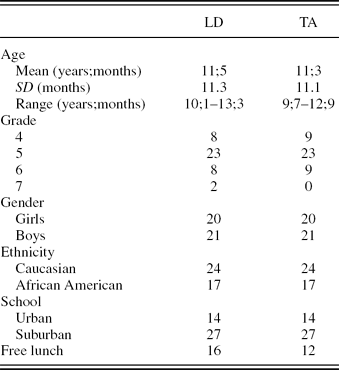
The participants were students with LDs (LD group) and TA peers from their schools (TA group; see Table 1). Each group included 41 students, and the two groups were matched on age (within 6 months), grade, gender, and ethnicity. Among 82 students (41 girls, 41 boys), 48 were Caucasian and 34 were African American. All participants were native English language speakers. The participants attended urban (N = 28) and suburban (N = 54) schools in a Midwest metropolitan area, with an equal number of boys and girls at each grade level.
Comparison of learning disability (LD) and typically achieving (TA) groups on the group demographic characteristics

The participants attended fourth (N = 17), fifth (N = 46), sixth (N = 17), and seventh (N = 2) grades, with Grades 4–6 constituting the majority (98%) of the sample. The LD group included 8 fourth graders, 23 fifth graders, 8 sixth graders, and 2 seventh graders. The TA group consisted of 9 fourth graders, 23 fifth graders, and 9 sixth graders. Thus, the two groups appear to have a comparable distribution of participants across the grade levels.
Sixteen LD students (39% of the LD group) and 12 TA students (29% of the TA group) were eligible for free or reduced lunch.
The mean age of the LD participants was 11 years, 5 months (SD = 11.3 months), ranging from 10 years, 1 month to 13 years, 3 months. The mean age of the TA participants was 11 years, 3 months (SD = 11.1 months), ranging from 9 years, 7 months to 12 years, 9 months (see Table 1). The results of one-way analysis of variance (ANOVA) on chronological age, F (1, 74) = 1.11, p = .295, indicated that the two groups were comparable with respect to the participants’ age. Developmental research that analyzed children's oral fictional stories (Kemper, Reference Kemper and Kuczaj II1984) and personal narratives (Peterson & McCabe, Reference Peterson and McCabe1983) using both EA and HPA indicated that the development of narrative structure is essentially completed by age 10 when children's narratives include all the structural components and achieve the most advanced narrative coherence patterns of both frameworks. The narrative structural complexity increases as children begin to include the characters’ internal responses, causally link narrative components in the form of goal-directed actions, organize events around a high point, and/or produce more complex and multiple episodic structures. Given the above developmental findings along with the participants’ age range from 9 years, 7 months to 13 years, 3 months and that the two groups did not differ with respect to age, it seems unlikely that age might have influenced the current results and/or masked possible age-related narrative performance differences across the LD and TA groups.
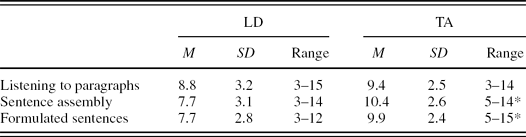
The participants’ language skills were assessed using select subtests of the Clinical Evaluation of Language Fundamentals—Third Revision (Semel, Wiig, & Secord, Reference Semel, Wiig and Secord1995). Two subtests, the formulated sentences and sentence assembly, were used to evaluate expressive syntactic skills, and the listening to paragraphs subtest was used to evaluate listening comprehension skills. A series of one-way ANOVAs was used to detect possible group differences on the three measures (see Table 2). Compared to the TA group, the LD group obtained significantly lower scaled scores on the sentence assembly (M = 7.7 and 10.4, respectively), F (1, 78) = 19.02, p = .000, η2 = 0.196, and formulated sentences (M = 7.7 and 9.9, respectively), F (1, 78) = 22.97, p = .000, η2 = 0.227, subtests. The group difference on the listening to paragraphs subtest was nonsignificant (M = 8.8 and 9.4, respectively), F (1, 78) = 1.72, p = .194, η2 = 0.022.
Comparison of learning disability (LD) and typically achieving (TA) groups on the subtests of the Clinical Evaluation of Language Fundamentals—Third Revision
*Significant differences. The level of significance was adjusted to .0166.
The TA participants (TA group) included students without any history of remedial services. Student achievement was assessed based on the scores on a district/state standardized achievement test (data available for 37 students). Among 26 students who took the Illinois Standards Achievement Test, 22 met or exceeded standards in reading, 22 in writing, and 20 in mathematics. Among 13 students who took the Iowa Test of Basic Skills, 9 demonstrated at least moderate achievement in reading and 9 in mathematics (no scores in writing were available). Overall, out of 37 participants for whom achievement scores were available, 84% demonstrated adequate achievement in reading and 78% in mathematics. The TA group demonstrated adequate listening comprehension and expressive syntactic skills (see Table 2).
The participants were identified as having an LD (LD group) by their school-based multidisciplinary teams according to the federal definition of specific LDs as it appears in the Individuals With Disabilities Education Act Amendments of 1997 (US Department of Education, 1997, 34 C.F.R. 300.7):
Specific learning disabilities means a disorder in one or more of the basic psychological processes involved in understanding or in using language, spoken or written, that may manifest itself in an imperfect ability to listen, think, speak, read, write, spell, or do mathematical calculations, including such conditions as perceptual disabilities, brain injury, minimal brain dysfunction, dyslexia, and developmental aphasia. The term does not include learning problems that are primarily the result of visual, hearing or motor disabilities, of mental retardation, of emotional disturbance, or of environmental, cultural, or economic disadvantage.
In the identification of specific LDs, the teams adhered to the following classification criteria (US Department of Education, 1997, 34 C.F.R. 300.541): (a) achievement not commensurate with the child's age and ability levels in one or more of the following areas: oral expression, listening comprehension, written expression, basic reading skill, reading comprehension, mathematics calculation, and/or mathematics reasoning; (b) existence of a severe discrepancy between achievement and intellectual ability; and (c) exclusion of the following conditions as a primary reason for underachievement: a visual, hearing, or motor impairment; mental retardation; emotional disturbance; or environmental, cultural, or economic disadvantage. In addition, all participants with LD met the research selection criterion of an absence of a diagnosis of an emotional disturbance as a primary or secondary disability on the participant's most recent case study evaluation or individualized education plan.
Data on academic achievement from their most recent case study evaluations and/or individualized education plans indicated that 36 exhibited difficulties with reading, 38 in writing, and 28 in mathematics. Data on cognitive weaknesses available for 40 participants revealed that 37 had weaknesses in auditory processing, 36 in visual processing, 15 in conceptual thinking/reasoning, 9 in organization of independent work, and 20 in attention, monitoring, and/or following directions. The majority of LD students (32 out of 41) received more than 50% of their instruction in a general education setting. Although the LD group showed listening skills comparable to the TA group, their expressive syntactic skills were significantly lower than those of their TA peers (see Table 2).
Narrative collection procedure
The participants’ personal and fictional narratives were collected within the context of conversation between each participant and an interviewer (McCabe & Rollins, Reference McCabe and Rollins1994; Peterson & McCabe, Reference Peterson and McCabe1983). The interviewer was a Caucasian female graduate student in special education who remained blind as to the disability, age, and grade status of the participants. In a separate room in the school, following a short introduction and assent, the interviewer initiated a casual conversation and explicitly encouraged the child to narrate about his/her recent experiences. Next, the interviewer assumed the role of a narrator who told short narratives on topics related to common childhood experiences (e.g., travel adventures or accidents) and prompted the child to recount similar events from his/her own experiences. To facilitate narrating, the interviewer showed an interest in, and support of, the child's recounts regardless of their content and/or organization. Narrating personal experiences was followed by the interviewer's explicit prompt to tell a fictional (make-believe) story. All interviews were audiotaped and transcribed verbatim.
Narrative data coding and reliability: Narrative structural organization and coherence
Audiotaped interviews were transcribed by two graduate assistants: one being a transcriber and another serving as a reviewer of the transcripts’ accuracy. Both graduate assistants were blind as to the participants’ disability status, ethnicity, grade, age, and school attended. The discrepancies between the two transcribers were mainly resolved by discussion. The lack of agreement after discussion was resolved by the author, who provided her vote. To assure reliability of data, the interrater agreement for all steps of the coding procedure (see detailed descriptions below) was calculated by first dividing the number of codes that agreed over the total number of codes and then multiplying by 100. All coding was performed by two raters: the author, who served as the first rater, and the graduate assistant, who served as the second rater. Using the interviews excluded from this study, the author trained the second rater by discussing the definitions and examples of the coding categories, followed by modeling of the coding process, guided practice, and feedback. Following the training of the second rater, the narratives used to establish interrater agreement were coded by the two raters. Upon establishing an acceptable agreement, the remaining narratives were coded by the second rater. The scoring of narrative categories was performed by counting the occurrences of each category.
Transcript analysis began with identifying narratives of personal experience based on Labov's definition of a minimal narrative as “a sequence of two clauses which are temporally ordered; that is, a change in their order will result in a change in the temporal sequence of the original semantic interpretation” (Labov, Reference Labov1972, p. 360). The three longest of each child's personal narratives (in clauses) were selected for analysis (except 6 participants who produced only 2 narratives), resulting in the total of 240 narratives. Because only 1 fictional narrative was elicited from each participant, the total of 82 fictional narratives was analyzed. First, transcripts were coded for the following types of HPA evaluation structural components: onomatopoeia (an imitation of a sound from the environment or an animated object), stress (a distinct emphasis in voice), elongating (a substantial drawing out of select words or sounds), exclamation (an increase in voice loudness), and imitation of human voice (a deviation from the narrator's typical speech pattern to imitate a characters’ speech pattern; Peterson & McCabe, Reference Peterson and McCabe1983). In contrast to the remaining types of structural components, the above five categories describe the features of the child's speech and therefore require the raters to listen to the child's audiotaped speech during the interview. The raters listened to the audiorecorded interviews and coded each occurrence of the above components. Interrater agreement for a randomly selected 20% of the transcripts was 91% for number of components and 98% for type of component.
Next, all narratives were broken into syntactic clauses, that is “logical sequences of words containing a subject and a verb” (Friend, Reference Friend1976, p. 31). Clauses were classified into two types: independent clauses and dependent clauses (Romine, Reference Romine1966). Independent clauses can stand alone because they express a complete thought. For example, in the sentence My cat broke her leg, and she chewed it off, there are two independent clauses (i.e., two complete thoughts): my cat broke her leg and she chewed it off. An independent clause can be in the form of a simple sentence consisting of one clause (e.g., I saw him later) or a main clause in a complex sentence containing a main clause and a subordinate clause (e.g., in the sentence She screamed so I went there, the independent clause is She screamed). In contrast, dependent clauses are subordinate and therefore their meanings are complete only in conjunction with the main clause. For example, in the sentence When I was five, I visited my uncle, there is one dependent clause, when I was five, the meaning of which (i.e., what occurred when the speaker was 5 years old) can be fully understood only in the context of the main clause, I visited my uncle. Generally, dependent clauses are introduced by a subordinating conjunction (e.g., that, because, when, if, since), a relative pronoun (e.g., more than), or an interrogative pronoun (e.g., how much, when).
The interrater agreement for 18% of the randomly selected transcripts was 95% for number of clauses and 97% for type of clause. Independent clauses were coded as one of the five structural narrative components of HPA: orientation, evaluation, complicating action, resolution, and appendage (this category includes abstracts, introducers, and codas). Narrative clauses coded as orientation, complicating action, resolution, or appendages could also be classified as evaluations. In order to compare the current results to the findings of previous studies on children's narrative skills (e.g., Peterson & McGabe, Reference Peterson and McCabe1983), dependent clauses were assigned to either the orientation or the evaluation category. For example, in the sentence I cried because I loved that dog, the dependent clause, because I loved that dog, is classified into the evaluation category since it expresses the narrator's personal meaning of a narrative event (i.e., crying). In another sentence, While it was raining, we stayed inside home, the dependent clause, while it was raining, is classified into the orientation category because it describes the context of a narrative event (i.e., weather conditions while staying inside home).
The interrater agreement for 18% of the randomly selected transcripts was 87%. Following coding of narrative clauses, each narrative was classified as one of the following six HPA coherence patterns: leapfrogging, impoverished, disoriented, chronological, ending-at-the-high-point, or classic. The interrater agreement for 18% of the randomly selected transcripts was 86%. Prior to establishing interrater agreement, the author (the first rater) explained the structural features of each pattern to the second rater and subsequently trained her to classify patterns through discussion, guided practice, and feedback using children's narratives available in the literature (Peterson & McCabe, Reference Peterson and McCabe1983). Each narrative was classified into one of the above patterns by qualitatively analyzing its structural organization as a whole and matching with the definitions of each pattern. Narrative 1 constitutes a classic narrative that provides successive complicating actions, including a high point, followed by a resolution of the central conflict of the narrative. In contrast, Narratives 2 and 3 assume the form of a chronological narrative that links narrative events and outcomes in a temporal sequence without emphasizing any event as particularly significant (i.e., a high point).
Narrative 1 is from a 12-year-old Caucasian boy:
You know what happened? I was in All Star game for baseball. And I was up against one of the fastest pitchers. And I was a little nervous and everything. And then (I I didn't think) you know I was thinking “Oh, I'm never gonna hit a ball against him.” And then I hit it. And it went ooou. And then I heard “Dooong.” I hit a car. But you know what? You know what it turned out to be? I hit my own mom's car. And then a few innings later someone else hit it. Luckily (we we) it was like an old van and (she just) she bought a new one so. It was like “Dong” right here. And on the other side “Dong” right there. Mine was the biggest. It's not as bad as across the street where they put too many bikes on a bike rack. And it went like “tchoo” and there is like three exact dents on the back of their trunk. It's funny.
Narrative 2 is from a 12-year-old African American boy:
When I got out of the hospital, I came to school and played in my basketball game. When we went outside, started throwing snowballs. Then we had to come back in for our pizza party. Then after our pizza party we went home. We played video games, watched TV, and went to sleep.
Narrative 3 is from a 10-year-old Caucasian girl:
Once was a cat. And the cat wanted to talk to people. So it, the cat was trying to learn how to talk and bumped into this one magical person. And the person put magic on the cat so the cat could talk to people. And the cat kept talking to people. And whenever someone was hurt the cat would go and talk. And it made the people feel better.
Further, all narratives were divided into propositions that consist of a predicator or a relational word (usually the verb) and one or more arguments related to the predicator (Fillmore, Reference Fillmore, Bach and Harms1968). As documented in previous studies (e.g., Peterson & McGabe, Reference Peterson and McCabe1983; Roth & Spekman, Reference Roth and Spekman1986), a proposition closely approximates a simple clause and “in most cases, utterances were segmented into propositions at clausal boundaries” (Roth & Spekman, Reference Roth and Spekman1986, p. 12). The interrater agreement for a randomly selected 15% of the transcripts was 96%.
Each proposition was classified into one of the following structural organization components of EA: setting, initiating event, internal response, attempt, direct consequence, and reaction. The interrater agreement for 15% of randomly selected transcripts was 85%. Narratives were then categorized into one of the seven coherence patterns of EA: descriptive, action sequence, reactive sequence, abbreviated episode, and complete episode. The interrater agreement for 15% of randomly selected transcripts was 88%. Prior to establishing interrater agreement, the author (the first rater) explained the structural features of each pattern to the second rater and subsequently trained her to classify patterns through discussion, guided practice, and feedback using children's narratives available in the literature (Stein & Albro, Reference Stein, Albro and Bamberg1997; Stein & Glenn, Reference Stein, Glenn and Freedle1979). Each narrative was classified into one of the above patterns by qualitatively analyzing its structural organization as a whole and matching with the definitions of each pattern. Narratives 4 and 5 illustrate goal-directed, problem-solving narrative organization (i.e., complete episode) in contrast to Narrative 6, which includes a chronology of events without linking them to the narrator's goals and internal responses (i.e., action sequence).
Narrative 4 is from a 12-year-old Caucasian boy:
So I was at the church with my dad ’cause it was like Saturday. And I was climbing a tree. And then I didn't know it was a hornet's nest at the time. So there was like a huge bee nest. It was probably like the back of this chair, that big. And so I thought it was a big pear ’cause it was on a pear tree. So I was like oh if I can get this for my mom, she's gonna be very happy with it. So but like I was maybe two feet away from it and I couldn't get any branches so I just hacked the pear. And it fell to the ground. And I jumped down and I got it. And a bee was in it which I didn't see. And then I told my mom what I saw. And she's like “Good thing you didn't get it.”
Narrative 5 is from an 11-year-old Caucasian girl:
Once upon a time there was a boy and a grandfather. The boy's name was David and the grandfather's name was Tinchy. And they lived in a small house. And one day a man from far away came and took David's grandfather. So David gathered up his things and went to find him. So he traveled to an island where he thought his grandfather had been taken. And he found a castle. And he thought his way in and found that his grandfather was in a cell in a dungeon room. So he thought the guard that had the keys and opened it. And then since there were too many guards around them they had to fight them off. And they took one of the castle's boats and sailed back home. And they lived happily ever after.
Narrative 6 is from a 10-year-old Caucasian boy:
I think it was like right after my fourth birthday. I was like at a playground and I was at this really high slide. And I was like hanging over the edge and I fell. And I fractured my leg. And there was only like a little hair speck away. And so I had like this cast but I had like this shoe on so I could like walk on it.
The coding of Narrative 7, given by a 10-year-old Caucasian boy with an LD, illustrates the use of the structural components of EA and HPA. Within the HPA framework, this narrative represents the classic narrative pattern because it recounts the events (i.e., getting a shot) up to the high point (i.e., being shaky), suspends at the high point to dwell on it (i.e., repetitive recount of emotional reaction of fear), and then relates the events that resolve the high point (i.e., looking at pictures with mother). Within the EA, this narrative adheres to the reactive sequence because it relates causally linked events (i.e., getting a shot that scared the character and actions taken to overcome his fear), but the events do not reflect a goal-directed behavior of the character (e.g., taking own initiative to overcome his fear or to avoid a shot).
Narrative 7 is coded using the structural components of HPA:
(Uhm well) I was at the hospital (and) [orientation] but it wasn't anything bad or anything [evaluation]. It was my first time getting a shot [orientation] and I was really scared [evaluation] so I was shaky [evaluation]. And (uhm) the doctor told me not to shake [complicating action] because if I kept on shaking [evaluation] it will hurt more [complicating action]. But I didn't wanna stop [evaluation] because I was so scared [evaluation]. And then my mom sat down [complicating action] and I got back [complicating action] and I sat down [complicating action]. And then she holded me down [complicating action] and we were looking at these pictures of (this lion) this white tiger with this baby and these dogs and the babies putting their heads on them [complicating action]. And I was just looking at the pictures [resolution] and then I wasn't shaky any more [appendages–coda].
Narrative 7 is coded using the structural components of EA:
(Uhm well) I was at the hospital (and) [setting] but it wasn't anything bad or anything [internal response]. It was my first time getting a shot [setting] and I was really scared [internal response] so I was shaky [internal response]. And (uhm) the doctor told me not to shake [initiating event] because if I kept on shaking [initiating event] it will hurt more [internal response]. But I didn't wanna stop [internal response] because I was so scared [internal response]. And then my mom sat down [attempt] and I got back [attempt] and I sat down [attempt]. And then she holded me down [attempt] and we were looking at these pictures of (this lion) this white tiger with this baby and these dogs and the babies putting their heads on them [direct consequence]. And I was just looking at the pictures [reaction] and then I wasn't shaky any more [reaction].
RESULTS
The LD and TA groups were compared on four dependent measures separately for personal and fictional narratives: (a) the mean proportion of narrative clauses in each structural organization components of HPA, (b) the mean proportion of propositions in each structural organization components of EA, (c) the mean proportion of narratives in each of the HPA coherence patterns, and (d) the mean proportion of narratives in each of the EA coherence patterns. A series of one-way ANOVAs was used to analyze group differences (the level of significance was adjusted by dividing .05 by the number of F tests).
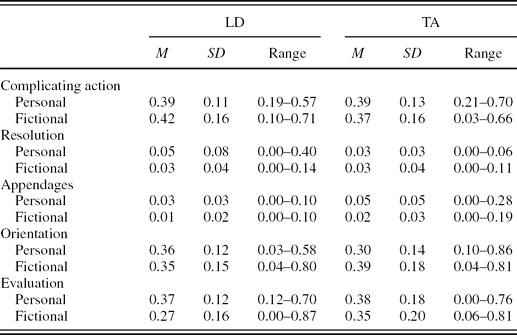
ANOVAs on the mean proportion of clauses per narrative classified into each of the five structural components of HPA indicated no significant effects for personal or fictional narratives (see Table 3). For personal narratives, the analyses yield the following results across the LD and TA groups, respectively: complicating action (M = 0.39 and 0.39), F (1, 78) = 0.61, p = .438, η2 = 0.008; resolution (M = 0.05 and 0.03), F (1, 78) = 1.02, p = .316, η2 = 0.013; appendages (M = 0.03 and 0.05), F (1, 78) = 6.59, p = .012, η2 = 0.078; orientation (M = 0.36 and 0.30), F (1, 78) = 6.33, p = .014, η2 = 0.075; and evaluation (M = 0.37 and 0.38), F (1, 78) = 0.38, p = .540, η2 = 0.005. For fictional narratives, the analyses yield the following results across the LD and TA groups, respectively: complicating action (M = 0.42 and 0.37), F (1, 78) = 1.49, p = .226, η2 = 0.019; resolution (M = 0.03 and 0.03), F (1, 78) = 0.10, p = .755, η2 = 0.001; appendages (M = 0.01 and 0.02), F (1, 78) = 0.55, p = .460, η2 = 0.007; orientation (M = 0.35 and 0.39), F (1, 78) = 0.77, p = .383, η2 = 0.010; and evaluation (M = 0.27 and 0.35), F (1, 78) = 4.55, p = .036, η2 = 0.055.
Comparison of learning disability (LD) and typically achieving (TA) groups in terms of the mean proportion of narrative clauses in each of the structural organization categories of high point analysis
Note: No significant differences. The level of significance was adjusted to .010.
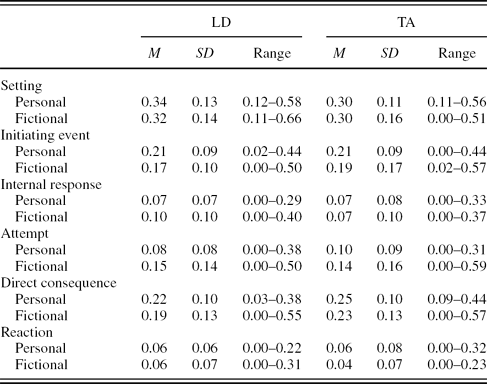
Similarly, ANOVAs on the mean proportion of propositions per narrative classified into each of the six structural components of EA indicated no significant effects for personal or fictional narratives (see Table 4). For personal narratives, the analyses yield the following results across the LD and TA groups, respectively: setting (M = 0.34 and 0.30), F (1, 78) = 3.82, p = .054, η2 = 0.047; initiating event (M = 0.21 and 0.21), F (1, 78) = 0.00, p = .948, η2 = 0.000; internal response (M = 0.07 and 0.07), F (1, 78) = 0.01, p = .933, η2 = 0.000; attempt (M = 0.08 and 0.10), F (1, 78) = 0.31, p = .578, η2 = 0.004; direct consequence (M = 0.22 and 0.25), F (1, 78) = 4.10, p = .046, η2 = 0.050); and reaction (M = 0.06 and 0.06), F (1, 78) = 0.19, p = .661, η2 = 0.002. For fictional narratives, the analyses yield the following results across the LD and TA groups, respectively: setting (M = 0.32 and 0.30), F (1, 78) = 0.53, p = .468, η2 = 0.007; initiating event (M = 0.17 and 0.19), F (1, 78) = 0.37, p = .544, η2 = 0.005; internal response (M = 0.10 and 0.07), F (1, 78) = 1.76, p = .189, η2 = 0.022; attempt (M = 0.15 and 0.14), F (1, 78) = 0.12, p = .727, η2 = 0.002; direct consequence (M = 0.19 and 0.23), F (1, 78) = 2.46, p = .121, η2 = 0.031; and reaction (M = 0.06 and 0.04), F (1, 78) = 0.02, p = .904, η2 = 0.000.
Comparison of learning disability (LD) and typically achieving (TA) groups in terms of the mean proportion of propositions in each of the structural organization categories of episodic analysis
Note: No significant differences. The level of significance was adjusted to .008.
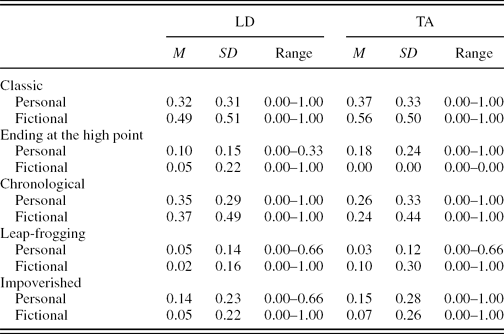
ANOVAs on the mean proportion of narratives classified into one of the five narrative coherence patterns of HPA revealed no significant effects for personal narratives or fictional narratives (see Table 5). For personal narratives, the analyses yield the following results across the LD and TA groups, respectively: classic (M = 0.32 and 0.37), F (1, 78) = 0.22, p = .644, η2 = 0.003; ending-at-the-high-point (M = 0.10 and 0.18), F (1, 78) = 3.80, p = .055, η2 = 0.046; chronological (M = 0.35 and 0.26), F (1, 78) = 1.57, p = .214, η2 = 0.020; leapfrogging (M = 0.15 and 0.14), F (1, 78) = 0.12, p = .727, η2 = 0.002; and impoverished (M = 0.14 and 0.15), F (1, 78) = 0.01, p = .936, η2 = 0.000. For fictional narratives, the analyses yield the following results across the LD and TA groups, respectively: classic (M = 0.49 and 0.56), F (1, 78) = 0.73, p = .394, η2 = 0.009; ending-at-the-high-point (M = 0.05 and 0.00), F (1, 78) = 0.47, p = .229, η2 = 0.018; chronological (M = 0.37 and 0.24), F (1, 78) = 1.77, p = .186, η2 = 0.022; leapfrogging (M = 0.02 and 0.10), F (1, 78) = 2.25, p = .137, η2 = 0.028; and impoverished (M = 0.05 and 0.07), F (1, 78) = 0.05, p = .821, η2 = 0.001.
Comparison of learning disability (LD) and typically achieving (TA) groups in terms of the mean proportion of narrative clauses in each of the coherence patterns of high point analysis
Note: No significant differences. The level of significance was adjusted to .010.
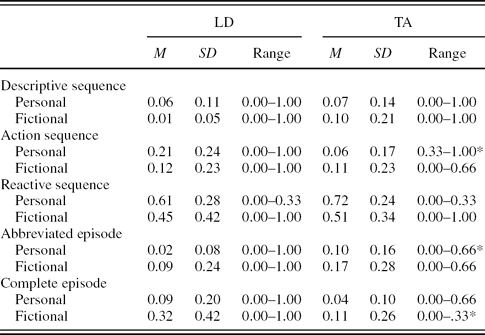
ANOVAs on the mean proportion of narratives classified into one of the five narrative coherence patterns of EA (see Table 6) revealed both significant and nonsignificant effects. For personal narratives, the analyses yield the following nonsignificant effects across the LD and TA groups, respectively: descriptive sequence (M = 0.06 and 0.07), F (1, 78) = 0.00, p = .983, η2 = 0.000; reactive sequence (M = 0.61 and 0.72), F (1, 78) = 2.78, p = .099, η2 = 0.194; and complete episode (M = 0.09 and 0.04), F (1, 78) = 1.36, p = .246, η2 = 0.033. Significant effects across the LD and TA groups, respectively, for personal narratives were on: action sequence (M = 0.21 and 0.06), F (1, 78) = 8.05, p = .006, η2 = 0.341, and abbreviated episode (M = 0.02 and 0.10), F (1, 78) = 7.03, p = .010, η2 = 0.107.
Comparison of learning disability (LD) and typically achieving (TA) groups in terms of the mean proportion of propositions in each of the coherence patterns of episodic analysis
*Significant differences. The level of significance was adjusted to .010.
For fictional narratives, the analyses yield the following nonsignificant effects across the LD and TA groups, respectively: descriptive sequence (M = 0.01 and 0.10), F (1, 78) = 5.52, p = .021, η2 = 0.066; action sequence (M = 0.12 and 0.11), F (1, 78) = 0.10, p = .751, η2 = 0.001; reactive sequence (M = 0.45 and 0.51), F (1, 78) = 0.76, p = .386, η2 = 0.010; and abbreviated episode (M = 0.09 and 0.17), F (1, 78) = 0.99, p = .324, η2 = 0.012. Significant effects across the LD and TA groups, respectively, for personal narratives was on complete episode (M = 0.32 and 0.11), F (1, 78) = 7.02, p = .010, η2 = 0.083.
Taken together, these results indicate that participants with LD produced a higher proportion of action sequences (M = 0.21, SD = 0.24) and a lower proportion of abbreviated episodes (M = 0.02, SD = 0.08) in personal narratives than did their TA peers (M = 0.06, SD = 0.17 and M = 0.10, SD = 0.16, respectively). In contrast, in their fictional narratives, participants with LD produced more complete episodes (M = 0.32, SD = 0.42) than their TA counterparts (M = 0.11, SD = 0.26).
DISCUSSION AND IMPLICATIONS
Despite extensive previous research, the current portrayal of narrators with LDs may be incomplete due to the limited scope of narrative analyses in the majority of up-to-date inquires. This study HPA and EA, in terms of the competency of narrators with LD to fulfill the referential and evaluative narrative functions in personal and fictional narratives. In particular, this study reveals the areas of incongruence in the current results between the two perspectives, a finding of potential importance to researchers and practitioners given the common use of both perspectives in children's narrative research.
Generally, the current results indicate comparable narrative competencies across students with LD and their TA peers on the majority of narrative facets analyzed in this study. First, the two narrative perspectives yielded consistent results, suggesting that the two groups are equally competent in their relative use of all analyzed structural organization components of both perspectives when recounting personal experiences, as well as narrating about fictional content. Specifically, the two groups demonstrated comparable ability to include narrative statements about the setting, events, the characters’ internal reactions and actions, and the outcomes of these actions (i.e., the structural organization categories of EA). The two groups showed comparable skills to represent narrative events while simultaneously conveying the personal meaning and significance of these events, as well as to summon the listener's attention to introduce and later close narratives within the communicative context of conversation (i.e., the structural organization categories of HPA).
In contrast to the consistency of the findings related to the participants’ use of structural organization categories, the two narrative perspectives yielded incongruent results in terms of their reliance on the narrative coherence patterns. The results of EA revealed group differences in both personal and fictional narratives with regard to the use of narrative coherence patterns reflective of the narrator's ability to sequence goal-directed behavior. These differences may be because the participants with LD demonstrated significantly less developed expressive syntax skills than their TA peers. Although the classification of narratives into coherence patterns of EA does not take into account the linguistic complexity of clauses (Stein, Reference Stein, Franklin and Barten1988; Stein & Albro, Reference Stein, Albro and Bamberg1997), the narrator's competence in using complex clauses to express causal relations among narrative components may have an effect on how their narratives are classified into the coherence patterns. In future research, an analysis of the differences between personal and fictional narratives of students with LD in terms of their linguistic complexity may shed additional light on the role of the narrator's structural language abilities in expressing narrative causal relations.
The group differences in the use of goal-directed narrative sequences are in the opposite direction across the two narrative genres analyzed. Specifically, in their personal narratives, the participants with LD more frequently recounted narrative events in the form of temporally organized, non-goal-directed sequences (i.e., action sequences). In contrast to personal narratives, fictional narratives of students with LD contained more episodes that include all components of a goal-directed behavior sequence (i.e., complete episodes). Perhaps students with LD might have difficulty transferring their narrative competencies shown in fictional narratives to personal recounts. Such a possibility may be at least partially accounted for by the differences in exposure to the two narrative genres and that each narrative genre puts specific demands on the narrator. Narrative-based instructional practices typically received by students with LD rely on the use of fictional narratives (Gardill & Jitendra, Reference Gardill and Jitendra1999; Kuldanek, Reference Kuldanek1998; Roth, Reference Roth2000; Zigo, Reference Zigo2001). Exposure to fictional narratives (stories) has been shown to contribute to children's ability to produce problem-solving narrative sequences reflective of goal-directed behavior while narrating about fictional content (Champion, Reference Champion2003; Heath, Reference Heath1983; Hicks, Reference Hicks, McCabe and Peterson1991). Narratives are assumed to provide a framework for organizing the knowledge of events by providing hierarchical story schemata that facilitate recognition, comprehension, recall, and production of narrative discourse (Black & Wilensky, Reference Black and Wilensky1979; Mandler, Reference Mandler1984; Rumelhart, Reference Rumelhart, Bobrow and Collins1975, Reference Rumelhart, LaBerge and Samuels1977; Stein & Glenn, Reference Stein, Glenn and Freedle1979, Reference Stein, Glenn and Friedman1982; Stein & Trabasso, Reference Stein, Trabasso and Glaser1982). Narrative-based interventions have been shown to enhance literacy achievement, discourse skill, self-esteem, and peer relations in children with LD (Garnett, Reference Garnett1986; Gurney, Gersten, Dimino, & Carine, Reference Gurney, Gersten, Dimino and Carine1990; Montague & Leavell, Reference Montague and Leavell1994; Pradl, Reference Pradl1984; Roth et al., Reference Roth, Speece, Cooper and De La Paz1996; Silliman, Reference Silliman1989).
In addition to the plausible facilitative effects of narrative exposure, the group differences across narrative genres may be related to the specific demands that each genre puts on the narrator. Previous research has associated narrative genres with specific types of content, structural, microlinguistic, and contextual knowledge (Hudson & Shapiro, Reference Hudson, Shapiro, McCabe and Peterson1991). Compared to other narrative genres, fictional narratives (stories) are typically marked by the extraordinary use of language and the literate character of their form and content (Heath, Reference Heath1986), closely resembling literate language of early school-based literacy practices (Pellegrini, Reference Pellegrini, Neuman and Dickinson2001).
The above findings are of importance given that in classroom-based narrative activities students are commonly expected to produce goal-directed, problem-solving narratives (Gay, Reference Gay2000; Gee, Reference Gee, McCabe and Peterson1991; Heath, Reference Heath1983). Narrators who in their personal recounts rely on a chronological representation of events without linking them to their goals, thoughts, and feelings may place a burden on their audiences to infer the underlying causality of their actions. Consequently, they may be perceived by teachers and peers as less skillful narrators, leading to reduced access to, and participation in, classroom narrative-based learning.
In contrast to the EA findings, from the HPA perspective, the participants with and without LD showed a comparable ability to use all coherence patterns in both personal and fictional narratives. HPA revealed that the two groups are equally skilled at producing the most complex narrative coherence pattern (i.e., classic narrative), in which coherence is achieved by building a hierarchical organization with one narrative event (i.e., a high point) assuming the role of a central organizing component. By using this most advanced narrative pattern, the narrators effectively convey the personal importance of the recounted events, guiding their audience in understanding their perspective on the recounts narrative events.
In summary, the current results indicate that the existence and nature of differences in narrative performance between students with and without LDs may depend on the approach to narrative analysis used. Although both HPA and EA analyze narrative structural organization and coherence, each has a specific focus that results in a different perspective on children's narrative competencies. EA focuses on how the narrator organizes goal-directed actions into episodes, a competency that provides an insight into his/her understanding of human intentionality and problem-solving behavior. In contrast, HPA examines narrative organization and coherence as it emerges through the relationships between the recount of events and the narrator's expressions of the personal significance of these events. Such an analysis allows speculating about the narrator's ability to communicate to the audience the personal meaning of the events and express his/her sociocultural identity. By utilizing the two narrative perspectives, educators may gain a broader understanding of narrative performance and, consequently, foster diverse expressions of personal and fictional meanings through narrating. With an expanding narrative analytical repertoire, educators may also be better prepared to engage learners of varying abilities and backgrounds in narrative-based classroom learning. Further, the current findings suggest that a comprehensive assessment of narrative performance should include narrating both personal and fictional content. The patterns of group differences in the use of episodic goal-directed narrative structures suggest that generalization of narrative competencies across narrative genres may not be warranted. Rather, the use of various narrative patterns may vary depending on the content (personal vs. fictional) and/or specific demands of narrative genres. Variability of performance across genres may assist educators in designing activities to enhance performance in a specific narrative genre by utilizing strengths demonstrated in other genres.
Although the current results seem to refine the existing portrayal of narrators with LD, both narrative perspectives used in this study have limitations that need to be taken into account. One of the most striking of these limitations pertains to their focus on the underlying structure of children's narratives without regard to a broader interactive and/or sociocultural context of narrating. For example, both approaches fail to capture the impact of the audience and the narrator–audience relationships on the structural organization of children's narrative, disregarding the assumption that narratives are often jointly constructed in interactions with the audience (e.g., Kemper, Reference Kemper and Kuczaj II1984; Pellegrini, Reference Pellegrini, Neuman and Dickinson2001). In addition, the emphasis on the internal structure of narratives results in minimal consideration (or neglect) of narrative content. However, topics, purposes, and functions of narratives have been shown to influence the organization and complexity of children's narratives (e.g., Hudson & Shapiro, Reference Hudson, Shapiro, McCabe and Peterson1991; Mening-Peterson, Reference Mening-Peterson1977).
Further limitations of the two perspectives relate the lack of systematic analysis of the impact of the demands of narrative tasks and the features of narrative elicitation techniques on the structural organization of children's narratives. However, various features of narrative tasks and elicitation techniques have been found to impact the fluency and organization of children's narrative performance. For example, Schneider (Reference Schneider1993) has documented that the mode of stimulus presentation (oral in retelling vs. visual in narrating about a picture sequence) affects the complexity and organization of narratives. Furthermore, Hedberg and Stoel-Gammon (Reference Hedberg and Stoel-Gammon1986) have pointed out that the type of narrative task (e.g., self-generation vs. retelling) may reveal different levels of children's ability to structure narratives. Other factors that have been shown to influence the narrative structural organization include the features of stimuli (e.g., type of props), the familiarity and interest in a narrative topic prompted by an examiner, the characteristics of the audience (e.g., familiar vs. unfamiliar audience), the purpose of telling a narrative, and the time constraints of the narrative tasks (Johnson, Reference Johnson1995).