Gesture applied to a metaphysical word becomes its physical demonstration and detailed definition. Love embraces, hate kills, pride debases one. The truth of such a language has something frightening: it says what words do not say. Every day we say and hear the words ‘I hate’ without being upset. Who would not be upset if the gesture of murder were to replace the word?Footnote 1
In this passage from his Observations sur la musique, et principalement sur la métaphysique de l'art (1779), Michel Paul Guy de Chabanon revealed his fear of gesture. Chabanon deemed gesture ‘frightening’ because it had unpredictable, possibly violent, consequences. Almost equally alarming was its intense ‘truth’, its power to render a distant or invisible or metaphysical concept concrete and vividly present. Yet Chabanon and his contemporaries found charm as well as fear in gesture. Voltaire admitted in 1765 that merely a gesture made by the actress Clairon was enough to ‘move’ and ‘excite’ him.Footnote 2 Fascinated by a performance of Corneille's Héraclius, Diderot remarked in Lettre sur les sourds et muets (1751) that gesture ‘triumphs’ over verbal language.Footnote 3 Louis de Cahusac likewise claimed in 1757 that facial expression and bodily movements formed a ‘primitive’ language, implying that gesture was so basic a mode of communication that it questioned verbal language as the primary vehicle for rationality.Footnote 4 It was this quasi-verbal charm that the eighteenth-century public found irresistible about the gestures of actors from the Théâtre de la Foire to the Opéra, from Italian lazzi to the French danse noble – a mode of communication that inspired both informal cataloguing and systematic studies of pantomime.Footnote 5 In the midst of these lively discussions, the role of music came to the fore. Chabanon saw musical rhythm and melody as the cause for which gesture was the effect. Musical rhythm generated gesture by ‘agitat[ing] our body’, and melody generated the ‘intentions’ of a performer.Footnote 6 Nevertheless, ‘as the modulated sounds themselves do not have a precise and distinct signification, the bodily movements, the gestures that result from them, do not have a more fixed form [than modulated sounds do]’.Footnote 7 In this sense music and gesture were, for Chabanon, equally ephemeral.
These cursory remarks on music and gesture invite us to explore the social and cultural meanings of physical gestures and their relationship to music in the French Enlightenment. But before delving into these larger questions, we should acknowledge the limitations of Chabanon's idealistic view, as well as the ways his description flattens out the complex nexus of meanings formed by music and gesture. Recent Baroque dance research has shown that music and gesture decidedly did not always say the same thing, as Chabanon assumes. Successful dance composers, including Lully, often toyed with different levels of symmetry to generate ‘perceptual counterpoint’ between music and dance.Footnote 8 When gesture conveyed a plot as it did in ballet-pantomime, its relationship to music became even more complicated.Footnote 9 Moreover, the question of whether either gesture or music had any fixed signification must be addressed case by case, since signification is so dependent on context. Shrugging off ‘modulated sounds’ and ‘dance movements’ as ephemeral before examining the contexts in which they appear would uncritically expunge any traces of signification. To understand how music and gesture correlate, then, we need to examine specifically how these two media signify.
Studies of expressive topoi offer help here. Leonard Ratner has shown how late eighteenth-century composers communicated with audiences through a range of expressive topoi, though we know little about how these topoi evolved.Footnote 10 Over the last three decades, topical analysis has been applied to operas and instrumental music and it has long celebrated the spontaneity, irregularity and quicksilver changes of the musical surface, whereas the music of the ancien régime has conventionally been construed in terms of its formality, propriety and social function. Few studies have applied topical analysis to eighteenth-century pantomime, however, partly because pantomime was used sparingly by composers in their operas and was not a well-defined musical genre. This article aims to demonstrate that applying topical analysis to pantomime helps elucidate Chabanon's point about the danger inherent in gesture. More specifically, to explain French pantomimic genres in terms of topics is to apprehend the dangerous nature of pantomime in a new way: within the conventional interpretative frameworks of the French lyric stage, pantomime has a degree of linguistic signification and intelligible dramatic meaning, but paradoxically it also has a perilous, disobedient and mischievous dimension, threatening both syntactical regularity and civility.
When composers like Rameau, Rousseau and Grétry translated the kinaesthetics of the human body into music in their pantomimes, they aimed to mimic the immediacy of gesture in music and thus to meld the two into a para-linguistic unit. In pantomime they found a way to link musical and verbal syntax more tightly; but as the music became more referential it almost inevitably became less formally predictable. By mid-century, court dance and pantomime had taken up opposing positions on the spectrum of danced genres: the more a pantomime resembled a speech, the more remote it was from court dance. It was as a natural extension of this opposition that court dances came to signify civility while pantomime became an emblem of the uncivil and the grotesque, representing unreason or even indecency. This opposition was by no means neat and it took different forms in different instances. In what follows I will provide examples of three stages in this process of severing pantomime from court dance, and of cordoning off considerations of musical signification from the music of court civility. I locate the origin of this split in the final dances of Rameau's 1748 ballet Pygmalion, in which peasants dance what is explicitly labelled a ‘naïve pantomime’ (‘pantomime niaise’), establishing pantomime as a peasant dance antithetical to French court dance.Footnote 11 The schism between the mannered and the non-mannered, the urban and the rural, adumbrated in Pygmalion becomes widened in Rousseau's Le Devin du village (1752–3), where the pantomime is inserted into a plot that thematises an encounter between urban temptation and rural innocence. Finally, I will consider a late example of the genre, from Grétry's ballet-héroíque Céphale et Procris (1773, performed in Paris in 1775), in which the rhythmic topos of the minuet is manipulated to create a pantomime that seems to function as an antithesis of a minuet. The anti-minuet in Céphale et Procris is a seduction scene that speaks through gesture and music, uncovers the danger beneath the superficial charm of gesture, and reveals temptation as a source of moral corruption. By seeing gesture, music and language as complementary parts of a single system, we can uncover social meanings in pantomime in more nuanced ways than usual in the past.
Rameau's ‘grotesque peasants’
In writing a ‘pantomime niaise’ for peasants in Pygmalion, Rameau departed from his mythological source, the Pygmalion episode in Ovid's Metamorphoses. In Ovid, Pygmalion is a king of Cyprus so devoted to virtue as to adore a woman he has sculpted out of ivory and to stage a festival in honour of Venus, goddess of virtue, to guide his subjects towards chaste and moral pursuits. The episode concludes when Venus rewards Pygmalion's virtue by simultaneously bringing his statue to life and turning the unchaste women of Cyprus to stone. Although the main source for Rameau's ballet was Ovid, his inclusion of a group of peasants to admire and celebrate the animation of the statue at the end of the ballet may have been inspired by recent Parisian models. He was most likely impressed by A. H. de Lamotte, who included in his opéra-ballet Le Triomphe des arts (1700) a final scene glorifying Amour and, by extension, the arts.Footnote 12 Perhaps Rameau followed Lamotte in expanding the last scene with dances, or took the idea of adding peasants from François Riccoboni's Pygmalion (1733, music by Jean-Joseph Mouret).Footnote 13 A third influence on Rameau's decision to unite dance and action in pantomime may have been the dancer Marie Sallé. Her execution of a ballet-pantomime on the story of Pygmalion in 1734 inspired Rameau to create the ‘rose’ in the flower scene in Les Indes galantes.Footnote 14 The connection with Sallé is strengthened by the fact that the Pygmalion ballet she danced in 1734 itself contained two large sections: a naïve pantomime (‘pantomime niaise’) followed by a lively one (‘pantomime vive’), both performed by peasants.
The livret for Rameau's Pygmalion specifies that in the pantomime the peasants should ‘dance around the statue’.Footnote 15 In the manuscript copy currently preserved at the Bibliothèque Nationale de France, a copyist added the performance direction of ‘admiration’, thus prescribing the attitude that the peasants are to take towards the animated statue.Footnote 16 According to the livret, the ‘pantomime niaise’ was to be danced by a couple of ‘paysans grotesques’ while the ‘pantomime vive’ was to be danced by a couple of ‘paysans simples’.Footnote 17 The term ‘grotesque’ most straightforwardly referred to the Italian grotteschi dancers employed at the Opéra and, more generally, to dancers who performed in an athletic, acrobatic style.Footnote 18 But encyclopaedias of the time also attribute aesthetic implications to the word, some of them contradictory. In some contexts ‘grotesque’ meant ‘monstrous’ or ‘hybrid’, as in a juxtaposition of two disparate things that might provoke laughter.Footnote 19 But it might also indicate a type of ‘lovable folly’ (‘déraison aimable’) that could be employed in moderation as an ornament to deviate from ‘the grand principles’.Footnote 20
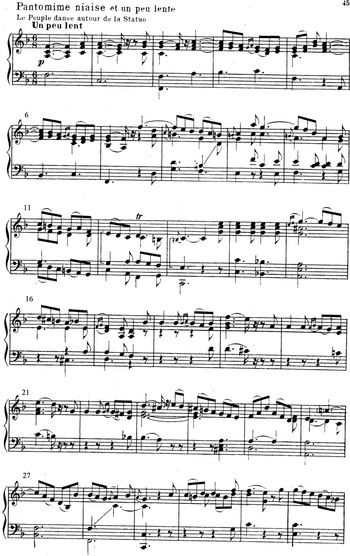
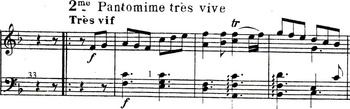
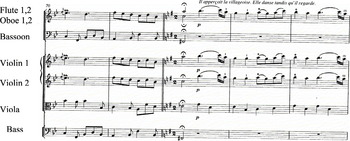
Rameau's music for this scene helps to clarify what the designation ‘grotesque’ may have meant to the composer, and which of these meanings may have predominated. Certain musical anomalies that seem to suggest particular ‘grotesque’ dance movements offer a window on the problem. One such hint occurs between the end of the ‘pantomime niaise’ (Ex. 1a) and the beginning of the ‘pantomime simple’ (Ex. 1b). At the last bar of the ‘pantomime niaise’ (bar 32, Ex. 1a), the dance actually comes to an abrupt end on a first-inversion dominant-seventh chord. The descending melody of the upper part ends on a Bb, signalling a resolution to A. The ensuing ‘pantomime simple’ begins after a brief general pause on the first half of the next bar (bar 33, Ex. 1b) and a delay of the expected tonic arrival until the beginning of the second dance. The expected harmonic resolution is suspended by the rest in bar 33, an effect that would leave listeners hanging.
Rameau, Pygmalion, ‘Pantomime niaise’, bars 11–32.

Rameau, Pygmalion, ‘Pantomime niaise’, bar 33, and ‘Pantomime simple’, bars 1–3.

For a composer and music theorist as experienced as Rameau, this kind of suspended ending must have served some explicit dramatic purpose.Footnote 21 Indeed, Rameau specifically asked the dancers, Jean-Barthélemy Lany and Pierre Sodi, to continue to dance during the one-bar silence between the two sections, as if to heighten the strangeness of the caesura. In the manuscript copy of the ballet, the copyist Brice notated – probably following Rameau's directive – the following stage instructions between the two pantomimes: ‘Very fast. We continue to dance as if the air were to keep going, and there is a surprise at the beginning of the following [air], etc.’Footnote 22 The pantomime dance outlasted the music, implying that the grotesque dancers were either deaf or too engrossed in their movements to notice the sudden silence. To dance without music is highly unusual, and to suspend the final tonic of a cadence across a rest distorts musical syntax enough to constitute a musical figure for the grotesque. With these two strategies – one choreographic, one musical – Rameau challenged the conventional correspondence between music and dance. To Rameau's mind, any infringement on this correspondence would generate so ridiculous, so subversive, so ‘grotesque’ an effect that it could engineer a good laugh from the audience.Footnote 23
Of all the dances in Pygmalion, none but the ‘pantomime niaise’ has an abrupt ending. But Rameau seems interested in other kinds of play with endings elsewhere in the ballet. When the Statue comes to life, she performs an elaborate series of dances taught to her by the Graces. All are court dances, including a Gavotte, Menuet, Chaconne, Loure, Rigaudon, Sarabande and Tambourin. Instead of presenting these as isolated numbers, Rameau links them to form a connected series. The final cadence of the Gavotte is elided with the beginning of the Minuet, enjoining the dancers to progress from one to the next without a conspicuous break. I suggest that this dance series provides a critical background against which the syntactical rupture between the two pantomimes gains musical as well as dramatic significance.
These court dances portray not only the intelligence of the animated Statue, but also the innate comportment and composure required of a virtuous woman, qualities that make her an idealised and ideal consort for Pygmalion, King of Cyprus. In sharp contrast, as the ‘pantomime niaise’ ends the peasants present themselves as indifferent to music. The abrupt conclusion of their music exaggerates their clumsiness, simplicity and insensibility – a stark contrast with the elegance of the animated Statue in her performance of the court dances. Such contrasts are by no means obvious elsewhere in the libretto: the peasants never sing anything and their social status shows through only in these two pantomime numbers, a key moment that cements social meaning in the work.
Rousseau's courtier
Rousseau's intermède Le Devin du village has long been seen as a staging ground for the ‘querelle’ over the respective virtues of French and Italian music that played out around it in the 1750s.Footnote 24 But even those scholars who have demonstrated the intermède's debt to French music have largely overlooked Rousseau's admiration for, and debt to, Rameau's Pygmalion, an opera that might well have prompted him to write his scène lyrique entitled Pygmalion in 1770.
After its première, Rameau's Pygmalion enjoyed continuous success at the Opéra from 1751 to 1754.Footnote 25 Baron de Grimm noted the originality of the ‘pantomime niaise’, which, together with other parts of the ballet, led him to call Pygmalion an ‘immortal’ work.Footnote 26 In his reply to Grimm's ‘Lettre sur Omphale’ (1752), Rousseau called Pygmalion ‘Rameau's masterpiece and [as] the most excellent piece of Music that has ever been heard in our Theatre’.Footnote 27 The two ballets are further linked by Lany, a dancer crowned by Ange Goudar as the ‘surgeon of all pantomimes that suffered from a mangled arm’, who had danced one of the two ‘grotesque peasants’ in Pygmalion and appeared as the courtier in Le Devin du village.Footnote 28
Considering his admiration for Pygmalion and his plan to have Lany dance the pantomime, it seems reasonable to suppose that Rousseau also followed Rameau in using the distinction between court dance and pantomime to articulate dramatic and social structure in Le Devin du village. Yet there are important and revealing differences between the two works. The denigration of peasants in Rameau's Pygmalion, for example, is reversed in Rousseau's Le Devin du village. Whereas Rameau used pantomime to portray peasants as insensible to the delicacy of aristocratic culture, Rousseau used it to extol the virtue of simplicity. Rameau stresses pantomime as a mode of expression antithetical to court dances, while Rousseau calls attention to syntactical changes. In addition, whereas Rameau implicitly uses pantomime and court dances to represent class distinction, Rousseau explicitly inserts social critique into his pantomime.
To understand the relationship between pantomime and morality in Le Devin, we need to know how Rousseau used the pantomime to address the problems he saw in the French lyric theatre and, more broadly, French society. Partly inspired by Diderot's Lettre sur les sourds et muets, in the 1740s and early 1750s Rousseau explored how music could project a unity of expression and even supply new meanings for a poem, a quest that led to his idea of the ‘unity of melody’ in Lettre sur la musique françoise (1753).Footnote 29 His quest for musical meanings paralleled his growing discontent with non-imitative dances in French opera, leading him to dismiss French ballets a few years later in his epistolary novel Julie, ou la nouvelle Héloïse (1760) as dances that presented little apart from the affect of joy and were loosely connected to the plot.Footnote 30 While he was pondering these aesthetic issues, he also gave over energy from 1750 to 1753 to defending his prize-winning Discours sur les sciences et les arts, or the so-called First Discourse, in which he had declared that arts and sciences, instead of advancing humanity, cause moral corruption. During the very same period Rousseau worked on the preface for the première of his play Narcisse: où l'amant de lui-même (composed in 1733, performed on 18 December 1752), in which he once again defended his position by casting aspersions on all education and literary culture: ‘among a people the taste for letters always proclaims a beginning of corruption which it very promptly accelerates’.Footnote 31
There is little doubt that Rousseau conflated his social and aesthetic critiques by the end of 1752. But what is important is that he added a pantomime – a genre he had previously denigrated in his First Discourse as ‘Italian’, which is to mean, farcical in the style of commedia dell'arte – to the performance of Le Devin at the Académie Royale de Musique on 1 March 1753. I suggest that he used pantomime here less as direct homage to the Italian commedia dell'arte tradition than as an experimental interface to address the problems of non-imitative dance, musical meaning and societal corruption. It is worth recalling the plot of this famous intermède: suspecting that her lover Colin has been unfaithful, the shepherdess Colette goes to see the soothsayer, who confirms her suspicion. To help the desperate Colette, the soothsayer designs a plan to bring Colin back to her. The soothsayer tells Colin, falsely, that Colette is being unfaithful to him with a ‘handsome gentleman from the city’, hoping that this deception will lead Colin to confess his unfaithfulness. After their confrontation, the soothsayer successfully brings the couple back together, and the chorus then celebrates their reunion, singing ‘Colin returns to his shepherdess’.
The theme of unfaithfulness figures prominently in the intermède's pantomime, whose content is made clear by the verbal instructions printed in the first engraved edition. The action can be summarised briefly:
A village girl (not Colette) dances and a courtier from the city watches her dance. The courtier offers her a purse; she refuses it with disdain. The courtier persists. In his second attempt, he offers her a necklace. This time, she accepts it, tries it on, and enjoys her new look. Meanwhile, a villager appears and looks at her in sorrow, as if he is disappointed with her being lured by the material goods from the city. Noticing his sorrow, the village girl hands the necklace back to the courtier, who threatens the villager as soon as he notices that the girl has refused to accept his gift. Frightened, the village girl tries to calm the courtier down, while at the same time signalling to the villager to leave. The villager, however, remains indifferent to the threat. Exasperated, the courtier escalates his threat by motioning to kill him. To plead for their lives, the village couple throw themselves at the feet of the courtier. Touched by their loyalty to one another, the courtier gives in and unites the couple. Other villagers come to celebrate the union, and praise the courtier.
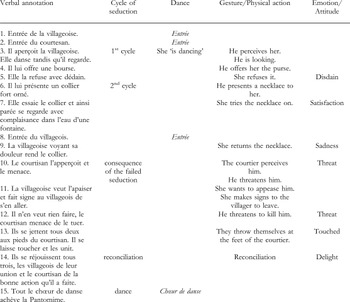
On a copy of the first edition, Rousseau wrote didascalies – short verbal instructions – over the musical staff, with the implication that each instruction was to match the beginning of a musical unit. The livret itself contains no such verbal hints for the choreography, perhaps because Rousseau wanted to ‘translate’ his music for performers, but hoped that it would speak more directly to audiences. All fifteen of these verbal annotations describe some kind of gesture (Table 1). One subset of the directions refers specifically to dance. In the first note, for example, Rousseau did not write ‘the village girl enters’ (‘la villageoise entre’) but instead ‘entry of the village girl’ (‘Entrée de la villageoise’), suggesting that she dances a social dance at her appearance. A second group of directions involves gestures that convey more pointed referential meanings, such as the direction ‘he offers her a purse’. Yet another group among the verbal annotations introduces emotions that accompany physical actions, as when the girl refuses the courtier's gift ‘with disdain’.
Rousseau, Le Devin du village, stage directions from the first edition

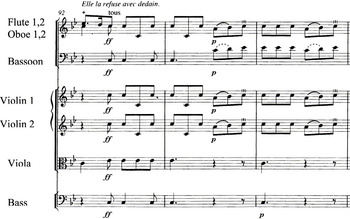
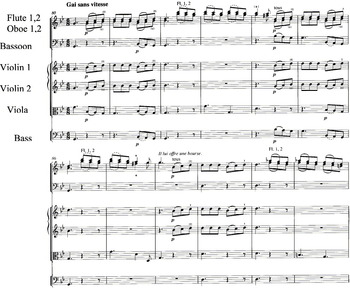
By attaching such verbal tags to units of music, Rousseau injects semantic meaning into gesture and music, forcing gesture to synchronise with music.Footnote 32 Verbal syntax also determines musical syntax. The fifth didascalie, for example, is printed over a sudden outburst of repeated notes on C (Ex. 2), interrupting the otherwise graceful and gentle musical unit beginning at bar 80.
Rousseau, Le Devin du village, Pantomime, bars 92–94.

However, not all the music corresponds neatly to gesture. Just as early French opera made evident distinctions between story and performance, the pantomime in Le Devin maps out a range of mute utterance.Footnote 33 To place gestural directives above each musical unit would have broached a set of questions vital to contemporary discussions on the nature of the senses, addressed most notably by Condillac and Diderot.Footnote 34 How can music and gesture ‘imitate’ verbal snippets? If both music and gesture are mute languages, as Diderot would have it, is one nevertheless ‘muter’ than the other? How do we know which medium conveys what at a given moment?
To approach these questions, I will focus on a single instance in which music and Rousseau's gestural indications seem to be at odds. The third verbal direction, ‘he [the courtier] sees the village girl’, appears starting at bar 72 (Ex. 3), immediately following a surprising harmonic swerve. The music for bars 69–71 repeats part of a phrase heard immediately before, creating the expectation of a half cadence in F at bar 72. But Rousseau replaces the anticipated F major chord with a prolonged diminished-seventh chord on F♯. This substitution is made more jarring by the approach to the F♯ through a diminished fourth in the bass and the descending diminished octave from the previous pitch (F) in bar 71. The intervallic dissonance is magnified by the major seventh outlined by the upper voice. The effect projected by this impetuous diminished-seventh chord does not seem to match the seemingly inoffensive glance of the courtier. And yet the diminished chord marks an important moment: the courtier sees the village girl, and the twin cycles of seduction begin. With that ‘look’ the courtier signals his interest in the village girl, and since it comes from a person of high social standing the look also signifies politeness, fine arts and talents – qualities that the village girl presumably lacks. In the autograph manuscript for the pantomime scene, Rousseau wrote here ‘gallantry of the courtier’ (‘galanteries du courtisan’).
Rousseau, Le Devin du village, Pantomime, bars 70–74.

Since the subsequent music at bars 80–2 (Ex. 4) is similar to that of bars 88–90, where Rousseau explicitly indicates ‘he gives her a purse’, we might conclude that for Rousseau gallantry was equated with bribery, a practice he had criticised in his First Discourse. It is worth recalling that in the ‘Preface to Narcisse’ Rousseau proposed that in addition to refinement and taste, politesse also initiates flattery, ‘seductive’ and ‘insidious effort’ that would ‘eventually shrivel the soul and corrupt the heart’, leading people into betraying, prejudicing against and, eventually, destroying one another.Footnote 35 With that one ‘look’, then, the village girl is exposed to danger, bribery and flattery that could corrupt her virtue. With the courtier's gaze, Rousseau revealed the disparity between the appearance of politeness and worldly temptation as the source of moral corruption.
Rousseau, Le Devin du village, Pantomime, bars 80–91.

By associating the courtier's look with a diminished-seventh chord, Rousseau produced an extraordinarily rich moment. At the large level of dance units, the chord articulates the sudden end of a sequence of two non-referential dance entrées. From another perspective, the diminished-seventh chord and gaze form a semiotic composite that anticipates dramatic vices to come, launching the twin cycles of seduction. Thus the chord affects the rest of the pantomime, for it both signals a departure from entrées (i.e. dance as dance) and suggests a kind of music that, at once draws meanings from gestures while triggering the mechanism through which the contents of expressive topoi are reinforced.
Le Devin's pantomime was one of the first attempts to communicate semantic meaning by linking music and gesture, without the use of spoken or sung words.Footnote 36 It was also one of the most frequently performed French operas in the third quarter of the eighteenth century, holding the stage until 1790. Rousseau must have been pleased with his innovation, for he never revised the scene even though he had ample chances to do so, most notably in 1778. His contemporary Diderot was pleased with it as well. He perceived the scene as pioneering in the history of dance because it closed the gap between dance and pantomime, transforming a non-imitative art into an imitative one:
Dance is still waiting for a genius. Everywhere it is bad because we hardly suspect that it is an imitative genre … I would want very much to be told what all the dances signify, including the minuet, the passepied, the rigaudon, the allemande, the sarabande, where one follows a predetermined path [as shown in choreography]. This man displays himself with infinite grace. He makes no movement in which I fail to perceive any ease, softness and nobility. But what does he imitate?Footnote 37
In Le Devin, Rousseau showed an ingenious path to reform ballet, steering away from the conventional choreographed court dance towards a new, natural, imitative dance that marked the ‘rebirth’ of the ancient pantomime.
Grétry's god of Love
By 1773, Grétry had established himself as the most prominent composer of opéra comique, thanks to a number of hits that included Le Tableau parlant (1769) and Zémire et Azor (1771). Although he had become increasingly active in using gesture as a theatrical resource in his operas, he had never inserted an extensive pantomime into any of his works.Footnote 38 This absence is telling, especially since by the 1770s pantomime had become a fashionable alternative to court dances at the Opéra.Footnote 39 As his correspondence testifies, however, Grétry was not at all comfortable with the genre.
Nonetheless, he did consider using it in his revised opéra comique La Fausse magie (1775), whose first performance at the Comédie Italienne had been received coolly. According to Grimm, the fault lay with a weak libretto, and although Grétry had written ‘captivating music’ to compensate for the libretto, audiences ‘obstinately refused to laugh’.Footnote 40 Unmoved by these criticisms, Grétry planned to modify the work for a new production in Brussels by adding a rehearsed but never-performed pantomime. In a letter to the Belgian composer and director of theatre Ignace Vitzthumb dated 21 February 1775, Grétry suggested resuscitating the once-rehearsed pantomime but also expressed his frustration with it:
The piece you are about to receive needs much attention. Paris neglects all of its accessories, and they [the Parisians] make a big mistake. One person proposed to us that we perform a pantomime of ghosts behind a transparent screen. It would appear after the chorus ‘O grand Albert’. We dared not risk this pleasantry, which perhaps would have succeeded … In the end the project was not well digested.Footnote 41
Grétry's concern about where to position the pantomime in La Fausse magie reveals that the technique was still unconventional enough to cause unease. But between February and May of 1775, between La Fausse magie and the revision of Céphale et Procris for Paris, Grétry seemed to change his mind about pantomime, for in Céphale et Procris he specified not one but two pantomimes – in Act I, scene 5 and the final scene of Act III – and in both instances he carefully associated music with gesture, just as Rousseau had done in Le Devin du village.Footnote 42
In beginning to make his peace with pantomime Grétry may have received some hints from Rousseau – not from his music, but from the philosophe himself. In his Mémoirs Grétry recalled his first meeting with Rousseau, who spoke highly of Grétry's music after attending a performance of La Fausse magie.Footnote 43 Grétry in turn claimed to have studied the music of Le Devin du village ‘with the most scrupulous attention’.Footnote 44 Like Rousseau, Grétry annotated his score with brief didascalies specifying physical gestures aligned with specific musical units. He even wrote these into the manuscript, which must have served as the prototype for the engraved edition. For any eighteenth-century musician familiar with Le Devin, this method of inserting directions for gesture would immediately have recalled Rousseau.Footnote 45
Although the manuscript for the Paris version of Céphale includes two extensive pantomimes, only one of these survives in the engraved edition, although both pantomimes were certainly performed.Footnote 46 The Mercure de France clearly refers to the performance of more than one pantomime: ‘The ballets, composition of Vestris, Dauberval and Gardel, were well approved. They themselves danced many numbers, and appeared in their excellent pantomimes with distinction.’Footnote 47 Indeed, the second pantomime, positioned at the end of Act III, was the main choreographed number of the ballet and called upon such leading dancers as Vestris, Guimard, Gardel, Michelot and Julie. Although we do not know what motivated Grétry to leave the second pantomime unpublished, we do know why he published the first one (Act I, scene 5): it is too essential to the plot to be eliminated. Grétry clearly continued to evaluate the effect of pantomime in Céphale et Procris after its successful performance in 1775. The meticulous attention he paid to the issue suggests that he had learned a lesson from the rehearsals of La Fausse magie. In Céphale et Procris, Grétry wanted to use pantomime less as a dramatic ‘pleasantry’, a label he used in frustration with respect to the failed La Fausse magie, than as a dramatic necessity.
Like Pygmalion, the story of Céphale et Procris originated in Ovid's Metamorphoses. Céphale and Procris are happily married and they love each other. Every day, Céphale goes hunting in the forest. When he gets tired, he takes a rest and he asks the breeze with the name Aura to refresh him. One day, a nymph hears him and thinks that Aura is a woman, a secret lover with whom Céphale meets. The nymph runs off to tell Procris of Céphale's unfaithful encounter. Anxious and heart-broken, Procris goes to the forest, and hides behind trees to hear for herself. As always, Céphale cries out for Aura. The despairing Procris makes some noises behind the bushes. Startled by the noise, Céphale throws his spear into the bush, thinking that the noises are made by wild animals. As soon as he hears Procris's scream, he laments that he has wounded his own wife. Up to the moment Procris dies in Céphale's arms, she does not know she has mistaken the term ‘Aura’ for a woman's name.
To provide a stronger justification for the death of Procris, the librettist Jean-François Marmontel amplified the role of the interfering nymph, Aura, a real woman who is secretly in love with Céphale. He also conceived of Procris as one of the followers of Diane, goddess of chastity, who has broken her vow by falling for Céphale.Footnote 48 With her marriage to Céphale, Procris leaves Diane's fellowship for good, a departure that symbolises the defeat of Diane. As Act I unfolds, the love relations among Céphale, Procris and Aura are reconfigured to exemplify the conflict between the god of Love and the goddess of Diane, symbols of affection and chastity, respectively.
That conflict is most evident at the end of Act I, when the power of love meets the vow of chastity head on. It was for this moment that Grétry devised a pantomime on the perils of seduction, couched as a play within a play. The content is quite straightforward. As part of a ceremony of admission celebrating a new fellow of Diane, a few nymphs stage a morality play in pantomime. With a nymph playing the role of Love, the pantomime teaches the newly admitted fellow how to resist a catalogue of ‘tricks’ Love enjoys using. These tricks include sighs, pleading, caresses and pretence. An uncorrupted nymph, as demonstrated in the pantomime, should recognise all these tricks and reject them one by one. While the pantomime illustrates defences against Love, it does not show the punitive consequence of breaking the vows of chastity, which, as the fate of Procris will show by the end of the opera, is death.
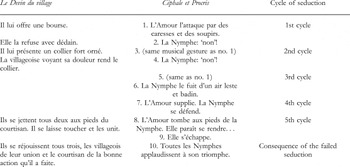
An eighteenth-century audience familiar with Le Devin du village would notice that Grétry's pantomime shares the same outline as Rousseau's. Instead of two cycles of seduction, Grétry wrote five (see Table 2 for a comparison of the two). Instead of temptation of worldly wealth, such as Rousseau presented in his intermède, Grétry presents the seduction of love.
Comparison of the pantomimes in Le Devin du village and Céphale et Procris

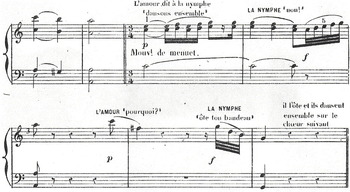
Grétry, Céphale et Procris, Pantomime, ‘mouvement de menuet’, bars 1–5.

Nevertheless, Grétry's pantomime ends very differently from Rousseau's. Instead of rushing into a series of celebratory dances, as in Le Devin, Grétry provides an unexpected extension: just as the other nymphs come out and celebrate the triumph of virtue, Grétry adds five additional bars in a section that he labels ‘mouvement de menuet’ (Ex. 5).Footnote 49 This is no ordinary minuet, for Grétry provides verbal descriptions to equate this music with gesture, turning it into a continuation of the pantomime; or perhaps better put, a brief delay before the resumption of the ‘pure’ dance of the scene. Dramatically, the number extends the confrontation between Love and the Nymph that had seemed to have resolved conflict:
Love: Let us dance together.
Nymph: No.
Love: Why?
Nymph: Remove your veil.
(He removes it and they dance together in the following number.)
On a structural level, these five added bars remind spectators that the ‘mouvement de menuet’ prolongs the play within a play represented in the pantomime. Love and Nymph, roles played by two of Diane's nymphs, are still performing their drama of seduction. Even though the staged drama has supposedly ended, the Nymph refuses to dance with Love because the latter (a female) is still playing the role of (the male) Love. To put an end to the petty confrontation, the Nymph demands that Love remove his mask before they begin to dance. On a symbolic level, the confrontation, petty as it may seem, carries profound meaning. It demonstrates how a virtuous woman should identify Love's trick at the most unlikely moment – when everyone is celebrating her virtue – with the commonest invitation – an invitation to dance an actual, non-pantomimic minuet with him. This extension of pantomime shows that Love can lure and catch a woman off guard, and she should therefore always be vigilant. Like Rousseau's pantomime that stages the perils of corruption, Grétry's pantomime demonstrates a multi-staged seduction. Both composers used pantomime as a medium to demonstrate immorality.
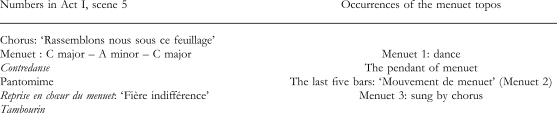
The literal and symbolic interpretations of the ‘mouvement de menuet’ depend on Grétry's treatment of the minuet as an expressive topos. But to fully grasp Grétry's design, we must examine the ‘mouvement de menuet’ not only within the context of the pantomime, but also within the larger context of Act I, scene 5 (Table 3).Footnote 50
Grétry, Céphale et Procris, Act I, scene 5
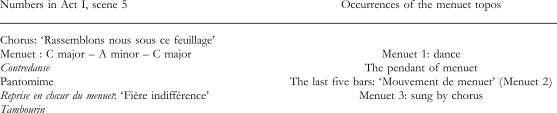
As Table 3 shows, minuets figure prominently in this scene. (According to Charles Compan, the contredanse customarily occurred after a minuet and functioned as a pendant to it, as is the case here.Footnote 51) In this way of understanding the structure of the scene, the pantomime is sandwiched between the two minuets.Whereas the minuet before the pantomime is a dance number, the one after the pantomime is a minuet sung by the chorus.Footnote 52 The similarities and differences among the three minuets – two versions of the minuet plus the brief, interpolated ‘mouvement de menuet’ – help explain how pantomime here not just stages the perils of seduction, but also signifies indecency.
To understand this, we must examine their phrase structure against that of the standard minuet. For eighteenth-century dancers, the basic structural unit of the minuet dance is the minuet step. In the classic dance treatise The Art of Dancing Explained by Reading and Figures (1724), Kellom Tomlinson asserted the importance of music to dancers, for ‘one minuet step is of equal value to two bars of the tune’.Footnote 53 Because each minuet step consists of two bars, even-numbered phrases are particularly common in music for minuet dances. As Rameau put it, ‘the cadence usually occurs in the fourth bar, sometimes in the second, but only seldom in the third’.Footnote 54 Rousseau agreed:
The number of bars of the [minuet] air, in each of its reprises, must be four or multiples of four, because it is necessary to have this many of them to finish the minuet step. The musician must, either by endings or well-marked cadences, make this four-bar unit felt in order to help the dancer's ear and to keep it in time.Footnote 55
Alexis Bacquoy-Guédon, former dancer of the Théâtre François as well as a dance pedagogue, was most conscious of how music dictates dance steps, noting that the two-bar unit of a minuet step formed the basis of teaching the minuet to students: ‘The step of Minuet contains two musical bars that distinguish the good from the false bar’.Footnote 56 The even-number bar, being the foundation of the minuet step, should be the structural foundation of the minuet piece. ‘Each musical phrase and each portion of the musical phrase must always end on the false bar’.Footnote 57 Likewise, the Noverre-influenced Charles Compan elaborated upon Rousseau's definition of the minuet in his Dictionnaire de danse (1787) by noting that the number of bars in a minuet ought to be even.Footnote 58
Although these music and dance treatises unequivocally registered the normative properties of a minuet, they did not report the variety of phrase structures in dance music, nor account for any deviations.Footnote 59 Yet anomalies abound. Notable composers of dance music ventured away from this norm.Footnote 60 Music theorist Joseph Riepel used the phrase structure of minuet in his treatise Anfangsgründe zur musicalischen Setzkunst (1752) for pedagogical purposes.Footnote 61 Not only could odd-numbered phrases be used in minuets, but asymmetrical phrases and elision, if handled skilfully, also provide ‘musical delights’.Footnote 62 Indeed, in Haydn's instrumental minuets composed after 1774, the odd-numbered phrases demonstrate so many structural intricacies that they seem to convey broader cultural meanings of irony, wit, humour, and jest.Footnote 63 The minuet in Mozart's Symphony K. 550, for example, begins with what Riepel called a Sechser, a six-bar phrase composed of two Dreyern, three-bar sub-phrases.Footnote 64
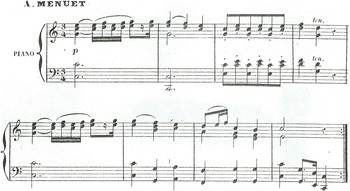
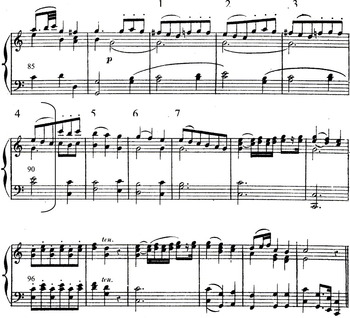
Grétry, for his part, seems to associate irregular phrasing with pointed meanings. In the case of Act I, scene 5 of Céphale et Procris, Grétry departed from the textbook model of the minuet, writing an odd-numbered phrase in Menuets 1 and 3. Furthermore, all three minuets begin with the same material. Menuet 1 is composed of three main sections: a C major minuet (Ex. 6) followed by a contrasting A minor trio in a slower tempo (‘un poco adagio’) leading to a reprise of the C major minuet. Although the C major minuet generally follows the typical minuet (its phrase structure is A(8) – B(4+8+7) – A′(8)), the phrase structure of the A minor trio is much freer, beginning with two three-bar units and ending with a five-bar phrase. Note, as well, that the B section of the C major minuet also ends with an odd-numbered phrase. When the music of Menuet 1 is taken up again in Menuet 3, a two-bar melodic repetition is eliminated (as indicated by the brackets in Ex. 7), now producing the phrase structure A(8)–B(4+8+5)–A′(8) (see Ex. 9, bars 27–33).
The effects of the phrase structural oddity in Menuets 1 and 3 are less conspicuous than in Menuet 2.Footnote 65 By the time Menuet 2 begins, a listener, having heard the main strain of Menuet 1 twice, would understandably measure Menuet 2 against Menuet 1. Perhaps based on this supposition, Grétry played with the opening of the number. After the first two bars establish a firm resemblance with Menuet 1, Menuet 2 quickly dissolves into music for pantomime. The coup d'archet quintuplet leaping into bar 3 obviously mimics the nymph's refusal, a mimetic musical gesture that disrupts the flow of the minuet. The disruption is intensified in bar 3, when silence intrudes. The rhythmic dislocation is aggravated in turn by the melody. With the diminished-fifth melodic interval of bars 3–4, the F♯ eliminates the residual expectation of the half cadence, removing any remaining sense of C major. By the time the dominant of C major appears in bar 5, the rhythmic gesture of the minuet, together with its symmetry – two of its defining features – have been erased.
Grétry, Céphale et Procris, Act I, scene 5, Menuet 1, bars 1–8.

Grétry, Céphale et Procris, Act I, scene 5, Menuet 1, bars 85–101.

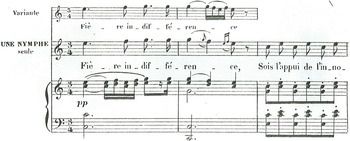
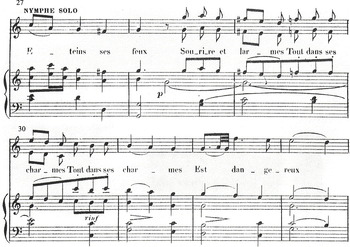
The meanings of the ‘mouvement de menuet’ are explained in the words sung by the nymphe and chorus in Menuet 3 (Ex. 8)Footnote 66 and there can be little doubt that these refer to the seduction performed in the pantomime: the nymphs disparage the god of Love, declaring that amorous temptation endangers chastity. Temptation in this case does not refer to an abstract concept, but something more concrete, as declared in the main point of the lyrics, ‘everything, in his charms, is dangerous’. The word ‘everything’ (‘tout’) in bar 29 of Example 9 denotes all of Love's tricks – including the ways he implores, seduces, persists and pretends to be a courteous minuet dancer (as shown in the ‘mouvement de menuet’) – all actions he performs in the pantomime:
[Proud indifference is the support of innocence. Proud indifference defends our hearts. Love sighs in vain; withstand his empire, withstand his victorious charms, oppose your rigours. Break his charms, break his knots, put out his fire. Smiles and tears, everything, in his charms, is dangerous.]
Grétry, Céphale et Procris, ‘Fière indifférence’, bars 1–3.

Grétry, Céphale et Procris, ‘Fière indifférence’, bars 27–33.

The way the Nymphs disparage Love in this chorus also has musical consequences. Since all the seductive tricks performed by Love are mimicked closely by music, the music that accompanies them conveys indecency, seduction and danger.Footnote 67 From the way Grétry used the expressive topos of the minuet in three versions – first in a minuet dance, then in a pantomime that ends with a rhythmic gesture of minuet which (in turn) dissolves, and finally a minuet sung by the chorus – it is clear that the minuet and pantomime generate a binary opposition of decency and indecency respectively.Footnote 68
The transformation from the minuet to pantomime in Menuet 2 signals the danger of artifice, and the odd-numbered phrases in Menuet 1 and Menuet 3 seem to hint at this danger. The verse ‘tout, dans ses charmes, est dangereux’ coincides with the only odd-numbered phrase of Menuet 3, which is unusual, judging by the menuet in the Act III divertissement of Céphale et Procris and by Grétry's approach to minuets in his oeuvre more generally. Among all the minuets Grétry composed in his career, all but one follows even-numbered phrasing.Footnote 69 The only exception is a ‘solemn minuet’ with the phrase structure 8+11+7 in the Act II divertissement of Panugre: dans l'île des lanternes (1785), an opera that Grétry himself later described as ‘entirely comical’. As he recalled in his Mémoires, Grétry designed a extra-long ‘run-on’ nineteen-bar phrase, ‘one of the longest phrases in the history of music’, to represent the indolence of the Lanternes people, who ‘are never in a hurry’. Within the context of Panugre, perhaps the odd-numbered phrases in the ‘solemn’ minuet invited the choreographer to design similarly comic dance steps.Footnote 70 In sum, one can conclude that the odd-numbered phrase in Menuet 1 hints at the danger, a hint that becomes ever more present through Menuets 2 and 3. Finally, as explained by the lyrics of Menuet 3, the odd-numbered phrases in the minuets of Céphale et Procris represent danger.
Yet, while there seems to be a connection between phrase length and dramatic meaning in this opera, we should resist making the broad generalisation that minuets with odd-numbered phrases were so abnormal to Grétry that they necessarily signal danger. On the contrary, Grétry himself expressed admiration for minuets with odd-numbered phrases. Three years after the Paris première of Céphale et Procris, he wrote a prologue called Les Trois Âges de l'Opéra (1778) that traced a historical trajectory of French opera, positioning Gluck as the heir of Lully and Rameau.Footnote 71 The prologue ends with a divertissement composed of nine dances and an arietta et choeur, a new number Grétry composed for this pastiche.Footnote 72 Two of the dances are minuets, one from Lully's Thésée (1675), another from Gluck's Orphée et Euridice (1774).Footnote 73 Gluck's minuet unfolds in paired seven-bar phrases, suggesting that Grétry was sufficiently comfortable with odd-numbered phrases to grant this piece exemplary status in his historical pastiche. In short, although Grétry presented the charm and danger of gesture in his pantomime of Céphale et Procris so clearly that the odd-numbered phrasing of minuet might even sound dangerous, elsewhere he delighted in minuets with odd-numbered phrasing for musical reasons.
The dangers of pantomime
The dangers of pantomime can be understood on two levels, one of dance, the other of language. As demonstrated by my Rameau example, the music that synchronises with the gestures of a pantomime introduces a kind of phrase irregularity fundamentally at odds with the principle of French court dances. But phrase irregularity in dance was not a rarity in the history of French dances, nor was pantomime new to eighteenth-century French audiences. What was new was to synchronise physical gesture and musical units, to narrate by means of a concatenation of musical gestures in a way that compromises the principle of regularity essential to court dances, and then to use the composite to represent immorality and danger.
The dangers of pantomime accrue in the fear of physical action, which had important implications. For Chabanon, fear of physical action stemmed from fear of a substitution for verbal language. About the same time as Chabanon published his opinion, a critic for the Journal de Paris expressed a similar concern: ‘The difficulty of a pantomime is to be able to express what seems to demand the aid of the word by means of gestures’.Footnote 74 Grétry seems to have conquered such fear of gesture quite well, for his pantomimes in Céphale et Procris prompted a favourable response.Footnote 75
While Grétry had ample reasons to enjoy his hard-won triumph as a composer of ballet music, he did not find in pantomime an ultimate solution to the fear of physical action. On the contrary, his success in the pantomime of Céphale et Procris made him ever cagier about the perils of pantomime. The challenge in pantomime was less about using stellar dancers or simulating verbal language by means of music and gesture than of tying it to the plot. The difficulty was to find the balance point that makes pantomime intelligible and economical enough in order to sustain interest in the audiences. In a section of his memoirs titled ‘On Illusion’, Grétry stated this in no uncertain terms:
Why is pantomime so dangerous to the dramatic art of which it forms a part? It is because it is addressed to everyone. If I do not understand, it is my fault. I myself am making the words of the drama that we perform, and what I am saying is always so well said! For what it would be is exactly the limit of my intelligence. It is excessive, the amateurs of pantomime will say, that words [are] sustained by expressive music; the gesture from these words and music suffice. Yes, pantomime is adequate to say what is easy to understand, in order to repeat through gestures what we have already said to ourselves with words. But try to set an original subject as pantomime, and you will see whether it will be explained, and whether anything will equal the impatience of the spectators … Without women, without brilliant decorations, would it be bearable?Footnote 76
Grétry's struggles with pantomime remind us again that the dangers of pantomime are inextricably entwined with its charm. Repeatedly, eighteenth-century composers were beguiled by physical gestures. They were spurred to plumb the abyss of muteness for meanings. Just when they fathomed how music and gesture could be used interdependently to heighten intelligibility, they discovered the unforeseen potential of muteness for attracting, generating, producing original meanings, or escaping preconceived ideas of legibility. In this way, eighteenth-century pantomime became crucial to the invention of new social meanings, new narrative structures, and prompted new ways of watching and of listening, and legitimating the quest for extra-musical meanings in music.