I. INTRODUCTION
Molybdenum is one of the metals most widely studied in oxidation processes due to its high relevance as a catalyst in both biological systems and synthetic reactions (Arzoumanian, Reference Arzoumanian1998; Eierhoff et al., Reference Eierhoff, Tung, Hammerschmidt and Krebs2009; Hille, Reference Hille2013; Castellanos et al., Reference Castellanos, Martínez Q, Martínez O, Leus and Van Der Voort2021; Martínez R. et al., Reference Martínez R., Trujillo, Carriazo and Castellanos2023; Maurya and Chauhan, Reference Maurya and Chauhan2023). In the last three decades, the synthesis of dioxo-Mo complexes with different ligands has been reported and their physicochemical properties have been studied, especially in the transfer of oxygen atoms to substrates such as phosphines, alcohols, arylalkanes and alkenes using different oxo-donors in liquid solution (Kühn et al., Reference Kühn, Santos and Abrantes2006; Páez et al., Reference Páez, Castellanos, Martínez O., Ziarelli, Agrifoglio, Páez-Mozo and Arzoumanian2008; Castellanos et al., Reference Castellanos, Martínez, Lynen, Biswas, Van Der Voort and Arzoumanian2013; Camargo et al., Reference Camargo, Castellanos, Rosas and Henao2014; Kargar et al., Reference Kargar, Fallah-Mehrjardi, Behjatmanesh-Ardakani, Munawar, Ashfaq and Tahir2021).
In the specific case of coordination complexes of Mo with the 4,4′-di-tert-butyl-2,2′-bipyridine ligand, a search in the Cambridge Structural Database (CSD,5.46; Groom et al., Reference Groom, Bruno, Lightfoot and Ward2016) revealed eleven different crystal structures forming monomers and dimers of the dioxide-Mo entity. The crystal structures of molybdenum dimers published in the CSD with this ligand are (μ2-Oxo)-bis(4,4′-di-tert-butyl-2,2′-bipyridine)-dichloro-tetraoxo-di-molybdenum(VI)⋅0.2hydrate [C36H48Cl2MoN4O5∙0.2(H2O); Refcode: IDECEB (Gomes et al., Reference Gomes, Fernandes, Gamelas, Gonçalves and Paz2011)]; bis(μ2-Oxo)-dichloro-bis(4,4′-di-tert-butyl-2,2′-bipyridine)-dioxo-di-molybdenum(VI) [C41H53Cl7Mo2N4O4∙5(CHCl3); Refcode: UKUGAK] (Gomes et al., Reference Gomes, Neves, Cunha-Silva, Valente, Gonçalves and Pillinger2016); bis(μ2-Oxo)-bis(4,4′-di-t-butyl-2,2′-bipyridine)-dichloro-dioxo-di-molybdenum(VI) [C40H60Cl2Mo2N4O6∙2(C2H6O); Refcode: UKUGEO] (Gomes et al., Reference Gomes, Neves, Cunha-Silva, Valente, Gonçalves and Pillinger2016); (μ-oxido)-tetrachloro-bis(4,4′-di-tert-butyl-2,2′-bipyridine)-dioxo-di-molybdenum(V)- dichloromethane [C36H48Cl4Mo2N4O3∙2(CH2Cl2); Refcode: JEYWAP] (Fosshat et al., Reference Fosshat, Siddhiaratchige D. M., Baumberger, Ortiz, Fronczek and Chambers2022). The monomeric crystal structures reported correspond to (4,4′-di-tert-butyl-2,2′-bipyridyl)-dichloro-dioxo-molybdenum [C18H24Cl2MoN2O2; Refcodes: UJOPAK (Sugimoto et al., Reference Sugimoto, Siren, Tsukube and Tanaka2003), UJOPAK01 (Arzoumanian et al., Reference Arzoumanian, Bakhtchadjian, Agrifoglio, Atencio and Briceño2006), and UJOPAK02 (Fosshat et al., Reference Fosshat, Siddhiaratchige D. M., Baumberger, Ortiz, Fronczek and Chambers2022); chloro-(4,4′-di-tert-butyl-2,2′-bipyridine)-(ethanolato)-dioxo-molybdenum [C20H29ClMoN2O3; Refcode: UKUFUD] (Gomes et al., Reference Gomes, Neves, Cunha-Silva, Valente, Gonçalves and Pillinger2016); and (4,4′-di-tert-butyl-2,2′-bipyridine)-difluoro-dioxo-molybdenum(VI) [C18H24F2MoN2O2; Refcode: IFUJIG] (Fosshat et al., Reference Fosshat, Fronczek and Chambers2023).
For the compound presented in this study, two single-crystal X-ray diffraction reports have been published (Refcodes: YOMXED [Arzoumanian et al., Reference Arzoumanian, Agrifoglio, Krentzien and Capparelli1995] and IFUJEC [Fosshat et al., Reference Fosshat, Fronczek and Chambers2023]). The first crystal structure was determined in space group Pnma at 295 K, and the second study reports the structure at 90 K in space group Pna21. In order to facilitate the identification of the dibromidodioxido-[(4,4′-di-tert-butyl)-2,2′-bipyridine]molybdenum(VI) complex using X-ray powder diffraction (XRPD) techniques recorded at room temperature, in this work, the powder diffraction data collected at 293 K is being reported. The successful structure refinement, in space group Pna21, which indicates the good quality of the data, and a report of the spectroscopic characterization are presented.
II. EXPERIMENTAL
All the chemical reagents were acquired from commercial suppliers and used without further purification. All the solvents used in the experiments were initially dried and deoxygenated by refluxing, for 12 h, with proper desiccant agents, under N2 atmosphere and distilled prior to their use. The synthesis procedure was carried out under standard Schlenk techniques in an inert atmosphere.
A. Synthesis of diaquadibromidodioxidomolybdenum(VI) [MoO2Br2(H2O)2]
Based on a previously reported procedure (Shapley, Reference Shapley2004), 25.4 g (145.2 mmol) of concentrated HBr (48%) was put in a 50-mL Erlenmeyer flask and submerged in a cold bath. Subsequently, 5.023 g (24.4 mmol) of Na2MoO4·2H2O was added and the mixture was stirred for 15 min. The flask was removed from the cold bath and 50 mL of previously dried and distilled diethyl-ether was added observing the formation of sodium bromide as a solid. The liquid phase was transferred to a separatory funnel where the organic phase was extracted and kept in a flask with anhydrous sodium sulfate. This extraction was repeated three times, until a very light -yellow color was obtained in the organic phase which contains the [MoO2Br2(H2O)2] precursor. The organic phase solution was stored in a fridge at −3.0 °C until its posterior use.
B. Synthesis of dibromidodioxido[(4,4′-di-tert-butyl)-2,2′-bipyridine]molybdenum (VI)
Using a Schlenk flask, 0.389 g (1.4 mmol) of the 4,4′-di-(tert-butyl)-2,2′-bipyridine ligand was dissolved in 5.0 mL of dichloromethane (solution A). A volume of 10 mL of [MoBr2O2(H2O)2] (stock solution previously prepared) was added to solution A, and the mixture was stirred for 2 h at room temperature. After that, a solid was obtained, filtered, and washed with 10 mL of diethyl ether followed by 10 mL of dichloromethane to obtain a greyish green material (0.554 g; Yield: 89.8%) (Figure 1).
Synthesis of dibromidodioxido-[(4,4′-di-tert-butyl)-2,2′-bipyridine]molybdenum(VI).

C. Spectroscopic studies and elemental analysis
The UV–vis spectra were registered with a Thermo Scientific Genesys 10S spectrophotometer. The IR spectra were registered using a Perkin-Elmer 1720XFT spectrophotometer, with the samples diluted in KBr. 1H-NMR analyses were performed with a Bruker Avance 400 equipment and the elemental analysis CHN was carried out using a CHNS/O Thermo Scientific Flash 2000 analyzer with a thermal conductivity detector (TCD) detector. FT-IR (KBr): Ligand: (s) 1,583 cm−1 (v C=C, C=N), (m) 2,900 cm−1 (vA C-H, -CH3), (m) 2,959 cm−1 (vS C-H, -CH3), (m) 1,223 cm−1 (ρ CH3-C-CH3, -C(CH3)3). Coordination compound: (s) 905 cm−1 (vS Mo-O), (s) 937 cm−1 (vA Mo-O), (m) 1,611 cm−1 (v C=C, C=N), (w) 2,905 cm−1 (vA C-H, -CH3), (w) 2,967 cm−1 (vS C-H, -CH3), (m) 1,252 cm−1 (ρ CH3-C-CH3, -C(CH3)3). 1H-RMN (DMSO-d6): Ligand ẟ(ppm): 1.34 (s) (C-CH3); 7.48 (dd) [J 1 = 0.0110; J 2 = 0.0050] (C5-H (bipy)); 8.41 (dd) [J 1 = 0.0110; J 2 = 0.0018] (C6-H (bipy)); 8.61 (dd) [J 1 = 0.0110; J 2 = 0.0017] (C3-H (bipy)). Coordination compound ẟ(ppm): 1.44 (s) (C-CH3); 7.88 (dd) [J 1 = 0.0110; J 2 = 0.0045] (C5-H (bipy)); 8.66 (d) [J = 0.0038] (C6-H (bipy)); 8.80 (d) [J = 0.0146]. UV–vis (CH2Cl2): Ligand: 242 nm (π → π* transition in aromatic ring), 284 nm (n → π* transition between nitrogen and aromatic ring and π → π* transition in aromatic ring). Coordination compound: 238 nm (π → π* transition in aromatic ring), 272 nm (π → π* transition in aromatic ring), 326 nm (ligand-to-metal charge transfer transition). Elemental analysis calculated for C18H24Br2MoN2O2 (556.2): C 38.87, H 4.35, N 5.04. Found: C 39.12, H 4.57, N, 5.08.
D. Powder diffraction data collection
XRPD measurements were carried out at 293 K using a Bragg–Brentano X’Pert Pro MPD PANalytical diffractometer equipped with a Cu anode (CuKα, λ = 1. 5405981 Å), a nickel filter and a high-speed PIXcel solid-state detector. A small fraction of the sample was ground and homogenized in an agate mortar and then mounted on a stainless-steel sample holder using the face-fill technique. The diffraction data were collected from 7.0 to −50.0° in 2θ, with a step size of 0.0263°, and a counting time of 97.92 s. The powder diffraction pattern recorded was indexed in an orthorhombic unit cell and used in a Rietveld refinement using the previously reported structures: Refcodes YOMXED (Arzoumanian et al., Reference Arzoumanian, Agrifoglio, Krentzien and Capparelli1995) and IFUJEC (Fosshat et al., Reference Fosshat, Fronczek and Chambers2023).
III. RESULTS AND DISCUSSION
The coordination compound dibromidodioxido-[(4,4′-di-tert-butyl)-2,2′-bipyridine]molybdenum(VI) was originally synthesized by Arzoumanian et al. (Reference Arzoumanian, Agrifoglio, Krentzien and Capparelli1995). They determined its crystal structure from single-crystal data collected with a diffractometer equipped with a point detector in the orthorhombic space group Pnma (N°62) (Arzoumanian et al., Reference Arzoumanian, Agrifoglio, Krentzien and Capparelli1995). Recently, this structure has been revisited also from single-crystal data but collected using a modern highly sensitive 2D detector (Fosshat et al., Reference Fosshat, Fronczek and Chambers2023). This new study reported the structure in the non-centrosymmetric orthorhombic space group Pna21 (N°33).
In the present study, a Rietveld refinement of the powder pattern, collected at room temperature (293 K) was performed using the General Structure and Analysis Software II (GSAS-II) (GSAS-II) software (Toby and Von Dreele, Reference Toby and Von Dreele2013). In the refinement of the structure reported by Fosshat et al. (Reference Fosshat, Fronczek and Chambers2023), the background was modeled with a 16-term Chebyshev polynomial, scales factor, sample displacement errors, absorption, unit cell parameters, peak shape parameters, thermal parameters, and atomic coordinates.
The refinement included 126 parameters, 1,714 data points, 2 restraints, and 1 constraint. The final whole pattern fitting converged with good figures of merit: Re = 1.20%, Rp = 3.32%, Rwp = 4.57%, and GoF = 1.900. The final refined fit yielded the unit cell parameters a = 17.9205(23) Å, b = 13.4451(16) Å, c = 18.1514(19) Å, V = 4,373.5(11) Å3, and values of Z = 8 and Z’ = 2 (Table I).
Experimental data of dibromidodioxido-[(4,4′-di-tert-butyl)-2,2′-bipyridine]molybdenum(VI) compound using single crystal analysis and powder diffraction analysis

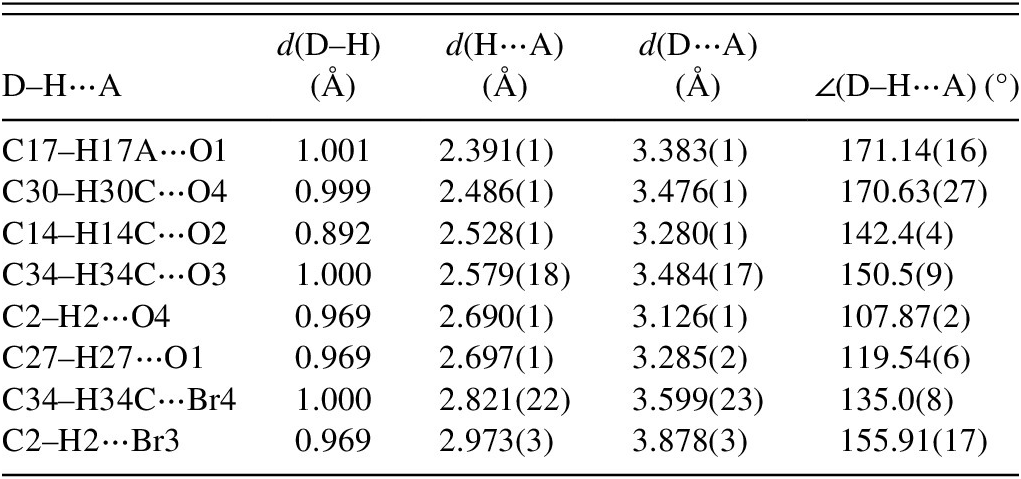
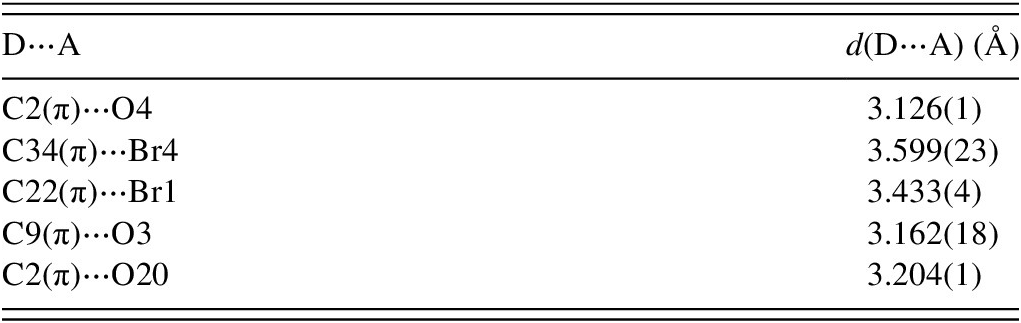
Figure 2 shows the final Rietveld refinement plot. The list of diffraction maxima recorded is presented in Table II. The atomic coordinates for the atoms in the asymmetric unit are presented in Table III. All bond distances and angles for the metallic center in the asymmetric unit of dibromidodioxido-[(4,4′-di-tert-butyl)-2,2′-bipyridine]molybdenum(VI) are presented in Table IV. The molecular structure was drawn using the Mercury software (MacRae et al., Reference MacRae, Sovago, Cottrell, Galek, McCabe, Pidcock and Platings2020) and is presented in Figure 3. The coordination sphere of the Mo atom consists of two bromines, two oxygens, and the two nitrogen atoms of the ligand, forming a distorted octahedron (Lin and Hall, Reference Lin and Hall1993; Barea et al., Reference Barea, Lledos, Maseras and Jean1998). A noticeable distortion involving the bromine atoms in the coordination sphere around Mo was confirmed based on the angles Br1-Mo1-Br2 of 157.10(2)°, O1-Mo1-Br2 of 92.53(1)°, Br3-Mo2-Br4 of 163.75(6)°, and O3-Mo2-Br4 of 106.34(2)°. Hydrogen bond geometry parameters and short intermolecular contacts in the asymmetric unit are presented in Tables V and VI, respectively.
XRDP data for dibromidodioxido-[(4,4′-di-tert-butyl)-2,2′-bipyridine]molybdenum(VI)

Calculated by DICVOL04 (Altomare et al. 2013) after indexing with 59 used lines and tolerance of 0.05 in d-spacing, obtaining the following figures of merit: M(20) = 11.6, F(20) = 28.1 (0.0087, 82), and F(59) = 12.2 (0.0105, 461).
Rietveld refinement plot of dibromidodioxido-[(4,4′-di-tert-butyl)-2,2′-bipyridine]molybdenum(VI).

Atomic coordinates for dibromidodioxido-[(4,4′-di-tert-butyl)-2,2′-bipyridine]molybdenum(VI) in the asymmetric unit

Molecular structure of dibromidodioxido-[(4,4′-di-tert-butyl)-2,2′-bipyridine]molybdenum(VI).

Bond distances and angles for the metallic center of dibromidodioxido-[(4,4′-di-tert-butyl)-2,2′-bipyridine]molybdenum(VI)

Hydrogen bond geometry of dibromidodioxido-[(4,4′-di-tert-butyl)-2,2′-bipyridine]molybdenum(VI)

Short intermolecular contacts of dibromidodioxido-[(4,4′-di-tert-butyl)-2,2′-bipyridine]molybdenum(VI)

A rapid estimation of the volumetric thermal expansion coefficient (α = 3.29 × 10⁻⁴ K−1) was done from the unit cell parameters obtained in this study at 293 K and the value reported from the single crystal study at 90 K (Fosshat et al., Reference Fosshat, Fronczek and Chambers2023) using the web-based tool PASCal (Cliffe and Goodwin, Reference Cliffe and Goodwin2012; Lertkiattrakul et al., Reference Lertkiattrakul, Evans and Cliffe2023).
DEPOSITED DATA
The CIF file containing the crystallographic data was deposited with the International Centre for Diffraction Data (ICDD). The data can be requested by contacting the managing editor at pdj@icdd.com.
FUNDING STATEMENT
This work was financially supported by the Universidad Nacional de Colombia and the Facultad de Ciencias de la Universidad Nacional de Colombia by internal projects code HERMES 62332.
CONFLICTS OF INTEREST
The authors have no conflicts of interest to declare.