‘After Richard Mayr – the most unforgettable of all Viennese singers – performed the Pierrot Lied’, recalled Luzi Korngold nearly fifty years after attending a performance of her husband's Die tote Stadt, ‘the audience broke into a hurricane of enthusiasm’.Footnote 1 Along with the ‘Lautenlied’, this lyrical baritone waltz remains today one of the most well-known numbers from Erich Wolfgang Korngold's three-act opera, which received a double premiere in Hamburg and Cologne on 4 December 1920 and went on to enjoy over a decade of success across dozens of European stages before succumbing to the full force of Nazi censorship in 1933.Footnote 2 In the second act of Die tote Stadt, a minor character named Fritz performs the ‘Pierrot Lied’ as an expressly requested song in the midst of a dance troupe's preparations for a rehearsal of Giacomo Meyerbeer's Robert le diable – a rehearsal that, in turn, takes place during an extended dream sequence within Die tote Stadt's overarching diegesis.Footnote 3 This dizzying descent into meta-theatrics establishes the ‘Pierrot Lied’ as a compounded example of what writers have variously termed ‘stage music’, ‘phenomenal song’, ‘narrative song’, ‘diegetic music’ and ‘heard music’ in opera.Footnote 4 Embedded within three layers of spectacle, the ‘Pierrot Lied’ is effectively removed fourfold from ‘reality’ and lies at the structural midpoint of the opera's narrative. Like the centre of a turning wheel or the zenith of parabolic flight, the song evokes a sensation of timelessness via Fritz's role-play as a moonstruck Pierrot, the lilting dactylic metre of the text, sweeping arpeggios in the harp, an abundance of notated vocal portamenti, and the overall elastic rhythms of the music (marked over the course of eighty-nine bars with numerous fermatas and six instances of poco rit – a tempo). Operatic action is temporarily frozen as the other members of the dance troupe cease their jests and (according to stage directions) ‘phantastisch um Fritz gruppiert, zumeist vorgebeugten Hauptes, starr die Augen auf ihn gerichtet, unbeweglich wie in Traum’ (gather fantastically around Fritz, most of them with heads inclined, their eyes fixated on him, motionless as if in a dream). With on-stage and off-stage audiences united in awed appreciation of music that is ‘audible’ as such, the ‘Pierrot Lied’ resounds as a literal showstopper, a dramatic centrepiece that revels reflexively in the conceit of sung spectacle.
Die tote Stadt stages the psychological turmoil of a grief-stricken man who plunges into a veritable abyss of such spectacle. Korngold and his father, the polarising Viennese critic Julius Leopold Korngold, adapted Die tote Stadt's librettoFootnote 5 from the 1892 novel Bruges-la-Morte by the Symbolist Belgian poet Georges Rodenbach.Footnote 6 The opera is set in ‘omnipresent … Bruges, the dead city, wearily dreaming of the past amidst the mystic peace of its churches and cloisters, its bells, its weather-worn Gothic facades, its stagnant waterways and abandoned canals’.Footnote 7 Paul, the protagonist, mourns his dead wife, Marie, and has transformed his home into a monument of heartbreaking denial: a life-sized portrait of Marie hangs on the wall; a plait of Marie's hair, stored in a glass coffer, rests on a table; and Marie's room, which Paul has named ‘die Kirche des Gewesenen’ (the Temple of the Past), remains perfectly preserved with all kinds of mementoes lying within.Footnote 8
The operatic action begins on the day a dancer named Marietta arrives in Bruges with her touring troupe of stage performers. She bears an uncanny likeness to the late Marie, and when Paul encounters her, he becomes spellbound by this surrogate object of desire. In the final scene of Act I, the ghost of Marie steps out of her portrait and tells Paul to free himself from the doppelgänger. At the beginning of Act II, Paul falls into a prolonged dream in which he finds himself abandoned by both his friend Frank and his housekeeper Brigitta. After surreptitiously watching Fritz's performance and Marietta's opera rehearsal, Paul slowly comes to recognise the perversity of his affections. His annoyance with Marietta finally turns into outright rage in Act III when he sees her dancing with Marie's plait of hair. Shouting ‘Mein Heiligtum, entweih es nicht!’ (My sacred relic, defile it not!), Paul chases Marietta around his house and, upon catching her, strangles her to death with the plait of hair. The dream sequence comes to a close and Paul awakens to discover that no murder has really taken place. In the end, having learned from his dream the importance of letting go, Paul leaves his home: the Temple of the Past, his relics, and Bruges, the dead city.
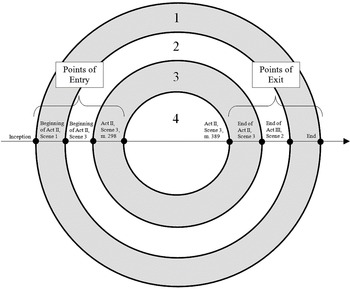
Marie's death, which occurs prior to the inception of the opera's formal narrative, constitutes the overwhelming trauma that drives Paul to delusion. By the time Paul is spying on Marietta at her rehearsal, he is, in effect, chasing after an actress who is the dreamt representation of a doppelgänger of his deceased wife. Die tote Stadt can accordingly be seen to contain four nested diegetic realms (as illustrated in Fig. 1): (1) the opera's so-called ‘real world’ (the ‘reality’ of which remains uncertain throughout the narrative); (2) Paul's dream world (the ‘un-reality’ of which is likewise contestable); (3) the dance troupe's rehearsal preparations for Robert le diable (and – following Fritz's song – the staging of a brief scene from that opera); and (4) Fritz's performance of the ‘Pierrot Lied’. Each point of ‘entry’ signals the descent of Paul into fantasy, while each point of ‘exit’ tracks his progressive flight from spectacle.
The four nested diegetic realms of Die tote Stadt.

The narrative levels of Die tote Stadt exemplify the phenomenon of mise-en-abyme, a term that was first deployed in aesthetic contexts by André Gide (1948) in his descriptions of reflexive embeddings in various forms of art.Footnote 9 Following Gide, the concept quickly gained currency among literary theorists and eventually became the subject of a full-length monograph by Lucien Dällenbach (1977), who expanded the definition of mise-en-abyme to account for any work with an interior aspect that ‘bears a similarity to the work that contains it’.Footnote 10 As Dällenbach observes, the word ‘abyme’ – literally ‘abyss’ – ‘invokes notions of depth, infinity, vertigo and falling’.Footnote 11 As such, mise-en-abyme ‘de-temporalizes and de-linearizes narrative: by bringing together the near and the far, the present and the past, it calls into question the system whereby one thing follows another, substituting for it a reality that is above or outside time’.Footnote 12 An illusion of infinite recursion necessarily confounds perceptual focus and betrays the porousness of the boundaries that are understood to exist between discrete diegetic strata.Footnote 13 By extending that which philosopher Gregory Currie calls the ‘collapse of iterativity’ – namely, the idea that ‘imagining that someone imagines P [tends] to collapse into imagining P’ – one might reckon that watching a spectacle within a spectacle (such as the ‘Pierrot Lied’) can easily collapse into a ‘direct’ experience of spectacle, leaving exterior narrative frames nipping only sporadically at the fringes of one's consciousness.Footnote 14 The lush orchestration, through-sung text and endless melodies of an opera such as Die tote Stadt weave a continuous sonorous fabric that potentially assists such collapse. As often remarked by theorists of opera and film, an immersive wash of music can function as a sort of psychological lubricant, one that smoothes over gaps in dramatic logic, shifts in narrative voice and other such distractions in one's overall apprehension of spectacle.Footnote 15
The enthusiastic initial reception of Die tote Stadt in Austria and Germany can perhaps be attributed, at least in part, to the resonances between the opera's mise-en-abyme depictions of trauma and the post-war conditions of the early 1920s. In presenting Paul's escape from the opera's diegetic realms as a ritual of mourning and healing, Korngold's narrative arguably conveyed to its early audiences the ideological perils as well as the revitalising powers of musical spectacle in the wake of cultural fallout. Just as Paul must learn to abandon the false comforts of his fantasies, so audience members had to forego, at the end of each performance, their absorption in theatrics and return to face the dead cities and dead Maries that loomed outside the cosy confines of the opera house.Footnote 16 The opera hence showcased illusion's edifying qualities and capacity to serve as an antidote to social disillusionment. On the surface, then, Die tote Stadt was a point-blank refutation of Opernkrise and its polemics, a reflexive and kaleidoscopic celebration of ‘pure’ spectacle during a period in which the value of art was itself being rigorously called into question.Footnote 17
Yet spectators and hermeneuts alike might harbour a lingering suspicion that any endeavour to read this opera and its mise-en-abyme narrative is ultimately an exercise in hermeneutical nihilism, a bid to rescue ‘meaning’ from a dramatic abyss that, by its very nature, resists straightforward interpretation. One could certainly view any practice of operatic hermeneutics in its own right as a journey into an abyss, a spelunking expedition with the objective of unearthing a cohesive, original interpretation of a work (and its stagings), or – as has become increasingly fashionable in recent years – submitting a handful of provocative observations that purposefully and ‘responsibly’ delight in polysemy, inconclusivity and the disavowal of textual legibility.Footnote 18 The striking palette of musical, dramatic and narrative manifestations of mise-en-abyme in Korngold's opera furnishes a fortuitous opportunity to place a reading of this opera in dialogue (and at odds) with the very act of reading opera. As philosopher Ashley Woodward puts it, ‘the frame-within-frame of the mise-en-abyme recalls the position of the postmodern nihilist who tries to frame the problem of nihilism, only to realise that he or she is enclosed in the same nihilistic frame, set on a larger scale’.Footnote 19Mise-en-abyme, of course, need not always be a cause for rhetorical paralysis (or – as Woodward's statement implies – existential crisis); rather, it can compel a certain level of reflexivity and an alertness towards the particular subtleties of hermeneutic manoeuvres. With this in mind, I seek to provide here an interpretation of Die tote Stadt through the framework of mise-en-abyme while contemplating, in turn, the social, political and intellectual incentives that have historically informed critical and dramaturgical characterisations of this opera.
1
One matter that should first be addressed concerns the enormous – yet heretofore unremarked – extent to which the reception of Die tote Stadt has been coloured by the ‘apolitical’ image that critics, biographers and dramaturges have long since imprinted on its composer. Much like his middle-namesake Wolfgang Amadeus Mozart – whose figure has been clouded by that which Maynard Solomon calls the ‘myth of the eternal child’Footnote 20 – Erich Wolfgang Korngold was widely regarded as a Wunderkind frozen in a cocoon of social pre-maturation.Footnote 21 In a 1967 biography of her husband, Luzi Korngold noted that Erich spent his days as a teenager under the constant surveillance of his over-protective parents and ‘was more childish than his contemporaries, untouched by the problems of puberty’.Footnote 22 Numerous writers also commented on Korngold's perpetually dreamy demeanour. As noted by biographer Brendan Carroll, Korngold ‘never learned to drive because of his concern that he might easily mistake the accelerator pedal for the sostenuto pedal of the piano whenever his mind was distracted by musical inspiration’.Footnote 23 Although Korngold was twenty-three-years old by the time Die tote Stadt received its premiere, he was still perceived then as an over-grown child who had his head in the clouds and remained hopelessly estranged from the post-war zeitgeist.
Writers have commonly placed Korngold beneath the spacious – daresay purgatorial – umbrella of ‘late-Romanticism’, the ‘late-ness’ of which tacitly points to the label's own connotations of stylistic obsolescence.Footnote 24 In an Italian biography of Korngold, Mario Tedeschi Turco describes Die tote Stadt as ‘deprived of the radical and revolutionary charge characteristic of Schoenberg or Berg, using instead, as a guiding principle, a completely late-romantic language’.Footnote 25 In similar fashion, William Ashbrook nebulously calls the opera ‘an example sui generis of post-World War I mittel-europäisch late-late romanticism’.Footnote 26 Other musicologists have wryly identified Die tote Stadt as ‘succulent’,Footnote 27 ‘a wet musico-dramatic dream’Footnote 28 and ‘more bombastic and “Wagnerian” at times than it needs to be’.Footnote 29 Setting aside the well-worn question of just how ‘Wagnerian’ an opera of this period ‘needed’ to be, it is evident that these remarks have aimed to delineate Korngold's (admittedly leitmotif-driven) opera as little more than a feast for the senses. To this day, the overriding assumption has been that Die tote Stadt succeeded by virtue of its fin-de-siècle ‘decadence’ and despite its lack of social timeliness.
The conservative image of Korngold became a well-publicised fact not least as a result of his father's persistent attacks against various modernist composers. Julius Korngold's aggressive rants eventually led Erich to be excluded from festivals hosted by ‘progressive’ musical organisations such as the International Society for Contemporary Music and Arnold Schoenberg's Society for Private Musical Performances.Footnote 30 Thus throughout his young adulthood, Korngold experienced an increasing pressure of living in (and yet apart from) a cultural climate in which practitioners of Expressionism, serialism, Zeitoper, Neue Sachlichkeit and other aesthetic currents were actively devising ways of deploying music as a political vehicle. Korngold resisted these modernist tendencies and rarely sought to stray from what he called ‘the eminent possibilities offered by old music’.Footnote 31 Unlike outspoken composers such as Schoenberg, Ferruccio Busoni, Hans Pfitzner, Ernst Krenek, Kurt Weill and Paul Hindemith, all of whom participated extensively in debates about the state of opera (and art more generally) during the inter-war period, Korngold refrained from overtly philosophising about his own compositional aims. On 23 May 1926, in an interview with the Neues Wiener Tagblatt, he reported: ‘I do not subscribe to any one doctrine. My musical creed may be called the inspired idea. With what displeasure people regard this concept nowadays!’Footnote 32
It seems rather fitting, then, that shortly after Die tote Stadt's premiere, the Berlin critic Adolf Weissmann praised the opera for its ‘Problemlosigkeit’ (problemlessness),Footnote 33 while Rudolf Stefan Hoffmann, Korngold's first biographer, likewise admired that the work did not ‘[abuse the operatic stage] to philosophise, or propagate mysteries and immolations’.Footnote 34 Such statements underscored the opera's alleged political neutrality (or naivety) and continue to find echoes in present-day criticisms of Korngold's music. In a recent article, David Allenby speculates that ‘perhaps [Korngold's] real problem was that there was no problem. With a total facility rare in music history, he had no need for a Beethovenian struggle with his material nor, like Wagner or Mahler, a compulsion to realise radically new creative forms’.Footnote 35 The ‘problemless’ image of Korngold has led writers to point out not only his ‘joie de vivre and optimism’Footnote 36 and ‘fröhliche Gelassenheit’ (cheerful serenity)Footnote 37 but also that his music was ‘effective in a cheaply theatrical sort of way, and that it is not surprising that [he] eventually went to Hollywood to ply his trade for The Bastard Art’ – that is, film music.Footnote 38 Hence, as a prodigy who, according to Robbert van der Lek, ‘had [by the age of twenty-five] effectively already said everything he had to say through his music’, Korngold was perceived as stunted in personal character yet bewilderingly mature in musical craft.Footnote 39 Some writers have attempted to explain Korngold's precocity by passing it off as simply the mechanistic imitation of compositional models. Indeed, as early as the 1920s, the reception of Korngold and his music has played out as a tug-of-war between those who pronounced the composer's style as derivative and those who insisted on its originality.Footnote 40 Biographer Brendan Carroll, who dubs Korngold ‘the last prodigy’, has gone so far as to say that he can ‘recognise the voice of Korngold in a single chord, so extraordinarily personal is his style’.Footnote 41 At stake for Korngold's defenders has been (and continues to be), it appears, a romantic vision of genius – a faith in the possibility that Korngold was a ‘true’ prodigy whose output was somehow able to rise above and go unsullied by the gritty politics of contemporary society.
But herein lies the rub: for no matter which position one takes in such disputes, Korngold emerges as a walking paradox.Footnote 42 The mystique of this problem(less) child was summarily articulated by composer and musicologist Egon Wellesz in his review of Korngold's first two operas, Violanta (1916) and Der Ring des Polykrates (1916):
In these works of a sixteen-year-old, the problem of personal experience seems to have become non-existent if one considers that an adolescent purely by intuition could have reproduced so uncannily the emotions and passions he cannot have yet experienced. In both of the operas, all phases of love are described, ranging from delicate flirtation to the most sensual eroticism.Footnote 43
How could it have been possible for Korngold – if he were emotionally ‘under-developed’ – to have produced what listeners perceived as ‘mature’ music? And by extension, how could an ‘asocial’ composer write music with any claim to social significance? Such questions raise some familiar red flags: they posit an ideological lockstep between the ‘nature’ and output of an artist; they stipulate life experience as a necessary (and perceptible) determinant of artistic expression; and they take for granted the existence of an uninterrupted pipeline of signification between compositional intentions and audience reception.Footnote 44 But even though students of the humanities nowadays tend to maintain a healthy scepticism towards the post-mortem author and the epistemological values of artistic intent, such caution is not always enough to quell the temptations of confessional criticism (especially when the artist under consideration is so thickly wreathed in contradiction and intrigue). The attempts of writers to ‘read’ Korngold in social or psychoanalytical terms have incidentally ended up making the composer out to be very much like the protagonist of Die tote Stadt – in sum, a poster-child of denial whose navel-gazing nostalgia rendered him almost pathological in character.
It is therefore not altogether surprising that Inga Levant, the director of the 2001 Strasbourg production of Die tote Stadt (originally filmed in front of a live audience and subsequently released on DVD),Footnote 45 chose to stage the work as a Künstleroper-like commentary on the trajectory of Korngold's life and career.Footnote 46 When I asked Levant, in a 2008 interview, to explain the concept behind the production, she responded:
The starting point of my production was Korngold's private life, which actually repeated the opera. He, like Paul, was living in the past and refused to accept the changed situation of his own life. He wanted to continue living in the Vienna of the 1920s when he was admired [as a] creative Wunderkind. Refusing to accept Hitler's rise to power, but being forced out of Austria at the last possible moment, sitting in Hollywood with all the possibilities to create a new style of film music for the young developing art form, he actually denied the reality around him and enclosed himself in the glorious Viennese past, waiting for the Nazis to go and to return to his beloved Vienna.Footnote 47
It is apparent that Korngold's child-like image and Die tote Stadt's reception have become tightly joined in the critical and dramaturgical imagination, but what remains less clear is whether Korngold and Paul really lived out parallel destinies, whether Die tote Stadt can be convincingly staged as a confessional work, and what the broader social and intellectual stakes of these queries might be.Footnote 48 Granted, the ease with which one can uncover (or fabricate) ‘evidence’ of a work's cultural, political and autobiographical valence constitutes a fundamental problem of allegory, which, in the words of Walter Benjamin, represents a form of discourse that seems to allow ‘[a]ny person, any object, any relationship [to] mean absolutely anything else’.Footnote 49 Such interpretive promiscuity naturally becomes a rather pronounced occupational hazard when one attempts to interpret a labyrinthine opera like Die tote Stadt. Let us now, then, turn to this opera and see just how deep its rabbit-hole goes.
2
In a 1921 interview with the Wiener Blätter des Operntheaters, Korngold described that which he found so stimulating about Rodenbach's source narrative for Die tote Stadt:
The peculiar atmosphere of Bruges; the melancholic undertone; the two lead characters with their compelling psychological conflicts; the struggle between the living woman's erotic power and the dead woman's lingering psychological power; the broader struggle between life and death, especially with regard to the beautiful idea of how the mourning of departed loved ones must, by necessity, be mitigated by a claim to life; and everywhere, a wealth of possibilities for musical design – all of this appealed to me.Footnote 50
The most conspicuous alteration that the Korngolds made when adapting Rodenbach's novel entailed, according to Julius, ‘refashioning the action [in the middle of the opera] as a dream … to soften the skit-like ending of a woman's strangulation and to achieve a conciliatory, elegiac conclusion’.Footnote 51 Yet by retaining various unsettling aspects of Rodenbach's story – which concludes with the murder of the doppelgänger in presumed ‘reality’ – Die tote Stadt casts doubt on whether Paul actually wakes up after killing Marietta, and, indeed, whether he is ever dreaming in the first place.Footnote 52 Many productions of the opera have toyed with audience expectations precisely by blurring the boundaries between the ‘real’ and ‘virtual’ realms of operatic diegesis, and, in line with Symbolist poetics, between the internal conditions and external symptoms of the protagonist.Footnote 53 Smoke, mirrors and other special effects have consistently been used to fulfil such goals since the opera's earliest performances. The Viennese critic Marcel Prawy recalled one particular optical-aural illusion that occurred during a 1921 staging of Die tote Stadt at the Vienna Staatsoper: ‘There was an unforgettable moment in the first act when [Maria] Jeritza stepped out of a picture frame and modulated her voice, which up until then had had all of Marietta's youthful radiance, to the muffled, hollow timbre of a voice from another world’.Footnote 54 In 1975, Frank Corsaro's New York City Opera staging of Die tote Stadt attempted to capture the opera's hallucinatory ambience via a ‘mixed media’ approach that utilised screens displaying pre-recorded moving images.Footnote 55 More recently, Meisje Hummel's 2008 San Francisco Opera staging – a revival of Willy Decker's hit European production – introduced a silent body double for Paul and embedded a scaled-down reproduction of the stage within the stage proper (see Fig. 2).Footnote 56
Paul (Torsten Kerl) and his own doppelgänger (Ben Bongers) in the 2008 San Francisco Opera staging of Die tote Stadt. Photo by Terrence McCarthy.

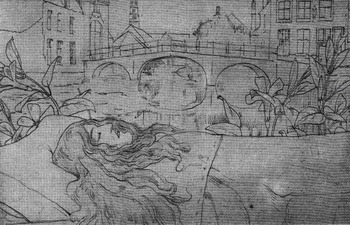
Such mise-en-scène pays tribute to the formal, thematic and imagistic reflections that pervade Die tote Stadt and its source material.Footnote 57 Throughout the opera, Paul sees Marie everywhere: in the water of the dead city's ubiquitous canals; in the relics that lie within the Temple of the Past; and, of course, in the nominally diminutive Mari-etta. Fernand Khnopff's ink-and-pencil frontispiece for Bruges-la-Morte highlights the affinities between the dead wife and the dead city by positioning the supine figure of the woman in parallel with one of the many iconic bridges of Bruges, and by framing her, Ophelia-like, with elegiac lilies that evoke Symbolist tropes of death and purity (see Fig. 3).Footnote 58 The dead woman's big hair (à la Mélisande) signifies female power and yet – because it is free-flowing, not yet braided into a murder weapon – retains an aura of natural innocence.
Fernand Khnopff's frontispiece for Rodenbach's Bruges-la-Morte.

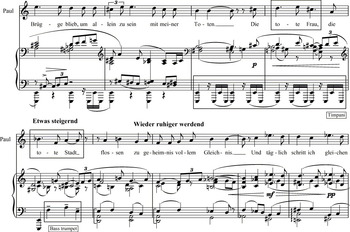
In Bruges-la-Morte, Rodenbach makes frequent use of chiastic rhetoric to indicate the protagonist's fixation with the dead woman. An exemplary line from the novel – ‘Bruges était sa morte. Et sa morte était Bruges’ (Bruges was his dead wife. And his dead wife was Bruges) – is likewise pronounced by Paul towards the beginning of Korngold's opera, albeit constructed differently: ‘Die tote Frau, die tote Stadt, flossen zu geheimnisvollem Gleichnis’ (The dead woman, the dead city, seemed to be fused into one mysterious being). Yet even here, a mirroring effect is achieved by the inverted melodic contours of ‘tote Frau’ and ‘tote Stadt’ (see Ex. 1). The former vocal phrase (bar 73) is doubled by the English horn and clarinet, while the latter (bar 74) is sung against a bass trumpet statement of what Arne Stollberg has designated, in a psychoanalytic study of the opera, as the ‘Kurzversion des Brügge-Motivs’ – here, a transposed retrograde inversion of the coinciding vocal melody.Footnote 59 A sense of lag is produced over the course of these two bars by the broadening of melodic profile – namely, by the drawn-out and mournful descending tetrachord (d″ – c♯″ – b♭′ – a′) formed by structural pitches resting on the first and third beats of the two vocal phrases (the regular dotted rhythms of which sound noticeably more deliberate than the free recit-like declamation of the surrounding text).Footnote 60 The timpani enhance this plodding effect by beating out a low E pedal-point in idiomatic funereal rhythms. The resulting illusion of temporal suspension (or at least deceleration) amounts to a musical manifestation of chiastic poetics, which, as Joyce Lowrie suggests, ‘abolishes diachronic time’ and gives rise to the impression that ‘reality might be nothing other than a petrified reflection in a looking glass, revealing that the future is merely a duplication of the past’.Footnote 61 A chiasmus, in this sense, folds narcissistically into itself, flaunting the clever musicality of its rhetorical symmetry and tautologically defying the mandates of semantic progress.
Inverted melodic contours and descending tetrachord in Act 1 scene 2 (bars 70–8) of Die tote Stadt.

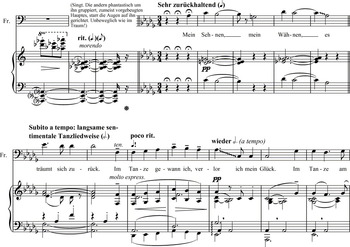
As suggested at the outset of this essay, the ‘Pierrot Lied’ invokes a protracted feeling of timelessness via its dreamy musical aesthetic and centralised position in Die tote Stadt's narrative (see Ex. 2). Especially given that neither the song nor the character of Fritz has an analogue in Rodenbach's novel, the ‘Pierrot Lied’ can be understood as dramatic excess, a self-contained and luxurious celebration of lyric flight. Fritz – who appears only in this scene and otherwise possesses very few lines – might even come to resemble an ‘outside’ musician who has been hired to make a celebrity cameo and to deliver a performance qua performance. The song lies at the core of the opera's diegesis and yet paradoxically outside of it: on the one hand, the audience hears this music refracted through the ears of Marietta, of Paul (who spies on the performance while hiding behind some trees) and of various other on-stage spectators (comprising almost the entire cast of the opera); on the other hand, the performance, so acutely spotlighted as a diegetic insertion (or intrusion), breaks down all such perceptual filters by collapsing into a manner of ‘pure’ song that transcends the opera's narrative altogether.
Opening of Fritz's ‘Pierrot Lied’ in Act II scene 3 (bars 298–312).

What ultimately tethers the ‘Pierrot Lied’ to the operatic diegesis is its function as a cautionary tale for the protagonist. Insofar as the song recounts Fritz's own obsession with Marietta, it warns Paul against the dangers of his spectacular pipe-dreams:

Fritz is unique among his troupe-mates in that he is doubly trapped within the business of make-believe. Bound by his infatuation with Marietta, he serves as an entertainer for his fellow entertainers. A dreamt projection of Paul's voice of conscience, Fritz represents the puppet-like fool that Paul might also one day become should he continue to indulge in Marietta's affections.Footnote 63
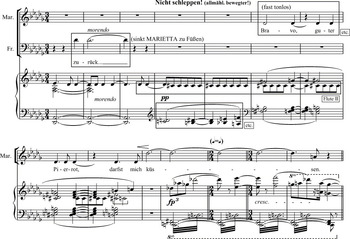
The d′♭ on which Fritz sings the final words of the ‘Pierrot Lied’ is instantly picked up by a flute's quaver iterations on the same pitch (enharmonically notated as c′♯ in the piano reduction) (see Ex. 3). In light of the instrument's breathy timbre, these quiet, metronomic pulsations – additionally marked staccato in the orchestral score – sound rather like panting and, as such, conjure forth the image of an obedient Fritz begging for a reward. Marietta obliges by telling him, ‘Bravo, guter Pierrot, darfst mich küssen’ (Bravo, good Pierrot, you may kiss me) and allowing him to kiss her on the cheek. But the monotony and low tessitura of Marietta's ‘fast tonlos’ melody – also sung on d′♭ – produce a mesmerising, sinister affect that is further intensified by the passage's sudden shift in harmonic language. The regular periodicity, soaring strings and sensuous consonances of parallel thirds and sixths in the ‘Pierrot Lied’ all give way here to a series of bleak chromatic linesdiverging symmetrically from the d′♭ pedal-point in halting, syncopated rhythms that disrupt the previous fluidity of the triple-metre waltz.
Marietta's response to the ‘Pierrot Lied’ in Act II scene 3 (bars 387–400).

Lying at the pit of the opera's narrative abyss, the ‘Pierrot Lied’ serves as a psychological vacuum that sucks Paul into the deepest realm of theatrical conceit before propelling him forcefully away from it, unveiling to him meanwhile the narcotic essence of Marietta's charms and boosting his resolve to take matters – quite literally – into his own hands. Indeed, following this turning point, the progressive dissolution of each diegetic sphere is accompanied by physical gestures of protest, gestures that Paul performs in his desperate attempt to dig himself out of his multi-layered fantasies and, in the end, to escape from Bruges (or even, it might appear, from the opera as a whole) – alas, something that Fritz, the sacrificial informant, was never able to do.
3
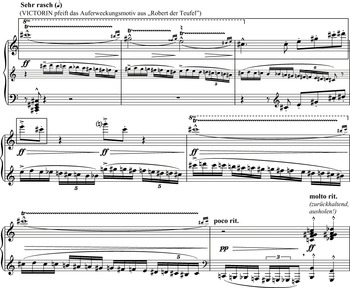
During Marietta's rehearsal of Robert le diable towards the end of Act II scene 3, a troupe member named Victorin whistles the ‘Resurrection Motif’ from the Act III ‘Invocation’ of Meyerbeer's opera and signals Marietta to ‘rise slowly from her seat and impersonate in pantomime a dead woman come to life’ (see Ex. 4). Several back-up nuns in night-attire appear in the illuminated windows of a convent. Amidst the diegetic pealing of ‘aufgeregtes Glockengetümmel’ (tumultuous bells), the orchestra descends into a tempest of cymbal crashes, timpani strikes, and harmonically as well as timbrally dissonant mixtures of brass bleats and piccolo glissandi, whipping up a bacchanal of noise that escalates in tempo and intensity until Paul's sudden entrance brings the rehearsal to a full stop:

Victorin whistling the ‘Resurrection Motif’ from Meyerbeer's Robert le diable in Act II scene 3 (bars 562–8) of Die tote Stadt. The tune here is doubled by trilling flutes, oboes, clarinets and piccolo, and fleshed out by descending chromatic runs in the strings.

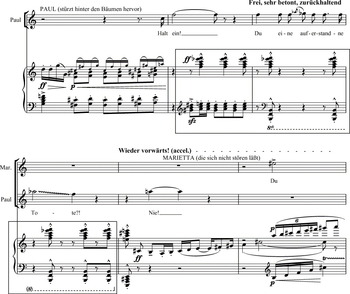
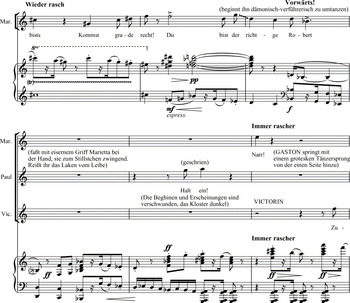
Witnessing the infernal resurrection of Marietta (or maybe, in Paul's eyes, Marie) is too much for our protagonist. Marietta's proclamation – ‘Du bist der richtge Robert’ – attempts to implicate him in the opera rehearsal and to drag him one level deeper into the abyss, but Paul, by tearing apart Marietta's costume, instead peels away a layer of fantasy, swiftly ending the pantomime and causing an exasperated Marietta to send away all of her fellow actors (see Ex. 5).Footnote 64 Paul's gesture is at once erotically charged and symbolically murderous, not only undressing Marietta but also undoing her meta-operatic persona – a forewarning of graver undoings yet to come.
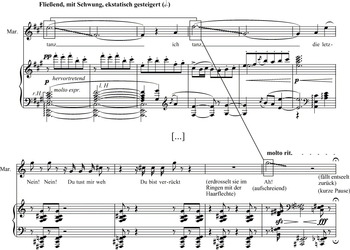
The dissolution of this diegetic layer, after all, provides only fleeting deliverance. Paul still remains a prisoner in his own dream, a prisoner in lockdown with Marietta, who – now ever so irritated by his resistance – proceeds to redouble her seductive efforts. A series of quarrels ensue between the two characters until Paul, at the end of Act III scene 2, enters into a state of frenzy upon seeing Marietta dancing with Marie's plait of hair. Singing ‘ich tanz, ich tanz’, Marietta refuses to put down the plait and tortures Paul in a cruel game of cat-and-mouse. When Paul at last manages to catch her, he throws her down on the floor and events unfold as follows:

In the music, Marietta's scream is intoned as ‘Ah!’ and notated as a glissando descending from g″. This utterance follows conjunctly from her two most recent glissandi on e″ and f″♯ eighty-six bars prior – glissandi that were sung to the word ‘tanz’ (of ‘ich tanz, ich tanz’), such that the eventual death-scream on g″ suggests that Marietta, Tänzerin extraordinaire, has finally taken things too far (see Ex. 6).
Paul's interruption of Marietta's rehearsal in Act II scene 3 (bars 579–90).

Continued.

[Above] Marietta singing ‘ich tanz’ on glissandi in Act III scene 2 (bars 691–6) and [Below] Marietta's death-scream on glissando later in the same scene (bars 764–7). The stabbing dissonant chords in bars 764–66 echo those which accompanied Paul's interruption of the troupe's rehearsal in Act II scene 3 (see bars 580–2 in Ex. 5).

Throughout the opera, Marietta's signature vocal gesture, the glissando that approximates hysterical cries of all sorts, serves as a sonic reflection of her relentlessly glissading body. As she dances across the stage in the moments leading up to her murder, her incessant singing of ‘ich tanz, ich tanz’ becomes the utmost exercise in musico-dramatic redundancy – for why would a professional singer-dancer need (or wish) to sing that she is dancing as she sings and dances? Marietta is, at first glance, a Salome-ish femme fatale, a seductress whose extravagant performances are described to render the protagonist completely ‘außer sich’ (beside himself). But she might also invite comparison to a less domineering operatic heroine – say, Jacques Offenbach's Antonia – a woman who, at the risk of dying, simply ‘loved singing too much’.Footnote 65 Marietta's chameleonic role-play of multiple personae – doppelgänger, siren, nun – has seemingly left her with no core identity of her own. She participates in a roundabout game of imitation for which there is no original, a game that is all too fitting given that she is not Marie, the opera's ‘original’ (and appropriately elusive) woman. Although she has mastered singing and dancing with flying colours, she has solely done so within the language of meta-theatrics. As a character with no demonstrable ‘centre’, Marietta is, in short, mise-en-abyme personified – a woman who is undone by her own spectacle and because she loved acting too much.
When Marietta falls dead to the ground, Paul stares at her in horror and exclaims: ‘Jetzt gleicht sie ihr ganz – Marie!’ (Now she is just like her – Marie!). A lengthier corresponding passage from Rodenbach's novel can shed light on the significance of this statement:
Les deux femmes s'étaient identifiées en une seule. Si ressemblantes dans la vie, plus ressemblantes dans la mort qui les avait faites de la même pâleur, il ne les distingua plus l'une de l'autre – unique visage de son amour!
[The two women had been fused into one. So alike in life, even more alike in a death that had given them the same pallor, he could no longer distinguish the one from the other – the singular face of his love!]Footnote 66
Like the archetypal Eurydice, Marie suffers two deaths: first, the decay of her body, and, second, the passing of Paul's obsession with her passing, symbolically enacted via Marietta's murder.Footnote 67 Yet Paul's statement – ‘Jetzt gleicht sie ihr ganz’ – is also a little misleading given that Marietta and Marie were (as Paul gradually comes to realise) actually nothing alike ‘in life’ except for their physical appearances. One might enquire as to whether there was even, in ‘reality’, any physical resemblance at all between the two women. That audience members witness so much of this operatic drama through Paul's own grieving vision(s) should make it impossible to discern true appearances from products of dramatic invention. Reality and fiction (and the fictions within fiction) are so thoroughly scrambled in this opera that Marietta's bodily congruence with Marie can easily be reckoned as complete fabrication, as the psychic projection of a wandering mind's eye.
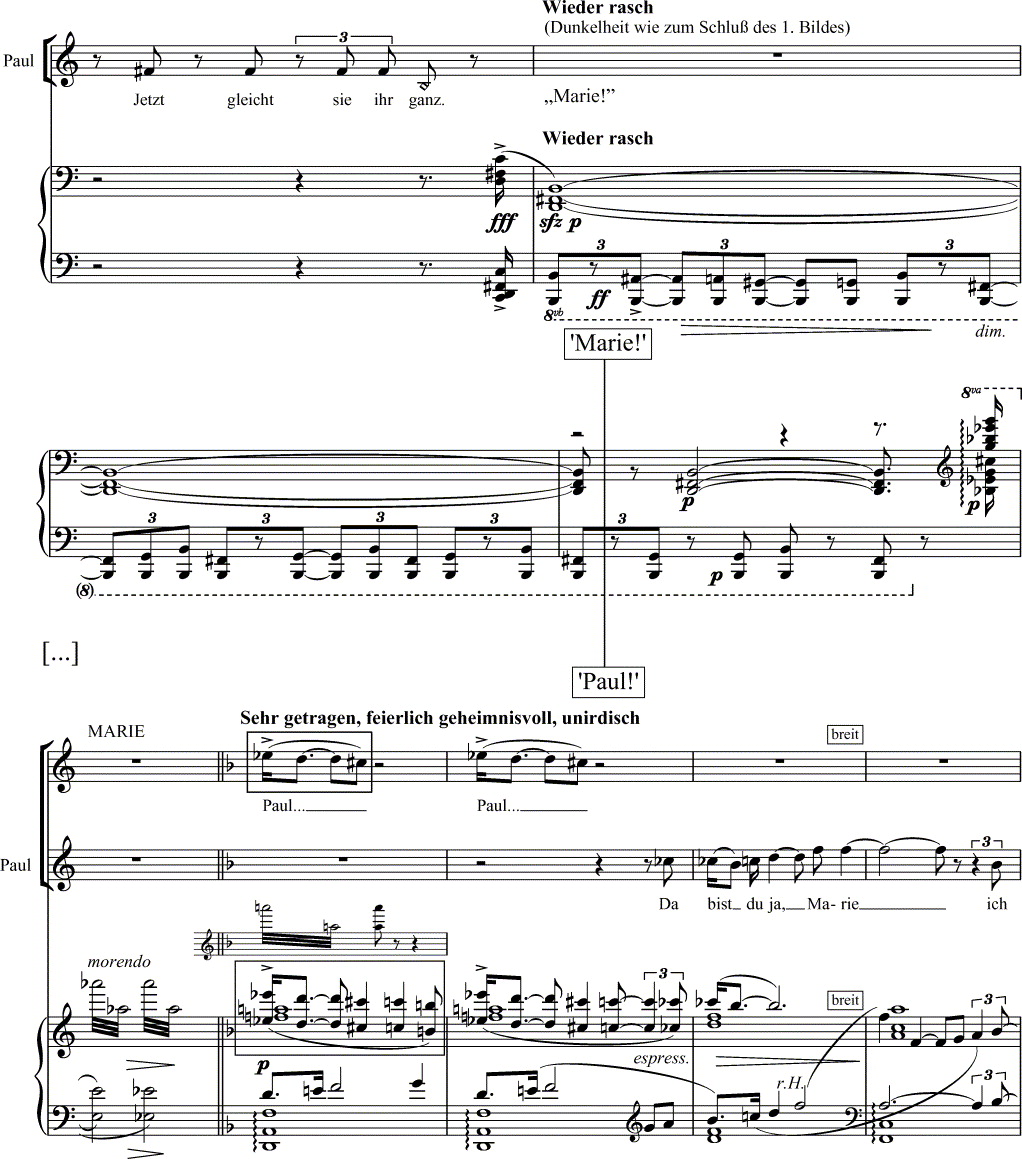
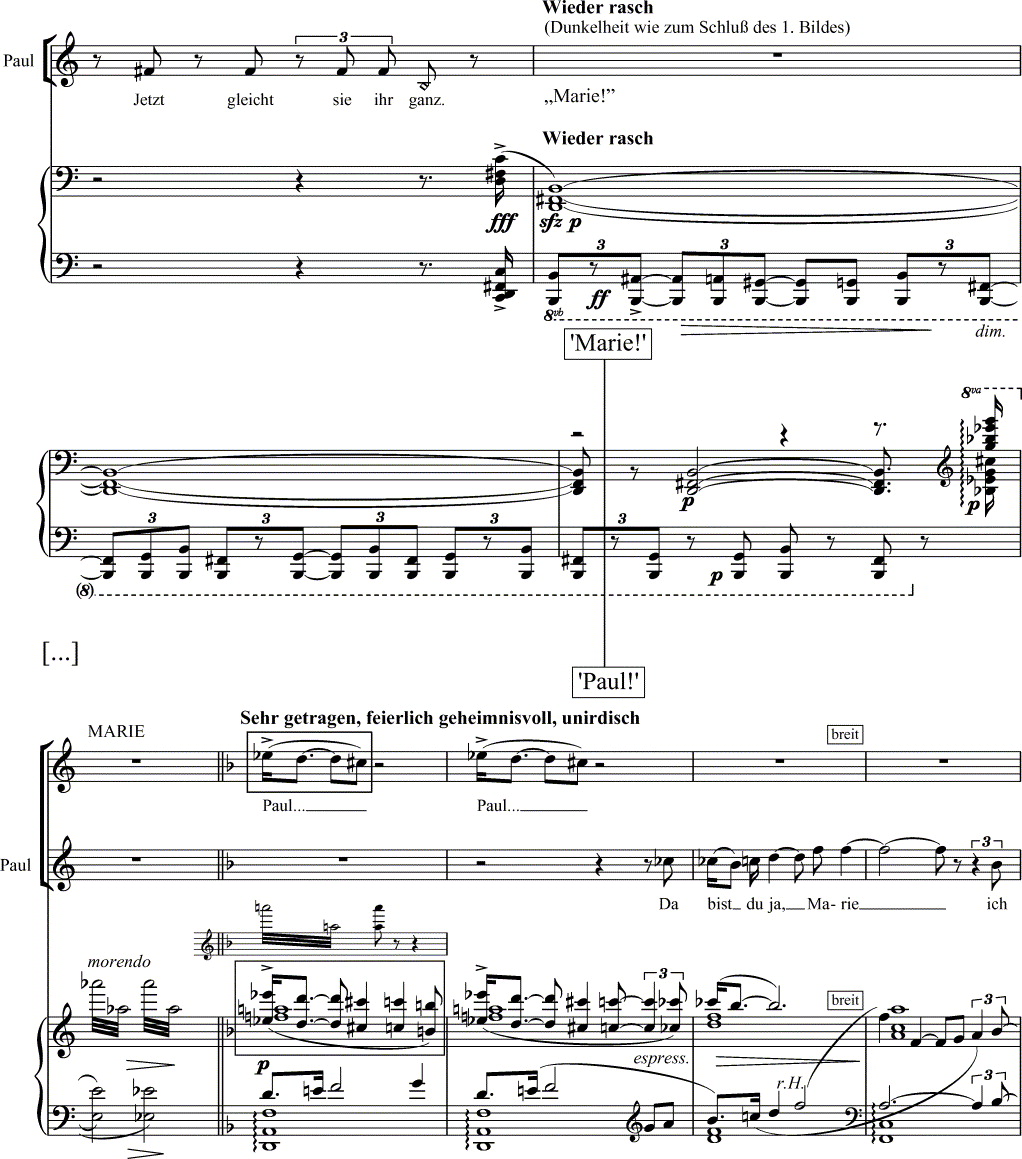
In the exact moment that Paul screams ‘Marie!’ – as he prepares to exit this nightmare – the orchestra plays that which Rudolf Stefan Hoffmann has labelled as the ‘Vision Motif’, which the ghost of Marie had memorably sung to the name ‘Paul!’ in Act I scene 6, immediately prior to Paul's entry into the dream realm (see Ex. 7).Footnote 68 By quoting Marie's melody, the instruments invoke her spiritual presence and call attention to her corporeal absence, counteracting Marietta's fleshy pyrotechnics and the excesses of spectacle more broadly. In these few precious seconds, the two rightful lovers simultaneously call out to each other across death's divide, with Marie gaining the uncanny capacity to ‘speak’ just as dream-Marietta finally falls dead and silent, her throat forced shut by strangulation.Footnote 69 This moment also marks the last time Paul utters his dead wife's name in the opera. It almost appears as if he has come to understand that Marie and her name can no longer continue to be represented in music (the language of opera), that no amount of song or dance can resurrect her, and that she does not belong in his world of the musical living any more than he belongs in his dreams of the dead.
[Above] Paul's scream (‘Marie!’) in Act III scene 2 (bars 768–71) and [Below] Marie's wailing cry (‘Paul!’) in Act I scene 6 (bars 5–9).
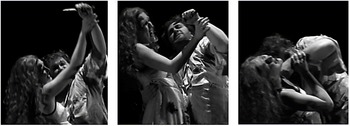
Thus what one actually hears during the scene of Marietta's murder is indeed a lot of non-singing, with utterances consistently being spoken, spoken-sung, glissed, screamed and instrumentally ventriloquised. In the 2001 Strasbourg production, Torsten Kerl and Angela Denoke (as Paul and Marietta) play at a frightening illusion of realistic violence by carrying out the entire murder scene in spoken tones (even the lines – as shown in bars 764–5 of Ex. 6 – that Korngold melodicised with angular tritone leaps). It is not simply that the actors are not singing per se – that is, a matter of expressive mode – but also that the non-sung vocalisations are accompanied by a cloud of audio-visual detritus rather foreign to opera's glossy veneer: one can see the projectile spit of Kerl as he sputters, ‘Gib … oder stirb!’; Denoke's acute declamations of ‘Nein! Nein!’ elicit from her surroundings audible echoes that her sustained singing, until this point, had effectively covered up – echoes that further draw attention, all of a sudden, to the foreboding vastness of the space enveloping the darkened stage; and all the while, the two struggling characters are kept in an awkwardly close-up shot, resulting in a shaky, documentary-like style of cinematography and its evocations of faux-realism (see Fig. 4).
The murder scene in the 2001 Strasbourg production of Die tote Stadt. Here, Paul kills Marietta by slitting her throat instead of strangling her with Marie's plait of hair, thus perhaps compounding the illusion that the actors are going (dangerously) ‘off-script’.

So jarring are these cumulative dramatic effects that a viewer could be led to perceive – against all common sense – that the murder taking place is somehow ‘real’ (or at least more ‘realistic’ than it ought to be). What is so potentially chilling about Denoke's on-stage murder is the notion that it can be difficult, if not impossible, to buy out of theatrical artifice. There are no ‘safe words’ in this role-play, so to speak, such that Denoke's desperate shriek of ‘Du tust mir weh!’ can (and, if convincing, is very much supposed to) sound indistinguishable from a real plea for help. The opera stage at this moment holds Denoke's voice hostage insofar as her scream is capable of signifying only as a stylised and dramaturgically sanctioned cry. Having sung, spoken, spoken-sung, shouted, laughed and screamed her way through the opera, Denoke, at the point of her character's death, finds herself in the role of a prima donna who cried wolf, a singer who has exhausted every mode of ‘alternative’ enunciation, an actress who has acted too much – just like Marietta – and now consequently possesses no way of telegraphing any real danger that might be occurring on that stage.Footnote 70 Viewers (especially those watching this production on the commercially distributed DVD), of course, would scarcely hesitate to bet their lives (or rather, Denoke's life) on the fact that there is no real danger. Yet the scene can nevertheless stick a sliver of doubt beneath one's skin, a fugitive doubt that is easily remedied by an appeal to reason, but can burrow, all the same, past rational faculties by virtue of the palpable drama of non-singing operatic bodies in savage conflict. Positioned at the climax of a narrative that insistently challenges the boundaries between what is real and what is fantasy, this scene ultimately leads us to the realisation that, sometimes on an opera stage, no one can hear you scream.
4
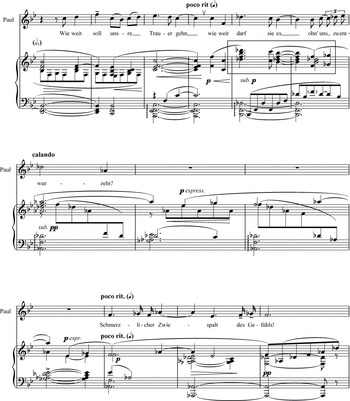
With Marietta's sacrificial dream-death – a karmic echo, perhaps, of Fritz's own sacrificial captivity as poor Pierrot – Paul escapes at last from his lengthy nightmare and its abyssal terrors. Yet this might be considered as only the opera's penultimate release, for the narrative's outermost diegetic layer – the one separating stage from audience – is still left standing. In the concluding moments of Die tote Stadt, Paul awakens to hear his housekeeper Brigitta announce the return of Marietta, who appears in search of an umbrella that she had left behind. Marietta enters ‘in Erscheinung und Haltung genau wie sie zu Endes des 1. Bildes fortging, leicht und liebenswürdig’ (with exactly the same appearance and manner as she went out at the end of Act I, jaunty and amiable), creating the illusion that no ‘real’ time has passed since the dream sequence first began and thereby bringing the opera's diptych narrative full circle. But Paul, equipped with his newfound wisdom, does not even acknowledge her presence, prompting Marietta to leave his house once and for all. Having overcome his final temptation, Paul describes to his friend Frank his acceptance of Marie's death, singing the following text to the tune of the ‘Lautenlied’, the song that Marietta and Paul performed as a duet in Act I (see Ex. 8).Footnote 71
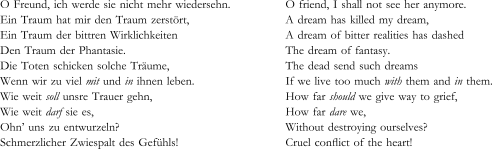
Paul reflecting on the lessons of his dream in Act III scene 3 (bars 100–12).

Upon Frank's suggestion, Paul decides to leave his home. After Brigitta and Frank exit the stage, he delivers a final soliloquy to the first verse of the ‘Lautenlied’ melody, but instead of singing, ‘Glaub, es gibt ein Auferstehn’ (I believe there will be resurrection), as he did in Act I, Paul now concludes, ‘Hier gibt es kein Auferstehn’ (There is no resurrection here). And just as Paul, after awakening from his dream, sees Marietta in a completely different (and no longer desirable) light, so perhaps audience members are tasked with hearing this Act III ‘Lautenlied’ not as a device of the doppelgänger's seduction (as was possibly the case with the Act I performance) but rather as a redeemed and purified iteration – sung with solitary voice – that affirms Paul's readiness to move on with his life.Footnote 72
What follows is a meditative pantomime in which Paul, it seems, physically takes apart the opera's outermost diegetic layer with deliberate, ritualistic gestures:
Paul erhebt sich, schließt mit langsamer Feierlichkeit die zum Zimmer der Toten führende Tür ab, nimmt die sie schmückenden Blumen ab, verhüllt das Bild und nimmt auch hier Blumen an sich, sie an die Brust drückend. Dann läßt er die Gardine des Fensters herab, ergreift die Tischlampe und schreitet gesenkten Hauptes auf die Ausgangstüre im Hintergrunde zu. Wenn er sie erreicht hat, öffnet und Abschied nehmend zurückblickt, fällt langsam der Vorhang.
[Paul rises, slowly and solemnly locks the door of the dead woman's room, takes down the flowers that bedeck it, draws the curtain across the portrait, and takes from this the flowers as well, holding them close to his breast. Then he draws the curtains of the window, takes the lamp, and goes, with lowered head, out the door and into the background. When he has reached and opened the door and taken one parting look backward, the curtain slowly falls.]
Since the opera stage at this point is mostly made up of the scant props and architecture with which Paul is interacting – including the various meaningful pieces of Marie-memorabilia – he arguably does not just draw the curtains, lock the door to the ‘Temple of the Past’, and take away the flowers, but additionally dismantles the stage as a whole, literally bringing down the (opera) house with his own bare hands – the same pair of hands with which he had earlier torn Marietta's costume (ending the rehearsal of Robert le diable) and throttled the doppelgänger (ending the dream). By de(-)constructing the stage, Paul passes the opera's moral torch to audience members who must now similarly forfeit their own indulgence in theatrical fantasy.
Yet the multiple mirrors, nested illusions and coups de théâtre (‘…and it was all a dream’) of this operatic experience can leave viewers with the uneasy impression that there is no real ‘here’ out here – or, put differently, that the world ‘outside’ this opera is just another layer of its dramatic onion, every bit as illusive, ephemeral and stage-like as any putatively contained spectacle. Such is likewise the dilemma of the hermeneut, who must confront Die tote Stadt and its mise-en-abyme narrative in the same way Paul gazes at Marietta – sceptically, a little uncomfortably, and with an intense longing for something substantial to come to fruition. Both meaning and presence are systematically elided in the opera's chain of disappearing acts: Fritz, who serves his crucial function in the limelight and thereafter vanishes so unceremoniously; Marietta, who cries out with hostage voice at the moment of her dream-death; and Paul, who makes his silent exit as a trauma survivor qua stage-hand with a didactic gesture towards the audience. But for eager exegetes who wish to plumb the opera's depths, interpretations will appear as ubiquitously as Paul's visions of Marie. Taking heed of Vladimir Jankélévitch's assertion about the capacity of music to ‘[mean] nothing and yet [mean] everything’,Footnote 73 Carolyn Abbate has suggested that a ‘coherent stance’ towards music's (and, by extension, opera's) ineffability ‘would involve not taking advantage of it, hesitating before articulating a terminus, or restricting music to any determinate meaning within any declarative sentence’.Footnote 74 David Levin's recent monograph on operatic stagings concludes with a similar caveat that, in both hermeneutical and dramaturgical endeavours, ‘the fact that … any work can be made to signify almost anything does not mean that anything goes’.Footnote 75 Following Abbate's critique of ‘gnostic’ analysis, Levin maintains that in ‘performing and theorizing these [operatic] works, we bear an ethical as well as an aesthetic responsibility to attend to the terms of antithesis’.Footnote 76 Any responsibility one might bear in the act of interpreting opera, of course, is primarily a responsibility not to the opera itself – the text-object that is animated via collective processes of composition, production, consumption and critical dialogue, but rather to actual people – the composers, performers, spectators and interlocutors upon whom the life (and perceived liveliness) of an opera depends.Footnote 77
Korngold's naive, myth-shrouded image has historically served as what one might call a hermeneutical fail-safe for patrons and critics of Die tote Stadt. For it is unlikely that the opera – with its abundant symbols and timely themes of loss and trauma – was regarded as inherently problemless or aphilosophical by its contemporary audiences. What seems more probable is that Korngold's childish reputation has by and large relieved individuals of the ‘responsibility’ (ethical or otherwise) of commenting on the opera in drastically problematic and philosophical ways. When Austrian and German critics during the early post-war period voiced their unease about the convoluted plots and ambiguous symbolism of operas such as Franz Schreker's Die Gezeichneten (1918), Richard Strauss's Die Frau ohne Schatten (1919) and Franz Schmidt's Fredigundis (1922), they were not just expressing anxieties about the potential political threats of cryptic narratives but also aiming to chastise the esoteric pretensions of these composers.Footnote 78 No such rebuke would have been necessary for kid Korngold. The perceived implausibility of intended political messages in Die tote Stadt appeared to have led writers to embrace the opera's relatable lessons of mourning and coping at face value – that is, to permit the opera's otherwise densely symbolic meta-theatrics to collapse into problemless, audience-friendly spectacle.
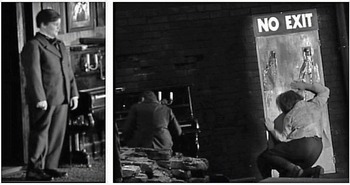
Let us consider, then, by way of conclusion, the final minutes of Inga Levant's Strasbourg production, which foregoes the opera's lieto fine and Paul's edifying pantomime. Instead, Frank – made up like a devil but dressed in a bishop's gown – hands a knife to Paul, who uses it to slit his own wrists as he sings the ‘Lautenlied’. As the song's orchestral coda plays, Paul staggers towards the back of the stage and slumps dead against a wooden door, above which a neon sign displays the existentialist words ‘No Exit’.Footnote 79 The production further introduces the character of a young boy who comes onto the stage during both the Act I and Act III performances of the ‘Lautenlied’. In the final scene, this mute boy – who has no analogue in the original libretto – sits down in front of a piano and acts as if he is accompanying Paul as the latter sings his farewell (see Fig. 5).
[Left] Grégory Rousset as adolescent Korngold in Act I and [Right] Rousset appearing to accompany Torsten Kerl's performance of the ‘Lautenlied’ in Act III scene 3 of the 2001 Strasbourg production of Die tote Stadt.

The boy, according to Levant, is meant to represent Korngold, trapped fittingly in his youth and on a stage exhibiting his most celebrated work. Levant explains that, at the end of this performance, ‘Paul – or Korngold – realises there is no resurrection, and he chooses to escape the reality that he cannot understand while singing his most famous tune, remembering himself as an inspired child playing his old piano’.Footnote 80 By framing ‘hier gibt es kein Auferstehn’ as a defeatist rather than a life-affirming proclamation, this production shackles Paul to the stage, to spectacle, and to a dream of an unrecoverable past. Frank's earlier proposal to Paul – ‘Willst du mit mir? Fort aus der Stadt des Todes?’ – is likewise recast as a menacing invitation to ‘escape’ Bruges via self-destruction rather than relocation. When I asked Levant why she altered the ending of the opera, she responded that she did not think she ‘changed the plot, but only interpreted it’.Footnote 81 Her goal was to use the opera to communicate what she believed to be a faithful (or at least provocative) representation of Korngold – a wide-eyed prodigy who bloomed too early and became fraught, in his later years, with a deep yearning for his days of Viennese glory. The resulting production thus resembles a tidy dramatic package that infuses staged narrative with a tone of auspicious confession, obliquely pathologising the composer's nostalgia (as intimated by Paul's suicide) and treating the opera writ large as a testament to Korngold's escapist tendencies.Footnote 82
The attempts of dramaturges, critics and biographers to preserve the apolitical image of Die tote Stadt and its composer might be understood as intellectual wish-fulfilment. The term ‘genius’ tends to be avoided nowadays due to its connotations of hero worship, the work concept and hegemonic canons, but this label has consistently been central to characterisations of Korngold and his early output. It is commonly observed that this Wunderkind somehow managed to absorb with remarkable ease the aesthetic elements of his compositional models while filtering out much of the inconvenient politics implicated therein. Such wishful discourse yields a portrait of a composer who spoke fluent Wagnerese and yet appeared magically unburdened by the baggage associated with this musical language and with fin-de-siècle ‘decadence’ more generally. Despite all the controversies ignited by his father, young Erich was regarded as having been chiefly dedicated to creating music for music's sake. His child-like demeanour made him an exemplary vessel through which ideals of prelapsarian, daresay redemptive, aesthetic autonomy could be vicariously fulfilled.Footnote 83 A view of compositional genius as a condition that transcends reason, culture and criticism must have been a tempting one even (or especially) for jaded writers who might otherwise have disapproved of Korngold's ‘conservative’ tendencies. Just as the enigmatic aspects of mise-en-abyme can bestow hermeneutical wings upon its interpreters, so the mystifying nature of Korngold's talents seems to have granted writers, both past and present, a rare instance of critical respite.
It could be concluded that Die tote Stadt's political valence lies precisely in its assumed apoliticality, or – to invoke again the transcendent vocabulary of genius – its supra-politicality.Footnote 84 Relying on such ambivalent rhetoric, to be sure, is a bit like having one's deconstructed cake and eating it too – part of the postmodern hermeneut's complete breakfast, naturally, but little more than empty calories if consumed without the accompaniment of critical contexts. Conversations about music and politics sometimes get mired in questions of whether a work ‘is’ or ‘is not’ political at the expense of reflexively interrogating the kinds of social, dramaturgical and academic motivations underlying the politicisation (or de-politicisation) of that work. For it is not, ultimately, that Die tote Stadt intrinsically defies problematisation or politicisation – quite the contrary: given its spectacular abyss, the opera supplies ample fodder for dramatic interpretation and lively philosophical debate. In the end, perhaps the initial meteoric popularity of the opera owed partly to the notion that it invited its audiences to identify with Paul's healing experience (across multiple levels of entertaining musical drama) without pressuring them to articulate the means or consequences of such identification. During an era in which one's patronage of specific musical genres was often construed as a facile reflection of political and ideological allegiance, Korngold's apolitical image and obscure intentions conceivably allowed audiences to lay aside such concerns and to luxuriate freely in operatic spectacle. For all ‘intents’ and purposes, then, Korngold's escape has also been our own – and it is in this reflection that the dead city has since lived.