Introduction
Sexuality in later life has several myths and socio-cultural stereotypes, especially when couples are composed by one spouse with Alzheimer's disease (AD) (DeLamater and Karraker, Reference DeLamater and Karraker2009; Mahieu et al., Reference Mahieu, Anckaert and Gastmans2014). Although the onset of AD results in cognitive decline, and affects all dimensions of couples’ relationship (Simonelli et al., Reference Simonelli2008; Hayes et al., Reference Hayes, Boylstein and Zimmerman2009; Davies et al., Reference Davies2010), it does not mean diminished sexual desire (Alagiakrishnan et al., Reference Alagiakrishnan2005). AD progression is often followed by decrease in sexual activity, but sexual interest and ability to enjoy sex may not disappear automatically (Tsatali et al., Reference Tsatali, Tsolaki, Christodoulou and Papaliagkas2010). Byers (Reference Byers2005) showed that sexual satisfaction and relationship satisfaction change together, resulting from changes in intimate communication between partners.
The sexual/intimacy dynamic in relationship has to accommodate people with AD (PwAD) functional and cognitive deficits (Davies et al., Reference Davies, Sridhar, Newkirk, Beaudreau and O'Hara2012; Nogueira et al., Reference Nogueira, Brasil, Sousa, Santos and Dourado2013). The spouse-caregiver's interest in being sexually intimate may be affected by PwAD decreased competency to consent and physical vulnerability (Mahieu et al., Reference Mahieu, Anckaert and Gastmans2014). PwAD may exhibit inappropriate sexual behavior, or may not be able to remember what to do during sexual intercourse, leading spouse-caregivers to have feelings of rejection and, decreasing sexual activity (Nogueira et al., Reference Nogueira2014). Nevertheless, depression, anxiety and medical conditions may be responsible for PwAD less interest in sexual activity (Davies et al., Reference Davies, Sridhar, Newkirk, Beaudreau and O'Hara2012). Spouse-caregivers’ satisfaction in intimacy does not depend only on the degree of PwAD physical and cognitive impairment, but also on the level of anxiety and burden of caring (Svetlik et al., Reference Svetlik, Dooley, Weiner, Williamson and Walters2005; Davies et al., Reference Davies, Sridhar, Newkirk, Beaudreau and O'Hara2012).
Davies et al. (Reference Davies2010) emphasize the impact of the regression into parent–child relations in the couples' intimacy, emotional, and sexual relationship. Negative changes in the marital relationship are associated to the decreased happiness, equal relations, and people with dementia's expressions of sexual needs when compared to the time before the diagnosis (Eloniemi-Sulkava et al., Reference Eloniemi-Sulkava2002). In addition, the physical intimacy is perceived as a relationship loss, especially with the increase of the activities of daily living (ADL) assistance (Svetlik et al., Reference Svetlik, Dooley, Weiner, Williamson and Walters2005).
There is a general consensus that sexuality compromised to some degree in a proportion of PwAD and spouse-caregiver dyads. However, the perceptions held by the PwAD about the changes in their marital life are not clear. Recently, a systematic review (Nogueira et al., Reference Nogueira, Brasil, Sousa, Santos and Dourado2013) found only two studies which include PwAD self-reports about the change in perceive sexuality (Wright, 1998; Dourado et al., Reference Dourado, Finamore, Barroso, Santos and Laks2010). Wright (1998) showed the longitudinal decline of the expressions of affection for all members of the couples after the onset of dementia, indicating that physical and emotional health of both partners influence the sexual relationship. Most recently, Dourado et al. (Reference Dourado, Finamore, Barroso, Santos and Laks2010) found that both partners of the couple demonstrated sexual dissatisfaction.
Thus, the investigation of sexual satisfaction and the perception of changes in sexuality in couples with a partner with AD is commonly focused only on spouse-caregivers’ observation. Although the perspectives of sexuality provided by PwAD may be uncertain, they are still valid to understand the quality of the relationship. In this context, this study aims to investigate (1) the perception of change in sexual activity and sexual satisfaction in spouse-caregivers and their partners diagnosed with AD and (2) the influence of clinical characteristics of PwAD and their spouse-caregivers in their sexual satisfaction. We hypothesized that PwAD perception of change of sexual activity is lower than their spouse-caregivers’ and control group (CG). We also assumed that spouse-caregivers may experience lower levels of sexual satisfaction than PwAD and dyads without dementia.
Methods
We included couples whose spouses were diagnosed with probable AD (n = 74) according to Diagnostic and Statistical Manual of Mental Disorders, Fourth Edition (American Psychiatric Association, 2000) and elderly couples without dementia (n = 21) as a CG. PwAD attended an outpatient clinic for routine follow-up appointments in the Center for Alzheimer's Disease at Federal University of Rio de Janeiro, and they were consecutively selected, according to the psychiatrists’ referrals, from January 2012 to September 2015. In order to ensure the findings were applicable for AD rather than other clinical problems, people with head trauma, aphasia, history of alcoholism, psychotic symptoms, epilepsy, and uncontrolled medical problems such as hypertension, depression, and diabetes were excluded from the study. All PwAD were able to read and write simple sentences, interact with the interviewer, and understand the commands. The clinical diagnosis of AD was based on a clinical interview with the PwAD and spouse-caregivers, cognitive screening tests, laboratory tests, and imaging studies. Only individuals with MMSE scores of 13–26 and classified as Clinical Dementia Rating (CDR) 1 or 2 according to the summed score were included in the study.
All spouse-caregivers had been previously informed of the diagnosis by the psychiatrist. We interviewed all spouse-caregivers in order to exclude who reported history of psychiatric or cognitive disorders to ensure that the findings were not biased by caregivers’ clinical problems. After the reported story of their health condition, all spouse-caregivers were considered acceptable for inclusion in the study.
The PwAD completed assessments about sexual satisfaction, quality of life (QoL), cognition, and their awareness of disease. The spouse-caregivers provided information about the PwAD (demographics, ability to perform ADLs, depressive symptoms, and dementia severity) and had their QoL, sexual satisfaction, and burden assessed.
The CG was composed by couples selected in different physical activity clubs in the same area of the outpatient clinic, without uncontrolled clinical problems and with the minimum age of 60 years old. The couples were individually interviewed from January 2013 to July 2015. When one of the spouses presented cognitive impairment, the couple was excluded from the CG. All partners had their sexual satisfaction and cognition independently assessed.
This study was approved by the Ethics Committee of the Institute of Psychiatry of the Federal University of Rio de Janeiro and all PwAD, spouse-caregivers, and CG participants received a full description of the study and signed informed consent forms prior to the interview.
Measures
We used the Brazilian adaptation of all instruments. All procedures were applied with the same technique and sequence by trained researchers.
PwAD measurements
Sexual satisfaction
The primary outcome was the Questionnaire on Sexual Experience and Satisfaction (QSES), which examines sexual satisfaction by determining the presence of sexual dysfunction in the last four weeks, with a score ranging from 14 to 84. Scores below 35 indicate normal sexual behavior and satisfaction; scores between 36 and 58 denote mild to moderate dissatisfaction; scores greater than 59 indicate moderate to severe dissatisfaction. Additionally, there are yes/no questions about the presence and perception of any recent change in sexual activity. Also, there is a question about sexual activity, and we considered how each person understands the presence of it (with or without intercourse). The participants' orally answered the questions and the interviewers filled in the QSES register form. The dyads were interviewed separately to exclude interference between partners. The questionnaire was validated for people with cognitive disorders and presents the sensitivity and specificity of 91.3% and 55.6%, respectively (Abdo and Oliveira, Reference Abdo and Oliveira2004).
Quality of life
We used the self-report version of the Quality of Life in Alzheimer's Disease Scale (QoL-AD). The 13 domains (physical health, energy, mood, living situation, memory, family, marriage, friends, chores, fun, money, self, and life as whole) are rated as poor (1), fair (2), good (3), or excellent (4), and the total score ranges from 13 to 52 (Novelli et al., Reference Novelli, Nitrinim and Caramellim2010).
Cognition
We applied the Mini-Mental State Examination (MMSE), a cognitive screening test. The score ranges from 0 to 30, and lower scores indicate impaired cognition (Bertolucci et al., Reference Bertolucci, Brucki, Campacci and Juliano1994).
Dementia severity
The severity of AD was measured with CDR, with stages ranging from 0 (no dementia) to 3 (severe dementia). We used the full protocol (Maia et al., Reference Maia2006).
Awareness of disease
We applied the Assessment Scale of Psychosocial Impact of the Diagnosis of Dementia (ASPIDD). The scale assesses discrepancies between PwAD and caregiver's reports about awareness of cognitive deficits, social relationships, family relationships, instrumental, and basic ADL. The 30-question ratings range from preserved, mildly impaired, moderately impaired to absent awareness of disease (Dourado et al., Reference Dourado2014).
Activities of daily living
We applied the Pfeffer Functional Activities Questionnaire (FAQ). The total score is 30 and each item ranges from 0 (normal) to 3 (dependent). Higher scores indicate worse functional status (Nitrini et al., Reference Nitrini, Caramelli, Bottino, Damasceno, Brucki and Anghinah2005).
Depressive symptoms
PwAD mood was measured with Cornell Scale for Depression in Dementia (CSDD). The total score is 38 and a cut-off score of 13 indicates the presence of depression (Portugal et al., Reference Portugal2012).
Spouse-caregivers’ measurements
Sexual satisfaction
Spouse-caregivers independently answered the QSES, the same scale used to measure PwAD sexual satisfaction (Abdo and Oliveira, Reference Abdo and Oliveira2004).
Quality of life
This is the same scale used to assess the PwAD QoL, but we used the caregiver self-reported version (Novelli et al., Reference Novelli, Nitrinim and Caramellim2010).
Burden
Spouse-caregiver burden was measured by Zarit Burden Interview (ZBI). The score ranges from 0 (no burden) to 88 (high burden) (Scazufca, Reference Scazufca2002).
Control group measurements
Sexual satisfaction
We used the QSES, which is the same scale used to measure PwAD and their spouse-caregivers’ sexual satisfaction (Abdo and Oliveira, Reference Abdo and Oliveira2004).
Cognition
Both partners answered the MMSE, which is the same scale used to assess PwAD cognition (Bertolucci et al., Reference Bertolucci, Brucki, Campacci and Juliano1994).
Statistical methods
All data and statistical analyses were performed with SPSS software for Windows release 21.0. The clinical and sociodemographic characteristics of PwAD, their spouses-caregivers and the CG were analyzed with descriptive statistics. The parametric variables were described by their mean and standard deviations (SD). The non-parametric variables were described by the percentage of the highest option.
The Levene test was used to verify the homoscedasticity between the variances. The χ 2 and Exact Fisher test were used to assess the differences on the change in sexual activity between PwAD, spouse-caregivers, and CG. The Student's t test assessed the differences between PwAD, spouse-caregivers’, and control group's sexual satisfaction and perception of change in sexual activity ratings. We used the one-way ANOVA to analyze the variance of ASPIDD ratings, because the variable was considered as ordinal and the domains of ASPIDD independent. Matrices of Pearson's correlations were created to investigate the correlations between the sexual satisfaction of PwAD, their spouse-caregivers, and CG and change in sexual activity, age, disease duration, educational level, gender, cognitive function, presence of depressive symptoms, functional activities, burden, and QoL. To control for family wise error rate, only results with p ≤ 0.001 were considered significant.
Differences between both groups (perception and no perception of change) in relation to clinical variables were analyzed by means of the χ 2 test. Predictive factors related to the dichotomous variable (perception vs. no perception of change) were identified by means of a binary logistic regression analysis.
We performed two binary logistic regression analyses in order to identify the factors related to the sexual satisfaction of the PwAD and spouse-caregivers. The linear regression was conducted only with the variables that were significantly correlated to sexual satisfaction. Models were run separately for PwAD and spouse-caregivers. Then, several tests were carried out with alternative models seeking to associate the best fit with the greatest explanatory power.
For all analyses, with the exception of the correlations, the α-level was set at p ≤ 0.05.
Results
Description of the sample
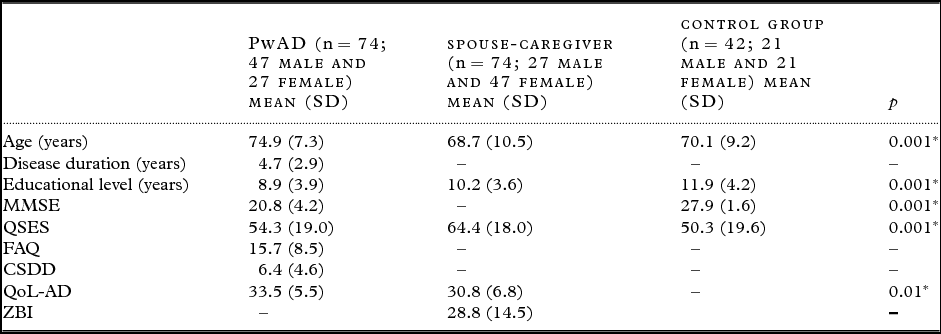
There was a significant difference between PwAD, spouse-caregivers, and CG in age (p < 0.001), educational level (p < 0.001), cognitive function (p < 0.001), frequency of sexual activity (p < 0.01), and sexual satisfaction (p < 0.001). The sociodemographic data of PwAD, their spouse-caregivers, and the CG are shown in Table 1.
Sociodemographic and clinical characteristics of PwAD, spouse-caregivers, and control group

SD = standard deviation; PwAD = people with Alzheimer’ Disease; MMSE = Mini-Mental State Examination; QSES = Questionnaire on Sexual Experience and Satisfaction; FAQ = Pfeffer functional activities questionnaire; CSDD = Cornell scale for depression in dementia; QoL-AD = quality of life in Alzheimer's disease; and ZBI= Zarit burden interview.
*p < 0.05; **p < 0.01; ***p < 0.001.
Perception of any change in sexual activity
PwAD
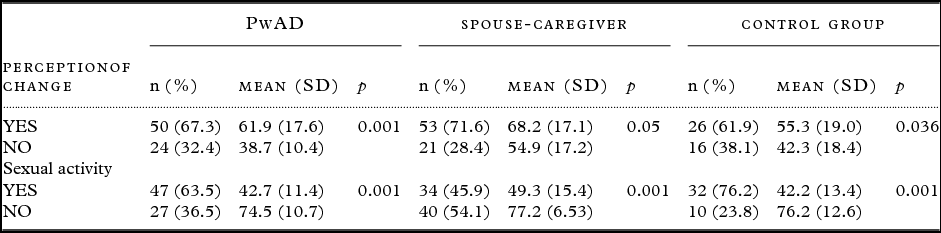
When PwAD were asked whether they faced recent any changes in sexual activity, 67.6% noticed the change. Sexual activity was reported by 63.5% of PwAD with mean of 42.7 (SD = 11.4) of sexual dissatisfaction.
There was a significant difference in sexual satisfaction between the perception and no perception of any change of PwAD sexual activity (p < 0.001). PwAD that reported change in sexual activity presented higher sexual dissatisfaction.
We also found significant difference in sexual satisfaction between the sexual activity and inactivity of PwAD (p < 0.001). PwAD with no sexual activity showed moderate to severe dissatisfaction.
PwAD who showed no perception of change in their sexual activity presented lower functionality (p < 0.01) and cognition (p < 0.001) and a higher sexual satisfaction (p < 0.001).
Spouse-caregivers
Spouse-caregivers also answered about their perception of any changes in sexual activity and 71.6% noticed recent changes, whereas 28.4% did not report any change in sexual activity. We found that 45.9% of spouse-caregivers were still sexually active.
There was significant difference in sexual satisfaction between the perception and no perception of any change in sexual activity of spouse-caregivers (p < 0.01). Spouse-caregivers that showed perception of change in sexual activity presented moderate to severe sexual dissatisfaction. We also found significant difference in sexual satisfaction between sexual activity/inactivity of spouse-caregivers (p < 0.001). Sexual inactivity resulted in moderate to severe dissatisfaction.
The spouse-caregivers that showed no perception of change in sexual activity exhibited higher sexual activity (p < 0.01).
Control group
We found that 61.9% of the CG noticed recent changes in their sexual activity and 38.1% did not perceive any recent change. Sexual activity was reported by 76.2% of CG and 23.8% did not have sexual activity.
There was significant difference in sexual satisfaction between the perception and no perception of any change of sexual activity of CG (p < 0.05). The CG that perceived change in sexual activity presented higher levels of sexual dissatisfaction.
There was also significant difference in sexual satisfaction between sexual activity/inactivity of CG (p < 0.001). Sexual inactivity resulted in moderate to severe dissatisfaction of CG. The perception of change in sexual activity of PwAD, their spouse-caregivers, and the CG is shown in Table 2.
Sexual activity and perceptions of change in sexual activity of PwAD, their spouse-caregivers, and the control group

SD = standard deviation; PwAD= people with Alzheimer’ disease.
Sexual satisfaction
A higher level of sexual satisfaction was found in 18.9% (n = 14) of all PwAD. A mild to moderate level was shown in 44.6% (n = 33) of the cases, and 36.5% (n = 27) showed moderate to severe dissatisfaction. There was a significant difference between sexual satisfaction and severity of dementia (p < 0.01). Mild severity of dementia resulted in higher sexual dissatisfaction.
The spouse-caregivers showed sexual satisfaction in 12% (n = 9), mild to moderate dissatisfaction in 23% (n = 17), and moderate to severe dissatisfaction in 65% (n = 48) of the cases.
The CG demonstrated high level of sexual satisfaction in 28.5% (n = 12) of the cases, mild to moderate sexual dissatisfaction in 40.5% (n = 17), and moderate to severe dissatisfaction in 31% (n = 13).
Sexual satisfaction by gender
PwAD
There was no significant relationship between PwAD sexual satisfaction and gender (p = 0.34).
Spouse-caregivers
There was a significant difference between sexual satisfaction and spouse-caregivers’ gender (p < 0.001). Female spouse-caregivers showed moderate to severe sexual dissatisfaction and male spouse-caregivers showed mild to moderate sexual dissatisfaction.
Control group
The analysis of sexual satisfaction and gender showed no significant relationship (p = 0.83).
Univariate analyses
PwAD
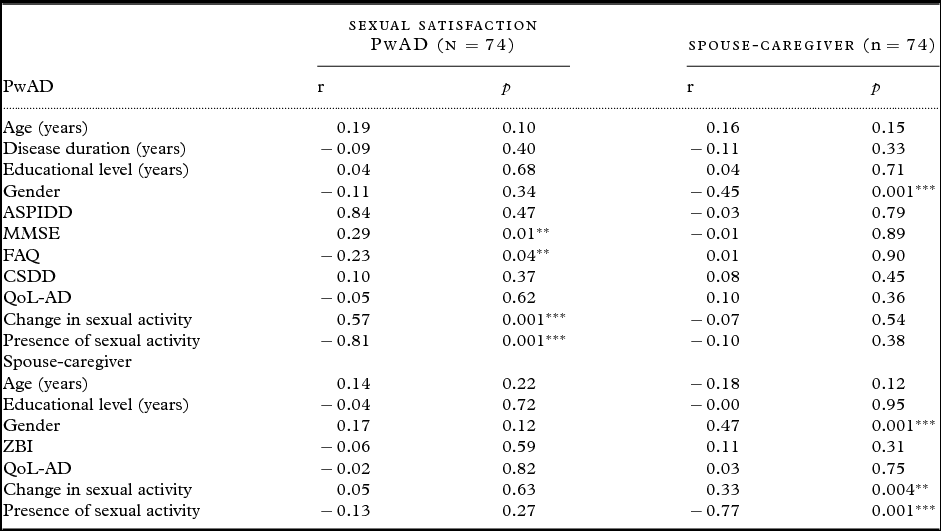
We found correlation between sexual satisfaction and PwAD perception of change in sexual activity (r = 0.57, p < 0.001). Sexual satisfaction was also correlated with sexual activity (r = −0.81, p < 0.001), cognitive status(r = 0.29, p < 0.01), and functionality (r = −0.23, p < 0.05).
Spouse-caregivers
There was correlation between sexual satisfaction and perception of change in sexual activity (r = 0.33, p < 0.01). Sexual satisfaction was also correlated with spouse-caregivers gender (r = 0.47, p < 0.001) and sexual activity (r = −0.77, p < 0.001).
Control group
We found correlation between sexual satisfaction and age of CG (r = 0.36, p < 0.05).
The correlations between sexual satisfaction and the study variables are shown in Table 3.
Pearson's correlation of PwAD and spouse-caregivers’ sexual satisfaction

R = Correlation coefficient; PwAD = people with Alzheimer's disease; ASPIDD = assessment scale of psychosocial impact of the diagnosis of dementia; MMSE = Mini-Mental State Examination; FAQ = pfeffer functional activities questionnaire; CSDD = Cornell scale for depression in dementia; QoL-AD = quality of life in Alzheimer's disease and ZBI = Zarit burden interview.
*p < 0.05; **p < 0.01; ***p < 0.001.
Multivariate analyses
The binary logistic regression showed that PwAD perception of change in sexual activity was related to PwAD sexual satisfaction (B = 0.116, Wald = 11.154, p < 0.001) and negatively related to dementia severity (B = −2.168, Wald = 8.121, p < 0.01).
The perception of change of spouse-caregivers was related to spouse-caregivers sexual satisfaction (B = 0.041, Wald = 7.458, p < 0.01).
The linear regressions indicated that PwAD sexual satisfaction was related to cognitive impairment (p < 0.05). The final model with the factors associated with PwAD sexual satisfaction explained 8% of the observed variance (p < 0.01). The logistic regression of factors predicting perception of change in sexual activity is shown in Table 4.
Logistic regression of factors predicting perception of change in sexual activity of PwAD and spouse-caregivers

*p < 0.05; **p < 0.01; ***p < 0.001.
Spouse-caregivers higher sexual satisfaction was related to gender of spouse-caregivers (p < 0.05) and presence of sexual activity (p < 0.001). The final model with the factors associated with spouse-caregivers’ sexual satisfaction explained 64% of the observed variance (p < 0.001).
The adjusted R2 and standardized regression weights are shown in Table 5.
Regression model of factors predicting PwAD's and spouse-caregivers’ sexual satisfaction

*p < 0.05; **p < 0.01; ***p < 0.001. B = Linear coefficient; β = Standardized beta coefficient; R2 = Coefficient of determination; Adj. R2 = Adjusted R-squared; MMSE = Mini-Mental State Examination.
Discussion
We aimed to investigate the perception of change in sexual activity and the factors related to sexual satisfaction in spouse-caregivers and their partners diagnosed with AD. We found that the perception of change and consequent interruption of sexual activity, with higher sexual dissatisfaction, were higher in PwAD and their spouse-caregivers, in comparison with elderly couples without dementia. Decreased sexual activity and sexual indifference are the most common sexual behavior changes in couples after the onset of dementia (Eloniemi-Sulkava et al., Reference Eloniemi-Sulkava2002; Mahieu et al., Reference Mahieu, Anckaert and Gastmans2014), because cognitive impairment may pose particular challenges in terms of loss of physical intimacy and overall relationship quality. Loss of intimacy is related to feelings of loss and emotional burden caused by the need to care for PwAD in daily activities and changes in their personality due to memory impairment as well as some behavioral symptoms (Svetlik et al., Reference Svetlik, Dooley, Weiner, Williamson and Walters2005).
Our findings are in agreement with the literature and support the conclusion that spouse-caregivers experience lower levels of sexual satisfaction than PwAD and elderly couples without dementia (Eloniemi-Sulkava et al., Reference Eloniemi-Sulkava2002; Simonelli et al., Reference Simonelli2008). We also found that gender differences played a role in spouse-caregivers’ sexual satisfaction. For future research, these differences should be further investigated because sexual satisfaction in AD may be associated with gender and the role of caregiving (Davies et al., Reference Davies, Sridhar, Newkirk, Beaudreau and O'Hara2012; Nogueira et al., Reference Nogueira, Brasil, Sousa, Santos and Dourado2013). Female spouse-caregivers assume different familiar tasks such as being wife, mother, and lover. This may cause conflict between roles and decrease sexual activity. The relationship may regress into parent–child relationship, and the healthy spouse may feel the sexual activity as “incestuous” (Baikie, Reference Baikie2002) or it may be low priority (Nogueira et al., Reference Nogueira2014). This negative change affects both emotional and sexual dimensions of the relationship (Davies et al., Reference Davies2010). Male spouse-caregivers commonly receive help from others on the caregiving tasks, and, thus, they usually maintain sexual intimacy (Baikie, Reference Baikie2002; Simonelli et al., Reference Simonelli2008; Hayes et al., Reference Hayes, Boylstein and Zimmerman2009; Nogueira et al., Reference Nogueira2014). Moreover, male spouse-caregivers are commonly engaged in sexual activity with their spouses, but interrupt it when she becomes unable to consent (Hayes et al., Reference Hayes, Boylstein and Zimmerman2009; Mahieu et al., Reference Mahieu, Anckaert and Gastmans2014). Conversely, female spouse-caregivers only continue sexual intercourse with PwAD if they are able to recognize them (Nogueira et al., Reference Nogueira, Brasil, Sousa, Santos and Dourado2013). Furthermore, they are more likely to replace their sexual activity for caring of PwAD and affective aspects of the relationship than the male counterparts (Mahieu et al., Reference Mahieu, Anckaert and Gastmans2014).
The presence of sexual activity was related with sexual satisfaction; however, we did not investigate if all forms of intimacy between couples were considered as a sexual activity. Sexuality is often misunderstood; social and cultural values place a substantial amount of emphasis on sexual intercourse, reducing sexuality to acts of sexual expression – the observable manifestations of sexual activity and desire (Dourado et al., Reference Dourado, Finamore, Barroso, Santos and Laks2010). Some studies have documented that the non-intercourse intimacy, like kissing, hugging, cuddling, and other forms of physical contact might also be considered as sexual activity in dementia (Davies et al., Reference Davies, Sridhar, Newkirk, Beaudreau and O'Hara2012; Nogueira et al., Reference Nogueira, Brasil, Sousa, Santos and Dourado2013). However, poorer health and cognitive impairment may result in less interest in sexual activities and decreased satisfaction, especially if the couples perceive that their relationships are not psychologically and emotionally secure (Svetlik et al., Reference Svetlik, Dooley, Weiner, Williamson and Walters2005). To better understand the age-related knowledge about sex, further studies should investigate the differences in meanings and concepts of sexual activity and sexual satisfaction in distinct ages of onset of dementia.
Our findings showed that PwAD perception of change in their sexual activity was related to dementia severity, and the sexual satisfaction was related to cognitive impairment. Frequently, cognitive deficits, dementia severity, neuropsychiatric symptoms, and awareness of disease have been considered as the main factors that influence PwAD self-report ratings (Sousa et al., Reference Sousa2013). Our data showed that PwAD related more sexual activity than their spouse-caregivers, suggesting that the cognitive impairment may interfere in the perception of change and presence of sexual activity. A longitudinal investigation may be necessary to evaluate the increase of cognitive impairment and the consequences in sexual satisfaction over the progression of dementia.
Our study has some limitations. First, we did not assess spouse-caregivers cognitive status with a screening instrument. We used only a self-reported story. Further studies should compare cognitive status of dyads with and without dementia measured with a more formal evaluation. Second, although the QSES was validated for people with cognitive disorders, and was used in previous study with PwAD (Dourado et al., Reference Dourado, Finamore, Barroso, Santos and Laks2010), it reports only symptoms and signs of sexual dysfunction as variables to analyse sexual satisfaction. A more detailed assessment tool would be necessary to better understand qualitative causes of sexual dissatisfaction in couples with dementia. Third, spouse-caregivers burden scores were generally low. This may be explained because all spouse-caregivers and PwAD attended an outpatient clinic, and they had information about the disease and adequate treatment. There is substantial evidence that changes in sexual activity and sexual satisfaction are related to distress and caregiver burden (Davies et al., Reference Davies, Sridhar, Newkirk, Beaudreau and O'Hara2012). Additionally, we did not assess PwAD neuropsychiatric symptoms. Further studies should investigate the relationship between perception of change in sexual activity, sexual satisfaction, and PwAD neuropsychiatric symptoms.
Interestingly, PwAD sexual satisfaction is related to the level of cognitive impairment and spouse-caregivers’ sexual satisfaction depends on gender and presence of sexual activity. No PwAD variables were related with spouse-caregivers’ sexual satisfaction or vice versa. Although it is still unclear whether sexual dissatisfaction improves emotional distress, this study is helpful for the expansion of the investigation of couples’ relationship after the onset of dementia and the development of strategies to increase the well-being of the couple. Evidence-based interventions, as psychotherapy or psychoeducational groups, may help to develop coping strategies to improve couples’ relationship. For example, techniques encouraging a dialogue between the dyad and including sexual relationship as part of that would be beneficial to them. The preservation of the sexual intimacy can be an important dimension in the marriage and maintain the feeling of being a couple.
Conflict of interest
None.
Description of authors’ roles
M. M. L. Nogueira was involved in designing the study, collecting the data, and writing the paper. M. F. B. Sousa and R. L. Santos collected the data and assisted with the writing. P. Simões performed the statistical analyses. I. B. Lacerda and M. A. T. Baptista collected the data. M. C. N. Dourado designed the study, supervised the data collection, and approved the final paper.