Introduction
Around the world social work codes of ethics address issues of social justice and equitable access to resources. Today, this includes access to technology (British Association of Social Workers 2002; International Federation of Social Workers 2005; National Association of Social Workers (NASW) and Association of Social Work Boards (ASWB) 2005). In the United States of America (USA), the NASW addressed the issue of technology in Standards for Technology and Social Work Practice (NASW and ASWB 2005). Although the Standards provide a much needed guide for using technology in assisting clients, they do not provide a framework for working with specific groups of clients, such as older adults. Of the ten Standards, three are clearly applicable to working with older adults: (a) bridging the ‘digital divides’ that limit accessibility for some individuals, (b) understanding the strengths and limitations of technologies in meeting the needs of members of vulnerable populations, and (c) using technology to advocate for clients and educate clients to advocate for themselves (NASW and ASWB 2005). This study addresses issues related to the ‘digital divide’ by testing a peer tutor model to teach older adults how to use information and communication technologies (ICTs).
Literature review
ICTs include computer-based applications that provide access to information anytime, anywhere, as well as those that enhance communication between two or more people, regardless of physical distance. These include web pages, email, the internet, online chat rooms and discussion groups, internet-based support groups, and voice technology and webcams (Blaschke, Freddolino and Mullen Reference Blaschke, Freddolino and Mullen2009). ICTs in general offer increasingly affordable, convenient, portable, and less intrusive ways of communicating with family and friends (Beckenhauser and Armstrong Reference Beckenhauser and Armstrong2009; Gatto and Tak Reference Gatto and Tak2008). For older adults specifically, ICTs have the potential to positively impact quality of life by improving social support and psycho-social wellbeing (Carpenter and Bunday Reference Carpenter and Bunday2007; Eastman and Iyer Reference Eastman and Iyer2004; Pfeil, Zaphiris and Wilson Reference Pfeil, Zaphiris and Wilson2009; Selwyn et al. Reference Selwyn, Gorard, Furlong and Madden2003). The internet allows older adults to communicate frequently, easily, and inexpensively with family and friends regardless of the physical distance between them (Adler Reference Adler2006; Czaja and Lee Reference Czaja, Lee, Charness and Schaie2003; White et al. Reference White, McConnell, Clipp, Branch, Sloane, Pieper and Box2002). It also provides an outlet to meet new people who have similar interests (Blit-Cohen and Litwin Reference Blit-Cohen and Litwin2004; White et al. Reference White, McConnell, Clipp, Branch, Sloane, Pieper and Box2002). For older adults who are home-bound, internet access allows them to feel like they are out of the house (Bradley and Poppen Reference Bradley and Poppen2003), improves their connection with the outside world (Selwyn et al. Reference Selwyn, Gorard, Furlong and Madden2003; White et al. Reference White, McConnell, Clipp, Branch, Sloane, Pieper and Box2002), and helps them avoid or reduce feelings of social isolation (Blit-Cohen and Litwin Reference Blit-Cohen and Litwin2004; Czaja et al. Reference Czaja, Charness, Fisk, Hertzog, Nair, Rogers and Sharit2006).
Although older adults are less likely to use the internet than other age groups (Organisation for Economic Co-operation and Development (OECD) 2011; Primrose Reference Primrose2003; United Nations 2008), recent data show that rates of ICT use by older adults are increasing around the world. In the USA, ICT use among older adults increased from 15 per cent in 2000 (Fox Reference Fox2004) to 38 per cent in 2009 (Fox Reference Fox2010) and the use of social media specifically nearly doubled among users aged 50 and older from 22 per cent in April 2009 to 42 per cent in May 2010 (Madden Reference Madden2010). In the United Kingdom, the percentage of non-users aged 75 and older had the greatest decline of any age group decreasing from 76.3 to 72.4 per cent from the second to the third quarter of 2011 (Office for National Statistics 2011). Worldwide older adults are more likely to be new internet users and to be less comfortable with ICT use (Chen, Boase and Wellman Reference Chen, Boase, Wellman, Wellman and Haythornthwaite2008). This is not surprising, as many older adults today left the workforce and educational settings before ICT knowledge was essential (Irizarry, Downing and West Reference Irizarry, Downing and West2002; Selwyn et al. Reference Selwyn, Gorard, Furlong and Madden2003). A study conducted in 2010 found that 76 per cent of Americans between 50 and 64 years of age are regular internet users (Pew Research Center 2010) and across OECD countries those aged 35–45 are the highest users (OECD 2011). ICT use among older adults, therefore, can be expected to increase dramatically during the next decade as baby-boomers age (Adler Reference Adler2006). In fact, Beckenhauser and Armstrong (Reference Beckenhauser and Armstrong2009) found that email was ranked third, behind face-to-face and telephone, as a preferred means of communication among older adults interviewed. Even so, given the speed with which technology is changing, the current cohort will find their skills quickly out of date once they leave the workplace.
Despite the potential of ICTs, older adults face a wide range of barriers to their use. These include cost (Blaschke, Freddolino and Mullen Reference Blaschke, Freddolino and Mullen2009; Manna et al. Reference Manna, Belchior, Tomita and Kemp2005), age-related issues (Czaja and Lee Reference Czaja, Lee, Charness and Schaie2003; Fox Reference Fox2004; Saunders Reference Saunders2004) and characteristics of the existing technology (Osman, Poulson and Nicolle Reference Osman, Poulson and Nicolle2005). Other barriers include attitudinal, and training and support issues. Low confidence, together with anxiety and stress related to computer use, are frequently reported obstacles and are higher among older adults than other age cohorts (Czaja et al. Reference Czaja, Charness, Fisk, Hertzog, Nair, Rogers and Sharit2006; Jung et al. Reference Jung, Peng, Moran, Jin, McLaughlin, Cody, Jordan-Marsh, Albright and Silverstein2010; Rosenthal Reference Rosenthal2008). The absence of perceived benefit, the perception that technology is dangerous, too expensive, complicated and confusing, and that it is too difficult to learn, can have a negative impact on ICT use by older adults (Eastman and Iyer Reference Eastman and Iyer2004; Gatto and Tak Reference Gatto and Tak2008; Manna et al. Reference Manna, Belchior, Tomita and Kemp2005; Melenhorst and Rogers Reference Melenhorst and Rogers2006; Saunders Reference Saunders2004; Selwyn Reference Selwyn2004).
In terms of training and support, Rosenthal (Reference Rosenthal2008) found that approximately three-quarters of older women sought computer help from family and friends and through computer classes. A higher proportion of older adults, compared to younger cohorts, reported attending classes and reading books as ways they learn to use the internet (Czaja et al. Reference Czaja, Charness, Fisk, Hertzog, Nair, Rogers and Sharit2006). However, many older adults face challenges in accessing appropriate training. These include financial barriers, transportation issues and the simple absence of training opportunities. Available training is often not provided in settings with sufficient numbers of sensitive, caring trainers needed to support the learning process for older adults (Czaja et al. Reference Czaja, Charness, Fisk, Hertzog, Nair, Rogers and Sharit2006; Eastman and Iyer Reference Eastman and Iyer2004; Irizarry, Downing and West Reference Irizarry, Downing and West2002; Osman, Poulson and Nicolle Reference Osman, Poulson and Nicolle2005; Xie Reference Xie2007).
When training is available, however, the results are generally positive. Older adults are capable of learning new technologies (Hickman, Rogers and Fisk Reference Hickman, Rogers and Fisk2007), although this may involve additional practice and support (Nair, Czaja and Sharit Reference Nair, Czaja and Sharit2007). Older adults felt less anxious about ICTs after training (Irizarry, Downing and West Reference Irizarry, Downing and West2002; Xie and Bugg Reference Xie and Bugg2009), saw potential advantages and uses of the technology (Campbell Reference Campbell2004), and reported increased interest in computer use and efficacy and improved attitudes toward computer technology (Laganá et al. Reference Laganá, Oliver, Ainsworth and Edwards2011; Xie and Bugg Reference Xie and Bugg2009). Mastery of new skills lets older adults keep in closer contact with family and friends (Namazi and McClintic Reference Namazi and McClintic2003), and keeps them up-to-date in the modern world (Clark and Straka Reference Clark and Straka2000). Although none of these studies utilised randomised control trials, taken together they dispel the notion that ICTs cannot offer positive potential applications and rewards for older adults, or that older adults are not open to learning how to use new technology. Other studies, however, offer less positive results in terms of the effect of computer training on other outcomes such as wellbeing and quality of life (Slegers, van Boxtel and Jolles Reference Slegers, van Boxtel and Jolles2008), cognitive ability (Slegers, van Boxtel and Jolles Reference Slegers, van Boxtel and Jolles2009) and the transfer of skills to the use of everyday technological devices (Slegers, van Boxtel and Jolles Reference Slegers, van Boxtel and Jolles2007).
One way to provide training to older adults that has not been examined in the above-mentioned studies is through peer tutors. The use of peer tutors in ICT-related training for older adults has precedents in other areas of service provision such as heart disease prevention (Rose Reference Rose2007) and managing chronic illness (Leveille et al. Reference Leveille, Wagner, Davis, Grothaus, Wallace, LoGerfo and Kent1998). The peer tutor approach seems appropriate given some of the special training challenges for older adults, especially the importance of sensitive, caring trainers and adequate support. Peers also model the benefits of computer use for sometimes sceptical learners (Osman, Poulson and Nicolle Reference Osman, Poulson and Nicolle2005). Redding, Eisenman and Rugolo stressed the importance of peer-led instruction ‘to remove learning barriers and dramatically improve the success rate for teaching technology to late adopters’ (Reference Redding, Eisenman and Rugolo1998: 1). Xie (Reference Xie2007) reached similar conclusions about the value of peer tutors in Shanghai.
Although there has not been much published research, the use of peers in ICT-related training is widespread. For example, SeniorNet, a national organisation that has provided computer and internet training to one million adults over 50 in the USA since 1986, uses a network of peer instructors and other specially trained staff to create a supportive learning environment (www.seniornet.org). The expectation in this and many similar programmes is that well-trained, older adult peers will be sensitive to the needs of participants and effective role models in the use of computers and the internet.
The current study reports on results from the second wave of the Technology and Aging Project (TAP2). As described elsewhere (Woodward et al. Reference Woodward, Freddolino, Blaschke-Thompson, Wishart, Bakk, Kobayashi and Tupper2010), participants in TAP1 showed significant improvement over time in their confidence in using ICTs and actual use of ICTs. TAP1, however, relied on a half-time project co-ordinator to administer the project and provide most of the training. For this reason, it is expensive and difficult to sustain. TAP2 builds on this previous work by testing a predominantly peer tutor model of the training. This paper reports on findings from the TAP2 learners. We anticipated that this model would be equally effective as TAP1 and, because of its reliance on volunteer peer tutors, would be more cost effective. The following hypotheses were tested:
• Hypothesis 1: Learners will report increased computer self-efficacy, use a greater number of ICTs, and report communicating with a greater number of people by email/instant messaging/Skype.
• Hypothesis 2: Learners will report decreased depression and loneliness, and increases in quality of life, number of contacts in social network, frequency of contact with network and perceived social support.
• Hypothesis 3: Outcomes will be different for those with beginning versus intermediate baseline skills and will vary based on attendance at training sessions.
Methods
Sample and procedures
Participants were drawn from TAP1, a six-month computer training programme for adults aged 60 and older. TAP1 and TAP2 were implemented in partnership with the Otsego County Commission on Aging (OCCOA), a community agency serving older adults in Otsego County, Michigan, USA. Participants from the TAP1 control group were recruited to participate in the training (N=19). Data were collected from both the tutors and the learners at baseline, three months, six months and nine months (three months after the end of the training). In combination with TAP1 data, this provides up to eight data points, with each participant serving as his/her baseline control.
Six participants selected to be peer tutors had all successfully completed the TAP1 training and were seen as having other qualities (e.g. patience, easy-going personalities) that made them good candidates for the older adult peer tutor role. The materials prepared for TAP1 sessions were revised based on feedback from participants and other ICT trainers, and these materials were the focus of the tutor training. Tutors attended 24 hours of training over six weeks during which they updated and refined curriculum materials, adapted those materials to their individual teaching styles, and practised presenting materials to the tutor group. The age of tutors ranged from 60 to 75 with a mean of 66.5 (standard deviation (SD)=5.6). Two of the tutors were male and four were female. Most had a two-year degree or higher (N=5) while one tutor had some college, but no degree. Three tutors had incomes of US $25,000–49,000, two had incomes of US $50,000–74,999, and one had a household income of US $75,000 or higher. Most tutors were married (N=5). The tutors were not significantly different from the learners on these characteristics.
Learners were divided into beginner (N=8) and intermediate (N=11) groups depending on their baseline skill level and experience with computers. Baseline skill level was determined in part by a measure of computer self-efficacy (CSE; described below) and current use of ICTs, but was based most on participant's self-assessment in conversation with the project co-ordinator. No clear cut-offs for CSE or ICT use were defined, but the beginner group reported on average less CSE (mean=39, SD=16.3) and ICT use (mean=2.6, SD=2.1) compared to the intermediate group (mean 71.9, SD=17.7 for CSE and mean=9.3, SD=4.3 for ICT use). A higher proportion of beginners also reported knowing nothing or only a little about computers while more of those in the intermediate group reported being somewhat or very knowledgeable.
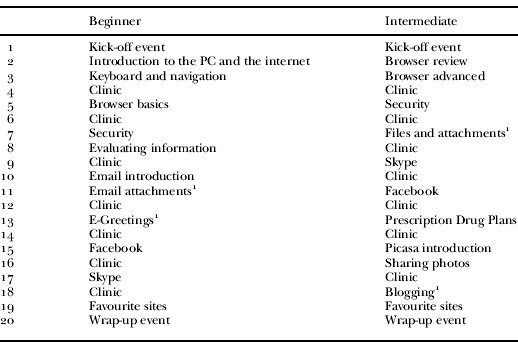
The actual TAP2 training was taught in a mixed format. Each group met weekly for a total of 18 sessions plus a kick-off and a wrap-up event for a total of 20 possible meeting times. Eleven sessions focused on specific topics and seven sessions were open clinics where learners could practise and ask questions of the tutors (see Table 1 for a complete listing of topics covered). In some sessions all tutors actively shared the instructional role, focusing on their small groups of learners. In other sessions, there was one instructor teaching the class from the front of the room. As noted in Table 1, all but two specific topics in both the beginner and intermediate groups were led by peer tutors.
Class schedule for TAP2 (second wave of the Technology and Aging Project)

Note: 1. Session led by a volunteer local expert; peer tutors simultaneously worked with their groups of students in support of the learning process.
Measures
Three main groups of variables were examined in this pilot study: computer-related outcomes, social support-related outcomes and mental health-related outcomes. CSE was measured using a scale adapted from Murphy, Coover and Owens (Reference Murphy, Coover and Owens1989). Respondents were asked to indicate how confident they felt completing 16 tasks without any assistance (e.g. escaping and exiting from software, sending and receiving email), on a scale from 1=very little confidence to 5=quite a lot of confidence. Item responses were summed for a possible overall score ranging from 16 to 80 (Cronbach's alpha=0.96). Participants also were asked to indicate how often they use 15 different ICTs with responses ranging from 0=never to 3=daily. This measure was created for TAP1 and updated for TAP2 based on additions and revisions to the training. The instrument was designed to be somewhat generic to accommodate the rapidly changing technology context while also cueing respondents to content covered in the training material. Items included: search for web pages on the internet; send or receive email; get news online; send ‘instant messages’ to someone who is online at the same time; online banking; play a computer game; download music files; download pictures from your camera; attach a picture to an email; edit a picture with computer software; online gambling; use a ‘cloud computing’ tool such as Google docs; update your own blog, Facebook page, or care page; reply to someone's posting on a blog, Facebook page, or care page; and use the computer to look up genealogy information. Responses were summed to create a scale measuring ICT use (possible range 0–42, Cronbach's alpha=0.80). Finally, respondents were asked to indicate how they communicated with each person in their social network and the number of people communicated with by email, instant messaging or Skype were counted.
Social network data were collected using an adaptation of Antonucci's hierarchical mapping technique (Antonucci Reference Antonucci1986). Respondents were asked to list the first names of individuals they would include in their network. For each person listed, data were gathered on the respondent's relationship with that person, how frequently they had contact with them, and what ICT tools were used to stay in contact with them. The total number of people in the respondent's network was a count of the number of people listed (possible range 1–20). Frequency of contact with each person was measured on a five-point scale ranging from 1=irregularly to 5=every day and the mean frequency of contact across the network as a whole was calculated. Perceived social support was measured using the Multidimensional Scale of Perceived Social Support (MSPSS; Zimet et al. Reference Zimet, Dahlem, Zimet and Farley1988). The MSPSS consisted of 12 statements to which respondents indicated how much they agreed on a scale ranging from 1=very strongly disagree to 7=very strongly agree. The possible range for the total score is 12–84 (Cronbach's alpha=0.92).
Loneliness was measured using a six-item scale (De Jong Gierveld and Van Tilburg Reference De Jong Gierveld and Van Tilburg2006). Respondents were given a series of statements such as, ‘I experience a general sense of emptiness’ and ‘There are plenty of people I can rely on when I have problems’ and asked to indicate the extent to which each statement applied to them. The possible range for the final scale is from 0 to 6 (Cronbach's alpha=0.57). For quality of life, respondents were asked to indicate how satisfied they were with 16 areas of their life (e.g. material comforts, health, close friends) on a scale from 1=terrible to 7=delighted (Flanagan Reference Flanagan1978). Responses were summed for a total score with a possible range from 16 to 112 (Cronbach's alpha=0.81). Finally, depressive symptoms were measured using the Geriatric Depression Scale (GDS; Yesavage et al. Reference Yesavage, Brink, Rose, Lum, Huang, Adey and Leirer1982). The GDS consists of 15 items. Respondents indicated by yes or no whether the statement applied to how they felt during the past week. Positive and negative items were reverse coded, and the number of responses indicating possible depression were counted (possible range 0–15, Cronbach's alpha=0.64).
Data were also collected on age and gender. Socio-economic status was indicated by a three-category measure of education (high school or less, some college, two-year degree or higher), and a four-category measure of household income (less than US $25,000, $25,000–49,999, $50,000–74,999 or $75,000 or higher). Other demographic measures included marital status (married, divorced/separated, widowed) and living situation (lives alone, lives with spouse, lives with other family or friends). A dichotomous variable indicated whether the learner was in the beginner or intermediate group and a continuous measure of the number of sessions attended was also included.
Analytic strategy
Descriptive statistics are presented for TAP2 learners at baseline. Mixed regression models (MRMs) were used for multivariate analyses to estimate change in outcomes over time (Rabe-Hesketh and Skrondai Reference Rabe-Hesketh and Skrondai2005; West, Welch and Galecki Reference West, Welch and Galecki2006). MRMs are useful for this type of analysis for several reasons. First, they do not require that subjects be measured on the same number of time-points. This is important because, as is to be expected with any longitudinal study, there was some attrition in our sample. Fourteen of the participants (74%) completed all eight data points (four for TAP1 and four for TAP2). Of those who did not complete all interviews, three (16%) completed all four TAP1 data points, but only baseline for TAP2 (two of these died and one became ill early in the training and was not able to return). Of the remaining respondents, one missed one data point and the other missed two. Unlike repeated-measures ANOVA, MRMs will not drop those with missing data points from analysis thus taking advantage of all available data. However, to make sure the three participants with TAP2 baseline data only did not skew results, analyses were run both with and without these data. As there was no substantive difference in results, results presented here include their data.
Second, with MRMs, subjects do not have to be measured at exactly equal time intervals. Although every effort was made to interview participants at all time-points, there was some variation due to difficulties in scheduling. Third, MRMs permit modelling of the effects of factors other than the treatment on the outcomes of interest. This includes time-invariant covariates such as gender, and time-varying covariates such as CSE that was treated as both an outcome and a predictor of other outcomes. Finally, in providing an estimate of the average change over time in both experimental and control group subjects, MRMs can provide an estimate of change for each individual as well as deviations from group trends.
Tables present these data with TAP1 baseline as the comparison. Although not shown, the same analyses with TAP2 baseline as the comparison are referenced in the text where it is useful to illuminate results. Models were run with time as a fixed effect only and again with time as both a fixed and random effect. A likelihood-ratio test was performed to compare these models and the one with the best fit was retained. Thus, for some outcomes time was reported as a fixed effect only, while other outcomes included time as a random effect as well. Four models are presented for each outcome. Model 1 is the null model with the dependent variable only to determine the level of between-person variance. Model 2 includes fixed effects for each time-point, as well as a random effect associated with the intercept for each participant and a residual associated with each observation. Model 3 added the learner's group (beginner or intermediate) and Model 4 added a measure of attendance. All models controlled for age, gender, education, household income, marital status and living situation. An alpha of 0.05 was used as the cut-off for determining statistical significance.
Results
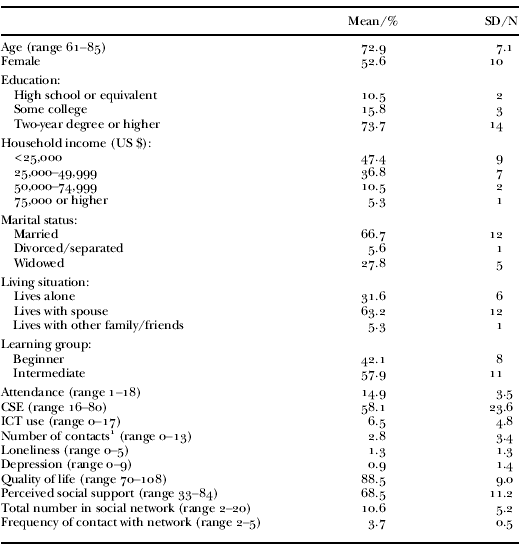
A description of the sample at TAP2 baseline is displayed in Table 2. Overall, the average age was 73 and just over half of the participants were female. The majority had a two-year degree or higher with 16 per cent having some college and 11 per cent having a high school degree or equivalent. About half had a household income less than $25,000, 37 per cent had income between $25,000 and $49,999, 11 per cent had income between $50,000 and $74,999, and 5 per cent had income $75,000 or higher. The majority were married (66.7%) with 27.8 per cent widowed and 5.6 per cent divorced or separated. Most lived with a spouse (63.2%) and about a third lived alone (31.6%) while one respondent (5.3%) lived with family or friends. Fifty-eight per cent of learners were in the intermediate group and 42 per cent in the beginner group. On average, learners attended 14.9 sessions out of a possible 20. The average CSE score at baseline was 58.1 (range 16–80). The average ICT use was 6.5 (range 0–17) and participants communicated with about three of their network members by email, instant messaging or Skype (range 0–13). In general, at baseline participants scored low on loneliness and depression measures and high in quality of life and perceived social support. The average number of contacts in the social network was 11 (range 2–20) and the average frequency of contact was 3.7 (range 2–5).
Description of TAP2 (second wave of the Technology and Aging Project) learners (N=19) at TAP2 baseline
Notes: 1. Contacts communicated with by email, instant messaging or Skype. SD: standard deviation. CSE: computer self-efficacy. ICT: information and communication technology.
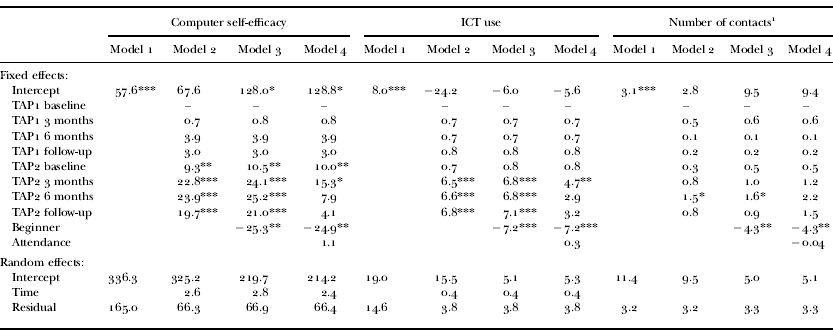
Table 3 shows mixed regression models for computer-related outcomes. As hypothesised, there were significant and consistent changes over time for both CSE and ICT use. Interestingly, CSE was significantly greater than the TAP1 baseline before the TAP2 training actually began (Model 2 TAP2 baseline). CSE increased throughout the training with a slight decline at follow-up, although self-efficacy still remained significantly greater than either TAP1 or TAP2 baseline (Model 2). ICT use significantly increased three months into the training and remained steady through follow-up (Model 2).
Mixed regression results for computer-related outcomes
Notes: 1. Contacts communicated with by email, instant messaging or Skype. Models 2–4 control for age, gender, education, household income, marital status and living situation. ICT: information and communication technology. TAP1: first wave of the Technology and Aging Project. TAP2: second wave of the Technology and Aging Project.
Significance levels: * p<0.05, ** p<0.01, *** p<0.001.
There were much less consistent results for the number of people in the network communicated with by email, instant messaging or Skype. While there is a significant increase at the end of the training (Model 2 TAP2 6 months) in comparison to TAP1 baseline, when the same analysis was run with TAP2 baseline as the comparison the difference is not significant.
Learner group (beginner versus intermediate) was significantly related to all computer-related variables (Model 3). Compared to those in the intermediate group, beginners reported significantly less CSE, less ICT use, and less communication with network members by email, instant messaging or Skype. Attendance was not significant (Model 4).
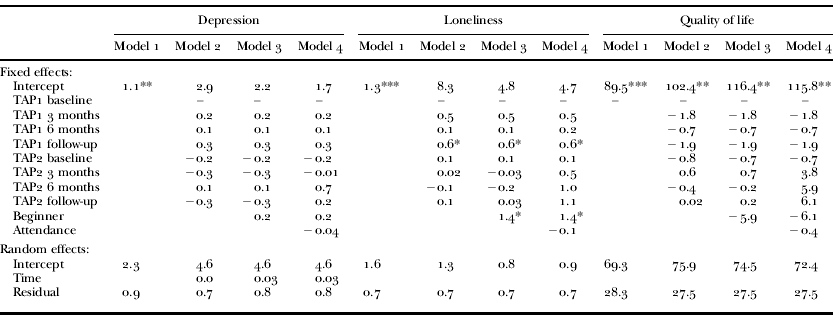
Mixed regression model results for mental health outcomes
Notes: Models 2–4 control for age, gender, education, household income, marital status and living situation. TAP1: first wave of the Technology and Aging Project. TAP2: second wave of the Technology and Aging Project.
Significance levels: * p<0.05, ** p<0.01, *** p<0.001.
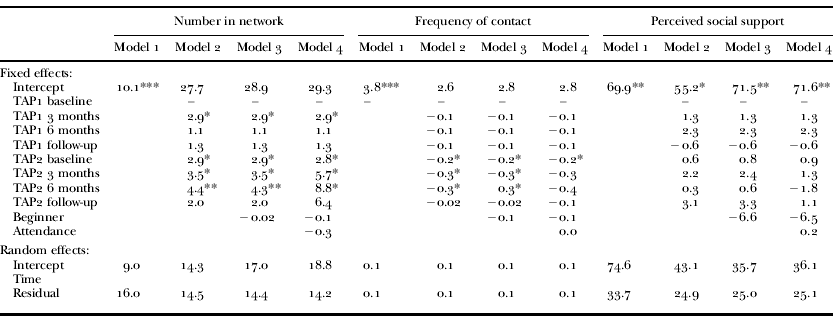
For mental health outcomes, there was no significant change over time. In fact, the only significant finding for mental health outcomes was that beginners reported significantly more loneliness than intermediate learners (Table 4, Model 3). In terms of social support variables (Table 5), there was no significant change in perception of social support. There was a significant increase in the number of people in the network compared to TAP1 baseline, while frequency of contact with network members significantly decreased in comparison to TAP1 baseline levels (opposite of our hypothesis). Neither of these results are significant changes in comparison to TAP2 baseline and neither learner group nor attendance was significantly related to social support variables.
Mixed regression results for social support variables
Notes: Models 2–4 control for age, gender, education, household income, marital status and living situation. TAP1: first wave of the Technology and Aging Project. TAP2: second wave of the Technology and Aging Project.
Significance levels: * p<0.05, ** p<0.01, *** p<0.001.
The data also include four participants who were assigned a ‘home tutor’ throughout the course of the project. Three of these were for health reasons and one was the primary care-giver for a spouse who was unable to remain alone. This care-giving spouse, however, was eventually convinced to attend the class for the social interaction and respite from care-giving and attended 17 sessions with one home visit. Two of the home-tutored participants died. The last participant attended ten of the 20 possible meetings (including the kick-off and wrap-up events) and was home tutored for four. Without this option, the participant would have missed these four sessions because of poor health. This learner's CSE and ICT use both increased, and anecdotally there were positive changes in this learner's overall wellbeing and happiness. All four home-tutored learners were in the beginner group. Their age ranged from 61 to 83 (mean=75, SD=9.9). Three of these learners were female. Two had a high school degree or equivalent, one had some college, and one had a two-year degree or higher. All four had household incomes less than $25,000. Two were married, one was divorced/separated, and one was widowed. Compared to the learner group as a whole, those who were home tutored were less educated and had a lower household income.
Discussion
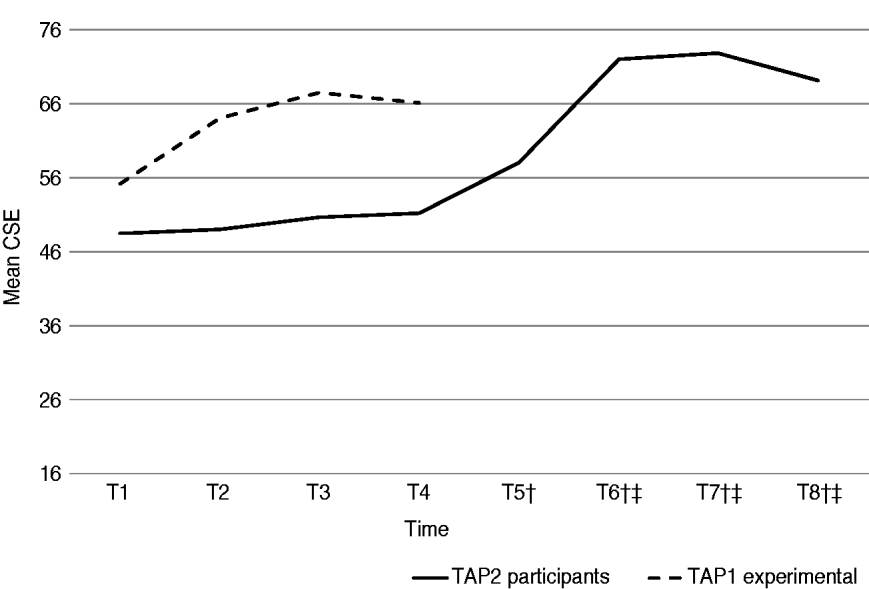
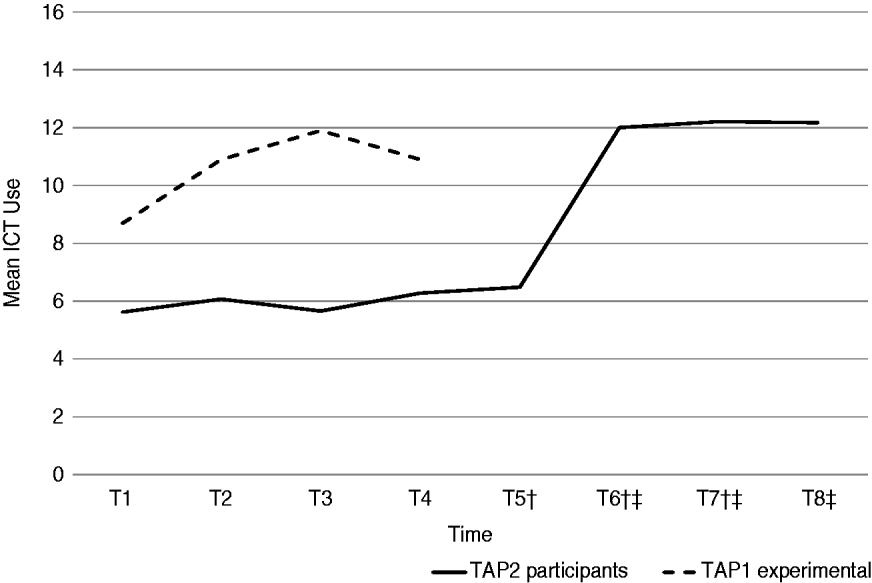
This project was a follow-up to a previous technology training project. While TAP1 relied on a project co-ordinator and community volunteers to deliver training, TAP2 relied predominantly on peer tutors. The results suggest that the peer tutor model is at least as effective as the staff-directed model. As with TAP1 (Woodward et al. Reference Woodward, Freddolino, Blaschke-Thompson, Wishart, Bakk, Kobayashi and Tupper2010), learners in TAP2 reported increased confidence in using computers and ICTs and an increased use of ICTs. Figures 1 and 2 suggest that TAP2 increases were at, or even slightly above, those of TAP1 learners. Most notably, in TAP2 ICT use did not drop off three months after the training ended to the same extent as occurred in TAP1.
Computer self-efficacy (CSE). Notes: TAP1: first wave of the Technology and Aging Project. TAP2: second wave of the Technology and Aging Project. † TAP2 participants' mean CSE higher compared to T1 (TAP1 baseline). ‡ TAP2 participants' mean CSE higher compared to T5 (TAP2 baseline).
Information and communication technology (ICT) use. Notes: TAP1: first wave of the Technology and Aging Project. TAP2: second wave of the Technology and Aging Project. † TAP2 participants' mean ICT use higher compared to T1 (TAP1 baseline). ‡ TAP2 participants' mean ICT use higher compared to T5 (TAP2 baseline).
TAP2 did not appear to have as significant an impact as TAP1 on the use of email, instant messaging and Skype for communicating with family and friends. One reason for this may be the placement of these topics later in the schedule in TAP2, giving learners less time to practise and become used to using them in the classroom format. The spike in this outcome at six months, shortly after this material would have been covered, lends some support to this assertion. Another reason may be the greater proportion of beginners in TAP2 compared to TAP1.
As with TAP1, the effect of the peer tutor training on participants' social network and other significant areas of life was mixed. In TAP1, there was a significant increase over time in the number of people in participants' social networks, but the difference between the experimental and control group was not significant. In TAP2 there is also a steady and significant increase over time compared to TAP1 data, but the difference was not significant when compared with the TAP2 baseline. Participants in both TAP1 and TAP2 scored relatively low on depression and high on quality of life, and reported fairly robust social networks at baseline. This limited the extent to which positive change was possible and highlights the need to test the programme with a broader range of participants. However, these results are also consistent with previous studies that did not find a relationship between computer training and wellbeing, quality of life or cognitive ability (Slegers, van Boxtel and Jolles Reference Slegers, van Boxtel and Jolles2008, Reference Slegers, van Boxtel and Jolles2009). A more targeted recruitment of home-bound elders and individuals suffering from depression or isolation would provide a stronger test of the training on psycho-social wellbeing. Although participants will always at some level self-select into such a programme, staff of social service agencies could be encouraged to refer clients who they think may benefit.
There was an increase in most measures between TAP1 and TAP2 baseline, although this difference was only statistically significant for CSE. However, these changes may explain, at least in part, the differences in results when comparing to TAP1 versus TAP2 baseline. The project site was in a social service agency that provides a wide variety of services in a small community. It is possible that some of this change, particularly in computer-related measures, is due to control group contamination either during TAP1 or in the time between the completion of TAP1 and the beginning of TAP2. Contamination may have occurred because of contact between experimental and control group members in TAP1 who may have participated together in other events sponsored by the agency, or simply because of the energy and excitement generated around the project that led control group members (later TAP2 learners) to seek out information on their own. Although we asked participants at the last TAP2 data collection point if they had received any other training, help from family or friends, or used online or other self-directed tutorials since the end of the TAP2 training, we did not gather this data for the period between the end of TAP1 and the start of TAP2. It is not unreasonable, however, to expect that, once their interest was piqued, some participants learned new skills on their own.
Other benefits of the peer tutor model were not captured in the outcome measures alone. One is the development of a cadre of peer tutor volunteers that can be used in other aspects of agency work involving technology. For example, agency staff already provide support to older clients in online tax preparation and Medicare Part D enrollment, and will increasingly work with clients around patient access to medical record systems. Peer tutor volunteers can now support those efforts in a variety of ways.
Another benefit of the peer tutor model is the ability to take training to older adults in their home. Home-bound individuals potentially have the most to gain from ICTs to help alleviate social isolation, bolster social support, and access services such as online prescription refills, library services and a variety of shopping. The ability to take care of these basic needs for him/herself could have far-reaching implications not only for the older adult's autonomy and self-esteem, but also for relieving care-givers of the need to handle these tasks.
Experiences from TAP2 offer insight into both the value and the challenges of home tutoring, reinforcing the potential for home tutoring and the need to explore this option further. However, it also highlights the fact that in many cases older adults may be too frail to take advantage of what home tutoring has to offer. Thus a challenge of home tutoring is adequately assessing the needs and abilities of potential participants. It is also vitally important to provide sufficient emotional support to peer tutors working with home-bound older adults to help them cope with their own feelings around the decline and even death of their students.
Implications
With technology becoming more important in everyday life in the 21st century and more broadly available throughout the world, social work and social care services are beginning to awaken to the need to embrace the possibilities for technology-based activities and services. In many parts of the world there are already clear public policy goals proclaiming the importance of ‘digital inclusion’, and social care agencies have begun the task of designing and implementing technology training for disadvantaged groups. In the USA, NASW and ASWB (2005) have suggested a set of Standards to guide the response to this emerging environment. Based on concepts of empowerment and the strengths perspective, these Standards describe the role technology will play in client, worker and agency experience, framing the discussion as a social justice issue. These Standards do not propose models for implementation, however, and thus it falls to projects like the Technology and Aging Projects to begin the process of developing, testing, refining and advancing potential strategies for dealing with the challenges implicit in the Standards.
The TAP2 project described here provides useful insights into these issues related to clients, workers and agencies. In terms of clients, the results reinforce earlier findings that with adequate resources and sensitive training models big improvements can indeed be made in older adult clients' CSE and in their level of ICT use. At the same time, the absence of other significant effects suggests that hopes for further impact on health and wellness outcomes may depend on more extensive application of newly acquired technology skills to other activities and programmes more specifically targeted in the areas of desired impact. An alternative possibility – that gains could be reached with a more disadvantaged client population – requires exploration in future research. Currently, however, it appears that the knowledge and skill gains that can be accomplished by programmes like TAP1 and TAP2 provide necessary but not sufficient improvement in client capacity to affect a broader range of outcomes.
At the same time, these results point to a number of client characteristics that pose challenges for both staff and agencies. Client access to computers, smart phones or other devices, and to high-speed internet access remains a social justice issue. Even more significant in terms of the level of effort required, is the implication of analyses not presented above. TAP2 data revealed that while more educated older adults reported greater use of ICTs, this difference was mediated with the addition of learner group to the model, suggesting that differences in education accounted for differences in baseline computer use skills. In fact, 50 per cent of the beginner group had two or more years of higher education compared to 90 per cent of the intermediate group. Given the greater gains by the intermediate group, this finding would seem to increase the challenge for agencies providing services to populations at the lower end of the education continuum. Additional effort will be required to move these client groups into the beginning stage of the technology age.
The research described here hints at the advantages and challenges of using older adult peer tutors as staff resources. The tutor–learner relationship appeared to play an important role in the learners' growth in CSE and ICT usage. As in many other social service endeavours, even the ‘high tech’ world of ICTs appears to benefit from an approach that utilises a ‘high touch’ approach, especially for older adults. That is, even as technology increasingly provides alternative means to provide services, information and support, for vulnerable populations human interaction is required to help facilitate the use of the technology. The availability of tutors ready and willing to make house calls provided a means to reach home-bound older adults who would otherwise have been unable to benefit from the programme. The agency now has a cadre of trained individuals able to continue stand-alone technology training activities targeted at older adults, or to work along with agency staff in developing and delivering new services that include technology skills (such as utilising electronic medical records in their health care).
Sources of potential tutors will vary tremendously by characteristics of the community in which services will be provided. In larger metropolitan areas there may be other non-profit organisations whose mission is to provide similar training to older adults, thus generating a potential stream of recruits. A review of the curriculum of these training programmes will provide some hint of the technical background of volunteers, which should nevertheless be confirmed by a technology skills assessment and an interview to assess interest in and suitability for a tutor role. In addition, agencies must follow standard procedures for vetting all volunteers, especially for tutors who may work in the homes of agency clients. For agencies in small communities without such specialised non-profit organisations it may be necessary to grow their own tutors by providing staff-led technology training and then recruiting tutors from their graduates.
It must be remembered, however, that peer tutor volunteers do not come as free additions to the workforce. In addition to technology training if needed, like other volunteers they require staff attention, supervision and nurturance. The variance within even this small tutor group suggests that not all volunteer tutors will be able to play the role of formal ‘instructors’, and thus hints at more complex models of service delivery. The mix of volunteer tutoring styles may have to be considered in programme development. Whether it is a volunteer co-ordinator or another paid staff member who is responsible for overseeing this activity, moving agency programming to be more responsive to technology dimensions is likely to be interesting and challenging work.
For agencies, in combination with the NASW/ASWB Standards this research project highlights a number of essential notions. First, there is both a need and demand for technology training, and those with the greatest need will frequently be the hardest to reach. Second, there appear to be relatively simple steps that can be taken to incorporate technology training into the service mix provided by agencies and move older adult clients into the technology world of the 21st century which is itself an important social justice and empowerment goal. Third, as more older adults become ICT literate and computer proficient, these skills will permit them to access new services that may enhance social support, health, mental health and other long-term outcomes.
The job of researchers and programme developers is to design, test and refine service models that will indeed enhance the likelihood of addressing these longer-term needs and achieving the desired outcomes. Based on the research reported above we would hypothesise that peer tutors will play an important role in delivering these new programme models.
Acknowledgements
This project was approved by the Human Subjects Review Board of Michigan State University, East Lansing, MI, USA. Funding was provided by the Michigan State University Pearl J. Aldrich Faculty Research Award (Drs Amanda T. Woodward and Paul P. Freddolino, co-investigators). The funder played no role in the design, execution, analysis and interpretation of the data, or writing of this study. As lead author, Dr Woodward was responsible for the design, execution and analysis of the data. All authors contributed to the interpretation of the results and writing of the study.