Introduction
The simultaneous co-occurrence of both manic and depressive symptoms (ie, “mixed states”) has long been recognized as early as the 1800s.Reference Swann, Lafer and Perugi 1 , Reference Castle 2 The fundamental understanding, definitions, and classification of mixed states has greatly developed over the past several decades.Reference Castle 2 The Diagnostic and Statistical Manual of Mental Disorders, Fourth Edition, Text Revision (DSM-IV-TR) had a highly restrictive definition of mixed states, defining a mixed episode as the co-occurrence of a threshold manic episode contemporaneously with a threshold major depressive episode (MDE). 3 The presence of a mixed episode denoted a diagnosis of bipolar I disorder (BD-I), thus excluding a diagnosis of bipolar II disorder (BD-II) or major depressive disorder (MDD). 3 Recently, this restrictive definition was found to lack sufficient sensitivity and had inadequate clinical and scientific validity.Reference Swann, Lafer and Perugi 1 , Reference Castle 2 , Reference Benvenuti, Miniati, Callari, Giorgi Mariani, Mauri and Dell’Osso 4 As such, a significant shift in defining mixed states occurred with the publication of the Diagnostic and Statistical Manual of Mental Disorders, Fifth Edition (DSM-5). 5 In the DSM-5, the mixed episode diagnosis was removed and replaced by the “with mixed features” specifier, which may be applied to any mood episode (ie, manic, hypomanic, or depressive episode). 5 The mixed features specifier denotes the co-occurrence of a threshold mood episode along with subthreshold symptoms of the opposite mood state. Further, this new conceptualization of mixed states was not restricted to BD-I. As such, mixed features may also be present in MDD or BD-II. 5
Replicated evidence has demonstrated that mixed states are common, with approximately 20–40% of patients with BD or MDD meeting criteria for DSM-5–defined mixed features at some point in their illness course.Reference Kessing 6 – Reference Verdolini, Agius, Ferranti, Moretti, Piselli and Quartesan 8 Further, mixed states have been associated with poorer clinical outcomes, greater comorbidity, more frequent relapse, and greater risk of suicide.Reference Shim, Woo, Jun and Bahk 9 – Reference Seo, Wang, Jun, Woo and Bahk 13 As such, the accurate diagnosis and effective treatment of mixed states remains a clinical and research priority. Given that the DSM-5 definition of mixed features was published relatively recently (May 18, 2013), updated treatment guidelines to provide recommendations in the treatment of mood episodes with mixed features are currently limited. Only the 2015 Florida Medicaid Guidelines and Korean Medication Algorithm Project for Bipolar Disorder: Third Revision have specifically addressed considerations for the treatment of mixed features based on expert consensus. 14 , Reference Woo, Lee and Jeong 15 Some authors have suggested that data from clinical trials utilizing DSM-IV-TR–defined mixed episodes may inform the treatment of DSM-5–defined mixed features.Reference Fagiolini, Coluccia and Maina 16 The direct application of these results may be problematic, as the previous mixed episode definition was much more restrictive and as such may not be generalizable to the current broader definition of mixed states. Further, these previous studies were conducted exclusively in subjects with BD-I, therefore yielding results that may not be generalizable to mixed states in BD-II and MDD.
Guidelines for the treatment of DSM-5 mixed features may be of great benefit. Evidence-based guidelines require replicated, randomized, placebo-controlled clinical trials (RCTs) that have robustly assessed efficacy, safety, and tolerability of an array of treatments to adequately inform treatment recommendations for clinical practice.Reference Woolf, Grol, Hutchinson, Eccles and Grimshaw 17 At the current time, insufficient evidence is available to adequately inform evidence-based guidelines for the treatment of mood episodes with DSM-5–defined mixed features. Currently, no agent would meet the standard criteria for a Level 1 or even Level 2 recommendation. As such, the publication of guidelines would be premature at the current time. However, in the interim, there is still a great need to provide recommendations for clinicians to guide the treatment of mixed features based on current evidence and expert opinion.
The primary objective of the current article is to provide recommendations for the acute treatment of mood episodes with DSM-5–defined mixed features. Recommendations will be based on the following: (1) an analysis of studies specifically evaluating treatments for DSM-5–defined mood episodes with mixed features, (2) the conservative generalization of studies evaluating treatments of DSM-IV-TR–defined mixed episodes, and (3) the careful synthesis of the available data with clinical expertise.
Foundations of Management
The general principles for managing mood episodes with mixed features are largely similar to the guiding principles in managing any mood episode, with some additional points of consideration. As such, general principles will only be briefly reviewed herein, with a focus on additional considerations when mixed features are present.
As with all mood episodes, an accurate diagnosis and characterization is of great importance. Given that depression with mixed features may be present as part of BD-I, BD-II, or MDD, this initial differentiation is essential. Therefore, obtaining a thorough history of previous potential manic or hypomanic episodes is of utmost importance. The use of symptom checklists and evidence-based rating scales to assess for response is also recommended and has been shown to improve outcomes.Reference Lobban, Solis-Trapala, Symes and Morriss 18 , Reference Hergueta and Weiller 19 Once a diagnosis has been made, early intervention in consultation with a mood disorder specialist should be prioritized and has been shown to improve long-term prognosis.Reference Kessing, Hansen and Hvenegaard 20 , Reference Bauer, Juckel, Correll, Leopold and Pfennig 21 Close monitoring for response and adverse effects is required (eg, systematically assessing for treatment response and following guideline-based adverse effect monitoring protocols).Reference Yatham, Kennedy and Parikh 22 When mixed features are present, close follow-up and monitoring are even further merited, given that mixed states are associated with an increased risk of affective switching and suicidality.Reference Schaffer, Isometsa and Azorin 23 For patients with MDD with mixed features, close monitoring after resolution of the mood episode may also be of benefit; the presence of mixed features is associated with an increased risk of MDD later declaring itself as BD,Reference Leonpacher, Liebers and Pirooznia 24 , Reference Frankland, Cerrillo and Hadzi-Pavlovic 25 as the bipolar nature of mixed depression has long been recognized.Reference Benazzi 26 – Reference Maj, Pirozzi, Magliano, Fiorillo and Bartoli 28 Additionally, with initiation of treatment, monitoring for activation syndrome is merited, as mixed depression is associated with increased rates of activation syndrome, which is listed by the U.S. Food and Drug Administration as a possible suicidality precursor while initiating or during antidepressant treatment.Reference Takeshima and Oka 29
While the focus of the current recommendations is psychopharmacological interventions, the use of adjunctive psychosocial interventions may also be of great benefit.Reference Yatham, Kennedy and Parikh 22 The use of individual and family psycho-education should be provided to all patients. Psychosocial interventions including cognitive behavioral therapy (CBT), interpersonal psychotherapy (IPT), and interpersonal and social rhythm therapy (IPSRT) may be of particular relevance for depression (both bipolar and unipolar) with mixed features. Use of IPSRT may be of particular relevance, given the profound circadian rhythm disturbances of mixed states.Reference McMahon, Herr, Zerubavel, Hoertel and Neacsiu 30 Of note, insufficient evidence exists to support psychosocial interventions as monotherapy for BD, and as such should always be combined with pharmacotherapy.Reference Yatham, Kennedy and Parikh 22
Specific pharmacological recommendations for each mixed mood state will follow. Treatments are categorized as first-line, second-line, third-line, or “not recommended.” As previously discussed, these recommendations should not be read as “evidence-based guidelines,” as “first-line” or “Level 1 recommendation” would usually imply that replicated RCT data has demonstrated efficacy, safety, and tolerability in this specific patient population (ie, RCTs conducted with subjects specifically during DSM-5–defined mood episodes with mixed features). Given that no agents would meet these criteria for DSM-5–defined mixed features specifically, recommendations are made based on the synthesis of available data and clinical expertise. However, the authors have still utilized the familiar terminology of “first-line,” “second-line,” etc. to allow for ease of clinical utilization of these recommendations. Prioritization of treatments as first-line is based both on expected efficacy and safety. For example, while 2 antipsychotics may have comparable efficacy, one may be first-line and the other second- or third-line based on the presence of significant metabolic effects in one agent and not the other.
Bipolar Disorder with Mixed Features
Acute management of mania/hypomania with mixed features
A limited number of studies have assessed the treatment of DSM-5–defined manic episodes with mixed features. McIntyre et al Reference McIntyre, Tohen, Berk, Zhao and Weiller 31 conducted a post-hoc analysis of 2 identically designed 3-week RCTs (n=960) in the acute treatment of mania evaluating asenapine versus olanzapine versus placebo. In subjects with mania with mixed features, both olanzapine and asenapine monotherapy were superior to placebo. With increasing baseline severity of depressive features, treatment outcome was poorer with olanzapine and placebo, but remained stable with asenapine. Tohen et al Reference Tohen, McIntyre, Kanba, Fujikoshi and Katagiri 32 also conducted a post-hoc analysis assessing olanzapine in the acute treatment of mania with mixed features based on pooled data from 3 3-week RCTs (N=228 olanzapine; N=219 placebo) that showed a greater decrease in Young Mania Rating Scale (YMRS) total scores in the olanzapine group compared to placebo. For mania with or without mixed features, the olanzapine-treated group also had significantly greater mean decrease in Hamilton Depression Rating Scale (HAM-D) scores compared with placebo (p=0.010, effect size=0.25). A larger effect size was observed in those with mixed features (effect size=0.34) compared to those without mixed features (effect size=0.20).
Only one study to date has evaluated hypomania with mixed features. Suppes et al Reference Suppes, Ketter and Gwizdowski 33 evaluated adjunctive quetiapine in 55 BD-II subjects with a stable medication regimen for ≥2 weeks and hypomania with mixed symptoms (>12 on the YMRS and >15 on the Montgomery–Åsberg Depression Rating Scale [MADRS] at 2 consecutive visits 1–3 days apart). Participants were randomly assigned to receive adjunctive quetiapine (n=30) or placebo (n=25). Adjunctive quetiapine demonstrated significantly greater improvement than placebo in Clinical Global Impression for Bipolar Disorder Overall Severity scores [F(1)=10.12, p=.002] and MADRS scores [F(1)=6.93, p=.0138], but no significant differences were observed for YMRS scores [F(1)=3.68, p=.069] compared to the placebo group, suggesting that quetiapine lacked a robust anti-manic effect in this study.
McElroy et al Reference McElroy, Martens and Creech 34 conducted an RCT of divalproex in 60 subjects with hypomania or mild mania, including participants with mixed hypomania and mixed mania, which consisted of 55% of the study participants. In this 8-week RCT, divalproex monotherapy was shown to significantly reduce symptoms of mania/hypomania in subjects with or without mixed features compared to placebo.
While limited evidence exists for treatments of DSM-5–defined mania/hypomania with mixed features, many studies have assessed treatments of DSM-IV-TR mixed episodes. Results from mixed episode studies may be partly generalizable to the treatment of mania with mixed features. Conversely, mixed episode studies are likely less applicable to the treatment of depression with mixed features. Based on results from recent meta-analyses and several systematic reviews, second-generation antipsychotics (SGAs) and divalproex appear to be the most efficacious acute treatments of mixed episodes for simultaneously alleviating symptoms of depression and mania.Reference Fagiolini, Coluccia and Maina 16 , Reference Muralidharan, Ali and Silveira 35 – Reference Fountoulakis, Kontis, Gonda, Siamouli and Yatham 37 Therefore, these treatments may be of benefit for mania with mixed features. Lithium also appears to be an effective acute treatment, as it alleviates both manic and depressive symptoms.Reference McIntyre and Yoon 36
Replicated evidence has demonstrated that antidepressants may worsen manic symptoms, and, as such, these agents should be discontinued upon diagnosis of a manic episode with or without mixed features.Reference Leverich, Altshuler and Frye 38 , Reference Frye, Helleman and McElroy 39 Similarly, psycho-stimulants may exacerbate manic symptoms and should be discontinued.Reference Cressman, Macdonald and Huang 40 During acute mania, regulation of sleep is essential to achieving remission of the manic episode. As such, benzodiazepines and hypnotics (ie, “z-drugs”) may be judiciously, temporarily used to aid in facilitating sleep and acutely decreasing agitation.Reference Dundar, Greenhalgh, Richardson and Dwan 41 , Reference Curtin and Schulz 42
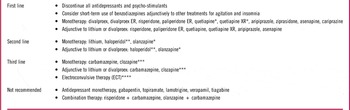
As shown in Table 1, recommended first-line monotherapies include divalproex, risperidone, paliperidone, quetiapine, aripiprazole, ziprasidone, asenapine, and the recently approved cariprazine.Reference Durgam, Earley and Lipschitz 43 , Reference Calabrese, Keck and Starace 44 These agents may also be used adjunctively with either lithium or divalproex. Olanzapine has been shown to be equally efficacious in the treatment of mixed episodes as other SGAs; however, due to safety concerns with significant weight gain and insulin resistance, it is recommended as a second-line intervention.
Recommendations for acute management of manic/hypomanic episodes with mixed features

* Quetiapine and olanzapine are effective; however, they have significant safety concerns with metabolic effects.
** Haloperidol is effective; however, it has safety and tolerability concerns with increased risk of extrapyramidal symptoms (EPS).
*** Consider clozapine for treatment refractory cases.
**** Consider ECT for treatment refractory cases or where pharmacological management is contraindicated. Where significant safety concerns exist (eg, acute suicidality with drug intolerance), ECT may be used first-line.
Carbamazepine and clozapine have less evidence to support their use in mixed statesReference Fountoulakis, Kontis, Gonda, Siamouli and Yatham 37 ; however, they may be considered if first- and second-line interventions fail. Electroconvulsive therapy (ECT) has been shown to be an effective and rapid treatment of mixed states, and as such may be considered at any point.Reference Medda, Toni, Mariani, De Simone, Mauri and Perugi 45 , Reference Valenti, Benabarre, Garcia-Amador, Molina, Bernardo and Vieta 46 Herein, ECT is recommended as a third-line intervention if other interventions fail. However, if emergent intervention is required and/or there is previously known medication intolerance or ineffectiveness, ECT may be considered as a first intervention. Antidepressant monotherapy, gabapentin, topiramate, lamotrigine, verapamil, and tiagabine have been shown to be ineffective treatments of mania and as such should be avoided in manic episodes with mixed features, as alleviation of manic symptoms is usually the first priority.Reference Yatham, Kennedy and Parikh 22
Acute management of bipolar depression with mixed features
Similarly, limited evidence exists for the treatment of bipolar depression with mixed features. Only one prospective RCT has been conducted evaluating the treatment of bipolar depression with mixed features, while all other studies have been post-hoc analyses. Patkar et al Reference Patkar, Gilmer and Pae 47 randomized 73 subjects in a double-blinded, placebo-controlled study to ziprasidone (40–160 mg/d) or placebo for 6 weeks. All subjects met DSM-IV-TR criteria for a MDE, while also meeting 2 or 3 (but not more nor less) DSM-IV-TR manic criteria with an underlying diagnosis or either MDD or BD-II.Reference Patkar, Gilmer and Pae 47 The primary outcome analysis indicated acute antidepressant efficacy of ziprasidone versus placebo (p= 0.0038). Efficacy was more pronounced in BD-II than in MDD (p= 0.036). A post-hoc analysis of these results by Pae et al Reference Pae, Patkar, Gilmer, Holtzman, Thommi and Ghaemi 48 attempted to assess other predictors of response, however, did not identify any mediating or moderating factors of statistical significance.
Several other post-hoc analyses have assessed the efficacy of SGAs in the treatment of bipolar depression with mixed features. Benazzi et al Reference Benazzi, Berk, Frye, Wang, Barraco and Tohen 49 conducted a post-hoc analysis of an 8-week, double-blind trial of BD-I subjects treated with placebo (n=355), olanzapine (5–20 mg/d; n=351), or olanzapine/fluoxetine combination (OFC) (olanzapine/fluoxetine doses: 6/25, 6/50, 12/50 mg/d; n=82). Mixed depression was defined as the co-occurrence of a MDE and >=2 manic/hypomanic symptoms. Response rates in the samples of patients with mixed features were the following: OFC versus olanzapine, OR=2.00 (95% CI, 0.96–4.19); OFC versus placebo, OR=3.91 (95% CI, 1.80–8.49); olanzapine versus placebo, OR=1.95 (95% CI, 1.14–3.34). These results suggested that compared to placebo, both olanzapine and OFC were efficacious treatments of bipolar depression with mixed features, with OFC being the most efficacious treatment. Tohen et al Reference Tohen, Kanba, McIntyre, Fujikoshi and Katagiri 50 also evaluated olanzapine via pooling data from 2 placebo-controlled olanzapine studies in subjects with bipolar I depression (olanzapine monotherapy [n=690] and placebo [n=524]). Subjects were categorized for mixed features by the number of concurrent manic symptoms at baseline (0, 1 or 2, and ≥3, respectively, as measured by a YMRS item score ≥1). Least-squares mean differences between olanzapine and placebo in the change of MADRS total scores were –3.76 (p=0.002), –3.20 (p<0.001), and –3.44 (p=0.002) for mixed features 0, 1 or 2, and ≥3, respectively. The response rates for olanzapine vs placebo were 52.6% vs 39.8%, 50.3% vs 40.0%, and 42.2% vs 33.7% for mixed features 0, 1 or 2, and ≥3, respectively, indicating superiority of olanzapine compared to placebo in all categories, including ≥3 manic symptoms (ie, qualifying for DSM-5–defined mixed features).
More recently, McIntyre et al Reference McIntyre, Cucchiaro, Pikalov, Kroger and Loebel 51 conducted a post-hoc analysis of subjects with a MDE associated with BD-I with a MADRS score≥20 and YMRS score ≤12 who were randomly assigned to 6 weeks of double-blind, once-daily treatment with lurasidone (n=186) or placebo (n=94). The presence of mixed features was defined as a YMRS score≥4 at study baseline. Treatment with lurasidone (versus placebo) was associated with significantly greater reductions in MADRS scores in the mixed features group (–15.7 vs –10.9; P=.001; week 6; mixed model for repeated measures [MMRM]; effect size=0.48).
Taken together, these results show promise for SGAs in the treatment of bipolar depression with mixed features. Ziprasidone, lurasidone, olanzapine, and OFC were specifically shown to be efficacious; however, post-hoc results should be interpreted with caution. Olanzapine and OFC should be used with caution given the significant metabolic effects and safety risks. Caution should also be used when prescribing ziprasidone given the QTc prolongation and high rates of akathisia associated with its use.
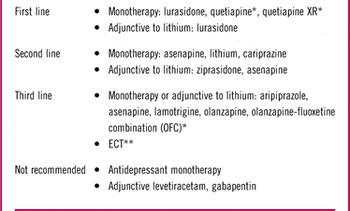
Given that quetiapine is an efficacious acute treatment of both mania and bipolar depression,Reference Yatham, Paulsson, Mullen and Vagero 52 , Reference Calabrese, Keck and Macfadden 53 it is also likely to be efficacious for bipolar depression with mixed features as well. However, this has yet to be shown in an RCT. Similarly, cariprazine has been shown to be an efficacious treatment of DSM-IV-TR–defined bipolar depression, mania, and mixed episodes and as such, is likely of benefit in the treatment of DSM-5–defined bipolar depression with mixed features.Reference Durgam, Earley and Lipschitz 43 , Reference Calabrese, Keck and Starace 44 Similarly, lithium may be an efficacious treatment that has yet to be evaluated. As discussed in the previous section, ECT may also be utilized for treatment-resistant cases or patients requiring emergent treatment who may not tolerate pharmacological treatments. Lamotrigine is listed as second line, as it is an efficacious treatment of bipolar depression. However, it is an ineffective anti-manic agent and therefore may theoretically be less effective to alleviate mixed features.Reference Yatham, Kennedy and Parikh 22 Antidepressant monotherapy should be avoided, as it may worsen manic symptoms. Adjunctive levetiracetam and gabapentin should be avoided due to their lack of efficacy in bipolar depression.Reference Yatham, Kennedy and Parikh 22 These recommendations are summarized in Table 2.
Recommendation for the acute management of bipolar depression with mixed features

* Olanzapine, OFC, and quetiapine are effective; however, they have significant safety concerns with substantial metabolic effects.
** Consider ECT for treatment refractory cases or where pharmacological management is contraindicated. Where significant safety concerns exist (eg, acute suicidality with drug intolerance), ECT may be used first-line.
Major Depressive Disorder with Mixed Features
Acute management of unipolar depression with mixed features
The presence of mixed features within the context of a MDE as part of a MDD has no DSM-IV-TR equivalent. As such, there is the greatest dearth of studies for unipolar depression with mixed features. Notably, the recently published 2015 Florida Medicaid guidelines provide recommendations specifically for MDD with mixed features. 14 In accordance with these guidelines, there is insufficient evidence to recommend a different treatment algorithm for MDD with mixed features compared to without mixed features. As such, management of mixed features may be the same as the general recommendation for MDD.Reference Lam, Kennedy and Grigoriadis 54 Additional recommendations would include closer monitoring when initiating antidepressant treatments, given the association between mixed features and later declaration of BD, as well as increased risk of activation syndrome and suicide. Additionally, antidepressant therapy may induce a manic episode and/or worsen mixed features.Reference Leverich, Altshuler and Frye 38 MDD with mixed features may also be more treatment resistant, requiring augmentation with an SGA or mood stabilizing agent.
There is interest in the use of SGAs and conventional mood stabilizing agents when mixed features are present to attempt to alleviate both depressive and manic symptoms; however, there is currently inadequate evidence to support their routine use. Only one RCT to date has attempted to evaluate these agents for the treatment of MDD with mixed features. In this recently published study, Suppes et al Reference Suppes, Silva and Cucchiaro 55 conducted a RCT with MDD subjects with a current MDE and 2 or 3 manic symptoms, randomly assigning subjects to 6 weeks of double-blind treatment with either lurasidone at 20–60 mg/day (N=109) or placebo (N=100). Changes from baseline in depression severity, as measured by MADRS (primary outcome measure) and Clinical Global Impressions–Severity subscale score (CGI-S; key secondary outcome measure) were evaluated using a mixed model for repeated-measures analysis. Mean changes at week 6 in the MADRS and CGI-S scores were –20.5 compared with –13.0 (effect size, 0.80) and –1.8 compared with –1.2 (effect size, 0.60), respectively. Significant improvements in YMRS scores were observed as well. Therefore, lurasidone monotherapy was shown to have a large antidepressant effect in MDD with mixed features.
Taken together, future studies are required and may reveal an earlier role of SGAs and mood stabilizing agents in the treatment of MDD with mixed features. At the current time, however, inadequate evidence exists to provide alternative guidelines for MDD with mixed features compared to DSM-IV-TR–defined MDD. Therefore, the authors refer the readers to other excellent evidence-based guidelines for the acute treatment of unipolar depression. 14 , Reference Lam, Kennedy and Grigoriadis 54
Conclusion
Mixed features are common in mood disorders, affecting up to 40% of mood disorder patients during the course of their illness. Mixed features are associated with poorer outcomes, higher levels of comorbidity, and treatment resistance. Therefore, the effective treatment of mixed states is of great importance. At the current time, there is a dearth of evidence to guide the treatment of DSM-5–defined mood episodes with mixed features. As such, national or international evidence-based guidelines are not available, as there is insufficient evidence to allow for the development of guidelines based on standard guideline development practices. In the interim, the current review attempts to provide some treatment recommendations by synthesizing expert opinion with the limited available data of studies utilizing DSM-5–defined mixed features with data from studies using DSM-IV-TR–defined mixed episodes.
There is currently insufficient evidence to make any conclusions about the management of MDD with mixed features, and, as such, the treatment recommendations remain largely unchanged from general guidelines for the treatment of MDD (ie, antidepressants remain first-line). However, there are significant safety concerns associated with antidepressant monotherapy when mixed features are present, meriting increased monitoring. However, as discussed in the 2015 Florida Medicaid Guidelines for the treatment of MDD with mixed features, early consideration of SGAs and/or mood stabilizers is merited. 14 For BD-I and BD-II, the current review identified SGAs as a class of medications showing the most promise in the treatment of BD with mixed features. Several SGAs identified have been shown to have antidepressant, anti-manic, and mood stabilizing effects, thus likely being a beneficial treatment of mixed states through targeting both sets of symptoms. For mania with mixed features, divalproex appears to likely be of benefit as well.
In selecting an SGA or mood stabilizer, notable differences should be considered. Differences between SGAs are primarily the variable antidepressant and anti-manic effects along with tolerability and safety. For example, lurasidone has been shown to have a potent antidepressant effect with minimal weight gain and as such may be prioritized in the treatment of bipolar depression with mixed features.Reference Citrome, Ketter, Cucchiaro and Loebel 56 While olanzapine and quetiapine have also been shown to have antidepressant and anti-manic effects, significant safety concerns exist with the substantial weight gain, dyslipidemia, and insulin resistance associated with these agents.Reference McElroy and Keck 57 – Reference McIntyre and Konarski 59 The importance of considering the metabolic effects of SGAs has recently been emphasized by the American Heart Association (AHA), as a diagnosis of BD or MDD has now been established as a cardiovascular risk factor, adding further merit to exerting caution when prescribing agents with adverse metabolic effects.Reference Goldstein, Carnethon and Matthews 60 These considerations are also emphasized in the 2015 Florida Medicaid Guidelines. 14
Admittedly, the current recommendations are not based on the usual standard of evidence required to inform guidelines due to the lack of available studies that specifically evaluate patient groups with mood disorders with DSM-5–defined mixed features. Further, the majority of the studies identified using DSM-5 mixed features were post-hoc analyses, lacking a priori hypotheses about the efficacy of specific agents for mixed features. As such, there is a great need for future research to assess the efficacy, safety, and tolerability of treatments specifically for mood episodes with mixed features via well-designed RCTs with a priori hypotheses specific to DSM-5–defined mixed features.
Disclosures
Joshua D. Rosenblat has no conflicts of interest to declare. Roger S. McIntyre has received research grant support from Lundbeck, Astra Zeneca, Pfizer, Shire, Otsuka, Bristol Myers Squibb, National Institute of Mental Health, Stanley Medical Research Institute, Canadian Institutes for Health Research, and The Brain and Behavior Research Foundation. He has also received speaker/consultant fees from Lundbeck, Pfizer, Astra Zeneca, Elli Lilly, Janssen Ortho, Sunovion, Takeda, Forest, Otsuka, Bristol Myers Squibb, and Shire.