Implications
Diseases of the locomotor system and respiratory tract are common problems in horse husbandry. Therefore, housing systems should meet horses’ needs in terms of movement, rest, fresh air, social behavior and feed intake. The present study shows that an active stable can meet these needs. This system is also suitable for horse husbandry under Icelandic conditions and is well accepted by the horses. The horses show good social behaviors, so positive effects on health and welfare are expected. Furthermore, the farmer's workload when using this system is lower than for individual boxes, but the horses are always available to ride.
Introduction
The management of horses in Iceland differs according to the class of animal. Breeding mares and young stock are most often kept outdoors throughout the year. Riding horses, however, are most often housed during winter. The housing conditions vary in design and quality, but the current trend has moved toward individual boxes with wood shavings as bedding. The main drawback of this system is the lack of free movement and exercise.
A survey of Icelandic veterinarians has shown that 70% to 80% of disease-related problems occur when horses are stabled during winter. In 13.6% of these cases, musculoskeletal disorders were the reason for the veterinary treatment. The investigation also showed that most disease-related problems are correlated with the usage and feeding of horses (Sigurdsson, Reference Sigurdsson1994).
Examinations of domestic and feral Icelandic horses have shown that several aspects of their behavior overlap, but that the behavior of horses in social groups can differ significantly depending on the composition of the group (Vervaecke et al., Reference Vervaecke, Stevens, Vandemoortele, Sigurjónsdóttir and De Vries2007). One study of Icelandic horses on pastures in wintertime showed that higher-ranking horses had better access to hay than lower-ranking ones. Thus, the dominant individuals gained weight in the winter period, whereas the subordinates lost weight (Ingólfsdóttir and Sigurjónsdóttir, Reference Ingólfsdóttir and Sigurjónsdóttir2008). Other investigations have shown that the linear dominance order was firm and correlated with age, weight, body condition, aggressiveness and time of residence in the herd, but not with the height of the horse (Van Dierendonck et al., Reference Van Dierendonck, DeVries and Schilder1995; Vervaecke et al., Reference Vervaecke, Stevens, Vandemoortele, Sigurjónsdóttir and De Vries2007; Ingólfsdóttir and Sigurjónsdóttir, Reference Ingólfsdóttir and Sigurjónsdóttir2008). Van Dierendonck et al. (Reference Van Dierendonck, DeVries and Schilder1995), studying a herd of Icelandic horses in captivity, observed that pairs of horses close in rank to each other were also often spatially close to each other, and horses in the middle ranks tended to be in close proximity to another horse more frequently than other horses.
It is generally agreed that housing conditions, feeding methods and the possibility of free movement have a major influence on the health status and welfare of domesticated horses (Thorne et al., Reference Thorne, Goodwin, Kennedy, Davidson and Harris2005; Jørgensen and Bøe, Reference Jørgensen and Bøe2007; Freire et al., Reference Freire, Buckley and Cooper2009). In particular, lack of movement and improper feeding are responsible for diseases of the musculoskeletal system as well as digestive and behavioral disorders.
Under natural conditions, horses spend most of their time moving in search of food. Wild-living horses, such as Camargue horses, spend 51% to 64% of the day grazing and 4% to 10% of the day walking (Duncan, Reference Duncan1980). Takhi horses released into the wild spend between 30% and 68% of daylight time grazing (Van Dierendonck et al., Reference Van Dierendonck, Bandi, Batdorj, Dügerlham and Munkhtsog1996). In a study of domesticated horses, Edouard et al. (Reference Edouard, Duncan, Dumont, Baumont and Fleurance2010) observed an average daily grazing time of 59.0% ± 1.6% over 24 h on a pasture.
Boyd (Reference Boyd1988 and Reference Boyd1991) reported that wild horses spend as much as 60% to 70% of their daily time foraging. Captive animals, however, may quickly consume their provided feed in a short period of time (Kiley-Worthington, Reference Kiley-Worthington1990).
There has been little evolution in horses’ teeth and digestive tracts during the years of domestication, suggesting little change in their strategies for food selection and digestion. Animal keepers should consider the instinctive behavior of domestic animals when designing appropriate environments for them. The optimization of horse management is also important to reduce both physical and behavioral diseases (Kiley-Worthington, Reference Kiley-Worthington1990).
Frentzen (Reference Frentzen1994) showed that the movement of horses can be encouraged by increasing the frequency of feeding. She showed that the number of daily feeding events has a greater influence on the distance traveled within the housing system than the extension of the path lengths to the feeding places. Benhajali et al. (Reference Benhajali, Richard-Yris, Ezzaouia, Charfi and Hausberger2009) arrived at similar conclusions. They studied the behavior of Arab breeding mares during their daily paddock time outside and concluded that giving these horses foraging opportunities had a positive influence on their behavior and welfare. The horses had less agonistic interactions, more positive social interactions and more friendships among themselves compared with mares without additional hay feeding in the paddock.
Group size seems to have a significant impact on social behavior. In a recent paper, Rose-Meierhöfer et al. (Reference Rose-Meierhöfer, Standke and Hoffmann2010b) found that horses housed in groups showed more aggressive actions in larger groups (in this case, 23 young horses) than in smaller groups (11 horses). However, an increase in group size also led to an increase in both movement activity and lying time.
Our previous investigations have addressed the influence of the husbandry system on horses’ movement activity and stress exposure. The comparison of an individual and a group husbandry system, each with adjacent outdoor enclosures, showed that horses are more active and less stressed (70% of the experimental horses) when kept in groups. Additional movement opportunities in the form of pasture or horse walkers had a significant influence on the movement activity of the group housing horses, whereas a lack of access to grazing land led to only a small increase in activity. Every additional motion caused a reduction of the stress load (Hoffmann et al., Reference Hoffmann, Bockisch and Kreimeier2009).
Chaplin and Gretgrix (Reference Chaplin and Gretgrix2010) also showed that housing conditions have a strong influence on the activity behavior of horses. In their investigation, horses were significantly more active when they were kept in a large paddock day and night than when they were stabled in a loose box. Another effect on the activity of horses was mentioned by Bertolucci et al. (Reference Bertolucci, Giannetto, Fazio and Piccione2008), who determined that diurnal behavioral patterns showed clear seasonal variations. The seasonal variations in the activity rhythms of athletic horses kept in stabled conditions were similar to those of feral or Przewalski horses under semi-reserve conditions.
A study of free active stables in Germany suggested that the activity of horses is affected by the amount of space and the arrangement of functional areas. The use of automatic feeding (for hay and concentrates) in addition to a good stable design leads to higher movement activity of horses (Rose-Meierhöfer et al., Reference Rose-Meierhöfer, Klaer, Ammon, Brunsch and Hoffmann2010a). In these parts of the world, group housing systems and movement stables are gaining importance because of their positive influence on health, welfare and social behavior. Furthermore, many horse owners want to keep their horses in conditions that are as natural as possible. The first active stable in Iceland was built in February 2010. Given this landmark project, the central motivation of this paper was to determine the suitability of an active stable under Icelandic conditions and its effect on horses. In particular, this study examined the effect of an automatic concentrate feeding station (CFS) on the movement activity and lying time of Icelandic horses.
Material and methods
Animals, housing and management
This study was performed on a horse farm in the Selfoss area in the southwest of Iceland. There were 52 Icelandic horses on the farm, which covered 70 ha. In February 2010, a newly built active stable that was initially scheduled for nine horses was put into operation. The investigations were performed between March and June 2010.
During the experimental period, eight Icelandic horses were housed in the active stable and used for the measurements. Seven of these horses were geldings, aged 4 to 21 years (mean ± s.d.: 9.14 ± 5.90 years), and one was a 7-year-old, non-pregnant mare. The height at withers was between 137 and 142 cm (138.88 ± 1.89 cm), and the weight of the horses was between 363 and 399 kg (374.75 ± 11.07 kg). The horses had previously been kept on the farm in groups on pastures but had no prior experience with an active stable system.
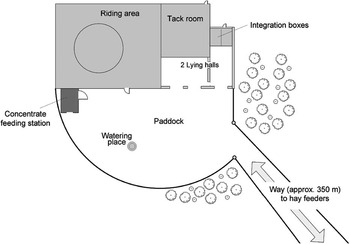
The components of the experimental barn (Figure 1) were a sand paddock (∼200 m2) with a watering place and a CFS, two lying halls and a roughage feeding area with three hay feeders (∼350 m from the sand paddock, connected by a sloping path). The CFS and hay feeders (HORSEKING®) as well as the watering place and a floor mounting system (HIT-DrainGrid®) were from the company HIT-Aktivstall® (Weddingstedt, Germany). One lying hall (88 m2) had a concrete floor that was half covered with rubber mats (SOFTBED® LIGHT elements, company HIT, Weddingstedt, Germany) and a horse toilet filled with wood shavings. The other lying hall (55 m2) had a sand floor and was connected to the other lying hall via two gate openings. The horses had free access to the lying halls at all times. In addition, the horses had access to pasture (∼3 h/day and all horses together). These times were noted in a trial protocol along with weather conditions (temperature, precipitation of rain and snow, wind force), visits by veterinarians, and other factors, all of which were considered in the analysis of the data. During the weeks of the experiment, the riding times and handling of the horses were limited to reduce disturbances. Days with a riding event or another interruption were excluded from the statistical analysis.
Ground plan of the experimental farm.

The horses were fed hay in three automatic hay feeders at six pre-fixed times per day, spread over the course of the day. A loud acoustic signal informed the horses of the beginning of feeding time. At each feeder, three horses could eat at the same time standing side by side. Altogether, there were nine feeding places for the eight horses. These hay feeders were closed with sliding plates on the frontside, which went up slowly at the predetermined feeding times. The hay could then be reached by the horses through vertical bars. Each feeding lasted 33 min, so the total daily time for hay feeding was ∼200 min/horse. The advantage of the time-controlled hay feeding method was the constant influence on the movement activity of the experimental horses in each trial period. In this way, the influence of the CFS on the behavior of the horses could be investigated specifically.
In the second period of the study, the housing system was supplemented by an automatic CFS (HORSEKING®, company HIT, Weddingstedt, Germany). At this station, every horse received up to 1.2 kg of supplementary feed consisting of concentrates (company Fóðurblandan, Island) and 0.1 kg of mineral supplement (Racingmineral, company Trouw Nutrition International). The horses wore transponder collars that were detected by the automatic feeder. At this station, only one horse had access to the feed at a time. At each visit, the horse received only a small portion (∼0.1 kg) of the daily allowance to motivate the horse to engage in more movement activity and to satisfy its natural needs. A certain amount of time had to elapse after each visit before a second visit was accepted. Throughout the experimental period, the horses retrieved, on average, 92% of the daily concentrate amount (equal to 1.104 kg/horse per day) and the whole amount of mineral feed. The horses could leave the feeding station through a one-way gate on the side or, after 99 s, by moving backward (a barrier behind the horse was closed for this period to protect the horse) if not hindered by another horse.
Experimental procedure
Observations were conducted between 8 March and 2 June 2010. Three weeks prior to commencement, the eight horses were held in the active stable (without the CFS) to accustom them to the new housing system.
Activity and lying behavior were measured in two trial periods, each 3 weeks long. During the first period (8 to 28 March 2010), the horses were housed as described above and fed with automatic hay feeders, but without the CFS. The horses received concentrates (∼1.0 kg/horse) and mineral (0.1 kg/horse) feed manually every morning.
After this first period, a CFS was installed in one corner of the sand paddock (Figure 1). The experimental horses were fitted with transponder collars and were trained to use the station for 3 weeks as an adaptation. Otherwise, the housing system was not modified, and the horse group and hay feeding remained the same, except that the hand feeding of concentrate and mineral feed was replaced by an automatic feeding system. After adaptation, the second period of investigation began (13 May to 2 June 2010).
Behavior analyses
Activity, Lying, Temperature pedometers (ALT Pedometers, Engineering Firm Holz, Falkenhagen, Germany) were used 24 h a day to analyze the movement activity and lying time for the entirety of the experimental periods. The pedometers were attached at the metatarsus just above the fetlock to one hind leg of each horse. The hind leg was chosen to avoid falsification of activity data because of front leg activities such as scraping and pawing.
The pedometer continuously recorded the movement activity and lying position of the animal. At the beginning of the trial period, intervals of 15 min were configured as a measurement data set, so all data within each 15-min interval were aggregated. Every second, the pedometers recorded a maximum of two impulses for movement activity, and every 15 s, the lying position was recorded. The ambient temperature at the horse's leg was measured every 15 min but was not included in this study. The stored data were transferred from the pedometer to a computer by radio transmission and were stored in an MS Access database (Microsoft Office Access 2007) for further processing. In the later data analysis, the daily (24-h) activities of the horses were calculated along with the time each horse spent lying.
The horses’ behavior was also recorded by video camera (software NV5000, AVerMedia Technologies, New Taipei City, Taiwan, Republic of China) and direct observation, especially to determine the hierarchy, utilization of different lying places and usage of the CFS. The determination of rank index was based on the method suggested by Sambraus (Reference Sambraus1975). An individual marking of the eight horses was not necessary because they were clearly distinguishable from one another by their phenotypes (especially the coat) and appearance.
The level of aggression of the animals was also analyzed during the second trial period. The horses were directly observed by a trained person during 12 hay feeding times (33 min each) on different days. The same person observed the horses from a distance, standing ∼15-m away. The horses were already familiar with this person. The observation occurred continuously during the entire hay feeding time. The times for the visual observations were selected on days without disturbance events and with equal weather conditions. During these observations, every aggressive behavior was recorded and entered in a sociometric matrix. The observer noted the time, each actor and reactor involved in the situation and the kind of aggression. Aggressive behaviors were classified as ‘threats’ and interactions ‘with physical contact’ according to an ethogram of Jørgensen et al. (Reference Jørgensen, Borsheim, Mejdell, Søndergaard and Bøe2009). The threats included displacement, threat to bite, threat to kick, head threat, chase and backing. Aggressive behaviors with physical contact included biting, kicking and pushing. Entirely uninvolved horses were also recorded. The data of the direct observations were first logged manually and were later logged in an Excel file (MS Office Excel 2007).
Estimation of body condition and weight
Because the active stable represents a new form of housing for horses in Iceland, the body condition score (BCS) and body weight (BW) were recorded during the study to determine their impact on the horses’ health, nutritional status and general body condition.
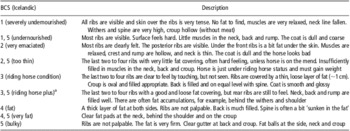
The BCS was determined with a method adapted for the Icelandic horse (Stefánsdóttir and Björnsdóttir, Reference Stefánsdóttir and Björnsdóttir2001). The score ranged from 1 (very underfed) to 5 (extremely fat) in steps of 0.5 (Table 1). The utilization of the equine-specific BCS determination method according to Kienzle and Schramme (Reference Kienzle and Schramme2004), which is based on a system for quarter horses (Henneke, Reference Henneke1985), was not practicable. The determination of the BCS with this system was problematic for Icelandic horses because of very high values in some body regions, such as fat along the neckline.
Icelandic BCS (after Stefánsdóttir and Björnsdóttir, Reference Stefánsdóttir and Björnsdóttir2001)

BCS = body condition score.
aRiding horse plus = a bit more than riding horse condition.
The BW of the Icelandic horses was measured with a measuring tape (Vægtbånd, Pfizer A/S, Hvidovre, Denmark). The tape had been previously validated with a horse scale (EziWeigh1, company Tru-Test, Auckland, New Zealand).
Statistical analyses
The data on activity and lying time were recorded with a pedometer and stored in an MS Office Access 2007 database. The elected records were transferred to Microsoft Office Excel 2007 and processed with this software for graphical representation. To determine the movement activity and lying time, the measured intervals (15 min each) were summed for activity impulses/day and lying time/day for each horse.
Behavioral observations to determine the rank position, BCS, BW, daily weather conditions, and special events (e.g. riding) were recorded in a trial protocol using Microsoft Office Excel 2007.
If a recording error (e.g. missing data sets, interruption of recording) was present or an event significantly influenced the behavior of the horses (e.g. horse-riding, inclement weather, illness), the related data for that horse and day were discarded from the statistical analysis.
SPSS for Windows (version 14.0.1, SPSS Inc., Chicago, IL, USA) was used for the statistical analysis. The data on movement activity and lying time were checked for normality using the Shapiro–Wilk test. The test for the normal distribution indicated that the data on the movement activity (impulses/day per horse) and lying duration (min/day per horse) were not normally distributed. Thus, the Wilcoxon signed-rank test was used to analyze the differences in movement activity and lying duration between the two periods (without and with the CFS).
Direct observations to determine the level of aggression could only be conducted during the second trial period, and a small amount of data was recorded. Therefore, descriptive statistics on the frequency, kind and time of aggressive behaviors are presented to provide additional information about the horses’ aggression.
The data on BW were also checked for normality with the Shapiro–Wilk test and were found to follow a normal distribution. Thus, the paired t-test was used to analyze differences in BW between the beginning and end of each trial period (without and with the CFS).
The critical value to determine statistical significance was defined as P < 0.05.
Results
Movement activity and lying behavior
The movement activity (impulses/day) and lying time (min/day) of the eight experimental horses in both periods (without and with the CFS) are shown in Table 2. The total average lying time of all horses was 99.7 min/day.
Movement activity and lying time of eight Icelandic horses in a period without and with a CFS

CFS = concentrate feeding station; s.d. = standard deviation; s.e. = standard error of mean; min. = minimum; max. = maximum.
The comparison of data in the first period (without the CFS) and the following period (with the utilization of the feeding station) illustrates a significant increase in both the activity (P < 0.001) and the lying time (P = 0.003) of the horses in the second period (Table 2).
The extra feeding events in the period with CFS caused an average increase in daily activity of 47% (7522 impulses/day per horse). The CFS also led to a change in lying behavior. The average lying duration of the eight Icelandic horses was extended by 31 min/day per horse, which corresponds to an increase of 37%. However, the trial period with CFS also caused lying times of 0 min/day by one horse in two cases and an overall wider range of lying duration.
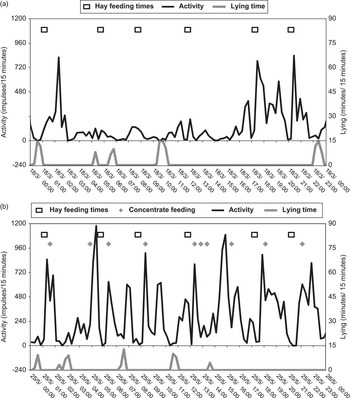
Figure 2a and b show the movement activity and lying time of one horse during the course of a day. During the first trial period without the CFS, this horse showed a high activity level after the first and the two last hay feedings of this day, with peaks between 750 and 850 impulses/15 min (Figure 2a). The video observation showed that the activity peaks were the result of the long distance (∼350 m) to the watering place. At these three times with the highest activity peaks, the observed horse went directly from the roughage feeding area to the watering place. In the second period, with additional feedings by the CFS (Figure 2b), the same horse showed more activity peaks over the day than in the first period; there were seven peaks with impulses between 750 and 1200/15 min at regular intervals over the entire day. It was striking to observe that a visit to the CFS followed shortly after each hay feeding.
(a) Activity and lying behavior of one representative horse over 1 day without concentrate feeding station (CFS). (b) Activity and lying behavior of one representative horse over 1 day with CFS (same horse as in Figure 2a).

Behavioral observations, rank index and weather conditions
Examination of the video recordings of the second trial period showed that after hay feeding the horses visited the CFS first and only then walked to the watering place. It was observed that the eight horses normally walked the path from the hay racks to the CFS together. However, during the remaining time of the day, the horses lingered near each other and used the same functional area of the stable. On the 12 days when the direct observations were conducted, the same order of horses was always recorded on their travels from the hay racks to the CFS. Consequently, the horses of the highest rank were the first to enter the CFS, and the low-ranking horses waited until it was their turn.
As a whole, the horses accepted the hay feeders immediately, and only a few needed help in adapting to the CFS. The lateral exit at the frontside caused problems because some of the horses preferred to exit the CFS backwards.
During the 12 direct observations of the horses at the hay dispensers, it was noted that low-ranking horses sometimes had to wait several minutes until they found a feeding place. During most of the observation time, however, all of the horses stood together in groups of two to three horses at each hay feeding station. In rare cases, one horse stood alone at one feeding station, whereas four horses gathered at another. During 28.8% of the observed feeding times, a single horse stood aside and did not receive hay. This result is reducible to two low-ranking horses.
The behavior of the horse flock was generally very peaceful in this management. The visual observations showed that during the entire observation period of nearly 7 h (12 periods of 33 min), a total of 126 aggressive forms of behavior were recorded near the hay feeders, for an average of 18 aggressive interactions per hour. Analysis of the data showed that 32% of the interactions (8/min) were observed during the first 5 min of feeding, 17% (4.4/min) were observed between 6 and 10 min and 51% (0.4/min) were observed in the last 23 min of feeding. Thus, the beginning of hay feeding and the determination of each feeding position caused the highest number of aggressive interactions between the horses. However, 121 (96%) of these aggressive interactions belonged to the category of ‘threats’, and only five interactions (4%) were ‘with physical contact’. Thus, as a whole, the level of aggression in this horse group was low.
The determination of rank index also showed that the oldest horse had the highest rank and the two youngest horses were ranked lowest. In addition, the comparison of the rank index and the lying time revealed that the higher the horse's rank, the longer its lying duration.
The daily recording of weather conditions showed relatively few differences in the trial periods. In the first period, the temperature was between −8°C and +8°C (mean: +3.1°C). It rained often, and there were fewer windy and sunny days. In the second period, the temperature was between +6°C and +18°C (mean: +12.0°C). Cloudy and sunny days alternated, and windy and rainy days were rare.
Body condition and weight
At the beginning of the investigations and at the end of the experimental phase, the horses were in good physical condition. One horse, which was ranked the lowest, was classified with a BCS of 2.5 (too thin). Six of the horses had a BCS of 3 (ideal for the Icelandic riding horse), and one horse scored slightly higher (BCS of 3.5). There was no change in BCS during the investigations.
The BWs of the experimental horses were determined with a measuring tape at the beginning and end of both trial periods (Table 3). A significant difference in BW was not observed in either the first period without CFS or the second trial period with CFS. The mean of the BWs showed a weight loss of 2.87 kg/horse in the first period and 11.00 kg/horse in the second period.
Weight of eight Icelandic horses at the beginning and end of a period without and with a CFS

CFS = concentrate feeding station; s.d. = standard deviation; s.e. = standard error of mean; min. = minimum; max. = maximum.
Discussion
The purpose of this investigation was to analyze the movement and lying behaviors, BCS and weight of Icelandic horses housed in an active stable system to determine the suitability of the stable system. The results of this study show that the activity and lying duration of Icelandic horses can be significantly increased by a CFS. Our results indicate no significant difference in BCS and BW of the horses, which remained at a very good level throughout the experiment.
Movement activity and lying behavior
ALT pedometers are a suitable method for determining the movement activity and lying time of horses because they do not disturb the animals’ behavior, and they collect information day and night (Brehme et al., Reference Brehme, Stollberg, Strickler, von Niederhäuser and Zurkinden2006; Hoffmann et al., Reference Hoffmann, Bockisch and Kreimeier2009). These advantages made it possible to compare the activity and lying data for the investigated horses in the periods with and without the CFS. Unfortunately, it is difficult to compare this activity with data from other measurement systems, such as global positioning system devices.
The investigation of Rose-Meierhöfer et al. (Reference Rose-Meierhöfer, Klaer, Ammon, Brunsch and Hoffmann2010a) regarding the activity of German horses in different open barn systems with equal ALT pedometers showed good agreement with the activity levels of Icelandic horses. The movement activity of the Icelandic horses in the active stable with the CFS (mean: 23 479 impulses/day per horse) was very similar to the results of German horses in an active stable, which was also equipped with automatic feeding stations for concentrate and hay and was divided into functional areas (155.32 impulses/10 min per horse, equal to 22 366 impulses/day per horse). Rose-Meierhöfer et al. (Reference Rose-Meierhöfer, Klaer, Ammon, Brunsch and Hoffmann2010a) also investigated a group of seven German horses in another active stable, in which the animals were also fed with automatic concentrate and hay feeding stations. Although the total area was larger and the number of horses was comparable to the Icelandic active stable, the German horses in the system with a CFS showed less movement activity (78.53 impulses/10 min per horse equal to 11 308 impulses/day per horse) than the Icelandic horses during the period without the CFS (15 957 impulses/day per horse). One possible reason for this difference could be the longer distance between the hay feeders and the watering place in the Icelandic stable (∼350 m) in comparison with the German stable, which had a distance of less than 40 m between the two functional elements. This result shows that the situation was already good in the first trial period in Iceland (without the CFS), and movement activity was further increased by using a CFS. Therefore, good planning and organization of a stable system has a significant influence on the movement activity of horses. These findings are in accordance with the work of Frentzen (Reference Frentzen1994), who demonstrated that in an open barn with an adjacent outdoor enclosure, functional areas help to increase activity, and feeding frequency, in combination with a longer distance between functional elements, has a significant influence on the horses’ movement activity. In contrast, Benhajali et al. (Reference Benhajali, Richard-Yris, Ezzaouia, Charfi and Hausberger2009) reported that horses with hay availability spend less time in locomotion than horses with no hay provision in a bare paddock. The experimental design seems to be responsible for this effect because the horses in their study received the complete hay ration at one place and time, and each horse had its own hay net.
The duration of the lying time was similar between the Icelandic horses in this study (average 99.7 min/day, which is 6.9% of the day) and the time budgets of adult (>3 years) Camargue horses. Duncan (Reference Duncan1980) observed a herd of free-living Camargue horses and found that adult male horses spent an average of 8.56% (autumn and winter 1975) and 5.90% (winter 1976) of the day lying (sum of lying up and flat). Furthermore, the average lying time of the Icelandic horses in an active stable was comparable to the lying time of horses studied by Fader and Sambraus (Reference Fader and Sambraus2004). The horses in their study were between 2 and 26 years old, were stabled in loose housing systems, and had a mean lying time of 89.5 min/day, with a range from 59.1 to 134.1 min/day. Apparently, the active stable and the use of the CFS had a significant influence on the individual lying behavior of the Icelandic horses because the lying time in our study ranged from 0.0 to 337.0 min/horse per day.
As a whole, the present investigation showed an increase of both mean activity and lying time/day per horse in the trial period with CFS. This result is comparable to our own experiments with ALT pedometers. A comparison of small and large group sizes also showed that horses with higher activity values had longer lying durations (Rose-Meierhöfer et al., Reference Rose-Meierhöfer, Standke and Hoffmann2010b). This finding is confirmed by investigations of various degrees of movement for horses (Hoffmann, Reference Hoffmann2008), which show that an increase of movement activity leads to a decrease of horses’ stress loads. Thus, the longer lying times of the Icelandic horses in the second trial period could be the result of a low stress load and greater well-being. Furthermore, Caanitz et al. (Reference Caanitz, O'Leary, Houpt, Petersson and Hintz1991) showed that exercised horses spend more time lying than non-exercised horses. Thus, an increase of lying duration could also be an effect of greater physical exertion for the Icelandic horses as a result of the increased movement activity.
Behavioral observations and rank index
Another method used in this project was behavioral observation. The use of video cameras is a suitable and accepted method for analyzing the behavior of horses without disturbing them (Mills and Nankervis, Reference Mills and Nankervis1999). However, one disadvantage was the lack of sound recording. Therefore, the observation of social and aggressive behavior during the hay feedings took place through a direct observation of the horses.
The observation of social interactions between horses in the present investigation showed an average of 18 aggressive interactions per hour. This number seems high, but it must be recognized that the observations took place during the hay feeding times of the eight horses. The analysis of these interactions showed that most were observed during the beginning of the hay feeding, when the horses determined their positions at one of the three hay feeders. A previous study by Holmes et al. (Reference Holmes, Song and Price1987) showed that head partitions (wire mesh and plywood partitions) on a trough facilitated the feeding of pellets by subordinate horses in the presence of dominant pen-mates. Therefore, a barrier at head height between the feeding places might be helpful for the lower-ranked horses, and an improvement of the used hay feeders might help to reduce aggressive interactions between the horses.
A comparison with the results of Jørgensen et al. (Reference Jørgensen, Borsheim, Mejdell, Søndergaard and Bøe2009) showed that the proportion of aggressive interactions was similar to our observations. In their investigation of a mixed gender group, threats represented 87% of the total aggressive interactions, and 13% of the aggressive interactions included physical contact. In contrast, the aggressive level in our study group was lower: 96% of aggressive interactions were threats, and only 4% were interactions with physical contact. Rose-Meierhöfer et al. (Reference Rose-Meierhöfer, Standke and Hoffmann2010b) also investigated the social behavior of horses. They reported a higher aggressive level (69% threats and 31% attacks) in small groups of 8 and 11 horses, but they included only young horses at ages of 1 to 2 years in their investigation. Thus, the composition of their groups explains the deviation from the other results. Bourjade et al. (Reference Bourjade, Moulinot, Henry, Richard-Yris and Hausberger2008) also observed high frequencies of agonistic interactions in groups of young horses of the same age. After the introduction of adults, the agonistic interactions decreased, and positive social behavior increased.
The recording of aggressive interactions between the horses was also used to determine the social hierarchy in the horse herd. Thus, a relationship between rank position and age as well as lying duration was identified. Vervaecke et al. (Reference Vervaecke, Stevens, Vandemoortele, Sigurjónsdóttir and De Vries2007) studied groups of young Icelandic horses and found that high-ranking males were older, which is in accordance with our findings. Furthermore, our finding that horses of a higher rank rest longer in lying positions than low-ranked horses is also in agreement with common results (Zeitler-Feicht and Prantner, Reference Zeitler-Feicht and Prantner2000; Fader and Sambraus, Reference Fader and Sambraus2004). However, this result also shows the importance of examining individual means rather than only group means. Some horses in the trial period with the CFS exhibited lying durations of 0 min/day, and some horses did not eat during hay feeding times. It is possible that group housing may be detrimental to some horses, especially if they do not receive sufficient resting time or feed. The consideration of individual horses has been described in previous investigations, which showed that 30% of the studied horses had a lower stress load in a single housing system than in a group housing system; these horses were either low-ranked horses or the highest-ranked horses (Hoffmann et al., Reference Hoffmann, Bockisch and Kreimeier2009).
Body condition and weight
The BCS and BW seemed to be positively correlated with the level of social rank, as previously shown for cows (Soltysiak and Nogalski, Reference Soltysiak and Nogalski2010) and for the body condition of 1-year-old female Icelandic horses (Vervaecke et al., Reference Vervaecke, Stevens, Vandemoortele, Sigurjónsdóttir and De Vries2007).
Ingólfsdóttir and Sigurjónsdóttir's (Reference Ingólfsdóttir and Sigurjónsdóttir2008) study of Icelandic horses on pastures in wintertime found that higher-ranking horses had better access to provided hay than lower-ranking horses. Thus, the dominant individuals gained weight in the winter period, and the subordinates lost weight. This finding was not observed in the present study. Apparently, all horses had sufficient time for feed intake and received the correct amount of concentrated feed. There was no change of BCS or a significant decrease in BW during the investigations. Therefore, no negative effect of the active stable system on the body condition of the Icelandic horses was verifiable during the analyzed time span. A longer trial period would be necessary to demonstrate the impact of an active stable system on the BW and condition of Icelandic horses.
Finally, we note that the behaviors of the Icelandic horses were comparable to those of warm-blooded horses in analogous housing systems. However, we also observed behavior patterns, such as herd synchronization, that are known among free-ranging horses.
Conclusions
The present study demonstrates that an active stable system is suitable for horses in Iceland. The horses in this study quickly become accustomed to the system. Only the lateral exit at the frontside could be improved and adapted for Icelandic horses because some of the horses preferred to exit the CFS backwards. Furthermore, the technology has no problems in the Icelandic climate and weather conditions.
The housing system meets all of the needs of the horses, and behavioral analyses show that group housing in an active stable is a near-natural option for keeping horses under human care. The lying duration was also similar to that of wild-living horses. Overall, the active stable system is a good alternative to individual boxes, especially for housing horses in Iceland during winter. However, it is also important to consider each individual animal to ensure that all horses receive sufficient resting time and feed, particularly with regard to low-ranked horses.
In this study, the long path between the hay feeders and the watering place was responsible for the comparatively high activity level. The application of a CFS in the second part of the study provided an additional increase of movement activity. Thus, the distance between the functional elements for ‘feeding’ and ‘drinking’ should be as long as possible in movement stables to motivate the horses to walk. The application of feeding in many small portions further enhances the horses’ activity.
The design of the roughage station itself might be improved if the single feeding places were separated with a view protector, for example, to reduce aggressive interactions between the horses. However, in contrast to a CFS or hay feeders for only one horse, the hay feeders (three places side by side per station) have the advantage of allowing horses to feed simultaneously, as they do in nature.
A firm social hierarchy between all horses is important to maintain a low level of aggression. Rank position also has an impact on the lying duration of the horse. Overall, sufficient available space for lying and movement is important in all group housing systems because it allows lower-ranked horses to rest without disturbance and to evade other herd members in critical situations.
Acknowledgments
The authors thank the Ölvisholt horse farm for the care and management of the horses and for their cooperation during the trial periods. Many thanks also go to the Faculty of Land and Animal Resources of the Agricultural University of Iceland for their video equipment and assistance.