Introduction
The genus Rhynchotechum Blume (Gesneriaceae) comprises a group of understorey subshrubs with a range that stretches from India to China, north to the Ryukyus in Japan, south through the Philippines and the Malay Peninsula to Sumatra and east to Papua New Guinea. The plants have relatively small flowers in cymose inflorescences and the fruits are white berries. They have little economic importance but some use by indigenous peoples. Their small flowers and variable leaves make the species difficult to distinguish. The last descriptive taxonomic work on the entire genus was by Clarke in 1883, although there have been a number of more recent regional accounts (Schlechter, Reference Schlechter1923; Hatusima, Reference Hatusima1971; Chun, Reference Chun1974; Walker, Reference Walker1976; Kao & De Vol, Reference Kao, De Vol and Li1978; Theobald & Grupe, Reference Theobald, Grupe, Dassanayake and Fosberg1981; Wang, Reference Wang1984; Li & Kao, Reference Li, Kao and Huang1998; Wang et al., Reference Wang, Pan, Li, Weitzman, Skog, Wu and Raven1998; Wang & Wang, Reference Wang and Wang2000; Burtt, Reference Burtt2001; Hilliard, Reference Hilliard, Grierson and Long2001).
The genus was erected in 1826 by Blume and included in the Cyrtandreae, a section of Bignoniaceae. It was distinguished from Cyrtandra J.R.Forst. & G.Forst. by its four fertile stamens with unilocular anthers and its globose fruit. It was similarly distinguished as part of Brown’s (Reference Brown and Brown1840) Gesneriaceae in tribe Cyrtandreae and was placed close to Cyrtandra in Gesneriaceae by Don (Reference Don1838) and Endlicher (Reference Endlicher1839, ‘Rhynchothecum’). Bentham (Reference Bentham, Bentham and Hooker1876) placed Rhynchotechum in tribe (or subfamily) Cyrtandreae close to Isanthera, which had been described by Nees in 1834. Bentham differentiated between them by whether the leaves were opposite (Rhynchotechum) or alternate (Isanthera), but Clarke (Reference Clarke and Hooker1884) noted that Rhynchotechum could also have alternate leaves and remained doubtful about whether Isanthera should be kept distinct, stating it differed in a shorter style and marginal anther dehiscence. In 1962, Burtt united Isanthera and Rhynchotechum based on his observations that the anthers of Isanthera discolor Maxim. had similar valve-like dehiscence as in Rhynchotechum and that Nees’ (1834) description was ambiguous about whether the anther dehiscence was longitudinal or medial. He was unable to find anthers of Isanthera permollis Nees (the type species), but Theobald & Grupe (Reference Theobald, Grupe, Dassanayake and Fosberg1981) later verified that wild Rhynchotechum permolle (Nees) B.L.Burtt specimens show the same kind of anther dehiscence as other Rhynchotechum species, a conclusion with which we concur.
Classifications up to and including Burtt & Wiehler (Reference Burtt and Wiehler1995) tended to place Rhynchotechum near Cyrtandra, which also has indehiscent fruit, but there were indications that the two genera are not closely related. Ivanina (Reference Ivanina1965) considered Rhynchotechum distinct enough, based on fruit and seed characters, to merit tribal status. Ratter (Reference Ratter1962) identified a diploid chromosome number for Rhynchotechum discolor (Maxim.) B.L.Burtt as 2n = 20 but for a Cyrtandra sp. he found 2n = 34. Kiehn & Weber (Reference Kiehn and Weber1997) had a count of 2n = 18–20 for Rhynchotechum parviflorum Blume and x = 17 for Cyrtandra species, and they mentioned that Burtt had doubts about the placement of Rhynchotechum within tribe Cyrtandreae. Later chromosome counts (Wang & Wang, Reference Wang and Wang2000) corroborate 2n = 20 for Rhynchotechum discolor as well as for R. brevipedunculatum J.C.Wang and R. formosanum Hatus.
In 2009, Möller et al. used trnL-F, atpB-rbcL and ITS sequences to construct a phylogeny of some Old World Gesneriaceae and found that Rhynchotechum was in a more basal position relative to most asiatic Gesneriaceae and was distant from Cyrtandra. They concluded that the tribe Cyrtandreae had no basis and that the morphological similarity, indehiscent fruit, was homoplastic. In the analysis, Rhynchotechum grouped monophyletically with Boeica T.Anderson ex C.B.Clarke, Platystemma Wall. and Leptoboea Benth. (Möller et al., Reference Möller, Pfosser, Jang, Mayer, Clark and Hollingsworth2009), all of which have dehiscent fruits. A similar phylogeny was generated by Wei et al. (Reference Wei, Wen, Chen, Shui and Möller2010) based on trnL-F and ITS, and it supported Boeica as the closest genus to Rhynchotechum.
This revision aims to clarify the species delimitations within Rhynchotechum.
Methods
This revision is based on a traditional taxonomic approach through the adoption of a morphological species concept. Species are differentiated by differences in multiple characters derived from observations on and measurements of herbarium specimens. Floral measurements are based on rehydrated flowers. The herbarium material studied included the collections at A, AAU, ABD, B, BM, BR (images only), CMU, CMU-Pharmacy, E, GH, GXMI (images only), IBSC (image only), K, K-W, KYO, L, MICH, NY, PE (images only), QBG, S, SING, UC, US and W (images only), totalling c.1000 specimens (herbarium abbreviations from Thiers, Reference Thiers2012).
Measurements were taken to the nearest 1/4 of a millimetre but it should be noted that flowering material for most species is rather scarce. The botanical terminology used is primarily based on Radford et al. (Reference Radford, Dickison, Massey and Bell1976), with the descriptor ‘narrowly obovate’ used in lieu of ‘oblanceolate’ for clarity.
All specimens have been seen except where indicated by ‘n.v.’ for non vidi. Flowering and fruiting times are based on the specimens seen, so the time spans may be underestimated. Flowering was recorded even if there were buds or small ovaries without corollas, while fruiting was recorded even with immature fruits. Often specimens had inflorescences at both stages and so were recorded as both flowering and fruiting. Geographic distribution mapping requires latitude and longitude (either recorded on the specimen or georeferenced using NGA (2011) and rarely Rios & Bart (Reference Rios and Bart2010)), which was not available for all specimens, so points represent specimens with data and do not show the entire range.
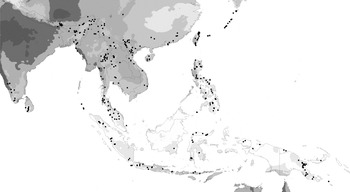
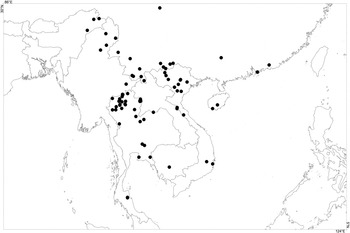
The climate-distribution maps were generated with the programme Diva-GIS. Climatic data were acquired through WorldClim (Hijmans et al., Reference Hijmans, Cameron, Parra, Jones and Jarvis2005b). Precipitation data comes from reasonable weather station coverage in Southeast Asia, with perhaps less dense coverage over Burma, Borneo and Indonesian New Guinea (Hijmans et al., Reference Hijmans, Cameron, Parra, Jones and Jarvis2005a; Fig. 1).
Distribution of Rhynchotechum Blume and precipitation seasonality (coefficient of variation, or standard deviation of weekly precipitation estimates as a percentage of the annual mean; Hutchinson, Reference Hutchinson2011). Darker areas have more seasonal precipitation, while lighter areas tend to be consistently wet year round. Bioclim15 data from WorldClim (www.worldclim.org).

Phytogeography, Biology and Uses
Further expeditions and specimen collection are needed from certain areas to accurately assess species’ distributions, particularly from Burma, Northeast India, Laos, Cambodia, Vietnam, Kalimantan, Sumatra, Sulawesi and Indonesian New Guinea. Based on the many collections we do have, however, the plants are most often found growing in shady, moist environments, typically in forests, between 0 and 2120 m. The centre of diversity for the genus appears to be in continental Southeast Asia, particularly northern Thailand, Burma, southern China and India. A few of the species have notable distributions. Rhynchotechum discolor has a large range from the Ryukyu Islands of Japan in the north down to Papua New Guinea and Flores in the south, but does not seem to occur in continental Southeast Asia or western Malesia. Rhynchotechum parviflorum has an even larger range stretching from the Nicobar Islands of India in the west, north into China and east to Papua New Guinea. It seems likely that these species have excelled at colonising new islands relative to other members of the genus, but how they accomplished this is unknown.
Rhynchotechum vestitum (Griff.) Wall. ex C.B.Clarke has a disjunct distribution in continental Asia and in Sumatra and Java. Likewise Rhynchotechum formosanum is found in Taiwan, China and Vietnam and then in Sumatra. These ranges could indicate occurrences of long-distance dispersal or the breakdown of previously more continuous distributions. The former explanation is more likely since the species inhabit similar ecological niches and there is a continuous distribution for other species in the genus across these areas.
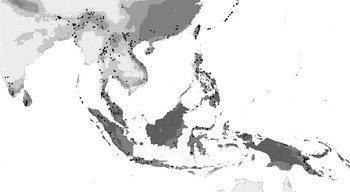
In general, the species tend to occur in more seasonal areas (Fig. 1), though there are a few exceptions. In addition the precipitation in the driest quarter would also appear to influence the distribution of species in the genus (Fig. 2). In general, Rhynchotechum species are mostly found in areas with a definite dry season but would appear to require a minimum amount of rainfall in the driest three months of the year.
Distribution of Rhynchotechum Blume and precipitation in the driest quarter (in mm). Darker areas have more precipitation in their driest three months (in steps of 0–25 mm, 26–50 mm, 51–100 mm, 101–400 mm, 401–2000 mm). Bioclim17 data from WorldClim (www.worldclim.org).

It is not known what pollinates the flowers or disperses the fruits. The small flowers may indicate insect pollination, while the white berries could be bird dispersed. Möller et al. (Reference Möller, Pfosser, Jang, Mayer, Clark and Hollingsworth2009) suggest that the fleshy fruits are bird dispersed, likening them to the fruits of Cyrtandra which Cronk et al. (Reference Cronk, Kiehn, Wagner and Smith2005) suggest may well be bird dispersed. Theobald & Grupe (Reference Theobald, Grupe, Dassanayake and Fosberg1981) did not observe pollinators for Rhynchotechum permolle and commented that the inflorescences are not very noticeable. Burtt (Reference Burtt1962) suggested that Rhynchotechum discolor is self-fertile which, if confirmed, could make seed set high and improve colonisation and potentially explain why R. discolor is so widespread. It would be interesting to know whether Rhynchotechum parviflorum is also self-fertile.
A few Rhynchotechum species are used by indigenous peoples for food, medicine, smoking and fibre. In Bangladesh, the flowers and leaves of Rhynchotechum ellipticum (Wall. ex D.Dietr.) A.DC. are used as food and medicine, but deforestation is a threat to the species there (Uddin, Reference Uddin, Ahmed, Hassan, Begum, Khondker, Kabir and Ahmad2009). In Northeast India, Rhynchotechum ellipticum and R. vestitum leaves are eaten as a vegetable (Jain & Borthakur, Reference Jain and Borthakur1980; Neogi et al., Reference Neogi, Prasad and Rao1989; Kayang, Reference Kayang2007). Hilliard (Reference Hilliard, Grierson and Long2001) stated that Rhynchotechum ellipticum is used for fodder. According to notes on the specimen Anderson 5334 (A) from Thailand, Rhynchotechum obovatum (Griff.) B.L.Burtt leaves are smoked as a substitute for tobacco and the plant may be used to supply fibre for cording. According to Lu et al. (Reference Lu, Xu, Chen and Liu1998b), Rhynchotechum vestitum is used in Yunnan, China as a folk medicine treatment for hepatitis A and B. Lu et al. (Reference Lu, Xu, Chen and Liu1998b) cited clinical observations of the plant’s effectiveness at reducing levels of serum glutamic-pyruvic transaminase and serum bilirubin. Liu et al. (Reference Liu, Chen, Yao and Ding1990) discovered a new anthraquinone from Rhynchotechum vestitum which they called rhynchotechol. Investigations have since been conducted in a search for the active compound, revealing new chemicals (Lu et al., Reference Lu, Xu, Chen and Liu1998a, Reference Lu, Xu, Chen and Liu1998b).
Characters
Characters used were those observable with a dissecting microscope and measurable with a ruler. Anatomical, palynological and cytological features, such as cell thickness, pollen coat type and chromosome number, have not been investigated in this study. Vegetative characters were included but the majority of characters are based on the inflorescence and flower.
Stem height often overlaps between species, though it is useful for reinforcing identifications, such as with Rhynchotechum formosanum, which is fairly diminutive. Stem thickness does not vary considerably between species although on herbarium material the full range may not have been observed.
Leaf phyllotaxis is a useful character for distinguishing species in certain areas, such as in Taiwan, where opposite-leaved Rhynchotechum formosanum and alternate-leaved R. discolor occur, both of which can be small plants and have small leaves. The character must be used with care, however, since species such as Rhynchotechum obovatum and R. alternifolium C.B.Clarke show both types of phyllotaxis in some specimens. Though most Rhynchotechum obovatum specimens have opposite leaves, the lower leaves may sometimes be alternate, and though R. alternifolium has alternate leaves, the upper pairs may be sub-opposite. Leaf shape and size can be somewhat diagnostic, but in more widespread species they vary and can even vary on a single plant along the stem. Leaf margin is not a useful character, though one species has a few specimens with atypical dentation (see discussion under Rhynchotechum discolor). Secondary vein pairs can be highly variable for some species and more consistent for others, so this is not particularly useful beyond reinforcing an identification.
Indumentum on stems and leaves is rarely a useful character, as most species have sub-glabrous to short, white pubescent adaxial leaf surfaces and yellow-rusty woolly abaxial leaf surfaces. One exception is Rhynchotechum vestitum, which is noticeably hispid over the entire plant. Inflorescence and calyx indumentum are useful, however, as seen in the scabrous inflorescence of Rhynchotechum ellipticum, or in the glandular hairs on inflorescence axes in R. formosanum.
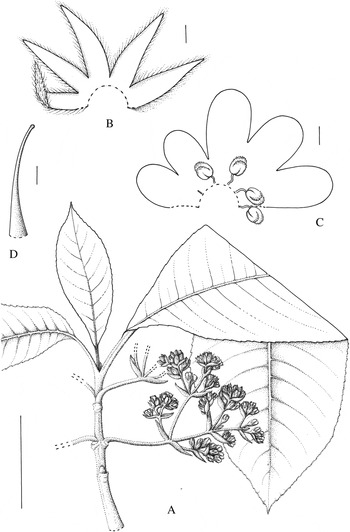
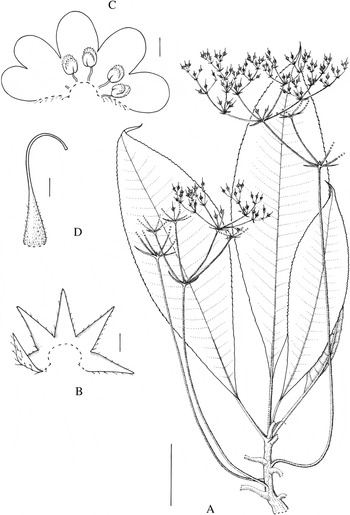
Inflorescence structure and, to a lesser degree, size are very useful in the delimitation of taxa. There are two types of inflorescence: (i) pedunculate (see for example Fig. 4) and (ii) sub-fascicled (reduced/absent peduncle) (see for example Fig. 10). Pedunculate inflorescences tend to occur in the axils of persistent leaves, while sub-fascicled inflorescences are often found in the axils of deciduous leaves, thereby appearing to be on a bare stem. The degree of branching can be somewhat informative, for example when comparing Rhynchotechum formosanum with R. obovatum, the former having relatively few-branched inflorescences compared to the latter. It is not definitive, however, since sometimes material is broken or inflorescences are underdeveloped. Inflorescence branch lengths are rarely useful, though they are helpful when identifying Rhynchotechum hookeri (C.B.Clarke) B.M.Anderson. Inflorescence bracts are likewise not very helpful, except in the case of identifying Rhynchotechum burmanicum B.M.Anderson.
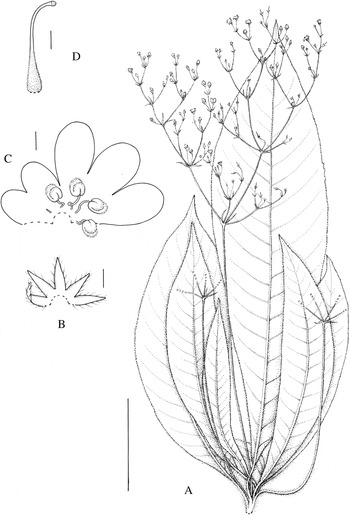
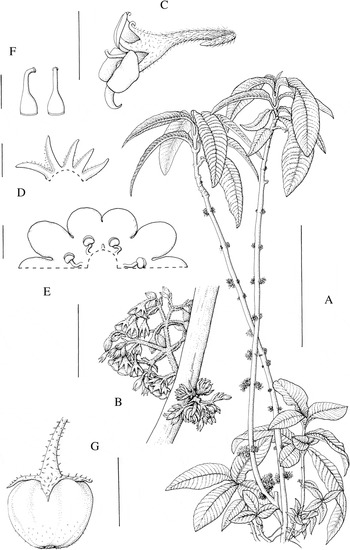
Rhynchotechum burmanicum B.M.Anderson. A, habit; B, calyx opened out; C, corolla dissection showing the two smaller lobes of the upper lip, the three larger lobes of the lower lip and the two stamens; D, pistil. Scale bars: A = 5 cm, B–D = 1 mm. From Kingdon-Ward 21177 (BM, E). Drawn by Claire Banks.

Calyx size and shape can be useful to distinguish species such as Rhynchotechum calycinum C.B.Clarke, R. alternifolium and R. discolor. Calyx indumentum, as mentioned above, can be very useful but should be used with care as exceptions may occur.
Corolla colour is not particularly diagnostic but can be helpful for reinforcing identifications based on other characters. Corolla shape and size are not particularly diagnostic for taxa except for reinforcing identifications or in delimiting particularly distinct species (e.g. Rhynchotechum parviflorum vs. R. discolor). As the corolla tube is short in all species, corolla lip lengths used in this revision include the tube length.
Stamens are distinctive in this genus although there is not much variation between species except, for some species, in anther indumentum.
Ovary size is also not very variable although the indumentum can be useful in some cases. Style length is a very useful character, especially since it is often retained in fruit and can differentiate some species, such as Rhynchotechum obovatum and R. formosanum. Stigma shape is fairly consistent across the genus.
Immature fruit shape may be useful in the recognition of some taxa (such as in the elongate ovoid fruit of Rhynchotechum discolor). Mature fruits may become more uniformly globose, as Burtt (Reference Burtt1962) notes when discussing the fruits of Rhynchotechum discolor. Seed characters are not useful in the delimitation of species since the seeds are irregularly ellipsoid with dimples or grooves on their surfaces in all species. Wang & Wang (Reference Wang and Wang2000) looked at seed coat ornamentation in three species in Taiwan and found few differences between them.
Taxonomic Account
Rhynchotechum Blume, Bijdr. Fl. Ned. Ind. 775 (1826); G.Don, Gen. Hist. 663 (1838); Endl., Gen. Pl. 719 (1839); Brown in Bennett, Pl. Jav. Rar. 122 (1840); DC., Prodr. 9: 285 (1845); Miquel, Fl. Ned. Ind. 2: 749 (1858); Benth. in Benth. & Hook.f., Gen. Pl. 2: 1016 (1876); C.B.Clarke in A.DC. & C.DC., Monogr. Phan. 5(1): 194 (1883); C.B.Clarke in Hook.f., Fl. Brit. India 4: 372 (1884); Fritsch in Engl. & Prantl, Nat. Pflanzenfam. 4(3b): 159 (1894); B.L.Burtt, Notes Roy. Bot. Gard. Edinburgh 24: 36 (1962). – Type: Rhynchotechum parviflorum Blume.
Isanthera Nees, Trans. Linn. Soc. London 17: 82 (1834); Endl., Gen. Pl. 668 (1839); DC., Prodr. 9: 279 (1845); Benth. in Benth. & Hook.f., Gen. Pl. 2: 1016 (1876); C.B.Clarke in A.DC. & C.DC., Monogr. Phan. 5(1): 191 (1883); C.B.Clarke in Hook.f., Fl. Brit. India 4: 372 (1884); Fritsch in Engl. & Prantl, Nat. Pflanzenfam. 4(3b): 159 (1894). – Type: Isanthera permollis Nees.
Corysanthera Wall. ex Endl., Gen. Pl. 719 (1839); L.E.Skog, Baileya 20: 1 (1976). – Type: Corysanthera elliptica Wall. ex D.Dietr.
[Cheilosandra Griff. ex Lindl., Veg. Kingd. 672 (1846) nom. nud. pro syn.; Benth. in Benth. & Hook.f., Gen. Pl. 2: 1025 (1876).]
Chiliandra Griff., Not. Pl. Asiat. 4: 150 (1854); Benth. in Benth. & Hook.f., Gen. Pl. 2: 1025 (1876). – Type: Chiliandra obovata Griff.
Subshrubs to 300 cm tall, erect or decumbent, typically unbranched. Leaves alternate, opposite or whorled, petiolate. Young leaves and stem apices often densely hairy, the hairs becoming less dense with age. Inflorescences compound cymes, pedunculate from the axils of leaves or leaf scars or with the peduncle reduced and the inflorescence branches appearing fascicled; bracts linear to triangular at branch points and below some pedicels. Flowers perfect, sub-regular, white to pink-purple or maroon. Calyx 5-lobed, divided to near the base, persistent and surrounding the fruit. Corolla short tubular and two-lipped, the upper lip of two lobes, the lower of three; the upper lip typically smaller and often with some colouration towards the base. Stamens four fertile plus one staminode, attached near the base of the corolla tube, the filaments twisted, the anthers globose with pollen sacs confluent and opening by a longitudinal slit with a valve-like dehiscence. Ovary of two carpels, unilocular; placentation parietal, the placentae nearly touching to make the ovary bilocular; style single, persistent in fruit, though may be broken off; disc small, surrounding the ovary at the base. Fruit fleshy and indehiscent, green when immature becoming white at maturity, rarely brown. Seeds numerous, very small, irregular ellipsoid, dimpled or grooved.
Sixteen species in India and Sri Lanka, east through Bangladesh and Burma into China and Taiwan, south through Vietnam, Laos, Cambodia and Thailand into Sumatra, east through Java, Borneo and Sulawesi to New Guinea, and north through the Philippines to Japan. Typically growing in primary and secondary forests, sometimes disturbed, in shady and moist conditions, in clayey to sandy soils on granite or limestone bedrock, often on steep slopes.
The genus can be recognised by its four stamens with anthers having confluent pollen sacs that dehisce by a valve on the inner face, and by its often white, fleshy, indehiscent fruits that tend to be globose. The flowers are often sub-regular and have short corolla tubes. Though there is some slight anisophylly, it does not make opposite-leaved species appear alternate-leaved.
Key to the species
1a. Inflorescence with a reduced/absent peduncle so that the branches appear fascicled from leaf axils; leaves opposite 2
1b. Inflorescence often with solitary peduncles from leaf axils (rarely another peduncle above the first), sometimes with a reduced peduncle but then the inflorescence unbranched; leaves opposite or alternate 6
2a. Plant hispid, the hairs stiff (1–3 mm long); calyx lobes distinctly caudate (the upper 1/3 to 1/2 of the length)15. R. vestitum
2b. Young parts of plant woolly pubescent to sub-glabrous, not hispid (hairs typically < 2 mm long, not stiff); calyx lobes triangular to linear acuminate, only rarely somewhat caudate 3
3a. Style (5.5–)6–7(–7.5) mm long; pedicels and calyx lobes often scabrous, the hairs conspicuously multicellular; ovary glabrous 6. R. ellipticum
3b. Style < 5 mm long; pedicels and calyx lobes sericeous or sub-glabrous; ovary glabrous to short pubescent 4
4a. Calyx lobes 5–6(–9) mm long, glabrous; corolla upper and lower lips ≥ 6 mm long, tube to 4.5(5–8) mm long 4. R. calycinum
4b. Calyx lobes < 4.5 mm long, glabrous to sericeous/villous; corolla upper and lower lips < 5 mm long, tube < 3 mm long 5
5a. Inflorescence ≤ 3 cm long, branches ≤ 0.5 cm long, pedicels sub-glabrous to sparsely sericeous and making up most of the inflorescence length; ovary glabrous to slightly puberulent; style 3.5–4 mm long 10. R. hookeri
5b. Inflorescence (0.9–)1.3–6(–9) mm long, branches 0.3–3.2(–4) mm long, pedicels sericeous/villous and often shorter than the inflorescence branches; ovary puberulent to short pubescent; style 1.5–3.25(–4) mm long 13. R. parviflorum
6a. Leaves and peduncles opposite or whorled 7
6b. Leaves and peduncles alternate 11
7a. Calyx lobes oblong to somewhat ovate/elliptic, glabrous to sparsely sericeous; leaf apices caudate, leaves abaxially sub-glabrous between the veins 1. R. alternifolium
7b. Calyx lobes triangular, hirsute to sericeous or rarely glabrous, or calyx lobes linear, densely villous; leaf apices acuminate to acute, leaves abaxially woolly between the veins 8
8a. Style ≤ 3.5 mm long; anthers glabrous 9
8b. Style ≥ 3.5 mm long (usually ≥ 4 mm long); anthers puberulent with glandular hairs 10
9a. Leaves elliptic to obovate, to 8.5(10.2) cm wide; calyx lobes 2–4 mm long; peduncle 0.6–4.5 cm long 8. R. formosanum
9b. Leaves oblong, to 5.8 cm wide; calyx lobes 4.5–5.2 mm long; peduncle 3.5–6.5 cm long 11. R. longipes
10a. Inflorescence bracts broad, oblong to ovate, first bract 10–17 mm long, second bract 7.5–13 mm long; style 4–4.5 mm long; pedicels and calyx lobes hirsute 3. R. burmanicum
10b. Inflorescence bracts linear acuminate to slightly triangular, first bract 5–12 mm long, second bract 3–10 mm long; style (3.5–)5–6 mm long; pedicels and calyx lobes sericeous/villous to densely so, rarely glabrous 12. R. obovatum
11a. Peduncle to > 10 cm long, or if less than 10 cm long, then calyx lobes oblong to somewhat ovate/elliptic, glabrous to sparsely sericeous, < 3.5 mm long 12
11b. Peduncle to 6.8(7.5) cm long; calyx lobes linear to triangular, sericeous to densely so, rarely sub-glabrous, (2–)3–7.5(–12) mm long 14
12a. Inflorescence > 30 cm long; calyx lobes sericeous and/or scabrous with glandular hairs, the hairs conspicuously multicellular 16. R. vietnamense
12b. Inflorescence ≤ 25 cm long; calyx lobes sub-glabrous to sparsely sericeous 13
13a. Calyx lobes 1–1.5 mm long; style 2.5–4 mm long; leaves abaxially woolly between the veins 9. R. gracile
13b. Calyx lobes 2.5–3(–3.5) mm long; style 5–7 mm long; leaves abaxially sub-glabrous between the veins 1. R. alternifolium
14a. Style (3.5–)5–6 mm long; upper corolla lip with a brownish red to dark purple colouration at the base 12. R. obovatum
14b. Style < 3 mm long; upper corolla lip white 15
15a. Calyx lobes triangular, (2–)3–5(–5.5) mm long; leaf secondary vein pairs 9–22(–25); Sri Lanka, S India, Burma, Sumatra and Java 16
15b. Calyx lobes linear, (3–)4–8(–12) mm long; leaf secondary vein pairs 5–14; Japan, S China, Taiwan, the Philippines, Flores, New Guinea 17
16a. Inflorescence 1.5–4.5(–5.5) cm long; fruit (dry) 3–9 mm long, puberulent; Sri Lanka, S India and Burma 14. R. permolle
16b. Inflorescence 4–12(–14) cm long; fruit (dry) 2.5–4.5 mm long, glabrous, rarely slightly puberulent; Sumatra and Java 7. R. eximium
17a. Peduncle < 0.5 cm long; inflorescence unbranched; stems 2–15 cm tall; calyx lobes 6–8(–12) mm long 2. R. brevipedunculatum
17b. Peduncle (0.5–)1.1–6(–6.7) cm long; inflorescence 2–3(–4)-branched; stems 2–60(–150) cm tall; calyx lobes (3–)4–7.5(–9) mm long 5. R. discolor
1. Rhynchotechum alternifolium C.B.Clarke in A.DC. & C.DC., Monogr. Phan. 5(1): 198 (1883); C.B.Clarke in Hook.f., Fl. Brit. India 4: 374 (1884). – Type: India, Upper Assam, by lake Brahmakoondo [Brahmakund], Griffith 3850 (lecto K (as s.n.), designated here; iso W [barcode: 0040706]).Fig. 3.
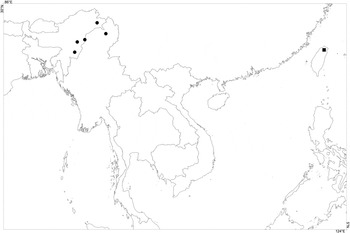
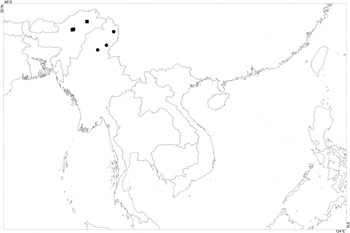
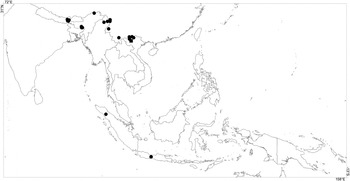
Fig. 3.Distribution map of Rhynchotechum alternifolium C.B.Clarke (•) and Rhynchotechum brevipedunculatum J.C.Wang (▪).


Stems 90–200 cm tall, to 5–7 mm diameter. Leaves alternate to sub-opposite; petiole 2–7 cm long; blade narrowly obovate, 5.8–24(–32.3) × (2.2–)4–9.7 cm, 2.3–3.3 times as long as wide, apex caudate, base narrowly cuneate to cuneate; margin denticulate to sub-entire, the teeth to 0.75 mm long; secondary vein pairs 11–16(–18); adaxially dark green, glabrous to rarely white pubescent; abaxially pale green, short rusty woolly on the rusty veins, sub-glabrous in-between. Inflorescence (3–)5–20 cm long, (2–)4–5-branched; peduncle (1.2–)2.5–11.5 cm long; first branch (0.7–)1.2–4.3 cm long; second branch 0.5–1.9(–2.9) cm long; axes short rusty-yellow villous/sericeous to sub-glabrous; bracts linear to triangular, first bract (4.5–)7–11(–14) mm long, second bract 4.5–9(–11) mm long; pedicels (2–)4–10(–13) mm long, rusty-yellow sericeous to densely so. Calyx lobes oblong to somewhat ovate/elliptic, 2.5–3(–3.5) × 1–1.75(–2) mm, glabrous to sparsely sericeous. Corolla white, exterior glabrous; upper lip with darker patch, 3–3.5 × 5 mm; upper lobes 2 × 1.75–2.5 mm, apices obtuse; lower lip 4.5–5 × 7 mm; lower lobes 2.25–2.5 × 2–2.5 mm, apices rounded to obtuse; tube 1.5 mm long. Stamens inserted near the base of the corolla tube; filaments c.1 mm long; anthers c.1.25 mm diameter, bumpy or puberulent; staminode c.0.25 mm long. Ovary 1 × 1.25 mm, slightly puberulent; style 5–7 mm long; stigma apex globose/rounded to truncate. Fruit (dry) ovoid to widely ovoid, 2.5–5 × 2.5–4.5 mm, glabrous.
Distribution. India and Burma.
Habitat and ecology. Growing in evergreen and mixed forests, with an altitude recorded only once at 1520 m. Flowering and fruiting February, August and November.
Proposed IUCN conservation assessment. Data Deficient (DD). Although there are several collections of this species the most recent is from 1962. In addition the regions where this plant has been collected are all poorly known and accurate measures of the distribution of the species and the numbers of individuals are not available.
Additional specimens studied. India. Arunachal Pradesh: Tirap Frontier Division, Waka, 27 viii 1958, G. Panigrahi 14947 (E). Assam: 1891, King’s Collector s.n. (E). Manipur: Mayung, 16 xi 1885, C.B. Clarke 42038 (K). Nagaland: Naga Hills, 5 ii 1935, N.L. Bor 6285 (K); Naga Hills, Kohima, 9 i 1951, W.N. Koelz 27217 (L, MICH).
Burma. Kachin hills, i 1898, Shaik Mokim s.n. (K [2]); Sumprabum, Hpuginhku Village, ii 1962, J. Keenan, U.T. Aung & U Tha Hla 3731 (E).
This species can be recognised by its alternate, sub-glabrous mature leaves with caudate apices, its often highly branched, long-peduncled inflorescences, and its oblong, sub-glabrous calyx lobes. It is most similar to Rhynchotechum obovatum but that species almost exclusively has opposite leaves and usually has densely sericeous calyx lobes.
Due to limited material, only one flower was available for dissection.
The type specimen does not have a number, despite the protologue indicating it is Griffith 3850. The number 3850 would have been an East India Company number given to a group of specimens and not a collector’s number. The locality is clear on the specimen, however, and matches that given in the protologue.
2. Rhynchotechum brevipedunculatum J.C.Wang, Taiwania 45: 359 (2000). – Type: Taiwan, Taipei Hsien, Urai, c.300 m, 30 x 1992, J.C. Wang 7905 (holo TNU n.v.; iso E, HAST n.v., TAI n.v., TAIF n.v., TNU n.v.).Fig. 3.
Stems 2–15 cm tall, to 2 mm diameter. Leaves alternate; petiole 0.4–1.1(–2) cm long; blade narrowly elliptic to narrowly obovate, 0.7–6.5(–c.16) × 0.3–2.2(–c.2.5) cm, 2.3–4.3 times as long as wide, apex acute, base narrowly cuneate; margin denticulate to dentate, the teeth to 1 mm long; secondary vein pairs 5–6(–9); adaxially dark green, glabrous to sparsely white pubescent, denser on the midvein; abaxially pale green, rusty woolly on the rusty veins to sub-glabrous in-between. Inflorescence < 1 cm long, unbranched; peduncle < 0.5 (0.2 in protologue) cm long, puberulous; bracts linear, first bract 8–10 mm long; pedicels < 5 (1 in protologue) mm long, puberulous. Calyx lobes linear, 6–8 (10–12 in protologue) × 1–1.25 (1.5–2 in protologue) mm, sparsely to densely yellow-rusty sericeous to sub-glabrous. Corolla white, exterior glabrous; upper lip c.6 × 7 mm; upper lobes c.4 × 3.5 mm, apices rounded; lower lip c.7 × 12 mm; lower lobes c.5 × 4 mm, apices rounded; tube c.2 mm long. Stamens inserted near the base of the corolla tube; filaments c.2.5 mm long; anthers c.1 mm diameter, glabrous; staminode c.0.5 mm long. Ovary c.1.5(–3, see note) mm long, puberulous; style c.1.75(–3.5, see note) mm long; stigma apex globose/rounded. Fruit not seen.
Distribution. Taiwan.
Habitat and ecology. Growing in forest, sometimes on mountain slopes, at 300 m. Flowering in October.
Proposed IUCN conservation assessment. Not evaluated as clarification on the status of this species is necessary.
Only known from the type collection. This species can be recognised by its very short, few-flowered inflorescences and exceptionally long calyx lobes. It is most similar to Rhynchotechum discolor but is shorter in stature (though there are specimens of R. discolor as short), has larger flowers with longer corolla tubes and calyx lobes, and has a fruit with a drier exocarp according to Wang & Wang (Reference Wang and Wang2000).
The only material available for study was the isotype at E so the description above incorporates additional measurements from the protologue. The protologue description has the gynoecium as c.6.5 mm and the ovary as 3 mm, which suggests the style is c.3.5 mm, but the drawing of the gynoecium accompanying the protologue has a scale bar next to it, and it is clear the ovary and style are much shorter. It is possible the author included the lower portion of the receptacle attached to the base of the ovary, or that the drawing is incorrect, but a smaller style and ovary fit with Rhynchotechum discolor to which the author allied this species.
In the protologue the author discusses in detail the differences between this species and Rhynchotechum discolor. Chief among these differences is the large size of the calyx lobes, illustrated in the protologue. There are few flowers on the isotype at E, but the calyx lobes are clearly shorter than in the original description and not outside the range of variation in Rhynchotechum discolor. There are Rhynchotechum discolor specimens with young inflorescences that are not expanded, and therefore short-peduncled, which might be mistaken for this species if the calyx lobes are not distinct. The isotype is smaller than is typical for Rhynchotechum discolor but further collections are necessary to clarify whether this really is a distinct species or part of the range of variation of R. discolor.
3. Rhynchotechum burmanicum B.M.Anderson,sp. nov.
Affinis Rhynchotecho obovato (Griff.) B.L.Burtt sed inflorescentiae bracteis permagnis, stylis brevioribus, fructu magis pubescenti et inflorescentiis foliisque magis hirsutis differt. – Type: Burma, Hkinlum, 4000 ft, 18 vii 1953, Kingdon-Ward 21177 (holo BM; iso E). Figs 4,5.
Fig. 5.Distribution map of Rhynchotechum burmanicum B.M.Anderson (•) and Rhynchotechum calycinum C.B.Clarke (▪).

Stems to 40 cm tall, to 5.5–9.5 mm diameter. Leaves opposite; petiole 2.5–7.5 cm long; blade elliptic to narrowly elliptic or slightly obovate, 15.2–27 × 6.1–9.5 cm, 1.8–3.3 times as long as wide, apex acuminate to acute, base narrowly cuneate to cuneate; margin denticulate, the teeth to 1 mm long; secondary vein pairs 16–24; adaxially dark green, glabrous to yellow hirsute, denser on the midvein; abaxially pale green, stiff yellow-rusty sericeous, denser on the veins. Inflorescence 4–15 cm long, 3–5-branched; peduncle 1.2–7.5 cm long; first branch (0.8–)2–3.5(–4.5) cm long; second branch 0.5–2 cm long; axes rusty tomentose becoming yellow hirsute; bracts broad, oblong to ovate, first bract 10–17 mm long, second bract 7.5–13 mm long; pedicels 2–7(–15) mm long, yellow hirsute. Calyx lobes triangular to ovate with acuminate apices, (3–)4–5(–6) × 1–2 mm, hirsute. Corolla purple, exterior glabrous; upper lip 3.25–5 × 4.5 mm; upper lobes 1.5–2 × 1.5–2 mm, apices rounded to obtuse; lower lip 4–6.5 × 7–8 mm; lower lobes 3–3.5 × 1.75–2.5 mm, apices obtuse to rounded; tube 1.5 mm long. Stamens inserted near the base of the corolla tube; filaments c.0.75–1 mm long; anthers c.1 mm diameter, puberulent with glandular hairs; staminode c.0.25–0.5 mm long. Ovary 1–1.75 × 1–1.5 mm, glabrous, but developing short pubescence; style 4–4.5 mm long; stigma apex globose/rounded to truncate. Fruit (dry) ovoid or oblong to widely ovoid, 4–5 × 3–4 mm, short pubescent.
Distribution. Burma.
Habitat and ecology. Growing in forest, sometimes on rocky slopes, at 450–1210 m. Flowering and fruiting July to August.
Proposed IUCN conservation assessment. Data Deficient (DD). The regions where this plant has been collected are poorly known and collected, and accurate measures of the distribution of the species and the numbers of individuals are not available.
Additional specimens studied. Burma. Myitkyina, S.M. Toppin 4259 (E); Myitkyina, Namma – Nammun, 1 iii 1910, J.H. Lace s.n. (E); Tsang valley, 2 viii 1937, F. Kingdon Ward 12874 (BM).
This species is similar to Rhynchotechum obovatum, but it is recognisably distinct in its much larger inflorescence bracts which often partly obscure the calyces of the clumped terminal flowers. Additionally, the inflorescence is more hirsute, while the style is typically shorter than in Rhynchotechum obovatum. The ovary is initially glabrous but as it develops it becomes puberulent to short pubescent. In this it differs from Rhynchotechum obovatum where the ovary only rarely has any indumentum and the fruit is glabrous. The leaf hairs are also more stiff and erect than is typical in Rhynchotechum obovatum with its woolly leaf indumentum.
The material is limited and floral dimensions are based on only a few flowers. The BM specimen is more complete than the E specimen, so it is designated as the holotype.
4. Rhynchotechum calycinum C.B.Clarke in A.DC. & C.DC., Monogr. Phan. 5(1): 199 (1883); C.B.Clarke in Hook.f., Fl. Brit. India 4: 374 (1884); Burkill, Rec. Bot. Surv. India 10: 330 (1925); G.D.Pal & Thoth., Bull. Bot. Surv. India 30: 173 (1988). – Type: India, Upper Assam, on the banks of the river Soondra, Unknown s.n. (holo K).Fig. 5.
Stems to 10.5 mm diameter. Leaves opposite; petiole 5–6.5 cm long; blade elliptic, to 24 × 8.5 cm, 2.8 times as long as wide, apex likely acuminate, base narrowly cuneate; margin entire to slightly denticulate, the teeth to 0.5 mm long; secondary vein pairs 14–15; adaxially dark green, glabrous; abaxially pale green, glabrous. Inflorescence 4–5 cm long, 4(–5)-branched; peduncle reduced/absent; first branch 1.8–2.5 cm long; second branch 0.5–1 cm long; axes sub-glabrous to slightly short yellow villous; bracts triangular to linear, first bract 6–9 mm long, second bract 7 mm long; pedicels (1–)2–6 mm long, sub-glabrous. Calyx lobes triangular to linear tapering, apices acute to obtuse, 5–6(–9) × 1.25–1.75(–2) mm, glabrous. Corolla white, exterior glabrous; upper lip 6–6.5 × 5.5 mm; upper lobes 2 × 2 mm, apices rounded to obtuse; lower lip 6–6.5 × 6.5 mm; lower lobes 2.5–3 × 2 mm, apices rounded to obtuse; tube 4.5 mm long. Stamens inserted near the base of the corolla tube, didynamous; filaments 1–2 mm long; anthers c.0.6 mm diameter, puberulent; staminode c.0.25 mm long. Ovary c.2.5 × 2 mm, likely glabrous; style to 3 mm long; stigma apex globose/rounded. Fruit (dry) ellipsoid, 2.5–2.75 × 2–2.25 mm, glabrous.
Distribution. Northeast India.
Habitat and ecology. Growing on the margins of primary forest, often in moist and shady conditions, along streams (Pal & Thothathri, Reference Pal and Thothathri1988) at 400–600 m. Flowering October to February, fruiting March to June (Pal & Thothathri, Reference Pal and Thothathri1988) and possibly October.
Proposed IUCN conservation assessment. Data Deficient (DD). The regions where this plant has been collected are poorly known and collected, and accurate measures of the distribution of the species and the numbers of individuals are not available.
Additional specimens cited in Burkill (1925) and Pal & Thothathri ( Reference Pal and Thothathri1988) but not seen. India. Arunachal Pradesh: Doimukh Sagali Road, 26 x 1985, G.D. Pal 1941 (ARUN n.v.); East Siang, Janak Stream, I.H. Burkill 37282 (not located); Subansiri F.D., Itanagar, 27 vi 1978, G.D. Pal 75958 (ARUN n.v.).
This species is distinctive in its glabrous, large calyx lobes and in its terminally compact inflorescences. The whole plant is less pubescent than typical in other Rhynchotechum species, particularly in the inflorescence. From Rhynchotechum ellipticum it differs in its sub-glabrous and larger calyx lobes and shorter style. From Rhynchotechum alternifolium it differs in its opposite leaves and shorter inflorescences (which are also sub-fascicled) as well as the shorter style.
Only the type was available for examination so the description above is partly based on Pal & Thothathri (Reference Pal and Thothathri1988) who examined flowering material from Arunachal Pradesh.
The floral measurements by Pal & Thothathri (Reference Pal and Thothathri1988) include a sketch of the dissected flower along with a description. Where there is a discrepancy between their text and their figure, the figure dimensions are used.
5. Rhynchotechum discolor (Maxim.) B.L.Burtt, Notes Roy. Bot. Gard. Edinburgh 24: 37 (1962); E.Walker, J. Jap. Bot. 46: 69 (1971); M.T.Kao & De Vol, Taiwania 17: 163 (1972); Chun (ed.), Fl. Hainan. 3: 529 (1974); E.Walker, Fl. Okinawa S. Ryukyu I. 945 (1976); M.T.Kao & De Vol in H.L.Li (ed.), Fl. Taiwan 681 (1978); T.Yamazuki in K.Iwats. et al., Fl. Jap. 3a: 377 (1993); Z.Y.Li & C.F.Hsieh, Taiwania 42: 92 (1997); Z.Y.Li & M.T.Kao in T.C.Huang, Fl. Taiwan, ed. 2 706, pl. 324, photo 362 (1998); W.T.Wang et al. in C.Y.Wu & P.H.Raven (eds), Fl. China 18: 394 (1998); J.C.Wang & C.C.Wang, Taiwania 45: 361 (2000). – Isanthera discolor Maxim., Bull. Acad. Imp. Sci. Saint-Pétersbourg 19: 538 (1874); C.B.Clarke in A.DC. & C.DC., Monogr. Phan. 5(1): 192 (1883). – Type: Formosa [Taiwan], Oldham 380 (lecto BM [barcode: 000041738], designated here; iso BM, GH, P n.v.).Fig. 6.
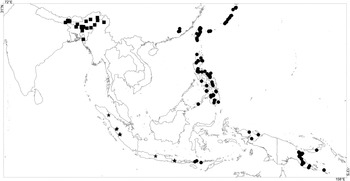
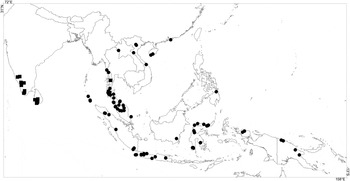
Fig. 6.Distribution map of Rhynchotechum discolor (Maxim.) B.L.Burtt (•), Rhynchotechum ellipticum (Wall. ex D.Dietr.) A.DC. (▪) and Rhynchotechum eximium (C.B.Clarke) Schltr. (★).
[Isanthera crenata C.B.Clarke in A.DC. & C.DC., Monogr. Phan. 5(1): 193 (1883) nom. nud. pro syn.]
Rhynchotechum tenue C.B.Clarke in A.DC. & C.DC., Monogr. Phan. 5(1): 199 (1883). – Type: Philippines, Manila [Manilla], Perrottet 197 (holo L).
Isanthera lanata Warb., Bot. Jahrb. Syst. 13: 418 (1891). – Type: Papua New Guinea, Saddle Mountain by Finschhafen, Warburg s.n. (not found).
Isanthera dimorpha Kraenzl., Philipp. J. Sci., C 8: 332 (1913). – Type: Luzon, Laguna, Mount Maquiling, c.300 m, Merrill 6295 (lecto US [barcode: 00126205], designated here).
Isanthera discolor Maxim. var. austrokiushiuensis Ohwi, Acta Phytotax. Geobot. 7: 29 (1938). – [Isanthera austrokiushiuensis Ohwi, Acta Phytotax. Geobot. 7: 29 (1938) nom. inval. pro syn.] – Rhynchotechum discolor (Maxim.) B.L.Burtt var. austrokiushiuense (Ohwi) Ohwi, Fl. Jap., revised ed. 813 (1965); T.Yamazuki in K.Iwats. et al., Fl. Jap. 3a: 377 (1993). – Type: Kyushu, Yakushima Island, near Haruo, M. Tagawa 1867 (holo KYO).
Isanthera discolor Maxim. var. incisa Ohwi, Acta Phytotax. Geobot. 7: 29 (1938). – Rhynchotechum discolor (Maxim.) B.L.Burtt var. incisum (Ohwi) E.Walker, J. Jap. Bot. 46: 69 (1971); E.Walker, Fl. Okinawa S. Ryukyu I. 945 (1976); Z.Y.Li & C.F.Hsieh, Taiwania 42: 93 (1997); Z.Y.Li & M.T.Kao in T.C.Huang, Fl. Taiwan, ed. 2 708 (1998); W.T.Wang et al. in C.Y.Wu & P.H.Raven (eds), Fl. China 18: 395 (1998). – Rhynchotechum discolor (Maxim.) B.L.Burtt f. incisum (Ohwi) Hatus. [Fl. Ryukyus 557 (1971)] ex J.C.Wang, Taiwania 45: 362 (2000). – Type: Ryukyu, Okinawa Island, Mount Nagodake, T. Kanashiro 9 (holo KYO).

Stems 2–60(–150) cm tall, to 3–8 mm diameter, may be recumbent with adventitious roots. Leaves alternate; petiole 0.9–6.5(–10) cm long; blade obovate or narrowly obovate to narrowly elliptic, slightly asymmetrical, (2–)3.5–20(–25.2) × (1.1–)1.5–6.8 cm, 2.1–5 times as long as wide, apex acuminate to acute, base narrowly cuneate; margin denticulate to serrate, the teeth typically to 1.75 mm, but sporadically to 9(–12) mm long; secondary vein pairs 6–14; adaxially dark green, glabrous to white pubescent, denser on midvein; abaxially pale green, yellow-rusty woolly, denser on the rusty veins. Inflorescence yellowish green, (1–)2–10(–16) cm long, 2–3(–4)-branched; peduncle (0.5–)1.1–6(–6.7) cm long; first branch 0.4–3(–4.1) cm long; second branch 0.5–1.7 cm long or absent; axes densely yellow-rusty villous/sericeous to sub-glabrous; bracts linear to triangular, first bract 4–13(–16) mm long, second bract 3–9 mm long; pedicels 1–10(–14) mm long, densely yellow-rusty sericeous. Calyx green to yellow or brown, lobes linear, (3–)4–7.5(–9) × 0.5–1 mm, densely yellow-rusty sericeous. Corolla white to cream, exterior glabrous; upper lip (2.75–)3–4(–4.5) × 3.5–5 mm; upper lobes (1–)1.5–2.5(–3) × 1.5–2.25(–3) mm, apices obtuse to rounded; lower lip (3.25–)3.5–5 × 6.5–7(–8) mm; lower lobes (1.5–)2–3.5 × 2–3 mm, apices rounded to obtuse; tube 1–2 mm long. Stamens inserted at 0.5–0.75 mm above the base of the corolla tube; filaments white, c.1–1.5(–1.75) mm long; anthers brown to orange-yellow, c.0.75–1 mm diameter, glabrous; staminode c.0.25–0.5 mm long. Ovary cream to green, 1.25–1.75 × 1–1.5 mm, slightly puberulent to puberulent; style pale yellow, 1–2 mm long; stigma apex globose/rounded to truncate or cleft. Fruit (dry) ovoid to widely ovoid, 4–8 × 2.5–5(–7) mm, glabrous to slightly puberulent, especially near style attachment.
Distribution. China, Taiwan, Japan, the Philippines, south to Papua New Guinea and Flores.
Habitat and ecology. Growing in primary and secondary forests, sometimes disturbed, thickets, swamps, and sometimes along trail sides, typically in moist and shady conditions, on clay to silt and sand, rarely on hardened lava, often on steep slopes, at 20–2000 m. Flowering and fruiting is recorded from all months.
Proposed IUCN conservation assessment. Least Concern (LC). This species is common and widespread.
Additional specimens studied. Japan.Ryukyu Islands: 1914, Unknown s.n. (A). Kagoshima: Amami Oshima: 17 vii 1919, S. Kawagoe s.n. (US); 11 viii 1927, T. Naito s.n. (US); Konia pass – Shinmura, Toho-mura, 11 viii 1956, S. Hatusima 20083 (L); Mt Yuwandake, 20 i 1957, H. Noguchi 3309 (L); Na-on Yamato-son, 25 vi 1969, M. Furuse 47694 (K) [as aff. Rhynchotechum discolor (Maxim.) B.L.Burtt]; Naze, 31 vii 1904, L.B. Boehmer et al. s.n. (NY); ibid., 31 vii 1904, Unknown s.n. (S); Sumiyoo river, 25 iii 1975, M. Furuse 8080 (K). Nakanoshima Island: 20 viii 1912, S. Kawagoe s.n. (US). Okinoerabu Island: valley of Mt Ohyama, 17 iii 1958, S. Hatusima & S. Sako 21490 (L). Tanegashima Island: 11 i 1952, S. Hatusima 15649 (A [2]); Ushino from Shima, 24 xi 1976, M. Furuse 12036 (K). Tokunoshima Island: 18 viii 1955, S. Hatusima 19118 (L); Mt Inokawa-dake, 24 viii 1975, K. Iwatsuki & H. Takasu et al. 105 (L). Yakushima Island: 7 viii 1928, G. Masamune s.n. (NY); Kurio – Segiri, 24 xii 1962, T. Yamazaki 6877 (K); Ohkawa falls, 18 iii 1976, M. Furuse 10382 (K); Seaside near Ohkawa falls, 13 xii 1976, M. Furuse 12216 (K); The Falls Oko, Yakucoh, Kumagegun, 13 xi 1980, K. Mimoro & I. Sasaki et al. 2495 (A). Okinawa: Iriomote-jima: Hidori River, 24 viii 1951, E.H. Walker & S. Tawada 6758 (US); Nakara River Region, 31 viii 1951, E.H. Walker & S. Tawada 6885 (US); near Kampira-no-taki, 11 x 1986, G. Murata, H. Koyama & A. Nitta 56469 (A); Ohtomi hill, 6 xi 1973, M. Furuse 4513 (K). Ishigaki Island: Mt Omoto, 13 i 1973, M. Furuse 2043 (K); ibid., 8 x 1972, M. Furuse 1440 (K); ibid., 18 x 1973, M. Furuse 4324 (K); ibid., 20 viii 1973, M. Furuse 4503 (K); ibid., 12 i 1973, M. Furuse 1988 (K); ibid., 8 x 1972, M. Furuse 1402 (K). Okinawa Island: Kunigami, Taminato – Ugan, 10 vii 1951, E.H. Walker & S. Sonohara et al. 6132 (US); Mt Terukubi, 21 xii 1972, M. Furuse 1856 (K); Nakagami, Goeku – Ugan, 28 vi 1951, E.H. Walker & S. Tawada 5875 (GH, L, US); Yona, 2 xi 1972, M. Furuse 1711 (K).
China.Fujian: Liung Chon San, 22 vii 1936, J.L. Gressitt 1678 (E, GH, UC). Guangdong: Mei County, Yam Na Shan, 4 viii 1932 – 31 viii 1932, W.T. Tsang 21459 (GH, K, NY, S); Meizhou City, Yinna Shan, 17 viii 1999, F-y. Zeng, H-g. Ye & Y-q. Chen et al. 1901 (AAU).
Taiwan. Bankinsing, ii 1914, U.J. Faurie 348 (GH); ibid., A. Henry 849 (NY); ibid., A. Henry 845 (K, US); ibid., A. Henry 1540 (K, US); Chosenkei, 3 xii 1912, W.R. Price 1104 (K); Keelung, vi 1884, C. Ford s.n. (E, K); Mt Taiheizan, 15 viii 1925, S. Suzuki s.n. (A); Naikokusei – Maibara, 4 vii 1912, W.R. Price 737 (K); Randaizan, 10 viii 1908, T. Kawakami & U. Mori s.n. (A); Shin ten, i 1914, U.J. Faurie 347 (A); Suirenbi, 21 viii 1929, Y. Yamamoto 859 (NY). Hualien Hsien: Butterfly Valley, 4 vii 1988, C-I. Peng 11669 (US); Juisui Forest Road, 20 i 1995, K-Y. Wang 647 (US); Shifeng, 22 viii 1951, H. Keng & M.T. Kao 2712 (L); Shuiyuan – Luanshan, 2 viii 1963, M. Tamura, T. Shimizu & M.T. Kao 21473 (E); Taroko National Park, Qingshui Shan, 21 vii 1992, C-C. Liao 487 (A); Xiulin Xiang – Yuanlaonao Shan, 21 vii 1992, W-P. Leu 1457 (E); Yushan National Park, 30 vii 1993, T. Chiang 17 (E). Keelung: vi 1884, C. Ford s.n. (E, K); ibid., 1887, O. Warburg 9345 (K). New Taipei: Pinglin, 1 xii 1988, C-F. Shen 1890 (NY); ibid., 1 xii 1988, C-F. Shen 1852 (NY); Sanxia District, 15 viii 1988, T-H. Hsieh & C-H. Hsiao s.n. (NY); Shihding District, Huangdidien, 23 vii 1991, C-H. Lin 706 (E, US); Taihoku, 8 i 1928, S-i. Sasaki s.n. (S); Taihoku, Herinbi, 18 iii 1918, E.H. Wilson 10139 p.p. (A [2], K); Taihoku, Kankou, xii 1933, R. Kanehira 3126 (NY); Taihoku, Urai, 4 xi 1966, C.G.G.J. van Steenis 20579 (L); Taihoku, Uraisya, 28 viii 1927, S-i. Sasaki s.n. (UC); Wulai District, Dabaoke Shan – Neitung Forest Road, 5 xii 1992, H-L. Ho 859 (A); Wulai District, Wulai, 19 iii 1992, B.M. Bartholomew 6211 (A, US); ibid., 24 vii 1985, C-I. Peng 8371 (US). Taipei: Datun Shan, 18 ii 1962, T.I. Chuang & P.I. Lin 4818 (A [2]); Nangang Shan, 10 i 1989, C-I. Peng 12256 (A); Shoei-guan-in-shan, 24 vii 1985, B.L. Shie 1139 (BR); Taipei – Ilan, 8 viii 1957, R.R. Ream 551 (GH). Nantou County:Chitou, 10 i 1963, C.S. Feung & M.T. Kao 322 (A). Pingtung County: Kenting National Park, 17 ix 1991, W.L. Wagner 6589 (US); Kenting National Park, Nanren Shan, 17 ix 1991, C-C. Wang 511 (A); Nanjunshan, 13 ix 1978, Ou & M.T. Kao 9053 (NY); Tahan Forest Road, 4 xii 1994, S-C. Hsiao 1043 (US); Wutai, Ali – Hsiaokueihu, 28 ix 1992, C-C. Liao 691 (A). Tainan County: Hsienkungmiao, 28 vii 1984, C-I. Peng 7089 (US). Taitung County: Guzilun Shan, 29 viii 1957, M.T. Kao & T.I. Chuang 1137 (A). Taoyuan County: Hsiayun – Hsiayunping, 11 i 1987, C-I. Peng 10288 (US); Peichatienshan, 29 xi 1986, C-I. Peng 10109 (US). Yilan County: Chi-Lan Forest Station – Yuen-Yang Lake Natural Reserve, 8 vii 1977, D.E. Boufford 19430 (GH); Chi-Lan Shan, 11 xi 1993, Edinburgh Taiwan Expedition 312 (E); Wushihpi Coast Nature Reserve, 17 vii 1992, C-I. Peng 15136 (US).
Indonesia. Nusa Tenggara Timur: Flores: Geli Mutu, 30 iii 1962, J.J. Loeters 1603 (L); Manggarai, 1985, Father E. Schmutz S.V.D. 6111 (L); N coast of Rana Messe, A.J.G.H. Kostermans & N. Wirawan 846 (K, L). Papua: Kainoei, 25 vii 1939, Aet & Idjan 136 (L); Mentembue, 22 vii 1939, Aet & Idjan 61 (L). West Papua: Arfak Mountains, Minjambau, 23 v 1962, C. Versteegh 12696 (L); Wandammen Peninsula, Pegunungan Wondiwoi, 28 ii 1962, F.A.W. Schram 10737 (L).
Philippines. Kantipla, vii 1995, D. Bicknell 863 (L). Catanduanes: Catanduanes Island, vii 1928 – ix 1928, M. Ramos & G. Edano s.n. (SING). Luzon: Manilla, 1841, H. Cuming 506 (K [2]); T. Lobb 444 (E, K [2]). Abra: Marririat, 16 v 1946, G.L. Alcasid et al. 228 (A); Mt Posuey, ii 1917, M. Ramos s.n. (US). Albay: Mt Mayon, 4 vi 1953 or v 1953 – vi 1953, D.R. Mendoza 1253 (L [2]); ibid., 10 vi 1953, D.R. Mendoza 1340 (K, L [2]); ibid., ix 1928, M. Ramos & G. Edano s.n. (SING); ibid., 15 xi 1991, Reynoso, E.M. Romero & R. Fuentes 3589 (GH); ibid., 4 ix 1908 – 6 ix 1908, C.B. Robinson s.n. (L, US). Benguet: vii 1907, E.A. Mearns s.n. (US); Baguio, viii 1906, H.M. Curran 4913 (BR); ibid., vi 1904, A.D.E. Elmer 6578 (K); ibid., iii 1907, A.D.E. Elmer 8407 (K); ibid., 19 i 1903 – 26 ii 1903, D.L. Topping 88 (US); ibid., 7 viii 1904, R.S. Williams 1366 (GH, K, US). Bulacan: Angat, ii 1919, M. Ramos & G. Edano s.n. (GH). Cagayan: Penablanca, 1 v 1917 – 18 vi 1917, M. Adduru 256 (GH, K). Camarines Norte: Paracale, xi 1918 – xii 1918, M. Ramos & G. Edano s.n. (A, K, L). Cavite: Talisay Ridge, 20 i 1917 – 21 i 1917, E.D. Merrill 10627 (K, L, SING, US). Ifugao: Banaue, Bangaan View Point, 5 viii 1992, E.J. Reynoso, Sagcal & Garcia 7126 (GH); Banaue, Mt Panawatan, Amganad, 30 vii 1961, H.C. Conklin & del Rosario 61 (A, K, L); Banaue, Mt Taggutu, 1 viii 1961, H.C. Conklin & del Rosario 157 (A, K, L); Banaue, U-ung, 24 xii 1961, G. Banlugan et al. 523 (A, L); Mt Polis, ii 1913, R.C. McGregor s.n. (US). Ilocos Norte: Bangui – Claveria, viii 1918, M. Ramos s.n. (K); Mt Sicapoa range, Mt Bubonbilit – miner’s camp, 2 xii 1975, K. Iwatsuki, G. Murata & H.G. Gutierrez 486 (L). Isabela: San Jose, 6 iii 1997, G.C.G. Argent, F. Gaerlan & Reynoso et al. 20010 (K); ibid., 6 iii 1997, M. Mendum & G.C.G. Argent et al. 29010 (E); San Mariano, ii 1926 – iii 1926, M. Ramos & G. Edano s.n. (S). Kalinga: Lubuagan, Mt Masingit, ii 1920, M. Ramos & G. Edano s.n. (A). Laguna: vi 1915 – viii 1915, R.C. McGregor s.n. (US); Calauan, xi 1910 – xii 1910, R.C. McGregor s.n. (SING); Mt Makiling, 1 ix 1935, H.H. Bartlett 15627 (A, MICH); ibid., vi 1917 – vii 1917, A.D.E. Elmer 17599 (GH, K, L); ibid., 13 vii 1916, C. Mabesa 253 (US). Mountain Province: Bomco, 25 vi 1911, Unknown s.n. (BR). Naga: Penicuason, Mt Isarog, 22 iii 1997, M. Mendum & G.C.G. Argent et al. 29145 (E). Quezon: Alabat Island, 21 xii 1916 – 30 xii 1916, E.D. Merrill 10466 (US). Sorsogon: Irosin, Mt Bulusan, xii 1915, A.D.E. Elmer 15368 (A, GH, K, L, S, US); ibid., xi 1915, A.D.E. Elmer 14843 (GH, K, L); Irosin, Patag, 11 v 1957, G. Edano & H.G. Gutierrez 7 (L, SING); Lake Bulusan, 16 vi 1958, J. Sinclair & G. Edano 9570 (E [2], K, SING). Mindanao: Agusan: Asiga River, iv 1931 – v 1931, M. Ramos & P. Convocar s.n. (A); Cabadbaran, Mt Urdaneta, viii 1912, A.D.E. Elmer 13558 (E, L, US). Bukidnon: Del Monte, xii 1940 – i 1941, H.H. Bartlett 17239 (MICH); Impasug-ong, Mt Kitanglad, Intavas, 18 vii 1991, F. Gaerlan, Sagcal & Fernando 3295 (GH); Mt Candoon, vi 1920 – vii 1920, M. Ramos & G. Edano s.n. (A); Mt Katanglad, iii 1949, M.D. Sulit 3399 (A, L [2]). Cotabato: Mt Apo, ix 1909 or vii 1909, A.D.E. Elmer 11700 (E, GH [2], K, L, US). Davao del Sur: Mt McKinley, 12 viii 1946, G. Edano 609 (A, L). Davao Oriental: Mt Mansamuga, 12 ix 1949, G. Edano 1837 (A). Lanao del Sur: Dansalan – Momungan, 29 ix 1938, A.L. Zwickey 230 (A, MICH); Pugaan Hill, 10 ix 1935, H.H. Bartlett 15906 (A, MICH, US). South Cotabato: Mt Matutum, iv 1932, M. Ramos & G. Edano s.n. (A). Surigao: Mt Cantugas, iii 1931, M. Ramos & P. Convocar s.n. (A). Negros: Negros Occidental: 8 xi 1999, P. Wilkie & F. Gaerlan et al. 75 (E); Mt Mandalagan, 8 xi 1999, P. Wilkie & F. Gaerlan et al. 87 (E) (and cultivated at RBGE). Negros Oriental: Cuernos de Negros, 6 vi 1948 or v 1948, G. Edano 426 (A, BR); Cuernos Mts, Dumaguete, iii 1908, A.D.E. Elmer 10436 (E, K, L, US); Lake Balinsasayo, 17 v 1991, D.A. Madulid et al. 913 (GH); Sibulan, Manlangco, 28 ix 1948, G. Edano 702 (A). Panay: Antique: Mt Balingaso, 7 iii 1976, M.J.S. Sands 3273 (A, K, L). Sulu Archipelago: Sulu: Jolo Island, Bud Sungal, 16 ix 1935, H.H. Bartlett 16081 (A, MICH). Eastern Visayas: Biliran: Biliran Island, Mt Suiro, 27 iv 1954, M.D. Sulit 5314 (L [2]). Leyte: 28 vi 1913, C.A. Wenzel 288 (GH); Baybay, Kalbiga Stream, 24 iii 1993, F. Gaerlan, Sagcal & E.M. Romero 10577 (GH); Ormoc, Lake Danao National Park, Lake Danao, 26 vi 1993, D.D. Soejarto, O. Fernando & R. Majaducon 8083 (L). Samar: iii 1914 – iv 1914, M. Ramos s.n. (US); Mount Sarawag, xii 1951, G. Edano s.n. (L).
Papua New Guinea. EV1 river, 3 xii 1935, C.E. Carr 13585 (A, L, SING [2]). Central: Boridi, 20 xi 1935, C.E. Carr 13440 (K, L, SING [3]); Koitaki, 5 vi 1935, C.E. Carr 12532 (L); Owen Stanley Range, Musa Mts, Doma, 28 x 1962, P.J.B. Woods 181 (E [2]). Milne Bay: Misima Island, Bwagaoia, 25 x 1971, H. Streimann & Y. Lelean 52677 (E, L); Misima Island, Mt Sisa, 24 vii 1956, L.J. Brass 27486 (L); Rabaraba, 26 vi 1972, P. Katik 56279 (E, L). Morobe: Atzera Range, 13 xii 1993, W.N. Takeuchi 9300 (A); Atzera Range, near Bubia, 11 v 2002, W.N. Takeuchi & D. Ama 16261 (A, K); ibid., 28 iii 2001, W.N. Takeuchi & D. Ama 15304 (A); Boana, 14 vi 1938, M.S. Clemens 8278 (B); Bulolo River gorge, 4 iv 1963, T.G. Hartley 11567 (A, K, L); Bulolo – Wau, 12 x 1962, P.J.B. Woods 93 (E [2]); Busu River, 25 ix 1962, E.E. Henty 14836 (E, K, L); Finisterre Range, Mountain near Kikiepa Village, 2 vi 1960, J.S. Womersley & R.F. Thorne 12674 (K, US); Gabensis, 30 x 1990, W.N. Takeuchi 6992 (E); Garaina – Saureli, 11 v 1968, P.J.B. Woods 1112 (E); Herzog Mountains, 13 viii 1991, W.N. Takeuchi 7392 (A, K); Matap, 26 iii 1940, M.S. Clemens 41068 (E, MICH, US); near Piera, 19 i 1964, T.G. Hartley 12620 (A, AAU, L, MICH); Oomsis Creek, 16 iii 1962, T.G. Hartley 10016 (A, L); Oomsis Logging Area, 20 vii 1966, J.S. Womersley 24776 (L, SING); Rawlinson Mts, Aregenang – Belah, 19 vi 1968, P.J.B. Woods, M. Black & Y. Lelean 1898 (A, E, K, L); Rawlinson Mts, Gawan – Sambue, 21 ii 1963, P. van Royen 16103 (K, L, SING); Ridge complex between the Erap and Busu basins, 1 iii 1989, W.N. Takeuchi 4479 (E, L); Wantoat, 7 viii 1968, W.R. Philipson & M.N. Philipson 3282 (A, E, K, L); Wau District, McAdam National Park, 24 viii 1971, P.F. Stevens 54718 (A, E, L); Wau District, Upper Watut, Slate Creek, Andarora, 10 xii 1970, H. Streimann & A. Kairo 44560 (E, K, L); Wau District, Wau, 4 x 1962, P.J.B. Woods 24 (E). New Britain: Nakanai Range, Yauyau, 5 vii 1973, G.W. Gillett 2561 (E); ibid., 5 vii 1973, G.W. Gillett 2564 (E). Northern: Alola, xii 1935, C.E. Carr s.n. (SING); Saga, 19 ix 1953, R.D. Hoogland 3939 (A, K, L, US).
This is a fairly variable species across its large range but always has distinctive linear calyx lobes and usually has few-branched inflorescences. It is also the only alternate-leaved species east of Wallace’s line and north into the Philippines, China and Japan. Chinese specimens generally have more symmetrical leaves, while Japanese specimens tend to be more robust and have larger inflorescences. Larger specimens are also observed in New Guinea, however, and the maturity of the plants (or even possibly a biennial life cycle) might explain why there are smaller and larger specimens. Regional variation requires a focused study of this taxon across the entire range. This may lead to varieties being recognised but this variation is not great enough to recognise separate species.
Isanthera discolor var. austrokiushiuensis was erected by Ohwi (Reference Ohwi1938) to account for plants with much condensed inflorescences with flowers in glomerules. According to Walker (Reference Walker1976), who synonymised the variety under the species, Ohwi withdrew his variety since these plants seemed to be immature and the inflorescences unexpanded. Condensed inflorescences in specimens from New Guinea have also been observed.
Isanthera discolor var. incisa was erected by Ohwi (Reference Ohwi1938) to account for plants with uncharacteristically deeply toothed leaves (to 9 or 12 mm). Indeed, these plants are distinct in this character from every other Rhynchotechum specimen. The occurrence is sporadic, however, and so the variety was reduced to the level of a forma by Hatusima (Reference Hatusima1971), though without reference to the basionym. As these plants occur sporadically in areas with otherwise typical Rhynchotechum discolor populations they are probably not a distinct biological group and as such they do not deserve nomenclatural status. In the type specimen the secondary venation in the leaf is branched more around the teeth.
Clarke’s Rhynchotechum tenue was described as having opposite leaves. The type specimen, however, has sub-opposite leaves which appear alternate and is otherwise indistinguishable from Rhynchotechum discolor.
In the protologue of Isanthera lanata, Warburg (Reference Warburg1891) suggests his species is similar to I. permollis and possibly to I. discolor (though he admits he has not seen the fruits of I. discolor). His description fits Rhynchotechum discolor and, since R. permolle and R. eximium (C.B.Clarke) Schltr. do not occur in Papua New Guinea, Isanthera lanata has been synonymised under R. discolor (the only alternate-leaved species in this region). The type has not been found and was likely lost when the Berlin herbarium was destroyed in World War II.
The type of Isanthera dimorpha is clearly Rhynchotechum discolor, though Kränzlin (Reference Kränzlin1913) suggests two types of flowers in the protologue. According to Kränzlin, one type is showy with a large corolla (4 mm) while the other resembles a ‘globose capsule’, and they both occur in the same inflorescence. It is possible that Kränzlin may have been misinterpreting young vs. mature flowers, as globose unopened flowers are present in other Rhynchotechum species (e.g. R. parviflorum).
The Ford s.n. specimen from Taiwan has small leaves and an unexpanded inflorescence with one flower that is difficult to adequately examine. The alternate leaf scars and the linear calyx lobes suggest that it is this species, but it is smaller than most Rhynchotechum discolor specimens.
The Mearns s.n. specimen from the Philippines has reduced inflorescence branches resulting in the flowers clumping together at the end of the peduncle. This is aberrant compared to other Rhynchotechum discolor specimens.
The Furuse 47694 specimen from Japan has longer calyces than typical Rhynchotechum discolor specimens but the peduncles are too long and it is too large to be R. brevipedunculatum.
6. Rhynchotechum ellipticum (Wall. ex D.Dietr.) A.DC. in DC., Prodr. 9: 285 (1845); Hook.f., Curtis’s Bot. Mag. 96: t. 5832 (1870); C.B.Clarke, Commelyn. Cyrtandr. Bengal. 131, pl. 41 (1874); C.B.Clarke in A.DC. & C.DC., Monogr. Phan. 5(1): 196 (1883); C.B.Clarke in Hook.f., Fl. Brit. India 4: 373 (1884); B.L.Burtt, Thai Forest Bull., Bot. 29: 106 (2001); Hilliard in Grierson & D.G.Long, Fl. Bhutan 2(3): 1326, fig. 108h–i (2001). – Corysanthera elliptica Wall. ex D.Dietr., Syn. Pl. 3: 582 (1842). – Type: Mts Sylhet, F. de Silva, W. Gomez & H. Bruce in Wallich 6411 (lecto K-W, designated here; iso BR, E, K ×2, W).Fig. 6.
Rhynchotechum ellipticum (Wall. ex D.Dietr.) A.DC. var. pilosior C.B.Clarke in A.DC. & C.DC., Monogr. Phan. 5(1): 196 (1883). – Type: Sikkim, 19 viii 1869, C.B. Clarke 8710 (holo K).
Stems (15–)60–180(–300) cm tall, to 5–10 mm diameter. Leaves opposite; petiole 1–4 cm long; blade elliptic to narrowly elliptic or slightly obovate, (5.5–)9–25.5(–29.3) × 3.5–10.5(–17.5) cm, 1.4–2.6(–3.1) times as long as wide, apex acuminate, rarely acute or obtuse, base narrowly cuneate to cuneate; margin denticulate to serrulate, the teeth to 2 mm long; secondary vein pairs 11–20(–25); adaxially dark green, glabrous to sparsely white pubescent; abaxially pale green, yellow-rusty woolly, denser and darker on the veins. Inflorescence pink, 1.2–8(–13.5) cm long, 2–5(–7)-branched; peduncle reduced/absent; first branch 0.4–3.3(–5.8) cm long; second branch 0.2–1.7(–2.3) cm long; axes short yellow-rusty sericeous/villous becoming scabrous to sub-glabrous higher up; bracts linear to triangular, first bract (1.5–)3–6 mm long, second bract (2–)3–5(–7) mm long; pedicels 1–13 mm long, scabrous, the hairs short and conspicuously multicellular, to sub-glabrous, hairs occasionally glandular. Calyx pink to pale pink, lobes triangular to linear acuminate with apices rounded, 3–4.5(–5.5) × c.1–1.5 mm, scabrous, the hairs short and conspicuously multicellular, to rarely sericeous, hairs occasionally glandular. Corolla red-purple, exterior scabrous with glandular hairs; upper lip 3–4 × (3–)4–5 mm; upper lobes 1–2 × 1.5–2.5 mm, apices rounded to obtuse; lower lip 5–7 × 7–8.5 mm; lower lobes 2–2.5 × 1.75–3 mm, apices rounded to obtuse; tube 1.5–2 mm long. Stamens inserted near the base of the corolla tube; filaments c.1 mm long; anthers purple, c.1–1.5 mm diameter, slightly puberulent; staminode c.0.25–0.5 mm long. Ovary 1–1.5 × 1–1.75 mm, glabrous to rarely puberulent with glandular hairs; style (5.5–)6–7(–7.5) mm long; stigma apex globose/rounded to truncate. Fruit (dry) widely ovoid, 3–4.5 × 3–4.5 mm, glabrous.
Distribution. India, Bhutan (Hilliard, Reference Hilliard, Grierson and Long2001), Bangladesh, Nepal and Burma.
Habitat and ecology. Growing in forests, typically in shady and moist conditions, on limestone bedrock, sometimes on steep slopes, at 150–2120 m. Flowering and fruiting July to January.
Proposed IUCN conservation assessment. Least Concern (LC). This species is widespread and not subject to significant threats.
Additional specimens studied. Nepal. Chula Chuli, 15 ix 1967, L.H.J. Williams & J.D.A. Stainton 8498 (K).
India. East Himalaya: 1940, K. Biswas 4736 (A); W. Griffith s.n. (GH); W. Griffith s.n. (W); i 1912, Ribu & Rhomoo s.n. (E); Ribu & Rhomoo s.n. (E). Arunachal Pradesh: Kimin – Khunipahar, 24 ix 1959, G. Panigrahi 19349 (BR); Mishmi Hills, Sadiya Plain, W. Griffith 641 (K); Subansiri F.D., Palin – Radang village, 16 xi 1964, A.R.K. Sastry 40676 (L); Tirap Frontier Division, Changlang, 20 viii 1958, G. Panigrahi 14443 (E). Assam: W. Griffith s.n. (K); W. Griffith s.n. (K); W. Griffith s.n. (K); F. Jenkins s.n. (L); F. Jenkins s.n. (E); F. Jenkins s.n. (L); J.W. Masters s.n. (L); J.W. Masters s.n. (E); Mrs. Marks s.n. (K); Simons s.n. (L); Unknown s.n. (GH); N. Wallich s.n. (GH); N. Wallich s.n. (L); Cachar, Shapore, 17 ix 1873, R.L. Keenan s.n. (K); Darrang, Charduar Reserved Forest, 17 i 1971, J.D.A. Stainton 6701 (K); Goalpara, 12 vii 1808, F. Buchanan-Hamilton 1375 (E); North Cachar Hills, Haflong, 17 viii 1908, W.G. Craib 274 (K); Pingrei, W. Griffith s.n. (L); Ralioui, v 1890, G. Wall 101 (E); Upper Assam, 1841, F. Jenkins & J.D. Hooker 293 (K). Bengal: K. Biswas 1691 (A). Manipur: xi 1907, A. Meebold 1200 (S); Karong, 1 x 1950, T.R. Chand 3759 (E, MICH). Meghalaya: Garo Hills, Chitmang, 18 xi 1929, N.E. Parry 967 (K); Garo Hills, Nenkra, 12 i 1929, N.E. Parry 1223 (K); Jowai, 26 i 1957, G.K. Deka 5196 (E); Khasia, J.D. Hooker & T. Thomson s.n. (K); Khasia Hills, J.D. Hooker & T. Thomson s.n. (L); ibid., J.D. Hooker & T. Thomson s.n. (E); ibid., J.D. Hooker & T. Thomson s.n. (BR); ibid., J.D. Hooker & T. Thomson s.n. (GH); ibid., J.D. Hooker & T. Thomson s.n. (L); ibid., J.D. Hooker & T. Thomson s.n. (US); ibid., J.D. Hooker & T. Thomson s.n. (NY); ibid., J.D. Hooker & T. Thomson s.n. (S); ibid., T. Lobb s.n. (K); ibid., T. Lobb s.n. (K); Khasia Hills, Cherrapunjee, 10 viii 1850, J.D. Hooker & T. Thomson 2046 (K [2]); ibid., 6 viii 1952, W.N. Koelz 30992 (MICH); Khasia Hills, Mawryngkneng, 30 ix 1951, T.R. Chand 4888 (E, MICH); Khasia Hills, Pynursla, 16 viii 1949, W.N. Koelz 23513 (E, MICH); Khasia, Mairang, 1 x 1855 – 30 x 1855, H.A.R.v. Schlagintweit-Sakünlünski s.n. (GH, US); Khasia, Murklow, 1850, J.D. Hooker & T. Thomson 2511 (K); Khasia, Umwai, 7 xi 1872, C.B. Clarke 19341 (US); Khasia, Walong, 21 x 1871, C.B. Clarke 16220 (L). Nagaland: Naga Hills, xi 1898, Dr. Prain’s Collector 480 (A [2]); Naga Hills, Perenmi, 4 viii 1935, N.L. Bar 6452 (K). Sikkim: G.H. Cave s.n. (A); J.D. Hooker s.n. (K); J.D. Hooker s.n. (L); J.D. Hooker s.n. (S); J.D. Hooker s.n. (GH); J.D. Hooker s.n. (K); 16 xi 1875, C.E.O. Kuntze 6639 (NY); T. Thomson s.n. (L); Gt. Rangit, xi 1879, J.S. Gamble 7357 (K); Teesta valley, 20 viii 1874, W.J. Treutler 621 (K). West Bengal: Darjeeling District, J.M. Cowan s.n. (E); Darjeeling, Mungpo, 24 ix 1875, C.B. Clarke 26764 (L); Darjeeling, Rishap, 2 viii 1870, C.B. Clarke 12286 (L); ibid., 2 viii 1870, C.B. Clarke 12387 (L); Darjeeling, Sevoke, iii 1873, J.S. Gamble 3506 (K); Darjeeling, Sureil – Mungpo, 21 x 1902, J.H. Lace 2449 (E); Dooars, Muragha’t, i 1880, J.S. Gamble 7659 (K); Gorubathan, 10 viii 1923, J.M. Cowan s.n. (K).
Bangladesh. W. Griffith s.n. (NY). Chittagong: Rajarhat, 9 i 1934, C.E. Parkinson 3426 (GH, NY). Sylhet: 4 xii 1850, J.D. Hooker & T. Thomson s.n. (K).
Burma. Kanang, 27 xii 1961, J. Keenan, U.T. Aung & U Tha Hla 3037 (E).
Unknown.F. Buchanan-Hamilton s.n. (K); W. Roxburgh s.n. (BR); Unknown s.n. (K).
This species can be recognised by its often scabrous inflorescences and its typically broad elliptic leaves, as well as its long style. The indumentum tends to be scabrous higher up the inflorescence and in more mature inflorescences, and almost always so on the calyx lobes. Some younger inflorescences are more sericeous lower down and may be mistaken for Rhynchotechum parviflorum, which has a smaller flower and style but may have scabrous calyx lobes with the hairs glandular and conspicuously multicellular. A few specimens were found with more sericeous calyx lobes and perhaps more secondary vein pairs, but apart from that they do not differ from Rhynchotechum ellipticum and occur in the same geographic area.
The Keenan et al. 3037 specimen from Burma has more glandular hairs than typically seen in Rhynchotechum ellipticum specimens and its leaves are sub-glabrous. These differences are insufficient to distinguish it as a separate taxon.
Rhynchotechum ellipticum var. pilosior C.B.Clarke has slightly more hispid inflorescences and leaves, approaching R. vestitum, but the hairs are shorter, the style is longer and the calyx lobes are distinct from that species. There was no material other than the type that could be referred to this variety, and it does not differ enough from typical Rhynchotechum ellipticum to be taxonomically distinguished.
Burtt (Reference Burtt2001) notes that this species does not occur in Thailand despite the use of the name. He points out that in the Flora of China (Wang et al., Reference Wang, Pan, Li, Weitzman, Skog, Wu and Raven1998) Rhynchotechum obovatum is incorrectly treated as synonymous with this name, a conclusion with which we agree. He distinguishes Rhynchotechum ellipticum from R. obovatum by its scabrous rather than woolly calyx indumentum. Though this is often the case, there are rare exceptions, and the difference in inflorescence structure is a better discriminator (Rhynchotechum obovatum has peduncled inflorescences).
A study by Lalfakawma et al. (Reference Lalfakawma, Sahoo, Roy, Vanlalhriatpuia and Vanalalhluna2009) on the species composition and density in disturbed and undisturbed forest sites in Northeast India revealed that Rhynchotechum ellipticum had a higher density in the disturbed forest.
7. Rhynchotechum eximium (C.B.Clarke) Schltr., Bot. Jahrb. Syst. 58: 303 (1923). – Isanthera eximia C.B.Clarke in A.DC. & C.DC., Monogr. Phan. 5(1): 193 (1883). – Type: Java, Junghuhn 35 (lecto L [barcode: 0003118], designated here; iso L ×2).Fig. 6.
Rhynchotechum angustifolium Ridl., J. Malayan Br. Roy. Asiat. Soc. 1: 80 (1923). – Type: Sumatra, Berastagi woods, 5000 ft, 12 ii 1921, Ridley s.n. (lecto K, designated here).
Stems 100–200 cm tall, to 5–9(–15) mm diameter. Leaves alternate; petiole (1.6–)2.1–4.5(–5.5) cm long; blade narrowly elliptic/oblong to slightly obovate, (8.7–)10.5–21(–29) × 2.9–7(–8.6) cm, 2.3–4.5 times as long as wide, apex acuminate, base narrowly cuneate; margin denticulate, rarely sub-entire, the teeth to 1.25 mm long; secondary vein pairs 12–22(–25); adaxially dark green, glabrous to white pubescent, denser on the veins; abaxially pale green, yellow-rusty woolly, denser on the rusty-brown veins. Inflorescence 4–12(–14) cm long, 3–4-branched; peduncle 1.7–6.8(–7.5) cm long; first branch (0.6–)1.2–3.5 cm long; second branch 0.4–1.8(–2.5) mm long; axes yellow-rusty villous/sericeous to densely so; bracts triangular to linear, first bract (4–)7–15 mm long, second bract 4.5–11 mm long; pedicels 1–13(–16) mm long, densely yellow sericeous/villous. Calyx yellowish green, lobes triangular with apices rounded, (2–)2.5–4(–4.5) × 0.75–1.25(–1.5) mm, densely yellow sericeous. Corolla white, exterior glabrous; upper lip 2.5–3.25 × (2.5–)3–4 mm; upper lobes 1–1.5 × 1–2 mm, apices rounded to obtuse; lower lip 3–4.5 × 4–6.5 mm; lower lobes 1.5–2.5 × 1–2 mm, apices rounded to obtuse; tube 1.5 mm long. Stamens inserted at 0.5 mm above the base of the corolla tube, slightly didynamous; filaments c.0.5–1.25 mm long; anthers c.0.75–1 mm diameter, bumpy or puberulent; staminode c.0.25–0.5 mm long. Ovary 1–2 × (0.75–)1–2 mm, glabrous, rarely slightly puberulent; style (1.25–)1.5–2 mm long; stigma apex globose/rounded to truncate or cleft. Fruit (dry) ovoid to widely ovoid, 2.5–4.5 × 2–3.5 mm, glabrous, rarely slightly puberulent.
Distribution. Sumatra, Java and Bali.
Habitat and ecology. Growing in montane forests, sometimes secondary vegetation, sometimes near rivers, on loam, at 910–1850 m. Flowering and fruiting January to April, August and October.
Proposed IUCN conservation assessment. Least Concern (LC). Although it is only known from relatively few collections these are over a wide area and several of the collecting localities are in protected areas.
Additional specimens studied. Indonesia.Sumatra: Jambi: Gunung Kerinci, 5 iii 1920, H.A.B. Bünnemeijer 8460 (K, L); ibid., iv 1914, H.C. Robinson & C.B. Kloss 37 (K). Sumatera Barat: Batang Sangir, 1 viii 1956, M. Jacobs 4433 (B, K, L); Gunung Merapi, 19 vii 2006, D. Girmansyah 757 (E); Mt Sago, 8 x 1956, P. Maradjo 82 (L); Pesisir Selatan Kerintji, Gunung Tujuh, 4 viii 1956, W. Meijer 6525 (L). Sumatera Utara: Berastigi, 4 vi 1928, R.S. Boeea 406 (MICH, NY, SING); Karohochebene, 21 i 1929, J.A. Lörzing 15099 (L); Karohoogulakte by Berastagi, 18 vii 1919, J.A. Lörzing 6709 (L). Java: 14 v 1932, E.W. Clason & Laarman 133 (L); Unknown 240 partim (L). Jawa Tengah: Gunung Ungaran, F.W. Junghuhn 20 (L). Bali: Batoe kaoe, i 1935, C.N.A. de Voogd 2136 (L); Batukau Nature Reserve, iii 1992, J.J. Afriastini 161 (K); Bedoegoel, 11 iv 1936, C.G.G.J. van Steenis 8082 (GH, K, SING); Bedugul forest region, Gunung Batukaru, 24 iii 1964, A. Dilmy 997 (K, US); ibid., 22 ix 1958, A.J.G.H. Kostermans & E. Kuswata Kartawinata et al. 69 (L); Central Bali, Tabanan, Mt Lesung, 25 vii 1994, J.A. McDonald & R. Ismail 4846 (A, E, K, L).
This species can be recognised by its alternate leaves and typically large inflorescences with flowers which have short, stout styles. The inflorescences may be more condensed when immature. It differs from Rhynchotechum discolor in its shorter, less linear calyx lobes and in its more highly branched, broader inflorescences. Often leaves only occur at stem apices with inflorescences below these in the axils of fallen leaves.
The Unknown 240 partim (L) specimen has no collector noted but is probably the Junghuhn specimen Clarke (Reference Clarke, Candolle and Candolle1883) lists in the protologue.
As suspected by Burtt (Reference Burtt1962), Rhynchotechum angustifolium is a synonym of this species.
8. Rhynchotechum formosanum Hatus., J. Jap. Bot. 15: 132, fig. 1 (1939); M.T.Kao & De Vol, Taiwania 17: 163 (1972); M.T.Kao & De Vol in H.L.Li (ed.), Fl. Taiwan 683 (1978); Z.Y.Li & C.F.Hsieh, Taiwania 42: 93 (1997); Z.Y.Li & M.T.Kao in T.C.Huang, Fl. Taiwan, ed. 2 708, photo 363 (1998) pro parte; W.T.Wang et al. in C.Y.Wu & P.H.Raven (eds), Fl. China 18: 394 (1998) pro parte; J.C.Wang & C.C.Wang, Taiwania 45: 363 (2000) pro parte. – Type: Formosa [Taiwan], Taihoku, Kanko [Kankou], 30 x 1932, Hatusima s.n. (holo FU n.v., photograph seen).Fig. 7.
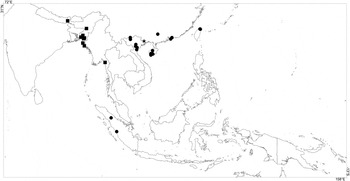
Fig. 7.Distribution map of Rhynchotechum formosanum Hatus. (•), Rhynchotechum hookeri (C.B.Clarke) B.M.Anderson (▪) and Rhynchotechum longipes W.T.Wang (★).
Lysimachia saurauifolia S.S.Ying, Quart. J. Chin. Forest. 20(4): 123, pl. 1, figs 1 & 2 (1987). – [Rhynchotechum saurauifolium (S.S.Ying) S.S.Ying, Mem. Coll. Agric. Natl. Taiwan Univ. 29(2): 47 (1989) nom. inval. pro syn.] – Rhynchotechum ellipticum (Wall. ex D.Dietr.) A.DC. var. saurauifolium (S.S.Ying) S.S.Ying, Mem. Coll. Agric. Natl. Taiwan Univ. 29(2): 47, pl. 1–2, colour photos 1–4 (1989). – Type: New Taipei, Hsintien, Kung-ping Shan, 2 viii 1986, S.S. Ying s.n. (holo NTUF).
Rhynchotechum ellipticum auct. non (Wall. ex D.Dietr.) A.DC.: Merrill, Lingnan Sci. J. 13: 71 (1934); Chun (ed.), Fl. Hainan. 3: 528 (1974) pro parte.

Stems < 15–60(–270; see note) cm tall, to 3–5.5 mm diameter. Leaves opposite; petiole 1.4–5.5 cm long; blade elliptic to obovate, 4.5–20.5 × 2.4–8.5(–10.2) cm, 1.5–2.9(–3.2) times as long as wide, apex acuminate, base narrowly cuneate; margin denticulate to entire, the teeth to 2 mm long; secondary vein pairs 9–19; adaxially dark green, glabrous to sparsely long white pubescent, denser on the midvein; abaxially pale green, yellow-rusty woolly, denser on the rusty veins. Inflorescence 2.6–8.5(–11) cm long, 2–3(–4)-branched; peduncle 0.6–4.5 cm long; first branch 0.6–3 cm long; second branch 0.4–1.9 cm long or absent; axes yellow-rusty sericeous/villous to densely so, sometimes with glandular hairs; bracts linear to triangular, first bract 1–7 mm long, second bract 1–5 mm long; pedicels (1–)4–15(–18) mm long, sericeous to densely so, often with glandular hairs present. Calyx red to purple, lobes triangular with rounded apex, 2–4 × 0.75–1.25 mm, sericeous to densely so, sometimes with glandular hairs. Corolla white to yellowish white, exterior glabrous; upper lip 3–4 × 3–4.5 mm; upper lobes 1–2 × 1.5–2 mm, apices obtuse; lower lip (3.5–)4–5 × 6–8 mm; lower lobes 2–2.5(–3.5) × 1.5–2(–2.5) mm, apices obtuse; tube 1–1.75 mm long. Stamens inserted at 1 mm above the base of the corolla tube; filaments c.0.5–0.75 mm long; anthers c.0.75–1 mm diameter, rarely reduced, glabrous; staminode to c.0.25–0.5 mm long or rarely absent. Ovary 1–1.5 × 1–2 mm, puberulent; style 2–3.5 mm long; stigma apex rounded to obtuse or truncate. Fruit (dry) obloid or ovoid to ellipsoid, 3–5.5 × 2–3.5 mm, glabrous to puberulent.
Distribution. Taiwan, China, Vietnam and Sumatra.
Habitat and ecology. Growing in forests, thickets and dense scrub, typically in moist and shady places, on clayey to moist sandy soil on limestone bedrock, on gentle to steep slopes, at 280–1150 m. Flowering and fruiting March to July.
Proposed IUCN conservation assessment. Least Concern (LC). This species is common and widespread.
Additional specimens studied. China. Guangdong: viii 1887, C. Ford 108 (K); Huiyang District, Lin Fa Shan, 1 x 1935 – 19 x 1935, W.T. Tsang 26030 (A, AAU); Ting-wu Shan, 1 vii 1963, K.C. Ting & K.L. Shih 666 (L). Guangxi: Leng District, Ku-lung Village, 2 x 1937, L.H. Chun 91334 (A); Sun-to District, Po Yam Shan, 20 x 1933, W.T. Tsang 23043 (GH); Sup-man-ta Shan, 28 vii 1937, H.Y. Liang 69875 (A). Hainan: 1 x 1933, C. Wang 34455 (NY); Danzhou County, Sha Po Shan, 26 v 1928, or W.T. Tsang 521 (A [2], K, NY, UC [2], US); Hung Mo Shan, 26 vii 1929, W.T. Tsang & Fung 587 (A [2], K, NY); ibid., 19 vi 1929, W.T. Tsang & Fung 330 (GH, K, NY, UC); Ledong, 16 vi 1936, S.K. Lau 27142 (A); Po-ting, 5 vii 1935, F.C. How 73097 (GH); ibid., 17 iv 1935, F.C. How 71972 (GH); Yaichow, 16 vii 1933, H.Y. Liang 62137 (GH, NY); ibid., 23 ix 1933, H.Y. Liang 63058 (NY). Hong Kong: Tai Po, G. Barretto’s Garden, 18 vi 2003, S.Y. Hu & K.H. Yung 609 (A). Yunnan: Wenshan, Maguan County, Gulinqing, 1 x 1985 – 10 x 1985, Z.R. Xu 5660 (US).
Taiwan.New Taipei: Shihding District, Leigongpo, 18 i 1989, C-I. Peng 12294 (A, US); Taihoku, Herinbi, 18 iii 1918, E.H. Wilson 10139 p.p. (A, K); Xindian District, Wenshan Experimental Forest, 29 vii 1994, K-Y. Wang 85 (A).
Vietnam. Ramvi, 1899, S. Wilson 2766 (K). Ha Tay: Mt Bavi, 1888, B. Balansa 4300 (K). Hoa Binh: Tan Lac District, Man Duc, 30 viii 1994, P.C. Boyce 864 (E, K, NY). Lao Cai: 19 xii 1964, Sino-Vietnam Expedition 3123 (not located; photocopy) [as cf. Rhynchotechum formosanum Hatus.]. Ninh Binh: Nho Quan District, Cuc Phuong National Park, 28 xii 1994, P.K. Loc 6918 (E); ibid., 15 ii 1965, Sino-Vietnam Expedition 4749 (not located; photocopy) [as cf. Rhynchotechum formosanum Hatus.].
Indonesia. Sumatra: Sumatera Barat: Barisan Range, Air Sirah above Padang, 9 v 1985, E.F. de Vogel & J.J. Vermeulen 7570 (L); Gunung Kerinci, Siolak Daras, 18 iii 1914, H.C. Robinson & C.B. Kloss s.n. (K). Sumatera Utara: Toba, Dolok Ri da Bolak, 9 x 1936 – 4 xii 1936, R.S. Boeea 11242 (A, US).
Unknown. 2 vi 1983, Unknown 568 (AAU).
This species can be recognised by its short stature, its peduncled inflorescences with puberulous ovaries, and its glandular hairs on the pedicels and sometimes other axes of the inflorescences. It varies in the size of the inflorescences and leaves within the same geographic area, but this effect may be due to differences in maturity. This species differs from Rhynchotechum parviflorum in the nature of the inflorescence peduncle. While Rhynchotechum parviflorum has a reduced or absent peduncle so that the inflorescence branches appear sub-fascicled, R. formosanum has proper peduncles arising from leaf axils. Rarely, two peduncles may appear to come from the same leaf axil, but always vertically offset from each other, not branching from the same point.
One specimen observed has some male-sterile flowers (How 73097). This is atypical for the species and for Rhynchotechum in general.
Two specimens had questionable height measurements in that the specimens clearly had roots and were less than 60 cm high yet the labels said the plants were 1.5 m and 9 ft high. These are likely errors, possibly because of incorrect copying of field notes to printed labels or a mismatch between descriptions and specimens, or perhaps because larger specimens, which we have not seen, were given the same collection number.
The specimens in Sumatra have somewhat wider styles in flower but not in fruit. In other characters they are not distinct and cannot be separated. Further collecting in Sumatra may help elucidate any differences. They are geographically isolated, and may represent a long-distance dispersal event. In Vietnamese specimens the developing fruit is more elongated but the specimens are also within the range of variation for the species in other characters and are not distinct enough to separate.
The name Rhynchotechum formosanum has been incorrectly applied to a number of specimens from China that we include in R. parviflorum. This is a potential source of confusion in regional floras. For example, the description of Rhynchotechum formosanum in the Flora of Taiwan, 2nd edn (Li & Kao, Reference Li, Kao and Huang1998) includes aspects of R. parviflorum such as paired cymes. Interestingly, the description says the corolla is white despite the photo showing a purple corolla, which is consistent with Rhynchotechum parviflorum.
Merrill (Reference Merrill1934) identified some specimens from Hainan as Rhynchotechum ellipticum, though without flowering material. He stated that they seemed to fit within the limits of that species but that they could also be something else. Merrill cited the specimens by their Lingnan University numbers as Tsang & Fung 17864 and 18121. The correct numbers are 330 and 587, respectively, and the specimens are Rhynchotechum formosanum. Chun (Reference Chun1974) cited Merrill under his account of Rhynchotechum ellipticum, but the figure accompanying the account looks to be R. parviflorum.
The location of the type specimen was taken from Li & Hsieh (Reference Li and Hsieh1997), as only a small photograph of the type was available and the label was unreadable.
The description provided with the protologue of Lysimachia saurauifolia S.S.Ying is odd in that it gives two different style lengths and indicates the seeds are 2–3 mm long, which is an order of magnitude larger than any other Rhynchotechum seeds (and indeed doesn’t fit with a fruit that is not much larger than that). The seed measurement is probably a mistake, and the illustration provided with the protologue fits our concept of Rhynchotechum formosanum.
9. Rhynchotechum gracile B.M.Anderson,sp. nov.
Affinis Rhynchotecho alternifolio C.B.Clarke sed inflorescentia longiore et graciliore, calyce minore, stylo breviore et foliis magis elongatis hirsutisque recedit. – Type: India, Assam, Masters s.n. (holo L).Fig. 8.
Fig. 8.Rhynchotechum gracile B.M.Anderson. A, habit; B, calyx opened out; C, corolla dissection showing the two smaller lobes of the upper lip, the three larger lobes of the lower lip and the two stamens; D, pistil. Scale bars: A = 5 cm, B–D = 1 mm. From Masters s.n. (L). Drawn by Claire Banks.

Stems to > 3 mm diameter. Leaves alternate to sub-opposite; petiole 1.5–3 cm long; blade narrowly elliptic to narrowly obovate, 13–20.5 × 2.7–6.3 mm, 3.3–4.8 times as long as wide, apex acuminate, base narrowly cuneate; margin entire to slightly denticulate, the teeth to 0.25 mm long; secondary vein pairs 14–19; adaxially dark green, white pubescent to woolly; abaxially pale green, short yellow-rusty woolly, denser on the rusty veins. Inflorescence 19–25 cm long, 5–6-branched; peduncle 11–13.5 cm long; first branch 1.5–4.3 cm long; second branch 1–3 cm long; axes short rusty villous; bracts linear, first bract 4–9 mm long, second bract 2–6 mm long; pedicels 3–8 mm long, sub-glabrous to rusty villous/sericeous. Calyx lobes triangular, 1–1.5 × 0.5 mm, sub-glabrous to sparsely rusty villous. Corolla colour unknown, exterior glabrous; upper lip 2.5–3 × 3.25 mm; upper lobes 0.75–1 × 1.25 mm, apices rounded to obtuse; lower lip 4–5 × 6 mm; lower lobes 2.5 × 2 mm, apices rounded to obtuse; tube 1.5 mm long. Stamens inserted at 0.5 mm above the base of the corolla tube; filaments c.0.75–1 mm long; anthers c.1 mm diameter, bumpy; staminode < 0.4 mm long. Ovary 1–1.5 × 0.5 mm, puberulent; style 2.5–4 mm long; stigma apex globose/rounded to truncate. Fruit not seen.
Distribution. India. Known only from the type collection.
Habitat and ecology. Unknown.
Proposed IUCN conservation assessment. Data Deficient (DD). This species is only known from one collection, the exact provenance of which is unknown.
This species can be recognised by its slender inflorescence and very small flowers. Its calyces are smaller than any other Rhynchotechum specimen, while in other characters it is at the higher end to beyond the range of Rhynchotechum alternifolium. From that species it differs in the calyx shape and size, the shorter style, the more elongate and hairy leaves, and in the longer and more branched inflorescence.
10. Rhynchotechum hookeri (C.B.Clarke) B.M.Anderson, comb. nov. – Rhynchotechum ellipticum (Wall. ex D.Dietr.) A.DC. var. hookeri C.B.Clarke in A.DC. & C.DC., Monogr. Phan. 5(1): 197 (1883). – Type: East Bengal, Chittagong, on Seetakoondo hill, Hooker & Thomson 481 (lecto K, designated here).Fig. 7.
Rhynchotechum ellipticum (Wall. ex D.Dietr.) A.DC. var. angusta C.B.Clarke in A.DC. & C.DC., Monogr. Phan. 5(1): 197 (1883). – Type: Lower Burma, Martaban, Parish 19 (lecto K, designated here).
Stems to > 50 cm tall, to 6.5–9 mm diameter. Leaves opposite; petiole 1.4–3.8 cm long; blade narrowly elliptic, 15.5–25 × 4.4–8.2 cm, 2.5–3.5 times as long as wide, apex acuminate, base cuneate; margin denticulate to entire, the teeth to 0.5 mm long; secondary vein pairs 15–21; adaxially dark green, glabrous to sparsely white pubescent; abaxially pale green, short rusty woolly, denser on the rusty veins. Inflorescence 1–3 cm long, 2–4-branched; peduncle reduced/absent; first branch 0.2–0.5 cm long; second branch 0.2–0.5 cm long; axes rusty sericeous/villous to sparsely so; bracts linear to triangular, first bract 3–6 mm long, second bract 2.5–4.5 mm long; pedicels 3–11 mm long, sparsely rusty sericeous to sub-glabrous. Calyx pinkish, lobes triangular to linear acuminate, 1.75–3 × 0.5–1 mm, sparsely sericeous/villous to glabrous. Corolla pink-lilac, exterior glabrous to sparsely puberulent; upper lip 3 × 3 mm; upper lobes 1.25 × 1.25–1.5 mm, apices rounded to obtuse; lower lip 4–4.5 × 6 mm; lower lobes 1.5 × 1.5–2 mm, apices rounded to obtuse; tube 1.5 mm long. Stamens inserted near the base of the corolla tube; filaments c.1 mm long; anthers c.1 mm diameter, slightly puberulent with glandular hairs; staminode c.0.25 mm long. Ovary 1–1.25 × 1.25 mm, glabrous to slightly puberulent; style 3.5–4 mm long; stigma apex globose/rounded to truncate. Fruit (dry) ellipsoid to ovoid, 2.5–3 × 2–2.5 mm, glabrous.
Distribution. India, Bangladesh and Burma.
Habitat and ecology. Growing in rainforest and woodland, at 0–300 m. Flowering and fruiting in March and July to September.
Proposed IUCN conservation assessment. Least Concern (LC). Although not known from a large number of specimens the extent of occurrence is more than 20,000 km2. The area of occupancy (AOO) is difficult to estimate as so much of the potential range is within Burma which is so poorly collected. However, given the known ecological preferences for this species it is unlikely to have an AOO low enough to qualify for a threat category.
Additional specimens studied. India. Assam: Cachar, J.D. Hooker & T. Thomson s.n. (K); ibid., R.L. Keenan s.n. (K); below Cachar, 1 xii 1850, J.D. Hooker & T. Thomson s.n. (K). Mizoram: Demagri, 10 ii 1873, C.B. Clarke 19627 (K). West Bengal: Darjeeling District, J.M. Cowan s.n. (E).
Bangladesh. Chittagong: 20 viii 1920, J.M. Cowan 923 (E); J.D. Hooker & T. Thomson s.n. (L); J.D. Hooker & T. Thomson s.n. (GH); J.D. Hooker & T. Thomson s.n. (W); Chittagong Hill Tracts, Barkal, iii 1880, J.S. Gamble 7837 (K); Cox’s Bazaar, Kelatali, 29 vii 1943, J. Sinclair 3083 (E); Cox’s Bazaar, Teknaf, Howaikong Reserve Forest, 6 viii 1997, M.A. Rahman et al. 1727 (K); Sitapahar, ix 1920, J.M. Cowan 1336 (E).
This species can be recognised by its fairly compact and sub-glabrous inflorescences (note particularly that most of the length of the inflorescence comes from the pedicels rather than the branches). When Clarke (Reference Clarke, Candolle and Candolle1883) established Rhynchotechum ellipticum var. hookeri he speculated that it might represent a distinct species. We agree that it is a good species which differs from Rhynchotechum ellipticum in the more elongate leaves, the non-scabrous inflorescence, the reduced inflorescence branch length, the shorter and more sub-glabrous calyx lobes, and the shorter styles.
This species differs from Rhynchotechum parviflorum in its more entire leaves, its smaller inflorescence, its less puberulent ovary, and its typically longer style, though there is a Burmese R. parviflorum specimen that has a style of similar length. Additional sampling in Burma and nearby localities may eventually show that these two species are not as different as they currently appear.
The flower measurements are based on a single flower due to the lack of suitable material.
Clarke (Reference Clarke, Candolle and Candolle1883) suggested that his Rhynchotechum ellipticum var. angusta might be the same taxon as Rhynchotechum ellipticum var. hookeri. Some of the Rhynchotechum ellipticum var. angusta specimens show somewhat longer inflorescence branches and may be distinct, but this is not a large enough difference to prevent uniting them.
The two J.D. Hooker & T. Thomson s.n. specimens from Cachar may be syntypes of Rhynchotechum ellipticum var. angusta, though Clarke (Reference Clarke, Candolle and Candolle1883) only lists the collector of the type as ‘Hooker f., in h. Kew’.
11. Rhynchotechum longipes W.T.Wang, Guihaia 4: 187 (1984); W.T.Wang et al. in C.Y.Wu & P.H.Raven (eds), Fl. China 18: 394, fig. 392 (1998). – Type: Guangxi, Ningming, Nanan, 8 vii 1977, Wen Ki-qiang 2-144 (holo GXMI n.v., photograph seen).Fig. 7.
Stems to c.35 cm tall, to 5 mm diameter. Leaves opposite; petiole 0.5–3 cm long; blade oblong, 10–19 × 3.5–5.8 cm, apex attenuate, base narrowly cuneate; margin denticulate; secondary vein pairs 12–15; adaxially glabrous; abaxially brown sericeous. Inflorescence spreading; peduncle 3.5–6.5 cm long; axes dense brown pubescent; bracts linear acuminate, first bract 6–7 mm long; pedicels 5–16 mm long. Calyx lobes linear with acute apices, 4.5–5.2 × 0.8 mm, densely appressed brown villous. Corolla white, exterior glabrous; upper lip c.3 × c.2.75 mm; upper lobes c.1.5 × c.1.5 mm, apices rounded to obtuse; lower lip c.3 × c.4.5 mm; lower lobes c.1.5 × c.1.5 mm, apices obtuse to rounded; tube 1.3–1.8 mm long. Stamens inserted at 1 mm above the base of the corolla tube; filaments c.0.6–0.8 mm long; anthers c.0.6–0.7 mm diameter, glabrous; staminode c.0.3–0.5 mm long. Ovary 1–1.2 mm long, minutely puberulent; style 3–3.2 mm long, puberulent at base; stigma small. Fruit (dry) minutely puberulent.
Distribution. China.
Habitat and ecology. Mostly unknown but flowering in July.
Proposed IUCN conservation assessment. Data Deficient (DD). This species is only known from the type and its full distribution and any potential or real threats are unknown.
Only a photograph of the type and a photocopy of the isotype were available, so flowers could not be examined. The protologue description could just as easily be of Rhynchotechum formosanum, apart from the leaf shape, longer peduncle, longer calyx and slightly smaller corolla dimensions. It is possible the type is a slightly atypical Rhynchotechum formosanum and that the author based floral measurements on an atypical flower. Without being able to closely examine the type or other specimens we retain this species as distinct based on the differences given but acknowledge that further study is necessary.
In the absence of specimens to examine, the description is based on the protologue and associated sketch.
12. Rhynchotechum obovatum (Griff.) B.L.Burtt, Notes Roy. Bot. Gard. Edinburgh 24: 38 (1962); Chun (ed.), Fl. Hainan. 3: 528 (1974); B.L.Burtt, Thai Forest Bull., Bot. 29: 107 (2001). – Chiliandra obovata Griff., Not. Pl. Asiat. 4: 150 (1854). – Type: Griff., Icon. Pl. Asiat. 4: pl. 438 (1854) (lecto, designated here). Epitype: Mishmee, Griffith s.n. (epi K [barcode: K000249997], designated here).Fig. 9.
Fig. 9.Distribution map of Rhynchotechum obovatum (Griff.) B.L.Burtt (•).
Rhynchotechum latifolium Hook.f. & Thomson ex C.B.Clarke, Commelyn. Cyrtandr. Bengal. 133, pl. 93 (1874); C.B.Clarke in A.DC. & C.DC., Monogr. Phan. 5(1): 198 (1883); C.B.Clarke in Hook.f., Fl. Brit. India 4: 374 (1884); Merr., Lingnan Sci. J. 5: 168 (1927); P.H.Ho, Illustr. Fl. Vietnam 3(1): 25 (1993). – Type: Assam, Wallich s.n. (lecto GH, designated here).
[Chelone latifolia Buch.-Ham. ex C.B.Clarke in A.DC. & C.DC., Monogr. Phan. 5(1): 198 (1883) nom. nud. pro syn.; C.B.Clarke in Hook.f., Fl. Brit. India 4: 374 (1884) pro syn.]
Cyrtandra hillii H.Lév., Repert. Spec. Nov. Regni Veg. 10: 145 (1911); H.Lév., Fl. Kouy-Tcheou 182 (1914–1915); L.A.Lauener, Notes Roy. Bot. Gard. Edinburgh 38: 472 (1980). – Type: Guizhou, Lo-Fou, x 1908, Cavalerie 3529 (holo E).
Rhynchotechum ellipticum auct. non (Wall. ex D.Dietr.) A.DC.: W.T.Wang et al. in C.Y.Wu & P.H.Raven (eds), Fl. China 18: 394, fig. 391 (1998).

Stems 30–300(–600; see note) cm tall, to 5–10(–15) mm diameter. Leaves opposite or whorled to rarely alternate lower down; petiole 2.2–6 cm long; blade obovate or narrowly obovate to elliptic or narrowly elliptic, (7.5–)10–25.5(–41) × 4.7–8.1(–21) cm, 2.2–3.3(–4.3) times as long as wide, apex acuminate to acute, base narrowly cuneate; margin denticulate, the teeth to 2 mm long; secondary vein pairs 13–24; adaxially dark green, glabrous to sparsely white pubescent, denser and yellower on the midvein; abaxially pale green, yellow-rusty woolly, denser on the veins. Inflorescence green to light brown, 2.5–9(–13.5) cm long, (2–)3–5-branched; peduncle 0.8–3(–6.8) cm long; first branch (0.5–)0.9–2.7(–3.7) cm long; second branch 0.4–2 cm long; axes densely yellow-rusty sericeous/villous; bracts linear acuminate to slightly triangular, first bract 5–12 mm long, second bract 3–10 mm long; pedicels 1–10 mm long, yellow-rusty sericeous/villous to densely so. Calyx green to light brown, lobes triangular with rounded or rarely slightly caudate apices, 2–4 × 0.75–1.5 mm, densely yellow-rusty sericeous to rarely glabrous. Corolla white or greenish white to pale pink, exterior glabrous or rarely slightly puberulent; upper lip with a brownish red to dark purple colouration at the base, 3–4.5 × 3–4.5 mm; upper lobes 1–1.5(–2) × 1–2(–2.5) mm, apices rounded to obtuse; lower lip 5–7 × 5–8 mm; lower lobes 1.5–3(–3.5) × 1–2.5(–2.75) mm, apices obtuse to rounded; tube 1.75–2(–2.5) mm long. Stamens inserted at 0.5 mm above the base of the corolla tube; filaments c.0.75–1 mm long; anthers cream to yellow or light brown, c.0.75–1.25 mm diameter, puberulent with glandular hairs; staminode c.0.25 mm long. Ovary 1–2 × (0.75–)1–1.5 mm, glabrous to rarely slightly puberulent; style white to greenish, (3.5–)5–6 mm long; stigma apex globose/obtuse to truncate. Fruit (dry) ovoid to widely ellipsoid/ovoid or obloid, (2.5–)3–5 × (2.5–)3–5 mm, glabrous.
Distribution. Bangladesh, India, Burma, Thailand, Vietnam, Laos, Cambodia and China.
Habitat and ecology. Growing in wet to dry primary and secondary evergreen forests and thickets, sometimes disturbed, often in wet and shady conditions, on granite or rarely limestone or sandstone bedrock, on gentle to steep slopes, at 197–2120 m. Flowering and fruiting recorded for all months except March and December.
Proposed IUCN conservation assessment. Least Concern (LC). This species is common and widespread.
Additional specimens studied. India. Arunachal Pradesh: Delei Valley, 2 viii 1928, F.K. Ward 8508 (K [2]); Mishmi Hills, W. Griffith s.n. (L). Assam: N. Wallich s.n. (K); N. Wallich s.n. (L); N. Wallich s.n. (W). Nagaland: Rusa, Rusa – Bimalpur, 7 ix 1958, G. Panigrahi 17037 (E).
Bangladesh. sin. loc., W. Griffith s.n. (GH, S).
China. Guangdong: Huiyang District, Lin Fa Shan, 1 x 1935 – 19 x 1935, W.T. Tsang 26030 (A, AAU); Thai-Yong, 15 vii 1901, J.M. Dalziel s.n. (E [2]); Ying Tak, Wan Tong Shan, 12 x 1926 – 13 x 1926, W.T. Tsang & K.C. Wong 2648 (A, UC). Guangxi: Yao Shan, 14 xii 1936, C. Wang 40648 (A). Guizhou: Lo-Fou, 1909, J. Cavalerie 3528 (K); ibid., 1909, J. Cavalerie s.n. (E). Hainan: 9 xii 1933, C. Wang 35263 (A, NY); Hung Mo Shan, 23 vi 1929, W.T. Tsang & Fung 356 (A, K, NY, UC); Kan-en District, Chim Fung Ling, 25 iv 1934, S.K. Lau 3860 (A [2], S); Kan-en District, Chim Fung Mt, 2 i 1935 – 31 i 1935, S.K. Lau 5222 (A, E); S of Shui Mun, 14 v 1922, F.A. McClure 3048 (NY, UC [3], US); Wuzhi Shan, 4 vi 1920, W.Y. Chun 6946 (UC); Yaichow, 18 viii 1933, H.Y. Liang 62691 (A, NY). Hong Kong: New Territories, Tai Mo Shan, 10 x 1973, K.Y. Chan 1277 (K). Sichuan: Emei Shan, vii 1904, E.H. Wilson 4759 (A, K). Yunnan: Che-li Hsien, Ban-chiou-chian, x 1936, C.W. Wang 79699 (A); Che-li Hsien, Nan-hsien-ho, x 1936, C.W. Wang 79497 (A); Che-li Hsien, Sheau-bang-chou-chian, ix 1936, C.W. Wang 79667 (A); Fo-Hai, vi 1936, C.W. Wang 74824 (A); ibid., vii 1936, C.W. Wang 74896 (A); Jenn-yeh Hsien, x 1936 – xi 1936, C.W. Wang 80287 (A); Lung-ling Hsien, 10 i 1934, H.T. Tsai 55061 (A); Mengla, 26 vi 1976, S.K. Pei 1405 (E); ibid., xi 1936, C.W. Wang 80676 (A); ibid., 13 x 1974, S.H. Yang 13379 (E); Mengla County, Xiao Meng Yang – Menglun, 18 ix 1983, Sino-American Expedition to Yunnan 222 (GH); Mengtze, A. Henry 9382 (A, K, NY); ibid., A. Henry 9382A (E [2], K, US); Mienning, 9 xi 1938, T.T. Yü 18198 (A, E); Nan-Chiao, vi 1936, C.W. Wang 76940 (A); Ping-pien Hsien, 27 vii 1934, H.T. Tsai 61282 (A); ibid., 28 vii 1934, H.T. Tsai 61321 (A); ibid., 5 vi 1934, H.T. Tsai 62300 (A); Simao, A. Henry 12111 (A, K, US); ibid., A. Henry 12111A (A, E [2], K); ibid., A. Henry 12111B (A, K, NY); ibid., A. Henry 12111C (A, K, NY); ibid., A. Henry 12111D (A, E [2], K); Wenshan, Maguan County, Gulinqing, 1 x 1985 – 10 x 1985, Z.R. Xu 5593 (E); Xichou Xian, Fa Dou, 16 ix 1947, K.M. Feng 11806 (A); Xichou Xian, Xiangpingshan, 2 ix 1947, K.M. Feng 11563 (A).
Burma. Htawgaw, ix 1924, G. Forrest 24921 (E, K); Katha District, Kadu Still, 22 ii 1910, J.H. Lace 5099 (E, K); Keng Tung, Valley of the Meh Len, 27 i 1922, J.F.C. Rock 2079 (A, UC, US); Myitkyina, S.M. Toppin 4049 (E); Myitkyina, Nansonti Reserve, ii 1909, E.M. Buchanan 45 (E); Sittung, 1890, J.C. Prazer s.n. (K); Sumprabum Sub-Division, Kanat Bum, 17 ii 1962, J. Keenan, U.T. Aung & U Tha Hla 3459 (A, E); Sumprabum Sub-Division, Kanat Bum, Ning W’Krok, 19 i 1962, J. Keenan, U.T. Aung & U Tha Hla 3328 (A, E); Sumprabum, Hpuginhku Village, iii 1962, J. Keenan, U.T. Aung & U Tha Hla 3818 (E); Sumprabum, Ndum-Zup – Hpuginhku Village, 30 xii 1961, J. Keenan, U.T. Aung & U Tha Hla 3091 (A, E).
Thailand. Huey Ya, 24 ii 1964, B. Hansen, G. Seidenfaden & T. Smitinand 11248 (E). Chanthaburi: Pong Namron, Khao Soi Dao Wildlife Sanctuary, 8 ii 1966 – 9 ii 1966, K. Iwatsuki & N. Fukuoka 7140 (E); ibid., 29 iv 1930, A.F.G. Kerr 19220 (K); Pong Namron, Khao Soi Dao Wildlife Sanctuary, Khao Soi Dao, 13 xi 1969, C.F.v. Beusekom & T. Smitinand 2184 (AAU, E, L). Chiang Mai: Huei Mae Mae, 17 vi 1998, W. Pongamornkul 123 (QBG); Mae Rim District, Queen Sirikit Botanic Garden to Ban Mae Sa Mai, 11 viii 1998, W. Nanakorn et al. 11726 (QBG); Mae Rim District, QSBG, Huai Pu, 9 vii 1998, S. Watthana 148 (QBG); Fang District, 10 km W of Fang, 24 vii 1968, K. Larsen, T. Santisuk & E. Warncke 2631 (AAU, E, L); Chai Prakan, Sidongyen Subdistrict, Ban Wieng Pa Pattana (Lahu village), 9 vii 1991, J.F. Maxwell 91-622 (CMU-Pharmacy, GH, L); Chiang Dao, Doi Chiang Dao Wildlife Sanctuary, Doi Pa Kia, 9 xi 1996, J.F. Maxwell 96-1506 (A, CMU); Doi Inthanon, 3 viii 1988, H. Takahashi 62717 (AAU); ibid., 25 vii 1988, S. Tsugaru 61786 (AAU, L, QBG); Fang, 11 vi 1960, T. Smitinand & H. St. John 6829 (K); Mae Chaem, 16 vii 1922, A.F.G. Kerr 6292 (K); Mae Taeng, Doi Mawn Ngaw, 14 viii 2002, P. Palee 545 (L); Mae Tang, Doi Sutep-Doi Pui National Park, Doi Pui-Puping Meditation Centre, 27 xi 1995, J.F. Maxwell 95-1188 (A, L); Mueang Chiang Mai, Doi Suthep-Doi Pui National Park, Chang Kian Valley, 17 vi 1992, J.F. Maxwell 92-296 (AAU, CMU, E, GH, L); Mueang Chiang Mai, Doi Suthep-Doi Pui National Park, Doi Suthep, 25 vii 1976, E.F. Anderson 3763 (UC); ibid., 20 vi 1957, Khantchai 635 (E); ibid., 12 viii 1987, J.F. Maxwell 87-785 (AAU, CMU-Pharmacy, L); ibid., 19 xii 1987, J.F. Maxwell 87-1619 (CMU-Pharmacy, L); ibid., 29 vi 1988, J.F. Maxwell 88-814 (AAU, CMU-Pharmacy, L); ibid., 30 x 1994, W. Nanakorn et al. 2570 (E); ibid., 25 x 1920, J.F.C. Rock 77 (US); ibid., 21 vi 1958, T. Sorensen, K. Larsen & B. Hansen 3668 (K). Chiang Rai: Doi Nang Ka, 1 xi 1930, N. Put 3285 (ABD, K); near Li Pa, 18 xii 1983, E.F. Anderson 5334 (A); Wiang Pa Pao, Khun Chae National Park, along a tributary of the Mae Toh Stream, 17 xi 1997, J.F. Maxwell 97-1357 (A, CMU); Doi Tung, 4 ix 2006, J.F. Maxwell 06-619 (CMU, QBG). Lampang: Muang Bahn, Chae Son, along Mae Mae Stream, 21 vi 1996, J.F. Maxwell 96-833 (A, CMU, L); Muang Bahn, Chae Son, Mae Jam (Yao) village, 9 xi 2003, J.F. Maxwell 03-433 (A, CMU). Lamphun: Mae Tha, Doi Khun Tan National Park, 5 v 1994, J.F. Maxwell 94-618 (A, CMU). Loei: Phu Luang NP, Wong Saphung, 25 xi 1957, D. Bunpheng 1020 (E); Na Haew, 21 vi 1995, W. Nanakorn et al. 3837 (QBG). Mae Hong Son: Mae Sariang, Ban Mae Sawan Noi stream, 3 iii 1991, J.F. Maxwell 91-224 (CMU-Pharmacy, L); Muang District, Hauy Pha Subdistrict, Ban Hauy Phung, 13 xii 2007, N. Tanaka et al. HN8318 (QBG). Nakhon Ratchasima: Khao Yai National Park, 14 iii 1968, C.F.v. Beusekom & C. Phengklai 43 (K, L); ibid., i 1964, C. Phengklai 612 (E, K, L). Nakhon Si Thammarat: Lan Saka, Khao Luang National Park, 23 x 1951, T. Smitinand 990 (E); Lan Saka, Khao Luang National Park, Khao Luang, 22 v 1968, C.F.v. Beusekom & C. Phengklai 927 (AAU, E, K, L); ibid., 25 i 1966, B. Hansen & T. Smitinand 12076 (E, SING); ibid., 28 iv 1928, A.F.G. Kerr 15439 (ABD, K); ibid., 24 viii 1995, K. Larsen & S.S. Larsen et al. 45935 (SING). Nan: Doi Khun Sathan, 19 xi 1993, K. Larsen & S.S. Larsen et al. 44563 (AAU); Doi Phu Kha National Park, 13 xii 1990, K. Larsen & S.S. Larsen et al. 41923 (AAU, K); ibid., 25 vi 1999, P. Srisanga 737 (E, QBG); ibid., 4 xi 1999, P. Srisanga 1129 (QBG); Pua, Doi Phu Kha National Park, 22 viii 2001, P. Srisanga & C. Maknoi 2046 (QBG); Sapan Waterfall, Doi Phu Kha National Park, 28 vi 2002, P. Srisanga 2582 (QBG); Doi Phu Kha National Park, Nan Watershed, 5 xi 1998, P. Srisanga 304 (E). Phitsanulok: Phu Miang, 27 vii 1966, K. Larsen, T. Smitinand & E. Warncke 936 (AAU, L); Phu Hin Rong Kla, 15 x 1998, P. Suksathan 1359 (QBG). Prachin Buri: Khao Yai National Park, 12 vii 1966, K. Larsen, T. Smitinand & E. Warncke 331 (AAU); ibid., i 1964, C. Phengklai 612 (E, K, L). Tak: Umphang, Doi Hua Mod, 12 vi 1933, H.B.G. Garrett 804 (K, L [2], US).
Cambodia. 20 iii 1929, E. Poilane 16082 (A). Kampong Speu: Thpong, Mt Knang Repoeu, v 1870, J.B.L. Pierre 852 (A, E, K, MICH, NY, UC).
Laos. Vientiane: Pak Munung, 24 iv 1932, A.F.G. Kerr 21233 (K, L).
Vietnam. E. Poilane 4418 (NY); Van Son, 4 i 1965, Sino-Vietnam Expedition 952 (IBSC, PE). Dac Lac: Krong Bong District, Cu Pui Municipality, Dak Tour Village to main peak of Chu Yang Sinh Mountain range along Dak Tour River, 5 v 2000, L. Averyanov et al. 6030 (E). Ha Tay: Mt Bavi, iv 1908, A.C.d. Alleizette 5435 (L); ibid., 29 v 1939, A. Pételot 2365 (E, US). Ha Tinh: Huong Son, Nga Doi, 17 v 1998, N.T. Hiep & P.K. Loc et al. 588 (E, SING); Huong Son, Rao An-Ngam Thep, 28 iv 1998, N.T. Hiep & V.V. Can 376 (E). Hoa Binh: Mai Chau District, Pa Co, 20 ix 2005, V.X. Phuong & N.V. Du et al. 612 (K); Mai Chau District, Pa Co, Na Pai Village, 9 xii 2002, D.K. Harder, N.T. Hiep & L. Averyanov 8071 (E); Mai Chau District, Xa Linh, 20 vi 2006, P.K. Loc & L.D. Tan et al. 498 (NY). Khanh Hoa: Nha Trang, vi 1909, A.C.d. Alleizette s.n. (L). Lao Cai: Sa Pa, vii 1940, A. Pételot 7181 (E); ibid., 7 xii 1964, Sino-Vietnam Expedition 90 (PE); Van Ban District, Nam Xe Municipality, Nam Xi Tan Village, 2 ii 2001, D.K. Harder, P.K. Loc & G.E. Schatz 7030 (E). Ninh Binh: Nho Quan District, Cuc Phuong National Park, May Bac Mountain, 28 xii 1994, D.D. Tirvengadum, P.K. Loc & N.T. Hiep et al. 3368 (AAU). Quang Binh: Minh Hoa, Ke Bang, 18 v 1997, L. Averyanov, N.T. Hiep & P.K. Loc 4787 (AAU). Son La: Ngoc Chien, Ban Pieng, 3 x 2008, N.V. Du & B.H. Quang et al. 2320 (K). Thanh Hoa: Ba Thuoc District, Thanh Son Municipality, Phu Tho, Eberhardt 5069 (US). Vinh Phu: Tam Dao, 27 viii 1994, P.C. Boyce 843 (K); ibid., 9 vii 1996, P.K. Loc 7068 (E).
Unknown. vii 1924, E. Poilane 10571 (GH).
This species can often be recognised by its broad, branching inflorescences with many flowers and its large obovate leaves. It often has three inflorescences per node (whorled), and the inflorescence and calyx tend to be densely sericeous. It has a larger stature, longer style, and a less puberulent ovary than Rhynchotechum formosanum, and the inflorescence is typically more branched.
Many Chinese specimens of Rhynchotechum obovatum have been incorrectly identified as R. ellipticum, and the name R. obovatum has been made synonymous with R. ellipticum in the Flora of China (Wang et al., Reference Wang, Pan, Li, Weitzman, Skog, Wu and Raven1998), but the two species are distinct, especially in the form of the inflorescence. Rhynchotechum obovatum has peduncled inflorescences that are single from the axils of leaves, whereas R. ellipticum has reduced peduncles so that the inflorescences appear fascicled in leaf axils. In addition, Rhynchotechum obovatum tends to have densely sericeous calyx lobes while R. ellipticum tends to have scabrous calyx lobes with conspicuously multicellular hairs. Finally, the leaves of Rhynchotechum obovatum tend to be more elongate and obovate than the leaves of R. ellipticum, though this character is not a strong differentiator. When Clarke (Reference Clarke1874) published Rhynchotechum latifolium, he included an illustration of that species along with one of R. ellipticum which clearly show the difference in inflorescence structure.
When Clarke (Reference Clarke1874) included the illustration of Rhynchotechum latifolium, he showed that the lower leaves could be alternate. In most specimens the leaves are clearly opposite, though the lower leaves are not always visible and may be alternate. Two specimens from Burma (Toppin 4049 and Buchanan 45) have all but the upper leaves alternate and are atypical of Rhynchotechum obovatum, though they are included because their flowers have sericeous calyx lobes, long styles, puberulent anthers, darkened upper corolla lobes, and glabrous ovaries. It is possible that with further sampling in Burma it may become clear that they represent a distinct entity. The Lace 5099 specimen from Burma has sub-opposite leaves and may be close to these.
The Anderson 5334 (A) specimen from Thailand is sterile but the leaves look close to Rhynchotechum obovatum and are whorled at one node. It is noted on the specimen that the leaves are smoked as a substitute for tobacco and that the plant also produces a fibre used for cording.
One of the labels has the height as 20 ft and describes the plant as a tree. This seems to be an error, as it is well beyond the height range of any other Rhynchotechum obovatum or any other species of Rhynchotechum.
The protologue does not mention a locality, so we are unable to verify whether the Griffith specimen from K is original material (Griffith’s attached note has ‘Cheilosandra’ rather than ‘Chiliandra’). The plate to which the initial publication refers has details of the flower (including puberulent anthers), is undoubtably original material and is lectotypified here. The Griffith specimen is designated as an epitype.
The lectotype of Rhynchotechum latifolium is designated here with a specimen from GH, despite there being a specimen of Wallich’s from Assam at K. The K specimen had ‘Assam diputatum’ written on it and was possibly number 11. This casts some doubt on whether the specimen is indeed the one referred to in the protologue, so the GH specimen is lectotypified instead. No specimens likely to be type material were found in K-W. There are also specimens from L and W, but since the specimens are without numbers and may not be duplicates, they are considered syntypes.
Clarke was probably unaware that the name Chelone latifolia had been used earlier as Chelone latifolia Muhl. ex Elliott, Sketch Bot. S. Carolina 2: 127 (1822), referring to a different plant.
In a study on Gesneriaceae pollen morphology in Thailand, Palee et al. (Reference Palee, Sampson and Anusarnsunthorn2003) describe the pollen of Rhynchotechum obovatum as ‘spheroidal, tricolpate, with long apertures, and microreticulate sculpturing. The colpi are long, elliptical with pointed ends, and granular.’
13. Rhynchotechum parviflorum Blume, Bijdr. Fl. Ned. Ind. 775 (1826); G.Don, Gen. Hist. 663 (1838); DC., Prodr. 285 (1845); Miquel, Fl. Ned. Ind. 2: 750 (1858); C.B.Clarke in A.DC. & C.DC., Monogr. Phan. 5(1): 195 (1883); C.B.Clarke in Hook.f., Fl. Brit. India 4: 373 (1884); Ridl., J. Straits Branch Roy. Asiat. Soc. 44: 84 (1905); Ridl. in King & Gamble, Mat. Fl. Malay. Penins. 21: 787 (1909); Ridl., Fl. Malay Penins. 2: 541 (1923); P.H.Ho, Illustr. Fl. Vietnam 3(1): 25 (1993); B.L.Burtt, Thai Forest Bull., Bot. 29: 107 (2001). – Type: Java, Seribu mountains, Blume s.n. (lecto L [barcode: 0834014], designated here). Epitype: Java, Preanger, Paroenkoeda [Parungkuda], 20 xii 1920, Bakhuizen van den Brink 5055 (epi L, designated here). Figs 10,11.
Fig. 10.Rhynchotechum parviflorum Blume. A, habit; B, inflorescence; C, flower; D, calyx opened out; E, corolla dissection with the two smaller lobes of the upper lip and the three larger lobes of the lower lip; F, pistil; G, fruit. Scale bars: A = 20 cm, B = 2 cm, C, G = 5 mm, D–F = 2.5 mm. All parts from RBGE cultivated collection 20021851. Drawn by Claire Banks.
Fig. 11.Distribution map of Rhynchotechum parviflorum Blume (•) and Rhynchotechum permolle (Nees) B.L.Burtt (▪).
Rhynchotechum parviflorum Blume var. penangensis C.B.Clarke in A.DC. & C.DC., Monogr. Phan. 5(1): 196 (1883). – Type: Prince of Wales Island [Penang], Unknown s.n. (holo K).
[Rhynchotechum lasianthus C.B.Clarke in A.DC. & C.DC., Monogr. Phan. 5(1): 195 (1883) nom. inval. pro syn.]
[Cyrtandra microcarpa C.B.Clarke in A.DC. & C.DC., Monogr. Phan. 5(1): 195 (1883) nom. inval. pro syn.]
Isanthera parviflora Ridl., Trans. Linn. Soc. London, Bot. 3: 331 (1893). – Type: Pahang, Kwala Tahan, viii 1891, Ridley 2171 (lecto SING, designated here).
Cyrtandra polycarpa K.Schum., Nachtr. Fl. Schutzgeb. Südsee 377 (1905). – Rhynchotechum polycarpum (K.Schum.) Schltr., Bot. Jahrb. Syst. 58: 304 (1923). – Type: [Papua New Guinea], Kaiser-Wilhemsland, on the way from Ramu to the coast, ii 1902, Schlechter 14203 (lecto E, designated here; iso NY).
Cyrtandra copelandii Elmer, Leafl. Philipp. Bot. 7: 2661 (1915). – Rhynchotechum copelandii (Elmer) Elmer ex Merr., Enum. Philipp. Fl. Pl. 3: 455 (1923). – Type: Mindanao, Agusan, Cabadbaran (Mt Urdaneta), ix 1912, Elmer 13716 (lecto BM, designated here; iso E, L).
[Rhynchotechum hoevellianum Schltr., Bot. Jahrb. Syst. 58: 304 (1923) nom. nud.]
Rhynchotechum ellipticum auct. non (Wall. ex D.Dietr.) A.DC.: Chun (ed.), Fl. Hainan. 3: 528 (1974) pro parte.
Rhynchotechum formosanum auct. non Hatus.: Z.Y.Li & M.T.Kao in T.C.Huang, Fl. Taiwan, ed. 2 708, photo 363 (1998) pro parte; W.T.Wang et al. in C.Y.Wu & P.H.Raven (eds), Fl. China 18: 394 (1998) pro parte; J.C.Wang & C.C.Wang, Taiwania 45: 363 (2000) pro parte.


Stems 20–180(–460; see note) cm tall, to 4.5–8 mm diameter, sometimes with multiple stems from a single base. Leaves opposite, rarely sub-opposite; petiole 1.7–4.5(–7.5) cm long; blade elliptic to narrowly elliptic or obovate to narrowly obovate, 9–27(–37) × 3.4–12 cm, 1.8–3.5(–6) times as long as wide, apex acuminate to acute, rarely obtuse or caudate, base narrowly cuneate to cuneate; margin denticulate to dentate, the teeth to 3 mm long; secondary vein pairs 9–24; adaxially dark green, glabrous to white pubescent, denser on the midvein; abaxially pale green, glabrous to yellow-rusty woolly, denser on the rusty-brown veins. Inflorescence dark purplish red or green to pinkish brown, (0.9–)1.3–6(–9) cm long, (2–)3–4(–5)-branched; peduncle reduced/absent; first branch 0.3–3.2(–4) cm long; second branch 0.3–1.6(–1.9) cm long; axes rusty-yellow villous/sericeous to sub-glabrous, rarely with glandular hairs present; bracts linear to triangular, first bract 2–6 mm long, second bract 2–8 mm long; pedicels 1–11 mm long, yellow-rusty sericeous/villous. Calyx purplish red or green to pinkish brown, lobes triangular with apices rounded, rarely somewhat caudate, (1.5–)2–3.5(–4) × (0.5–)0.75–1(–1.5) mm, yellow-rusty sericeous/villous to sub-glabrous or scabrous with glandular hairs. Corolla white to pale purple, exterior glabrous to slightly puberulent; upper lip with purple-red colouration at the base, 2.25–3.5 × 2–4 mm; upper lobes 0.75–1.5 × 0.75–2 mm, apices obtuse to rounded; lower lip (2.75–)3.5–4.5(–5) × (3–)4.5–6(–8) mm; lower lobes 1–2 × 1–2.25 mm, apices obtuse to rounded; tube (1–)1.5–2 mm long. Stamens inserted at 0.5–0.75(–1) mm above the base of the corolla tube; filaments c.0.5–1 mm long; anthers yellow to red-brown, c.0.5–0.75 mm diameter, glabrous, rarely slightly puberulent; staminode c.0.25–0.5 mm long. Ovary (0.5–)0.75–1.25 × (0.5–)0.75–1.5 mm, short pubescent to puberulent; style white, 1.5–3.25(–4) mm long; stigma white, apex truncate to globose/rounded. Fruit (dry) ellipsoid to widely ellipsoid or widely ovoid, (2.5–)3–4 × 2–3.5(–5) mm, glabrous to slightly puberulent.
Distribution. India (Nicobar Isl.), Burma, Thailand, Vietnam, China, Sumatra, Kalimantan, Sulawesi, Indonesian New Guinea, Papua New Guinea and the Philippines.
Habitat and ecology. Growing in primary and secondary forests and thickets, sometimes disturbed, sometimes near streams, in shady conditions, on clayey loam to moist sandy soil on granite, limestone or sandstone bedrock, sometimes on steep slopes and in ravines, at 0–1600 m. Flowering and fruiting recorded in all months.
Proposed IUCN conservation assessment. Least Concern (LC). This species is common and widespread.
Additional specimens studied. India. Andaman and Nicobar Islands: Great Nicobar Island, 16 vi 1977, N.P. Balakrishnan 5792 (E [2]); Great Nicobar Island, Galathea riverside, 24 vii 1976, N.P. Balakrishnan 4000 (E, L); Great Nicobar Island, Navy Dera, 14 vi 1981, D.K. Hore 8814 (E); Katchal Island, Mildera, 17 xii 1974, P. Chakraborty 2201 (E); ibid., 5 xi 1976, P. Chakraborty 4627 (L [2]).
China. Guangdong: viii 1887, C. Ford 109 (K [2]). Guangxi: Bose, Bako Shan, 27 ix 1928, R.C. Ching 7702 (NY, US); Fangcheng District, Kung Ping Shan, 10 ix 1936 – 18 ix 1936, W.T. Tsang 26854 (A, E, K). Hainan: Bo-ting, 11 x 1936, S.K. Lau 27967 (A); Dung Ka, 25 ix 1932, N.K. Chun & C.L. Tso 43946 (A, NY, US); Lam Ko District, Top of Lin Fa Shan, 2 viii 1927, W.T. Tsang 287 (A, K, NY, UC, US); Lingshui Xian, Tongteiling, 16 x 1956, L. Teng 2617 (AAU); Po-ting, 21 v 1935, F.C. How 72532 (GH); Ya Xian, 10 x 1933, C. Wang 34570 (A, NY); Yaichow, 18 iii 1933, F.C. How 70372 (NY). Hong Kong: Wah Shan Kuek, 23 viii 1970 – 24 viii 1970, S.Y. Hu 10939 (A).
Burma. Tavoy, South of Paungdaw Power Station, 6 ix 1961, J. Keenan, U.T. Aung & R.H. Rule 1419 (A, E); Tawer District, Tebyu Township, 16 x 1998, J.F. Maxwell 98-1125 (L).
Thailand.Chumphon: Langsuan, Ban Kraye, 19 ii 1927, A.F.G. Kerr 12001 (K, L). Krabi: Khao Phanom Bencha, 27 iii 1930, A.F.G. Kerr 19379 (K); Khao Phanom District, Khao Phanom Bencha, Trail from Ban San to top of Khao Phanom Bencha, 18 vi 2006, K. Williams 1866 (E). Nakhon Si Thammarat: Lan Saka, Khao Luang National Park, 21 vii 1999, S. Watthana, S. Inthamusik & P. Suksathan 449 (E, QBG); Lan Saka, Khao Luang National Park, Groong Ching waterfall, 12 viii 1986, J.F. Maxwell 86-585 (A, CMU-Pharmacy, L). Nan: East side of Nan River, 7 xii 1957, E.H. Walker 7984 (US); Thung Chang, Ban Huai Dong at Road 1080, 20 xi 1993, K. Larsen & S.S. Larsen et al. 44639 (AAU). Pattani: Kao Kalakiri, 31 iii 1928, A.F.G. Kerr 14930 (K, L). Phang Nga: 15 km N of Takuapah, 13 vii 1972, K. Larsen & S.S. Larsen et al. 30933 (E, L); Khao Phra Mi, Khao Khlong Yang, 6 vii 1972, K. Larsen & S.S. Larsen et al. 30680 (AAU, L); Muang Phangnga, Sra Manora Forest park, 16 ix 2010, D.J. Middleton & K. Bunpha et al. 5446 (E). Satun: Koh Talutao, 17 vi 1974, R. Geesink, T.A. Hattink & C. Charoenphol 7317 (L). Surat Thani: Chieo Lan Dam and surroundings, 28 x 1990, K. Larsen & S.S. Larsen et al. 40919 (AAU); Phanom, Khao Sok National Park, 25 x 1990, K. Larsen & S.S. Larsen et al. 40906 (AAU). Trang: Khao Chong, 12 viii 1975, J.F. Maxwell 75-788 (AAU, L); Khao Chong National Park, 13 vii 1985, J.F. Maxwell 85-709 (L); ibid., 11 x 1985, J.F. Maxwell 85-952 (A); Trang chong forest, 14 ix 1933, Mrs. D.J. Collins 2386 (K, US). Yala: Betong, 26 viii 1923, A.F.G. Kerr 7198 (K); ibid., 1 viii 1923, A.F.G. Kerr 7451 (ABD [2], K); Mueang Yala, Waterfall at Yala, 21 x 1970, C. Charoenphol, K. Larsen & E. Warncke 4109 (AAU).
Vietnam. Ha Tay: Mt Bavi, 2 x 1940, A. Pételot 7184 (E). Hoa Binh: Luong Son, 31 viii 1994, P.C. Boyce 878 (E, K). Nghe An: Pu Mat, Khe Kem waterfall, 14 x 2008, N.V. Du & B.H. Quang et al. 2929 (K). Quang Nam-Da Nang: Mt Bana, v 1927 – vii 1927, J. Clemens & M.S. Clemens 4220 (BM, K, NY, UC).
Malaysia. Peninsular Malaysia: Kedah: Langkawi, Gunung Raya, 13 xi 1921, M. Haniff & M. Nur 7181 (K, SING); ibid., 19 vi 1932, A.F.G. Kerr 21719 (K, L, SING); Pulau Langkawi, 27 viii 1925, R.E. Holttum 17442 (SING). Kelantan: Bukit Temangan, 14 ii 1923, M. Haniff & M. Nur 10263 (SING); Kuala Aring, R.H. Yapp s.n. (K). Pahang: Pulau Tioman, Ayer Susin, 17 iv 1929, D.M. Henderson 21674 (SING); Telom, xi 1908, H.N. Ridley 13897 (SING); Ulu Batang Padang, xi 1908, H.N. Ridley 13612 (SING). Penang: Penang Hill, 16 x 1951, J. Sinclair 39333 (SING); Pulau Betong, xi 1898, C. Curtis s.n. (SING); ibid., xi 1898, C. Curtis s.n. (SING); ibid., 12 ix 1968, S. Hardial 692 (L, SING); Pulau Pinang, Penara Bukit, vii 1893 or 1890, C. Curtis 3035 (SING [2]). Perak: L. Wray 3245 (SING); G. Ijuk, viii 1884, B. Scortechini 1222 (SING [2]); Jor, 13 ix 1924, M. Haniff 14217 (SING); Taiping, Bukit Larut, viii 1881, King’s Collector 2237 (SING [4]); ibid., xii 1902, H.N. Ridley s.n. (SING).
Indonesia. Sumatra: Aceh: Gunung Leuser Nature Reserve, Lau Alas Valley, Ketambe, 12 vi 1972, W.J.J.O. de Wilde & B.E.E. de Wilde-Duyfjes 12811 (K, L); Mt Kemiri, 22 viii 1971, K. Iwatsuki & G. Murata et al. 921 (L). Lampung: Gunung Dempo, H.O. Forbes 2178 (L); Mt Tanggamus, 25 iv 1968, M. Jacobs 8034 (K, L). Sumatera Barat: Gunung Kerinci, Siolak Daras, 19 iii 1914, H.C. Robinson & C.B. Kloss s.n. (K); ibid., 14 iii 1914, H.C. Robinson & C.B. Kloss s.n. (SING); Gunung Singgalan, P.W. Korthals 183 (L). Sumatera Utara: Sibolangit, 17 x 1927, J.A. Lörzing 12181 (L); ibid., 22 x 1917, J.A. Lörzing 5376 (L); Sibolangit, Karohoogul by Koeala, 10 v 1919, Galoengi 288 (L). Java: 22 vi 1930, C.A.B. Backer 36355 (L); ibid., C.L. Blume 240 (L); ibid., H.O. Forbes 537 (K); ibid., P.W. Korthals 84 (L); ibid., P.W. Korthals 240 (L); ibid., Zippel 77 (L). Banten: 4 ii 1954, T.O. van Kregten 44 (K, L); Ujung Kulon Reserve, Gunung Cibinua, 8 v 1992, J.A. McDonald & J.J. Afriastini 3319 (A, K, L, SING, US); Ujung Kulon Reserve, Gunung Payung, 9 i 1964, N. Wirawan 285 (K, L). Jawa Barat: Ci Kao, P.W. Korthals 98 (L); Cicarak, Citpatak, 2 v 1961, Unknown s.n. (K); Cipatat, 2 v 1947, L.R. Lanjouw s.n. (L); Gunung Salak, 14 iii 1904, B.P.G. Hochreutiner 151 (L); Preanger, Kokonengan, 8 xii 1917, W.F. Winckel 8 (L); Trogong, P.W. Korthals 184 (L). Jawa Tengah: Gunung Merapi, F.W. Junghuhn 29 (L [2]); Karangbolong, 24 ii 1898, S.H. Koorders 29731 (K, L). Jawa Timur: Pasuruan, 25 vi 1896, S.H. Koorders 23796 (L). Kalimantan: Kalimantan Selatan: Gunung Besar, 19 ii 1979, G. Murata, M. Kato & Y.P. Mogea 3907 (L). Sulawesi: Bantimurung, 20 ii 1938, P. Buwalda 3806 (A, K, L); Bontorihu, 15 v 1912, Noerkas 232 (L); Gunung Dako, 24 iii 1985, Ramlanto & Z. Fanani 512 (L); Gunung Sojol, 25 ii 2000, M. Mendum, G.C.G. Argent & Hendrian 148 (E); ibid., 25 ii 2000, M. Mendum, G.C.G. Argent & Hendrian 148A (E); Karaenta Nature Reserve, 17 ii 1981, Swedish Expedition to Sulawesi 1981 20 (L); Kolaka, Mt Pondunaah, 13 v 2008, D. Girmansyah 882 (US); Mt Nokilalaki, 5 v 1975, W. Meijer 10037 (L); Mt Nokilalaki, above kampong Toro, 22 iv 1975, W. Meijer 9441 (L); Pass from Palu to east coast, 23 ii 2000, M. Mendum, G.C.G. Argent & Hendrian 126 (E); Sanggona, 21 iii 1929, G.K. Kjellberg 944 (S); Tongoa, 2 iii 1981, Swedish Expedition to Sulawesi 1981 137 (E, L). Gorontalo: Bululitua – Gunung Boliohutu, 22 iv 2002, M. Mendum & H. Atkins et al. 145 (E); Dumoga Bone National Park, Tinayola Camp on the Sungai Olama, 9 viii 1991, W. Milliken 865 (E, K, L); Tulabolo, 4 iv 2002, M. Mendum & H. Atkins et al. 11 (E); ibid., 2002, S. Scott SUL02-11 (E cultivated, 13 ix 2007, D.J. Middleton 4230); Tulabolo – Pinogu, 2002, S. Scott SUL02-18 (E cultivated, 13 ix 2007, D.J. Middleton 4231). Sulawesi Utara: tributary of Sungai Ilanga, 17 iii 1990, J.S. Burley, Tukirin et al. 3975 (K, L, SING). Indonesian New Guinea: West Papua: 29 iii 1996, A.M. Polak 1187 (E); Vogelkop Peninsula, Tohkiri Mts, Aifat river valley, 7 xi 1961 – 8 xi 1961, P. van Royen & H.O. Sleumer 7241 (A, K, L).
Papua New Guinea.Madang: Kani Mts, 9 x 1907, F.R.R. Schlechter 16672 (UC). Morobe: Bupu, 3 iii 1964, A.N. Millar 23263 (E, L).
Unknown.P.W. Korthals 33 (L).
This species can be recognised by its hairy, small-flowered, sub-fascicled inflorescences that occur along the stem and its typically elongate and denticulate leaves. One of the most widespread Rhynchotechum species, it has regional variation that would benefit from more focused study, especially in Hainan and South China where the specimens have broader leaves and somewhat different inflorescence hairs and are somewhat disjunct from the rest of the distribution of the species. These characters vary across the range of the species and leaf shape may vary in a single plant. For instance, specimens in Sulawesi and the Philippines tend to have scabrous calyx lobes with glandular hairs, while a similar indumentum is also found on some of the southern China specimens. Specimens from New Guinea look more like those from Peninsular Malaysia to Java though with slightly larger inflorescences and slightly shorter, stouter styles. There may also be flower colour differences within geographic areas as well, such as the Sulawesi specimens which may have white or pinkish flowers. A Burmese specimen had a slightly longer style and shorter calyx (which was described as cream) than typical Rhynchotechum parviflorum, and the corolla was said to have pinkish dots.
Rhynchotechum parviflorum can be distinguished from R. formosanum by the form of the inflorescence (sub-fascicled) and by the lack of glandular hairs further down the inflorescence. It has a shorter style and smaller flower than Rhynchotechum ellipticum as well as a puberulent ovary, which R. ellipticum lacks. It has smaller flowers with smaller calyx lobes than Rhynchotechum calycinum.
One of the specimens has a height of 15 ft on the label, but the specimen is clearly shorter than that and the recorded value is probably an error. The Maxwell 85-952 specimen from Thailand has massive inflorescences and leaves and was originally identified as Rhynchotechum ellipticum. The sericeous calyx lobes and short styles place it in Rhynchotechum parviflorum though the plant is more robust than most specimens.
The Rhynchotechum parviflorum specimens from China have been confused with both R. ellipticum and R. formosanum. When Chun (Reference Chun1974) described Rhynchotechum ellipticum from Hainan, he included a figure which appears to be of R. parviflorum. Though we have not seen material from Taiwan of this species, the descriptions in Li & Kao (Reference Li, Kao and Huang1998) and in Wang & Wang (Reference Wang and Wang2000) suggest they may have seen specimens of Rhynchotechum parviflorum in Taiwan. The description of Rhynchotechum formosanum in the Flora of China (Wang et al., Reference Wang, Pan, Li, Weitzman, Skog, Wu and Raven1998) suggests they too included R. parviflorum specimens in their concept of R. formosanum, and many of the R. parviflorum specimens were previously determined as R. formosanum by Wang or Weitzman & Skog.
The type material for the species is sterile, but it is the only unequivocal original material from Java that we have seen. The leaves are on the larger side, with one extremely long leaf. In order to better explain the species, another specimen from Java is designated as an epitype, since it has flowering material.
The type of Rhynchotechum copelandii from Mindanao has a short inflorescence but is not distinct enough to separate. The inflorescence could be immature and unexpanded, and it shares characters such as calyx indumentum with the Sulawesi material. The protologue suggests that the ovary is glabrous, but the type material actually has a puberulent ovary.
Rhynchotechum parviflorum Blume and Isanthera parviflora Ridl. are heterotypic and the shared specific epithets appear to be coincidental.
When Clarke (Reference Clarke, Candolle and Candolle1883) established Rhynchotechum parviflorum var. penangensis, he did so based on a larger flower and longer style, saying that it was probably a larger-flowered variety of R. parviflorum or a closely related species. The specimen had been identified as Rhynchotechum ellipticum, but Clarke pointed out that it had a different calyx indumentum than R. ellipticum and a puberulent ovary. The material is not distinct enough, however, to be separated from the rest of Rhynchotechum parviflorum. Other specimens from Peninsular Malaysia tend to have fewer secondary vein pairs than the rest of the species, but the character is not consistent and some specimens have more vein pairs, suggesting a more continuous variation.
The invalidly published name Rhynchotechum hoevellianum was mentioned by Schlechter (Reference Schlechter1923) when he was discussing R. polycarpum, a name synonymous with R. parviflorum. He suggested that Rhynchotechum polycarpum was related to R. hoevellianum from Celebes, but differed in leaf indumentum and length of calyx lobes and filaments. It seems that the Rhynchotechum hoevellianum he mentions is R. parviflorum from Sulawesi.
14. Rhynchotechum permolle (Nees) B.L.Burtt, Notes Roy. Bot. Gard. Edinburgh 24: 39 (1962); Ramamoorthy in C.J.Saldanha & Nicolson, Fl. Hassan Dist. 531 (1976); W.L.Theob. & Grupe in Dassan. & Fosberg, Revis. Handb. Fl. Ceylon 3: 105, fig. 8 (1981). – Isanthera permollis Nees, Trans. Linn. Soc. London 17: 82 (1834); Walp., Repert. Bot. Syst. 3: 124 (1844); DC., Prodr. 9: 280 (1845); Wight, Icon. Pl. Ind. Orient. 4: pl. 1355 (1848); Walp., Ann. Bot. Syst. 3(1): 99 (1852); Miquel, Fl. Ned. Ind. 2: 749 (1858); C.B.Clarke in A.DC. & C.DC., Monogr. Phan. 5(1): 192 (1883); C.B.Clarke in Hook.f., Fl. Brit. India 4: 372 (1884). – Type: Unknown locality [probably India], Heyne s.n. in Wallich 9073 (lecto K, designated here; iso GH, K).Fig. 11.
[Cyrtandra lanuginosa R.Br. in Wall., Numer. List 7131 (1832) nom. nud.]
Isanthera floribunda Gardner, Calcutta J. Nat. Hist. 6: 483 (1846); Walp., Ann. Bot. Syst. 3(1): 99 (1852). – Type: Ceylon [Sri Lanka], Gardner 605 (lecto K, designated here; iso BR, K ×2).
Isanthera permollis Nees var. paucinervia C.B.Clarke in A.DC. & C.DC., Monogr. Phan. 5(1): 192 (1883). – Type: Lower Burma, Mergui, Griffith s.n. (holo K).
Stems 10–60(–100) cm tall, to 5.5–8 mm diameter, may be decumbent and rooting at nodes. Leaves alternate; petiole (1.9–)2.4–6.2(–7.6) cm long; blade obovate to narrowly obovate or oblong to elliptic, (5–)7–20(–25) × 1.9–9(–10) cm, 2.2–3.1 times as long as wide, apex acuminate or caudate to acute, base narrowly cuneate; margin entire to denticulate, the teeth to 1 mm long; secondary vein pairs 9–20; adaxially dark green to green, glabrous to white pubescent, denser on the midvein; abaxially pale green, yellow-rusty woolly to rarely sub-glabrous, denser on the rusty-brown veins. Inflorescence 1.5–4.5(–5.5) cm long, 2–3(–4)-branched; peduncle 0.8–2.3(–2.8) cm; first branch 0.3–1.5(–2.2) cm long; second branch 0.3–1 cm long or absent; axes yellow-rusty sericeous/villous to densely so; bracts linear to triangular, first bract 3–13 mm long, second bract 3–12 mm long; pedicels (1–)2–10(–12) mm long, yellow-rusty sericeous/villous to densely so. Calyx lobes triangular, apices may be somewhat caudate, sometimes toothed, 3–5(–5.5) × 1–1.5(–1.75) mm, densely yellow-rusty sericeous, rarely villous. Corolla white, exterior glabrous; upper lip 3–4(–5.5) × 4–5(–7) mm; upper lobes 1.5–2(–4.5) × (1.5–)2–3 mm, apices rounded to obtuse; lower lip 3.5–5.5 × 7–10(–12) mm; lower lobes 2–3(–4) × (2.25–)2.5–3.5(–4.5) mm, apices rounded to obtuse; tube 1–1.5 mm long. Stamens inserted at 0.75(1) mm above the base of the corolla tube; filaments c.0.75–1(–1.25) mm long; anthers yellow, c.(0.5–)0.75–1.25 mm diameter, glabrous to slightly puberulent with glandular hairs; staminode c.< 0.2–0.5 mm long. Ovary 1–1.5 × 1–2 mm, puberulent; style 1.25–2.5 mm long; stigma apex truncate, sometimes globose/rounded to slightly cleft. Fruit (dry) ovoid, 3–9 × 3–7 mm, puberulent.
Distribution. India, Sri Lanka and possibly Burma.
Habitat and ecology. Growing in evergreen and monsoon forests, sometimes dry or disturbed, often near streams (Theobald & Grupe, Reference Theobald, Grupe, Dassanayake and Fosberg1981), on moist clayey or sandy soils, sometimes on steep slopes, at 250–1200 m. Flowering and fruiting June to November, probably year round (Theobald & Grupe, Reference Theobald, Grupe, Dassanayake and Fosberg1981).
Proposed IUCN conservation assessment. Least Concern (LC). This species is common and widespread.
Additional specimens studied. India. Herb. Wight s.n. (E); Courtallam, Herb. Wight 2035 (GH, K, L). Karnataka: Mysore, Hassan, Kenchankumri State Forest, 15 viii 1971, T.P. Ramamoorthy 2022 (E, US); Mysore, Hassan, Kenchankumri State Forest, Shiradi Ghat, 18 vii 1969, C.J. Saldanha 14221 (E, MICH); ibid., 5 viii 1970, C.J. Saldanha & T.P. Ramamoorthy 406 (K, US). Kerala: Kannur District, Chandanathode, 29 vi 1965, J.L. Ellis 25242 (E); Palghat District, Silent Valley, 24 vi 1976, C.E. Ridsdale 244 (K, L, SING); Ponmudi, 8 vi 1976, C.E. Ridsdale 64 (K, L, SING). Tamil Nadu: Courtallam, Herb. Wight 590 (K); ibid., viii 1835, Herb. Wight 593 (E [2], NY); ibid., 1835, Herb. Wight 2035 (GH, K, L); ibid., viii 1835, Herb. Wight 793 (E); Devala, xi 1884, J.S. Gamble 15633 (K); Nilghiri Mountains, G. Thomson 61 (K); ibid., G. Thomson s.n. (GH); Nilghiri Mountains, Caicou Ghat, x 1886, J.S. Gamble 18320 (K); Puliampatty, xi 1852, Herb. Wight 2351 (K [2], L); Sivagiri, 1837 or viii 1836, Herb. Wight 3511 (E [2], L).
Sri Lanka. G. Gardner s.n. (K); iii 1836, Herb. Wight 696 (E, K); G.H.K. Thwaites s.n. (K); Walker 1373 (E); Mrs. Walker 1761 (E, K); Mrs. Walker 43 (K). Central Province: Kandy District, Kotmale – Nawalapitiya, 30 viii 1969, D.A. Grupe 198 (US); ibid., 30 vi 1968, W.L. Theobald & D.A. Grupe 2312 (US). Sabaragamuwa: Ratnapura, Adams Peak, Gilimale, 17 ix 1977, H.P. Nooteboom & Huber 3174 (L, US); Ratnapura, Dotalugala, 9 xi 1975, S.H. Sohmer & S. Waas 10505 (US); Ratnapura, Rasagalla, 17 vii 1969, R.W. Read 2201 (K, US [2]); Ratnapura, Sinharaja Forest Reserve, 4 xi 1977, H. Huber 558 (US). Southern Province: Galle District, Udugama – Hiniduma, 26 vii 1968, W.L. Theobald & D.A. Grupe 2361 (US).
Unknown.Herb. Wight s.n. (K, L).
This is the only species from southern India and Sri Lanka and it can be recognised by its alternate leaves and condensed, short-peduncled inflorescences just below or among the leaves. The Sri Lanka specimens tend to have fewer vein pairs, but that character seems to grade into the values for the southern India material. Some of the Sri Lanka specimens also have toothed calyx lobes.
This species is relatively geographically isolated from the rest of the genus, and is similar to Rhynchotechum discolor and R. eximium. It differs from Rhynchotechum discolor in its broader leaves and often shorter calyx lobes, and from R. eximium in its shorter, more contracted inflorescences and often longer fruit.
There is no material of Wallich 9073 in K-W.
The type of Rhynchotechum permolle var. paucinervia from Burma has ‘var. Burmannica’ written in Clarke’s handwriting, but he published it as var. paucinervia because of the fewer vein pairs (Clarke says 6–8, but actually 8–9). The inflorescence is in poor condition and it is not clear whether it is a specimen of Rhynchotechum permolle or if it is a strange form of R. alternifolium. The sericeous calyx lobes, however, along with the few vein pairs and short inflorescence make it unlikely to be Rhynchotechum alternifolium. There is also the possibility that the specimen was mislabelled and the locality is incorrect, or that there was an odd long-distance dispersal event, since it is the only specimen of Rhynchotechum permolle from that area.
Herat & Theobald (Reference Herat and Theobald1979) include Rhynchotechum permolle in their study of Gesneriaceae vegetative morphology in Sri Lanka and conclude that the species has unusual stomata, among other features. They also mention the hairs with long thin cells which can be seen in other Rhynchotechum species.
The Wight (Reference Wight1848) plate shows the anthers incorrectly (the slit is longitudinal rather than medial).
15. Rhynchotechum vestitum (Griff.) Wall. ex C.B.Clarke, Commelyn. Cyrtandr. Bengal. 132, pl. 92 (1874); C.B.Clarke in A.DC. & C.DC., Monogr. Phan. 5(1): 197 (1883); C.B.Clarke in Hook.f., Fl. Brit. India 4: 373 (1884); W.T.Wang et al. in C.Y.Wu & P.H.Raven (eds), Fl. China 18: 395 (1998); Hilliard in Grierson & D.G.Long, Fl. Bhutan 2(3): 1326 (2001). – Corysanthera vestita Griff., Itin. Pl. Khasyah Mts. 124 (1848). – Type: Bhutan, Geeree nuddee, 3300 ft, Griffith 426 (lecto K [barcode: K000249996], right-hand specimen on sheet, designated here; iso K ×2).Fig. 12.
Fig. 12.Distribution map of Rhynchotechum vestitum (Griff.) Wall. ex C.B.Clarke (•) and Rhynchotechum vietnamense B.M.Anderson (▪).
Rhynchotechum hispidum C.B.Clarke in A.DC. & C.DC., Monogr. Phan. 5(1): 197 (1883). – Type: Java, Horsfield s.n. (lecto K [barcode: K000250000], designated here; iso BM, K).

Stems 60–150(–180) cm tall, to 5–7.5(–12) mm diameter, sometimes decumbent and rooting at nodes. Leaves opposite; petiole 2–7 cm long; blade elliptic to narrowly elliptic, (4.5–)6.5–22(–28) × 2.2–7.8(–12) cm, (1.4–)1.9–2.8 times as long as wide, apex acuminate, rarely acute, base narrowly cuneate to cuneate; margin denticulate to sub-entire, rarely dentate, the teeth to 2 mm long; secondary vein pairs 8–19; adaxially dark green, long rusty-yellow appressed hispid, the hairs 1–3 mm long, stout; abaxially pale green, long yellow-rusty appressed hispid, denser on the reddish-brown veins. Inflorescence 1.2–4.8(–5.5) cm long, (2–)3–4-branched; peduncle reduced/absent; first branch (0.4–)0.9–2.4 cm long; second branch 0.3–1(–1.7) cm long; axes densely long yellow hispid, rarely yellow villous/sericeous; bracts triangular to linear, first bract 5–16(–24) mm long, second bract 3–9 mm long; pedicels (2–)4–14 mm long, densely long yellow hispid, rarely yellow sericeous. Calyx whitish to greenish, lobes triangular with apices caudate (the upper 1.5–3 mm), (3.5–)4–6(–7) × (0.75–)1–2(–2.5) mm, densely long hispid. Corolla pink to white, exterior glabrous; upper lip 3–4 × 4–6 mm; upper lobes 1.5–2 × 2–2.5 mm, apices rounded to obtuse; lower lip (4.5–)5–6(–6.5) × (5–)6–8 mm; lower lobes 2–3 × 1.5–3 mm, apices rounded to obtuse; tube 1.5–2 mm long. Stamens inserted at 0.75 mm above the base of the corolla tube, slightly didynamous; filaments c.1(1.25) mm long; anthers c.(0.75–)1–1.25(–1.5) mm diameter, puberulent with glandular hairs to rarely glabrous; staminode c.0.25–0.5 mm long. Ovary (0.75–)1–1.5 × 1–2 mm, slightly puberulent with or without glandular hairs; style 2–3(5–6, see note) mm long; stigma apex truncate to globose/rounded. Fruit (dry) ovoid to very widely ovoid, 3–4 × 3–4 mm, glabrous to rarely slightly puberulent.
Distribution. India, Bhutan (Hilliard, Reference Hilliard, Grierson and Long2001), Bangladesh, China, Vietnam, Sumatra and Java.
Habitat and ecology. Growing in rainforests, sometimes disturbed, in damp and shady conditions, in loam on granite and limestone, sometimes in ravines, at 450–1820 m. Flowering and fruiting in March and July to September.
Proposed IUCN conservation assessment. Least Concern (LC). This species is common and widespread.
Additional specimens studied. India. Arunachal Pradesh: Tuting, 3 iv 1958, G.K. Murthy 13131 (E). Assam: Simons 2 (L); N. Wallich s.n. (GH). Meghalaya: Khasia, 11 xii 1871, C.B. Clarke 15086 (L); ibid., J.D. Hooker & T. Thomson s.n. (K); ibid., J.D. Hooker & T. Thomson s.n. (K); Khasia Hills, J.D. Hooker & T. Thomson s.n. (L); ibid., J.D. Hooker & T. Thomson s.n. (GH); ibid., T. Lobb s.n. (K); Khasia Hills, Cherrapunjee, Herb. Wight s.n. (L); ibid., 28 viii 1850, J.D. Hooker & T. Thomson 2174 (K); Khasia Hills, Mahadeo, W. Griffith s.n. (K); Khasia Hills, Pynursla, 26 viii 1949, T.R. Chand 2076 (MICH); ibid., 25 xi 1956, G. Panigrahi 4634 (E). Sikkim: J.S. Gamble s.n. (K); J.D. Hooker s.n. (K); J.D. Hooker s.n. (GH); J.D. Hooker s.n. (L); J.D. Hooker s.n. (K); Rungbee, 19 ix 1875, J.S. Gamble 3504 (K); Singtam, viii 1881, J.S. Gamble 9638 (K). West Bengal: Darjeeling District, 30 viii 1875, C.B. Clarke 27260 (K); Darjeeling District, Rongsong, 29 v 1912, G.H. Cave s.n. (E); Darjeeling, Rishap, 19 viii 1869, C.B. Clarke 8722 (L); Darjeeling, Sureil, 7 xi 1911, Ribu & Rhomoo s.n. (E); Darjeeling, Sureil – Mungpo, 21 x 1902, J.H. Lace s.n. (E).
Bangladesh. W. Griffith s.n. (GH).
China. Yunnan: Baoshan, Tengchong – Lungling, x 1922 – xi 1922, J.F.C. Rock 7091 (A, UC, US); Nujiang Lisu Aut. Pref., Fugong, Salween tributary along ‘First School Valley’ west of Fugong, 30 ix 1997, Gaoligong Shan Expedition 1997 9739 (E); Nujiang Lisu Aut. Pref., Lishadixiang, Mi’eluo Cun, 12 viii 2005, Gaoligong Shan Biodiversity Survey 27333 (GH); ibid., 12 viii 2005, Gaoligong Shan Biodiversity Survey 27340 (GH); Nujiang Lisu Aut. Pref., Majixiang, 19 viii 2005, Gaoligong Shan Biodiversity Survey 27893 (GH); Ping-pien Hsien, 14 vii 1934, H.T. Tsai 60883 (A); Simao, A. Henry 12216 (E [2], K [2], L, NY, US); ibid., A. Henry 12216A (E [2], K, NY); ibid., A. Henry 12216B (US); Sinhausiang, Chengkang, 19 vii 1938, T.T. Yü 16848 (A, E); Wenshan, Maguan County, 1 x 1985 – 10 x 1985, Z.R. Xu 5626 (E).
Burma. Myitkyina, Hkinlum, 21 vii 1953, F. Kingdon Ward 21194 (E); Sumprabum Sub-Division, Kanat Bum, 17 ii 1962, J. Keenan, U.T. Aung & U Tha Hla 3458 (E).
Vietnam. Ha Giang: Vi Xuyen, Cao Bo, Tam Ve Village, 9 ix 2000, D.K. Harder & P.K. Loc et al. 5368 (E). Lao Cai: Ta Yang Ping, ix 1942, A. Pételot 7910 (E).
Indonesia. Sumatra: Aceh: Gajolanden, Paloh – Kongke, 4 iii 1937, C.G.G.J. van Steenis 9476 (K, L, SING). Java: Jawa Tengah: Gunung Slamet, 19 iii 2004, W.S. Hoover & J. Hunter et al. HW11351 (US); ibid., 18 iii 2004, H. Wiriadinata & S. Hoover et al. HW11346 (A, US) [as aff. Rhynchotechum vestitum (Griff.) Wall. ex C.B.Clarke].
A distinctive species which can be recognised by its long, hispid hairs, which cover the plant, and by its calyx lobes, which are noticeably caudate. The geographic range is peculiar, with most of the specimens being from India and southern China, only two specimens from Vietnam, one from Sumatra, and six from Java. The material from Sumatra and Vietnam looks similar to the material from India and China, but some of the material from Java is rather distinct. Two of the Java specimens (a single collection, Wiriadinata et al. HW11346) is a dwarf example of the species, with shorter hairs and smaller flowers; another specimen looks intermediate between the species in general and the dwarf collection; and the remaining three specimens are type material of Rhynchotechum hispidum and are typical R. vestitum. The dwarf specimens, although rather distinct, are linked to Rhynchotechum vestitum as found in Java and elsewhere by the intermediate specimen and are not recognised as a distinct taxon.
When Clarke (Reference Clarke, Candolle and Candolle1883) described Rhynchotechum hispidum he differentiated it from R. vestitum by the longer-petiolate leaves and the smaller corolla. The petioles are not longer, however, and the flowers are in poor condition on the Rhynchotechum hispidum type. Regardless, a smaller corolla is not a large enough difference to separate the two taxa in this case.
One atypical specimen (Tsai 60883 from Yunnan) had exceptionally long styles, a slightly different corolla shape, and a thicker stem, but is otherwise not separable from Rhynchotechum vestitum.
16. Rhynchotechum vietnamense B.M.Anderson,sp. nov.
Similis Rhynchotecho alternifolio C.B.Clarke sed inflorescentia et pedunculis longioribus, calycis lobis glanduloso-scabridis et magis triangularibus, et foliis cum paribus venarum secundariarum pluribus differt. – Type: Vietnam, Lao Cai, Van Ban, Liem Phu Community, 700 m, 17 vii 2002, Van der Werff et al. 17398 (holo E; iso MO n.v.). Figs 12,13.
Fig. 13.Rhynchotechum vietnamense B.M.Anderson. A, habit; B, calyx opened out; C, corolla dissection showing the two smaller lobes of the upper lip, the three larger lobes of the lower lip and the two stamens; D, pistil. Scale bars: A = 5 cm, B–D = 1 mm. From Van der Werff 17398 (E). Drawn by Claire Banks.

Stems to 100 cm tall, to 10 mm diameter. Leaves alternate; petiole 4.4–5.6 cm long; blade narrowly elliptic to narrowly obovate, 16.5–24.5 × 4.7–8 cm, 3.1–3.5 times as long as wide, apex long acuminate to caudate, base narrowly cuneate; margin serrulate, the teeth to 1 mm long; secondary vein pairs 23–25; adaxially dark green, glabrous to sparsely short rusty pubescent, denser on the midvein; abaxially pale green, short rusty villous/sericeous, denser on the veins. Inflorescence 31–36 cm long, 5–6-branched; peduncle 18.5–25 cm long; first branch 4.5–5.5 cm long; second branch 1.5–3.3 cm long; axes short rusty villous to densely villous/sericeous; bracts linear, first bract 11–17 mm long, second bract 6–10 mm long; pedicels 4–10 mm long, rusty sericeous to sub-glabrous. Calyx lobes triangular to linear, 2–3 × 0.75–1 mm, sericeous and/or scabrous with glandular and conspicuously multicellular hairs. Corolla maroon, exterior slightly puberulent with some glandular hairs; upper lip 3–3.25 × 3.25 mm; upper lobes 1–1.25 × 1.5 mm, apices obtuse to rounded; lower lip 5–5.75 × 6 mm; lower lobes 2 × 1.5–2 mm, apices obtuse to rounded; tube 1.5–2 mm long. Stamens inserted near the base of the corolla tube; filaments c.0.75–1 mm long; anthers c.1.25 mm diameter, slightly puberulent to papillate; staminode c.0.25 mm long. Ovary 2.25 × 2 mm, slightly puberulent with glandular hairs; style 7–7.5 mm long; stigma apex globose/rounded. Fruit not seen.
Distribution. Vietnam. Known only from the type collection.
Habitat and ecology. Growing in a selectively logged forest on granite bedrock at 700 m. Flowering in July.
Proposed IUCN conservation assessment. Data Deficient (DD). This species is only known from the type and its full distribution is unknown.
This species is most distinct in its large inflorescence size. The peduncles and inflorescences are longer than those of any other Rhynchotechum specimen. The alternate leaves, long styles and highly branched inflorescences suggest an affinity with Rhynchotechum alternifolium but, in addition to the inflorescence size difference, the calyx lobes have a different indumentum and shape, the leaves have more vein pairs, and the floral dimensions differ from that species. In addition, Rhynchotechum alternifolium is known only from India and Burma, while this new species occurs in Vietnam.
Insufficiently Known
Rhynchotechum brandisii C.B.Clarke in A.DC. & C.DC., Monogr. Phan. 5(1): 199 (1883). – Stauranthera brandisii (C.B.Clarke) C.B.Clarke in Hook.f., Fl. Brit. India 4: 372 (1884). – Type: Burma, Pegu, Thoungyun, Brandis s.n. (holo K).
The specimen Brandis s.n. (K) from Burma has ‘Cyrtandra sp.’ and ‘Stauranthera’ written on the sheet, and Clarke recorded it as Rhynchotechum brandisii C.B.Clarke but later also as Stauranthera brandisii (C.B.Clarke) C.B.Clarke. The leaves are not those of a Rhynchotechum, the inflorescence differs, and the seeds appear to have ornamentation unlike other Rhynchotechum species. Burtt (Reference Burtt1962) noted that the specimen vegetatively resembled Tetraphyllum bengalense C.B.Clarke. What is clear is that it is not a Rhynchotechum. Burtt placed the specimen in a Tetraphyllum folder at Kew but a combination in Tetraphyllum has not been published.
Acknowledgements
We thank the curators of the following herbaria for the loan or consultation of material: A, AAU, ABD, B, BM, BR (images only), CMU, CMU-Pharmacy, E, GH, GXMI (images only), IBSC (image only), K, K-W, KYO, L, MICH, NY, PE (images only), QBG, S, SING, UC, US and W (images only); and the curatorial staff at the Royal Botanic Garden Edinburgh (RBGE) for handling these loans. The library staff at RBGE are thanked for help with finding literature; Martin Pullan is thanked for his help with database management; Henry Noltie shed light on some of the older Indian specimens and literature; Robert Mill translated the diagnoses into Latin; and James Richardson and Craig Costion provided useful input on the climate-distribution figures.