Introduction
The middle school stage is a critical transition period for adolescents and a time in which various adaptation challenges frequently occur. Peer victimization and depressive symptoms are major threats to the healthy development of adolescents worldwide. Twenty-three percent of 15-year-olds across the countries in the Organization for Economic Cooperation and Development (OECD) had been victimized by their peers (OECD, 2019), and 36.7% of adolescents aged 12–17 experienced persistent depressive symptoms (Bitsko et al., Reference Bitsko, Claussen, Lichstein, Black, Everett Jones, Danielson and Gyawali2022). Peer victimization refers to being the target of peer aggression either directly (e.g., physical or verbal attacks) or indirectly (e.g., rumor spreading or social exclusion), which broadly encompasses repeated, intentional aggression characterized by power imbalances (i.e., bullying) and other forms of peer harm (Schacter, Reference Schacter2021). Peer victimization has shown a stable high correlation with depressive symptoms compared to many other adjustment problems (Christina et al., Reference Christina, Magson, Kakar and Rapee2021). Given their prevalence, insight into the developmental associations between peer victimization and depressive symptoms during critical transitions may help promote healthy development and well-being in adolescents.
Although peer victimization and depressive symptoms are intertwined during adolescence, there is no consensus on the directionality of their interaction. From interpersonal risk perspectives, several longitudinal studies have found that peer victimization increases the risk of later depressive symptoms (Geoffroy et al., Reference Geoffroy, Boivin, Arseneault, Renaud, Perret, Turecki, Michel, Salla, Vitaro, Brendgen, Tremblay and Côté2018), exhibiting dose-response effects (Zwierzynska et al., Reference Zwierzynska, Wolke and Lereya2013). Adolescents who experience peer victimization tend to adopt withdrawal behaviors in peer interactions to avoid potentially hurtful social situations (Guedes et al., Reference Guedes, Santos, Ribeiro, Freitas, Rubin and Veríssimo2018; Pouwels et al., Reference Pouwels, Lansu and Cillessen2016). Meanwhile, peer victimization undermines positive self-perception, thus paving the way for the development of depressive symptoms in behavioral and cognitive aspects (Pan et al., Reference Pan, Yang, Liu, Chan, Liu and Zhang2020). However, other studies have found that the effects of depressive symptoms on peer victimization are symptom-driven (Krygsman & Vaillancourt, Reference Krygsman and Vaillancourt2017; Marsh et al., Reference Marsh, Craven, Parker, Parada, Guo, Dicke and Abduljabbar2016). Low activity in adolescents with depressive symptoms impedes the formation of favorable peer relationships (Kochel et al., Reference Kochel, Ladd and Rudolph2012), and a negative ego-state that signals resignation is more likely to attract the attention of bullies, thus increasing the risk of peer victimization (Saint-Georges & Vaillancourt, Reference Saint-Georges and Vaillancourt2019).
Inspired by these debates, researchers have increasingly examined the relationship between peer victimization and depressive symptoms from the perspective of developmental psychopathology. Focusing on different aspects of developmental change, this integrative framework elaborates on how competence and psychopathology unfold (Masten, Reference Masten2006). As the systemic developmental principle emphasizes, different periods of development are sequentially and coherently changing processes. The system is capable of adapting to transitions and changes in the environment, and individuals and the environment have bidirectional influences as well. Moreover, the longitudinal principle emphasizes the importance of capturing changes in the rate of development and turning points in understanding the association between peer victimization and depressive symptoms. These principles indicate that there may be a developmental pattern of interaction between changes in peer victimization and depressive symptoms during adolescents’ school transition (Troop-Gordon, Reference Troop-Gordon2017). In the context of school transition, the social hierarchy of peers is disrupted, which results in a reorganization of peer relationships (Rambaran et al., Reference Rambaran, Duijn, Dijkstra and Veenstra2020). Some adolescents may bully others to maintain their status among peers (Vaillancourt et al., Reference Vaillancourt, Brittain, Farrell, Krygsman and Vitoroulis2023), with fluctuations in the incidence of peer victimization (Evans & Smokowski, Reference Evans and Smokowski2016; Garandeau et al., Reference Garandeau, Lee and Salmivalli2014). Increases in depressive symptoms make adolescents less energetic and socially impaired (Neal & Veenstra, Reference Neal and Veenstra2021), thus making them easy targets for bullying and increasing the likelihood of peer victimization (Saint-Georges & Vaillancourt, Reference Saint-Georges and Vaillancourt2019). Moreover, the need for favorable peer relationships becomes more pronounced during the school transition (Bukowski et al., Reference Bukowski, Buhrmester, Underwood, Underwood and Rosen2011). Adolescents have difficulty coping with peer victimization due to sudden changes in interpersonal relationships and are more likely to develop depressive symptoms (Ames et al., Reference Ames, Leadbeater, Merrin and Sturgess2019; Nelson et al., Reference Nelson, Leibenluft, Mcclure and Pine2005). Based on this integrative framework, Cho et al. (Reference Cho, Zatto and Hoglund2022) found a nonlinear development of peer victimization and depressive symptoms in adolescents. Peer victimization was associated with slower reductions in depressive symptoms, and depressive symptoms were associated with slower reductions in peer victimization.
However, the aforementioned work in this field did not capture the dynamic interactions of these variables over time, although peer victimization and depressive symptoms in adolescence are dynamic (i.e., changeable) in nature. Thus, understanding of intraindividual changes in peer victimization and depressive symptoms, as well as the drivers of change, is limited. To gain further insight into this issue, latent change score (LCS) analysis is an approach that is increasingly used because it emphasizes the concept of “change” (Grimm et al., Reference Grimm, An, McArdle, Zonderman and Resnick2012). LCS analysis examines temporal changes and models the changes along with “raw” scores as a predictor or outcome in the analysis; that is, it examines whether peer victimization/depressive symptoms at one point in time and prior changes in peer victimization/depressive symptoms predict subsequent changes in peer victimization/depressive symptoms (Klopack & Wickrama, Reference Klopack and Wickrama2020; Matusik et al., Reference Matusik, Hollenbeck and Mitchell2021). Accordingly, the overarching aim of this study was to explore changes in and temporal coupling between adolescents’ peer victimization and depressive symptoms using LCS analysis.
Furthermore, despite the possible bidirectional influences between peer victimization and depressive symptoms, adolescent boys and girls differ in interpersonal and emotional interactions (Cyranowski et al., Reference Cyranowski, Frank, Young and Shear2000). Thus, there may be subtle gender differences in the relationship between peer victimization and depressive symptoms (Girgus & Yang, Reference Girgus and Yang2015). On the one hand, interpersonal stress affects girls more prominently than boys, and girls exhibit more profound patterns of response to interpersonal stress (Flook, Reference Flook2011). Girls prefer close confidant-like friendships in peer relationships to fulfill their social needs and sense of self-worth, with these friendships providing them with social feedback that reinforces positive or negative self-awareness (Baumeister, Reference Baumeister2005; Rankin et al., Reference Rankin, Lane, Gibbons and Gerrard2004). In this way, girls’ exposure to negative interpersonal events (e.g., peer victimization) may threaten critical self-perceptions and needs for interpersonal satisfaction, with attendant negative emotions that are difficult to cope with, thereby increasing the likelihood of depressive symptoms (Johnson & Whisman, Reference Johnson and Whisman2013). On the other hand, boys appear to value peer relationships as a means to improve their status within the group at large (Kwang et al., Reference Kwang, Crockett, Sanchez and Swann2013). The negative effects of low activity and social withdrawal associated with depressive symptoms are greater in boys. These symptoms put boys at greater risk of passive peer reactions, including peer rejection and lower popularity among peers (Doey et al., Reference Doey, Coplan and Kingsbury2014). Thus, boys with depressive symptoms may be at an increased risk of relationship challenges and peer victimization. The current findings on gender differences in the relationship between peer victimization and depressive symptoms are mixed. Several studies have confirmed that girls have greater interpersonal vulnerability, leading to more severe negative impacts of peer victimization on depressive symptoms than boys (Pontes et al., Reference Pontes, Ayres and Pontes2018). Other studies have found no gender difference in the effect of peer victimization on depressive symptoms, with depressive symptoms predicting subsequent peer victimization in both boys and girls (Sentse et al., Reference Sentse, Prinzie and Salmivalli2017; Stapinski et al., Reference Stapinski, Araya, Heron, Montgomery and Stallard2015). The understanding of gender differences may be limited by considering these variables as static rather than dynamic. Distinguishing the effects of state and time-varying components could further enhance understanding of gender differences in the association between peer victimization and depressive symptoms. Given the above theoretical and empirical findings of gender differences, the second aim of this study was to investigate gender differences in the coupling of adolescents’ peer victimization and depressive symptoms over time.
In summary, the present study was designed to address the above gaps in understanding changes in adolescents’ peer victimization and depressive symptoms over time using LCS analysis and to identify how these variables may act as dynamic determinants of one another (i.e., how changes in each variable predict subsequent changes in each variable). The two research topics were as follows: (1) the directionality of predictive relationships between peer victimization and depressive symptoms in terms of state and change components and (2) the presence of gender differences in the directionality of predictions. Moreover, subjective socioeconomic status (subjective SES) is an important demographic factor that influences adolescents’ victimization and depressive symptoms; namely, low subjective SES was found to increase the risk of peer victimization and depressive symptoms. Subjective SES was included as a control variable in the current study (Pernille et al., Reference Pernille, Trab, Rikke and Holstein2009; Quon & McGrath, Reference Quon and McGrath2014).
Methods
Participants
Four waves of data collection were conducted in seven randomly selected middle schools in Central China at six-month intervals, starting in January 2015, which marked end of the first semester of 7th grade (the first semester in which adolescents enter middle school). The study included 13 classes in two urban schools, 15 classes in one suburban school, and 19 classes in four rural schools. A total of 2,613, 2,608, 2,600, and 2,536 adolescents completed the survey at T1, T2, T3, and T4, respectively. A total of 2,534 adolescents (51.9% boys, Mage = 12.98 ± 0.60 years at T1) who completed at least three waves of data collection on peer victimization and depressive symptoms were included in the statistical analysis. Of these students, 95.5% were of Han Chinese ethnicity, 17.4% came from one-child families, 94% had paternal education of high school or less, and 98% had maternal education of high school or less. The missing rates for the four waves of peer victimization were 2.1%, 0.5%, 1.6%, and 4.2%, respectively, and those for depressive symptoms were 1.6%, 0.5%, 1.4%, and 4.1%.
Procedure
All procedures were approved by the institutional review board of the authors’ institution. At each assessment wave, data were collected through a paper-and-pencil survey in the classroom by trained graduate students. Parents or legal caregivers provided written informed consent for their children to participate in the study. Adolescents were told that all results would be treated with respect, including confidentiality, independence, and integrity, and that the data would be used only for scientific research purposes without revealing their personal information. Adolescents had the right to withdraw from the survey at any time and for any reason. The teacher was present during the survey to maintain classroom discipline.
Measures
Peer victimization
At each wave, adolescents completed the Campus Aggression and Bullying Scale (the National Children’s Study of China, NCSC; Dong & Lin, Reference Dong and Lin2011) to report the frequency of peer victimization in the past semester. This scale has seven items on physical victimization, verbal victimization, and relationship victimization. Each item is scored on a scale from 0 (did not occur) to four (more than five times). The score of peer victimization was computed as the average of scores on the seven items. The questionnaire showed good reliability (Cronbach’s α values ranged from 0.794 to 0.864, and retest reliability ranged from 0.495 to 0.618 across the four waves) and construct validity (RMSEA ranged from 0.065 to 0.078, CFI values ranged from 0.928 to 0.937 across the four waves). Additional psychometric properties of the questionnaire were provided in the Supplementary Material (Section 1).
Depressive symptoms
Adolescents indicated the degree to which they experienced depressive symptoms in five dimensions over the past two weeks (i.e., anhedonia, negative mood, negative self-esteem, ineffectiveness, and interpersonal problems) using the Chinese version of the Child Depression Inventory (CDI; Kovacs, Reference Kovacs1992; Liu et al., Reference Liu, Li, Wang, Miao and Zhong2019). The 27 items were rated on a scale of 0–2 based on severity, ranging from mild to severe. The total score of depressive symptoms was computed as the average of scores on the five subscales. The Chinese version of the CDI has shown good reliability (Cronbach’s α values ranged from 0.872 to 0.898, and retest reliability ranged from 0.506 to 0.698 across the four waves) and construct validity (RMSEA values ranged from 0.034 to 0.040, CFI values ranged from 0.910 to 0.914 across the four waves). Additional psychometric properties of the questionnaire were provided in the Supplementary Material (Section 1).
Demographic variables
Gender was coded as 0 = boys and 1 = girls. Subjective socioeconomic status (subjective SES) was measured at T1 using the following question: “How would you rank your family’s financial situation?.” Responses were rated from one to five, representing low, middle-low, middle, middle-high, and high SES.
Statistical analyses
A latent change scores model (LCSM) was established to examine the temporal dynamics of the relationship between peer victimization and depressive symptoms (Grimm et al., Reference Grimm, An, McArdle, Zonderman and Resnick2012). Changes in a variable of the univariate LCSM were considered a function of (1) a participant’s individual linear trajectory over time that encompassed the additive sum of changes (i.e., slope) and (2) a quantity that was proportional to the lagged effect of the previous status or level of itself (β) (see Fig. 1). Thus, the changes in a variable of the bivariate LCSM could be predicted by the previous level or status (coupling effect) and the change in an alternative variable (change-to-change effect). To estimate the true latent change between each assessment, various parameters were equally constrained to ascertain if the same dynamics were at play across all assessments (e.g., the path shown in Fig. 1 was constrained to 1) (Grimm et al., Reference Grimm, Mazza and Mazzocco2016; Reference Grimm, Ram and Estabrook2017).
Univariate latent change score model.

Analyses were conducted using Mplus 8.3 (Muthén & Muthén, Reference Muthén and Muthén1998–2017). First, longitudinal measurement invariance of peer victimization and depressive symptoms across time and gender was examined. Measurement homogeneity at different times and among different groups is a prerequisite for LCSM analysis (Widaman et al., Reference Widaman, Ferrer and Conger2010). Longitudinal measurement invariance was assessed using the following steps: (1) a baseline model was established (i.e., the loading and intercept of the observed variables were allowed to be estimated freely, and the mean value of each factor was fixed at 0), (2) the loading of the observed variables was restricted to be equal (i.e., weak factorial invariance model), and (3) the intercept of the entries was restricted to be equal (i.e., strong factorial invariance model). Considering that the chi-square index was sensitive to changes in sample size and that the sample size of this study was large, the criteria for comparing model differences in this study were as follows: ΔCFI ≥ 0.02 indicated a significant difference between models (Putnick & Bornstein, Reference Putnick and Bornstein2016; Rutkowski & Svetina, Reference Rutkowski and Svetina2017).
Then, descriptive statistics were performed, and a series of competition models were constructed (see Fig. 2). Model 1 was the baseline model, assuming that there was no association between peer victimization and depressive symptoms. Model 2 was the unidirectional coupling model that peer victimization influences depressive symptoms, assuming that the level and change in peer victimization affected subsequent changes in depressive symptoms. Model 3 was the unidirectional coupling model that depressive symptoms influence peer victimization, assuming that the level and change in depressive symptoms affected the subsequent changes in peer victimization. Model 4 was the full coupling model of reciprocal effects, assuming that the level of and change in peer victimization and depressive symptoms influence subsequent changes in each other. Proportional change effects were constrained to be the same across time in all four models. The fit of each model was evaluated as follows: a better fitting model was indicated by smaller values of the χ 2 goodness-of-fit index, Akaike information criterion (AIC), Bayesian information criterion (BIC), and sample size adjusted BIC (adj. BIC) (Vrieze, Reference Vrieze2012). Likewise, adequate fit was indicated by a comparative fit index (CFI) and Tucker-Lewis index (TLI) greater than 0.90, as well as a standardized root mean square residual (SRMR) and root mean square error of approximation (RMSEA) less than 0.08 (Marsh et al., Reference Marsh, Hau, Grayson, Maydeu-Olivares and McArdle2005; Mcdonald & Ho, Reference McDonald and Ho2002). All models were analyzed using a robust maximum likelihood estimator, and missing values were processed using full information maximum likelihood (Lee & Shi, Reference Lee and Shi2021). The nested models were examined using the Satorra-Bentler chi-square difference test (Satorra & Bentler, Reference Satorra and Bentler2001).
Competition model diagram of bivariate dual latent change score model. For clarity of presentation, latent slope and intercept factors, observed variables, residual variances were excluded. vic, peer victimization; dep, depressive symptoms.

Next, multi-group structural equation modeling was conducted to identify the best-fit model (from Model 1 to Model 4 above) to determine gender differences in the interaction between peer victimization and depressive symptoms. Specifically, a free estimation model (freely estimating proportional effects, coupling effects, and change-to-change effects for boys and girls) and a constraint model (restricting proportional effects, coupling effects, and change-to-change effects to be equal for boys and girls) were established to investigate whether there were gender differences in the best-fit model (Gelman & Stern, Reference Gelman and Stern2006). If the free estimation model had better fitting indices than the constraint model, it indicated that there were gender differences. Finally, the actual data trajectories and simulated trajectories of peer victimization and depressive symptoms were constructed using the package ggplot2 in the R program (Wickham, Reference Wickham2016).
Power analysis
A Monte Carlo power analysis was conducted to determine the statistical power of the sample size for this study on LCSMs parameters (Zhang & Liu, Reference Zhang, Liu, Ferrer, Boker and Grimm2018). According to the practice guidelines by Zhang et al. (Reference Zhang, Hamagami, Grimm and McArdle2015), the R package, RAMpath was applied for analysis (Zainal & Newman, Reference Zainal and Newman2022). The results showed that for small effect sizes (d < 0.2), the sample size of this study had 100% power for LCSM parameters of the proportional effects, coupling effects, and change-to-change effects between peer victimization and depressive symptoms.
Results
Longitudinal measurement invariance
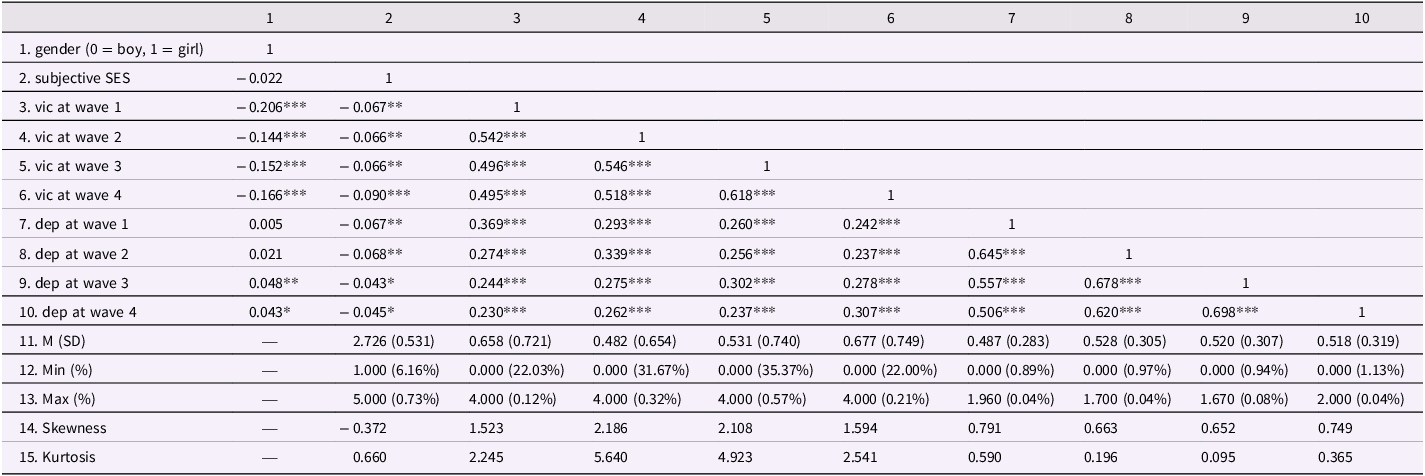
Analysis of longitudinal measurement invariance showed that peer victimization exhibited weak factorial invariance and strong factorial invariance, and depression symptoms exhibited weak factorial invariance in terms of cross-time measurement invariance. Further analysis showed that after enabling free estimates of the first wave of intercepts, depressive symptoms exhibited strong factorial invariance (ΔCFI = 0.006). In terms of cross-gender invariance, depressive symptoms were consistent with weak factorial invariance and strong factorial invariance. Peer victimization was only consistent with weak factorial invariance, which may be related to the higher peer victimization of boys than girls in the four waves (see Table 1 for correlations between gender and peer victimization). Overall, the measurement of peer victimization and depressive symptoms had acceptable equivalence across time and gender. Additional information on longitudinal measurement invariance was provided in the Supplementary Material (Section 2, Table S4).
Descriptive statistics for study variables at each wave

vic, peer victimization; dep, depressive symptoms. *two-tailed p < 0.05; **p < 0.01; ***p < 0.001.
Descriptive analysis
Descriptive statistics and correlations of variables at each wave are shown in Table 1. The mean scores of peer victimization and depressive symptoms across the four waves ranged from 0.482 to 0.677 and from 0.487 to 0.528, respectively. The four-wave assessments showed a moderate positive association between peer victimization and depressive symptoms (rs varied from 0.230 to 0.369, p < 0.001). The peer victimization of girls was lower than that of boys in all four measurement waves (rs varied from −0.144 to −0.206, p < 0.001). Depressive symptoms were greater in girls than in boys at the third and fourth measurement waves (rs = 0.048, p < 0.01; rs = 0.043, p < 0.05, respectively).
LCSMs and model comparisons
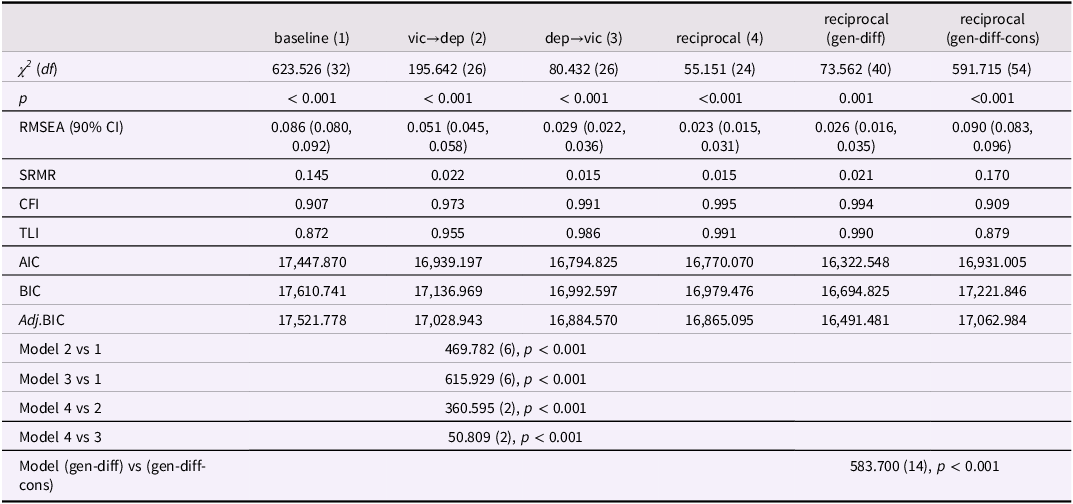
The fitting indices of the four competing models are shown in Table 2. Compared with Models 1 to 3, Model 4 (reciprocal effects) was the optimal model with the best-fit index and the lowest AIC, BIC, and adj. BIC values. The unstandardized parameter estimates of the reciprocal effects model were summarized in the Supplementary Material (Section 3, Table S5). The slope mean represents constant linear changes for individuals, indicating that peer victimization (B = 0.855, p < 0.001) and depressive symptoms (B = 0.199, p = 0.002) increased across the four measurement waves. The correlation between the intercept and slope suggested that peer victimization changed more rapidly in individuals with higher peer victimization at the start (B = 0.394, p < 0.001), and depressive symptoms changed more rapidly in individuals with higher depressive symptoms at the start (B = 0.014, p = 0.013). The intercept correlation indicated that individuals with higher levels of peer victimization at the initial measurement had higher depressive symptoms (B = 0.073, p < 0.001), and vice versa.
Fitting indexes and Satorra-Bentler chi-square difference test for latent change scores models

vic, peer victimization; dep, depressive symptoms; gen-diff, model of gender difference; gen-diff-cons, constraint model of gender difference.
As shown in Figure 3, the proportional effects indicated that higher levels of peer victimization (B = −1.978, p < 0.001) and depressive symptoms (B = −0.476, p < 0.001) in the previous wave were associated with lower increases in these variables in subsequent waves, suggesting a ceiling effect. The coupling effects showed that higher levels of depressive symptoms in the previous wave were associated with a higher increase in peer victimization in the subsequent wave (B = 1.599, p < 0.001); similar effects were observed in prior peer victimization levels on subsequent changes in depressive symptoms (B = 0.091, p = 0.034). Changes in previous peer victimization (B = 0.699, p < 0.001) and depressive symptoms (B = −1.421, p<0.001) predicted future peer victimization changes. Upward changes in peer victimization exacerbated future peer victimization changes, and upward changes in depressive symptoms downregulated future peer victimization. However, changes in depressive symptoms were not affected by changes in prior depressive symptoms and peer victimization.
Latent change scores model of peer victimization and depressive symptoms for the full sample. For clarity of presentation, the path coefficients were displayed only once in paths that were constrained to be equal, and only significant path coefficients were displayed. Dashed lines indicate non-significant paths. vic, peer victimization; dep, depressive symptoms. * p < 0.05; ** p < 0.01; *** p < 0.001.

Gender differences in LCSMs
As shown in Table 2, the fitting indices of the gender difference model (free estimation model) were better than those of the constrained model (Satorra-Bentler Scaled χ 2 = 583.700, Δdf = 14, p < 0.001), indicating that there were gender differences in the reciprocal effects. The unstandardized parameter estimates of the LCSMs for boys and girls were summarized in the Supplementary Material (Section 3, Table S5). The mean slope of peer victimization for girls (B = 1.035, p = 0.008) was significant, but it was not significant in boys. The correlation between the intercept and slope of depressive symptoms was significant in girls (B = 0.037, p < 0.001). Girls showed a correlation between the intercept of depressive symptoms and the slope of peer victimization (B = 0.106, p = 0.043), while boys did not. The coupling effects of the prior levels of depressive symptoms on subsequent changes in peer victimization were significant in boys (B = 2.243, p < 0.001) but not in girls (see Fig. 4 for boys and Fig. 5 for girls). The coupling effects of peer victimization levels on changes in depressive symptoms were not significant in boys or girls. Regarding the change-to-change effects, increased depressive symptoms in boys decreased the change in later peer victimization (B = −2.320, p = 0.001), and increased peer victimization in girls increased the change in later depressive symptoms (B = 0.166, p = 0.012).
Latent change scores model of peer victimization and depressive symptoms for boys. For clarity of presentation, the path coefficients were displayed only once in paths that were constrained to be equal, and only significant path coefficients were displayed. Dashed lines indicate non-significant paths. vic, peer victimization; dep, depressive symptoms. * p < 0.05; ** p < 0.01; *** p < 0.001.

Latent change scores model of peer victimization and depressive symptoms for girls. For clarity of presentation, the path coefficients were displayed only once in paths that were constrained to be equal, and only significant path coefficients were displayed. Dashed lines indicate non-significant paths. vic, peer victimization; dep, depressive symptoms. * p < 0.05; ** p < 0.01; *** p < 0.001.

In addition, the difference test of three pathways with similar effects in boys and girls (peer victimization status → peer victimization change, depressive symptoms status → depressive symptoms change, and peer victimization change → peer victimization change) showed that the relationship between prior levels of depressive symptoms and subsequent changes in depressive symptoms was significantly stronger in girls than in boys (χ 2 = 10.460, df = 1, p = 0.001). The remaining two pathways showed no gender differences (peer victimization status → peer victimization change: χ 2 = 1.874, df = 1, p = 0.171; peer victimization change → peer victimization change: χ 2 = 3.165, df = 1, p = 0.075). Trajectories of the actual data in the four measurement waves of boys and girls are shown in Figures 6 and 7 (Kievit et al., Reference Kievit, Brandmaier, Ziegler, van Harmelen, de, Susanne, Moutoussis, Goodyer, Bullmore, Jones, Fonagy, Lindenberger and Dolan2018; Zainal & Newman, Reference Zainal and Newman2021).
Trajectories of the actual data for boys.

Trajectories of the actual data for girls.

Robustness analysis of the results
The following additional analyses were conducted to verify the robustness of the results. First, the developmental trajectories of LCSMs were simulated for boys and girls, with 0, 2, and 4 set as the starting values of peer victimization (which was measured on a scale of 0–4); 0, 1, and 2 set as the starting values for depressive symptoms (which was measured on a scale of 0-2); and a starting value of 0 for the change values of the two. Figure 8 shows that the peer victimization of boys increased with initial values of depressive symptoms and subsequently declined with decreasing depressive symptoms, demonstrating a stable symptom-driven effect of depressive symptoms. Changes in boys’ peer victimization barely affected changes in depressive symptoms. Figure 9 shows that girls’ depressive symptoms changed as the initial value of peer victimization increased, showing that depressive symptoms rose and fell with the fluctuations in peer victimization. Changes in initial values of depressive symptoms barely affect trends in peer victimization.
Simulated developmental trajectories of peer victimization and depressive symptoms for boys. vic, peer victimization; dep, depressive symptoms.

Simulated developmental trajectories of peer victimization and depressive symptoms for girls. vic, peer victimization; dep, depressive symptoms.

Second, a random-intercept cross-lagged panel model (RI-CLPM; Hamaker et al., Reference Hamaker, Kuiper and Grasman2015) of peer victimization and depressive symptoms was conducted to validate the robustness of the LCSM results. Similar to the LCSM results, with a restricted autoregressive pathway of 1, peer victimization and depressive symptoms in boys interacted with each other (peer victimization → depressive symptoms, B = 0.878, p < 0.001; depressive symptoms → peer victimization, B = 2.751, p < 0.001). The stability of the depressive symptom-driven effects in boys was verified, whereas the effects of peer victimization on depressive symptoms may not have occurred through changes in depressive symptoms. Peer victimization affected depressive symptoms in girls (B = 0.946, p < 0.001), consistent with the results of LCSMs. RI-CLPM pathways for boys and girls were shown in the Supplementary Material (Section 4, Figures S1 and S2).
In addition, a sensitivity analysis was conducted by constraining the proportional effects to zero to reduce the possibility of overestimating the coupling effects (Zainal & Newman, Reference Zainal and Newman2022; Reference Zainal and Newman2023), as explained in the Supplementary Material (Section 5).
Discussion
The findings of this study support a reciprocal effects model in which changes in peer victimization and the occurrence of depressive symptoms was a function of prior levels and changes in each variable. Consistent with previous studies showing a strong association between the two (Christina et al., Reference Christina, Magson, Kakar and Rapee2021; Wu et al., Reference Wu, Zhang, Su and Hu2015), the positive correlation between intercepts in the full sample suggested that higher levels of peer victimization were associated with higher levels of depressive symptoms (and vice versa). Within-individual changes in the four measurement waves showed that the constant linear change components of adolescents’ peer victimization and depressive symptoms increased over time. Levels and changes in peer victimization and depressive symptoms interacted, while changes in depressive symptoms unilaterally influenced changes in peer victimization. This pattern differed between boys and girls.
The ceiling effects of peer victimization and depressive symptoms over time were observed in both boys and girls, as well as the catalytic effect of changes in prior peer victimization on the stabilization of subsequent peer victimization. Gender differences were exhibited in the more subtle impact components. In boys, peer victimization (either level or change) did not affect changes in depressive symptoms; instead, levels and changes in depressive symptoms affected changes in peer victimization. Elevated levels of depressive symptoms reduced the subsequent increase in these levels, which in turn contributed to an increase in peer victimization. Thus, peer victimization and depressive symptoms showed depressive symptom-driven effects in boys, both as a direct effect of depressive symptom level on changes in peer victimization and through changes in depressive symptoms. In girls, increased prior peer victimization promoted subsequent increases in depressive symptoms. Elevated levels of peer victimization decreased the subsequent increase in peer victimization, which further reduced the magnitude of the increase in depressive symptoms. However, this does not imply a decline in depressive symptoms because depressive symptoms in girls showed a constant rate of increase (the slope of depressive symptoms was 0.484, p < 0.001). Thus, depressive symptoms in girls varied with peer victimization.
Gender stereotypes may be a potential explanation for the gender differences in the dynamic relationships between peer victimization and depressive symptoms. Specifically, gender stereotypes emphasize toughness and grit in boys. The outward manifestation of depressive symptoms, such as withdrawal and sadness, violates the social norms of boys; thus, depressive symptoms are more likely to elicit peer victimization (Card & Hodges, Reference Card and Hodges2008; Rogers et al., Reference Rogers, DeLay and Martin2017; Salk et al., Reference Salk, Hyde and Abramson2017). In contrast to boys, girls experienced more negative consequences of peer victimization and suffered depressive symptoms as a result. Girls are more susceptible to interpersonal stress than boys (Stroud et al., Reference Stroud, Papandonatos, D’Angelo, Brush and Lloyd-Richardson2017). Moreover, their strong sense of interpersonal dependence and group evaluation makes it difficult for them to cope with adverse events such as peer victimization that disrupt interpersonal relationships (Pontes et al., Reference Pontes, Ayres and Pontes2018). This further contributes to the exacerbation of depressive symptoms (Rudolph & Flynn, Reference Rudolph and Flynn2007).
Strengths and limitations
Adolescents in the transition from elementary to middle school experience dramatic emotional and behavioral fluctuations (Bailen et al., Reference Bailen, Green and Thompson2019). Focusing on the changes in adolescent development, this study identified the factors that influence changes in peer victimization and depressive symptoms from the perspective of the fluctuating nature of this period. These findings provide an empirical basis for understanding the developmental patterns in the dynamic changes in both variables. Gender differences in the dynamic relationships between peer victimization and depressive symptoms also have practical importance. Efforts to alleviate depressive symptoms in boys may be effective in encouraging their integration into peer groups and thus reducing subsequent changes in peer victimization. In girls, it is critical to monitor and identify the onset of peer victimization and intervene early to mitigate the subsequent depressive symptoms that may occur.
In addition to the above strengths, there are some limitations of this study. First, participants were not provided with a definition of peer victimization in the measurement, and there may be potential biases in participants’ understanding of this construct (Sawyer et al., Reference Sawyer, Bradshaw and O’Brennan2008). Second, self-reported peer victimization by adolescents may be underestimated due to the influence of social desirability (Ivarsson et al., Reference Ivarsson, Broberg, Arvidsson and Gillberg2005). Moreover, adolescents with depressive symptoms may be influenced by a bias in self-perception and exaggerate reports of peer victimization, increasing the correlation between these two variables (Casper & Card, Reference Casper and Card2017). Using a definition-based measure of peer victimization and combining self-reports with peer nominations to more accurately reflect peer victimization is worth considering. Third, emotion regulation and coping skills are not fully developed in adolescence, and depressive symptoms are affected by physiological development and environmental changes (DePasquale et al., Reference DePasquale, Herzberg and Gunnar2021). Future research should further control for multiple possible influencing factors (e.g., puberty, life events) to obtain more comprehensive results. Fourth, data were collected over a limited time span in early adolescence. Extending the time frame examined to the high school years would be beneficial in providing comprehensive developmental patterns of the interaction between peer victimization and depressive symptoms. Moreover, the increased prevalence of cyber victimization makes it an issue of concern in the study of adolescent peer victimization (Tran et al., Reference Tran, Thai, Dang, Vo and Duong2023). Future research should focus on the interrelationships between cyber victimization and the development of depressive symptoms to increase empirical evidence in the field of adolescent victimization and health development. Finally, the diversity of the sample of this study was limited (in terms of cultural context, sexual orientation, and gender identity). For generalization, the findings need to be replicated and validated in multi-regional, multi-cultural, and gender-diverse samples.
Conclusion
The relationships between peer victimization and depressive symptoms in adolescents are developmentally dynamic, especially during the school transition period. Depressive symptoms in boys drove peer victimization. Depressive symptoms in girls varied according to peer victimization. Taken together, these findings provide empirical evidence that enhances understanding of how adolescents’ peer victimization and depressive symptoms interact with each other during development. This study also emphasizes the importance of distinguishing the effects in boys and girls for developing practical interventions.
Supplementary material
The supplementary material for this article can be found at https://doi.org/10.1017/S0954579423001529.
Acknowledgements
The authors gratefully thank the National Social Science Fund of China for supporting this study.
Funding statement
The research was supported by the National Social Science Fund of China (21BSH104).