Introduction
The genus Carbacanthographis Staiger & Kalb was established by Staiger (Reference Staiger2002) for species of Graphidaceae with lirellate ascomata, well-developed labia, a distinctly carbonized excipulum, warty periphysoids, apically smooth paraphyses, and hyaline, non-amyloid to weakly amyloid ascospores. While Staiger (Reference Staiger2002) originally included eight species in the genus, 23 species are currently listed in Index Fungorum (Staiger Reference Staiger2002; Nakanishi et al. Reference Nakanishi, Kashiwadani and Moon2003; Kalb Reference Kalb2004; Archer Reference Archer2005, Reference Archer2007; Lücking et al. Reference Lücking, Archer and Aptroot2009; Sharma et al. Reference Sharma, Makhija and Khadilkar2010; Tripp et al. Reference Tripp, Lendemer and Harris2010; Sharma & Khadilkar Reference Sharma and Khadilkar2011; Kukwa et al. Reference Kukwa, Schiefelbein and Flakus2013; Kalb & Aptroot Reference Kalb and Aptroot2018), after excluding three species reclassified in the genus Redonographa (Lücking et al. Reference Lücking, Tehler, Bungartz, Rivas and Lumbsch2013). Lücking et al. (Reference Lücking, Hodkinson and Leavitt2017) counted 28 species, in anticipation of additional species not yet formally included or established in the genus; these are treated in this study, in addition to several other new taxa.
Species of Carbacanthographis are most similar to those of Graphis Adans. and Allographa Chevall. (Lücking et al. Reference Lücking, Archer and Aptroot2009; Lücking & Kalb Reference Lücking and Kalb2018), sharing well-developed, carbonized labia, but they are distinguished by the presence of warty periphysoids lining the inner excipulum above the hymenium (although these might sometimes be indistinct), the mostly non-amyloid ascospores, and the typically thick, white-pruinose cover on the lirellae, in addition to an often ecorticate or loosely corticate thallus. The white cover on the lirellae and the non-amyloid ascospores also resemble the genus Dyplolabia A. Massal., an unrelated lineage in the subfamily Fissurinoideae, which differs in the lack of warty periphysoids and the usually diamond-shaped ascospore lumina (Staiger Reference Staiger2002). While Carbacanthographis originally included species with non-amyloid to weakly amyloid (C. amicta (Nyl.) Staiger & Kalb and C. inspersa Staiger) ascospores, four species subsequently assigned to this genus have rather distinctly amyloid ascospores, viz. C. albolirellata B. O. Sharma & Khadilkar, C. salazinica (A. W. Archer) A. W. Archer, C. sorediata B. O. Sharma et al. and C. violaceospora (Kukwa et al. Reference Kukwa, Schiefelbein and Flakus2013).
As a consequence, the most reliable phenotypic difference between Carbacanthographis on one hand and Graphis or Allographa on the other are the warty periphysoids; five new species described here also feature apically warty paraphyses, a character previously not reported for the genus. The overall similarity with Graphis and Allographa is remarkable given that Carbacanthographis is not related to those two genera, but instead clusters with Heiomasia Nelsen et al. and the Acanthothecis peplophora group in another tribe (Lumbsch et al. Reference Lumbsch, Kraichak, Parnmen, Rivas, Aptroot, Cáceres, Ertz, Feuerstein, Mercado-Díaz and Staiger2014; Medeiros et al. Reference Medeiros, Kraichak, Lücking, Mangold and Lumbsch2017). Heiomasia has ascomata very similar to Carbacanthographis but differs largely in the thick isidia and the absence of distinct, warty periphysoids (Nelsen et al. Reference Nelsen, Lücking, Rivas and Mbatchou2010; Lendemer & Harris Reference Lendemer and Harris2014); in contrast, the Acanthothecis peplophora group, which is not related to Acanthothecis Clem. s. str. (Medeiros et al. Reference Medeiros, Kraichak, Lücking, Mangold and Lumbsch2017), forms uncarbonized lirellae.
New collections made by the first author in Brazil, together with herbarium revisions including some historical type material, revealed 17 species new to science and one new combination in Carbacanthographis; this required a thorough nomenclatural and taxonomic update of the genus, which is presented here in the form of a dichotomous key (along with a separately published interactive key), plus brief descriptions and selected illustrations. We also present molecular data for one of the new species, expanding the sampling of the genus, which is notoriously difficult to sequence.
Materials and Methods
Morphological, anatomical and chemical studies
Morphological and anatomical characteristics were analyzed in the Laboratory of Mycology at UFRGS and the laboratories at BGBM, using a Leica Zoom 2000 and a Zeiss Stemi DV4 stereomicroscope, and Zeiss Axioskop and Leica DM500 compound microscopes. For spot tests (Table 1), we used 10% potassium hydroxide (K) and para-phenylenediamine (P). Lugol's solution (I) was used for testing the amyloidity of the ascospores. All specimens were exposed to ultraviolet light (UV). Analysis of secondary metabolites was performed using TLC, with solvents A, B and C (Culberson & Ammann Reference Culberson and Ammann1979; Orange et al. Reference Orange, James and White2010).
Main secondary metabolites of Carbacanthographis and their respective reactions in spot tests using K (best performed in thallus sections under the microscope) and P (best performed in exposed medulla and the pruina on the ascomata).

Molecular phylogenetic studies
DNA extraction and amplification of the mitochondrial small subunit (mtSSU) and nuclear large subunit (nuLSU) were performed using the REDExtract-N-Amp Plant PCR Kit (Sigma Aldrich, USA). DNA extraction followed the manufacturer's instructions, except that 20 μl of extraction buffer and 20 μl of dilution buffer were used.
The primers used for mtSSU amplification were mr-SSU1 and mr-SSU3R (Zoller et al. Reference Zoller, Scheidegger and Sperisen1999), and AL2R (Mangold et al. Reference Mangold, Martín, Lücking and Lumbsch2008) and Nu-LSU-1125-3′ (= LR6) (Vilgalys & Hester Reference Vilgalys and Hester1990) were used for nuLSU. PCR reactions contained 3.5 μl Red TAQ (REDExtract-N-Amp Plant PCR Kit), 0.5 μl of each primer (10 μM), 2 μl genomic DNA extract and 6.5 μl distilled water for a total of 13 μl. Thermal cycling parameters for nuLSU were: initial denaturation for 5 min at 94 °C, followed by 35 cycles of 30 s at 95 °C, 30 s at 58 °C, 1 min at 72 °C, and a final elongation for 10 min at 72 °C. For mtSSU, the parameters were: initial denaturation for 5 min at 95 °C, followed by 35 cycles of 45 s at 94 °C, 1 min at 50 °C, 1 min 30 s at 72 °C, and a final elongation for 10 min at 72 °C. Samples were visualized on a 1% ethidium bromide-stained agarose gel under UV light and bands were gel-extracted, heated at 70 °C for 5 min, cooled to 45 °C for 10 min, treated with 1 μl GELase (Epicentre Biotechnologies, Madison, WI, USA) and sent for sequencing to Macrogen, Amsterdam.
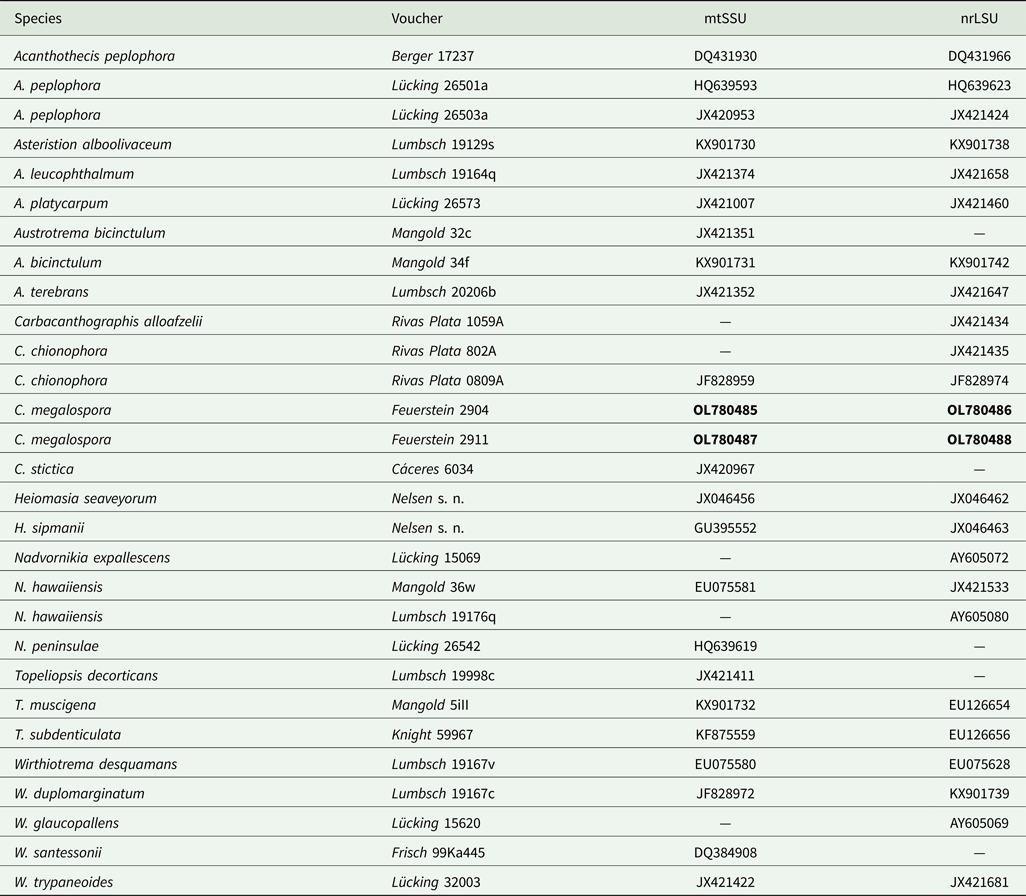
The obtained sequences were aligned with other species of the genus Carbacanthographis and other genera of the tribe Wirthiotremateae, together with related lineages available from GenBank (Table 2), following Medeiros et al. (Reference Medeiros, Kraichak, Lücking, Mangold and Lumbsch2017), and using Topeliopsis Kantvilas & Vězda as outgroup. The combined alignment was subjected to a maximum likelihood search using RAxML v.8.2.8 (Stamatakis Reference Stamatakis2014), with non-parametric bootstrapping using 1000 replicates under the universal GTR-GAMMA model.
GenBank Accession numbers and voucher information for sequences of Wirthiotremateae and allied taxa used in this study. Newly generated sequences are indicated in bold.

Interactive key
An interactive key was created using the program FRIDA (FRiendly IDentificAtion) 3.0 developed by the Department of Life Sciences at the University of Trieste, Italy (Martellos Reference Martellos, Nimis and Vignes2010). The key is available on the Dryades project website at http://dryades.units.it/frida_keys/graphidaceae/index.php?procedure=ext_key_home&key_id=11.
Results and Discussion
During the study, 17 new species of Carbacanthographis were discovered: C. acanthoamicta, C. acanthoparaphysata, C. novoguineensis, C. salazinicoides and C. subchionophora from Papua New Guinea; C. aggregata, C. halei, C. pseudorustica and C. sipmaniana from Malaysia; C. aptrootii from China; C. latispora and C. multiseptata from Venezuela; C. amazonica from Colombia, French Guyana and Suriname (Amazon region); C. chionophoroides from Colombia and Brazil; and C. brasiliensis, C. megalospora and C. spongiosa from Brazil. Except for C. megalospora, a new species recently collected in Brazil, the other species were found in material deposited in the herbarium of the Botanic Garden and Botanical Museum of the Freie Universität Berlin (B) and in the Smithsonian National Herbarium (US).
One of the factors that influence the success of DNA extraction in Graphidaceae is the age of the specimen. Therefore, it was not possible to extract and amplify DNA from the herbarium specimens dating from 1965–2002, and Carbacanthographis megalospora was the only new species that could be sequenced for this study, confirming the position of the species within the genus (Fig. 1).
Phylogenetic tree (maximum likelihood) based on concatenated mtSSU and nuLSU sequence data, with Topeliopsis as outgroup, showing the Carbacanthographis clade with respect to neighbouring clades and the position of C. megalospora (shaded). Country of origin is indicated and specimens are listed in Table 1. Numbers below branches represent bootstrap support values.

In this paper, we accept four additional species with distinctly amyloid ascospores in Carbacanthographis, viz. C. acanthoparaphysata, C. aptrootii, C. brasiliensis and C. pseudorustica, in addition to one species, C. sipmaniana, with weakly amyloid ascospores. These are placed in the genus because of their pruinose lirellae and distinctly warty periphysoids. While warty periphysoids are a diagnostic feature of Carbacanthographis, most species thus far included in the genus have smooth paraphyses, with the exception of C. uniseptata (Kalb & Aptroot Reference Kalb and Aptroot2018). In this study, five new species with apically warty paraphyses are also introduced: C. acanthoamicta, C. acanthoparaphysata, C. aptrootii, C. brasiliensis and C. sipmaniana. Notably, among the newly described species, there was a strong correlation between the presence of amyloid ascospores and apically warty paraphyses, with four out of six species having both these features. This correlation needs to be explored further. Below, descriptions of the 17 new species, as well as comments on the additional 24 species currently accepted in the genus, are presented and a dichotomous identification key is provided.
World key to species of Carbacanthographis
Main key
1 Excipulum laterally carbonized Group 1
Excipulum completely carbonized 2
2(1) Ascospores transversely septate Group 2
Ascospores muriform or submuriform Group 3
Group 1: excipulum laterally carbonized
1 Ascospores submuriform to muriform 2
Ascospores transversely septate 5
2(1) Ascospores muriform, more than 40 μm long; stictic acid; thallus whitish, lirellae not contrasting with thallus colour 3
Ascospores submuriform, up to 30 μm long; salazinic, protocetraric and/or norstictic acids; thallus greenish, the white-pruinose lirellae contrasting with thallus colour 4
3(2) Ascospores single, 80–100 × 20–25 μm; hymenium clear; margins of lirellae smooth 23. C. cleitops
Ascospores 6–8 per ascus, 50–75 × 18–30 μm; hymenium thinly inspersed; margins of lirellae verrucose 39. C. triphoroides
4(2) Thallus lacking soralia; ascospores 11–17 × 5–7 μm, I−; salazinic, protocetraric and norstictic acids 32. C. marcescens
Thallus sorediate; ascospores 17–28 × 7–10 μm, I+; salazinic and consalazinic acids 36. C. sorediata
5(1) Ascospores up to 30 μm long and up to 9-septate; thallus greenish to brownish, the white-pruinose lirellae strongly contrasting with thallus colour 6
Ascospores usually more than 30 μm long and more than 10-septate; thallus pale to whitish, lirellae not contrasting with thallus colour 8
6(5) Ascospores 25–30 × 5–7.5 μm, 7–9-septate; stictic acid 31. C. iriomotensis
Ascospores 12–25 μm long, 3–5-septate; salazinic or psoromic and 2-O-demethylpsoromic acids 7
7(6) Ascospores 12–17 × 6–8 μm, 3-septate, I−; psoromic and 2-O-demethylpsoromic acids 19. C. alloafzelii
Ascospores 18–25 × 6–8 μm, 3–5-septate, I+; salazinic acid 34. C. nematoides
8(5) Ascomata concolorous, erumpent; ascospores 25–70 × 7.5–10 μm, 10–15-septate; salazinic acid 28. C. indica
Ascomata white-pruinose, prominent; ascospores 60–90 × 8–12 μm, 15–29-septate; norstictic acid 29. C. induta
Group 2: excipulum completely carbonized, ascospores transversely septate
1 Hymenium inspersed 2
Hymenium clear 3
2(1) Thallus uneven to shallowly verrucose, lacking minute pores; ascomata sessile, uniformly white-pruinose, below the pruina the labia often striate; ascospores 23– 35 × 6–7 μm, 9–13-septate; stictic, constictic, menegazziaic and hypostictic acids 37. C. stictica
Thallus verrucose and with numerous minute pores, causing a spongy appearance including of the ascoma margins; ascomata erumpent, thinly pruinose but with a distinct lateral thalline margin, labia entire; ascospores 23–25 × 6–7 μm, 6–8-septate; stictic and cryptostictic acids 16. C. spongiosa
3(1) Lichexanthone present (thallus UV+ yellow) 4
Lichexanthone absent (thallus UV−) 5
4(3) Ascospores 55–100 × 7–9 μm, 16–24-septate 21. C. candidata
Ascospores 20–25 × 6–8 μm, 5–8-septate 22. C. chionophora
5(3) Ascospores 7–8 × 3–4 μm, 1-septate 40. C. uniseptata
Ascospores more than 12 μm long and multiseptate 6
6(5) Thallus isidiate; ascospores 3-septate; protocetraric acid 26. C. hertelii
Notes. If thallus with numerous thickened, robust isidia and a chemistry of 5-hydroxy-4-O-demethylnotatic acid and 4-O-demethylnotatic acid, see Heiomasia seaveyorum Nelsen & Lücking Thallus lacking isidia; ascospores more than 5-septate 7
7(6) Ascospores more than 120 μm long; ascomata typically shortly oval 8
Ascospores up to 60 μm long; ascomata typically lirelliform 9
8(7) Ascospores 140–155 × 30–35 μm, 13–17-septate; stictic, cryptostictic and constictic acids 9. C. latispora
Ascospores 170–200 × 12–16 μm, 29–35-septate; protocetraric acid 11. C. multiseptata
9(7) Paraphyses apically warty; ascospores I+; norstictic acid or no substances 10
Paraphyses apically smooth; ascospores I− or rarely I+; stictic or protocetraric acids 12
10(9) No substances; ascospores 13–19-septate, 50–65 × 6–9 μm 6. C. brasiliensis
Norstictic acid; ascospores variable 11
11(10) Ascospores 17–20 × 6–8 μm, 5–7-septate; norstictic and connorstictic acids 15. C. sipmaniana
Ascospores 45–55 × 8–10 μm, 12–16-septate; norstictic acid 5. C. aptrootii
12(9) Ascospores 45–65 × 10–12 μm, I+ 13. C. pseudorustica
Ascospores 25–35 × 6–8 μm, I− 13
13(12) Ascomata white-pruinose, contrasting with thallus; ascospores 25–35 × 6–8 μm; stictic acid 14
Ascomata with smooth thallus cover concolorous with thallus; ascospores up to 25 μm long; protocetraric acid 15
14(13) Thallus smooth to uneven, often laterally lining the ascomata; ascospores 25–30 × 6–8 μm; norstictic acid (trace) present in addition to stictic acid 4. C. amazonica
Thallus uneven to distinctly verrucose, not forming a lateral margin along the ascomata; ascospores 25–35 × 7–8 μm; stictic and constictic acids 8. C. halei
15(13) Ascospores 13–20 × 6–7 μm, 5–7-septate 7. C. chionophoroides
Ascospores 22–25 × 5 μm, 9–13-septate 17. C. subchionophora
Group 3: excipulum completely carbonized, ascospores submuriform to muriform
1 Lichexanthone present (thallus UV+ yellow) 2
Lichexanthone absent (thallus UV−) 3
2(1) Ascospores 4 per ascus, 90–165 × 9–14 μm, I+ 41. C. violaceospora
Ascospores 8 per ascus, 55–90 × 11–18 μm, I− 38. C. subalbotecta
3(1) Ascospores more than 100 μm long; 1–4 per ascus 4
Ascospores up to 80 μm long; 8 per ascus 6
4(3) Ascospores 4 per ascus, 114–162 × 9–15 μm; protocetraric acid 33. C. muriformis
Ascospores single, more than 20 μm wide; stictic acid and satellite substances 5
5(4) Thallus ecorticate, shallowly verrucose also laterally along the ascomata; ascospores 120–180 × 20–30 μm 25. C. crassa
Thallus corticate, rather smooth along the ascomata; ascospores (185–)235–255 × 30–40 μm 10. C. megalospora
6(3) No substances 7
Psoromic, protocetraric or salazinic acid, sometimes additionally with norstictic acid 8
7(6) Ascomata prominent to sessile; ascospores 16–20 × 6–8 μm, I+ 18. C. albolirellata
Ascomata immersed to erumpent; ascospores 6–12 × 7–10 μm, I− 24. C. coccospora
8(6) Hymenium inspersed; protocetraric acid 30. C. inspersa
Hymenium clear 9
9(8) Paraphyses apically warty 10
Paraphyses apically smooth 11
10(9) Protocetraric acid; ascospores I+ 2. C. acanthoparaphysata
Salazinic acid; ascospores I− 1. C. acanthoamicta
11(9) Psoromic and subpsoromic acids; ascospores 22–26 × 10–12 μm 27. C. hillii
Salazinic acid 12
12(11) Ascospores more than 40 μm long 14. C. salazinicoides
Ascospores up to 25 μm long 13
13(12) Ascospores I−; ascomata typically aggregated in small clusters 14
Ascospores I+; ascomata typically dispersed 15
14(13) Ascospores 12–13 × 7–8 μm, 3–4 × 0–1-septate; ascomata prominent, distinctly aggregated 3. C. aggregata
Ascospores 15–20 × 8–10 μm, 5 × 0–1-septate; ascomata sessile, loosely to irregularly aggregated 12. C. novoguineensis
15(13) Ascomata prominent; ascospores 14–18 × 6–7 μm, 5–6 × 1–2-septate; salazinic acid 20. C. amicta
Ascomata sessile; ascospores 19–23 × 7–8 μm, 5–7 × 0–1-septate; salazinic, consalazinic, norstictic and protocetraric acids 35. C. salazinica
The New Species
1. Carbacanthographis acanthoamicta Feuerstein & Lücking sp. nov.
MycoBank No.: MB 836667
Differing from Carbacanthographis amicta by the non-amyloid ascospores and the apically warty paraphyses.
Type: Papua New Guinea, Northern Province, Owen Stanley Range, Myola, 09°09′S, 147°46′E, 2100 m, in primary montane forest in valley, 14 October 1995, A. Aptroot 37327 (LAE—holotype; B—isotype).
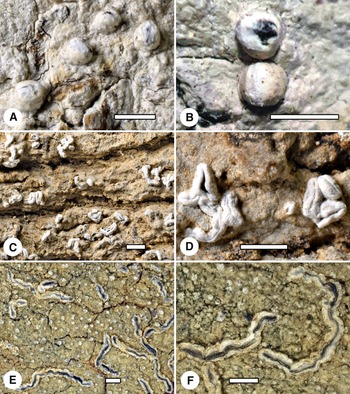
A & B, Carbacanthographis acanthoamicta, thallus with ascomata (isotype). C & D, C. acanthoparaphysata, thallus with ascomata and ascospore (isotype). E & F, C. aggregata, thallus with ascomata (isotype). Scales = 1 mm. Ascospore length = 20 μm. In colour online.

Thallus corticolous, uneven to verrucose, olive to yellowish brown, thinly corticate; prothallus present, black; isidia and soralia absent.
Ascomata lirelliform, concolorous with the thallus to whitish, dispersed to somewhat clustered, straight to sinuous, unbranched to irregularly or sometimes stellately branched, prominent, with complete thalline margin but not distinctly pruinose, 1–3 mm long, 0.4–0.6 mm wide. Labia well developed, entire to becoming striate. Disc concealed. Excipulum completely carbonized. Hymenium clear, I−. Paraphyses apically warty. Periphysoids apically warty, 7–10 μm long. Ascospores 8 per ascus, hyaline, submuriform to muriform, 5–7 × 0–2-septate, 17–20 × 8 μm, twice as long as wide, I−.
Chemistry
Thallus surface UV−; medulla P+ orange, K+ yellow turning red; thallus section K+ yellow forming small red crystals. TLC: salazinic acid.
Etymology
The epithet refers to the similarity with Carbacanthographis amicta.
Distribution and ecology
So far known only from the type locality, growing epiphytically in montane rainforest.
Notes
Carbacanthographis acanthoamicta is the only taxon in the genus with a completely carbonized excipulum, clear hymenium, apically warty paraphyses, (sub-)muriform ascospores, and salazinic acid. The common C. marcescens has a laterally carbonized excipulum and further differs in the distinctly pruinose ascomata and the ecorticate thallus. Carbacanthographis amicta is morphologically and anatomically most similar to C. acanthoamicta but deviates in the smooth paraphyses and the I+ ascospores (Staiger Reference Staiger2002).
2. Carbacanthographis acanthoparaphysata Feuerstein & Lücking sp. nov.
MycoBank No.: MB 836668
Differing from Carbacanthographis albolirellata in the apically warty paraphyses and the presence of protocetraric acid.
Type: Papua New Guinea, Northern Province, Owen Stanley Range, Myola, 09°09′S, 147°46′E, 2100–2400 m, in primary montane forest on mountain slope, 15 October 1995, A. Aptroot 37493 (LAE—holotype; B—isotype).
Thallus corticolous, uneven to shallowly verrucose, whitish grey to pale yellowish, ecorticate; prothallus present, black; isidia and soralia absent.
Ascomata lirelliform, concolorous with the thallus but upper portion of the labia with a white cover, dispersed, straight to sinuous, unbranched to irregularly branched, prominent to partly becoming sessile, with complete thalline margin, 1–5 mm long, 0.3–0.5 mm wide. Labia well developed, entire to becoming striate. Disc concealed. Excipulum completely carbonized. Hymenium clear, I−. Paraphyses apically warty. Periphysoids apically warty, 5–10 μm long. Ascospores 8 per ascus, hyaline, submuriform, 4–6 × 0–2-septate, 17–20 × 8 μm, c. twice as long as wide, I+ blue.
Chemistry
Thallus surface UV−; medulla P+ orange-red, K− to faintly K+ yellow; thallus section K− to very weakly K+ yellow. TLC: protocetraric acid.
Etymology
The specific epithet refers to the apically warty paraphyses.
Distribution and ecology
So far known only from the type locality, growing epiphytically in montane rainforest.
Notes
Carbacanthographis acanthoparaphysata and C. acanthoamicta are the only species with apically warty paraphyses and submuriform ascospores. They differ from each other by their chemistry, the latter producing salazinic acid. Carbacanthographis inspersa and C. albolirellata, both with apically smooth paraphyses, are similar in ascoma morphology, excipulum carbonization, and ascospore size and amyloidity (Staiger Reference Staiger2002; Sharma & Khadilkar Reference Sharma and Khadilkar2011); apart from the apically smooth paraphyses, the first differs by the inspersed hymenium and the second by the absence of chemical substances.
3. Carbacanthographis aggregata Feuerstein & Lücking sp. nov.
MycoBank No.: MB 836669
Differing from Carbacanthographis novoguineensis in the smaller ascospores and the less emergent, more distinctly aggregated ascomata.
Type: Malaysia, Johor, Gunung Pulai Forest Reserve, 01°36′N, 103°34′E, 150 m, regrowth in disturbed primary forest, 26 November 2000, H. Sipman, B. C. Tan & Farida 46433 (SNP—holotype; B—isotype).
Thallus corticolous, continuous, uneven, greenish grey to grey, ecorticate; prothallus present, black; isidia and soralia absent.
Ascomata lirelliform, white-pruinose, aggregated in small clusters, straight to sinuous, irregularly to radiately branched, prominent, 0.5–2 mm long, 0.2–0.3 mm wide. Labia well developed, entire. Disc concealed. Excipulum completely carbonized. Hymenium clear, I−. Paraphyses smooth. Periphysoids apically warty, 10–15 μm long. Ascospores 8 per ascus, hyaline, submuriform, 3–4 × 0–1-septate, 12–13 × 7–8 μm, c. 1.5 times as long as wide, I−.
Chemistry
Thallus surface UV−; medulla P+ orange, K+ yellow turning red; thallus section with K+ yellow efflux forming red crystals. TLC: salazinic and norstictic (trace) acids.
Etymology
The epithet refers to the distinctly aggregated ascomata.
Distribution and ecology
So far known only from Asia (China and Malaysia), growing epiphytically in lowland rainforest.
Notes
Carbacanthographis aggregata and C. novoguineensis (see below) are the only species with a completely carbonized excipulum, clear hymenium, apically warty periphysoids, submuriform, I− ascospores and salazinic acid; however, C. aggregata is separated from the latter by the smaller ascospores, the more distinctly aggregated, less emergent ascomata and traces of norstictic acid in addition to salazinic acid. A specimen from Hong Kong (Aptroot 43365) shares almost all the characteristics of C. aggregata, except for the lirellae being erumpent rather than prominent and the presence of salazinic acid as the only compound. For now, we consider this material to also belong here, but further collections are needed for a better understanding of this taxon.
Additional specimen examined
China: Hong Kong: New Territories, Tai Po Kau Nature Reserve, 150 m along Tai Po Kau mountain, 22°24′N, 114°10′E, 1998, A. Aptroot 43365 (B).
4. Carbacanthographis amazonica Feuerstein & Lücking sp. nov.
MycoBank No.: MB 836670
Differing from Carbacanthographis stictica by the clear hymenium and additional presence of traces of norstictic acid.
Type: French Guiana, Saint-Laurent-du-Maroni, Canton de Maripasoula, Commune de Saül, 03°37′N, 53°12′W, 300–400 m, moist tropical forest, on hills over quartz and granite, 7 September 1994, R. C. Harris 33844 (NY—holotype; B—isotype).
A, Fissurina albocinerea present in the type material of Carbacanthographis alloafzelii (BM). B, C. alloafzelii, thallus with ascomata (Philippines, Rivas Plata & Lücking 1059A). C & D, C. amazonica, thallus with ascomata (isotype). E, C. aptrootii, thallus with ascomata and ascospores (isotype). F, C. brasiliensis, thallus with ascomata and ascospore (isotype). Scales = 1 mm. Ascospore length: E (lower right ascospore) = 50 μm; F = 60 μm. In colour online.

Thallus corticolous, uneven, greenish to greenish yellow, ecorticate; prothallus present, black; isidia and soralia absent.
Ascomata lirelliform, laterally concolorous with the thallus, apically white-pruinose, dispersed but rather dense, straight to sinuous, unbranched to sparsely branched, sessile, with an irregularly developed, lateral thalline margin, 1–7 mm long, 0.4–0.6 mm wide. Labia well developed, entire to becoming striate. Disc concealed. Excipulum completely carbonized. Hymenium clear, I−. Paraphyses smooth. Periphysoids apically warty, 6–10 μm long. Ascospores 8 per ascus, hyaline, 7–12-septate, 25–30 × 6–8 μm, 3–5 times as long as wide, I−.
Chemistry
Thallus surface UV−; medulla P+ orange, K+ yellow turning orange; thallus section with persistently K+ yellow efflux and occasional formation of red, needle-shaped crystals. TLC: stictic acid and traces of norstictic acid.
Etymology
The name of the species refers to the broader Amazon region where it was found, in three different countries.
Distribution and ecology
Known from the Amazon region, growing epiphytically in tropical rainforest.
Notes
Carbacanthographis latispora (see below), C. spongiosa (see below) and C. stictica (Staiger Reference Staiger2002) are the only other species with a completely carbonized excipulum, transversely septate ascospores and stictic acid as the major substance. Carbacanthographis latispora differs in the very short ascomata and large ascospores (140–155 × 30–35 μm), and C. spongiosa in the erumpent ascomata with the lateral thalline margin having a spongiose appearance, and the inspersed hymenium. Carbacanthographis stictica corresponds morphologically with C. amazonica but also differs in the inspersed hymenium.
Additional specimens examined
Colombia: Amazonas: Comunidad Villazul, E of Araracuara, 0°42′S, 72°07′W, 1988, H. Sipman & J. Duivenvoorden 28303 (B, COAH).—French Guyana: Saint-Laurent-du-Maroni: Saül, along trail to Monts la Fumeé, 03°38′N, 53°11′W, tropical primary forest, 1988, H. Sipman 31660 (B).—Suriname: Sipaliwini: Kabalebo, km 34, 1900 m, 1981, R. Zielman 9696b (B).
5. Carbacanthographis aptrootii Feuerstein & Lücking sp. nov.
MycoBank No.: MB 836671
Differing from Carbacanthographis sipmaniana by the larger ascospores with more septa.
Type: China, Yunnan, Xishuangbanna, Xishuangbanna Primeval Forest Park, 22°01′N, 100°52′E, 600 m, primary remnant in narrow valley, 2 November 2002, A. Aptroot 57440 (KUN—holotype; B—isotype).
(Fig. 3E)
Thallus corticolous, continuous, uneven to shallowly verrucose, greyish to yellowish grey, ecorticate; prothallus absent; isidia and soralia absent.
Ascomata lirelliform, white-pruinose, dispersed, straight to sinuous, unbranched to sparsely branched, erumpent to prominent, with an irregularly developed, lateral thalline margin, 1–5 mm long, 0.2–0.3 mm wide. Labia well developed, entire to becoming striate. Disc concealed. Excipulum completely carbonized. Hymenium clear, I−. Paraphyses apically warty. Periphysoids apically warty, 10–15 μm long. Ascospores 8 per ascus, hyaline, 12–16-septate, 45–55 × 8–10 μm, 4–6 times as long as wide, I+ blue-violet.
Chemistry
Thallus surface UV−; medulla P+ orange, K+ yellow turning red; thallus section with K+ yellow efflux forming red, needle-shaped crystals. TLC: norstictic acid.
Etymology
The species is named in honour of André Aptroot, for his numerous, important contributions to tropical lichenology.
Distribution and ecology
So far known only from the type locality, growing epiphytically in rainforest.
Notes
Carbacanthographis sipmaniana and C. brasiliensis (see below) are the only other species with a completely carbonized excipulum, transversely septate, I+ blue-violet ascospores, and apically warty paraphyses. Carbacanthographis sipmaniana differs in the larger ascospores with more numerous septa, while C. brasiliensis contains no lichen acids.
6. Carbacanthographis brasiliensis Feuerstein & Lücking sp. nov.
MycoBank No.: MB 836672
Differing from Carbacanthographis aptrootii by the absence of chemical substances.
Type: Brazil, São Paulo, Campos do Jordão, Serra da Mantiqueira, Mirante de São José dos Alpes, 22°40′S, 45°30′W, 1750 m, in cloud forest on tree, 25 September 1997, A. Aptroot 41688 (IBT—holotype; B—isotype).
(Fig. 3F)
Thallus corticolous, uneven, whitish grey, ecorticate; prothallus not observed; isidia and soralia absent.
Ascomata lirelliform, concolorous with the thallus but mostly abraded in the available material, dispersed, straight to sinuous, unbranched to sparsely branched, prominent to becoming sessile, with a lateral to apically thin complete thalline margin and traces of whitish pruina, 1–5 mm long, 0.4–0.6 mm wide. Labia well developed, becoming striate. Disc concealed. Excipulum completely carbonized. Hymenium clear, I−. Paraphyses apically warty. Periphysoids apically warty, 8–15 μm long. Ascospores 8 per ascus, hyaline, 13–19-septate, 50–65 × 6–9 μm, 5–10 times as long as wide, I+ blue violet.
Chemistry
UV−, K−. TLC: no substances detected.
Etymology
The specific epithet is derived from the name of the country where the lichen was collected.
Distribution and ecology
Known from Brazil, growing epiphytically in montane rainforest.
Notes
Carbacanthographis aptrootii is most similar to C. brasiliensis but differs in the presence of norstictic acid and the more delicate ascomata. The specimen from Minas Gerais (Aptroot 41450) seems to represent the same species but the thallus was almost completely eaten, probably by an invertebrate, leaving only the lirellae.
Additional specimen examined
Brazil: Minas Gerais: Catas Altas, Serra do Caraça, Parque Natural do Caraça, in rainforest remnant, 20°06′S, 43°29′W, 1270 m, on bark of tree, 1997, A. Aptroot 41450 (B, SP).
7. Carbacanthographis chionophoroides Feuerstein & Lücking sp. nov.
MycoBank No.: MB 836673
Differing from Carbacanthographis subchionophora in the size and number of septa of the ascospores.
Type: Colombia, Nariño, Tumaco, c. 3 km from La Guayacana, 01°25′N, 78°22′W, 50 m, tall rainforest, on trunk and crown branches of cut trees, 3 June 1986, H. Sipman, R. Velosa et al. 32901 (COL—holotype; B—isotype).
A & B, Carbacanthographis chionophoroides, thallus with ascomata and ascospores (isotype). C & D, C. halei, thallus with ascomata (holotype). E, C. latispora, thallus with ascomata and ascospore (isotype). F, C. megalospora, thallus with ascomata (holotype). Scales = 1 mm. Ascospore length: A (right ascospore) = 18 μm; E = 140 μm. In colour online.

Thallus corticolous, uneven to minutely and shallowly verrucose, whitish, thinly corticate; prothallus present, black; isidia and soralia absent.
Ascomata lirelliform, concolorous with the thallus, dispersed, straight to sinuous, unbranched to sparsely branched, prominent to sessile, with complete thalline margin, 1–3 mm long, 0.3–0.5 mm wide. Labia well developed, entire to soon becoming striate. Disc concealed. Excipulum completely carbonized. Hymenium clear, I−. Paraphyses smooth. Periphysoids apically warty, 5–10 μm long. Ascospores 8 per ascus, hyaline, 5–7-septate, 13–20 × 6–8 μm, 2–3 times as long as wide, I−.
Chemistry
Thallus surface UV−; medulla P+ orange-red, K− to very weakly K+ yellowish; thallus section K− to very weakly K+ yellow. TLC: protocetraric acid.
Etymology
The epithet reflects the similarity with Carbacanthographis chionophora.
Distribution and ecology
Known only from South America, growing epiphytically at low altitudes.
Notes
Carbacanthographis hertelii, C. multiseptata (see below), C. subchionophora (see below) and C. uniseptata agree in the completely carbonized excipulum, the transversely septate ascospores, and the presence of protocetraric acid as secondary compound (Kalb Reference Kalb2004; Kalb & Aptroot Reference Kalb and Aptroot2018). However, C. multiseptata differs in the broad, short lirellae and the very large ascospores, being more than 170 μm long; C. uniseptata in the smaller, 1-septate ascospores; C. hertelii in the isidiate thallus and 3-septate ascospores; and C. subchionophora in the larger ascospores with more numerous septa.
Additional specimens examined
Brazil: São Paulo: Ilha Comprida, vegetation with dense undergrowth of Bromeliaceae, close to the beach, 0 m, 1979, H. Sipman 14109 (B). Sergipe: Areia Branca, Serra de Itabaiana, remnants of Atlantic forest, 10°48′S, 37°16′W, 140 m, on tree, 2010, K. Kalb 38089 (hb. Kalb).—Colombia: Amazonas: Tumaco, brazo del Rio Mira near Lacowa, Mora forest in river delta, 01°43′N, 78°50′W, 10 m, on leguminose tree, 1986, H. Sipman, R. Velosa et al. 33256 (B).
8. Carbacanthographis halei Feuerstein & Lücking sp. nov.
MycoBank No.: MB 836674
Differing from Carbacanthographis amazonica in the coarsely verrucose thallus with strong contrast between the white-pruinose ascomata and the thallus, by the larger ascospores, and by the absence of traces of norstictic acid.
Type: Malaysia, Sarawak, Baku National Park, oak-dipterocarp forest, 10 March 1965, M. E. Hale 29858 (US—holotype).
Thallus corticolous, coarsely verrucose, olive-yellow, distinctly corticate; prothallus indistinct; isidia and soralia absent.
Ascomata lirelliform, prominent (to sessile), black but white-pruinose, strongly contrasting with the thallus, solitary, sinuous, simple to irregularly branched, 1–5 mm long, 0.4–0.6 mm wide. Labia well developed, entire, basally with an irregular thalline margin that often separates by a narrow split. Disc concealed. Excipulum completely carbonized. Hymenium clear, I−. Paraphyses smooth. Periphysoids indistinct, apically warty, 4–8 μm long. Ascospores 8 per ascus, hyaline, 9–13-septate, 25–35 × 7–8 μm, 4–5 times as long as wide, I−.
Chemistry
Thallus surface UV−; medulla P+ orange, K+ yellow turning orange; thallus section with persistently K+ yellow efflux. TLC: stictic and constictic acids.
Etymology
The epithet honours Mason Hale, for his important contributions to tropical lichenology and being the collector of the type material.
Distribution and ecology
Known from insular Malaysia (Sarawak); found in lowland rainforest.
Notes
The type material of Carbacanthographis halei agrees with C. amazonica (see above), C. spongiosa (see below) and C. stictica (Staiger Reference Staiger2002) in the completely carbonized excipulum, transversely septate, rather small ascospores, and stictic acid as the main substance. The latter two have an inspersed hymenium and all three differ in thallus and lirella morphology.
9. Carbacanthographis latispora Feuerstein & Lücking sp. nov.
MycoBank No.: MB 836675
Differing from Carbacanthographis multiseptata in the wider ascospores and number per ascus, and the presence of substances of the stictic acid complex.
Type: Venezuela, Amazonas, Alto Orinoco, near savannah of La Esmeralda, 3°11′N, 65°33′W, 150 m, Amazon rainforest, on dead branch, March 1996, A. Jentzsch 37 (VEN—holotype; B—isotype).
(Fig. 4E)
Thallus corticolous, uneven to rimose or shallowly verrucose, whitish grey, ecorticate; prothallus absent; isidia and soralia absent.
Ascomata oval to shortly elongate, concolorous with the thallus, dispersed, unbranched, prominent to becoming sessile, with complete thalline margin, 0.5–1 mm long, 0.5–0.7 mm wide. Labia well developed, soon becoming striate. Disc concealed. Excipulum completely carbonized. Hymenium clear, I−. Paraphyses smooth. Periphysoids apically warty, 10–15 μm long. Ascospores 1 per ascus, hyaline, 13–17-septate, (120–)140–155 × 30–35 μm, 4–5 times as long as wide, I−.
Chemistry
Thallus surface UV−; medulla P+ orange, K+ yellow turning orange; thallus section with persistently K+ yellow efflux. TLC: stictic, cryptostictic and constictic acids.
Etymology
The name refers to the broad ascospores, uncommon in the genus.
Distribution and ecology
So far known only from the type locality, growing epiphytically in Amazon rainforest.
Notes
Carbacanthographis latispora is unique in having rather broad, transversely septate ascospores, a completely carbonized excipulum, and stictic acid as the major compound. Carbacanthographis multiseptata (see below) is morphologically similar but has narrower ascospores (12–16 μm) occurring 4 per ascus.
10. Carbacanthographis megalospora Feuerstein & R. M. Silveira sp. nov.
MycoBank No.: MB 836676
Differing from Carbacanthographis crassa in the size of the ascospores (185–255 × 30–40 μm) and the corticate thallus.
Type: Brazil, Espírito Santo, Santa Teresa, Reserva Biológica Augusto Ruschi, 19°54′S, 40°33′W, 800 m, Atlantic forest, 7 November 2017, S. C. Feuerstein 2911 (ICN—holotype).
(Fig. 4F)
Thallus corticolous, uneven to rimose or shallowly verrucose, whitish grey, thinly corticate; prothallus black; isidia and soralia absent.
Ascomata lirelliform, dispersed, straight, usually unbranched, sessile, with almost complete thalline margin, 1–3 mm long, 0.8–1.2 mm wide. Labia well developed, entire. Disc concealed, white-pruinose along the slit. Excipulum completely carbonized. Hymenium clear, I−. Paraphyses smooth. Periphysoids smooth or partially warty, 7–17 μm long. Ascospores 1 per ascus, hyaline, muriform (185)235–255 × 30–40 μm, 6–8 times as long as wide, I−.
Chemistry
Thallus surface UV−; medulla P+ orange, K+ yellow turning orange; thallus section with persistently K+ yellow efflux. TLC: stictic, cryptostictic and constictic acids.
Etymology
The epithet refers to the size of the ascospores, thus far the largest known in the genus.
Distribution and ecology
Known from Brazil, growing epiphytically in Atlantic forest.
Notes
This new species has the largest ascospores in the genus. Carbacanthographis crassa is most similar due to the completely carbonized excipulum, the muriform, I− ascospores also occurring singly in the asci, and the secondary chemistry (Staiger Reference Staiger2002), but differs in the ecorticate thallus, the distinctly smaller ascospores (120–180 × 25–30 μm), and the ascoma having a more irregular appearance, often bent and with a shallowly verrucose thalline margin.
Additional specimens examined
Brazil: Espírito Santo: Santa Teresa, Reserva Biológica Augusto Ruschi, Atlantic forest, 19°54′S, 40°33′W, 800 m, on bark of tree, 2017, S. C. Feuerstein 2904, 2906 (ICN). Minas Gerais: Catas Altas, Serra do Caraça, 20°06′S, 43°29′W, 1300 m, on bark of tree, 1997, H. Sipman 41029 (B).
11. Carbacanthographis multiseptata Feuerstein & Lücking sp. nov.
MycoBank No.: MB 836677
Differing from Carbacanthographis latispora in the narrower ascospores, their number per ascus, and in the protocetraric acid chemistry.
Type: Venezuela, Amazonas, Alto Orinoco, River Surumomi c. 10 km from La Esmeralda, 3°12′N, 65°38′W, 120 m, Amazon rainforest, 1997, A. Goetzke & N. Blüthgen 7 (B—holotype).
A & B, Carbacanthographis multiseptata, thallus with ascomata (holotype). C & D, C. novoguineensis, thallus with ascomata (isotype). E & F, C. pseudorustica, thallus with ascomata (holotype). Scales = 1 mm. In colour online.

Thallus corticolous, uneven, whitish to pale beige, ecorticate; prothallus absent; isidia and soralia absent.
Ascomata oval, concolorous with the thallus, dispersed, unbranched, becoming sessile, with complete thalline margin, 0.5–1 mm long, 0.5–0.7 mm wide. Labia well developed, entire to becoming striate. Disc concealed. Excipulum completely carbonized. Hymenium clear, I−. Paraphyses smooth. Periphysoids apically warty, 12–50 μm long. Ascospores 4 per ascus, hyaline, 29–35-septate, 170–200 × 12–16 μm, 10–16 times as long as wide, I−.
Chemistry
Thallus surface UV−; medulla P+ orange-red, K− to K+ weakly yellowish; thallus section K− to very weakly K+ yellow. TLC: protocetraric acid.
Etymology
The epithet refers to the numerous ascospore septa.
Distribution and ecology
So far known only from the type locality, growing epiphytically in Amazon rainforest.
Notes
Carbacanthographis multiseptata and C. latispora (see above) are the only species with a completely carbonized excipulum and multiseptate ascospores longer than 100 μm; they also share the short, broad ascomata. However, C. latispora has single-spored asci with much broader ascospores (30–35 μm) and produces stictic acid.
12. Carbacanthographis novoguineensis Feuerstein & Lücking sp. nov.
MycoBank No.: MB 836678
Differing from Carbacanthographis aggregata in the larger ascospores and the less distinctly aggregated, more emergent ascomata.
Type: Papua New Guinea, Northern Province, Owen Stanley Range, Myola, 09°09′S, 147°46′E, 2100–2400 m, in primary montane forest on mountain slope, 15 October 1995, A. Aptroot 37524 (LAE—holotype; B—isotype).
Thallus corticolous, uneven, greenish to brownish grey, ecorticate; prothallus absent; isidia and soralia absent.
Ascomata lirelliform, white-pruinose, straight to sinuous, unbranched to branched and in part becoming aggregated in small, irregular clusters, sessile, 0.5–2 mm long, 0.2–0.3 mm wide. Labia well developed, entire. Disc usually concealed but sometimes slightly gaping. Excipulum completely carbonized. Hymenium clear, I−. Paraphyses smooth. Periphysoids apically warty, 5–15 μm long. Ascospores 8 per ascus, hyaline, submuriform, 5 × 0–1-septate, 15–20 × 8–10 μm, twice as long as wide, I−.
Chemistry
Thallus surface UV−; medulla P+ orange, K+ yellow turning red; thallus section with K+ yellow efflux forming small red crystals. TLC: salazinic acid.
Etymology
The specific epithet is derived from the geography of the new species.
Distribution and ecology
So far known only from the type locality, growing epiphytically in montane rainforest.
Notes
Carbacanthographis aggregata (see above) is most similar to C. novoguineensis, also featuring a completely carbonized excipulum, clear hymenium, submuriform, I− ascospores and salazinic acid, but differs in the smaller ascospores (12–13 × 8 μm), the more distinctly aggregated, less emergent ascomata, and the additional presence of norstictic acid (trace).
13. Carbacanthographis pseudorustica Feuerstein & Lücking sp. nov.
MycoBank No.: MB 836679
Differing from Carbacanthographis halei in the larger, I+ amyloid ascospores.
Type: Malaysia, Sarawak, Sungei Assan logging area, 1 m, logging area in virgin peat dipterocarp forest, 11 March 1965, M. E. Hale 30421 (US—holotype).
Thallus corticolous, coarsely verrucose, olive-grey, corticate; prothallus thin, blackish; true isidia and soralia absent but protruding verrucae somewhat resembling thick, short isidia and soralia when abraded.
Ascomata lirelliform, prominent, black but white-pruinose or with whitish cover, contrasting with the thallus, solitary, sinuous, simple to irregularly branched, 3–8 mm long, 0.4–0.7 mm wide. Labia well developed, entire, basally with a thin, irregular thalline margin that separates by a narrow split. Disc concealed. Excipulum completely carbonized. Hymenium clear, I−. Paraphyses smooth. Periphysoids indistinct, apically warty, 7–12 μm long. Ascospores 8 per ascus, hyaline, 11–15-septate, 45–65 × 10–12 μm, 4–5 times as long as wide, I+ amyloid.
Chemistry
Thallus surface UV−; medulla P+ orange, K+ yellow turning orange; thallus section with persistently K+ yellow efflux. TLC: stictic and constictic acids.
Etymology
The epithet refers to the superficial similarity to Allographa rustica, the name Hale originally applied to this material.
Distribution and ecology
Known from insular Malaysia (Sarawak); found in lowland rainforest.
Notes
Mason Hale originally applied the name Graphis (Allographa) rustica (Kremp.) Lücking & Kalb to this material and another specimen, newly described above under the name Carbacanthographis halei, given the similarity in chemistry, anatomy and ascospores of both collections to A. rustica. Both specimens are similar in morphology, including the coarsely verrucose thallus, but they differ substantially in ascospore type, the ascospores of C. pseudorustica being twice as large as those of C. halei and I+ amyloid, and hence cannot be subsumed under a single species. The similarity of both to A. rustica is only superficial (Lücking et al. Reference Lücking, Archer and Aptroot2009; under Graphis): the latter has a smooth to uneven thallus, epruinose lirellae with the black labia contrasting sharply with the lateral thalline margin and lacking warty periphysoids, and has larger ascospores (60–100 × 9–15 μm).
14. Carbacanthographis salazinicoides Feuerstein & Lücking sp. nov.
MycoBank No.: MB 836680
Differing from Carbacanthographis salazinica in the larger ascospores.
Type: Papua New Guinea, Northern Province, Owen Stanley Range, Myola, 09°09′S, 147°46′E, 2100 m, in primary montane forest in valley, 14 October 1995, A. Aptroot 37230 (LAE—holotype; B—isotype).
A & B, Carbacanthographis salazinicoides thallus with ascomata (isotype). C, C. sipmaniana, thallus with ascomata and ascospore (isotype). D & E, C. spongiosa, thallus with ascomata (holo- and isotype). F, C. subchionophora, thallus with ascomata (holotype). Scales = 1 mm. Ascospore length = 18 μm. In colour online.

Thallus corticolous, smooth to uneven, pale beige to whitish, thinly corticate; prothallus present, dark brown; isidia and soralia absent.
Ascomata lirelliform, white-pruinose, dispersed, straight to sinuous, unbranched to irregularly or partly radiately branched, prominent, with lateral to almost complete thalline margin but labia with a whitish cover, 1–6 mm long, 0.3–0.4 mm wide. Labia well developed, entire. Disc concealed. Excipulum completely carbonized. Hymenium clear, I−. Paraphyses smooth. Periphysoids apically warty, 8–15 μm long. Ascospores 8 per ascus, hyaline, muriform, 40–60 × 8 μm, 5 times as long as wide, I−.
Chemistry
Thallus surface UV−; medulla P+ orange, K+ yellow turning red; thallus section with K+ yellow efflux forming mostly small red crystals. TLC: salazinic acid.
Etymology
The epithet reflects the similarity to C. salazinica.
Distribution and ecology
So far known only from the type locality, growing epiphytically in montane rainforest.
Notes
To date, all known species of the genus with muriform ascospores, a completely carbonized excipulum and salazinic acid have ascospores smaller than 25 μm (Staiger Reference Staiger2002; Archer Reference Archer2005; see also key above), making Carbacanthographis salazinicoides the only species with medium-sized ascospores in this group.
15. Carbacanthographis sipmaniana Feuerstein & Lücking sp. nov.
MycoBank No.: MB 836681
Differing from Carbacanthographis aptrootii in the size and number of septa of the ascospores.
Type: Malaysia, Sabah, Kota Belud, Kinabalu Park, 06°05′N, 116°35′E, 1800 m, in mossy oak forest on slope below Kandis Shelter, 9 May 1989, H. Sipman & B. Tan 30903 (SNP—holotype; B—isotype).
(Fig. 6C)
Thallus corticolous, uneven to rimose or verruculose, greyish brown to yellowish grey, ecorticate; prothallus present, black; isidia and soralia absent.
Ascomata lirelliform, concolorous with the thallus or the blackish labia partially exposed, dispersed, straight to sinuous, unbranched to rarely branched, prominent to becoming sessile, with complete thalline margin, 0.5–2 mm long, 0.25–0.35 mm wide. Labia well developed, entire. Disc concealed. Excipulum completely carbonized. Hymenium clear, I−. Paraphyses apically warty. Periphysoids apically warty, 7–10 μm long. Ascospores 8 per ascus, hyaline, 5–7-septate, 17–20 × 6–8 μm, 2–3 times as long as wide, I+ weak blue.
Chemistry
Thallus surface UV−; medulla P+ orange, K+ yellow turning orange; thallus section with K+ yellow efflux forming red, needle-shaped crystals. TLC: norstictic and connorstictic acids.
Etymology
The species is named after Harrie Sipman in recognition of his valuable contribution to tropical lichenology.
Distribution and ecology
So far known only from the type locality, growing epiphytically in montane rainforest.
Notes
Carbacanthographis sipmaniana and C. aptrootii (see above) are the only species with warty paraphyses, transversely septate ascospores and norstictic acid, but they can be differentiated by the size and number of septa of the ascospores; 17–20 × 6–8 μm with 5–7 septa in C. sipmaniana and 45–55 × 8–10 μm with 12–16 septa in C. aptrootii.
16. Carbacanthographis spongiosa Feuerstein & Lücking sp. nov.
MycoBank No.: MB 836682
Differing from Carbacanthographis stictica in the thallus surface appearing spongiose and greenish in colour, and the largely erumpent lirellae mostly covered by the thallus margin and lacking a distinct pruina.
Type: Brazil, Sergipe, Santa Luzia, private property, 11°19′S, 37°27′W, 40 m, Atlantic forest (closed forest), 2000, M. Cáceres & R. Lücking 00-840 (ISE—holotype; B, F—isotypes).
Thallus corticolous, surface verrucose and with irregular, minute pores giving it a spongy appearance, greenish, ecorticate; prothallus present; isidia and soralia absent.
Ascomata lirelliform, laterally concolorous with the thallus, labia dark grey, dispersed, straight to somewhat sinuous, unbranched, erumpent, with rather thick lateral thalline margin of the same consistency as the thallus and thinly white-pruinose labia, 1–2 mm long, 0.4–0.6 mm wide. Labia well developed, entire to becoming faintly striate. Disc concealed. Excipulum completely carbonized. Hymenium inspersed, I−. Paraphyses smooth. Periphysoids apically warty, 4–10 μm long. Ascospores 8 per ascus, hyaline, 6–8-septate, 23–25 × 6–7 μm, 3–4 times as long as wide, I−.
Chemistry
Thallus surface UV−; medulla P+ orange, K+ yellow turning orange; thallus section with persistently K+ yellow efflux. TLC: stictic and cryptostictic acids.
Etymology
The epithet refers to the spongy appearance of the thallus surface.
Distribution and ecology
Known so far only from the type locality, growing epiphytically in Atlantic forest.
Notes
Only three other species in Carbacanthographis have an inspersed hymenium, viz. C. inspersa, C. stictica and C. triphoroides (Staiger Reference Staiger2002; Lücking et al. Reference Lücking, Archer and Aptroot2009). Carbacanthographis inspersa and C. triphoroides are easily separated by the muriform ascospores, while C. stictica differs by the continuous, greyish thallus and the prominent to sessile, white-pruinose lirellae.
17. Carbacanthographis subchionophora Feuerstein & Lücking sp. nov.
MycoBank No.: MB 836683
Differing from Carbacanthographis chionophora in the absence of lichexanthone.
Type: Papua New Guinea, Central Province, Owen Stanley Range, Kagi Village, 09°08′S, 127°40′E, 1400 m, secondary vegetation and gardens, 20–21 October 1995, A. Aptroot 38227 (LAE—holotype; B—isotype).
(Fig. 6F)
Thallus corticolous, uneven, greyish white to yellowish grey, thinly corticate; prothallus present, black; isidia and soralia absent.
Ascomata lirelliform, concolorous with the thallus, dispersed, straight to sinuous, unbranched to sparsely branched, prominent to sessile, with apically thin complete thalline margin, 1–2 mm long, 0.2–0.3 mm wide. Labia well developed, entire to becoming striate. Disc concealed. Excipulum completely carbonized. Hymenium clear, I−. Paraphyses smooth. Periphysoids apically warty, 5–10 μm long. Ascospores 8 per ascus, hyaline, 9–13-septate, 22–25 × 5 μm, 4–5 times as long as wide, I−.
Chemistry
Thallus surface UV−; medulla P+ orange-red, K− to K+ weakly yellowish; thallus section K− to very weakly K+ yellow. TLC: protocetraric acid.
Etymology
The epithet reflects the similarity to C. chionophora.
Distribution and ecology
Known from Papua New Guinea and Brazil, growing epiphytically in montane rainforest and Atlantic forest.
Notes
Carbacanthographis chionophora (Staiger Reference Staiger2002) and C. chionophoroides (see above) are the most similar species, sharing the completely carbonized excipulum, transversely septate, I− ascospores, and the presence of protocetraric acid. However, C. chionophora contains lichexanthone (thallus UV+ yellow) and C. chionophoroides has smaller ascospores (13–20 μm long) with only 5–7 septa.
The specimen Kalb 37888, collected in Brazil, has ascospores of the same size as C. subchionophora but with the same number of septa as C. chionophoroides. In addition, the ascomata are more robust and up to 0.25 mm wide. This specimen may represent another new species but we decided to keep it provisionally in C. subchionophora based on ascospore size.
Additional specimen examined
Brazil: Sergipe: c. 45 km NE of Aracaju, Parque Nacional de Itabaiana, remnants of Atlantic forest, 10°46′S, 37°20′W, 190 m, on bark of tree, 2010, K. Kalb 37888 (hb. Kalb).
Other Species
18. Carbacanthographis albolirellata B. O. Sharma & Khadilkar
Lichenologist 43, 293 (2011); type: India, Tamil Nadu, Kodaikanal, 25 Jan. 1975, P. G. Patwardhan & A. V. Prabhu 75365 (AMH—holotype).
Brief description
Thallus corticate, yellowish to olive-brown. Ascomata lirelliform, short and unbranched, prominent, white-pruinose, 1–4 mm long, 0.5–0.7 mm wide. Excipulum completely carbonized. Hymenium clear. Paraphyses smooth. Periphysoids apically warty. Ascospores 8 per ascus, hyaline, submuriform, 6–8 × 1–2-septate, 16–20 × 6–8 μm, I+ blue-violet. Spot tests: K−, P−, UV−.
Chemistry
No lichen substances.
Geographical distribution
Eastern Paleotropics, known from India (Sharma & Khadilkar Reference Sharma and Khadilkar2011).
19. Carbacanthographis alloafzelii (A. W. Archer) A. W. Archer
Syst. Biodivers. 5, 12 (2007).—Graphis alloafzelii A. W. Archer, Mycotaxon 89, 324 (2004); type: Solomon Islands, Western Province, Kolombangara Island, D. J. Hill 10472 (BM!—holotype, corresponding individual probably lost).
Brief description
This description is based on the sequenced specimen from the Philippines (see below). Thallus ecorticate, whitish. Ascomata lirelliform, short to elongate and unbranched, prominent to sessile, white-pruinose, 1–3 mm long, 0.3–0.5 mm wide. Excipulum laterally carbonized. Hymenium clear. Paraphyses smooth. Periphysoids apically warty. Ascospores 8 per ascus, hyaline, 3-septate, 12–17 × 6–8 μm, I−. Spot tests: K−, P+ yellow, UV−.
Chemistry
Psoromic and 2-O-demethylpsoromic acids.
Geographical distribution
Eastern Paleotropics, originally described from the Solomon Islands (Archer Reference Archer2004, Reference Archer2007) and also reported from the Philippines (Rivas Plata et al. Reference Rivas, Parnmen, Staiger, Mangold, Frisch, Weerakoon, Hernández-M, Cáceres, Kalb and Sipman2013).
Notes
Unfortunately, this taxon provides a nomenclatural challenge. The principal species present in the type material in BM is a Fissurina (Fig. 3A). It appears to be conspecific with F. albocinerea (Vain.) Staiger (Staiger Reference Staiger2002). One would therefore be tempted to synonymize C. alloafzelii with the latter. However, there are serious conflicts with the protologue: while parts of the described morphology, as well as the chemistry and the ascospores, agree with the original description, the lirellae of Fissurina are uncarbonized and prominent, whereas in the description the lirellae were given as laterally carbonized and sessile.
This could still be considered a potential error in observation, but the situation is further complicated by the fact that a sequenced specimen from the Philippines (Rivas Plata & Lücking 1059-A; Rivas Plata et al. Reference Rivas, Parnmen, Staiger, Mangold, Frisch, Weerakoon, Hernández-M, Cáceres, Kalb and Sipman2013) perfectly matches the protologue (Archer Reference Archer2004, Reference Archer2007) and represents a genuine Carbacanthographis, with strongly carbonized labia and warty periphysoids (Fig. 3B). It is therefore possible that this taxon was originally present in the type material of C. alloafzelii as a small individual, and perhaps used up during study.
An additional complication is the depiction of the Fissurina in the protologue (Archer Reference Archer2004: 323, fig. 2), which also excludes the possibility that the type material has somehow been mixed up. Since the Fissurina lacks carbonization, and since a species of Carbacanthographis with the characters of C. alloafzelii demonstrably exists, it would make little sense to lectotypify the name with the Fissurina and add it as a synonym of F. albocinerea, while at the same time establishing a new name for the matching Carbacanthographis. The Code would recommend designating a neotype in such a case (ICN Art. 9.16). However, a neotype should preferably be from the same region (Solomon Islands) and so we refrain from designating the rather small collection from the Philippines as neotype, awaiting a more suitable specimen from the Solomon Islands.
Additional specimen examined
Philippines: Nueva Vizcaya (Luzon): Mt Palali, near Solano, 16°26′N, 121°13′E, 700–1400 m, montane rainforest, 2007, E. Rivas Plata & R. Lücking 1059A (B, F).
20. Carbacanthographis amicta (Nyl.) Staiger & Kalb
In Staiger, Biblioth. Lichenol. 85, 103 (2002).—Graphis amicta Nyl., Ann. Sci. Nat., Bot. 4, 370 (1863).—Graphina amicta (Nyl.) Zahlbr., Cat. Lich. Univers. 2, 394 (1923); type: Japan, Bonin Island, E. J. Gr 4 (H-NYL 7525!—holotype).
Brief description
Thallus thinly corticate, cream to light brown. Ascomata lirellate, prominent, partly branched, white-pruinose, 1–3 mm long, 0.2–0.3 mm wide. Disc slit-like. Excipulum completely carbonized. Hymenium clear. Paraphyses simple. Periphysoids apically warty. Ascospores 8 per ascus, hyaline, muriform, 5–6 × 1–2-septate, 14–18 × 6–7 μm, I+ weakly blue-violet. Spot tests: K+ yellow turning red, forming small red crystals in microscopic section, P+ orange-red, UV−.
Chemistry
Salazinic acid.
Geographical distribution
Eastern Paleotropics, known from the Bonin Islands and Thailand (Staiger Reference Staiger2002; Aptroot et al. Reference Aptroot, Saipunkaew, Sipman, Sparrius and Wolseley2007). A new record for Papua New Guinea is listed below. The species was also reported from the United States, as Graphis amicta (Fink Reference Fink1935), but without any source data or referenced material and this probably represents a misapplied name (Esslinger & Tucker Reference Esslinger and Tucker2009).
Additional specimens examined
Papua New Guinea: Madang: mouth of Boroi River near Bogia, mangrove forest, 04°05′S, 144°47′E, 1992, A. Aptroot 30436 (B).
21. Carbacanthographis candidata (Nyl.) Staiger & Kalb
In Staiger, Biblioth. Lichenol. 85, 104 (2002).—Graphis candidata Nyl., Flora 52, 72 (1874); type: Brazil, Amazonas, Paricatuba (H-NYL 7538—holotype).
Graphis singaporina Nyl., Sert. Lich. Trop. Labuan Singapore, 23 (1891); type: Singapore, 1879, E. Almquist s. n. (H-NYL 7575!—holotype).
(Fig. 7A)
A, Carbacanthographis candidata, thallus with ascomata (holotype). B, C. chionophora, thallus with ascomata (holotype). C, C. crassa, thallus with ascomata (isotype in BM). D, C. induta, thallus with ascomata (holotype). E, C. marcescens (Brazil, Cáceres 01-168). F, C. nematoides, thallus with ascomata (lectotype). Scales = 1 mm. In colour online.

Brief description
Thallus thinly corticate, cream to whitish. Ascomata lirelliform, prominent to sessile, elongate, mostly unbranched, white-pruinose, especially along the slit, 1–3 mm long, 0.4–0.6 mm wide. Excipulum completely carbonized. Hymenium clear. Paraphyses smooth. Periphysoids apically warty. Ascospores 4–8 per ascus, hyaline, 15–24-septate, 55–100 × 7–9 μm, I−. Spot tests: K−, P+ orange-red, UV+ yellow.
Chemistry
Protocetraric acid and lichexanthone.
Geographical distribution
Probably pantropical, known from the USA (Tripp et al. Reference Tripp, Lendemer and Harris2010), Venezuela and Brazil (Staiger Reference Staiger2002; Aptroot & Cáceres Reference Aptroot and Cáceres2018), Singapore (Staiger Reference Staiger2002), and Thailand (Aptroot et al. Reference Aptroot, Saipunkaew, Sipman, Sparrius and Wolseley2007).
Additional specimens examined
Brazil: Maranhão: Governador Edison Lobão, povoado Bananal, cerrado, 5°39′S, 47°23′W, 2009, S. C. Feuerstein 262, 317, 336, 338 (UPCB). Paraná: Paranaguá, Ilha do Mel, restinga arbustiva, 25°31′S, 48°20′W, 2013, S. C. Feuerstein 1406 (UPCB). São Paulo: Ilha Comprida, 1979, H. Sipman 14109 (UPCB). Tocantins: Itaguatins, São Paulo Farm, cerrado, 5°44′S, 47°32′W, 2009, S. C. Feuerstein 480 (UPCB).—Venezuela: Amazonas: Alto Orinoco, savannah of La Esmeralda, 03°11′N, 65°33′W, non-flooded tree- and shrub-savannah, 1996, A. Jentzsch 3, 43 (B).
22. Carbacanthographis chionophora (Redinger) Staiger & Kalb
In Staiger, Biblioth. Lichenol. 85, 105 (2002).—Graphis chionophora Redinger, Ark. Bot. 27, 13 (1935); type: Brazil, Mato Grosso, Santa Anna da Chapada, 6 Mar. 1894, Malme 2512 (S!—holotype).
Graphis erminea Nyl., Flora 69, 103 (1886) (nom. nud.); original material: Cuba, C. Wright s. n. (BM!).
Graphis candidissima Zahlbr., Cat. Lich. Univers. 2, 296 (1923) [1924]; nom. nov. pro Graphis albissima Vain. [non Müll. Arg.], Ann. Acad. Sci. Fenn. 6, 159 (1915); type: Guadeloupe, Morne Hirondelle, P. Duss s. n. (TUR-Vain 27530!—holotype).
(Fig. 7B)
Brief description
Thallus thinly corticate, whitish. Ascomata lirellate, prominent to sessile, partly branched, with complete thalline margin, 1–3 mm long, 0.4–0.7 mm wide. Excipulum completely carbonized. Hymenium clear. Paraphyses simple. Periphysoids apically warty. Ascospores 8 per ascus, hyaline, 5–8-septate, 20–25 × 6–8 μm, I−. Spot tests: K−, P+ orange-red, UV+ yellow.
Chemistry
Protocetraric acid and lichexanthone.
Geographical distribution
Apparently a neotropical species, reported from Costa Rica (Breuss & Neuwirth Reference Breuss and Neuwirth2007), Panama (van den Boom & Sipman Reference van den Boom and Sipman2013), the Caribbean (original material of Graphis erminea, G. candissima) and Brazil (Staiger Reference Staiger2002; Cáceres et al. Reference Cáceres, Aptroot, Parnmen and Lücking2014; Aptroot et al. Reference Aptroot, Feuerstein, Cunha-Dias, Nunes, Honorato and Cáceres2017).
Additional specimens examined
Brazil: Mato Grosso: Sorriso, BR 163, km 763, cerrado, 12°28′S, 55°40′W, 1983, L. Brako & M. Dibben 5862, 5863 (INPA). Pará: Altamira, Cachimbo Airbase, gallery forest along river, 9°21′S, 54°53′W, 1983, L. Brako & M. Dibben 6183 (INPA). Tocantins: Itaguatins, São Paulo Farm, cerrado, 5°44′S, 47°32′W, 2009, S. C. Feuerstein 382, 405, 414, 417, 441, 465 (UPCB).
23. Carbacanthographis cleitops (Fée) Lücking
In Lücking et al., Lichenologist 41, 433 (2009).—Graphis cleitops Fée, Suppl. Essai Crypt. Écorc., 32 (1837).—Graphina cleitops (Fée) Müll. Arg., Mém. Soc. Phys. Hist. Nat. Genève 29, 41 (1887); type: Caribbean, unknown locality, s. col. (G!—holotype).
Brief description
Thallus ecorticate, whitish. Ascomata lirelliform, short, prominent, white-pruinose, 0.5–2 mm long, 0.6–0.8 mm wide. Excipulum laterally carbonized. Hymenium clear. Paraphyses smooth. Periphysoids apically warty. Ascospores 1 per ascus, hyaline, muriform, 80–100 × 20–25 μm, I−. Spot tests: K+ yellow, P+ orange-red, UV−.
Chemistry
Stictic acid.
Geographical distribution
Thus far known only from the type material, without information on the geographical region but probably from the Caribbean, described as collected from the bark of Cinchona.
24. Carbacanthographis coccospora (Aptroot) Aptroot & Lücking
In Lücking et al., Lichenologist 41, 433 (2009).—Graphis coccospora Aptroot, Fungal Divers. 9, 19 (2002); type: Brazil, Minas Gerais, Catas Altas, 17 Sept. 1997, Aptroot 41071 (IBT!—holotype; B!—isotype).
Brief description
Thallus saxicolous, thinly corticate, metallic greyish. Ascomata lirelliform, erumpent, short and unbranched, 0.5–1.5 mm long, 0.3–0.6 mm wide, thinly pruinose. Excipulum completely carbonized. Hymenium clear. Paraphyses smooth. Periphysoids apically warty. Ascospores 8 per ascus, hyaline, submuriform, 3–5 × 0–1-septate, 6–12 × 7–10 μm, I−. Spot tests: K−, P−, UV−.
Chemistry
No lichen substances.
Geographical distribution
Possibly pantropical, originally described from Brazil (Aptroot Reference Aptroot2002) but recently also reported from Thailand (Poengsungnoen et al. Reference Poengsungnoen, Boonpragob, Manoch, Kalb and Mongkolsuk2011).
25. Carbacanthographis crassa (Müll. Arg.) Staiger & Kalb
In Staiger, Biblioth. Lichenol. 85, 106 (2002).—Graphina crassa Müll. Arg., J. Linn. Soc., Bot. 30, 459 (1895).—Phaeographina crassa (Müll. Arg.) Redinger, Ark. Bot. 26, 85 (1933); type: Brazil, Rio de Janeiro, Corcovado, 4 Sept. 1892, Glaziou 1857 (G!—holotype; BM!—isotype).
(Fig. 7C)
Brief description
Thallus ecorticate, greenish grey. Ascomata lirelliform, prominent to sessile, short to elongate, usually unbranched, whitish to yellowish pruinose, 1–3 mm long, 0.5–1 mm wide. Excipulum completely carbonized. Hymenium clear. Paraphyses smooth. Periphysoids apically warty. Ascospores 1 per ascus, hyaline, muriform, 34–49 × 4–7-septate, 120–180 × 20–30 μm, I−. Spot tests: K+ yellow, P+ orange-red, UV−.
Chemistry
Stictic, constictic and cryptostictic acids.
Geographical distribution
A neotropical species, known from Cuba (https://www.gbif.org/species/3417077) and various parts of Brazil (Staiger Reference Staiger2002; Dal-Forno Reference Dal-Forno2009).
Additional specimens examined
Brazil: Minas Gerais: Catas Altas, Serra do Caraça, secondary forest, 20°06′S, 43°29′W, 1997, H. Sipman 40786 (B). Sergipe: Areia Branca, Reserva Ecológica Serra de Itabaiana, Atlantic forest, 10°45′S, 37°20′W, 2000, M. Cáceres & R. Lücking 2207 (B).
26. Carbacanthographis hertelii Kalb & Staiger
In Staiger, Biblioth. Lichenol. 88, 308 (2004); type: Australia, Queensland, 16 August 2002, K. Kalb, s. n. (CANB—holotype; BM, GZU, M—isotypes!).
Brief description
Thallus ecorticate, whitish, densely isidiate. Ascomata lirelliform, prominent, elongate and mostly unbranched, thickly white-pruinose, 1–4 mm long, 0.4–0.6 mm wide. Excipulum completely carbonized. Hymenium clear. Paraphyses smooth. Periphysoids apically warty. Ascospores (4–)8 per ascus, hyaline, 3-septate, 14–17 × 4.5–6 μm, I−. Spot tests: K−, P+ orange-red, UV−.
Chemistry
Protocetraric acid.
Geographical distribution
Eastern Paleotropics, originally described from Australia (Kalb Reference Kalb2004) and subsequently reported from Thailand (Schumm & Aptroot Reference Schumm and Aptroot2012).
27. Carbacanthographis hillii (A. W. Archer) A. W. Archer
Syst. Biodivers. 5, 12 (2007).—Graphina hillii A. W. Archer, Mycotaxon 83, 362 (2002); type: Solomon Islands, Guadalcanal, 27 Oct. 1965, D. J. Hill 9160 (BM—holotype).
Brief description
Thallus thinly corticate, pale greenish. Ascomata lirellate, short and unbranched, sessile, thickly white-pruinose, 1–2 mm long, 0.6–0.8 mm wide. Excipulum completely carbonized. Hymenium clear. Paraphyses smooth. Periphysoids indistinct. Ascospores 8 per ascus, hyaline, muriform, 5 × 1–2-septate, 22–26 × 10–12 μm, I−. Spot tests: K−, P+ yellow, UV−.
Chemistry
Subpsoromic, psoromic and 2-O-demethylpsoromic acids.
Geographical distribution
Eastern Paleotropics, thus far known only from the Solomon Islands (Archer Reference Archer2002, Reference Archer2007).
28. Carbacanthographis indica B. O. Sharma & Khadilkar
Lichenologist 43, 295 (2011); type: India, Meghalaya, Garo Hills, 5 Nov. 1977, P. G. Patwardhan & M. B. Nagarkar 77.1340 (AMH—holotype).
Brief description
Thallus ecorticate, greyish white. Ascomata lirelliform, erumpent, elongate and irregularly branched, white-pruinose, 1–5 mm long, 0.4–0.6 mm wide. Excipulum laterally carbonized. Hymenium clear. Paraphyses smooth. Periphysoids apically indistinctly warty. Ascospores 8 per ascus, hyaline, 10–15-septate, 25–70 × 7.5–10 μm, I+ weakly blue-violet. Spot tests: K+ yellow turning red, forming small red crystals in microscopic section, P+ orange-red, UV−.
Chemistry
Salazinic acid.
Geographical distribution
Eastern Paleotropics, known from India (Sharma & Khadilkar Reference Sharma and Khadilkar2011).
29. Carbacanthographis induta (Müll. Arg.) Lücking
In Lücking et al., Lichenologist 41, 433 (2009).—Graphis induta Müll. Arg., Hedwigia 30, 185 (1891); type: Vietnam, Monte BaVi, Balansa s. n. (G!—holotype).
(Fig. 7D)
Brief description
Thallus ecorticate to thinly corticate, grey to whitish. Ascomata lirelliform, erumpent to prominent, elongate and irregularly branched, white-pruinose, 1–6 mm long, 0.25–0.35 mm wide. Excipulum laterally carbonized. Hymenium clear. Paraphyses smooth. Periphysoids apically warty. Ascospores 8 per ascus, hyaline, 15–29-septate, 60–90 × 8–12 μm, I+ blue-violet. Spot tests: K+ yellow turning red, forming red, needle-shaped crystals in microscopic section, P+ orange-red, UV−.
Chemistry
Norstictic and stictic (trace) acids.
Geographical distribution
Eastern Paleotropics, reported from Cambodia (Nakanishi et al. Reference Nakanishi, Kashiwadani, Futagam and Moon2010) and Vietnam (Lücking et al. Reference Lücking, Archer and Aptroot2009) and newly recorded here for Thailand.
Notes
Lücking et al. (Reference Lücking, Archer and Aptroot2009) reported the ascospores as non-amyloid (I−), but when reviewing the type it was possible to verify that they are amyloid (I+ blue-violet).
Additional specimens examined
Thailand: Loei: Tha Li, 17°37′S, 101°25′E, 1996, Hensen 7-1986 (B). Uthai Thani: Khao Nang Rum, Serrayut's plot, 18°29′S, 99°18′E, 1992, Wolseley & Aguirre-Hudson 4572 (B).
30. Carbacanthographis inspersa Staiger
Biblioth. Lichenol. 85, 107 (2002); type: Brazil, São Paulo, Ilha Comprida, Nov. 1980, K. Kalb 31147 (CANB—holotype; BM, GZU, M—isotypes!).
Brief description
Thallus ecorticate, yellowish grey. Ascomata lirelliform, short to elongate, partly branched, prominent, white-pruinose, 1–5 mm long, 0.3–0.5 mm wide. Excipulum completely carbonized. Hymenium inspersed. Paraphyses smooth. Periphysoids apically warty. Ascospores 8 per ascus, hyaline, muriform, 3–6 × 1–2-septate, 14–18 × 6–7 μm, I+ weak blue. Spot tests: K−, P+ orange-red, UV−.
Chemistry
Protocetraric acid.
Geographical distribution
Neotropical, thus far known only from Brazil (Staiger Reference Staiger2002).
31. Carbacanthographis iriomotensis (M. Nakan.) M. Nakan. & Kashiw.
In Nakanishi et al., Bull. Natl Sci. Mus. Tokyo 29, 86 (2003).—Graphis iriomotensis M. Nakan., Hikobia 1, 213 (1981); type: Japan, Yaeyama Islands, Pref. Okinawa, 1979, M. Nakanashi 20738 (HIRO—holotype, not seen).
Brief description
Thallus ecorticate, brownish. Ascomata lirelliform, elongate and irregularly branched, thickly white-pruinose, 1–5 mm long, 0.2–0.3 mm wide. Excipulum laterally carbonized. Hymenium clear. Paraphyses smooth. Periphysoids apically warty. Ascospores 8 per ascus, hyaline, 7–9-septate, 25–30 × 5–7.5 μm, I−. Spot tests: K+ yellow, P+ orange-red, UV−.
Chemistry
Stictic acid.
Geographical distribution
Thus far known only from Japan (Nakanishi Reference Nakanishi1981).
32. Carbacanthographis marcescens (Fée) Staiger & Kalb
In Staiger, Biblioth. Lichenol. 85, 109 (2002).—Graphis marcescens Fée, Essai Crypt. Exot. 24, 38 (1825); type: America meridionali, unknown locality, s. col. (G!—lectotype; L!—isolectotype).
Graphis intricata Eschw. in Martius, Fl. Bras. 1, 79 (1833) [non Graphis intricata Fée]; type: Brazil, Bahia, Martius s. n. (M!—lectotype).
Graphina plittii Zahlbr., Annln Naturh. Mus. Wien 42, 60 (1928); type; USA, Florida, Plitt s. n. (G!—lectotype).
(Fig. 7E)
Brief description
Thallus ecorticate, greenish. Ascomata lirelliform, elongate, partly branched, erumpent to prominent, thickly white-pruinose, 1–5 mm long, 0.2–0.3 mm wide. Excipulum laterally carbonized. Hymenium clear. Paraphyses smooth. Periphysoids apically warty. Ascospores 8 per ascus, hyaline, submuriform, 3–4 × 0–1-septate, 11–17 × 5–7 μm, I−. Spot tests: K+ yellow turning red, forming small red crystals in microscopic section, P+ orange-red, UV−.
Chemistry
Salazinic, protocetraric and norstictic acids.
Geographical distribution
Pantropical; reported, for example, from the USA (Staiger Reference Staiger2002; Tripp et al. Reference Tripp, Lendemer and Harris2010), Costa Rica, Cuba, Colombia, Guyana and Brazil (Staiger Reference Staiger2002; Cáceres et al. Reference Cáceres, Aptroot, Parnmen and Lücking2014; Sipman & Aguirre-C Reference Sipman, Aguirre-C, Bernal, Gradstein and Celis2016; Aptroot et al. Reference Aptroot, Feuerstein, Cunha-Dias, Nunes, Honorato and Cáceres2017), Cameroon (Staiger Reference Staiger2002), Madagascar (Aptroot Reference Aptroot2016), China (Aptroot & Sipman Reference Aptroot and Sipman2001; Sipman Reference Sipman2010; Jia & Lücking Reference Jia and Lücking2017), Japan (Nakanishi Reference Nakanishi1981), India (Sharma et al. Reference Sharma, Makhija and Khadilkar2010), Thailand (Aptroot et al. Reference Aptroot, Saipunkaew, Sipman, Sparrius and Wolseley2007), Singapore (Sipman Reference Sipman2010), the Solomon Islands (Archer Reference Archer2007) and Australia (Staiger Reference Staiger2002). However, the paleotropical records in particular need to the checked since several new species are described above that could have been mistaken for C. marcescens. Newly recorded below for French Guyana and Papua New Guinea.
Additional specimens examined
Brazil: Amazonas: Presidente Figueiredo, Antônio Filinto, Amazonic forest, 01°45′S, 59°40′W, 1979, W. R. Buck 2919 (INPA, NY). Minas Gerais: Catas Altas, Serra do Caraça, secondary forest, 20°06′S, 43°29′W, 1997, H. Sipman 41017, 41461 (B, SP). Rio Grande do Norte: Baía Formosa, Reserva Particular do Patrimônio Natural Mata Estrela Senador Antônio Farias, Atlantic forest, 06°22′S, 35°01′W, 2001, M. Cáceres 01-168 (B, ISE). São Paulo: Ilha Comprida, restinga forest, 1979, H. Sipman 14003 (B).—China: Hong Kong: New Territories, Tai Po Kau, secondary forest, 22°25′N, 114°11′E, 2000, H. Sipman & A. Aptroot 45163 (B).—Costa Rica: Alajuela: Reserva Florestal San Ramón, 10°13′N, 84°37′W, 1988, H. Sipman et al. 41971, 41987 (B, CR). Cartago: PN Rio Chiripó Pacífico, disturbed primary forest, 09°29′N, 83°29′W, 2000, H. Sipman & L. Umaña 46566, 46568 (B, CR). Puntarenas: San Vito de Coto Bruz, Estación Biológico Las Cruzes, disturbed primary forest, 08°47′N, 82°57′W, 2004, H. Sipman 53268 (B).—French Guiana: Regina: S shore of Arataye Creek, primary lowland forest, 03°59′N, 52°35′W, 2003, H. Sipman 50941, 50950, 50863 (B).—Guyana: Upper Takutu-Upper Essequibo: Rupununi River, Monkey Pond landing, margin of savannah, 03°53′N, 58°55′W, 1988, P. J. M. Maas et al. 7646 (B); ibid., 03°45′N, 59°20′W, 1988, P. J. M. Maas et al. 7708a (B). Upper Demerara-Berbice: Mabura Hill, in evergreen forest, 05°21′N, 58°40′W, xi–xii 1988, B. Bleij & J. C. Biesmeijer s. n. (B).—Papua New Guinea: Madang Province: Baitata logging site, 05°00′S, 145°46′E, 1995, A. Aptroot 38864 (B); foothills of Finisterre Range, 05°26′S, 145°34′E, primary forest, 1995, A. Aptroot 38796 (B).—Singapore: Singapore: Bukit Timah Nature Reserve, slightly disturbed primary forest, 01°21′N, 103°41′E, 2000, H. Sipman 45963 (B).
33. Carbacanthographis muriformis E. Tripp & Lendemer
Lichenologist 42, 65 (2010); type: USA, Florida, Glades Co., 30 March 1998, K. Harris 42110 (NY!—holotype).
Brief description
Thallus thinly corticate, whitish to light grey. Ascomata lirelliform, concolorous with thallus, prominent to sessile, partly branched, with complete thalline margin, 1–5 mm long, 0.3–0.5 mm wide. Excipulum completely carbonized. Hymenium clear. Paraphyses smooth. Periphysoids apically warty. Ascospores 4 per ascus, hyaline, muriform, 25–37 × 1–3-septate, 114–162 × 9–15 μm, I−. Spot tests: K+ yellow, P+ orange-red, UV−.
Chemistry
Protocetraric acid.
Geographical distribution
USA (Tripp et al. Reference Tripp, Lendemer and Harris2010).
34. Carbacanthographis nematoides (Leight.) Feuerstein & Lücking comb. nov.
MycoBank No.: MB 836684
Basionym: Graphis nematoides Leight., Trans. Linn. Soc. London 27, 176, tab. XXXVII, fig. 32 (1869); type: Sri Lanka, G. H. K. Thwaites 152 (BM!—lectotype).
(Fig. 7F)
Brief description
Thallus ecorticate, brownish. Ascomata, lirelliform, prominent, elongate and partly branched, white-pruinose, 1–6 mm long, 0.2–0.3 mm wide. Excipulum laterally carbonized. Hymenium clear. Paraphyses smooth. Periphysoids apically warty. Ascospores 8 per ascus, hyaline, 3–5-septate, 18–25 × 6–8 μm, I+ bluish. Spot tests: K+ yellow turning red, forming small red crystals in microscopic section, P+ orange-red, UV−.
Chemistry
Salazinic acid.
Geographical distribution
Possibly pantropical; known from the Sri Lankan type material (Leighton Reference Leighton1869) but recently also reported from Brazil (Käffer Reference Käffer2013).
35. Carbacanthographis salazinica (A. W. Archer) A. W. Archer
Telopea 11, 70 (2005).—Graphina salazinica A. W. Archer, Mycotaxon 77, 176 (2001); type: Australia, New South Wales, Conglomerate State Forest, 19 Sept. 1998, A. W. Archer 189 (NSW—holotype, not seen; BM!—isotype).
A & B, Carbacanthographis salazinica, thallus with ascomata (isotype in BM). C & D, C. stictica, thallus with ascomata (Peru, Scharnagl 2337; Brazil, Cáceres 6034). E, C. subalbotecta, thallus with ascomata (Brazil, Cáceres s. n.). F, C triphoroides, thallus with ascomata and ascospore (isotype in PC). Scales = 1 mm. Ascospore length: F = 70 μm. In colour online.

Brief description
Thallus ecorticate, olive green to olive-brown. Ascomata lirelliform, elongate and partly branched, prominent to sessile, thickly white-pruinose, 1–4 mm long, 0.2–0.3 mm wide. Excipulum completely carbonized. Hymenium clear. Paraphyses smooth. Periphysoids apically warty. Ascospores 8 per ascus, hyaline, submuriform, 5–7 × 0–1-septate, 19–23 × 7–8 μm, I+ violet-blue. Spot tests: K+ yellow turning red, forming red crystals in microscopic section, P+ orange-red, UV−.
Chemistry
Salazinic, consalazinic, norstictic and protocetraric acids.
Geographical distribution
Eastern Paleotropics, known from Vietnam (Joshi et al. Reference Joshi, Upreti, Nguyen, Nguyen, Oh and Hur2015) and Australia (Archer Reference Archer2001).
36. Carbacanthographis sorediata B. O. Sharma, Makhija & Khadilkar
Lichenologist 42, 393 (2010); type: India, Tamil Nadu, Agasthyamalai, 24 Jan. 1983, P. G. Patwardhan & P. K. Sethy 83250 (AMH—holotype, not seen).
Brief description
Thallus ecorticate to thinly corticate, greenish grey. Ascomata lirelliform, elongate, partly branched, prominent, thickly white-pruinose, 1–4 mm long, 0.3–0.4 mm wide. Excipulum laterally carbonized. Hymenium clear. Paraphyses smooth. Periphysoids apically warty. Ascospores 8 per ascus, hyaline, submuriform, 7–8 × 0–2-septate, 17–28 × 7–10 μm, I+ weakly blue. Spot tests: K+ yellow turning red, forming small red crystals in microscopic section, P+ orange-red, UV−.
Chemistry
Salazinic and consalazinic acids.
Geographical distribution
Eastern Paleotropics, known from India (Sharma et al. Reference Sharma, Makhija and Khadilkar2010).
37. Carbacanthographis stictica Staiger & Kalb
In Staiger, Biblioth. Lichenol. 85, 111 (2002); type: Brazil, Amazonas, Aug. 1993, K. Kalb 27106 (hb. Kalb!—holotype).
Brief description
Thallus ecorticate, pale greenish. Ascomata lirelliform, elongate, partly branched, sessile, thickly white to pale yellowish pruinose, 1–7 mm long, 0.3–0.5 mm wide. Excipulum completely carbonized. Hymenium thinly inspersed. Paraphyses smooth. Periphysoids apically warty. Ascospores 8 per ascus, hyaline, 9–13-septate, 23–35 × 6–9 μm, I−. Spot tests: K+ yellow, P+ orange-red, UV−.
Chemistry
Stictic, constictic, menegazziaic and hypostictic acids.
Geographical distribution
Apparently neotropical, known from Peru (Rivas Plata & Lücking Reference Rivas and Lücking2013), Bolivia (Kukwa et al. Reference Kukwa, Schiefelbein and Flakus2013) and Brazil (Staiger Reference Staiger2002; Cáceres et al. Reference Cáceres, Aptroot, Parnmen and Lücking2014; Aptroot et al. Reference Aptroot, Feuerstein, Cunha-Dias, Nunes, Honorato and Cáceres2017). New records are included below for Colombia, French Guyana, Suriname and Venezuela.
Additional specimens examined
Brazil: Pará: Altamira, Cachimbo Airbase, gallery forest along river, 9°21′S, 54°53′W, 1983, L. Brako & M. Dibben 6188 (INPA); Cachoeira Carúa, Amazon rainforest, 8°45′S, 54°57′W, 1983, L. Brako 6530, 6586, 6799, 6903 (INPA); BR 163, km 1208–1228, Amazon rainforest, 5°55′S, 55°40′W, 1983, L. Brako 7235, 7301 (INPA); Municipality of Melgaço, Caxiuanã National Forest, Estação Científica Ferreira Penna, 400 km west of Belém, on trail behind the station, 2009, M. Cáceres 6034 (ISE).—Colombia: Amazonas: Comunidad de Villazul, light savannah forest, 00°36′S, 72°10′W, 1988, H. Sipman & J. Duivenvoorden 28447, 28468 (B, COAH). Caqueta: Araracuara, low forest, 00°37′S, 72°23′W, 1988, H. Sipman & J. Duivenvoorden 27712, 27942 (B, COAH). Guainía: Inírida, Torre Veredal, 03°38′N, 68°56′W, 2017, J. B. Silano 17-177 (B).—French Guiana: Regina: S shore of Arataye Creek, primary lowland forest, 03°59′N, 52°35′W, 2003, H. Sipman 50705 (B).—Peru: Madre de Dios: Manú National Park, Cocha Cashu Biological Station, 2016, K. Scharnagl 2337 (MSC).—Suriname: Sipaliwini: Kabalebo, 1981, R. Zielman 9696 (B).—Venezuela: Amazonas: Cerro Duida, Noroeste de La Esmeralda, bosque ombrófilo, 1994, L. Galiz & V. Marcano 192b (B); Alto Orinoco, savannah of La Esmeralda, lowland riverine forest, 03°11′N, 65°33′W, 1996, A. Jentzsch 25 (B). Bolivar: Cerro Guaiquinima, light forest, 05°35′N, 63°32′W, 1990, H. Sipman 26318, 26334, 26343, 26379, 26466, 26390, 26451 (B).
38. Carbacanthographis subalbotecta Staiger & Kalb
In Staiger, Biblioth. Lichenol. 85, 112 (2002); type: Brazil, Mato Grosso, July 1980, K. Kalb 28860 (hb. Kalb—holotype!).
(Fig. 8E)
Brief description
Thallus thinly corticate, light grey to whitish. Ascomata lirelliform, elongate and sometimes branched, prominent to sessile, thickly white-pruinose, 1–5 mm long, 0.5–0.8 mm wide. Excipulum completely carbonized. Hymenium clear. Paraphyses smooth. Periphysoids apically warty. Ascospores 8 per ascus, hyaline, muriform, 18–24 × 2–4-septate, 55–90 × 11–18 μm, I−. Spot tests: K−, P+ orange-red, UV+ yellow.
Chemistry
Protocetraric acid and lichexanthone.
Geographical distribution
Neotropical, known from various parts of Brazil (Staiger Reference Staiger2002; Cáceres et al. Reference Cáceres, Aptroot, Parnmen and Lücking2014; Cáceres & Aptroot Reference Cáceres and Aptroot2016; Pereira et al. Reference Pereira, Passos, dos Santos, Lücking and Cáceres2018).
Additional specimens examined
Brazil: Pará: BR 163, km 842, Amazon rainforest, 8°45′S, 54°57′W, 1983, L. Brako 6832 (INPA); Municipality of Melgaço, Caxiuanã National Forest, Estação Científica Ferreira Penna, 400 km west of Belém, on trail behind the station, 31 January 2009, M. Cáceres s.n. (ISE).
39. Carbacanthographis triphoroides (M. Wirth & Hale) Lücking
In Lücking et al., Lichenologist 41, 434 (2009).—Graphina triphoroides M. Wirth & Hale, Smithson. Contr. Bot. 40, 44 (1978); type: Dominica, Can-Dom logging area, Dleau Gommier, Jan. 1969, Hale 35161 (US!—holotype!).
Graphis triphoroides Nyl., Flora 69, 103 (1886) [nom. nud.]; original material: Cuba, C. Wright 15 (H-NYL 7520!—holotype; BM!, PC!, US!—isotypes).
(Fig. 8F)
Brief description
Thallus ecorticate, whitish. Ascomata lirelliform, short to elongate, unbranched, prominent to sessile, thickly white-pruinose and with thick, verrucose, lateral thalline margin, 1–6 mm long, 0.7–1 mm wide. Disc concealed. Excipulum laterally carbonized. Hymenium thinly inspersed. Paraphyses smooth. Periphysoids apically warty. Ascospores 8 per ascus, hyaline, muriform, 6–9 × 1–3-septate, 50–75 × 18–30 μm, I+ violet-blue. Spot tests: K+ yellow, P+ orange-red, UV−.
Chemistry
Stictic acid.
Geographical distribution
Possibly a Caribbean endemic, known from Cuba and Dominica (Wirth & Hale Reference Wirth and Hale1978; Lücking et al. Reference Lücking, Archer and Aptroot2009).
Notes
The inspersion of the hymenium is very subtle and may sometimes go unnoticed; however, the species is otherwise characteristic and unmistakable (Wirth & Hale Reference Wirth and Hale1978; Lücking et al. Reference Lücking, Archer and Aptroot2009). Lücking et al. (Reference Lücking, Archer and Aptroot2009) reported the type erroneously as being from Cuba, under the impression that Wirth & Hale (Reference Wirth and Hale1978) had taken up Nylander's epithet based on the Cuban material. However, Wirth & Hale (Reference Wirth and Hale1978) described the species based on type material from Dominica, and hence their reuse of the epithet triphoroides is unfortunate, since Nylander's designation is not a homotypic synonym.
40. Carbacanthographis uniseptata Kalb & Aptroot
Australasian Lichenol. 82, 84 (2018); type: Australia, Queensland, Fitzroy Island, 25 August 1988, K. Kalb 21255 (CANB—holotype, not seen).
Brief description
Thallus ecorticate, pale greenish white. Ascomata lirellate, becoming sessile, partly branched, thickly white-pruinose, 0.5–1.5 mm long, 0.2–0.3 mm wide. Excipulum completely carbonized. Hymenium clear. Paraphyses in part apically warty. Periphysoids apically warty. Ascospores 8 per ascus, hyaline, 1-septate, 7–8 × 3–4 μm, amyloidity not checked. Spot tests: K+ brownish yellow, P+ orange-red, UV−.
Chemistry
Protocetraric acid.
Geographical distribution
Australia (Kalb & Aptroot Reference Kalb and Aptroot2018).
41. Carbacanthographis violaceospora Kukwa & Flakus
Herzogia 26, 233 (2013); type: Bolivia, La Paz, Larecaja, 16 May 2011, M. Kukwa 8679 (UGDA—holotype, not seen).
Brief description
Thallus thinly corticate, pale beige to greyish white. Ascomata lirellate, becoming sessile, unbranched to rarely branched, with complete thalline margin, 1–4 mm long, 0.4–0.6 mm wide. Excipulum completely carbonized. Hymenium clear. Paraphyses smooth. Periphysoids apically warty. Ascospores 4 per ascus, hyaline, muriform, 42–47 × 1–3-septate, 90–165 × 9–14 μm, I+ violet-blue. Spot tests: K+ brownish yellow, P+ orange-red, UV+ yellow-orange.
Chemistry
Protocetraric acid and lichexanthone.
Geographical distribution
Bolivia (Kukwa et al. Reference Kukwa, Schiefelbein and Flakus2013).
Acknowledgements
We thank CAPES (Coordenadoria de Aperfeiçoamento de Pessoal de Nível Superior) for the Ph.D. scholarship to the first author; ICMBio (Instituto Chico Mendes de Conservação da Biodiversidade) for collection permits and the IAPT (International Association for Plant Taxonomy) for research grants for molecular extraction; Dr Pier Luigi Nimis for helping in the development of the online identification key; Dr Harrie Sipman for help with the TLC and the identification of some secondary compounds; Dr Bibiana Moncada for help with the laboratory analyses; and Viviane de Oliveira Garcia for collecting some of the Brazilian samples. Dr James Lendemer assisted in locating original material of Carbacanthographis amazonica (Harris 33844) in the NY herbarium and the curators at US provided original material of C. halei and C. pseudorustica on loan. Dr Alan Archer provided help in clarifying the status of C. alloafzelii.
Author ORCIDs
Shirley Cunha Feuerstein, 0000-0003-4589-694X; Robert Lücking, 0000-0002-3431-4636.