Part One. The shock of the Jōmon
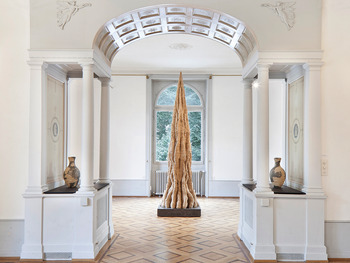
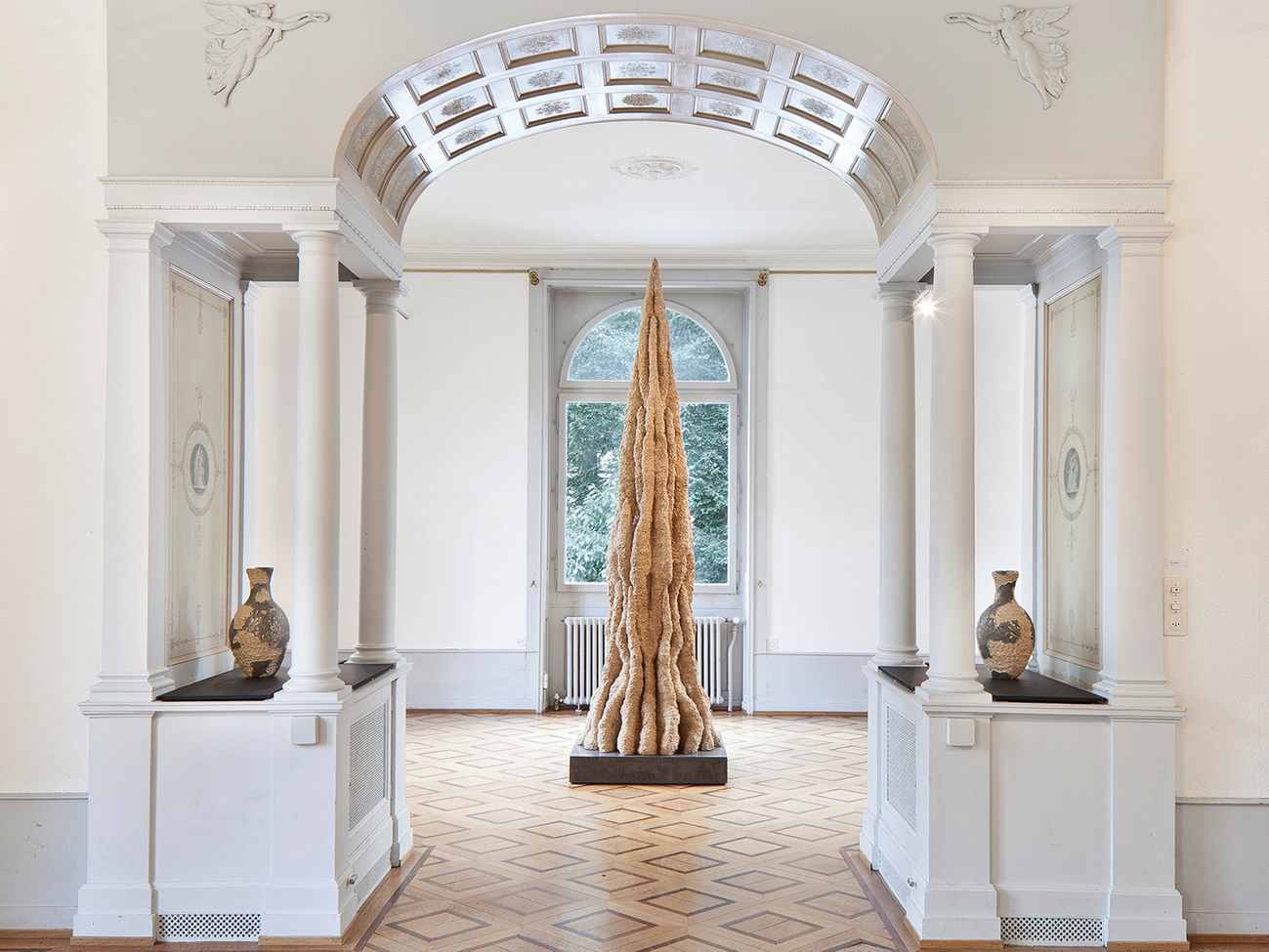
When a friend of mine saw the large ceramic sculpture shown in Figure 1, he wondered if it had been inspired by Jōmon pottery. I had never come across Jōmon pottery, so he gave me two books of prehistoric Japanese art (Egami Reference Egami1973; Stanley-Baker Reference Stanley-Baker1984). Turning to the pages on the Middle Jōmon period I was captivated, disturbed and bewildered by the images of flame pots (Fig. 2). Later, when I visited the Jōmon pots in the British Museum collection, I found myself spiralling round and around one of them, unable to stop moving, unable to make sense but revelling in the contradictory austere/decadent richness of the experience. The exhibition has since changed; there are now more pots on display, but, as they are lined up against a wall, it is frustratingly only possible to see them from one, arbitrarily assigned frontal view.
Extended Phenotype 4 (2013) by Paul March. Stoneware, 1×1×3.5 m. (Photograph: © Paul L. March.)
Flame pot, 5000 bp. Earthenware, excavated from the Iwanohara Site, Nagaoka City, Niigata Prefecture, Japan. (British Museum, on loan from the Nagaoka City Board of Education. Photograph: © Paul L. March.)

In the following passage Tarō Okamoto, one of Japan's best-known modernist artists, describes his own encounter with a flame pot:
one experiences a strange shock from the unbelievably radical asymmetry, which is consistent across the entire body of the vessel. This asymmetry has a broken rhythm and is dynamic. This expressiveness always exceeds the limits on one's expectations. With one asymmetrical face of the vessel as a starting point, the viewer begins to feel the urge to view it while circling all the way around the vessel. (Okamoto & Reynolds Reference Okamoto and Reynolds2009, 54–5)
I was surprised to find little exploration of the explosive sensory experience that Okamoto describes in the archaeological literature on Jōmon pots. Moreover, few explicit links were made between an analysis of the creative origins of Jōmon pots and the contemporary experience of them as active and destabilizing creations. Several years later I still wonder what it is about encounters with flame pots that is so arresting, and I make this the starting point for the article that follows.
Introducing Jōmon archaeology
I begin with a brief summary of Jōmon archaeology (see Habu Reference Habu2004; Kenrick Reference Kenrick1995; Kidder & Esaka Reference Kidder and Esaka1968; Kobayashi Reference Kobayashi2004; Steinhaus & Kaner Reference Steinhaus and Kaner2016, for more detailed accounts). The word Jōmon (cord-pattern in Japanese) was coined by Edward S. Morse, a nineteenth-century American zoologist and orientalist who found the remains of ceramic pots decorated with the repetitive imprint of twisted cord while excavating a shell midden at Omori, about 50 km east of Tokyo. This cord imprint is a hallmark of Jōmon pottery and now refers also to the culture that produced it. These ceramic artefacts present an evolving pattern of production starting at least 14,000 years ago and ending around 3000 years ago with the beginning of the Yayoi Period, the first evidence of rice farming and the emergence of a more restrained and elegant form of pottery.
The Jōmon people were fisher-gatherer-hunters who lived in settled communities. This sedentary lifestyle may have contributed to the precocious emergence of ceramic technology. The evolving morphology of ceramic output has been used taxonomically to divide the 11,000 or so years of Jōmon culture into six main stages, namely Incipient, Initial, Early, Middle, Late and Final stage.
Kaen doki [fire-flame pottery] defines the Middle Jōmon stage, dating it to about 5000 years ago. They originate in the Echigo region with finds concentrated along the Shinano Valley in the Niigata prefecture. The term ‘fire flame’ was given to the original finds at the Umataka site, but when pots of similar form and construction technique were discovered in other sites in the Niigata prefecture and beyond, the appellation was widened to kaen-gata doki [fire-flame type pottery] (Ghobadi Reference Ghobadi2015). According to Kobayashi (Reference Kobayashi2004), the relative isolation of the Echigo area resulted in the establishment of a particular style, shinbo ninzaki, which developed independently of the influence of the morioso and the subsequent jusanbodai style that defined the pots of the surrounding regions. Kobayashi (Reference Kobayashi2004) divides the shinbo ninzaki style into three chronological stages, locating flame pots within the final stage. Ghobadi (Reference Ghobadi2015) describes flame pot stylistic variation using Terasaki's (Reference Terasaki1991) typology (itself adapted from Kobayashi Reference Kobayashi and Kobayashi1988) which sub-divides flame pots into four groups, A, B, C and D. The sub-division is based on construction methods and visual appearance, although contextual analysis demonstrates that different styles also followed different cycles of use, exchange and deposition (Ghobadi Reference Ghobadi2015; Pearson Reference Pearson2007). As a brief morphological description, group A contains the iconic flame-type (Fig. 2) and crown-type pots. The former are characterized by so-called cockscomb projections, the latter by what in Japanese are called tanzaku gata tokki castellations (tanzaku gata tokki refers to the contemporary Japanese practice of hanging messages in trees on vertical tags). A pot is divided into different design fields: decoration around the top of the vessel is organized horizontally with motifs around the rim, whereas the base contains four panels of relief, organized vertically and containing embedded spiral motifs. Aside from some hybrid examples, group A and B vessels do not feature any cord-imprint (Jōmon) pattern. Group B pots tend to be significantly plainer overall than group A vessels. Group C pots are distinguished from group A by the existence of cord-imprint decoration over much of the vessel, overlaid with an embossed and groove relief (ryukisen and chinsen: see below). Group D pots are plain, simple pots of a variety of forms and dimensions, whose surfaces are normally covered in what appears to be a rapidly applied cord imprint.
All four groups were constructed using the coiling method: sides of a pot are built up by spiralling a cylindrical coil of clay onto itself in a circular motion before smoothing down the joint between layers. Contemporary potters (including myself) still make regular use of the coiling technique in construction. In the case of a group B or D pot, a length of twisted cord was then rolled across the smooth, damp surface to give the distinctive imprint of Jōmon parallel lines.
The rim and body extensions that are the principle characteristic of group A pots were made by adding rolls or slabs of clay that were pinched or modelled into shape. The embossed pattern on group A pots was made using a combination of two techniques. The first involves rolling out a thin cylinder of clay, using the same gestural technique as the coiling construction method, and then sticking this to the vessel surface (ryutaimon). In the second technique a length of bamboo is drawn across the surface of a vessel leaving a convex ridge (ryukisenmon). Other relief patterns could be achieved by changing the bamboo profile, for example, a convex semicircle produces a concave ridge (chinsen). The relief pattern on group B and C pots did not involve the coil technique but was made using bamboo tools alone.
Sense and archaeology
What a shock it would be for anyone to encounter the crude, inharmonious shapes and patterned decoration of Jōmon ceramics without adequate advance preparation. In particular, the strangeness of the over-ripe middle Jōmon period is beyond words. (Okamoto & Reynolds Reference Okamoto and Reynolds2009, 50)
The raised line pattern that is the most characteristic feature of Jōmon ceramics moves in every direction in a manner that is rough, blunt and wild … If one follows that line, it gets tangled up then gets loose, it descends into confusion then re-emerges, it dodges every possible accident, it endlessly returns then flees. (Okamoto & Reynolds Reference Okamoto and Reynolds2009, 54)
This assault on the senses is not lost on archaeologists. Bausch (Reference Bausch2016) entitled her paper on flame pots ‘The splendour of the Middle Jōmon Culture‘; Barnes (Reference Barnes2015, 127) as ‘florid … with intricate flame-shaped rims’ of ‘immense creativity’; and Kaner (Reference Kaner2018, 3) describes how an encounter with flame pots ‘evokes feelings of shock and awe. The shock comes from the visual overload that results from attempting to take in the complexity of design.’
Despite the shock, the experiential nature of Jōmon pots is not a major concern in the archaeological literature; Japanese research concentrates upon a typological analysis that focuses on an ‘extremely detailed chronology of Jōmon pottery’ (Habu Reference Habu2004, 200; see also Egami Reference Egami1973; Imamura, Reference Imamura1996; Kobayashi Reference Kobayashi2004; Naumann Reference Naumann2000). Indeed, Kobayashi (Reference Kobayashi2004, 68) warns of the seductive dangers of flame pots: ‘Whilst appreciating these pieces we must not lose sight of the fact that they are the material representations of mental images and symbols shared by the inhabitants of the Jōmon Echigo style zone who made and used the pots.’
Kobayashi's warning reflects a pervading ambivalence about the place of subjective and aesthetic responses in archaeological research. The exact nature of the ambivalence to subjectivity depends somewhat on whether we take the word ‘aesthetic’ to refer to a property of an object, a sensation belonging to the beholder, or an emergent aspect of the relationship between the two (Skeates Reference Skeates2017), but the general concern is well captured in a viewpoint piece published in this journal in 1994 in which five specialists (Taylor, Vickers, Smith, Renfrew and Morphy) were asked to pronounce on whether aesthetics has a place in archaeology. To varying degree, they all emphasized the danger of drawing any equivalence between a contemporary affective response to a prehistoric artefact and the responses of the original object-maker and its users (Is there a place for aesthetics in archaeology? 1994).
The unease is compounded by a tendency to refer to particularly impressive prehistoric artefacts such as flame pots as ‘art’. In a recent special issue on Art and Archaeology, Robb (Reference Robb2017) provides an overview of how the application of the word ‘art’ to a prehistoric artefact entangles it with modern cultural roles and imbues it with contemporary aesthetic qualities. Nevertheless, the use of the art word in archaeology persists partly, as Robb points out, for lack of an alternative way of highlighting the specialness that some prehistoric things appear to express. He suggests ‘powerful objects’ (Robb Reference Robb2017, 595) as an alternative and in the same issue, Wells (Reference Wells2017, 617) offers ‘visually complex objects’.
These two authors aim to reposition the European/Western concept of art within a wider multicultural context, thereby facilitating the consideration of the specific sensory/affective responses of material culture across different societies. This more anthropological approach (following Morphy Reference Morphy1994) encourages an exploration of the aesthetic quality of ancient or prehistoric material using contextual evidence in order to locate the sensory experience in relation to the culture of the original users and makers. For example, in his analysis of Minoan drinking vessels, Knappett (Reference Knappett2005, 133) situates the vertical and recursive relationship between action, mind and matter within the ‘horizontal networks in which objects find themselves’ (see also Crnobrnja Reference Crnobrnja2011; Meegan Reference Meegan, Ginn, Enlander and Crozier2014; Sofaer Reference Sofaer2015; Wells Reference Wells2017). In short, a contextual approach to aesthetics has two advantages. First, it enables contentions about long-absent sensorial responses to be stress-tested against an existing network of material evidence. Second, it explicitly locates aesthetic response in the past, helping to separate it from the feelings of the contemporary archaeologist. However, there is a fine line between mitigating the amalgamation of contemporary and prehistoric sensibilities and losing empathy for an artefact altogether. In order to recognize something as powerful or visually complex, it seems to me that we must remain sensitive to it. By interacting dispassionately, we surely attenuate its vibrancy and risk losing an important perspective on human development. For example, Barrett (Reference Barrett2013, 11) argues that essential cognitive capacities were dependent upon the ability to make sensory distinctions: ‘The move to metaphor must have depended upon the recognition that various things embodied common or contrasting qualities. Consequently, it was the sensual recognition of common qualities in things that was primary’.
The methodological philistinism of Gell (Reference Gell, Coote and Shelton1992) creates a similar bind. Gell (Reference Gell1996; Reference Gell1998) made a major contribution to the revaluation of notions of aesthetics in archaeology. By ‘taking an attitude of resolute indifference towards the aesthetic value of works of art’ (Gell Reference Gell, Coote and Shelton1992, 42), he played a significant part in loosening the grip of western aesthetic values on the study of material culture. He aimed to reveal ‘the specific objective qualities of the art object as an object’ (Reference Gell, Coote and Shelton1992, 43) by ignoring its subjective qualities. Despite the important perspectival shift afforded by methodological philistinism, I suggest that it comes with a cost: an ‘attitude of resolute indifference’ encourages a relationship lacking vitality.
For example, if objectivized, a flame pot's ‘absurd, magnificent convolutions’ (Okamoto & Reynolds Reference Okamoto and Reynolds2009) risk being perceived as dislocated features. Rather than evoking the nonsensical sense that Okamoto finds therein, they become formal in their presentation. It seems to me that a refusal to engage (methodologically or otherwise) creates the impression that to experience extravagance has no function. Dissociated from sense, the convolutions are assigned a default ritual role:
Some of these rim adornments were so large, cumbersome and freely formed that although some may have served for hanging or carrying one doubts their utility … Small lugs may have been functional but larger handles were so ungainly that, like the ornate rims, their serviceability is doubtful … the sculptural representations that swarm around the rims … are concrete manifestations of zoomorphic and anthropomorphic repertories that form a consistent iconography … accepted by many archaeologists as offering firm evidence of an ideology, and associated ritual. (Kenrick Reference Kenrick1995, 53)
Concerns about the consequences of excluding the researcher's sensory experience from archaeological research has led some researchers, most notably Hamilakis (Reference Hamilakis2013; Reference Hamilakis2017, Hamilakis & Jones Reference Hamilakis and Jones2017) to propose a wholesale re-habilitation of the senses. For example, in a recent paper about Neolithic figurines from Greece, Papadopoulos et al. (Reference Papadopoulos, Hamilakis, Kyparissi-Apostolika and Díaz-Guardamino2019) argue that archaeological recording methods (photos, drawings, notes, etc.) objectify archaeological evidence by failing to capture the sensoriality of artefacts. These acts of representation allow archaeological method to ignore the kinaesthetic and corporeal experiences that are central to the contemporary and past experiences of the object. They suggest using various hands-on approaches to access the affectualFootnote 1 experience that emerges from inter-nodal spaces in a distributed network of artefacts, environmental features and humans.
Within this understanding, affect becomes central in sensoriality; this is not about individuated emotional reactions and feelings, either on the part of the present-day researcher or on the part of people in the past … It does not aim at representing or recreating past senses, but at evoking some of the affective energy and power of sensoriality, which is neither past nor present, but multi-temporal. The body and the sensorial and affective constitution of the researcher become, inevitably, part of this endeavour; as such, reflexivity and an investigation of the researcher's own sensorial archaeology is a starting point of any investigation on the senses. (Papadopoulos et al. Reference Papadopoulos, Hamilakis, Kyparissi-Apostolika and Díaz-Guardamino2019, 8)
Clearly Papadopoulos et al. do not intend to equate the feelings of present-day researchers with those of past people. They focus not on the individual emotional reactions, but describe instead a supra-systemic notion of sensoriality and affect that arises out of shifting assemblages (Deleuze & Guattari Reference Deleuze, Guattari and Massumi1987) and implicates the researcher in the prehistoric mark-making of others. Although, from the perspective of an academic paper, they may be correct to refer to this evocation as multi-temporal, I suggest that the position of the authors in this respect is only possible because they move outside the specific system-of-affect in order to do so. Within the system, there exists only an affective evocation in the present, as below, which is subsequently brought outside and attached to the past.
How to convey the intimate, affective experience of the researcher as s/he explores in detail the surface of a figurine with a magnifying glass and raking light? How to evoke the sensorial experience of past makers and handlers of clay and figurines-in-the-making? (Papadopoulos et al. Reference Papadopoulos, Hamilakis, Kyparissi-Apostolika and Díaz-Guardamino2019, 15)
Despite their intentions they end up with a phenomenological account of a present-day individual which is retrofitted to past actions. Finally, they imply a universal quality to ‘the power of sensoriality’, describing it as ‘neither past nor present, but multi-temporal’ (Reference Papadopoulos, Hamilakis, Kyparissi-Apostolika and Díaz-Guardamino2019, 8), leaving me unsure what conclusions Papadopoulos et al. wish me to draw about the ontological status of affect with regard to what went on between figurine and its original maker. Perhaps experiencing uncertainty is an inevitable and even necessary part of subjective accounts: something I will return to later.
Bailey (Reference Bailey and Insoll2017a) proposes another way of integrating archaeology and the senses. In a review of research into prehistoric figurines of South Eastern European, he concludes that, despite examples of excellent contextual fieldwork, interpretations of the data fail to move beyond the anecdotal. In ‘Disarticulate—repurpose—disrupt’, Bailey (Reference Bailey2017b) rejects the archaeological requirement to show how artefacts fit neatly into past cultural roles and instead begins working with artists as facilitators of a more explorative, less deterministic position. (See Bailey et al. Reference Bailey, Cochrane and Zambelli2010, in relation to dogū—Jōmon figurines.) Bailey aims to ‘disarticulate’ an artefact from its past and ‘repurpose’ it by allowing its materiality to forge new, sensorial relationships with present-day humans to ‘disrupt’ the political and cultural status-quo. Bailey (Reference Bailey and Insoll2017a, 844) claims that breaking with the past to disrupt the present paradoxically and recursively provides insights into past practices:
as we are starting to release our articulations with figurines from the confines of meaning, we may be stumbling upon a truer connection to those Neolithic people who made, handled, broke, and threw away these objects. Perhaps Neolithic figurines … existed in the past exactly as they do in the current art/archaeology work: as evocations, provocations, and objects of admiration, fear, wonder, and bewilderment … My intention has been to use material and surrounding ephemera in order to make new works. These new works loop back … to connect in some obscure way with the Neolithic material: both new art/archaeology work and the original figurines were in play, at play, and of play.
Bailey does not appear to expect the same burden of proof for art/archaeological projects as he does for contextual approaches. Perhaps this is because the capacity of art to ‘connect in some obscure way’ is a function of a network of overdetermined metaphorical associations woven from the artist's engagement with material: a state of affairs more difficult to achieve with narrative interpretations. Art/archaeology work avoids determinist yet anecdotal descriptions of meaning, remaining explicitly in the realm of the possible. This does not mean that art/archaeology interpretations are more valid than anecdotal ones. By positioning the work as artistic, Bailey moves the response outside the scope of objective validity; although, when he talks of making a ‘truer connection to … Neolithic people’, he undermines this position. Instead, as with the uncertainty I found at the centre of Hamilakis’ approach, perhaps we can acknowledge that a connection exists while accepting the discomfort of its indeterminate nature.
In this section I have summarized why archaeology is wary of aesthetic reactions, followed by a description of the possible consequences of avoiding sensorial responses altogether. I then introduced the proposals of Hamilakis and Bailey for re-integrating the senses into archaeological research, highlighting the epistemological uncertainty that accompany them both and suggesting that this may be something worth living with. I will now review the typological approach, with its goal of avoiding interpretation altogether.
The typological approach
The typological analysis of Jōmon pots began with Yamanouchi's seminal work in the 1930s. One of its main goals is to identify styles as manifestations of a shared mental template of a group of socially connected potters, thereby linking material form to cultural associations and discontinuities (Ghobadi Reference Ghobadi2015). Kobayashi is largely responsible for having extended and developed Yamanouchi's work, and so I will draw principally on his 2004 account to illustrate the conceptual framework.
For Kobayashi, a detailed chronological and geographical taxonomy helps identify the relationship between different pots, indicating who was using them and what they might have meant to their users: ‘investigating the history of Jōmon pottery style zones provides an insight into the Jōmon mind, even if we are left guessing at the actual contents of the stories the pots were used to tell’ (Kobayashi Reference Kobayashi2004, 56).
Each Jōmon vessel is a version of a cultural archetype expressing the beliefs of the community. The form and basic motif of each pot is regulated and defined by the potter's mental image of the ‘community template’. With a critical mass of similar forms, a certain style or ‘spirit’ starts to emerge. This spirit is not communicated by morphological design, but by an ‘abstract effect’ produced by the overall impression of the vessel.
Turning to their evolutionary development, Kobayashi draws attention to the strange form of some incipient Jōmon pots—cuboid with flat bases. He points out that such a morphology does not emerge naturally from modelling clay and suggests that these early innovative clay containers were inspired by
everyday items they had to hand, for example basketry, wooden objects and bags made of animal skins. While these objects may not have helped much with the technological developments needed for pottery making, they provided convenient models for shape …
The potters had images of these objects in their heads as they started to make pots, and for this reason the incipient Jōmon can be described as the ‘image stage’ in the history of the development of Jōmon pottery. (Kobayashi Reference Kobayashi2004, 34–5)
Kobayashi suggests that ‘image stage’ pots evolved into forms more consistent with the material properties of clay—circular, conical and deep—and he notes that Jōmon decorative motifs also moved progressively away from the imitation of effects that could be easily obtained on the surface of other materials such as wood or basketry, to be replaced by patterns that capitalized upon the plastic qualities of clay. The influence of earlier containers as ‘external representations’ (Kirsh Reference Kirsh, Cowley and Vallée-Tourangeau2017) as well as the material qualities of clay are both acknowledged but neither is given an agential role in the creative process: an inconsistency I will return to later.
Kobayashi associates the evolution of the middle Jōmon period from the early phase with the breakdown of the conceptual assumption that linked pottery exclusively to its function as a container and the creation of a narrative role:
The establishment of these narrative patterns indicates that Jōmon potters had moved from just holding mental images of the object they wanted to create in their heads, to having particular concepts in mind, which they wanted to express through combinations of symbols, which carried meanings that would have been understood by other people in their community. In other words, by this stage, meaningful concepts existed prior to the designs used to express them, and these concepts were given a reality in the Jōmon world through appearing on Jōmon pots. The visual impact of the design motif began to lose some of its significance as the motif itself became increasingly standardised and stylised, whilst the symbolic meaning of the motif as an expression of a particular concept gained in importance. (Kobayashi Reference Kobayashi2004, 45)
Certain motifs detached themselves from the overall geometric design, developing into symbolic representations of specific concepts that were already circulating in the Jōmon community, thereby indicating
a shift from motif as just an ornamental form to motif as implicated in the appearance of a sophisticated system of symbolism, presumably related to the Jōmon world view, even though we are unable to decipher the precise meanings these motifs expressed. (Kobayashi, Reference Kobayashi2004, 48)
Kobayashi notices that these patterns began to wrap themselves around the entire pot, making it impossible to take in the whole motif in a single gaze. In order to have been able to make sense of these extended patterns and ‘to recreate the complete composition in their mind's eye’ (Reference Kobayashi2004, 50), he concludes that Jōmon people must already have been familiar with the motifs and their signification.
The limits of representational meaning
The view that a pot's form begins with an internal image in the head of the potter is refered to as hylomorphism and is associated with a philosophical position dating back to Aristotle which proposes that the form (morphe) something takes can be separated from the matter (hyle) from which it is made (Ingold Reference Ingold2010). Hylomorphism enables a model of the mind in which an abstracted form can be representationally stored. This reliance on the mental image as the driver of creative activity is consistent with mainstream cognitive-science descriptions of creativity (e.g. Boden Reference Boden2004) as well as the wider cognitive-science, information-processing approach (see David et al. Reference David, Miclea and Opre2004 for an introduction). However, both the typological approach and the brain-as-computer metaphor make two significant epistemological assumptions. First, they separate mind from body/environment; and second, they assume that decisions are made through the manipulation of internal representations, rather than through interaction with the external world (as in Gibson's Reference Gibson1979 model of direct perception). Separating the act of conception from its material realization influences the way meaning is attached to Jōmon pots. However, by shifting away from an analysis of form towards an investigation into the process of becoming, a very different field of meaning emerges—as I will describe in the next section.
Material Engagement Theory
Developed by Renfrew and Malafouris in an archaeological context, Material Engagement Theory (MET) presents a radical re-thinking of the nature of human cognition. By reframing the mind in systemic terms, Malafouris places the analysis of the process of change at the centre of a methodology for understanding human becoming. MET is described in detail by Malafouris (Reference Malafouris2013), with further important elaborations concerning the concepts of creative thinging and metaplasticity in Malafouris (Reference Malafouris2014; Reference Malafouris2015; Reference Malafouris2018). The six most relevant concepts to my purpose can be summarized as follows:
The extended mind: Clark and Chalmers (Reference Clark and Chalmers1998) propose that external artefacts can act as scaffolding for cognition. The mind extends outwards to incorporate objects on a temporary basis. Malafouris interprets the extended mind differently by suggesting that the mind does not extend outwards from the brain, but exists only within the process of moment-by-moment human–material interaction: a conceptualization more ontologically related to Heidegger's ([1927] Reference Heidegger, Macquarrie and Robinson1962) notions of Dasein and of ‘thinging’ (see below).
Enactive signification: It follows from the above that sense and materialization are recursively co-dependent, together creating an experience unmediated by language. Perception and cognition are not information-processing tasks, but together create a sense-making experience, inextricably linked to the physical world.
Material agency: If cognition is an emergent property of a human–environmental system, then it follows logically that humans can no longer be conceived of as the sole drivers of activity. A concept of agency is necessary that recognizes that the vector of action is determined by preceding material–human confrontations, linked together by intention.
Intention-in-action: Traditionally, intention refers to an internal mental state that directs and drives an individual's behaviour (Searle Reference Searle1983). But Searle departs from this internalist view in his description of the intentionality of everyday activity in which he suggests that intention is presented within the actions themselves. Malafouris (Reference Malafouris, Knappett and Malafouris2008; Reference Malafouris2013) takes Searle's model of intention in action (Searle Reference Searle1983, ch. 3) and extends it by demonstrating that all intention is intentional activity, born of prior experience or cultural practice.
Creative thinging: Heidegger's notion of ‘thinging’ (Reference Heidegger and Hofstadter1971) emphasizes the behavioural nature of things as opposed to the representational quality of objects. In this sense, an intention-in-action is ‘thinged’ into taking place by actionable things. Creative thinging extends the notion by proposing that thinking can occur directly though the behaviour of things and the transformation of material. Creative thinging is a point in time and space where/when mind and matter become indistinguishable.
Metaplasticity: The relationship between the plasticity of brain functioning, the mutability of culture and the plastic potential of material–human interaction creates an arena of recursive action in which development and the awareness of development occur together (see section on Metaplastic rules and habits, below).
The first thing to notice when looking at Jōmon flame pots in relation to MET is that attention is focused, not on the pot itself, nor on its human maker, but on the meeting point between human activity and matter. Creative thinging is a phenomenological process that puts sensation at the heart of meaning making. In these terms, a flame pot is not the product of human cognition, it is a trace left by a cognitive process (creative thinging) in which the brain, body and clay co-construct (through material agency) an emergent, materially articulated meaning (enactive signification). A flame pot does not represent an internal image, nor is it the product of human intention. It cannot therefore be taken as an artefactual clue to an antecedent, causative state of mind, nor seen as the outcome of a particular pattern of neural activity that may or may not be replicable in the brains of modern humans. Rather, the creative thinging of a flame pot is the intention-in-action of the mind.
MET and typology
In this section I will review the typological approach from the perspective of MET and give five reasons to suggest that a significant amount of evidence is overlooked by concentrating exclusively on style and symbolism and ignoring the emergent sensorial signification of material engagement.
First, the presence of non-ceramic containers in the incipient Jōmon potters’ environment means that it could have been the containers themselves that determined the shape of incipient Jōmon pots, rather their mental representations. Whereas physical presence does not rule out the use of mental imagery as a source of insight, having an object in plain sight renders it unnecessary.
In a recent critique of insight as an explanatory model of problem solving, Vallée-Tourangeau and March (Reference Vallée-Tourangeau and March2019) introduce the term ‘outsight’ to describe how problem solving may take place by observing and manipulating the environment. Outsight provides a more parsimonious explanation for the emergence of Jōmon pottery. Kobayashi unwittingly provides a beautiful example of outsight when describing how Yamanouchi discovered how the pattern on Jōmon pots was made:
He took a break and without thinking about what he was doing, picked up a small spring from his desk and rolled it across a flattened piece of modelling clay. Seeing the resulting series of parallel lines on the flattened clay surface, he suddenly realised the significance of what he had done. He went on to try the same thing with twisted cord. To his delight, the distinctive cord-impressions which he had long been researching appeared on the clay before his eyes. Yamanouchi had solved the mystery of how Jōmon people used twisted cords to decorate their pots, by rolling them across the surface of the vessel. (Kobayashi Reference Kobayashi2004, 26)
The development of flame-style pottery also undermines representational explanations. Ghobadi (Reference Ghobadi2015, 68) notes that a flame pot's unique ‘visual impact[,] melds numerous design influences from a host of neighbouring, regional pottery styles’. It is difficult to envisage how such hybrid vessels could emerge fully formed through mental imagery alone without engaging directly with physical examples of extra-regional pots. This is not an argument about whether or not mental imagery exists; it is about the nature of creative intention. Hylomorphism ascribes agency to the Jōmon potter and creative intention to her internal image. MET proposes that intention becomes manifest through a process of materially and culturally guided engagement.
Second, as previously noted, Kobayashi argues that the Incipient stage evolves into the Early Jōmon stage by a shift away from skeuomorphs towards a morphology that arises naturally from modelling clay. In fact, this evolution demonstrates perfectly the reciprocal relationship between form and matter: portraying cognition, not as something that occurs in an internal conceptual space (as in Boden Reference Boden2004), but as an external activity, guided by the behaviour of material. If there is a conceptual space, it is the metaplastic, sensory attentiveness to the possibilities of clay.
Third, Kobayashi describes how the pots of the Middle period distinguish themselves from Early Jōmon pots by a change of role from container, to a medium for symbolic representation. This functional change is mediated by pre-existing Jōmon concepts finding expression in the erstwhile decorative motifs of Early Jōmon vessels. As previously mentioned, Bailey (Reference Bailey and Insoll2017a) described attempts to account for the meaning of prehistoric figurines as anecdotal and, whereas Kobayashi explicitly avoids specific interpretations of flame pots, his general assertion that the motifs told a story is itself a narrative illustrated by a flame vessel which could equally well illustrate other explanations. To avoid anecdotal analysis, Bailey suggests (Reference Bailey and Insoll2017a, 17) that we ‘release the restraints of standard archaeological reasoning, and work in a more creative world’ and, interviewed about Jōmon figurines (dogū), Kobayashi agrees with him:
instead of coming up with the ‘correct’ interpretation, we need to be fostering new and innovative research questions. Dogū get us thinking, perhaps just as they got the Jōmon people thinking. (Bailey et al. Reference Bailey, Cochrane and Zambelli2010, 81)
But what does it mean to think? MET proposes that we think through material change, not about it. Instead of considering meaning in terms of the outcome of change, MET focuses on the act of making as an enactive thread (Malafouris Reference Malafouris and Manzotti2011). The crucial difference is that conceptualization is gesturally mediated. In enactive signification, the signifier and signified are co-created, emerging simultaneously. As an artist, having spent years making things of uncertain ontological status, I felt liberated by Malafouris’ description of the enactive sign because it explicitly distinguished material expression from meaning, undermining the notion of an artistic intention lurking somewhere behind the work. Enactive signification has no requirement for an artwork to designate something or stand in for anything else.
This is not to deny that an artefact may also be communicative in a linguistic sense. Byers (Reference Byers1999) points to the possibility of something exhibiting both symbolic and pragmatic meaning. By considering flame pots in MET terms, I do not exclude a possible symbolic role. Rather, I am suggesting how such a role might evolve through the intermediary of generations of indexical associations and habitual actions that were evoked and facilitated by these pots. Nanoglou (Reference Nanoglou2009, 285) calls these ‘performative articulations’, emphasizing that they do not stand in ‘for an abstract set of rules, but actually materialize discourses, which … cannot exist outside this materialization’.
Malafouris elaborates on the concept of enactive signification using Kirsh's (Reference Kirsh, Taatgen and van Rijn2009) notion of cognitive projection: an operation that takes place by mapping a cognitive space onto the physical structure of an object. Kirsh describes projection as an augmented form of perception: that is, a way of conceiving of added possibilities beyond those that are actually present; a way of exploring novel, abstract constructs by grafting them onto more concrete and familiar ones. For example, the sculptural exuberance of flame pots developed from earlier, more utilitarian vessels. As we will see in Part Two, given that they continued to be used to hold and prepare food, their flame and crown protrusions can therefore be experienced as a challenge to the role of containment. A flame pot can serve as an anchor from which to extend a metaphorical exploration of the permeability or otherwise of boundaries in relation to, for example, the body, social structure or environmental limits. Rather than suggesting that the people of the Middle Jōmon period used flame pots to investigate the concept of boundaries, I am showing that flame pots can facilitate a process of materially bounded intuition.
Fourth, given the difficulty in viewing an entire flame-pot motif from one perspective, Kobayashi concludes that their symbolic content portrayed very familiar community-based concepts, providing further evidence that flame pots evolved into representational vehicles equivalent to clay tablets—their morphological features to be read as a string of linguistic signs that together form a narrative. I described above how enactive signification explains the emergence of a form of realization that is non-linguistic and non-representational. Unlike narration, there is no fixed temporal order—no requirement to begin the pot at any particular point. Indeed, meaning emerges, not by standing stationary, the better to read each sign, but from the circling movement of the pot relative to the viewer. Enactive signification is able to capture the over-determined and indeterminate possibilities of material engagement that together create overlapping and congruent meanings as well as contradictory ones.
Finally, Kobayashi's separation of Jōmon pots into different styles based on an overall impression or abstract effect is not integrated into the typological framework, leaving it unclear exactly what ‘abstract’ means and how it relates to the physical qualities of a vessel. I suggest that this abstract effect is effectively captured by understanding meaning in terms of the materiality of enactive signification as described above.
In this section I have presented the advantages of considering the sensual richness of material expression. By sensual richness I mean, for example, the sense I have of sensori-motor-empathic directional smoothness combined with gentle resistance when my eyes run along a furrow on the surface of a flame pot. This feeling tells me no more about the Jōmon potter wielding her bamboo tool than I learn about the modernist painter Clyfford Still by following the brush strokes on one of his canvases. But I suggest that this sort of gestural empathy does make a link, not to a past creator, but to a moment of creative thinging that allows a prehistoric artefact to resonate in the present. By concentrating on the relationship between action and clay, I am not suggesting that the creative thinging of a flame pot happens in splendid creative isolation. It happens at the junction of a number of temporal arcs of different scales: the time it takes to make a gesture, to make a pot, to reach gestural readiness (traditionally referred to as an apprenticeship), and more: the lifetime of a pot in a community, the time delineated by the ancestral pedigree of the pot type, etc. A process-centred approach allows us to consider each pot as a node in a metaplastic (as opposed to metaphysical) exploration of the world.
Part Two: Clayful phenomenology
So far, I have discussed why archaeology is uncomfortable about admitting sensory experience as receivable evidence, and I have also argued that it is a shame to leave it out. I have suggested that MET, specifically the concept of enactive signification, can be used to put sensation back at the centre of a non-verbal, materially articulated process of meaning making. In the next section I will describe how a prolonged artistic interaction with clay unexpectedly presented an opportunity to ‘thing creatively’ with Jōmon pots.
Malafouris (Reference Malafouris2018) presents a series of photos of a potter working at a wheel. The images can certainly be interpreted as evidence of the imposition of creative intention, but Malafouris points out that this reading does not capture the extent to which the potter's gestures occur within a cognitive ecology of human–material enaction—held in dynamic, transactional equilibrium by the clay's bodily changes.
It is one thing to see creative thinging in the dynamism of a potter's wheel; it is more tricky to thing creatively with flame pots while standing in the half-light of a museum, on the wrong side of a pane of glass that separates the viewer from a row of vessels lined up defensively against a wall as though for an identity parade. It turns out that there is another way of going about this.
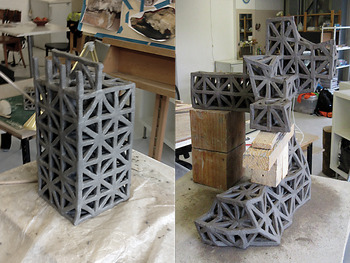
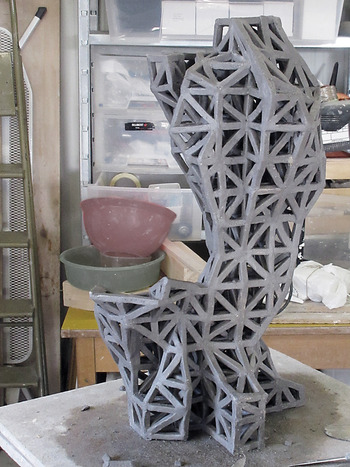
In 2016, I began a series of sculptures, originally entitled The Matrices, later renamed Holocene Pottery for reasons I will explain later. The sculptures were built up by repetitively adding open, diagonally intersected cubes of clay (see Figure 3a). Normally this activity would produce a grid-like cuboid, but here, the growing structure was increasingly deformed by the occasional addition of a shorter edge or diagonal (see Figure 3b). I wrote the previous sentence in the passive voice because the active voice implies a strong sense of personal agency, whereas this emerging deformation seemed to be associated with a fluctuating and indistinct sense of agency and of self. The absolute linguistic division between the active and passive voice is problematic when trying to describe a systemically generated sense of agency. The active voice determines a single agent. The passive voice avoids naming agency altogether. It is therefore difficult to record the sense of agency I am trying to describe.
(Left) Holocene grid-like cuboid structure and (right) its deformation by addition of foreshortened edges. (Photograph: © Paul L. March.)

I had acquired a procedural dexterity in this cube-making task, having already used the same technique to make a large sculptural installation (Fig. 4). I worked intermittently on the Holocene project for about three years, taking notes and photos. A time-lapse camera took a photo every 20 seconds. (An edited version of Holocene 6 footage can be seen at https://vimeo.com/288572786)
Claustra (2015) by Paul March. Stoneware, 1.8×2×1.8 m. (Photograph: © Paul L. March.)

In May 2018 two fellow-artists, seeing the sculptures in my workshop, felt their origins to be geographically, culturally and temporally indeterminate: stretching across a period from the distant past, through the present and into the future. The extended timespan brought to mind the word ‘Holocene’. A note I made at the time reads:
The extent to which work is both precise and intricate—clumsy and approximate. (This) relates to (the visit) of R-A and L (the artists) about time and place—every continent, past and future. Were Jōmon done in the same way? Jōmon = Holocene? (Holocene 6, 14.5.18) Footnote 2
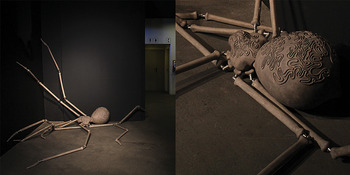
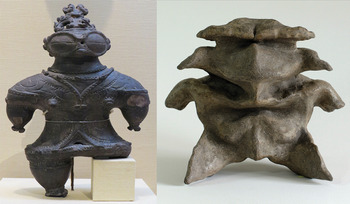
Something about the artists’ comments on temporal and spatial indeterminacy evoked the word ‘Holocene’ and provided a link between Jōmon pots and Matrices sculptures. Jōmon ceramics have influenced my work since I first came across them in 2013: explicitly so in the case of Jōmon spider kit (Fig. 5), and dogū (Jōmon figurines) may implicitly have influenced three others, Substantia Innominata II, III and V (Fig. 6).
Jōmon spider kit (2013) by Paul March. Stoneware, steel and stainless steel, 4×2×1.5 m. (Photograph: © Paul L. March.)

(Left) Dogū figurine (3000–2400 BP). (Ueno Museum, Tokyo.); (right) Substantia Innominata 10 (2014) by Paul March. Stoneware, 35×35×25 cm. (Photograph: © Paul L. March.)

Although Jōmon pottery intermittently entered the extended mind of my workshop, I can say little more about the exact process by which flame pots and Matrices sculptures became entangled at this moment—except for the important point, that it felt that I was discovering links, not making them. By this I mean that rather than any prior intention to engage in flame-pot research, I believe it was intention-in-action that was responsible for bringing the Jōmon–Holocene creative system into a transient existence, enabling further exploration of itself through the process of cognitive projection described earlier (Kirsch Reference Kirsh, Taatgen and van Rijn2009). Conceptual engagement with flame pots took place through the unfolding, sensorial and physical experience of modelling clay, which inevitably locates the sense-making of these prehistoric artefacts in the present. The clayful phenomenological approach, as I wish to call it (see March Reference March2019 on the phenomenology of playing with clay), allows for a recursive pattern of sensorial activity between Jōmon and Holocene which I will demonstrate in the following five sections.
Creating space
What seemed to impress Okamoto most about Jōmon pottery was its ability to engage actively with space:
It is a miracle that an object made in the Stone Age … could be so fresh and so sharp and could so completely seize hold of the space around it … the great achievement of the abstract and avant-garde sculptors of the twentieth century has been to … make space itself sculptural … If one were to compare the way Jōmon ceramics control space with avant-garde art, not only is it powerful and not the least bit inferior, but, on the contrary, it is actually more intense. (Okamoto & Reynolds Reference Okamoto and Reynolds2009, 55)
Okamoto's sense of the spatiality of Jōmon pottery contrasts with the perception of traditional sculptures and ceramic ware in which the role of the surface is paramount, both implying the volume it contains (see Noë Reference Noë2005, concerning implicit perception in action) and separating the object from the space in which it sits. When viewing the base of a flame pot, a non-potter may apply the same perceptual constraints. As a result, the capacity to seize hold of space does not manifest itself in the way a pot begins to take shape. In contrast, even when making the most ordinary of vessels, a potter senses the creative manipulation of space. Where a non-potter might perceive a surface, a potter experiences an emerging volume: ‘he shapes the void … From start to finish the potter takes hold of the impalpable void and brings it forth as the container in the shape of a containing vessel’ (Heidegger Reference Heidegger and Hofstadter1971, 167).
What I find so intriguing and astonishing about flame pots is their ability to make explicit at the top what was tacit at the base. Moving up towards the ‘flames’, I enter a space whose boundaries are liminal. The pot's apparent volume expands and contracts as I circle around it. This sensation of creating space through working with clay was also explicitly enacted in the Holocene construction method, which, as it advanced, drew no clear demarcation between what was and what was not Holocene, as I state in my notes:
The Holocenes are almost entirely void. There is not a skin. The framework colonises a void … the distinction between thing and space (or air) is no longer valid. (Holocene 8, 1.8.18)
The open Holocene framework was built from a confusional state concerning what it means to take up space; whether creative thinging makes space or takes up space; whether space exists when there is activity or when there is no activity. By diffracting Jōmon through Holocene and vice versa, the tacit knowledge necessary for shaping space was revealed and experienced and, from within this Jōmon–Holocene creative system, Holocene frames and Jōmon flames creatively thinged about the nature of spatial experience.
Enacting agency
The Holocene framework construction technique and the coiling method used by Jōmon potters are both highly constrained. But, unlike the continuum of coiling, constructing a framework is a step-wise, freeze-frame activity which breaks down the act of making and opens up the process of deformation to analysis in a way that is not accessible by raising the gaze from the base to the rim of a flame pot.
As the cuboid structure of a Holocene piece becomes increasingly deformed, a contrast develops between the precise, geometrically architectural gestures of cube-making and an emerging, organic structure. I want to describe what happens to my sense of agency during this process. The gestures and work practices of a previous project (Fig. 4) defined the cube-making procedure and so I began this project with a series of procedural rules. This is how I refer to them in my notes:
Perhaps being so constrained by rules causes extreme decisions in the space between rules. These rules were imposed during the making. There are some that are explicit, there are some that grow out of the work (common-law rules) that can be interpreted. (Holocene 9, 6.12.18)
Agency was therefore predicated upon the geometry of the structure. When an act of deformation occurred, I experienced it as a requirement of the project, not something that I decided in advance: more like a premonition that was articulated by the relationship between the expanding cuboid structure and the pattern of my gestures. Further deformation tended to occur by extending pre-existing lines of deformation—similar to the way a fracture propagates itself. Over the weeks, these deformations would extend in all directions until they found a spatial equilibrium between themselves. The following notebook excerpt offers a paradoxical picture of someone who feels he has little control over an intentional activity in which he plays an important role:
adding bits by impulse—on a bit by bit basis. With no plan and no understanding of how several of these decisions join … up. Long periods when I am working at a fast pace—adding bits without hesitation, whilst at the same time—no understanding how such a process can create something that is interesting to look at … How do the individual impulses form together to form an overall intention? I do not feel part of that intention. I am not conscious of it—I am only conscious of what I should do next. (Matrix 4, 11.2.18)
I feel purposeful. I am fully implicated in the unfolding realization of a sculpture in its entirety and yet I feel the impulse for action only as far as the next moment. ‘I only see the future in terms of one strut’ (Holocene 8, 10.7.18). Throughout most of a sculpture's development, the criteria used in the decision-making process were inaccessible to me. Then, quite suddenly, I would notice the work beginning to behave differently.
It doesn't really matter too much how it grows until a certain point and then it does. How does it know it is finishing? … As it gets towards the end, I put lengths on—it doesn't look right. This is a different matter—things matter more (Holocene 6, 14.5.18)
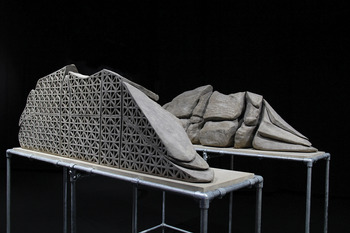
As it sensed the end, the sculpture began to make specific demands about how to proceed. The consequence of each new change was no longer localized, but was felt across the whole piece as the sculpture began to follow a rather unexpected course: one that I (immersed in contemporary art) would probably not have chosen (see Fig. 7).
I am confronted by configurations that do not fit into what I would describe as sculptural forms. They clash but seem to impose themselves … a tension between the canons of art and what the system seems to want to do. (Holocene 9, 18.12.18)
Holocene 9 by Paul March. A clash between the intentions of the creative system and the canons of art. (Photograph: © Paul L. March.)

In a previous paper (March Reference March2019) I wrote about the anxiety associated with ceding control to an extended mind, and other artists have also been disturbed by the dissolution of sense of self that takes place under the direction of material agency, as Alexandra Engelfriet describes: ‘Clay can give you the feeling of being pulled into it, sucked away out of existence. It can go as far as an experience of death’ (Higgin Reference Higgin2016, 110).
But there are also more positive descriptions, for example, Marion Milner (Reference Milner1950, 142): ‘there occurred, at least sometimes, a fusion into a never-before-known wholeness; not only were the object and oneself no longer felt to be separate, but neither were thought and sensation and feeling and action’.
Returning to the more continuous construction method of a flame pot, the initial shape is determined by a gentle, gradually expanding spiral, but, at a certain height, coiling becomes increasingly disrupted as the spiral extends beyond the space delineated by the geometry of its original polar coordinates. The pot loses conical symmetry as it expands discontinuously and, like a Holocene sculpture, begins to behave increasingly unpredictably as it nears completion. Although unpredictable, the experience is one in which construction remains constrained by the sculptural imperative that these discontinuous, asymmetric extensions occur in relation to each other. For this to occur, clayful activity maintains the entirety of the vessel in the extended mind so as to achieve this sense of holistic equilibrium.
Effacing traces
As with most coil-built vessels, the indexical traces left on a flame pot by the technique are effaced. In the case of flame pots, the surface is then overwritten with vertical stratifications. In this way the temporally organized horizontal strata of coil-construction are effectively rotated 90° and spiral motifs are often incorporated within this matrix of vertical lines. Towards the end of making Holocene 7, I realized that throughout the project I too had been effacing the production marks, but the gesture was so automatic as to be invisible to me until Jōmon pots joined the creative system and began interrogating the Holocene modelling methodology.
Why correct all the join(t)s and make smooth? … Efface the hand of man. The history of production disappears—(it means we) can't see how a cube forms. (Holocene 8, 19.7.18)
To answer my notebook question, with the joints left visible, the sculpture is effectively divided into its constitutive units of production, facilitating two possible modes of experience: either as the sum of its many parts, or in relation to the process of construction. Both possibilities anchor interpretation temporally to the period of the sculpture's construction and systemically to the hand that made it and to its creative thinging origins. Visible joints maintain the sculpture as a model of what it might have become. Although it might be expected that this provisional status would highlight creative process over creative product, it is the historical evidence of a process rather than its dynamism that is emphasized. With process temporally fixed, future thinging possibilities between viewer and sculpture are diminished. The viewer is constrained to experience the sculpture in reference to its making and its maker—rendering flights of fancy between the sculpture and the viewer less likely (Heidegger Reference Heidegger, Young and Haynes2002).
Returning to flame pots, effacing the indexical lines left by coil-making and vertically reorienting them brings about a similar reorientation of my gaze. The vertical, regimented lines, seen in relation to the rest of the vessel, now take my eyes away from the horizontal temporality of production, moving them upwards towards the crazily enfolding gyrations of the vessel's top. On the way up, the embedded spirals anticipate the disruption to be found at the top of the vase. But, more importantly, on seeing the spirals and swirls, the indexical, horizontal traces left by coiling are metaphorically transformed into icons of the mode of production.
Metaplastic rules and habits
The recursive diffraction of Holocene sculpture and flame pot suggested a metaplastic flexibility in their construction methods. For a Holocene sculpture, a restrictive, geometrical procedure became an organic, flourishing structure by deforming the basic cubic substrate. But the rule breaking was constrained. Sides remained straight, cubes deformed by shortening an edge, never lengthening one. Longer edges arose only to bridge the gap made by antecedent foreshortening decisions and angles were always right-angles unless a more acute angle was needed to close a side. On 13 March 2018, I wrote:
There is a mathematical logic (at least it pretends to be a mathematical logic) which is not my logic—and keeps surprising me with what it allows … . part of (the) reason geometry + organic go together is because geometry is false—constantly cheating—but we don't see it (the signs of cheating).
The Holocene rules of engagement cannot be expressed as a set of verbal or geometric propositions. They are explicit only inasmuch as they manifested themselves across the timespan of the project. The line of transgression was negotiated and understood through the act of making and the emergent rules were made literally flexible by the plasticity of the clay. This is important. It is this metaplasticity that allows for the quality of cognitive transposition that is possible through material engagement, that is described by enactive signification and which, I argue, is not accessible through language (March & Glavneau Reference March, Glavneau, Pritzker and Runco2020)
The intentional drive provided by the recourse to unconscious habits and procedural memory was disrupted by this clayful rule bending. For Ingold (Reference Ingold1999), memories are not specific, environmental adaptions, structured by genetic predispositions on one side and the mores of culture on the other. Rather, they are patterns of activity that exist within specific contexts and develop ontogenetically such that the body, activity and environment grow inseparably into each other. ‘In reality, memories, like the bodies to which they belong, undergo continual generation and regeneration in the contexts of individuals’ life activities within an environment’ (Ingold Reference Ingold1999, 429). In this respect, habits are not isolated gestures but develop in relation to specific materials. Sensitively attuned to their material substrate, habitual actions are often rhythmical and these individual rhythms-of-making become linked into networks of movements: a form of bodily intelligence that develops in relation to the world.
It is the repetitive constancy of gesture that, I believe, transfers structural action to form and delivers a material consistency and coherence to a creative system. The Holocene creative system starts by beating out a regular, cubic rhythm but then, while maintaining the rhythmical connection with the original matrix, each Holocene sculpture begins to stretch and test the limits of its own habitual gestures. An alternative title to Holocene might have been Variations and Fugue on the Theme of a Cube.
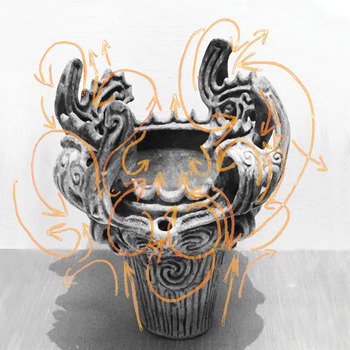
Similarly, the coiling technique of pot-making requires a specific network of movements that play themselves out, bodily and culturally, in relation to the feeling of clay. A flame-pot base begins with this invariant and repetitive network of movements. The initial form is determined by the gradually expanding coiling technique, but the vertical lines and spirals of the base encourage the gaze to rise—projecting movement upwards in an eddying pattern (see Figure 8). It is this projected dynamic that allows the clayful system to experience an escape from the predictable pattern laid down by the basal mode of production and its canonical constraints. The coiling motion flourishes and develops, exploring how it came into being as the structure gains height. However, the spiral-of-formation is not lost altogether. It is taken up, reoriented and pushed to an extreme. Flame pot clayfulness explores the limits of the spiral; it does not seek to destroy it. The gestural plasticity of clay-in-hand searches for the limits of system-imposed rhythms: exploring the extent to which habitual patterns can maintain continuity while evolving or rupture and transform into a different network of movements.
Upward movement and eddying pattern of gaze on a flame pot. (Photograph: © Paul L. March.)

Making rotational sense
I keep turning it. At each turn it is working towards a 3D perspective from each angle … at that orientation. But once the orientation changes—those perspectives disappear. I can remember I had them but I can no longer sense them. I can be aware that I may be destroying them (destroying the previous perspective by working on the present one) but this does not change the overriding effect of the sensation of new perspectives at new orientations (Matrix 6, mid April 2018)
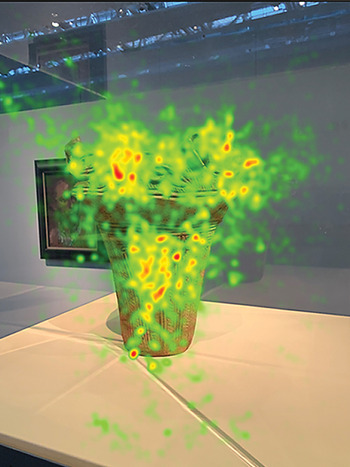
An ecological approach to perception (Gibson Reference Gibson1979) suggests that we perceive a group D Middle Jōmon pot through its function. Its presence awakens possibilities of specific actions such as pouring, filling or storing, and in so doing gives sensori-motor meaning to a hollow mass of clay. In the previous section, I suggested that an encounter with the bumps and curls, spirals and protrusions of a flame pot awakens the possibilities of rhythmical and rotational movement patterns. Support for this view is found in a recent study by March, Ross & Vallée Tourangeau (Reference March, Ross and Vallée Tourangeaun.d.) that used video analysis of body and eye movement to show how flame-pot morphology consistently choreographed the movements and viewing patterns of 24 participants. The results are vividly summarized in Figure 9.
Flame pot with heat map of gaze fixations for 24 participants showing a similar spiral pattern of eye movements across participants. (Photograph: © Paul L. March.)

To summarize, the clayful phenomenological approach enacts a procedure in which the indexical spirals of construction are effaced, turned perpendicular and experienced as iconic forms and structures. Initial empirical evidence suggests that the perceptual experience of this iconic transposition is mirrored by and mediated through bodily movement. The body and gaze are choreographed in a dance of sensori-motor empathy that evokes the indexical movements of construction. (See https://vimeo.com/410590408 for a video excerpt of a participant's gaze and body movements.)
Discussion
This paper relies on the rigorous and scholarly work of Kobayashi. Although I contrast his typological approach with that of MET, I am not criticizing the meticulously collected evidence, nor the way the typographical framework reveals a temporal and spatial network of influences between Jōmon pottery styles. The difference between the two positions concerns the existence and nature of non-linguistic meaning and how it emerges from a material substrate. Kobayashi predicates his search for meaning on a hylomorphic model of the mind that divides form and matter and separates events in the world from cranial activity. Kobayashi identifies routes by which pots may have become meaningful to their makers and how this meaning was communicated. MET outlines a different signification altogether, one that focuses, not on the artefact, but on ‘the hylonoetic field of human becoming’ (Malafouris Reference Malafouris2014, 142). The clayful, phenomenological approach presented here is based upon the principles of MET. It developed while using creative thinging to try to understand the modelling process in a contemporary art project. When two artists visited my workshop, the creative system unexpectedly expanded. Their comments created an association between the physically present (and self-presencing) Holocene project and the physically absent (but conceptually evoked) Jōmon flame pots. From an MET perspective, it was intention-in-action within the Jōmon-Holocene creative system that brought this expansion about. The system functioned through a process of cognitive projection that enabled a recursive and diffractive pattern of sensorial activity between Jōmon and Holocene. The process of cognitive projection gave flow to the pot's rigid structure, highlighting its capacity to perform. The evocation of an absent flame pot through the physical dynamism of contemporary modelling helped the former to escape its previous evocation as a physically present but static museum object.
Whether or not intention-in-action was responsible for creating this research opportunity, this case study was certainly opportunistic. It might, therefore, be argued that, rather than relying on a chance, subjective connection such as this one between flame pots and Holocene project, a more directly relevant association could be achieved by making a replica of a flame pot. This makes sense from an experimental archaeology perspective as a way of generating and testing hypotheses about possible Jōmon chaînes opératoires and providing useful information about material process (Jeffra Reference Jeffra2015). But I give three reasons to suggest that experimental archaeology is not so good at capturing sensory process. First, prehistoric sensory experience leaves little trace: a challenge for any approach seeking to establish valid, reliable and replicable findings based on physical evidence. Second, if this challenge were met, the data would be inferential rather than phenomenological. Objective and subjective methods produce qualitatively different outcomes. Taking the subjective view of a contemporary flame-pot maker, her attention would be focused, not on creating something new, but on simulating something old: an experience that amounts to one of progressive embodied learning rather than clayful phenomenological exploration. In short, experimental archaeology and clayful phenomenology proceed in quite different ways.
The Holocene project began as an artistic one. When flame pots joined, they were incorporated into a contemporary art system and were experienced, to a great extent, in those terms. In light of the difficulties created by referring to prehistoric artefacts as art, I want to argue that taking an artistic position is not the same as labelling something as art. By artistic position, I mean the development of a system that allows a process of enactive signification to propagate and foster metaphorical associations. I think I am on a similar track to Sjöstrand (Reference Sjöstrand2017, 371) when he refers to ‘the art function’ as ‘set into operation when an object of experience reveals its multiple possibilities of existence and thus offers an agent multiple latent possibilities for creative choices’.
This position is qualitatively different from inferential reasoning, whether deductive, inductive or abductive. An inference seeks to provide an evidence-based explanation—a reasonable story that fits the available facts. An artistic position, on the other hand, is not measured by its approximation to objective truth. Instead, it allows for transient connections to be made in a subjective space that are true only in as much as they occurred in that space. In The Open Work, Eco (Reference Eco and Cancogni1989, 86) gives a clear account of the dynamic behaviour of indeterminate art: ‘Its signs combine like constellations whose structural relationships are not determined univocally, from the start, and in which ambiguity of the sign does not … lead back to reconfirming the distinction between form and background.’ But he also describes what can happen if openness is left unchecked (Reference Eco and Cancogni1989, 91): ‘What remains then is no longer a field of possibilities but rather the indistinct, the primary, the indeterminate at its wildest—at once everything and nothing’.
It may be possible to address Eco's warning by focusing research on tacit knowledge as ‘an embodied means of self-understanding in which imagination does not run riot but is put to a specific disciplined use’ (Sofaer Reference Sofaer2015, 20). Perhaps the specific modelling techniques and the anatomically constrained gestural characteristics that brought material and process together to make a flame pot can link to contemporary practice through the uniquely plastic and intemporal creative quality of clay. But even if embodied knowledge can offer access to past, processual activity, it is experienced in a contemporary, cultural context. One thing is clear at least: if we take meaning to be enacted and not encoded, then artefacts can only exist phenomenologically in the present. They can offer no way back to the sensorial patterns of the past. ’[w]e must seize this purposeless purpose and this meaningless meaning as our method’ (Okamoto & Reynolds Reference Okamoto and Reynolds2009, 54–5).
Many years ago, as a trainee clinical psychologist, a supervisor told me that to take feelings seriously was not the same as taking them to be true. Incertitude about the status of felt experience permeates this paper. From the ontological uncertainty of Hamilakis’ sensoriality and the obscure way in which Bailey's art/archaeologies connect with the Neolithic world, to the clayful associations of the Jōmon-Holocene system: making sense goes hand-in-hand with feeling doubt. We may as well embrace it.
Acknowledgements
I wish to thank Wendy Ross and Frédéric Vallée-Tourangeau for their help in preparing this paper, their patient support and their intellectual generosity. I thank the Editor and the two reviewers for their invaluable comments and guidance, Lambros Malafouris for his inspiration and Norman Braden for introducing me to Jōmon pottery in the first place.