INTRODUCTION
Tropical forests are among the most diverse plant communities worldwide (Hart et al. Reference HART, HART and MURPHY1989, Whitmore Reference WHITMORE1998). They contain about 50–80% of the Earth's species diversity (Fays Reference FAYS2008, Puig Reference PUIG2002). However, there is still a knowledge gap in our understanding of the structure and diversity of tropical forests. Factors controlling tree density and diversity in rain forest include natural and anthropogenic disturbances, climate, soil drainage, other soil characteristics (Ghazoul & Sheil Reference GHAZOUL and SHEIL2010, Richards Reference RICHARDS1996) and biotic interactions between species which play a fundamental role in the stability of ecological communities (Thébault & Fontaine Reference THÉBAULT and FONTAINE2010).
Contrary to the association of tropical forests with high biodiversity, some patches within these systems are found to have low diversity (Connell & Lowman Reference CONNELL and LOWMAN1989, Djuikouo Reference DJUIKOUO2012, Hart et al. Reference HART, HART and MURPHY1989, Sonké Reference SONKÉ2005). Such monodominant forests may cover large areas (up to hundreds of square kilometres) and occur adjacent to significantly more-diverse forest types (Hart et al. Reference HART, HART and MURPHY1989). In African and Neotropical monodominant forests, the dominant species mostly belong to Caesalpiniaceae whereas in Asia they usually belong to Dipterocarpaceae and Lauraceae (Anbarashan & Parthasarathy Reference ANBARASHAN and PARTHASARATHY2013, Degagne et al. Reference DEGAGNE, HENKEL, STEINBERG and FOX2009, Peh et al. Reference PEH, LEWIS and LLOYD2011a).
It has been hypothesized that, in tropical regions, mixed forests are found on the most productive soils whereas single-species dominance (monodominance) depends on unfavourable soils characteristics (Richards Reference RICHARDS1996). However, when comparing monodominant and mixed forest stands, there was no significant difference in soil texture and chemical composition in many cases (Hart Reference HART1995, Peh et al. Reference PEH, SONKÉ, LLOYD, QUESADA and LEWIS2011b). This implies that monodominance of these systems is not readily explained by edaphic limitations.
By contrast, a positive feedback mechanism of species-specific life-history traits may explain the existence of such ‘classical monodominant’ forests (Peh et al. Reference PEH, LEWIS and LLOYD2011a). For example, a monodominant species of a closed canopy could cast a deep shade and form a deep leaf litter layer that provide favourable conditions for its large seeds to develop into shade-tolerant saplings and deter seedling regeneration of other non-dominant species.
Gilbertiodendron dewevrei (De Wild.) J. Leonard (Fabaceae-Caesalpinioideae) is an important example of a classical monodominant species which forms large stands from south-eastern Nigeria and eastern Cameroon across the entire Guineo-Congolian rain-forest zone to Eastern Democratic Republic of Congo (Gerard Reference GERARD1960, Hart Reference HART1990, Richards Reference RICHARDS1996). It can form extensive, sometimes almost pure stands, reaching more than 10000 ha. Typically, G. dewevrei accounts for more than 75% of the total basal area and above-ground biomass (Djuikouo et al. Reference DJUIKOUO, DOUCET, NGUEMBOU, LEWIS and SONKÉ2010, Makana et al. Reference MAKANA, EWANGO, MCMAHON, THOMAS, HART and CONDIT2011) and more than 90% of the canopy-level trees (Hart Reference HART1995, Torti et al. Reference TORTI, COLEY and KURSAR2001). As a consequence, in various ecological studies, forests dominated by G. dewevrei have been recognized as a distinct formation (White Reference WHITE1983). This paper compares tree-species composition, structure and regeneration patterns between the G. dewevrei forests and their adjacent high-diversity mixed forests at the Dja Biosphere Reserve in Cameroon, critically focusing on smaller stems as these are ignored in most studies utilizing tropical forest inventory plots (e.g. Lewis et al. Reference LEWIS, LOPEZ-GONZALEZ, SONKÉ, AFFUM-BAFFOE, BAKER, OJO, PHILLIPS, REITSMA, WHITE, COMISKEY, EWANGO, FELDPAUSCH, HAMILTON, GLOOR, HART, HLADIK, DJUIKOUO, JON, LOVETT, MAKANA, MALHI, MBAGO, NDANGALASI, PEACOCK, PEH, SHEIL, SUNDERLAND, SWAINE, TAPLIN, TAYLOR, SEAN, VOTERE and HANNSJÖRG2009). Specifically, we aimed to test the following hypotheses: (1) mixed-forest species were established well in the understorey of monodominant forest; (2) dominance by a single species can modify the overall forest structure and tree species richness i.e. including the structure and diversity of the regenerating canopy trees as compared with mixed-species stands.
MATERIALS AND METHODS
Study sites
We conducted this study in the 526000-ha Dja Biosphere Reserve located in south-east Cameroon (2°50′–3°30′N, 12°20′–13°40′E, ~600 m asl). The habitat of the reserve is classified as moist evergreen forests (Letouzey Reference LETOUZEY1985), comprising a heterogeneous terra firme system with large patches dominated by G. dewevrei. The soil beneath the monodominant and mixed-forest stands does not differ (Peh et al. Reference PEH, SONKÉ, LLOYD, QUESADA and LEWIS2011b).
The mean annual temperature is 24.3°C, with minimum average monthly temperatures of 23.4°C in October and maximum average monthly temperatures of 26.5°C in February (Djuikouo Reference DJUIKOUO2012). The annual rainfall averages 1512 mm (average from 1979 to 2008), with monthly precipitation less than 100 mm occurring between December and February.
Data collection
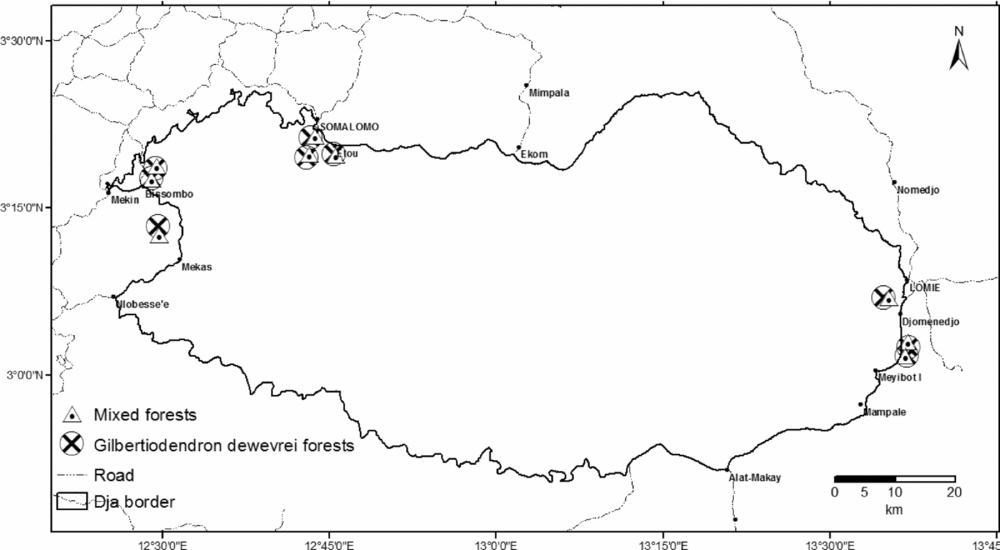
We studied the floristic structure and regeneration patterns in 18 1-ha (100 × 100 m) permanent sample plots, nine plots established in G. dewevrei-dominated forest and nine in mixed forest (Figure 1). By using remote-sensing images, plot locations were chosen based on the presence of G. dewevrei stands which are patchily distributed throughout the reserve. Three locations, Bissombo (BIS), Somalomo (DJK) and Lomié (DJL) were selected based on their phytogeographic influence on the reserve (Senterre Reference SENTERRE2005, Sonké Reference SONKÉ2005).
Location of sampling sites within the Dja Biosphere Reserve, Cameroon.

First a patch of G. dewevrei was located, and within that a plot set at a random location (using a random compass bearing and random distance from an arbitrary start location). For each G. dewevrei-dominated-forest plot, a corresponding mixed-forest plot was established nearby to minimize potential differences between these plots in terms of edaphic and topographical characteristics. Again randomization was used to avoid local-scale biases in plot locations. These sites were also selected such that the plot was within a homogeneous forest type; if a plot was not homogeneous a new random location was chosen. Each plot was further divided into small quadrats of 20 × 20 m to assist in the enumeration. All the trees with a diameter at breast height (dbh) ≥10 cm within a plot were tagged, mapped and measured using standard methods (Lewis et al. Reference LEWIS, LOPEZ-GONZALEZ, SONKÉ, AFFUM-BAFFOE, BAKER, OJO, PHILLIPS, REITSMA, WHITE, COMISKEY, EWANGO, FELDPAUSCH, HAMILTON, GLOOR, HART, HLADIK, DJUIKOUO, JON, LOVETT, MAKANA, MALHI, MBAGO, NDANGALASI, PEACOCK, PEH, SHEIL, SUNDERLAND, SWAINE, TAPLIN, TAYLOR, SEAN, VOTERE and HANNSJÖRG2009, White & Edwards Reference WHITE and EDWARDS2000).
Within each plot, we also surveyed the trees of small size classes (height ≥10 cm and dbh <10 cm) that included juvenile individuals of large-statured (canopy) species plus juvenile and adult individuals of small-statured (understorey) species. Specifically, three parallel strips, 19 m apart, of 100 × 1 m each were enumerated for stems <10 cm dbh within each 1-ha plot (i.e. 300 m2; 3% of plot area). We recorded the height of all plants within these strips, and also recorded their dbh if they were taller than 3 m. Because sample sizes are generally low for individual species given the limited sampling, we classified all the individuals (dbh <10 cm and dbh ≥10 cm) recorded in the plots into four categories: G1, height <5 m; G2, height ≥5 m and dbh <20 cm; G3, dbh between 20–40 cm; and G4, dbh > 40 cm. Voucher specimens were collected for each plant to confirm the field identification by using existing floras and herbarium specimens at the National Herbarium of Cameroon and National Botanical Garden of Belgium.
Data analysis
We used diversity indices to describe diversity patterns across the study plots. Shannon (ISH) and Simpson (D’) diversity indices are the most widely used, and thus facilitate comparisons. These indices take into account not only the number of species but also whether species are more or less equally abundant, or whether in contrast one or a few species dominate. Hurlbert's species richness curves that were rescaled to the number of individuals were employed to compare species richness among different size classes (G1, G2, G3, G4). These rarefaction curves give the expected number of species E(Sx) in a sample of x individuals selected at random (without replacement) from a plot containing n individuals and S species (Hurlbert Reference HURLBERT1971).
 \begin{equation*}
{\rm E}\left( {Sx} \right) = \sum {1 - C_{n - nj}^N } /C_n^N
\end{equation*}
In addition, we used Entropart in the R package which employs the state-of-the-art method of entropy partitioning (http://CRAN.R-project.org/package-entropart) to estimate the effective species number of each size class of each forest type. This approach, which assumes that community species follow multinomial distributions (Marcon et al. Reference MARCON, HERAULT, BARALOTO and LANG2012, Reference MARCON, SCOTTI, HERAULT, ROSSI and LANG2014), enables us to correct sampling biases and compare 95% confidence intervals between corresponding size classes of the two forest types, and among size classes within each forest type.
Since the plots of monodominant and mixed forests were paired, we used Student's t-test to determine if the two forest types are different in terms of species richness and structure. In addition, we used chi-square test to determine if the distribution of stems is associated with size classes. Cluster analysis was conducted using WARD algorithm and NNESS Index to verify the similarities between plots. The NNESS Index takes into consideration the number of species and the number of stems per species. Statistical analyses were performed using MVSP 3.2 (Kovach Computing Service) and STATISTICA 6 (StatSoft France, Maisons – Alfort, France).
RESULTS
Forest structure
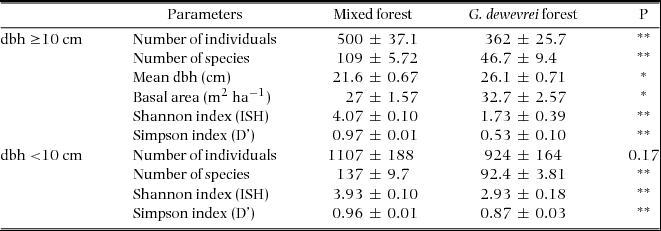
We recorded a total of 18272 small stems (i.e. trees with dbh <10 cm) within the 5400 m2, representing 387 species, 226 genera and 62 families. Some 72.6% were identified to species level, 16.5% identified to genus level, 5.1% identified to family level, and 5.8% remain unidentified. Small-stem density was not significantly different between mixed forest (3.7 ± 0.6 stems m−2) and monodominant forest (3.1 ± 0.6 stem m−2) (Table 1).
Structural parameters and diversity of Gilbertiodendron dewevrei and mixed forests of 18 1-ha plots of trees with dbh ≥10 cm and 18300-m2-subplots of trees with dbh <10 cm at the Dja Biosphere Reserve, Cameroon. Differences between forest types analysed by Student's t-test, df = 16;* denotes P <0.05 (significant); ** denotes P <0.001 (highly significant).
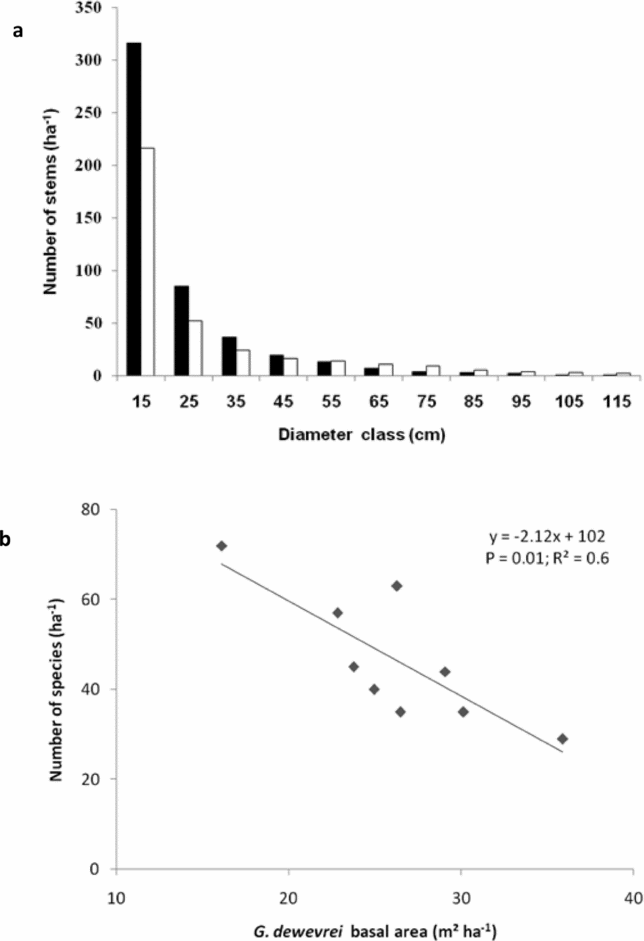
A total of 7755 stems with dbh ≥10 cm were recorded within the 18 1-ha permanent plots, representing 263 species, 167 genera and 44 families. About 91.4% were identified to species level, 4.7% identified to genus level, 2% identified to family level and 1.9% remain unidentified. The mixed forest had significantly more stems than G. dewevrei forest (500 ± 37.1 and 362 ± 25.7 stems ha−1, respectively). Although both monodominant and mixed forests had decreasing stem numbers along the gradient of size classes (Figure 2a), the mixed forest had significantly higher density of trees at the threshold of 10 cm and fewer large trees (> 40 cm) than monodominant stand (Chi-square test, χ2 = 10.8, df = 1, P <0.001). Furthermore, total basal area was significantly different between the two forest types. Average basal area of G. dewevrei forest was 32.7 ± 2.6 m2 ha−1, whereas that of mixed forest was 27 ± 1.6 m2 ha−1 (Student's test, t = 3.76, df = 16, P <0.05).
Distribution of stems density in mixed (dark bars) and Gilbertiodendron dewevrei (white bars) stands (a). Labels on the x-axis are midpoints of diameter intervals. Relationship between G. dewevrei basal area and number of species at the Dja Biosphere Reserve, Cameroon (b).
In G. dewevrei forest, 80% of the total basal area of trees with dbh ≥10 cm was accounted for solely by the dominant species. The mixed-forest species made a relatively small contribution to the total basal area of the monodominant forest; these species were Desbordesia glaucescens (1.5%), Erythrophloeum suaveolens (1.6%), Pentaclethra macrophylla (1.1%), Irvingia gabonensis (0.7%), Alstonia boonei (0.7%), Petersianthus macrocarpus (0.6%) and Carapa procera DC. (0.6%). These species had a relatively greater contribution to the total basal area of the mixed forest (e.g. P. macrocarpus, 6.9%; P. macrophylla, 4.7%; C. procera, 2.5%; D. glaucecens, 2.2% and E. suaveolens, 1.24%).
Floristic relationship
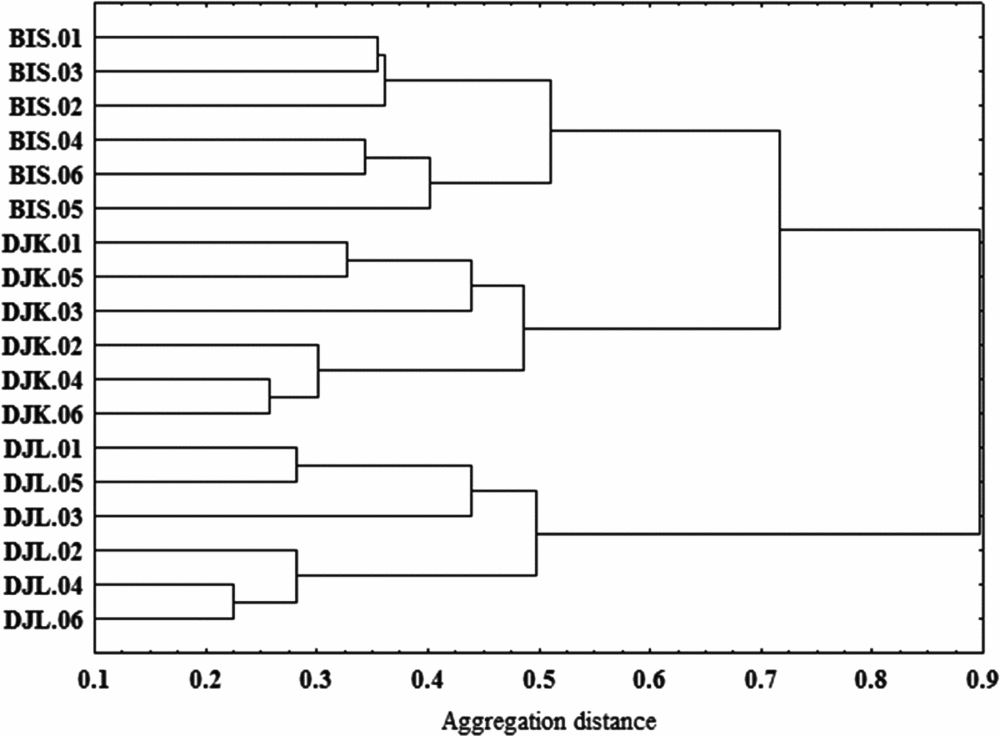
Cluster analysis based on overall floristic composition (i.e. including trees with dbh <10 cm), clearly shows a floristic link between mixed forest and G. dewevrei forest (Figure 3). Despite the relatively low similarity between both forest types in terms of structure, the floristic composition of monodominant forest was relatively similar to that of their adjacent mixed forest of the same locality. Distinction of each locality without clear differentiation of forest types was observed.
Cluster analysis based on overall floristic composition (i.e. including trees with dbh <10 cm) across all 18 plots at the Dja Biosphere Reserve, Cameroon: Bissombo BIS; Lomié DJL; Somalomo DJK. Odd-numbered plots (e.g. BIS. 01) denote Gilbertiodendron dewevrei-dominated forest; even-numbered plots (e.g. BIS. 02) denote mixed forest.
Forest composition
Mixed forest was significantly more diverse than G. dewevrei forest in terms of species richness in both trees with dbh ≥10 cm and dbh <10 cm, as measured by Simpson's and Shannon's diversity indices (Table 1). Mixed forest had an average of 109 ± 5.7 species ha−1 of trees with dbh ≥10 cm, and 137 ± 9.7 species of trees with dbh <10 cm, whereas G. dewevrei forest had an average of 46.7 ± 9.4 species ha−1 and 92.4 ± 3.8 species for stems with dbh ≥10 cm and dbh <10 cm, respectively. Many species were represented by only one individual with dbh ≥10 cm in the monodominant forest (48 spp. across the nine 1-ha plots).
Thirty-eight families were identified in the G. dewevrei forest. Fabaceae-Caesalpinioideae was the dominated (sub)family which constituted more than 82% of the relative basal area of the monodominant forest (with 80% solely by G. dewevrei). Irvingia gabonensis with 0.7% of the relative basal area was the only species occurring in all plots of G. dewevrei forest. Apart from G. dewevrei which constituted 32.2% of trees with dbh <10 cm, other relatively important tree species in the monodominant forest included Tabernaemontana crassa Benth. (1.2%), T. pendulifolia K. Schum (1.3%), Angylocalyx pynaertii De Wild. (0.9%), Strombosia pustulata Oliv. (0.7%) and Polyalthia suaveolens Engl. & Diels (0.5%).
In mixed forest, we identified 44 families dominated by Euphorbiaceae (20% of the relative basal area) with 32 different species. Families such as Euphorbiaceae, Rubiaceae and Annonaceae were well-represented by individuals with small diameters in both forest types.
There was no significant relationship between the diversity of stems with dbh ≥10 cm and dbh <10 cm for both forest types (mixed forest: R2 = 0.01, P = 0.78; monodominant forest: R2 = 0.10, P = 0.4). However, a significant negative correlation was observed between the basal area and species richness in the G. dewevrei forest (Figure 2b).
Vertical structure of species
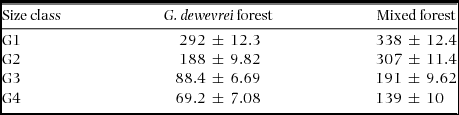
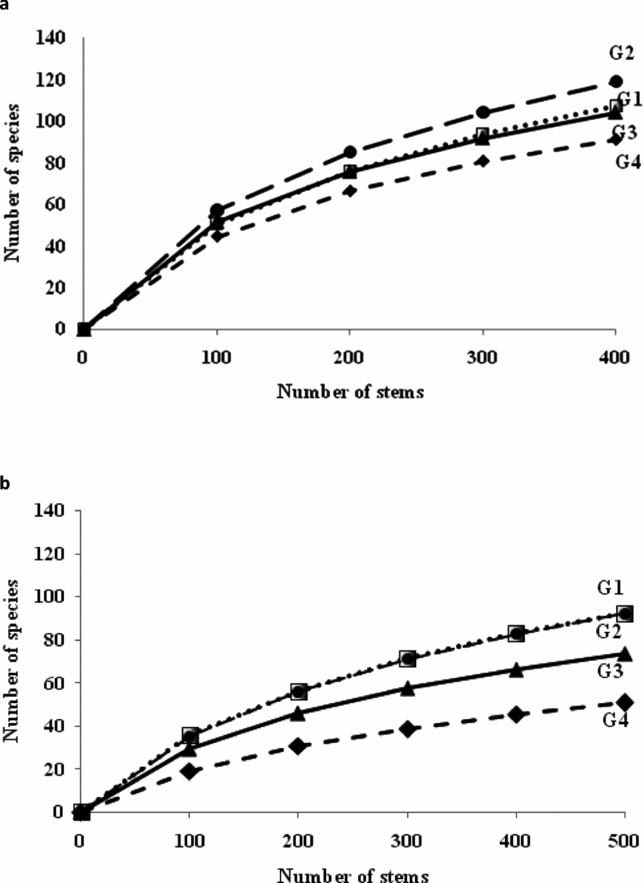
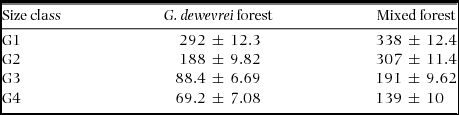
The species richness of different size-class distributions was evaluated using Hurlbert's curve for both forest types. The asymptotic smoothed species accumulation curves for the mixed forest are higher than that of monodominant forest across all size classes, suggesting that, for similar number of stems, a monodominant forest has fewer species than mixed forest in both trees with dbh ≥10 cm and dbh <10 cm (Figure 4). In accordance with the Hulbert's species curves, effective species numbers of all size classes of the mixed forest were significantly higher than the corresponding size classes of the monodominant forest (Table 2). The significant decline in effective species numbers along the increasing size classes (i.e. confidence intervals of all size classes did not overlap) was observed in both forest types.
Effective species numbers (± 95 %) of each size class (G1, height <5 m; G2, height ≥5 m and dbh <20 cm; G3, dbh between 20–40 cm; and G4, dbh > 40 cm) of the Gilbertiodendron dewevrei and mixed forests at the Dja Biosphere Reserve, Cameroon.
Species richness (Hurlbert Curve) in mixed forest (a) and Gilbertiodendron dewevrei forest (b) at the Dja Biosphere Reserve (Cameroon), for four different size classes: G1, height <5 m; G2, height ≥5 m and dbh <20 cm; G3, dbh between 20–40 cm; and G4, dbh > 40 cm.
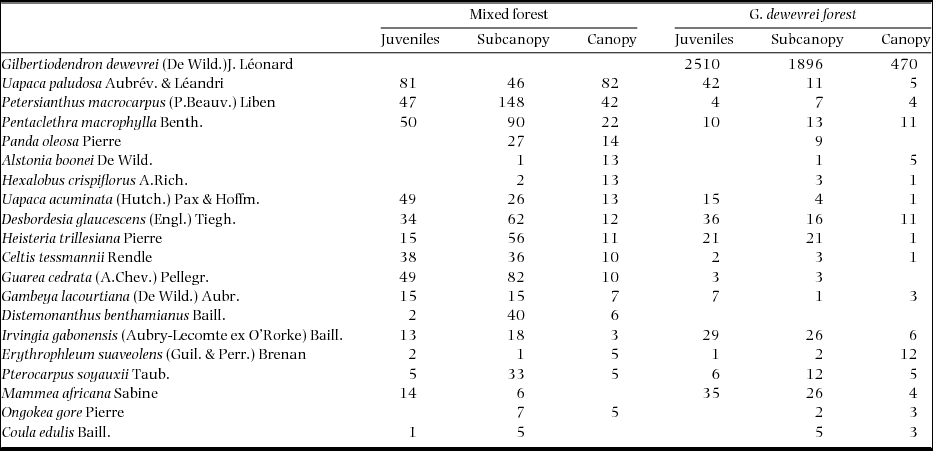
Regardless of forest type, most species with large trees (dbh > 40 cm) were also well represented in other size classes (Table 3). However, species number of trees > 40 cm dbh is significantly different between the two forest types (Student's test, t = 7.34, df = 16, P <0.001). The species number of the subcanopy size class (dbh between 20 cm and 40 cm), was highly significantly different between the two forest types (Student's test, t = −12.6, df = 16, P <0.001). In both forest types, this size class was dominated by Olacaceae, Annonaceae, Myristicaceae, Rubiaceae and Sterculiaceae. Natural regeneration was observed in most subcanopy species. These species included T. crassa, A. pynaertii, S. pustulata, Santiria trimera (Oliv.) H. J. Lam ex Aubrév. and Polyathia suaveolens. For both forest types, the stem numbers occurring in size class between 20 cm and 40 cm correlated positively and significantly with those in the smaller size class (mixed forest: r = 0.32, P <0.05; monodominant forest: r = 0.54, P <0.001).
Twenty canopy species in the Gilbertiodendron dewevrei and mixed forests at the Dja Biosphere Reserve, Cameroon. Juveniles: dbh <10 cm; Subcanopy: 10 cm ≤ dbh <40 cm; Canopy: dbh ≥40 cm (the values in the table indicate number of individuals).
Because these datasets are strongly clumped by plots, we could not analyse the size class distributions of each canopy species in monodominant and mixed stands. Nevertheless when combining the plots together for exploratory purposes (Table 3), we observed that (1) some species, such as Distemonanthus benthamianus, were abundant in the mixed forest but absent in the monodominant forest; and (2) while non-dominant species in monodominant stand are generally associated with mixed forest, three mixed-forest species (E. suaveolens, I. gabonensis, Mammea africana) had higher numbers of large trees in monodominant forest.
DISCUSSION
Based on our survey of nine 1-ha plots of Gilbertiodendron dewevrei forest, this study confirms the floristic homogeneity of monodominant forest at the canopy level (Connell & Lowman Reference CONNELL and LOWMAN1989, Makana et al. Reference MAKANA, HART, HART, Dallmeier and Comiskey1998). A similar pattern was observed by Hart et al. (Reference HART, HART and MURPHY1989) at Ituri forest in the Democratic Republic of the Congo: the monodominant stands of this forest, G. dewevrei accounted for 80% of the total basal area, and diversity index scores were lower than those of the mixed forest. In terms of total based area, our study shows that the G. dewevrei forest at Dja Biosphere Reserve (32.7 ± 2.6 m2 ha−1) was not significantly different from the same forest type at Uele in the Democratic Republic of the Congo (29.9 m2 ha−1) (Gerard Reference GERARD1960). These G. dewevrei forests were also not different in terms of stem density of trees with dbh ≥10 cm (Dja Biosphere Reserve: 362 ± 25.7 trees ha−1; Uele: 419 trees ha−1).
Higher species richness in both stems with dbh ≥10 cm and dbh <10 cm was observed in mixed forest after controlling for the stem density. Using another approach, Makana et al. (Reference MAKANA, HART, HIBBS, CONDIT, Losos and Leigh2004, 2011) compared the monodominant and mixed forests directly using two 10-ha plots of each forest type and showed that, despite the dominance of G. dewevrei, species diversity of the monodominant forest was high and comparable to their adjacent mixed forest. The discrepancy between our results is probably because our sites were selected in such a way that the entire area was within a homogeneous 1-ha of forest.
Surprisingly, species diversity in the smaller size classes of the monodominant forest, though lower than that of the mixed forest, was still relatively high. In the monodominant forest, the higher diversity of stems with dbh <10 cm compared with that of the established stems implies the following: first, most propagules were originated from the adjacent mixed forest and are capable of penetrating into G. dewevrei forest. Second, a significant number of non-dominant species were able to overcome deep shade and deep litter to germinate successfully. Third, most of these mixed-forest species however still failed to establish at the canopy level.
Our estimated average stem density of trees with dbh <10 cm in G. dewevrei forest was 3.1 stems m−2, which is not significantly different from that of the mixed forest (3.7 stems m−2). But our estimated average stem density of trees with dbh ≥10 cm was significantly lower in the monodominant forest (362 stem ha−1) as compared with the mixed forest (500 stems ha−1). This indicates that G. dewevrei was able to outcompete most stems of the mixed-forest species, despite having a significant number of the latter successfully dispersed into the monodominant system. Generally, hypotheses about the origin and maintenance of classical monodominance usually refer to one or a suite of species-specific life-history traits, such as the ability to stage massive and synchronous fruiting, avoidance of predation and herbivory, and low soil nutrient availability. Also, low light availability and deep litter in the monodominant forest could inhibit the establishment of seedlings of mixed-forest species (Gross et al. Reference GROSS, TORTI, FEENER and COLEY2000, Hart Reference HART1995, Peh et al. Reference PEH, LEWIS and LLOYD2011a, Torti et al. Reference TORTI, COLEY and KURSAR2001). Nevertheless, some shade-tolerant mixed-forest species (such as Desbordesia glaucescens, Irvingia gabonensis, Polyalthia suaveolens, Strombosia pustulata, Santiria trimera) were able to attain a relative high sapling density in the monodominant despite the biophysical barriers imposed by the dominant species (Makana et al. Reference MAKANA, EWANGO, MCMAHON, THOMAS, HART and CONDIT2011). In addition, the presence of gap colonizers or high-light-demanding species such as Alstonia boonei, Distemonanthus benthamianus and Petersianthus macrocarpus in the mixed forest suggests the occurrence of periodic succession in response to gap formation. However, these species were unlikely to co-exist with G. dewevrei in significant numbers for two reasons: first, there are significantly fewer and smaller gaps in this forest type, compared with their adjacent mixed forest, indicating very lower exogenous disturbances (Hart et al. Reference HART, HART and MURPHY1989, Peh et al. Reference PEH, LEWIS and LLOYD2011a). Second, under the shade of these colonizers that occasionally established in the monodominant forest, their new recruits were unlikely to compete successfully with the more abundant, shade-tolerant saplings of G. dewerei.
Both structure and composition of the two forests may provide us with new insights on the processes leading to monodominance in G. dewevrei forest, and also on the mechanisms for maintaining species diversity in the mixed forest (Hart et al. Reference HART, HART and MURPHY1989). The size-class distributions of canopy species in monodominant and mixed forests at Dja Biosphere Reserve suggest that, without severe large-scale disturbance, both forest types are likely to continue to be dominated by their current dominant species. The dominant canopy species of the monodominant (G. dewevrei) and mixed forests (e.g. U. paludosa, P. macrocarpus, P. macrophylla, D. glaucescens) are all well represented in the subcanopy layers and had abundant juveniles.
Most small individuals of mixed-forest species in the monodominant forest would likely be out-competed by individuals of G. dewevrei. This is an example of diffuse competition (Hubbell & Foster Reference HUBBELL, FOSTER, Sutton, Whitmore and Chadwick1983) whereby a positive feedback of the biotic conditions created by the monodominant stands (Peh et al. Reference PEH, LEWIS and LLOYD2011a) is having a broad negative impact on all other tree species. Our observation also suggests that G. dewevrei only suppresses rather than eliminates the presence of mixed-forest species (Makana et al. Reference MAKANA, EWANGO, MCMAHON, THOMAS, HART and CONDIT2011).
Interestingly, each locality of our sampling sites was distinct in terms of their floristic composition, which included species of trees with dbh ≥10 cm and dbh <10 cm. This implies that the floristic composition of both forest types may not be homogeneous throughout the reserve and there may be a spatial differentiation of floristic characteristics in the region. Earlier studies on classical monodominant forests had also observed a change in the floristic composition with geographical distances (Condit et al. Reference CONDIT, ASHTON, BASLEV, BROKAW, BUNYAVEJCHEWIN, CHUYONG, CO, DATTARAJA, DAVIES, ESUFALI, EWANGO, FOSTER, GUNATILEKE, GUNATILEKE, HERNANDEZ, HUBBELL, JOHN, KENFACK, KIRAKIPRAYOON, HALL, HART, ITOH, LAFRANKIE, LIENGOLA, LAGUNZAD, LAO, LOSOS, MAGARD, MAKANA, MANOKARAN, NAVARETTE, MOHAMMED, OKHUBO, PÉREZ, SMAPER, HUA SENG, SUKUMAR, SVENNING, TAN, THOMAS, THOMSON, VALLEJO, VILLA MUÑOZ, VALENCIA, YAMAKURA and ZIMMERMAN2005, Gerard Reference GERARD1960).
The results of this study support the assumption that there is a floristic inflow from the mixed forest into the monodominant G. dewevrei forest (Djuikouo et al. Reference DJUIKOUO, DOUCET, NGUEMBOU, LEWIS and SONKÉ2010, Hart et al. Reference HART, HART and MURPHY1989, Makana et al. Reference MAKANA, HART, HIBBS, CONDIT, Losos and Leigh2004, Peh et al. Reference PEH, SONKÉ, SÉNÉ, DJUIKOUO, NGUEMBOU, TAEDOUMG, BEGNE. and LEWIS2014). Many species had abundant juveniles in the undergrowth of these monospecific forests. But species richness in monodominant forest decreased along a gradient of increasing tree size classes, and very few species could establish well into the monodominant canopy. Therefore, this observation does not support the hypothesis that the structure of the canopy tree diversity of the monodominant forests might shift towards diversification. No doubt some mixed-forest species were well-represented in the subcanopy and canopy layers in G. dewevrei-dominated forest. Their presence in the smaller size classes was proportionate to their population size in the canopy, indicating that these non-dominant species have in situ regeneration potential in the monodominant systems. Nevertheless, in the absence of severe disturbance, G. dewevrei would likely to remain dominant in the canopy, and possibly expand at the expense of adjacent mixed forest.
ACKNOWLEDGEMENTS
MNDK was supported by the ‘Formation à la Recherche’ program of the Agence Universitaire de la Francophonie. SLL who contributed to the research costs was supported by a Royal Society University Research Fellowship. KSHP was supported by the Southampton University‘s IFLS Fellowship. We thank Olivier Séné, Hermann Taedoung and Christelle Gonmadje for their field assistance. We are grateful for all the members of the laboratory of tropical and subtropical forestry (Gembloux Agro-Bio Tech) as well as the staff of the National Herbarium of Yaounde and Meise for allowing access to the herbarium collections.