Syncope is a common acute symptom in children, and the causes are not completely clear. They generally include neurally mediated syncope, cardiac syncope, and unexplained syncope. Neurally mediated syncope includes vasovagal syncope, postural orthostatic tachycardia syndrome, orthostatic hypotension, and situational syncope, and is common in children.Reference Chen, Zhang, Ingrid, Chen, Qin and Du 1 – Reference Abboud 4 Vasovagal syncope and postural orthostatic tachycardia syndrome are the major reasons for syncope in children, whereas cardiac syncope accounts for 5–6%.
Postural orthostatic tachycardia syndrome is defined as, during a head-up or head-up tilt test, an increase in heart rate over 30 beats per minute or maximum heart rate over 120 beats per minute, often accompanied by symptoms of dizziness, shortness of breath, headaches, palpitations, paleness, blurred vision, fatigue, morning discomfort, and even orthostatic intolerance.Reference Chen and Du 5 , Reference Ojha, Chelimsky and Chelimsky 6 According to Stewart, postural orthostatic tachycardia syndrome is one of the signs of chronic orthostatic intolerance,Reference Stewart 7 and could accompany syncope.
Cardiac syncope is a kind of syncope triggered by brain ischaemia caused by a sudden decrease of cardiac output, and can cause death under serious situations. Most instances of cardiac syncope have no relation to posture, seldom have pre-symptoms, but are sometimes accompanied by cyanosis, dyspnoea, arrhythmia, weak heart sound, and abnormal electrocardiogram. The cardiac diseases that can lead to cardiac syncope are classified into three types: arrhythmia, cardiac output construction, and cardiomyopathy. Although cardiac syncope occurs only in a small proportion of child population, it is quite dangerous. Therefore, it is crucial to differentiate cardiac syncope from postural orthostatic tachycardia syndrome-associated syncope in a timely and accurate manner in the clinic. A thorough history and appropriate investigations remain essential in the assessment of syncope.Reference MacCormick, Crawford and Chung 8
By enquiring about the detailed medical history and conducting physical examinations and head-up tests and/or head-up tilt tests, we could clarify postural orthostatic tachycardia syndrome with syncopal symptoms. For the diagnosis of cardiac syncope, we selected the following examinations depending on the real situation: electrocardiogram, echocardiography, Holter electrocardiogram, serum biochemical analysis, exercise test, or intra-cardiac electrophysiologic examinations. 9 However, under emergency situations, the above-mentioned methods are sometimes not available. Thus, it is necessary to propose a useful method to differentiate cardiac syncope from postural orthostatic tachycardia syndrome-related syncopal symptoms quickly and efficiently.
The Calgary score was originally used to make differential diagnoses between adult vasovagal syncope and other types of syncope,Reference Serletis and Sheldon 10 , Reference Sheldon, Rose, Connolly, Ritchie, Koshman and Frenneaux 11 and included seven diagnostic questions, each producing a corresponding score. The Calgary score is then calculated. Reliable data from the history taking are crucial to an accurate Calgary score.Reference Romme, van Dijk, Boer, Bossuyt, Wieling and Reitsma 12 If it surpassed a threshold value, the initial diagnosis as vasovagal syncope or other types of syncope would be classified. For the purpose of an initial differential diagnosis between cardiac syncope and postural orthostatic tachycardia syndrome in children, we explored the value of a child's characteristics-based modified Calgary score in differential diagnoses of cardiac syncope and postural orthostatic tachycardia syndrome-associated syncope.
Subjects and methods
Subjects
From August, 2002 to April, 2011, a total of 213 children were diagnosed with cardiac syncope or postural orthostatic tachycardia syndrome-associated syncope in the Department of Pediatrics, Peking University First Hospital. Of these children, 22 cases, including 9 boys and 13 girls, in the age group of 2–18 years (mean of 10.5 plus or minus 4.6 years) suffered from cardiac syncope. In addition, 191 cases, including 92 boys and 99 girls, in the age group of 5–19 years (mean of 11.9 plus or minus 2.7 years) suffered from postural orthostatic tachycardia syndrome-associated syncope.
Methods
Clinical diagnostic criteria of postural orthostatic tachycardia syndrome
The diagnosis was made with reference to the criteria proposed by Stewart.Reference Stewart 7 A positive response for the head-up test or head-up tilt test was as follows: postural orthostatic tachycardia syndrome should be considered if the heart rate increased over 30 beats per minute in a head-up tilt test during the first 10 minutes or reached a maximum heart rate of over 120 beats per minute, accompanied by symptoms such as head-up dizziness, syncope, shortness of breath, headache, palpitations, paleness, blurred vision, fatigue, and discomfort in the morning.Reference Low, Sandroni, Joyner and Shen 13 The cardiac syncope diagnostic standard referred to the Electrophysiological Disorders of the Heart edited by Saksena et al.Reference Saksena, Camm and Boyden 14
Head-up test and head-up tilt test
The child was asked to lie down quietly for 10 minutes and baseline heart rate, blood pressure, and electrocardiogram were subsequently recorded. The child then stood upright, maintaining that position for 10 minutes, and changes in the above parameters were recorded. During the test, intolerance symptoms were closely observed. 9
Head-up tilt test included the basic head-up tilt test and the sublingual nitroglycerin-provocated head-up tilt test. For the basic head-up tilt test, all possible drugs that could affect the autonomic nervous system were discontinued for 3 days before the test. Fasting was needed and the environment was quiet and dark with suitable light. The Dash 2000 Multileads Physiological Monitor (GE Company, Toronto, Canada) was used to test the changes in electrocardiogram and blood pressure, which were continually recorded during the test. In the beginning, the child lay in the supine position for 10 minutes, and baseline blood pressure, heart rate, and electrocardiogram were recorded. The child was then asked to stand against the 60° tilt table, and blood pressure, heart rate, electrocardiogram changes, and clinical manifestations were dynamically recorded for 45 minutes or until a positive response occurred. For sublingual nitroglycerin-provocated head-up tilt test, if the child's basic head-up tilt test was negative, he or she was asked to stand in the tilt table and orally take a nitroglycerin tablet at 4–6 micrograms per kilogram (maximum 300 micrograms) for 20 minutes or until a positive response was observed, during which blood pressure, heart rate, electrocardiogram changes, and clinical manifestations were dynamically recorded.
Modified Calgary score
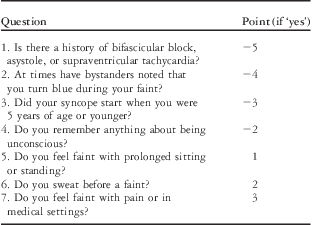
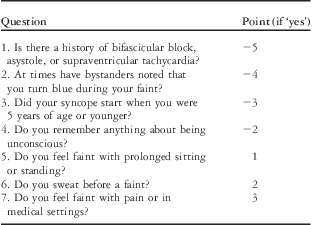
The modified Calgary score consisted of seven diagnostic questions relating to medical history, triggers, circumstances, as well as signs and symptoms of transient loss of consciousness (Table 1).Reference Sheldon, Rose, Connolly, Ritchie, Koshman and Frenneaux 15 All questions were answered with “yes” or “no”. The answers’ corresponding scores were then summarised to obtain a total score, ranging from −14 to +6 points. In the modified Calgary score, we considered the peak age of the incidence of postural orthostatic tachycardia syndrome in children and equivalently changed the original third question “age over 35 years old” to “age less than 5 years old”.
Individual items of the modified Calgary score.Reference Romme, van Dijk, Boer, Bossuyt, Wieling and Reitsma 12
Statistical analysis
The semi-quantitative data were expressed as median, whereas the enumeration data were expressed as cases (percentage). The mean values of both groups were compared using the Wilcoxon Rank-Sum Test. The receiver operating characteristic curve was used to analyse the prediction value of the Calgary score in differentiating cardiac syncope from postural orthostatic tachycardia syndrome-associated syncope. The area under the curve represented the predictive value. Scores between 0.5 and 0.7 had low diagnostic values, between 0.7 and 0.9 had middle diagnostic values, and over 0.9 had high diagnostic values. The 95% confidence interval not including 0.5 or p-value less than 0.05 showed predictive value.Reference Swets 16
Results
Comparison of the modified Calgary score
The comparison of the modified Calgary score between cardiac syncope and postural orthostatic tachycardia syndrome cases: The median score (−5.0) in cardiac syncope cases significantly differed from that of postural orthostatic tachycardia syndrome-associated syncope (0.0; p < 0.01).
Predictive value of the modified Calgary score
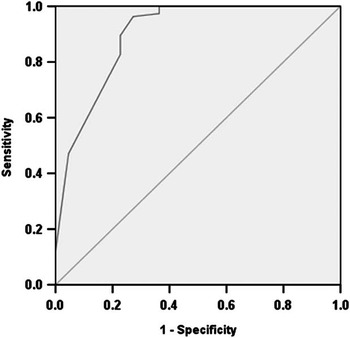
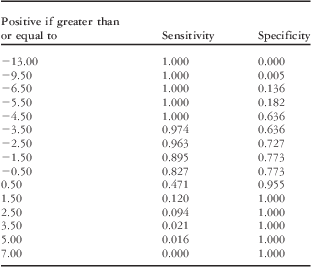
The prediction value of the modified Calgary score for determining cardiac syncope or postural orthostatic tachycardia syndrome-associated syncope: receiver operating characteristic (Fig 1) was used to analyse the sensitivity and specificity of the modified Calgary score for predicting cardiac syncope. The area under receiver operating characteristic was 0.898 and standard deviation was 0.042 with 95% confidence interval (0.816, 0.980), which did not include 0.5. Different modified Calgary scores were selected to analyse their sensitivity and specificity (Table 2). The results suggested that a score of −2.5 yielded a sensitivity of 96.3% and a specificity of 72.7% for differentiating cardiac syncope from postural orthostatic tachycardia syndrome-associated syncope. Owing to the fact that the scores were always integer numbers, a modified Calgary score less than −3.0 could be used to differentiate cardiac syncope from postural orthostatic tachycardia syndrome-associated syncope.
The receiver operating characteristic of different Calgary scores. The longitudinal axe represents sensitivities of different Calgary scores. The transversal axe represents the false positive rate (1 – specificity). The 45° dotted line is the standard reference line, representing sensitivity being equal to false positive rates, which had no predictive value. The farther the curve from the reference line, the higher the predictive value it had. The area under the curve represents the predictive value of index on results, which was low when between 0.5 and 0.7, middle when between 0.7 and 0.9, and high when over 0.9.

The different points of the modified Calgary score prediction for the differential diagnosis between CS and POTS-associated syncope.

CS = cardiac syncope; POTS = postural orthostatic tachycardia syndrome
Discussion
Clinical issues of postural orthostatic tachycardia syndrome
The concept of postural orthostatic tachycardia syndrome in children was first proposed by Stewart et al in 1999 as one kind of orthostatic intolerance.Reference Stewart, Gewitz and Weldon 17 The major manifestations of postural orthostatic tachycardia syndrome are chronic orthostatic intolerance symptoms accompanied by obvious orthostatic tachycardia. Chronic symptoms include dizziness, shortness of breath, headaches, palpitations, paleness, blurred vision, fatigue, morning discomfort, and even syncope under serious conditions. At present, a large sample-based epidemiologic study on postural orthostatic tachycardia syndrome is lacking, but according to GrubbReference Grubb 18 at least 50,000 Americans have manifestations of postural orthostatic tachycardia syndrome. The main pathogenesis of postural orthostatic tachycardia syndrome is orthostatic low blood volume.Reference Medow and Stewart 19 Currently, the clinical diagnosis of postural orthostatic tachycardia syndrome mainly relies on the head-up test and/or head-up tilt test, but such tests are far from efficient under emergency situations.
Cardiac syncope
Cardiac syncope is triggered by multiple pathological mechanisms during acute and chronic fatal arrhythmia and cardiac mechanic acute dysfunction. Cardiac syncope in children is most common in those with serious arrhythmia, cardiac output dysfunction, and cardiac ischaemia, such as paroxysmal tachycardia, paroxysmal atrial fibrillation, sick sinus syndrome, atrioventricular blockages, congenital heart disease, idiopathic pulmonary artery hypertension, hypertrophic cardiomyopathy, and Adams–Stokes syndrome under the most serious conditions. Under rare conditions, it can cause sudden death.Reference Massin, Bourguignont and Coremans 20 – Reference Chen and Du 22 Therefore, it remains crucial to find a way to rapidly and accurately differentiate cardiac syncope from neurally mediated syncope based on a patient's medical history in emergency.
Usefulness of the modified Calgary score in the differential diagnosis of syncope in children
In 2002, Sheldon from Calgary UniversityReference Sheldon, Rose and Ritchie 23 first applied Calgary syncope symptom scores in adult syncopal diagnosis. In 2006, they applied the Calgary score in adult vasovagal syncope diagnosis. In 2009, Romme et alReference Romme, van Dijk, Boer, Bossuyt, Wieling and Reitsma 12 indicated that Calgary score had high sensitivity (87%) in distinguishing vasovagal syncope from transient loss of consciousness, but with only 32% specificity. Studies revealed that most children with postural orthostatic tachycardia syndrome were older than 5 years.Reference Chen, Wang and Sun 24 Consequently, we modified the Calgary score according to the clinical characteristics of children, changed the third question in the original score items from “age over 35 years” to “less than 5 years”, and performed receiver operating characteristic for evaluating the diagnostic value of the scores in cases of cardiac syncope or postural orthostatic tachycardia syndrome-associated syncope. The results suggested that this score yielded a sensitivity of 96.3% and a specificity of 72.7% for differentiating cardiac syncope from postural orthostatic tachycardia syndrome-associated syncope in children, and thus was of significance for clinical practice in emergency.
Limitations
There are also some limitations in this study, however, especially in subject selection. We had less cases of cardiac syncope. We need multi-centre studies in the future to improve the value of research. In addition, a small part of children are too young to understand the questions and express their feelings, and we had to obtain some useful information from their parents, which might limit the accuracy of information.
Acknowledgements
This work was supported by Capital Medical Science Development Projects of China (2009-1008), and Beijing Science and Technology Project (D10100050010059).