Public health emergency preparedness requires coordinated efforts on the part of public health agencies and health care professionals. In the last decade, much of this focus has been on the work of first responders, pre-hospital emergency medical services (EMS), and hospital-based first receivers. While the role of EMS and hospitals in disaster preparedness cannot be understated, recent events have demonstrated that community-based primary care practices are an important yet underutilized resource during disasters with health consequences.Reference Dolan and Krug 1 Primary care has been defined by the Institute of Medicine as “the provision of integrated, accessible health care services by clinicians who are accountable for addressing a large majority of personal health care needs, developing a sustained partnership with patients, and practicing in the context of family and community.” 2 Family doctors are trusted information sources during emergencies and play important roles in risk communication for health-related recommendations. Patients are also more likely to prepare for disasters if instructed to do so by their regular doctors, potentially improving outcomes, especially among high-risk individuals.Reference Olympia, Rivera, Heverley, Anyanwu and Gregorits 3 The American Academy of Pediatrics Committee on Pediatric Emergency Medicine and Task Force on Terrorism acknowledged this influence when it called on pediatricians to help their patients by discussing preparedness and providing specific guidance for disaster readiness.Reference Lurie 4 Moreover, patient utilization of primary care practices instead of emergency departments for medication refills and non-urgent medical evaluations might alleviate the emergency department congestion that was seen following Hurricanes Katrina and Sandy, and during the 2009 H1N1 influenza pandemic.Reference Markenson and Reynolds 5 , Reference Jhung, Shehab and Rohr-Allegrini 6 Finally, primary care practices are uniquely suited to recognize and manage the health impact of disasters with long recovery phases, particularly stress-related mental health sequelae.Reference Lurie 4 , Reference Weisler, Barbee and Townsend 7
For emergency response organizations to begin to incorporate primary care practices into disaster plans, it is important to understand their current capacities and challenges. The existing literature suggests that their level of preparedness is generally low. Surveys suggest that only 21-26% of family physicians feel prepared for a bioterrorism incident;Reference Chen, Hickner, Fink, Galliher and Burstin 8 , Reference Alexander, Larkin and Wynia 9 50% feel prepared for a serious respiratory epidemic and 20% feel prepared for an earthquake.Reference Hogg, Huston, Martin and Soto 10 Nevertheless, their willingness to participate in a disaster response is high, with 80% willing to care for patients in the event of an outbreak of an unknown but potentially deadly pathogen,Reference Alexander and Wynia 11 and 77% willing to be contacted on an urgent basis in the case of a public health emergency.Reference Hogg, Huston, Martin and Soto 10 We surveyed primary care physicians (PCPs) in Pennsylvania to understand the preparedness capacity and challenges among primary care providers and to gain insight into their resource needs. Our findings provide a baseline perspective into the readiness of these providers before the September 2016 publication of the Centers for Medicare and Medicaid Services final rule “Emergency Preparedness Requirements for Medicare and Medicaid Participating Providers and Suppliers,” (https://www.cms.gov/Medicare/Provider-Enrollment-and-Certification/SurveyCertEmergPrep/Emergency-Prep-Rule.html) which defines preparedness standards for a wide range of providers that participate in Medicare and Medicaid, including federally qualified health centers, and other community-based primary care facilities.
METHODS
A self-administered web-based survey was distributed via e-mail by 4 medical professional societies in Pennsylvania that serve primary care clinicians (defined for the purposes of this study, as physicians who practice Internal Medicine, Family Medicine, and Pediatrics): the Pennsylvania chapters of the American College of Physicians, the American Academy of Pediatrics, the Association of Family Physicians. The survey was also sent to the listserv of the Pennsylvania Association of Community Health Centers. The exact number of e-mail recipients is undetermined, but based on the membership of the 4 societies, it is estimated that the survey was distributed to ~8000 primary care providers. The survey was open for a period of 1 month during January 2014; 2 reminder e-mails were sent by the professional societies to their members during that period. The survey instrument was pre-tested by representatives from the Pennsylvania Department of Health, staff-members of the 4 professional societies, and a sample of PCPs. The final survey instrument contained questions in 3 main categories: practice preparedness plans and communications, preparedness of patients with special health care needs, and needed resources. Survey responses were compiled through Qualtrics survey software and analyzed using SPSS. Completion of the survey was completely voluntary; no incentives were offered.
RESULTS
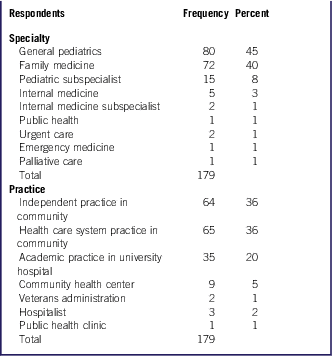
In total, 185 survey responses were received. The analysis was restricted to respondents who self-identified as non-retired primary care providers and who answered at least 1 survey question. The final sample included 179 respondents, yielding an estimated response rate of 2.2%. The most represented specialties were general pediatrics (45%) and family medicine (40%), and the most common types of practices included independent practices in the community (36%) and practices associated with a health care system (36%) (see Table 1). Most respondents did not answer every question, so results are presented as the proportion of responses to specific questions. A total of 92% (126/137) of practices reported that they used electronic health records (EHR) and 64% (84/132) provide care using a Patient-Centered Medical Home model for health care delivery.
Practice Characteristics of Survey Respondents

Practice Preparedness Plans and Communications Capacity
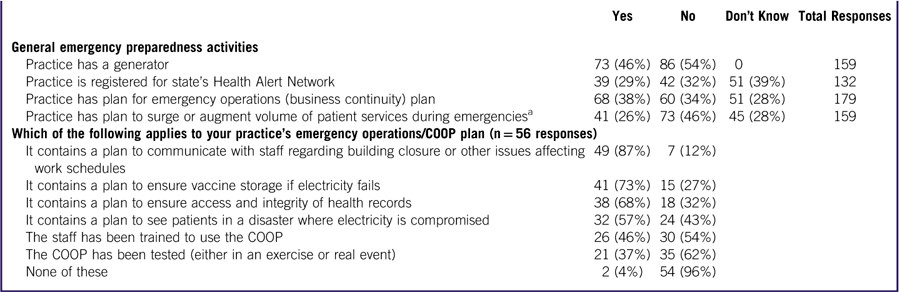
Only 38% (68/179) of practices reported that their practice had a continuity of operations plan (COOP), defined as a plan to sustain the organization’s essential functions, 12 although 28% (51/179) indicated that they did not know if their practices had this plan in place. Forty-six percent (73/159) of practices reported that they had a generator. A total of 26% (41/159) of practices knew their practice had a plan to “surge” or accommodate an increase in demand for patient visits. Fewer than one-third of respondents (29% or 39/132) reported that they were registered on the state’s Health Alert Network. Forty-one percent (65/159) of respondents indicated that their practice had the capacity to communicate with patients during a disaster, and an additional 13% (21/159) indicated that they were developing plans to do so. The cited methods included: telephone/voice messaging (89%), the practice website (72%), patient portal (61%), and e-mail (53%).
Of the 56 respondents who answered questions regarding the elements of their COOP plan: 46% reported that the staff had been trained to use it, and 37% reported that it had been tested in either an exercise or real event. Table 2 depicts key components of the emergency capabilities and COOP of surveyed practices.
Elements of Emergency Planning in Primary Care Practices

Abbreviation: COOP, continuity of operations plan.
a Plan for patient surge was defined in the survey as a plan to expand patient services or increase the number of encounters for a period of 1 week or less in the event of a public health emergency.
Patients with Special Health Care Needs
Practices were also asked about the preparedness of at-risk patients. Only 8% (11/142) of practices reported they believed that their patients with special health care needs (defined in the survey as patients with any condition resulting in chronic medication dependence, reliance on medical equipment or supplies, or use of special medical services) were adequately prepared for a public health emergency (defined as having access to an adequate supply of medications and medical supplies, a plan for pertinent emergency notifications or communication, a plan for evacuation from their home if necessary, or a plan for back-up power supply if dependent on assistive technology). Respondents reported that these patients lacked information regarding resources to help them (73% or 103/142) and had limited financial resources (70% or 100/142). Forty-eight percent of the practices (58/121) reported that they used their EHR to create registries of patients with special health care needs; approximately one-third of practices (34% or 47/137)) routinely generate “emergency care plans” or medical summaries after patient encounters to provide patients with a hard-copy of a document that includes their medical diagnoses, current medications, and other important medical information.
Approximately two-thirds of PCPs (68% or 97/142) reported that they were able, or “somewhat” able to assist their patients with special health care needs prepare for disaster, identifying the following challenges with respect to preparing these patients: insufficient information regarding government plans (86% or 99/115), insufficient resources (eg, patient education materials) to assist patients (79% or 91/115), insufficient time during an encounter (76% or 87/115), and insufficient information regarding community resources (74% or 85/115). Providers also cited limitations in patients’ ability to access supplies (71% or 82/115), and constraints placed by insurance companies regarding medication and equipment access (65% or 75/115) as obstacles to patient preparedness.
Challenges for Medical Practice Preparedness Efforts: Needed Resources
Practices were asked to identify different resources as useful or somewhat useful for preparing for emergencies and disasters. These included templates for how to prepare for emergencies (98% or 130/132), partnerships that can help the practice (98% or 130/132), current and relevant information from credible sources (97% or 128/132), mental health counseling skills (87% or 115/132), and communications technology to reach multiple patients quickly (95% or 126/132). A total of 76% (100/132) of respondents also identified assistance with using social media as needed to improve their readiness for disasters.
DISCUSSION
Primary care practices have important roles to play in public health disasters, particularly those with requiring non-emergent medical evaluation, administration of medical countermeasures, risk communication, behavioral health support, and long-term monitoring and management of post-disaster sequelae. This survey suggests that many would benefit from assistance with continuity of operations planning for a wide range of disasters, particularly incidents that require expanded capacity for patient care (surge), proactive patient communications, and maintaining practice operations in the face of disruption.
This study’s major limitation is the low response rate, likely less than 3% of the combined membership of the major professional organizations representing primary care in the state. Pediatric practices accounted for a disproportionate percentage of the final sample, perhaps because a state-wide conference on emergency preparedness for pediatricians participating in a Patient-Centered Medical Home program was held several weeks prior to the survey’s distribution. However, pediatricians may be more interested in emergency preparedness than other clinicians, given their involvement in communities and the vulnerabilities of children in disasters. Despite these limitations, the findings provide a signal that suggests significant emergency preparedness needs among PCP practices in one of the largest states in the country, a state with both rural and urban areas that experiences major weather events and other potential disruptions for medical practices. We believe these findings are likely generalizable to other regions of the country.
The relatively small cross-section of physicians and practices who responded to this survey may be more likely to have plans in place than non-responding practices, if participation reflects heightened concern regarding the impact of disasters on their practice and the health of their patients. The finding that fewer than half of responding practices had sufficient COOP plans in place, and nearly 3 quarters lacked plans for patient surge reflects major preparedness planning challenges. Fewer than one-third of the practices that responded to this survey are registered on the state’s Health Alert Network, a primary method by which public health agencies communicate with providers. If this gap exists in other states, significant work is needed to inform primary care practices about this important communication channel.
No less concerning is the finding that most providers believed that their patients with special health care needs were not prepared for major disasters, although more than two-thirds of respondents indicated they felt capable of improving their patients’ preparedness. Resources that providers identified as potentially useful included information for patients, better guidance for planning, real-time situational awareness and information during emergencies, and partnerships that can support practices—all relatively inexpensive investments that government public safety agencies can make to enhance community capacity for primary care during emergencies. Third-party payers can facilitate preparedness by reimbursing for preparedness planning and for counseling at-risk patients regarding emergency readiness, and by implementing proactive policies for expanded patient access to medications and equipment before and during disasters.
Medical practices that are struggling to maintain financial stability in the face of declining insurance reimbursements and high-cost investments in EHR and other technology may not prioritize emergency preparedness efforts. However, as practices adopt technological initiatives like EHR (and comply with meaningful use incentives) and utilize new media for communication with patients, they are also improving their capacity for preservation of health care data, providing a mechanism for patient access and portability of medical information that is relatively disaster-resistant, and augmenting their capacity for urgent information transmission to patients and health care partners. Innovative models like Patient-Centered Medical Home which many primary care practices have adopted (including most of this sample) provide enhanced services to medically complex patients. The Patient-Centered Medical Home is an organization of primary health care in which a team of providers provides comprehensive preventative, acute and, chronic care for patients; coordinating services across the health system, with an emphasis on quality improvement and patient safety. 13 This model can be leveraged for preparedness purposes, improving capacity for identifying at-risk individuals and dedicating additional staff-time for patient counseling and outreach. A shift in priorities by major payers and policies that integrate preparedness metrics into quality assurance algorithms for medical practices could encourage preparedness efforts among both patients and their providers. Primary care providers are a key component of the health care system and critical for community preparedness. Additional studies are needed to reach a larger segment of primary care providers in ambulatory settings and identify successful strategies for both practice and patient preparedness.
Acknowledgments
This study was supported by the Pennsylvania Department of Health. The authors gratefully acknowledge the assistance of the Pennsylvania Chapters of the American Academy of Pediatrics, the Association of Family Physicians, the American College of Physicians; and the Pennsylvania Association of Community Health Centers, all of whom distributed the survey to their members.
Funding
This project was supported by 93.074 National Bioterrorism Hospital Preparedness Program and the Public Health Preparedness Cooperative Agreement Program from the US Department of Health and Human Services (HHS) through a grant from the Pennsylvania Department of Health. The contents are solely the responsibility of the authors and do not represent the views of HHS or the Pennsylvania Department of Health. The Drexel University Institutional Review Board approved the protocol as Exempt Category 2.
Conflicts of Interest
The authors have no conflicts of interest.