INTRODUCTION
Antineutrophil cytoplasmic antibodies (ANCA)-associated vasculitis (AAV) comprise a group of infrequent systemic autoimmune diseases of unknown cause that share the presence of inflammation and necrosis of the walls of small-sized vessels with few or none immune deposits and circulating ANCA (Jarrot & Kaplanski, Reference Jarrot and Kaplanski2016; Yates & Watts, Reference Yates and Watts2017). The major clinicopathologic variants of AAV are granulomatosis with polyangiitis (GPA), microsopic polyangiitis (MPA), eosinophilic granulomatosis with polyangiitis (EGPA), and single-organ AAV [renal-limited AAV (RLV)] (Jennette et al., Reference Jennette, Falk, Bacon, Basu, Cid, Ferrario, Flores-Suarez, Gross, Guillevin, Hagen, Hoffman, Jayne, Kallenberg, Lamprecht, Langford, Luqmani, Mahr, Matteson, Merkel, Ozen, Pusey, Rasmussen, Rees, Scott, Specks, Stone, Takahashi and Watts2013).
Involvement of the central (CNS) and peripheral (PNS) nervous systems is present in patients with GPA, with prevalence of CNS involvement of 22–54%, occurring as a late manifestation that confers poor prognosis. Neurological manifestations include focal symptoms due to cerebral infracts or subdural hematomas, epileptic seizures, and psychotic disturbances. It is extremely difficult to differentiate CNS alterations due to the effects of organ damage from those with true cerebral vasculitis (Mattioli et al., Reference Mattioli, Capra, Rovaris, Chiari, Codella, Miozzo, Gregorini and Filippi2002).
Cognitive dysfunction (CD) is a common neuropsychiatric manifestation in systemic autoimmune diseases. It has been linked to chronic inflammation mediated by proinflammatory cytokines that contribute to atherogenesis and microvascular neuronal injury; the direct effect of autoantibodies; the presence of procoagulation states; the secondary effect of therapeutic agents such as steroids, and the high comorbidity with affective disorders (Colgecen et al., Reference Colgecen, Celikbilek and Keskin2016; Hanly, Reference Hanly2014; Oldham, Reference Oldham2017). As an example of this, CD occurs at some extent in up to 80% of patients with systemic lupus erythematosus (SLE) and 30% of patients with rheumatoid arthritis (RA); it may adversely affect health-related quality of life (HRQOL), social functioning, and has been linked to increased unemployment rates (Adhikari et al., Reference Adhikari, Piatti and Luggen2011; Covey et al., Reference Covey, Shucard, Shucard, Stegen and Benedict2012; Meade et al., Reference Meade, Manolios, Cumming, Conaghan and Katz2018). Moreover, a systematic review that analyzed cognitive impairment in patients with RA reported under-performance on cognitive function tests in these patients compared to controls, particularly on verbal function, memory and attention, in association with demographic (age, education), clinical (disease activity), and psychological (depression) factors (Meade et al., Reference Meade, Manolios, Cumming, Conaghan and Katz2018).
The occurrence of cognitive impairment caused by a direct involvement of CNS small vessels in AAV is controversial, with information supporting a rapidly evolving cognitive decline in cases of severe worsening of the disease and in association with positivity for anti-myeloperoxidase ANCA (Capra et al., Reference Capra, Gregorini, Mattioli, Santostefano and Galluzzi1998). Few studies have assessed CD in patients with AAV; in one of them including 43 AAV patients, a prevalence of 30% of subclinical neuropsychological impairment was found, consisting on mild abstract reasoning loss, mental speed reduction, and nonverbal memory impairment (Mattioli et al., Reference Mattioli, Capra, Rovaris, Chiari, Codella, Miozzo, Gregorini and Filippi2002).
CD is not restricted to systemic autoimmune diseases; it also overcomes in association with age and cerebrovascular disease, and after acute and chronic health disorders such as major surgery, critical illnesses, systemic hypertension, diabetes mellitus, and hemodialysis (Duarte-García et al., Reference Duarte-García, Romero-Díaz, Juárez, Cicero-Casarrubias, Fragoso-Loyo, Núñez-Alvarez and Sánchez-Guerrero2018).
Given the negative impact of CD on HRQOL, we aimed to characterize cognitive function in Mexican patients with AAV, to compare this profile in patients with other autoimmune and non-autoimmune chronic conditions, and to investigate the association between CD, disease activity, and other psychological factors such as depression, anxiety, sleep quality, and fatigue.
METHODS
Study Patients
Patients included in the present study participated in a cross-sectional comparison analysis conducted to assess patient and physician perspectives on HRQOL in patients with AAV (Hinojosa-Azaola et al., Reference Hinojosa-Azaola, Jiménez-González and Alcocer-Castillejos2018). Inclusion criteria were patients >18 years old with established diagnosis of AAV (GPA, MPA, or RLV) according to the American College of Rheumatology (ACR) 1990 or the definition by the 2012 Chapel Hill Consensus (Jennette et al., Reference Jennette, Falk, Bacon, Basu, Cid, Ferrario, Flores-Suarez, Gross, Guillevin, Hagen, Hoffman, Jayne, Kallenberg, Lamprecht, Langford, Luqmani, Mahr, Matteson, Merkel, Ozen, Pusey, Rasmussen, Rees, Scott, Specks, Stone, Takahashi and Watts2013; Leavitt et al., Reference Leavitt, Fauci, Bloch, Michel, Hunder, Arend, Calabresse, Fries, Lie, Lightfoot, Masi, McShane, Mills, Stevens, Wallace and Zvaifler1990). Patients with EGPA were not included. Comparison group comprised patients with diagnosis of RA according to ACR/European League Against Rheumatism (EULAR) 2010 criteria (Aletaha et al., Reference Aletaha, Neogi, Silman, Funovits, Felson, Bingham, Birnbaum, Burmester, Bykerk, Cohen, Combe, Costenbader, Dougados, Emery, Ferraccioli, Hazes, Hobbs, Huizinga, Kavanaugh, Kay, Kvien, Laing, Mease, Ménard, Moreland, Naden, Pincus, Smolen, Stanislawska-Biernat, Symmons, Tak, Upchurch, Vencovský, Wolfe and Hawker2010), and patients with nonautoimmune chronic kidney disease (CKD) stages 3–5 (diabetic or hypertensive nephropathy, nonautoimmune glomerulonephritis, toxic nephropathy, and polycystic kidney disease) (Levin & Stevens, Reference Levin and Stevens2014). RA and CKD patients were matched with AAV patients according to age (±10 years), gender, and disease duration. Comparison diseases were selected taking into account chronic conditions that share clinical manifestations present in AAV patients.
All patients were recruited from the outpatient of Rheumatology, Nephrology and Internal Medicine clinics at the Instituto Nacional de Ciencias Médicas y Nutrición Salvador Zubirán, a tertiary care center in Mexico City. The Hospital Institutional Review Board approved the study and all patients provided written informed consent.
Data Collection and Measures
Evaluation of all patients included sociodemographic data, comorbidities, clinical characteristics, and treatment. In AAV patients, additional information was considered, including blood laboratory measures at the time of evaluation (hemoglobin, albumin, erythrocyte sedimentation rate, C-reactive protein, and serum creatinine), as well as evaluation of disease activity and damage using the Birmingham Vasculitis Activity Score for GPA (BVAS/GPA) and the Vasculitis Damage Index (VDI), respectively (Exley et al., Reference Exley, Bacon, Luqmani, Kitas, Gordon, Savage and Adu1997; Stone et al., Reference Stone, Hoffman, Merkel, Min, Uhlfelder, Hellmann, Specks, Allen, Davis, Spiera, Calabrese, Wigley, Maiden, Valente, Niles, Fye, McCune, St Clair and Luqmani2001). High disease activity was considered as a BVAS/GPA ≥3; absence of damage as a VDI = 0; low-moderate damage as a VDI 1–4; and severe damage as a VDI ≥5.
Previous neuroimaging studies (e.g., computed tomography and magnetic resonance imaging) were retrieved when available to evaluate confounding factors. The use of concomitant neuropsychiatric drugs (e.g., anti-depressants, anti-psychotics, benzodiazepines, opioid analgesics, etc.) as well as prior history of traumatic brain injury or comorbid neuropsychiatric diagnoses was also considered.
All patients underwent a standardized neuropsychological battery (NEUROPSI) that was designed and validated for Mexican population and takes into account age and educational level (Ostrosky-Solis et al., Reference Ostrosky-Solis, Ardila and Rosselli1999). A psychiatrist trained in neuropsychological examination administered the test in a quiet hospital environment and the entire session lasted on average 30–60 min.
NEUROPSI explores the following cognitive domains: (1) orientation, (2) attention and concentration, (3) verbal and spatial short- and long-time memory, (4) language, (5) writing and reading, and (6) executive, conceptual, and motor functions. Scores lower than 1 standard deviation (SD) according to the age and educational level group were considered as impaired in each subtest (Ostrosky-Solis et al., Reference Ostrosky-Solis, Ardila and Rosselli1999). The principal domains were considered as impaired if at least one of the tests included in the domain scored lower than 1 SD. Individuals were considered as having cognitive impairment if they had two or more impaired domains and reported any cognitive difficulty in daily life. The latter was assessed by directly asking the patients if they had “any problems with their memory or concentration.”
Sleep impairment within the last month was assessed with the Pittsburgh sleep quality index, a self-rated questionnaire that evaluates seven sleep components. A general score ≥6 differentiates good versus bad sleep quality (Buysse et al., Reference Buysse, Reynolds, Monk, Berman and Kupfer1989; Mollayeva et al., Reference Mollayeva, Thurairajah, Burton, Mollayeva, Shapiro and Colantonio2016). Fatigue was quantified using the Multidimensional Fatigue Inventory (MFI-20) in the Spanish validated version that consists of 19 items. It is a self-reported instrument that evaluates five subscales with scores for each dimension: general fatigue (3–21), physical fatigue (4–28), mental fatigue (4–28), reduced motivation (4–28), and reduced activity (4–28) (Boada-Grau et al., Reference Boada-Grau, Merino-Tejedor, Gil-Ripoll, Segarra-Pérez and Vigil-Colet2014).
The Hospital Anxiety and Depression Scale (HADS), a self-assessment scale in the setting of a hospital medical outpatient clinic, was used to identify anxiety and depressive symptoms. Depression and anxiety were considered individually and as the presence of both disorders in the same patient according to the cutoff scores (≥7) (Bjelland et al., Reference Bjelland, Dahl, Haug and Neckelmann2002; Zigmond & Snaith, Reference Zigmond and Snaith1983).
Statistical Analysis
Descriptive statistics include n, %, and median with minimum and maximum ranges. Differences between groups were evaluated with the Student’s t test or Mann-–Whitney U test for continuous variables, and Chi-square test or Fisher’s exact test for categorical variables. ANOVA was used for comparing continuous variables within the three study groups. Post-hoc analysis and multiple comparison correction were made whenever a statistical difference was found. Univariate logistic regression was used and odds ratios (OR) and 95% confidence intervals (CI) were calculated.
In order to explore whether impairment in each domain was associated with other psychological variables, we performed univariated t Student analyses comparing mean scores of HADS, Pittsburgh Sleep Quality Index and MFI-20, and each of the principal cognitive domains. All analyses were carried out using Stata software version 12.0 and SPSS software version 22.
RESULTS
AAV Patients
A total of 60 patients with AAV were included, 53 (88%) with diagnosis of GPA, 5 (8%) MPA, and 2 (3%) RLV. Median age of AAV patients was 54 (23–75) years, median disease duration was 5.6 years, and 36 (60%) were female. With regard to clinical characteristics, all patients were ANCA positive; median BVAS/GPA score was 2 (0–16); high disease activity was present in 26 (43%), whereas median VDI score was 3 (0–11). Total time of prednisone exposure was 41 (3–150) months.
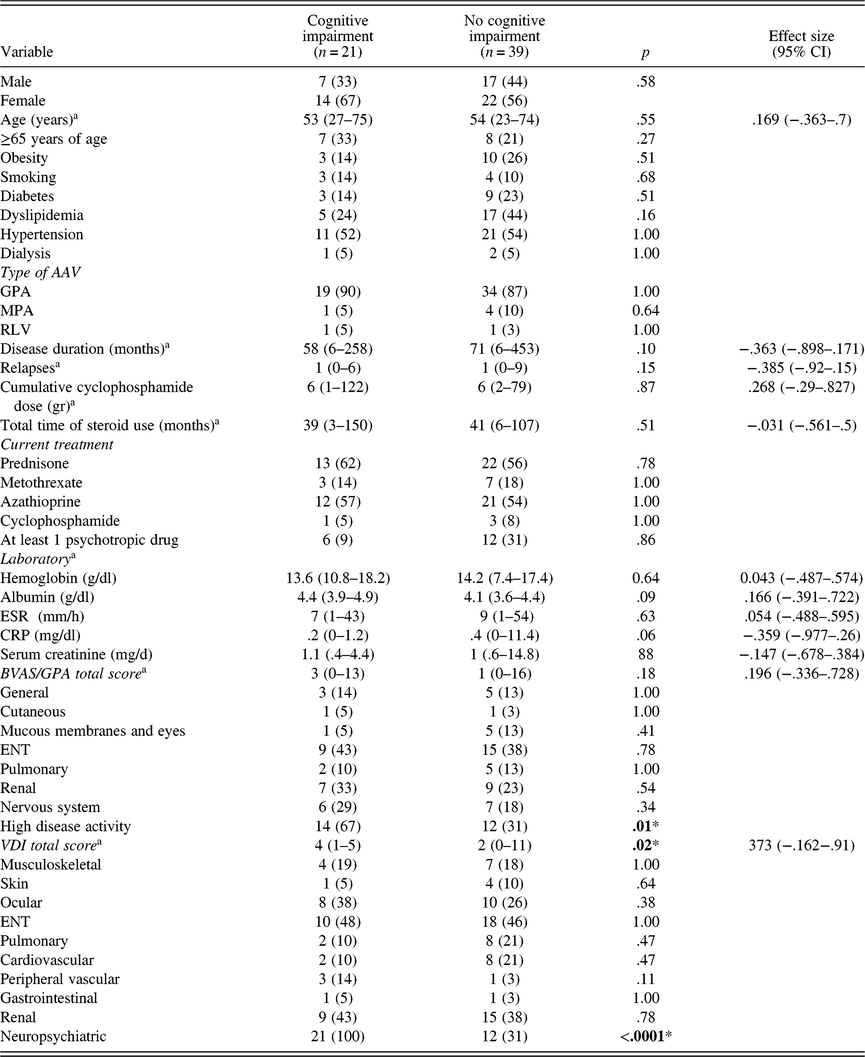
According to our a priori definition, we found that 35% (n = 21) of AAV patients classified as cognitively impaired. When AAV patients with (n = 21) and without (n = 39) cognitive impairment were compared regarding demographic characteristics, comorbidities, treatment, laboratory variables, disease activity, and damage, we found that high disease activity (assessed by BVAS/GPA) at the moment of evaluation was more frequent in patients with cognitive impairment [67% vs. 31%, OR = 4.5, 95% CI = 1.44–13.98, p = .009, χ2(2, n = 119) = 7.16, p = .007]. Cognitive impaired patients also showed higher damage scores (Mdn = 4 vs. Mdn = 2, z = −2.491 points, p = .013); however, this difference was due to the neuropsychiatric component of the score that includes cognitive impairment and no other significant differences were found in the rest of the VDI components. Of notice, the effect size for the VDI was not statistically significant.
The frequency of intake of at least one psychotropic drug was not statistically different in AAV patients with or without cognitive impairment. Moreover, there was no difference in the frequency of AAV patients ≥65 years of age with and without CD [33% vs. 21% respectively, χ2(1, n = 60) = 1.197, p = .274. Table 1 shows these results.
Characteristics of AAV patients with and without cognitive impairment

AAV, ANCA-associated vasculitis; GPA, granulomatosis with polyangiitis; MPA, microscopic polyangiitis; RLV, renal-limited vasculitis; ESR, erythrocyte sedimentation rate; CRP, C-reactive protein; BVAS/GPA, Birmingham vasculitis activity score for GPA; ENT, ears, nose, throat; VDI, Vasculitis Damage Index
Results represent n (%), except amedian (minimum–maximum)
*statistically significant p-values
AAV Patients and Comparison Groups
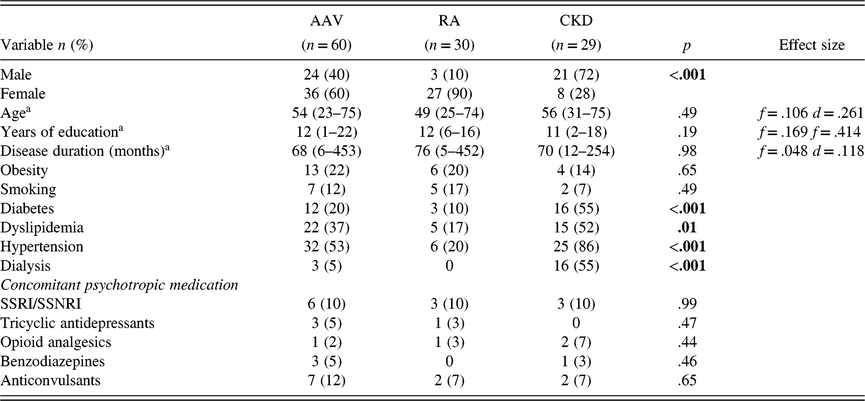
The comparison group comprised 30 patients with RA and 29 patients with CKD. Patients in the three groups were homogeneous regarding demographic characteristics, including age, gender, and disease duration. Mean years of education did not significantly differed (F(2, 117) = 1.70, p = .19). A higher proportion of patients in the CKD group had diabetes [55.2% vs. 20% in AAV, and 10% in RA χ2(2, n = 119) = 17.92, p ≤ .001], dyslipidemia [51.7% vs. 36.7% and 16.7%, respectively, χ2(2, n = 119) = 8.04, p = .018], hypertension [86.2% vs. 53.3% and 20%, respectively, χ2(2, n = 119) = 25.95, p < .001], and were on dialysis [55.2% vs. 5% in AAV and 0% in RA χ2(2, n = 119) = 44.3, p < .001], compared to the other groups. Less than 12% of patients from the three groups were receiving concomitant psychotropic medications (Table 2). At the time of evaluation, 23 (79.3%) of CKD patients had stable disease, whereas 16 (53%) of RA patients had active disease. There was no association between disease activity and cognitive impairment in neither group (43.8% of CD in active RA patients [χ2(1, n = 30) = .201, p = .654] and 50% of CD in active CDK patients [χ2(1, n = 29) = .468, p = .494]).
Demographic and clinical characteristics of AAV patients and comparison groups

AAV, ANCA-associated vasculitis; RA, rheumatoid arthritis; CKD, chronic kidney disease; SSRI, selective serotonine reuptake inhibitors; SSNRI, selective serotonine and norepinephrine reuptake inhibitors
a Median (minimum–maximum)
Table 2 shows the demographic characteristics of the three groups.
With regard to prior neuroimaging studies and neuropsychiatric diagnoses, 23 patients in the AAV group, 1 patient in RA group, and 9 patients in CKD group had a neuroimaging study according to the treating physician consideration (not this study investigators). Of these studies, 15 (65%) and 5 (56%) were reported with no abnormalities (AAV and CKD patients, respectively). The neuroimaging study in the RA patient showed microangiopathic leukopathy. The most frequent comorbid neuropsychiatric diagnosis in AAV patients was generalized anxiety disorder (8%). These data are shown in the Supplementary Material.
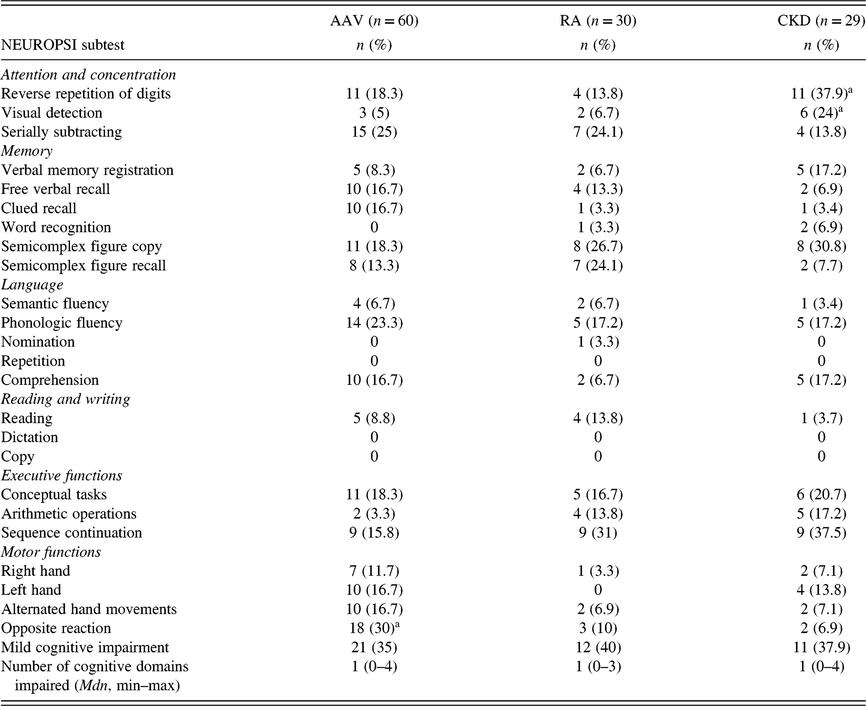
Prevalence of cognitive impairment in AAV patients was similar to that in patients with RA and CKD [35%, 40%, and 37.9%, respectively, χ2(2, n = 119) = .230, p = .89]. Abnormal performance was more frequently found in the executive functions in the three groups [45%, 51.7%, and 50%, respectively, χ2(2, n = 117) = .422 p = .81], specifically in conceptual tasks and sequence continuation, followed by language [25%, 13.8%, and 25%, respectively χ2(2, n = 117) = 1.585, p = .45] mostly phonologic fluency. Of notice is that verbal and visual attentional tests were more frequently impaired in patients from the CKD group [χ2(2, n = 115) = 7.759, p = .021], and psychomotor functions were more frequently affected in AAV patients, specifically, opposite reactions [χ2(2, n = 119) = 8.931, p = .011]. No impairment was found in orientation domain in any of the groups. Figure 1 displays the percentage of patients with impairment in each general cognitive domain within the three groups.
Prevalence of impairment of cognitive domains in AAV, RA, and CKD patients. AAV, ANCA-associated vasculitis; RA, rheumatoid arthritis; CKD, chronic kidney disease.

Table 3 shows details of the frequency of impairment in cognitive subtests in the three groups.
Percentage of patients with AAV, RA and CKD impaired in the different cognitive tasks of the NEUROPSI battery

AAV, ANCA-associated vasculitis; RA, rheumatoid arthritis; CKD, chronic kidney disease; Mdn, median
a χ2 p < .05
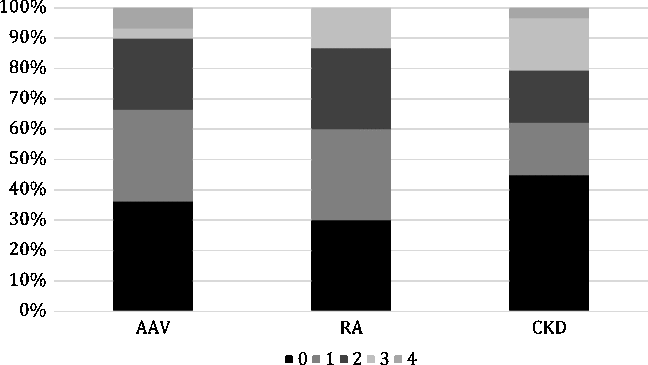
The number of impaired cognitive domains had a median of 1 for all groups (min–max = 0–4, 0–3, and 0–4 for AAV, RA, and CKD, respectively). Six (10%) AAV, 4 (13.3%) RA, and 6 (20.7%) CKD patients had more than two affected domains [χ2(2, n = 119) = 1.92, p = .383], as shown in Figure 2.
Number of impaired domains expressed in percentages in AAV, RA, and CKD patients. AAV, ANCA-associated vasculitis; RA, rheumatoid arthritis; CKD, chronic kidney disease.

Analysis of anxiety, depression, fatigue, and sleep quality in AAV patients showed that HADS total score, and especially anxiety score, was higher in patients with memory impairment than in those with normal memory function [M = 8.73, SD = 4 vs. M = 5.37, SD = 3.7, t(58) = −2.72, p < .009]. Neither Pittsburgh Sleep Quality Index nor MFI-20 fatigue scores differed between those cognitively impaired and not impaired.
DISCUSSION
One-third of the 60 patients with AAV that we studied showed cognitive impairment, similar to the proportion in patients with RA and CKD matched according to age, gender, and disease duration. High disease activity at the time of neuropsychological examination was associated with CD in AAV patients and not in the control groups. Executive functions, specifically conceptual tasks and sequence continuation, followed by language, were the tasks more frequently impaired in all patients, whereas psychomotor function was more frequently affected in AAV patients compared to the other groups.
The prevalence of cognitive impairment in AAV patients from our study is similar to the one reported by Mattioli et al. (Reference Mattioli, Capra, Rovaris, Chiari, Codella, Miozzo, Gregorini and Filippi2002), where 13/43 AAV patients (30%) showed subclinical neuropsychological impairment, despite the differences in the methodology and neuropsychological assessment between the two studies. In this regard, our study considered abnormal scores below 1 SD of the normative values and CD when there were abnormal results in at least two cognitive domains, whereas Mattioli et al. (Reference Mattioli, Capra, Rovaris, Chiari, Codella, Miozzo, Gregorini and Filippi2002) defined subclinical cognitive impairment in the presence of abnormal results in at least two neuropsychological tests (not domains). Moreover, in our study, 23% of AAV patients had two impaired domains and 10% three or more domains impaired (compared to 30% and 13.9%, respectively, in their study).
The most frequently affected cognitive functions in our AAV patients are similar to the ones reported by Mattioli et al. (Reference Mattioli, Capra, Rovaris, Chiari, Codella, Miozzo, Gregorini and Filippi2002) (abstract reasoning, attention, and nonverbal memory), considering that these functions can be included in the executive tasks. An interesting issue is the higher proportion (although no statistically significant) of phonological fluency impairment in vasculitis patients, which is congruent with other results reporting fluency tasks as indicators able to discriminate subjects with vascular versus Alzheimer’s dementia (Matioli & Caramelli, Reference Matioli and Caramelli2012).
The prevalence of cognitive impairment in our patients differs from the one reported by Duarte-García et al. (Reference Duarte-García, Romero-Díaz, Juárez, Cicero-Casarrubias, Fragoso-Loyo, Núñez-Alvarez and Sánchez-Guerrero2018) in Mexican patients with recent-onset SLE, where only 16% were diagnosed with moderate/severe CD. This may be partially explained by younger age of SLE patients (mean 26.4 years) and the different neuropsychological batteries used for the evaluation. Opposed to our findings, disease activity was not associated to CD. Other factors reported to be associated with CD, such as body mass index/obesity, were not associated in our study. The results suggest that age and disease duration are important factors contributing to the development of cognitive impairment in systemic autoimmune diseases, but also in chronic conditions.
The transversal nature of our study, the absence of neuroimaging in many patients and the similarities of cognitive impairment in AAV and comparison groups, prevents us from suggesting that cognitive impairment is a neuropsychiatric syndrome in AAV. Our results, instead, suggest a multifactorial origin of cognitive alterations and the presence of factors shared with other chronic diseases (i.e., disease activity, anxiety, and depression levels). A study with a larger sample of patients would be needed to clarify this matter.
Recently, an international collaboration was created to investigate the impact of AAV on HRQOL and to develop a disease-specific patient-reported outcome measure to assess outcomes of importance to patients. As a result, 55 individual themes within 7 broad domains were identified (general health perceptions, impact on function, psychological perceptions and social perceptions, social contract, social role, and symptoms), and then reduced to 35 candidate items, including among others, psychosocial symptoms such as cognition and poor concentration, depression, anger, quality of communication, and fatigue (Robson et al., Reference Robson, Dawson, Cronholm, Milman, Kellom, Ashdown, Easley, Farrar, Gebhart, Lanier, McAlear, Peck, Luqmani, Shea, Tomasson and Merkel2018).
Although none of our patients had clinical dementia, CD may impact daily activities. Specifically, the alteration of executive functions has been reported in different medical conditions (Godefroy et al., Reference Godefroy, Azouvi, Robert, Roussel, LeGall and Meulemans2010) and autoimmune diseases such as systemic sclerosis, where it has been described as a dysexecutive syndrome (Yilmaz et al., Reference Yilmaz, Mollahasanoglu, Gurvit, Can, Tuncer, Inanc and Yavuz2012). The presence of either behavioral or cognitive dysexecutive symptoms has been associated with further loss of autonomy, so it becomes important to better characterize and follow those patients with executive symptoms. We would also suggest assessing subjective cognitive complaint and measure its impact in quality of life perception.
This study has limitations, including the inability to analyze the role of other confounding factors contributing to cognitive impairment (i.e., menopausal state), the lack of neuroimaging studies in all patients at the time of evaluation, the small sample size of control groups, and the fact that cognition was assessed with a brief cognitive battery. Furthermore, it should be considered that systemic diseases (e.g., renal failure) may cause cognitive impairment. Despite this, we consider that our study provides important information regarding the cognitive profile in a relatively large sample of AAV patients from a single center; it assesses important clinical and psychological variables and compares the results with other chronic diseases.
In conclusion, no statistically significant differences were found in the frequency of CD among the three clinical populations. Early diagnosis and intervention is of great importance to avoid HRQOL impairment. The evaluation and management of these patients should also consider the neuropsychological profile. Further prospective studies including AAV patients with CD are needed.
ACKNOWLEDGEMENTS
This research received no specific grant from any funding agency in the public, commercial, or not-for-profit sectors.
CONFLICTS OF INTEREST
The authors have nothing to disclose.
SUPPLEMENTARY MATERIAL
To view supplementary material for this article, please visit https://doi.org/10.1017/S1355617719000262.