Introduction
In Brazil, around 74% of elderly have less than eight years of education, and a considerable proportion of this population (20%) has no formal education (IBGE, 2010). Studies have shown that learning to read and write changes the organization and functioning of the brain, impacting brain and cognitive reserve, respectively (Stern, Reference Stern2009; Arenaza-Urquijo et al., Reference Arenaza-Urquijo2013). For some linguistic abilities, such as naming, at least nine years of schooling may be needed to achieve high performance standards (Radanovic et al., Reference Radanovic, Mansur and Scaff2004). Thus, educational level significantly influences performance on neuropsychological tests, including naming tests by visual confrontation, such as the Boston Naming Test (BNT) (Miotto et al., Reference Miotto, Sato, Lucia, Camargo and Scaff2010).
The BNT (Kaplan et al., Reference Kaplan, Goodglass and Weintraub1983) is one of the most widely used tests for assessing naming ability and lexical retrieval. The BNT is commonly used in clinical neuropsychology for populations with varied educational backgrounds, being applicable to all individuals, because it does not rely on reading or writing (Rosselli and Ardila, Reference Rosselli and Ardila2003). Therefore, the test can be used for investigating communication disorders in many different acquired neurological abnormalities in both adults and children.
Numerous studies in the literature have reported strong correlation between the BNT and education. Among healthy older adults, studies show that individuals with a high educational level tend to attain near maximum correct scores (Welch et al., Reference Welch, Doineau, Johnson and King1996; Hawkins and Bender, Reference Hawkins and Bender2002; Zec et al., Reference Zec, Markwell, Burkett and Larsen2005). However, relatively few studies have been conducted in low-educated or illiterate older adults. Marien et al. (Reference Marien, Mampaey, Vervaet, Saerens and De Deyn1998), in a study of a Dutch population, found that older adults with less than ten years of education had a much lower rate of correct responses on the BNT compared to their peers with higher educational level. The same phenomenon was observed by Rami et al. (Reference Rami2008) in a study involving rural Spanish elderly with few years of formal education. Similar results were found for the 15-item short versions (Calero et al., Reference Calero, Arnedo, Navarro, Ruiz-Pedrosa and Carnero2002). Manly et al. (Reference Manly1999) studied healthy illiterate and low-educated elders living in the United States that were heterogeneous for nationality and ethnicity (Caucasian, Hispanic, and Afro-American). The authors observed performance differences on the 15-item BNT among the groups stratified by educational levels, only on the analysis of elders whose mother tongue was Spanish.
In a Brazilian study, Mansur et al. (Reference Mansur, Radanovic, Araújo, Taquemori and Greco2006) applied the original version of the BNT to healthy individuals aged 28–70 years with between 2 and 24 years of education. Discrepancies were observed in the naming of some figures not commonly found in Brazilian culture. Age had a lesser effect on performance than education, and the authors suggested normative data for the BNT based on number of years of education.
Performance on the BNT is highly influenced by culture, as some of the objects portrayed (and the corresponding names) of the original version are either unknown or rare in places outside the US, especially, in low-income countries. This fact has generated a significant body of research regarding culturally adapted versions of the test (Colombo and Assal, Reference Colombo and Assal1992; Kim and Na, Reference Kim and Na1999; Barker-Collo, Reference Barker-Collo2001; Tallberg, Reference Tallberg2005). Considering the cultural differences between the country of origin of the test (United State) and Brazil, a version adapted for use in the Brazilian population was developed (Miotto et al., Reference Miotto, Sato, Lucia, Camargo and Scaff2010). Out of the 60 figures and respective names, 20 were identified by linguists and neuropsychologists as less frequent in the Portuguese language and Brazilian culture. Therefore, they were replaced by semantically similar words selected from books, newspapers, and television. The 20 new words and their respective pictures were placed in the same position as the items removed from the original test. The replaced figures were as follows: (19) Pretzel by Cake, (28) Wreath by Bouquet, (29) Beaver by Anteater, (31) Rhinoceros by Elephant, (32) Acorn by Cashew, (38) Harp by Violin, (40) Knocker by Cuckoo, (41) Pelican by Turkey, (42) Stethoscope by Thermometer, (43) Pyramid by Christ the Redeemer, (45) Unicorn by Saci-Pererê (character from the Brazilian folklore), (49) Asparagus by Beetroot, (50) Compass by Stapler, (52) Tripod by Tape measure, (53) Scroll by Magnifying glass, (55) Sphinx by Sugar Loaf mountain, (56) Yoke by Stirrup, (58) Palette by Pencil case, (59) Protractor by Drill, and (60) Abacus by Hourglass.
The validation study of the adapted Brazilian version of the BNT was carried out in 739 healthy Portuguese speakers of both sexes aged 6–77 years and with 0–17 years of education. The authors suggested that the adapted BNT was the most suitable for use in the Brazilian population. However, very few older adults with low educational level were included in the validation.
It has been proposed that the short version of the BNT can be useful in clinical practice for rapid screening and in cases of patients with reduced attention. There are several abbreviated 30- and 15-item versions of the BNT in the literature. The first attempt to standardize an abbreviated version of the BNT was the Consortium to Establish a Registry for Alzheimer's Disease (CERAD) (Morris et al., Reference Morris1989), which incorporates a 15-item version of the test. The criteria for selecting the 15 stimuli to be included in the short version were five words that had high, medium, and low frequency in the English language, respectively. Williams et al. (Reference Williams, Mack and Henderson1989) developed two 30-item BNT versions: a version containing even-numbered items and a version with odd-numbered items. The authors observed that the two short versions exhibited high correlation with the original test. It is noteworthy that aging studies involving the abbreviated versions on the BNT have rarely focused on the issue of illiteracy and low education.
The cognitive changes associated with normal aging, particularly among low-educated or illiterate elderly, may resemble those observed in early-stage dementias (Brucki, Reference Brucki2010). Thus, studying the performance of illiterate and low-educated older adults on naming by visual confrontation is important for a better understanding of this aspect of cognitive functioning in these strata of the population and for clinical neuropsychology practice. The short versions of the BNT, containing 30 or 15 items, although useful in clinical practice (Hobson et al., Reference Hobson2011), have been less studied. Additionally, previous studies on the BNT applied in large illiterate samples have not been found. Thus, the objectives of the present study were to (1) establish normative data for the original, adapted, and abbreviated versions of the BNT for a large number of illiterate and low-educated older adults without evidence of cognitive impairment or depression, (2) to compare participants’ performance on the original and adapted versions of the BNT, (3) to compare performance on the BNT at three levels of initial education. The following hypotheses were raised; (1) performance on the adapted BNT would be greater than on the original version, (2) illiterate older adults would have lower performance than literate participants, and (3) older adults with 3–4 years of education would have better performance than individuals with 1–2 years of education.
Methods
Participants
The sample comprised 180 healthy older adults, 60–93 years old, of both sexes and with 0–4 years of education. The participants were stratified according to (1) age: 60–69 years, 70–79 years, and ≥ 80 years; and (2) educational level: 0 year (illiterate), 1–2 years, and 3–4 years of education. All participants were users of a public geriatric outpatient service, situated in the Eastern region of the city of São Paulo. This service also provides leisure and social activities for older adults. In this study, illiterate individuals were those participants who reported not being able to read and write a simple message, and were unable to read the sentence “close your eyes” in the Mini-Mental State Examination (MMSE). Individuals who attended school for less than one year, but were able to read and understand the sentence above, were regarded as having 1–2 years of education.
Exclusion criteria included being under the age of 60 years, having over four years of education, and having a previous or current history of neurological and/or psychiatric disorders. Individuals with limiting sensory deficits (impaired auditory acuity affecting functional communication and/or limited visual acuity hampering the recognition of the stimuli) were also excluded. Cognitive, functional status, and psychiatric screening instruments were applied. Individuals with scores outside the normal range for age and education were also excluded from the sample.
In total, 208 potential participants were assessed and 28 were excluded. The reasons for exclusion were low MMSE scores (n = 20), GDS scores (n = 02) and medication use that suggested psychiatric or neurologic diseases (n = 06).
Instruments
All the participants answered a questionnaire collecting socio-demographic and health-related data. The cognitive screening tests used to guarantee exclusion of participants with cognitive impairment were the MMSE and Brief Cognitive Screening Battery (BCSB). The Functional Activities Questionnaire (FAQ) was used to verify intact functional status. In the absence of changes, the Geriatric Depression Scale (GDS) was subsequently applied, followed lastly by the BNT.
The MMSE (Folstein et al., Reference Folstein, Folstein and McHugh1975; Brucki et al., Reference Brucki, Nitrini, Caramelli, Bertolucci and Okamoto2003) is an important screening instrument for cognitive impairment. In the present study, the cut-off points suggestive of dementia were the mean values reported by Brucki et al. (Reference Brucki, Nitrini, Caramelli, Bertolucci and Okamoto2003) for each educational level minus one standard deviation, giving cut-off scores of 17 points for illiterate individuals and 22 points for individuals with 1–4 years of education.
The BCSB (Fichman-Charchat et al., Reference Fichman-Charchat, Miranda, Fernandes, Mograbi, Rosinda and Aguiar2016) entails the presentation of ten concrete black and white figures. The individual is asked to perform naming, immediate recall (Incidental Memory), recall after inspection for 30 sec twice (Immediate Memory and Learning), delayed recall and recognition. The Verbal Fluency Test (VF) – animal category and Clock Drawing Test (CDT), corrected by the Shulman scale (Shulman et al., Reference Shulman, Shedletsky and Silver1986), are applied between Learning and Delayed Recall. For the CDT, a value of 3 points was employed as a cut-off (Aprahamian et al., Reference Aprahamian, Martinelli, Neri and Yassuda2009), and for VF the cut-off was 9 points (Caramelli et al., Reference Caramelli, Carthery-Goulart, Porto, Charchat-Fichman and Nitrini2007). For delayed recall on the BCSB memory test, a cut-off score of 5 points was employed (Nitrini et al., Reference Nitrini2004).
The FAQ (Pfeffer et al., Reference Pfeffer, Kurosaki, Harrah, Chance and Filos1982) assesses functional independence of the individual for instrumental activities of daily living (IADL). The cut-off score adopted for functional change was 2 points (dos Santos Sanches et al., Reference dos Santos Sanchez, Correa and Lourenço2011). The GDS (Yesavage et al., Reference Yesavage1983) is designed to screen for depressive symptoms. The short 15-item version was used with a cut-off score for depression of 6 points (Paradela et al., Reference Paradela, Lourenço and Veras2005).
Boston Naming Test (BNT)
The version used in this study contained the 60 original pictures of the BNT (Kaplan et al., Reference Kaplan, Goodglass and Weintraub1983) plus the 20 additional ones suggested in the adapted version of the BNT (Miotto et al., Reference Miotto, Sato, Lucia, Camargo and Scaff2010), with 80 stimuli total. Each new item was incorporated directly after its respective original item. For example, the item Cake (new) was placed immediately after Pretzel (original). The stimuli were presented individually and participants asked to name the pictures shown. A 20-sec response time was allowed. When participants gave an incorrect response or failed spontaneously to name the stimulus, a semantic cue was provided and additional 20 sec were allowed for naming. In the event of repeated incorrect response or failure to name, a phonological cue was given in the form of the first syllable of the word. Only correct responses involving spontaneous naming and use of a semantic cue were counted – consistent with guidelines contained in the original test manual. The test was applied from the first to the 80th item without applying the stop rule. All responses, both correct and incorrect, were recorded on an answer sheet for later analysis.
Some stimuli had more than one correct response owing to disparities between North American and Brazilian cultures and to regional differences. On item 19 – Pretzel (a typical American sweet product), the response “Rosca” (Brazilian sweet pastry/doughnut) was accepted; on item 33 – Igloo, the response “Clay-type oven” was accepted (due to bearing close visual resemblance); item 36 – Cactus, the response “Mandacaru” (similar type of cactus closely resembling the drawing) was accepted; and on item 56 – Yoke, the word “Canga” was accepted for being a local synonym.
For the analysis of the short forms of the BNT, the versions with 30 even-numbered items and 30 odd-numbered items were used. The original pictures proposed by the CERAD battery (Morris et al., Reference Morris1989) were used for the 15-item BNT, and only the original BNT pictures were used in the abbreviated versions.
Procedures
The battery of tests was administered in one session by the leading researcher (KSBL) and it lasted between 90 to 120 min. When participants demonstrated signs of fatigue, a small break was taken. Testing was conducted individually in a silent room.
Ethical aspects
All participants were informed about the study objectives and methods, and then signed the free and informed consent form. The information included in this manuscript was obtained in compliance with regulations of the institution where it was conducted. When participants demonstrated cognitive and/or functional impairment or GDS scores were suggestive of major depression, they were referred to the appropriate clinics within the institution. This study was approved by the Ethics Committee of the Hospital das Clínicas of the University of São Paulo School of Medicine under process number 22413/12.
Statistical analyses
Descriptive analyses were performed by calculating means, standard deviations, and percentages. Age and education bands were compared using ANOVAs. The percentage correct response rates on the different versions of the BNT were compared using the χ 2 test. Cohen's effect size was also calculated. Correlations were calculated using Pearson's coefficient. Cronbach's α coefficient was used to assess internal consistency for the studied BNT versions. All statistical analyses were completed with the Statistical Package for the Social Sciences (SPSS), version 17.
Results
The sample was comprised of 180 older men and women who were 60 years and older. Mean age was 74.9 (SD = 7.1) years, and women represented 77.2% of the sample. The investigated education groups were statistically equivalent as to age and sex.
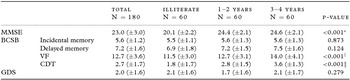
Table 1 depicts the cognitive characteristics of the sample stratified by educational level. A significant difference in performance among the education groups was detected for the MMSE, VF, and CDT, with lower performance observed in the illiterate group. All three groups differed on the CDT.
Sample characteristics according to cognitive variables expressed as mean (standard deviation)

Note: MMSE = Mini-Mental State Exam; BCSB = Brief Cognitive Screening Battery; VF = Verbal Fluency Test; CDT = Clock Drawing Test; GDS = Geriatric Depression Scale.
Note: p-value for ANOVA test.
*illiterate ≠ 1–2 years and 3–4 years.
†illiterate ≠ 3–4 years.
‡illiterate ≠ 1–2 years ≠ 3–4 years.
The performance of the education groups on the five versions of the BNT is reported in Table 2. The illiterate participants had lower performance than the two literate groups on all BNT versions. Participants with 1–2 and 3–4 years of education had statistically equivalent BNT performance. For the CERAD version, a significant difference was observed only between the illiterate group and the group with 3–4 years of education.
Performance of sample on different versions of the BNT (original, adapted, 30-item odd/even and CERAD), stratified by educational level, expressed as means (standard deviation)

Note: spontaneous naming + semantic cues (spo + sem).
Note: P-value for ANOVA test followed by multiple comparisons.
*illiterate ≠ 1–2 years and 3–4 years.
†illiterate and 1–2 years ≠ 3–4 years.
‡illiterate ≠ 1–2 years.
§illiterate ≠ 3–4 years.
Regarding the use of semantic cues (Table 2), participants with 0–2 years of education benefited significantly more from the cues than individuals with 3–4 years of education, on both the original and adapted versions of the BNT. On the short 30-item versions, individuals from the illiterate group attained a greater number of correct responses after prompting with semantic cues, whereas the educated groups gained no benefit. After phonological cueing on the adapted BNT, the illiterate group exhibited a higher number of correct responses.
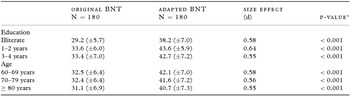
Participants’ performance was compared on the original and adapted BNTs with the sample stratified by education. Performance was significantly higher on the adapted BNT than on the original version across all education groups (Table 3). Effect size analyses were carried out to assess the magnitude of the difference between the two BNT versions, and results suggested medium effect sizes (Cohen, Reference Cohen1992), as seen in Table 3.
Comparison of sample performance on original and adapted BNT, stratified by age and education, expressed as mean (standard deviation)

Note: *p-value for t-test paired samples correlations and effect size (Cohen´s d) correlations.
Percentage of correct responses on each test item was compared for the original and the replaced pictures in the original and adapted version, respectively (Table 4). A greater number of correct responses were found for the replaced items, with the exception of item 56, when performance was equivalent.
Comparison of absolute number and percentage rate of correct responses for the 20 original and replaced items of the BNT (N = 180)

Note: *p-value for χ 2 test.
As to age effects, significant differences were not observed in BNT performance when the sample was stratified into age bands (data not shown). In addition, no significant correlations were detected between age (as a continuous variable) and BNT scores for the original version (r = −0.072, p-value = 0.338), adapted (r = −0.089, p-value = 0.236), 30-item even (r = −0.044, p-value = 0.560), 30-item odd (r = −0.087, p-value = 0.243), and CERAD (r = −0.096, p-value = 0.198).
BNT normative data for the sample, stratified by age and education, were presented in Table 5, with the two literate groups aggregated, due to the lack of significant differences between them.
Normative data for the original, adapted, 30-item (even and odd) and CERAD versions of the BNT, stratified by age and education, expressed as mean (standard deviation)

Note: BNT = Boston Naming Test.
Internal consistency scores (Cronbach's α) for the total sample were 0.856, 0.848, 0.698, 0.787, and 0.505 for the original, adapted, 30-item even, 30-item odd, and CERAD, respectively.
Discussion
The present study investigated the performance of healthy illiterate and low-educated older adults on different versions of the BNT, including a version adapted for use in Brazil and short forms of the test. Normative data for older adults with lower or no education were reported for all the studied versions. The literate participants performed better on all of the BNT versions studied. The participants with 0–2 years of education gained more benefit from the semantic cues, whereas only illiterate individuals showed performance gains after phonological cues. There were a higher number of correct responses on the adapted BNT across all educational levels.
The hypothesis that illiterate older adults would have poorer performance compared to those with a few years of education was confirmed for all versions of the BNT. It was hypothesized that those with three or four years of education would attain a higher number of correct responses on the BNT relative to individuals with one or two years of education. However, on almost all of the versions assessed (except for the CERAD BNT), both literate groups (1–2 and 3–4 years) attained similar results. This suggests that initial literacy has a major impact on naming ability and those additional years of education yield further gains of a lesser magnitude, corroborating previous findings (Manly et al., Reference Manly1999; Ardila et al., Reference Ardila, Ostrosky-Solis, Rosselli and Gómez2000). As a result, normative data were aggregated for the literate groups (1–4 years) (Table 5).
Comparison of the original versus adapted BNT revealed a greater number of correct responses for the adapted version, congruent with the results of Miotto et al. (Reference Miotto, Sato, Lucia, Camargo and Scaff2010). Notably, these findings suggest that when the original stimuli of the test are used, individuals from other countries can be at a disadvantage due to differences in culture and socio-economic level (Rosseli and Ardila, Reference Rosselli and Ardila2003). The results of the present study support the use of the adapted version, as the adaptations rendered the test more readily understood while average scores remained well below the maximum.
Nonetheless, item accuracy scores revealed that some of the adapted items generated a much higher number of correct responses than the original test, even in the second half, where test items should be less frequent. Adapted items such as 31 (elephant), 43 (Christ the Redeemer), and 59 (Drill) had correct response rates of over 90%, and they are in the second half of the test. This is an important concern as an easier BNT could lead to a higher percentage of false negative results decreasing the test's diagnostic accuracy. In addition, the fact that words with high percentage correct rates are found in the second half might affect the discontinuation rule, as a correct answers to easy items may delay interruption. Based on current findings, the sequence of the pictures in the adapted BNT should be revised to guarantee the ascending difficulty level of the test. Future studies should investigate whether the diagnostic accuracy of the adapted version is higher than that of the original BNT, in Brazil, involving patients with dementia and/or stroke, conditions that usually lead to language impairment.
Results regarding the use of semantic cues (Table 2) indicated that participants with lower education (0–2 years) benefited more from cues then the group with 3–4 years of education. This finding suggests that less educated older adults may have difficulty interpreting black and white pictures or retrieving the corresponding name. In fact, Reis et al. (Reference Reis, Faísca, Ingvar and Petersson2006) reported that black and white drawings are less recognizable for illiterate individuals. It is possible that illiteracy limits the knowledge about less frequent objects and pictures, due to reduced exposure to them. Arguably, illiterate adults’ daily lexicon may focus on frequent words, hindering their ability to retrieve less common words/object names.
No age effects were found for the versions of the BNT studied. Naming ability is usually associated with semantic memory and crystallized intelligence, and these tend to be less affected by the aging process. These results support authors advocating that lexical retrieval remains stable during aging (Cruice et al., Reference Cruice, Worrall and Hickson2000). Yet, age effects on naming abilities have been documented previously (e.g. Verhaegen and Poncelet, Reference Verhaegen and Poncelet2013).
Internal consistency for the original BNT (α = 0.862) was similar to that reported previously (Graves et al., Reference Graves, Bezeau, Fogarty and Blair2004; Pedraza et al., Reference Pedraza2011). For the even/odd-item and CERAD versions of the BNT, the values were slightly higher than those found by Tombaugh and Hubiey (Reference Tombaugh and Hubiey1997).
Undoubtedly, the most important contribution of the present study is the provision of normative data for older adults with 0–4 years of education. These data fill a gap in the literature, given the current limited understanding of the cognitive performance of illiterate and low-educated elderly.
As to the study's limitations, one could cite the possibility of inclusion of a few individuals with mild cognitive deficits in the sample, given that a complete neuropsychological battery was not applied. In other words, if comprehensive neuropsychological testing had been carried out, the BNT norms might be slightly higher after the exclusion of participants with mild cognitive deficits not captured by the screening tests applied. Additionally, study participants were users of a geriatric service in the Eastern region of São Paulo. The sample may therefore not be representative of low-educated elders from other regions.
As to study implications, the normative data reported in the present study should be valuable in clinical practice for the early detection of naming impairment in among older adults with no or limited educational experience.
In summing up, the present study has provided norms for different versions of the BNT, including the Brazilian adapted version, which generated higher scores in all age groups then the original BNT. Results documented that even initial levels of schooling may lead to performance improvement in naming ability. It is vital to document the performance of older adults with no or limited schooling a clinical parameter, so that early pathological changes in language might be detected. Future BNT studies in Brazil should complement the present normative study, and assess temporal stability and convergent validity.
Conflict of interest
None.
Description of authors’ roles
All authors participated in research design. K. S. B. Leite collected data, ran data analyses and wrote the first version of the paper under the supervision of M. S. Yassuda. E. C. Miotto, R. Nitrini, and M. S. Yassuda revised the manuscript.
Acknowledgments
MSY was funded by CAPES, one of the Brazilian federal research agencies, under a productivity grant, number 307184/2012-9.