Over the last decade, disasters have been intensifying in scale and range leading to greater population health risks. Natural disasters, acts of terrorism, and emerging infectious diseases such as the Zika virus pose a variety of complex social and health challenges to local health departments (LHDs). LHDs frequently partner with non-governmental organizations to enhance disaster preparedness and response capacity. 1 - Reference Ablah, Konda, Melbourne, Ingoglia and Gebbie 7 Community- and faith-based organizations (CFBOs) are natural partners of health departments because of their insider knowledge of community cultures, structures, and resources. These local organizations can assist health departments by providing community information, helping communicate messages to the public, and improving the public’s trust in government health agencies.Reference Baezconde-Garbanati, Unger, Portugal, Delgado, Falcon and Gaitan 8 - Reference Chandra and Acosta 11 They can also expand the reach of health departments to marginalized communities that may face greater risks during certain emergency events.Reference Wholey, Gregg and Moscovice 12 During and after a disaster, CFBOs play a key role in emergency response by relaying important information, providing support services, and facilitating opportunities to openly discuss policies and plans of action.Reference Crouse Quinn 9 , 13
US policy documents advocate collaborations between governmental and non-governmental agencies through a “whole community” approach. 14 , 15 The Federal Emergency Management Agency (FEMA) outlines a strategic framework for implementing whole-community concepts, which includes understanding the community’s needs, engaging and empowering all parts of the community, and strengthening existing community relationships. 15 As a part of this approach, FEMA encourages collaborations with national volunteer organizations that aim to coordinate with and support government agencies during disasters. One predominant group is called National Voluntary Organizations Responding to Disasters, which has branches called Voluntary Organizations Responding to Disasters (VOADs) located throughout the country.Reference Brudney and Gazley 16 Federal funding further supports working with CFBOs to prepare for disasters. The Centers for Disease Control (CDC) and Prevention’s Public Health Emergency Preparedness (PHEP) grants, awarded to 62 state, territory, and metropolitan public health departments, include objective standards to evaluate their implementation of the whole-community approach. Performance measures entail identifying and engaging with community partners who can assist with the mitigation of health risks and be integrated into the jurisdiction’s emergency plans with defined community roles and responsibilities. 17
Despite such imperatives, there is limited evidence on how to collaborate with community organizations. Past studies vary substantially in study design and sample population, and generally do not examine facilitators of different types of inter-organizational collaborations needed to address the multifaceted challenges of disasters afflicting diverse communities. For example, to identify “model communities” with good working relationships between public health and emergency services agencies, Lerner et al. examined open-ended questionnaires from a convenience sample of 20 communities from across the nation. In the 7 communities with the most successful collaborations between public health and emergency care agencies, factors that facilitated inter-organizational connections included a strong leader driving the collaboration, shared resources, and funding for accomplishing goals.Reference Lerner, Cronin and Schwartz 18 Funding was also recognized as enhancing relationships between LHDs and various community organizations in other studies. In a survey-based study among public health agencies following the H1N1 epidemic, LHDs that received CDC Public Health Emergency Response (PHER) grants reported that PHER funding contributed to enhancing the strength of their partnerships with state immunization programs, private medical providers, schools, businesses, retail pharmacies, and education authorities.Reference Kun, Zimmerman, Rose and Rubel 19 Avery and Zabriskie-Timmerman also found that receiving CDC funding increases the capacity for building disaster preparedness partnerships through the ability to the hire emergency preparedness coordinators.Reference Avery and Zabriskie-Timmerman 20 In another study that used semi-structured qualitative interviews with LHDs, Schoch-Spana et al. found that programmatic funding, in addition to adequate staffing and supportive agency leadership and culture, improved community engagement in public health emergency preparedness.Reference Schoch-Spana, Sell and Morhard 21 In a later phase of this investigation, which used survey data from a larger national sample of LHDs, Schoch-Spana et al. demonstrated that having formal policies and employing a coordinator with previous experience were associated with more intense community engagement in public health emergency preparedness.Reference Schoch-Spana, Selck and Goldberg 22
In summary, previous research demonstrates that there are a variety of factors impacting collaborations between LHDs and CFBOs. Research should be guided by a theoretical framework that recognizes how factors that influence partnerships vary according to the nature of the collaboration. Organizational theory, which describes inter-organizational coordination as connections between organizations for information or resource exchange to accomplish common goals,Reference Banaszak-Holl, Allen, Mor and Schott 23 - Reference Ven, Delbecq and Koenig 25 states that understanding the facilitators of effective partnerships requires the examination of organizational capacity and context.Reference Longest and Klingensmith 26 , Reference Butterfoss, Goodman and Wandersman 27 Organizational capacity refers to organizational structures, processes, and resources that promote connections and partnered activities.Reference Longest and Klingensmith 26 Organizational context refers to the reasons why organizations need to work together and the opportunities that exist to support the partnership.Reference Longest and Klingensmith 26
Thus, inter-organizational relationships may vary greatly according to the types of partnership activities undertaken, but this has not been accounted for in earlier research. Collaborative activities between LHDs and non-governmental organizations are most often low-intensity and center around information sharing rather than shared decision-making.Reference Barnes and Curtis 28 Different collaborative activities are also better suited to prepare for and respond to different types of emergencies. For example, preparedness efforts for the Zika virus would benefit from partnerships that can enhance communication of prevention information to pregnant women and other high-risk groups. On the other hand, LHDs focusing on terrorism-recovery plans need partners who can increase their capacity to promote community healing and address the psychological needs of local residents. Glik et al. distinguish between 4 independent categories of activities that LHDs engage in to collaborate with CFBOs for disaster preparedness and response.Reference Glik, Eisenman and Donatello 29 LHDs can participate in different combinations of these activity dimensions with their community partners. The first dimension is communication and outreach, which encompasses the creation, distribution, and promotion of disaster information materials. Second is resource sharing, which occurs when LHDs utilize CFBO resources for disaster preparedness and response, such as services, space, and volunteers. Third, there is capacity building, which comprises activities whereby LHDs work with and train CFBOs to become prepared so that they can help members, clients, or other constituents in the event of a disaster. Finally, partnership planning includes community-based planning between LHDs and CFBOs to develop and enact community-wide preparedness and response plans, CFBO participation in community drills, and ensuring ongoing coordination between LHDs and CFBOs before and after an event.Reference Glik, Eisenman and Donatello 29
To address the gaps in understanding what contributes to the success of LHD collaborations with CFBOs for emergency preparedness and response, we studied the relationships between Glik et al.’sReference Glik, Eisenman and Donatello 29 4 partnership-activity dimensions and LHD organizational capacity and contextual factors. We used survey data collected from disaster preparedness coordinators from a nationally representative sample of LHDs in order to identify facilitators of their diverse experiences working with community organizations. Our results can guide LHDs in their planning and implementation of whole-community practices in disaster preparedness and response initiatives. We aim to improve partnerships between government health agencies and non-governmental organizations, and ultimately enhance public health capacity to prepare and respond to different community-wide disasters.
METHODS
We conducted a national survey of disaster preparedness coordinators at local public health departments (n=273) between August and December 2011. Using the National Association of County and City Health Officials database of 2864 LHDs, we applied a probability-proportional-to-size sampling design. This method generated a stratified random sample of 750 LHDs that reflect the national distribution of large (>250,000), medium (25,000-250,000), and small (<25,000) populations. 1 Contact information was only confirmed for 654 disaster preparedness coordinators who were invited to participate in the survey. Survey data collection was conducted using an online data collection system. All participants provided signed informed consent before being surveyed. The study was approved by the University of California Los Angeles Institutional Review Board.
Measures
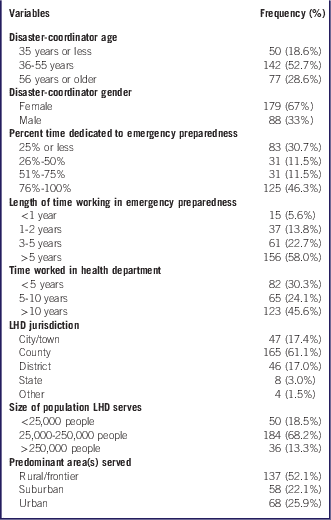
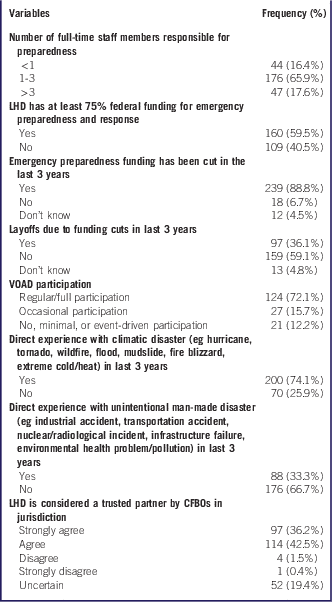
Three categories of independent variables were used to predict the disaster preparedness coordinators’ perceptions of successful partnership activities: individual, contextual, and organizational capacity factors. A list of measures describing the individual disaster coordinator and contextual factors related to the LHD is provided in Table 1. LHD organizational capacity measures are listed in Table 2.
Sample Characteristics of Disaster Preparedness Coordinators and Local Health Departments (LHDs) (n=273)

Local Health Department (LHD) Characteristics Related to Disaster Preparedness and Response (n=273)

Abbreviations: VOAD, Voluntary Organizations Active in Disaster; CFBO, Community- or Faith-Based Organizations.
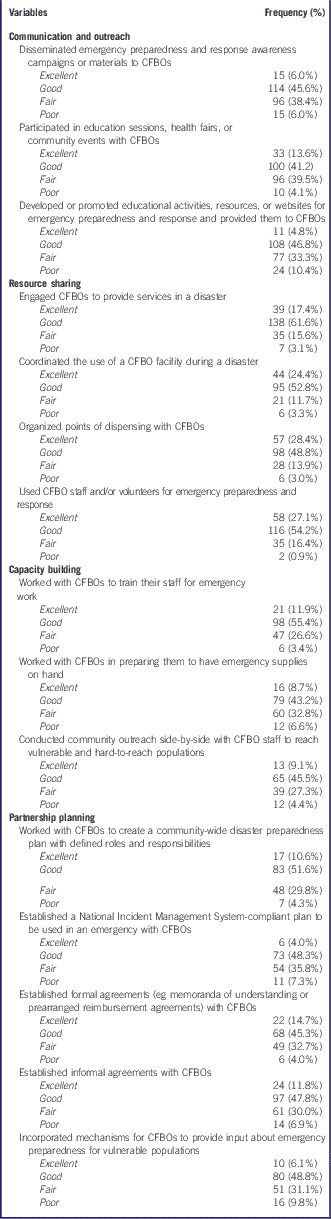
The survey first assessed whether the LHD’s disaster preparedness program had engaged in a specific collaborative activity. This was enquired from the perspective of the disaster preparedness coordinator, as it is their role to coordinate the LHD’s preparedness activities, including those that support functional partnerships with community organizations. Coordinators indicating that they had participated in such an activity were then asked “how would you rate the success of this activity.” Success was rated using a Likert response scale that ranged from “excellent” to “poor”. The activities were based on a previous analysis of the study data, which identified 4 dimensions of LHD-CFBO partnerships and tested them for construct validity and inter-item reliability.Reference Glik, Eisenman and Donatello 29 A full list of the measures in each dimension can be found in Table 3.
Rating of LHD-CFBO Partnership-Building Activities (n=273)

Abbreviations: LHD, Local Health Department; CFBO, Community- or Faith-Based Organizations.
Statistical Analysis
Our aim was to assess the relationships between characteristics of the LHDs and their experience with the 4 types of partnership activities (communication and outreach, resource sharing, capacity building, and partnership planning). We first calculated frequency distributions of the independent and dependent variables. Composite scores were then derived for the 4 types of partnership activities by summing the values for each dimension (1=Poor, 2=Fair, 3=Good, 4=Excellent). We then calculated the mean scores across items that comprised each dimension so they could be treated as outcome variables in multiple linear regression models. We ran separate regression models for each of these outcomes using SAS® 9.3 PROC MIXED. Missing data were addressed using multiple imputation methods with PROC MI and PROC MIANALYZE. Each model was initially specified using all LHD measures, as we did not outline a priori hypotheses about which variables would be associated with which partnership dimensions. To ensure parsimonious models, we used a stepwise covariate-selection procedure, allowing variables to enter the model when P≤0.05 and to remain in the model as long as P<0.1. This procedure specified the predictors remaining in each of the final models.
RESULTS
Survey data were collected from 273 respondents from a sample of 654 disaster preparedness coordinators (response rate=42%). Overall, 19% of the disaster coordinators were from small LHDs (<25,000 people served), 68% from medium-sized LHDs (25,000-250,000 people served), and 13% were from larger LHDs (>250,000 people served). The majority of LHDs had a county jurisdiction (61.1%) and were located in an urban area (53.3%). Approximately 58% of those surveyed worked more than half time in emergency and disaster preparedness, 58% worked in emergency and disaster preparedness for greater than 5 years, and 46% of respondents worked in a public health department for more than 10 years. Women made up 67% of the sample and 53% of sample respondents were between 36 and 55 years of age (Table 1).
Most of the responding health departments (65.9%) had 1-3 full-time employees working in emergency preparedness. More than half of the LHDs had received 75% or more of their emergency preparedness and response funding from a federal source, but 88.8% had experienced funding cuts in the 3 years before the survey. The majority of respondents (72.1%) had regular involvement with VOADs and agreed that the LHD was considered a trusted partner by CFBOs in their jurisdiction (42.5%). Previous experience with disasters was varied, with 74.1% having experience in dealing with a climatic disaster and 33.3% with an unintentional man-made disaster in the last 3 years (Table 2).
Ratings of partnership activities are presented in Table 3. Although the majority of disaster preparedness coordinators rated the success of communication and outreach activities as good, over one-third of respondents also rated these activities as fair. The lowest rating was for “developed or promoted educational activities, resources, or website for emergency preparedness and response and provided them to CFBOs” with over 10% of coordinators rating this activity as poor. The success of capacity-building activities was also mostly rated as good, followed by a rating of fair. The most successful capacity-building activity was “worked with CFBOs to train their staff for emergency work” with over two-thirds of respondents rating this activity as either excellent or good. Resource sharing was generally more successful than the other types of activities, with over a quarter of respondents rating both “organized points of dispensing with CFBOs” and “used CFBO staff and/or volunteers for emergency preparedness and response” as excellent. Partnership-planning activities were mostly rated as good. Establishing formal agreements with CFBOs was the partnership-planning activity with the greatest success, with 14.7% of coordinators rating this activity as excellent.
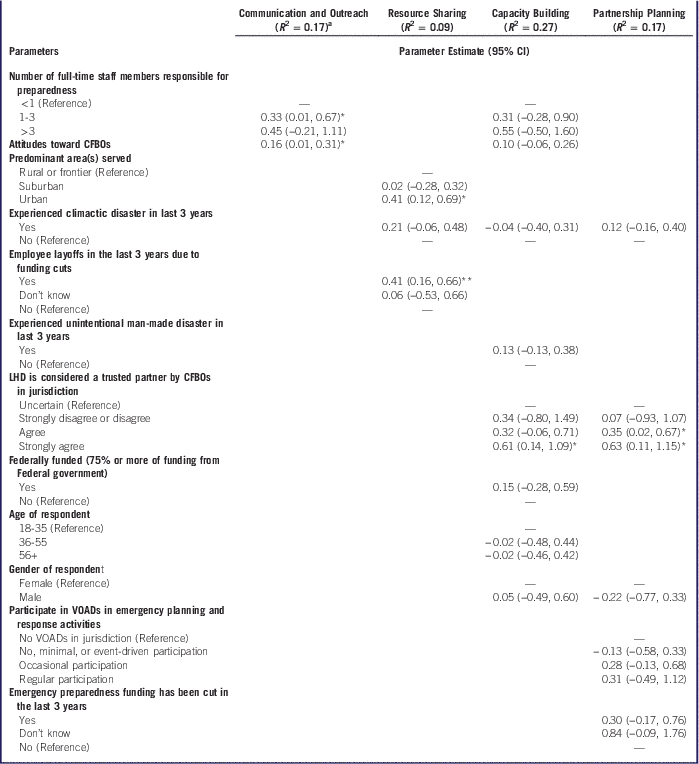
Table 4 presents results from the multiple linear regression models examining the ratings of success of 4 LHD-CFBO partnership-activity dimensions.
Multiple Linear Regression Models Examining Participation in 4 LHD-CFBO Partnership Dimensions (n=273)

Abbreviations: LHD, Local Health Department; CFBO, Community- or Faith-Based Organizations; VOADs, Voluntary Organizations Active in Disaster.
a The highest R 2 values are reported across regression models using 5 multiple-imputation data sets.
*P<0.05, **P<0.001.
Communication and Outreach
Covariates in the final model to predict communication and outreach were the number of staff members responsible for preparedness planning and attitudes toward CFBOs. Having 1-3 full-time employees was positively associated with the disaster coordinator’s perception of success in communication and outreach activities compared with organizations having less than 1 full-time employee (β=0.33, 95% CI=0.01, 0.67). However, the rating of communication and outreach for LHDs with more than 3 full-time employees was not significantly different from those with less than 1 full-time employee (β=0.45, 95% CI=−0.21, 1.11). An increase in positive attitudes toward CFBOs was significantly associated with perceptions of more successful communication and outreach (β=0.16, 95% CI=0.01, 0.31).
Resource Sharing
Covariates in the final model to predict resource sharing were the predominant geographical areas served, experience with climatic disasters, and whether there had been employee layoffs in the last 3 years due to funding cuts. Serving in an urban jurisdiction was positively associated with a higher rating of resource sharing compared with serving in rural jurisdictions (β=0.41, 95% CI=0.12, 0.69), but the rating for predominantly suburban areas was not significantly different from that for rural areas (β=0.02, 95% CI=−0.28, 0.32). LHDs that had employee layoffs in the last 3 years were significantly associated with a higher rating of resource sharing compared with those who did not have employee layoffs (β=0.41, 95% CI=0.16, 0.66).
Capacity Building
Covariates in the final model for the prediction of capacity building were the number of staff members responsible for preparedness planning, experience with climatic disasters, experience with man-made disasters, whether the disaster-preparedness coordinator considers the LHD to be a trusted partner by the CFBOs in its jurisdiction, whether the LHD receives more than 75% of its funding from the federal government, attitudes toward CFBOs, disaster-coordinator age, and disaster-coordinator gender. Only disaster coordinators who strongly agreed that their LHD was a trusted partner of CFBOs in their jurisdiction were significantly associated with a higher rating of success in capacity-building activities compared with those who were uncertain whether their LHD was trusted by CFBOs (β=0.61, 95% CI=0.14, 1.09).
Partnership Planning
Covariates in the final model to predict partnership planning were experience with climatic disasters, level of participation with VOADs in emergency planning and response activities, perceptions about the LHD being a trusted partner by CFBOs in their jurisdiction, whether emergency preparedness funding has been cut in the last 3 years, and disaster-coordinator gender. Those who agreed (β=0.35, 95% CI=0.02, 0.67) and strongly agreed (β=0.63, 95% CI=0.11, 1.15) that their LHD was a partner trusted by CFBOs in their jurisdiction were significantly associated with a higher rating for the success in partnership-planning activities in comparison with those who were uncertain whether their LHD was trusted by CFBOs.
DISCUSSION
Our results highlight important characteristics of LHD-CFBO partnerships from the perspective of disaster preparedness coordinators working at LHDs. The majority of LHDs regularly participated in disaster planning and response activities with VOADs, following FEMA recommendations for the “whole community” approach. LHD disaster coordinators predominantly rated collaborations with CFBOs as good, with generally higher ratings for resource-sharing measures. Several characteristics were also associated with respondent perceptions of successful partnerships with CFBOs. Urban jurisdictions were associated with more successful resource sharing than were rural jurisdictions. The perception of trust from local CFBOs was an important predictor of capacity-building and partnership-planning activities. Organizational characteristics such as employee layoffs and the number of full-time LHD staff responsible for emergency preparedness efforts were positively associated with successful resource sharing and communication and outreach, respectively. Disaster coordinators with positive attitudes toward CFBOs were also associated with greater ratings of communication and outreach activities. Together, these different trends can help us understand how LHDs can improve their experiences by collaborating with CFBOs and ultimately enhance their abilities to address diverse hazards and threats.
In comparison with disaster coordinators working at rural LHDs, those located in an urban location rated resource sharing higher, which includes such measures as having organized points of dispensing with CFBOs and using CFBO staff or volunteers for emergency preparedness and response. This finding is likely a reflection of the unique risks and functions of metropolitan health departments. These LHDs serve larger proportions of at-risk populations and encounter greater threats from terrorist events.Reference Plough 30 They are also directly responsible for emergency planning and coordination with hospitals, community health centers, first-responder agencies, community organizations, and ethnically and linguistically diverse populations.Reference Plough 30 Disaster preparedness coordinators working at urban LHDs may therefore participate in greater and more frequent resource sharing to address these additional needs. Further, large metropolitan public health departments are eligible for greater federal funding for emergency preparedness through CDC’s Cities Readiness Initiative. 31 This funding may facilitate resource-mobilization activities required to respond to emergencies in urban areas.
Another pattern that emerged from our analysis concerns inter-organizational trust. Believing that the LHD is trusted by local CFBOs was positively associated with disaster-coordinator experiences with capacity building and partnership planning, but did not significantly predict the success of resource-sharing or communication and outreach activities. Considering the differences between these types of collaborative activities, one possible explanation is that coordinators may expect greater trust from CFBOs to engage in capacity building and partnership planning because of the higher level of involvement they entail. These activities require that CFBOs become integrated into the LHD mission as they work side-by-side with the disaster coordinator to become emergency responders, develop formal plans and agreements, and ultimately enhance the capacity to recover from disasters. Not only must LHD staff trust their partners in order to participate in these involved activities, but they must also believe that the trust is being reciprocated. On the other hand, resource-sharing and communication and outreach activities do not require the same level of integration into planning and operations. Although disseminating educational materials to CFBOs and promoting shared resources furthers the mission of the LHD, these activities require less involvement from partners and may not demand such a high level of trust from CFBOs. A higher rating of CFBO trust may therefore only enhance the success of more involved, give-and-take collaborations.
Our results suggest that structural factors within LHDs, such as those related to staff capacity, play a more dominant role in the less-involved activities encompassed in the resource-sharing and communication and outreach dimensions. Employee layoffs enhanced the rating of resource-sharing activities, which may result from disaster preparedness coordinators recognizing the importance of continued reliance on CFBO members to fill the roles that their program’s limited staff cannot address. Having 1-3 full-time LHD staff also improved communication and outreach in comparison with those having only 1 staff member. The continued emergence of new threats—such as the Ebola and Zika viruses, or other novel hazards—requires sufficient staff capacity to communicate up-to-date information to CFBOs. Past research supports our finding that adequate staffing is required to engage the community in emergency preparedness and responseReference Schoch-Spana, Sell and Morhard 21 ; however, the fact that having more than three staff members was non-significant suggests that there is a limit to its effectiveness. It is possible that having too many points of contact can strain communication with CFBOs, though further research is needed.
In addition to having sufficient staff, positive attitudes toward CFBOs was associated with greater ratings of communication and outreach activities. This dimension measures regular interactions between the disaster preparedness coordinator and community organizations, which is why positive valuation of partners is critical for sustaining relationships. Unfortunately, many LHDs face challenges in maintaining communication and outreach because of limited resources, which can place a strain on overworked staff. Federal PHEP grants have been declining in recent years, further stretching the thin resources of LHDs.Reference Marquez, Patel, Raphael and Morgenthau 32 - 34 Rather than hiring additional staff to keep up with communication and outreach, another way to enhance disaster-coordinator attitudes toward CFBOs is to establish formal partnership plans and policies. These plans can assume the form of partnership programs that centralize and oversee partnerships for an entire organization with little need for additional resources. In their best form, these programs are furnished with visible leadership, equipped with strategies to reduce barriers, and versed in best practices. Previous research supports the use of these programs by demonstrating that having formal policies to engage the community enhances community-based partnerships.Reference Schoch-Spana, Selck and Goldberg 22
Despite the evidence supporting LHD-CFBO partnerships for disaster preparedness and response, LHDs possess limited guidance or evidence-based experience on how to successfully engage in different types of collaborations. Our results highlight important facilitators of successful community partnerships from the perspective of disaster preparedness coordinators who work with CFBOs. Believing that the LHD is trusted by CFBOs was an important predictor of capacity building and partnership planning. These two dimensions require close contact between disaster coordinators and CFBOs, as community partners become highly integrated into emergency planning efforts. These partnerships are thus better suited to respond to large-scale emergencies, such as natural disasters that create damage to local infrastructure. Characteristics related to the LHD’s structure and organization, on the other hand, were important for resource sharing and communication and outreach, partnership dimensions that are less involved but easier to engage in more quickly. Quick dissemination of information and materials to respond to novel threats such as emerging pandemics may therefore benefit from hiring additional full-time staff.
Federal mandates have evolved to emphasize community partnership approaches to disaster preparedness and response. LHDs are responsible for planning and implementing these approaches and our results highlight important facilitators. Partnership planning and capacity building are the two dimensions that best overlap with specific PHEP performance measures related to the “whole community” approach. For instance, PHEP emphasizes the need to integrate community partners into the jurisdiction’s emergency plans with defined community roles and responsibilities. This measure coincides with several activities included in the partnership-planning dimension. Training CFBO staff and conducting community outreach with them to reach vulnerable populations, two activities included in the capacity-building dimension, also overlap with the PHEP performance measure to “identify and engage with public and private community partners who can assist with the mitigation of identified health risks.” 17 Given that CFBO trust is positively associated with these two dimensions, disaster coordinators and other LHD staff should focus on building trust within the community in order to enhance partnership activities that are tied to federal funding. Although other organizational factors are important, especially to quick responses to emerging threats, they may not be as relevant to the community-engagement measures mandated by CDC funding.
Limitations
There are several limitations that must be addressed. First, there was a less-than-optimal survey response rate, which was due in part to the challenges of identifying disaster-preparedness coordinators in health departments.Reference Sammartinova, Glik, Prelip, Stajura, Martel and Eisenman 35 However, our final study sample did reflect the national jurisdiction size distribution, with most of the sample from small or medium jurisdictions. 1 Second, when asking participants to rate the success of the different collaborative activities, we did not specify whether this rating was related to the process or outcome associated with the activity. Respondents may have therefore answered differently depending on their subjective understanding of success, contributing to measurement error of our outcome variables. Third, we only enquired about the ratings of partnership activities from the perspective of disaster preparedness coordinators. Although coordinators are primarily responsible for leading coordination efforts with community organizations, they are not the only LHD staff who work closely with community organizations for disaster preparedness. Their impressions of successful collaborations may therefore be biased, especially assuming their leadership role and level of involvement in these activities. It would have also been helpful to examine these from the perspective of CFBOs so that we could obtain a more balanced understanding of these partnerships. For instance, results from a qualitative study examining perceptions from various CFBOs across the United States found that local organizations place greater value on access to LHD staff, trust, and respect when building partnerships rather than on discrete resources such as funding, supplies, and facilities.Reference Stajura, Glik, Eisenman, Prelip, Martel and Sammartinova 36 Finally, we did not include many questions about disaster drills and exercises, which are important contributors to community resilience and could have expanded our dimensions.
CONCLUSIONS
Research and US policy documents support the increasing role of CFBOs in disaster preparedness and response. Our study highlights factors that facilitate different collaborative activities between disaster preparedness coordinators working at LHDs and CFBOs. Inter-organizational trust was an important predictor of capacity building and partnership planning, the two dimensions that require CFBOs to become highly integrated into the LHDs emergency planning efforts and are thus better suited to respond to large-scale emergencies. Structural factors related to staff capacity are more salient in addressing new threats by allowing quick dissemination of information and resources. The capacity-building and partnership-planning dimensions also coincide with specific PHEP performance measures, suggesting that federally funded programs would benefit from enhanced trust within the community. These findings can be utilized by LHDs to improve disaster preparedness and response capacity.
Acknowledgments
The authors thank the staff at the UCLA Center for Public Health and Disasters.
Funding
This work was supported by a Preparedness and Emergency Response Research grant no. 1P01TP00030301 from the Centers for Disease Control and Prevention (CDC).
Disclaimer
The findings and conclusions in this article are those of the authors and do not necessarily represent the official position of CDC.
Human Participant Protection
The work described in this article was approved by the Institutional Review Board of the University of California Los Angeles.