Generally, feed intake accounts for the highest portion of milk production cost, and feed efficiency has a noticeable effect on profitability of lactating dairy cows. Thus, increasing biological efficiency for converting feed to milk should be an important goal for the dairy industry and breeding programmes, either by direct and indirect phenotypic selection (Zamani et al. Reference Zamani, Miraei-Ashtiani and Mohammadi2008) or estimates of genomic breeding values (Khansefid et al. Reference Khansefid, Pryce, Bolormaa, Miller, Wang, Li and Goddard2014). Several criteria have been proposed to measure feed efficiency in lactating dairy cows (Zamani, Reference Zamani and Chaiyabutr2012). The proposed criteria may have some advantages and disadvantages.
Feed conversion ratio (FCR) is defined as dry matter intake (DMI) over milk yield (MY) ratio, where a lower FCR means a higher efficiency. Gross milk efficiency (GME) is reverse of the FCR and can be described as MY to DMI ratio where a more efficient cow would have a higher GME.
The FCR and GME could be calculated simply, but these criteria encounter some major problems. Feed composition and milk yield contents are ignored in FCR and GME. For example, a more concentrated feed will result in lower FCR and higher GME and thus, a higher efficiency of lactation. Likewise, other requirements, mainly maintenance, body weight change and pregnancy are also ignored in FCR and GME. Use of a main feed component for expression of the cow's efficiency is another way to overcome these problems.
Energetic efficiency is commonly used to measure biological efficiency in farm animals, especially dairy cows, because energy is the most limiting feed component and is closely related to milk production level (Zamani, Reference Zamani and Chaiyabutr2012). Moreover, important feed components such as carbohydrates, fats and proteins are different forms of energy and are accounted for in energetic efficiency. Gross energy efficiency, net energy efficiency and residual feed intake are well-known measures of energetic efficiency.
Gross energy efficiency (GEE) is portion of a given category of energy intake recovered in milk (Brody, Reference Brody1945). The GEE does not account for other energy uses such as maintenance, pregnancy and the energy supplied or reserved by body weight change. For example, negative energy balance at early stages of lactation supplies a considerable amount of energy from body reserves and the cow will have a higher GEE and vice versa in late lactation. The disadvantage of GEE could be eliminated by another criterion, called net energy efficiency (NEE). The NEE is defined as the ratio of the milk energy to the available portion of energy intake used for milk production over maintenance requirements (Brody, Reference Brody1945; Buttazzoni & Mao, Reference Buttazzoni and Mao1989; Miraei-Ashtiani et al. Reference Miraei-Ashtiani, Zamani, Nik-Khah, Moradi-Shahrbabak, Naserian and Akbari2005).
FCR, GME, GEE and NEE are ratio measures and are likely to have some statistical problems including increase of error variance as a proportion of total variance and high phenotypic and genetic correlations with milk yield (Wang et al. Reference Wang, Roy, Lee, McAllister, Batra, Lin, Vesely, Wauthy and Winter1992).
Residual feed intake (RFI) or residual energy intake (REI) is another measure of energetic efficiency and simply defined as the difference between actual and expected energy intakes. Expected energy intake could be obtained based on either average trajectory of the population or the published energy requirements of lactating dairy cows such as National Research Council (2001). Generally, a more efficient animal uses a higher proportion of energy intake for lactation and thus would have a negative REI. The RFI or REI was first proposed by Koch et al. (Reference Koch, Swiger, Chambers and Gregory1963) and was widely used in various studies such as Ngwerume & Mao (Reference Ngwerume and Mao1992), Zamani et al. (Reference Zamani, Miraei-Ashtiani and Mohammadi2008), Connor et al. (Reference Connor, Hutchison, Norman, Olson, Van Tassell, Leith and Baldwin2013), Liinamo et al. (Reference Liinamo, Mäntysaari, Lidauer and Mäntysaari2015) and so on. Residual intake was also used in protein efficiency studies (Zamani et al. Reference Zamani, Miraei-Ashtiani, Alipour, Aliarabi and Saki2011).
The REI does not have the statistical problems attributed to the ratio criteria (FCR, GME, GEE and NEE). In other words, the REI is independent of the energy kinetics components included in its derivation (Hurley et al. Reference Hurley, López-Villalobos, McParland, Kennedy, Lewis, O'Donovan, Burke and Berry2016). However, a disadvantage is still noticeable about REI. The same REI which indicates equal efficiencies, does not have equal magnitudes for animals with different levels of production or energy intake. For example, a 5 Mcal/d REI is considerable for a low producing cow but the same value would be negligible for a high producing cow, because the lower producing cow loses a higher proportion of her energy intake as REI. Thus, another measure of efficiency, without the problems attributed to the previous criteria may provide more accurate measurement of efficiency. The aim of the present study was introducing a new approach to measure energetic efficiency and comparison of its statistical properties with other measures of feed efficiency in dairy cows.
Materials and methods
Data
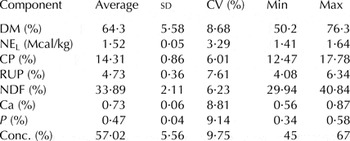
The data set was 1478 monthly records of 268 lactating Holstein cows located in two tie-stall farms. The experimental cows had ad libitum access to different total mixed rations, balanced according to National Research Council (NRC, 2001). Nutritional components of the diets are presented in Table 1. Weekly feed intake and milk yield and monthly milk composition and body weight were measured regularly. Feed intake was calculated as the difference of the feed offered and orts. Milk contents, including protein, fat and lactose were measured using an infrared milk analyser (Milko-Scan 133B, Foss Electric, Denmark).
Descriptive statistics for nutritional components of the fed diets

sd: standard deviation; CV: coefficient of variation; DM: dry matter; NEL: net energy for lactation; CP: crude protein; RUP: ruminally undegradable protein; NDF: neutral detergent fiber; Ca: calcium; P: phosphorus; Conc.: concentrate % in the ration
Measures of efficiency
Feed conversion ratio (FCR) and gross milk efficiency (GME) were calculated according to the Eqs. (1) and (2), respectively as follow:
 $${\rm FCR =} \displaystyle{{{\rm DMI}} \over {{\rm FCM}}}$$
 $${\rm GME =} \displaystyle{{{\rm FCM}} \over {{\rm DMI}}}$$
where, DMI and FCM are dry matter intake and 4% fat-corrected milk yield, respectively.
Gross energy efficiency (GEE) and net energy efficiency (NEE) were calculated based on the Eqs. (3) and (4), respectively.
 $${\rm GEE =} \displaystyle{{{\rm ECM}} \over {{\rm NEI}}}$$
 $${\rm NEE} = \displaystyle{{{\rm ECM}} \over {{\rm NEI} - {\rm NE}_{\rm m} - {\rm NE}_{{\rm preg}} - {\rm NE}_{{\rm BWC}}}} $$
where, ECM and NEI are energy contents of milk and net energy intake, respectively; NEm and NEpreg are net energy requirements for maintenance and pregnancy, respectively and NEBWC is the net energy required for or supplied by body weight change. The elements of the Eqs. (3) and (4) were estimated according to National Research Council (2001).
Residual energy intake (REI) was calculated as the difference of actual and expected net energy intakes and expected energy intakes were obtained based on average trajectory of the studied population. In other words, REI was considered as residual effects in a model fitting net energy intakes on body weight, fat corrected milk, body weight change and pregnancy stage as follow:
 $$\eqalign{ {\rm NEI} & = 17 \cdot 9886 + 0 \cdot 1079\;{\rm B}{\rm W}^{0 \cdot 75} + 0 \cdot 1041\;{\rm FCM} \cr & \quad + 0 \cdot 6496\;{\rm BWC} - 0 \cdot 2285\;{\rm PS} + {\rm REI}} $$
where, NEI is net energy intake (Mcal/d), BW, FCM, BWC and PS are body weight (kg), 4% fat corrected milk (kg/d), body weight change (kg/d) and pregnancy stage (month) and REI is residual energy intake (Mcal/d) as residual effects of the model. The model was fitted using Proc REG of SAS 9.4 (SAS Inst. Inc., Cary, NC).
To overcome the disadvantage attributed to REI (adjusting magnitude of REI for energy intake level), another criterion called proportional residual energy intake (PREI) was calculated as fallow:
 $${\rm PREI =} \displaystyle{{{\rm REI}} \over {{\rm NEI}}}$$
where, REI and NEI were residual and net energy intakes, respectively. The PREI is equivalent to the ‘percentage error’ and indicates the proportion of net energy intake lost as residual energy intake.
Statistical analyses
Descriptive statistics and simple correlation coefficients among the production traits and efficiency criteria were estimated using Proc MEANS and Proc CORR of SAS 9.4 (SAS Inst. Inc., Cary, NC), respectively. Least square means for the studied production traits and efficiency criteria were estimated fitting a linear model in which herd-year-season, lactation stage and parity were considered as independent fixed factors, using Proc GLM of SAS 9.4 (SAS Inst. Inc., Cary, NC).
Results and discussion
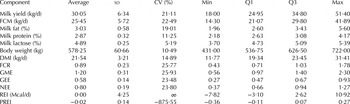
Descriptive statistics of the studied production traits and efficiency measures are presented in Table 2. Averages of production traits and DMI were in the ranges reported in previous energetic efficiency studies. Average of milk yield (30·05 kg/d) was similar to the MY level reported by Manafiazar et al. (Reference Manafiazar, McFadden, Goonewardene, Okine, Basarab, Li and Wang2013) and Ross et al. (Reference Ross, Chagunda, Topp and Ennos2015) and higher than those reported by Prendiville et al. (Reference Prendiville, Pierce, Delaby and Buckley2011), Xue et al. (Reference Xue, Yan, Ferris and Mayne2011) and Mäntysaari et al. (Reference Mäntysaari, Liinamo and Mäntysaari2012). Milk fat and protein percentages (3·03 and 2·87%, respectively) were to some extent less than those reported by Mäntysaari et al. (Reference Mäntysaari, Liinamo and Mäntysaari2012), Manafiazar et al. (Reference Manafiazar, McFadden, Goonewardene, Okine, Basarab, Li and Wang2013) and Xue et al. (Reference Xue, Yan, Ferris and Mayne2011). Milk lactose percentage (4·89%) was similar to the report of Xue et al. (Reference Xue, Yan, Ferris and Mayne2011). However, milk lactose has been rarely reported in energy efficiency studies. Average DMI (21·54 kg/d) was slightly lower than report of Connor et al. (Reference Connor, Hutchison, Norman, Olson, Van Tassell, Leith and Baldwin2013) and higher than those reported by Manafiazar et al. (Reference Manafiazar, McFadden, Goonewardene, Okine, Basarab, Li and Wang2013) and Liinamo et al. (Reference Liinamo, Mäntysaari, Lidauer and Mäntysaari2015).
Descriptive statistics for the studied production traits and efficiency criteria

sd: standard deviation; CV: coefficient of variation; Q1: first quartile; Q3: third quartile; FCM: 4% fat-corrected milk yield; DMI: dry matter intake; FCR, GME, GEE, NEE, REI and PREI: feed conversion ratio, gross milk efficiency, net energy efficiency, residual energy intake and proportional residual energy intake, respectively
Averages of REI and PREI were 0·00 ± 4·25 and −0·02 ± 0·14 respectively (Table 2). The REI range was −7·82 to 10·92 Mcal/d (Table 2). This means that net energy intake of the most efficient cow was 7·82 Mcal/d less than her predicted need but the least efficient cow consumed 10·92 Mcal more net energy than her estimated need of energy. This range was similar to the reported ranges of −6·58 to 8·64 and −7·06 to 9·93 Mcal/d by Manafiazar et al. (Reference Manafiazar, McFadden, Goonewardene, Okine, Basarab, Li and Wang2013) and Manafiazar et al. (Reference Manafiazar, Goonewardene, Miglior, Crews, Basarab, Okine and Wang2016), respectively. The observed range of REI does not provide a very informative perspective about the animal's efficiencies. For example, loss of 10·92 Mcal/d does not have the same importance for low and high producing animals. Importantly, the PREI may be more informative than the REI. For example, the observed range of PREI (−0·36 to 0·27) means that the least efficient cow lost 0·27 of her energy intake as residual energy intake, while the most efficient animal saved 0·36 of her net energy intake by her efficiency.
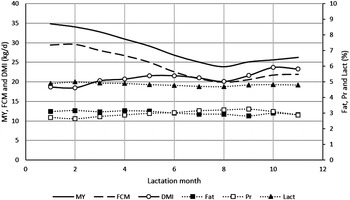
General trends of the estimated least square means for production traits and DMI are presented in the Fig. 1. Milk yield traits including MY and FCM showed a general decreasing trend, while milk components were almost constant over different stages of lactation. The cows were entered to the experiment at least 3–4 weeks after parturition, thus the MY and FCM did not show any peak point. DMI showed a general increasing trend over different stages. General trends of production traits and DMI agreed with previous studies such as Prendiville et al. (Reference Prendiville, Pierce, Delaby and Buckley2011), Mäntysaari et al. (Reference Mäntysaari, Liinamo and Mäntysaari2012) and Ross et al. (Reference Ross, Chagunda, Topp and Ennos2015).
Observed trends of least square means for milk yield (MY), fat corrected milk (FCM) and milk fat (Fat), milk protein (Pr), milk lactose (Lact) and dry matter intake (DMI) after parturition.

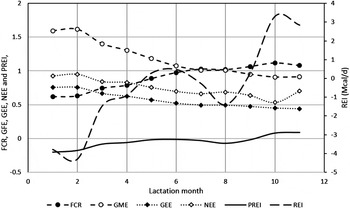
Estimated trends of least square means for the studied measures of efficiency at different lactation stages are illustrated in Fig. 2. Traditional ratio measures of efficiency (FCR, GME, GEE and NEE) and REI showed a general decrease of efficiency throughout the trajectory. General decreasing trends of NEE were also reported in Holstein, Jersey and their crossbreds (Prendiville et al. Reference Prendiville, Pierce, Delaby and Buckley2011) and, in Scotland, Holstein-Friesian cows (Ross et al. Reference Ross, Chagunda, Topp and Ennos2015). General trend of the estimated REI in different lactation stages agrees with those reported in Nordic Red dairy cows (Mäntysaari et al. Reference Mäntysaari, Liinamo and Mäntysaari2012; Liinamo et al. Reference Liinamo, Mäntysaari, Lidauer and Mäntysaari2015). Increase of efficiency was also confirmed by the trend estimated for PREI (Fig. 2).
Observed trends of least square means for efficiency measures including feed conversion ratio (FCR), gross milk efficiency (GME), gross energy efficiency (GEE), net energy efficiency (NEE), residual energy intake (REI) and proportional residual energy intake (PREI) after parturition.

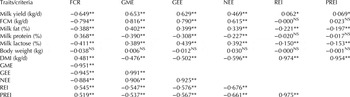
Correlation coefficients estimated among production traits, body weight, dry matter intake and different efficiency criteria are presented in Table 3. Generally, highly significant correlations were estimated among production traits and traditional ratio measures of efficiency (FCR, GME, GEE and NEE). It is well known that gross milk efficiency is highly correlated with milk yield (Blake & Custodio, Reference Blake and Custodio1984; Korver, Reference Korver1988), especially when the feed is freely offered for the animals (Connor et al. Reference Connor, Hutchison, Norman and Hill2012). This finding supports previous findings on high phenotypic and genetic correlations of conventional ratio measures, including FCR, GME, GEE and NEE milk yield (Wang et al. Reference Wang, Roy, Lee, McAllister, Batra, Lin, Vesely, Wauthy and Winter1992; Hurley et al. Reference Hurley, López-Villalobos, McParland, Kennedy, Lewis, O'Donovan, Burke and Berry2016).
Estimated correlation coefficients between production traits and efficiency criteria

FCM: fat-corrected milk yield; DMI: dry matter intake; FCR: feed conversion ratio; GME: gross milk efficiency; GEE: gross energy efficiency; NEE: net energy efficiency; REI: residual energy intake; PREI: proportional residual energy intake; NS: not significant; * and **: significant at 0·05 and 0·01 levels, respectively.
Despite traditional ratio criteria (FCR, GME, GEE and NEE), the REI and PREI had lower correlations with production traits (Table 3). The REI and PREI had low correlations with milk yield, milk fat and milk lactose which is to some extent in accordance with original definition of residual feed intake as the component of feed intake that is phenotypically independent of production (Kennedy et al. Reference Kennedy, van der Werf and Meuwissen1993; Hurley et al. Reference Hurley, López-Villalobos, McParland, Kennedy, Lewis, O'Donovan, Burke and Berry2016). However, correlations of REI with milk yield and composition traits in the present study were similar to those reported by Mäntysaari et al. (Reference Mäntysaari, Liinamo and Mäntysaari2012), Liinamo et al. (Reference Liinamo, Mäntysaari, Lidauer and Mäntysaari2015) and Hurley et al. (Reference Hurley, López-Villalobos, McParland, Kennedy, Lewis, O'Donovan, Burke and Berry2016). Despite traditional ratio criteria, the REI and PREI did not have any significant correlations with FCM and milk protein (Table 3). Low correlations of REI and PREI with production traits could be attributed to the method used to estimate REI and therefore PREI. Because the REI was estimated as residual effects in phenotypic regression of intake over production traits (Kennedy et al. Reference Kennedy, van der Werf and Meuwissen1993). The PREI is a ratio criterion but independent from production level, because its numerator (REI) is independent from production traits.
The DMI had moderate correlations with traditional ratio criteria (FCR, GME, GEE and NEE) ranging from −0·596 to 0·481 and strong correlations with REI and PREI from 0·954 to 0·974 (Table 3). Strong correlation of DMI and REI and lower correlations of DMI with other traditional efficiency criteria agrees with report of Manafiazar et al. (Reference Manafiazar, Goonewardene, Miglior, Crews, Basarab, Okine and Wang2016).
High and significant correlations were observed between all measures of feed efficiency. Whereas, common ratio criteria (FCR, GME, GEE and NEE) had higher correlations together and less correlations to REI and PREI. A high correlation was also observed between REI and PREI (Table 3). These observations showed that the PREI has statistical properties similar to REI. However, as was mentioned previously, REI shows amount of daily energy loss as Mcal/d, but the PREI indicates amount of energy loss as proportion to total energy intake, which provides a different perspective to animal efficiency. Of course, similar to RFI, animal efficiency can be measured as proportion of residual feed intake to total dry matter intake, and this criterion would be proportional to residual feed intake (PRFI).
Conclusion
The results obtained in the present study indicate that traditional ratio criteria (FCR, GME, GEE and NEE) are most likely influenced by production traits while REI and PREI were less influenced by production level. On the other hand, the PREI adjusts the REI for total intake level. The PREI could be considered as a worthwhile measure of efficiency for more studies in the future.
The authors are thankful to Education – Research farm of University of Tehran and Ravansar Dairy Farm for their kindly cooperation.